
Judge, 1921-08-20 · page 26 of 36
Judge — August 20, 1921 — page 26: what you’re looking at
What you’re looking at
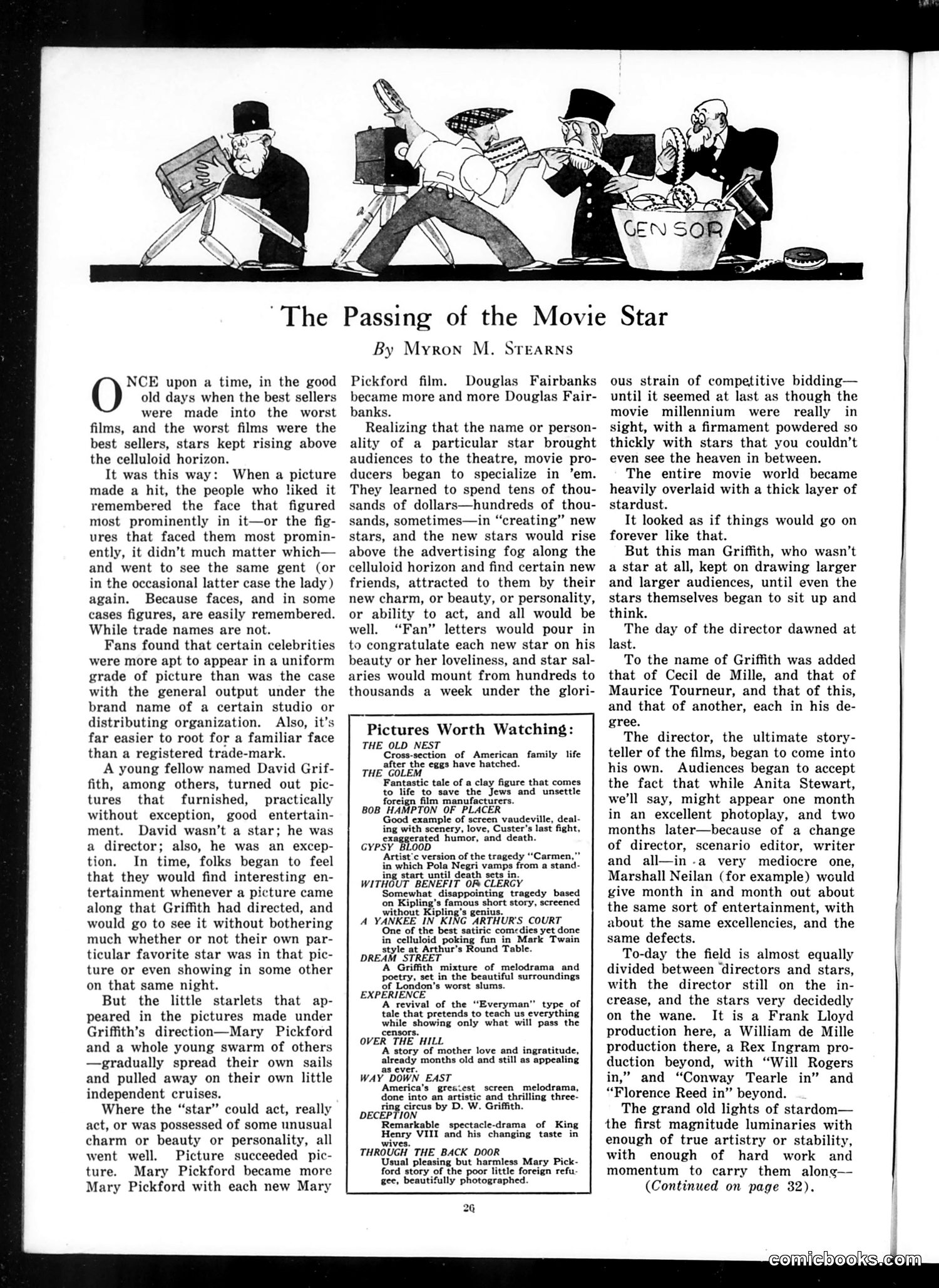
The cartoon header satirizes the film industry's machinery for creating stars. It depicts four figures on an assembly line: a director framing a shot, a cameraman filming, a censor reviewing content, and a producer in a pot—suggesting stars are manufactured products rather than discovered talents. The accompanying article by Myron M. Stearns argues that early cinema relied on recognizable *faces* rather than studio brand names to draw audiences. Director D.W. Griffith was exceptional—audiences came for *his* films specifically. However, stars like Mary Pickford and Douglas Fairbanks eventually outgrew their studios, realizing their own names held commercial value. The satire critiques how producers began "creating" stars through massive spending on publicity and marketing, treating personality and beauty as commodities. The piece suggests this industrialized star-making system represents cinema's evolution from artistic medium to pure entertainment commodity, where fan letters and salary inflation replaced genuine talent cultivation.
📄 Transcribed text from this page (OCR, searchable)
Machine-transcribed from the original scan — historical spelling and the odd misread are preserved.
old days when the best sellers were made into the worst films, and the worst films were the best sellers, stars kept rising above the celluloid horizon. It was this way: When a picture made a hit, the people who liked it remembered the face that figured most prominently in it—or the fig- ures that faced them most promin- ently, it didn’t much matter which— and went to see the same gent (or in the occasional latter case the lady) again. Because faces, and in some cases figures, are easily remembered. While trade names are not. Fans found that certain celebrities were more apt to appear in a uniform grade of picture than was the case with the general output under the brand name of a certain studio or distributing organization. Also, it’s far easier to root for a familiar face than a registered trade-mark. A young fellow named David Grif- fith, among others, turned out pic- tures that furnished, practically without exception, good entertain- ment. David wasn’t a star; he was a director; also, he was an excep- tion. In time, folks began to feel that they would find interesting en- tertainment whenever a picture came along that Griffith had directed, and would go to see it without bothering much whether or not their own par- ticular favorite star was in that pic- ture or even showing in some other on that same night. But the little starlets that ap- peared in the pictures made under Griffith’s direction—Mary Pickford and a whole young swarm of others —gradually spread their own sails and pulled away on their own little independent cruises. Where the “star” could act, really act, or was possessed of some unusual charm or beauty or personality, all went well. Picture succeeded pic- ture. Mary Pickford became more Mary Pickford with each new Mary Orn upon a time, in the good ‘The Passing of the Movie Star By Myron M. Srearns Pickford film. Douglas Fairbanks became more and more Douglas Fair- banks. Realizing that the name or person- ality of a particular star brought audiences to the theatre, movie pro- ducers began to specialize in ’em. They learned to spend tens of thou- sands of dollars—hundreds of thou- sands, sometimes—in “creating” new stars, and the new stars would rise above the advertising fog along the celluloid horizon and find certain new friends, attracted to them by their new charm, or beauty, or personality, or ability to act, and all would be well. “Fan” letters would pour in to congratulate each new star on his beauty or her loveliness, and star sal- aries would mount from hundreds to thousands a week under the glori- Pictures Worth Watching: THE OLD NEST Cross-section of American family life after the eggs have hatched. THE GOLEM Fantastic tale of a clay figure that comes to life to save the Jews and unsettle foreign film manufacturers. BOB HAMPTON OF PLACER Good example of screen vaudeville, deal- ing with scenery, love, Custer’s last fight, exaggerated humor, and death. GYPSY BLOOD Artist’c version of the tragedy “Carmen,” in which Pola Negri vamps from a stand- g start until death sets in. WITHOUT BENEFIT OP CLERGY Somewhat disappointing tragedy based on Kipling’s famous short story, screened without Kipling’s genius. A VANREE IN RING SIRTHUR'S. COURT One of the best ic comedies yet done in celluloid poking fun in Mark Twain style at Arthur's Round Table DREAM STREET A Griffith mixture of melodrama and Poetry, set in the beautiful surroundings f London's worst slums. EXPERIENCE A revival of the “Everyman” type of tale that pretends to teach us everything while showing only what will pass the censors. OVER THE HILL A story of mother love and ingratitude, already months old and still as appealing as ever. WAY DOWN EAST America’s gres‘est screen melodrama, done into an artistic and thrilling three: ring circus by D. W. Griffith. DECEPTION Remarkable spectacle-drama of King Henry VIII and his changing taste in wives. THROUGH THE BACK DOOR Usual pleasing but harmless Mary Pick- ford story of the poor little foreign refu gee, beautifully photographed. ous strain of competitive bidding— until it seemed at last as though the movie millennium were really in sight, with a firmament powdered so thickly with stars that you couldn’t even see the heaven in between. The entire movie world became heavily overlaid with a thick layer of stardust. It looked as if things would go on forever like that. But this man Griffith, who wasn’t a star at all, kept on drawing larger and larger audiences, until even the stars themselves began to sit up and think. The day of the director dawned at last. To the name of Griffith was added that of Cecil de Mille, and that of Maurice Tourneur, and that of this, and that of another, each in his de- gree. The director, the ultimate story- teller of the films, began to come into his own. Audiences began to accept the fact that while Anita Stewart, we'll say, might appear one month in an excellent photoplay, and two months later—because of a change of director, scenario editor, writer and all—in-a very mediocre one, Marshall Neilan (for example) would give month in and month out about the same sort of entertainment, with about the same excellencies, and the same defects. To-day the field is almost equally divided between ‘directors and stars, with the director still on the in- crease, and the stars very decidedly on the wane. It is a Frank Lloyd production here, a William de Mille production there, a Rex Ingram pro- duction beyond, with “Will Rogers in,” and “Conway Tearle in” and “Florence Reed in” beyond. The grand old lights of stardom— the first magnitude luminaries with enough of true artistry or stability, with enough of hard work and momentum to carry them along— (Continued on page 32).