
Judge, 1921-08-20 · page 7 of 36
Judge — August 20, 1921 — page 7: what you’re looking at
What you’re looking at
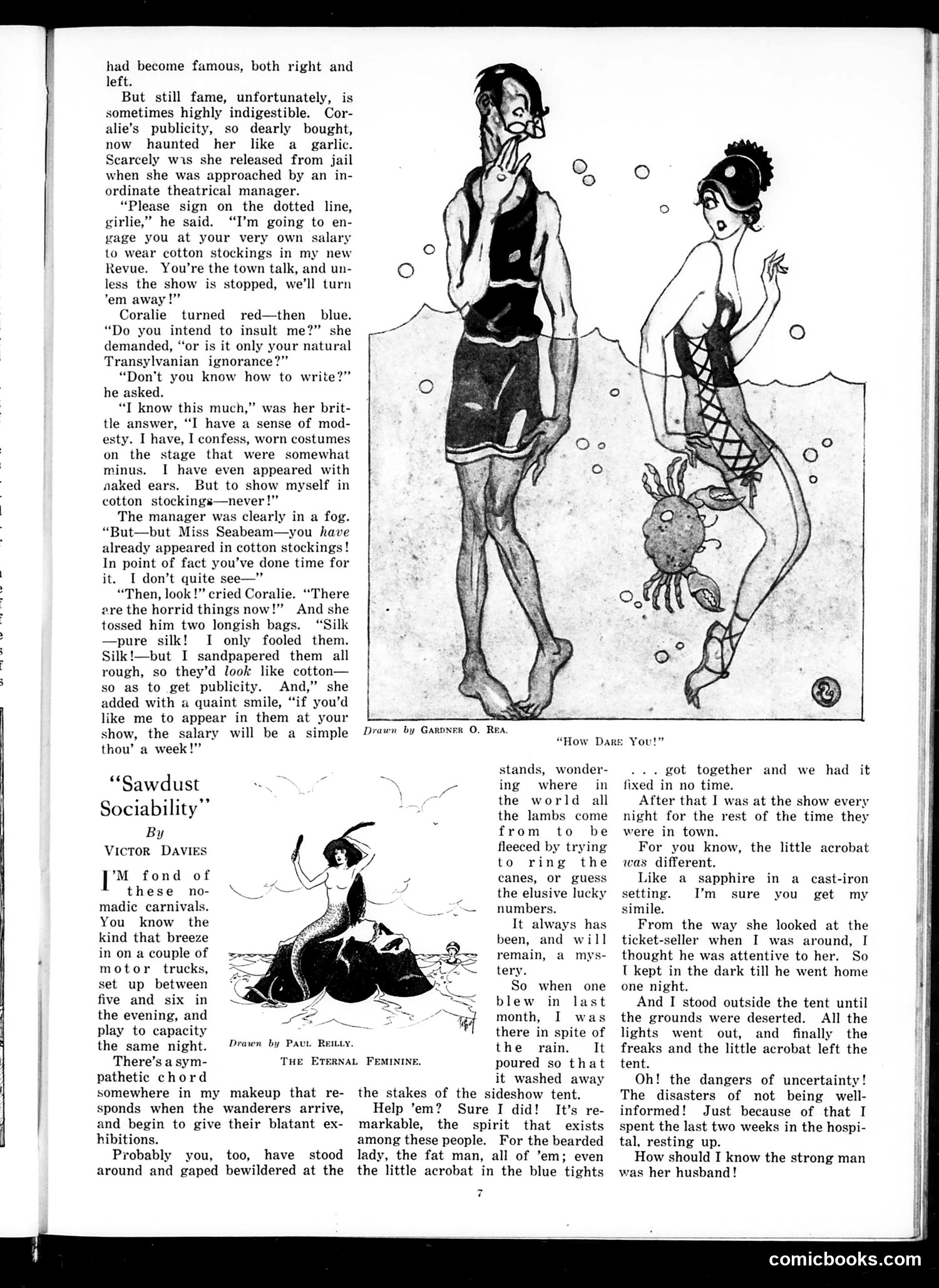
This page contains two separate humorous stories satirizing early 20th-century social pretensions and carnival life. **"How Dare You!"** (top) mocks a theatrical manager's attempt to exploit a woman named Coralie, who has recently gained notoriety (apparently from a jail sentence involving scanty costumes). When he offers her a salary to wear cotton stockings in his revue, she indignantly refuses—not because she's modest, but because she's a *fraud*. She reveals she previously appeared nearly naked while wearing sandpapered silk stockings *disguised* to look like cotton, purely for publicity. The satire targets manufactured celebrity and the absurd contradictions of show-business "respectability." **"Sawdust Sociability"** (bottom) humorously recounts a carnival encounter. The narrator helps stranded carnival performers and becomes infatuated with a young acrobat, assuming a ticket-seller is courting her. He spends two weeks in the hospital after confronting her—only to discover she's the strong man's wife. The joke targets romantic naivety and the dangers of making assumptions without proper information. Both pieces mock social pretense and human folly through exaggerated situations.
📄 Transcribed text from this page (OCR, searchable)
Machine-transcribed from the original scan — historical spelling and the odd misread are preserved.
had become famous, both right and left. But still fame, unfortunately, is sometimes highly indigestible. Cor- alie’s publicity, so dearly bought, now haunted her like a_ garlic. Searcely wis she released from jail when she was approached by an in- ordinate theatrical manager. “Please sign on the dotted line, girlie,” he said. “I’m going to en- gage you at your very own salary to wear cotton stockings in my new Revue. You’re the town talk, and un- less the show is stopped, we’ll turn ’em away !” Coralie turned red—then blue. “Do you intend to insult me?” she demanded, “or is it only your natural Transylvanian ignorance?” “Don’t you know how to write?” he asked. “I know this much,” was her brit- tle answer, “I have a sense of mod- esty. I have, I confess, worn costumes on the stage that were somewhat minus. I have even appeared with aaked ears. But to show myself in cotton stockings—never !” The manager was clearly in a fog. “But—but Miss Seabeam—you have already appeared in cotton stockings! In point of fact you’ve done time for it. I don’t quite see—” “Then, look!” cried Coralie. “There ere the horrid things now!” And she tossed him two longish bags. “Silk —pure silk! I only fooled them. Silk!—but I sandpapered them all rough, so they’d look like cotton— so as to get publicity. And,” she added with a quaint smile, “if you’d like me to appear in them at your show, the salary will be a simple thou’ a week!” “Sawdust Sociability” By VicToR DAVIES [™ fond of these no- madic carnivals. You know the kind that breeze in on a couple of motor trucks, set up between five and six in the evening, and play to capacity the same night. There’s a sym- pathetic chord somewhere in my makeup that re- sponds when the wanderers arrive, and begin to give their blatant ex- hibitions. Probably you, too, have stood around and gaped bewildered at the Drawn by Paut REILLY. THE ETERNAL FEMININE. Drawn by GarDNeR O. REA “How Dare You!” stands, wonder- a ing where in ~ the world all the lambs come from to be fleeced by trying to ring the canes, or guess the elusive lucky numbers. It always has been, and will remain, a mys- tery. So when one blew in last month, I was there in spite of the rain. It poured so that it washed away the stakes of the sideshow tent. Help ’em? Sure I did! It’s re- markable, the spirit that exists among these people. For the bearded lady, the fat man, all of ’em; even the little acrobat in the blue tights a . got together and we had it fixed in no time. After that I was at the show every night for the rest of the time they were in town. For you know, the little acrobat was different. Like a sapphire in a cast-iron setting. I’m sure you get my simile. From the way she looked at the ticket-seller when I was around, I thought he was attentive to her. So I kept in the dark till he went home one night. And I stood outside the tent until the grounds were deserted. All the lights went out, and finally the freaks and the little acrobat left the tent. Oh! the dangers of uncertainty! The disasters of not being well- informed! Just because of that I spent the last two weeks in the hospi- tal, resting up. How should I know the strong man was her husband! comicbooks.com