
Judge, 1921-08-20 · page 20 of 36
Judge — August 20, 1921 — page 20: what you’re looking at
What you’re looking at
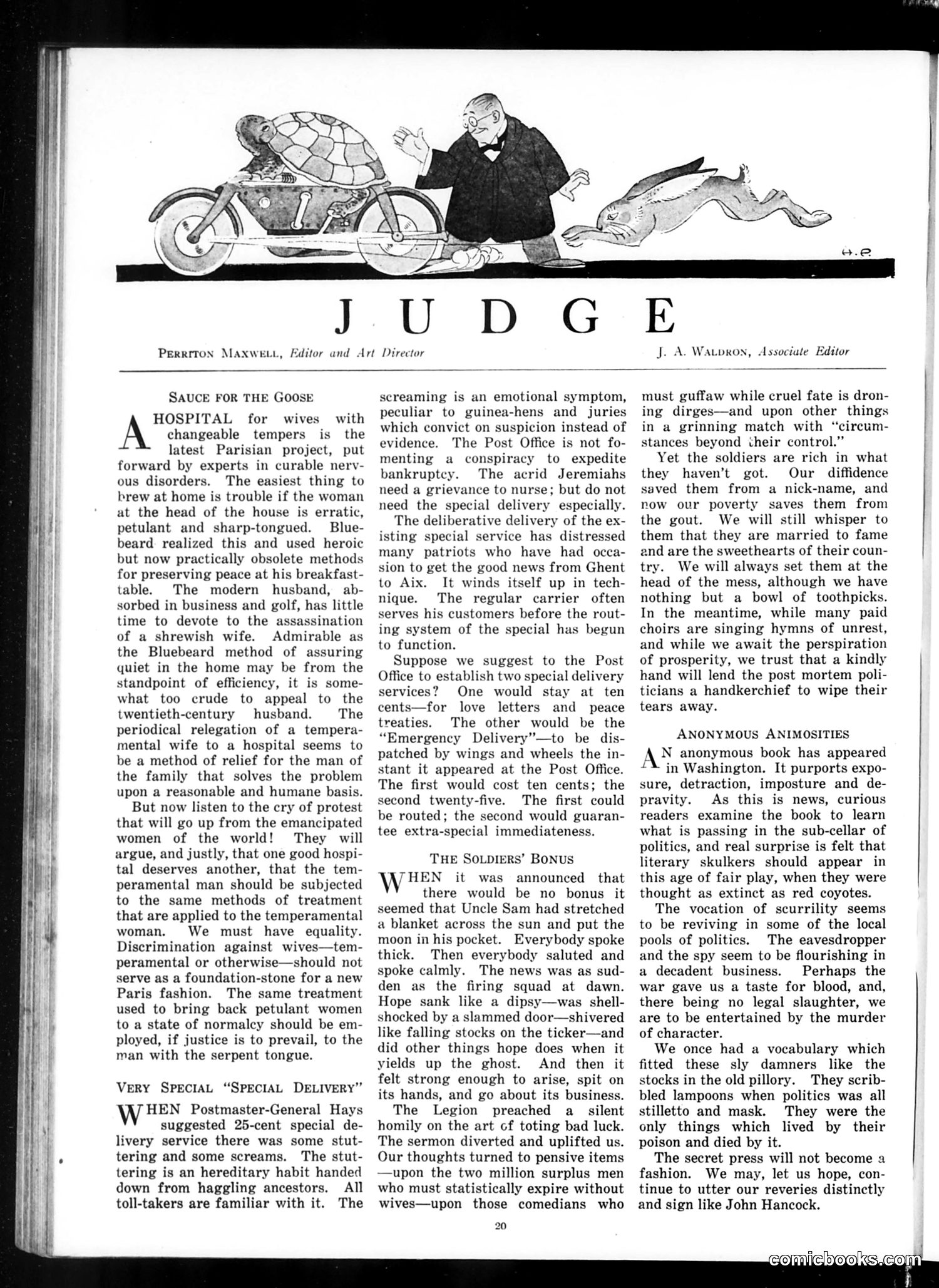
The top cartoon depicts a man in formal dress gesturing with exasperation at a motorcycle sidecar containing a turtle, while a rabbit lies on the ground. This illustrates the article "Sauce for the Goose," which satirizes a proposed Parisian hospital for wives with "changeable tempers." The joke's point: the article argues that if temperamental wives deserve hospitalization, then temperamental husbands deserve the same treatment—advocating equality in marital "discipline." The cartoon's absurd vehicles and animals likely mock this notion of managing difficult spouses. The article references the Bluebeard legend (a wife-killer) as an outdated solution to shrewish wives, positioning the modern hospital proposal as supposedly more "humane" while still treating women as problems to be solved rather than equals deserving respect. The satire targets both the Parisian idea and the underlying assumption that difficult spouses—particularly women—require institutional "correction."
📄 Transcribed text from this page (OCR, searchable)
Machine-transcribed from the original scan — historical spelling and the odd misread are preserved.
Perrrton MaAxwett, Editor and Art Director J. A. Watpron, Associate Editor SAUCE FOR THE GOOSE HOSPITAL for wives with A changeable tempers is the latest Parisian project, put forward by experts in curable nerv- ous disorders. The easiest thing to brew at home is trouble if the woman at the head of the house is erratic, petulant and sharp-tongued. Blue- beard realized this and used heroic but now practically obsolete methods for preserving peace at his breakfast- table. The modern husband, ab- sorbed in business and golf, has little time to devote to the assassination of a shrewish wife. Admirable as the Bluebeard method of assuring quiet in the home may be from the standpoint of efficiency, it is some- what too crude to appeal to the twentieth-century husband. The periodical relegation of a tempera- mental wife to a hospital seems to be a method of relief for the man of the family that solves the problem upon a reasonable and humane basis. But now listen to the cry of protest that will go up from the emancipated women of the world! They will argue, and justly, that one good hospi- tal deserves another, that the tem- peramental man should be subjected to the same methods of treatment that are applied to the temperamental woman. We must have equality. Discrimination against wives—tem- peramental or otherwise—should not serve as a foundation-stone for a new Paris fashion. The same treatment used to bring back petulant women to a state of normalcy should be em- ployed, if justice is to prevail, to the man with the serpent tongue. VeRY SPECIAL “SPECIAL DELIVERY” HEN Postmaster-General Hays suggested 25-cent special de- livery service there was some stut- tering and some screams. The stut- tering is an hereditary habit handed down from haggling ancestors. All toll-takers are familiar with it. The screaming is an emotional symptom, peculiar to guinea-hens and juries which convict on suspicion instead of evidence. The Post Office is not fo- menting a conspiracy to expedite bankruptcy. The acrid Jeremiahs need a grievance to nurse; but do not need the special delivery especially. The deliberative delivery of the ex- isting special service has distressed many patriots who have had occa- sion to get the good news from Ghent to Aix. It winds itself up in tech- nique. The regular carrier often serves his customers before the rout- ing system of the special has begun to function. Suppose we suggest to the Post Office to establish two special delivery services? One would stay at ten cents—for love letters and peace treaties. The other would be the “Emergency Delivery”’—to be dis- patched by wings and wheels the in- stant it appeared at the Post Office. The first would cost ten cents; the second twenty-five. The first could be routed; the second would guaran- tee extra-special immediateness. THE SOLpDIERS’ BONUS W HEN it was announced that there would be no bonus it seemed that Uncle Sam had stretched a blanket across the sun and put the moon in his pocket. Everybody spoke thick. Then everybody saluted and spoke calmly. The news was as sud- den as the firing squad at dawn. Hope sank like a dipsy—was shell- shocked by a slammed door—shivered like falling stocks on the ticker—and did other things hope does when it yields up the ghost. And then it felt strong enough to arise, spit on its hands, and go about its business. The Legion preached a_ silent homily on the art of toting bad luck. The sermon diverted and uplifted us. Our thoughts turned to pensive items —upon the two million surplus men who must statistically expire without wives—upon those comedians who 20 must guffaw while cruel fate is dron- ing dirges—and upon other things in a grinning match with “circum- stances beyond their control.” Yet the soldiers are rich in what they haven’t got. Our diffidence saved them from a nick-name, and now our poverty ves them from the gout. We will still whisper to them that they are married to fame and are the sweethearts of their coun- try. We will always set them at the head of the mess, although we have nothing but a bowl of toothpicks. In the meantime, while many paid choirs are singing hymns of unrest, and while we await the perspiration of prosperity, we trust that a kindly hand will lend the post mortem poli- ticians a handkerchief to wipe their tears away. ANONYMOUS ANIMOSITIES AN anonymous book has appeared +* in Washington. It purports expo- sure, detraction, imposture and de- pravity. As this is news, curious readers examine the book to learn what is passing in the sub-cellar of politics, and real surprise is felt that literary skulkers should appear in this age of fair play, when they were thought as extinct as red coyotes. The vocation of scurrility seems to be reviving in some of the local pools of politics. The eavesdropper and the spy seem to be flourishing in a decadent business. Perhaps the war gave us a taste for blood, and, there being no legal slaughter, we are to be entertained by the murder of character. We once had a vocabulary which fitted these sly damners like the stocks in the old pillory. They scrib- bled lampoons when politics was all stilletto and mask. They were the only things which lived by their poison and died by it. The secret press will not become a fashion. We may, let us hope, con- tinue to utter our reveries distinctly and sign like John Hancock.