
A complete issue · 36 pages · 1921
Judge — June 4, 1921
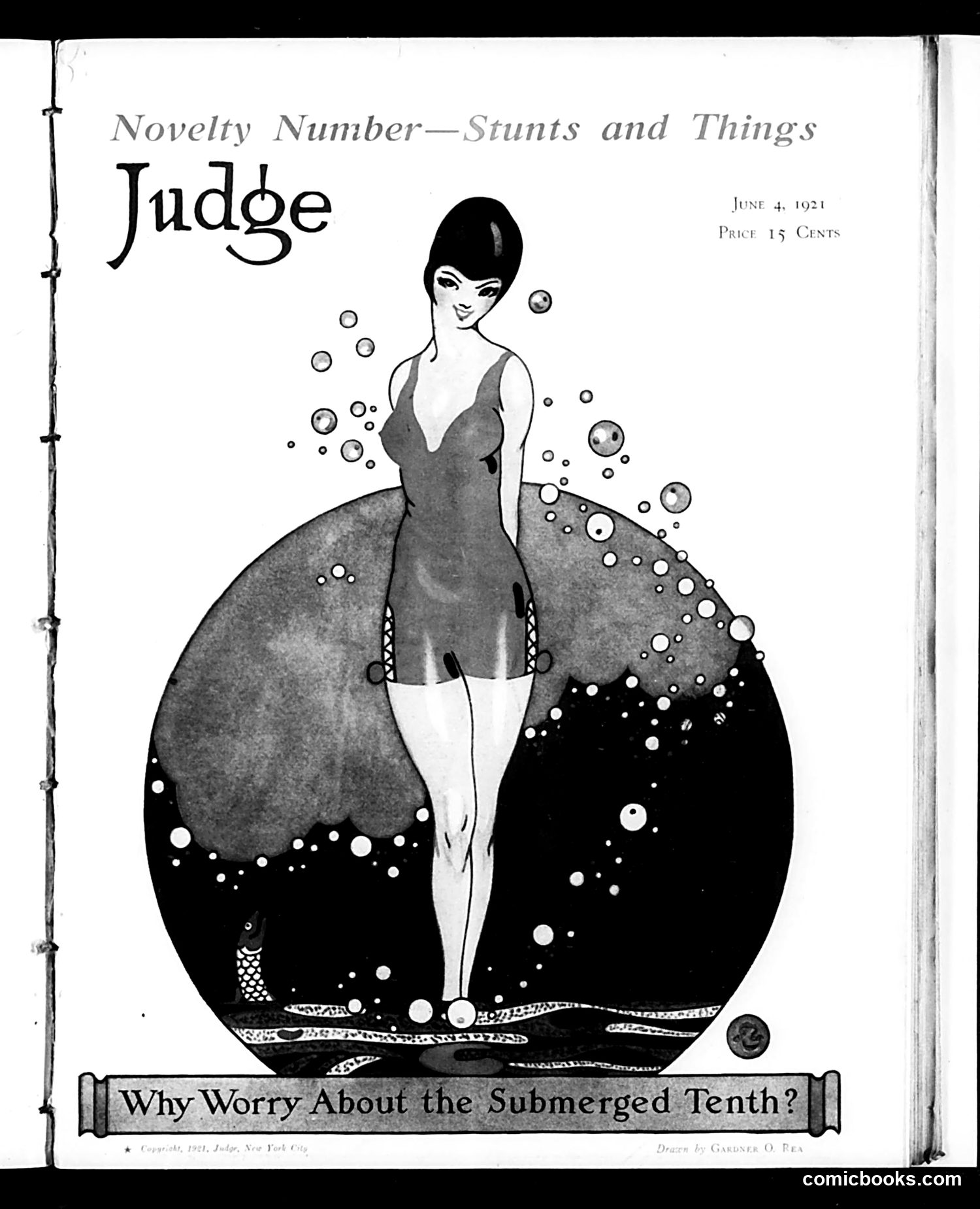
This June 1921 *Judge* magazine cover satirizes women's fashion and body anxiety. The illustration depicts a woman standing in or emerging from a large sphere, surrounded by bubbles, with the caption "Why Worry About the Submerged Tenth?" The "submerged tenth" is a sociological term referring to the poorest segment of society. Here, the satire appears to mock women's preoccupation with fashion and appearance—specifically the silhouette created by undergarments and corsets—as trivial compared to serious social problems. The bubble imagery and spherical form suggest either obesity concerns or the distorting effects of fashionable dress of the era. The joke criticizes women (or society generally) for prioritizing superficial beauty standards over substantive social welfare issues.
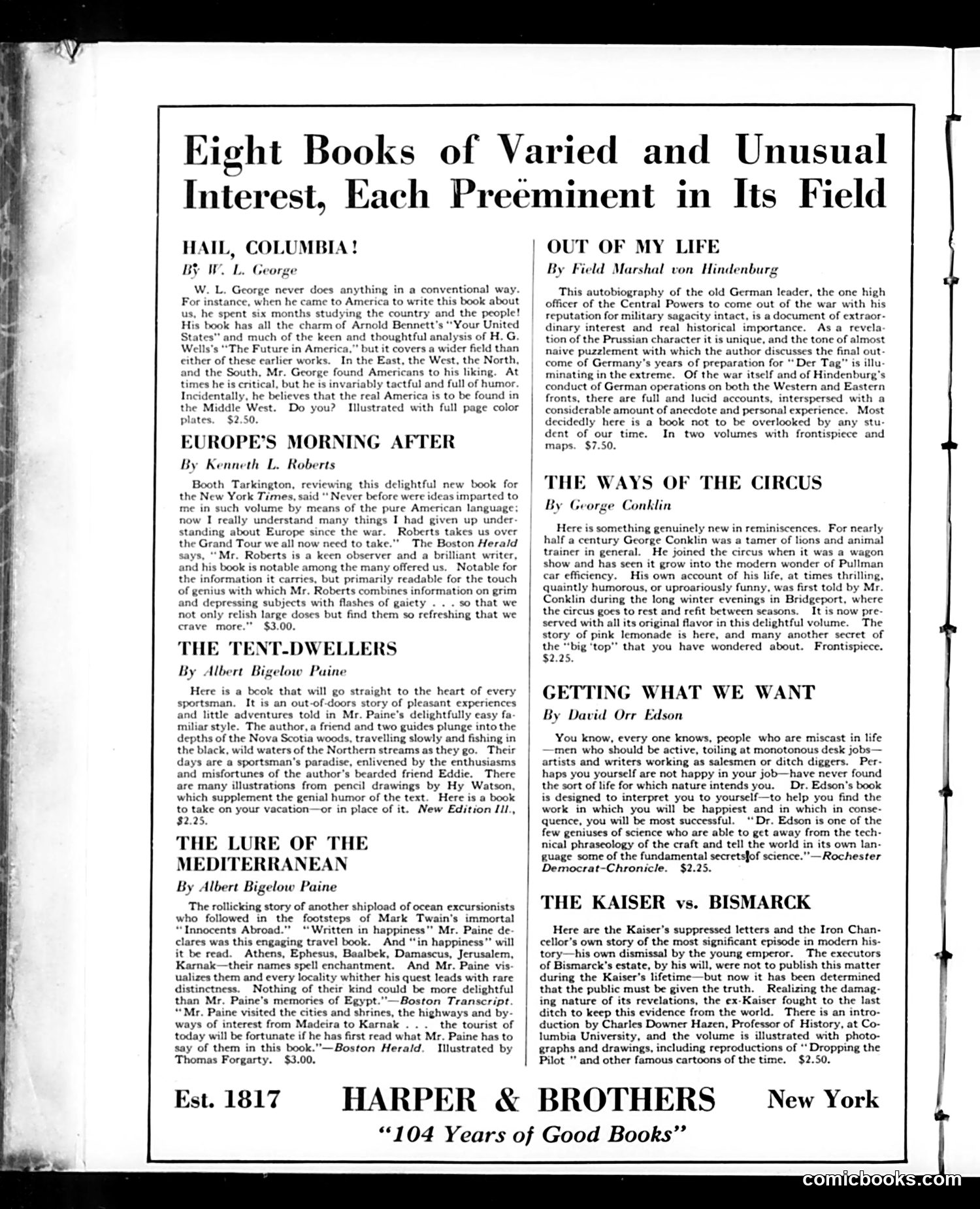
This page is primarily **advertising for Harper & Brothers publishers**, showcasing eight new books from circa 1920s. The ads emphasize each book's distinction in its field. Notable titles include: - **"Hail, Columbia!"** by W.L. George—a travel book about America - **"Out of My Life"** by Field Marshal von Hindenburg—a German WWI military autobiography - **"The Kaiser vs. Bismarck"**—featuring suppressed letters about imperial German history The page contains **no political cartoons or satire**. Instead, it reflects post-WWI American publishing interests: German military memoirs and analyses were commercially viable for American readers seeking to understand recent enemies and historical figures. The emphasis on "preëminent in its field" suggests marketing to educated, serious readers interested in contemporary history and biography rather than satire or humor.
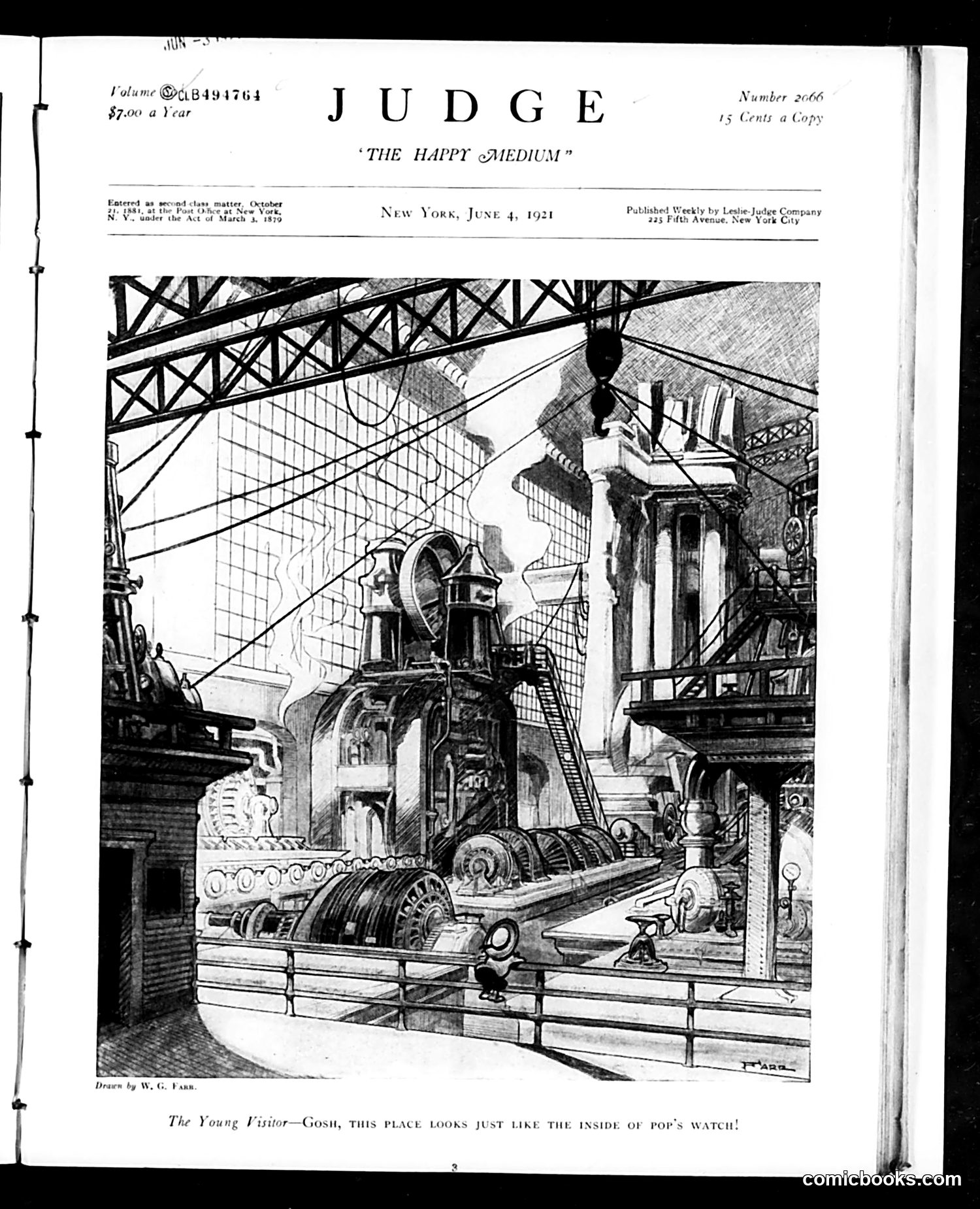
This page features an industrial illustration titled "The Young Visitor—Gosh, this place looks just like the inside of pop's watch!" The cartoon depicts a massive factory interior with complex machinery, gears, and mechanical systems viewed from an elevated platform. A small figure (the "young visitor") observes the intricate industrial apparatus, comparing it to a pocket watch's inner workings. The joke relies on the visual similarity between factory machinery and watchwork—both involve precisely coordinated mechanical components. This reflects early 1920s American fascination with industrial scale and mechanical complexity. The phrase "pop's watch" suggests the child's wonder at understanding how such intricate systems function, making sophisticated machinery relatable through everyday objects.
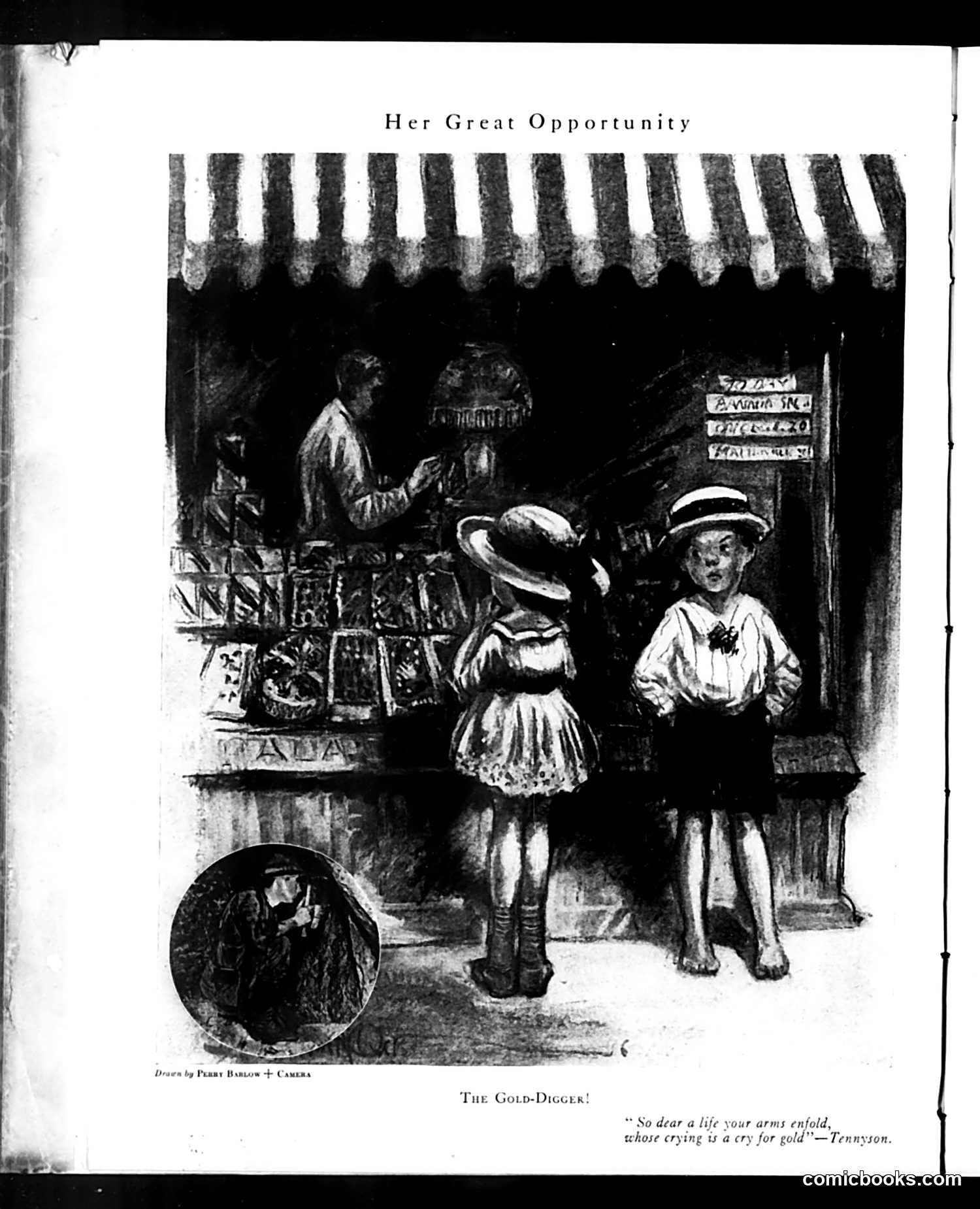
This satirical cartoon depicts two children peering into a shop window displaying jewelry and valuables. The title "The Gold-Digger" and the Tennyson quote ("So dear a life your arms enfold, / whose crying is a cry for gold") suggest social commentary on materialism and mercenary motivations in relationships. The children represent innocence contrasted with the commercial temptation of wealth visible through the shop window. The cartoon likely satirizes how economic desires—specifically the pursuit of gold or money—corrupt human relationships and values, even among the young. The "great opportunity" referenced in the header implies a cynical commentary on how financial gain motivates human behavior and choices.
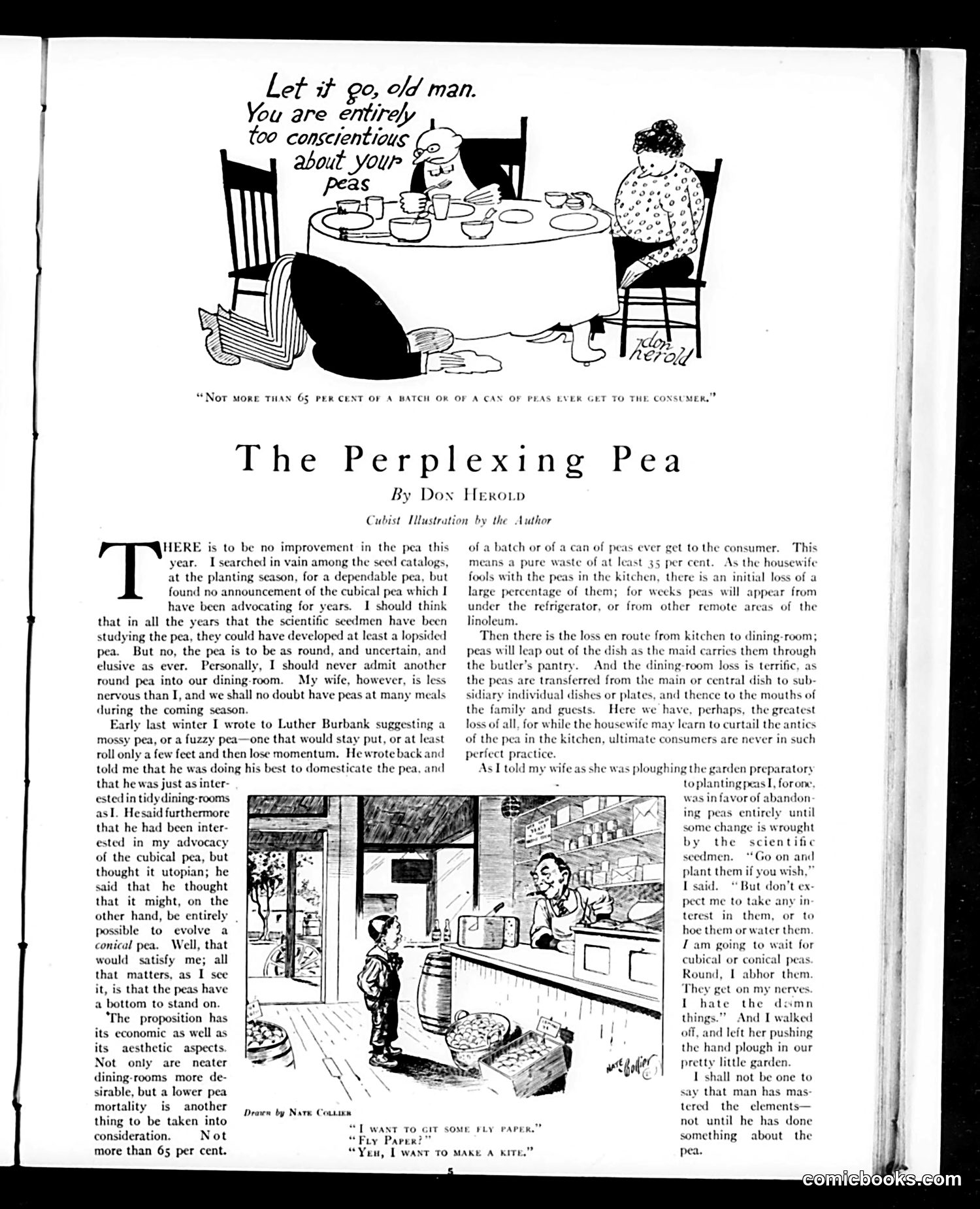
This satirical piece critiques an agricultural problem: peas that fail to survive from farm to table. The top cartoon shows a man under the dining table, addressing another diner, with the caption about peas being "too conscientious about your peas"—a joke about their tendency to escape or disappear. Herold's article humorously describes peas leaping from dishes, rolling off tables, and causing losses during kitchen preparation. He proposes developing a "control pea" that stays put—treating the problem as absurd yet real. The middle illustration shows a kitchen scene with someone dealing with this persistent issue. The satire mocks both the agricultural industry's inability to solve this problem and housewives' frustration with uncooperative vegetables. It reflects early 20th-century food waste and domestic management concerns.
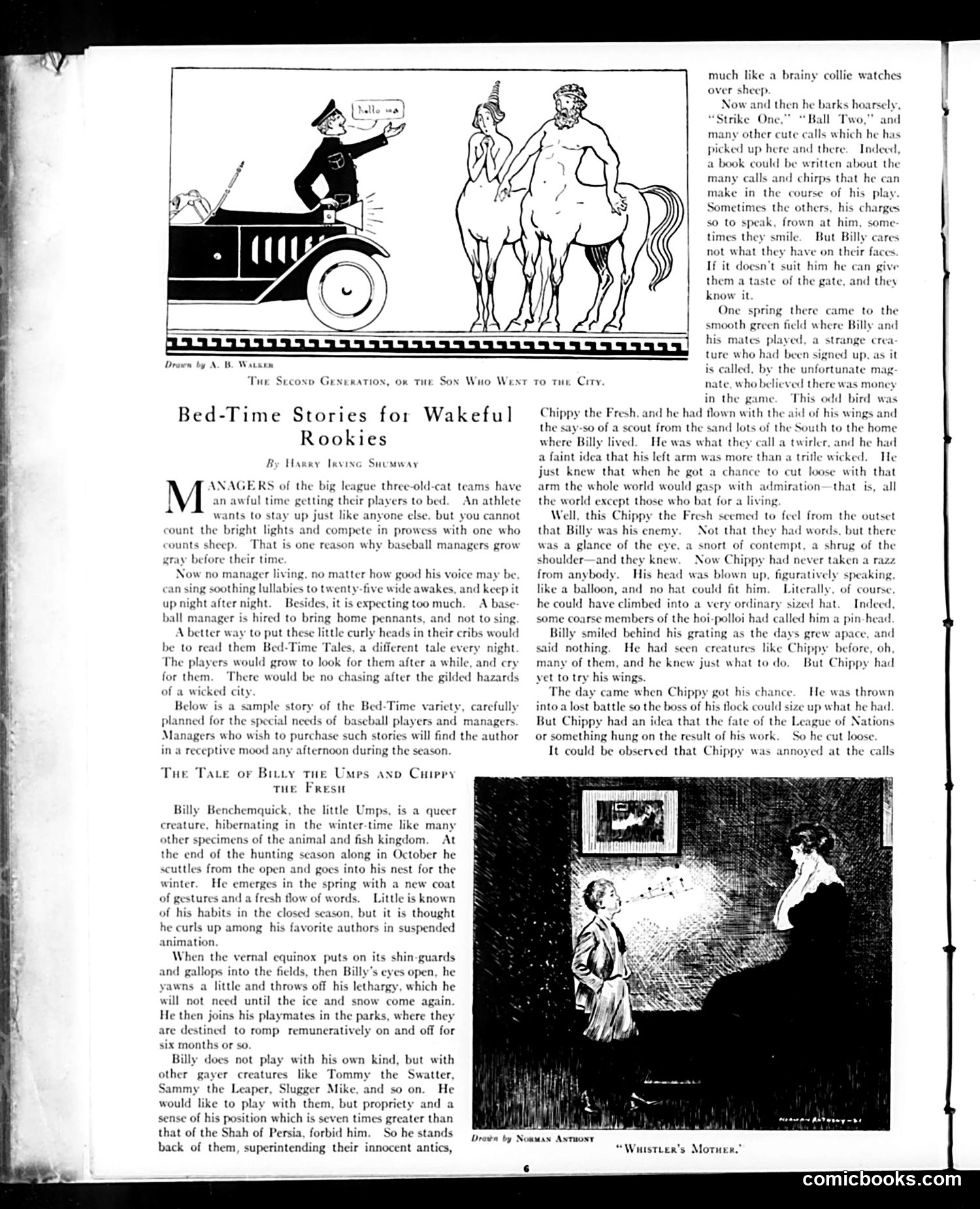
This page contains **"Bed-Time Stories for Wakeful Books,"** a humorous column by Harry Irving Shumway about baseball managers and their challenges keeping rowdy players focused. The **top cartoon** (drawn by A.B. Walker) shows "The Second Generation, or the Sons Who Went to the City"—depicting someone in a motorcar calling out to mounted riders, likely satirizing the contrast between modern urban life (automobiles) and rural/traditional pastimes (horseback riding). The "second generation" reference suggests social commentary on how younger Americans were abandoning country life for cities. The **main article** humorously describes Billy the Umps, an anthropomorphized creature inhabiting winter parks alongside other animals, using animal behavior as metaphor for baseball personalities and manager challenges. It's lighthearted sporting humor rather than political satire.
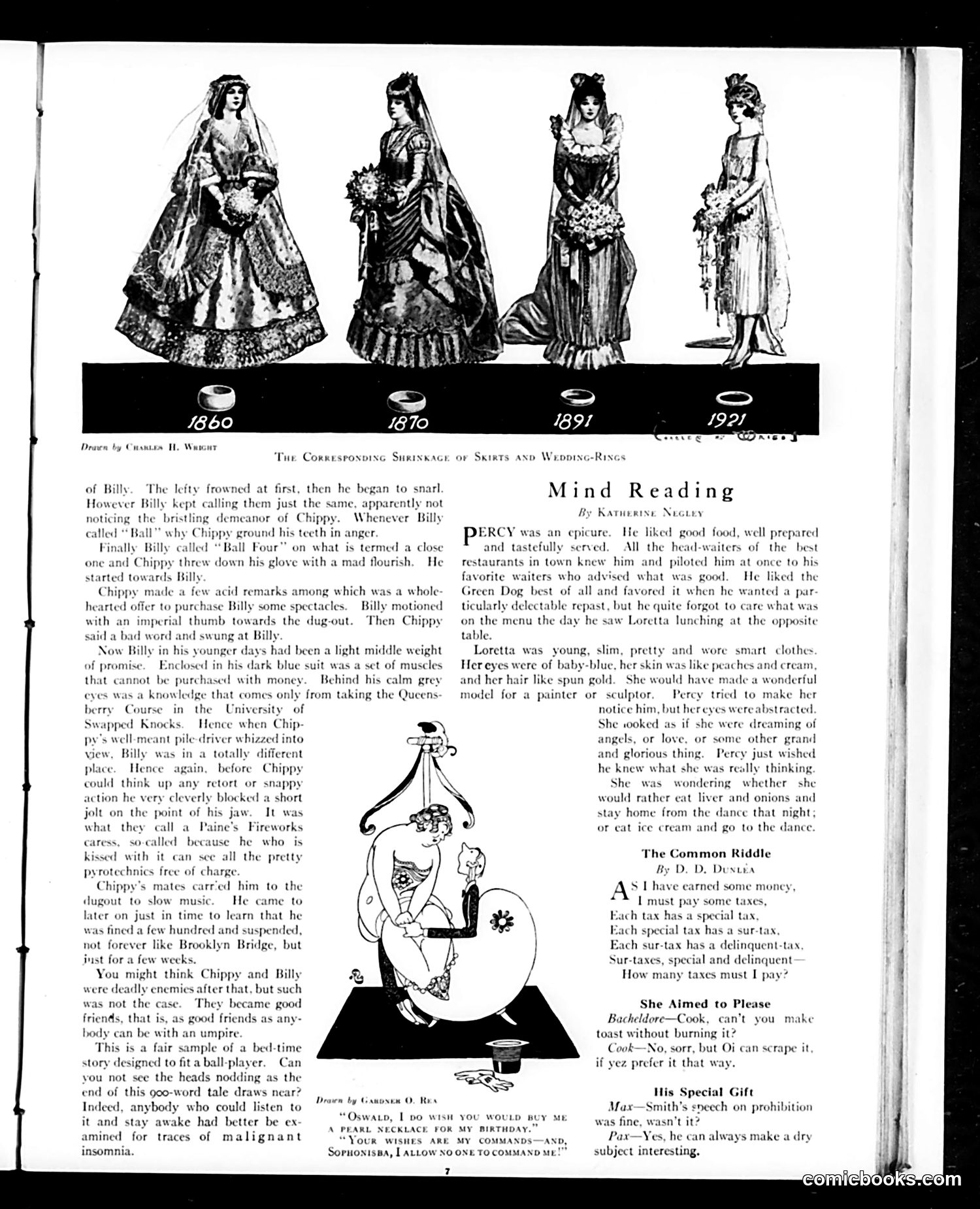
**Top Section - "The Corresponding Shrinkage of Skirts and Wedding-Rings" (1860-1921):** This is a fashion history illustration showing how women's wedding dress silhouettes changed dramatically over six decades. The progression reveals the Victorian era's enormous skirts gradually shrinking to the sleeker, shorter styles of the 1920s—satirizing how radically women's fashion transformed in this period. **Main Story - "Mind Reading":** A light romantic comedy about Percy, a wealthy epicure, who becomes infatuated with Loretta at a restaurant. The joke is that while Percy believes he's reading her mind—imagining she's thinking of romantic things—she's actually wondering whether to eat liver and onions at home or go dancing. It's satirizing male vanity and the gap between men's romantic fantasies and women's mundane practical concerns. **Additional Content:** Minor humor pieces including "The Common Riddle" (tax joke), "She Aimed to Please" (servant humor), and "His Special Gift" appear on the page, typical of Judge's mixed comedic offerings.
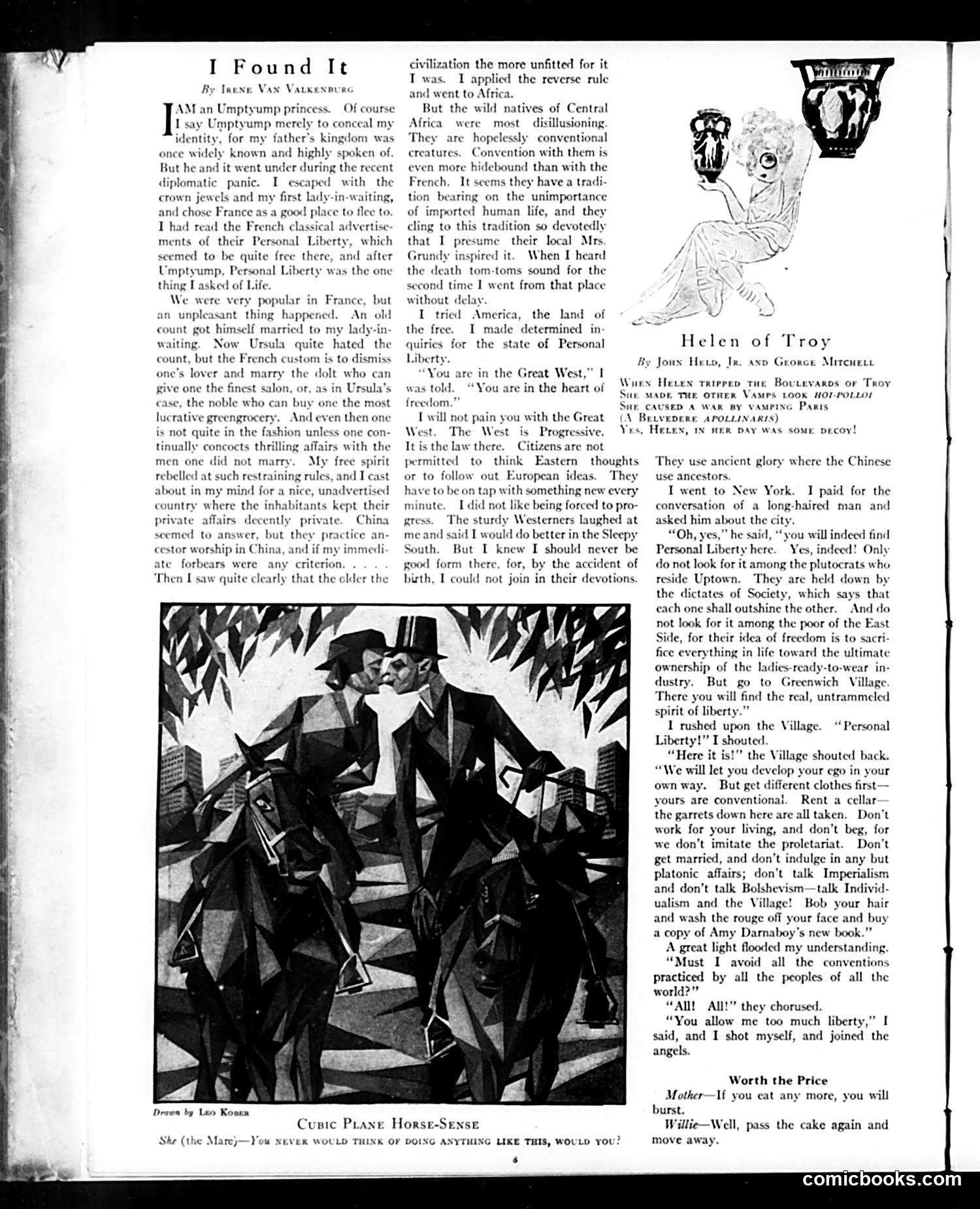
This page contains two satirical pieces mocking the concept of "Personal Liberty." **"I Found It"** (left column) is a story by Irene Van Valkenburg about an exiled princess searching the world for genuine freedom. She discovers that every society—France, Africa, America, the South, and New York's upper classes—claims to offer liberty while actually enforcing strict social conventions. The joke satirizes the hypocrisy of nations and social classes that advertise freedom while maintaining rigid, often oppressive norms. **"Helen of Troy"** (right column) is a brief humorous piece about the legendary seductress, suggesting her power lay in defying conventional beauty standards and social expectations—another angle on liberty and nonconformity. **The cartoon** shows a horse declining to do something foolish, using "common sense." It reinforces the satirical theme: true freedom isn't found in fashionable rhetoric but in practical wisdom and avoiding societal pressure to conform. Together, these pieces mock Progressive-era claims about freedom and progress while suggesting that genuine liberty remains elusive.
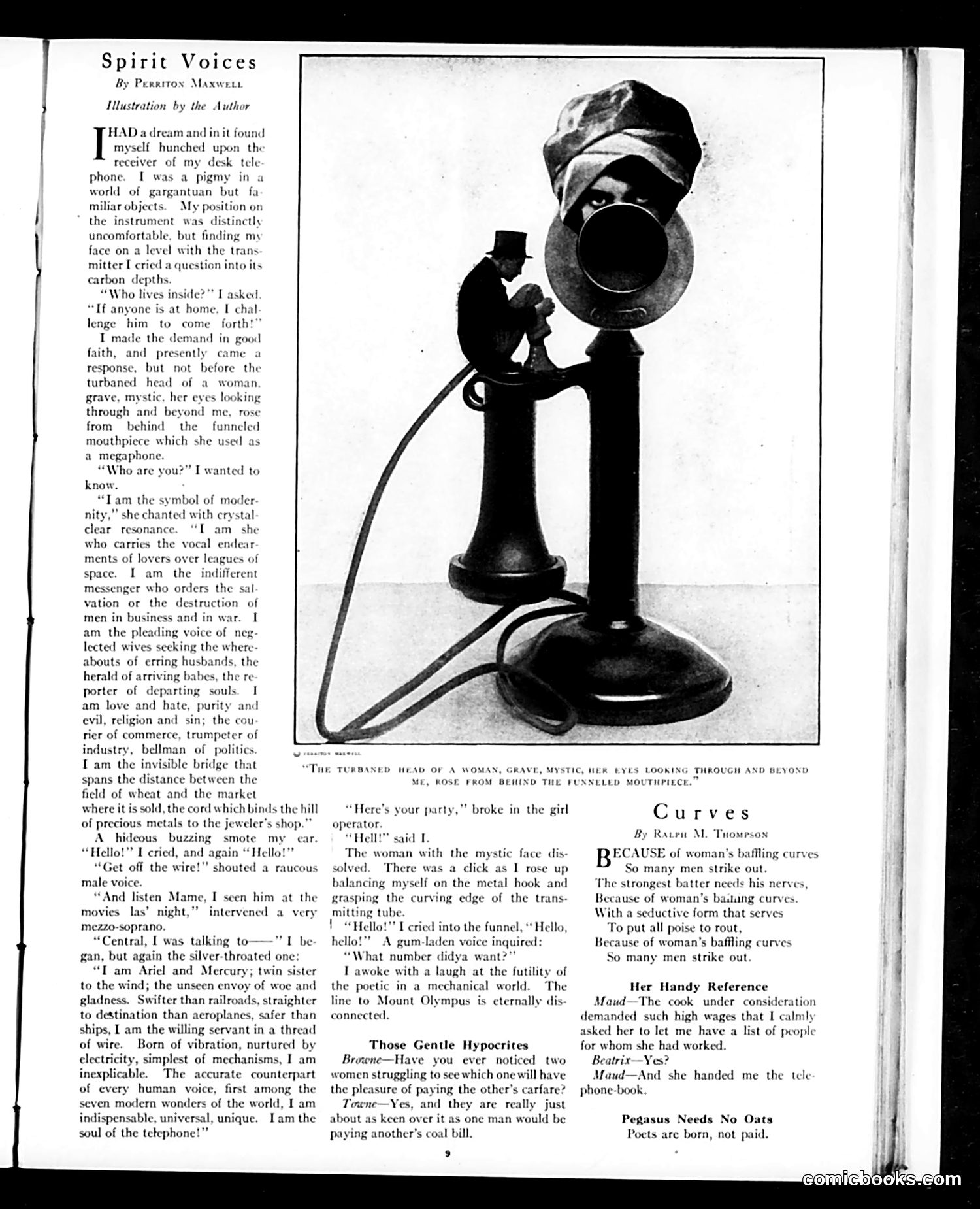
This is a whimsical satirical piece about the newly modern telephone technology. The author dreams he's tiny, perched on a telephone receiver, where a mystical, turbaned woman's head emerges from the mouthpiece claiming to be "the symbol of modernity." She delivers grandiose monologues about the telephone's importance—it carries love messages, business orders, news of births and deaths, connects commerce to farms—positioning it as almost divine ("Mount Olympus"). The satire mocks the era's breathless reverence for telephone technology as humanity's greatest achievement. The joke's punchline undercuts this romanticism: when an actual operator connects him, a gum-chewing voice asks "What number didya want?"—banal reality destroying poetic aspiration. The final line, "The line to Mount Olympus is eternally disconnected," captures the gap between technological utopianism and mundane human reality, satirizing both the technology-worship of the modern age and the disconnect between elevated ideals and everyday experience.
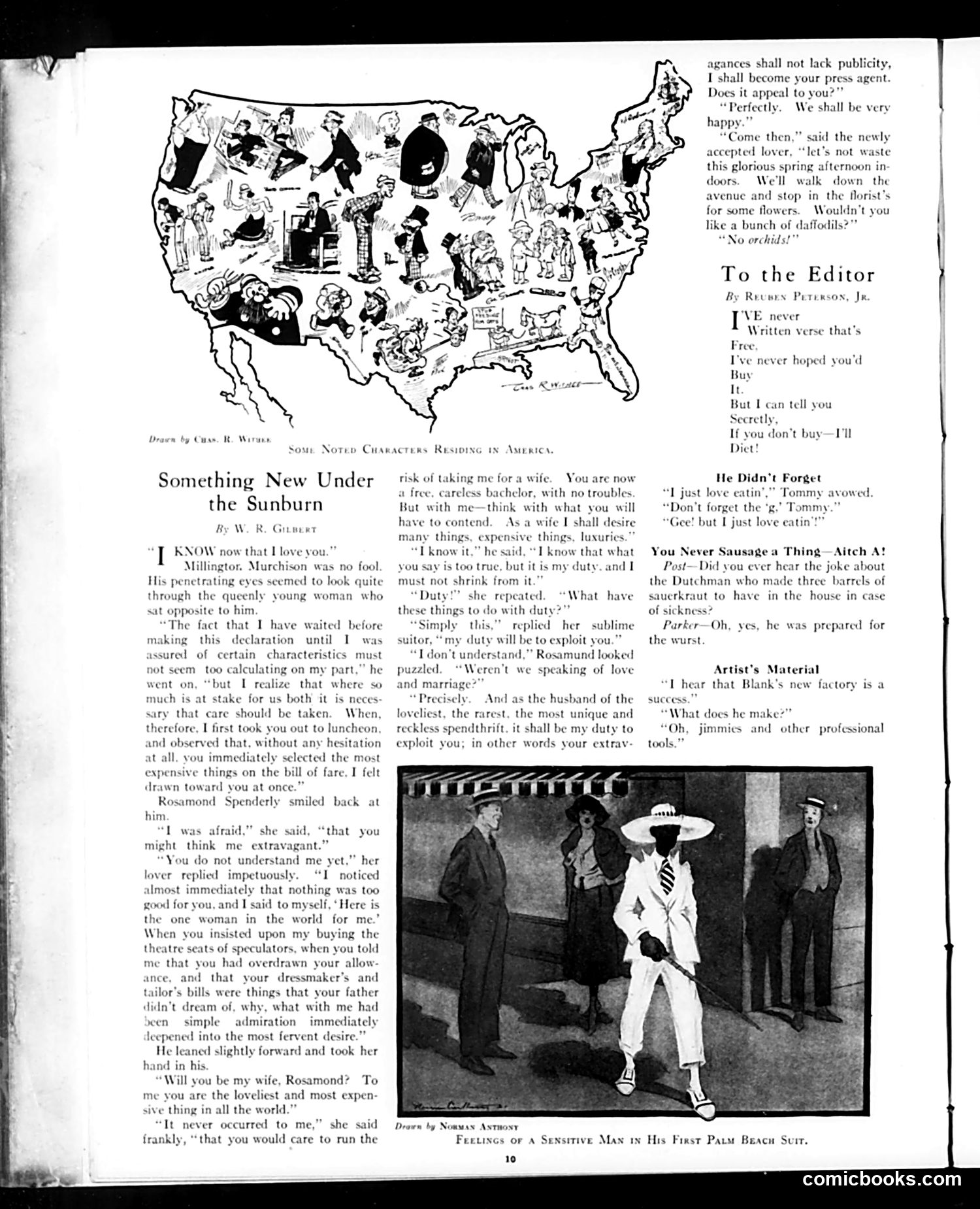
This story satirizes the mercenary nature of courtship among the wealthy. A man named Millington Murchison proposes to Rosamond Spenderly, a woman he's deliberately chosen *because* of her extravagance—her expensive tastes, overspending, and reckless financial habits. Rather than hide this mercenary motivation, he openly admits he loves her *for* being expensive. The joke's punchline: he plans to marry her solely to exploit her lavish lifestyle for *publicity*, positioning himself as her "press agent." Her extravagances will make him famous. She accepts this arrangement happily, asking for orchids instead of daffodils. The satire targets Gilded Age matrimonial practices where wealthy men sought advantageous marriages, while also mocking the conspicuous consumption culture and how publicity/notoriety could be monetized. The woman's willing participation suggests Judge's sardonic view that both parties in such arrangements are equally calculating and morally empty.
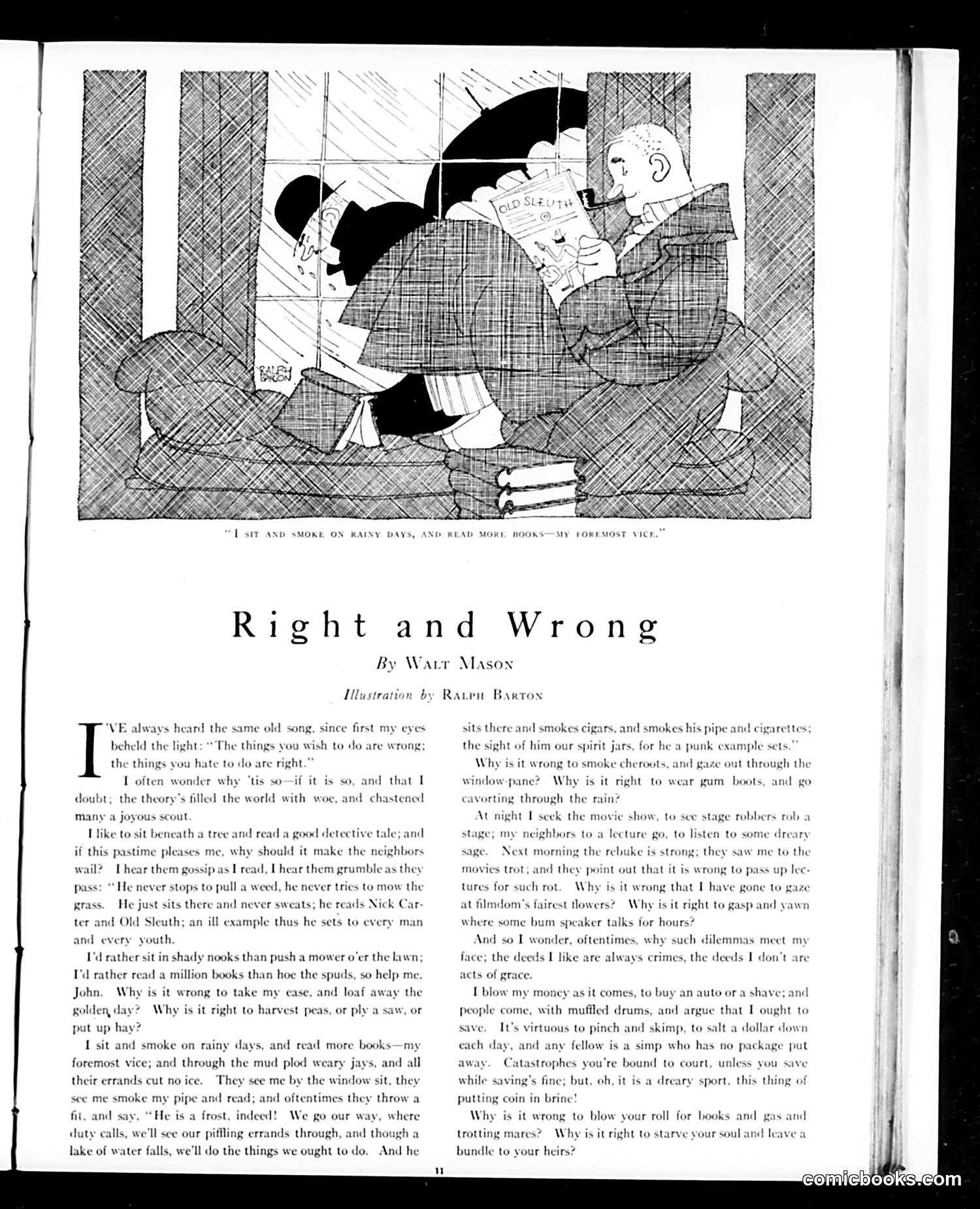
This satirical essay attacks Victorian morality and social hypocrisy. The illustration shows a man relaxing indoors with books and a pipe while rain falls outside—embodying the "vices" he's accused of. Mason's narrator catalogs society's contradictory moral standards: neighbors condemn him for reading detective stories and smoking instead of mowing lawns, yet they themselves waste time at lectures. He questions why leisure is "wrong" while drudgery is "right," why attending movies is sinful but listening to boring speakers is virtuous, why spending money on pleasure is irresponsible while hoarding for heirs is noble. The satire targets puritanical busybodies who judge others' harmless pleasures while ignoring their own hypocrisies. Mason argues these arbitrary moral rules serve only to police enjoyment and enforce conformity—the real "frost" isn't his leisure, but society's joyless demands.
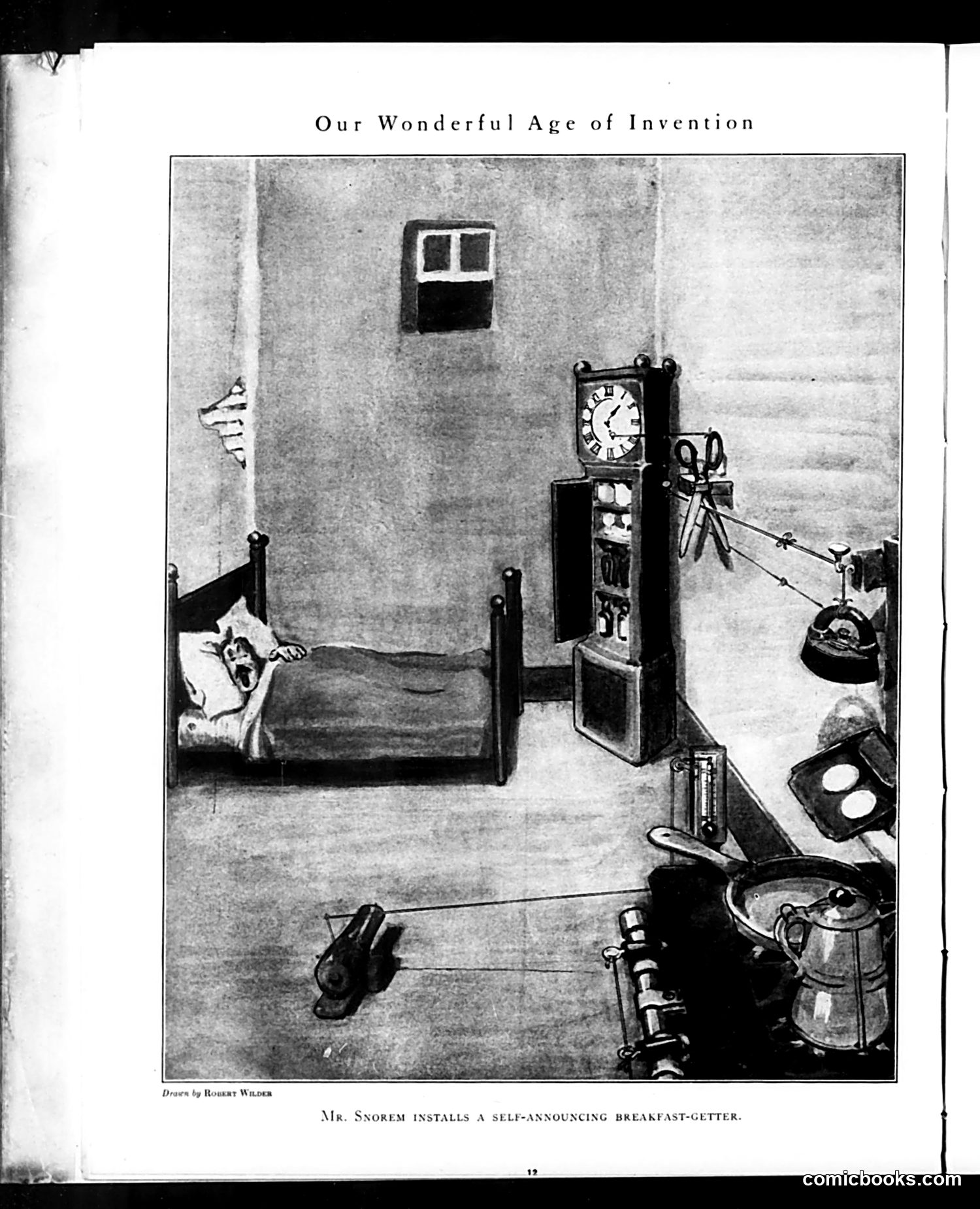
This satirical illustration, drawn by Robert Wildes, depicts "Mr. Snorem Installs a Self-Announcing Breakfast-Getter." The cartoon mocks over-mechanization and unnecessary complexity in modern life. A sleeping man in bed is surrounded by an elaborate Rube Goldberg-style contraption—including a clock, mechanical arms, pulleys, and various devices—apparently designed to automatically deliver breakfast. The absurdity is the point: the cartoon critiques the era's obsession with technological "progress" and labor-saving inventions by showing how ridiculously overcomplicated such a device would be for a simple task. This reflects early 20th-century anxieties about whether modern invention genuinely improved daily life or merely created needless complexity. The satire targets both inventors' ambitions and society's gullible enthusiasm for gadgetry.
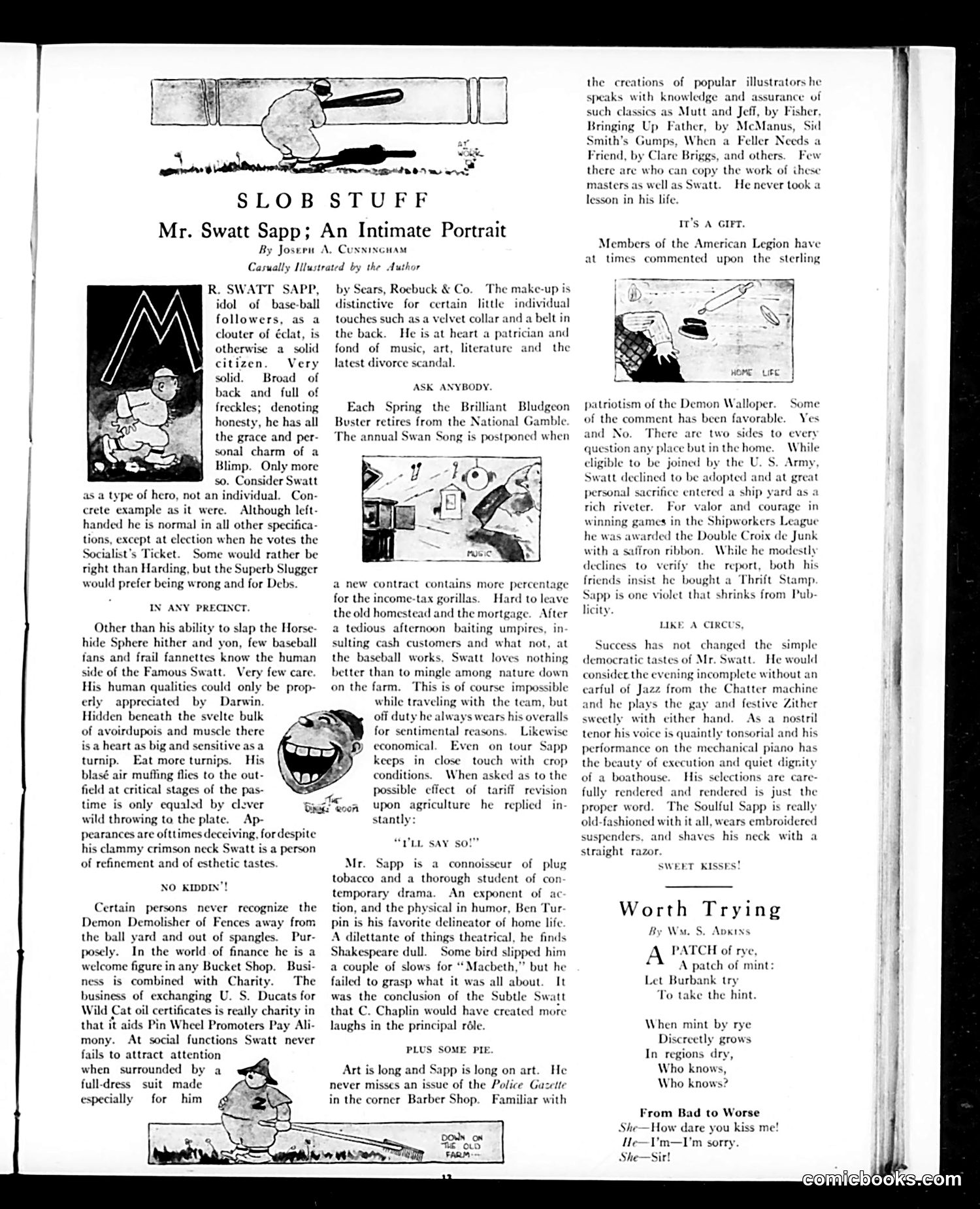
This is a satirical character sketch of a fictional baseball player named Swatt Sapp, written by Joseph A. Cunningham and illustrated by the author. The piece mocks the perceived gap between athletic celebrity and actual personal substance. Sapp is portrayed as a successful but intellectually hollow slugger—strong, honest, and physically impressive, yet emotionally stunted ("a heart as big and sensitive as a turnip"). The satire emphasizes his contradictions: he votes Socialist despite being financially comfortable; he reads lowbrow entertainment (Ben Turpin films, *Police Gazette*) while claiming refined tastes; he dabbles in dubious financial schemes like "Wild Cat oil certificates." The barbs target not just Sapp but the culture that elevates athletes uncritically. His ignorance of Shakespeare, preference for slapstick, and obsession with comic strips represent broader anxieties about American popular taste. References to "income-tax gorillas," mortgages, and farm sentimentality situate this as post-WWI commentary on working-class aspiration and materialism.
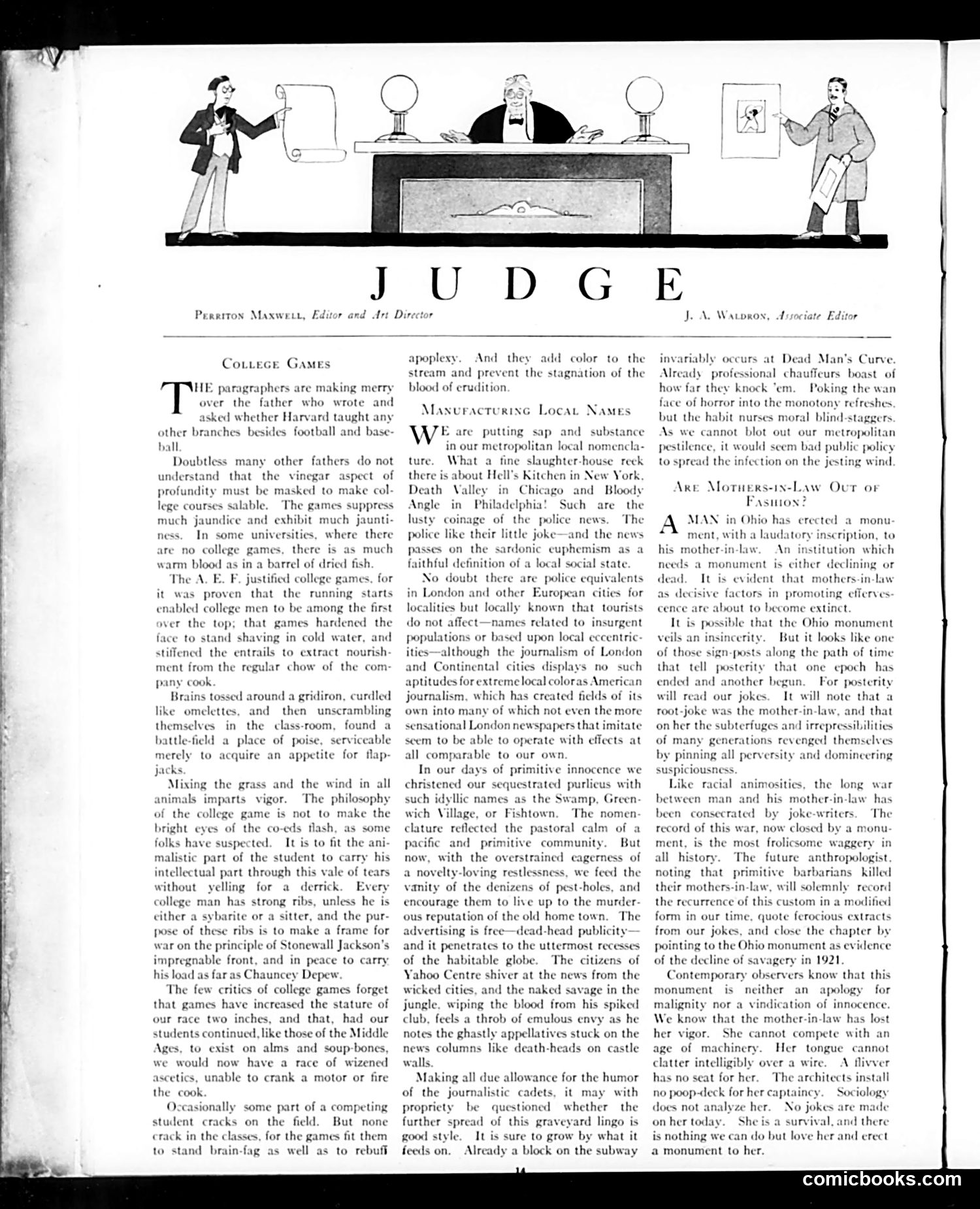
This page contains two editorial pieces from Judge magazine satirizing American college culture and urban naming conventions. **"College Games"** defends collegiate athletics against critics, arguing that football and baseball physically toughen students—preparing them for "war" and hardship. The author sarcastically claims games increase national stature and that without sports, students would become "wizened ascetics." This reflects post-WWI anxiety about American vigor and masculinity. **"Manufacturing Local Names"** criticizes how police reporters and journalists sensationalize poor neighborhood names—"Hell's Kitchen," "Death Valley," "Bloody Angle"—treating them as colorful local color rather than addressing actual poverty and crime. The author laments that romanticized naming encourages residents to "live up to" violent reputations rather than improving conditions. This is social criticism wrapped in sardonic humor about journalistic sensationalism and class attitudes toward working-class neighborhoods.
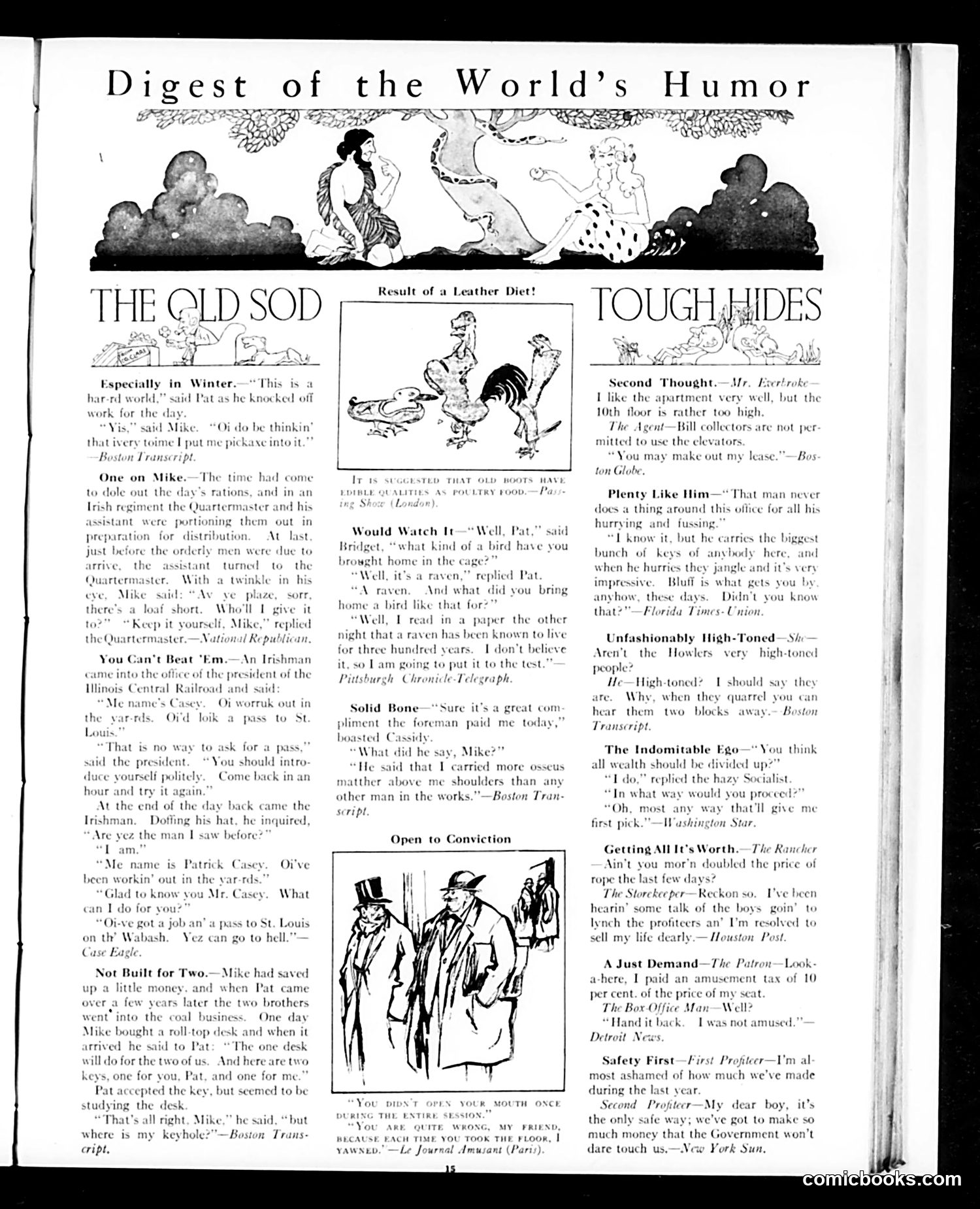
This page from *Judge* contains humor pieces primarily satirizing **Irish immigrants and working-class laborers** in early 20th-century America. The recurring Irish characters (Pat, Mike, Casey) reflect period stereotypes about Irish workers on railroads and in manual labor. Key satire targets include: **"You Can't Beat 'Em"**: Mocks Irish immigrants' perceived lack of social refinement—Casey must learn proper etiquette to request a railroad pass, implying Irish workers were considered uncouth. **"Not Built for Two"**: Jokes about Irish thriftiness and naiveté regarding desk ownership and keyholes. **"Open to Conviction"**: Satirizes socialists and their argumentative nature—a man is convinced wrong through rhetorical exhaustion rather than logic. **Other pieces** mock high-society pretension, profiteering during wartime ("rope the last few days"), and urban apartment dwellers avoiding bill collectors. The humor relies on ethnic caricature, class condescension, and contemporary social anxieties about immigration, labor disputes, and economic inequality.
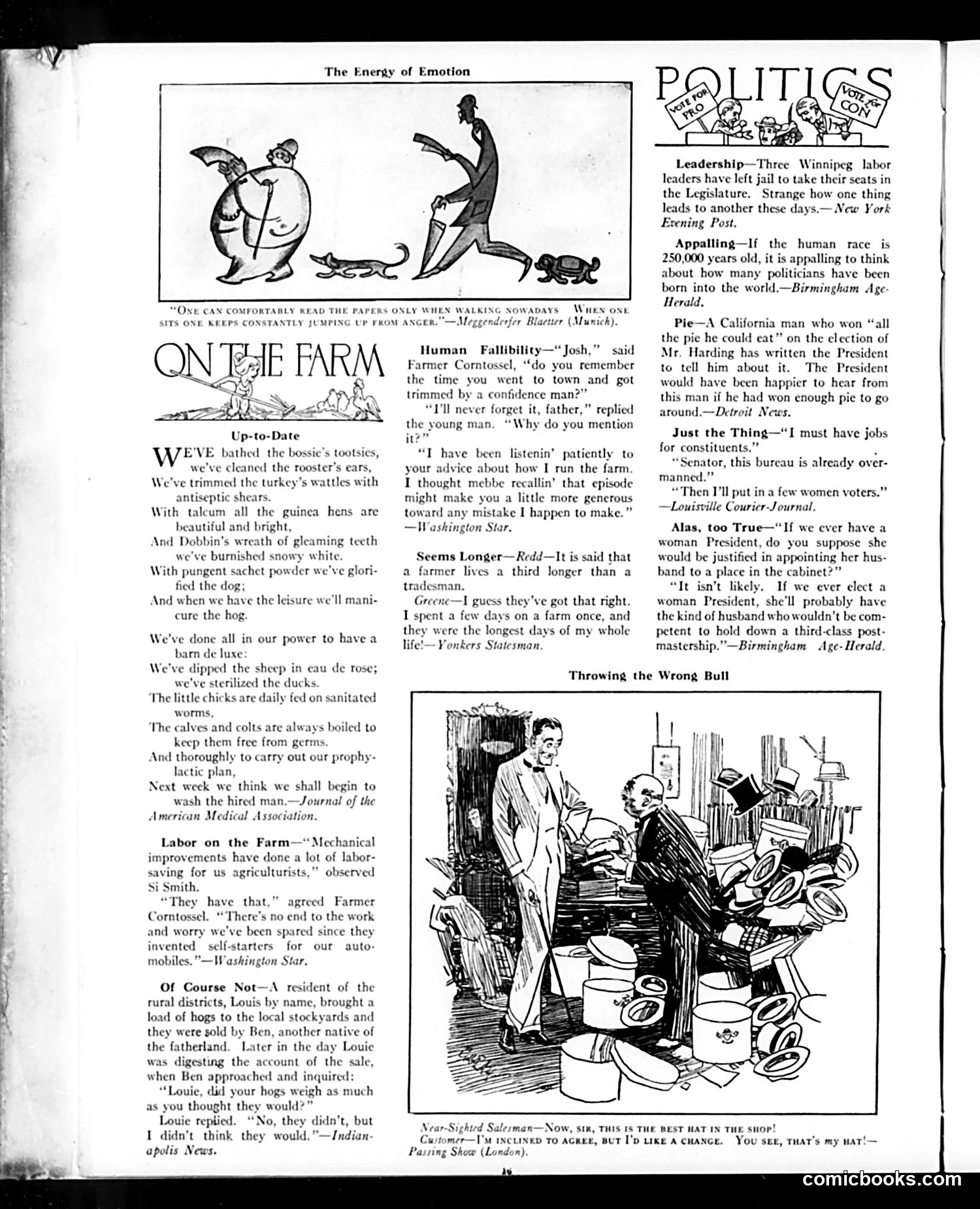
This page from *Judge* contains multiple satirical pieces targeting early 20th-century American life and politics. **"On the Farm"** mocks progressive hygiene obsessions by depicting absurdly over-sanitized farm practices—bathing livestock, sterilizing ducks, boiling calves. The satire suggests that modern cleanliness mania, while well-intentioned, becomes ridiculous when applied to farm management. **Political snippets** in the right column ridicule politicians and government inefficiency: labor leaders in jail becoming legislators; appointing unqualified constituents to jobs; the absurdity of a woman president's husband holding office. These reflect contemporary skepticism about democratic governance. **"Throwing the Wrong Bull"** (bottom cartoon) depicts a near-sighted salesman trying to sell a hat to a customer surrounded by bulls' heads—visual wordplay on "bull" (deception/nonsense), suggesting the salesman himself represents corporate deception. Overall, the page satirizes contemporary anxieties: excessive modernization, political corruption, and commercial dishonesty—typical *Judge* fare targeting the Progressive Era's contradictions.
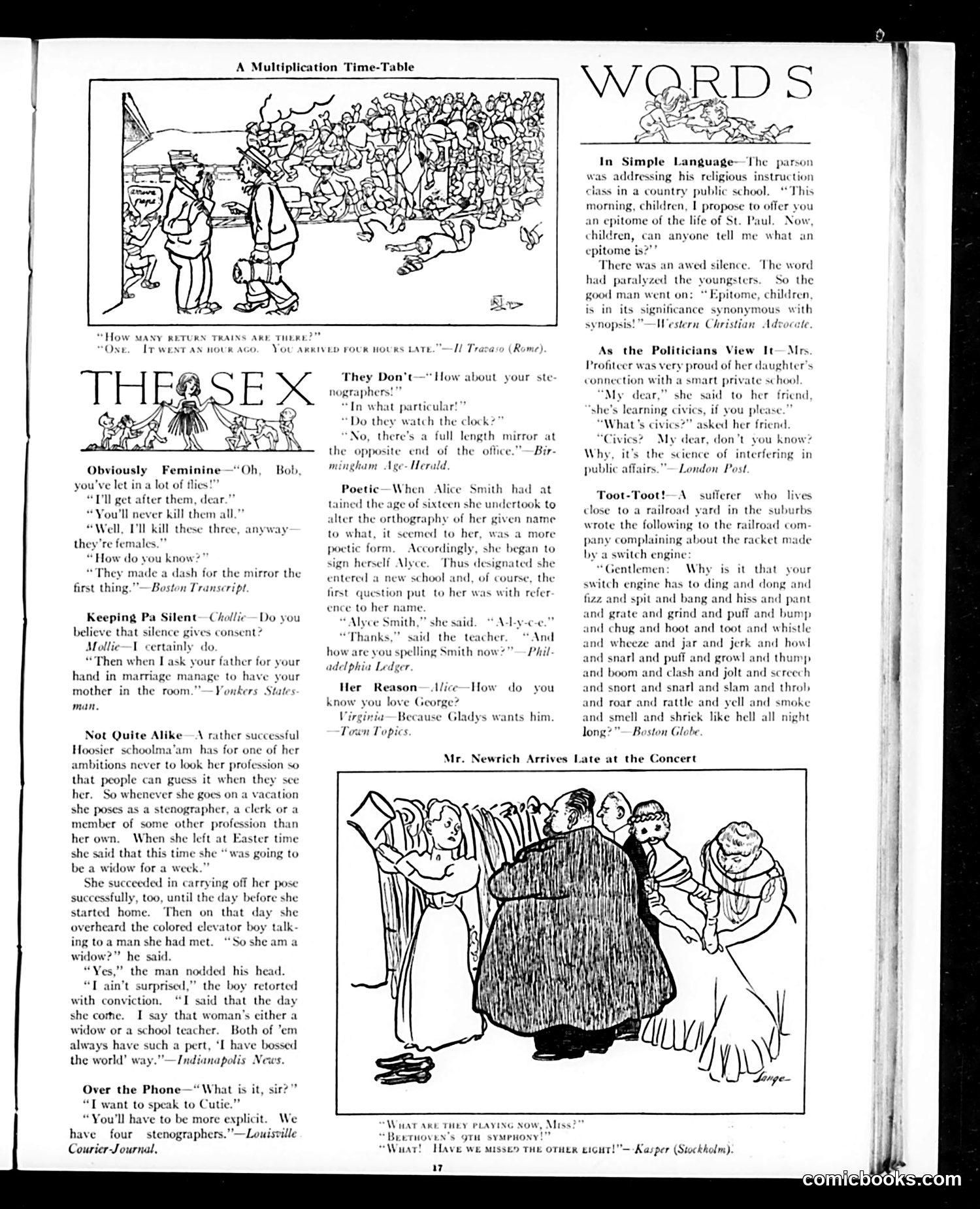
This page from the satirical magazine *Judge* contains multiple short humor pieces mocking early 20th-century American social types and attitudes. **"The Sex" section** collects brief jokes exploiting period stereotypes: women are vain (dashing for mirrors), stenographers watch clocks and have bossy demeanors, and their romantic motivations are superficial (a woman loves a man only because her rival wants him). **"A Multiplication Time-Table"** cartoon satirizes Italian train service's notorious unreliability—a passenger misses his train, then waits four hours for the next one, making return trips multiply absurdly. **"Mr. Newrich Arrives Late at the Concert"** depicts social pretension: a wealthy but uncultured newcomer ("Newrich" = nouveau riche) arrives at a classical concert and hilariously misidentifies Beethoven's 9th Symphony, missing what "light" to see. **Other pieces** mock schoolteachers' pretensions, stenographers' vanity, and railroad noise complaints—all reflecting working-class and middle-class anxieties of the era. The humor relies on period-specific social hierarchies now largely obsolete.
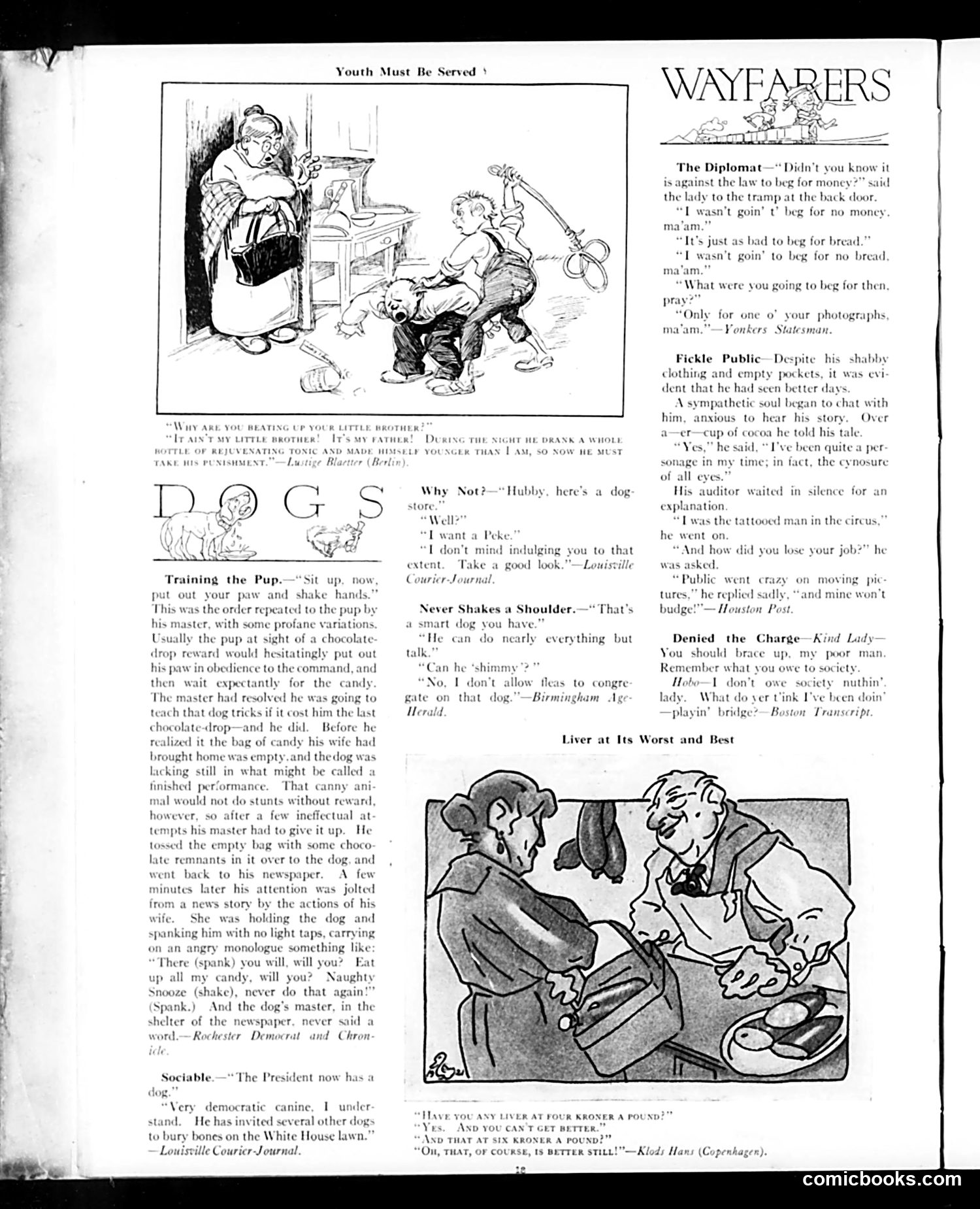
This page from *Judge* contains several humorous anecdotes and cartoons mocking human behavior through dog-related scenarios: **"The Diplomat"** satirizes a poor man's dignity—he refuses to beg for money or bread, only asking for the lady's photograph, suggesting even the destitute maintain pride. **"Training the Pup"** ironically shows a master teaching his dog tricks for chocolate rewards, only to have his wife beat the dog for eating the candy—commentary on human inconsistency and hypocrisy. **"Liver at Its Worst and Best"** (bottom cartoon) appears to reference Scandinavian pricing or quality issues, with characters debating liver prices at different kroner amounts—likely topical to the era. Other brief jokes mock sociability, flirtation ("shimmy"), and middle-class pretension. The overall thrust: humans' moral failings are revealed through their interactions with animals and each other.
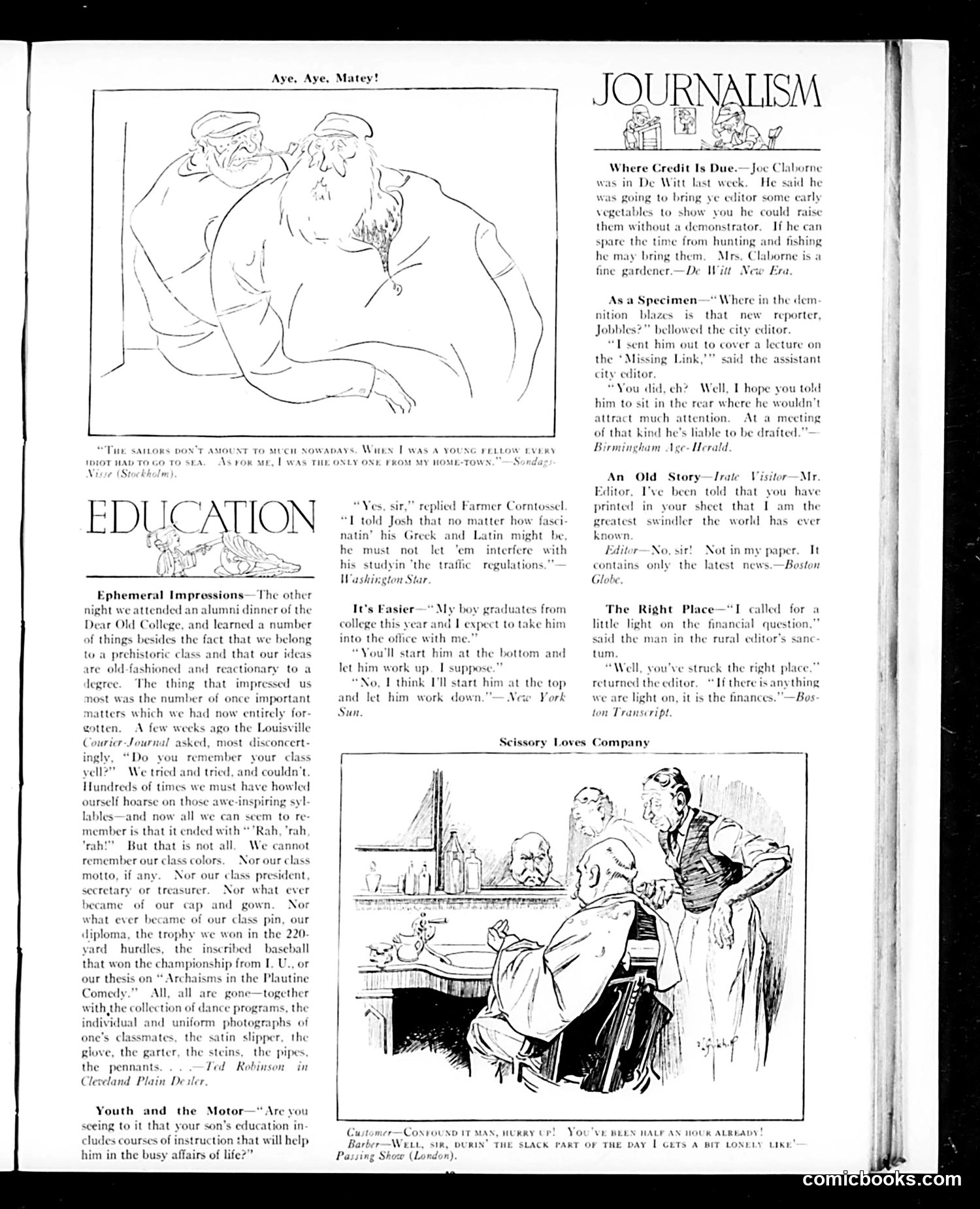
This page from Judge magazine contains satirical commentary on American education and journalism circa early 1900s. The top cartoon "Aye, Aye, Matey!" depicts two rotund sailors, satirizing nostalgia for seafaring life—likely mocking romanticized views of naval service. The **Education section** includes several vignettes poking fun at college culture: alumni unable to remember their class identity details; a farmer insisting his son study traffic regulations despite studying Greek and Latin; and differing philosophies on whether young graduates should "start at the bottom" versus "at the top." The **Journalism section** satirizes newspaper offices and editors' demands. The "Missing Link" joke implies a new reporter is so uneducated he belongs among evolutionary primitives. Multiple items mock editorial priorities: one editor demands vegetables for his table, another seeks financial transparency while running a perpetually broke operation. The "Scissory Loves Company" cartoon shows a barber complaining business is slow during daytime hours—satirizing service workers' frustrations with unpredictable schedules. Overall, the page mocks institutional pretension, generational disconnect, and workplace absurdities.
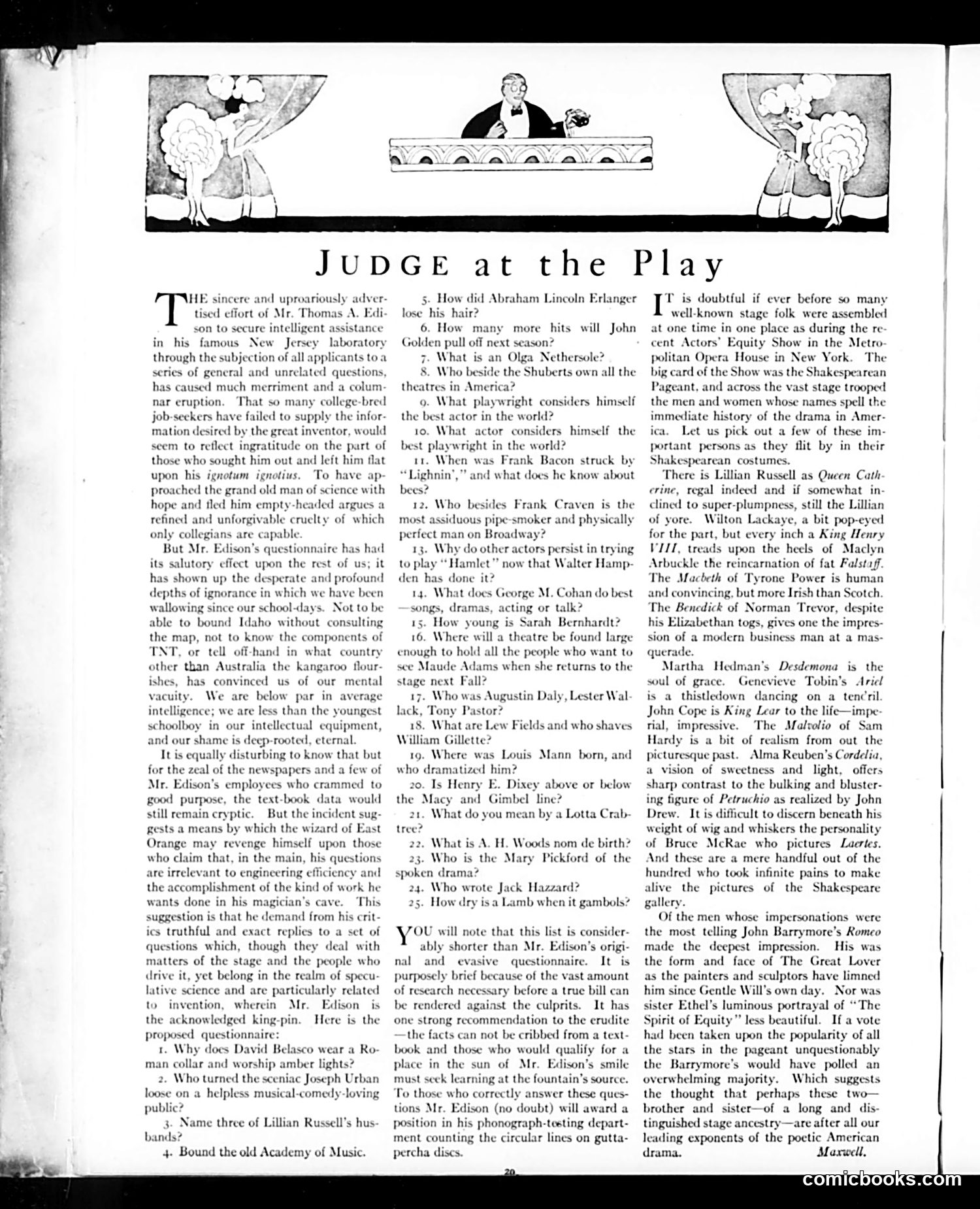
This page satirizes Thomas Edison's famous intelligence questionnaire for job applicants at his New Jersey laboratory. Edison's test—requiring knowledge of obscure facts unrelated to engineering—became a public scandal when educated college graduates failed spectacularly. Judge's satire turns the tables: if Edison's questions seem irrelevant to actual work, why not demand theater industry figures answer equally absurd questions about Broadway? The "questionnaire" mocks prominent theater personalities—David Belasco, the Shubert brothers, Frank Bacon, George M. Cohan, Sarah Bernhardt, and Maude Adams—with nonsensical inquiries (e.g., "How did Abraham Lincoln Erlanger lose his hair?"). The joke: Edison's test exposed widespread ignorance, but theater people know their industry equally poorly. It's a pointed critique of Edison's methodology while gently ribbing Broadway's famous personalities and their perceived pretensions.
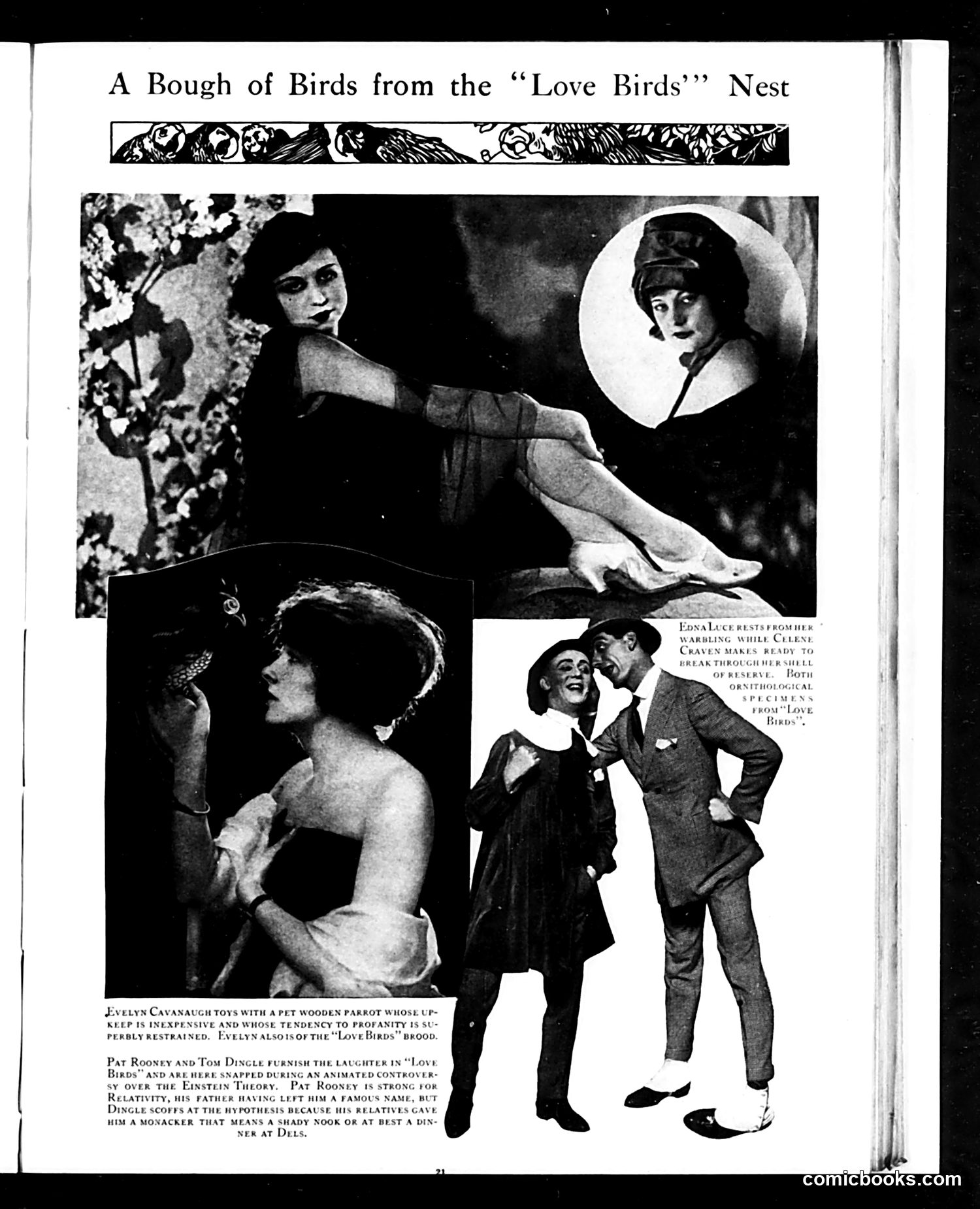
This page promotes a theatrical production called "Love Birds," featuring photographs of cast members. The title's bird metaphor plays on the romantic comedy theme. The content identifies several performers: - **Edna Luce** and **Celene Craven**, appearing in various poses - **Evelyn Cavanaugh**, shown playing with a wooden parrot (a prop joke about inexpensive stage business) - **Pat Rooney** and **Tom Dingle**, two comedians captured during an "animated controversy" about Einstein's Theory of Relativity The satire here is lightweight: Rooney supports Einstein's relativity theory partly because his famous father's legacy gives him confidence to embrace innovation, while Dingle ridicules it because his own surname—meaning "a shady nook"—suggests his family background doesn't inspire intellectual authority. This is essentially promotional content with mild comedic commentary on the performers' personalities and the show's plot, typical of Judge magazine's theatrical coverage.
This is a film review column praising the German film "Deception" (about Henry VIII), which—like the earlier German film "Passion"—achieved unexpected critical and commercial success in America despite coming from a former enemy nation. The satire targets American filmmakers' nationalist assumptions. The author notes that while Americans have established "rules for excellence" in cinema, this German production threw out those rules and created a "masterpiece" anyway—hence the bewildered "How come?" The irony: postwar America, having just fought Germany, must grudgingly acknowledge German cinematic superiority. The Henry VIII narrative serves as an extended metaphor for justified rule-breaking: the king violates religious and political authority to do what he wants, "the way he wants it." The implicit argument: great art, like Henry's reign, justifies its own methods through results, not adherence to established rules. The column celebrates the film's emotional authenticity and directorial vision over technical formula—a modernist stance challenging conventional American film criticism.
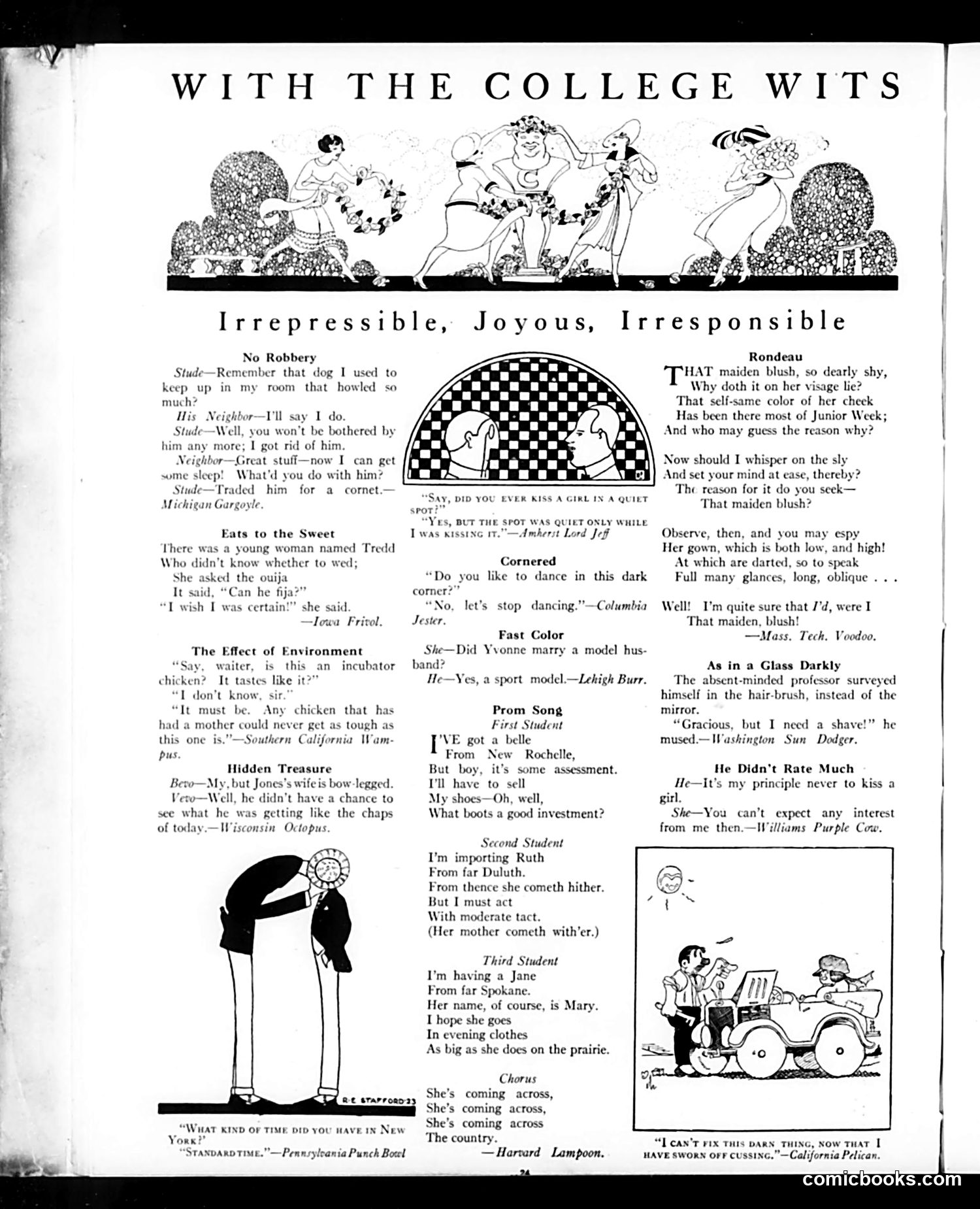
This is a humor page featuring college jokes and comic strips from various American university publications (Michigan Gargoyle, Iowa Frivol, etc.). The content reflects early 20th-century college social life. **Key themes:** The jokes mock student stereotypes: poor dorm conditions (loud dogs), romantic pursuits of college men importing dates from other cities, and social awkwardness. The "Rondeau" satirizes the visible evidence of female students' social activities—low-cut evening gowns attracting male attention, causing their blushes. **Notable elements:** - References to "prom songs" suggest courtship rituals where male students formally invited women - The absent-minded professor gag was a standard trope - "Fast Color" jokes about courtship in dark corners reflect anxieties about unsupervised male-female interaction **The bottom cartoon** shows a frustrated driver unable to repair his car because he's sworn off profanity—suggesting automotive breakdowns were common enough to warrant blasphemous language. Overall, this reflects 1920s-era campus humor emphasizing romantic pursuits, mechanical mishaps, and the clash between propriety and modern college life.
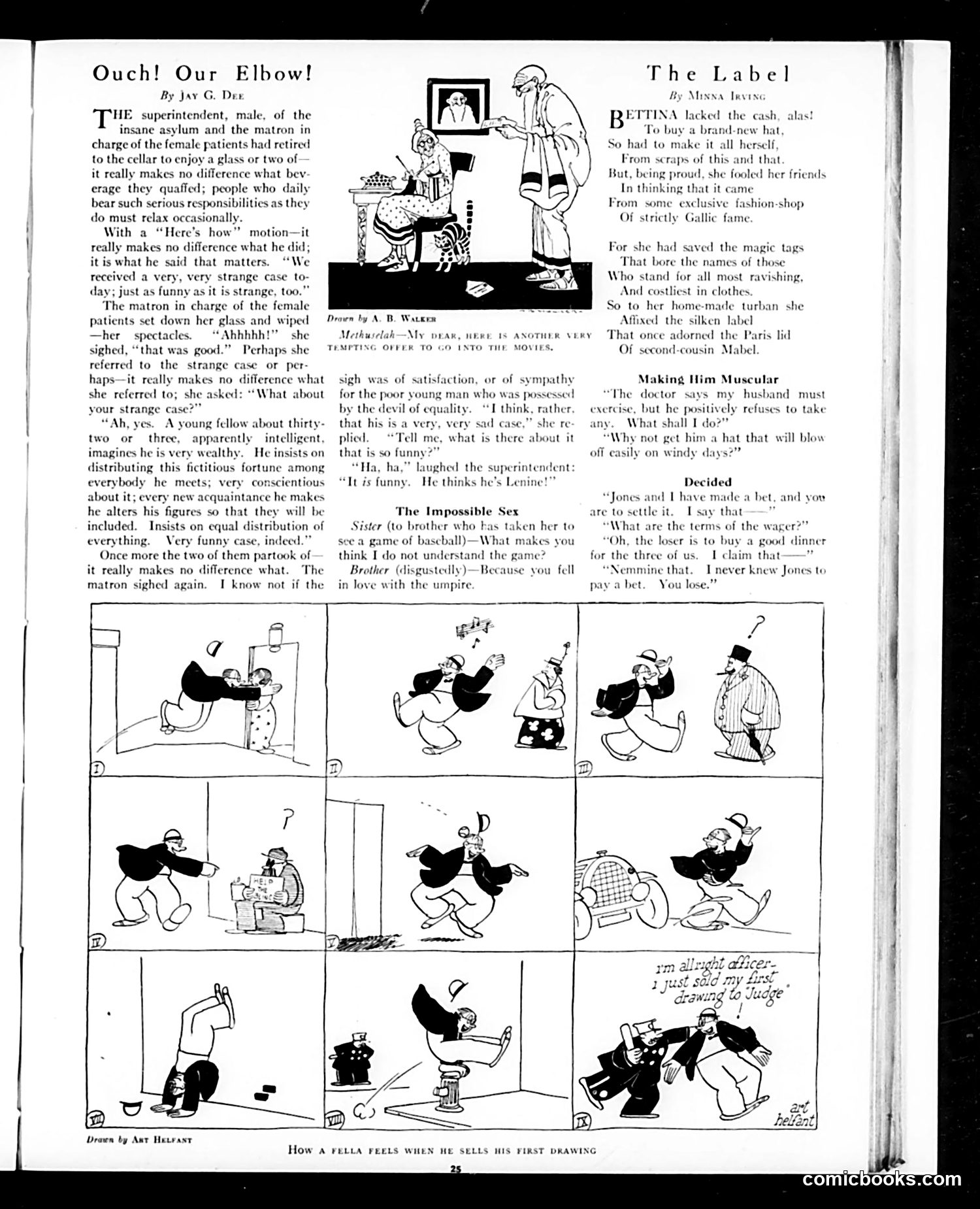
This page contains three satirical pieces typical of early 20th-century American humor: **"Ouch! Our Elbow"** mocks the mental health establishment. Two asylum administrators discuss a patient who imagines himself wealthy and wants to distribute his fortune equally—the punchline: "He thinks he's Lenin!" This satirizes both the perceived danger of communist/socialist ideology and portrays asylum staff as callous drinkers rather than serious professionals. **"The Label"** satirizes class pretension: a poor woman (Bettina) creates a homemade hat but attaches fake designer labels to deceive friends into thinking it's from Paris. It mocks both consumer materialism and the obsession with branded goods as status markers. **The comic strip** (by Art Heurast, titled "How a Fella Feels When He Sells His First Drawing") appears to show slapstick reactions to making a first sale—depicting physical comedy rather than political satire. The other brief jokes mock marriage dynamics and gender incomprehension regarding sports. Overall, the page reflects 1920s anxieties about wealth distribution, consumerism, and social pretense.
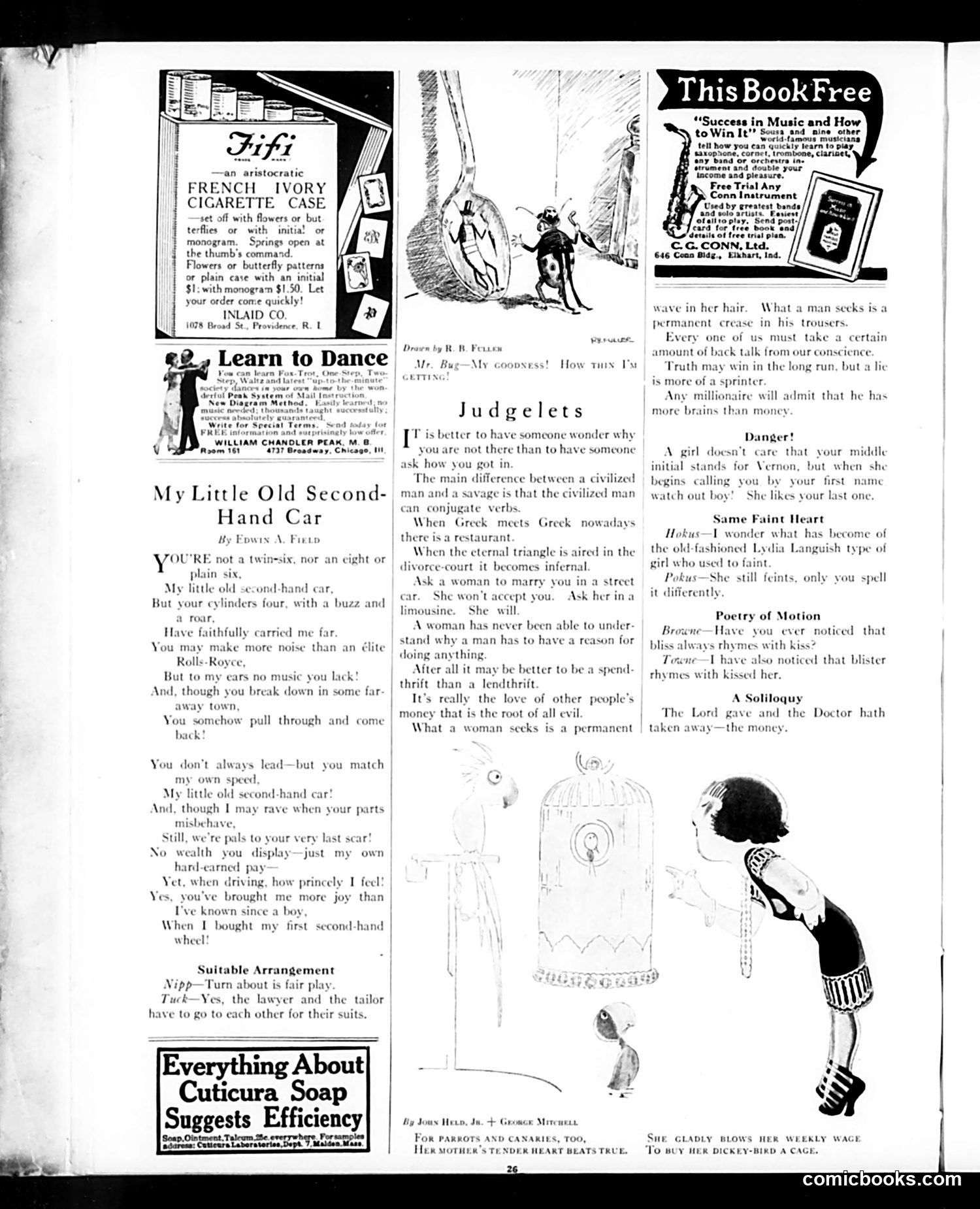
This Judge magazine page combines humor columns, light verse, and advertisements typical of early 20th-century American satire. **Main Content:** The "Judgelets" section offers brief satirical observations on gender and social behavior—comparing how women seek "permanent" marriage while men want permanent trouser creases; noting women can't understand why men need reasons for actions; and commenting on divorce ("eternal triangle"). **The Poetry:** "My Little Old Second-Hand Car" sentimentally celebrates an unreliable but beloved used automobile—poking gentle fun at working-class pride in modest possessions. The cartoon below shows a woman happily spending her weekly wages on a birdcage, illustrating period stereotypes about female frivolousness. **The Humor:** These pieces rely on period assumptions about gender roles (frivolous women, practical men) and class distinctions (limousines vs. street cars). The satire is mild social commentary rather than sharp political critique. **Advertising** fills margins, typical of Judge's business model.
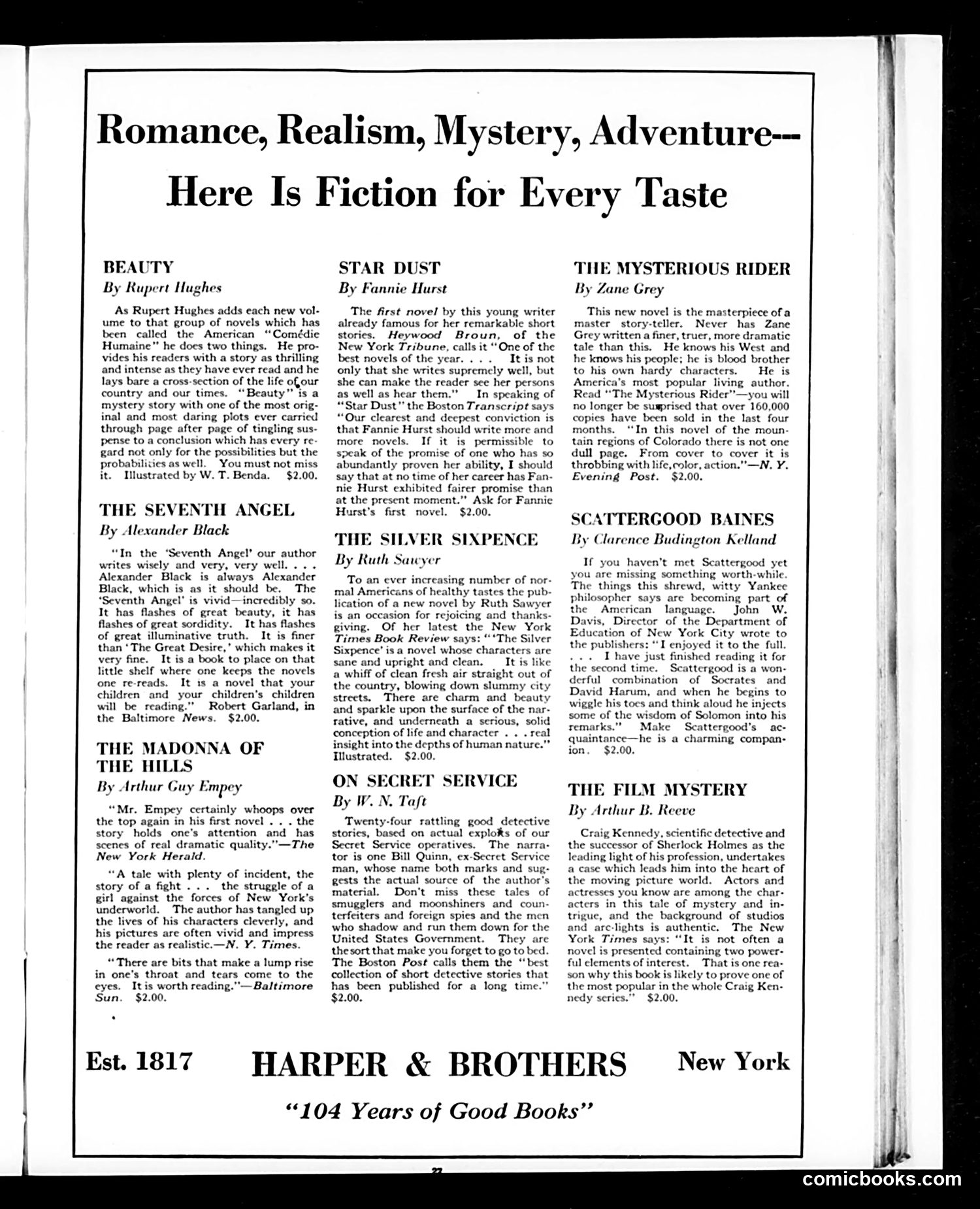
This page is not a political cartoon but rather a **book advertisement** from Harper & Brothers publishers. It showcases seven novels across various genres—romance, mystery, adventure, and realism—marketed to appeal to diverse reader tastes. The advertisement highlights works by established and emerging writers of the period (early 1920s), including Rupert Hughes, Alexander Black, Arthur Guy Empey, Fannie Hurst, Ruth Sawyer, W.N. Taft, Zane Grey, Clarence Budington Kelland, and Arthur B. Reeve. Each entry includes publisher quotes praising the novels' literary merit and commercial appeal. The page emphasizes Harper & Brothers' prestige—"104 Years of Good Books"—established 1817, presenting themselves as purveyors of quality fiction for middle-class American readers. There is no satire or political commentary; this is straightforward commercial publishing promotion typical of Judge magazine's advertising content.
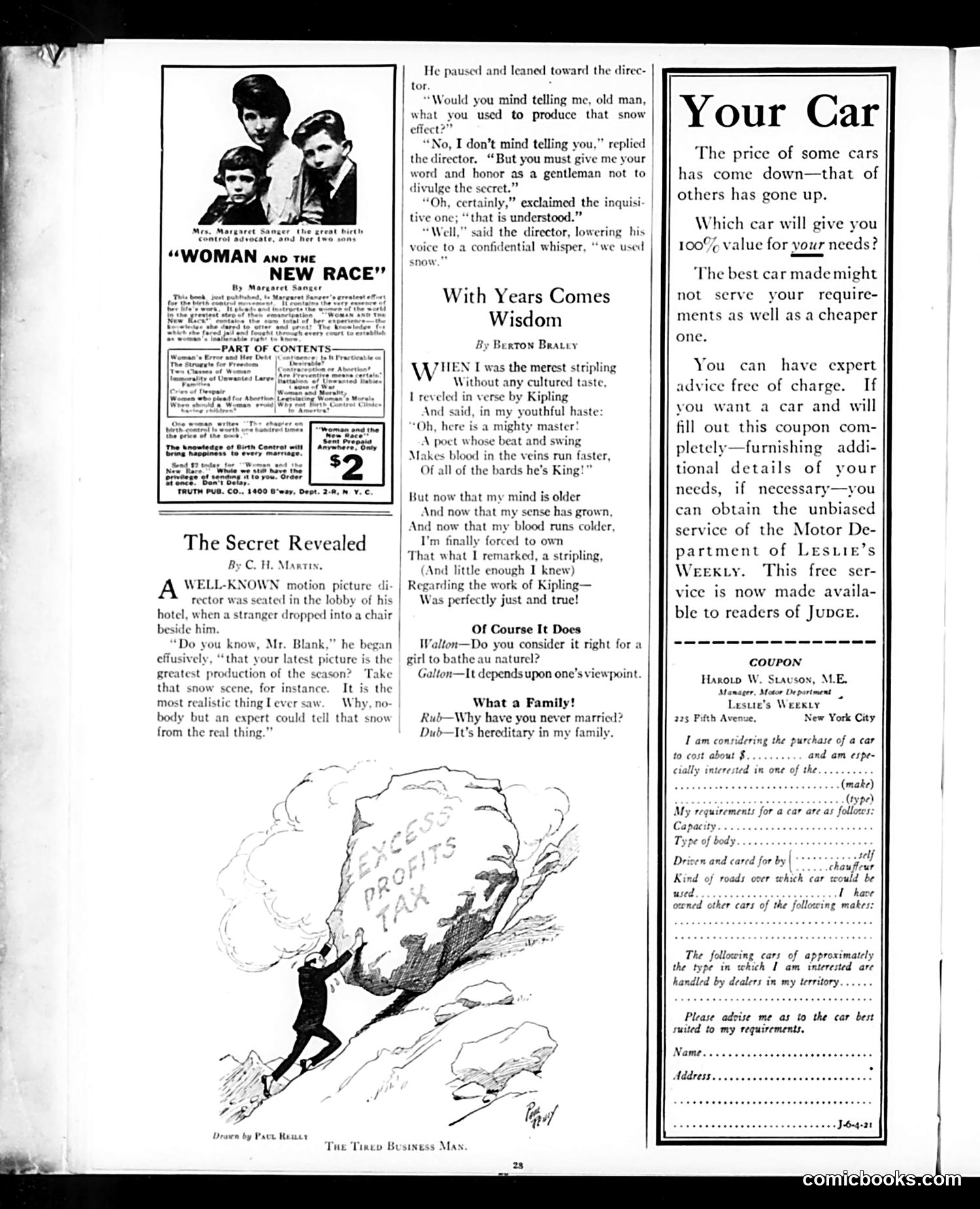
This page contains three distinct pieces: **"The Secret Revealed"** — A short humor piece mocking motion picture directors' pretentiousness. A stranger praises a film director's "realistic" snow effect, demanding to know the secret. The punchline: the director used actual snow. The satire targets both the director's affected secrecy about ordinary things and the public's gullibility in attributing artistic genius to straightforward filmmaking. **"With Years Comes Wisdom"** — A poem by Berton Bradley about changing literary tastes. The speaker once praised Kipling's work enthusiastically as a youth, now dismisses it with maturity—only to admit reluctantly that his youthful assessment was actually correct. The joke mocks intellectual pretension and the assumption that older judgment is automatically superior. **"Your Car"** — A full-page automobile advertisement offering free expert advice through Judge magazine's Motor Department. Readers can fill out a coupon detailing their car needs and budget to receive unbiased purchasing guidance from Leslie's Weekly. The page represents typical Judge content: satirizing professional pomposity and human vanity alongside commercial advertisements.
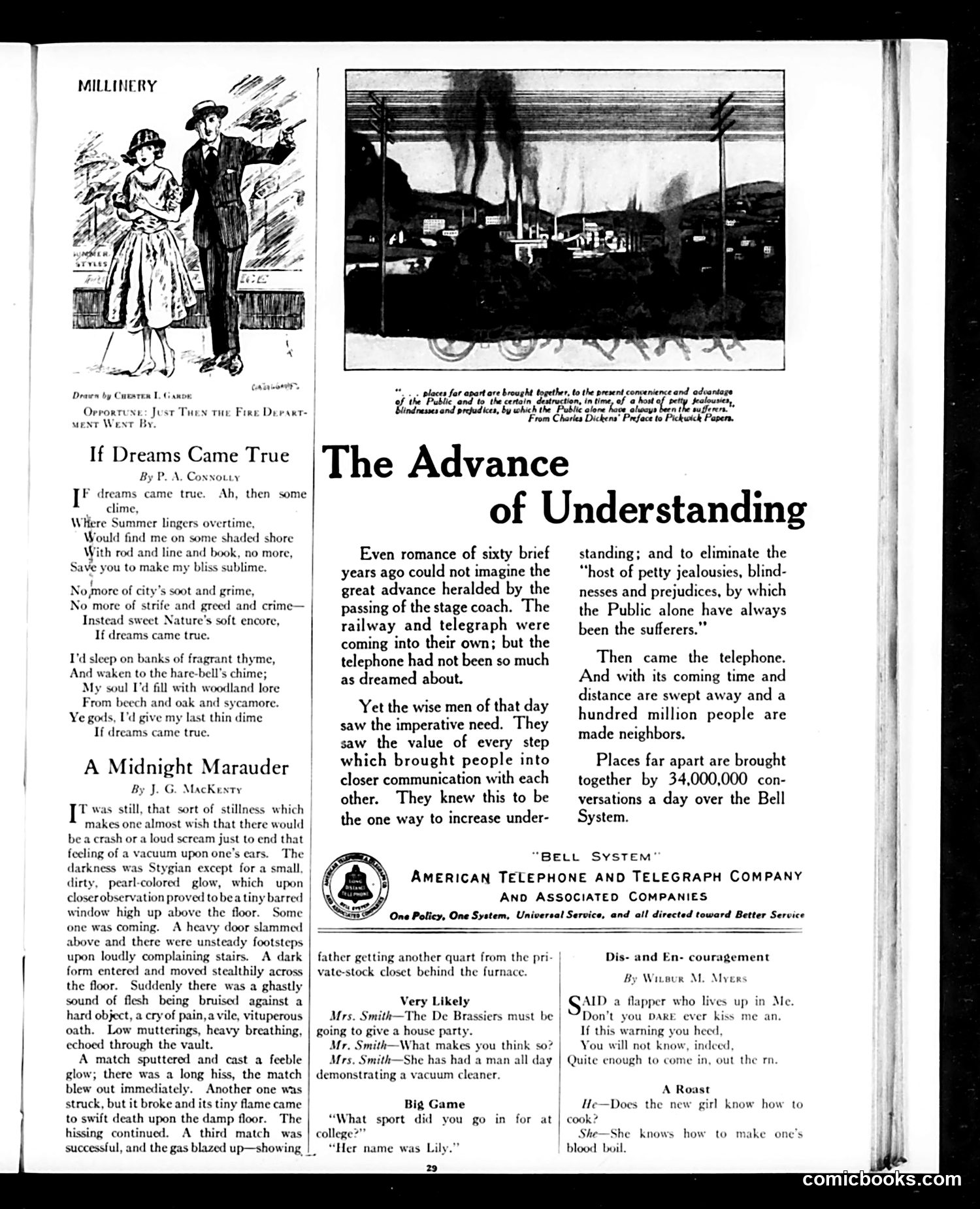
This Judge magazine page is primarily **advertising disguised as editorial content**. The dominant feature is a full-page advertisement for the Bell Telephone System, using a dramatic illustration of an industrial town with smoke and railroad tracks. The ad's text argues that the telephone represents "advance of understanding"—quoting Dickens to suggest that communication technology eliminates "petty jealousies, blindnesses and prejudices" between people. It promotes the Bell System's ubiquity: 34 million daily conversations connecting distant places. The page also contains lightweight literary content (poetry, short stories) and humor pieces typical of Judge's satirical style, including jokes about vacuum cleaners and flapper dating customs. **Context modern readers miss:** This represents early-20th-century corporate PR rhetoric, positioning technological infrastructure as a moral good and social necessity—a familiar marketing strategy that predates modern tech company messaging about "connecting people."
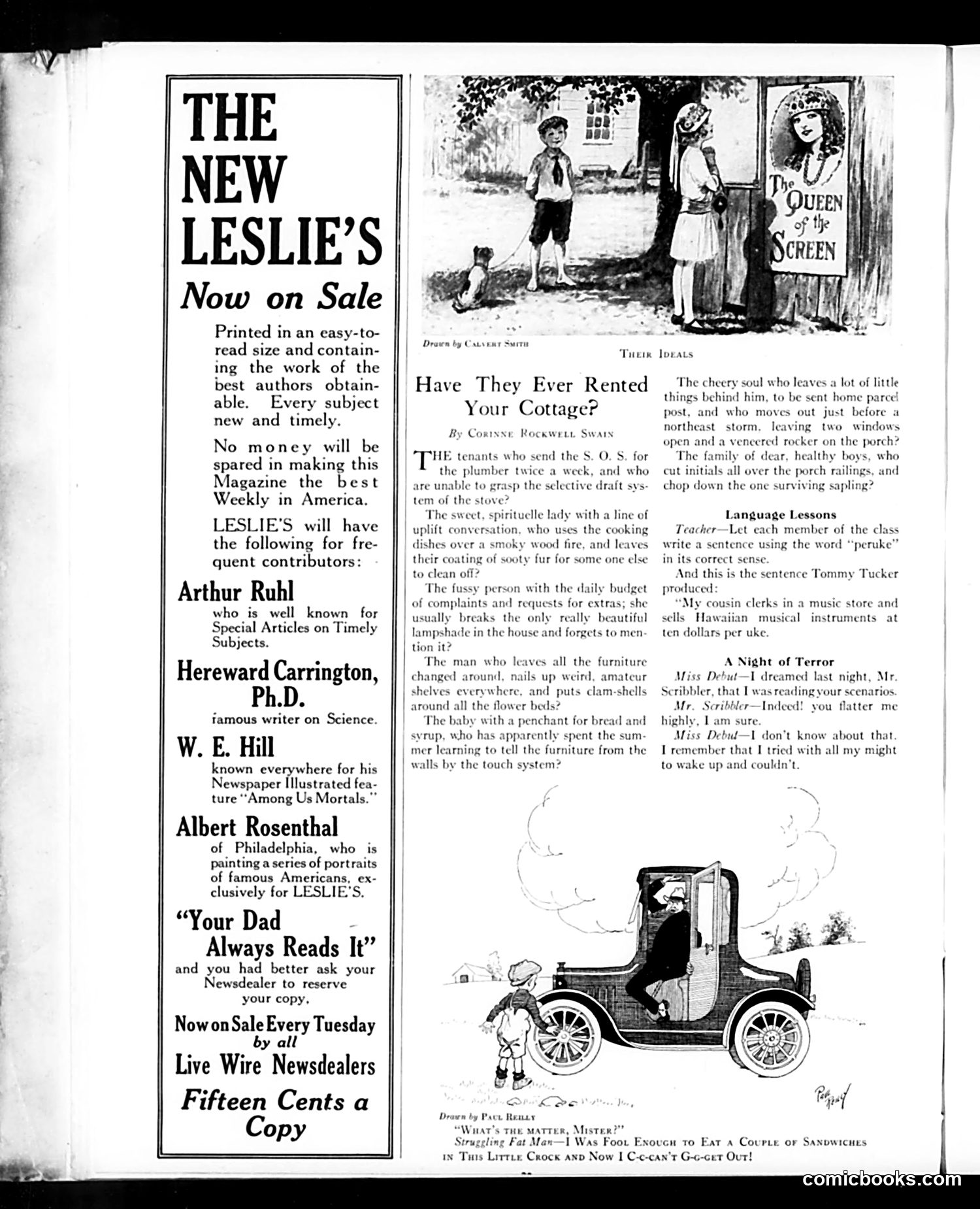
This page is primarily **advertising for Leslie's Magazine**, promoting it as America's best weekly publication. The left column announces contributing writers including Arthur Ruhl (timely subjects), Hereward Carrington (science), W.E. Hill (cartoonist of "Among Us Mortals"), and Albert Rosenthal (portrait painter). The tagline "Your Dad Always Reads It" encourages newsstand reservations at fifteen cents per copy. The right side contains **three satirical pieces**: 1. **"Have They Ever Rented Your Cottage?"** catalogues annoying tenant types—spirituelle ladies who damage kitchens, fussy complainers, destructive families, and slovenly guests who leave windows open during storms. 2. **"A Night of Terror"** jokes about a would-be author whose scenarios put the dreamer to sleep. 3. **A cartoon** showing a portly man stuck in a small automobile after eating sandwiches—visual humor about gluttony and mechanical constraint. The humor targets middle-class property anxieties and social embarrassment typical of 1910s American satire.
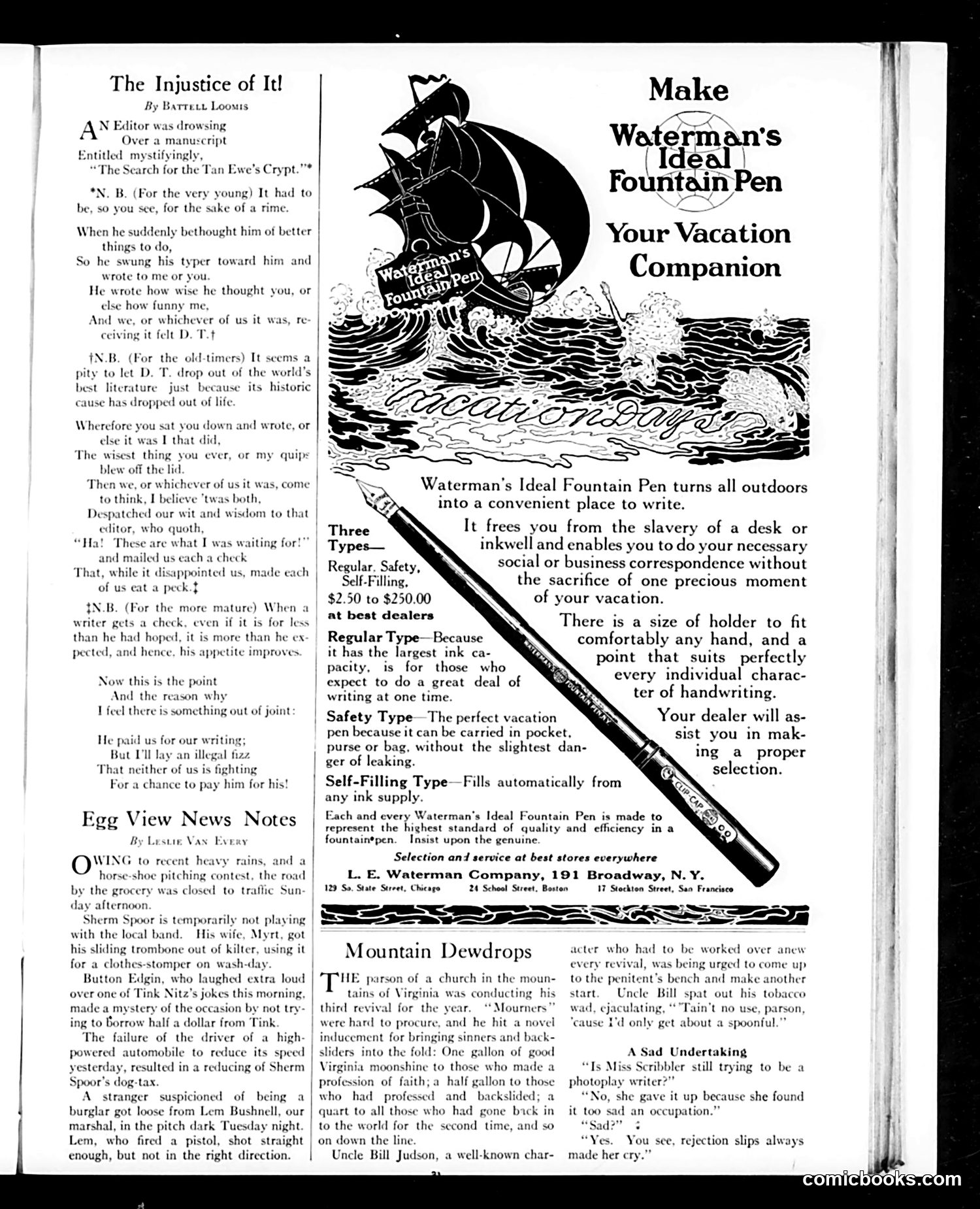
This page from *Judge* magazine contains satirical humor and period advertising. **"The Injustice of It!"** is a humorous verse piece mocking the frustration of freelance writers. The joke: an editor pays writers for their submissions—but they never reciprocate by paying him, despite presumably benefiting from his editorial work. The satire gently critiques the transactional nature of professional writing and the one-sided gratitude in publishing. **"Egg View News Notes"** offers small-town gossip written in a folksy style, including absurdist humor: a stranger escapes a marshal's custody in darkness; the marshal shoots his pistol but hits the wrong target entirely (Sherm Spoor's dog instead). The comedy derives from rural incompetence and small-town drama. **The dominant content is advertising** for Waterman's Ideal Fountain Pen, emphasizing three types and their utility for vacation correspondence—a luxury concern for affluent readers of 1920s *Judge*. This reflects the era when quality fountain pens were status symbols and vacation writing was a gentleman's leisure activity.
This page is primarily **advertisements and book reviews** rather than political cartoons. The main content includes: **Book Reviews by Benjamin De Casseres:** - *The Ram-Lamb and the Telepathic Sneeze* reviews Vachel Lindsay's *The Golden Book of Springfield* (1920), a utopian novel set in 2018. De Casseres notes that Lindsay's future Springfield still has corrupt mayors, cocaine rings, and lynchings—satirizing the notion that social reform will fundamentally change human nature. - A second review discusses Jim Montague's *More Truth Than Poetry*, humorously debating whether babies should be allowed to drink alcohol, reflecting Prohibition-era debates about drinking habits. **Context for modern readers:** These reviews mock progressive reformism and Prohibition-era moralizing, suggesting that despite social movements, corruption and vice persist. The pages reflect 1920s anxieties about modernity, reform, and social control. The remaining content is period advertising (diamonds, dog medicines, stammering cures).
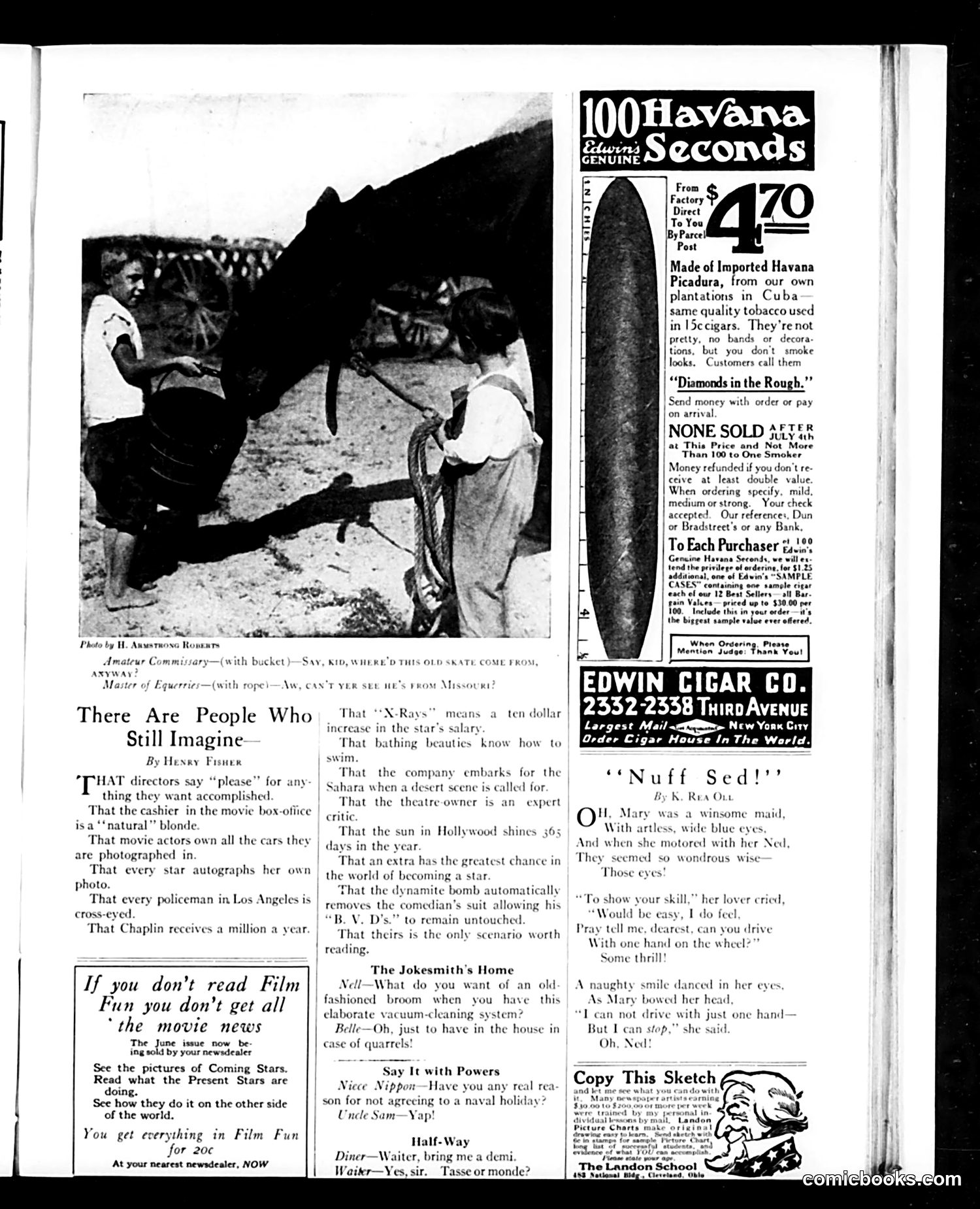
This page is primarily **advertising and light entertainment content**, not political satire. The dominant feature is a large cigar advertisement for Edwin Cigar Co.'s "100 Havana Seconds" ($4.70), marketed as rejected or factory-direct cigars. The small cartoon at top shows an amateur horseman asking where an old, worn-out horse came from, with the reply "from Missouri"—a mild jab at Missouri as a source of inferior stock (playing on regional stereotypes common in early 20th-century American humor). The article "There Are People Who Still Imagine" satirizes Hollywood industry misconceptions—debunking myths that directors say "please," stars own their cars, or extras have real chances at stardom. This reflects genuine 1920s-era skepticism about movie-industry glamour. The remaining content includes joke columns ("Say It with Powers," "The Jokesmith's Home") and a sentimental poem about a flirtatious motorcar ride. These are generic humor filler, not political commentary. The page reflects **entertainment magazine conventions** of the era rather than substantive satire.
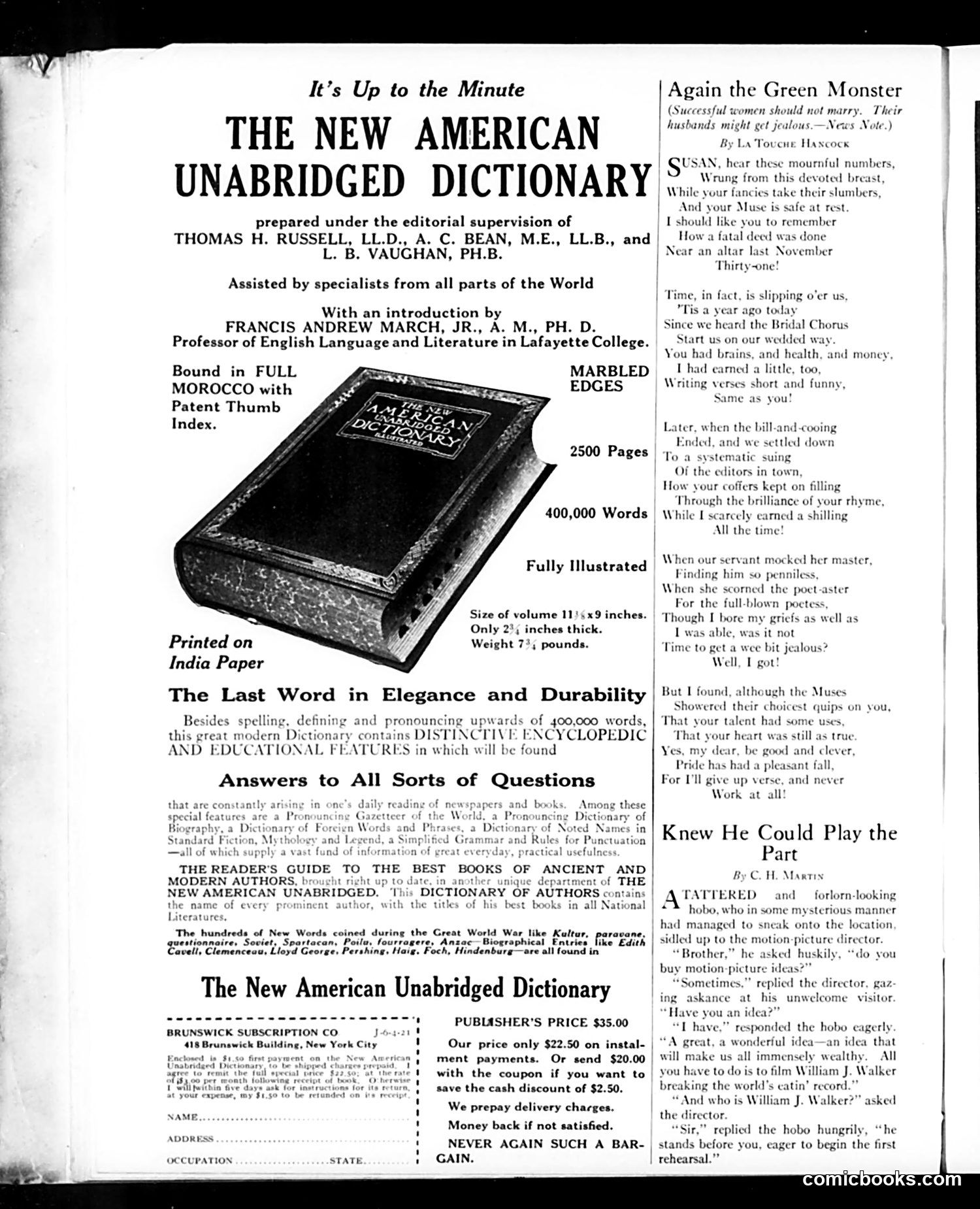
This page is primarily a **dictionary advertisement** with two sidebar literary pieces. **Main Content:** The New American Unabridged Dictionary advertisement dominates, promoting a comprehensive 2,500-page reference work containing 400,000 words. The ad emphasizes its currency by noting it includes "New Words coined during the Great World War" (Kaltar, Anzac, etc.), indicating this advertisement dates to the early 1920s post-WWI era. **Literary Content:** Two poems/stories appear: 1. "Again the Green Monster" by La Touche Hancock—a poem about a husband growing jealous when his writer-wife's literary success surpasses his own. The "green monster" of jealousy is the theme. 2. "Knew He Could Play the Part" by C.H. Martin—a brief story about a hobo pitching a film idea about someone named William J. Walker breaking an eating record. The page reflects Judge magazine's typical mix of advertising and satirical humor targeted at educated, literate audiences.

This page is **not a cartoon or satire**, but rather a **government financial advertisement** from Judge magazine, likely published around 1921. The "Seven Good Reasons" promote Treasury Savings Securities—a patriotic savings program offering small denominations (25¢ stamps to $1,000 certificates) with 4% interest, tax exemptions, and security. These were marketed as safe, accessible investments for ordinary Americans. The context: This appears post-World War I, when the U.S. government actively promoted savings bonds to citizens as both a financial instrument and patriotic duty. The emphasis on small denominations and accessibility reflects efforts to encourage widespread participation across income levels. Rather than satire, Judge here functions as a platform for government messaging—using its circulation to promote official financial policy to readers.
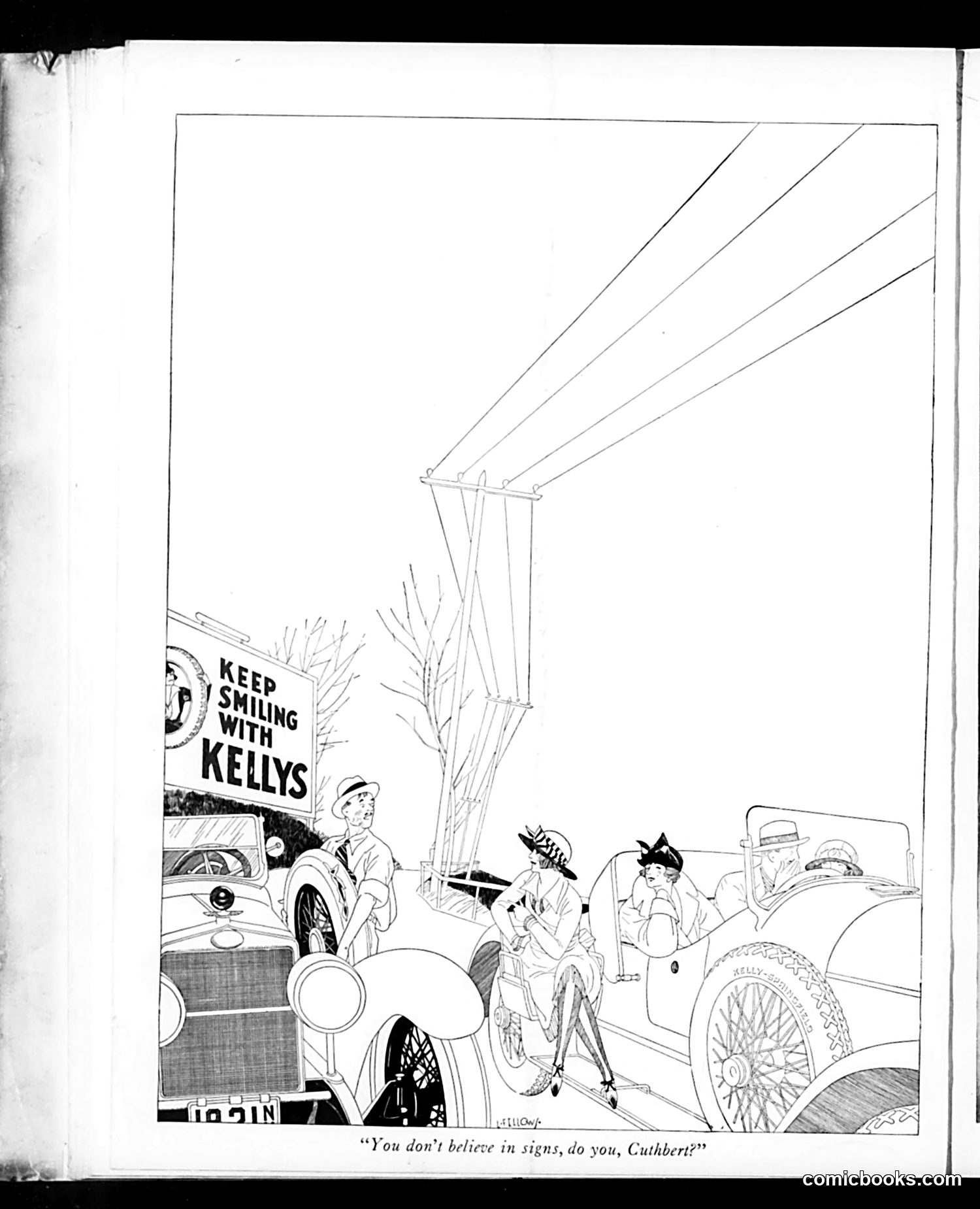
This is a single-panel cartoon satirizing skepticism toward advertising signs. The scene shows a gas station or car dealership with a large "KEEP SMILING WITH KELLYS" sign overhead. A man (presumably "Cuthbert") stands among several parked cars while another figure questions his disbelief in signs. The joke's irony is visual: despite claiming not to believe in signs' persuasive power, Cuthbert is positioned directly beneath prominent advertising, suggesting signs work whether people consciously acknowledge it or not. This reflects early 20th-century concerns about advertising's psychological influence on consumers—a satirical jab at those who deny advertising affects them while being surrounded by commercial messaging.