
Judge, 1921-06-04 · page 20 of 36
Judge — June 4, 1921 — page 20: what you’re looking at
What you’re looking at
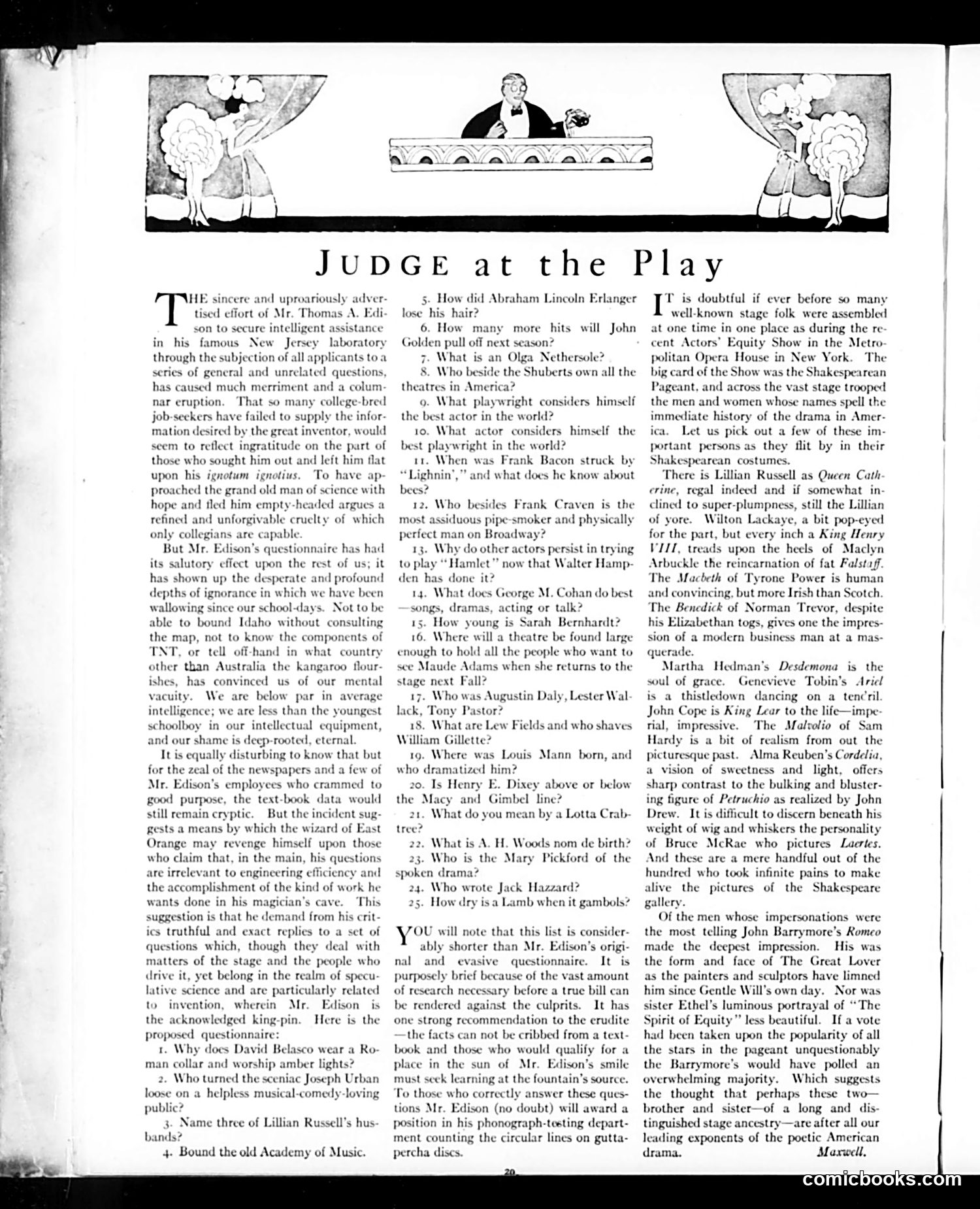
This page satirizes Thomas Edison's famous intelligence questionnaire for job applicants at his New Jersey laboratory. Edison's test—requiring knowledge of obscure facts unrelated to engineering—became a public scandal when educated college graduates failed spectacularly. Judge's satire turns the tables: if Edison's questions seem irrelevant to actual work, why not demand theater industry figures answer equally absurd questions about Broadway? The "questionnaire" mocks prominent theater personalities—David Belasco, the Shubert brothers, Frank Bacon, George M. Cohan, Sarah Bernhardt, and Maude Adams—with nonsensical inquiries (e.g., "How did Abraham Lincoln Erlanger lose his hair?"). The joke: Edison's test exposed widespread ignorance, but theater people know their industry equally poorly. It's a pointed critique of Edison's methodology while gently ribbing Broadway's famous personalities and their perceived pretensions.
📄 Transcribed text from this page (OCR, searchable)
Machine-transcribed from the original scan — historical spelling and the odd misread are preserved.
JUDGE at the Play HE sincere and uproariously adver- tised effort of Mr. Thomas A. Edi son to secure intelligent assistance in his New Jersey laboratory through the subjection of all applicants toa series of general and unrelated questions, has caused much merriment and a colum nar eruption. That so many college-bred job-seekers have failed to supply the infor- mation desired by the great inventor, would seem to reflect ingratitude on the part of those who sought him out and left him flat upon his ignotum ignotius. To have ap proached the grand old man of science with hope and fled him empty-headed argues a refined and unforgivable cruelty of which famous only collegians are capable But Mr. E its salutory effect upon the rest of us; it has shown up the desperate and profound depths of ignorance in which we have been wallowing since our schooldays. Not to be able to bound Idaho without consulting the map, not to know the components of TNT, or tell off-hand what country other than Australia th r= has had ison’s questionnaire kangaroo fh ishes, has convinced us of our mental vacuity. We are below par in average intelligence; we are less than the youngest schoolboy in our intellectual equipment, and our shame is deep-rooted, eternal. It is equally disturbing to know that but for the zeal of the newspapers and a few of Mr. Edison’s employees who crammed to good purpose, the text-book data would still remain cryptic. But the incident sug- gests a means by which the wizard of East Orange may revenge himself upon those who claim that, in the main, his questions are irrelevant to engineering efficiency and the accomplishment of the kind of work he wants done in his magician’s cave. This suggestion is that he demand from his crit- ics truthful and exact replies to a set of questions which, though they deal with matters of the stage and the people who drive it, yet belong in the realm of specu lative science and are particularly related to invention, wherein Mr. the acknowledged king-pin. proposed questionnaire: 1. Why does David Belasco wear a Ro- man collar and worship amber lights? 2. Who turned the sceniac Joseph Urban loose on a helpless musical-comedy-loving Here is the public? Name three of bands? 4- Bound the old Academy of Music. ian Russell's hus 5. How did Abraham Lincoln Erlanger lose his hair? 6. How many more hits will John Golden pull off next season? 7. What is an Olga Nethersole? 8. Who beside the Shuberts own all the theatres in America? o. What playwright considers himself the best actor in the world? 10. What actor considers himself the best playwright in the world? 11. When was Frank Bacon struck by “Lighnin’,” and what does he know about bees? 12. Who besides Frank Craven is the most assiduous pipe-smoker and physically perfect man on Broadway? 13. Why do other actors persist in trying to play “Hamlet” now that Walter Hamp- den has done it? 14. What does George M. Cohan do best songs, dramas, acting or talk? 15. How young is Sarah Bernhardt? 16. Where will a theatre be found large cnough to hold all the people who want to see Maude Adams when she returns to the stage next Fall? 17. Who was Augustin Daly, Lester Wal lack, Tony Pastor? 18. What are Lew Fields and who shaves William Gillette? 19. Where was Louis Mann born, and who dramatized him? 20. Is Henry E. Dixey above or below the Macy and Gimbel line? What do you mean by a Lotta Crab- tree? . What is A. H. Woods nom de birth? 23. Who is the Mary Pickford of the spoken drama? 24. Who wrote Jack Hazzard? How dry is a Lamb when it gambols? ZOU will note that this list is consider- ably shorter than Mr. Edison’s origi- nal and evasive questionnaire. It is purposely brief because of the vast amount of research necessary before a true bill can be rendered against the culprits. It has one strong recommendation to the erudite the facts can not be cribbed from a text- book and those who would qualify for a place in the sun of Mr. Edison’s smile must seek learning at the fountain’s source. To those who correctly answer these ques- tions Mr. Edison (no doubt) will award a position in his phonograph-testing depart- ment counting the circular lines on gutta- percha discs. I is doubtful if ever before so many well-known stage folk were assembled at one time in one place as during the re cent Actors’ Equity Show in the Metro. politan Opera House in New York. The big card of the Show was the Shakespearean Pageant, and across the vast stage trooped the men and women whose names spell the immediate history of the drama in Amer- ica. Let us pick out a few of these im portant persons as they flit by in their Shakespearean costumes. There is Lillian Russell as Queen Cath erine, regal indeed and if somewhat in- clined to super-plumpness, still the Lillian of yore. Wilton Lackaye, a bit pop-eyed for the part, but every inch a King Henry VIIT, treads upon the heels of Maclyn Arbuckle the reincarnation of fat Falstaff. The Macbeth of Tyrone Power is human and convincing, but more Irish than Scotch. The Benedick of Norman Trevor, despite his Elizabethan togs, gives one the impres- sion of a modern business man at a mas- querade. Martha Hedman’s Desdemona is the soul of grace. Genevieve Tobin's Ariel is a thistledown dancing on a tencril. John Cope is King Lear to the life—impe rial, impressive. The Malvolio of Sam Hardy is a bit of realism from out the picturesque past. Alma Reuben’s Cordelia, a vision of sweetness and light, offers sharp contrast to the bulking and bluster- ing figure of Petruchio as realized by John Drew. It is difficult to discern beneath his weight of wig and whiskers the personality of Bruce McRae who pictures Lacrtes. And these are a mere handful out of the hundred who took infinite pains to make alive the pictures of the Shakespeare gallery Of the men whose impersonations were the most telling John Barrymore's Romeo made the deepest impression. His was the form and face of The Great Lover as the painters and sculptors have limned him sinc enue Will's own day. Nor was sister Ethel’s luminous portrayal of “The Spirit of Equity” less beautiful. If a vote had been taken upon the popularity of all the stars in the pageant unquestionably the Barrymore’s would have polled an overwhelming majority. Which suggests the thought that perhaps these two— brother and sister—of a long and dis- tinguished stage ancestry—are after all our leading exponents of the poetic American drama. Maxwell,