
Judge, 1921-06-04 · page 6 of 36
Judge — June 4, 1921 — page 6: what you’re looking at
What you’re looking at
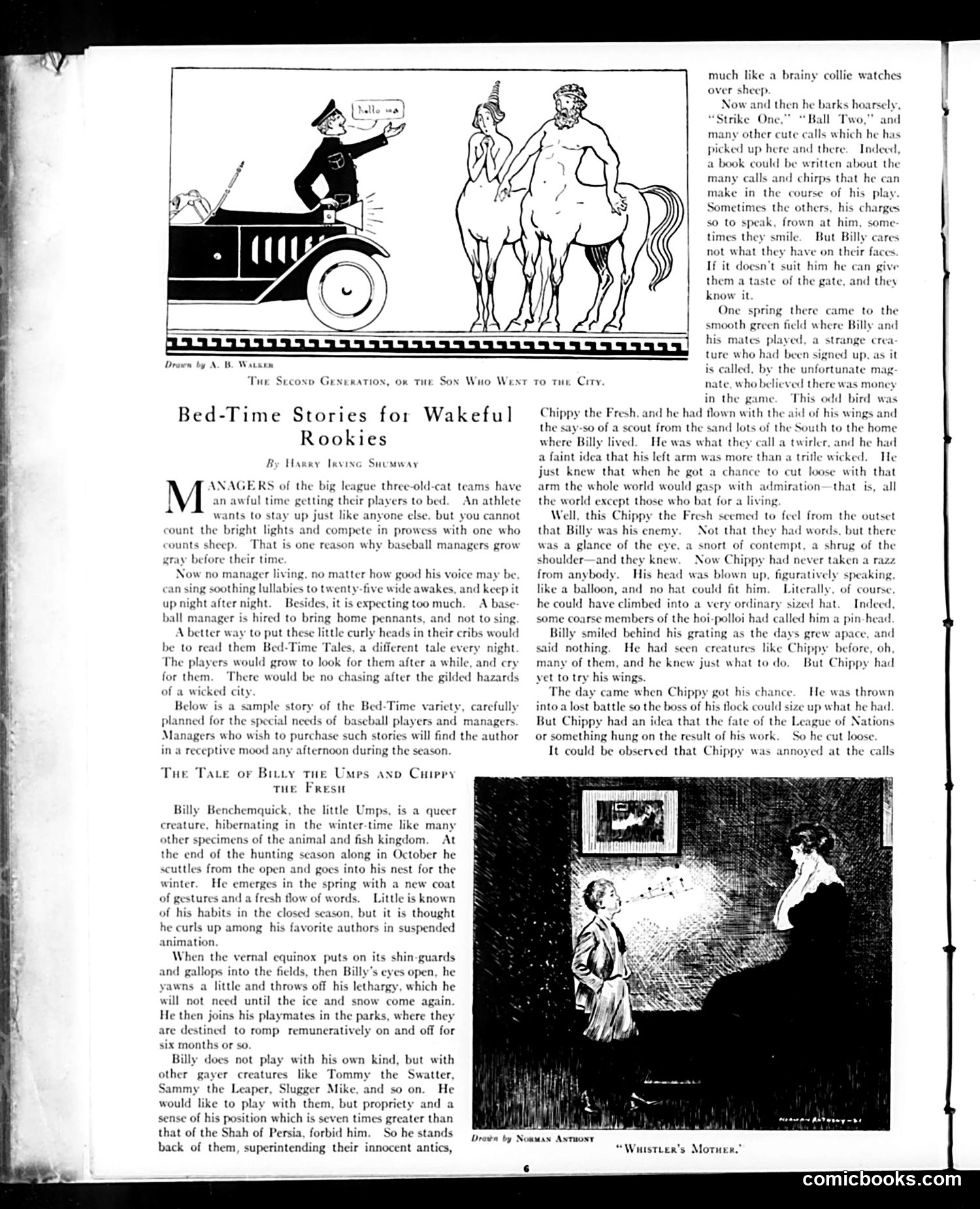
This page contains **"Bed-Time Stories for Wakeful Books,"** a humorous column by Harry Irving Shumway about baseball managers and their challenges keeping rowdy players focused. The **top cartoon** (drawn by A.B. Walker) shows "The Second Generation, or the Sons Who Went to the City"—depicting someone in a motorcar calling out to mounted riders, likely satirizing the contrast between modern urban life (automobiles) and rural/traditional pastimes (horseback riding). The "second generation" reference suggests social commentary on how younger Americans were abandoning country life for cities. The **main article** humorously describes Billy the Umps, an anthropomorphized creature inhabiting winter parks alongside other animals, using animal behavior as metaphor for baseball personalities and manager challenges. It's lighthearted sporting humor rather than political satire.
📄 Transcribed text from this page (OCR, searchable)
Machine-transcribed from the original scan — historical spelling and the odd misread are preserved.
much like a brainy collie watches over sheep. Now and then he barks hoarsely, “Strike One,” “Ball Two,” and many other cute calls which he has picked up here and there. Indeed, a book could be written about the many calls and chirps that he can make in the course of his play Sometimes the others, his charges so to speak, frown at him, some times they smile. But Billy cares not what they have on their faces. If it doesn’t suit him he can give them a taste of the gate, and they know it One spring there came to the smooth green field where Billy and Drawn by ABW Tne Secoxn Generation, ox tHe Sox Wuo West Bed-Time Stories for Wakeful Rookies Harry Invine Suusway ANAGERS of the big league three-old-cat teams have an awful time getting their players to bed. An athlete wants to stay up just like anyone else. but you cannot count the bright lights and compete in prowess with one who ints sheep. Th gray before their time Now no manager living. no matter how good his voice may be, can sing soothing lullabies to twenty-five wide awakes, and keep it up night after night. Besides, it is expecting too much. A base ball manager is hired to bring home pennants, and not to sing. \ better way to put these little curly heads in their cribs would be to read them Bed-Time Tales, a different tale every night The players would grow to look for them after a while, and ery for them. There would be no chasing after the gilded hazards tis one reason why baseball managers grow of a wicked city Below is a sample story of the Bed-Time variety, carefully planned for the special needs of baseball players and managers. Managers who wish to purchase such stories will find the author in a receptive mood any afternoon during the season. Tue Tare or Bitty tue Umes ano Cuppy THE FRresit Billy Benchemquick, the little Umps, is a qu creature, hibernating in the winter-time like many other specimens of the animal and fish kingdom. At the end of the hunting scason along in October he scuttles from the open and goes into his nest for the winter. He emerges in the spring with a new coat of gestures and a fresh flow of words. Little is known of his habits in the closed season, but it is thought he curls up among his favorite authors in suspended animation. When the vernal equinox puts on its shin-guards and gallops into the fields, then Billy’s eyes open, he yawns a little and throws off his lethargy, which he will not need until the ice and snow come again. He then joins his playmates in the parks, where they are destined to romp remuneratively on and off for six months or so. Billy does not play with his own kind, but with other gayer creatures like Tommy the Swatter, Sammy the Leaper, Slugger Mike, and so on. He would like to play with them, but propriety and a sense of his position which is seven times greater than that of the Shah of Persia, forbid him. So he stands back of them, superintending their innocent antics, Drown by » his mates played, a strange cr q ture who had been signed up, as it is called, by the unfortunate mag To THe Crry nate, who believed there was money in the g This odd bird was Chippy the Fresh, and he had flown with the aid of his wings and the say-so of a scout from the sand lots of the South to the home where Billy lived. He was what they call a twirler, and he had a faint idea that his left arm was more than a tritle wicked. He just knew that when he got a chance to cut loose with that arm the whole world would gasp with admiration—that is, all the world except those who bat for a living. Well, this Chippy the Fresh seemed to feel from the outset that Billy was his enemy t that they had words, but there was a glance of the eye, a snort of contempt, a shrug of the shoulder—and they knew. Now Chippy had never taken a razz from anybody. His head was blown up, figuratively: speaking, like a balloon, and no hat could fit him. Literally, of course. he could have climbed into a very ordinary sized hat. Indeed some coarse members of the hoi-polloi had called him a pin-head. Billy smiled behind his grating as the days grew apace, and said nothing. He had seen creatures like Chippy before, oh many of them, and he knew just what to do. But Chippy had yet to try his wings. The day came when Chippy got his chance. He was thrown into a lost battle so the boss of his flock could size up what he had But Chippy had an idea that the fate of the League of Nations or something hung on the result of his work. So he cut loose. It could be observed that Chippy was annoyed at the calls max ANTHONY “Wuistter’s Motuer.” — comicbooks.com