
A complete issue · 32 pages · 1921
Judge — May 28, 1921
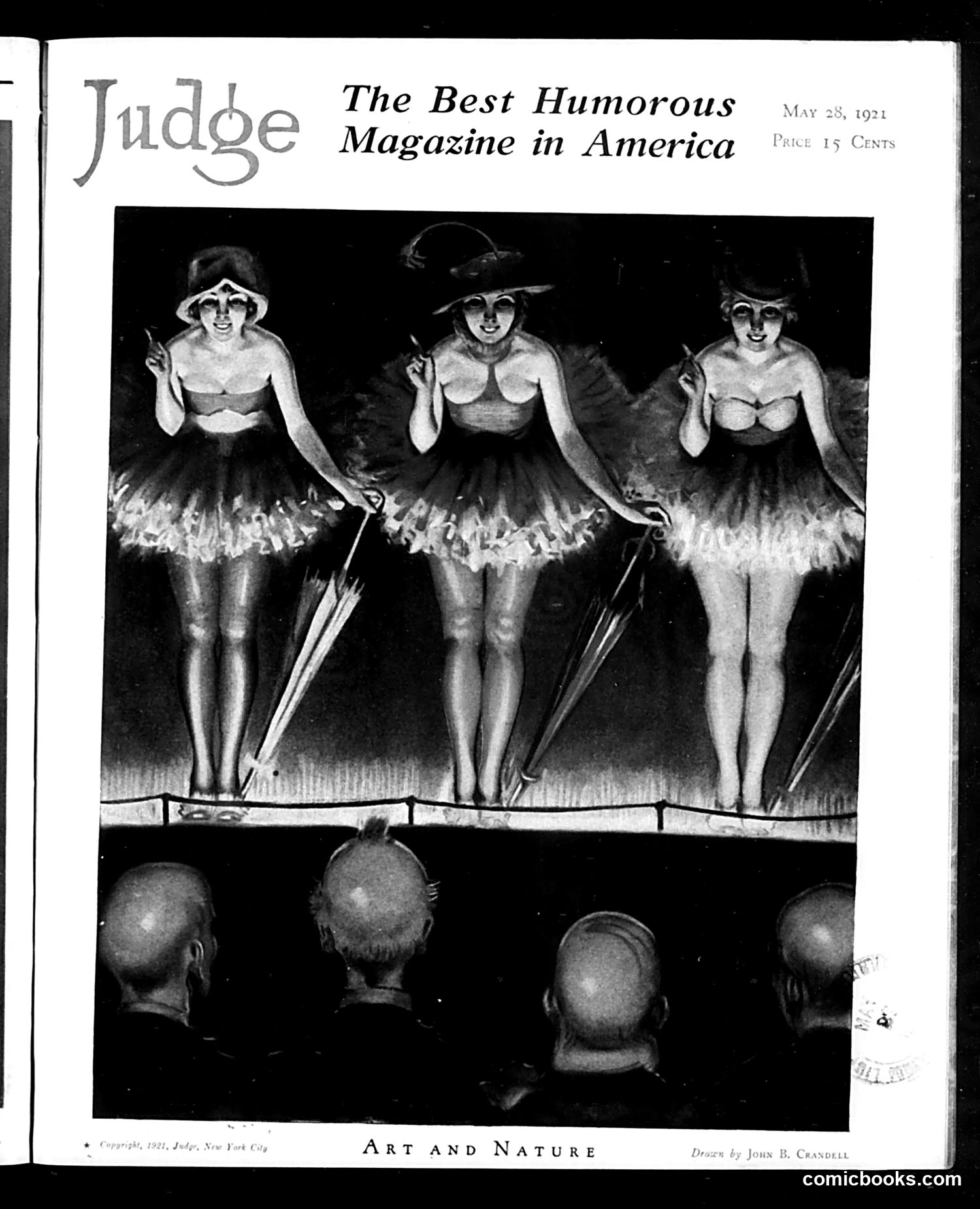
This cartoon satirizes the contrast between artistic performance and male audience reaction. The top panel shows three showgirls in theatrical costumes (tulle skirts, hats) posing with rifles—likely referencing popular Broadway revues of the 1920s that combined leggy dancers with military or exotic themes. The bottom panel depicts bald men viewing the performance from the audience, their heads rendered uniformly featureless and characterless. The satire appears to mock both the artificiality of staged "Art" (the costumed performers) and the undiscriminating male gaze ("Nature"—reduced to basic animal instinct). The title's contrast suggests the cartoon cynically comments on how theatrical spectacle exploits both performers and audience, reducing both to their most basic elements.
This page is primarily **promotional text** rather than political satire. It's an advertisement for *Judge* magazine itself, titled "Making the Clock Tick a Smile a Minute." The ornamental initial letter contains a **decorative illustration** (not a political cartoon), showing stylized figures in classical design. The text promotes *Judge*'s mission: publishing humor to improve national morale. It claims the magazine carefully curates submissions—"weeding out" sad material—to deliver quality comedy through sketches, jokes, and illustrations. The copy emphasizes *Judge* as a "household necessity" for "alert Americans" and encourages subscriptions at 225 Fifth Avenue, New York City. **No specific political figures or events are referenced.** This is essentially a house advertisement pitching the magazine's value proposition to potential subscribers.
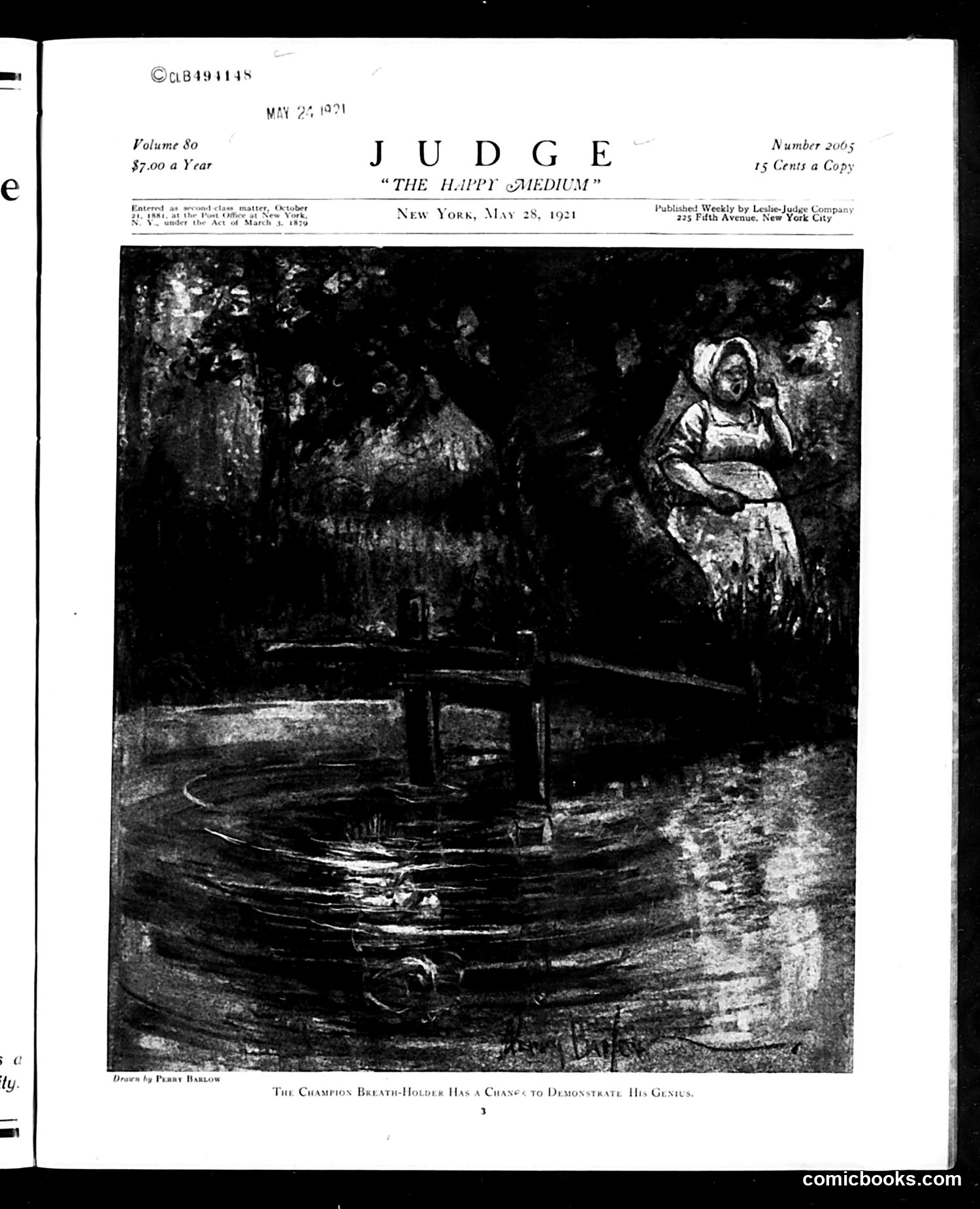
The page features a single illustration titled "The Champion Breath-Holder Has a Chance to Demonstrate His Genius," drawn by Cesare Barron. The image shows a figure in period dress standing beside what appears to be a well or water source, suggesting a holding-one's-breath challenge or stunt. The satire likely references a contemporary "breath-holding" performer or publicity seeker—a popular novelty act during the 1920s. The cartoon mocks the promotional spectacles and dare-devil stunts that entertained the public during this era. Without additional context identifying the specific "champion" referenced, the precise target remains unclear, but it exemplifies Judge's typical satire of public fads and showmanship.
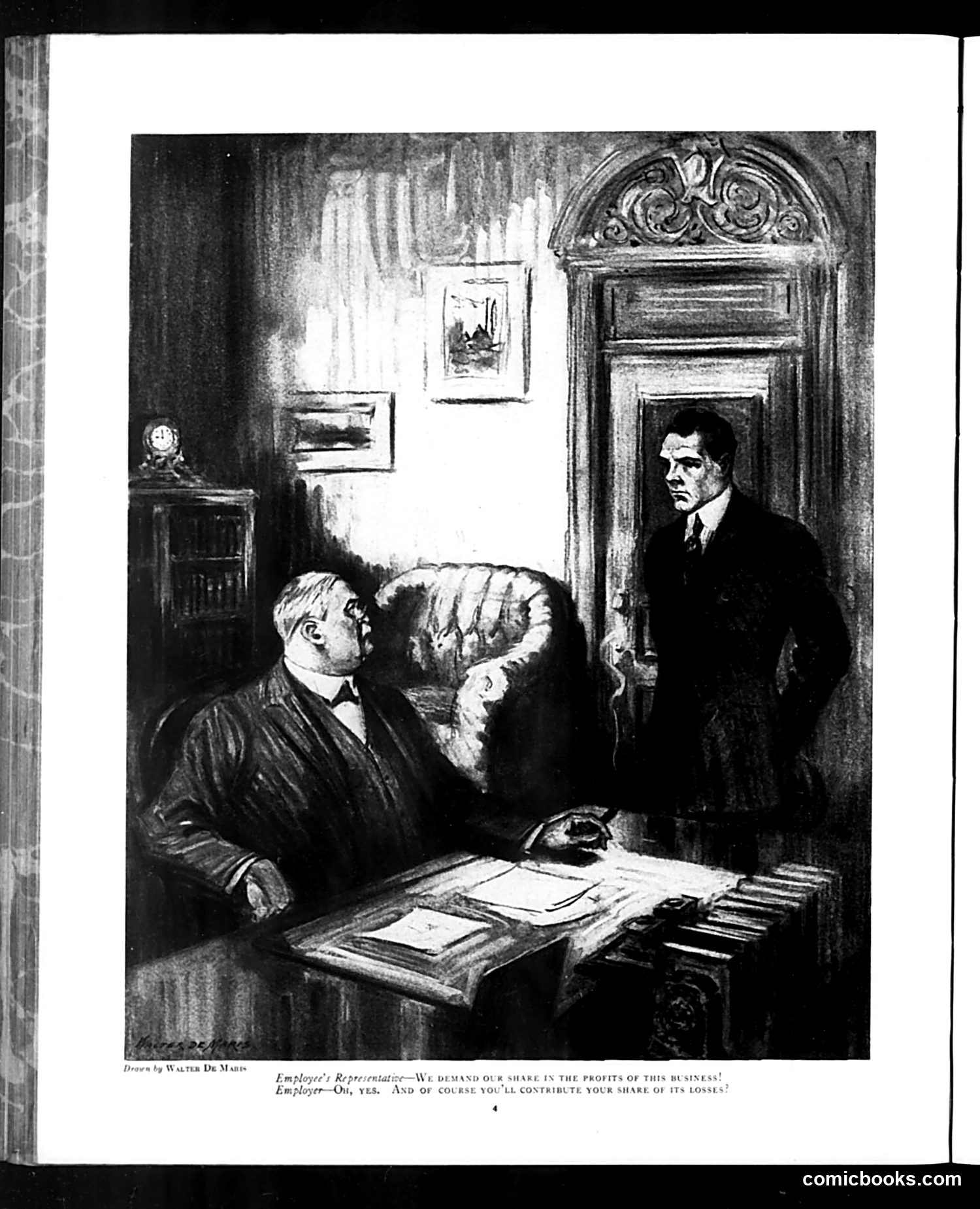
This cartoon depicts a labor dispute in an office setting. An employee's representative (center, gesturing) confronts an employer (seated left) while a second man (standing right, observing) witnesses the negotiation. The dialogue reveals the satire's point: the representative demands the company share profits from the business, and when the employer agrees, immediately adds that employees must also contribute to covering losses. The cartoon mocks labor negotiations of the early 20th century, satirizing employers who eagerly accept profit-sharing proposals but hastily qualify them by demanding workers bear financial risk equally. The joke highlights the one-sided nature of such "compromise" agreements—workers gain nothing while accepting downside exposure. The artist is Walter De Maris.
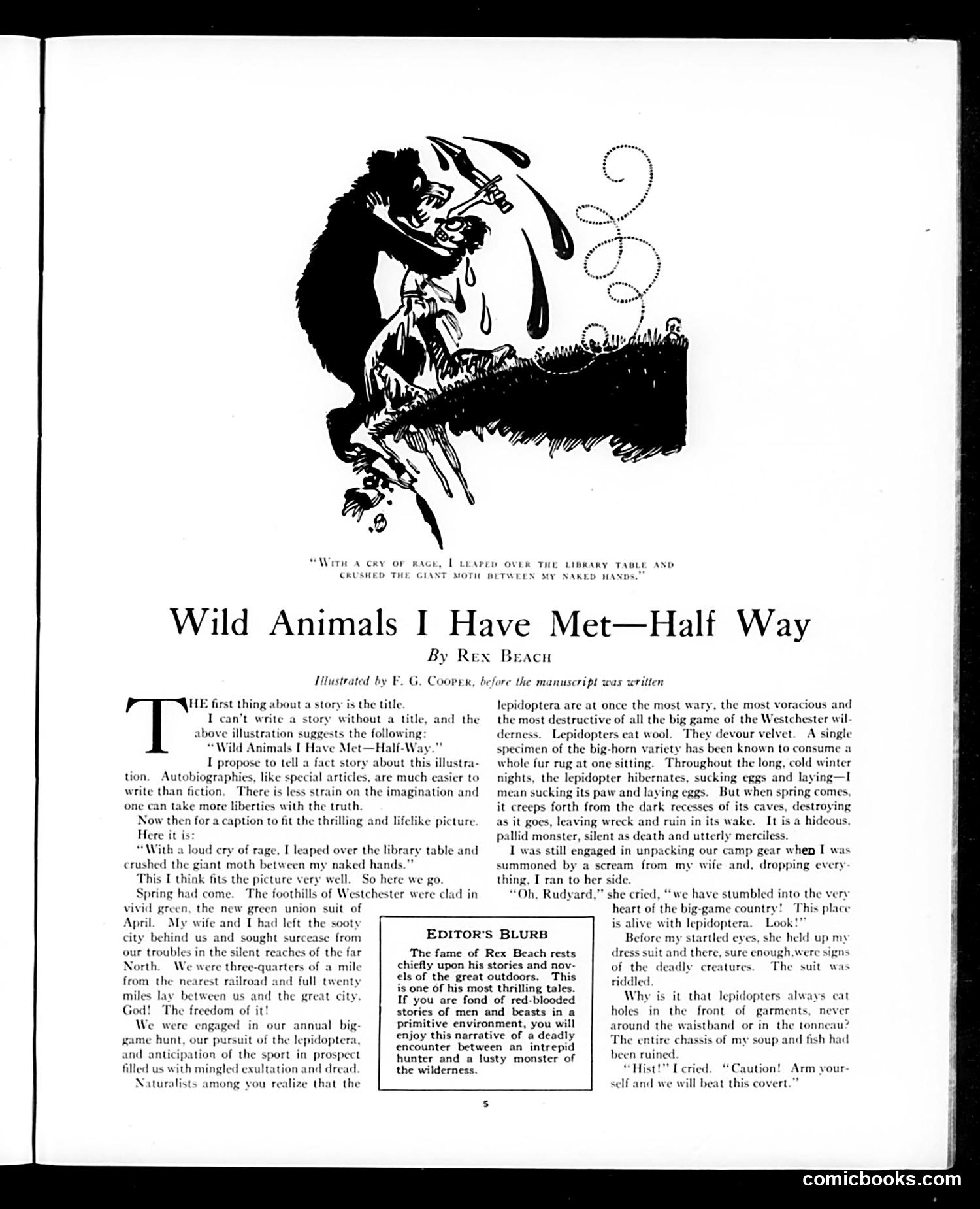
This page features an article titled "Wild Animals I Have Met—Half Way" by Rex Beach, illustrated by F. G. Cooper. The content is **not political satire** but rather adventure fiction. The illustration depicts a dramatic encounter: a man fighting a large moth. The accompanying caption reads: "With a cry of rage, I leaped over the library table and crushed the giant moth between my naked hands." The article describes Beach's supposedly true encounters with dangerous wildlife, particularly lepidoptera (moths and butterflies) that allegedly consume wool and destroy clothing and gear. The narrative framing presents this as autobiographical adventure storytelling rather than satire. The "Editor's Blurb" validates Beach's reputation for thrilling tales of hunters in wilderness settings. This is **straight adventure journalism**, not political commentary.
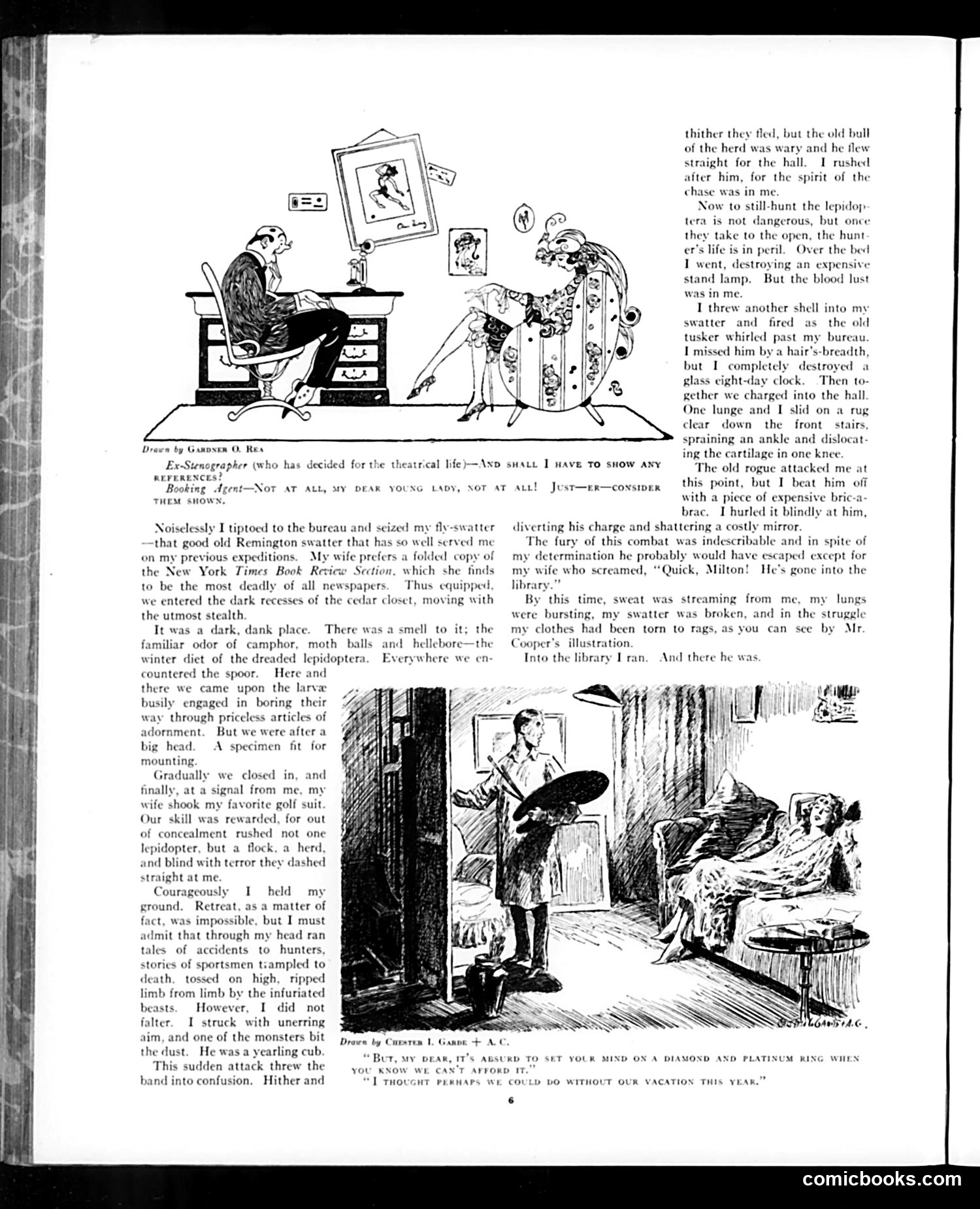
This page contains two unrelated items: **Top illustration** (by Gluyas O. Rex): A theatrical sketch showing a man at a desk with theatrical pictures, and a woman in an elaborate costume covered in decorative items. The caption indicates this is about someone deciding to pursue theatrical life, with a note that "references" should be considered—apparently a commentary on someone choosing show business despite practical concerns. **Bottom illustration** (by Cesare I. Gambe and A.C.): Shows a domestic scene where a man appears to be discussing vacation plans with a woman in bed. The caption jokes about affording a diamond and platinum ring when the couple "can't afford" a vacation—satirizing middle-class financial priorities and conspicuous consumption over practical needs. Both are mild social satire about impractical spending and life choices.
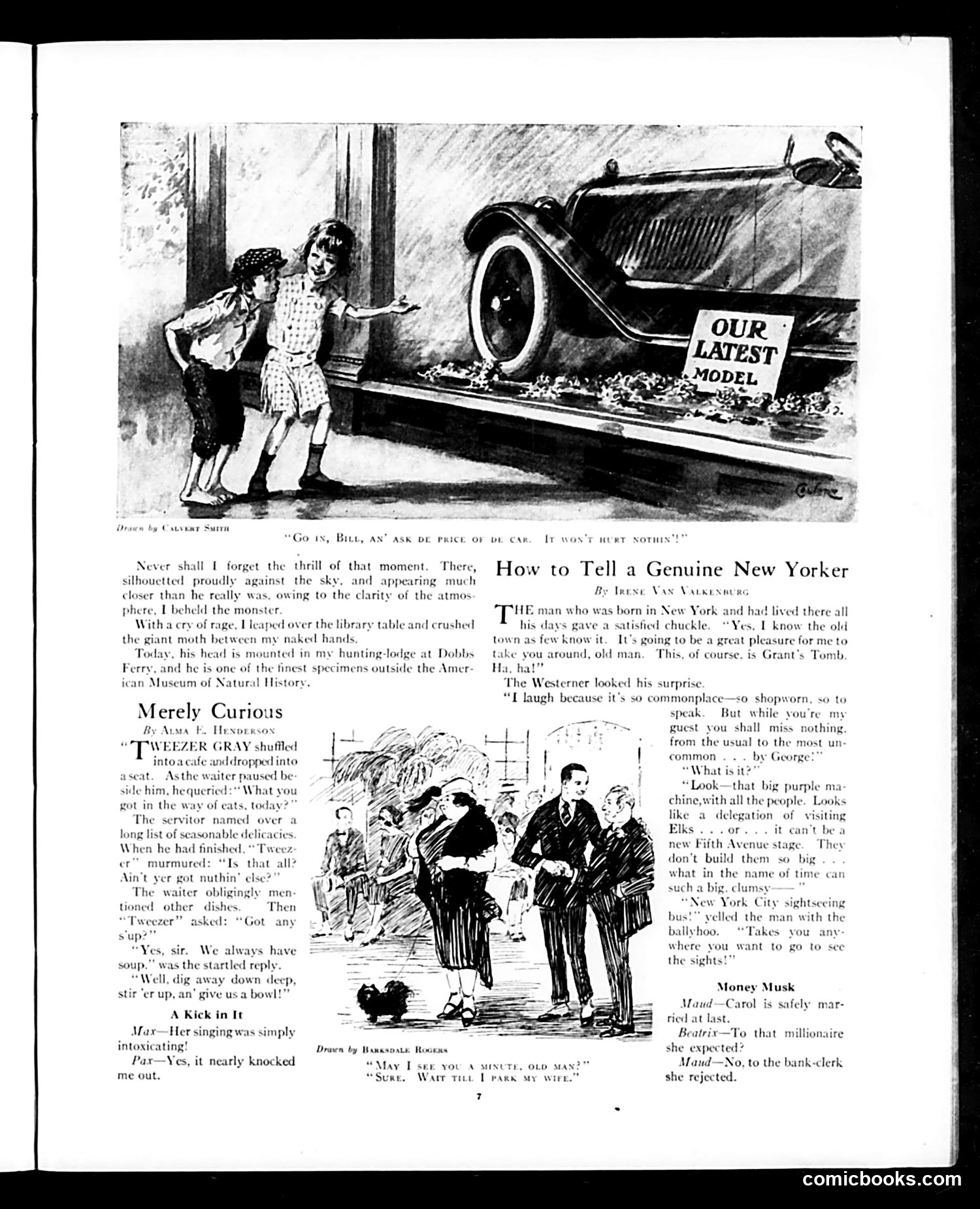
This page contains several short humorous pieces typical of early 20th-century American satire: **Top cartoon**: Shows children amazed by a car labeled "Our Latest Model," with dialogue in exaggerated working-class accent: "Go on, Bill, an' ask de price of de car. It won't hurt nothin'!" This mocks both the novelty of automobiles and working-class speech patterns. **"How to Tell a Genuine New Yorker"**: A New York native smugly explains the city to a visiting Westerner, pointing out a sightseeing bus and claiming it represents authentic New York culture. The satire targets New York boosterism and provincial pride—the native mistakes a tourist attraction for something genuinely local. **Other brief pieces** ("Merely Curious," "A Kick in It," "Money Musk") are simple joke vignettes with ethnic or class-based humor typical of the era. The overall tone reflects Judge's satirical approach to American social types, regional differences, and commercialism of the period.
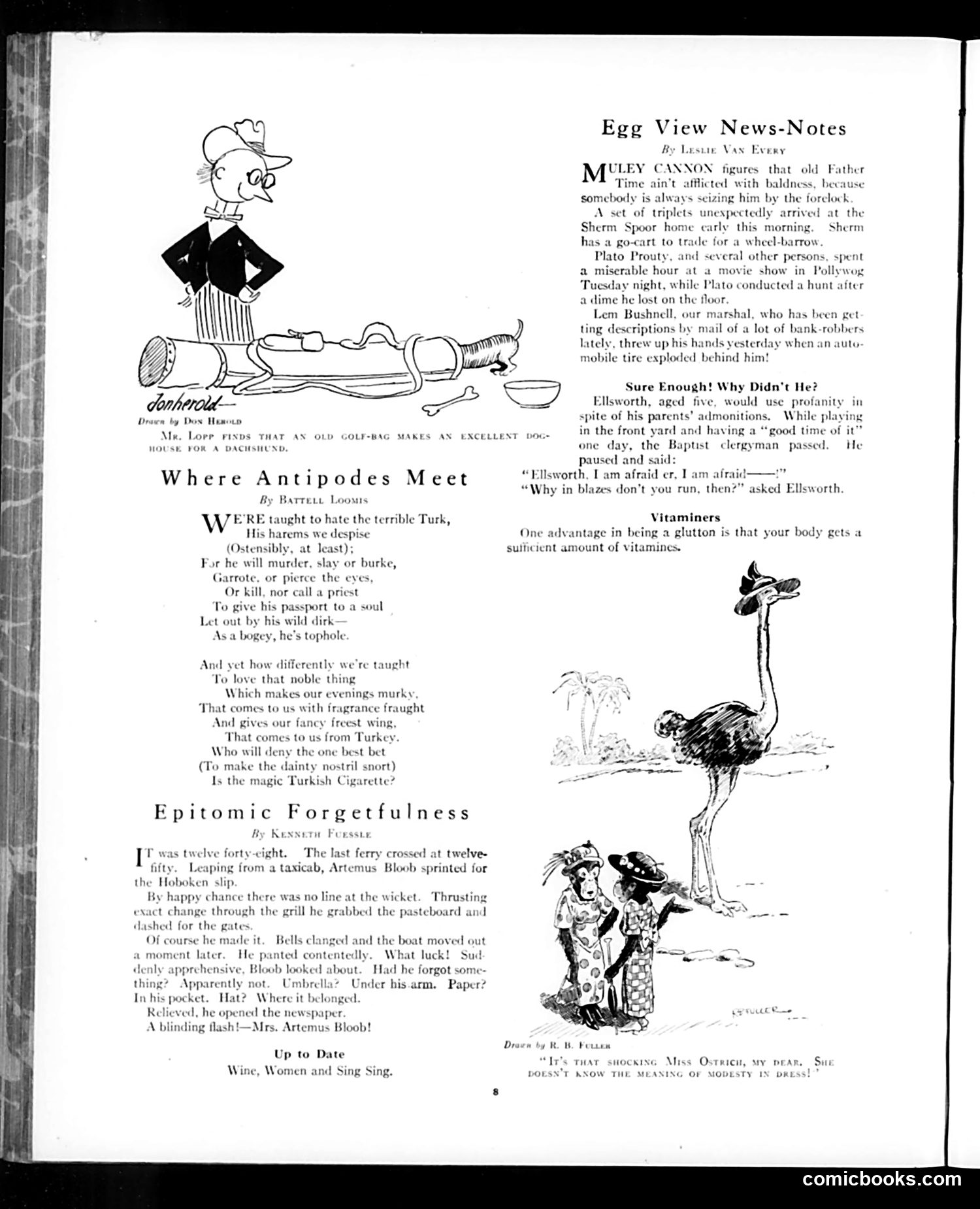
This page contains several satirical pieces typical of early 20th-century American humor: **"Where Antipodes Meet"** is a poem mocking Western hypocrisy about Turkey. It contrasts Western moral condemnation of Ottoman brutality with enthusiasm for Turkish cigarettes—suggesting Americans happily consume Turkish products while despising Turkish culture. The "magic Turkish Cigarette" represents this contradiction. **"Epitomic Forgetfulness"** is a comedic short story about a man named Artemus Bloob who frantically catches a ferry, relieved he hasn't forgotten anything—until he opens the newspaper and sees his wife's name, implying he's forgotten *her*. **"Egg View News-Notes"** appears to be local gossip or humor about a small town, mentioning characters like "Muley Cannon" and "Lem Bushnell." **The cartoon** at top shows a woman with a golf bag, captioned as "an excellent house for a dachshund"—a visual pun about the dog's long, narrow body fitting inside the bag. These pieces reflect Judge's typical format: combining visual gags, satirical verse, and humorous anecdotes targeting contemporary American society and consumer culture.
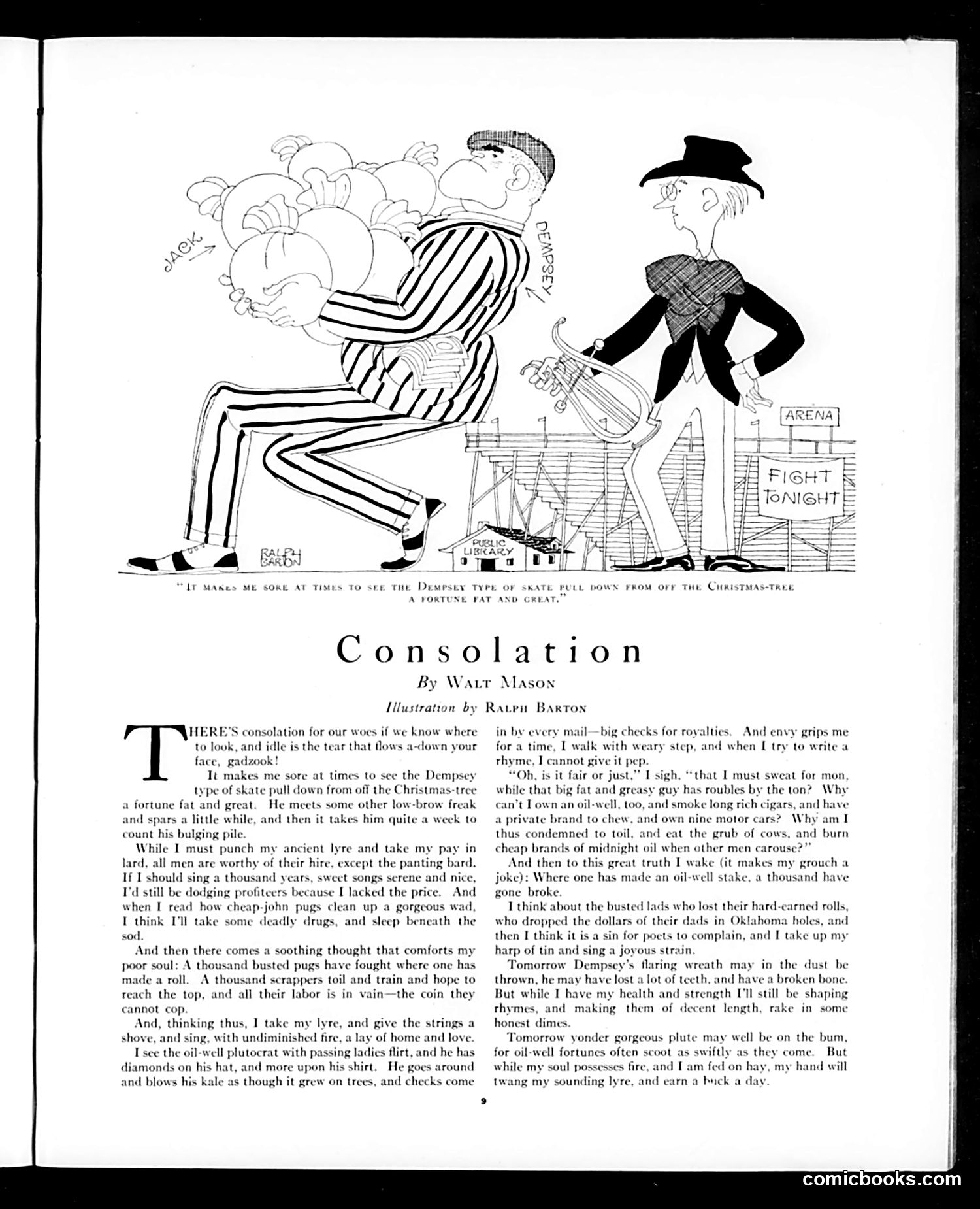
This poem by Walt Mason, illustrated by Ralph Barton, expresses working-class resentment toward wealthy people who earned money easily through boxing or oil speculation during the early 20th century. The cartoon depicts two figures: a muscular "Dempsey type" boxer (likely referencing champion Jack Dempsey) who "pulled down a fortune fat and great" from fighting, and an oil-well plutocrat. The poem's narrator—a struggling poet—envies their wealth while performing honest but poorly-paid labor. The satire's point: while the wealthy enjoy undeserved riches, most people who attempt such ventures fail. The consolation offered is that hardship is universal among the poor, and virtue (honest work, art, integrity) sustains the soul better than ill-gotten gains. It's essentially arguing *moral superiority* compensates for financial inferiority—a common anxiety-soothing device during America's Gilded Age wealth disparity.
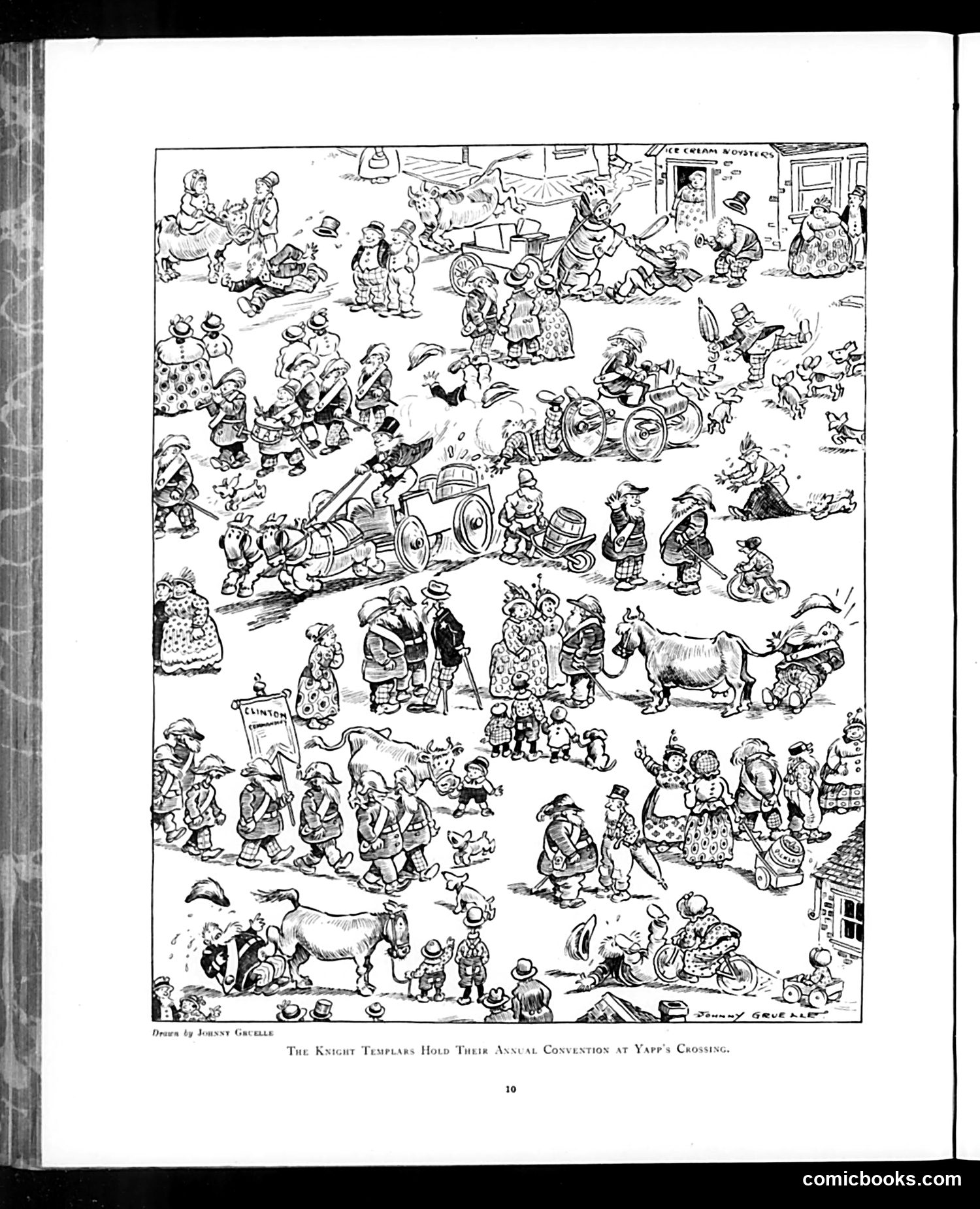
This is a crowded satirical scene by Johnny Gruelle depicting what appears to be a fraternal organization's gathering. The title references "Knight Templars" (a Masonic degree organization) meeting at "Yapp's Crossing," likely a real or fictional location. The cartoon mocks such conventions through chaotic detail—numerous figures in period dress, children, animals (goats, a cow), musicians with drums, and various comedic activities scattered throughout. The satire likely targets the pretentiousness or secrecy of fraternal orders, portraying their "annual convention" as a disorganized carnival rather than dignified gathering. The densely-packed composition with multiple humorous vignettes was typical of Judge magazine's style, inviting readers to find jokes in the details rather than a single focal point.
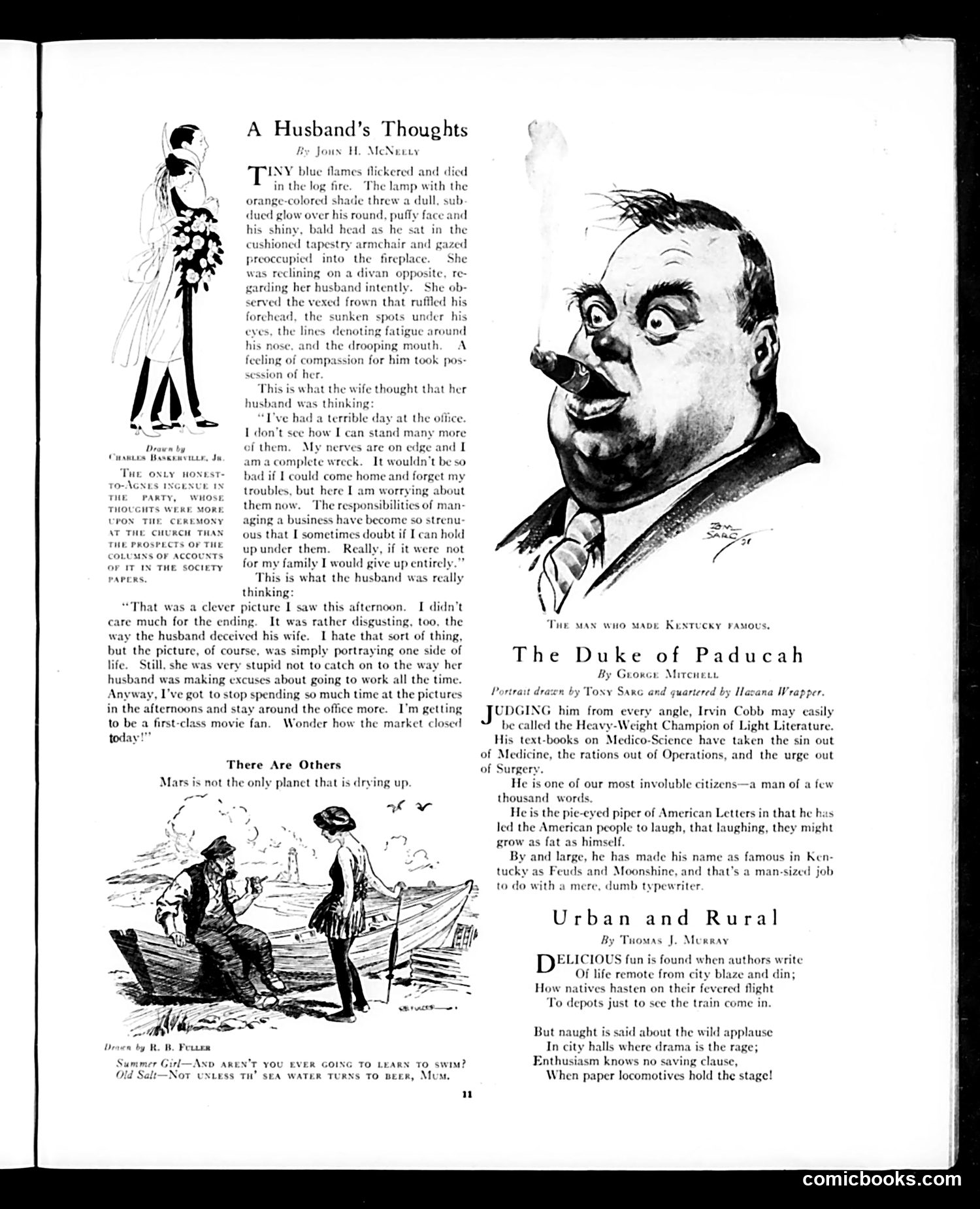
**"A Husband's Thoughts"** satirizes the gap between what wives *think* their husbands are worrying about versus reality. The wife imagines her exhausted husband brooding over work stress and family responsibility. Instead, he's actually preoccupied with a movie he saw—specifically, he's mentally critiquing the plot about a husband deceiving his wife, while ironically making his own excuses to spend time at picture shows rather than at the office. The joke is the husband's obliviousness to his own hypocrisy. **"There Are Others"** is a brief visual gag about Mars drying up (a contemporary astronomical theory), with a caption suggesting that husbands are also "drying up"—likely a joke about masculine vitality or usefulness declining. **"The Duke of Paducah"** profiles Irvin Cobb, a real Kentucky humorist and writer known for light comedic literature. It's largely promotional/complimentary rather than satirical. **"Urban and Rural"** contrasts rural people's simple excitement about seeing trains with city audiences' manufactured enthusiasm for theatrical spectacle.
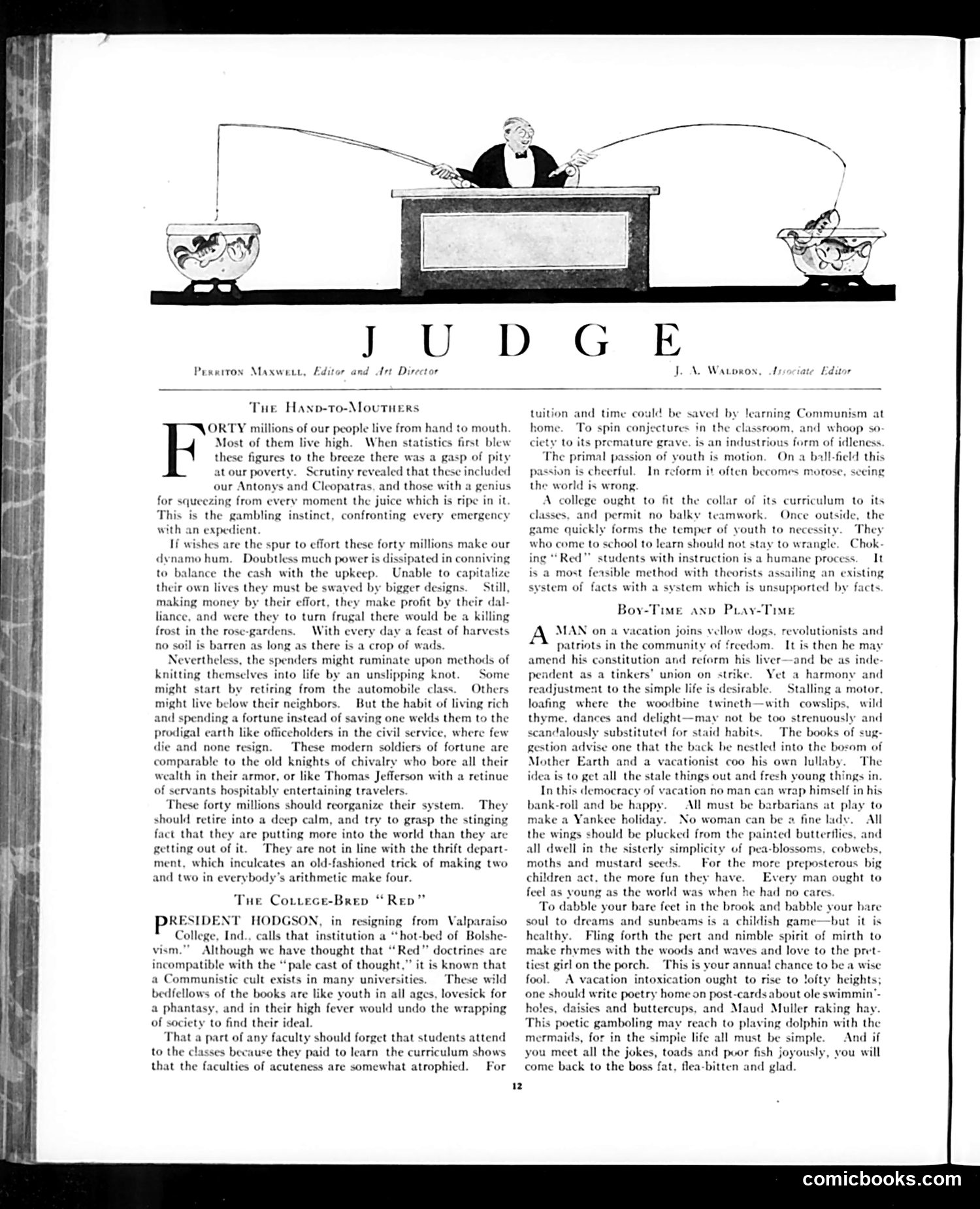
This page contains editorial commentary rather than cartoons. The masthead illustration shows a judge figure balancing scales, symbolizing editorial judgment. The three articles criticize American social and political problems: 1. **"The Hand-to-Mouthers"** attacks the poor and working class for living beyond their means, spending frivolously rather than saving—blaming personal habits for poverty rather than systemic issues. 2. **"The College-Bred 'Red'"** discusses President Hodgson's resignation from Valparaiso College, claiming communism exists in universities. The piece dismisses student radicals as idealistic youth intoxicated by fantasy, arguing they should be "choked" with instruction rather than engaged intellectually. 3. **"Boy-Time anno Play-Time"** (partially visible) appears to discuss vacation and leisure. The overall tone is conservative, mocking both poverty and student political activism. This reflects early 20th-century anxieties about communist influence in American colleges during the post-WWI Red Scare period.
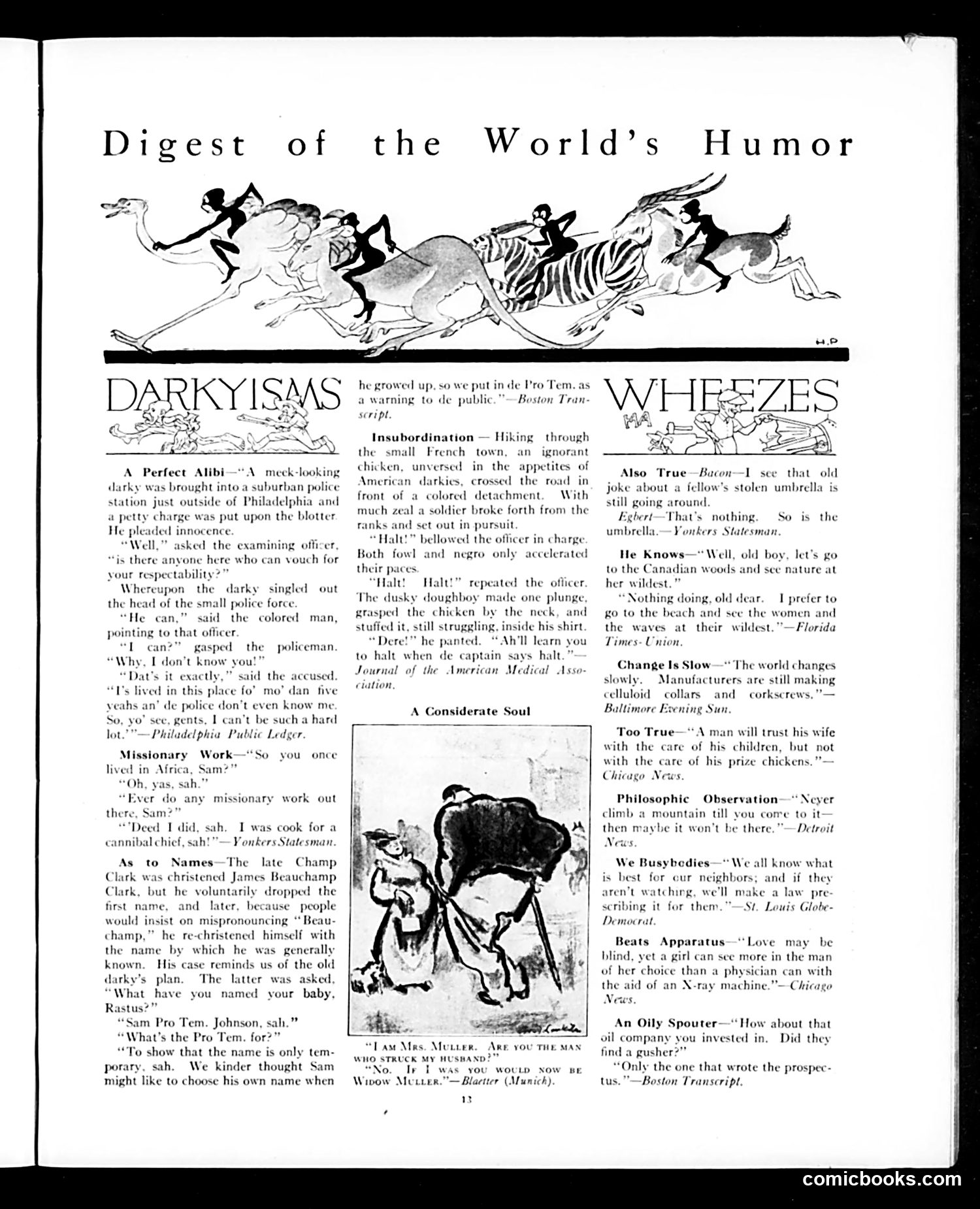
This page collects brief humorous anecdotes organized under thematic headers. The satire targets several subjects: **Racial stereotyping**: Multiple jokes rely on caricatured dialect and behavior of African Americans ("darkies," "doughboy"), reflecting the casual racism of the era. The "Perfect Alibi" and "Insubordination" pieces use phonetic spelling and stereotype compliance for comedic effect. **Social commentary**: "A Perfect Alibi" satirizes policing and respectability; the unnamed Black man's logic—that living invisibly in a town for five years proves his innocence—mocks the contradictions of segregated society. **General satire**: Other items mock married life ("Too True"), oil speculation fraud ("An Oily Spouter"), and institutional hypocrisy ("We Busybodies"). The centerpiece illustration depicts people riding various animals chaotically—visual metaphor for the humorous chaos contained within. The page reflects Judge's approach: mixing lowbrow ethnic humor with sharper social criticism, though the racial content is now deeply uncomfortable.
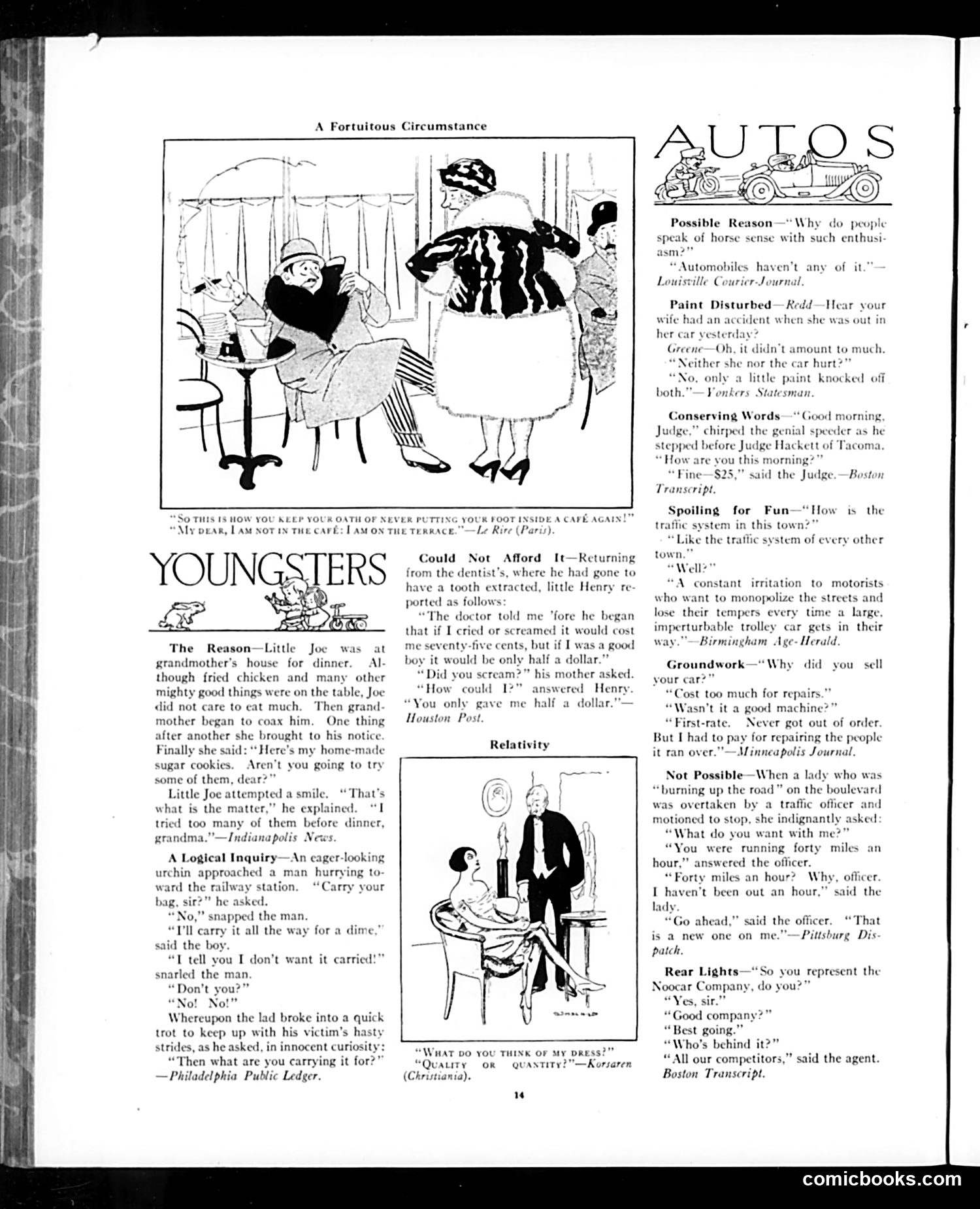
This page from *Judge* magazine presents several short humorous anecdotes satirizing early 20th-century American social behaviors and the emerging automobile culture. **Key targets:** 1. **"A Fortuitous Circumstance"** (top): A woman caught violating her oath never to enter a café again—she's on the terrace instead, technically not "inside." 2. **"Youngsters"** section: Children outwitting adults through literal interpretations (Joe ate too many cookies beforehand; a porter persists despite rejection). 3. **Automobile humor**: Multiple jokes mock motorists' reckless driving ("burning up the road"), vanity about repairs, and traffic conflicts with trolley cars—reflecting anxieties about cars as new, dangerous technology. 4. **"Relativity"**: A quip about judging women's dresses by quality versus quantity (appearance). The satire targets human foolishness, parental naiveté, and the chaotic early automobile era when traffic rules were unclear and drivers' entitlement was already considered comical.
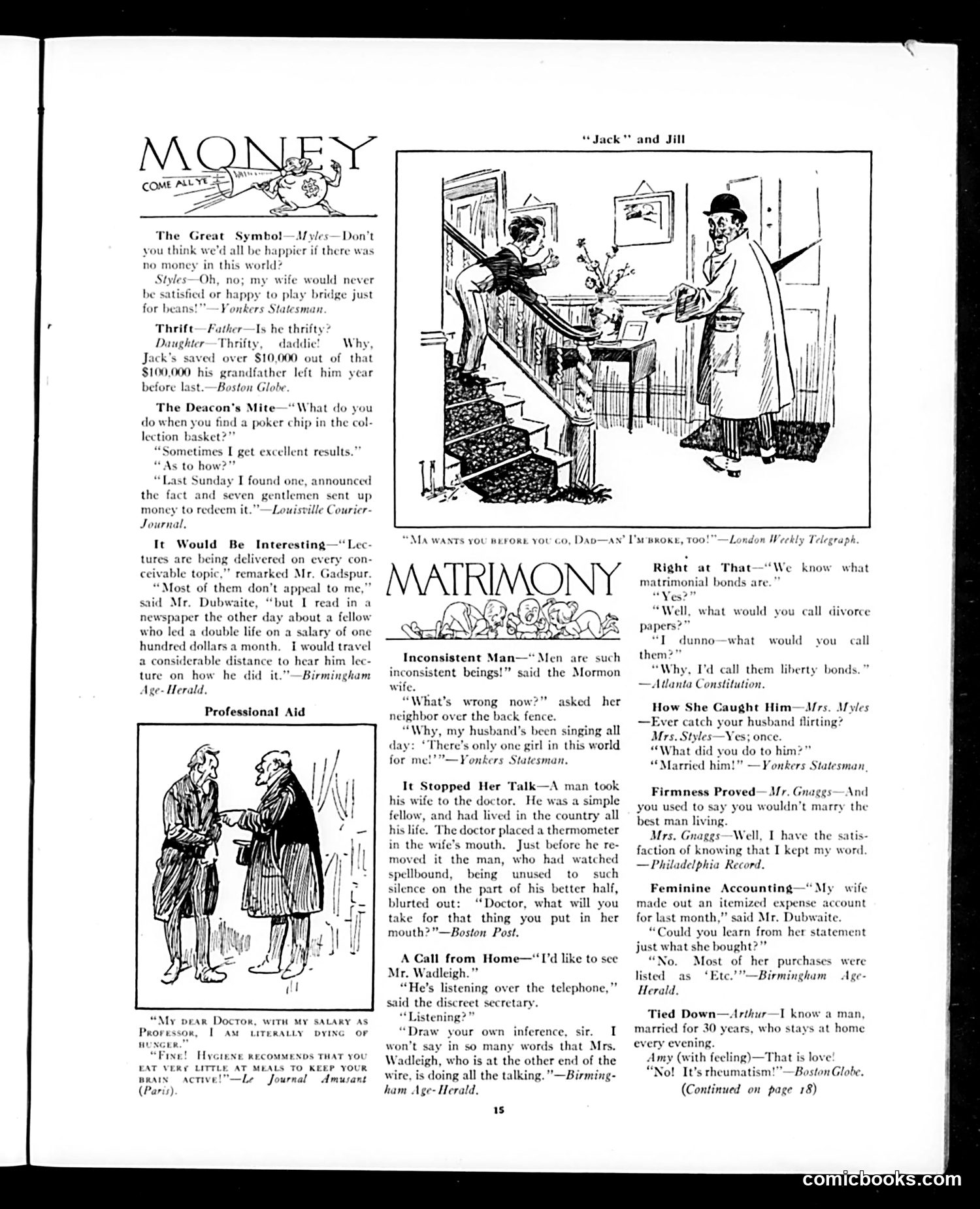
This page from Judge presents humorous short jokes and anecdotes about marriage, money, and social behavior—typical satirical content for the era. The cartoons satirize domestic life and gender relations. "Jack and Jill" depicts a man arriving home to find his wife entertaining another man, with the caption suggesting marital infidelity concerns. "Professional Aid" shows a doctor-patient exchange mocking hypochondria or economic desperation. The text jokes target predictable targets: wives' spending habits, marital discord, and the gap between courtship romance and married reality. Several anecdotes mock rural simplicity (the country husband amazed by a thermometer) and feminine chattiness (Mrs. Wadleigh monopolizing the telephone). The "Matrimony" section includes wordplay on bonds and divorce, and jokes about women who claim they'd never marry yet do—suggesting satire of female inconsistency or changing standards. Overall, the page reflects early 20th-century Judge's formula: genteel mockery of middle-class marriage, gender stereotypes, and social pretension, aimed at an educated readership.
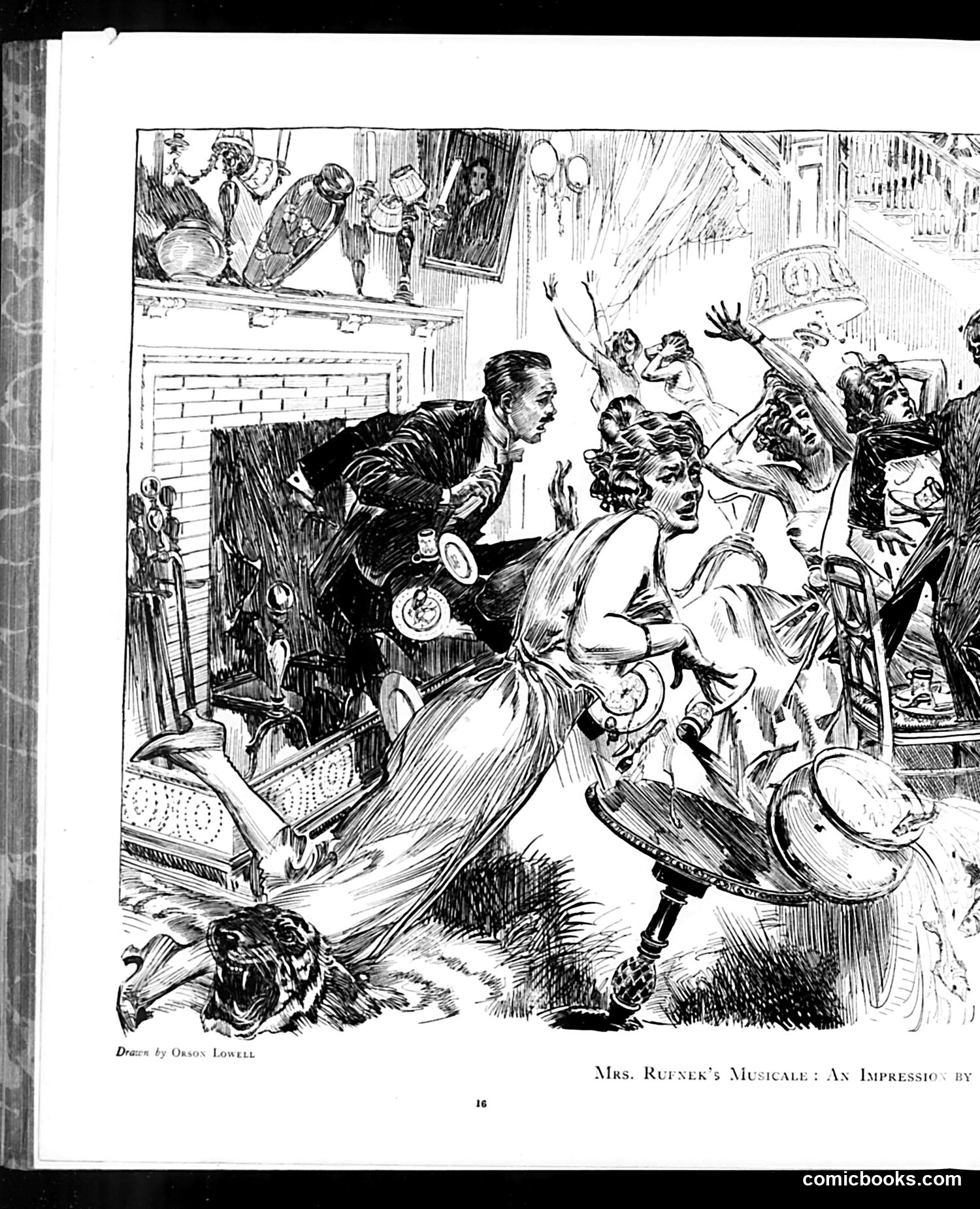
This cartoon by Orson Lowell satirizes a chaotic musical performance or social event. A well-dressed man (likely a musician or conductor) appears flustered, gesturing wildly amid pandemonium. Women in elaborate dress dominate the scene, seemingly performing or socializing with exaggerated theatrical energy. A dog in the foreground adds to the comic disorder. The satire targets upper-class social gatherings, particularly amateur musical performances by wealthy women ("musicales" were fashionable salon events). The joke seems to be that Mrs. Rufnek's event is absurdly disorganized and overwrought—the performers lack talent or restraint, the attendees are more interested in spectacle than music, and the whole affair devolves into ridiculous chaos. This mocks pretentious high-society entertainment culture.
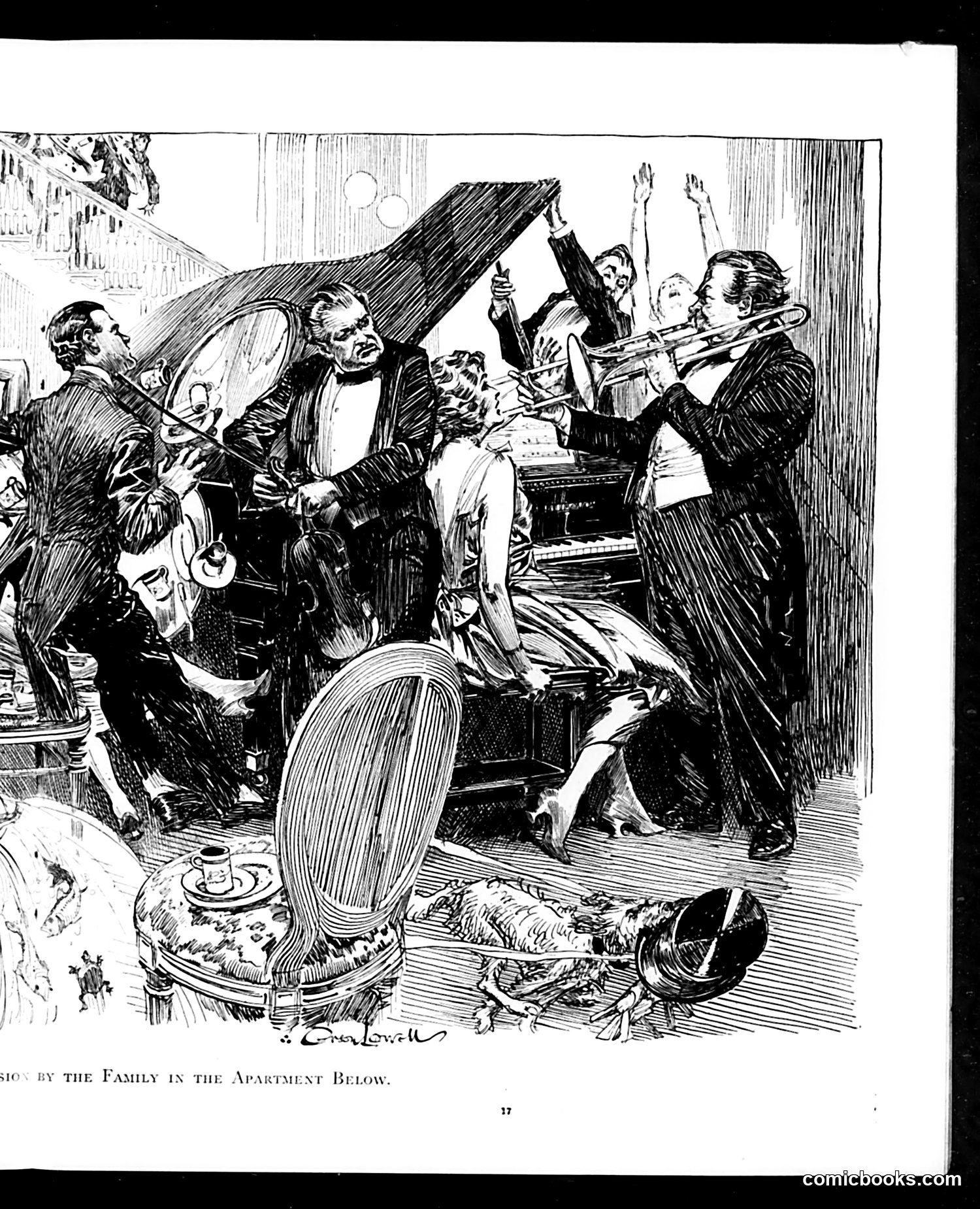
This is a satirical illustration signed by Cesare Lionelli depicting a chaotic domestic scene. Well-dressed men in formal attire appear to be performing music (visible instruments include what looks like a trombone and drum) while a woman sits elevated, seemingly conducting or directing them. The scene depicts musical chaos—figures have their arms raised in exaggerated gestures, and the overall composition suggests disorder and comedic disruption. The partial caption references "THE FAMILY IN THE APARTMENT BELOW," indicating this likely satirizes noise complaints between neighbors—a common urban social friction point. The joke appears to target either pretentious amateur musicians or the disruption caused by domestic musical performances to those living nearby. The formal dress combined with the chaotic musicmaking suggests mockery of aspiring or pompous amateur performers.
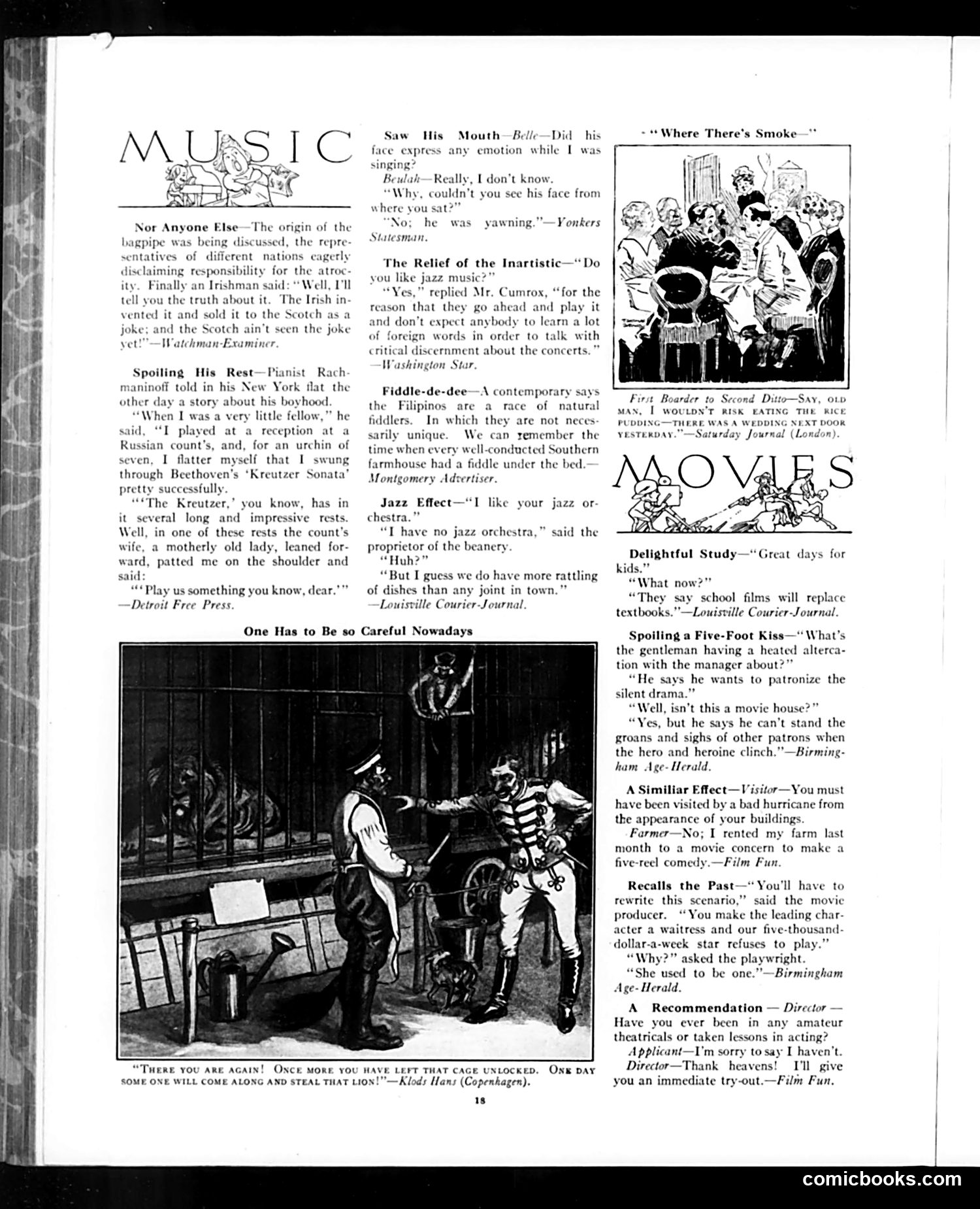
This page from *Judge* collects brief humorous anecdotes about contemporary American life, circa early 1900s. The main cartoon depicts a zookeeper repeatedly forgetting to lock a lion's cage—a visual joke about carelessness in the modern age. The text snippets satirize contemporary culture: - **Musical snobbery**: A pianist's childhood story mocks pretentious classical music audiences who interrupt performances - **Jazz and modernism**: Multiple jokes dismiss jazz music and "artistic" pretension, celebrating practical American attitudes - **Silent film culture**: Several anecdotes mock the emerging movie industry—patrons disturbed by audience reactions during emotional scenes, and filmmakers' casual attitudes toward actors - **National stereotypes**: An Irish joke blames Scotland for the bagpipe; a comment about Filipino "fiddlers" references racial stereotyping The humor assumes readers familiar with Rachmaninoff, classical music conventions, and the nascent film industry. The underlying satire gently mocks both highbrow artistic pretension and the chaos of modern American popular entertainment.
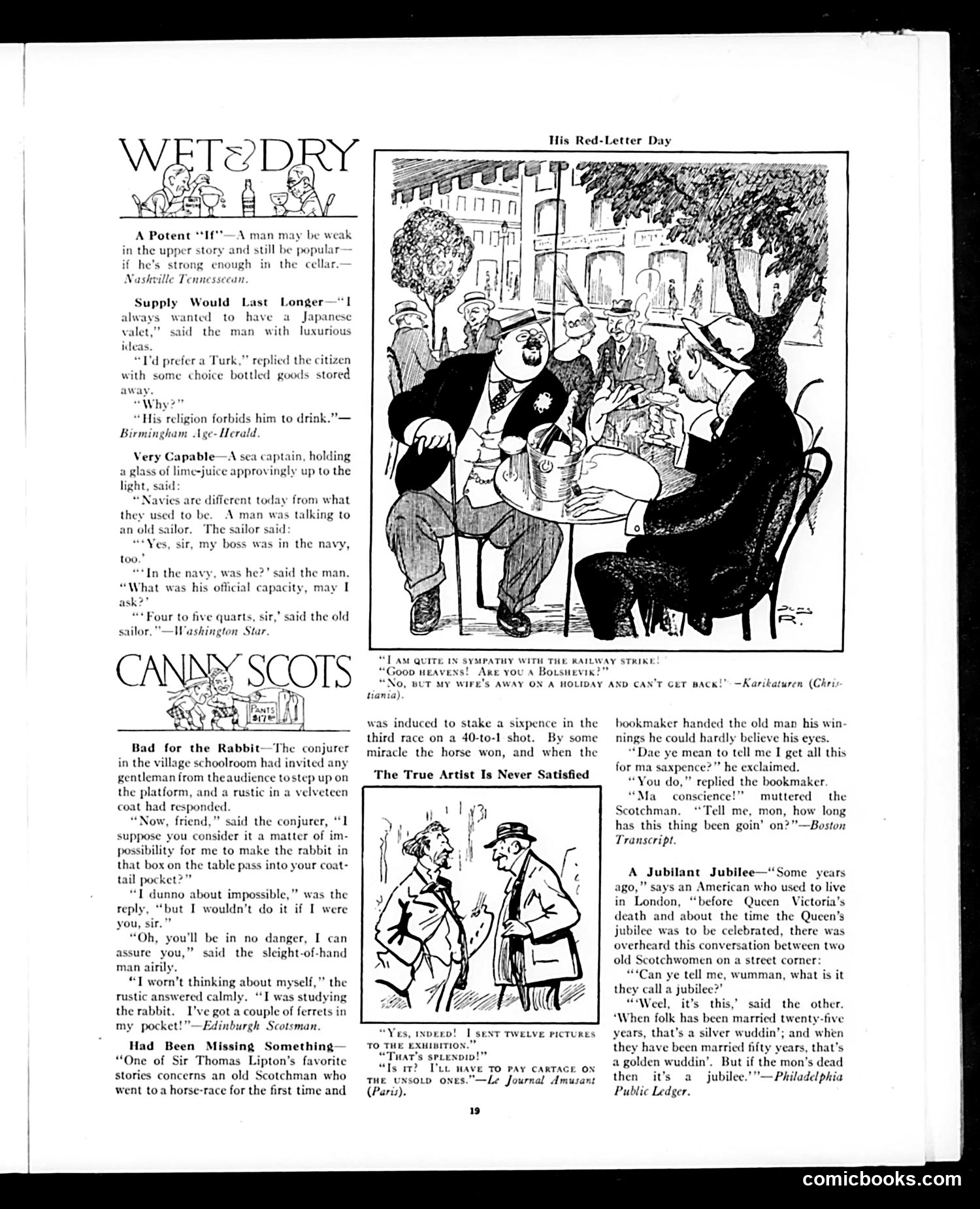
This page from Judge magazine contains several brief humorous anecdotes satirizing social attitudes of the era (likely early 1900s): **Main themes:** - **Alcohol culture**: Multiple jokes reference drinking and bootleggers, reflecting Prohibition-era anxieties. One quip mocks a man wanting a Japanese valet for his "cellar" (hidden liquor stash); another jokes about preferring a Turkish servant whose religion forbids drinking. - **Class and pretension**: The humor often targets working-class figures trying to appear sophisticated or their innocent misunderstandings of upper-class life. - **Gender roles**: A cartoon shows a man happy about his wife being away on holiday during a railway strike—implying domestic complaints. The cartoons use exaggerated facial expressions and dress typical of the era's satirical illustration style. The humor is gentle, relying on wordplay and situational comedy rather than sharp political critique. Overall, the page reflects period preoccupations with drink, propriety, and social station.
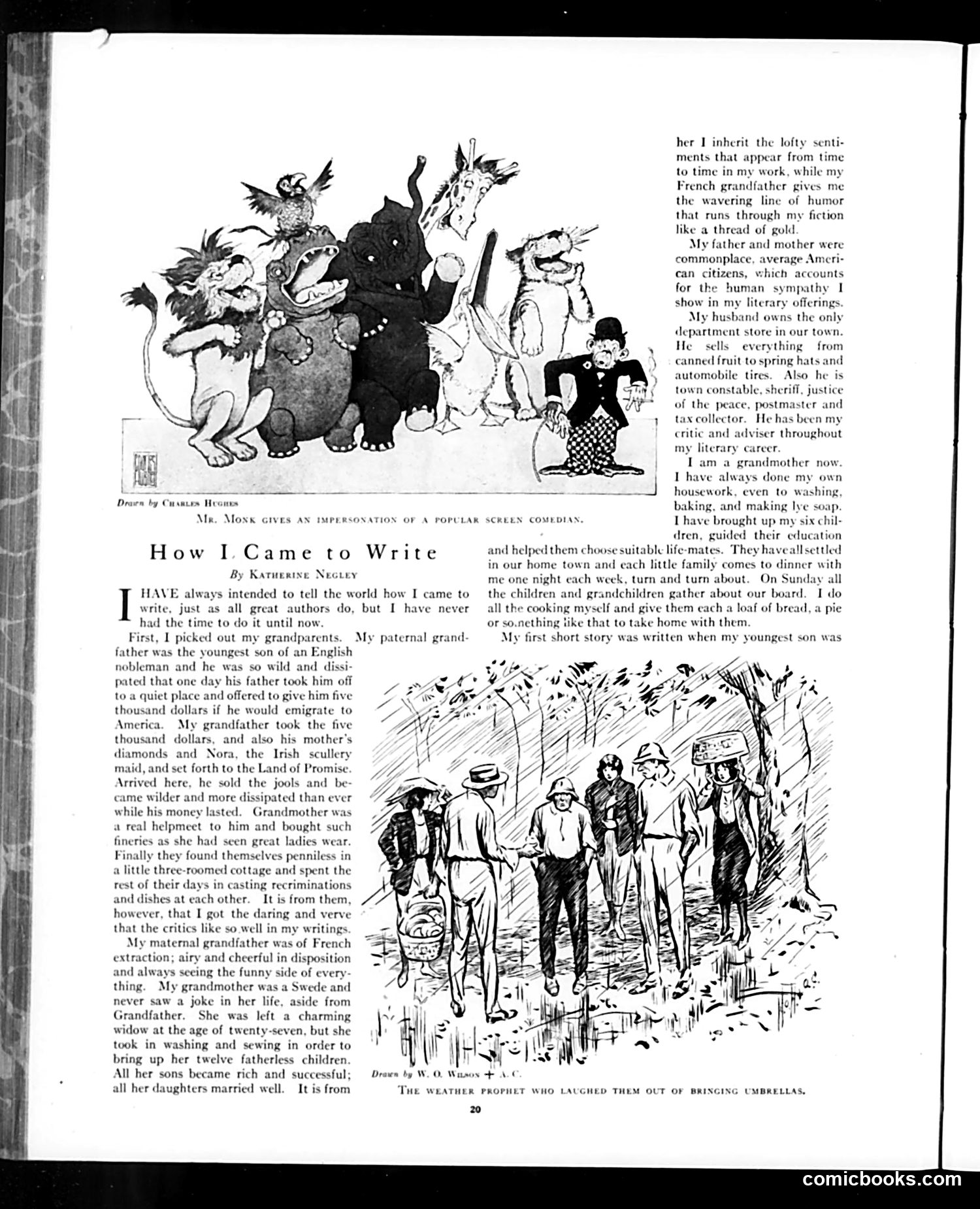
This page contains **two distinct pieces**: an autobiographical essay by Katherine Negley about her literary influences, and two cartoon illustrations. **The Charles Hepworth cartoon** (top) depicts "Mr. Moxk" impersonating a popular screen comedian—likely referencing silent film comedy stars of the era. The exaggerated animal characters and physical comedy suggest vaudeville-influenced humor. **The W.O. Wilson cartoon** (bottom) shows men caught in rain without umbrellas, titled "The Weather Prophet Who Laughed Them Out of Bringing Umbrellas." This satirizes someone (a weather predictor or charlatan) whose overconfidence or false predictions caused practical embarrassment. **Negley's essay** humorously traces her literary sensibility to colorful ancestors: a dissolute English nobleman, a thrifty Irish immigrant grandmother, and a cheerful French grandfather. She credits her "daring," "verve," and humor to this heritage—a common literary trope of her era attributing character to bloodlines. The piece is lighthearted domestic memoir framed as creative autobiography.
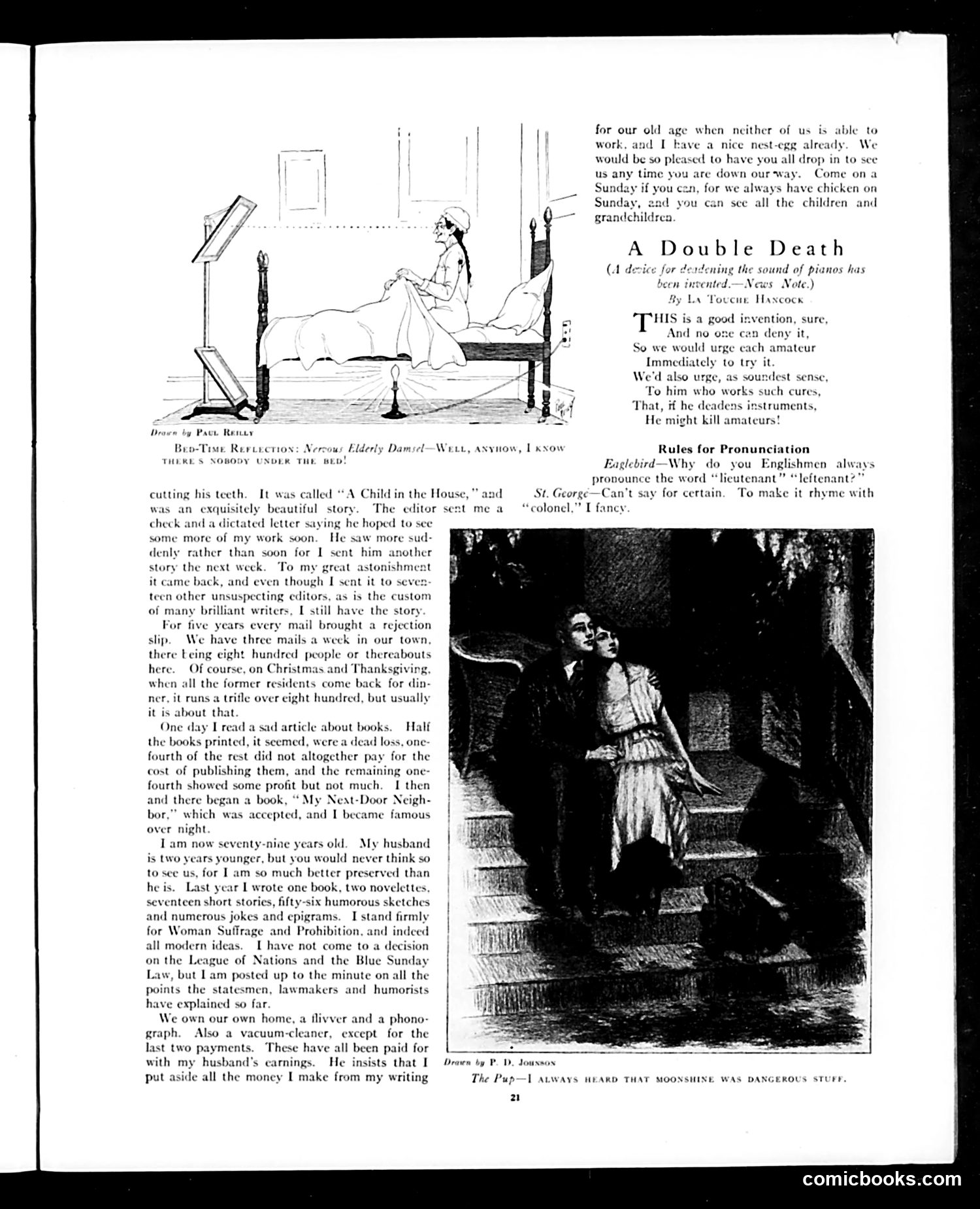
This page contains two distinct pieces of satire: **Top Section**: A first-person essay by an elderly female writer recounting her publishing struggles and current life. The satire targets literary rejection and the difficulty of breaking into publishing—she endured five years of rejections before success. The humor lies in her boasting about her productivity at seventy-nine while her husband looks worse despite being younger, and her confidently opining on modern issues (women's suffrage, Prohibition) while admitting ignorance on others. **"A Double Death"**: A short comic poem mocking a new invention that deadens piano sound. The joke: if the device successfully silences instruments, it would "kill amateurs"—suggesting amateur musicians are so terrible that eliminating their noise would be merciful. This targets the common annoyance of unskilled amateur musicians. **Lower Section**: A brief exchange about English pronunciation quirks (why "lieutenant" sounds like "leftenant"), followed by a cartoon caption about moonshine being dangerous, likely referencing Prohibition-era bootlegging. The page satirizes publishing, amateur musicianship, and dialect humor typical of early 20th-century American magazines.
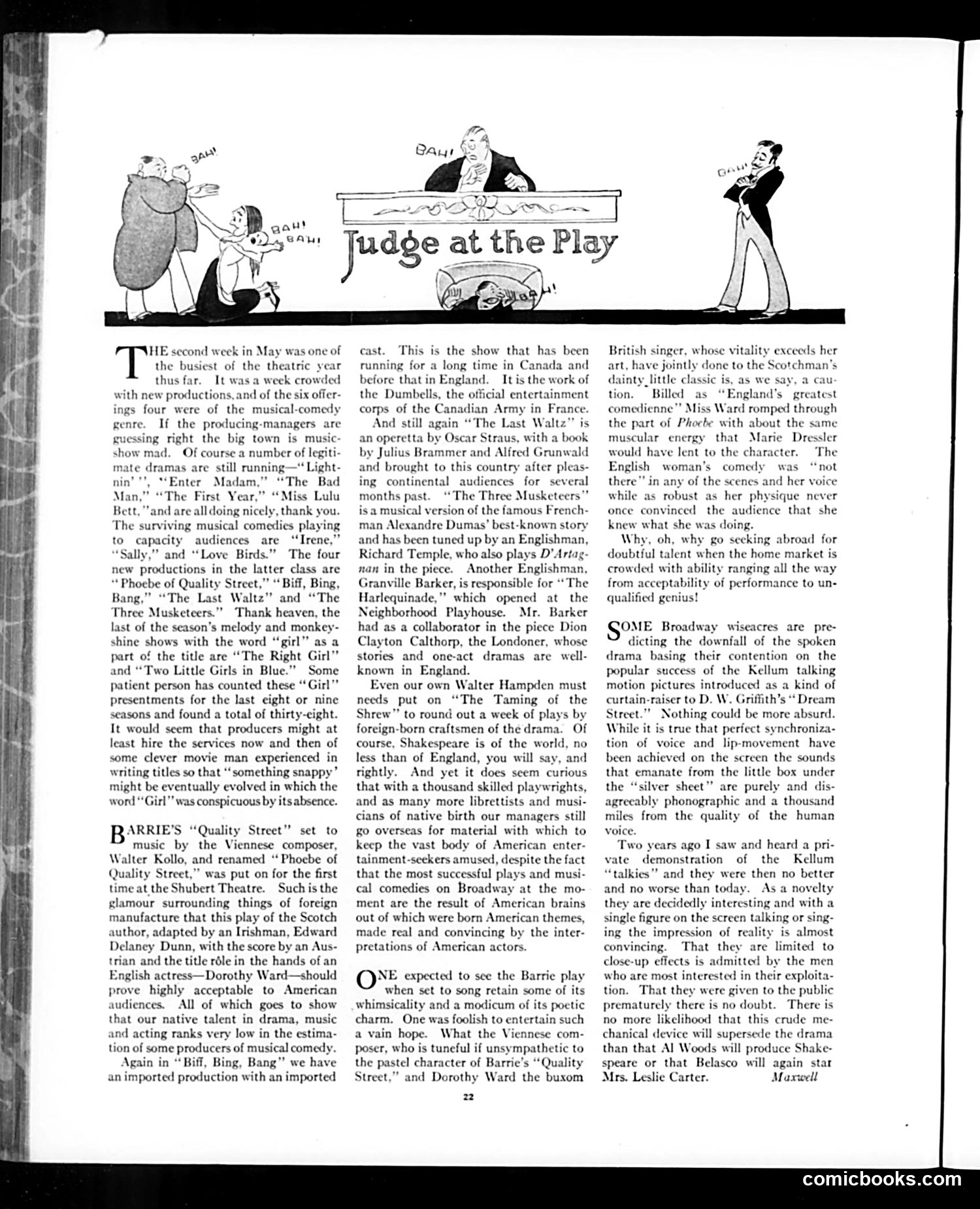
This theater review critiques Broadway's May season, illustrated with cartoon judges awarding ratings ("BAHL!" and "GOOD!"). The satire targets American theater producers' preference for **imported European productions** over homegrown American talent. The author ironically notes that while Broadway's **most successful shows use American themes and actors**, producers still import plays from England, France, Austria, and Canada—often adapted by foreign creators. Examples include "Phoebe of Quality Street" (Scottish play by Austrian composer) and "The Last Waltz" (Continental operetta), while even American actor Walter Hampden revives Shakespeare rather than new American drama. The complaint is distinctly **nationalist**—why do American producers distrust American playwrights, musicians, and actors when American-created works demonstrably succeed? The cartoon judges mock this backwards logic, suggesting producers should recognize native talent's proven worth.
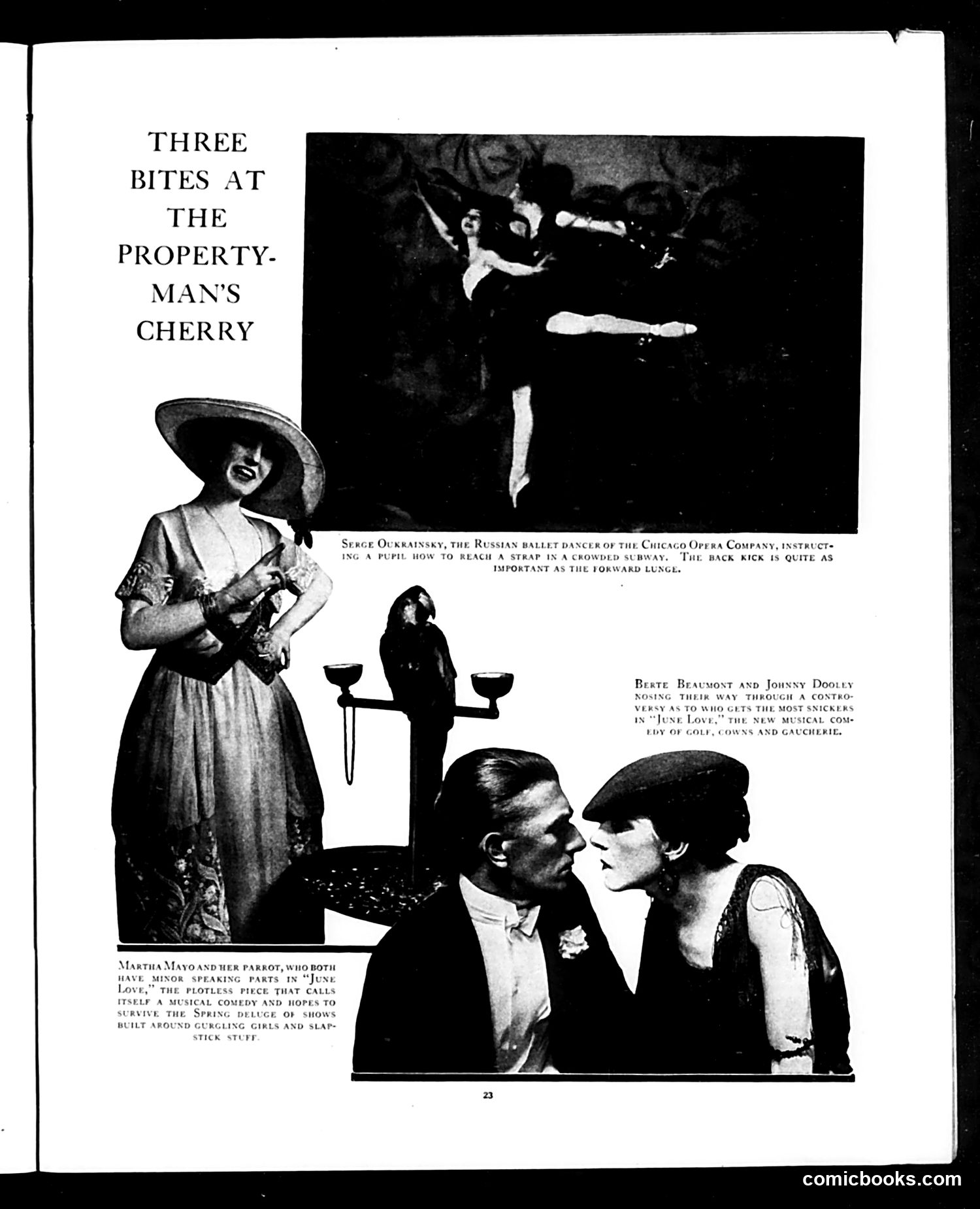
This Judge page satirizes a Broadway musical called "June Love" through three separate vignettes mocking its production and cast. The top image shows Russian ballet dancer Serge Oukrainsky from the Chicago Opera Company, satirizing how classical ballet technique is being applied to trivial musical-comedy situations (teaching subway etiquette). The middle scene depicts actors Beate Beaumont and Johnny Dooley squabbling over who receives the most comedic attention in the show—poking fun at petty backstage rivalries. The bottom panel features Martha Mayo and her parrot, both minor cast members, mocking how the production relies on gimmicks (trained animals, "gurgling girls") rather than actual plot to survive the competitive spring theater season. The title's "three bites" suggests taking multiple shots at the show's weak foundation and desperate casting choices.
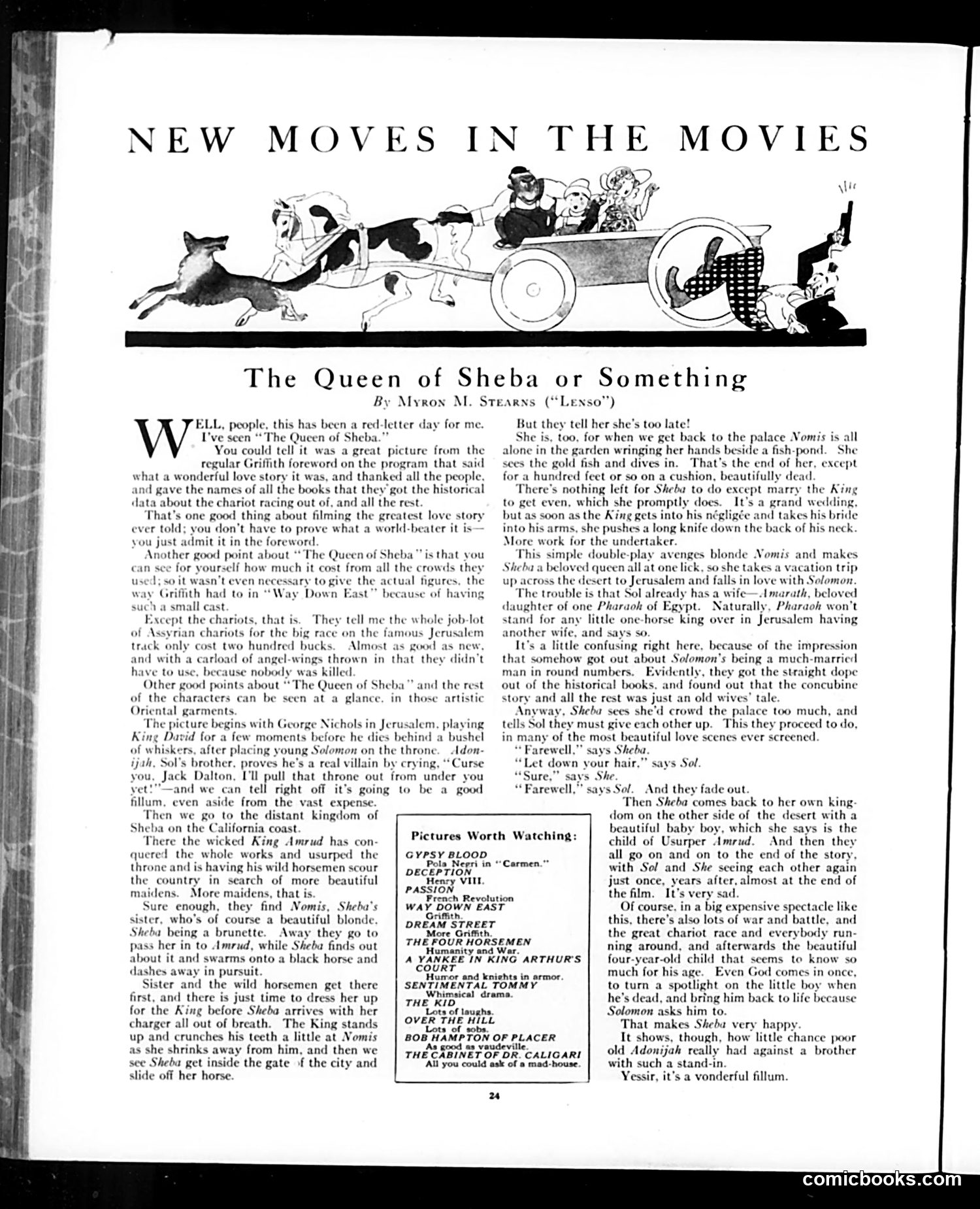
This is a movie review by Myron M. Stearns ("Lexso") mocking the epic biblical film *The Queen of Sheba*. The satire targets the pretensions of big-budget silent cinema, particularly D.W. Griffith's productions. Key targets: **The spectacle-over-substance critique**: Stearns ridicules how filmmakers justify expensive productions through lengthy preambles and credits rather than actual quality. He notes the $200 chariots and "carload of angel-wings" wasted on crowd scenes. **Melodramatic plotting**: The convoluted love triangle (Sheba → Nomis → Solomon → Amarath) and absurd motivation (Sheba kills the King then leaves Solomon) are presented as typical Hollywood excess. **Historical pretension**: The film claims authenticity through "historical data" while producing obviously ridiculous dialogue ("I'll pull that throne out from under you yet!"). **Cheap exoticism**: "Artistic Oriental garments" stand in for actual production values. The tone is affectionate mockery—Stearns enjoyed the film despite (or because of) its absurdities, capturing early 1920s cinema's blend of ambition, melodrama, and cost-justifying spectacle.
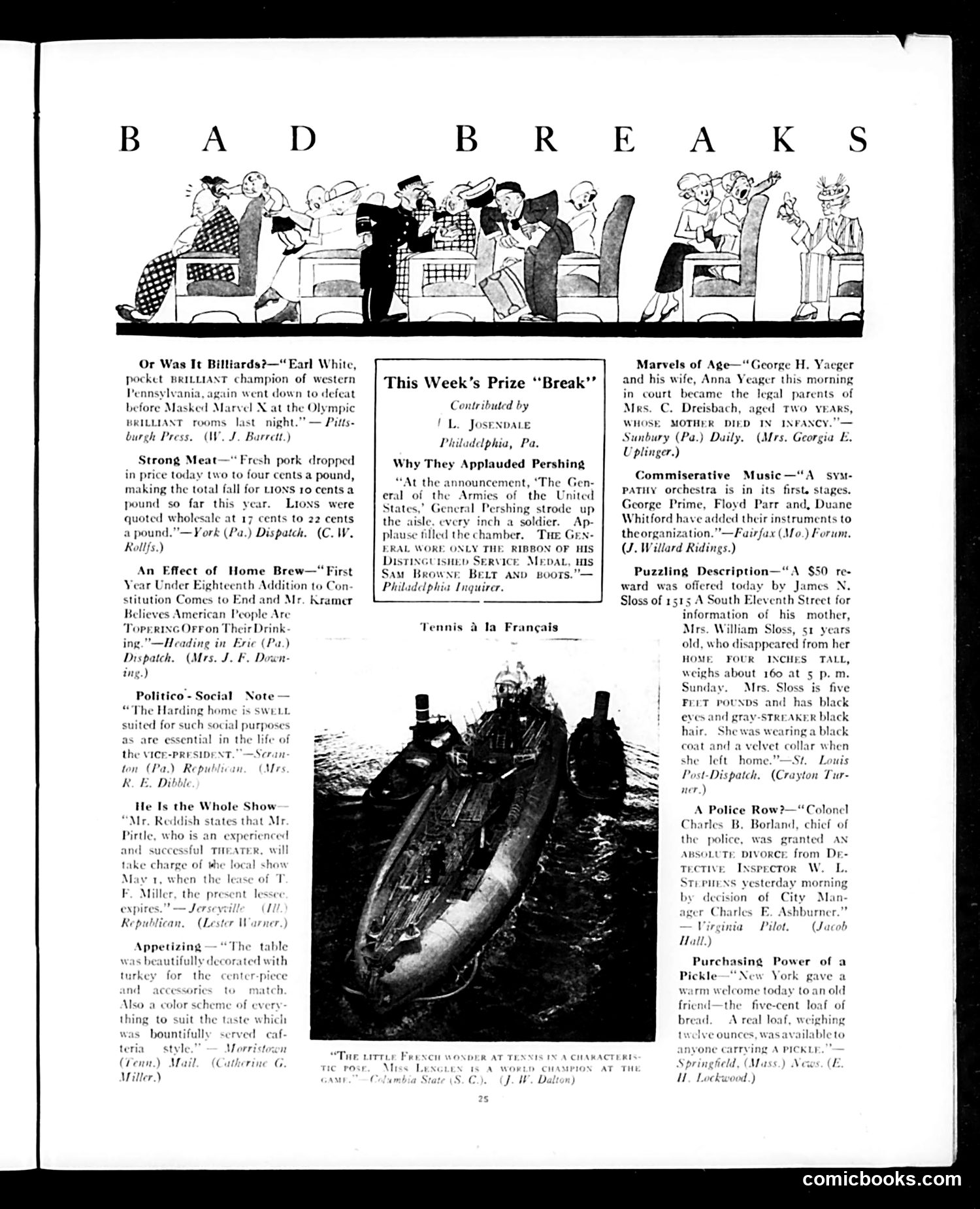
This page from Judge combines satirical "bad breaks" (newspaper misquotes) with lighter social commentary. The cartoons mock absurd or contradictory newspaper excerpts through humor rather than political attack. **Key Items:** The top cartoon depicts various social situations labeled "BAD BREAKS"—visual gags illustrating ridiculous news snippets (a wrestling match mistaken for billiards, confusing pork price drops with lion prices). **"Why They Applauded Pershing"** mocks General John J. Pershing's overly formal military appearance—the audience applauded not his words but his impressive uniform and decorations, suggesting superficial patriotism. **"Tennis à la Française"** (image shows figures in what appears to be a boat or odd position) likely satirizes French sports or leisure activities as strange to American sensibilities. The remaining entries are newspaper clipping errors: a woman described as "four inches tall weighing 160 pounds," a police chief granted divorce from a detective—absurdities created by poor editing that Judge reprints for comedic effect. This format—highlighting journalism's humorous contradictions—was Judge's regular feature during the 1920s.
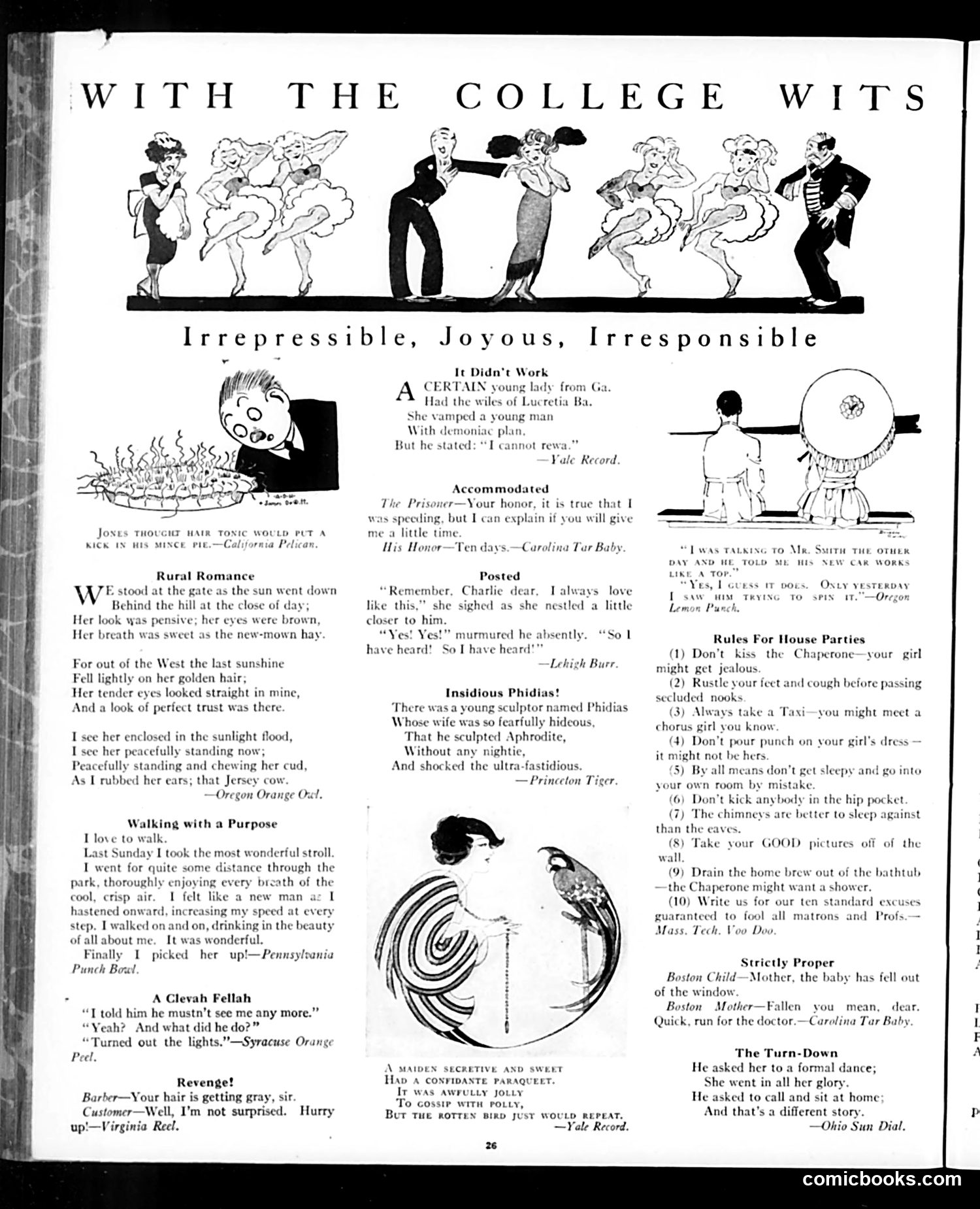
This page collects humorous short pieces and jokes from college publications, representing 1920s campus humor. The content includes: **Recurring joke types:** - **Romantic misunderstandings** ("It Didn't Work," "A Clevah Fellah") where young men fail to respond as expected to women's advances - **Clever wordplay** ("Insidious Phidias" - a limerick about sculptor Phidias creating idealized female nudes) - **Social etiquette humor** ("Rules For House Parties") - satirizing strict chaperone rules governing college dating and parties - **Absurdist rural humor** ("Rural Romance") - a twist ending where the narrator's romantic reverie is revealed to be about a cow **The satire targets:** rigid social conventions around courtship, the gap between romantic expectation and reality, and the arbitrary restrictions placed on young people during this era. The "college wits" bylines (Yale Record, Princeton Tiger, etc.) indicate these are reprinted from actual college humor magazines—a common Judge practice. The overall tone is lighthearted mockery of both young romance and Victorian-era social rules.
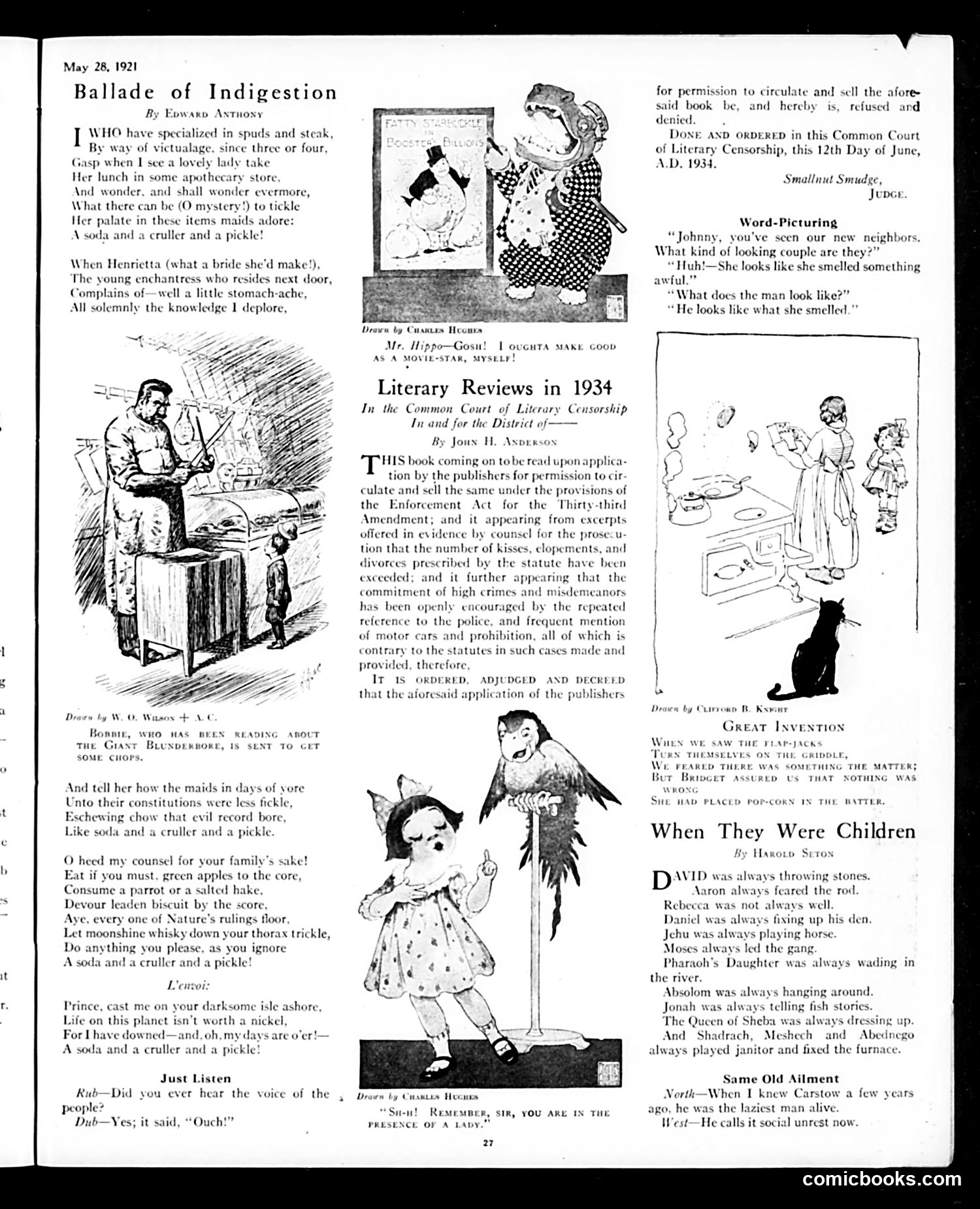
This page contains several humorous pieces satirizing early 1920s American life: **"Ballade of Indigestion"** mocks the dietary habits of fashionable young women. The poet laments that ladies he admires eat only light "apothecary store" fare—sodas, crullers, pickles—rather than hearty traditional foods like steak and potatoes. The joke targets the genteel pretensions and delicate appetites associated with modern women and urban sophistication, which the author finds baffling and unhealthy. **The "Literary Reviews in 1934"** section satirizes anticipated future censorship. It imagines a fictional court denying publication of a book for excessive "kisses, elopements, and divorces" and references to "motor cars and prohibition"—contemporary concerns. This is prescient satire about Prohibition (1920-1933) and anxieties about modern morality. Other cartoons include mild wordplay ("Great Invention" about pancakes) and a biblical-themed piece listing children's mischievous habits. The overall tone reflects Jazz Age anxieties: changing gender roles, modern consumption, and moral decline.
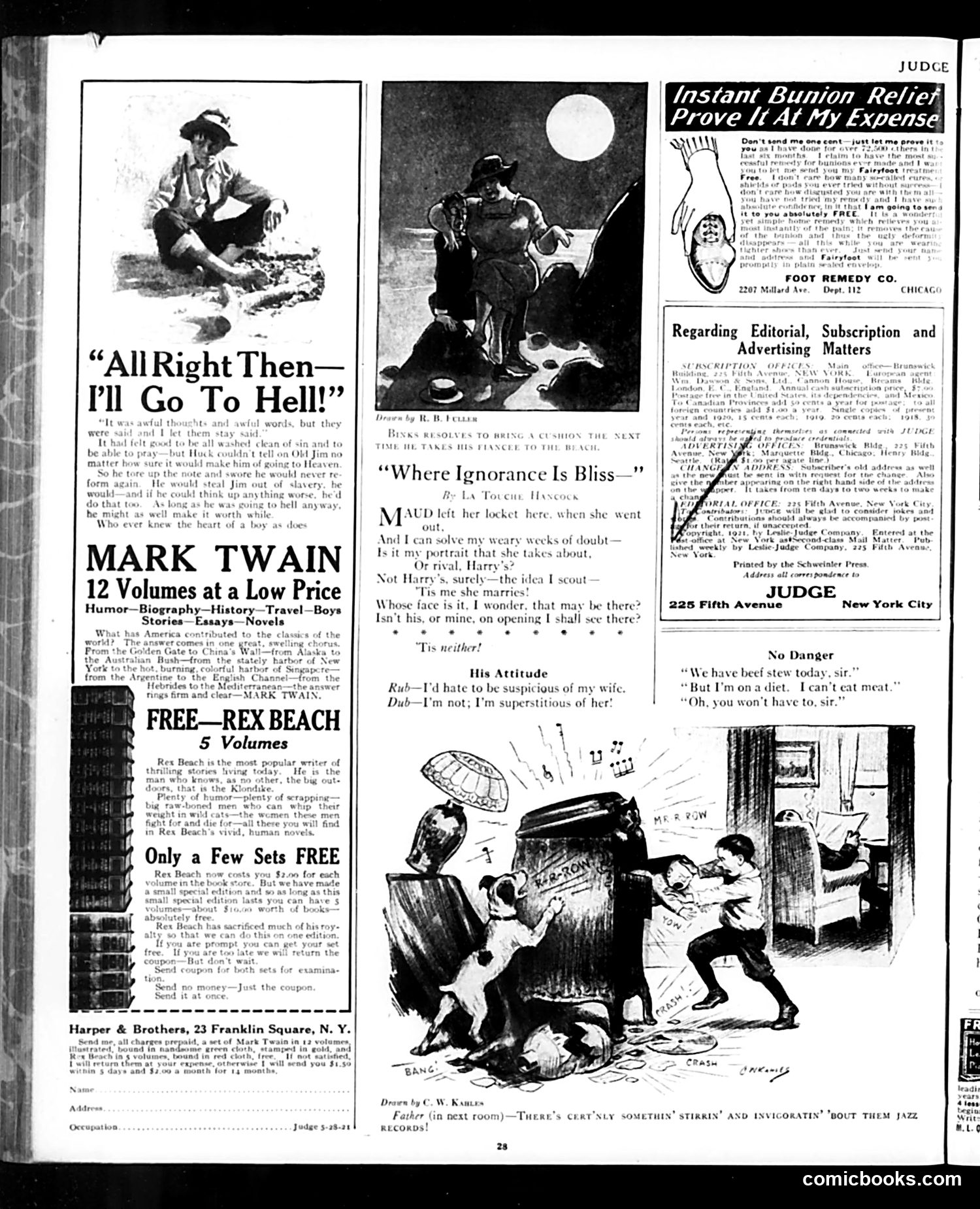
This page from *Judge* magazine (appears to be early 20th century) contains multiple elements: **Main Cartoon ("Where Ignorance Is Bliss"):** A woman has lost her locket and worries whose picture is inside—her husband Harry's, a rival's, or someone else's. The humor relies on the woman's paranoia and the "twist" that it's *neither* man's photo. The accompanying dialogue between "Rub" and "Dub" jokes about superstition versus suspicion in marriage. **Literary Advertisements:** The page heavily advertises Mark Twain and Rex Beach book collections, positioning them as affordable luxury items for readers. **Smaller Comic ("No Danger"):** A domestic joke about a man on a diet being served beef stew; the servant's reassurance that "you won't have to [eat it]" suggests the food is so unpalatable it's inedible—a common servants'-quarters humor trope. **Right Panel:** Includes a foot remedy advertisement and editorial information. The overall tone reflects typical early-1900s *Judge* content: domestic comedy, literary promotion, and consumer advertising.
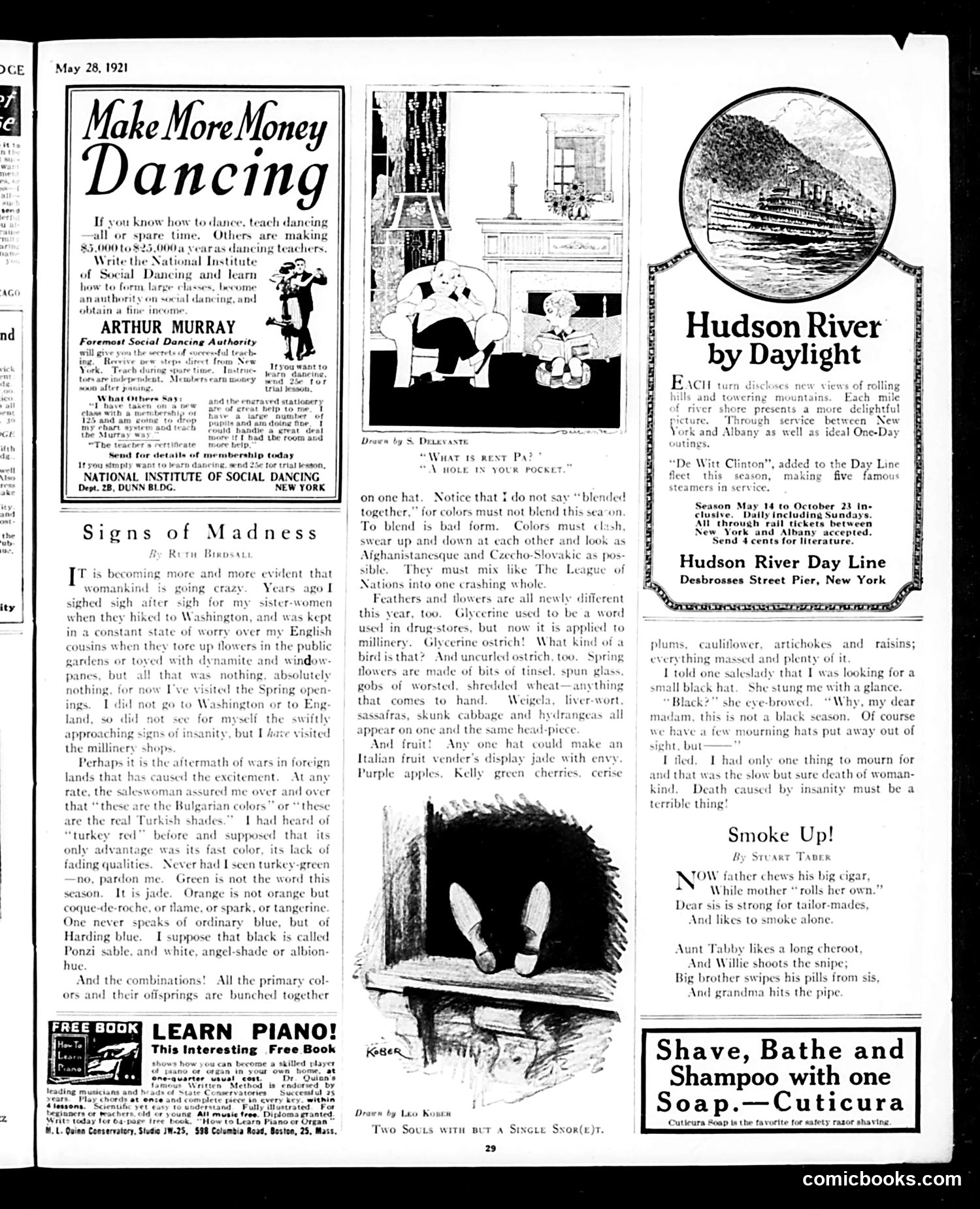
This page contains primarily **advertisements and light humor columns** rather than political cartoons. The main satirical piece is "Signs of Madness" by Broun Heysa, which uses fashion and consumer culture as a vehicle for social commentary. The author observes that post-WWI America is exhibiting signs of collective insanity through increasingly absurd fashion trends. Specifically, he mocks: - The clash of clashing, non-blending colors now fashionable (referencing the League of Nations as a metaphor for chaotic mixing) - Frivolous millinery trends like "glycerine ostrich" - Fruit vendors' displays with impossibly garish produce colors The satire critiques the frivolousness of 1920s consumer culture and women's fashion obsessions as evidence of societal madness. The piece concludes darkly, suggesting this obsession with material trivia signals "the slow but sure death of womankind." The page also includes Arthur Murray's dancing instruction ad, Hudson River Day Line tourism ad, and a light poem "Smoke Up!" about family smoking habits—typical Judge content mixing commerce with gentle social observation.
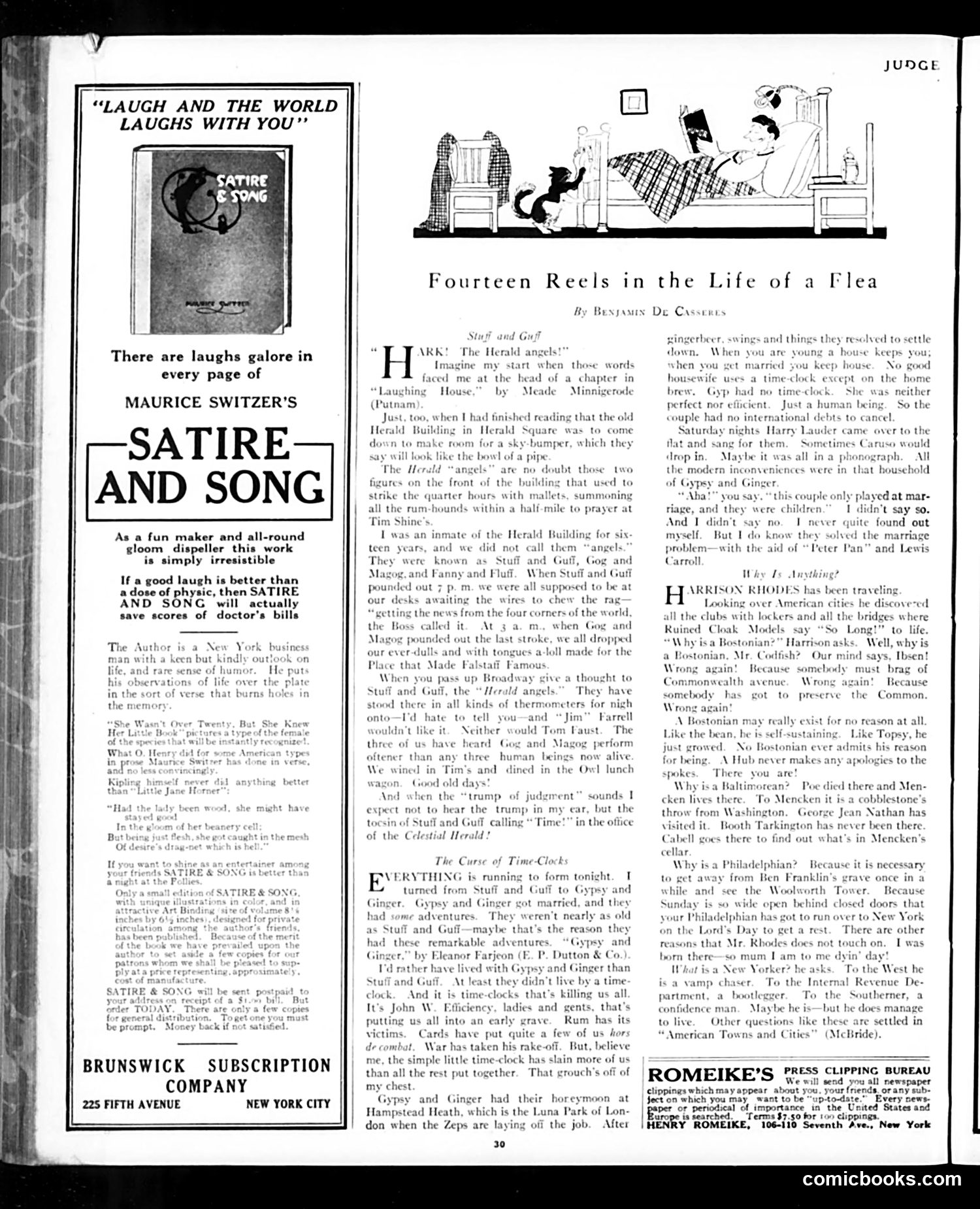
This page is primarily a book advertisement for Maurice Switzer's *Satire and Song*, displayed alongside two unrelated articles. The main article, "Fourteen Reels in the Life of a Flea" by Benjamin De Casseres, is a humorous essay using a flea's perspective to satirize early 20th-century urban life. The flea narrates living in the Herald Building in New York City, personifying office workers (Stuff, Guff, Gog, and Magog) and commenting on modern anxieties: time-clocks, efficiency obsession, and war's toll. References to "John W. Efficiency" mock the era's productivity obsession. The piece also includes a sidebar about regional American stereotypes—discussing why people from Boston, Philadelphia, and New York behave distinctively—suggesting provincial character types common in period satire. Overall, it's gentle social commentary packaged as whimsical flea reportage.
This is **not a cartoon**, but rather an **advertorial essay** — essentially an advertisement promoting advertising itself. It appears in *Judge*, a satirical magazine, making the irony deliberate. The piece defends advertising's value using the metaphor "a gold brick always looks good" — a reference to confidence schemes where worthless items are sold on appearance alone. The author argues that unlike such fraud, legitimate advertising comes only from reputable manufacturers with genuine products, since only quality makers can sustain expensive ad campaigns. The piece reassures readers that publishers and advertisers depend on public trust and therefore won't promote inferior goods. It concludes by urging readers to trust and regularly read advertisements as reliable guidance for purchasing decisions. **The satire**: This is likely Judge magazine gently mocking the advertising industry's self-justifying rhetoric — the irony being that an *advertisement for advertising* uses circular logic to convince readers that advertisements are trustworthy guides rather than persuasive manipulation.
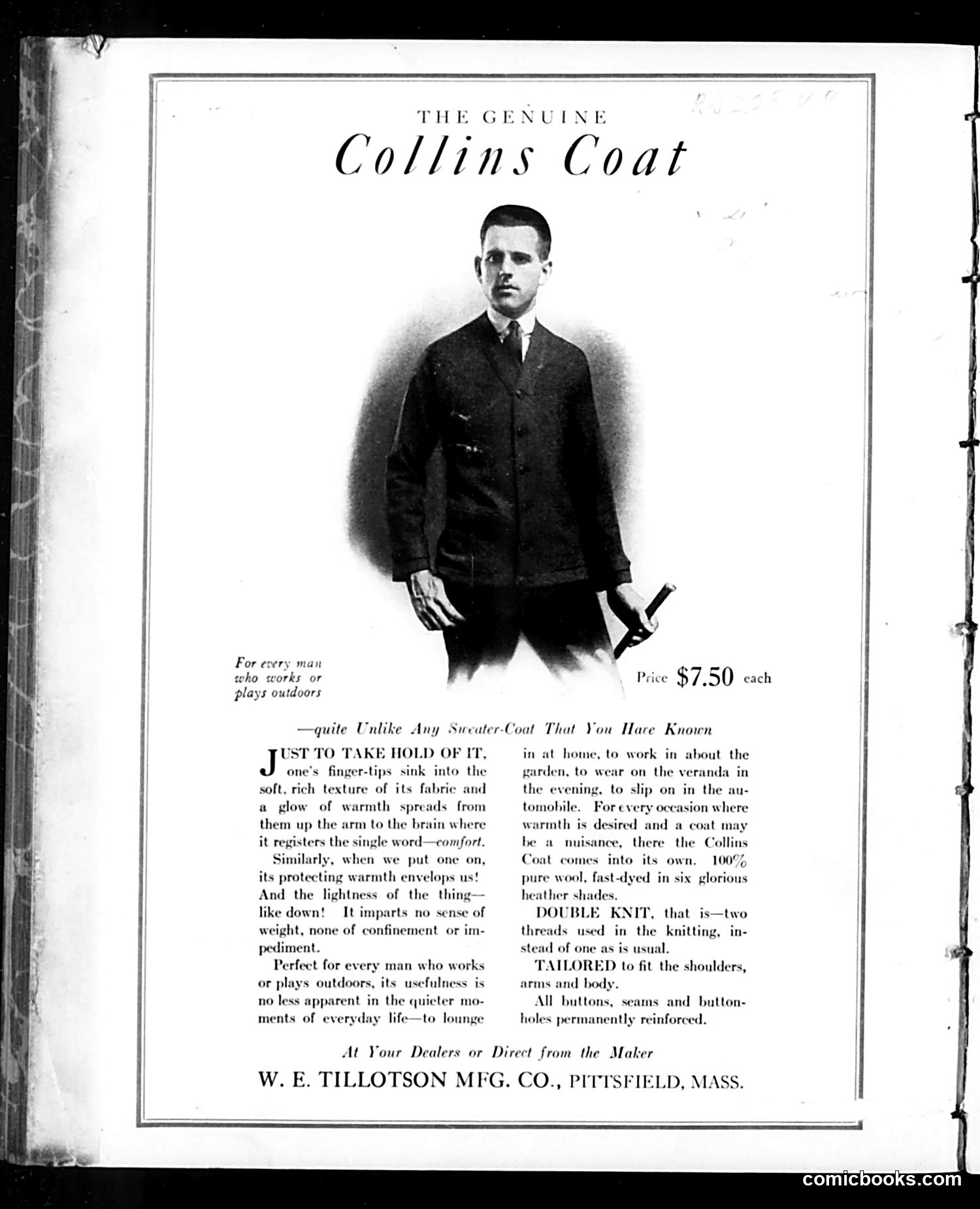
This is **not a cartoon or satire**—it's a straightforward advertisement for the Collins Coat, manufactured by W.E. Tillotson in Pittsfield, Massachusetts. The page price is $7.50. The ad uses marketing copy typical of early 20th-century advertising, emphasizing comfort, warmth, and versatility for working men and outdoor enthusiasts. Key selling points highlighted include the soft wool fabric, lightweight construction, double-knit durability, and tailored fit. The language appeals to masculine practicality: the coat suits "every man who works or plays outdoors" and transitions seamlessly from work to leisure (lounging at home, automobile travel, evening wear on verandas). The photograph shows a well-dressed man modeling the garment to demonstrate its professional appearance and fit. There is no political or social satire present—this is simply a period clothing advertisement that appeared in *Judge* magazine as paid content.