
Judge, 1921-05-28 · page 19 of 32
Judge — May 28, 1921 — page 19: what you’re looking at
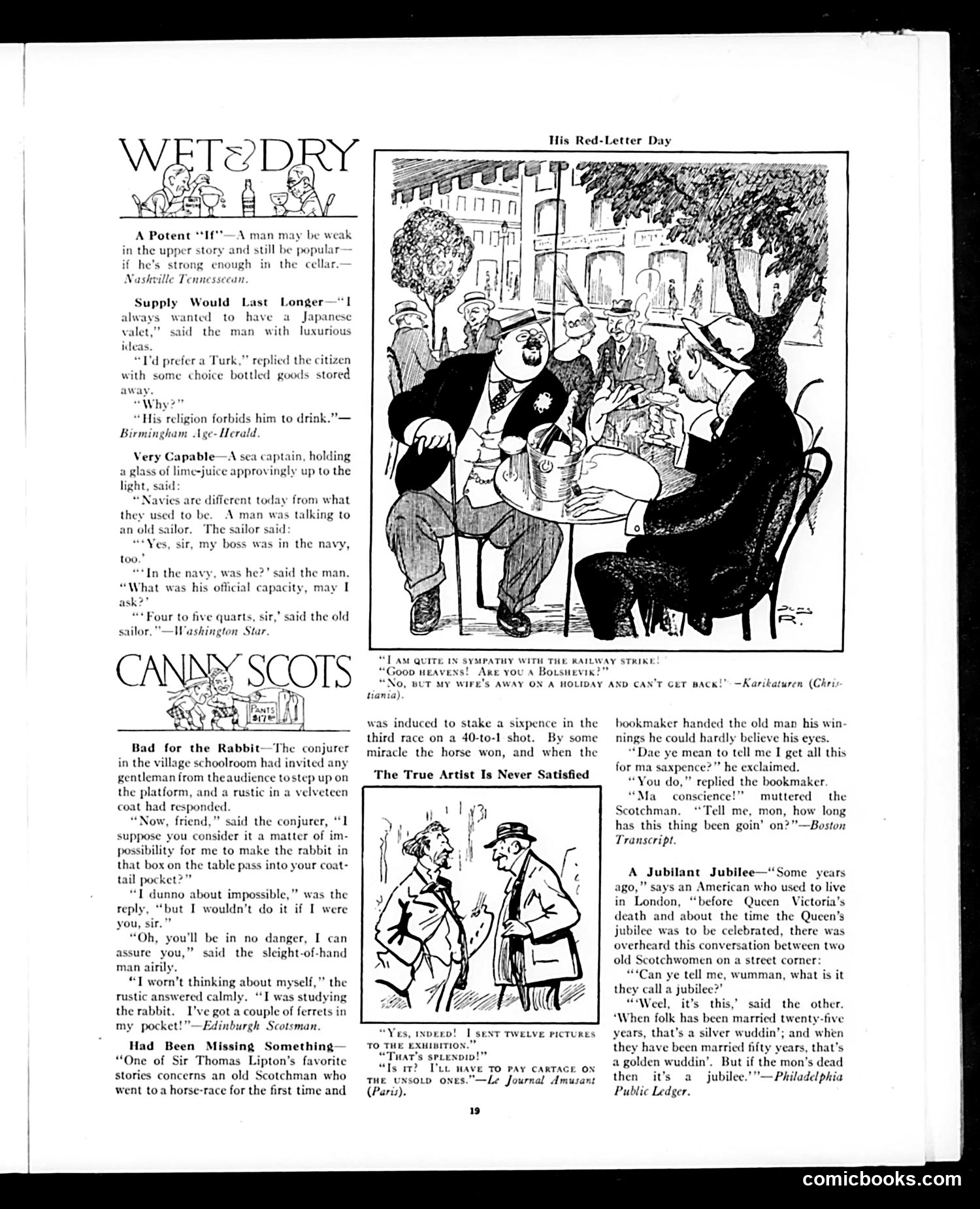
What you’re looking at
This page from Judge magazine contains several brief humorous anecdotes satirizing social attitudes of the era (likely early 1900s): **Main themes:** - **Alcohol culture**: Multiple jokes reference drinking and bootleggers, reflecting Prohibition-era anxieties. One quip mocks a man wanting a Japanese valet for his "cellar" (hidden liquor stash); another jokes about preferring a Turkish servant whose religion forbids drinking. - **Class and pretension**: The humor often targets working-class figures trying to appear sophisticated or their innocent misunderstandings of upper-class life. - **Gender roles**: A cartoon shows a man happy about his wife being away on holiday during a railway strike—implying domestic complaints. The cartoons use exaggerated facial expressions and dress typical of the era's satirical illustration style. The humor is gentle, relying on wordplay and situational comedy rather than sharp political critique. Overall, the page reflects period preoccupations with drink, propriety, and social station.
📄 Transcribed text from this page (OCR, searchable)
Machine-transcribed from the original scan — historical spelling and the odd misread are preserved.
A Potent “If"’—A man may be weak in the upper story and still be popular if he’s strong enough in the cellar Nashville Tennesseean. Supply Would Last Longer—“I always wanted to have a Japanese valet,” said the man with luxurious ideas. “I'd prefer a Turk,” replied the citizen with some choice bottled goods stored aw “Why?” “His religion forbids him to drink.”— Birmingham Age- Herald. Very Capable—A sea captain, holding a glass of lime-juice approvingly up to the light, said “ Navies are different today from what they used to be. was talking to an old sailor. The s. 1 “Ves, sir, my boss was in the navy, too.” “In the navy, was he?’ said the man. “What was his official capacity, may I ask?" “*Four to five quarts, sir,’ said the old "—Washington Star. sailor. Bad for the Rabbit—The conjurer in the village schoolroom had invited any gentleman from theaudience tostep up on the platform, and a rustic in a velveteen coat had responded. “Now, friend,” said the conjurer, “1 suppose you consider it a matter of im- possibility for me to make the rabbit in that box on the table pass into your coat- tail pocket?” “I dunno about impossible,” was the reply, “but I wouldn't do it if I were you, sir.” “Oh, you'll be in no danger, I can assure you,” said the sleight-of-hand man airil; “T worn’t thinking about myself,” the rustic answered calmly, “I was studying the rabbit. I’ve got a couple of ferrets in my pocket!” —Edinburgh Scotsman. Had Been Missing Something- “One of Sir Thomas Lipton’s favorite stories concerns an old Scotchman who went toa horse-race for the first time and His Red-Letter Day “TAM QUITE IN SYMPATHY WITH THE KAILM “Goop neavens! Are you a Bousnevix? y STRIKE “No, BUT MY WIFE'S AWAY ON A HOLIDAY AND CAN'T Get Back!” —Karikaturen (Chri ti a), was induced to stake a sixpence in the third race on a 40-to-1 shot. By some miracle the horse won, and when the The True Artist Is Never Satisfied TO THE EXHIBITION. “Tuat’s spcenpip!” “Isr? Tut Wave To Pay CARTAGE ON tue uxsorp oxes."—Le Journal dmusant (Paris). 19 bookmaker handed the old man his win nings he could hardly believe his eyes “Da mean to tell me I get all this for ma saxpence?” he exclaimed. “You do,” replied the bookmaker. “Ma conscience!” = muttered — the Scotchman. “Tell me, mon, how long has this thing been goin’ on?”—Boston Transcript. A Jubilant Jubilee—“Some y ago,” says an American who used to live in London, “before Queen Victo death and about the time the Queen’s jubilee was to be celebrated, there was overheard this conversation between two old Scotchwomen on a street corner: ““Can ye tell me, wumman, what is it they call a jubilee?” this,’ said the othe been married twenty-fi that’s a silver wuddin’; and when y have been married fifty years, that’s a golden wuddin’. But if the mon’s dead then it’s a jubilee.’ —Philadel phia Public Ledger. ars, comicbooks.com