
Judge, 1921-05-28 · page 22 of 32
Judge — May 28, 1921 — page 22: what you’re looking at
What you’re looking at
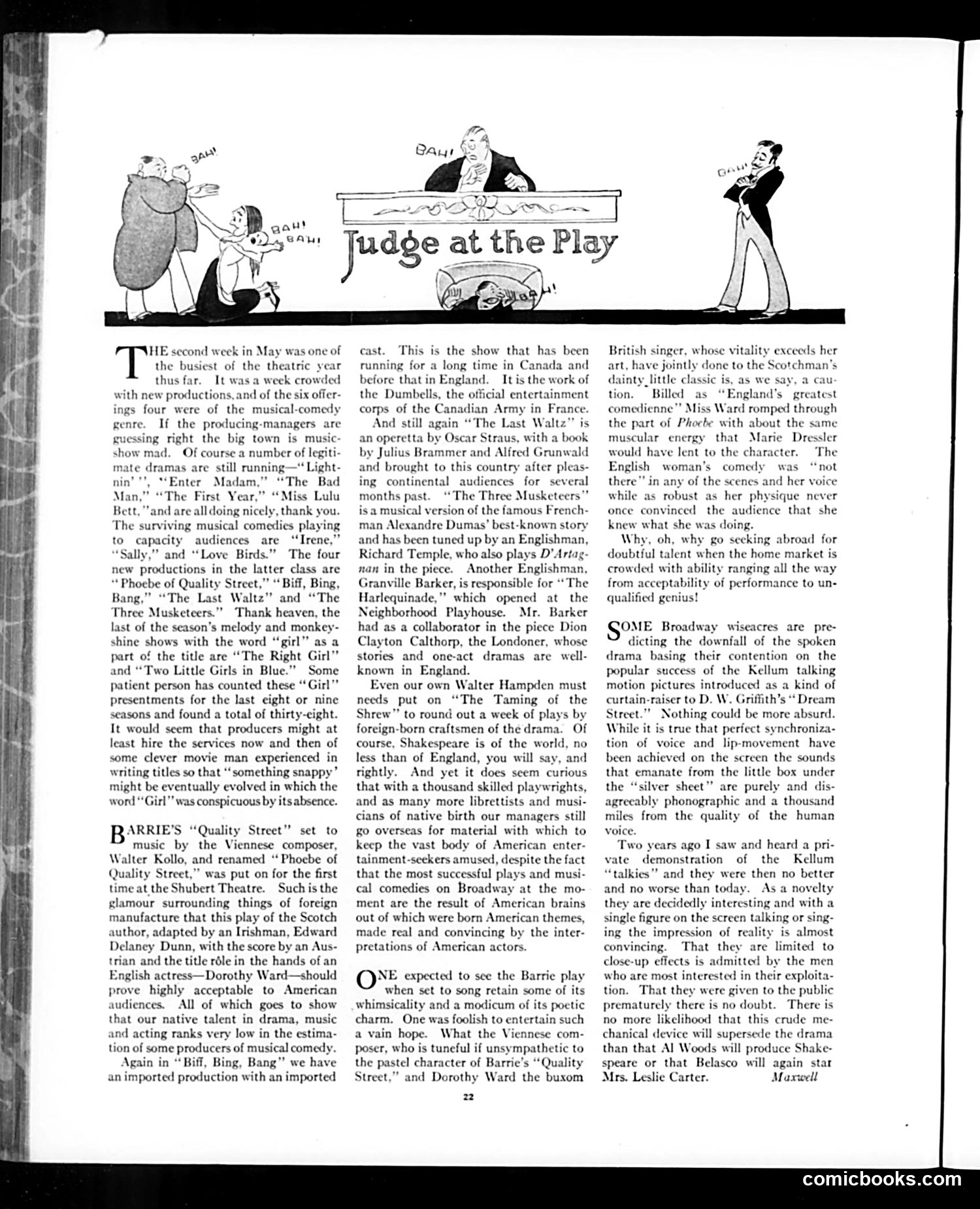
This theater review critiques Broadway's May season, illustrated with cartoon judges awarding ratings ("BAHL!" and "GOOD!"). The satire targets American theater producers' preference for **imported European productions** over homegrown American talent. The author ironically notes that while Broadway's **most successful shows use American themes and actors**, producers still import plays from England, France, Austria, and Canada—often adapted by foreign creators. Examples include "Phoebe of Quality Street" (Scottish play by Austrian composer) and "The Last Waltz" (Continental operetta), while even American actor Walter Hampden revives Shakespeare rather than new American drama. The complaint is distinctly **nationalist**—why do American producers distrust American playwrights, musicians, and actors when American-created works demonstrably succeed? The cartoon judges mock this backwards logic, suggesting producers should recognize native talent's proven worth.
📄 Transcribed text from this page (OCR, searchable)
Machine-transcribed from the original scan — historical spelling and the odd misread are preserved.
HE second week in May was one of the busiest of the theatric year thus far. It was a week crowded with new productions, and of the six offer- ings four were of the musical-comedy genre. If the producing-managers are guessing right the big town is mu: show mad. Of course a number of legiti- mate dramas are still running—* Li nin’, “Enter Madam,” “The Man,” “The First Year,” “Miss Lulu Bett, ‘and are alldoing nicely, thank you. The surviving musical comedies playing to capacity audiences are ‘‘Irene,” ‘Sally,”” and “Love Birds.” The four new productions in the latter class are hoebe of Quality Street,” “ Biff, Bing, Bang,” “The Last Waltz’ and “The Three Musketeers.” Thank heaven, the last of the season’s melody and monkey- shine shows with the word “girl” as a part of the title are “The Right Girl” and “Two Little Girls in Blue.” Some patient person has counted these “Girl” presentments for the last eight or nine seasons and found a total of thirty-eight. It would seem that producers might at least hire the services now and then of some clever movie man experienced in writing titles so that “something snappy’ might be eventually evolved in which the word “Girl” was conspicuous by its absence. ARRIE’S “Quality Street” set to music by the Viennese composer, Walter Kollo, and renamed “Phoebe of Quality Street,” was put on for the first time atthe Shubert Theatre. Such is the glamour surrounding things of foreign manufacture that this play of the Scotch author, adapted by an Irishman, Edward Delaney Dunn, with the score by an Aus- trian and the title réle in the hands of an English actress—Dorothy Ward—should prove highly acceptable to American audiences. All of which goes to show that our native talent in drama, music and acting ranks very low in the estima- tion of some producers of musical comedy. Again in “ Biff, Bing, Bang” we have an imported production with an imported cast. This is the show that has been running for a long time in Canada and before that in England. It is the work of the Dumbells, the official entertainment corps of the Canadian Army in Frane And still again “The Last Waltz an operetta by Oscar Straus, with a book by Julius Brammer and Alfred Grunwald and brought to this country after pleas- ing continental audiences for several months past. The Three Musket i is a musical version of the famous French- man Alexandre Dumas’ best-known sto: and has been tuned up by an Englishman, Richard Temple, who also plays D’Artag- nan in the piece. Another Englishman, Granville Barker, is responsible for “The Harlequinade,”” which opened at the Neighborhood Playhouse. Mr. Barker had as a collaborator in the piece Dion Clayton Calthorp, the Londoner, whose stories and one-act dramas are well- known in England. Even our own Walter Hampden must needs put on “The Taming of the Shrew” to round out a week of plays by foreign-born craftsmen of the drama. Of course, Shakespeare is of the world, no less than of England, you will say, and rightly. And yet it does seem curious that with a thousand skilled playwrights, and as many more librettists and musi- cians of native birth our managers still go overseas for material with which to keep the vast body of American enter- tainment-seekers amused, despite the fact that the most successful plays and musi- cal comedies on Broadway at the mo- ment are the result of American brains out of which were born American themes, made real and convincing by the inter- pretations of American actors. QE expected to sce the Barrie play when set to song retain some of its whimsicality and a modicum of its poetic charm. One was foolish to entertain such a vain hope. What the Viennese com- poser, who is tuneful if unsympathetic to the pastel character of Barrie’s “Quality Street,” and Dorothy Ward the buxom 22 exceeds her cotchman’s British singer, whose vitalit art, have jointly done to the $ dainty little classic is, as we sa cau tion, Billed as “England’s greatest comedienne” Miss Ward romped through the part of Phoebe with about the same muscular energy that Marie Dressler would have lent to the character. The English woman’s comedy was “not there” in any of the scenes and her voice while as robust as her physique never once convinced the audience that she knew what she was doing. Why, oh, why go secking abroad for doubtful talent when the home market is crowded with ability ranging all the way from acceptability of performance to un- qualified genius! OME Broadway wiseacres are pre- dicting the downfall of the spoken drama basing their contention on the popular success of the Kellum talking motion pictures introduced a: ind of curtain-raiser to D. W. Griffith’s “‘ Dream Street.” Nothing could be more absurd. While it is true that perfect synchroniza- tion of voice and lip-movement have been achieved on the screen the sounds that emanate from the little box under the “silver sheet” are purely and dis- agreeably phonographic and a thousand miles from the quality of the human voic Two years ago I saw and heard a pri- vate demonstration of the Kellum “talkies” and they were then no better and no worse than toda As a novelty they are decidedly interesting and with a single figure on the screen talking or sing- ing the impression of reality is almost convincing. That they are limited to close-up effects is admitted by the men who are most interested in their exploita- tion. That they were given to the public prematurely there is no doubt. There is no more likelihood that this crude me- chanical device will supersede the drama than that Al Woods will produce Shake- speare or that Belasco will again star Mrs. Leslie Carter. Maxwell comicbooks.com