
A complete issue · 32 pages · 1921
Judge — May 14, 1921
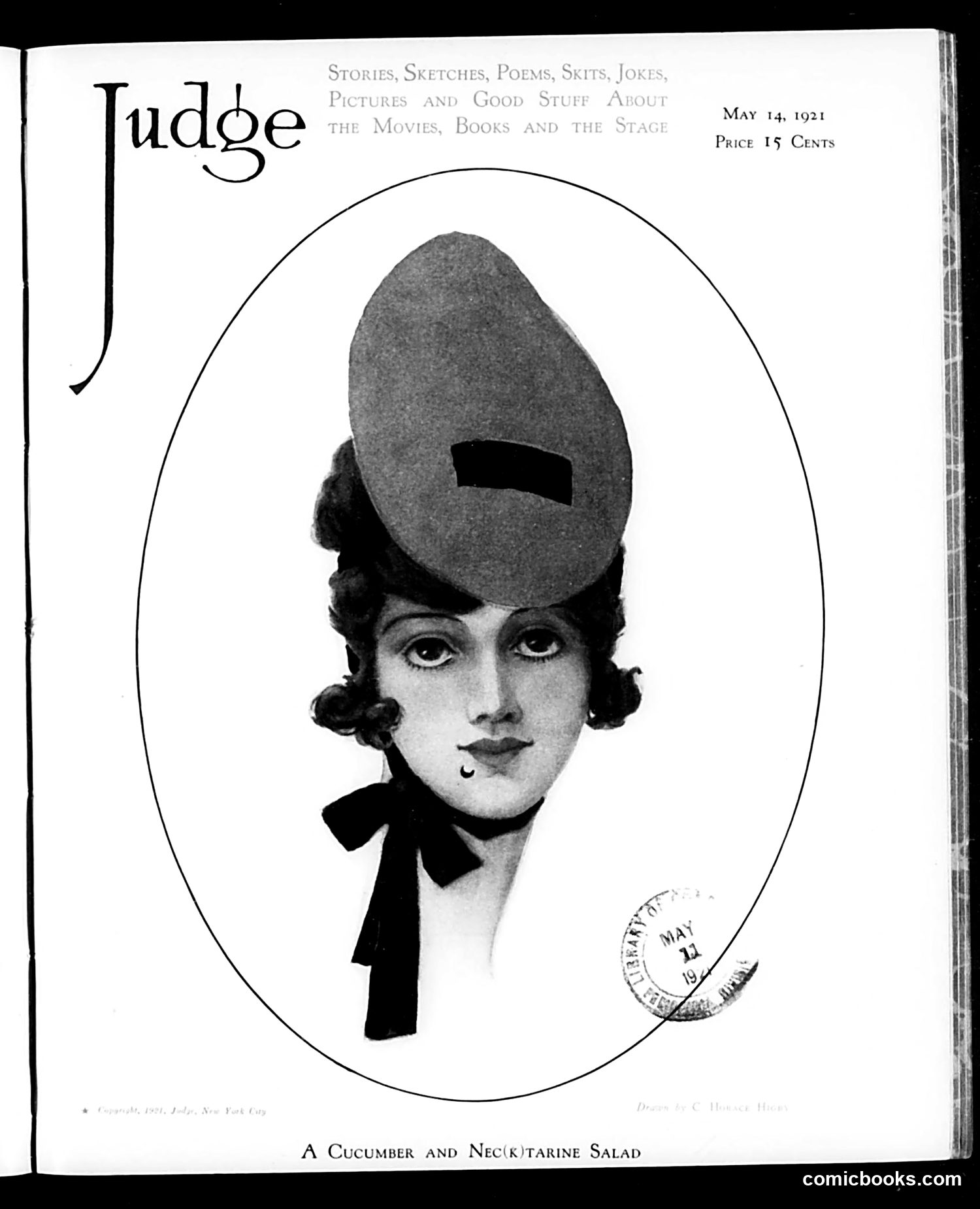
This Judge magazine cover from May 14, 1921 features a stylized portrait of a woman wearing an enormous, egg-shaped hat and a black bow at her neck. The caption reads "A Cucumber and Nec(k)tarine Salad." The satire appears to target **extravagant women's fashion**, specifically the absurdly oversized millinery that was fashionable in the early 1920s. The wordplay in the caption—substituting "nectarine" for "necktarine" (neckwear)—creates a food pun, though the connection between the title and the absurd hat size remains the primary joke. This reflects a common satirical theme of the era: mocking women's increasingly impractical and outlandish hat designs, which were considered both ridiculous and wasteful by critics.
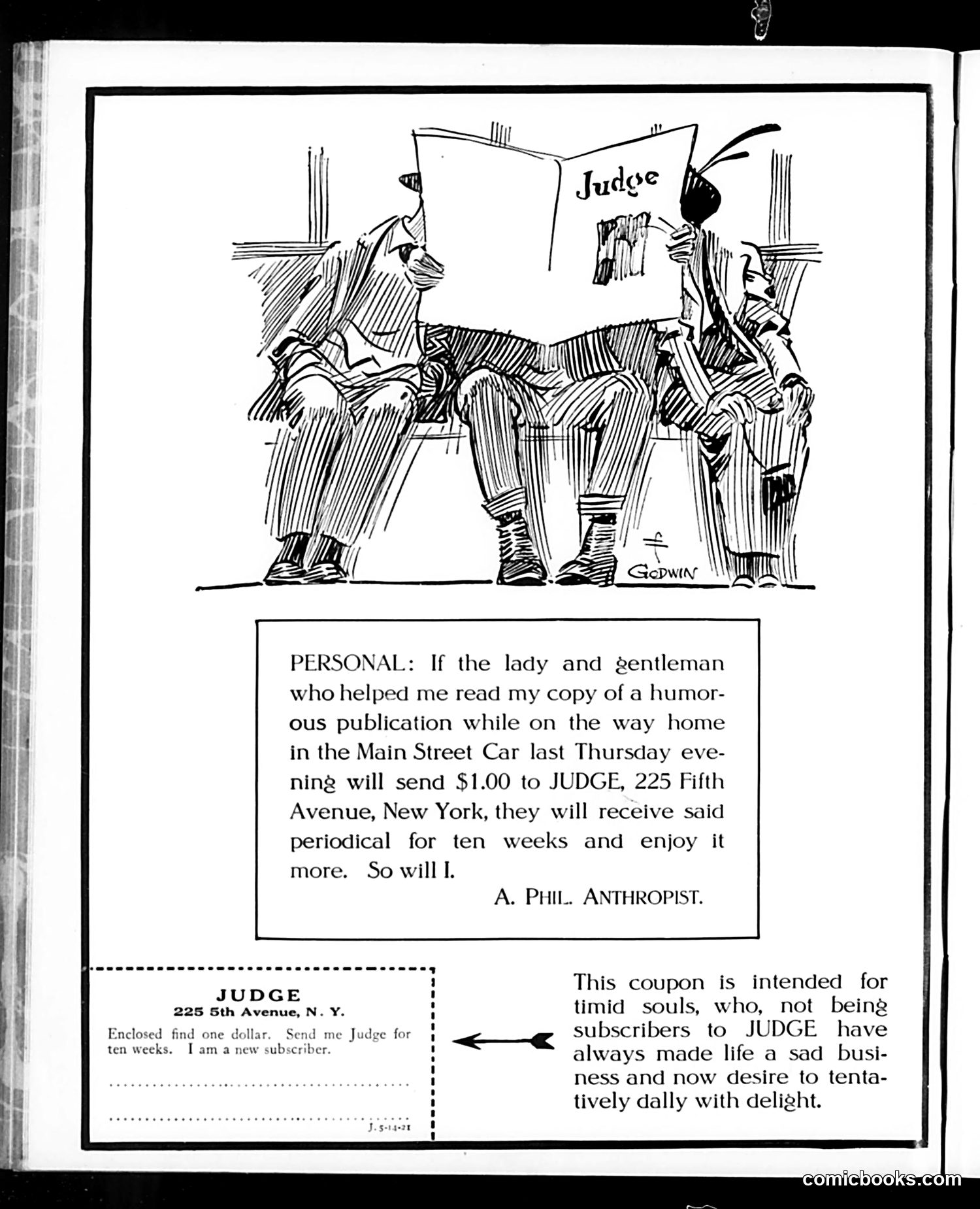
This page combines a cartoon with a personal advertisement and subscription coupon. The cartoon depicts three figures in a courtroom or legal setting, with one holding a "Judge" publication. One figure is labeled "Judge," suggesting personification of the magazine itself. The "Personal" section describes a humorous encounter on a streetcar where someone helped the writer read a copy of Judge. As thanks, the writer offers to pay $1 for ten weeks of the magazine for that helpful stranger—a lighthearted reward for spreading Judge's readership. The accompanying text notes this coupon targets "timid souls" who haven't subscribed, suggesting Judge marketed itself as a source of humor and delight to brighten mundane daily life. This is essentially a subscription promotion disguised as a human-interest story.
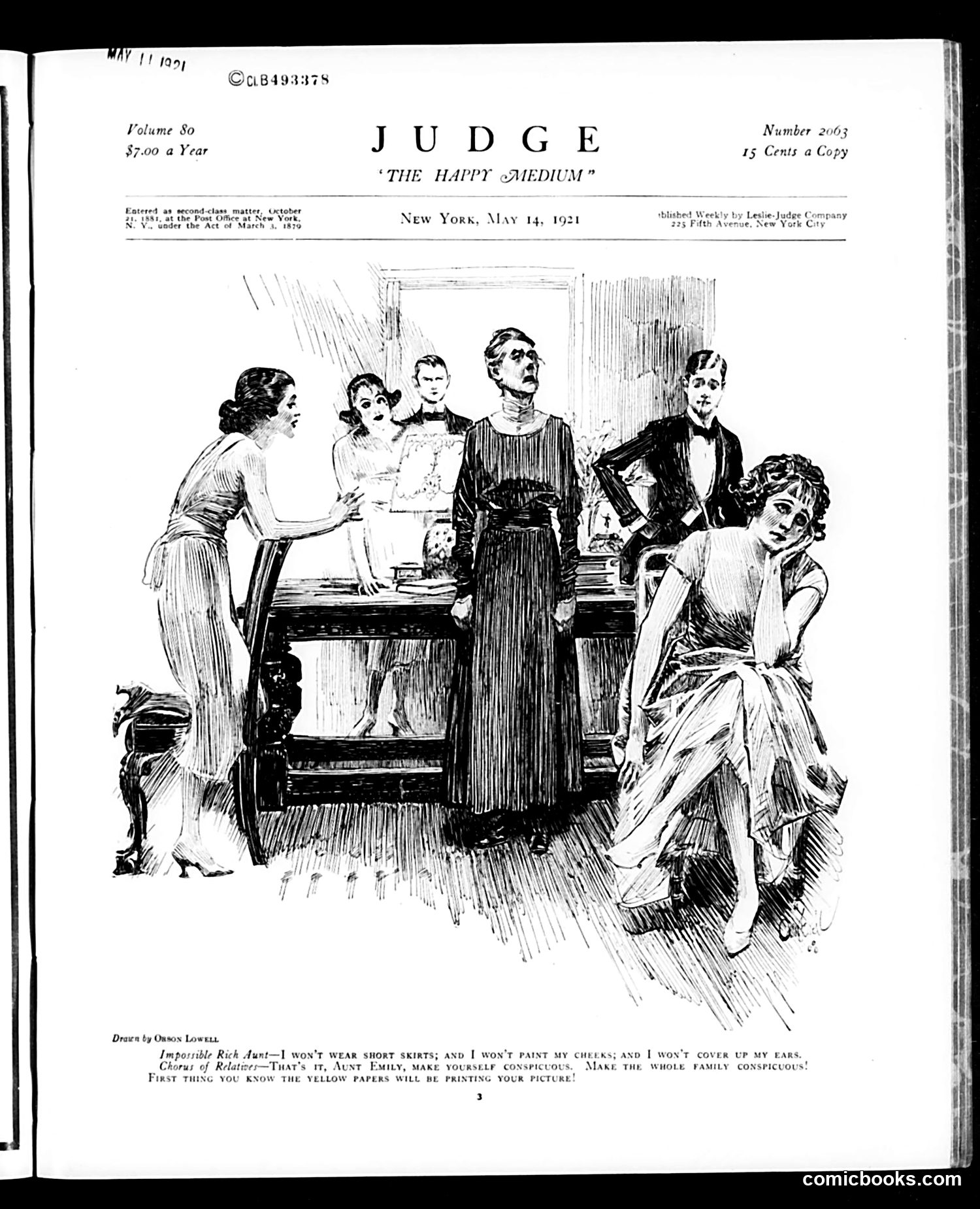
This illustration satirizes social conformity and family pressure regarding women's appearance and behavior. The scene depicts a family gathering around a woman being criticized for her modern choices—specifically short skirts, painted cheeks, and uncovered ears. The dialogue (attributed to "Osborn Lowell") presents an "Impossible Rich Aunt" character rebelling against relatives' demands for respectability. The chorus of relatives insists she make herself "conspicuous" by conforming, threatening to publish her picture in "yellow papers" (tabloids). The satire mocks how 1920s families attempted to police women's fashion and appearance during the era of flappers and changing social norms. The aunt's defiance represents the generational conflict over women's autonomy and modern style that characterized the period.
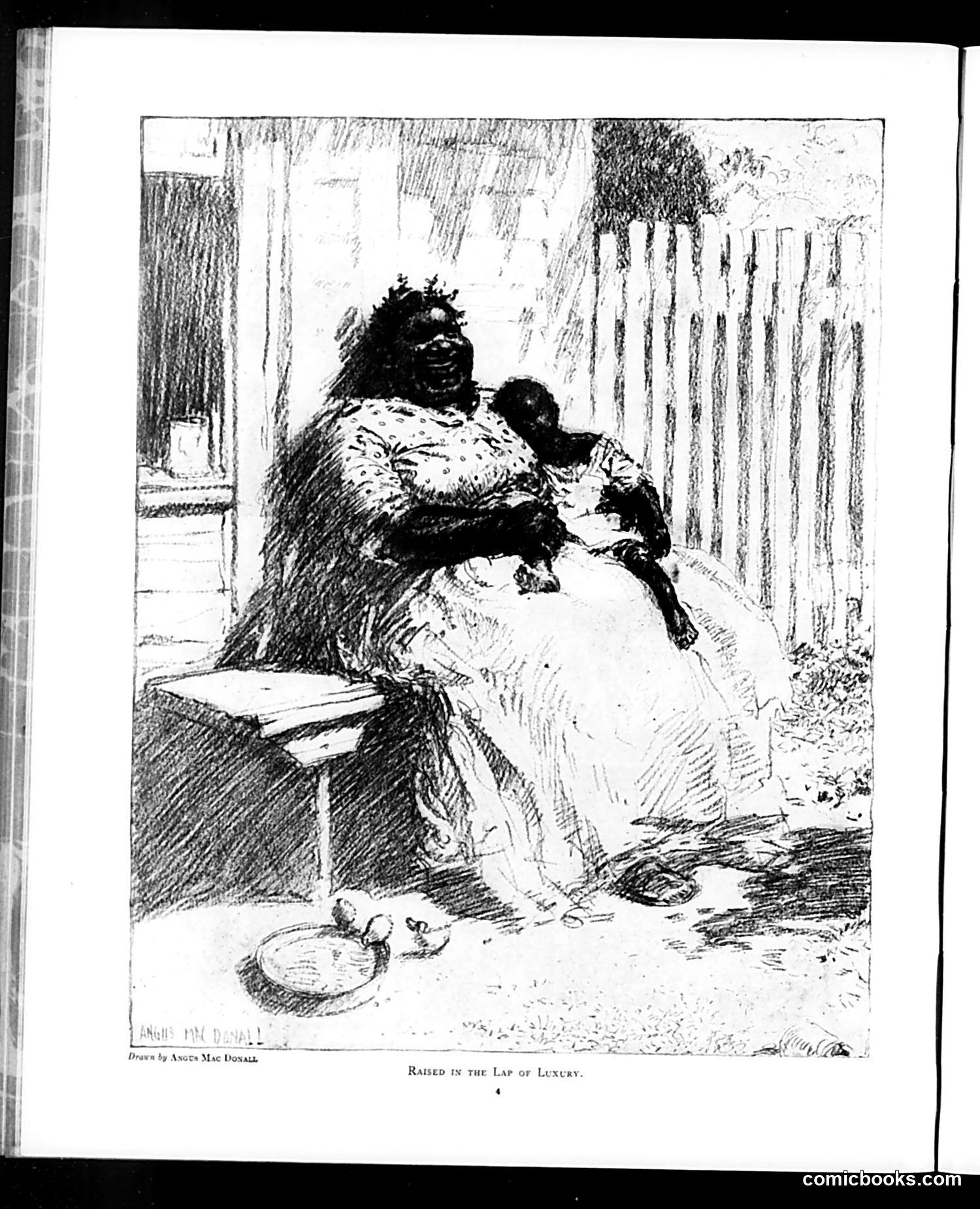
This sketch by Angus MacDonald satirizes wealth inequality and child neglect. The image depicts an elaborately dressed woman with exaggerated features seated indoors, cradling a small child. A bowl sits on the floor—apparently for the child's meager meal. The contrast is stark: the woman displays ostentatious clothing and ornamentation while the child appears impoverished and underfed. The title's irony is key—the phrase "raised in the lap of luxury" typically means privileged upbringing, but here it depicts the opposite: a child surrounded by wealth yet denied basic nourishment and care. The cartoon critiques wealthy parents, likely aristocrats or the newly rich, who prioritized material display and personal indulgence over their children's welfare. This was a common Progressive Era concern about parental neglect among the privileged classes.
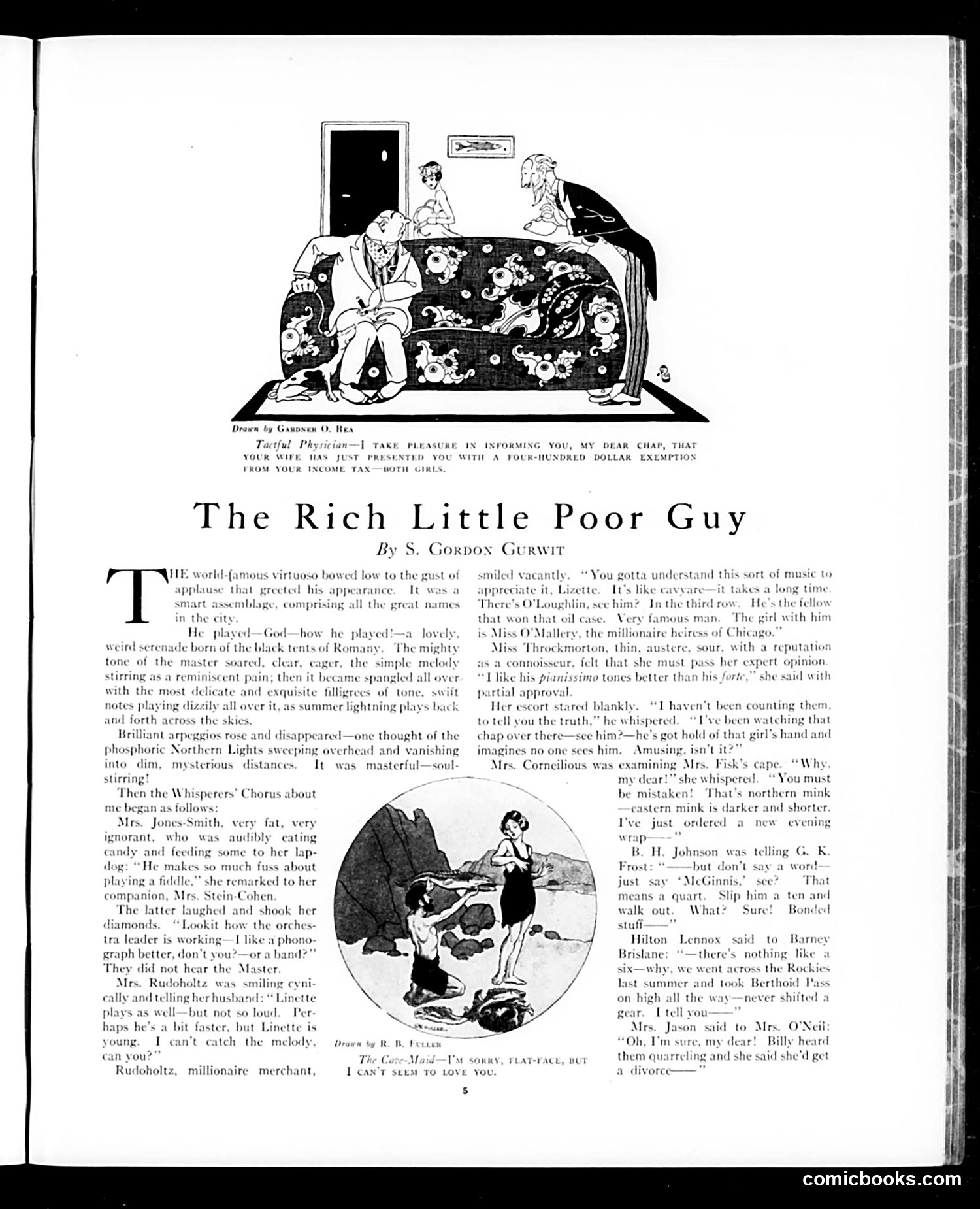
This is a short story by S. Gordon Gurwit satirizing wealthy society's pretensions. The top cartoon (drawn by Grunson D. Hea) depicts a physician informing a man that his wife has secured him a $400 tax exemption—framed as a dubious "gift" from both daughters. The story's narrative mocks affluent characters like Mrs. Jones Smith, Mrs. Rudholtz (a millionaire merchant's wife), and Miss O'Mallery, portraying them as superficial and gossipy. The accompanying illustration shows a couple in romantic tension outdoors. The satire targets the wealthy's financial anxieties, their obsession with status symbols (orchestras, fur capes, trips), and marital instability. The "poor guy" title ironically suggests that wealth brings emotional poverty—a common Judge magazine theme critiquing Gilded Age excess and moral emptiness among the elite.
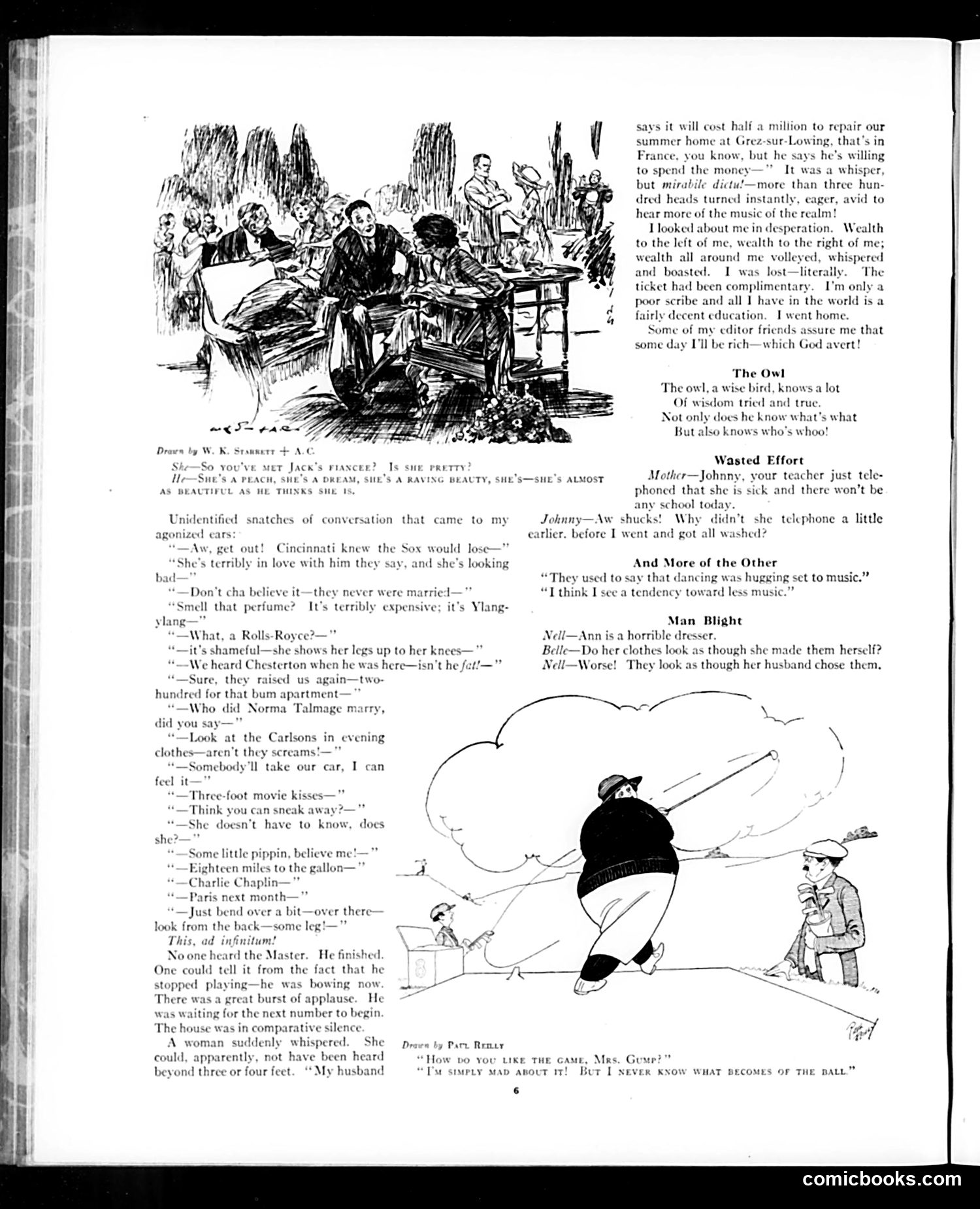
This page contains several satirical pieces typical of early 20th-century humor magazines: **Upper illustration**: Shows wealthy socialites gossiping at what appears to be an exclusive venue. The satire mocks high society's obsession with wealth, status, and scandals—references to expensive cars (Rolls-Royce), fashionable clothing, and marital drama reflect period anxieties about nouveau riche ostentation. **Text snippets**: Overheard conversation fragments satirize upper-class pretension and materialism—discussions of expensive purchases, social climbing, and celebrity gossip. **"Man Blight" cartoon**: Depicts a man in athletic wear, apparently a poor sport. The joke concerns gender expectations: his wife criticizes his behavior, suggesting masculine vanity and poor sportsmanship were familiar targets of satire. The overall tone reflects Judge's consistent critique of wealth-obsessed American society and social pretense.
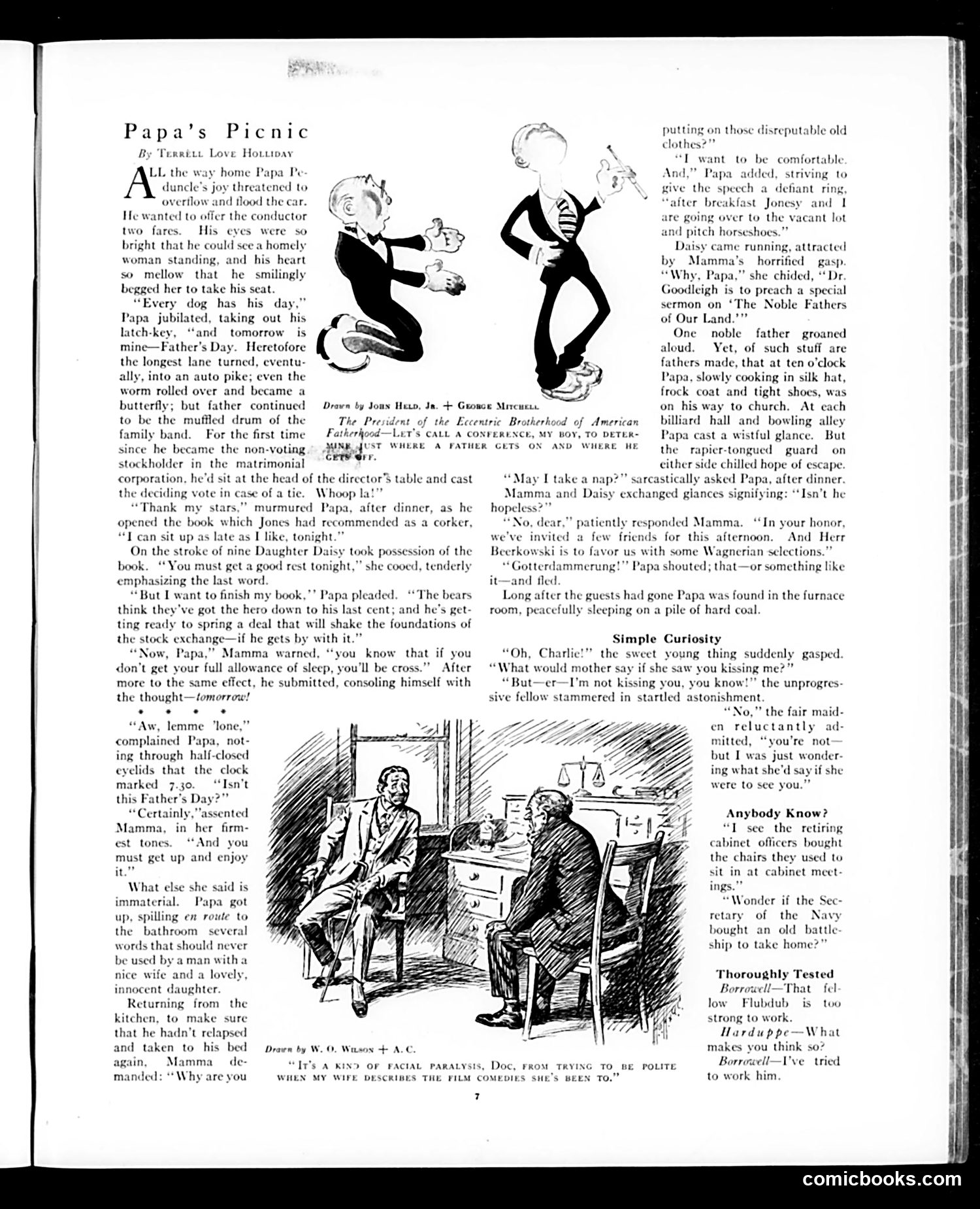
This satirical story mocks the commercialization of Father's Day and the gap between paternal expectations and reality. Published in *Judge* magazine, it depicts Father's Day (established 1910, federally recognized 1972) as a hollow holiday where fathers receive no actual consideration or freedom. The joke: Papa anticipates a day of leisure and authority—"the non-voting stockholder" finally getting respect. Instead, his family immediately reasserts control. His daughter confiscates his book, his wife forces early bedtime, and the next morning brings mandatory formal church attendance in uncomfortable clothes, then forced entertainment (Wagnerian opera), all while he watches others enjoy billiards and bowling. The satire targets both commercial sentimentality around fatherhood and the reality that fathers—despite being family breadwinners—held little actual domestic power. Papa's escape to the basement furnace room, sleeping peacefully, represents the only freedom he finds. The cartoon critiques how American consumer culture celebrates fathers while their families ignore their actual needs and desires.
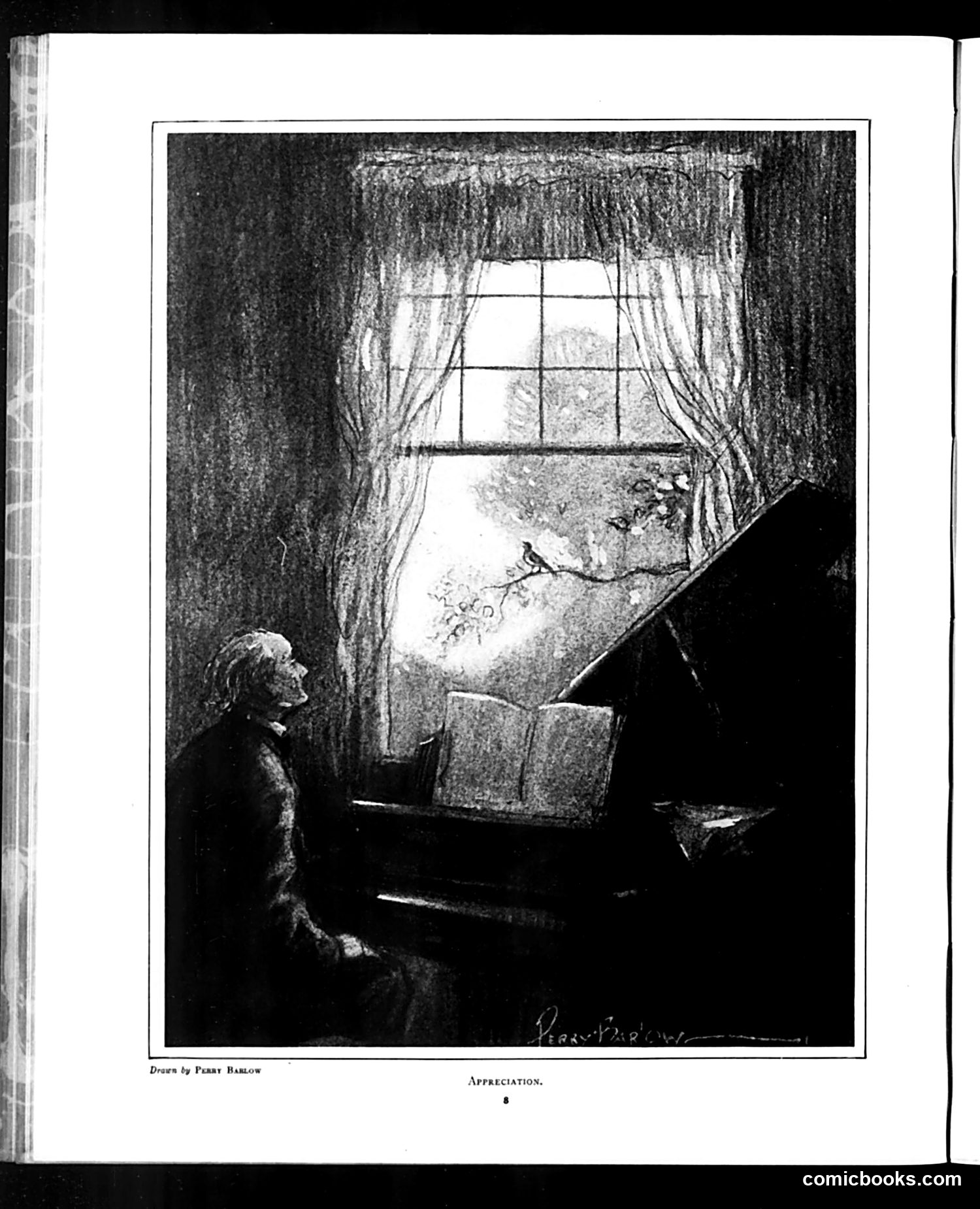
This illustration by Penny Barlow depicts a solitary figure seated at a piano, gazing out a window at a natural landscape with birds and foliage. The title "Appreciation" suggests the cartoon's theme: the value of pausing to acknowledge beauty or gratitude. The composition contrasts the figure's inward domestic setting with the outdoor world beyond—a common satirical device in Judge magazine. Without additional context from the magazine's date and surrounding articles, the exact satirical target remains unclear. It may comment on modern people's disconnection from nature, the importance of artistic appreciation, or perhaps critique those who neglect to recognize value in simple things. The melancholic mood and solitary figure suggest contemplation of missed opportunities or overlooked beauty.
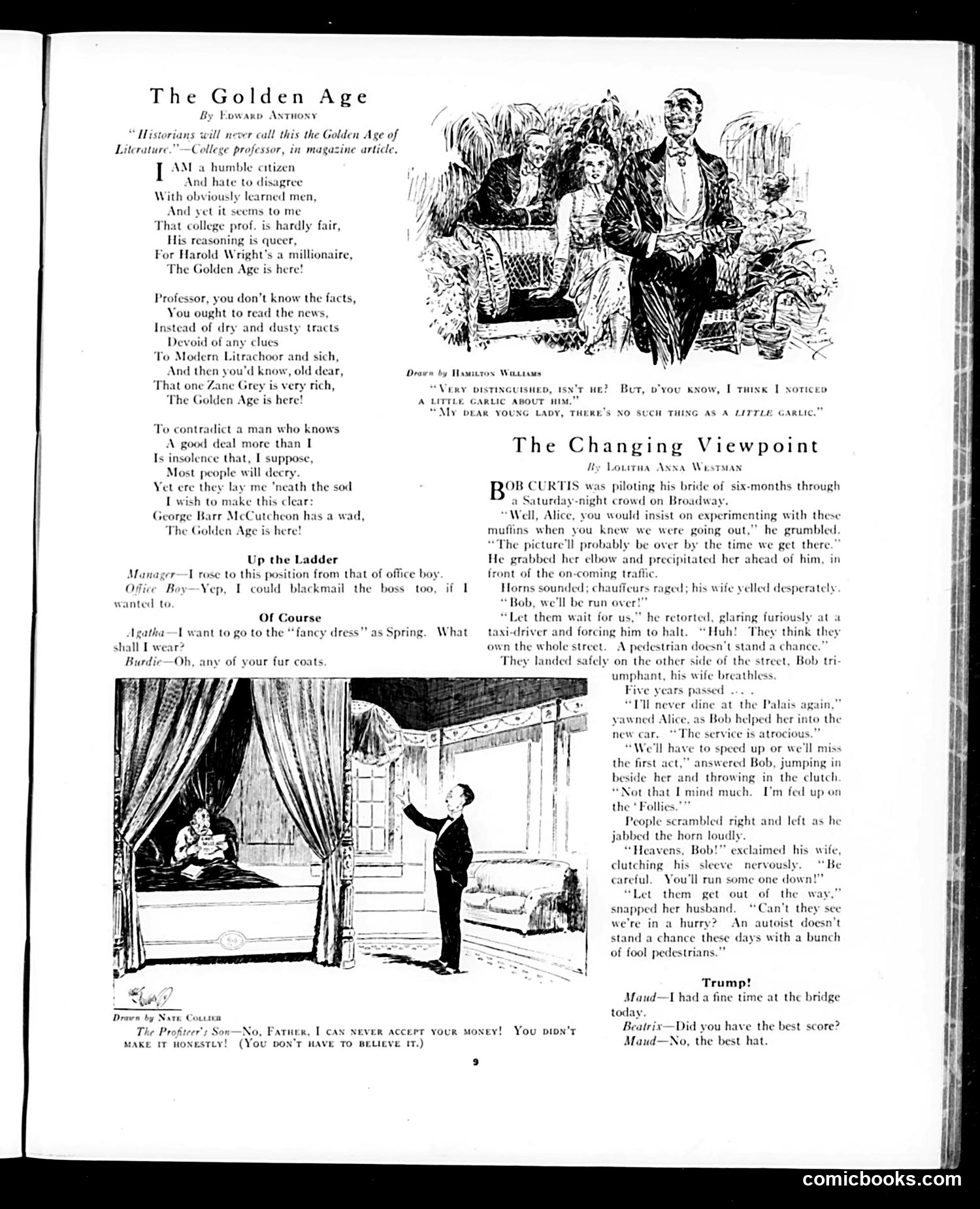
**"The Golden Age" poem** mocks a college professor's claim that modern literature lacks merit. The speaker sarcastically argues it *is* a "Golden Age" — not because of literary quality, but because popular authors like Harold Wright, Zane Grey, and George Barr McCutcheon are wealthy. The joke: the professor values serious literature; ordinary readers measure success by authors' bank accounts. This satirizes both anti-intellectual attitudes and the commercialization of American letters. **"The Changing Viewpoint"** depicts Bob Curtis, a married man now recklessly endangering pedestrians with his automobile, dismissing concerns about hitting people. Five years earlier, he was more cautious. The satire critiques how automobiles were corrupting manners and morality — drivers treated the streets as their domain, pedestrians be damned. It's a social commentary on technology's dehumanizing effects and changing values. **"Trump!" joke** mocks women's priorities: Maud valued her outfit more than winning at bridge — reinforcing period stereotypes about female vanity.
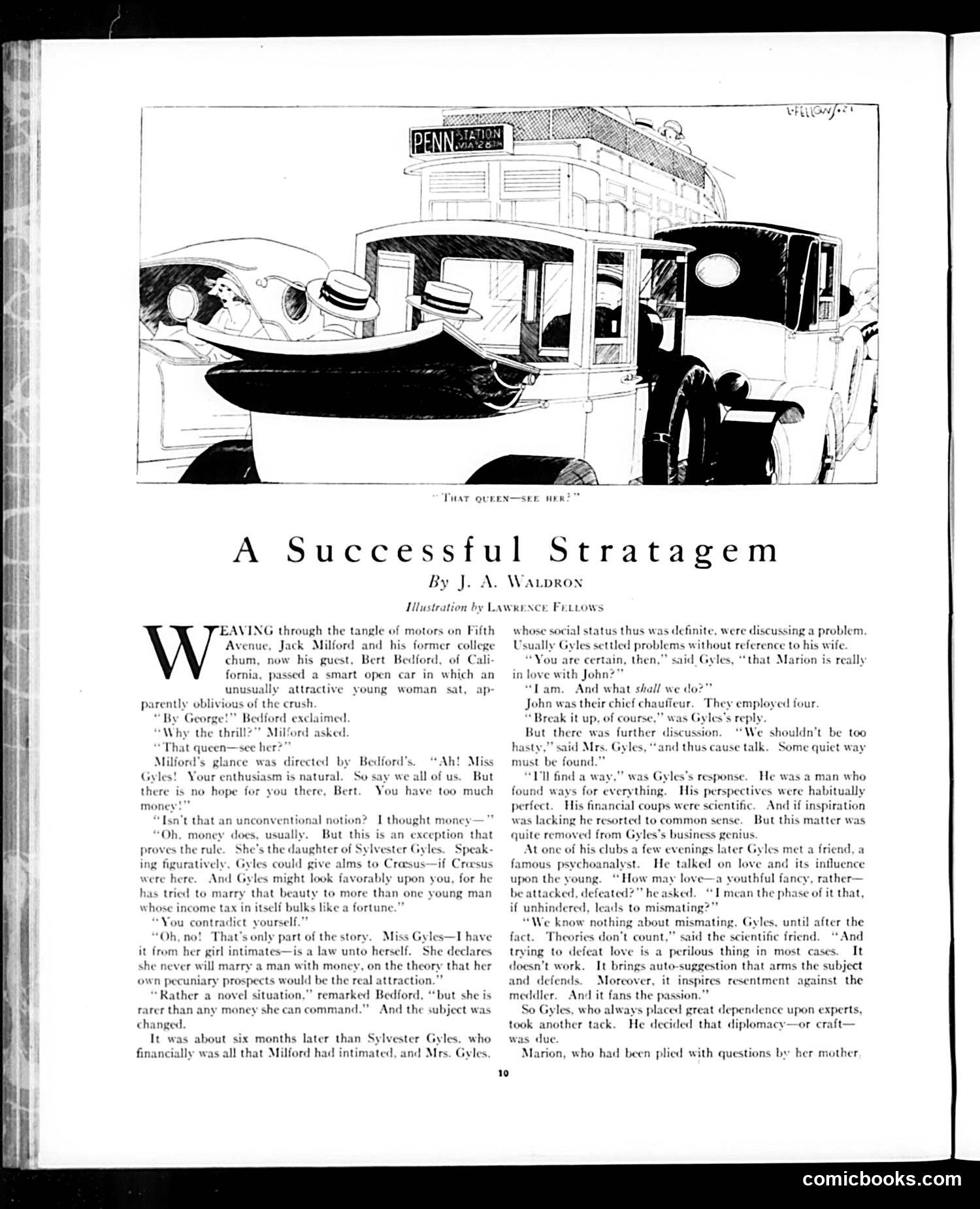
This story-with-illustration satirizes wealthy industrialists' attempts to control their children's romantic lives through manipulation rather than force. The setup: Miss Marion Gyles, daughter of the fabulously rich Sylvester Gyles, has fallen in love with John, the family's chauffeur. Her father—a self-made man accustomed to solving all problems through money and expertise—seeks advice from a famous psychoanalyst on how to break up the romance. The satire targets the era's faith in "expert" solutions and the absurdity of wealthy fathers treating romantic entanglements like business problems. The psychoanalyst's advice—that opposing love only strengthens it—sets up the story's "stratagem": Gyles must use "diplomacy or craft" instead of blunt force. The illustration shows the stylized 1920s setting (Fifth Avenue, automobiles, fashionable dress), while the narrative gently mocks upper-class social anxiety about class boundaries and parental authority's limits.
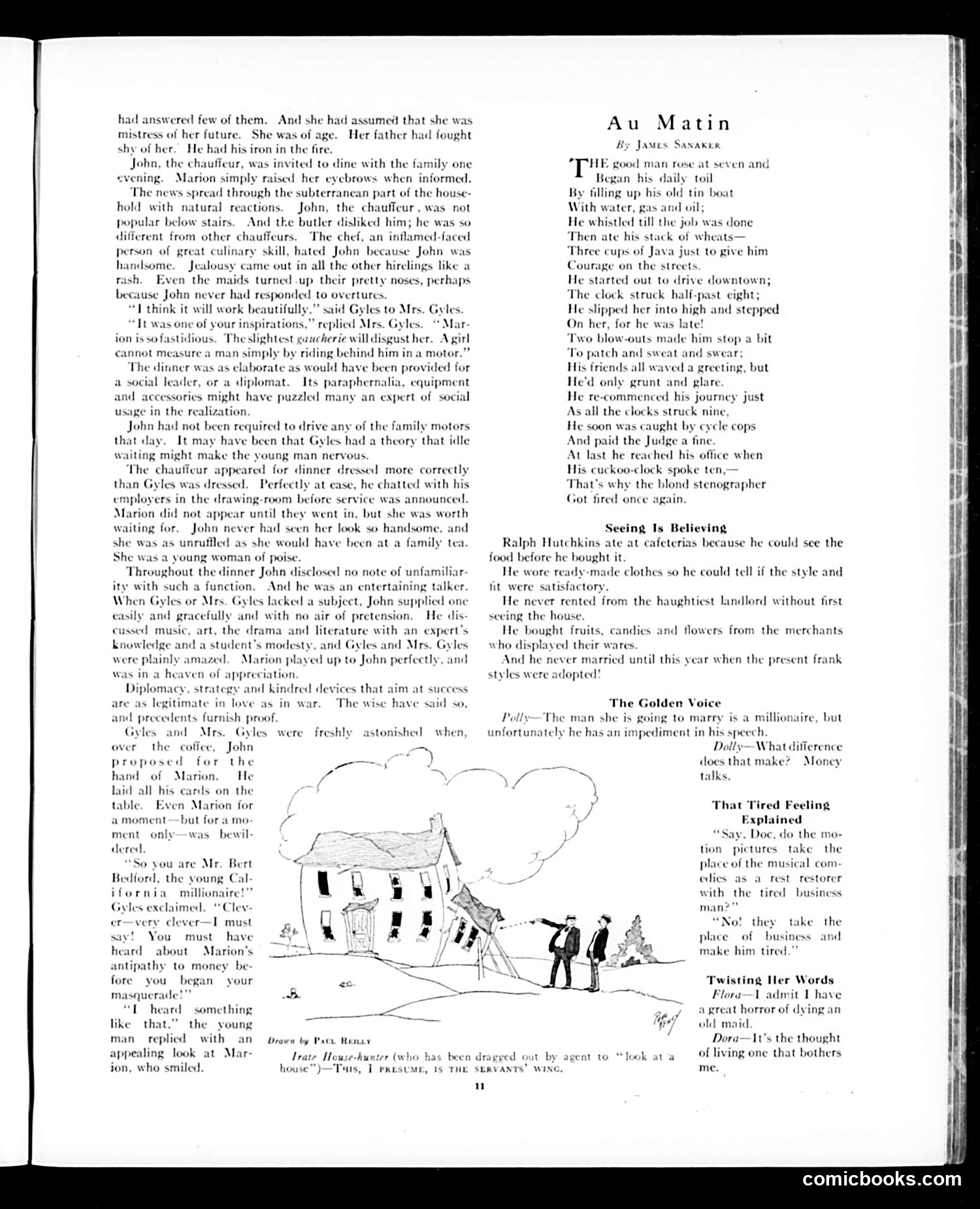
This page contains two distinct pieces: **Left side: Story illustration** depicting a social satire about class pretense. A wealthy California millionaire (Bert Bedford) disguises himself as a chauffeur to court Marion, a young woman hostile to wealth. The humor lies in the deception: Marion's parents encourage the ruse, believing their fastidious daughter will reject him based on his "lower" station. The chauffeur proves charming and educated, embarrassing the household staff who resent his handsomeness and competence. The revelation—that he's actually wealthy—exposes the family's hypocrisy: they despise money yet approve the match once his true status emerges. The satire mocks both class snobbery and the arbitrary nature of social acceptance. **Right side: "Au Matin"** is an unrelated poem about a hardworking man's frustrating morning commute (car troubles, flat tires, rude encounters), ending with his grumpiness—domestic humor rather than political satire.
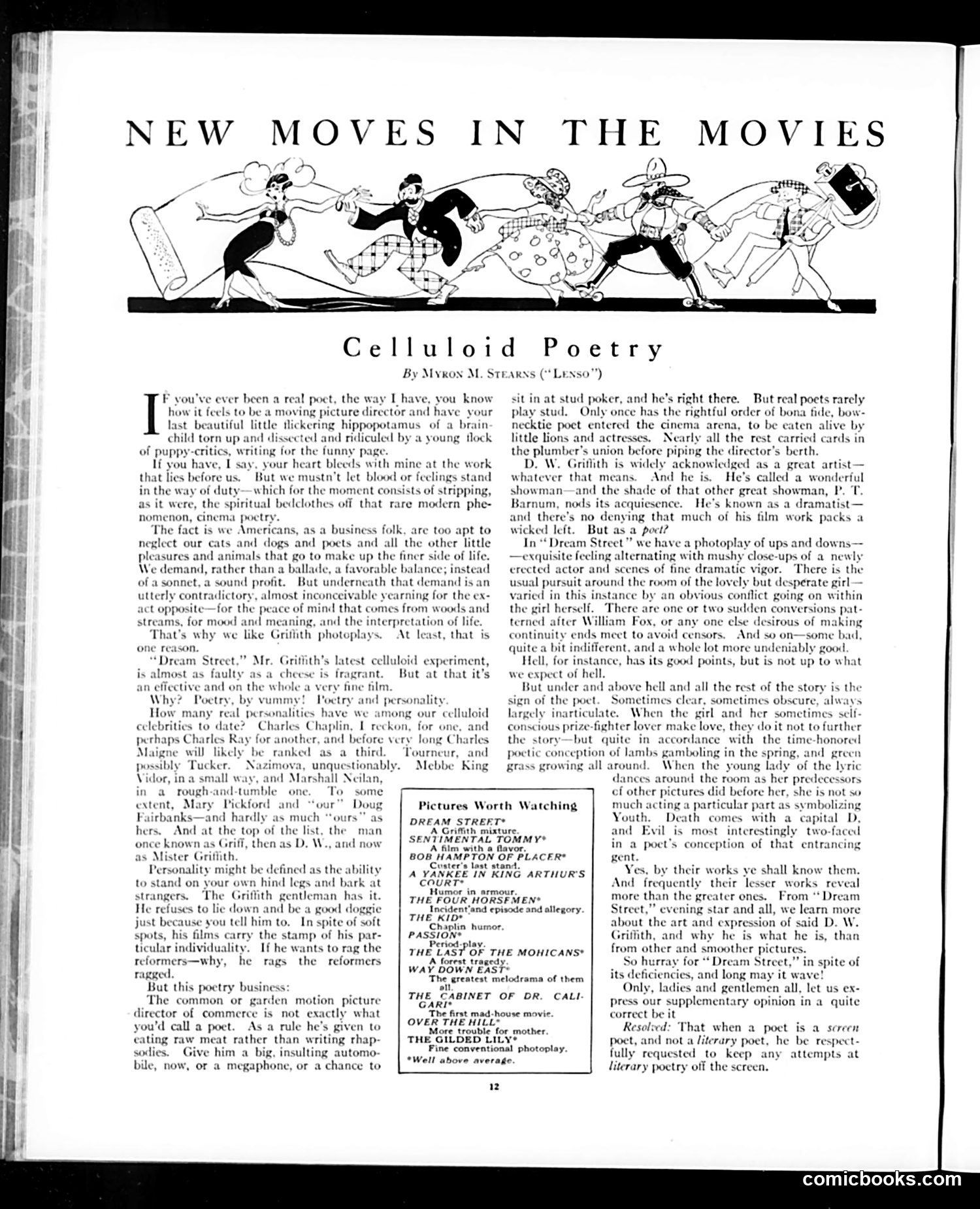
This is a film criticism essay by Myron M. Stearns ("Lesso") analyzing D.W. Griffith's film "Dream Street" as an example of cinema poetry. The piece argues that while American culture neglects "poets and all the other little pleasures," Griffith's films succeed because they combine entertainment with poetic sensibility. The author contends that true cinematic art requires personality and artistic vision—qualities he credits to Griffith, Chaplin, Charles Ray, and a handful of others. The critique of "Dream Street" is mixed: technically flawed but artistically compelling. Stearns objects to conventional plot devices (chases, love scenes, sudden conversions for censorship) yet praises Griffith's underlying poetic vision. He distinguishes between "ditch poetry" (screen melodrama) and genuine artistic expression, insisting cinema poets shouldn't imitate theatrical conventions. The accompanying illustrations show exaggerated dance movements, satirizing emerging "modern moves" in silent film acting.
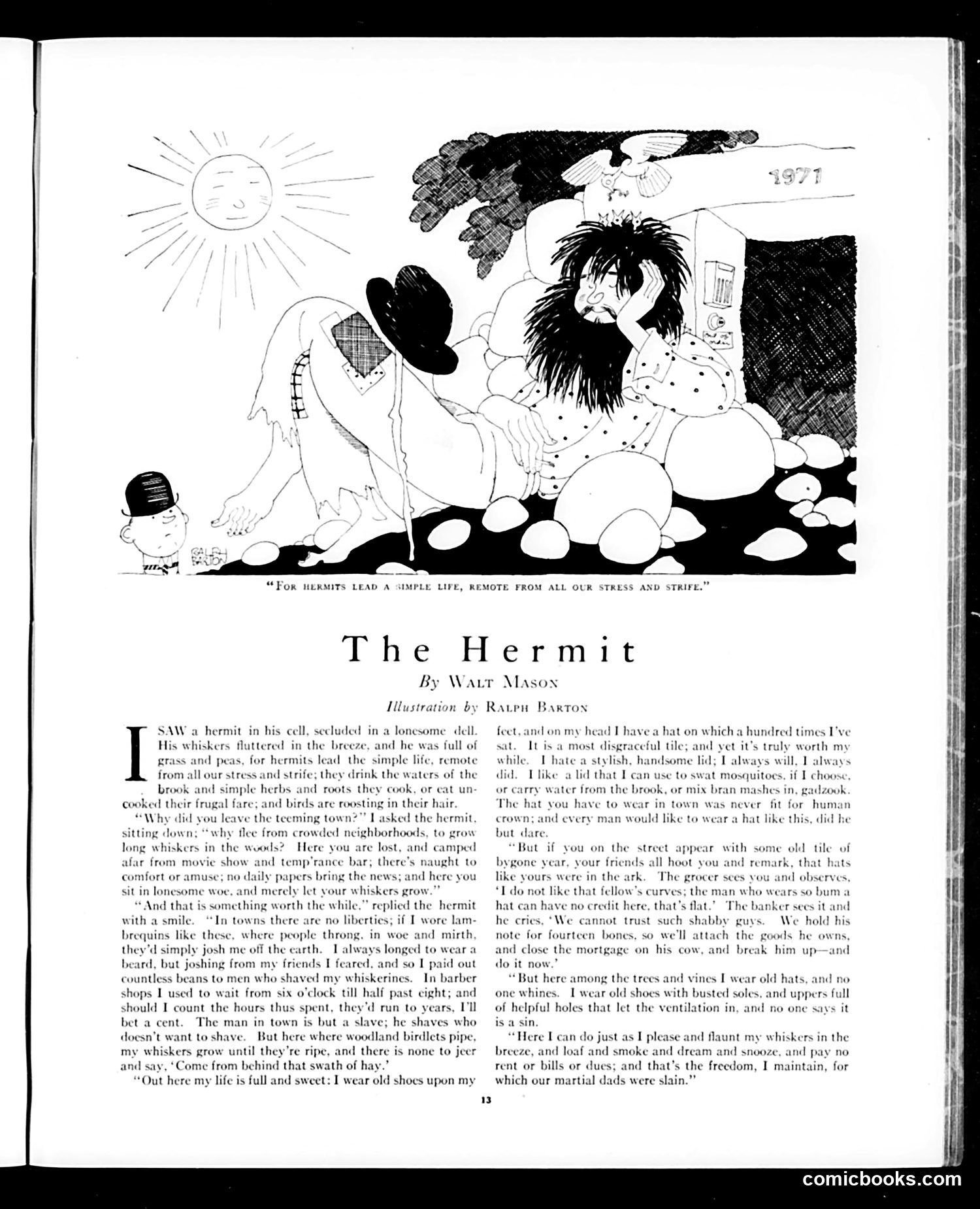
This is a satirical story-poem about rejecting modern urban conformity. A hermit explains to a visitor why he abandoned civilization for woodland isolation. The satire targets **early 20th-century consumer culture and social pressure**: the hermit resents mandatory grooming (expensive barber visits), fashion expectations, and the surveillance of respectability. Wearing an old hat or beard marks one as poor or eccentric, inviting judgment from grocers and bankers who deny credit based on appearance rather than character. The hermit celebrates freedom from these pressures—wearing shabby shoes, growing whiskers unchecked, avoiding rent and bills. His crude appearance (birds nesting in his hair) becomes desirable precisely because no one can judge or exploit him. The illustration shows the contrast: the hermit contentedly wild amid nature, while tiny town figures (visible upper right, marked "1871") represent the cramped, judgmental world he's escaped. The satire is ambivalent—the hermit seems foolish yet enviably free, suggesting Judge readers might share his frustrations with social conformity even if actual withdrawal is impractical.
This page from *Judge* contains two satirical essays rather than cartoons. **"Shall Married Men Wear Rings?"** mocks a proposal to make married men wear rings (like animals branded to prevent straying). The satire suggests this reflects deep suspicion of married men's fidelity and tendency toward infidelity ("vampishly cultivating the fine arts of dissimulation"). The piece sarcastically argues the rings won't work because dissemblers are indistinguishable from bootleggers anyway, and suggests cheaper alternatives like displaying photographs instead. **"Judging Our Public Men"** appears to reference Theodore Roosevelt and debates over the Colombian Treaty, discussing how public figures are unfairly judged by contemporaries. It argues we cannot truly know leaders' real purposes or predict outcomes, and cites historical examples (Buchanan, Jackson, Hamilton, Machiavelli) whose reputations changed over time—a plea for judging public servants more fairly and charitably. Both pieces reflect early 20th-century concerns about male behavior and political leadership credibility.
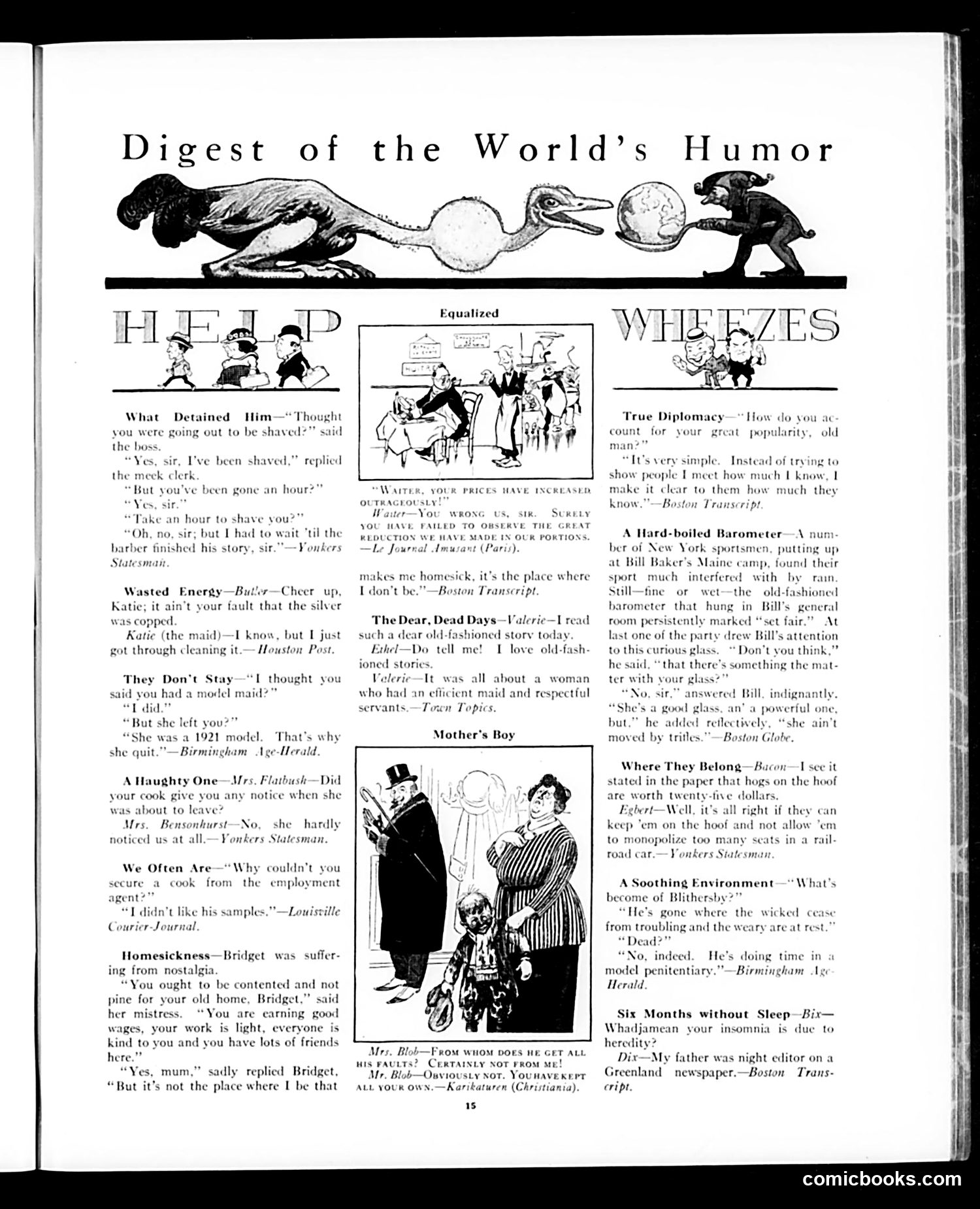
This is a collection of brief satirical jokes reflecting early 1920s American social anxieties. Key themes: **Domestic Service Crisis**: Multiple jokes mock the difficulty of keeping household staff—maids and cooks leave constantly, with one described as a "1921 model" (disposable, like a car). This reflects post-WWI labor shortages and servants' newfound mobility. **Class Tensions**: A waiter raises prices; a clerk delays a customer by listening to the barber's stories. The humor mocks both working-class impudence and upper-class inconvenience. **Economic Anxiety**: Jokes about restaurant portions shrinking and hog prices reflect inflation concerns. The "equalized" cartoon shows a waiter dismissing complaints about price increases. **Rural vs. Urban**: A Maine camp joke about a barometer stuck on "fair weather" satirizes rural stubbornness and disconnection from reality. Overall, these are conservative, class-conscious jokes aimed at affluent readers worried about servant reliability, rising costs, and social disruption in the post-war period.
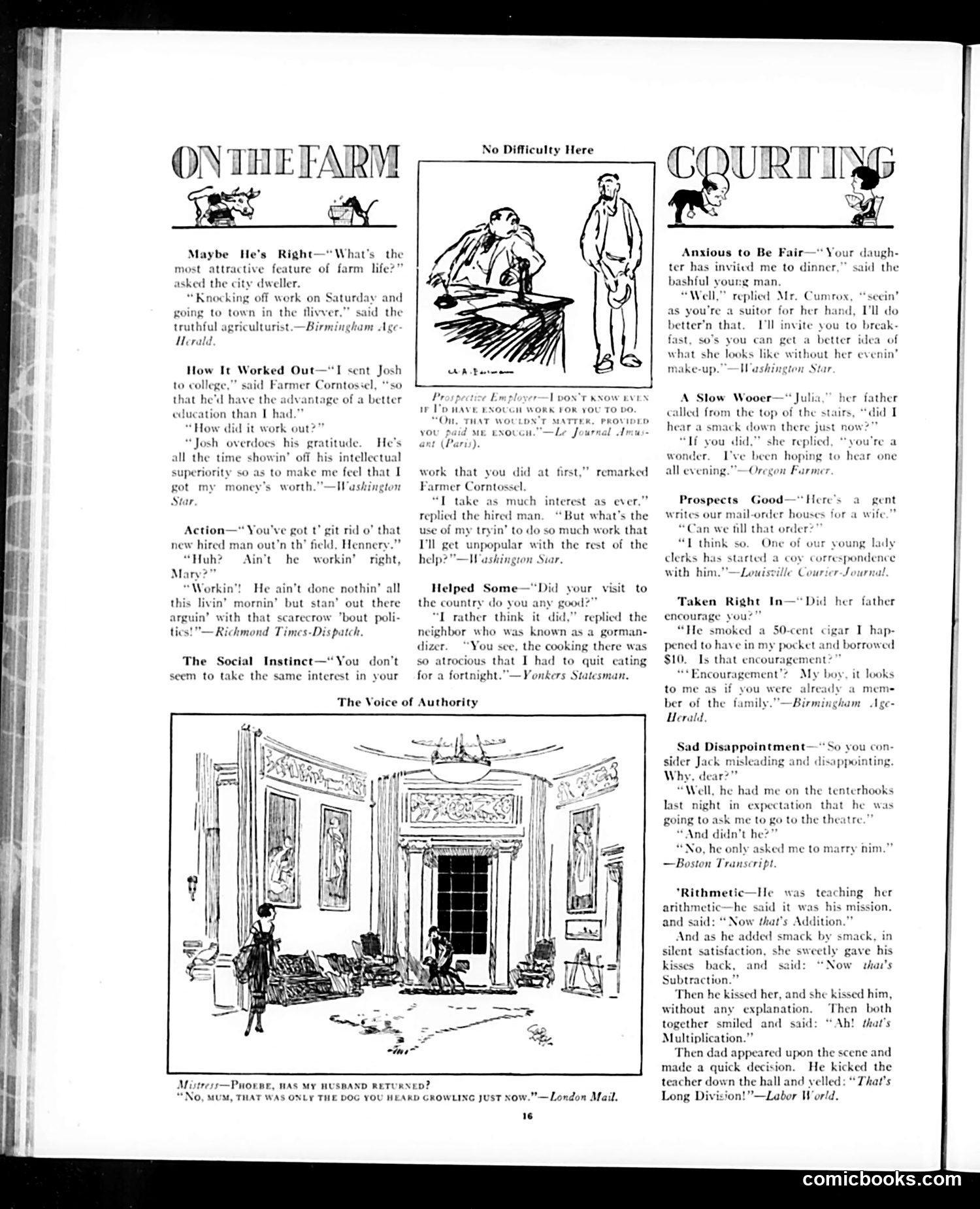
This page from Judge magazine contains humorous anecdotes about rural American life and courtship, typical of early 20th-century satirical humor. **"On the Farm" section** mocks farmer stereotypes: a hired man argues with a scarecrow about politics; a farmer's college-educated son shows off intellectual superiority; another farmer stops working to avoid seeming too industrious to coworkers. The satire targets rural attitudes toward education, labor, and social status. **"Courting" section** contains romantic comedy sketches. The humor relies on traditional gender dynamics and courting customs—a bashful suitor being sized up by the father, a woman's disappointment that a date proposal was actually a marriage proposal, and a teacher kissing a student to teach arithmetic concepts. **"The Voice of Authority"** illustration shows a woman asking her maid if her husband returned, with the punchline that she only heard a dog growling. This jokes about marital discord. The overall tone reflects early-20th-century assumptions about class differences, gender roles, and rural simplicity versus urban sophistication. The humor depends on recognizing period-specific courtship conventions and farm-life attitudes now largely obsolete.
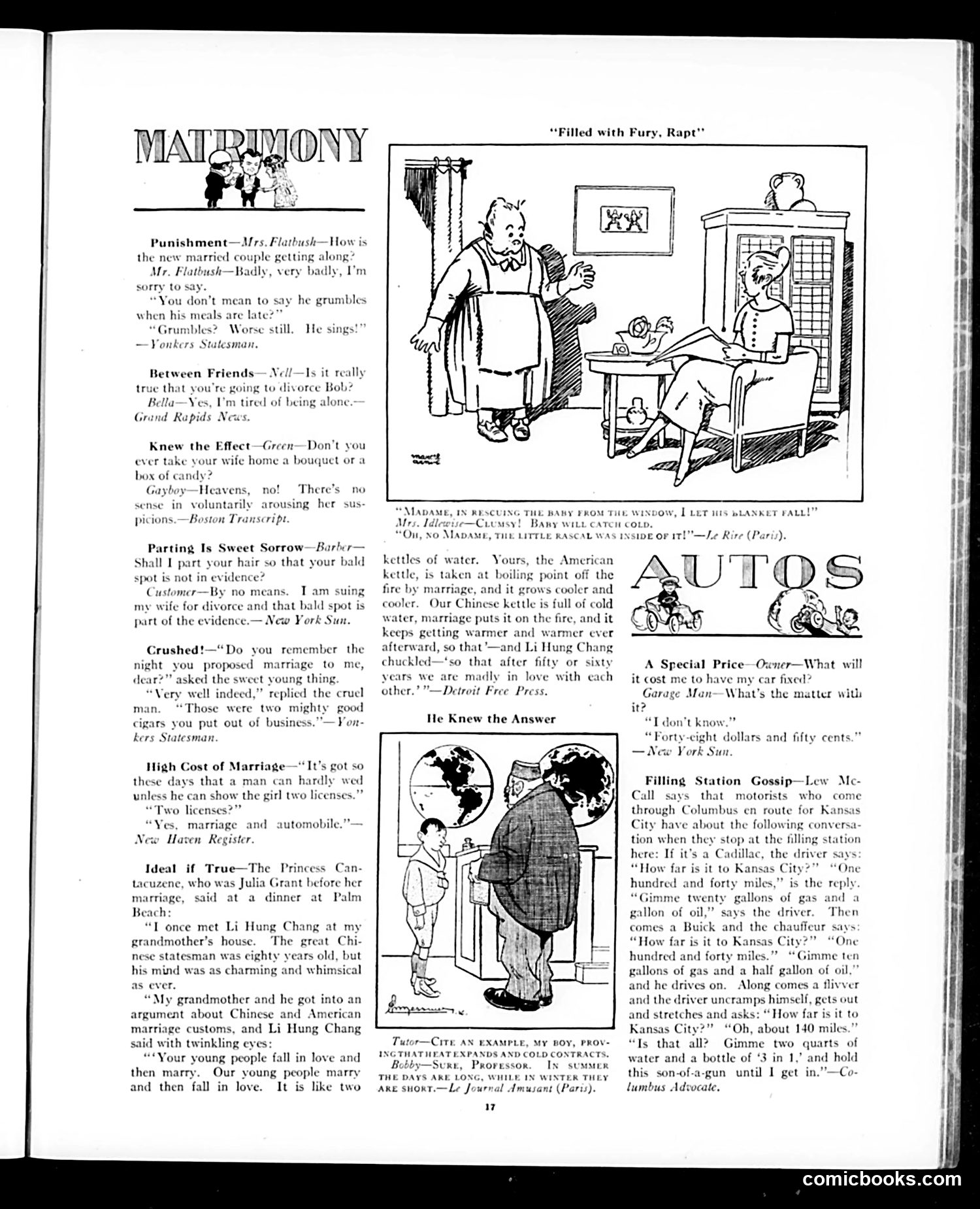
This page contains brief humorous anecdotes about marriage, typical of early 20th-century American humor. The satire targets matrimonial discord through quick jokes: **Key themes:** - **Marriage dissatisfaction**: Multiple jokes depict couples unhappy after wedding ("getting along badly," "tired of being alone," divorcing) - **Gender dynamics**: A wife's suspicions, domestic complaints about late meals, and a husband using his bald spot as divorce evidence - **The "cooling kettle" anecdote**: A supposed conversation with Li Hung Chang contrasts American and Chinese marriage—American couples "cool off" after marriage while Chinese couples warm to love over decades. This reflects period Orientalism and exoticizing of Chinese culture. - **Class/automobile humor**: A tutor's science lesson about thermal expansion, a car repair scam ($48.50 for unknown problems), and filling-station gossip about different car owners' purchasing patterns The cartoons and text use marriage failure and domestic tension as humor vehicles, reflecting anxieties about modern matrimony in the Jazz Age era.
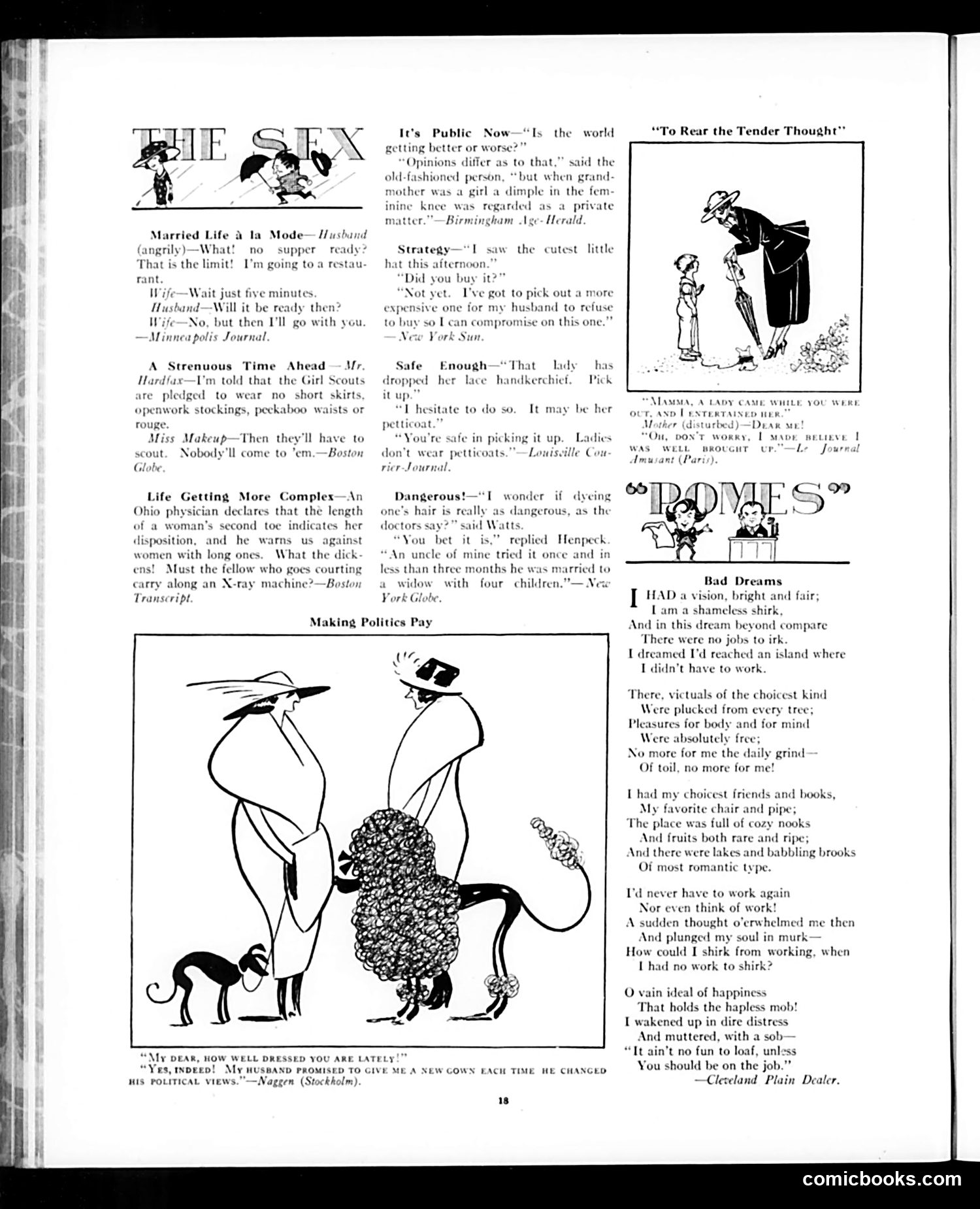
This page from the satirical magazine *Judge* contains multiple short humor pieces mocking early 1900s social conventions: **"Married Life à la Mode"** satirizes the modern housewife's contradictory behavior—she complains about lacking supper preparations yet insists on accompanying her frustrated husband to a restaurant. **"Making Politics Pay"** (main cartoon) depicts a well-dressed woman crediting her new wardrobe to her husband's changing political views, implying politicians reward themselves financially through office. The Stockholm attribution suggests this was an international observation about political corruption. **Minor pieces** mock Girl Scouts abandoning makeup, pseudo-scientific claims about women's toe length predicting temperament, and hair-dyeing dangers (a widower's cautionary tale). **"Bad Dreams"** poem presents ironic social commentary: a man dreams of workless paradise but awakens distressed, realizing leisure has no meaning without work obligations to escape—satirizing the era's Protestant work ethic and the public's inability to genuinely enjoy leisure. The overall theme critiques modern social pretenses, consumerism, and the tension between desire for ease and cultural compulsion toward productivity.
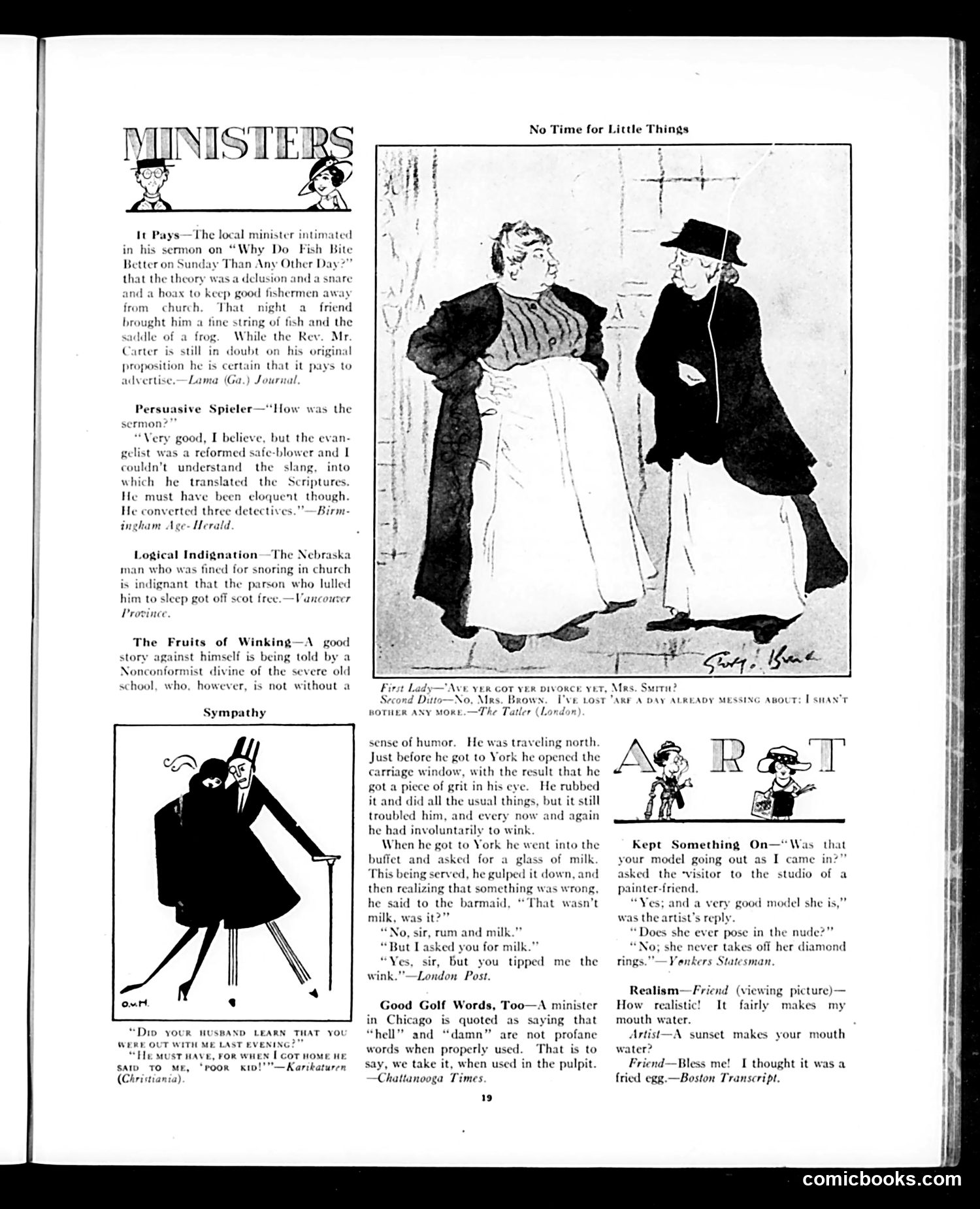
This page from *Judge* magazine contains satirical anecdotes mocking clergy and religious hypocrisy, typical of early 20th-century American humor. **Main cartoon** ("No Time for Little Things"): A working-class woman dismisses her friend's concerns about divorce proceedings, suggesting she's too busy with life's pressures to worry about legal formalities—satire on how divorce, once scandalous, became routine. **"It Pays"**: A minister preaches against Sunday fishing, then accepts fish as a gift anyway—mocking clerical inconsistency and suggesting advertising (even unintentional) works. **Other anecdotes** target preachers: one is an ex-safecracker using slang; another's snoring congregation member gets no consequence while the boring sermon does; another accidentally "winks" at a barmaid, receiving rum instead of milk. The humor relies on depicting clergy as hypocritical, dull, or unexpectedly worldly—common Progressive-era satire challenging religious authority and pretense.
This page reviews "Clair de Lune," a play starring the famous Barrymore siblings—Ethel and John—at New York's Empire Theatre. The critic is harshly disappointed despite the celebrity draw and lavish production design. The satirical thrust: **Famous names alone cannot save a bad play**. Though Ethel Barrymore is visually stunning and the sets are beautifully designed by Homer Emens, the adaptation of Victor Hugo's "L'Homme qui Rit" is poorly constructed and relies on cheap theatrical tricks (undressing scenes, emotional wallops) rather than genuine artistry. John Barrymore is wasted in an effeminate, colorless role. The headnote illustration depicts a judge—representing critical judgment—evaluating theatrical performance. The critic concludes that despite the Barrymores' individual talents, they deserve better material than this derivative, Oscar Wilde-imitating vehicle. The page reflects early 1920s Broadway's tension between star power and artistic merit.
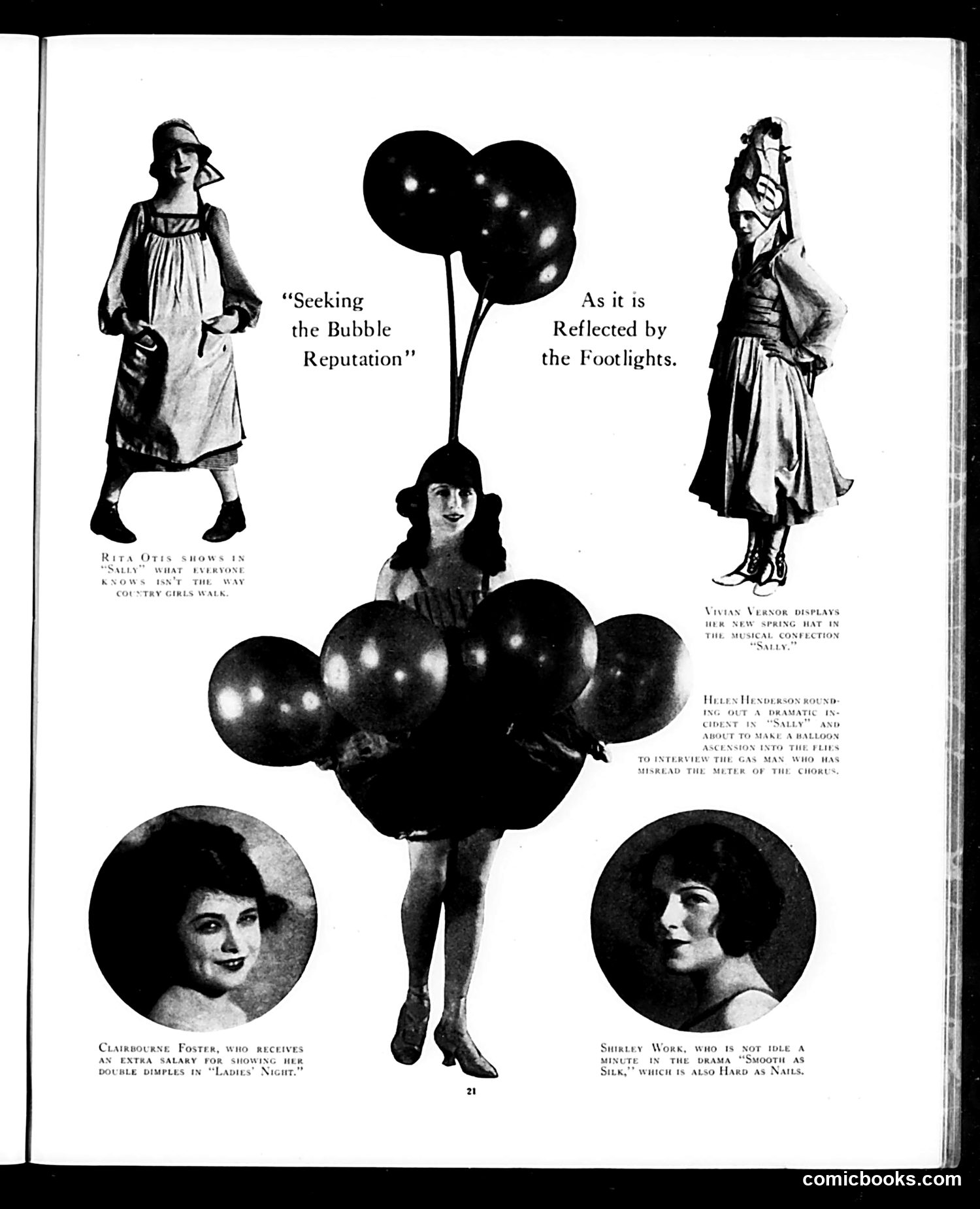
This page satirizes theatrical actresses and the pursuit of fame in early 20th-century theater. The central image shows a woman holding enormous balloons labeled "Seeking the Bubble Reputation"—a Shakespeare reference meaning the hollow pursuit of fame. The layout presents actresses in two contexts: their everyday appearance (left and right figures) versus their glamorous stage personas (circular portraits at bottom). The captions identify real performers: Clairbourne Foster and Shirley Work, noting they receive extra salary or perform demanding roles in specific productions ("Ladies' Night," "Smooth as Silk"). The satire criticizes the disconnect between actresses' actual lives and their manufactured stage images. The "bubble reputation" metaphor suggests their fame is insubstantial and temporary. Rita Orts's caption mocks the affected way "country girls" adopt theatrical mannerisms. The joke targets both the vanity of aspiring actresses and the theater industry's marketing of female performers' appearance over talent.
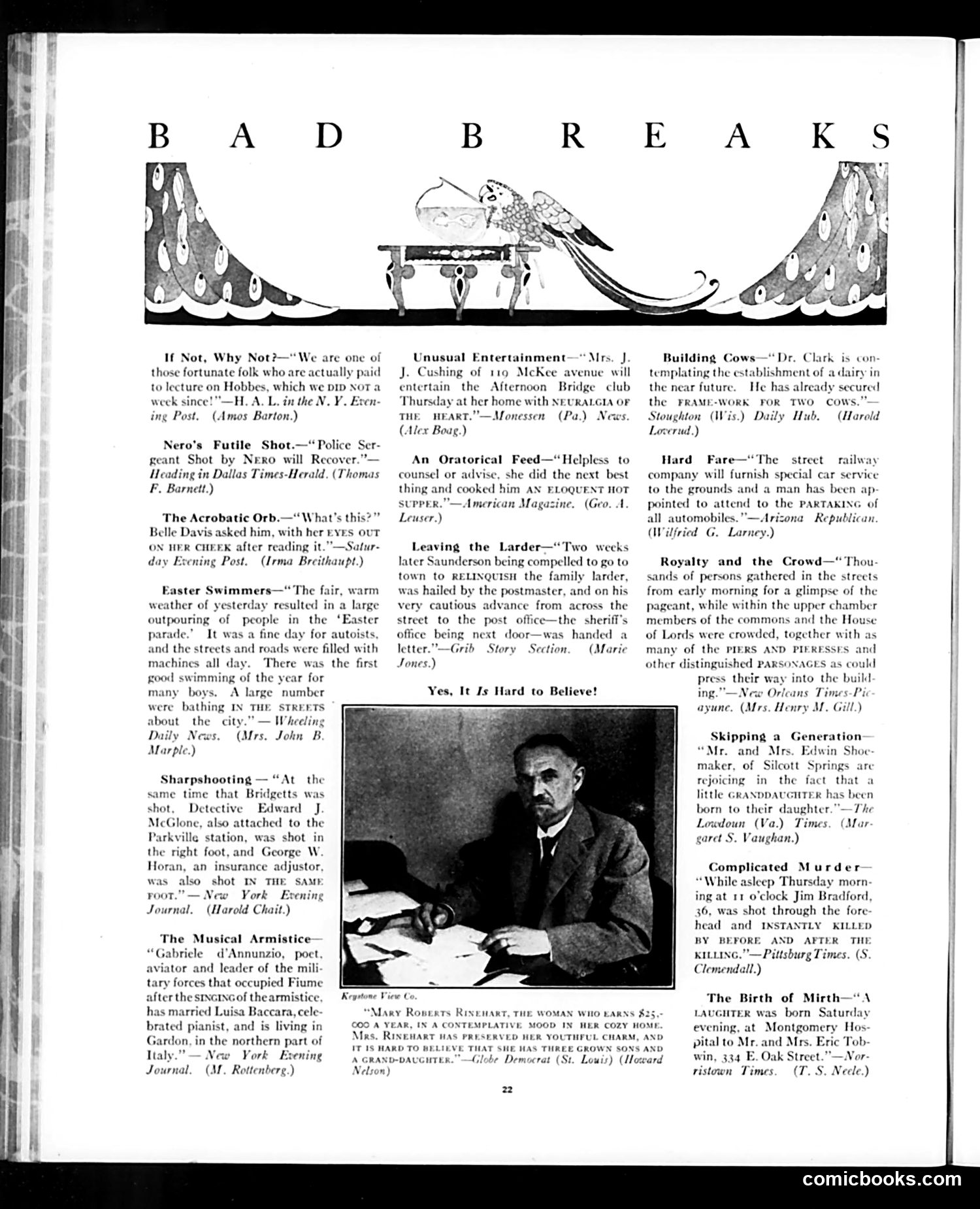
This is a humor page from *Judge* magazine consisting entirely of **"Bad Breaks"**—editorial cartoons built around humorous newspaper headline typos and grammatical errors. Each item mocks absurd meanings created by missing words or awkward phrasing in actual newspaper clippings. For example: - A headline about someone being "shot" followed by "will recover" becomes funny because the omitted context makes it seem impossible - "Neuralgia of the HEART" as entertainment sounds ridiculous (likely meant "heart trouble") - A woman earning $25,000 yearly shown in a photo captioned as "contemplative" in her home—the joke being her youthfulness despite her age and successful career The cartoon at top features the **"Bad Breaks"** title with decorative art-deco styling. The center photograph shows **Mary Roberts Rinehart**, a celebrated author/playwright, illustrating one of the clippings about her preserved youth. This was a popular *Judge* format: finding real newspaper mistakes and republishing them with credited sources to highlight the absurdity of poor editing. The humor relies entirely on the reader recognizing how badly edited copy creates unintended meanings.
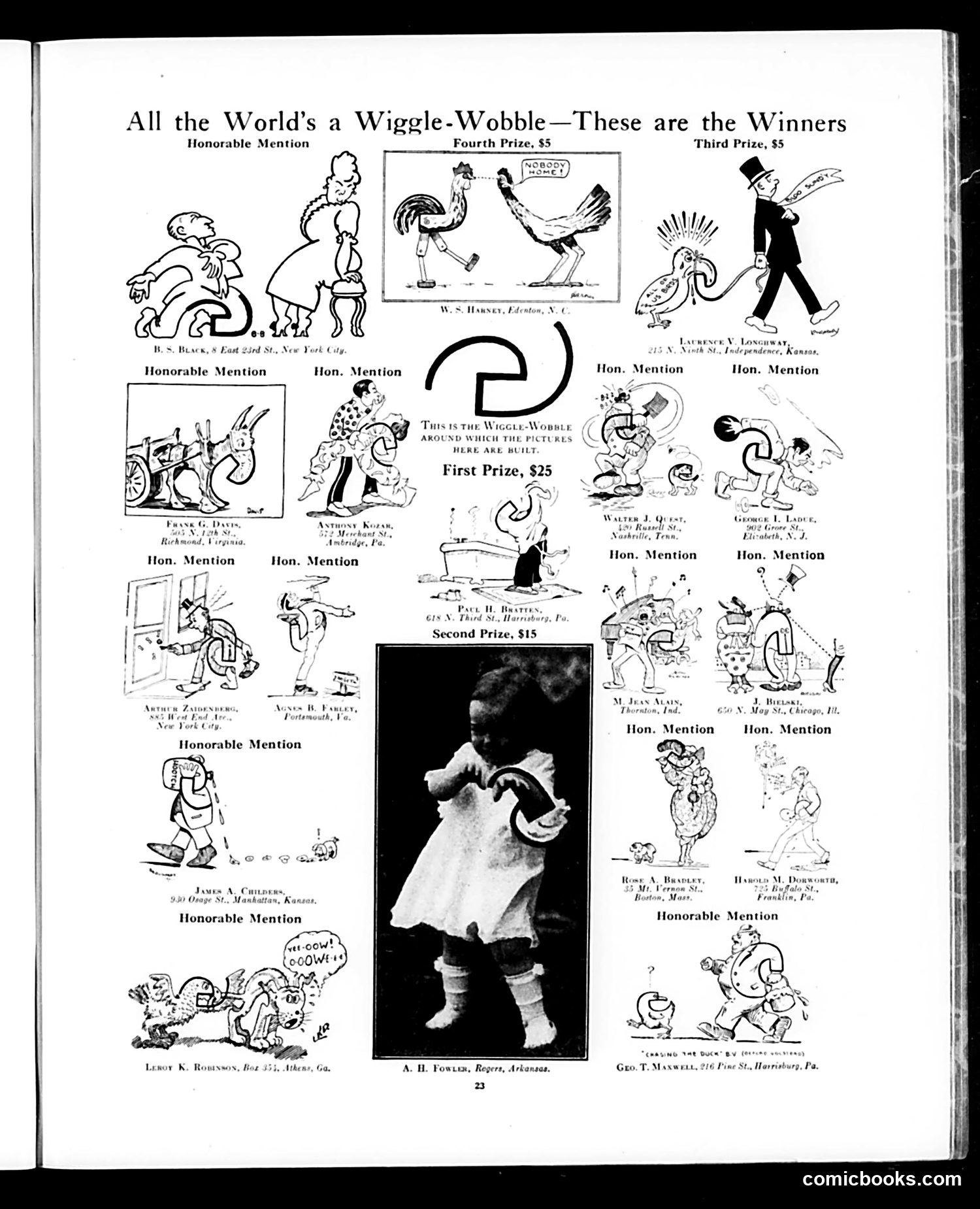
This page announces winners of a Judge magazine drawing contest centered on the "wiggle-wobble" motif—a squiggly S-curve visible at the center of the page. Contestants submitted cartoons built around this abstract shape. The contest awarded prizes ($25 first prize down to $5 for fourth) and honorable mentions to cartoonists from across America who creatively incorporated the wiggle-wobble into humorous drawings. The submissions show varied comic scenarios: people dancing, roosters, children playing, and general slapstick situations. The central photograph appears to be A.H. Fowlen from Rogers, Arkansas—possibly the first-prize winner or contest organizer—holding the original wiggle-wobble shape. This represents Judge's interactive engagement with readers—a common early-20th-century magazine practice of running contests to encourage amateur submissions and boost circulation. The geographic diversity of winners (Kansas, North Carolina, Pennsylvania, etc.) demonstrates national participation.
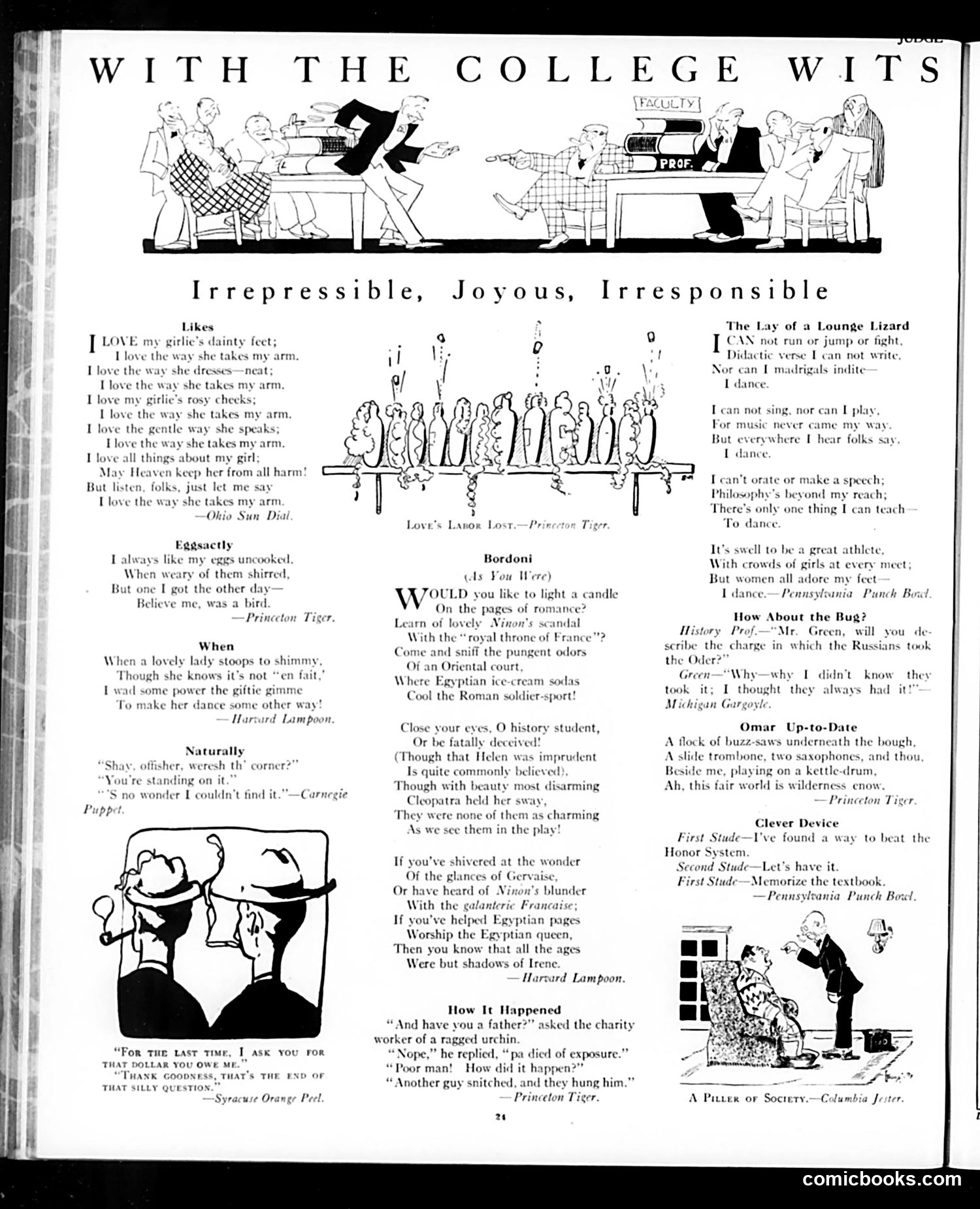
This page collects humorous student verse and cartoons from college publications (Princeton Tiger, Harvard Lampoon, etc.), satirizing contemporary collegiate life and culture. **Key content includes:** - **Romantic comedy**: Poems mocking lovesick male students obsessed with their girlfriends' mannerisms - **"Bordoni"**: A parody of exotic historical drama, likely referencing Lina Bordoni (contemporary stage performer), mocking students who romanticize history through theatrical productions rather than actual study - **Academic incompetence**: Jokes about students cheating the honor system, professors ignorant of current events, and the general frivolousness of college life - **Jazz Age references**: "The Lay of a Lounge Lizard" satirizes the carefree, non-intellectual college male who can only dance—reflecting 1920s youth culture anxieties - **Social critique**: Dark humor about poverty ("pa died of exposure") contrasts with the privileged college setting The satire targets the disconnect between collegiate pretension and actual learning, plus the era's youth culture obsession with romance, performance, and leisure over substance.
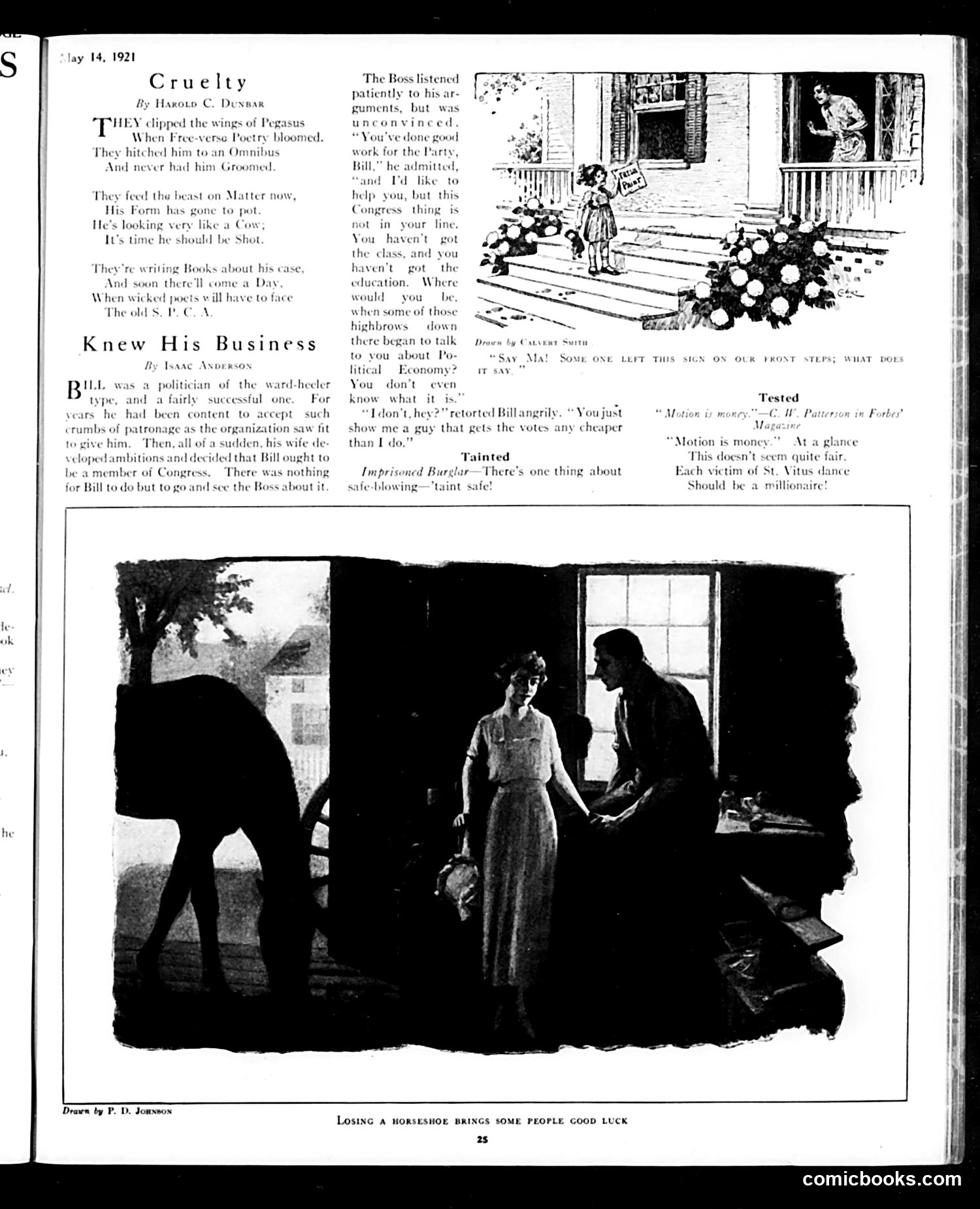
This page contains three satirical pieces critiquing early 1920s American politics and social attitudes. **"Cruelty"** mocks the decline of literary quality, comparing free-verse poetry to a debased beast—suggesting modernist poetry has lost its classical elegance. **"Knew His Business"** satirizes urban machine politics. Bill is a successful ward-heeler (political operative who trades patronage for votes) whom his ambitious wife wants elevated to Congress. The "Boss" refuses, arguing Bill lacks the education and class needed for higher office—ironic since Bill's entire career relied on political corruption rather than merit. The satire targets both the cynicism of machine politics and the pretension that Congress requires sophistication. **The illustration** captioned "Losing a Horseshoe Brings Some People Good Luck" depicts an interior scene; the caption appears to reference superstition or possibly a lost political opportunity bringing fortune to others. The sidebar items offer brief satirical jokes about motion, economics, and safe-cracking—typical magazine filler humor of the era.
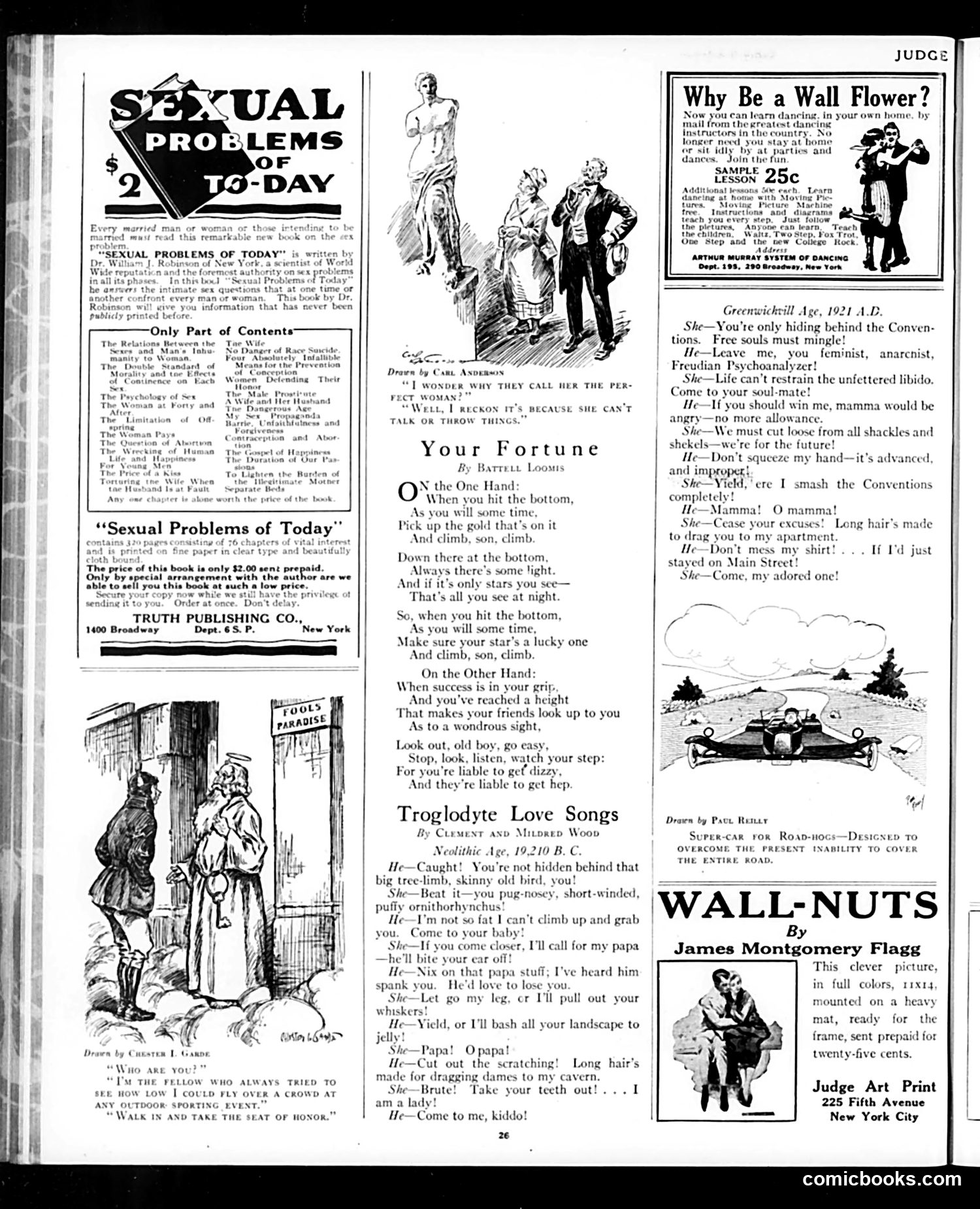
This page contains several distinct satirical pieces reflecting 1920s social anxieties: **"Sexual Problems of To-Day"** (left) advertises a $2.00 book addressing "intimate sex questions"—reflecting contemporary confusion about changing sexual mores post-WWI. **The two cartoon vignettes** mock different social types: one depicts a reckless stunt-flyer being honored (unclear satire), another jokes that the "perfect woman" is one who cannot talk or throw things—misogynistic humor common to the era. **"Troglodyte Love Songs"** and **"Greenwhichvill Age"** contrast prehistoric and 1920s courtship. The latter satirizes bohemian Greenwich Village youth: the woman invokes "Conventions," "Freud," and "libido" while the man worries about his allowance—mocking both radical posturing and economic dependency. The satire suggests modern "free souls" are merely adopting fashionable rhetoric. **"Your Fortune"** offers platitudinous verse about climbing from adversity. The page overall reflects Judge's conservative mockery of 1920s sexual liberation, psychoanalysis, and bohemian culture as shallow affectation.
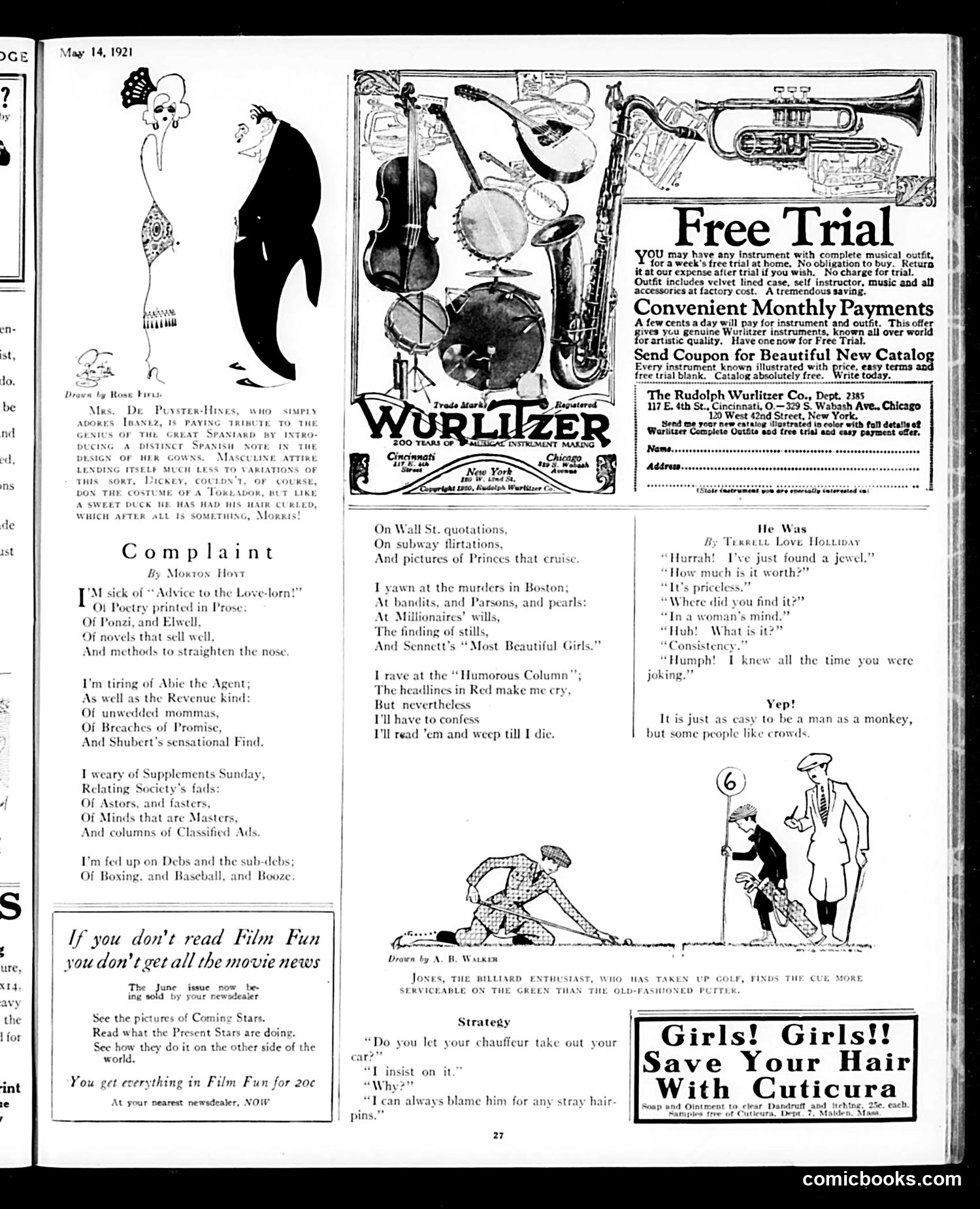
This page is primarily **advertising and light humor** rather than political satire. Key content: **Main Features:** - A fashion note about Mrs. De Forster-Hines imitating Spanish designer Ibáñez's style, with a joke about a duck getting its hair curled - "Complaint" by Morton Hoyt: a humorous poem griping about overused newspaper content—advice columns, Ponzi schemes, society gossip, boxing coverage—representing reader fatigue with repetitive media - A short joke about a jewel found "in a woman's mind" (consistency) - A cartoon showing a golfer using a billiard cue on the green instead of a putter **Context:** The references to "Ponzi" (the 1920 scheme) and "Elwell" (likely the unsolved 1920 murder of Joseph Elwell) date the piece to early 1920s America. The satire targets journalistic clichés rather than politics. The remainder is **product advertising** for Wurlitzer musical instruments and Cuticura hair products—typical of the era.
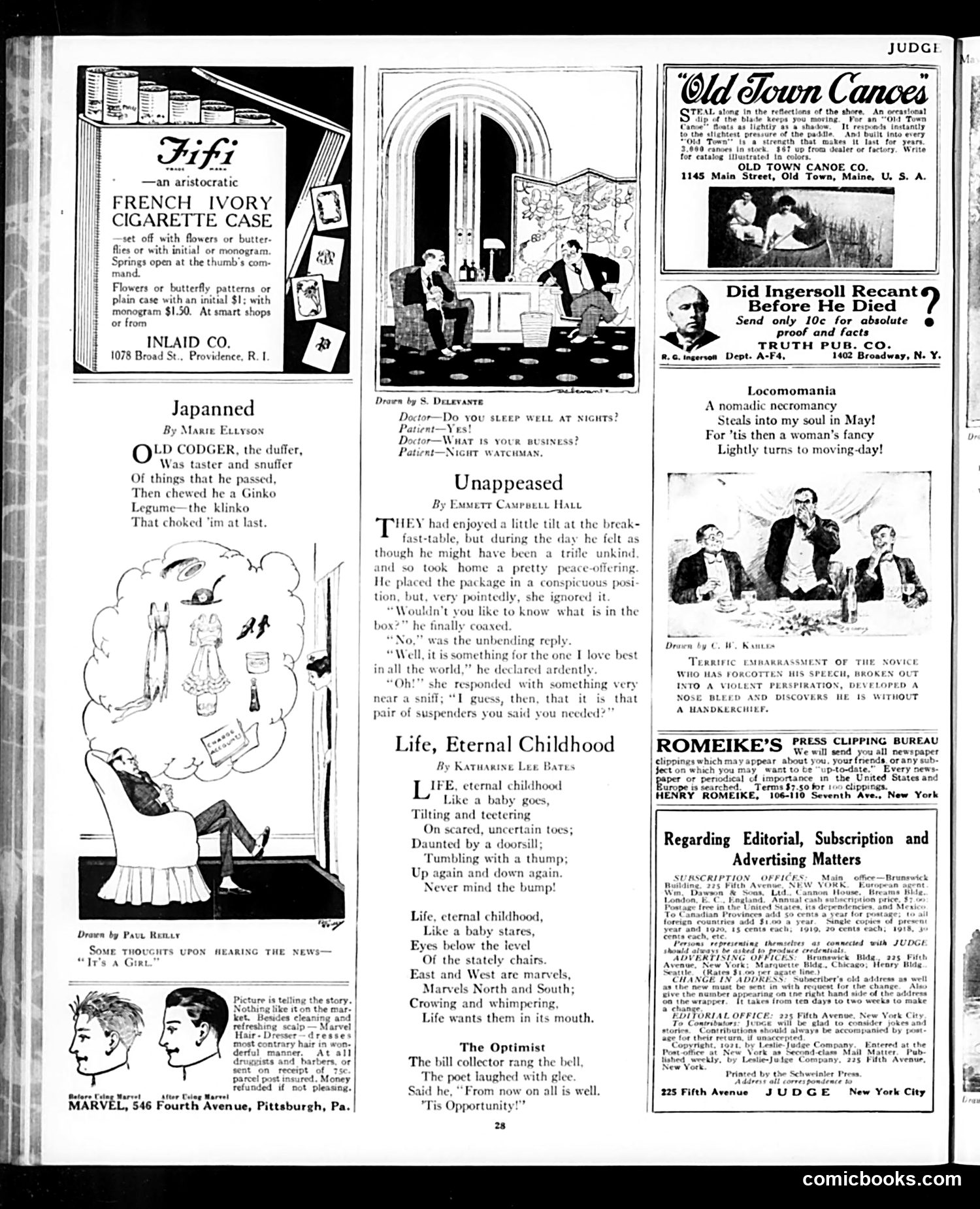
This page from *Judge* (a satirical weekly) contains mostly light humor and advertisements typical of early 20th-century American magazines. **Main Content:** The cartoons and poems are gentle social satire: "Japanned" mocks an elderly man who dies from eating an indigestible legume; "Unappeased" depicts marital discord where a husband's peace offering is rejected by his wife; "Life, Eternal Childhood" is sentimental verse comparing life to infancy; "The Optimist" presents a light joke about a poet welcoming a bill collector as "opportunity." **Advertisements include:** - French ivory cigarette cases (luxury goods) - Old Town Canoes - A dubious "Truth Publishing" pamphlet claiming Robert Ingersoll recanted his atheism before death (likely false advertising preying on religious readers) - Romeike's Press Clipping Bureau (a legitimate publicity service) The page reflects *Judge*'s mix of mild domestic humor, consumer advertising, and occasional dubious or predatory ads—typical of the era's magazine publishing.
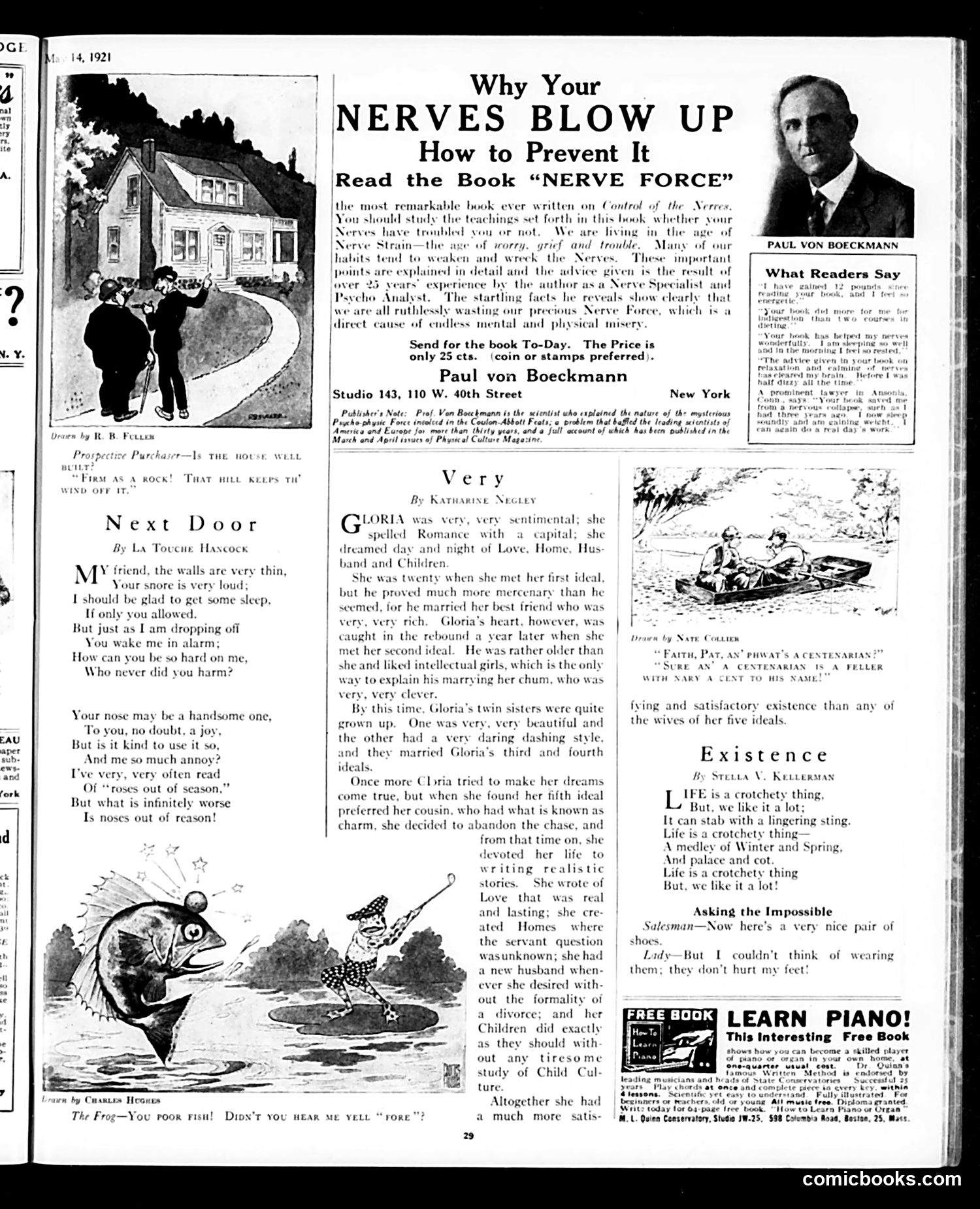
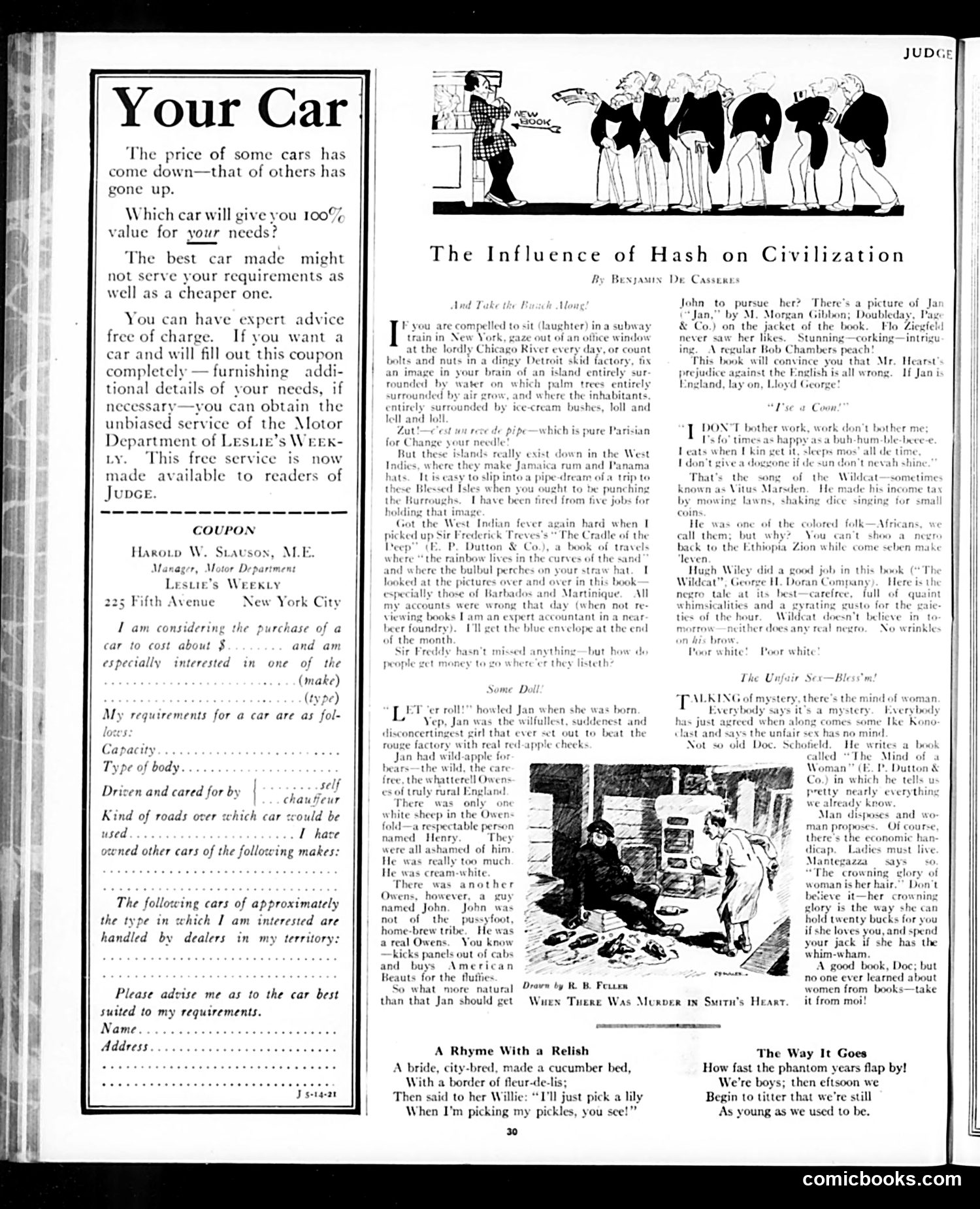
This page contains mixed content: a car advertisement coupon and several humor pieces typical of Judge magazine. **The Main Cartoon** ("The Influence of Hash on Civilization"): A satirical short story about a character named Jan, likely written to mock romantic adventure fiction popular in the 1920s. The narrative mocks both the exotic "island paradise" fantasies authors created and the supposedly noble rural English characters who were stock figures in such tales. The humor lies in deflating literary pretension. **Secondary humor pieces** include crude racial stereotypes ("Is'e a Coon") and light verse about domestic life ("A Rhyme with a Relish"), typical of Judge's era. **The car coupon** is straightforward advertising dressed as consumer advice—offering "free expert service" to help readers choose automobiles, appealing to the uncertainty of the emerging automobile market. The page reflects 1920s middle-class concerns: automobile ownership and literary taste, alongside the casual racism standard to the publication's era.
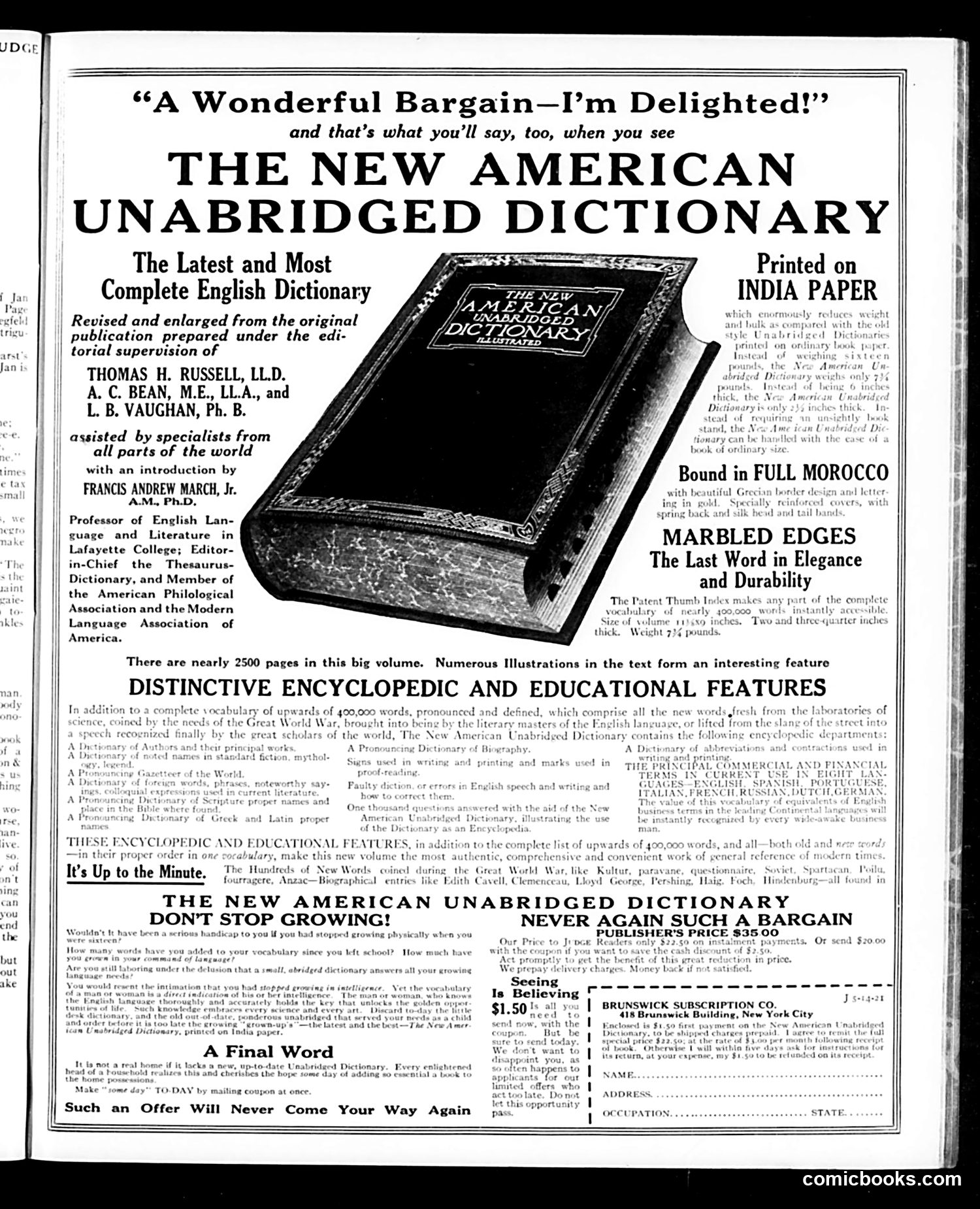
This is **primarily a dictionary advertisement**, not a political cartoon. The page is a full-page ad for "The New American Unabridged Dictionary" from what appears to be an early 20th-century *Judge* magazine. The ad uses marketing language typical of the era—emphasizing the dictionary as a bargain ("A Wonderful Bargain," "Never Again Such a Bargain"), highlighting its physical qualities (morocco binding, marbled edges, india paper), and listing prestigious editors and contributors. The only potentially satirical element is the framing quote "A Wonderful Bargain—I'm Delighted!"—a common advertising technique that uses mock testimonials. However, this appears to be genuine marketing rather than satire of dictionary publishing or education itself. The subscription offer at bottom ($1.50) and publisher information suggest this filled advertising space in *Judge*, but contains no discernible political commentary or social satire worthy of note for modern readers.
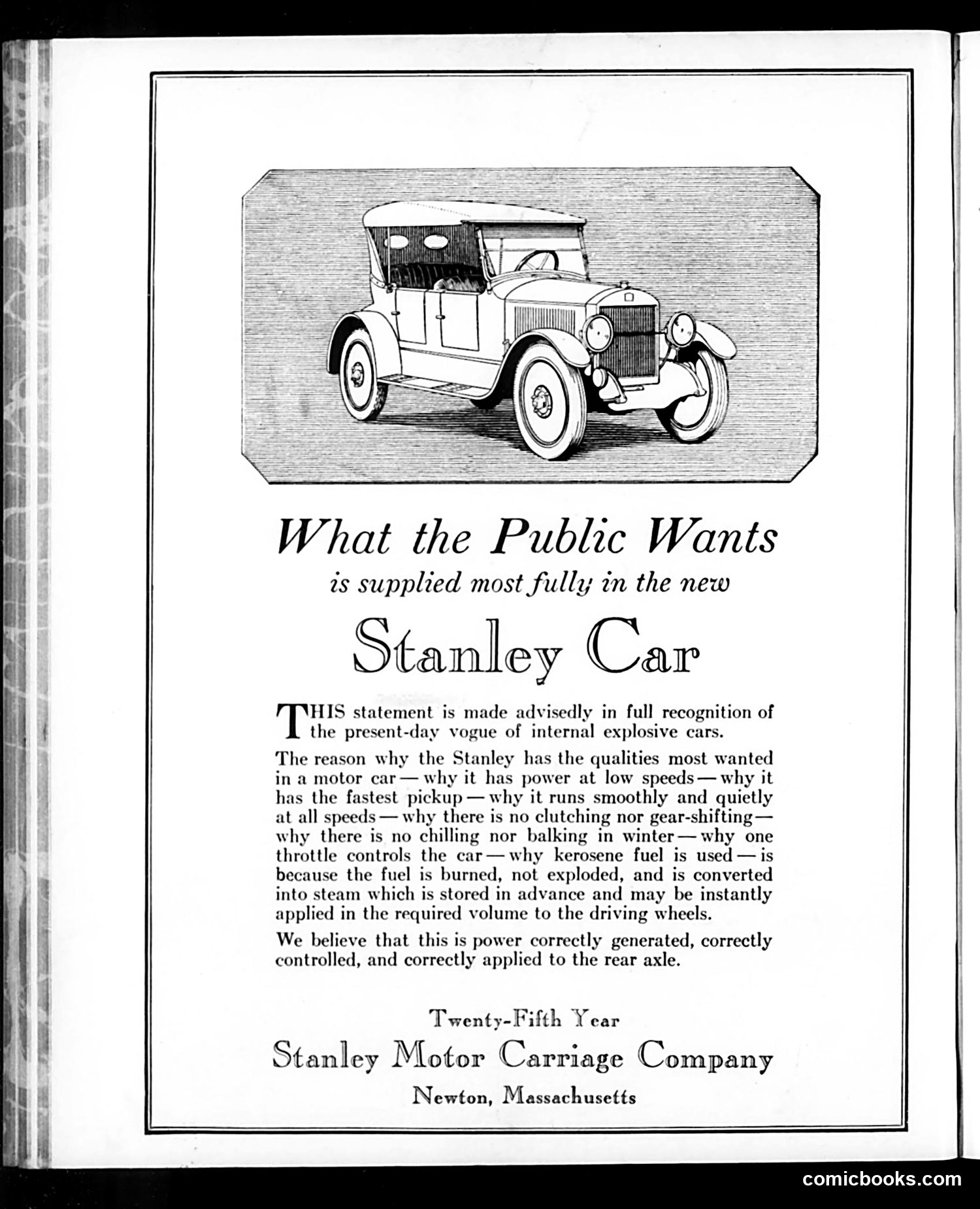
This is an **advertisement, not satire or political cartoon**. It's a full-page promotional piece for the Stanley Motor Carriage Company of Newton, Massachusetts, celebrating their twenty-fifth year in business. The page features an illustration of an early steam-powered automobile and argues for steam technology's superiority over the "internal explosive cars" (gasoline engines) becoming popular. Stanley claims their steam car offers advantages: low-speed power, quick acceleration, smooth quiet operation, no gear-shifting, winter reliability, and single-throttle control. **Historical context for modern readers**: This represents a genuine technological competition in early automotive history. Steam and gasoline engines competed vigorously through the 1910s-1920s. Stanley ultimately lost this "battle"—gasoline engines became dominant due to better fuel availability, simpler mechanics, and refueling speed. This ad's defensive tone ("present-day vogue") suggests Stanley was already fighting a losing market position when published.