
Judge, 1921-05-14 · page 11 of 32
Judge — May 14, 1921 — page 11: what you’re looking at
What you’re looking at
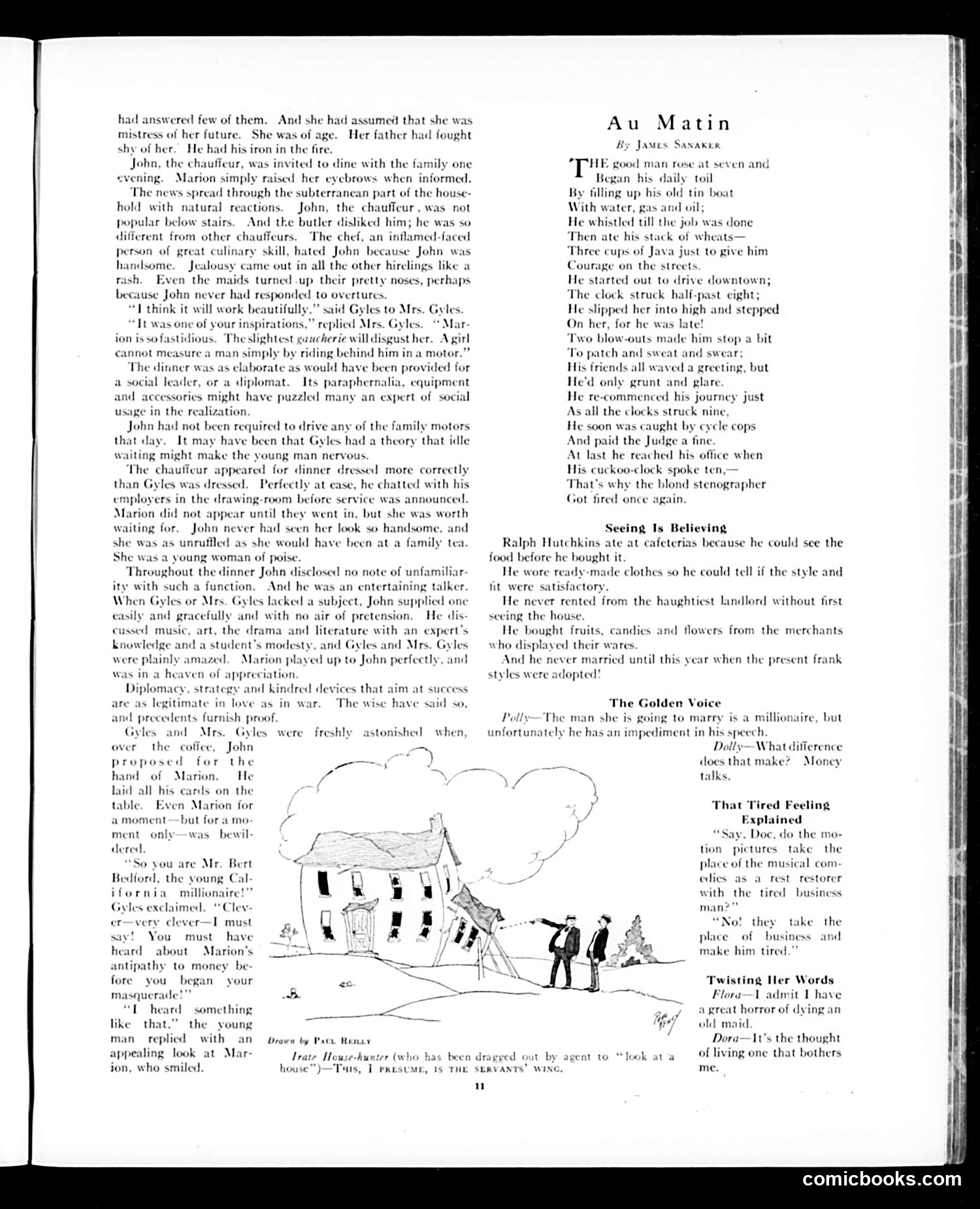
This page contains two distinct pieces: **Left side: Story illustration** depicting a social satire about class pretense. A wealthy California millionaire (Bert Bedford) disguises himself as a chauffeur to court Marion, a young woman hostile to wealth. The humor lies in the deception: Marion's parents encourage the ruse, believing their fastidious daughter will reject him based on his "lower" station. The chauffeur proves charming and educated, embarrassing the household staff who resent his handsomeness and competence. The revelation—that he's actually wealthy—exposes the family's hypocrisy: they despise money yet approve the match once his true status emerges. The satire mocks both class snobbery and the arbitrary nature of social acceptance. **Right side: "Au Matin"** is an unrelated poem about a hardworking man's frustrating morning commute (car troubles, flat tires, rude encounters), ending with his grumpiness—domestic humor rather than political satire.
📄 Transcribed text from this page (OCR, searchable)
Machine-transcribed from the original scan — historical spelling and the odd misread are preserved.
had answered few of them. And she had assumed that she was mistress of her future. She was of age. Her father had fought shy of her. He had his iron in the fire. John, the chauficur, was invited to dine with the f ning. Marion simply raised her eyebrows when informed. ‘The news spread through the subterranean part of the house- hold with natural reactions. John, the chauffeur, was not popular below stairs. And tke butler disliked him; he was so different from other chauffeurs. The chef, an inflamed-faced person of great culinary skill, hated John because John was handsome. Jealousy came out in all the other hirclings like a rash. Even the maids turned .up their pretty noses, perhaps. iuse John never had responded to overtures. I think it will work beautifully,” said Gyles to Mrs. Gyles. “It was one of your inspirations,” replied Mrs. Gyles.“ Mar ion issofastidious. The slightest guucherie will disgust her. A girl cannot measure a man simply by riding behind him ina motor.” The dinner was as claborate as would have been provided for a social leader, or a diplomat. Its paraphernalia, equipment and accessories might have puzzled many an expert of social the realization ohn had not been required to drive any of the family motors that day. It may have been that Gyles had a theory that idle waiting might make the young man nervous. ‘The chauffeur appeared for dinner dressed more correctly than Gyles was dressed. Perfectly at ease, he chatted with his employers in the drawing-room before service was announced. Marion did not appear until they went in, but she was worth waiting for. John never had seen her look so handsome, and she was as unruffled as she would have been at a family tea. ily one bes usa She was a young woman of poise. Throughout the dinner John disclosed no note of unfamiliar- ity with such a function. And he was an entertaining talker. When Gyles or Mrs. Gyles lacked a subject, John supplied one easily and gracefully and with no air of pretension. He dis art, the drama and literature with an expert's *s modesty, and Gyles and Mrs. Gyles. Marion played up to John perfectly, and cussed music knowledge and a stude were plainly amazed was in a heaven of appreciation. Diplomacy. strategy and kindred devices that aim at success love as in war. The wise have said so, as legitimate ! precedents Gyles are rish proof. Gyles John the Mrs. freshly astonished wher the coffee proposed for hand Marion. He laid all his cards on the table. Even Marion for a moment—but for a mo bewil and were over of ment only dered “So you are Mr. Bert Bediord, the young Cal ifornia millionaire!” Gyles exclaimed.“ Clev very clever—I must say! You must have heard about Marion's antipathy to money be fore began your masquerade!” “LT heard like that.” the young man replied with appealing look at ion, who smiled. was er you something an Mar- Drawn by Pocw Remar Irate House: beer house”)—Tars, 1 Presume, 1s THE SERVANTS’ WING, WW Au Matin By Janes Saxaner THE good man rose at seven and Began his daily toil By filling up his old tin boat With water, gas and oil; He whistled till the job was done Then ate his stack of wheats— Three cups of Java just to give him Courage on the streets. He started out to drive downtown; The clock struck half-past eight; He slipped her into high and stepped On her, for he was late! Two blow-outs made him stop a bit ‘To patch and sweat and swear: His friends all waved a greeting, but He'd only grunt and glare He re-commenced his journey just As all the clocks struck nine He soon was caught by cycle cops And paid the Judge a fine. At last he reached his office when His cuckoo-clock spoke ten,— That's why the blond stenographer Got fired once ¢ Seeing Is Believing Ralph Hutchkins ate at cafeterias because he could see the food before he bought it. He wore ready-made clothes so he could tell if the style and fit were satisfactory. He never rented from the haughtiest landlord without first secing the house. He bought fruits, candies and flowers from the merchants who displayed their wares. And he never married until this year when the present frank styles were adopted! The Golden Voice Polly—The man she is going to marry is a millionaire, but unfortunately he has an impediment in his speech Dolly—What difference does that make? Money talks, That Tired Feeling Explained Doc, do the mo- tion pictures take the place of the musical com restorer business “Say rest tired edies with man?" as a the the and ol they take place of business make him tired.” Twisting Her Words Flora—\ admit I have a great horror of dying an old maid Dora—It’s the thought of living one that bothers me. comicbooks.com