
Judge, 1921-05-14 · page 20 of 32
Judge — May 14, 1921 — page 20: what you’re looking at
What you’re looking at
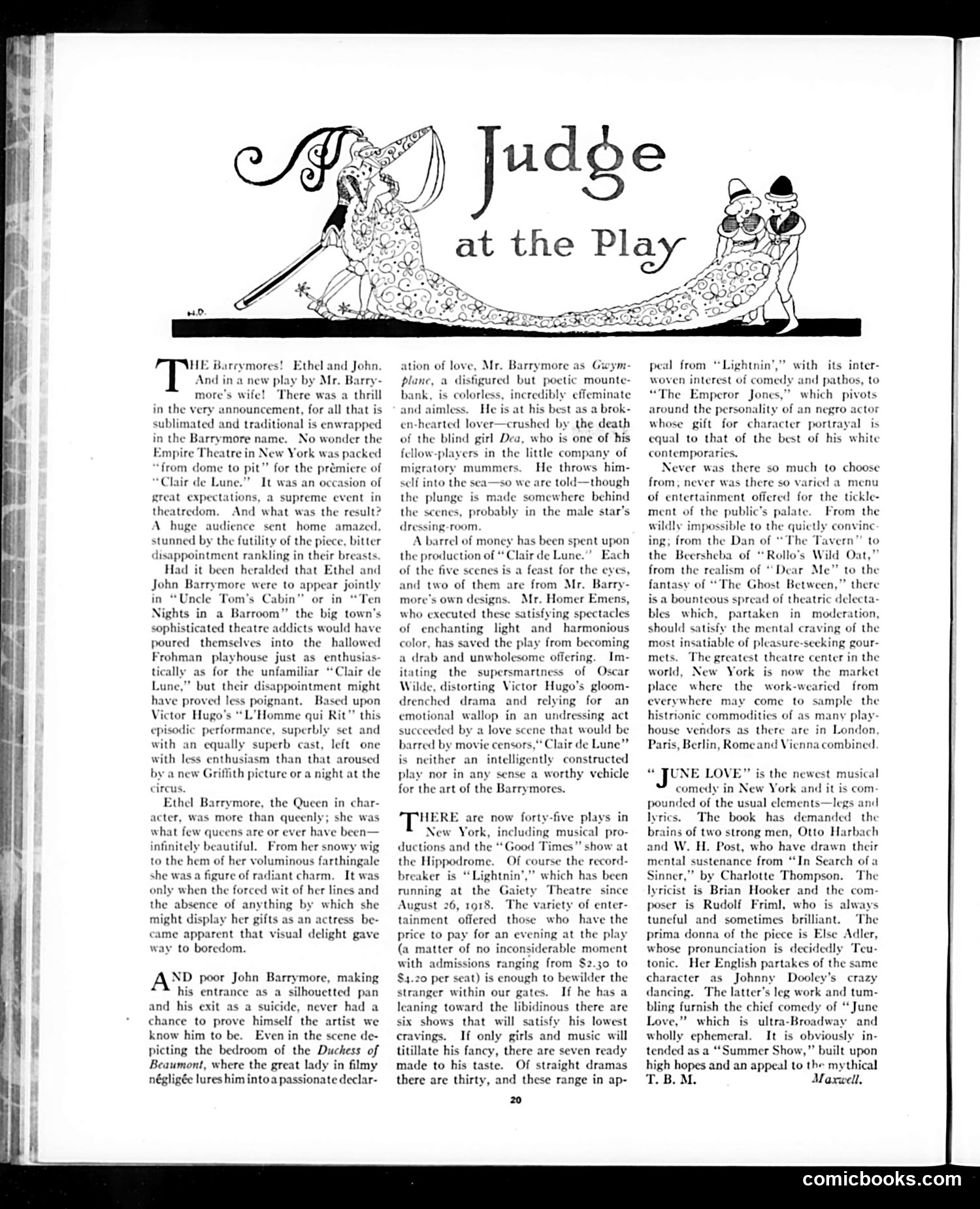
This page reviews "Clair de Lune," a play starring the famous Barrymore siblings—Ethel and John—at New York's Empire Theatre. The critic is harshly disappointed despite the celebrity draw and lavish production design. The satirical thrust: **Famous names alone cannot save a bad play**. Though Ethel Barrymore is visually stunning and the sets are beautifully designed by Homer Emens, the adaptation of Victor Hugo's "L'Homme qui Rit" is poorly constructed and relies on cheap theatrical tricks (undressing scenes, emotional wallops) rather than genuine artistry. John Barrymore is wasted in an effeminate, colorless role. The headnote illustration depicts a judge—representing critical judgment—evaluating theatrical performance. The critic concludes that despite the Barrymores' individual talents, they deserve better material than this derivative, Oscar Wilde-imitating vehicle. The page reflects early 1920s Broadway's tension between star power and artistic merit.
📄 Transcribed text from this page (OCR, searchable)
Machine-transcribed from the original scan — historical spelling and the odd misread are preserved.
| | HE Barrymores! Ethel and John, And in a new play by Mr. Barry- more’s wife! There was a thrill in the very announcement, for all that is sublimated and traditional is enwrapped in the Barrymore name. No wonder the Empire Theatre in New York was packed “from dome to pit’ for the prémicre of “Clair de Lune.” It was an occasion of great expectations, a supreme event in theatredom. And what was the result? \ huge audience sent home amazec stunned by the futility of the piece, bitter disappointment rankling in their breasts. Had it been heralded that Ethel and John Barrymore were to appear jointly in “Uncle Tom's Cabin” or in “Ten Nights in a Barroom” the big town’s sophisticated theatre addicts would have poured themselves into the hallowed Frohman playhouse just as enthusias- tically as for the unfamiliar “Clair de Lune,” but their disappointment might proved less poignant. Based upon Victor Hugo's “*L’Homme qui Rit” this episodic performance, superbly set and with an equally superb cast, left one with less enthusiasm than that aroused by a new Griffith picture or a night at the circus. Ethel Barrymore, the Queen in char- acter, was more than queenly; she was what few queens are or ever have been— infinitely beautiful. From her snowy wig to the hem of her voluminous farthingale she was a figure of radiant charm. It was only when the forced wit of her lines and the absence of anything by which she might display her gifts as an actress be- came apparent that visual delight gave way to boredom. AND poor John Barrymore, making his entrance as a silhouetted pan and his exit as a suicide, never had a chance to prove himself the artist we know him to be. en in the scene de- picting the bedroom of the Duchess of Beaumont, where the great lady in filmy négligée lures him intoa passionate declar- ation of love, Mr. Barrymore as Gwym- plane, a disfigured but poetic mounte- bank, is colorless, incredibly effeminate and aimless. He is at his best as a brok- en-hearted lover—crushed by the death of the blind girl Dea, who is one of his fellow-players in the little company of migratory mummers. He throws him- self into the sea—so we are told—though the plunge is made somewhere behind the scenes, probably in the male star’s dressing-room. A barrel of money has been spent upon the production of “ Clair de Lune.’ Each of the five scenes is a feast for the eyes, and two of them are from Mr. Barry- more’s own designs. Mr. Homer Emens, who executed these satisfying spectacles of enchanting light and harmonious color, has saved the play from becoming a drab and unwholesome offering. Im- itating the supersmartness of Oscar Wilde, distorting Victor Hugo’s gloom- drenched drama and relying for an emotional wallop in an undressing act succeeded by a love scene that would be barred by movie censors,‘ Clair de Lune” is neither an intelligently constructed play nor in any sense a worthy vehicle for the art of the Barrymores. HERE are now forty-five plays in New York, including musical pro- ductions and the ‘Good Times” show at the Hippodrome. Of course the record- breaker is “Lightnin’,” which has been running at the Gaiety Theatre since August 26, 1918. The variety of enter- tainment offered those who have the price to pay for an evening at the play (a matter of no inconsiderable moment with admissions ranging from $2.30 to $4.20 per seat) is enough to bewilder the stranger within our gates. If he has a leaning toward the libidinous there are six shows that will satisfy his lowest cravings. If only girls and music will titillate his fancy, there are seven ready made to his taste. Of straight dramas there are thirty, and these range in ap- 20 peal from “Lightnin’,” with its inter- woven interest of comedy and pathos, to “The Emperor Jones,” which pivots around the personality of an negro actor whose gift for character portrayal is equal to that of the best of his white contemporaries. Never was there so much to choose from, never was there so varicd a menu of entertainment offered for the tickle- ment of the public’s palate. From the wildly impossible to the quictly convine ing; from the Dan of “The Tavern” to the Beersheba of ‘Rollo’s Wild Oat,” from the realism of “Dear Me” to the fantasy of “The Ghost Between,” there bounteous spread of theatric delecta- bles which, partaken in moderation, should satisfy the mental craving of the most insatiable of pleasure-seeking gour- mets. The greatest theatre center in the world, New York is now the market place where the work-wearied from everywhere may come to sample the histrionic commodities of as many play- house vendors as there are in London Paris, Berlin, Romeand Vienna combined “ TUNE LOVE” is the newest musical comedy in New York and it is com pounded of the usual clements—legs and lyrics. The book has demanded the brains of two strong men, Otto Harbach and W. H. Post, who have drawn their mental sustenance from ‘In Search of a Sinner,” by Charlotte Thompson. The Iyricist is Brian Hooker and the com- poser is Rudolf Friml, who is always tuneful and sometimes brilliant. The prima donna of the piece is Else Adler, whose pronunciation is decidedly Teu- tonic. Her English partakes of the same character as Johnny Dooley’s crazy dancing. The latter's leg work and tum- bling furnish the chief comedy of “June Love,” which is ultra-Broadway and wholly ephemeral. It is obviously in- tended as a “Summer Show,” built upon high hopes and an appeal to the mythical T. B. M. Maxwell. comicbooks.com