
Judge, 1921-05-14 · page 12 of 32
Judge — May 14, 1921 — page 12: what you’re looking at
What you’re looking at
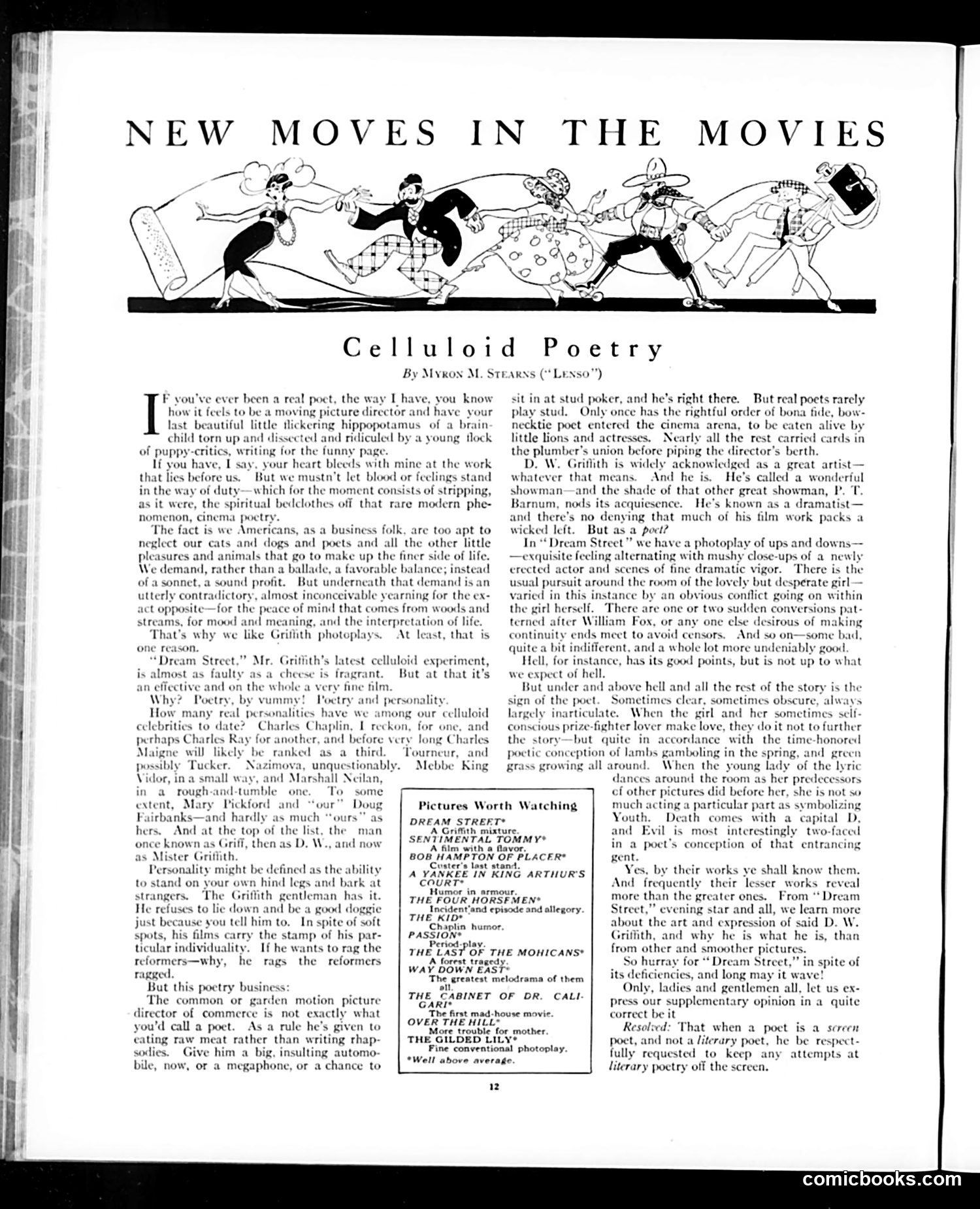
This is a film criticism essay by Myron M. Stearns ("Lesso") analyzing D.W. Griffith's film "Dream Street" as an example of cinema poetry. The piece argues that while American culture neglects "poets and all the other little pleasures," Griffith's films succeed because they combine entertainment with poetic sensibility. The author contends that true cinematic art requires personality and artistic vision—qualities he credits to Griffith, Chaplin, Charles Ray, and a handful of others. The critique of "Dream Street" is mixed: technically flawed but artistically compelling. Stearns objects to conventional plot devices (chases, love scenes, sudden conversions for censorship) yet praises Griffith's underlying poetic vision. He distinguishes between "ditch poetry" (screen melodrama) and genuine artistic expression, insisting cinema poets shouldn't imitate theatrical conventions. The accompanying illustrations show exaggerated dance movements, satirizing emerging "modern moves" in silent film acting.
📄 Transcribed text from this page (OCR, searchable)
Machine-transcribed from the original scan — historical spelling and the odd misread are preserved.
| | J F you've ever been a real poct, the way Ihave, you know how it feels to be a moving picture director and have your last beautiful litle flickering hippopotamus of a brain child torn up and dissected and ridiculed by a young flock of puppy-critics, writing for the funny page. If you have, I say. your heart bleeds with mine at the work that lies before us. But we mustn't let blood or feelings stand in the way of duty—which for the moment consists of stripping, as it were, the spiritual bedclothes off that rare modern phe- nomenon, cinema poetry. The fact is we Americans, as a business folk, are too apt to neglect our cats and dogs and poets and all the other little pleasures and animals that go to make up the finer side of life. We demand, rather than a ballade, a favorable balance; instead of a sonnet, a sound profit. But underneath that demand is an utterly contradictory, almost inconceivable yearning for the ex- act opposite—for the peace of mind that comes from woods and streams, for mood and meaning, and the interpretation of life. That's why we like Griffith photoplays. At least, that is one reason. “Dream Street,” Mr. Grithith’s latest celluloid experiment, is almost as faulty as a cheese is fragrant. But at that it’s an effective and on the whole a very fine film. Why? Poetry, by vummy! Loctry and personality How many real personalities have we among our celluloid celebrities to date? Charles Chaplin, L reckon, for one, and perhaps Charles Ray for another, and before very long Charles Maigne wil) likely be ranked as a third. Tourneur, and possibly Tucker. Nazimova, unquestionably. Mebbe King Vidor, ina small way, and Marshall Neilan, in a rough-and-tumble one. To some extent, Mary Pickford and “our” Doug hers. And at the top of the list, the man once known as Griff, then as D. W., and now Celluloid Poetry By Myo M. Steaks (“Lexso”) Pictures Worth Watching Fairbanks—and hardly as much “ours” as | pream STREET A Grifith miature SENTIMENTAL TOMMY®* A film with a favor, sit in at stud poker, and he’s right there. But real poets rarely play stud. Only once has the rightful order of bona fide, bow- necktie poct entered the cinema arena, to be eaten alive by little lions and actresses. Nearly all the rest carried cards in the plumbers union before piping the director's berth. D. W. Grifith is widely acknowledged as a great artist— whatever that means. And he is. He's called a wonderful showman—and the shade of that other great showman, P. T. Barnum, nods its acquiesence. He’s known as a dramatist— and there’s no denying that much of his film work packs a wicked left. But as a poet? In “Dream Street” we have a photoplay of ups and downs— —exquisite fecling alternating with mushy close-ups of a newly erected actor and scenes of fine dramatic vigor. There is the usual pursuit around the room of the lovely but desperate girl— varied in this instance by an obvious conflict going on within the girl herself. There are one or two sudden conversions pat- terned after William Fox, or any one else desirous of making continuity ends mect to avoid censors. And so on—some bad, quite a bit indifferent, and a whole lot more undeniably good. Hell, for instance, has its good points, but is not up to what we expect of hell. But under and above hell and all the rest of the story is the sign of the poet. Sometimes clear, sometimes obscure, always largely inarticulate. When the girl and her sometimes seif conscious prize-fighter lover make love, they do it not to further the story—but quite in accordance with the time-honored poctic conception of lambs gamboling in the spring, and green grass growing all around. When the young lady of the lyric dances around the room as her predecessors ef other pictures did before her, she is not so much acting a particular part as symbolizing Youth. Death comes with a capital D, and Evil is most interestingly two-faced in a poct’s conception of that entrancing as Mister Griffith. BOB HAMPTON OF PLACER* gent. Personality might be defined as the ability | 4 ySQMsee et stand. yes Yes, by their works ye shall know them. to stand on your own hind legs and bark at couRT* And frequently their lesser works reveal strangers. The Griffith gentleman has it. | py Peo ORSE ene more than the greater ones. From ‘Dream He refuses to lie down and be a good « Incident’and episode and allegory. Street,”’ evening star and all, we learn more just because you tell him to. In spite of soft THE RID® spots, his films carry the stamp of his par- PASSION* Period-play. ticular individuality. If he wants to rag the THE LAS? OF THE MOHICANS* ragged. The greatest melodrama of them reformers—why, he rags the reformers But this poetry busin The common or garden motion picture HE, GS director of commerce is not exactly what you'd call a poet. As a rule he’s given to cating raw meat rather than writing rhap- sodies. Give him a big, insulting automo- bile, now, or a megaphone, or a chance to Chaplin humor. about the art and expression of said D. W. ffith, and why he is what he is, than from other and smoother pictures. rray for ** Dream Street,” in spite of its deficiencies, and long may it wav Only, ladies and gentlemen all, let us ex- it THE CABINET OF DR. CALI-| press our supplementary opinion in a quite The first mad-house movie correct be it OVER THE HILL More trouble for mother. THE GILDED LILY* poe! Fine conventional photoplay. *Well above average. Resolved: That when a poct is a screen and not a literary poet, he be respect- fully requested to keep any attempts at literary poetry off the screen, comicbooks.com