
Judge, 1921-05-14 · page 14 of 32
Judge — May 14, 1921 — page 14: what you’re looking at
What you’re looking at
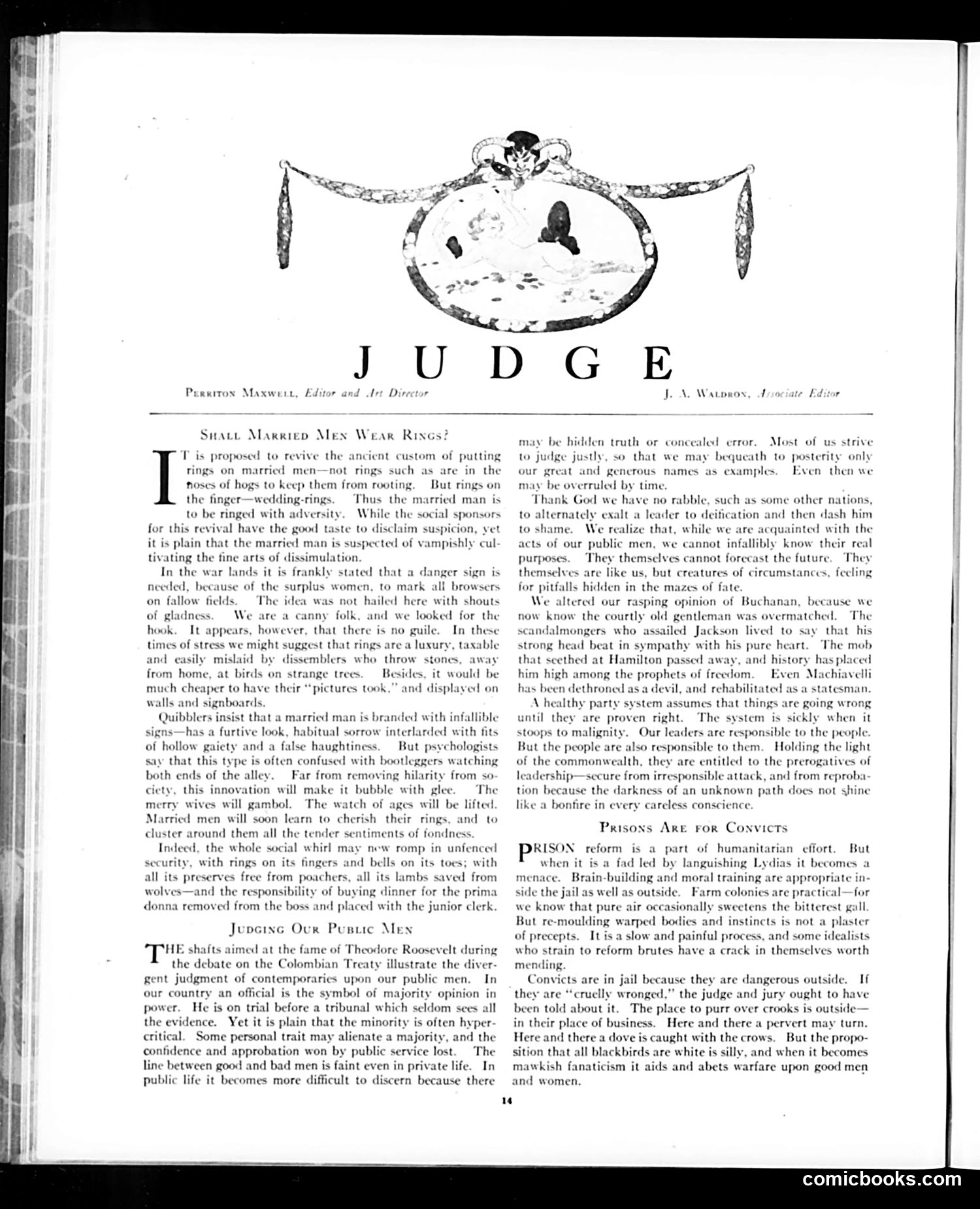
This page from *Judge* contains two satirical essays rather than cartoons. **"Shall Married Men Wear Rings?"** mocks a proposal to make married men wear rings (like animals branded to prevent straying). The satire suggests this reflects deep suspicion of married men's fidelity and tendency toward infidelity ("vampishly cultivating the fine arts of dissimulation"). The piece sarcastically argues the rings won't work because dissemblers are indistinguishable from bootleggers anyway, and suggests cheaper alternatives like displaying photographs instead. **"Judging Our Public Men"** appears to reference Theodore Roosevelt and debates over the Colombian Treaty, discussing how public figures are unfairly judged by contemporaries. It argues we cannot truly know leaders' real purposes or predict outcomes, and cites historical examples (Buchanan, Jackson, Hamilton, Machiavelli) whose reputations changed over time—a plea for judging public servants more fairly and charitably. Both pieces reflect early 20th-century concerns about male behavior and political leadership credibility.
📄 Transcribed text from this page (OCR, searchable)
Machine-transcribed from the original scan — historical spelling and the odd misread are preserved.
Perniton Maxwetr, Editor A. Watprox, drsociate Edit Suatt Markiep Mex Wear Rincs? I is proposed to revive the ancient custom of putting rings such as are in the ngs on married men—ne hoses of hogs to keep them from rooting. But rings on the finger—wedding-rings. Thus the married man is to be ringed with adversity. While the social sponsors md taste to disclaim suspicion, yet for this revival have the g it is plain that the married man is suspected of vampishly cul tivating the fine arts of dissimulation. In the war lands it is frankly stated that a danger sign is , because of the surplus women, to mark all browsers on fallow fields. The idea was not hailed here with shouts of gladness. We are a canny folk, and we looked for the hook. It appears, however, that there is no guile, In these times of stress we might suggest that rings are a luxury, taxable and easily mislaid by dissemblers who throw si from home, at birds on strange trees. Besides, it would be much cheaper to have their “pictures took,” and displayed on walls and signboar: Quibblers insist that a married man is branded with infallible sign has a furtive look, habitual sorrow interlarded with fits of hollow gaiety and a false haughtiness But psychologists say that this type is often confused with bootleggers watching both ends of the alley Far from removing hilarity from so: ciety, this innovation will make it bubble with glee. The metry wives will gambol. The watch of ages will be lifted Married men will soon learn to cherish their rings, and to cluster around them all the tender sentiments of fondness. Indeed, the whole social whirl may new romp in unfenced security, with rings on its fingers and bells on its toes; with bs saved from ones, away all its preserves free from poachers, all its la wolves—and the responsibility of buying dinner for the prima donna removed from the boss and placed with the junior clerk Jepcixe Our Pesuic Mes HE shafts aimed at the fame of Theodore Roosevelt during the debate on the Colombian Treaty illustrate the diver gent judgment of contemporaries upon our public men. In our country an official is the symbol of majority opinion in power. He is on trial before a tribunal which seldom sees all the evidence. Yet it is plain that the minority is often hype critical. Some personal trait may alienate a majority, and the confidence and approbation won by public service lost. The line between good and bad men is faint even in private life. In public life it becomes more difficult to discern because there may be hidden truth or lod error. Most of us strive to judge justly, so that we may bequeath to posterity: only mced our great and generous names as examples. Even then we may be overruled by time. Thank God we have no rabble, such as some other nations, to alternately exalt a leader to deification and then dash him to shame. We realize that, while we are acquainted with the acts of our public men, we cannot infallibly know their real purposes. They themselves cannot forecast the future. They themselves are like us, but creatures of circumstances, feeling for pitfalls hidden in the mazes of fate. We altered our rasping opinion of Buchanan, because we now know the courtly old gentleman was overmatched. The scandalmongers who assailed Jackson lived to say that his strong head beat in sympathy with his pure heart. The mob that seethed at Hamilton passed away, and history has placed him high among the prophets of freedom. Even Machiavelli asa devil, and rehabilitated as a statesman. ystem assumes that things are going wrong The system is sickly when it has been dethron \ healthy party until they are proven right Our leaders are responsible to the people stoops to malignity. But the people are also responsible to them. Holding the light of the commonwealth, they are entitled to the prerogatives of leadership—secure from irresponsible attack, and from reproba tion because the darkness of an unknown path docs not shine like a bonfire in every careless conscience. Prisons Are ror Convicts RISON reform is a part of humanitarian effort. But when it a fad led by languishing Lydias it becomes menace. Brain-building and moral training are appropriate in- side the jail as well as outside. Farm colonies are practical—for we know that pure air occasionally sweetens the bitterest gall But re-moulding warped bodies and instincts is not a plaster of precepts. It is a slow and painful process, and some idealists who strain to reform brutes have a crack in themselves worth mending. Convicts are in jail because they are dangerous outside. If they are “cruelly wronged,” the judge and jury ought to have been told about it. The place to purr over crooks is outside— in their place of business. Here and there a pervert may turn. Here and there a dove is caught with the crows. But the propo- sition that all blackbirds are white is silly, and when it becomes mawkish fanaticism it aids and abets warfare upon good men and women. comicbooks.com