
A complete issue · 32 pages · 1921
Judge — April 2, 1921
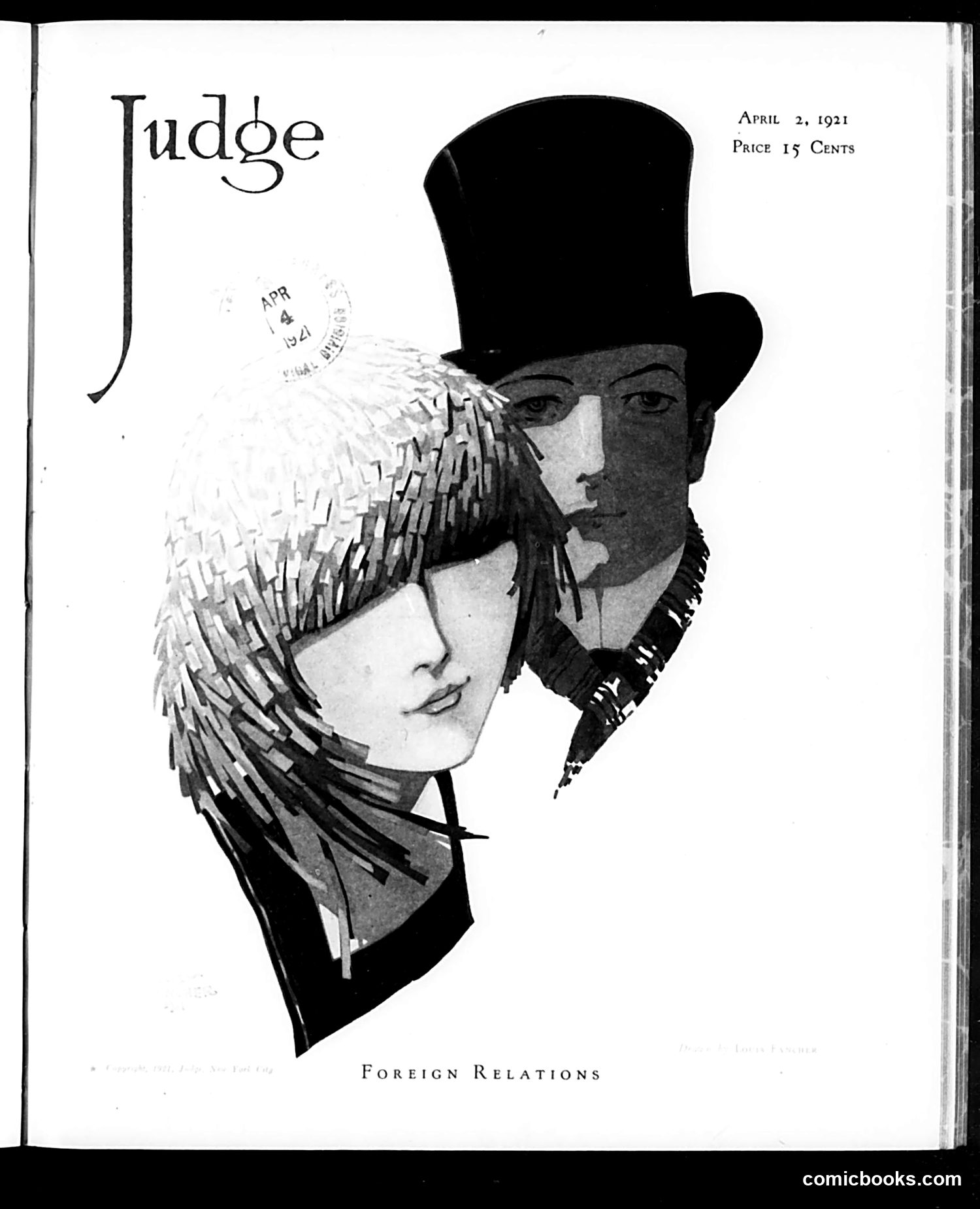
This satirical cover depicts two figures in profile—a woman wearing an elaborate feathered hat on the left, a man in a top hat on the right—positioned as if in intimate proximity. The caption "Foreign Relations" is a double entendre: it simultaneously references diplomatic relations between nations while suggesting a romantic or scandalous relationship between individuals. The elaborate, exaggerated styling of both figures suggests they represent national stereotypes or political personages of the era. The sophisticated dress and the suggestive positioning imply commentary on America's post-WWI diplomatic dealings, possibly critiquing foreign policy through innuendo. The overall tone is humorous rather than serious political critique, typical of Judge magazine's satirical approach to contemporary issues.
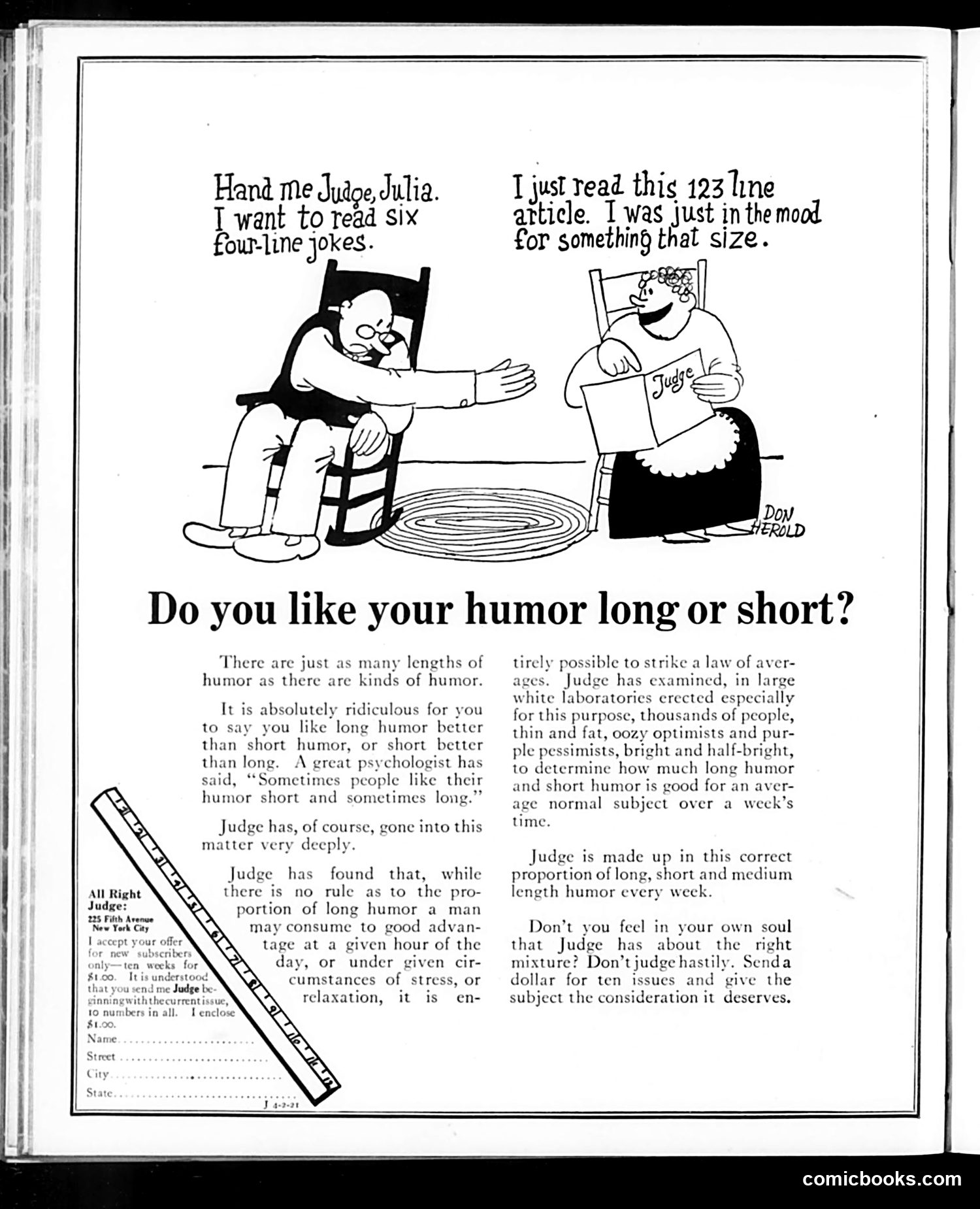
This page is primarily **advertising and editorial content** rather than political satire. The cartoon at the top depicts two people (labeled "Judge") discussing humor lengths—one character requests "six four-line jokes" while the other has just read a 123-line article and was "in the mood for something that size." The accompanying text humorously examines whether people prefer long or short humor, claiming Judge magazine has scientifically determined the ideal proportion of different humor lengths for readers. It's a self-promotional piece celebrating Judge's editorial balance. The bottom contains a subscription offer with blanks for name, address, and contact information, positioned as a ruler measuring humor length—a visual pun reinforcing the "long vs. short" theme. This is essentially **branded content** masquerading as analysis.
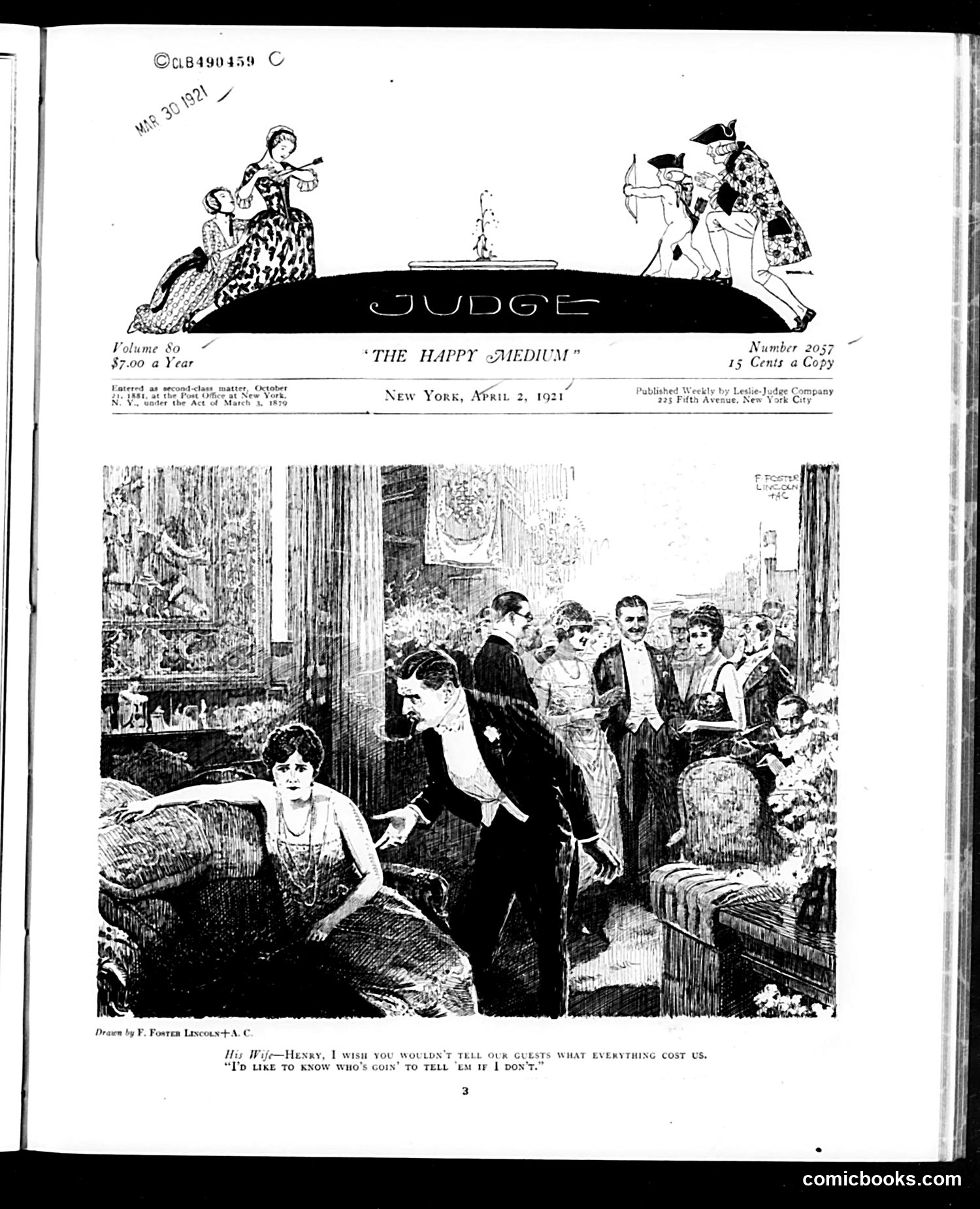
This page depicts a social satire about entertaining houseguests. The cartoon, drawn by F. Forain Liscon, shows a crowded parlor scene where a man addresses his wife, Henry, saying he wishes she wouldn't tell guests what everything costs—he'd like to know who's going to tell them if he doesn't. The humor targets upper-class anxiety about appearing wealthy while entertaining. The woman's comment reveals the family's nervousness about displaying their possessions and expenses to social visitors. It's a gentle satire of 1920s bourgeois pretension—the concern that frank discussion of costs might embarrass hosts or guests, yet the wife's discretion itself becomes awkward. The crowded scene emphasizes the social pressure of entertaining during the Jazz Age.
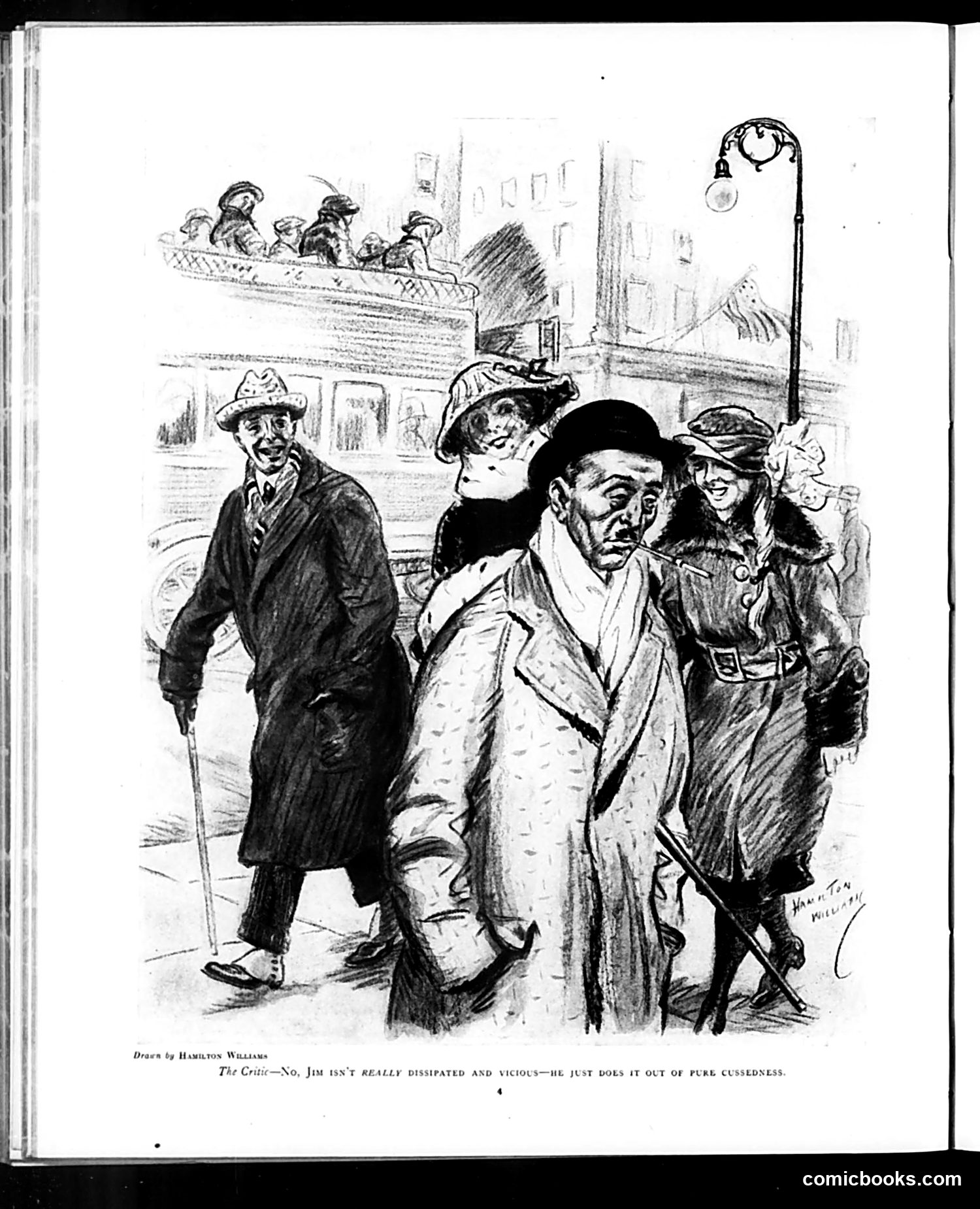
This cartoon by Hamilton Williams, titled "The Critic—No, Jim isn't really dissipated and vicious—he just does it out of pure cussedness," depicts a street scene with well-dressed men in early 20th-century attire. The central figure appears to be a man being escorted or confronted, while bystanders observe from a street corner and elevated walkway. The caption suggests social commentary about behavior and reputation. "Cussedness" (stubbornness/contrariness) is presented as motivation for apparent vice or dissipation. The cartoon appears to satirize either a public figure's questionable conduct or society's tendency to excuse bad behavior through character flaws rather than addressing underlying issues. Without identifying "Jim" specifically, the satire targets hypocrisy in how society judges and explains away misconduct.
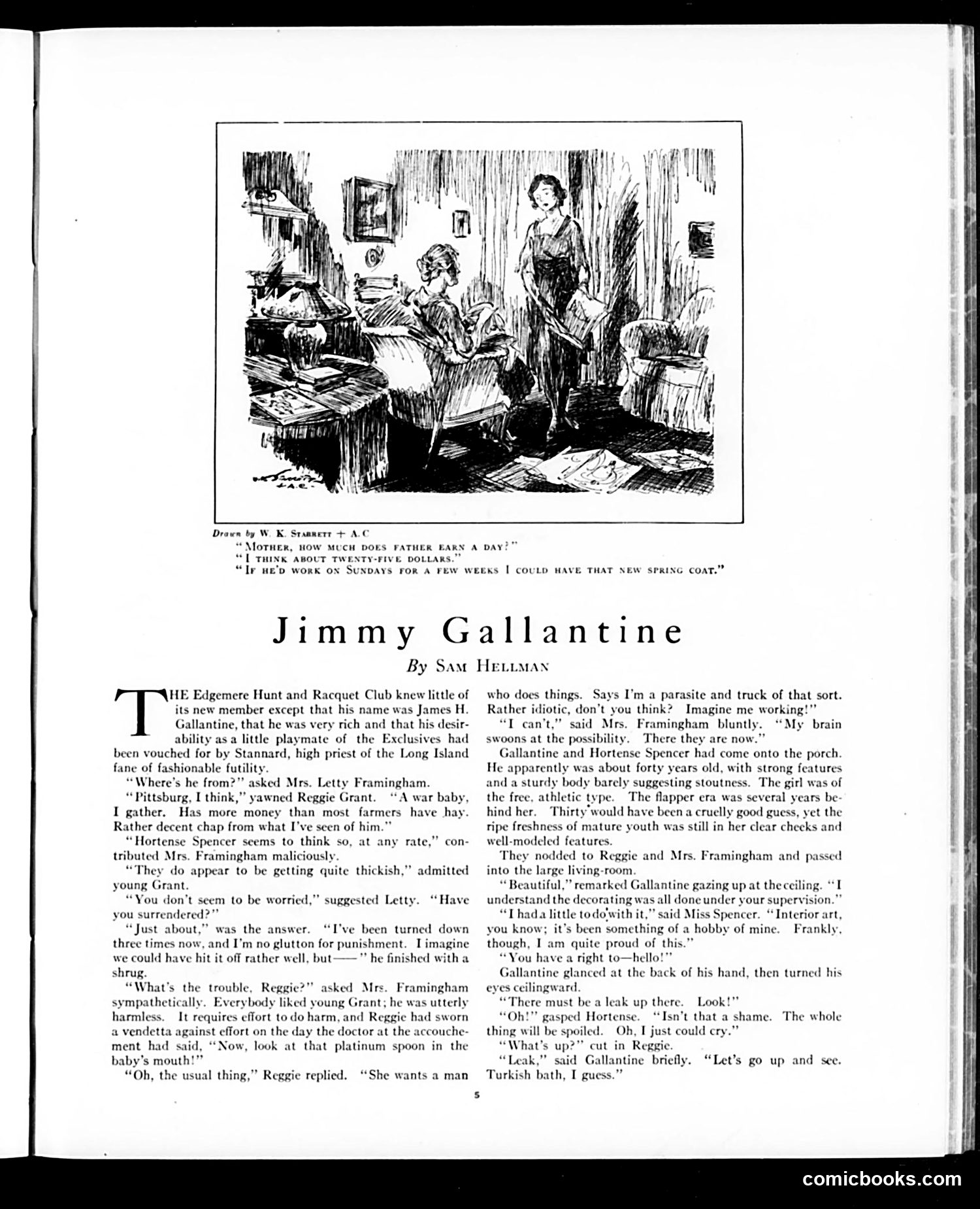
The page contains a sketch and the beginning of a short story by Sam Hellman, not political satire. The cartoon above the title (drawn by W.K. Stannett) depicts a domestic scene with three figures discussing household finances—likely a wife, husband, and servant. The dialogue mentions a father's earnings ("twenty-five dollars"), working on Sundays, and a desired spring coat, illustrating working-class economic struggles of the era. The story itself appears to be social comedy about James H. Gallantine, a wealthy member of the Edgemere Hunt and Racquet Club who is apparently idle and dependent on family wealth. The narrative suggests satirical commentary on parasitic wealthy individuals contrasted with working-class concerns—a common Judge magazine theme addressing class tensions in early 20th-century America.
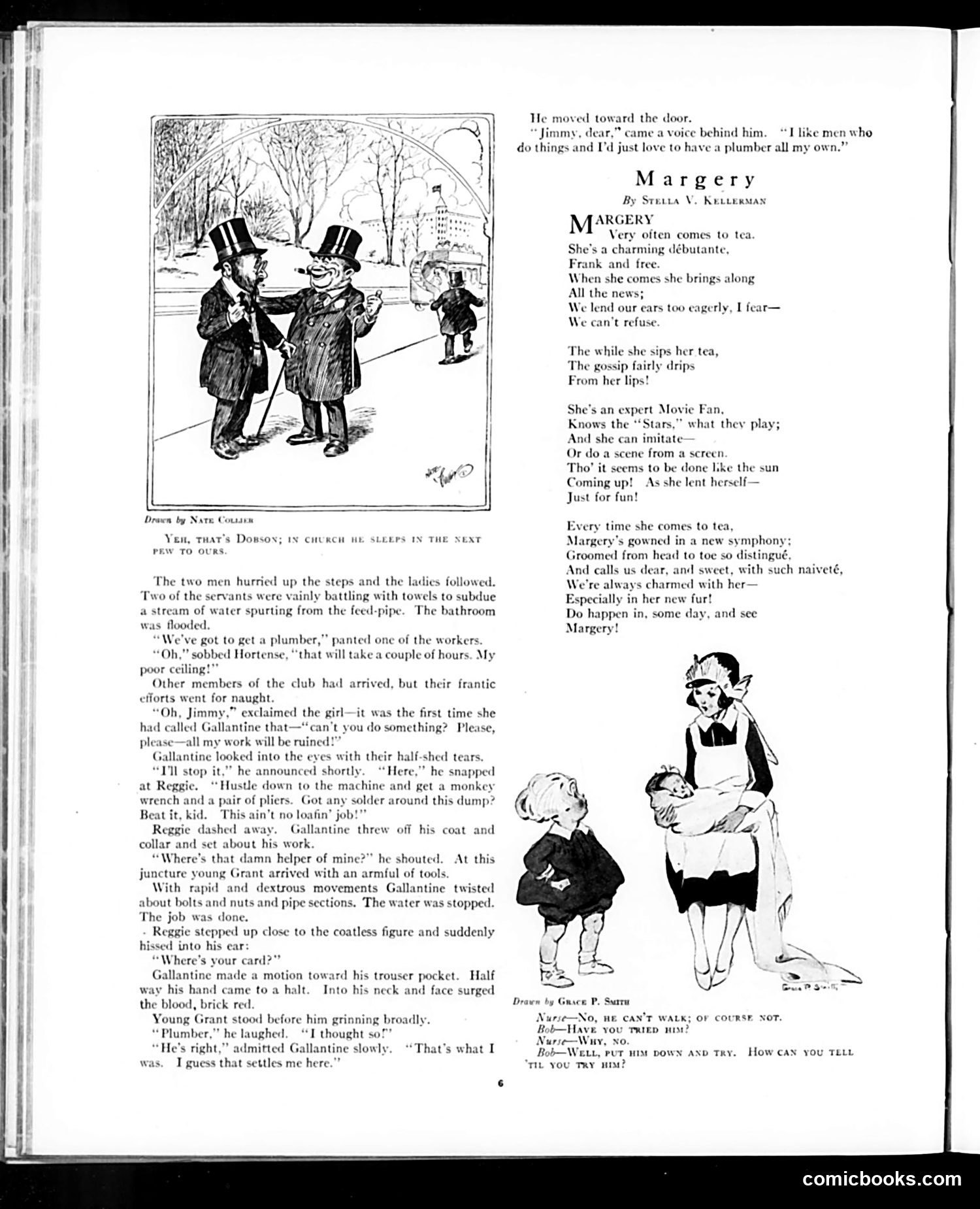
This page contains two distinct pieces: **Left side:** A humorous story about a plumbing emergency at a club, illustrated with a cartoon showing two men in top hats. The narrative depicts workers frantically attempting repairs while club members arrive, culminating in a young man named Grant arriving with tools and successfully resolving the crisis by retrieving a lost card from a pipe. **Right side:** A poem titled "Margery" by Stella V. Kellerman, illustrated by Grace P. Stetson, celebrating a gossipy debutante who frequents tea gatherings. She's portrayed as fashionable, knowledgeable about movies, and entertaining—someone whose visits are anticipated despite (or because of) her love of spreading news and gossip among society circles. Both pieces gently satirize upper-class social life and leisure culture of the era.
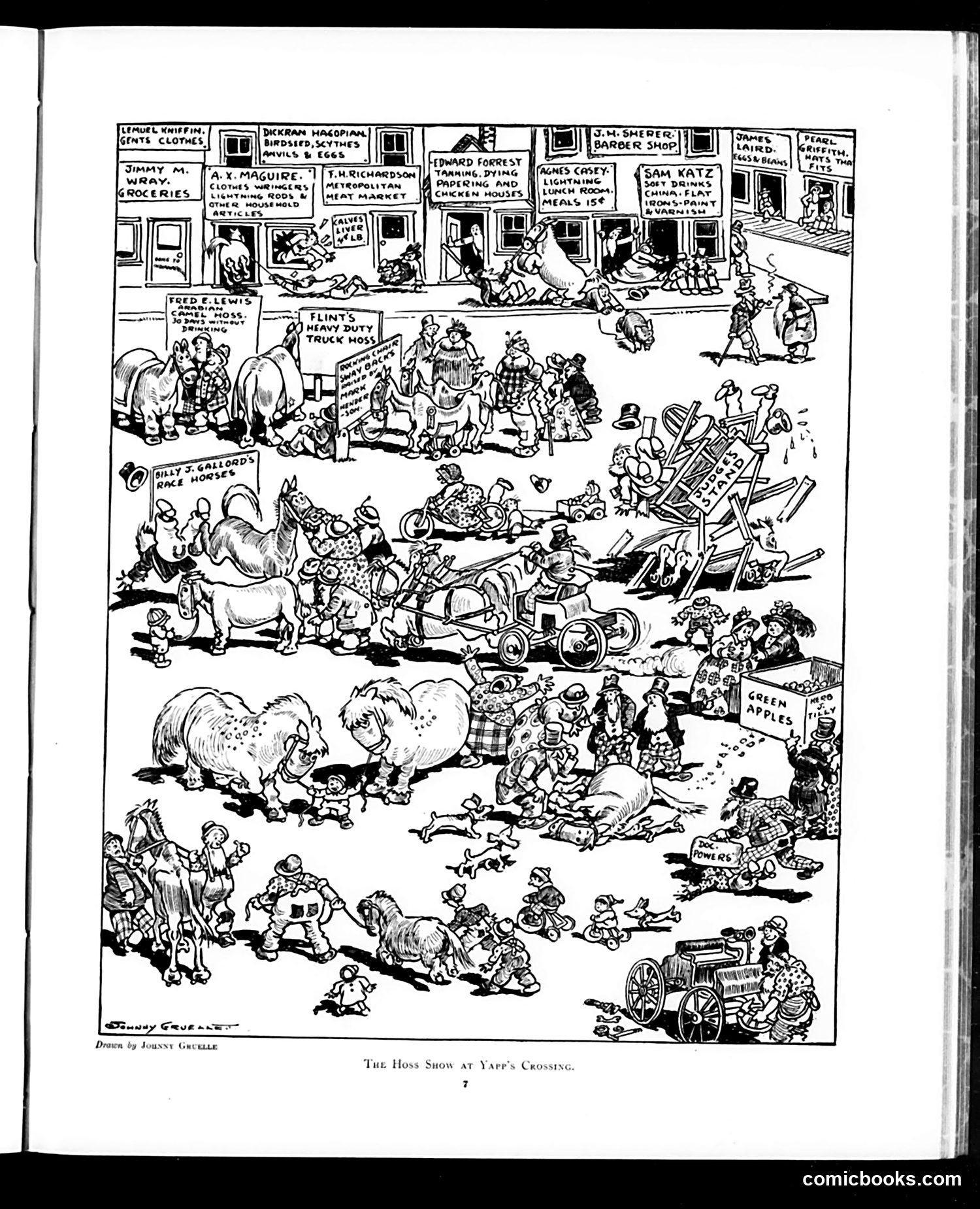
This satirical cartoon depicts a chaotic street fair or market scene dominated by horses and their handlers. The top strip shows various small businesses (groceries, butcher shop, barber shop, etc.), while the main illustration below portrays a densely packed carnival-like gathering of vendors, livestock, and townspeople. The satire appears to mock rural or working-class commerce and animal trading, with exaggerated caricatures of merchants and farmers. The numerous horses, wagons, and crowds suggest commentary on the disorder or absurdity of such public markets. The title references "Yare's Crossing," likely a specific local area, making this probably a localized joke for Judge's urban readership—poking fun at rustic or provincial life and commerce. The artist (Guelette) emphasizes the hubbub through dense, busy linework typical of early 20th-century satirical illustration.
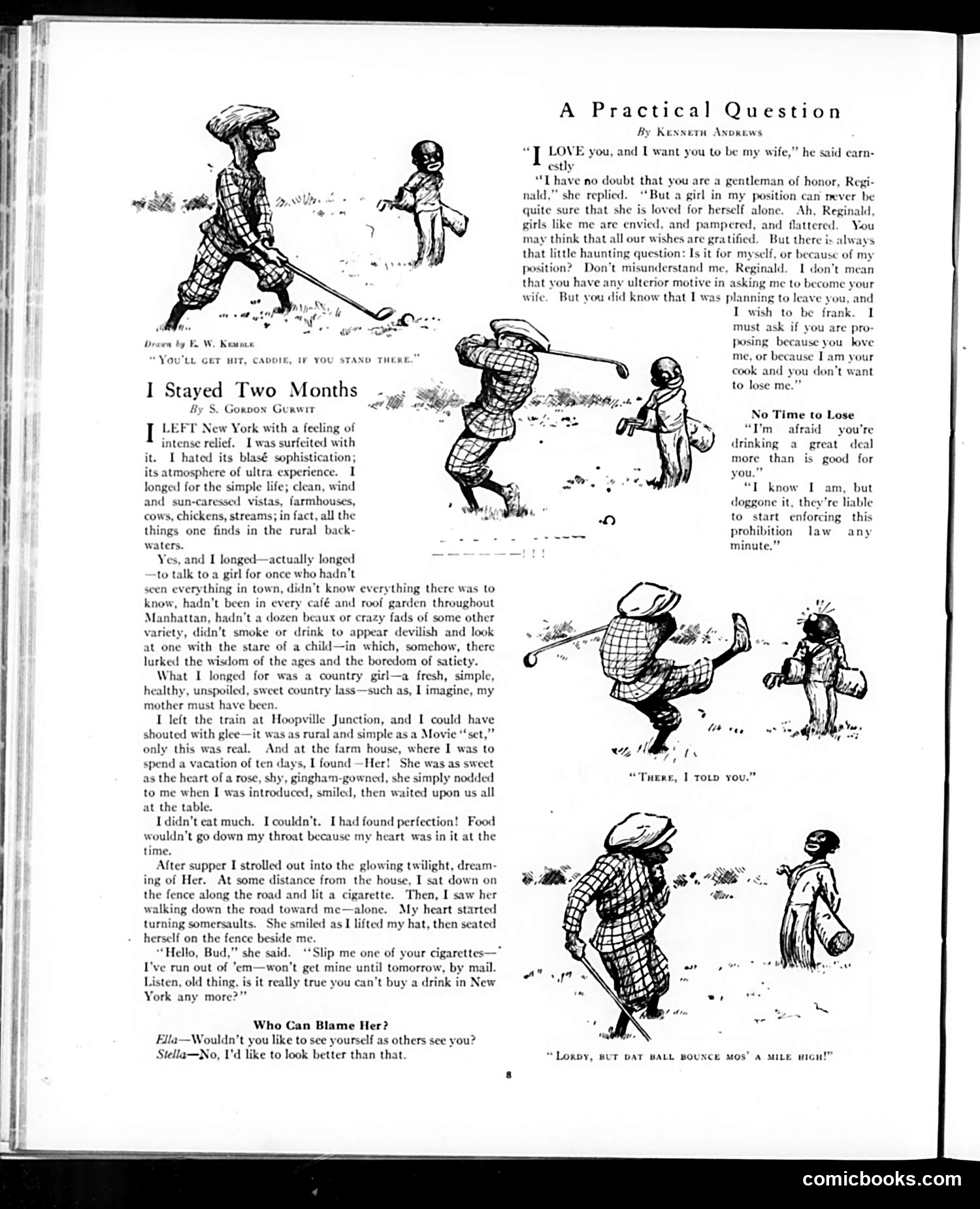
This page contains three distinct pieces of satirical humor: **"I Stayed Two Months"** (left): A man escapes sophisticated New York City seeking a "simple country girl" untainted by urban sophistication. The joke's punchline arrives when this supposedly innocent farm girl immediately asks for cigarettes and complains about Prohibition—revealing she's just as modern and vice-prone as any city woman. It's satire on the futility of romanticizing rural simplicity. **"A Practical Question"** (top right): A woman accepts a marriage proposal but questions whether she's loved for herself or because she's the man's cook. It satirizes both gold-digger anxieties and the precarious economic position of working women. **"No Time to Lose"** (bottom right): A man justifies heavy drinking by noting Prohibition enforcement could begin "any minute," suggesting people were stockpiling alcohol before the law's implementation—likely referencing the imminent 18th Amendment (Prohibition began 1920). All three pieces mock social pretenses and contemporary anxieties of the era.
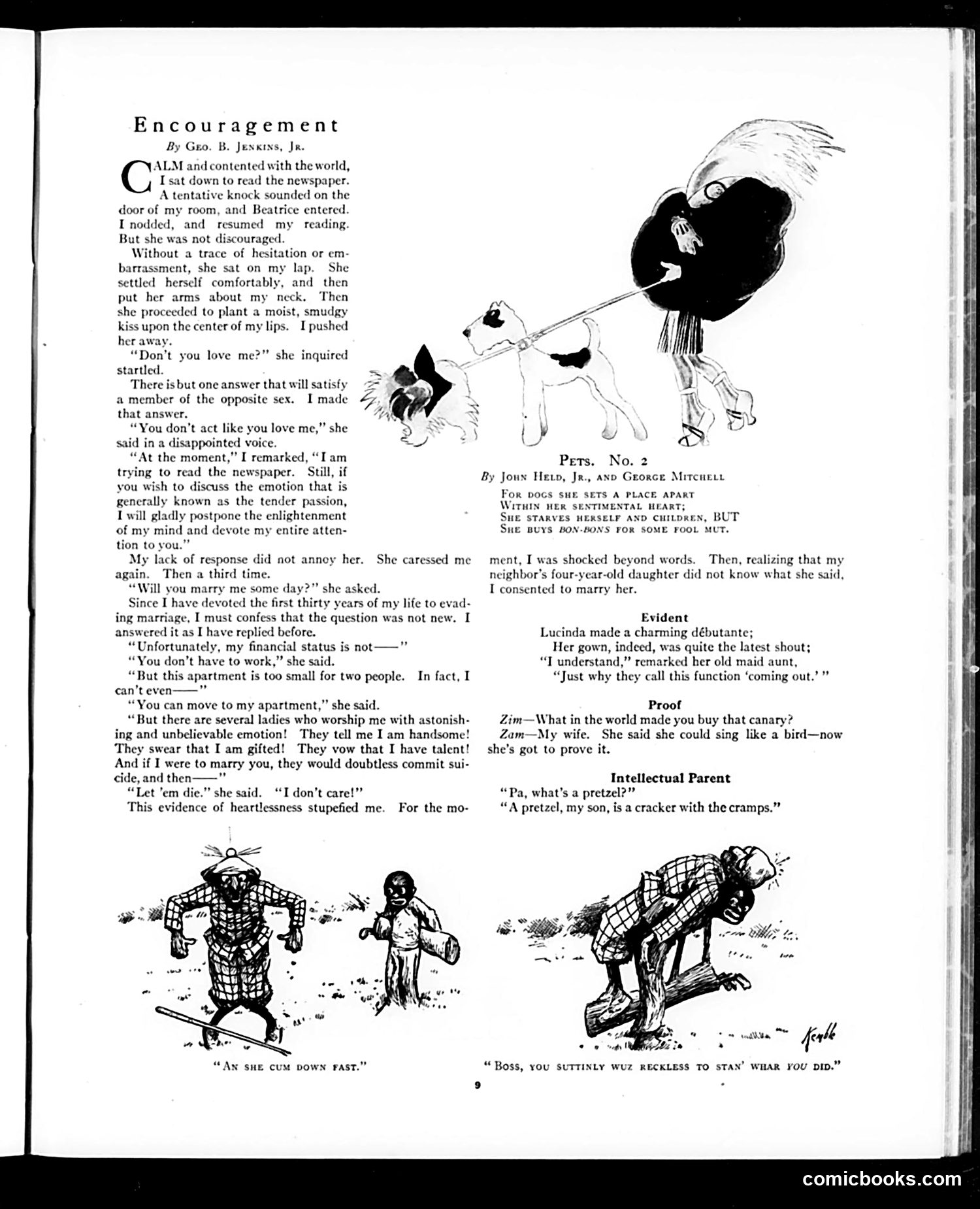
This page contains three separate humor pieces typical of early 20th-century American satire: **"Encouragement"** (main story): A romantic comedy where a persistent woman pressures a reluctant bachelor into marriage. The satire targets both genders—the woman's emotional manipulation and the man's weak resistance to matrimonial commitment. This reflects period anxieties about marriage as a trap. **"Pets, No. 2"** (illustration with caption): Shows a dog neglecting her own offspring to buy treats for "some fool mut" (mutt). This satirizes women's sentimental foolishness and misplaced priorities—a common stereotype of the era. **Bottom cartoons and short gags**: Include slapstick humor ("As she cum down fast"), domestic stereotypes about wives and canaries, and a father-son joke about pretzels causing digestive distress. The overall theme: satire of romance, marriage, and gender relations through exaggerated stereotypes. Women are portrayed as emotionally irrational; men as hapless victims of matrimonial schemes.
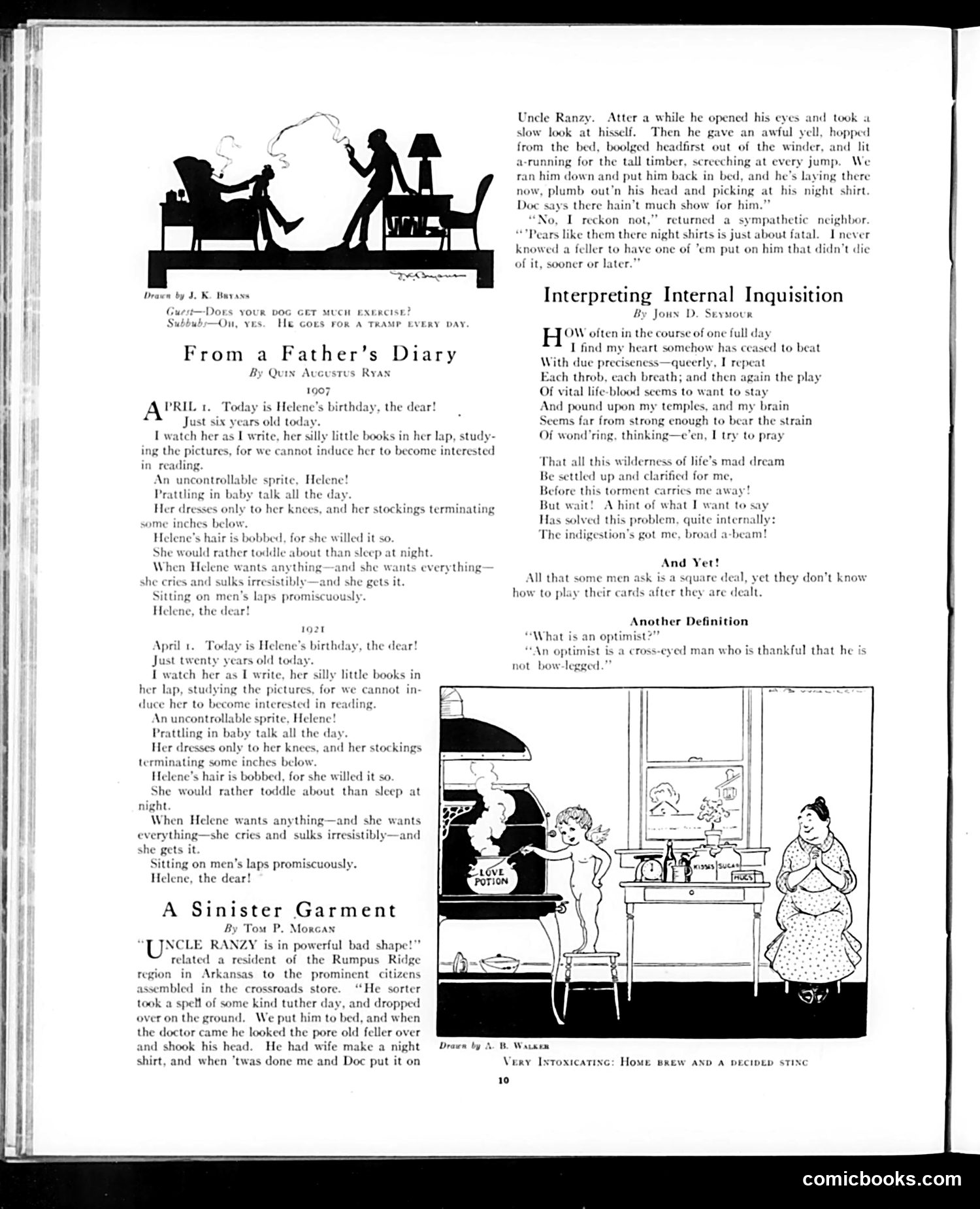
This page satirizes early 20th-century American life through multiple pieces: **"From a Father's Diary"** contrasts a child named Helene at age 6 (1907) with age 20 (1921). The identical descriptions—her baby talk, short dresses, bobbed hair, and tendency to sit on men's laps—mock how young women of the 1920s retained childish behaviors. The joke targets the "flapper" generation's apparent refusal to mature. **"A Sinister Garment"** uses rural dialect humor: Uncle Ranzy becomes so horrified by a nightshirt that he jumps from a window. The piece mocks superstitious folk beliefs about clothing causing illness or death. **The cartoons and poems** employ light satire on everyday anxieties—a dog's exercise, indigestion masquerading as heart problems, and definitions of optimism. Overall, this page reflects Judge's typical approach: gentle mockery of generational differences, rural superstitions, hypochondria, and modern social changes, aimed at educated urban readers.
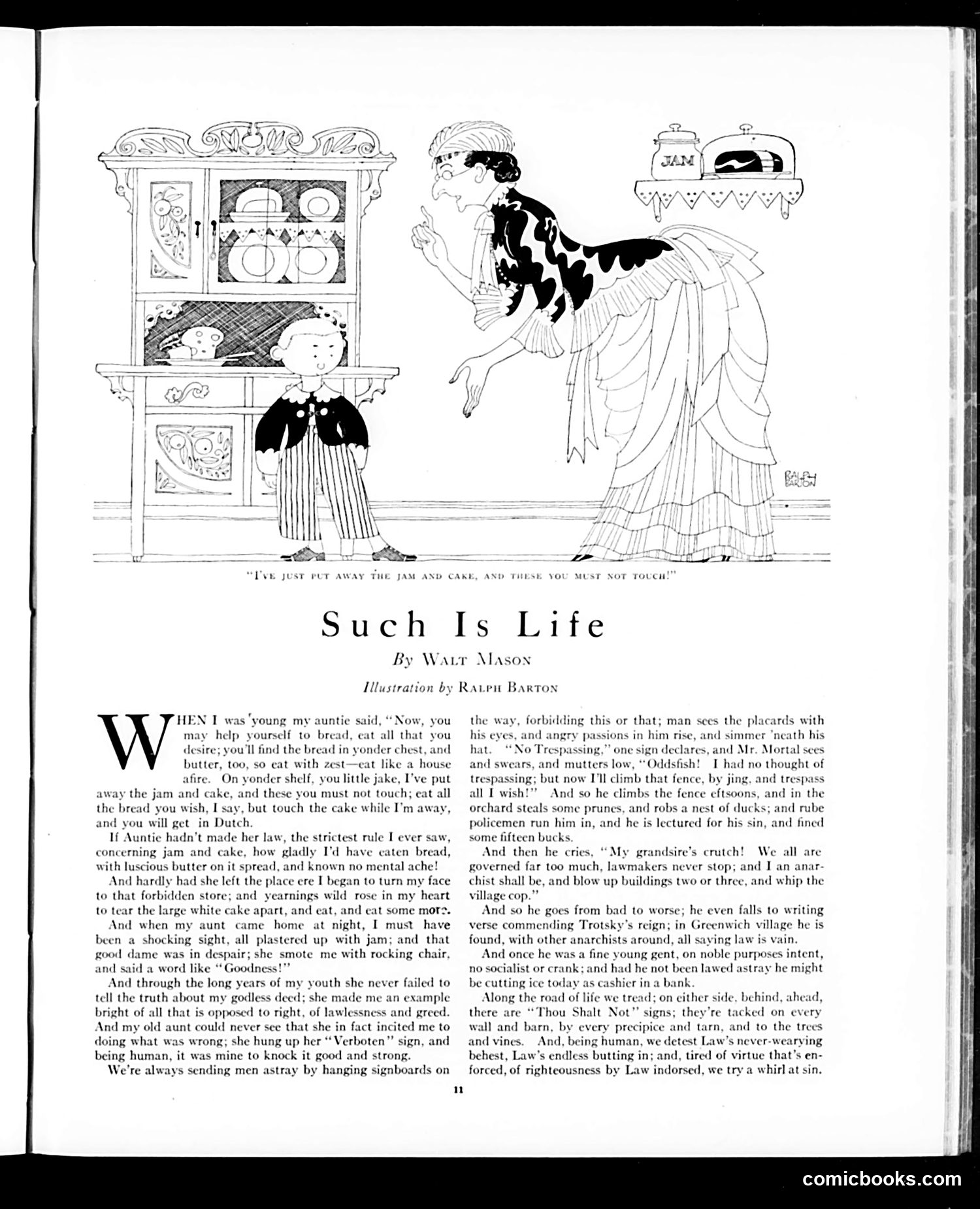
This is not a political cartoon but an illustrated essay criticizing excessive legal restrictions and moral prohibitions. The narrative uses a childhood anecdote as a frame story: a boy forbidden from eating jam and cake becomes obsessed with the forbidden items precisely *because* they're prohibited. He eats them anyway and is punished. Mason extends this logic philosophically: he argues that laws and "Thou Shalt Not" signs paradoxically *encourage* lawbreaking by making rule-breaking appealing to human nature. The example escalates—a man climbing a fence to steal prunes eventually becomes radicalized into anarchism and Bolshevism (referencing Trotsky), writing revolutionary verse in Greenwich Village. The satire targets overly restrictive moralism and legislation as counterproductive. Rather than preventing vice, prohibition creates resentment and rebellion. Ralph Barton's illustration depicts a mother enforcing such rules on a child—the visual embodiment of the essay's critique. This reflects early 20th-century debate about Prohibition and paternalistic governance.
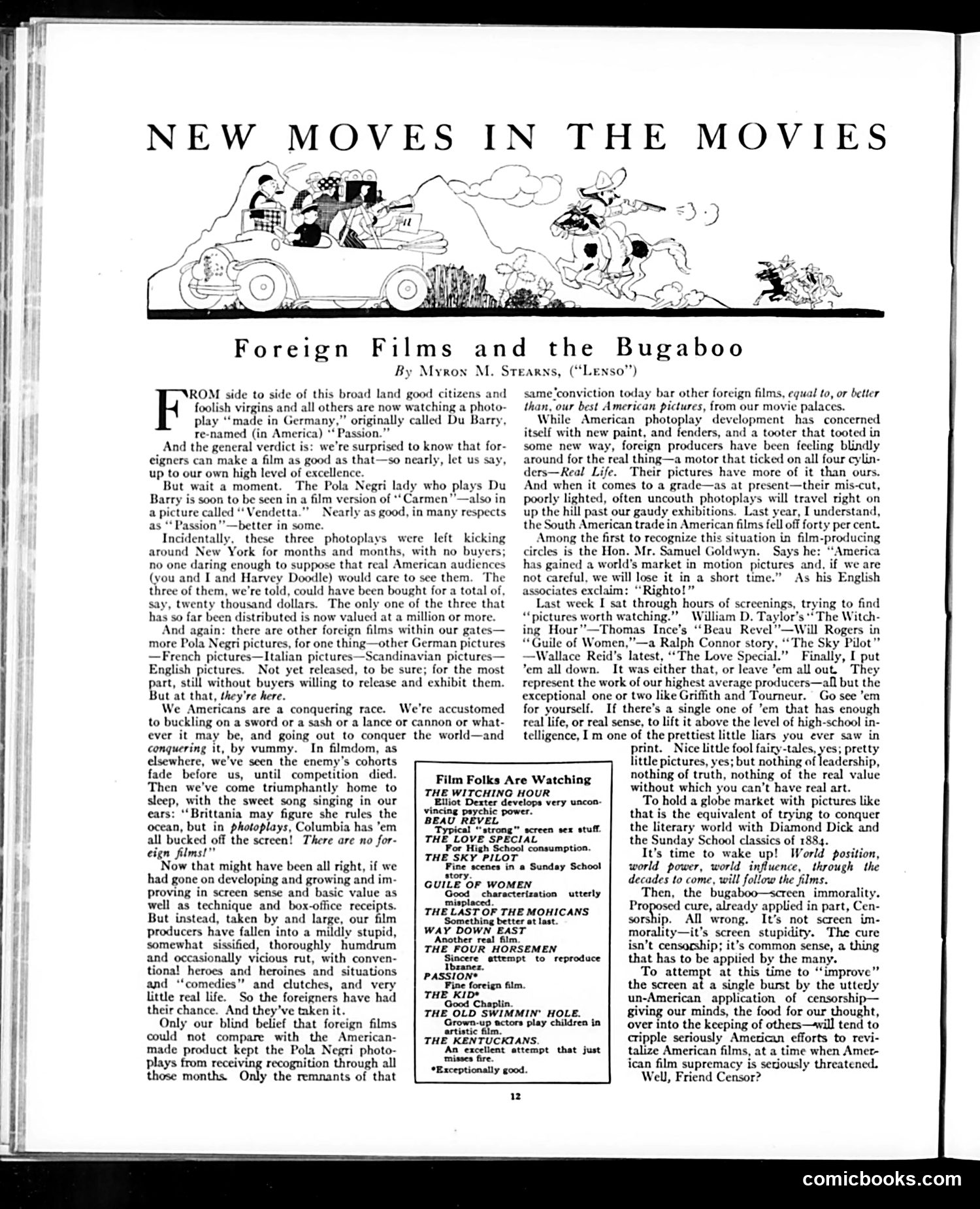
This article argues that American film producers have grown complacent and mediocre, allowing superior foreign films—particularly German productions like "Passion" (originally "Du Barry") featuring actress Pola Negri—to dominate despite initial American prejudice against them. **The satire's point**: American filmmakers, once confident in their superiority, have become lazy and conventional. Foreign competitors, initially dismissed as unmarketable, proved audiences would eagerly watch quality work. The author criticizes American producers for falling into "mildly stupid" routines of conventional heroes, artificial situations, and cheap tricks rather than developing real artistic merit. **The "Bugaboo"** (fear/obstacle) is American insularity—blind faith that domestic films automatically excel, preventing recognition of genuinely better foreign work. The sidebar reviews validate this critique, marking most contemporary American films as mediocre while praising "The Four Horsemen" and "Way Down East" as exceptions showing what's possible.
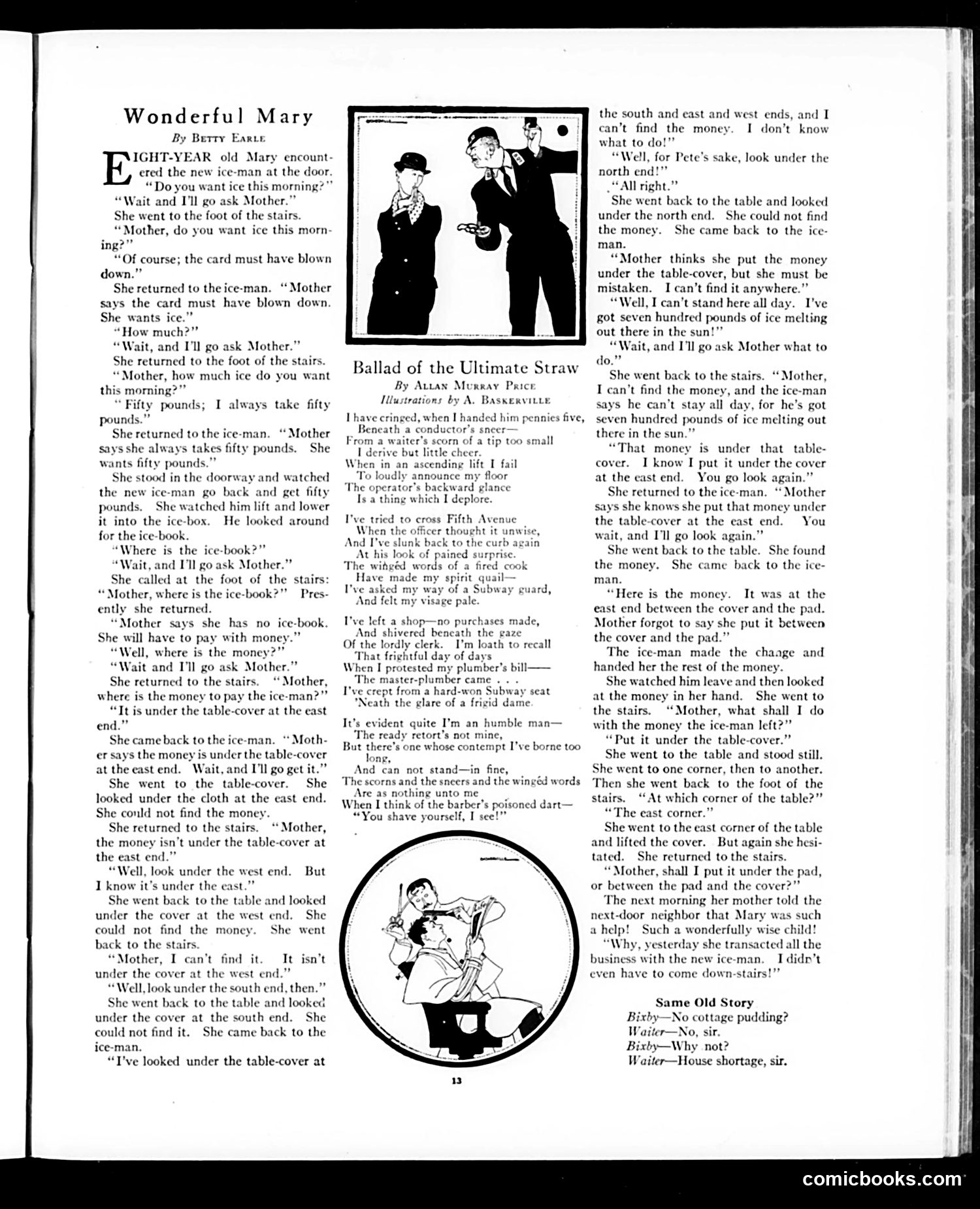
**The Main Story:** This is a humorous domestic tale about an 8-year-old girl who must relay messages between her absent-minded mother and the ice delivery man. The joke escalates as Mary repeatedly runs upstairs to ask her mother simple questions (how much ice? where's the payment?), only to discover Mother has given contradictory or unhelpful answers. The climax: Mother insists the money is under the table—but Mary searches east, west, and south ends without finding it before finally checking north. **The Satire:** The story gently mocks scattered, forgetful housewives of the era who couldn't keep track of household basics, and the inconvenience this caused working servicemen. It's also mild comedy about childhood obedience—Mary dutifully asks about everything rather than using common sense. **Secondary Content:** The page also includes "Ballad of the Ultimate Straw," a poem by Allan Murray Price about accumulated social humiliations (snubbing by servants, conductors, clerks), culminating in a barber's cutting remark: "You shave yourself, I see!"—suggesting the narrator is so poor or cheap he does his own grooming.
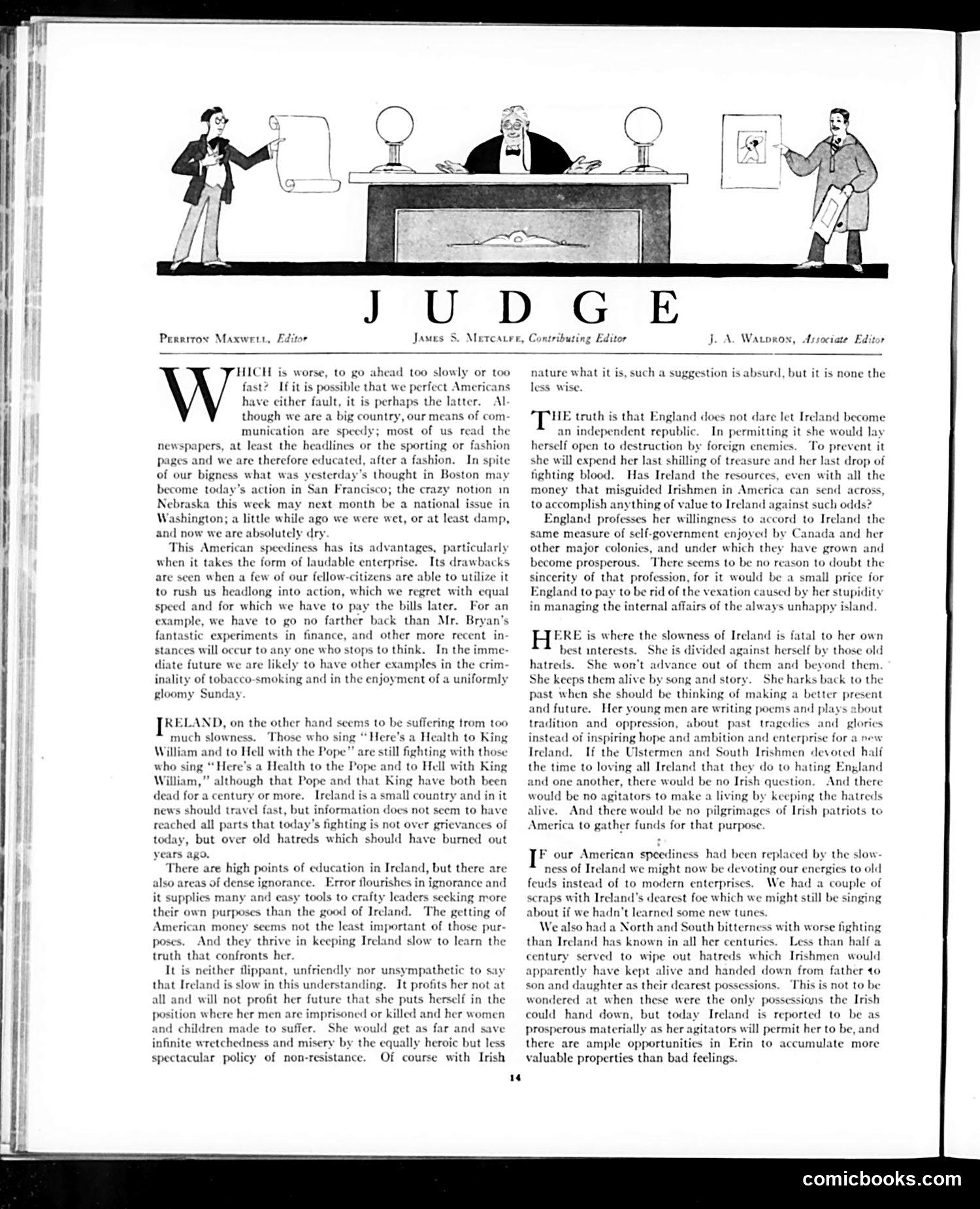
This page combines editorial commentary with a judge-themed masthead illustration. The content addresses two separate political issues: **The Cartoon Header**: Shows a judge at a bench flanked by two men presenting opposing cases—a visual metaphor for the editorial's balanced consideration of American versus Irish problems. **Main Editorial Arguments**: 1. **American "Speediness"**: Criticizes Americans for rushing into actions (referencing William Jennings Bryan's financial experiments) without adequate deliberation, then regretting costly consequences. 2. **Irish "Slowness"**: Attacks Ireland for remaining trapped in centuries-old religious and political feuds ("Here's a Health to King William and to Hell with the Pope"). The editor argues Irish leaders exploit ignorance and American donations to perpetuate resistance rather than pursue practical self-governance. 3. **Irish Independence**: Argues England won't grant full independence due to strategic concerns, but offers dominion-like self-government comparable to Canada's—implying Irish demands are unreasonable. The satire positions Ireland as backward and emotionally-driven versus practical Anglo-Saxon governance.
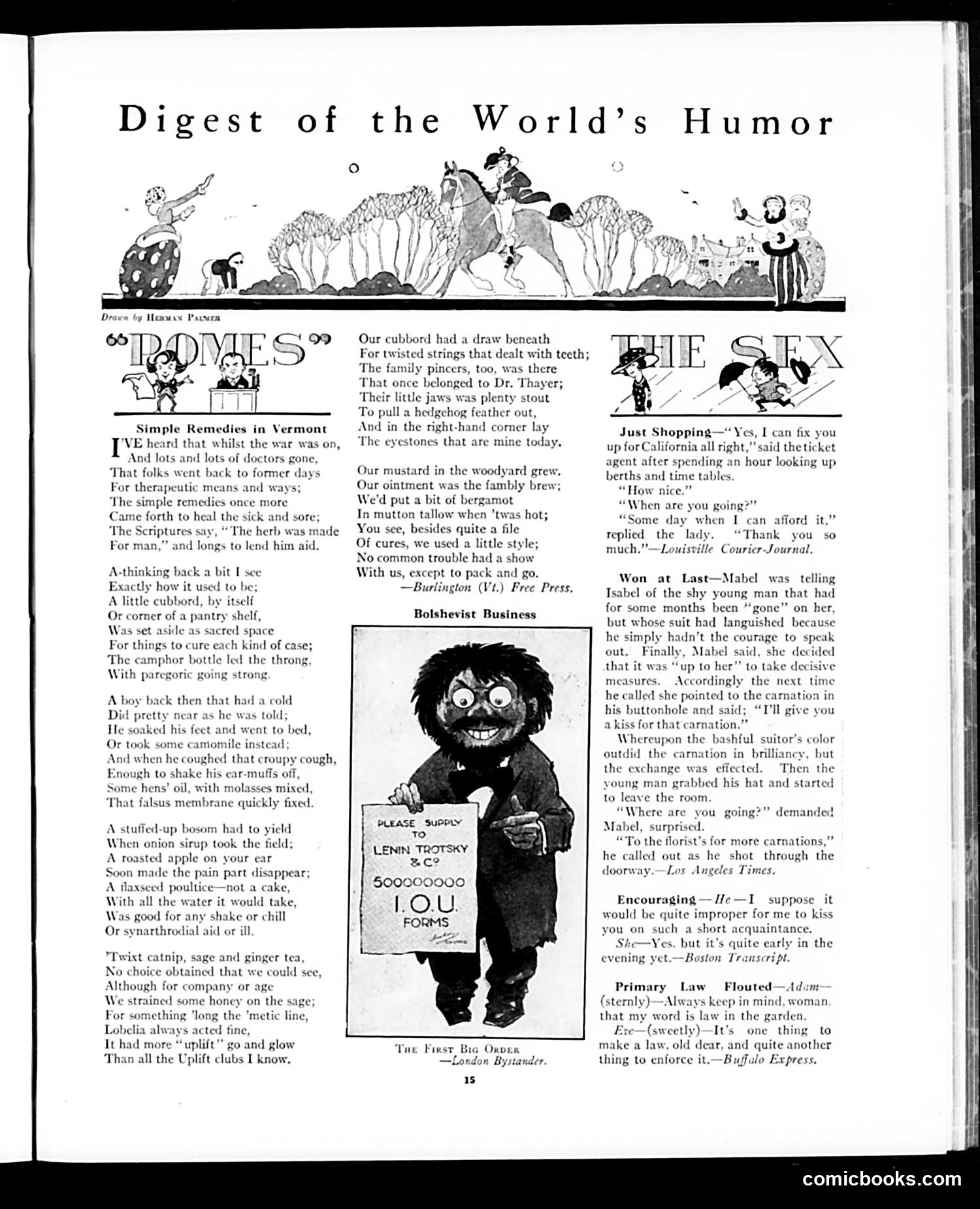
This page from *Judge* magazine contains humor pieces and one political cartoon. The **Bolshevik Business cartoon** (center) is the most historically significant: it depicts a caricatured figure labeled "Lenin Trotsky & Co." holding an IOU form for 500,000,000, satirizing Soviet Russia's financial instability and debt. This reflects post-WWI American skepticism toward the new communist government. The other content includes nostalgic Vermont folk remedies (camphor, paregoric, poultices) reflecting wartime shortages when doctors were scarce. The remaining brief jokes address everyday situations—travel booking, courtship, and gender roles—typical of early-20th-century humor magazines. The Soviet satire represents broader American anti-communist sentiment during this period, while the remedies piece captures genuine historical memory of pre-modern medicine.
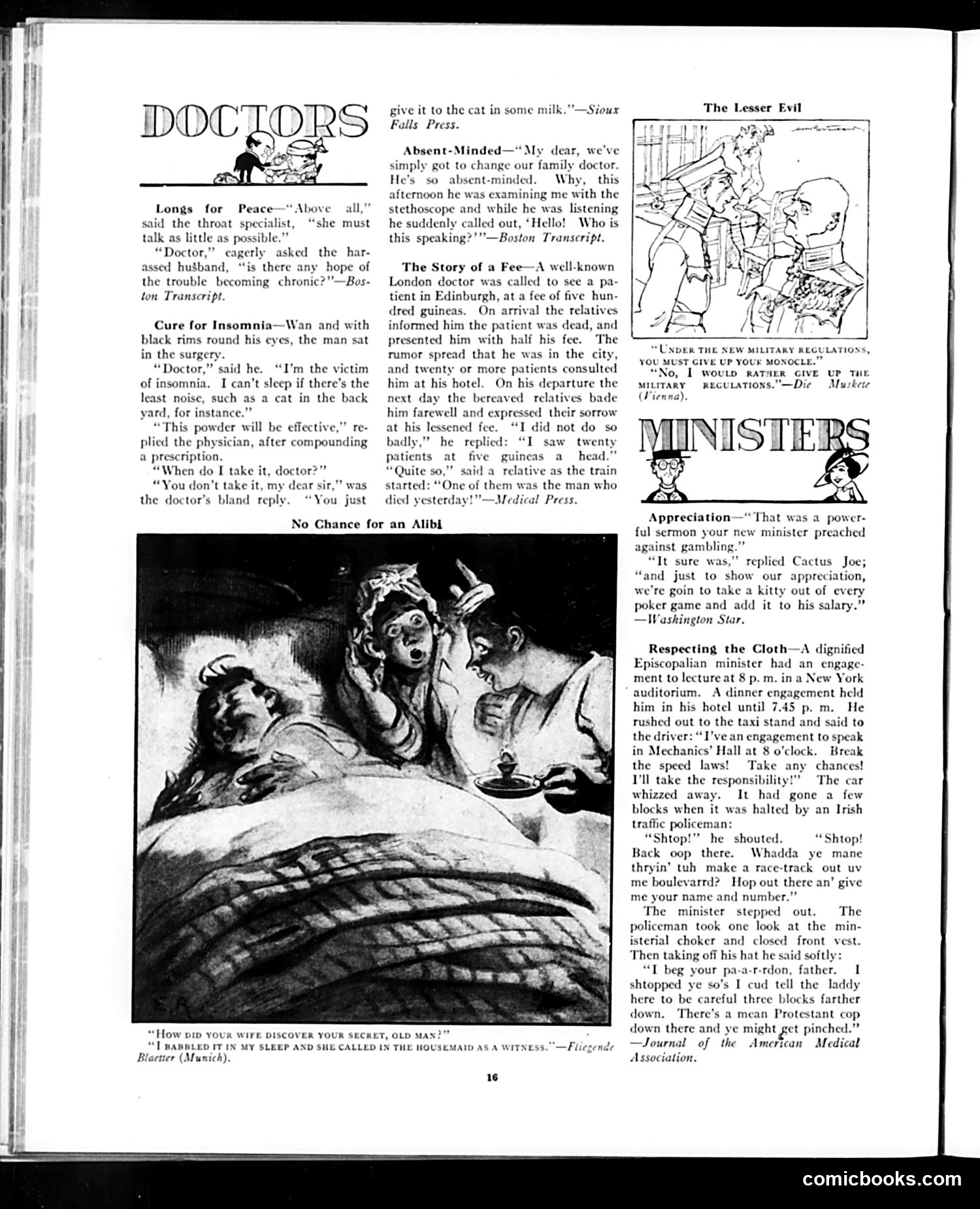
This page contains short humorous anecdotes typical of early-20th-century Judge magazine, plus one political cartoon. **The cartoons and jokes satirize:** 1. **Doctor humor**: Multiple medical jokes mock physicians' absent-mindedness and fee-gouging. One story describes a London doctor who charges five hundred guineas to visit a dead patient, then profits further by seeing twenty other patients—discovering one was the deceased man himself. 2. **"The Lesser Evil" cartoon**: A German military regulation required soldiers to surrender their monocles. The cartoon's joke is that a German officer prefers abandoning military regulations entirely rather than giving up his monocle—satirizing Prussian vanity and the absurdity of militaristic fashion obsession. 3. **The Irish policeman story**: An Episcopal minister rushes to a lecture; an Irish traffic cop stops his speeding taxi. Upon seeing the minister's clerical collar, the cop—himself Catholic—warns the minister about a "mean Protestant cop" ahead, suggesting sectarian favoritism and ethnic stereotypes. The humor relies on period prejudices and occupational stereotypes now dated but historically representative of Judge's audience expectations.
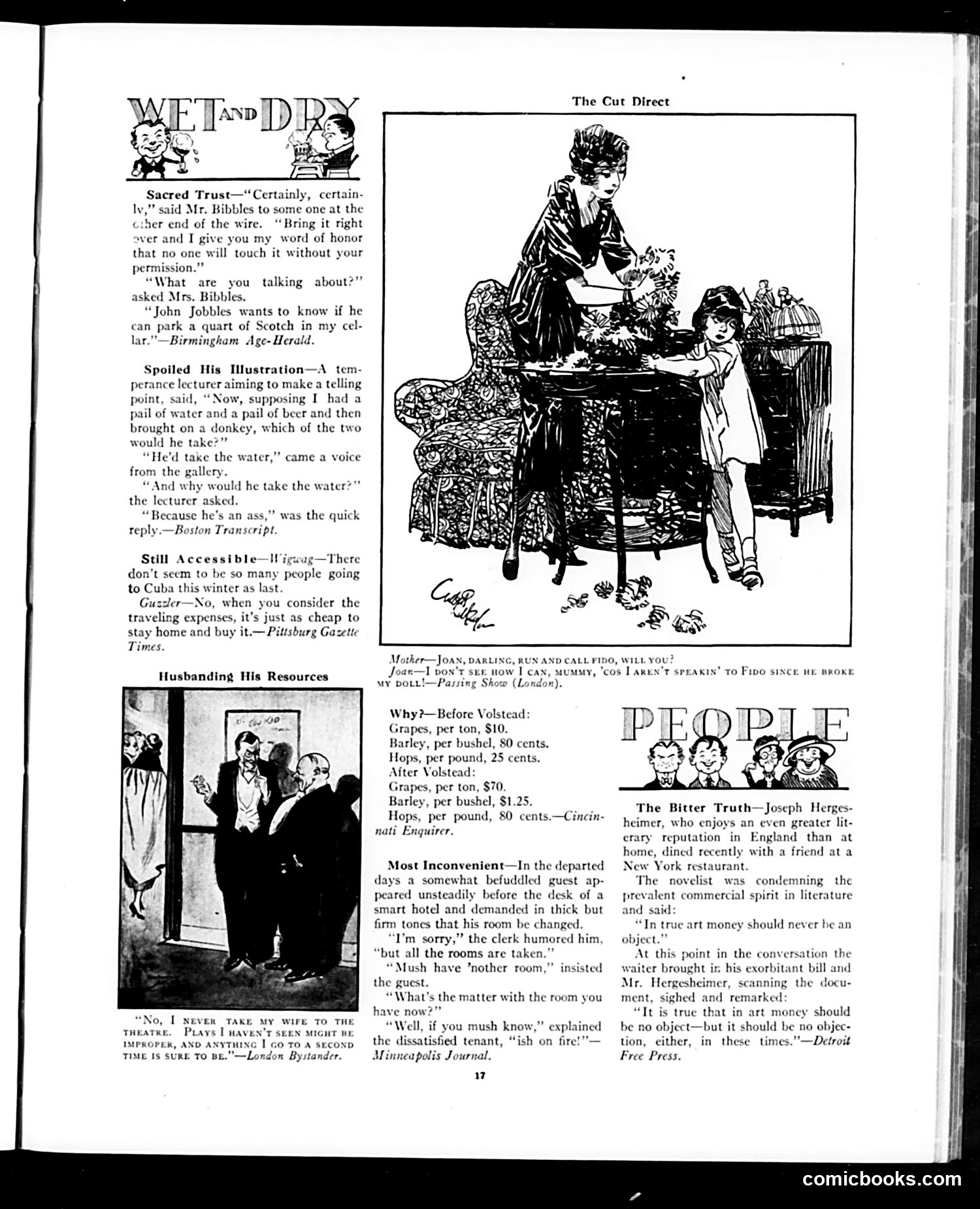
This page from Judge magazine collects brief humorous anecdotes reflecting early-20th-century American social concerns. **Key satires:** 1. **Prohibition era jokes**: Multiple items reference alcohol smuggling and price inflation after Volstead Act passage. "Sacred Trust" depicts a man hiding Scotch whiskey in his cellar; "Why?" compares commodity prices before/after Prohibition (grapes jump from $10 to $70 per ton), and "Most Inconvenient" jokes about a drunk guest claiming his hotel room is "on fire." 2. **"The Bitter Truth" cartoon** features novelist Joseph Hergersheimer (a real literary figure) dining out. The satire mocks artists' claims that "money should never be an object" in art—then undercuts this pretense when presented an expensive restaurant bill. It's social commentary on commercial hypocrisy among intellectuals. 3. **Various short jokes** target marital dynamics, theater etiquette, and class anxiety about travel expenses. The overall tone reflects Judge's satirical stance on Prohibition's economic effects and upper-class pretension.
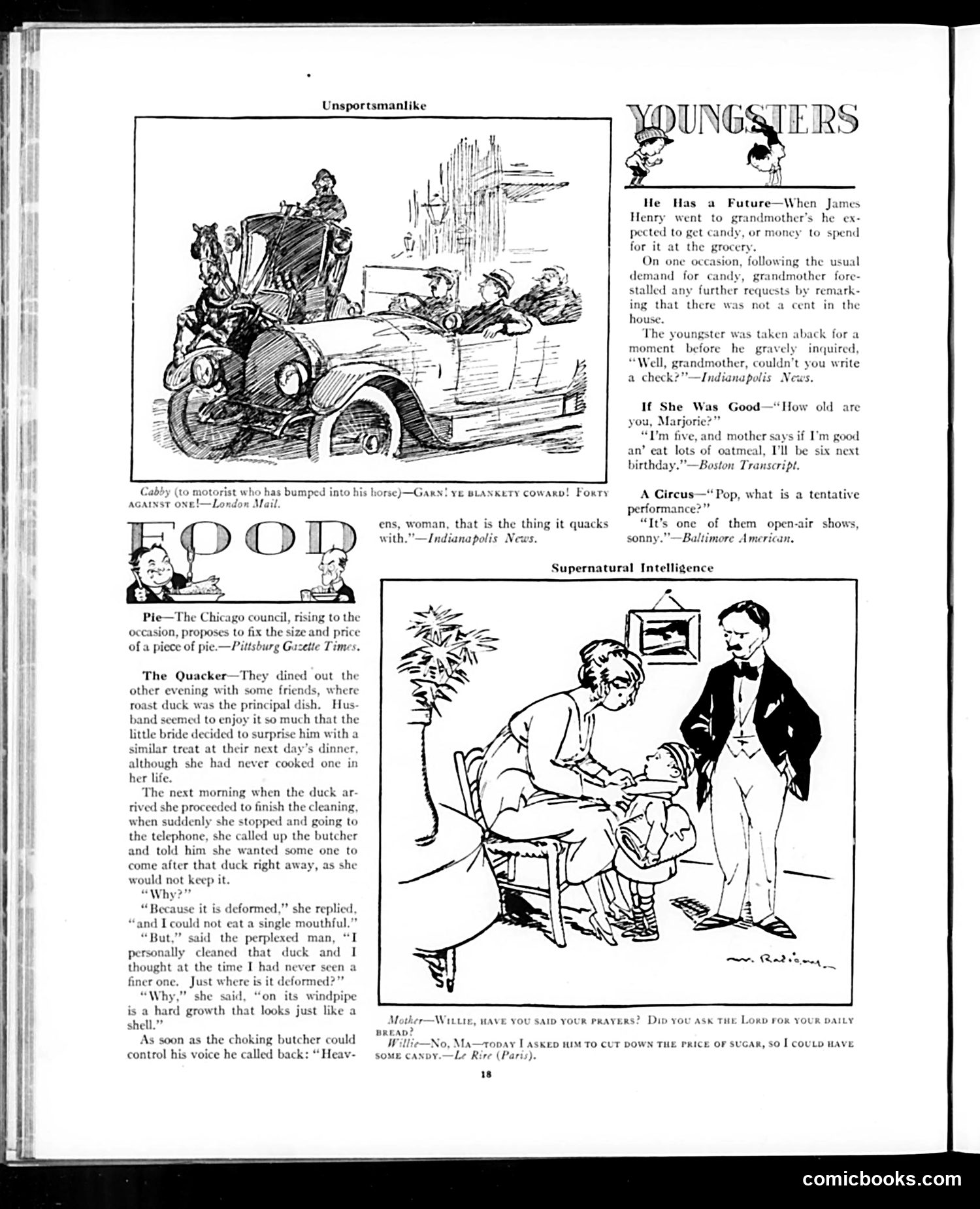
This page contains several humorous anecdotes and cartoons satirizing everyday American life, likely from the early 20th century. **"The Quacker"** mocks a newlywed's naïveté: she calls a butcher in panic, believing a duck is "deformed" because of a hard growth on its windpipe—unaware that the growth is the duck's larynx, which produces its quack. The joke targets her ignorance of basic anatomy and cooking. **"He Has a Future"** satirizes a child's precocious materialism: when told grandmother has no cash, the boy immediately suggests she write a check—implying he already understands credit systems. **"Supernatural Intelligence"** depicts a boy telling his mother he didn't pray for daily bread but instead asked God to lower sugar prices so he could buy candy. This mocks both childhood selfishness and perhaps wartime/economic rationing concerns. The top cartoon shows a motorist collision with a cab driver, with accompanying commentary about unsportsmanlike conduct in traffic. Overall, the page uses children and naive adults as subjects for gentle satire about modern life's absurdities.
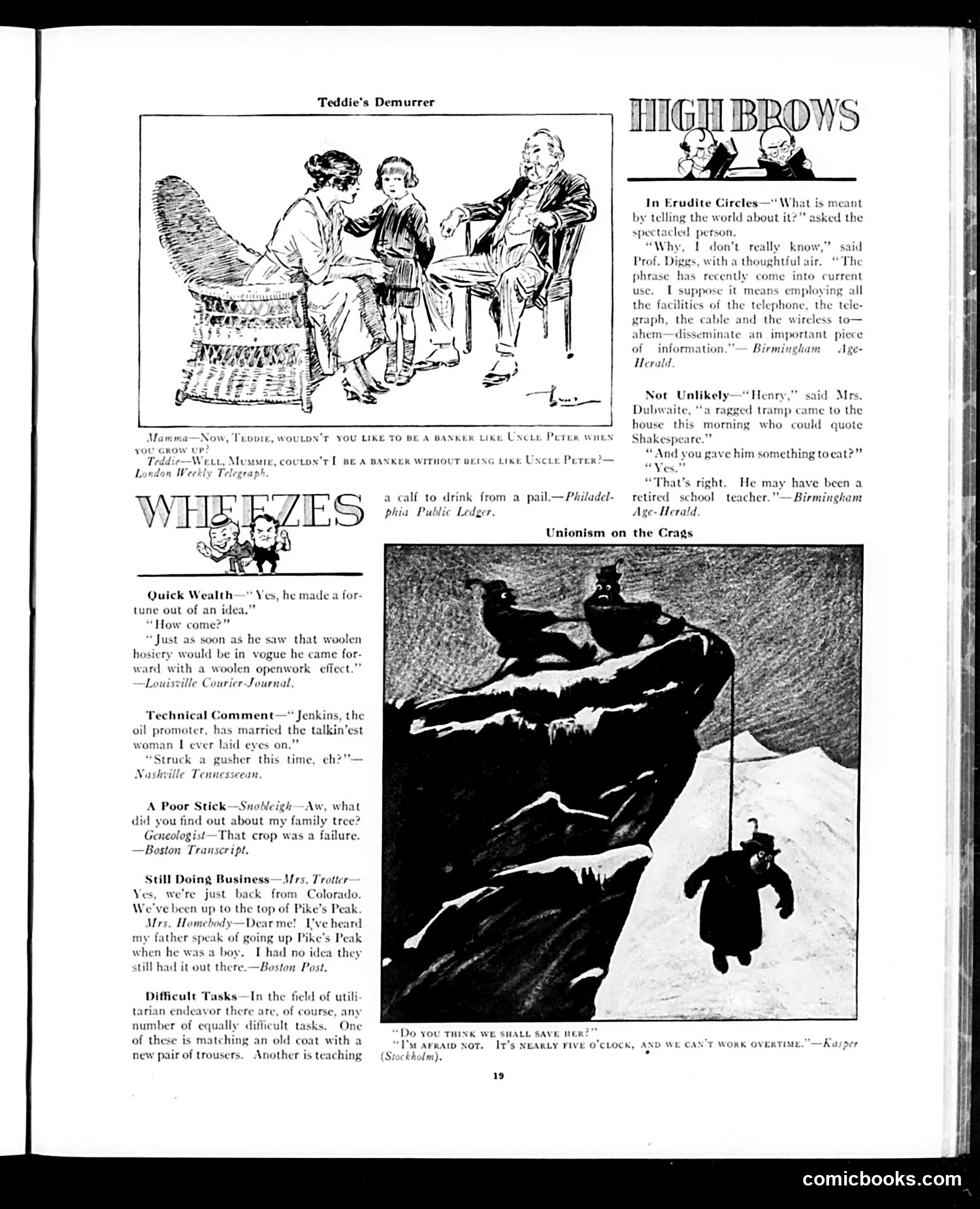
This page contains several unrelated satirical humor pieces typical of early 20th-century Judge magazine. **"Teddie's Demurrer"** (top cartoon) appears to reference Theodore Roosevelt ("Teddie"), showing a domestic scene where a mother asks her son if he'd like to be a banker like "Uncle Peter." The humor seems to play on Roosevelt-era attitudes about wealth and profession. **"Wheeltzes"** section collects brief jokes from various newspapers, including quips about quick wealth from woolen hosiery, an oil promoter's marriage ("struck a gusher"), and family genealogy research. **"Unionism on the Crags"** (bottom photograph) shows workers on a mountainside with a caption about refusing overtime work past 5 o'clock, mocking labor union demands for work-hour restrictions—a contemporary social controversy. The page reflects common Judge satire: poking fun at social pretensions, labor activism, and contemporary business trends. Without specific historical markers visible, exact references remain somewhat unclear, but the overall tone targets modern anxieties about work, wealth, and class.
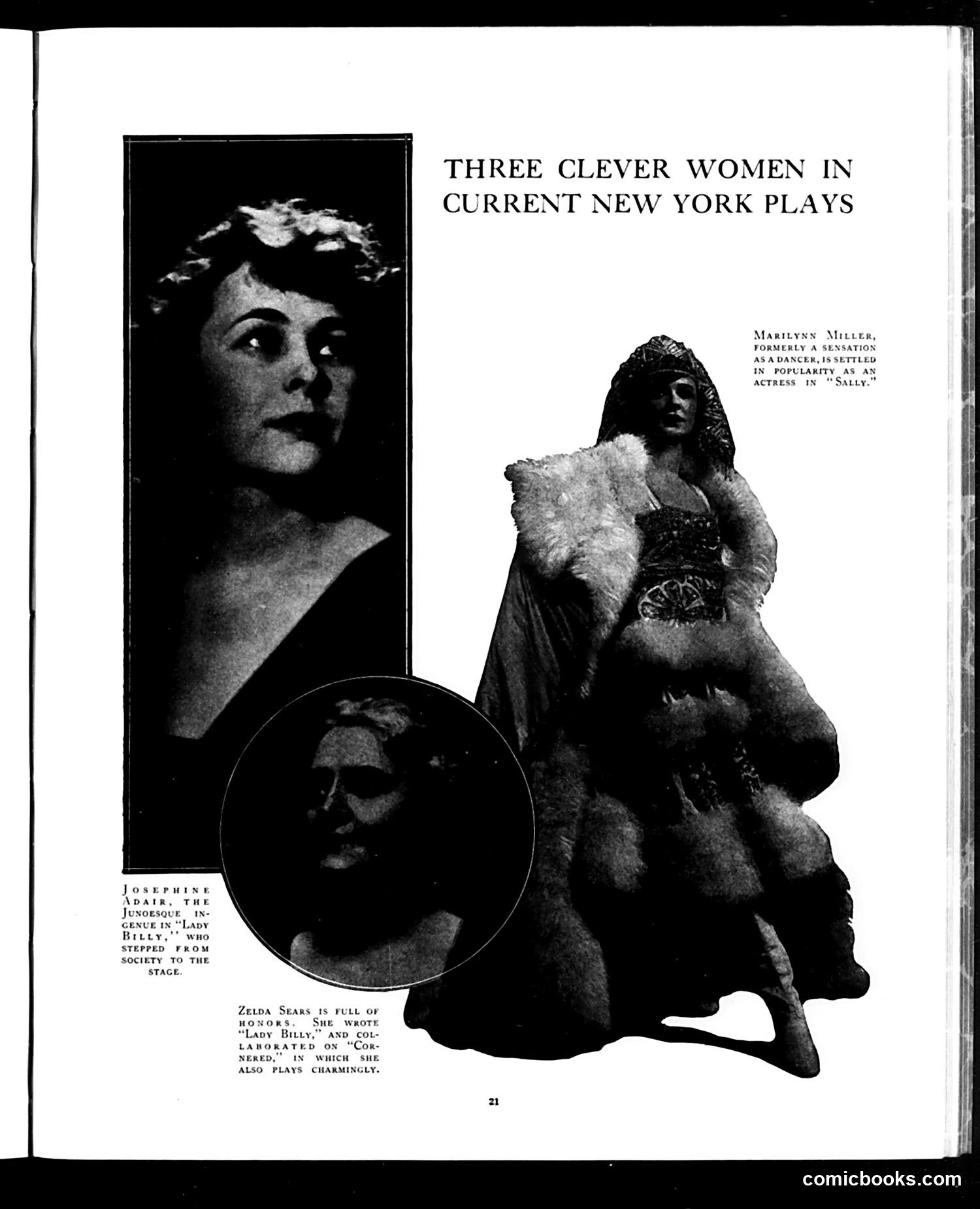
This is a theatrical spotlight feature, not political satire. It celebrates three actresses in contemporary Broadway productions circa the 1910s-1920s: **Josephine Adair** — described as "the ingénue incense in 'Lady Billy,'" who transitioned from high society to stage acting. **Zelda Sears** — playwright and actress who wrote "Lady Billy" and collaborated on "Cornered," in which she also performs. **Marilynn Miller** — formerly a notable dancer, now established as an actress in the play "Sally." The piece functions as entertainment journalism praising these women's theatrical accomplishments and career transitions. The photographs present them as sophisticated professionals rather than objects of ridicule, which reflects Judge magazine's occasional coverage of cultural and entertainment topics alongside its satirical content.
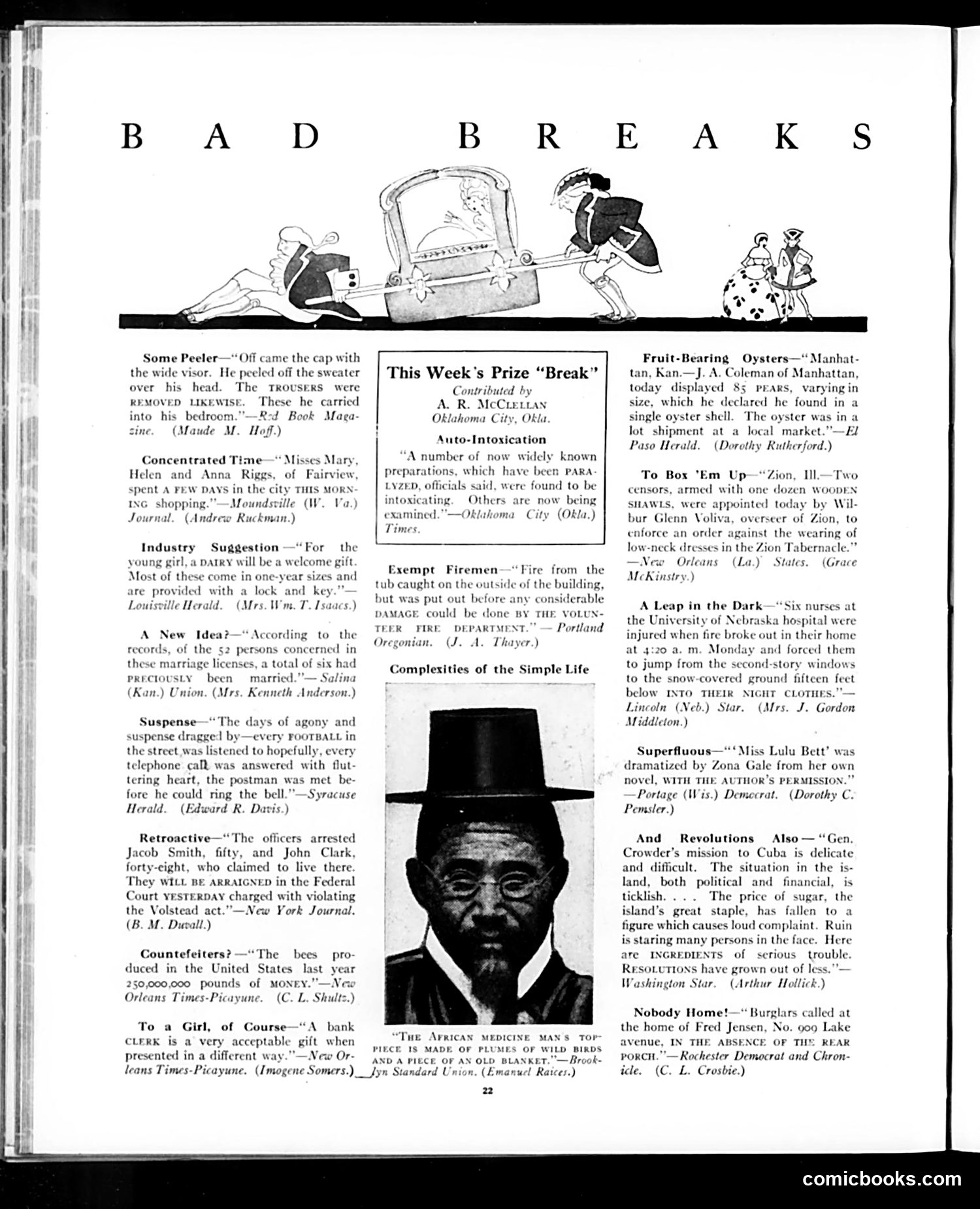
This page from *Judge* magazine collects humorous "breaks"—amusing newspaper excerpts and typos submitted by readers. The humor relies on unintentional double meanings and absurd literal readings created by poor wording or editing. Examples include: a man removing all his clothes (suggesting impropriety); a "dairy" gift for young girls with a "lock and key" (implying something inappropriate); and Prohibition-era references like "Volstead act" violations. There's also satire on topical issues: Volstead Act enforcement, the Zion religious community's dress codes, and General Crowder's mission to Cuba. The central image shows "The African Medicine Man's Toppiece," likely mocking colonial-era ethnographic displays popular in early 20th-century America. The page's humor depends on readers recognizing how awkward phrasing creates unintended, often risqué implications—a staple of *Judge's* satirical format mocking both newspapers and contemporary social concerns.
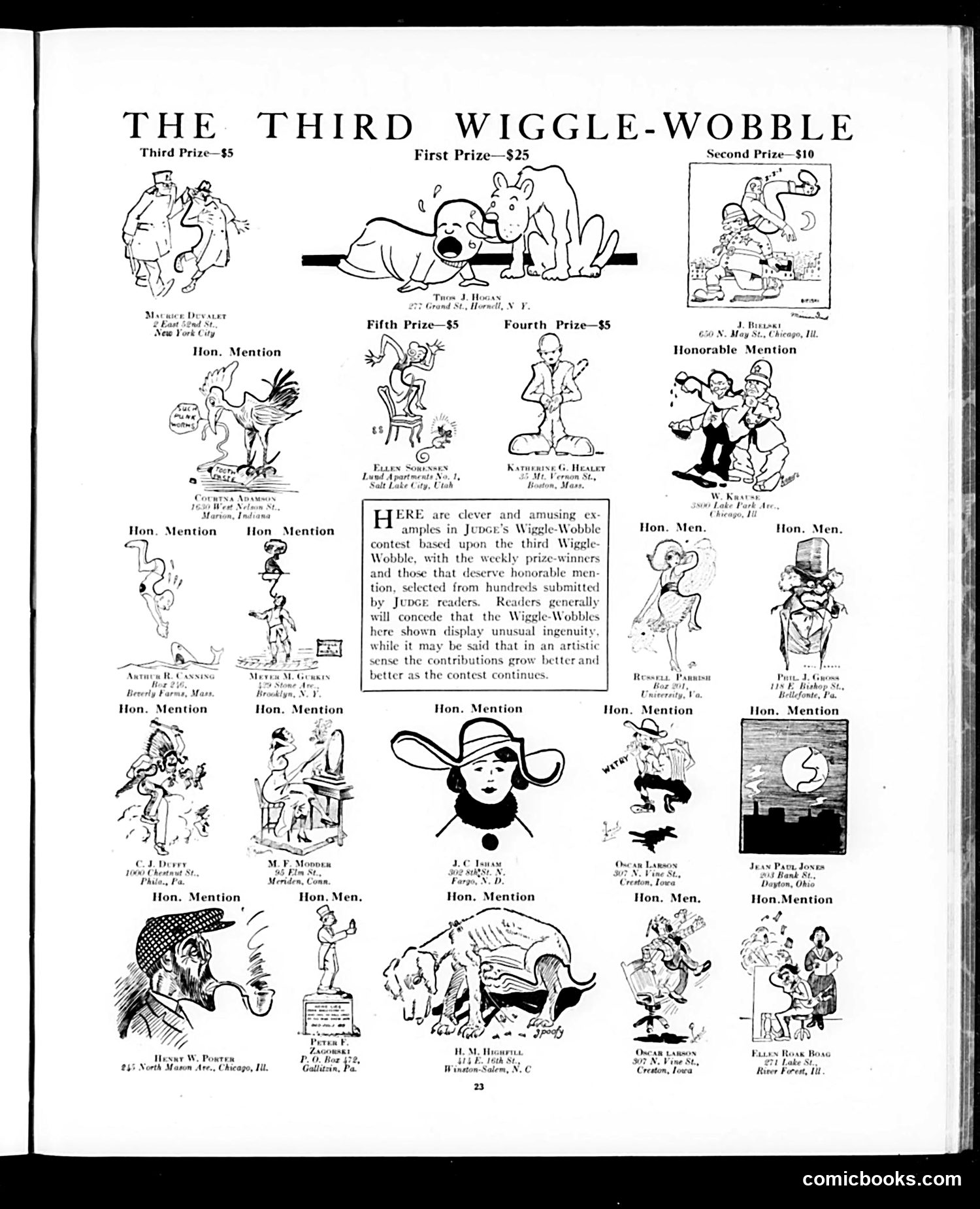
This page showcases results from *Judge* magazine's "Wiggle-Wobble" cartooning contest—a recurring feature inviting readers to submit humorous drawings. The page displays the winning entries and honorable mentions, with monetary prizes ($25 for first place down to $5 for third). The "Wiggle-Wobbles" appear to be brief, whimsical cartoon gags featuring exaggerated human and animal figures in absurd situations. The introductory text notes that submissions have grown artistically sophisticated over successive contests. Contributors are credited with their names and addresses, suggesting this was a popular participatory feature engaging *Judge*'s readership. The cartoons themselves—featuring elongated limbs, distorted poses, and slapstick scenarios—reflect early 20th-century comic aesthetics. This represents *Judge*'s role not just as satirical publication but as a platform for amateur cartooning talent.
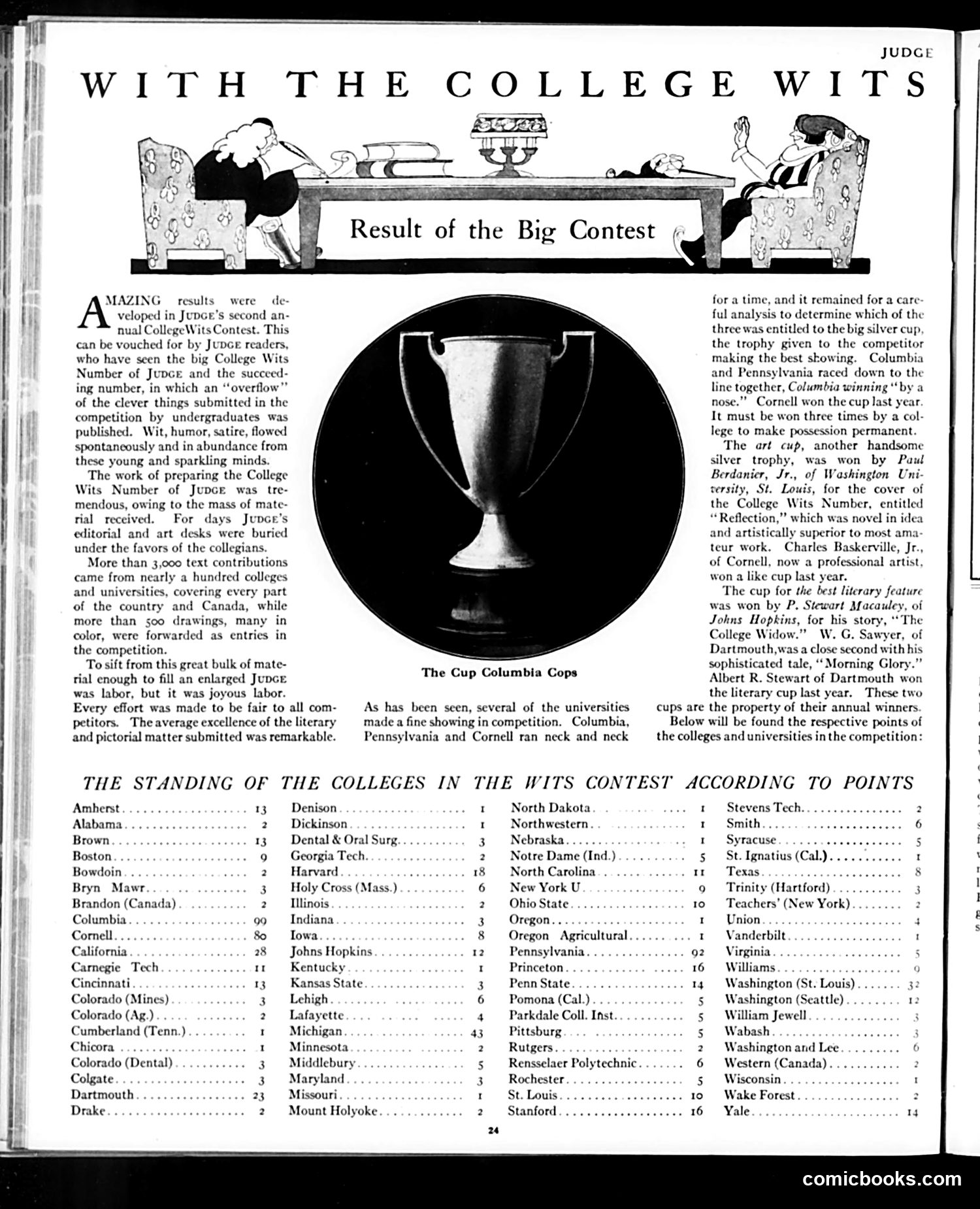
This page celebrates Judge magazine's second annual College Wits Contest, a national humor competition for undergraduates. The cartoon header shows two figures at a table exchanging witty remarks while a judge presides—illustrating the contest's central activity. The article reports that nearly 100 colleges submitted over 3,000 entries and 500 drawings. Judge editorial staff spent days sorting material to fill an enlarged special issue. The standings table reveals Columbia University won the overall competition, narrowly beating Pennsylvania and Cornell—all three universities competed fiercely for the silver trophy cup (shown in the circular image). Winners are named for best literary and artistic contributions. The page demonstrates Judge's role as an arbiter of collegiate humor and satire during this era, celebrating young writers and artists while promoting the magazine itself to educated audiences through academic competition.
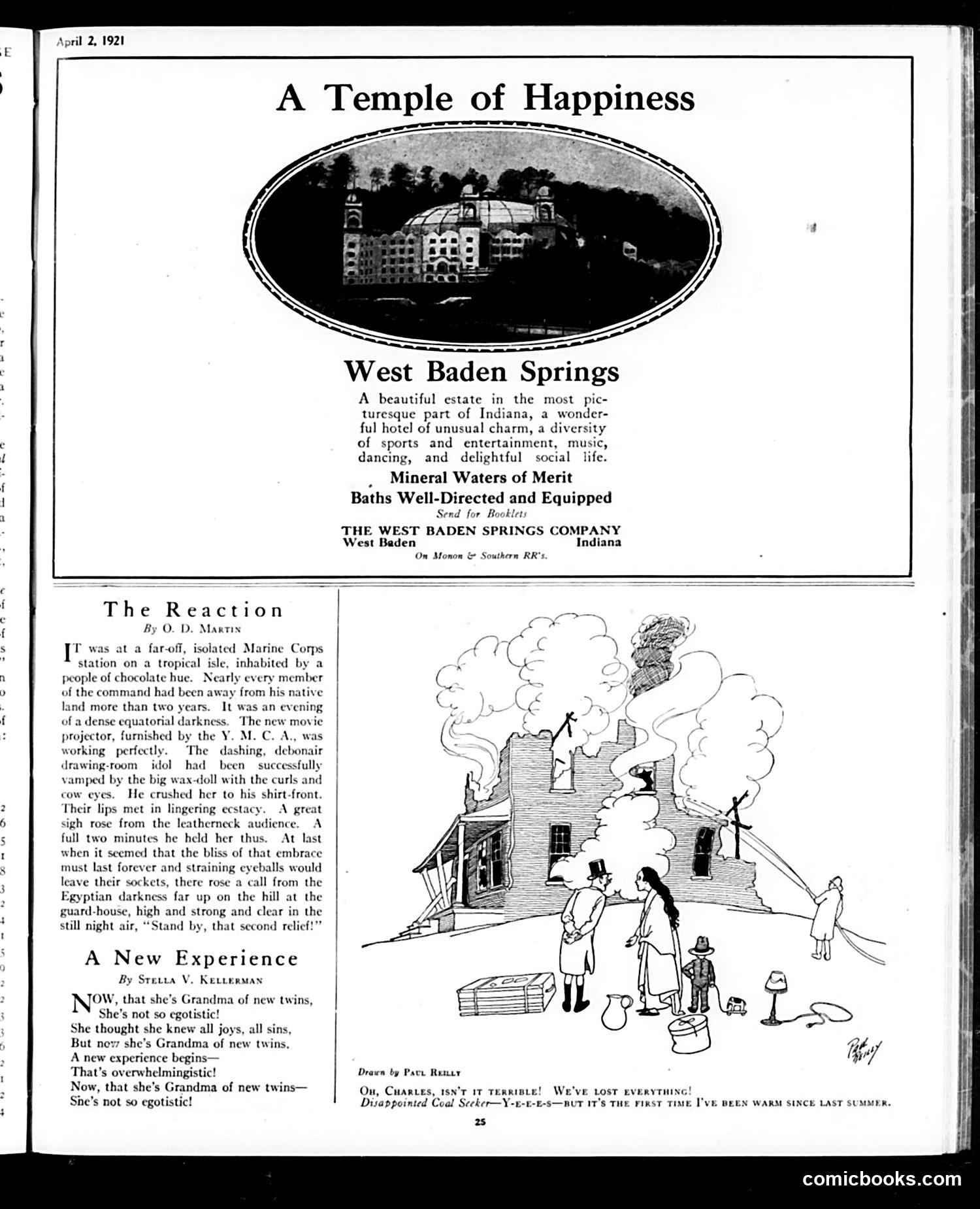
**Upper Section:** A full-page advertisement for West Baden Springs, a luxury Indiana resort hotel featuring mineral baths and entertainment—standard period advertising with no satirical content. **"The Reaction" (by O.D. Martin):** A humorous anecdote about homesick Marines stationed at a tropical base. During a movie screening of a romantic scene, the audience of servicemen watches intently as actors embrace. Just as the emotional moment peaks, a guard's call for "second relief" breaks the spell—a joke about military duty interrupting romantic fantasy and the longing of troops separated from home. **"A New Experience" (by Stella V. Kellerman):** Light verse about a woman becoming a grandmother to twins, suggesting she's lost some smugness and discovered a genuinely new life experience. The tone is gently mocking her previous confidence. **Paul Renby's Cartoon:** Shows a disappointed man and woman amid a collapsed house, joking that despite losing everything, it's the first time he's been warm since summer—dark humor about post-WWI coal shortages and winter hardship, likely referencing 1921 fuel crises affecting Americans.
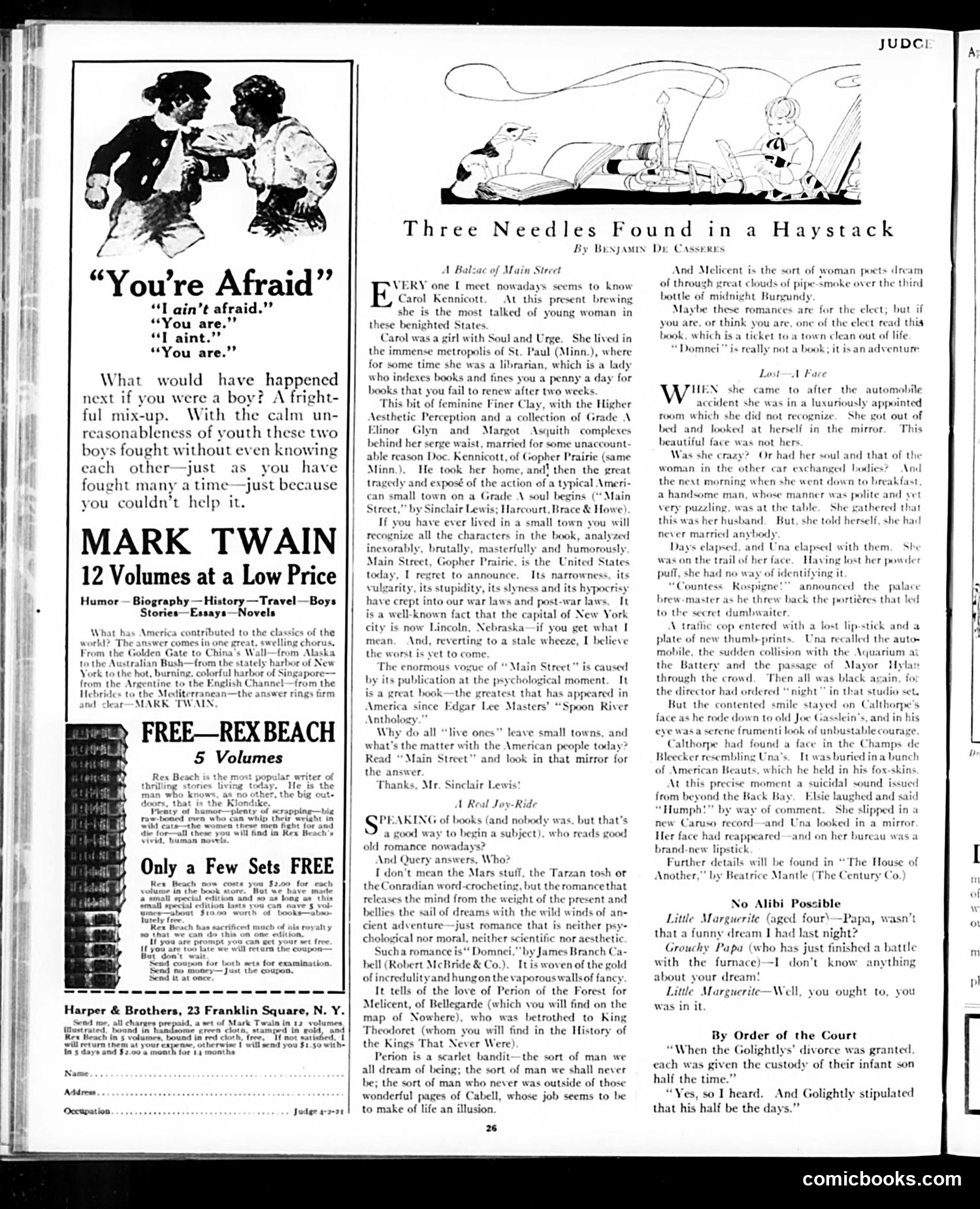
The left side features a **"You're Afraid" cartoon** depicting two young boys in a pointless argument-turned-fight. The satire illustrates childhood quarrels: two boys provoke each other into combat simply because they cannot help themselves, with no real cause or knowledge of each other. This appears to be commentary on human nature—how people (especially youth) engage in conflict irrationally, merely because of inability to resist. The page is primarily **advertising for books**, particularly Mark Twain's 12-volume collection and Rex Beach's works, leveraging their popularity and cultural authority. The right side contains a **literary review** of Sinclair Lewis's *Main Street*, comparing Lewis to Balzac. The reviewer praises the novel as capturing small-town American mediocrity and hypocrisy, suggesting these provincial attitudes have infected even major cities. The satire critiques American conformity and narrow-mindedness embodied in small-town life.
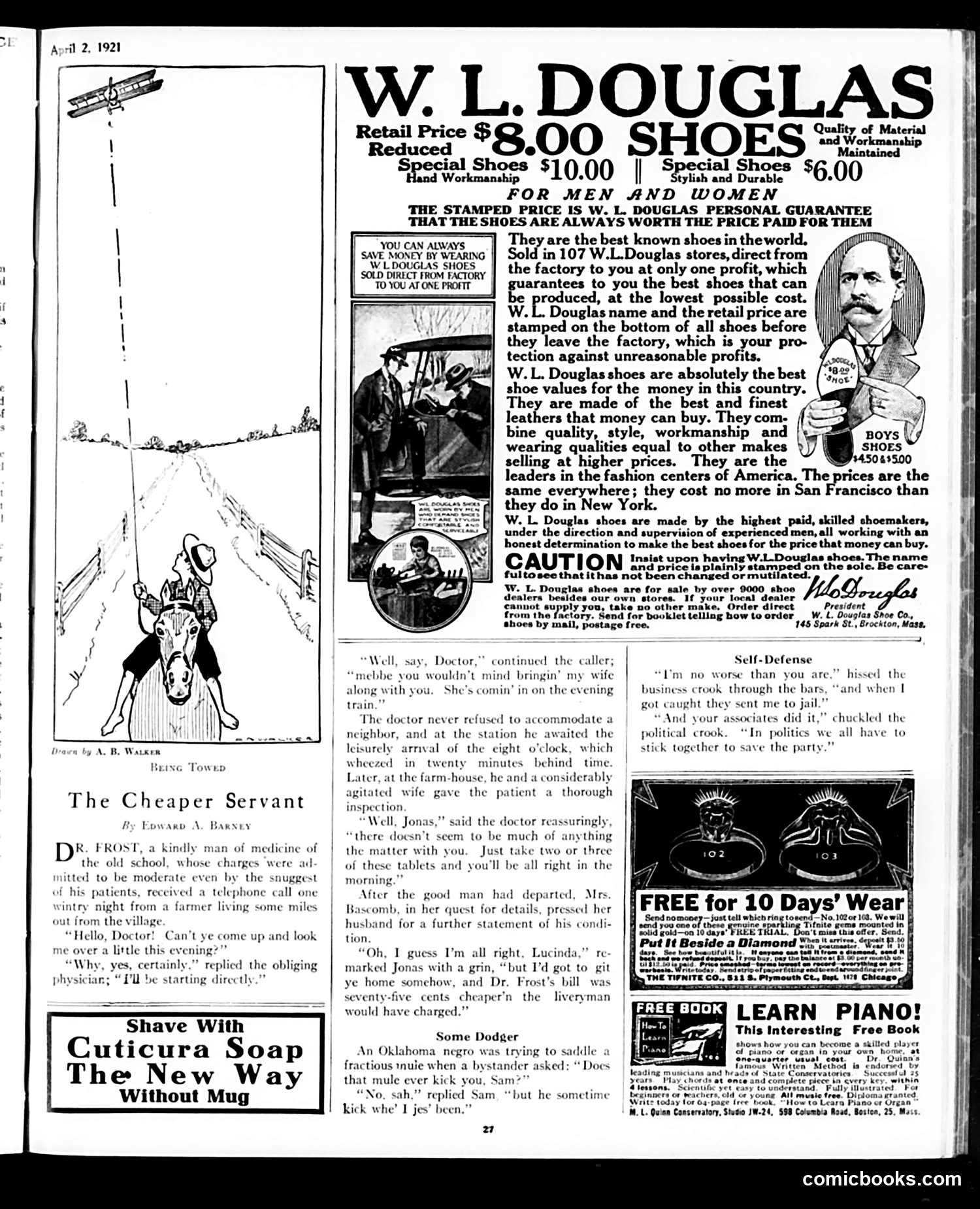
This page is primarily **advertising and fiction**, not political satire. The main cartoon, "Being Towed" by A.B. Walker, shows a man on horseback being pulled along by a rope—likely a humorous illustration unrelated to the page's content. The featured story, "The Cheaper Servant" by Edward A. Barney, is a rural humor piece about a farmer named Jonas who calls Dr. Frost to his home, then asks the doctor to fetch his wife from the train. The punchline reveals Jonas was faking illness simply to avoid paying the more expensive liveryman for transportation—he's using the doctor's house call as a cheaper alternative. The joke plays on rural economic thrift and the comedy of deception. The page is dominated by a large **W.L. Douglas Shoes advertisement** promoting factory-direct sales at reduced prices, emphasizing quality and fair pricing. Additional small humor pieces ("Self-Defense," "Some Dodger") and product advertisements (Cuticura Soap, piano lessons) fill remaining space.
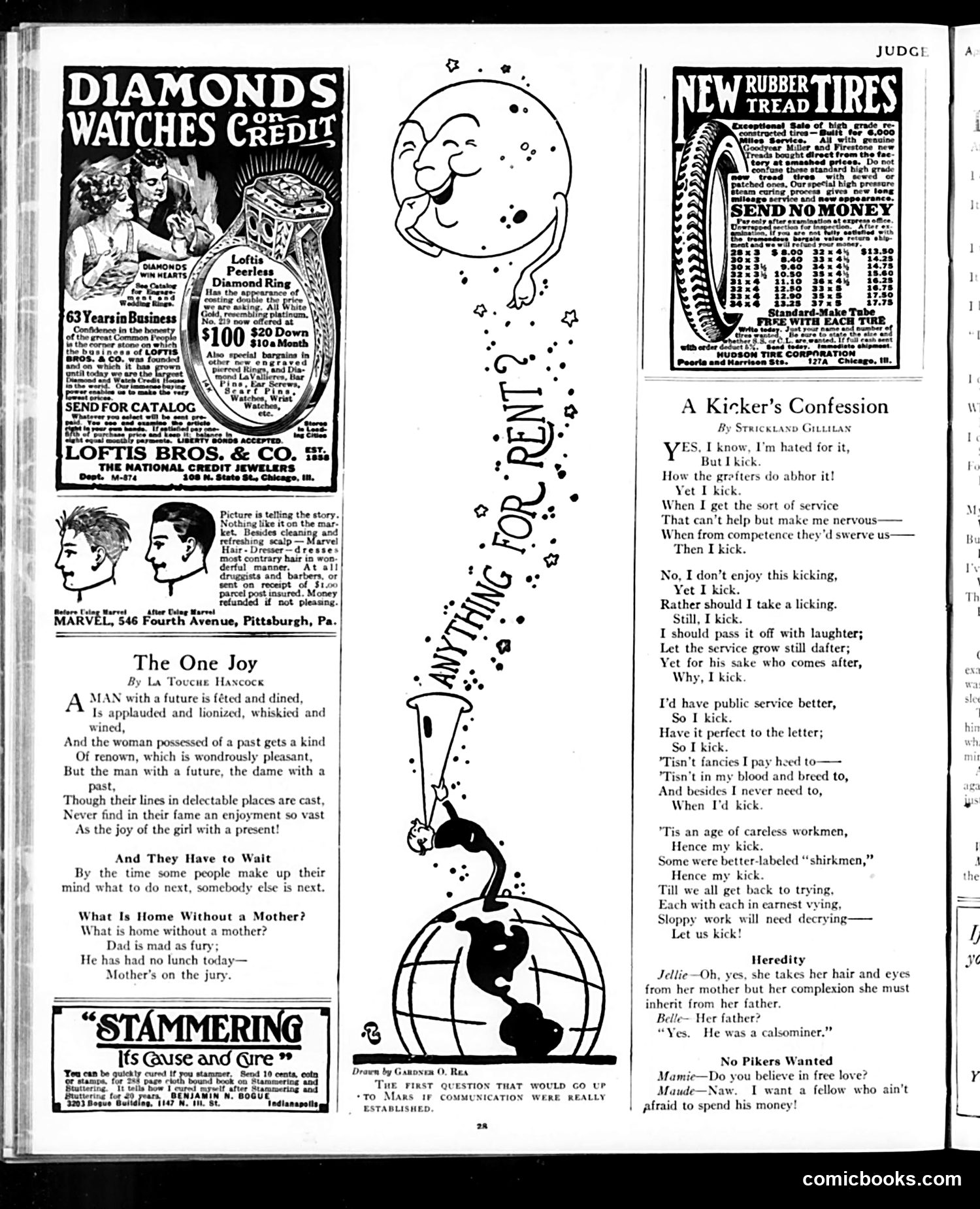
This page from *Judge* contains several satirical pieces typical of early 20th-century American humor: **"A Kicker's Confession"** is the main feature—a poem defending complaining about poor service. The speaker justifies "kicking" (complaining) about incompetent workers, bad service, and careless workmanship, arguing it's necessary social criticism to protect future customers. The satire mocks both chronic complainers and those who passively tolerate mediocrity. **Supporting humor pieces** include brief jokes about social situations: "The One Joy" contrasts how society celebrates people with futures or scandalous pasts but ignores ordinary present happiness; "What Is Home Without a Mother?" plays on domestic role expectations; and "Heredity" makes a crude joke about a woman's complexion inherited from a "calsominer" (whitewasher/laborer). The surrounding **advertisements** for diamonds, watches, tires, and hair products are period-typical commercial content. The overall tone reflects *Judge's* middle-class perspective on service quality, work ethics, and social propriety circa the 1910s-1920s.
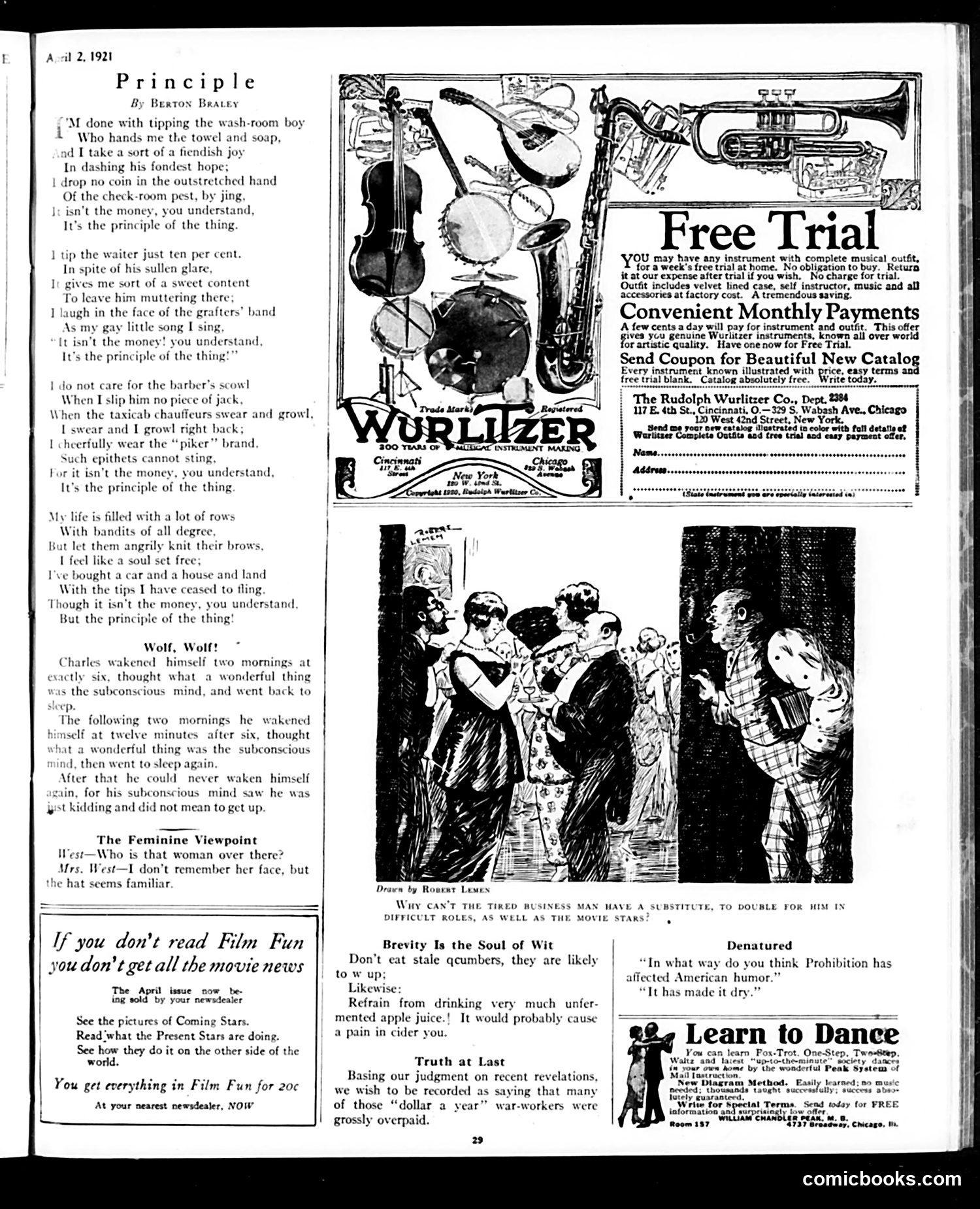
This poem satirizes a man who refuses to tip service workers—waiters, barbers, taxi drivers, porters—claiming it's "the principle of the thing," not the money. The joke's ironic payoff: by refusing to tip (supposedly on principle), he's actually saved enough to buy a car and house. In 1921 America, tipping was becoming standard practice, and this reflects middle-class anxiety about the custom. The satire mocks the self-righteous hypocrisy of someone who frames cheapness as moral principle while plainly profiting financially. The poem suggests his "principle" is really just rationalization for greed. The other page content includes unrelated humor pieces, advertisements (notably a Wurlitzer musical instruments free-trial ad), and brief jokes about Prohibition's effects on American humor and tired businessmen—typical Judge magazine fare of the period.
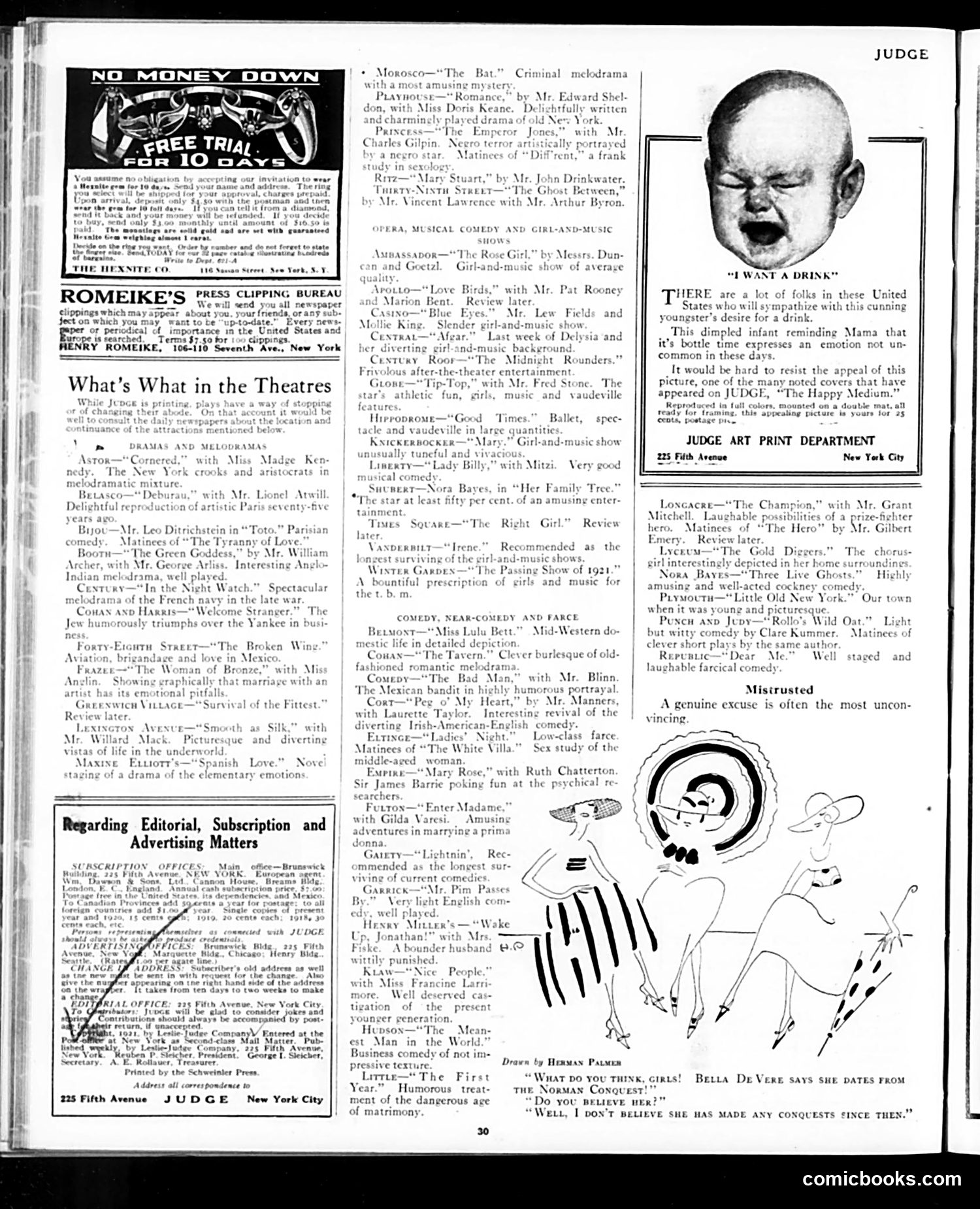
This page contains theatrical reviews and advertisements typical of Judge's content, but the notable cartoon appears at bottom right: "What Do You Think, Girls?" by Bella De Vere. The cartoon depicts a flapper-era exchange about dating and conquest. A young woman claims she's dated "from the Norman Conquest" onward—a historically impossible boast. The punchline's skeptical response ("I don't believe she has made any conquests since then") is a double-entendre: it mocks both her dubious historical claim and her current dating prospects, implying she's no longer attracting suitors. **Context for modern readers:** This reflects 1920s anxieties about "modern women"—the newly liberated flapper generation. The joke simultaneously ridicules female braggadocio about romantic conquests while doubting a woman's ongoing desirability, reflecting period attitudes toward aging and female sexuality. The Norman Conquest reference adds absurdist humor to what is fundamentally a dismissive comment about a woman's romantic value.
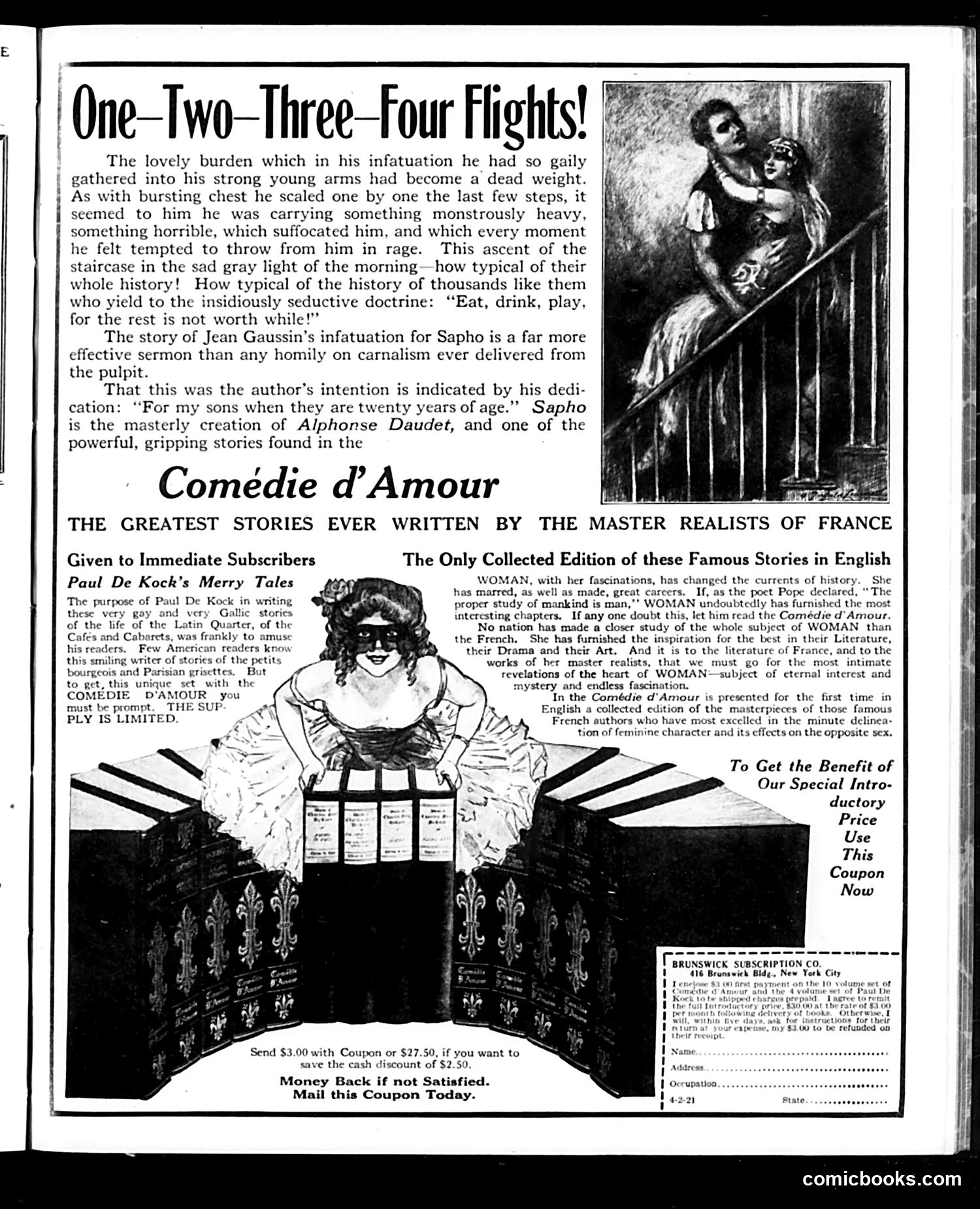
This is primarily an **advertisement for a book series**, not a political cartoon. The page promotes the *Comédie d'Amour*, a collected English edition of French realist stories by authors like Alphonse Daudet. The featured illustration depicts a scene from Daudet's novella *Sapho*—a man carrying a woman up multiple flights of stairs, both literally and metaphorically burdened by their illicit relationship. The accompanying text frames this as a moral lesson: the man's infatuation has become a "dead weight," illustrating the consequences of hedonistic living ("Eat, drink, play, for the rest is not worth while"). The advertisement emphasizes that these French stories offer serious moral instruction about feminine nature and romantic entanglement—positioned as edifying literature worthy of a gentleman's library, with Daudet's dedication "For my sons when they are twenty years of age" lending paternal gravitas to tales of seduction and consequence.
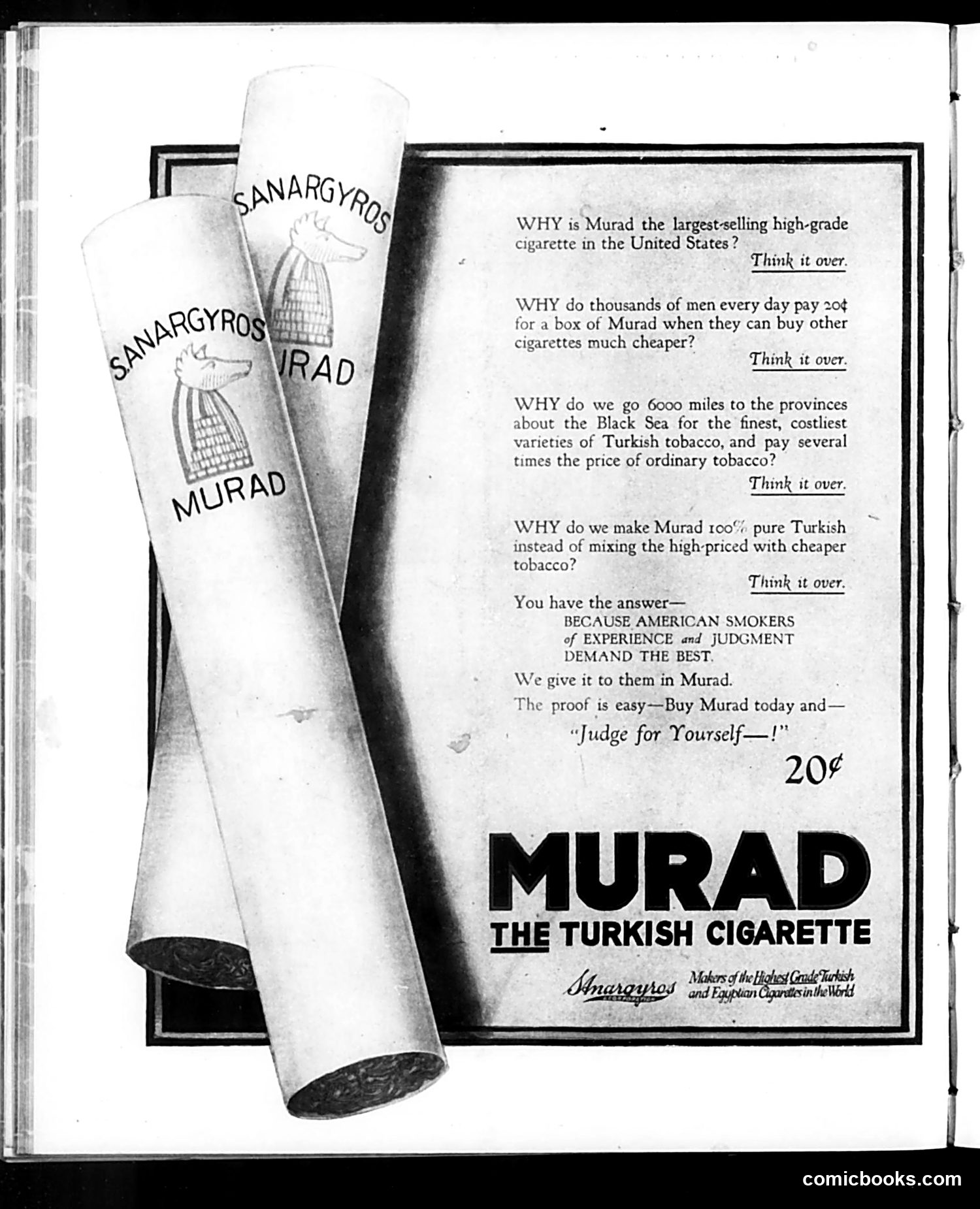
This is a **full-page advertisement**, not editorial content or satire. It promotes Murad Turkish cigarettes as a premium product priced at 20¢per box. The ad uses a rhetorical strategy: four "Why?" questions establish that Murad commands higher prices and uses expensive Turkish tobacco. The answer provided: American consumers of "experience and judgment" demand quality. The visual shows three cigarettes with "Sanargyros" and "Murad" branding, emphasizing the product. By modern standards, this represents **mid-20th-century marketing techniques**—before tobacco health warnings. The messaging appeals to consumer sophistication and taste rather than addressing price objectively. The "Turkish" origin was a luxury marker of the era. The ad assumes readers accept cigarette smoking as an unremarkable consumer choice worthy of discriminating judgment.