
Judge, 1921-04-02 · page 20 of 32
Judge — April 2, 1921 — page 20: what you’re looking at
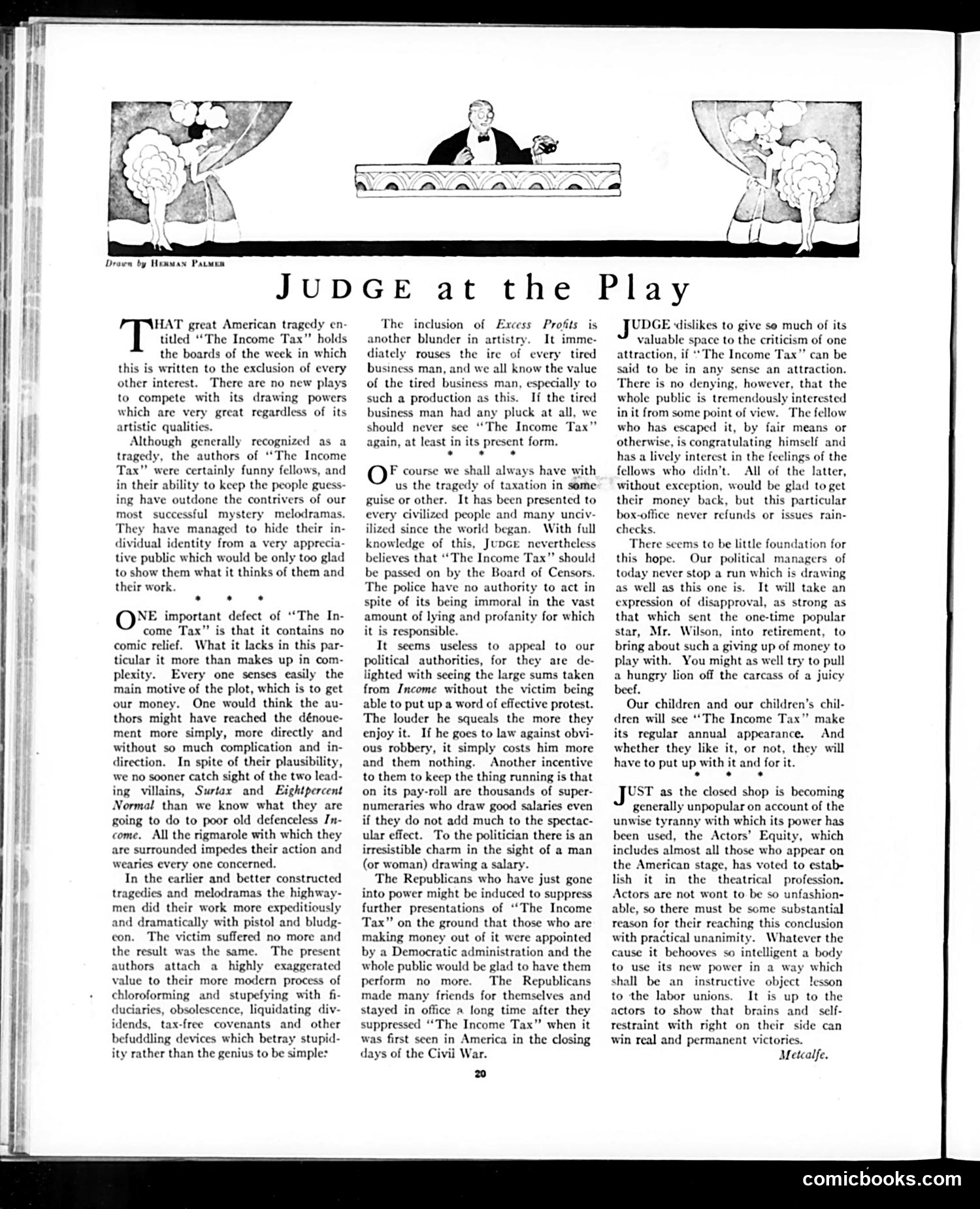
A restored page from Judge, 1921-04-02. Page through the whole issue in the reader above.
📄 Transcribed text from this page (OCR, searchable)
Machine-transcribed from the original scan — historical spelling and the odd misread are preserved.
Drown by Henan Pauwen HAT great American tragedy en- titled “The Income Tax” holds the boards of the week in which this is written to the exclusion of every other interest. There are no new plays to compete with its drawing powers which are very great regardless of its artistic qualities. Although generally recognized as a tragedy, the authors of “The Income ‘a were certainly funny fellows, and in their ability to keep the people guess- ing have outdone the contrivers of our most successful mystery melodramas. They have managed to hide their in- dividual identity from a very apprecia- tive public which would be only too glad to show them what it thinks of them and their work. NE important defect of ‘‘The In- come Tax” is that it contains no comic relief. What it lacks in this par- ticular it more than makes up in com- plexity. Every one senses easily the main motive of the plot, which is to get our money. One would think the au- thors might have reached the dénoue- ment more simply, more directly and without so much complication and in- direction. In spite of their plausibility, we no sooner catch sight of the two lead- ing villains, Surtax and Eightpercent Normal than we know what they are going to do to poor old defenceless In- come. All the rigmarole with which they are surrounded impedes their action and wearies every one concerned. In the earlier and better constructed tragedies and melodramas the highway- men did their work more expeditiously and dramatically with pistol and bludg- con. The victim suffered no more and the result was the same. The present authors attach a highly exaggerated value to their more modern process of chloroforming and stupefying with fi- duciaries, obsolescence, liquidating div- idends, tax-free covenants and other befuddling devices which betray stupid- ity rather than the genius to be simple: The inclusion of Excess Profits is another blunder in artistry. It imme- diately rouses the ire of every tired business man, and we all know the value of the tired business man, especially to such a production as this. If the tired business man had any pluck at all, we The Income Tax” present form. * t in its . 8 F course we shall always have with us the tragedy of taxation in some guise or other. It has been presented to civilized people and many unciv- ilized since the world began. With full knowledge of this, JupGe nevertheless believes that ‘The Income Tax" should be passed on by the Board of Censors. The police have no authority to act in spite of its being immoral in the vast amount of lying and profanity for which it is responsible. It seems useless to appeal to our political authorities, for they are de- lighted with seeing the large sums taken from Income without the victim being able to put up a word of effective protest. The louder he squeals the more they enjoy it. If he goes to law against ob’ ous robbery, it simply costs him more and them nothing. Another incentive to them to keep the thing running is that on its pay-roll are thousands of super- numeraries who draw good salaries even if they do not add much to the spectac- ular effect. To the politician there is an irresistible charm in the sight of a man (or woman) drawing a salary. The Republicans who have just gone into power might be induced to suppress further presentations of “The Income Tax” on the ground that those who are making moncy out of it were appointed by a Democratic administration and the whole public would be glad to have them perform no more. The Republicans made many friends for themselves and stayed in office a long time after they suppressed “The Income Tax” when it was first seen in America in the closing days of the Civil War. JUDGE at the Play UDGE «dislikes to give so much of its valuable space to the criticism of one attraction, if “The Income Tax” can be said to be in any sense an attraction. There is no denying, however, that the whole public is tremendously interested in it from some point of view. The fellow who has escaped it, by fair means or otherwise, is congratulating himself and has a lively interest in the feelings of the fellows who didn’t. All of the latter, without exception, would be glad to get their money back, but this particular box-office never refunds or issues rain- checks. There scems to be little foundation for this hope. Our political managers of today never stop a run which is drawing as well as this one is. It will take an expression of disapproval, as strong as that which sent the one-time popular star, Mr. Wilson, into retirement, to bring about such a giving up of money to play with. You might as well try to pull a hungry lion off the carcass of a juicy beef. Our children and our children’s chil- dren will see “The Income Tax" make its regular annual appearance. And whether they like it, or not, they will have to put up with it and for it. ot Nel ais JUST as the closed shop is becoming generally unpopular on account of the unwise tyranny with which its power has been used, the Actors’ Equity, which includes almost all those who appear on the American stage, has voted to estab- lish it in the theatrical profession. Actors are not wont to be so unfashion- able, so there must be some substantial reason for their reaching this conclusion with practical unanimity. Whatever the cause it behooves so intelligent a body to use its new power in a way which shall be an instructive object lesson to the labor unions. It is up to the actors to show that brains and_ self- restraint with right on their side can win real and permanent victories. Metcalfe. comicbooks.com