
Judge, 1921-04-02 · page 12 of 32
Judge — April 2, 1921 — page 12: what you’re looking at
What you’re looking at
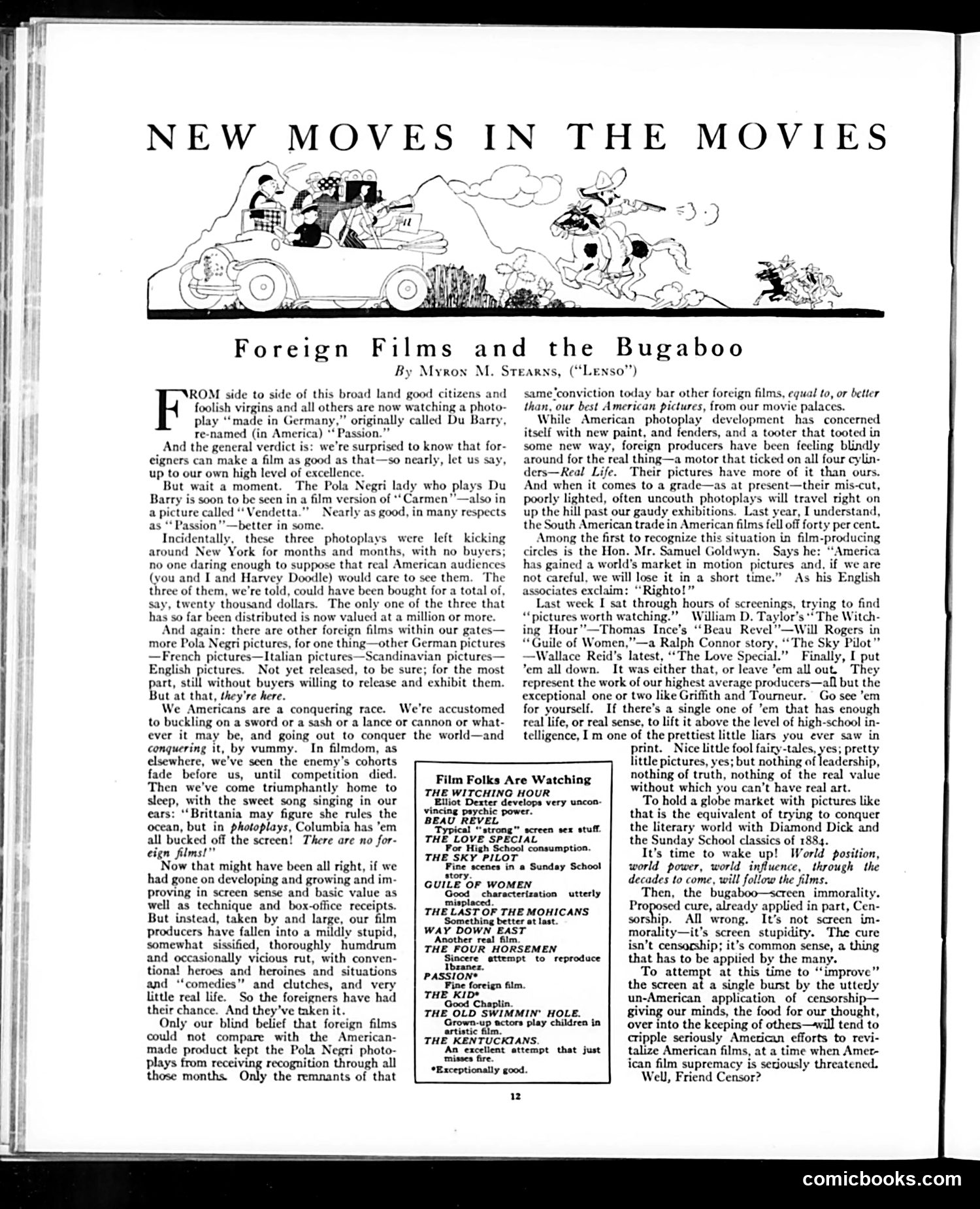
This article argues that American film producers have grown complacent and mediocre, allowing superior foreign films—particularly German productions like "Passion" (originally "Du Barry") featuring actress Pola Negri—to dominate despite initial American prejudice against them. **The satire's point**: American filmmakers, once confident in their superiority, have become lazy and conventional. Foreign competitors, initially dismissed as unmarketable, proved audiences would eagerly watch quality work. The author criticizes American producers for falling into "mildly stupid" routines of conventional heroes, artificial situations, and cheap tricks rather than developing real artistic merit. **The "Bugaboo"** (fear/obstacle) is American insularity—blind faith that domestic films automatically excel, preventing recognition of genuinely better foreign work. The sidebar reviews validate this critique, marking most contemporary American films as mediocre while praising "The Four Horsemen" and "Way Down East" as exceptions showing what's possible.
📄 Transcribed text from this page (OCR, searchable)
Machine-transcribed from the original scan — historical spelling and the odd misread are preserved.
A S==——S — — ———— t owe~s«=— I EE! ROM side to side of this broad land good citizens and foolish virgins and all others are now watching a photo- play ‘made in Germany,” originally called Du Barry, re-named (in America) ** Passion.” And the general verdict is: we're surprised to know that for- eigners can make a film as good as that—so nearly, let us say, up to our own high level of excellence. But wait a moment. The Pola Negri lady who plays Du Ba soon to be seen in a film version of ** Carmen"’—also in a picture called ‘‘ Vendetta.”” Nearly as good, in many respects s ‘* Passion "’—better in some. Incidentally, these three photoplays were left kicking around New York for months and months, with no buyers; no one daring enough to suppose that real American audiences (you and I and Harvey Doodle) would care to see them. The three of them, we're told, could have been bought for a total of, say, twenty thousand dollars. The only one of the three that has so far been distributed is now valued at a million or more. And again: there are other foreign films within our gates— more Pola Negri pictures, for one thing—other German pictures “rench pictures—Italian pictures—Scandinavian pictures— English pictures. Not yet released, to be sure; for the most part, still without buyers willing to release and exhibit them. But at that, they're here. We Americans are a conquering race. We're accustomed to buckling on a sword or a sash or a lance or cannon or what- ever it may be, and going out to conquer the world—and conquering it, by vummy. In filmdom, as elsewhere, we've seen the enemy's cohorts fade before us, until compe Then we've come triumphantly home to sleep, with the sweet song singing in our ears: “‘Brittania may figure she rules the ocean, but in photoplays, Columbia has 'em all bucked off the screen! There are no for- cign films!” Now that might have been all right, if we had gone on developing and growing and im- Proving in screen sense well as technique and box-office receipts. But instead, taken by and large, our film Producers have fallen into a mildly stupid, somewhat sissified, thoroughly humdrum and occasionally vicious rut, with conven- tiona! heroes and heroines and situations and ‘‘comedies” and clutches, and very little real life. So the foreigners have had their chance. And they’ve taken it. Only our blind belief that foreign films could not compare with the American- made product kept the Pola Negri photo- plays from receiving recognition through all those months. Only the remnants of that BEAU REVEL Foreign Films and the Bugaboo By Myron M. Stearns, (“Lenso”) ion died. Film Folks Are Watching THE WITCHING HOUR Elliot Dexter develops very uncon- vincing psychic power. *strong” screen sex stuff. Typical * THE Love SPECIAL hool consumption. THE, Sky “PILOT = scenes in 8 Sunday School GUILE OF WOMEN nd basic value as Good characterization utterly isplaced: THE LAST OF THE MOHICANS ° Something better at last. sorship. All wrong. It’s not screen im- WAY DOWN EAST Another real film. THE, FOUR HORSEMEN incere attempt to reproduce ‘Chaplin. THE OLD SWIMMIN’ HOLE. Grown-up actors play children in artistic film. THE KENTUCKIANS. excellent attempt that just misses fire. *Exceptionally good. or better same ‘conviction today bar other foreign films, equat td than, our best American pictures, from our movie palaces. While American photoplay’ development has concerned itself with new paint, and fenders, and a tooter that tooted in some new way, foreign producers have been feeling blindly around for the real thing—a motor that ticked on all four cylin- ders—Real Life. Their pictures have more of it than ours. And when it comes to a grade—as at present—their mis-cut, poorly lighted, often uncouth photoplays will travel right on up the hill past our gaudy exhibitions. Last year, I understand, the South American trade in American films fell off forty per cent. Among the first to recognize this situation in film-producing circles is the Hon. Mr. Samuel Goldwyn. Says he: “America has gained a world’s market in motion pictures and, if we are not careful, we will lose it in a short time.” As his English associates exclaim: “Righto!” Last week I sat through hours of screenings, trying to find “pictures worth watching.” William D, Taylor’s ‘The Witch- ing Hour’—Thomas Ince’s “Beau Revel’’—Will Rogers in “Guile of Women,”—a Ralph Connor story, ‘The Sky Pilot” —Wallace Reid's latest, ‘The Love Special.” Finally, I put ‘em all down. It was cither that, or leave ’em all out. They represent the work of our highest average producers—all but the exceptional one or two like Griffith and Tourneur. Go see ’em for yourself. If there's a single one of ’em that has enough real life, or real sense, to lift it above the level of high-school in- telligence, I m one of the prettiest little liars you ever saw in print. Nice little fool fairy-tales, yes; pretty little pictures, yes; but nothing of leadership, nothing of truth, nothing of the real value without which you can’t have real art. To hold a globe market with pictures like that is the equivalent of trying to conquer the literary world with Diamond Dick and the Sunday School classics of 1884. It's time to wake up! World position, world power, world influence, through the decades to come, will follow the films. Then, the bugaboo—screen immorality. Proposed cure, already applied in part, C morality—it’s screen stupidity. The cure isn’t censorship; it’s common sense, a thing that has to be applied by the many. To attempt at this time to “improve” the screen at a single burst by the uttedy un-American application of ‘censorship— giving our minds, the food for our thought, over into the keeping of others—will tend to cripple seriously American efforts to revi- talize American films, at a time when Amet- ican film supremacy is seriously threatened. Well, Friend Censor? comicbooks.com