
Judge, 1921-04-02 · page 11 of 32
Judge — April 2, 1921 — page 11: what you’re looking at
What you’re looking at
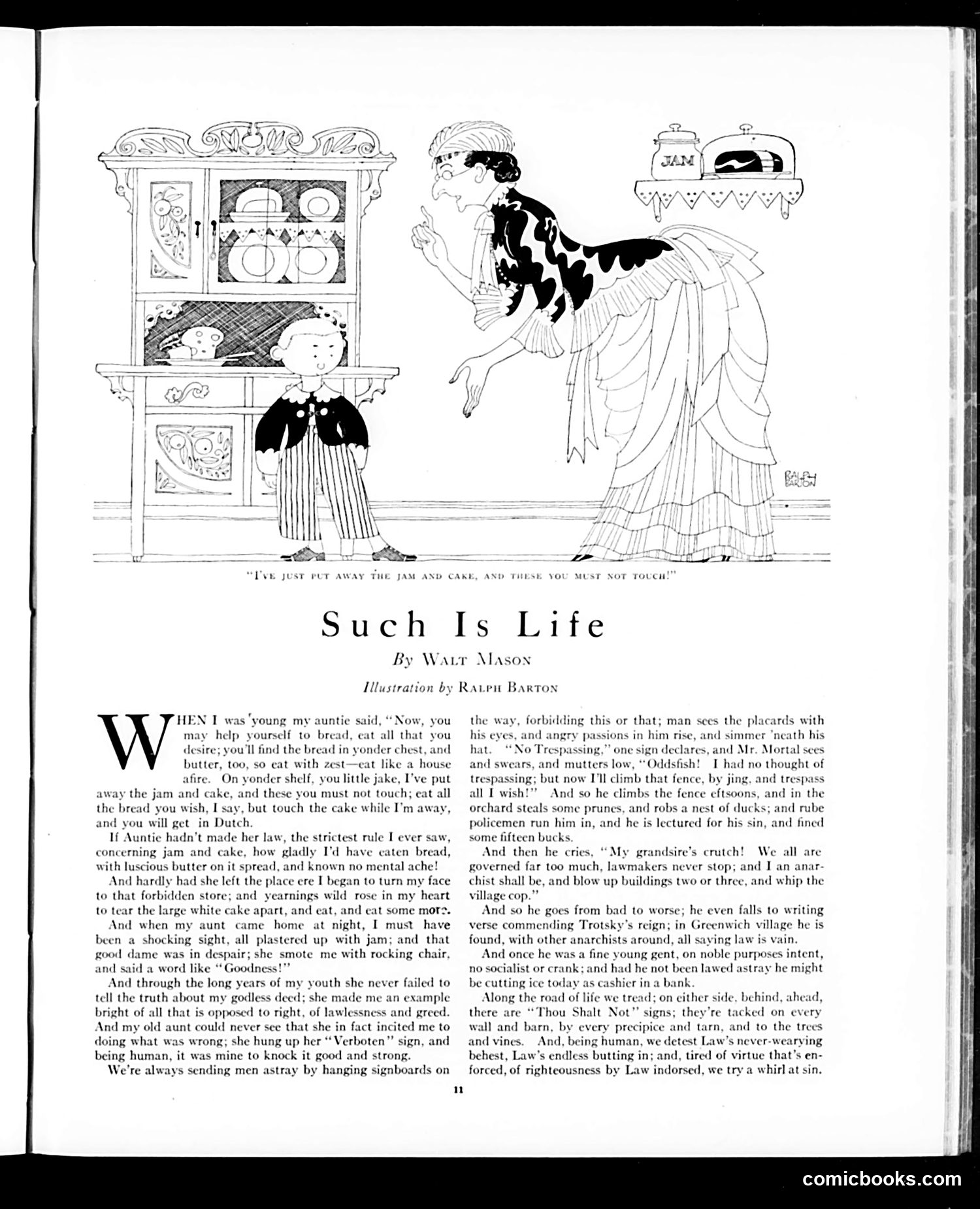
This is not a political cartoon but an illustrated essay criticizing excessive legal restrictions and moral prohibitions. The narrative uses a childhood anecdote as a frame story: a boy forbidden from eating jam and cake becomes obsessed with the forbidden items precisely *because* they're prohibited. He eats them anyway and is punished. Mason extends this logic philosophically: he argues that laws and "Thou Shalt Not" signs paradoxically *encourage* lawbreaking by making rule-breaking appealing to human nature. The example escalates—a man climbing a fence to steal prunes eventually becomes radicalized into anarchism and Bolshevism (referencing Trotsky), writing revolutionary verse in Greenwich Village. The satire targets overly restrictive moralism and legislation as counterproductive. Rather than preventing vice, prohibition creates resentment and rebellion. Ralph Barton's illustration depicts a mother enforcing such rules on a child—the visual embodiment of the essay's critique. This reflects early 20th-century debate about Prohibition and paternalistic governance.
📄 Transcribed text from this page (OCR, searchable)
Machine-transcribed from the original scan — historical spelling and the odd misread are preserved.
JUST PUT AWay THE Such Is By Warr Mason JAM AND CAKE, AND THESE VO = = a tees Se MUST NoT TOUCH Life Illustration by Raveu Barton HEN I was ‘young my auntie said, “Now, you may help yourself to bread, eat all that you desire; you'll find the bread in yonder chest, and butter, too, so eat with zest—eat like a house afire. On yonder shelf, you little jake, I’ve put away the jam and cake, and these you must not touch; eat all the bread you wish, I say, but touch the cake while I'm away, and you will get in Dutch. If Auntie hadn’t made her law, the strictest rule I ever saw, concerning jam and cake, how gladly I'd have caten bread, with luscious butter on it spread, and known no mental ache! And hardly had she left the place ere I began to turn my face to that forbidden store; and yearnings wild rose in my heart to tear the large white cake apart, and eat, and cat some more. And when my aunt came home at night, I must have been a shocking sight, all plastered up with jam; and that good dame was in despair; she smote me with rocking chair, and said a word like ‘‘ Goodness!” And through the long years of my youth she never failed to tell the truth about my godless deed; she made me an example bright of all that is opposed to right, of lawlessness and greed. And my old aunt could never see that she in fact incited me to doing what wrong; she hung up her “ Verboten”’ sign, and being human, it was mine to knock it good and strong. We're always sending men astray by hanging signboards on the way, forbidding this or that; man sees the placards with his eyes, and angry passions in him rise, and simmer ‘neath his hat rrespassing,”’ one sign declares, and Mr, Mortal sees and swears, and mutters low ddsfish! I had no thought of trespassing; but now I'll climb that fence, by jing, and trespass all I wish And so he climbs the fence eftsoons, and in the orchard steals some prunes, and robs a nest of ducks; and rube policemen run him in, and he is lectured for his sin, and fined some fifteen bucks. And then he cries, “My grandsire’s crutch! We all are governed far too much, lawmakers never stop; and I an anar- chist shall be, and blow up buildings two or three, and whip the village cop. And so he goes from bad to worse; he even falls to writing verse commending Trotsky’s reign; in Greenwich village he is found, with other anarchists around, all saying law is vain. And once he was a fine young gent, on noble purposes intent, no socialist or crank; and had he not been lawed astray he might be cutting ice today as cashier in a bank. Along the road of life we tread; on either side, behind, ahead, there are “Thou Shalt Not”’ signs; they’re tacked on every wall and barn, by every precipice and tarn, and to the trees and vines. And, being human, we detest Law’s never-wearying behest, Law’s endless butting in; and, tired of virtue that’s en- forced, of righteousness by Law indorsed, we try a whirl at sin. comicbooks.com