
A complete issue · 32 pages · 1920
Judge — December 18, 1920
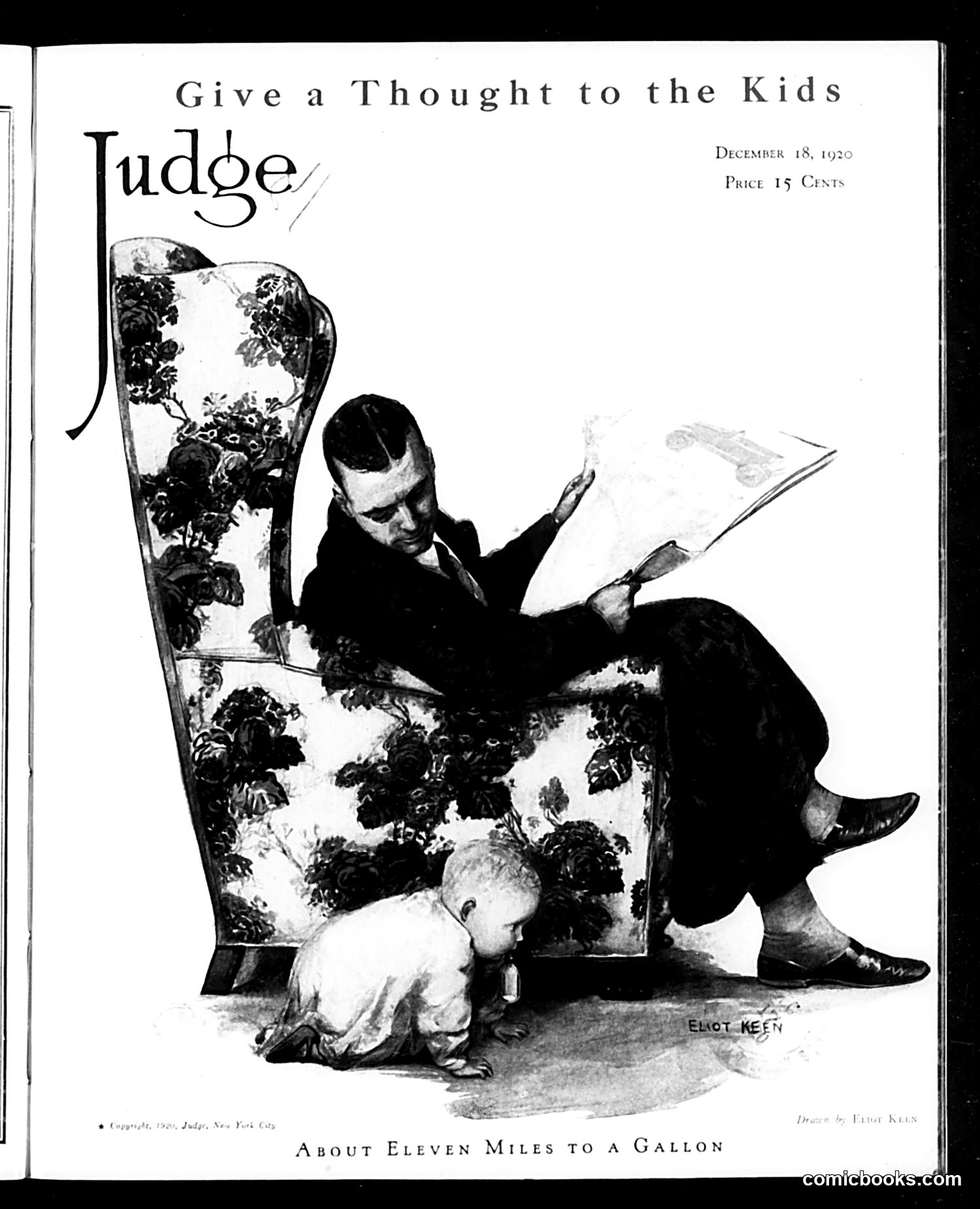
This cover depicts an adult man and child examining a large decorative pitcher or jug filled with what appears to be plants or flowers. The caption "About Eleven Miles to a Gallon" suggests a satirical comparison between the pitcher's capacity and automobile fuel efficiency. The likely satire concerns early 1920s automobiles, which achieved poor gas mileage by modern standards. The humor appears to derive from presenting household objects' capacity in fuel-efficiency terms—the jug holds about as much as a car travels on one gallon of gasoline. The phrase "Give a Thought to the Kids" in the header suggests commentary on wasteful consumption or resource use affecting future generations, a common Progressive-era concern.
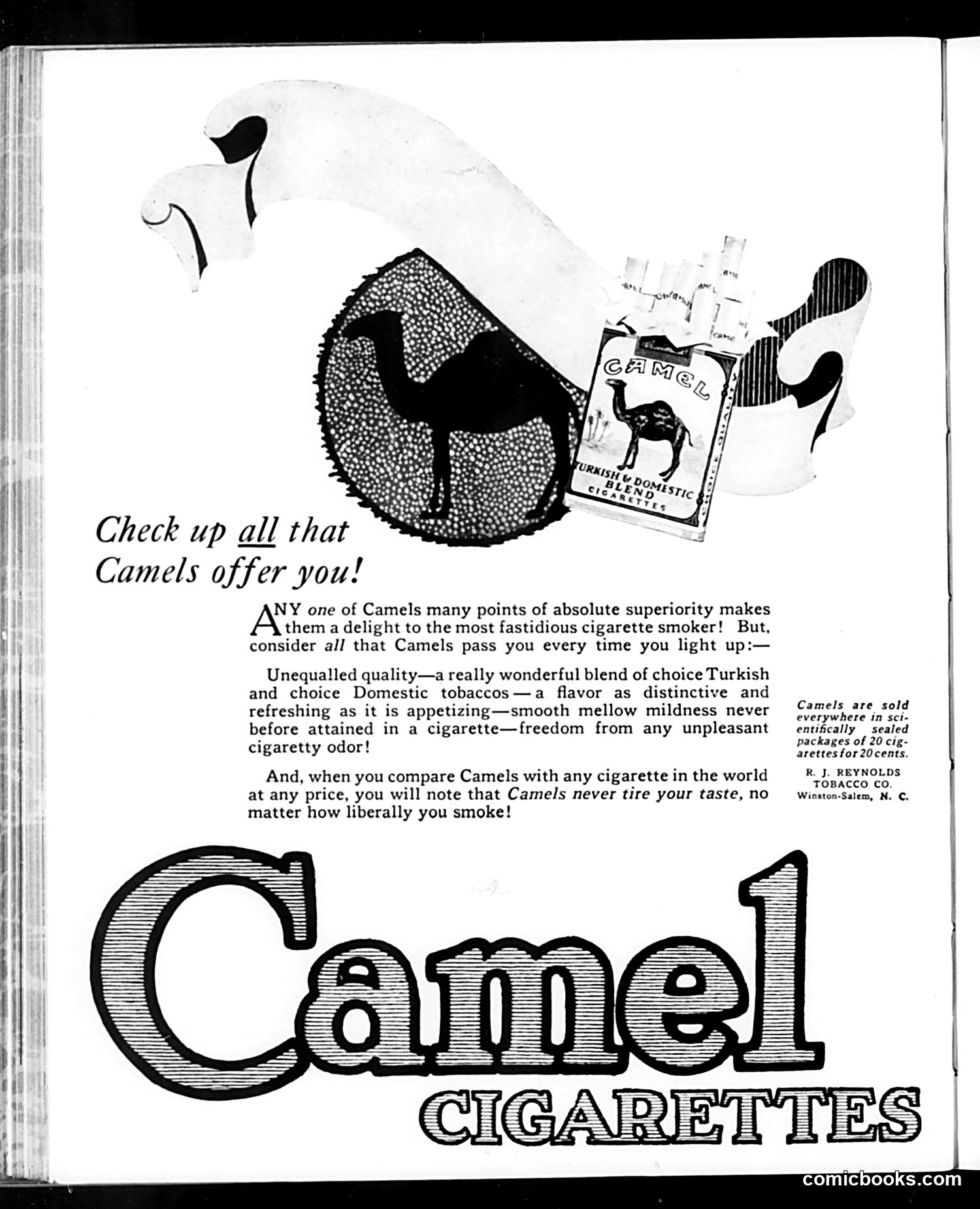
This page is **primarily a Camel cigarette advertisement**, not satire. The dominant content features a stylized camel's head in a dotted/stippled art style alongside a Camel cigarette package, with large "Camel CIGARETTES" branding at bottom. The ad copy emphasizes product qualities: "Unequalled quality," a "blend of choice Turkish and choice Domestic tobaccos," and claims Camels "never tire your taste" even with liberal smoking. There is **no apparent political cartoon or satire** on this page. The "Judge" magazine masthead suggests this ran in that satirical publication, but the content itself is straightforward commercial advertising—possibly humorous only in its earnest health/quality claims by modern standards, given what we now know about cigarette dangers.
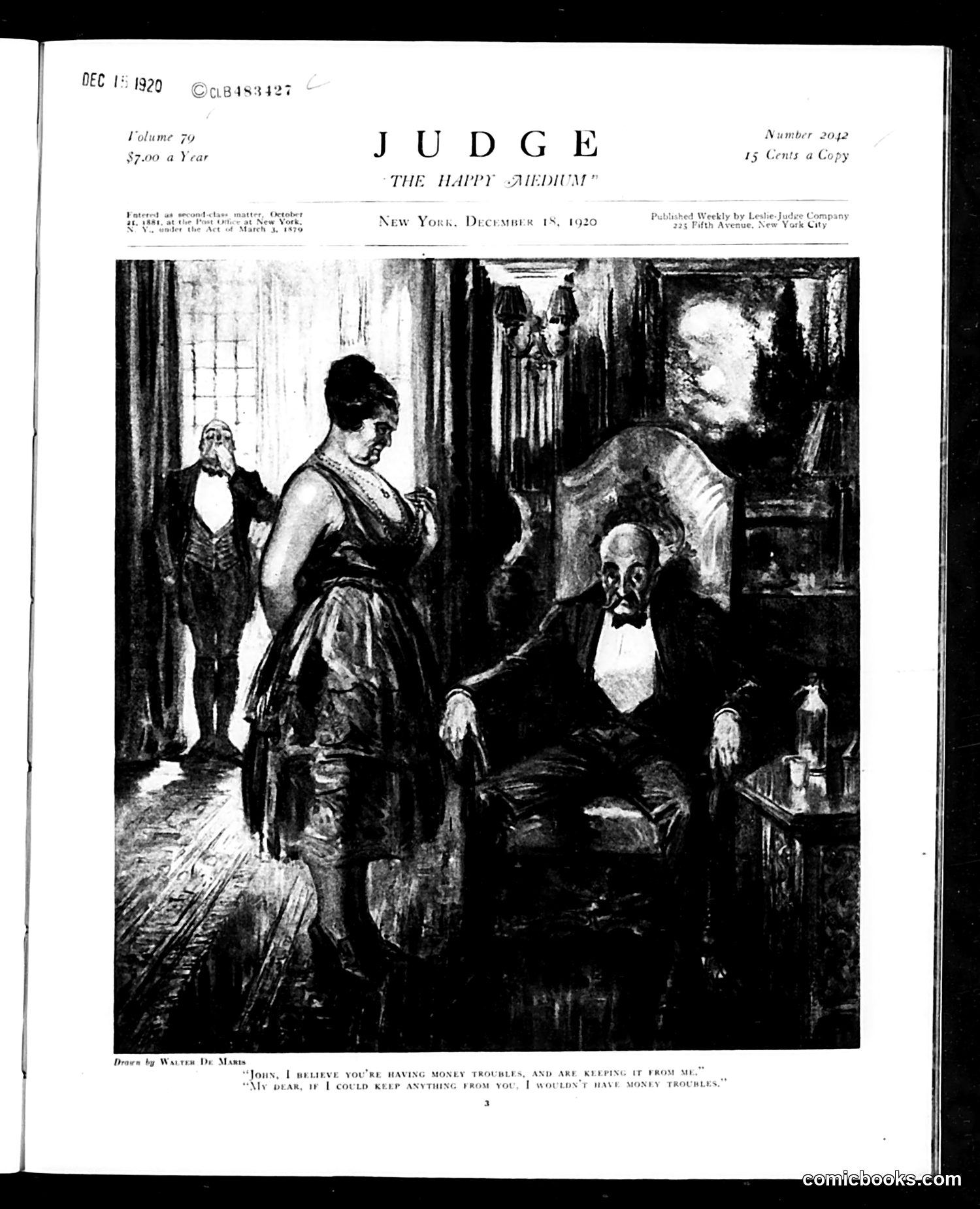
This illustration by Walter De Maris depicts a domestic financial dispute. A seated man in formal attire (appearing distressed or confrontational) addresses a standing woman, with two other men observing in the background. The dialogue reveals the satire's point: the man claims he's "keeping money troubles from" the woman, yet she responds that she wouldn't "have money troubles" if she could keep things from him—implying she'd hide her spending habits. This reflects post-WWI anxieties about marriage, gender roles, and household finances during economic uncertainty. The cartoon satirizes the tension between spouses over money management, with the woman's retort suggesting wives felt controlled or judged regarding their financial independence and discretionary spending.
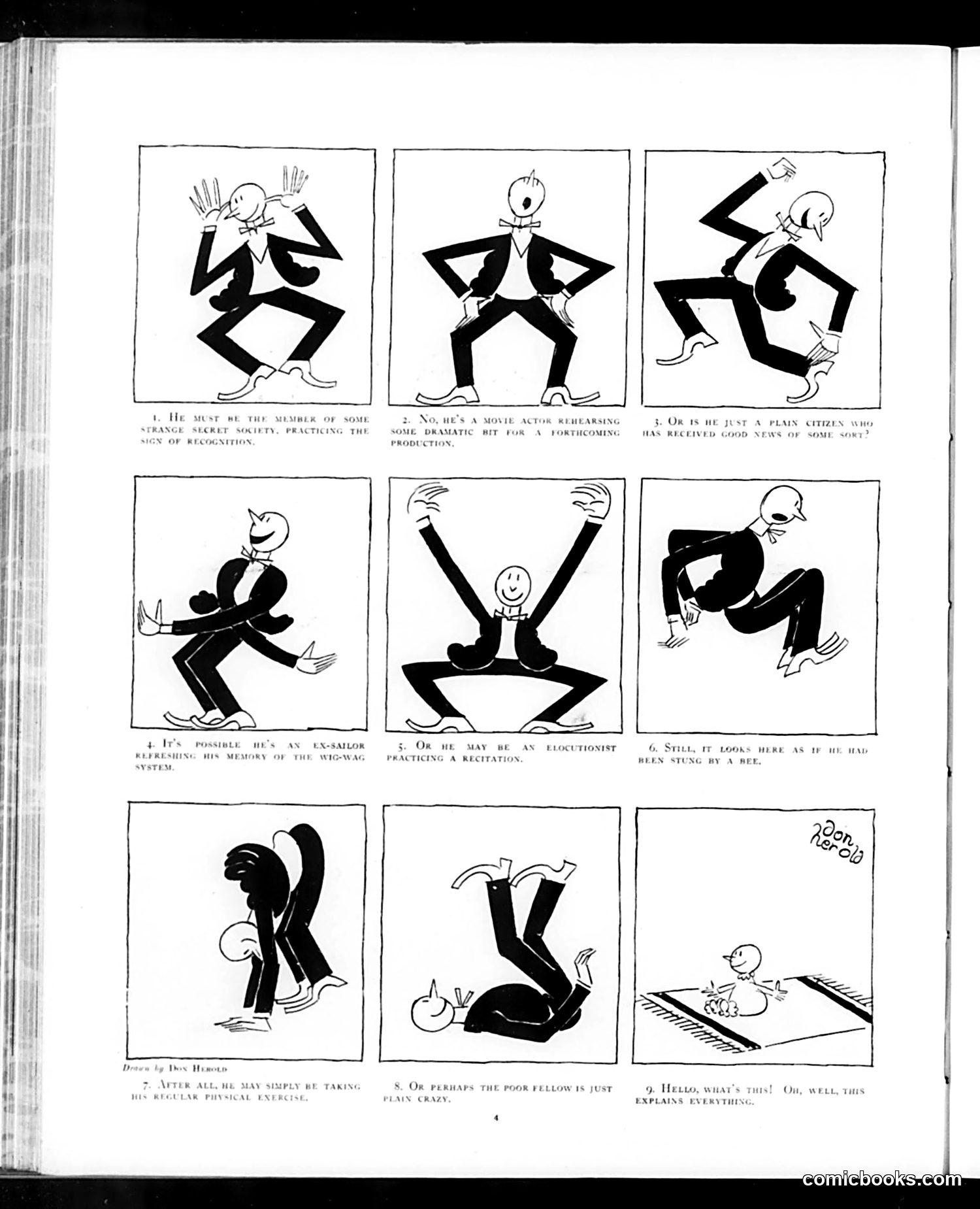
This appears to be a humorous nine-panel comic strip showing a man in various states of physical distress and exaggerated poses. The captions suggest satirical explanations for his behavior: 1. A member of a secret society practicing ritualistic signs 2. A movie actor rehearsing dramatic movements 3. A citizen receiving good news 4. An ex-sailor refreshing his "wig-wag" system (maritime signaling) 5. An elocutionist practicing recitation 6. Someone stung by a bee 7. Engaging in "regular physical exercise" 8. Simply "plain crazy" 9. A final panel where "this explains everything" The satire appears to mock various social affectations and explanations people might offer for eccentric public behavior—suggesting that regardless of the excuse given, the man is simply acting absurdly. It's gentle social commentary on pretentiousness and the human tendency to rationalize odd conduct.
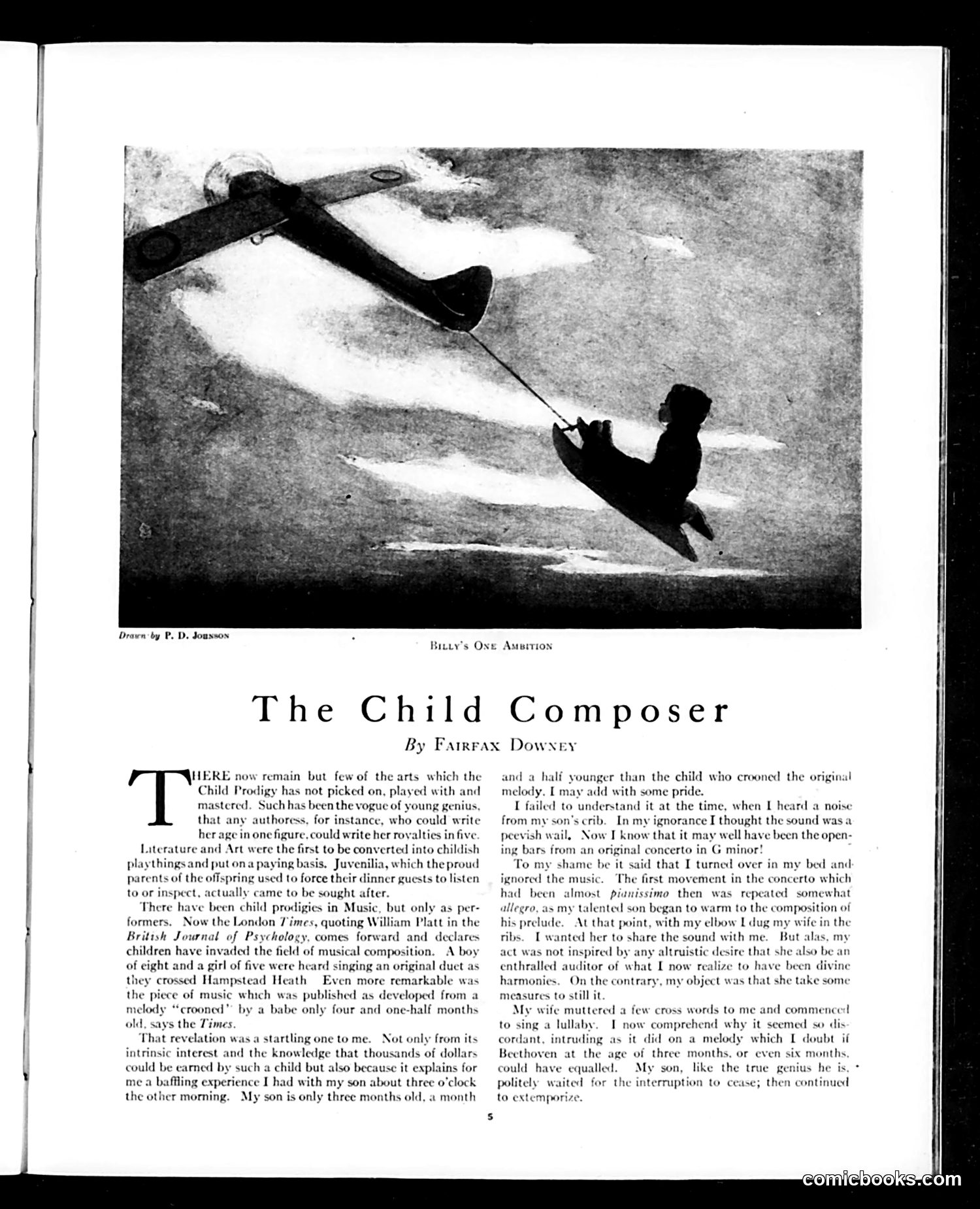
This article discusses child prodigies in music composition—a phenomenon the author notes is rare compared to child performers. The piece references William Platt in the *British Journal of Psychology* and mentions that boys have occasionally composed original music. The illustration titled "Billy's One Ambition" (drawn by F. D. Joanson) depicts a child conducting or wielding a baton like a weapon against a kite. The cartoon appears to humorously contrast a child's musical aspirations with childish play—suggesting the gap between serious musical composition and children's actual interests and capabilities. The article explores why child composers are uncommon despite thousands of dollars being earned by child performers, using the author's own son's brief musical experiments as an example of childhood's fleeting creative moments.
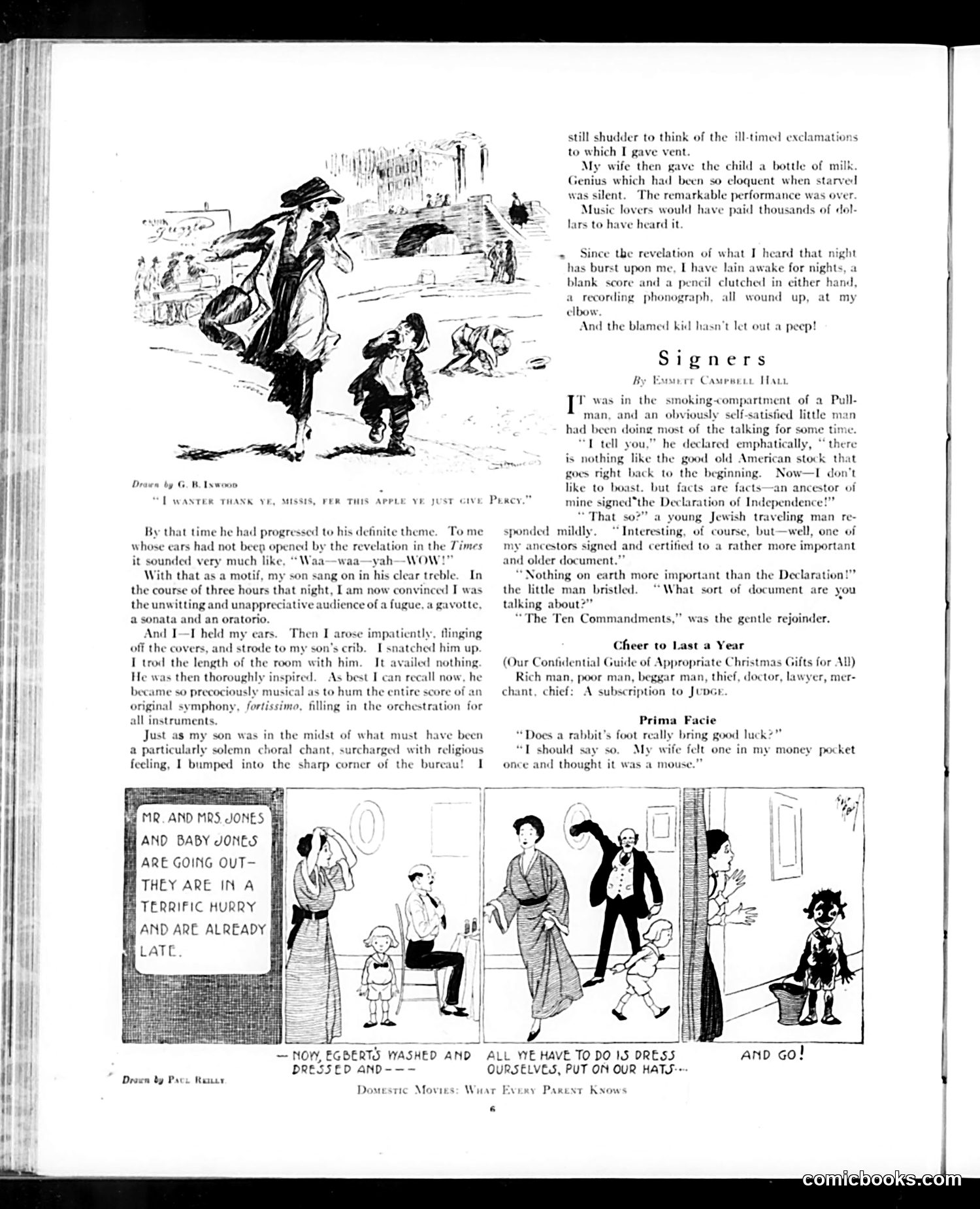
This Judge magazine page contains three distinct pieces: 1. **Top illustration** (by G.R. Lynwood): Shows an adult and child on a street, captioned "I WANTS THANK YE, MISSIS, FER THIS APPLE YE JUST GAVE PERCY." The accompanying text describes a man's transformative musical experience after hearing his son sing—apparently badly—which inspired him to create a symphony. The satire mocks both pretentious music criticism and parents' tendency to overvalue their children's talents. 2. **"Signers" article** (by Everett Campbell Hall): A brief story about a pompous man bragging about ancestors who signed the Declaration of Independence, countered by a Jewish traveler's reference to the Ten Commandments. The satire targets ethnic prejudice and historical one-upmanship. 3. **Comic strip** (by Paul Hales, titled "Domestic Movies: What Every Parent Knows"): Depicts a family frantically rushing to get dressed and leave, showing the chaos of parental life—likely satirizing the gap between idealized domesticity and actual family scramble.
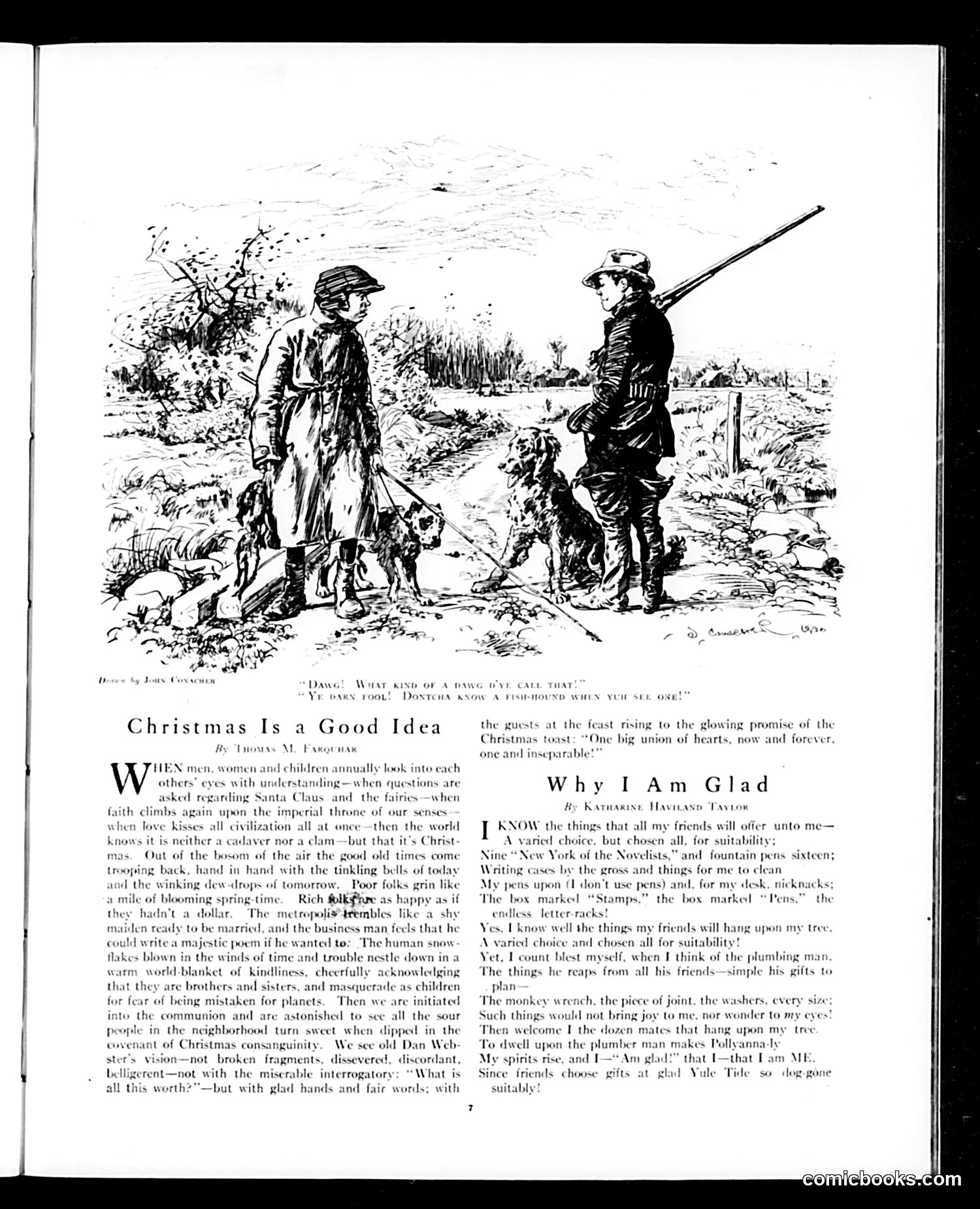
This page contains two separate humorous essays about Christmas, typical of Judge magazine's satirical approach. **"Christmas Is a Good Idea"** by Thomas M. Farguhax is a sentimental piece celebrating how Christmas temporarily transforms society—making poor people happy, rich people humble, and uniting everyone in brotherly feeling. The satire is gentle: it mocks the idealism of the season while acknowledging its genuine appeal. The illustration shows two hunters with dogs, with dialogue about calling a dog—likely illustrating the common folk participating in Christmas festivities. **"Why I Am Glad"** by Katharine Haviland Taylor employs class-based humor. The narrator lists the predictable, repetitive gifts she'll receive (writing supplies, desk items), then contrasts this with a plumber's simpler gifts (wrenches, washers). The joke: she considers herself fortunate because at least she *knows* what to expect, whereas the plumber receives more practical, useful items—inverting typical assumptions about wealth and satisfaction. Both pieces reflect early 20th-century American attitudes about class, consumption, and holiday traditions.
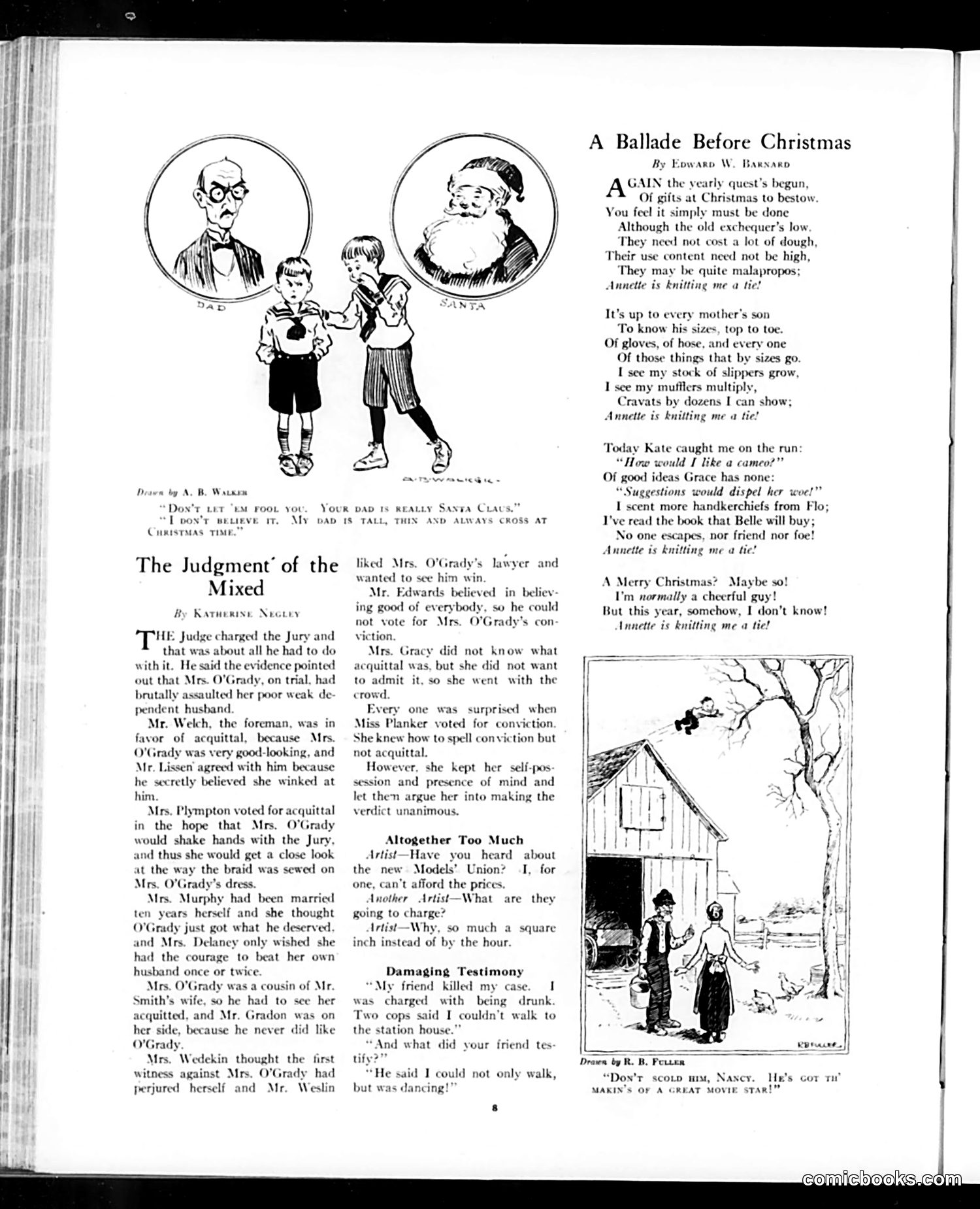
This page contains three distinct pieces of early 20th-century satirical humor: **"The Judgment of the Mixed"** satirizes jury deliberation, where jurors vote based on everything *except* evidence. Mrs. O'Grady stands trial for assaulting her husband, but jurors acquit her based on irrelevant factors: her attractiveness, the hope of shaking her hand, sympathy for wives in bad marriages, family connections, and the lawyer's appeal. Only one juror votes to convict—based solely on spelling ability, not guilt. The satire mocks how juries ignore judicial instructions to follow the law. **"Altogether Too Much"** jokes about artists' labor organizing: models now demand payment per square inch rather than hourly rates—an absurd pricing scheme suggesting the Models' Union is overreaching and pricing out struggling artists. **"A Ballad Before Christmas"** is a humorous poem about gift-giving anxiety during the holidays, with the repeated refrain "Annette is knitting me a tie!"—suggesting an unwanted, inevitable gift. The page reflects Progressive-era skepticism about justice system reliability and labor disputes.
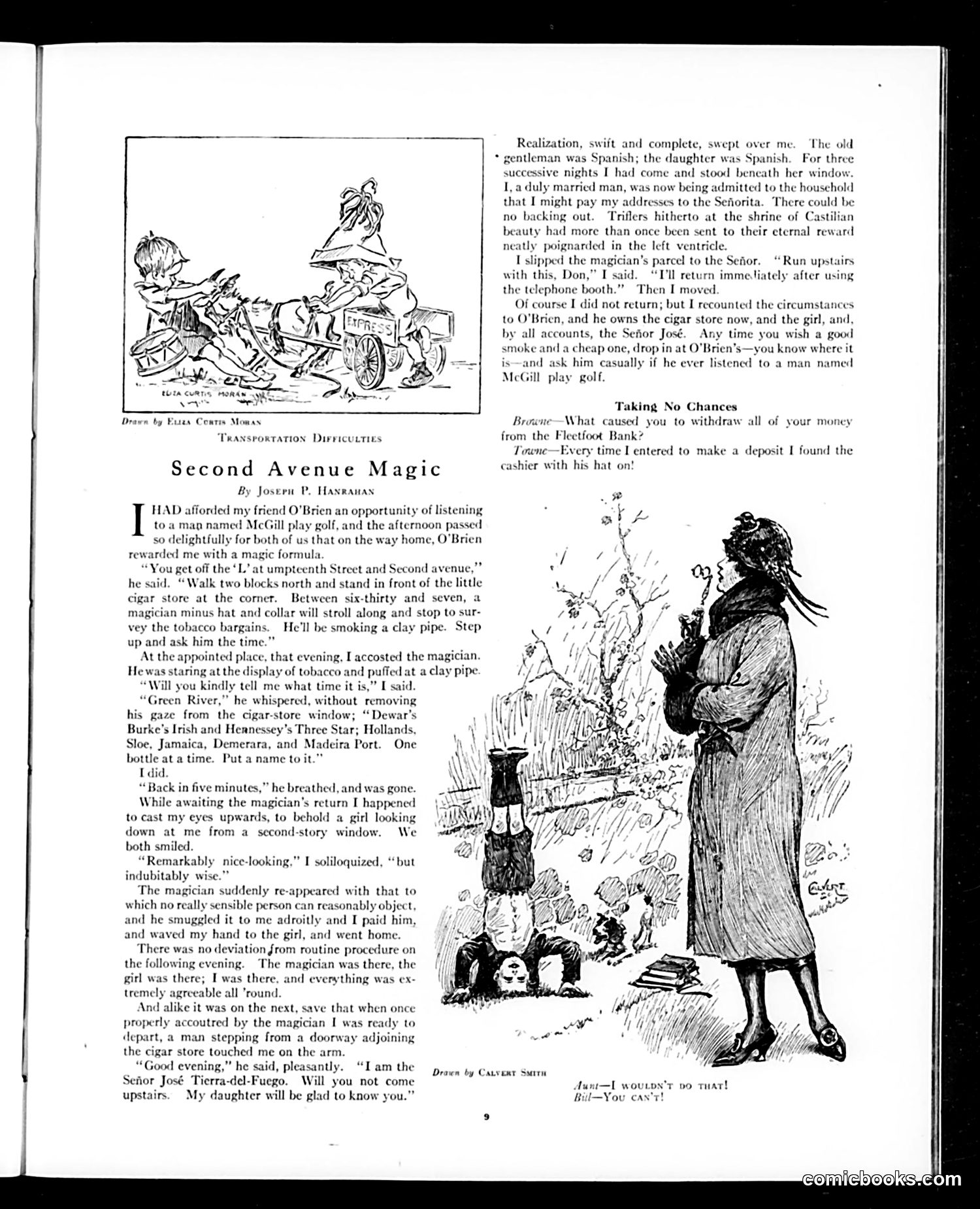
This story satirizes **illicit alcohol sales during Prohibition**. The "magician" is a bootlegger operating from a cigar store front on Second Avenue in New York City. When the narrator asks for the time, the magician responds with whiskey brand names ("Green River," "Dewar's," etc.), a coded language for purchasing contraband liquor. The elaborate plot—where the narrator unknowingly attracts a Spanish girl while making nightly purchases, only to be confronted by her protective father—is humorous misdirection. The real joke: the narrator thinks he's in romantic/mortal danger, but the story simply illustrates how openly Prohibition bootlegging operated in plain sight, with customers making regular visits to corner stores under thin pretenses. The second item, "Taking No Chances," is a brief joke about bank runs (likely referencing Depression-era financial panic), where a depositor withdraws funds because the cashier's hat-wearing suggests he's preparing to flee.
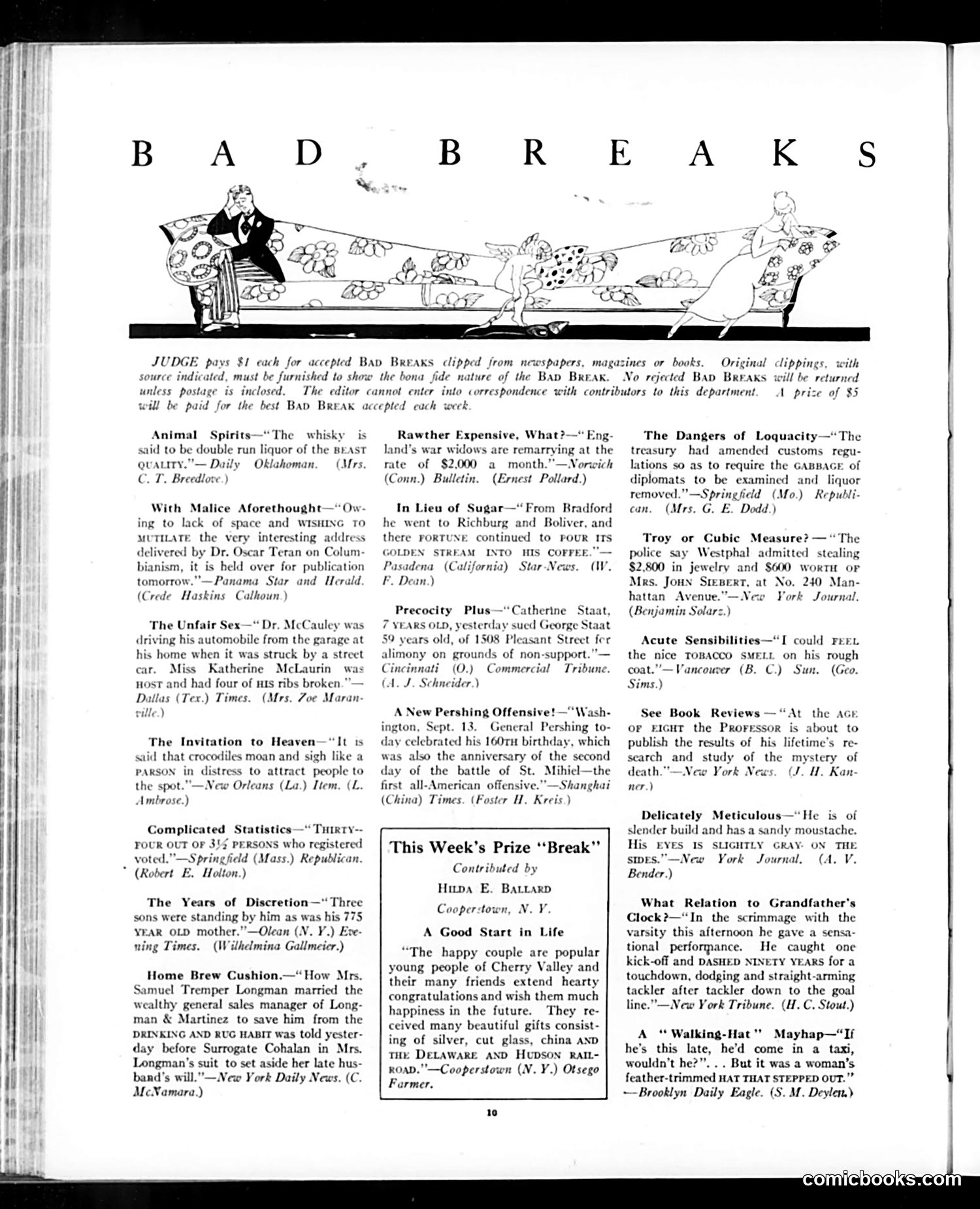
This page from *Judge* magazine features "Bad Breaks"—humorous printing errors and awkward phrasings clipped from newspapers. Readers submitted these comic mistakes for payment ($1 each), with the best winning $5. The humor relies on **unintentional double meanings** created by poor word choice or editing. For example: - A clipping states England's war widows remarry at "$2,000 a month" (likely meant to say "rate"), making it absurdly sound like a commodity price - Another mentions a 7-year-old suing a 59-year-old "for alimony," a nonsensical legal claim - A wedding announcement inexplicably lists "the Delaware and Hudson Railroad" among gift recipients These aren't intentional satire but rather *accidental* comedy—embarrassing errors from real publications that reveal sloppy editing, ambiguous phrasing, or malapropisms. The "Bad Break" concept mocks careless journalism while entertaining readers through their bewilderment at how such errors reached print.
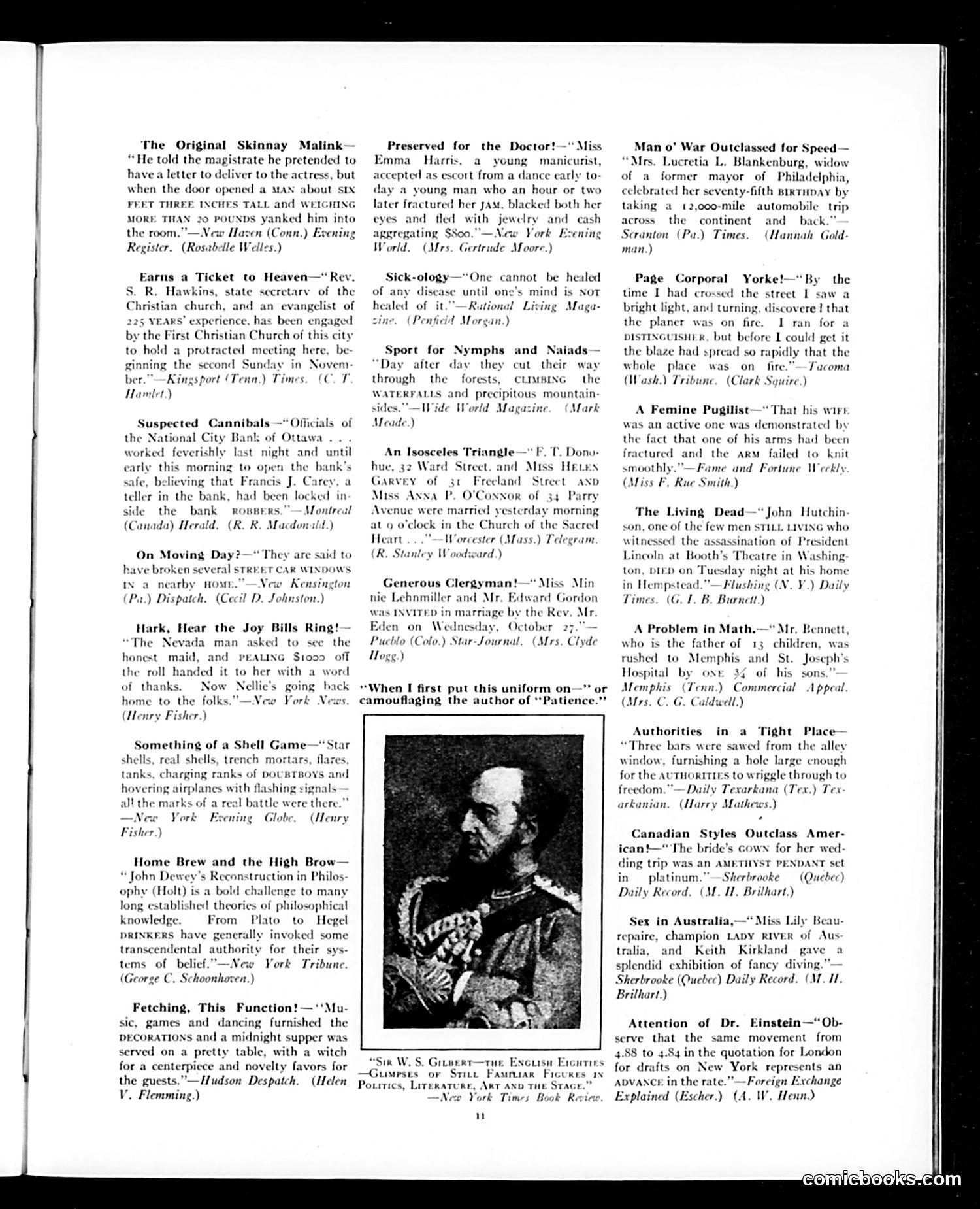
This is a humor column compiling short, absurdist news items from various newspapers. The recurring joke structure involves lengthy newspaper quotations that build mundane expectations, then deliver punchlines through comedic juxtaposition or exaggeration. Examples include: a man described as extraordinarily tiny (six feet three inches, weighing over 20 pounds—an impossible contradiction) delivering mail; a reverend with implausibly long tenure (225 years); a banker trapped in his own safe; and a 75-year-old widow taking a 12,000-mile car trip. The bottom image appears to show a figure in elaborate historical dress, captioned as depicting "still familiar figures in politics, literature, art and the stage." The satire mocks both the absurdities newspapers actually published and the pretentious language in which editors reported trivial social events—capturing the surrealism of early 20th-century American journalism.
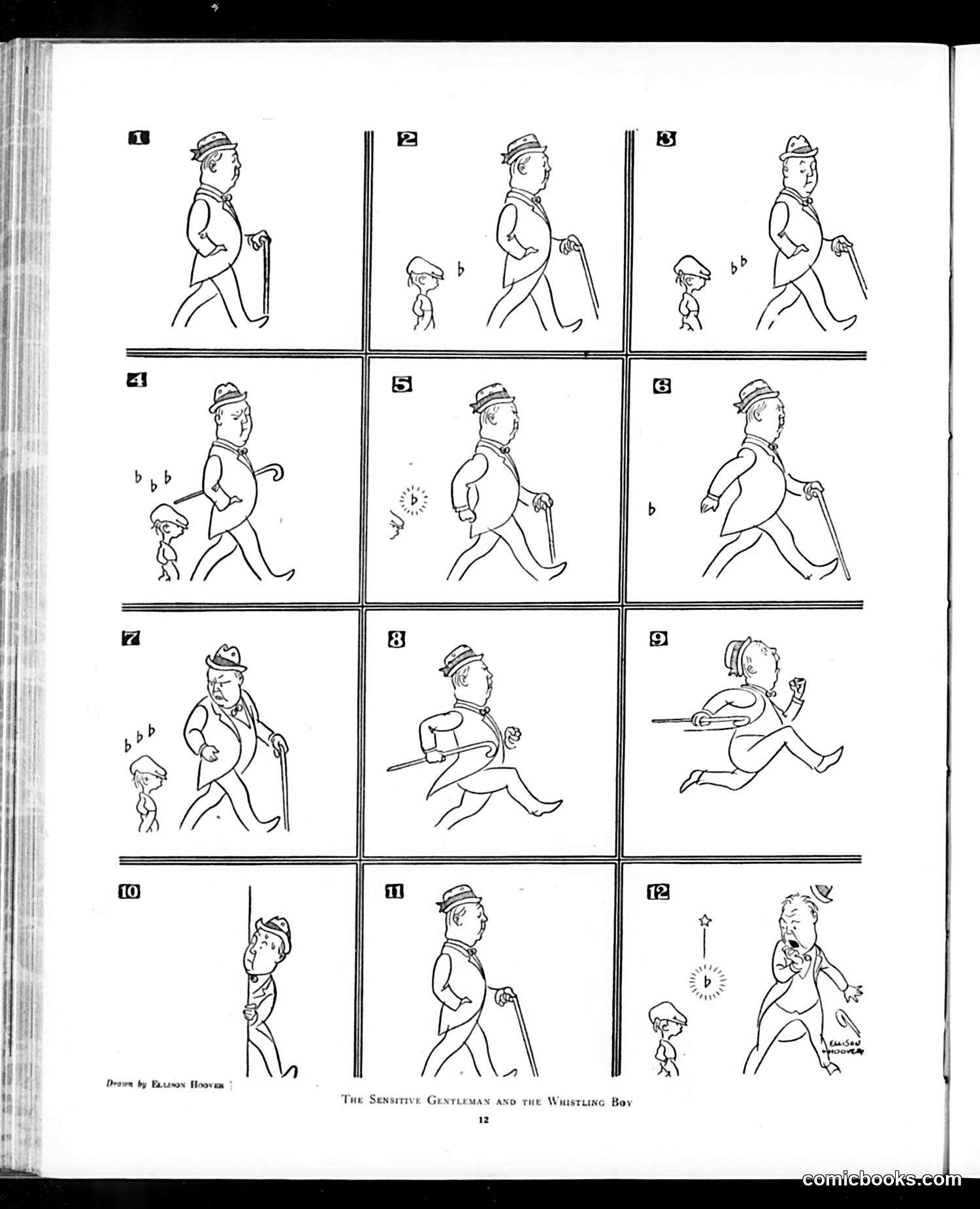
This single-panel comic strip (12 frames) depicts a confrontation between a well-dressed, portly gentleman with a cane and a small boy. The gentleman appears increasingly agitated by the boy's whistling—indicated by "b" and "b b b" sound-effect marks throughout the sequence. The satire mocks refined, sensitive masculinity: the gentleman's exaggerated reactions to minor annoyance contrast sharply with his pretense of gentlemanly composure. By the final panels, his composure completely crumbles as he chases the boy in frustration. The joke targets affected propriety and the gap between social pretense and actual behavior—a common Judge magazine theme. The "sensitive gentleman" cannot maintain his dignified facade when provoked by something as trivial as a child's whistling.
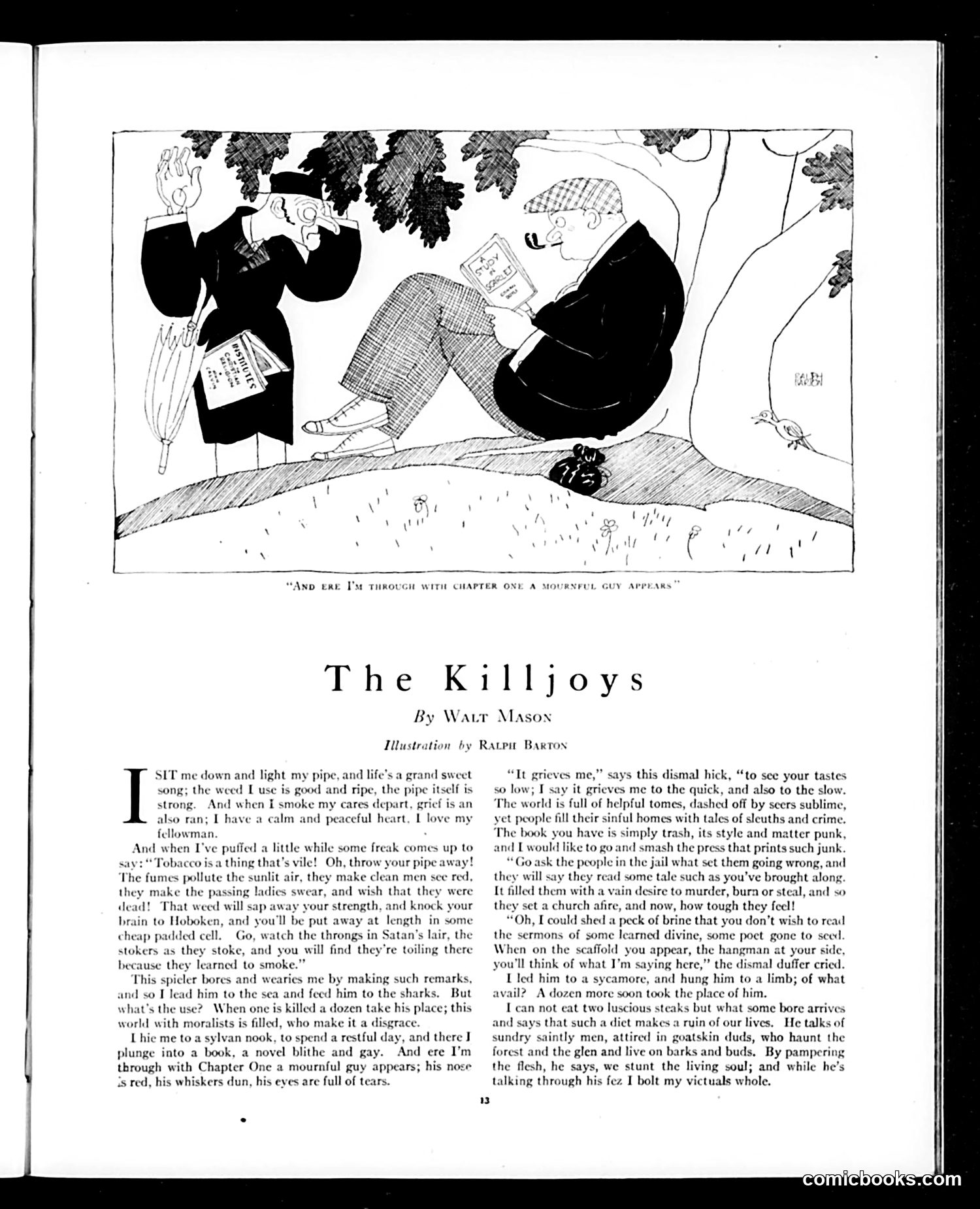
This is a humorous story-poem satirizing self-righteous moralists who constantly criticize others' innocent pleasures. The illustration shows a man relaxing outdoors reading a novel while being pestered by a judgmental figure. The narrator describes repeatedly encountering preachy "killjoys" who condemn his smoking, novel-reading, and eating meat—claiming these habits lead to moral ruin. Each time one appears with sanctimonious warnings, the exasperated narrator eliminates him (feeds him to sharks, hangs him from a tree), only to have another replace him immediately. The satire targets 1910s-era moral crusaders and puritanical reformers who saw popular entertainments (detective fiction, tobacco, meat consumption) as gateways to crime and sin. Mason mocks their doom-saying by showing how absurdly pervasive and tedious such people are, and how their warnings ring hollow to anyone simply trying to enjoy life's modest pleasures. The joke: moralists are themselves the real nuisance to society.
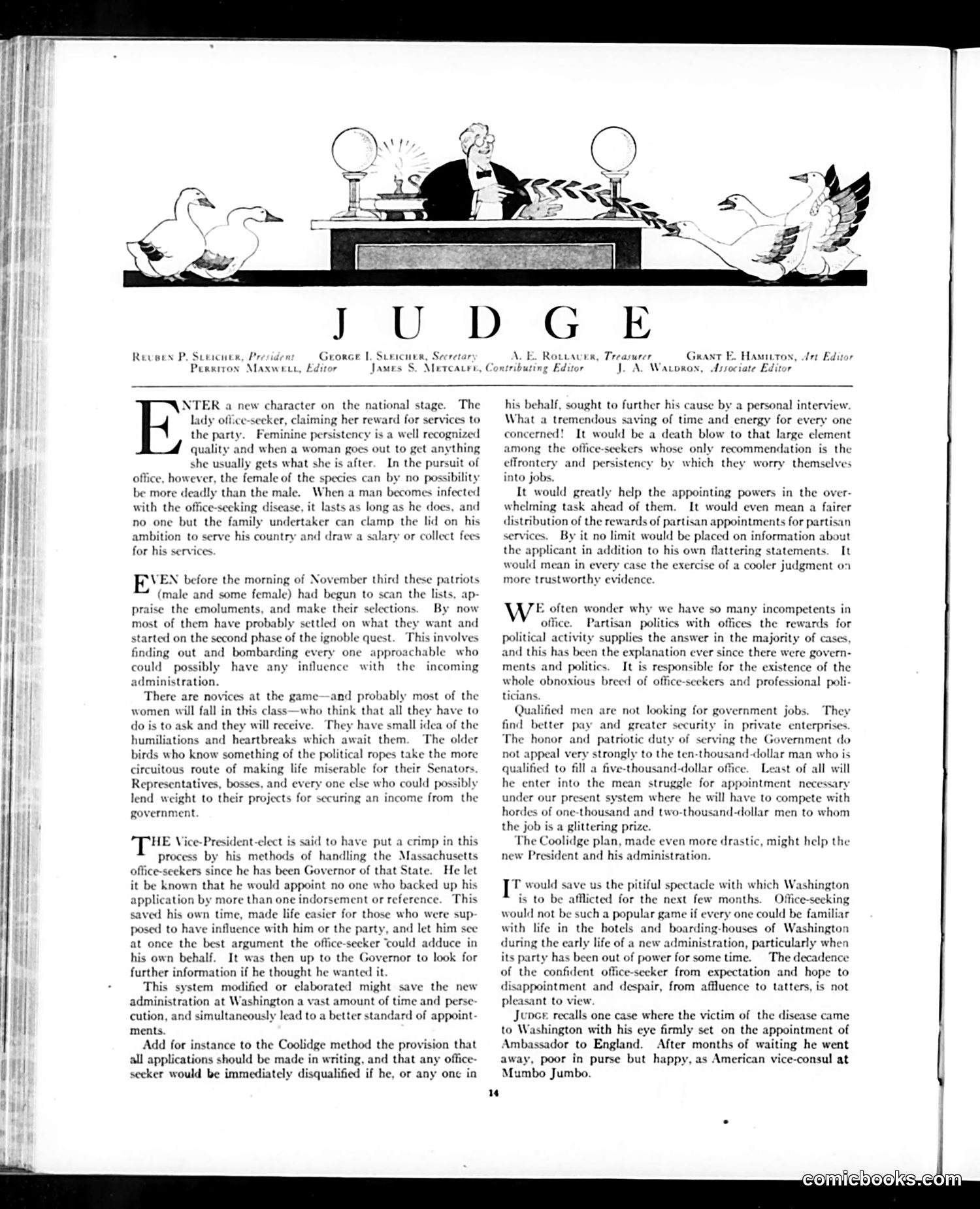
This page satirizes the problem of patronage appointments in American government, particularly the flood of office-seekers pestering politicians after elections. The editorial criticizes both male and female job applicants who use persistence, connections, and personal harassment to secure government positions. The text praises the Vice-President-elect (appears to be Calvin Coolidge, based on the "Coolidge method" mentioned) for implementing a system limiting recommendations to one per applicant. The author proposes an even stricter reform: requiring written applications only, with personal interviews disqualifying candidates entirely. The cartoon header—showing geese surrounding a formal-dressed man at a desk with lamps—likely mocks office-seekers as bothersome "birds" pestering the administration. The satire argues that partisan politics, not merit, determines appointments, leading to government incompetence. The proposed reforms aim to restore rational hiring based on qualifications rather than political pressure and persistence.
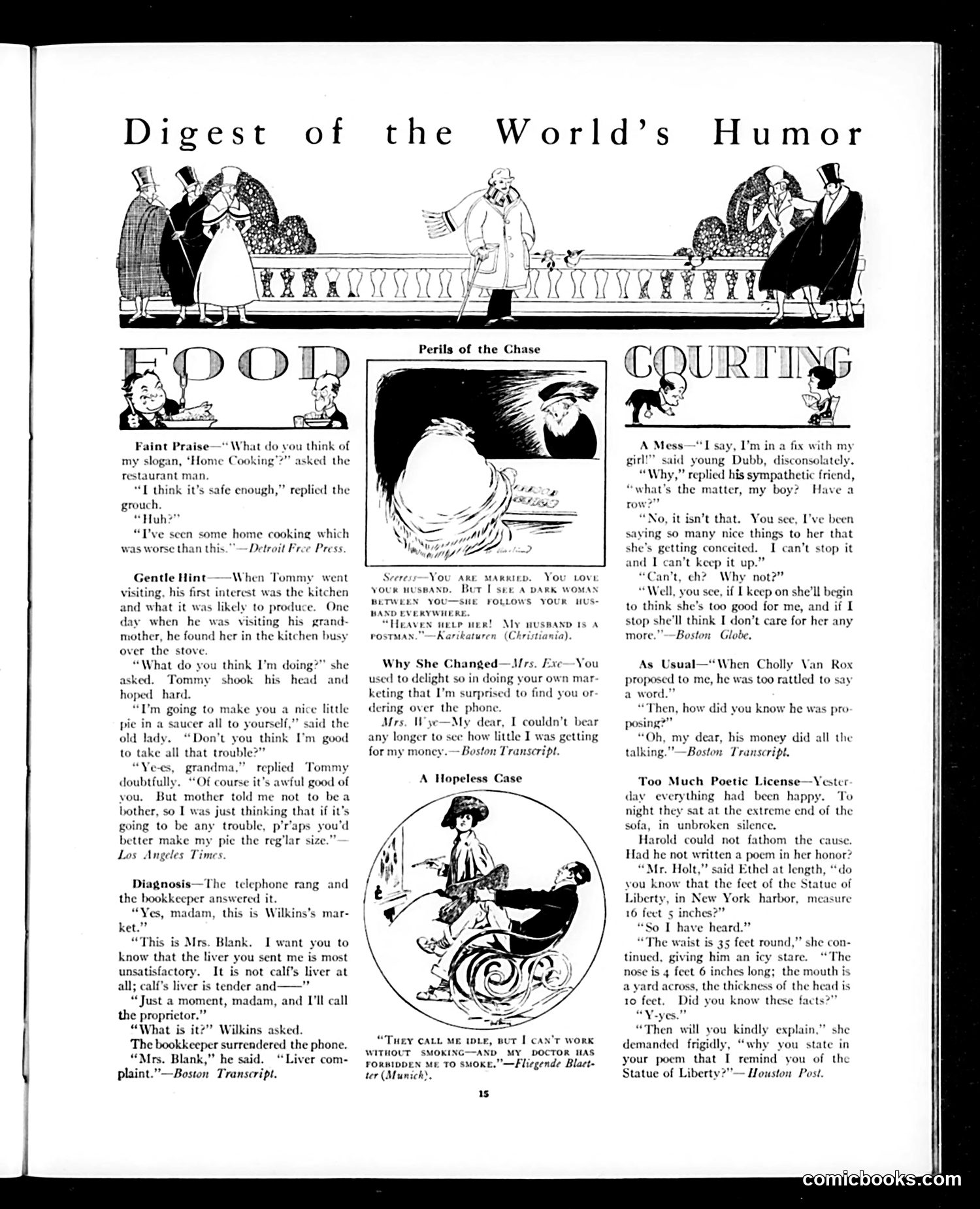
This page collects brief humorous anecdotes from various publications, illustrating early 20th-century domestic and social comedy. **Key jokes include:** - **"Faint Praise"**: A restaurant's "Home Cooking" slogan backfires when a diner notes he's seen worse home cooking. - **"Gentle Hint"**: A boy hints to his grandmother that she should bake a full-sized pie rather than a small one—flattery masking self-interest. - **"Diagnosis"**: A butcher's employee calls his boss to handle a complaint, claiming the customer has a "liver complaint" (pun on digestive illness vs. the literal complaint about liver quality). - **"As Usual"**: A woman married for money—the husband was too nervous to propose verbally; "his money did all the talking." - **"Too Much Poetic License"**: A husband's romantic poem comparing his wife to the Statue of Liberty offends her because he emphasized only Liberty's physical dimensions (large feet, waist, nose, mouth). The humor reflects period attitudes toward marriage (financial pragmatism), courtship, and domestic life, emphasizing miscommunication and irony.
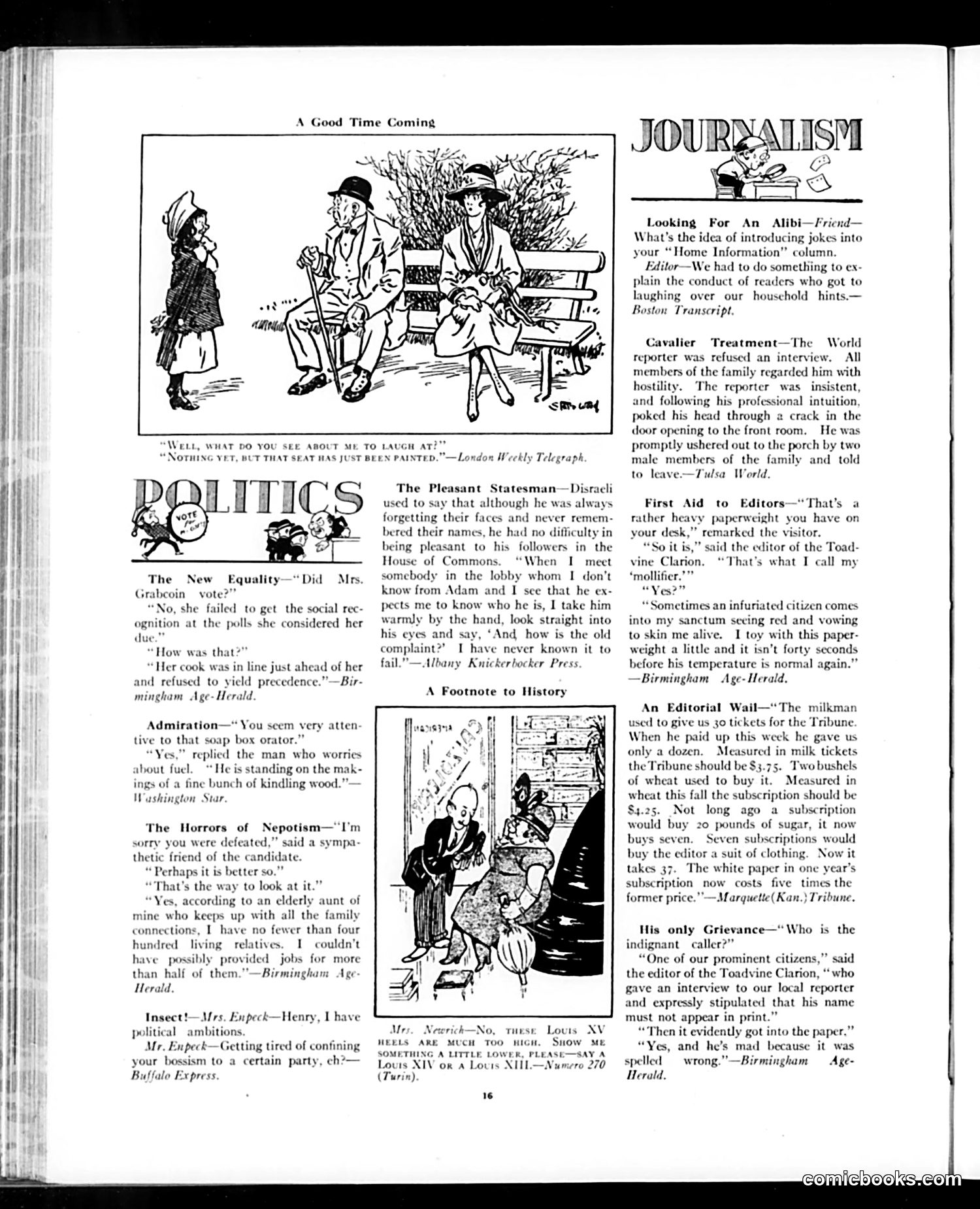
This page contains several short satirical pieces mocking early 20th-century American social and political pretensions: **"A Good Time Coming"** (top cartoon): Shows a woman being denied social recognition at voting polls because her cook—a servant—stood ahead of her in line and refused to yield. The satire targets both class snobbery and the absurdity of women's limited voting rights. **Political/Social Humor Items:** - "The New Equality" mocks women's suffrage by suggesting Mrs. Grabcoin valued social status over voting rights - "Nepotism" jokes about a defeated political candidate relieved he couldn't appoint four lazy relatives to jobs - "The Pleasant Statesman" references Disraeli's diplomatic charm toward forgotten constituents **"A Footnote to History"** (bottom cartoon): A wealthy woman (Mrs. Newrich—obviously mocking "nouveau riche") asks a servant to show her Louis XV/XIV heels, but requests something "lower." The joke concerns both shoe heels and aristocratic social rank. The **Journalism section** satirizes editors' struggles with angry readers and inflated subscription costs during economic inflation.
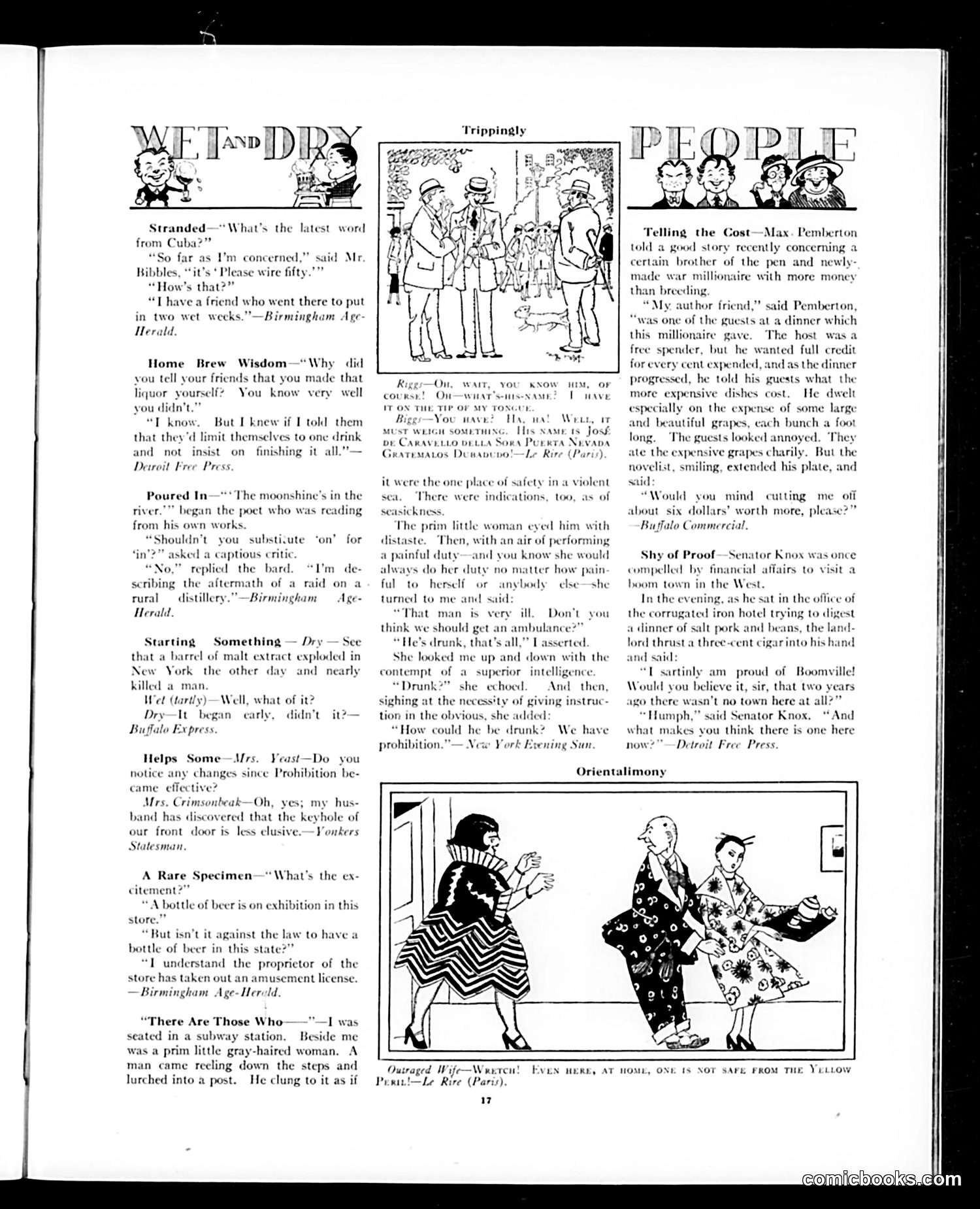
This page from *Judge* magazine is a collection of brief satirical jokes and anecdotes, mostly centered on **Prohibition-era humor** (the ban on alcohol, 1920-1933). Key themes: **Prohibition enforcement**: Multiple jokes mock the law's ineffectiveness—moonshine flows freely ("in the river"), beer bottles are somehow displayed legally via "amusement licenses," and people easily access alcohol despite the ban. **Social hypocrisy**: A prim woman criticizes a drunk man, then denies he could be intoxicated because "prohibition" exists—absurdly assuming the law prevents drunkenness. **Class satire**: A "newly-made war millionaire" (profiteer from WWI) ostentatiously announces the cost of every dish at dinner, revealing his lack of breeding; a witty novelist deflates him by requesting "$6 worth" of grapes. **Regional Americana**: Small-town boosterism appears in the Senator Knox anecdote about a frontier "boom town." The cartoons at top and center illustrate specific stories (a drunk man in a subway, an encounter between stylishly-dressed figures). The humor assumes readers' familiarity with Prohibition's failures and period social anxieties.
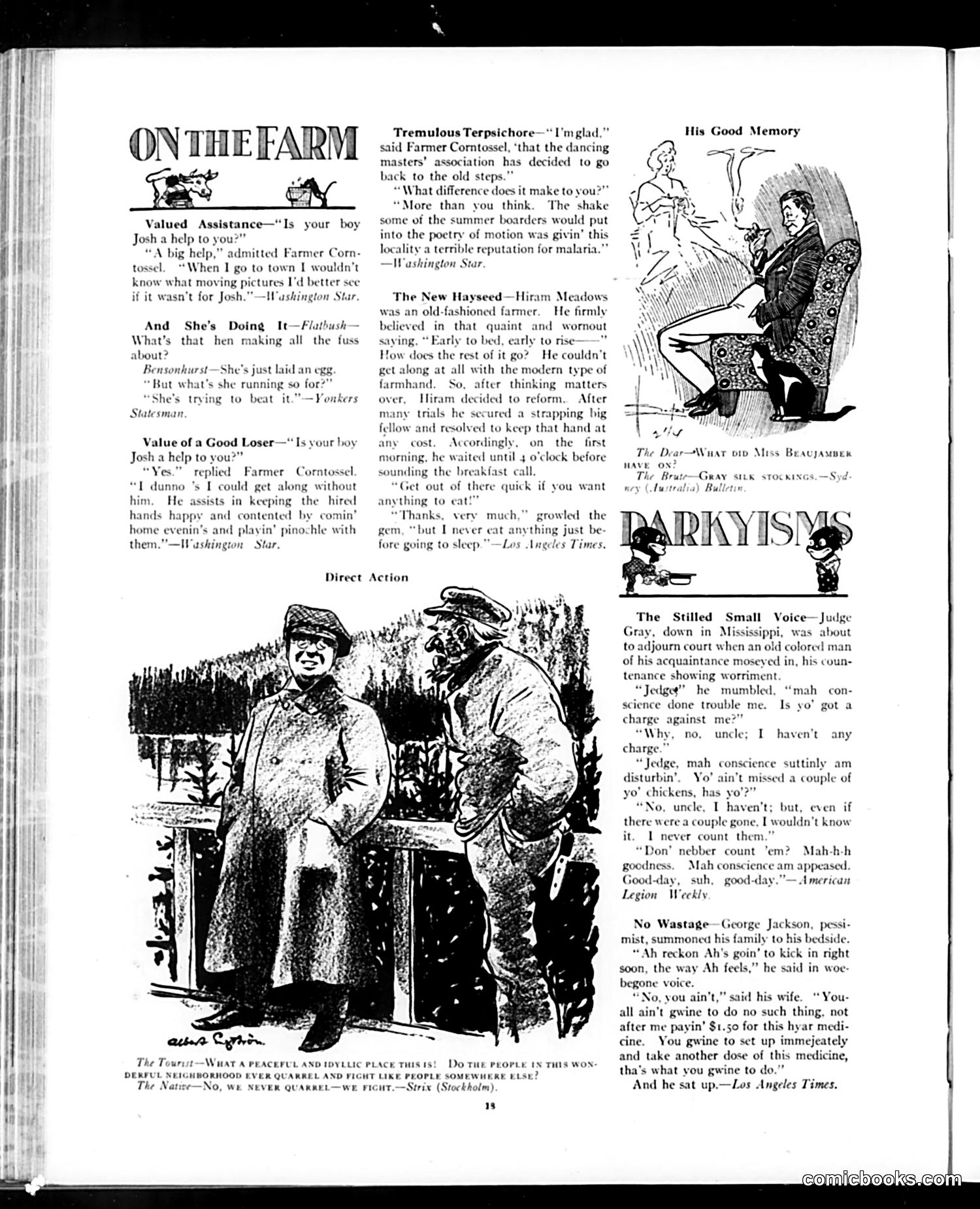
This page from *Judge* contains several short humorous anecdotes typical of early 20th-century American humor. The cartoons and jokes mock rural/farming life and period stereotypes: **"Direct Action"** (main illustration): Two farmers discuss their neighborhood's peacefulness. The joke plays on language—a tourist assumes "quarrel" means argue, but locals clarify they "fight" instead, suggesting rural violence as normal behavior. **Other rural humor**: Multiple brief jokes satirize farmers and rustic characters, including Farmer Corntossel (a recurring figure), who provides comic perspective on modern life—moving pictures, dancing, and farmhand management. The "New Hayseed" story jokes about old-fashioned work habits clashing with modern workers. **Dialect humor**: Several jokes feature African American characters rendered in heavy dialect, reflecting period conventions (though offensive by modern standards). These center on folk wisdom, conscience, and practical concerns. The overall tone is gentle mockery of rural simplicity versus modern complexity, typical of urban-oriented *Judge* magazine humor aimed at educated readers.
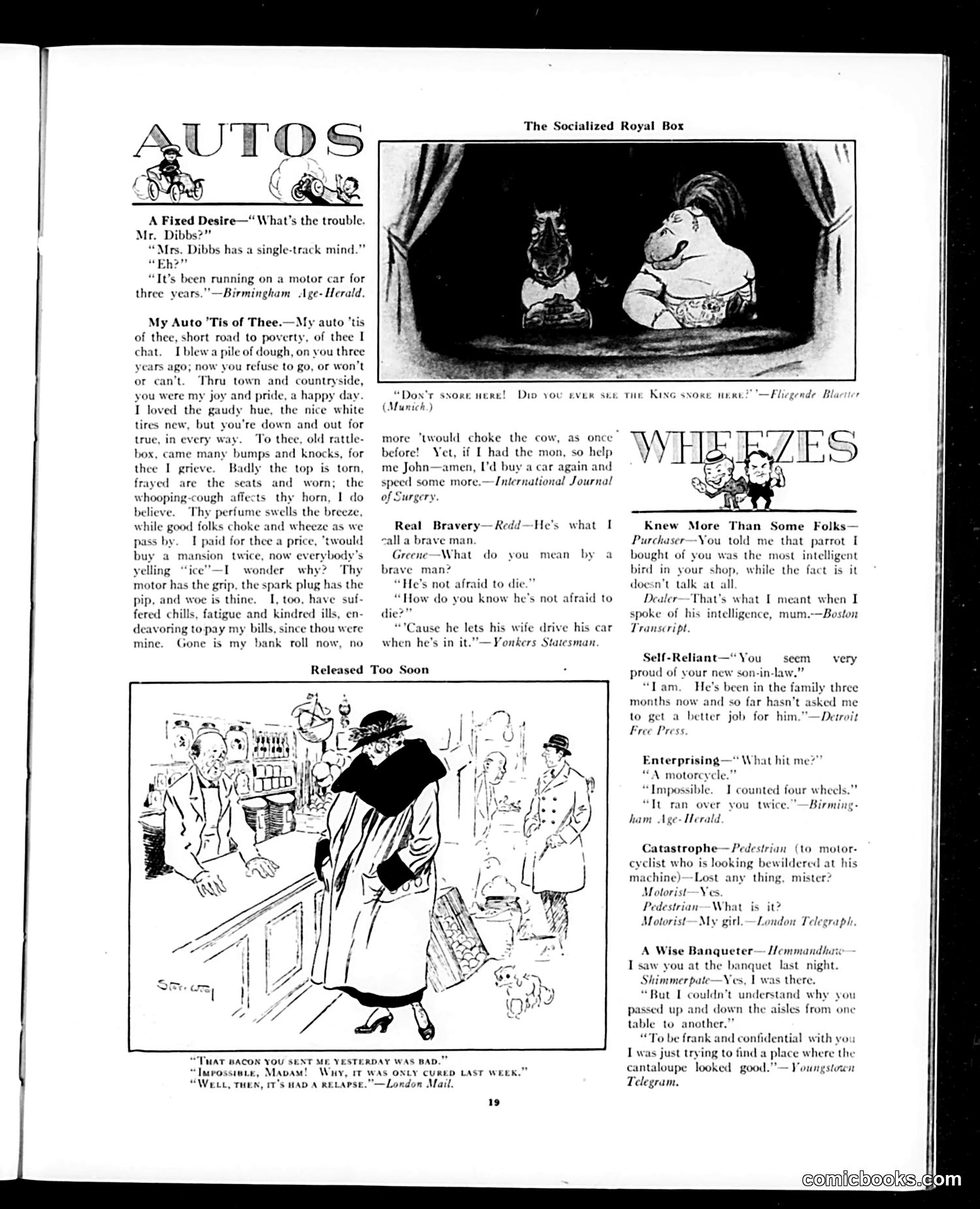
This page contains multiple short humorous anecdotes satirizing early automobile culture (likely 1910s-1920s). The main themes: **Auto Ownership's Financial Trap**: Several pieces mock the expense of car ownership. "My Auto 'Tis of Thee" parodies the patriotic song, describing a car owner's descent from pride to bankruptcy—once owning a fine automobile, now broke and the car is worthless ("everybody's yelling 'ice'" at the junk dealer). The opening joke about Mrs. Dibbs's "single-track mind" running on motor cars reflects contemporary anxiety about automobiles consuming family finances. **Marital Dynamics**: "Real Bravery" jokes that a man brave enough to let his wife drive is truly fearless—reflecting period concerns about women drivers and male anxiety about relinquishing control. **The cartoon "Released Too Soon"** shows a woman returning spoiled bacon, punning on medical/social "relapse"—unrelated to autos but typical period humor. Other snippets mock parrot dealers, son-in-laws, and motorcyclists with light wordplay typical of Judge's style.
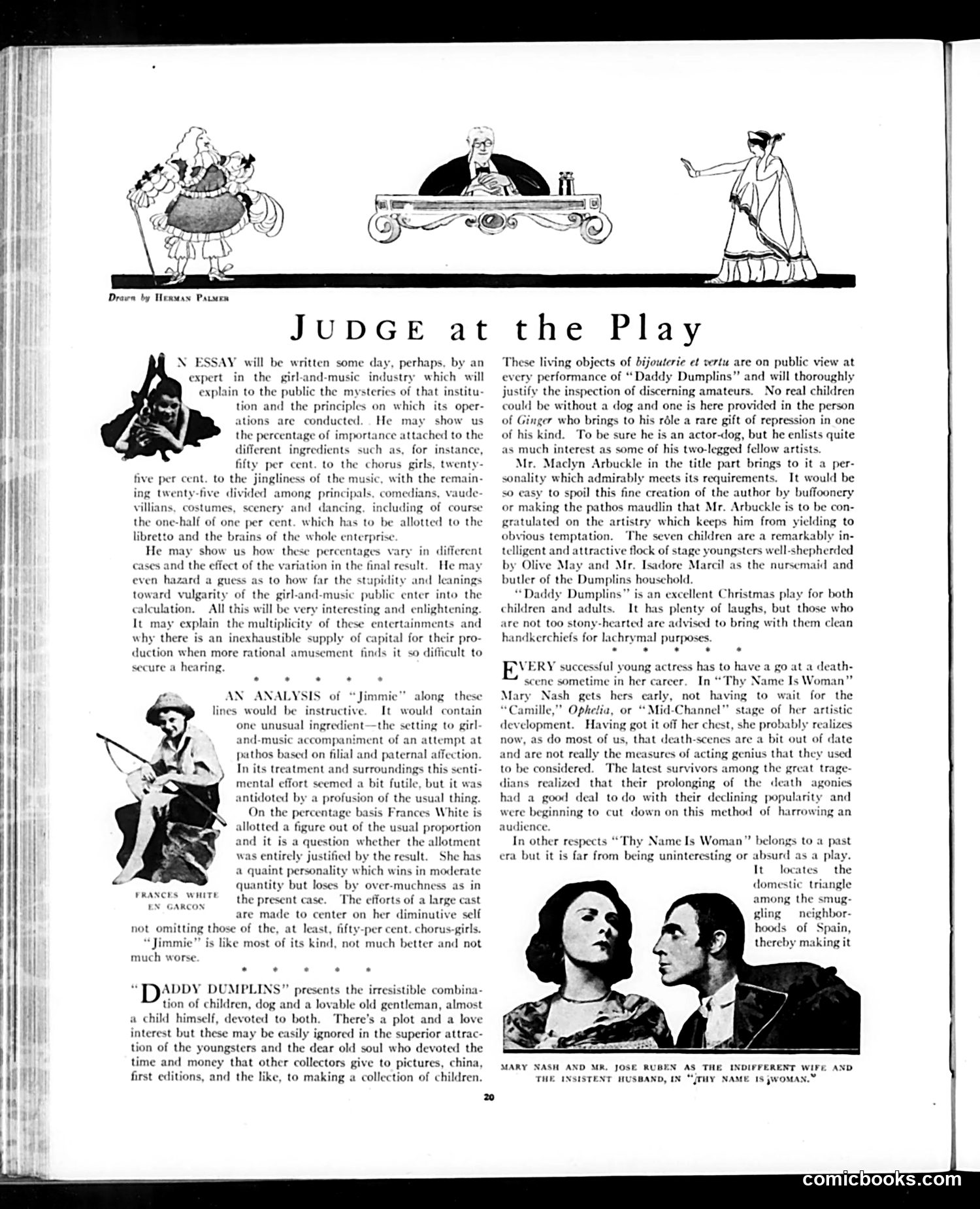
This page contains theatrical reviews from *Judge* magazine's drama section. The top illustration by Herman Palmer depicts a judge (literally) overseeing theatrical productions—a visual pun on the magazine's "Judge at the Play" column. The reviews critique two Broadway productions. "Jimmie" is dismissed as typical girl-and-music entertainment where the reviewer sarcastically calculates that chorus girls comprise 50% of the appeal, with music, principals, and actual plot relegated to minimal percentages. Actress Frances White receives a mixed assessment: charming in moderation but exhausting in excess. "Daddy Dumplins" receives more praise, praised for featuring child actors and a dog as genuine attractions rather than mere plot devices. Actor Maclyn Arbuckle is commended for avoiding maudlin sentimentality. The final photograph shows Mary Nash and Jose Ruben in the Spanish-set domestic drama "Thy Name Is Woman." The satire targets Broadway's commercial formula: lavish production values prioritize spectacle over substance, with genuine artistry being secondary to audience manipulation.
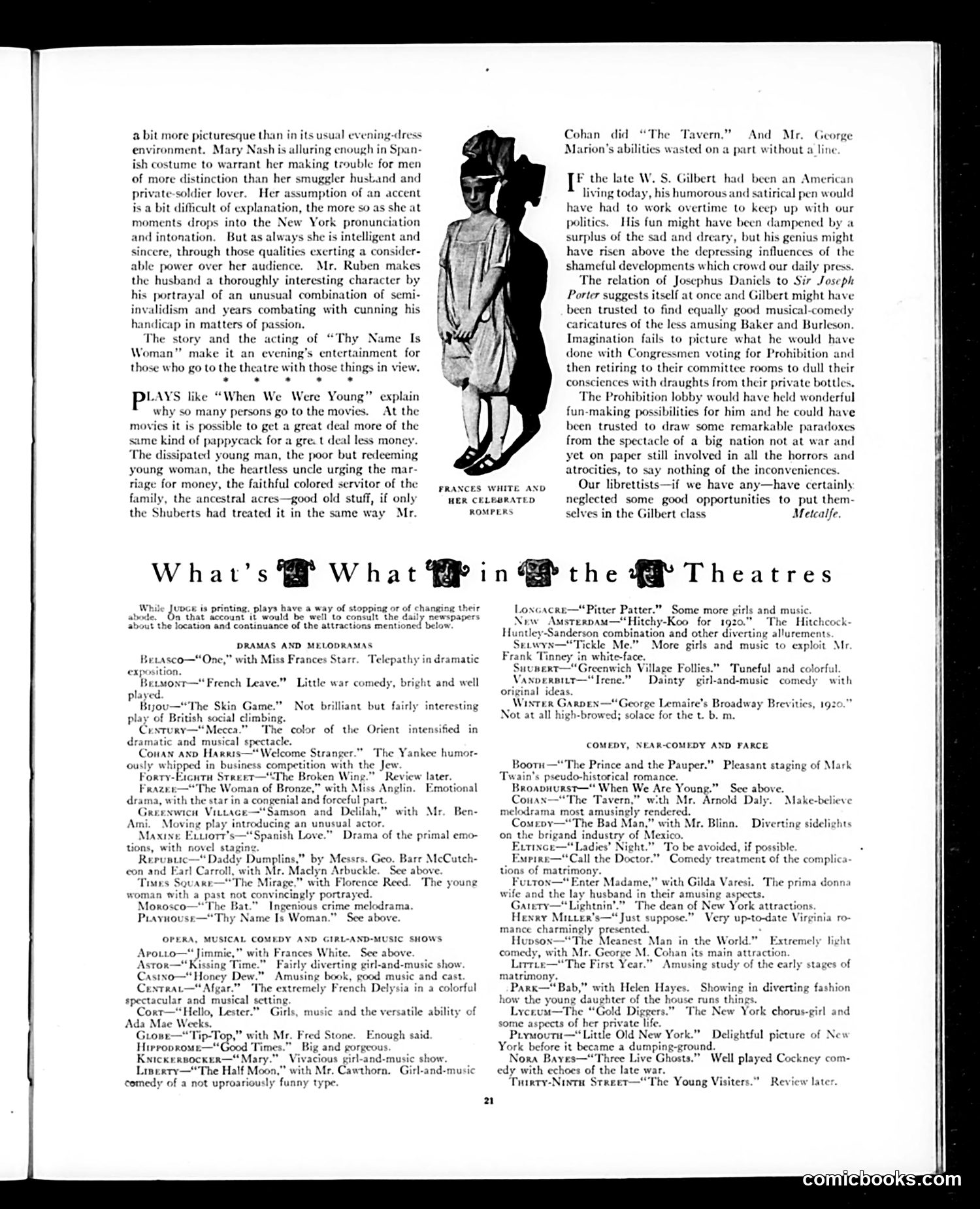
This page is primarily **theatre reviews**, not political cartoons. The single illustration shows "Frances White and Her Celebrated Rompers"—likely a theatrical performer or dance troupe from the era. The political content appears in a brief essay titled "If the late W. S. Gilbert had been an American living today." The writer imagines what the famous Gilbert & Sullivan satirist could satirize in contemporary American politics, specifically mentioning: - **Josephus Daniels** (Secretary of the Navy under Wilson) - **Baker and Burleson** (likely Newton Baker and Albert Burleson, Wilson cabinet members) - **The Prohibition lobby**, which the writer mocks for hypocrisy—congressmen voting for Prohibition while secretly drinking The satire suggests these politicians and policies would make excellent comedy material, lamenting that contemporary American librettists lack Gilbert's talent for exposing governmental absurdity and moral contradiction. It's commentary on early 1920s American politics during Prohibition enforcement.
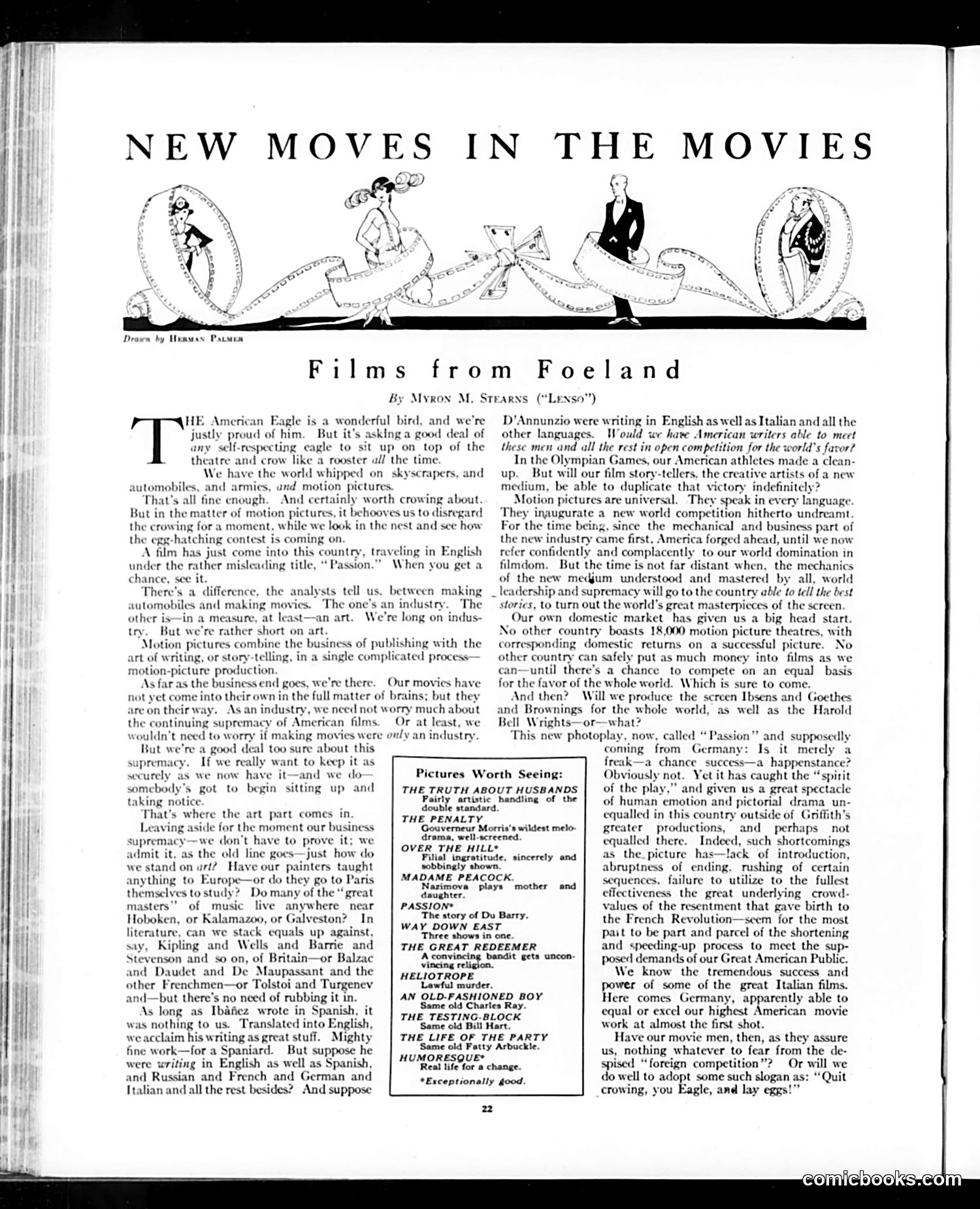
This page from *Judge* magazine discusses American cinema's international competition, particularly regarding imported European films. The illustration at top depicts figures dancing along film strip, celebrating "new moves in the movies." The main article by Myron M. Stearns argues that while America dominates the *business* of filmmaking (production scale, infrastructure), it lags in *artistic* merit compared to European cinema. He references a German film titled "Passion" coming to American theaters, questioning whether American filmmakers can compete creatively with European writers and artists. Stearns uses the metaphor of the American Eagle: we crow about industrial superiority but neglect artistic development. He contends that without cultivating storytelling talent comparable to European masters (Tolstoy, Balzac, etc.), American cinema's supremacy won't last. The accompanying "Pictures Worth Seeing" box lists current films with brief critiques, indicating *Judge's* film coverage for contemporary audiences.
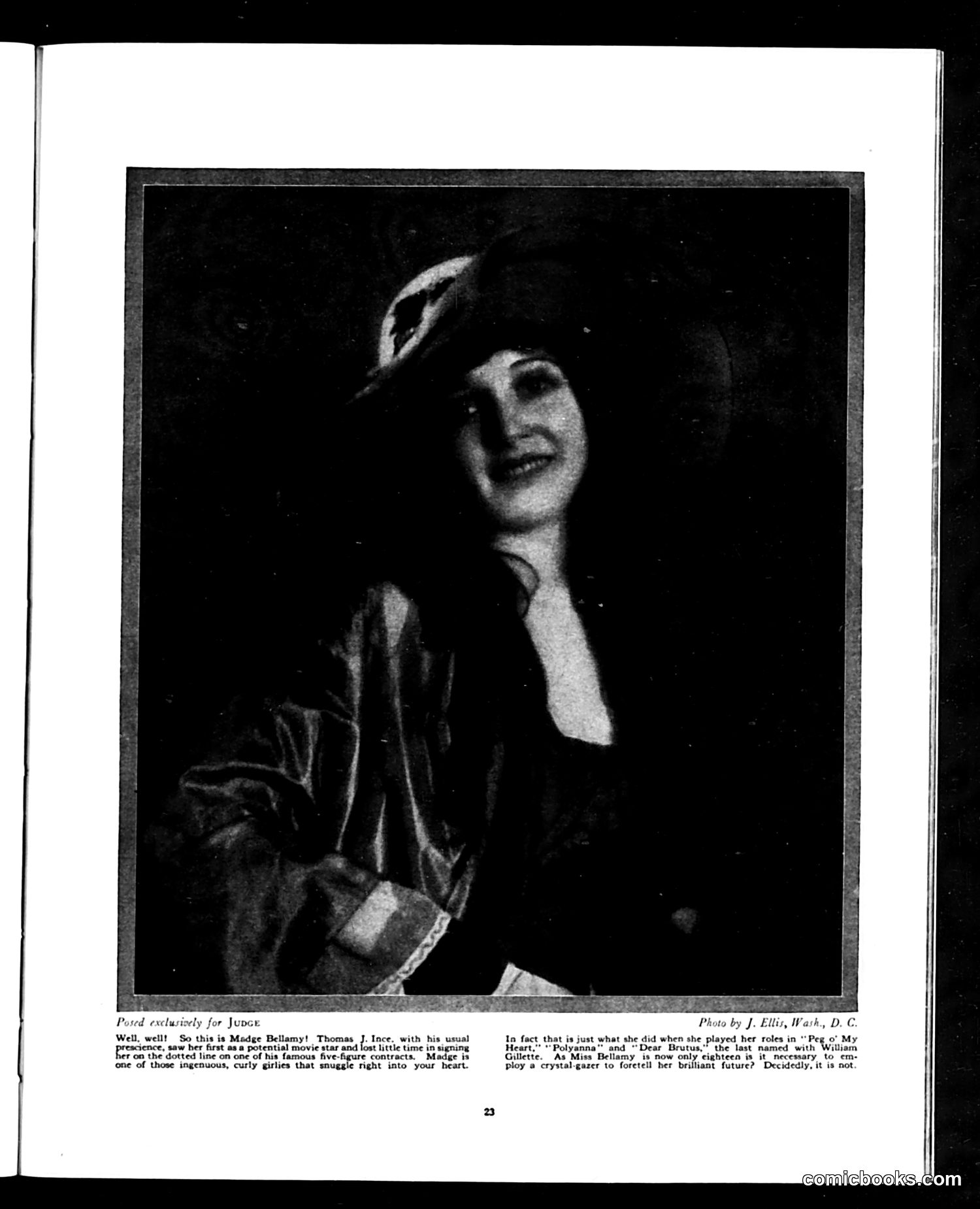
This page features a posed photograph of actress **Madge Bellamy**, a silent film star under contract with producer **Thomas H. Ince**. The accompanying text is not satirical but rather a lighthearted promotional profile. The piece celebrates Bellamy's early career success, noting that Ince signed her to a lucrative "five-figure contract" after recognizing her potential as a movie star. It references her roles in films including *Peg o' My Heart*, *Pollyanna*, and *Dear Brutus* (notably opposite established actor William Gillette). The "joke" is gentle: the author rhetorically asks whether a crystal-gazer is needed to predict her brilliant future—the answer being no, because her success is already evident. This is essentially entertainment journalism disguised as humor, promoting both Bellamy and the film industry to Judge's readers. The piece reflects the 1920s fascination with Hollywood celebrities.
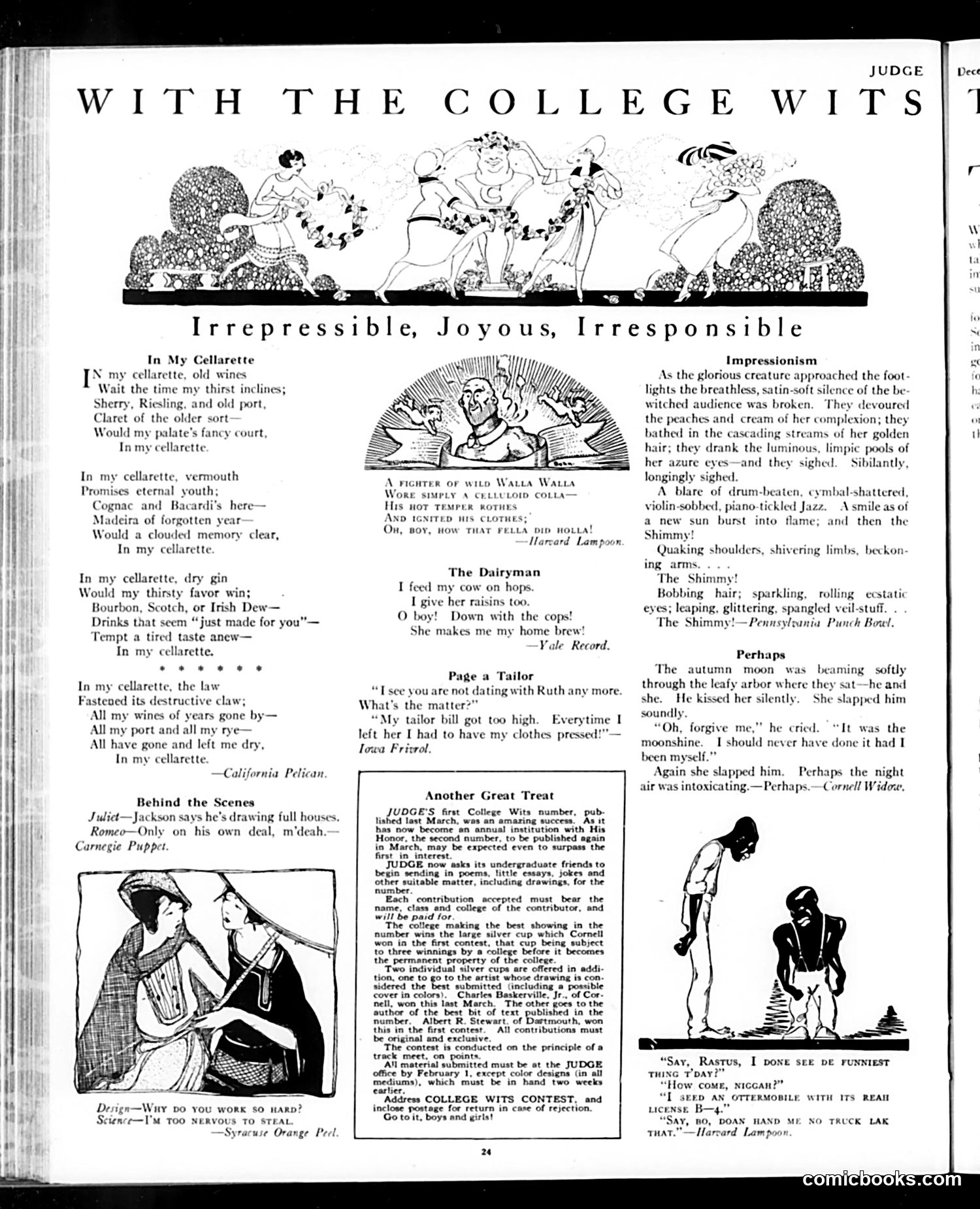
This page showcases **Judge magazine's "College Wits" contest**, featuring humorous poems and jokes from university contributors. The dominant theme is **Prohibition's impact**, particularly the loss of alcohol. The opening poem "In My Cellarette" laments a once-full liquor cabinet now emptied by law enforcement—a direct reference to Prohibition (likely the 18th Amendment, ratified 1919). The final stanza's punchline: "the law / Fastened its destructive claw" captures the era's resentment toward alcohol bans. Other jokes reference contemporary college life: dating costs, home brewing (illegal under Prohibition), and the "Shimmy" dance craze. The bottom cartoon depicts a young woman dancing the Shimmy—a provocative, energetic dance that scandalized conservative Americans in the 1920s. The "Another Great Treat" box announces the contest itself, where colleges compete for silver cups. This reflects Judge's appeal to educated, college-aged readers who clearly viewed Prohibition as a humorous grievance worthy of satirical verse.
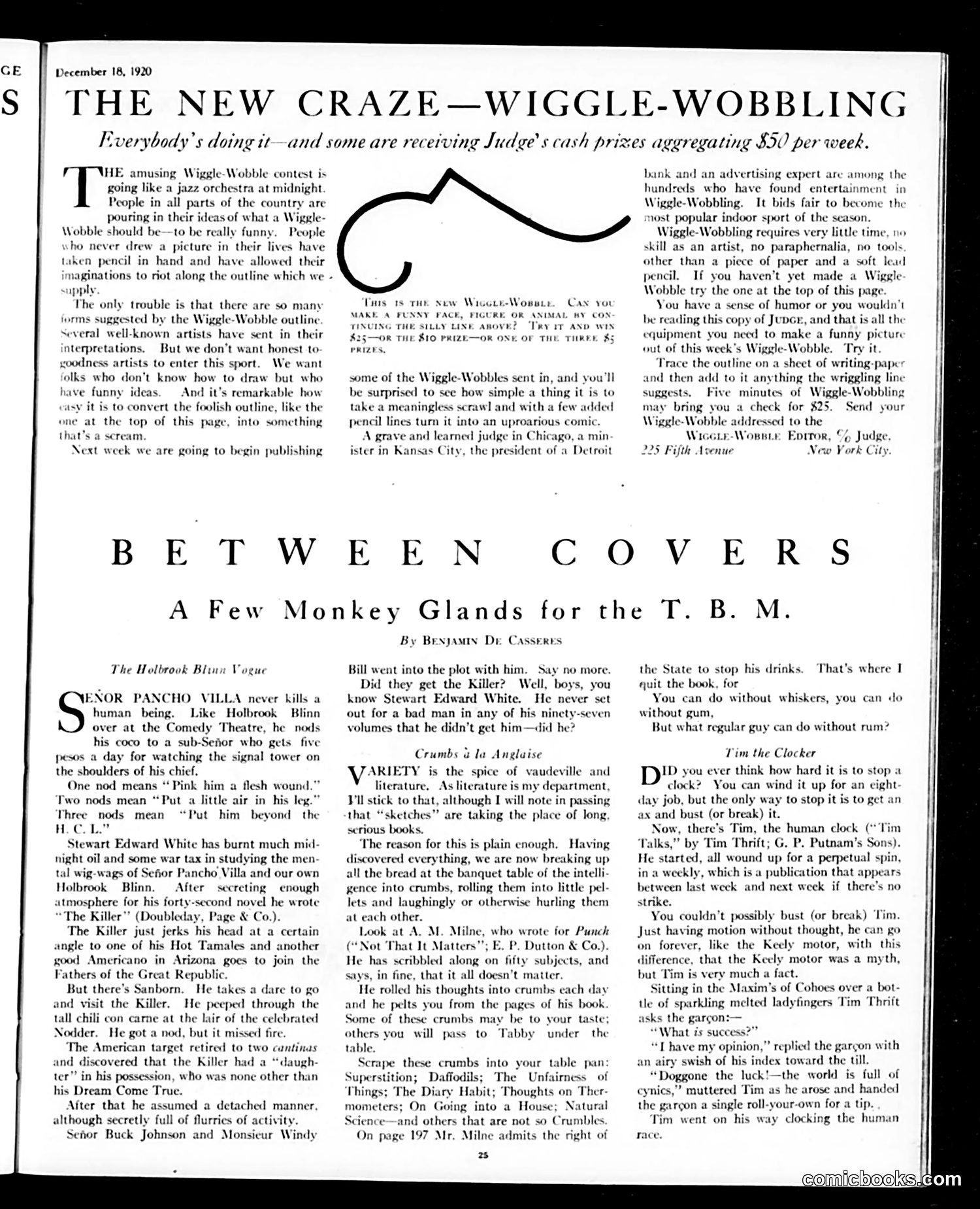
The main attraction is Judge magazine's "Wiggle-Wobble" drawing contest—a parlor game craze sweeping 1920s America. Participants receive a nonsensical wavy line and must complete it into a funny face, animal, or figure. The contest offers cash prizes ($25 first place, $5 runners-up), and Judge emphasizes it requires no artistic skill, just humor and imagination. The appeal is explicitly democratic: anyone—not professional artists—can participate. The page notes that prominent citizens (a Chicago judge, Kansas City minister, Detroit bank president) have entered, suggesting the fad's broad popularity across social classes. It's framed as the perfect indoor entertainment for the 1920s leisure class, requiring only paper and pencil. The satirical angle: Judge promotes this as the season's most "popular indoor sport," gently mocking how easily Americans embrace trivial novelties and mass-participation contests.
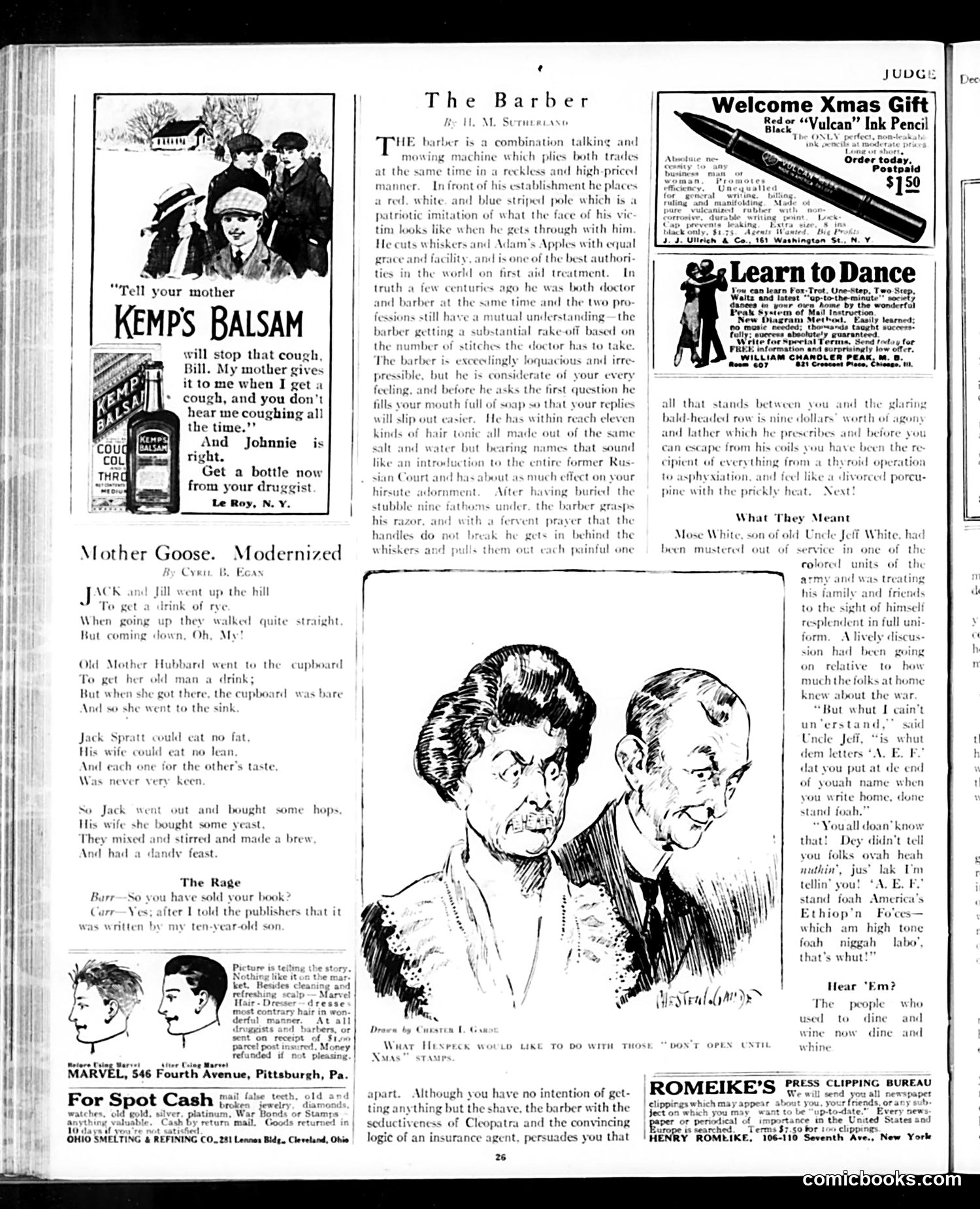
This page contains advertisements and humorous pieces typical of Judge magazine's satirical content. **"The Barber"** by R.H. Sutherland is a comedic essay about barbers as a profession. It presents the barber as a figure combining tradesman and showman—noting the iconic red, white, and blue pole, comparing the barber's work on customers' faces to the damage inflicted ("looks like when he gets through with him"). The piece humorously describes barbers' upselling tactics and their manipulation of customers, comparing them to "Cleopatra" in seductiveness. **"Mother Goose, Modernized"** by Cyril H. Egan is a parody updating nursery rhymes. Jack and Jill's "drink of rye," Jack Spratt's wife brewing "hops" and "yeast"—these appear to reference Prohibition-era humor, transforming innocent nursery rhymes into alcohol-focused scenarios. **"The Rage"** is a brief joke where a publisher accepts a book only after learning it was "written by my ten-year-old son," satirizing both literary trends and gullible publishers. The page is primarily **advertising-driven**, with remedies like Kemp's Balsam and the "Vulcan" ink pencil occupying significant space.
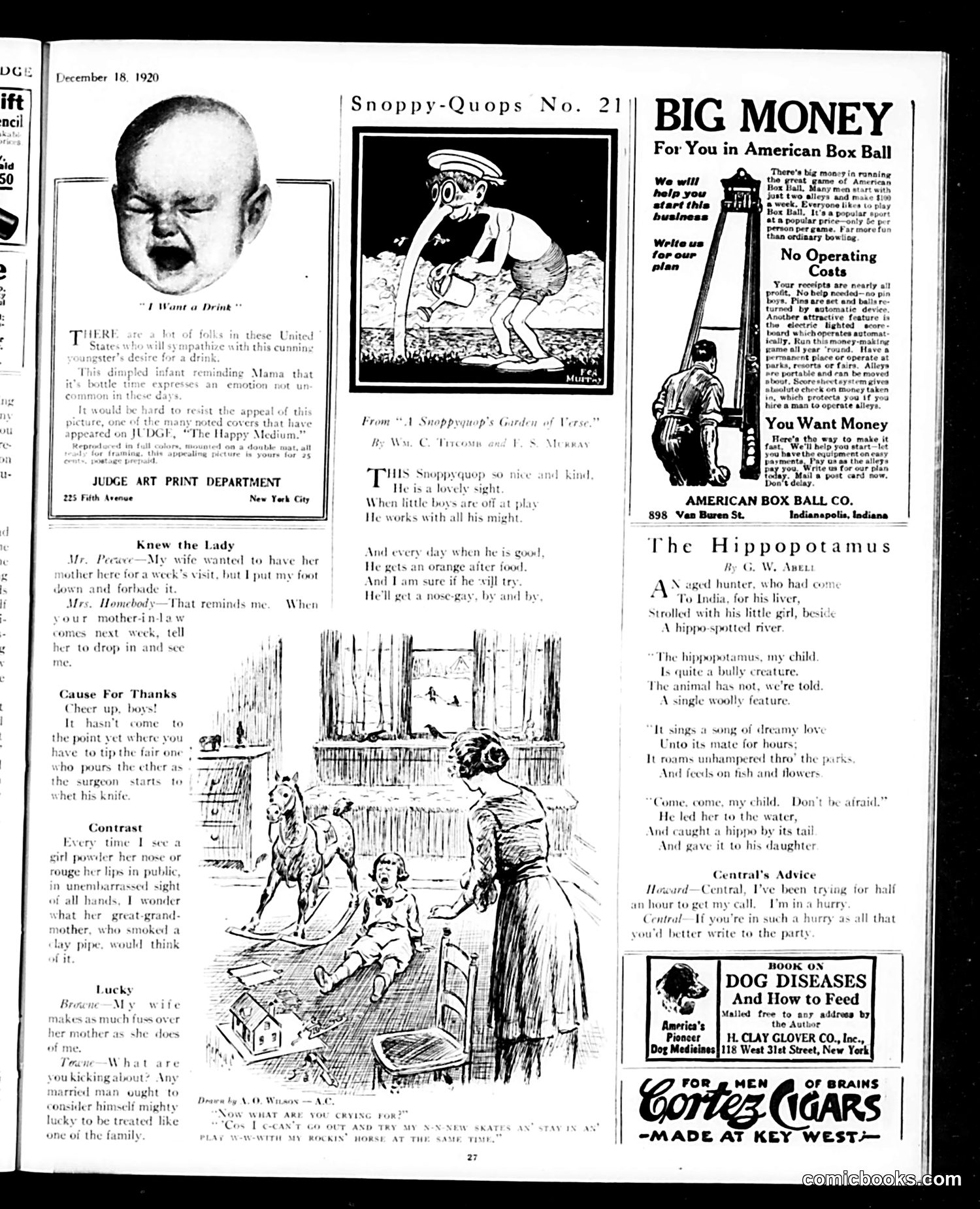
This page from *Judge* (December 18, 1920) contains mostly **advertisements and light humor**, not political satire. The main content includes: **"I Want a Drink"** — A cartoon referencing **Prohibition**, which began January 1920. The dimpled infant's caption appeals to sympathy for those deprived of alcohol under the new constitutional ban—satire of Prohibition sentiment. **"Knew the Lady," "Cause For Thanks," etc.** — Brief domestic humor jokes about marriage and tipping etiquette; no deeper political meaning. **"The Hippopotamus"** — A children's poem with illustration; purely whimsical. **Large advertisements** dominate: "American Box Ball" (a bowling-type game), "Cortez Cigars," and "Dog Diseases" book. These reflect 1920s consumer culture. The page is primarily **commercial and entertainment-focused** rather than offering serious political commentary. The Prohibition reference is the only topical social issue evident.
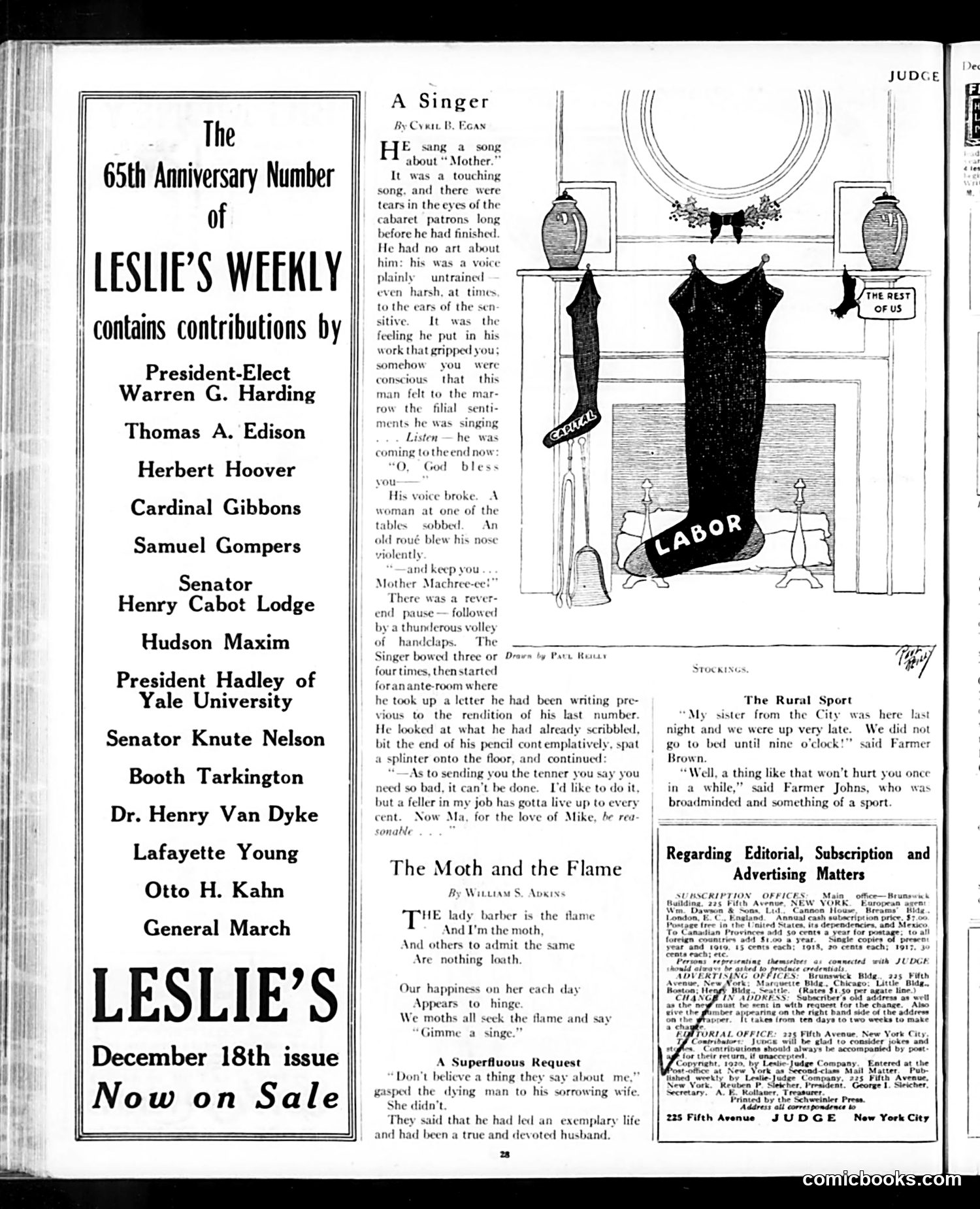
This is primarily an **advertisement and table of contents** for Leslie's Weekly's 65th Anniversary issue (December 18th), featuring contributions from prominent figures including President-Elect Warren G. Harding, Thomas Edison, Herbert Hoover, and others—reflecting this magazine's prestige circa 1920-1921. The page includes three brief **humorous pieces**: 1. **"A Singer"**: A sentimental cabaret performer moves audiences with an emotional rendition of "Mother Machree," yet is revealed as a callous man refusing financial help to his own mother in a letter—satirizing performative sentimentality versus actual human decency. 2. **"The Moth and the Flame"**: A light joke about a barber (the "flame") attracting male customers (the "moths") seeking haircuts ("singe"). 3. **"A Superfluous Request"**: Dark humor about a dying man warning his wife not to believe people's eulogies about him—implying his public reputation contradicts his actual character. The cartoons and text together emphasize contrasts between public appearance and private reality.
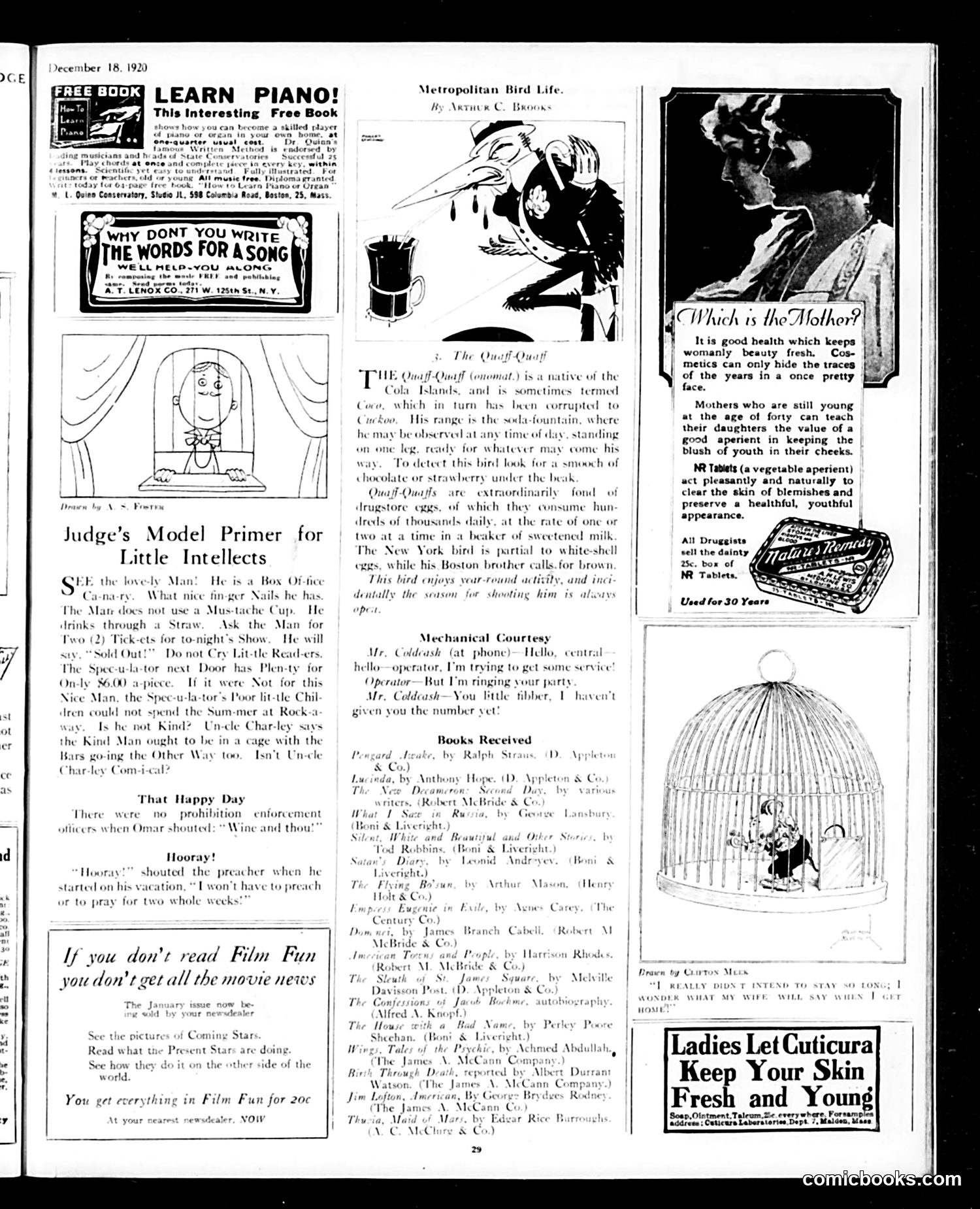
This page contains several satirical pieces typical of Judge's humor: **"Judge's Model Primer for Little Intellects"** mocks the wealthy through a children's primer format. It satirizes ticket scalpers and speculators who profit from theater scarcity, portraying them as parasites on working families—a genuine economic grievance during the post-WWI period. **"That Happy Day"** jokes about Prohibition (enacted January 1920), mocking a preacher's relief at vacation from moral duties. The reference to Omar suggests Omar Khayyam's famous wine-drinking verses, contrasting pre-Prohibition freedom with current restrictions. **"Mechanical Courtesy"** presents a brief telephone humor sketch about miscommunication—standard Judge fare. **"Metropolitan Bird Life"** uses ornithological language to humorously describe the "Quaff-Quaff" bird, a thin disguise for soda fountain patrons consuming ice cream and eggs—likely mocking young people's leisure habits. The page also advertises piano lessons, songwriting services, and cosmetics—typical magazine revenue sources of the era.
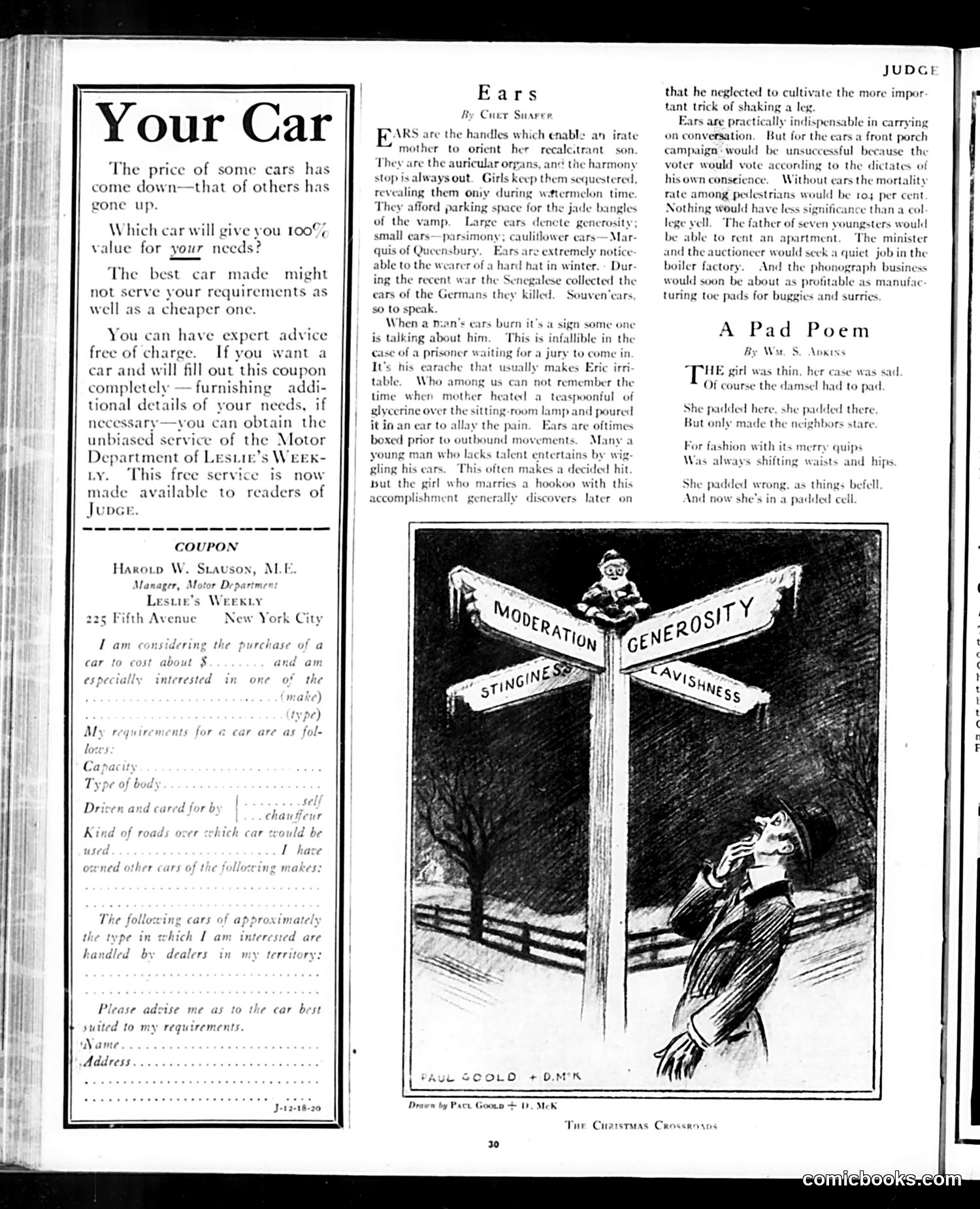
This page combines three distinct pieces typical of early-20th-century Judge magazine: **"Your Car"** (left): An advertisement offering free automotive advice from Leslie's Weekly to Judge readers, positioned as consumer guidance during a period when car prices were volatile. **"Ears" (top right)**: A humorous essay by Chet Shafer offering whimsical definitions and observations about ears—their social meanings (small ears suggest stinginess, large ones generosity), practical uses (holding bangles, anchoring hard hats), and cultural references (Senegalese collecting German soldiers' ears as WWI souvenirs). The tone is light satire on human vanity and bodily oddities. **"A Pad Poem" (bottom right)**: A brief satirical verse mocking women's fashion—specifically the era's obsession with padding undergarments to create desired silhouettes. The punchline suggests a woman padded incorrectly and ended up institutionalized ("padded cell"). The accompanying cartoon by Paul Scold and D. McKenty illustrates the poem's theme, showing a fashionably dressed woman at a signpost labeled with virtues (Moderation, Generosity, Stinginess, Lavishness).
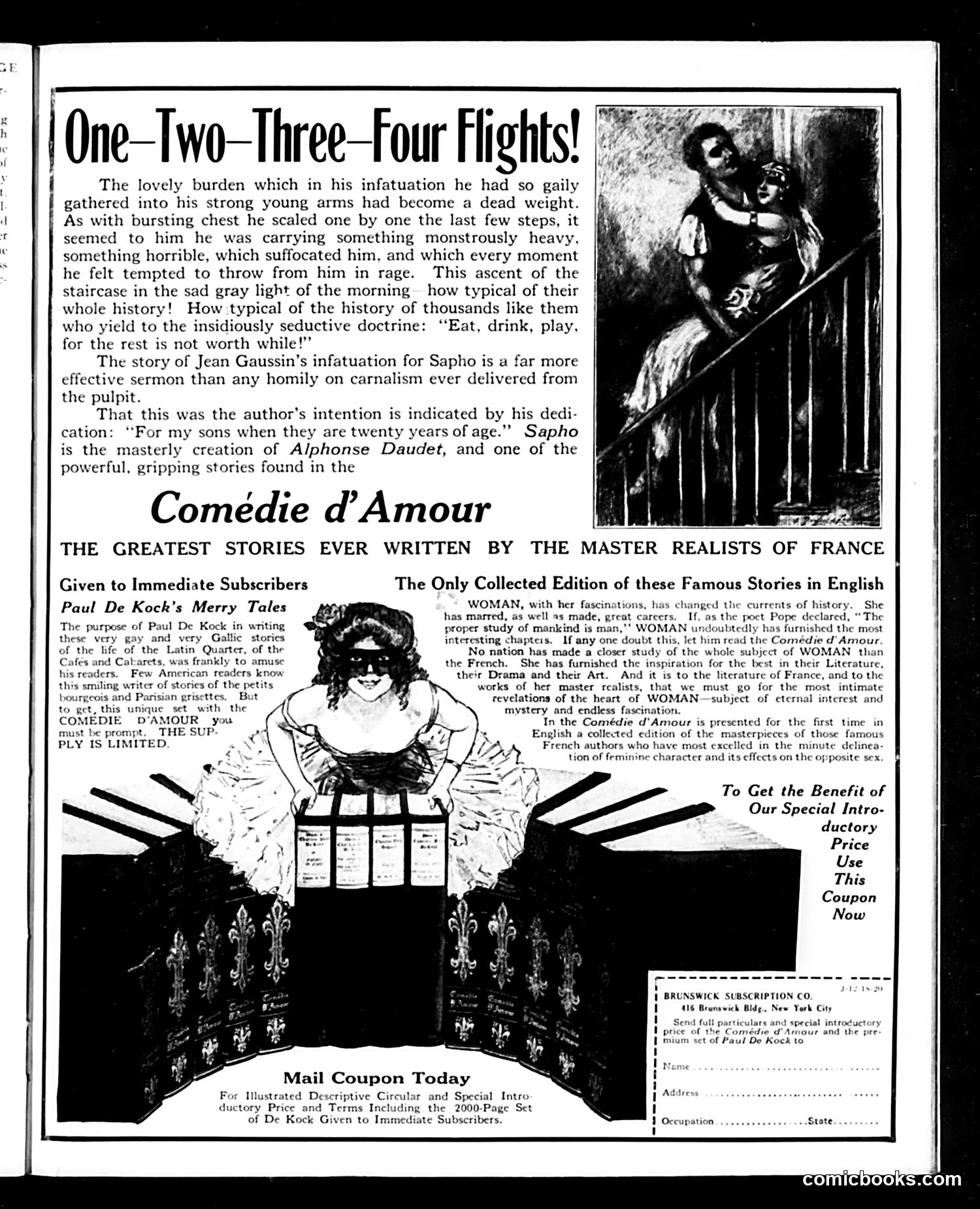
This is primarily **advertising**, not satire. The page promotes a subscription collection of French literature called *Comédie d'Amour*, featuring stories by Alphonse Daudet and Paul De Kock. The top section excerpts Daudet's *Sapho*, describing a man carrying his mistress up stairs—the physical burden symbolizing moral entrapment in carnality. The text frames this as a moral warning ("sermon") about the seductive doctrine of hedonism ("Eat, drink, play, for the rest is not worth while"). The advertisement explicitly markets these stories to men, emphasizing that French writers have uniquely studied **feminine character and its effects on the opposite sex**—presenting women as subjects of intellectual and moral fascination rather than equals. This reflects early 20th-century attitudes treating "woman" as an exotic, mysterious subject worthy of literary study. The pitch combines literary prestige with voyeuristic appeal, offering "intimate revelations of the heart of WOMAN" to English readers for the first time.
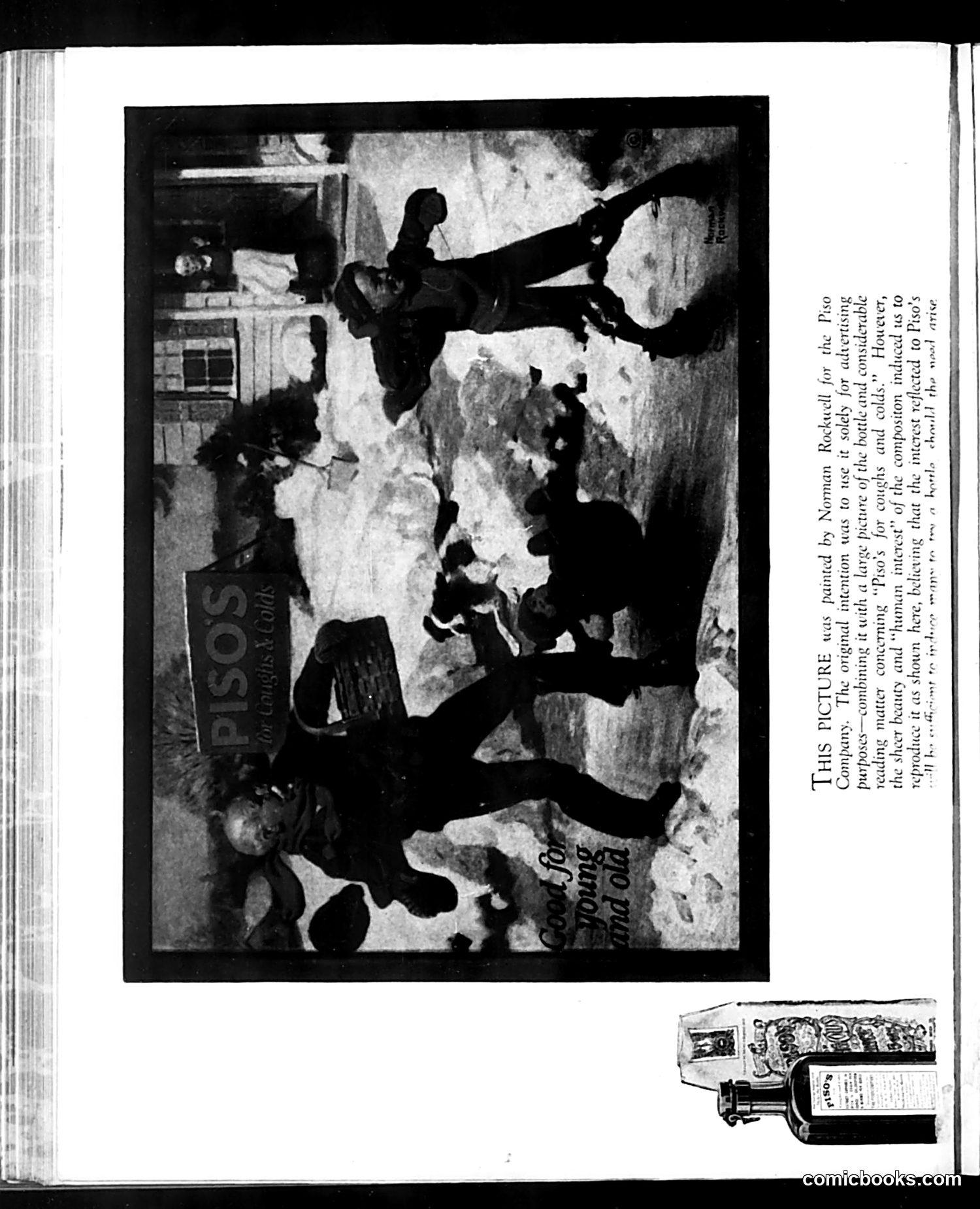
This page from *Judge* magazine features a photograph labeled "THE PICTURE WAS PAINTED BY NORMAN ROCKWELL FOR THE PISO COMPANY" showing what appears to be a domestic scene with multiple figures gathered around a table. The text indicates this is an advertisement for Piso's cough medicine, with Rockwell's illustration commissioned to promote the product. The accompanying caption describes the original painting being used for advertising purposes, combining high-quality artistic work with commercial messaging—a common early 20th-century practice where renowned illustrators lent their talents to product endorsements. The satire or commentary likely involves how prestigious artists like Rockwell were enlisted for commercial advertisement, blending fine art with mass-market salesmanship during this era of American consumer culture.