
Judge, 1920-12-18 · page 21 of 32
Judge — December 18, 1920 — page 21: what you’re looking at
What you’re looking at
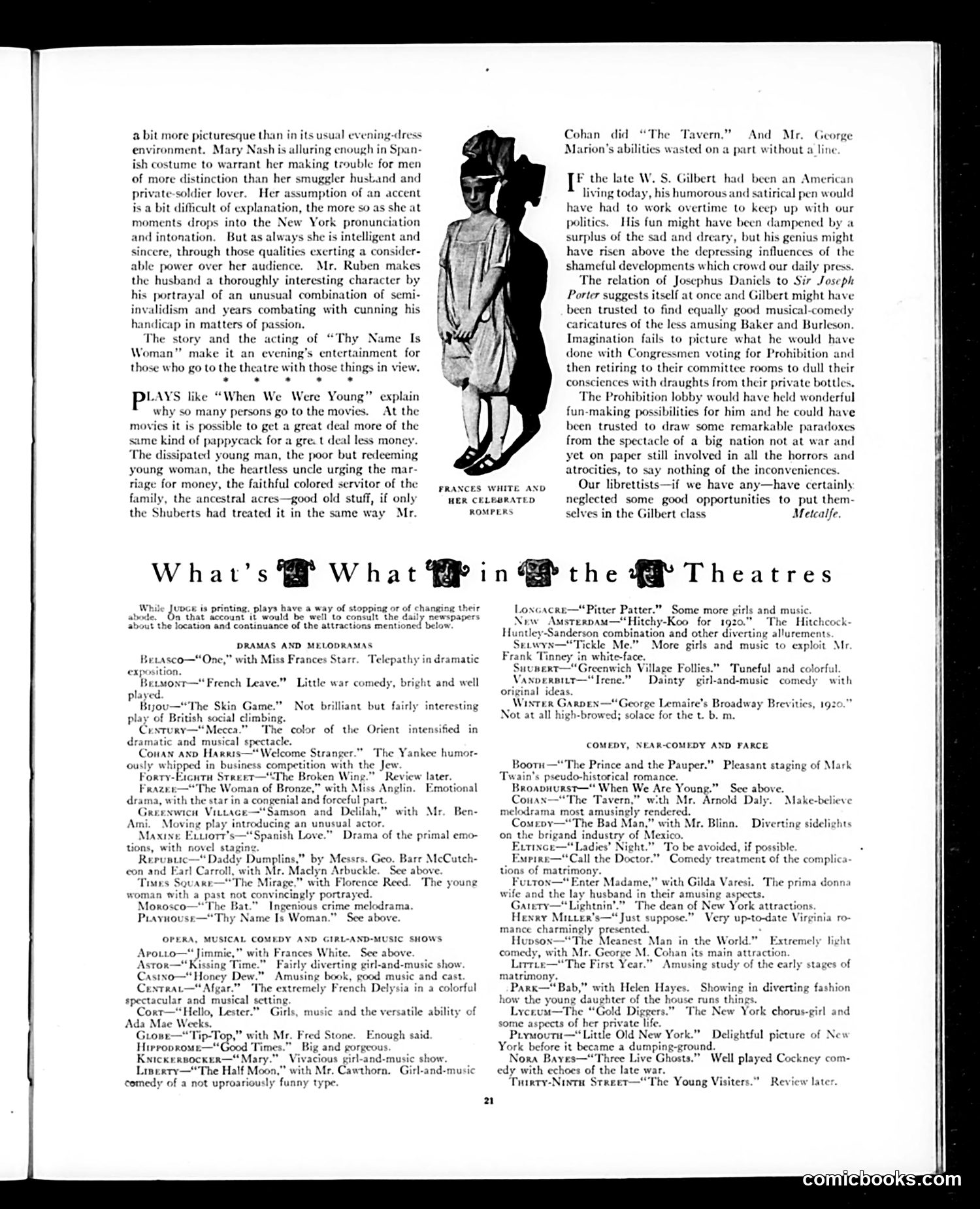
This page is primarily **theatre reviews**, not political cartoons. The single illustration shows "Frances White and Her Celebrated Rompers"—likely a theatrical performer or dance troupe from the era. The political content appears in a brief essay titled "If the late W. S. Gilbert had been an American living today." The writer imagines what the famous Gilbert & Sullivan satirist could satirize in contemporary American politics, specifically mentioning: - **Josephus Daniels** (Secretary of the Navy under Wilson) - **Baker and Burleson** (likely Newton Baker and Albert Burleson, Wilson cabinet members) - **The Prohibition lobby**, which the writer mocks for hypocrisy—congressmen voting for Prohibition while secretly drinking The satire suggests these politicians and policies would make excellent comedy material, lamenting that contemporary American librettists lack Gilbert's talent for exposing governmental absurdity and moral contradiction. It's commentary on early 1920s American politics during Prohibition enforcement.
📄 Transcribed text from this page (OCR, searchable)
Machine-transcribed from the original scan — historical spelling and the odd misread are preserved.
a bit more picturesque than in its usual evening-dress environment. Mary Nash is alluring enough in Span- ish costume to warrant her making trouble for men of more distinction than her smuggler husband and private-soldier lover. Her assumption of an accent is a bit difficult of explanation, the more so as she at moments drops into the New York pronunciation and intonation. But as always she is intelligent and sincere, through those qualities exerting a consider- able power over her audience. Mr. Ruben makes the husband a thoroughly interesting character by his portrayal of an unusual combination of semi- invalidism and years combating with cunning his handicap in matters of passion, The story and the acting of “Thy Name Is Woman” make it an evening’s entertainment for those who go to the theatre with those things in view. “8 © © @ LAYS like “When We Were Young” explain why so many persons go to the movies. At the movies it is possible to get a great deal more of the same kind of pappycack for a gre. t deal less money. ‘The dissipated young man, the poor but redeeming young woman, the heartless uncle urging the mar- riage for money, the faithful colored servitor of the family, the ancestral acres—good old stuff, if only the Shuberts had treated it in the same wa FRANCES HER CELEBRATED y Mr. ROMPERS Cohan did “The Tavern.” And Mr. George Marion's abilities wasted on a part without a line F the late W. S. Gilbert had been an Ameri living today, his humorous and satirical pen would have had to work overtime to keep up with our politics. His fun might have been dampened by a surplus of the sad and dreary, but his genius might have risen above the depressing influences of the shameful developments which crowd our daily press. The relation of Josephus Daniels to Sir Joseph Porter suggests itself at once and Gilbert might have been trusted to find equally good musical-comedy caricatures of the less amusing Baker and Burleson Imagination fails to picture what he would have done with Congressmen voting for Prohibition and then retiring to their committce rooms to dull their consciences with draughts from thcir private bottles. The Prohibition lobby would have held wonderful fun-making possibilities for him and he could have been trusted to draw some remarkable paradoxes from the spectacle of a big nation not at war and yet on paper still involved in all the horrors and atrocities, to say nothing of the inconvenience: Our librettists—if we have any—have certainly neglected some good opportunities to put them- selves in the Gilbert class Metcalfe. an WHITE AND What’s @ What iP in @# the Theatres While Jupce is printing. plays bave a way of stopping or of changing their e. On that account it would be well to consult the daily newspapers ‘the location and continuance of the attractions mei { below DRAMAS AND MELODRAMAS Lasco—“One,” with Miss Frances Starr. ‘Telepathy in dramatic sition. B eLsont— played. Bruyou—“The Skin Game.” Not brilliant but fairly interesting of British social climbing. Cestury—“Mecea.”” ‘The color of the Orient intensified in dramatic and musical spectacle. Conan axp Harnis— Welcome Strang ously whipped in business competition with the Jew Forry-Etcuru Steeet—“The Broken Wing.” Review later Frazer—*The Woman of Bronze,” with Miss Anglin. Emotional drama, with the star in a congenial and forceful part Greenwicn Vittsce—“Samson and Delilah,” with Mr. Ben- Ami. Moving play introducing an unusual actor. Maxine Exuiorr’s—‘Spanish Love.” Drama of the primal emo- tions, with novel stagi Rervsiic—* Daddy Dumplins.” by Messrs. Geo. Barr McCutch- con and Earl Carroll, with Mr. Maclyn Arbuckle. Sce above. Titers Sovarr—"The Mirage,” with Florence Reed. The young woman with a past not convincingly portrayed. Moxosco—The Bat.” Ingenious crime melodran Praynouse—"Thy Name Is Woman.” See above. French Leave.” Little war comedy, bright and well t." The Yankee humor- OPERA, MUSICAL COMEDY AND GIRL-AND-MUSIC SHOWS Avoto— Jimmie,” with Frances White. See above Astor—“Kissing Time.” Fairly diverting girl-and-music show Castxo—Honey De musing book, good music and cast Cextrar—" Afgar.” extremely French Delysia in a colorful spectacular and musical setting. Cont—"Hello, Lester.” Girls, mus Ada Mae Weeks. Grose—“Tip-Top,” with Mr. Fred Stone. Enough said Hirrovrome—"Good Times.” Big and gorgeous Kuicxersocxer—" Mary.” Vivacious girl-and-music s Linexry—“The Half Moon,” with Mr. Cawthora, Girl- comedy of a not uproariously funny type, and the versatile ability of ow, nd-music Loxcacre—“ Pitter Patter.” Some more girls and music. New Ansterpam—Hitchy-Koo for 1920.” The Hitchcock- Huntley-Sanderson combination and other diverting allurements Seuwys—“Tickle Me.” More girls and music to exploit Mr Frank Tinney in white-face. Suvnext—"Greenwich Village Follies.” ‘Tuneful and colorful Vaxperpitr—"Irene.” Dainty gitl-and-music comedy with original ideas. Wiser Garpe Lemaire’s Broadway Brevities, 1920.” Not at all high-browed; solace for the t. b. m. COMEDY, NEAR-COMEDY AND FARCE Boorn—"The Prince and the Pauper.” Pleasant staging of Mark Twain's pseudo-historical romanc Broapnurst—" When We Are Young.” Sce above. Couax—"The Tavern,” with Mr. Arnold Daly. Make-believe melodrama most amusingly rendered. Comroy—""The Bad Man,” with Mr. Blinn. Diverting sidelights on the brigand industry of Mexico. Extixce—"Ladies’ Night.” To be avoided, if possible , Estpint—"Call the Doctor.” Comedy treatment of the complica- tions of matrimony Furroy— ter Madame,” with Gilda Varesi. The prima donna wife and the lay husband in their amusing aspects. Gatery—"Lightnin’.” ‘The dean of New York attrac Hexry Mitter’s—“Just suppose.” Very up-to-date V mance charmingly presented. Hupsos—"The Meanest Man in the World.” Extremely light comedy, with Mr. George M. Cohan its main attract Lirree—“The First Year.” Amusing s matrimony Park—“Bab,” with Helen Hayes. Showing in diverting how the young daughter of the house runs thi Lycevst—The “Gold Diggers.” The New York chorus-girl and some aspects of her private lif PrywouTu— Little Old New York.” Delightful picture of York before it became a dumping-ground. Nora Bayes—“Three Live Ghosts.” Well played Cockney com- edy with echoes of the late war. Twarry-Nintu Street—“The Young Visiters.” Review later. ions. ginia ro- ly stages of shion 2 Comicbooks.com