
Judge, 1920-12-18 · page 22 of 32
Judge — December 18, 1920 — page 22: what you’re looking at
What you’re looking at
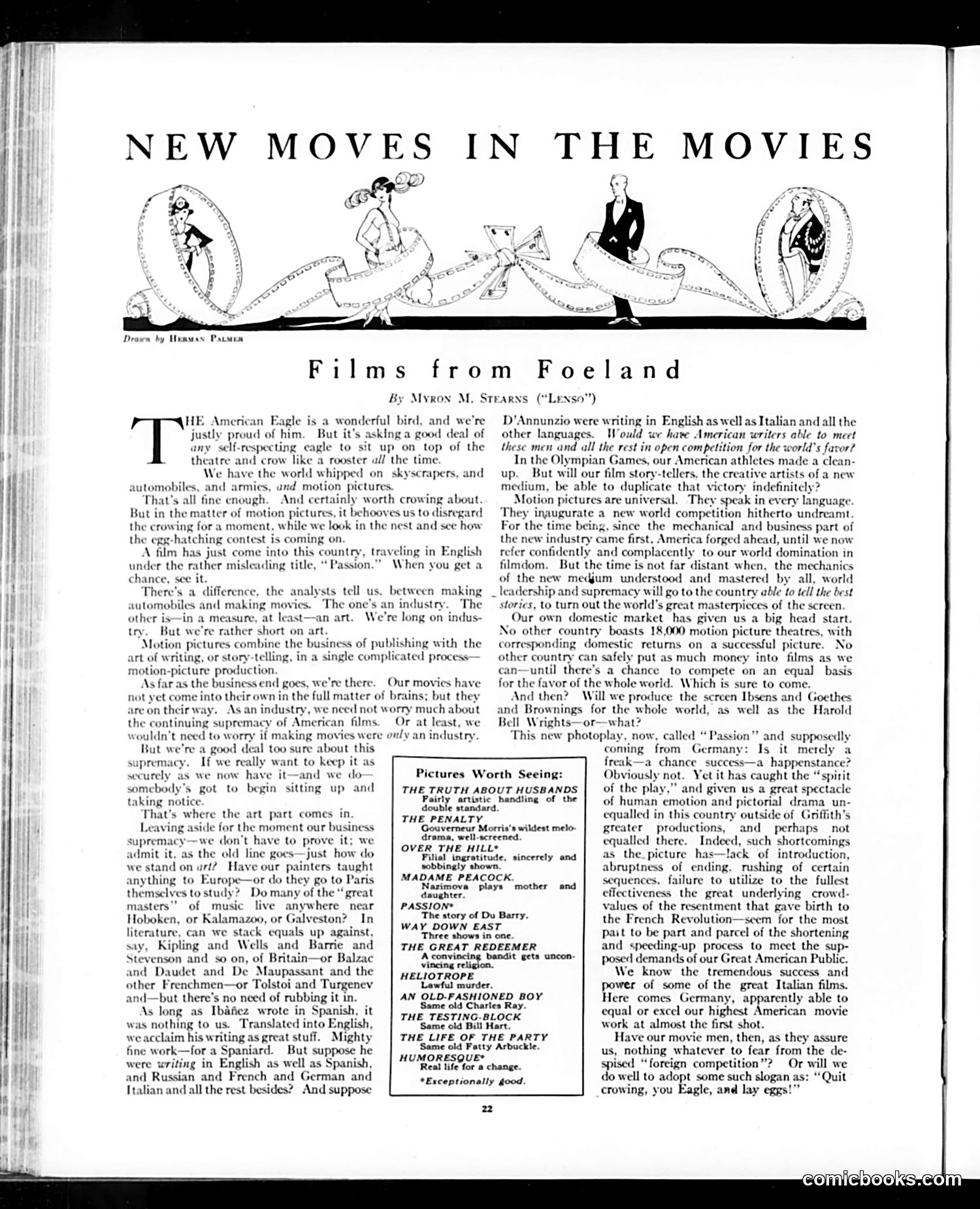
This page from *Judge* magazine discusses American cinema's international competition, particularly regarding imported European films. The illustration at top depicts figures dancing along film strip, celebrating "new moves in the movies." The main article by Myron M. Stearns argues that while America dominates the *business* of filmmaking (production scale, infrastructure), it lags in *artistic* merit compared to European cinema. He references a German film titled "Passion" coming to American theaters, questioning whether American filmmakers can compete creatively with European writers and artists. Stearns uses the metaphor of the American Eagle: we crow about industrial superiority but neglect artistic development. He contends that without cultivating storytelling talent comparable to European masters (Tolstoy, Balzac, etc.), American cinema's supremacy won't last. The accompanying "Pictures Worth Seeing" box lists current films with brief critiques, indicating *Judge's* film coverage for contemporary audiences.
📄 Transcribed text from this page (OCR, searchable)
Machine-transcribed from the original scan — historical spelling and the odd misread are preserved.
j Drawn by Ui Films By Myron M. Ste HE American Eagle is a wonderful bird, and we're justly proud of him. But it’s asking a good deal of any self-respecting eagle to sit up on top of the theatre and crow like a rooster all the time. We have the world whipped on skyscrapers, and automobiles, and armies, and motion pictures. That's all fine enough. And certainly worth crowing about But in the matter of motion pictures, it behooves us to disregard the crowing for a moment, while we look in the nest and see how the egg-hatching contest is coming on. A film has just come into this count under the rather misleading title, “ Passion.”” chance, see it. There’s a difference, the analysts tell us, between making automobiles and making movies. The one’s an industry. The other is—in a measure, at least—an art. We're long on indus- try. But we're rather short on art Motion pictures combine the business of publishing with the art of writing, or story-telling, in a single complicated process— motion-picture production. As far as the business end goes, we're there. Our movies have not yet come into their own in the full matter of brains; but they are on their w As an industry, we need not worry much about the continuing supremacy of American films. Or at least, we wouldn't need to worry if making movies were only an industry But we're a good deal too sure about this supremacy. If we really want to keep it as securely as we now have it—and we do somebody's got to begin sitting up and taking notice. That's where the art part comes in. Leaving aside for the moment our business supremacy—we don't have to prove it; we admit it, as the old line goes—just how do we stand on urt? Have our painters taught anything to Europe—or do they go to Paris themselves to study? Do many of the “great masters” of music live anywhere near Hoboken, or Kalamazoo, or Galveston? In literature, can we stack equals up against, say, Kipling and Wells and Barrie and Stevenson and so on, of Britain—or Balzac and Daudet and De Maupassant and the other Frenchmen—or Tolstoi and Turgenev and—but there’s no need of rubbing it in. As long as Ibafez wrote in Spanish, it was nothing to us. slated into English, traveling in English When you get a THE TRUTH ABO. Fairly artistic double THE PENALTY MADAME PEACO: daughter. PASSION* WAY DOWN EAS Three shows in vincing religion. HELIOTROPE Lawful murder. Same old Bill Hi we acclaim his writing as great stuff. Mighty THE LIFE OF THE PARTY fine work—for a Spaniard. But suppose he HUMORESOURST Aceh, were writing in English as wel Spanish, Real life for a change. and Russ and French and German and Italian and all the rest besides? And suppose _ leadership and suprem: Pictures Worth Seeing: andard, Gouverneur Morris’s wildest melo- drama, well-screened. OVER THE HILL* Filial ingratitude, sincerely and sobbingly shown. Nazimova plays The story of Du Barry. THE GREAT REDEEMER ‘A convincing bandit gets uncon- AN OLD-FASHIONED BOY Same old Charles Ray. THE TESTING-BLOCK *Exceptionally good. MOVES IN THE MOVIES i from Foeland ARNS (“LENSO D'Annunzio were writing in English as well as Italian and all the other languages. Would we have American writers able to meet these men and all the rest in open competition for the world’s favor? In the Olympian Games, our American athletes made a clean- up. But will our film story-tellers, the creative artists of a new medium, be able to duplicate that victory indefinitely: Motion pictures are universal. They speak in every language. They inaugurate a new world competition hitherto undreamt For the time being, since the mechanical and business part of the new industry came first, America forged ahead, until we now refer confidently and complacently to our world domination in filmdom. But the time is not far distant when, the mechanics of the new medjum understood and mastered by all, world "y will go to the country able to tell the best stories, to turn out the world’s great masterpieces of the screen Our own domestic market has given us a big head start. No other country boasts 18,000 motion picture theatres, with corresponding domestic returns on a successful picture. No other country can safely put as much money into films as we can—until there’s a chance to compete on an equal basis for the favor of the whole world. Which is sure to come. And then? Will we produce the screen Ibsens and Goethes and Brownings for the whole world, as well as the Harold Bell Wrights—or—what? This new photoplay, now, called “Passion” and supposedly coming from Germany: Is it merely freak—a chance success—a happenstance Obviously not. Yet it has caught the “spirit of the play,” and given us a great spectacle of human emotion and pictorial drama un- equalled in this country outside of Griffith's greater productions, and perhaps not equalled there. Indeed, such shortcomings as the picture has—lack of introduction, abruptness of ending, rushing of certain sequences, failure to utilize to the fullest effectiveness the great underlying crowd- values of the resentment that gave birth to the French Revolution—seem for the most pait to be part and parcel of the shortening and speeding-up process to meet the sup- posed demands of our Great American Public. We know the tremendous success and power of some of the great Italian films. Here comes Germany, apparently able to equal or excel our highest American movie work at almost the first shot. Have our movie men, then, as they assure us, nothing whatever to fear from the de- spised “foreign competition”? Or will we do well to adopt some such slogan “Quit crowing, you Eagle, and lay eggs! UT HUSBANDS handling of the CK. ‘mother and re one. jart.