
Judge, 1920-12-18 · page 18 of 32
Judge — December 18, 1920 — page 18: what you’re looking at
What you’re looking at
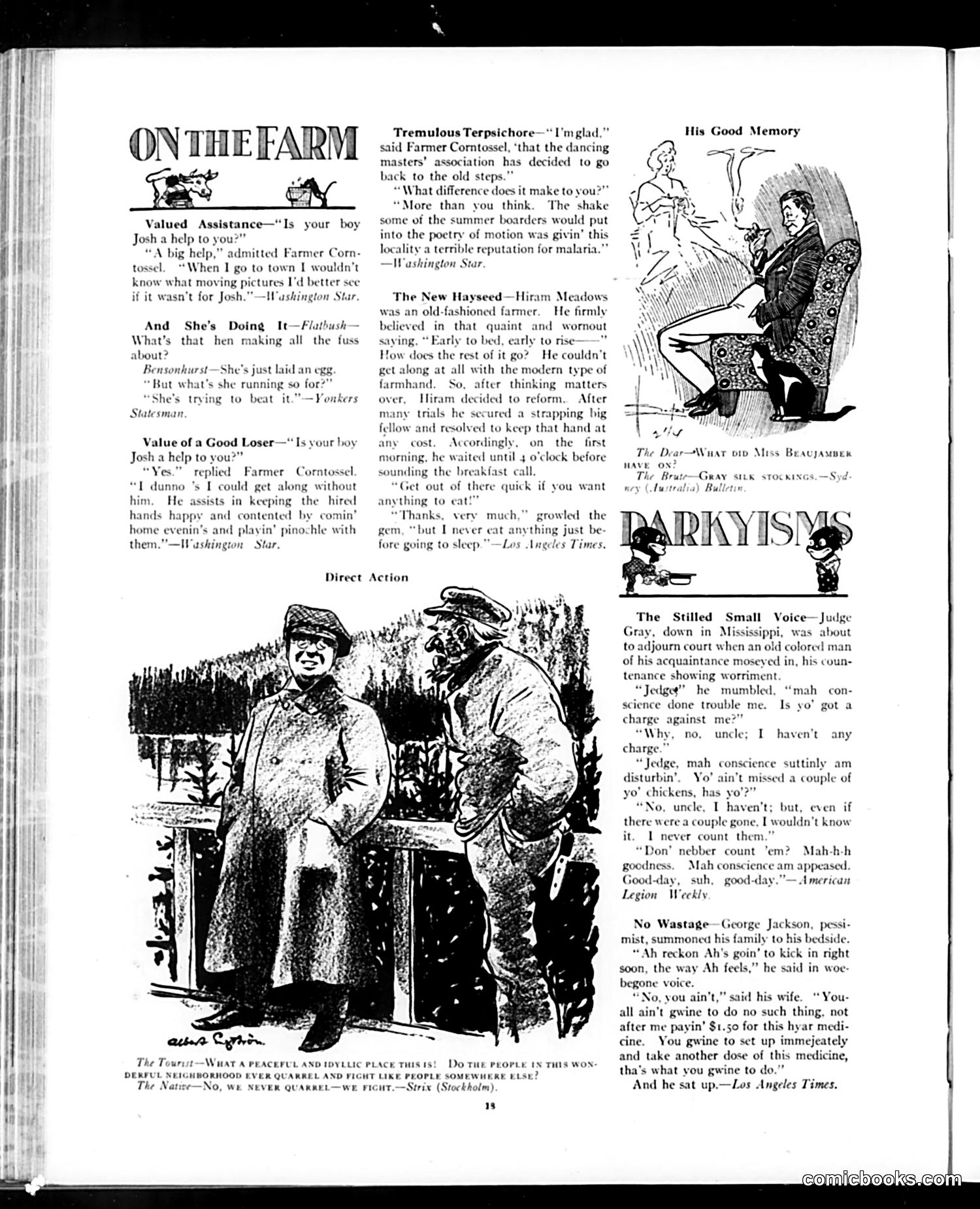
This page from *Judge* contains several short humorous anecdotes typical of early 20th-century American humor. The cartoons and jokes mock rural/farming life and period stereotypes: **"Direct Action"** (main illustration): Two farmers discuss their neighborhood's peacefulness. The joke plays on language—a tourist assumes "quarrel" means argue, but locals clarify they "fight" instead, suggesting rural violence as normal behavior. **Other rural humor**: Multiple brief jokes satirize farmers and rustic characters, including Farmer Corntossel (a recurring figure), who provides comic perspective on modern life—moving pictures, dancing, and farmhand management. The "New Hayseed" story jokes about old-fashioned work habits clashing with modern workers. **Dialect humor**: Several jokes feature African American characters rendered in heavy dialect, reflecting period conventions (though offensive by modern standards). These center on folk wisdom, conscience, and practical concerns. The overall tone is gentle mockery of rural simplicity versus modern complexity, typical of urban-oriented *Judge* magazine humor aimed at educated readers.
📄 Transcribed text from this page (OCR, searchable)
Machine-transcribed from the original scan — historical spelling and the odd misread are preserved.
| | help,” admitted Farmer Corn- tossel. “When I go to town I wouldn’t know what moving pictures I'd better see if it wasn't for Josh.” —Washington Star. And She's Doing It—Flathush What's that hen making all the fuss about? Bensonhurst—She’s just laid an egg. But what's she running so for?” “She's trying to beat it.’—Yonkers Statesman Value of a Good Loser—* Is your boy Josh a help to you?” “Yes.” replied Farmer Corntossel I dunno ’s I could get along without him. He assists in keeping the hired hands happy and contented by comin’ home evenin’s and playin’ pinochle with them.” —IWashingi Star, Tremulous Terpsichore—" I'mglad,” said Farmer Corntossel, ‘that the dancing masters’ association has decided to go back to the old steps.” “What difference does it make to you?” “More than you think. The shake some of the summer boarders would put into the poctry of motion was givin’ this locality a terrible reputation for malaria.” —Washington Star The New Hayseed—Hiram Meadows was an old-fashioned farmer. He firmly believed in that quaint and wornout saying, “Early to bed, early to rise——”" How does the rest of it go? He couldn't get along at all with the modern type of farmhand. So, after thinking matters over, Hiram decided to reform. After many trials he secured a strapping big fellow and resolved to keep that hand at any cost. Accordingly, on the first morning, he waited until 4 o'clock before sounding the breakfast call. “Get out of there quick if you want anything to eat! “Thanks, very much,” growled the gem, “but [I never cat anything just be fore going to sleep." —Los Angeles Times. Direct Action The Towrist -WUat A PEACEFUL AND IDYLLIC PLACE THIS 18 DERFUL NEIGHBORHOOD EVER QUARREL AND FIGHT LIKE PEOPLE SOMEWHERE ELSE 0, WE NEVER QUARREL—WE FIGHT.—Strix (Stockholm) The Native—Ni Do THe PeOPLE IN THIS WON 13 His Good Memory The Dear—Wuar viv Miss Beavyaupen HAVE ON? The Brute—Geay six stocnines.—Syd. C fustralia) Bulletin The Stilled Small Voice—Judge Gray, down in Mississippi, was about to adjourn court when an old colored man of his acquaintance moseyed in, his coun- tenance showing worriment “Jedgey” he mumbled, “mah con- science done trouble me. Is yo" got a charge against m “Why, no, uncle; I haven't any charge.” Jedge, mah conscience suttinly am disturbin’. Yo! ain't missed a couple of yo’ chickens, has yo'?” “No, uncle, I haven't; but, even if there were a couple gone. I wouldn't know it. I never count them.” “Don’ nebber count 'em? Mah-h-h goodness. m appeased Good-day, suh, good-day.”—A merican Legion Weekly Mah conscience No Wastage—George Jackson, pessi- mist, summoned his family to his bedside. “Ah reckon Ah's goin’ to kick in right soon, the way Ah feels,”” he said in woe- begone voice. “No, you ain't,” said his wife. ‘ You- all ain't gwine to do no such thing, not after me payin’ $1.50 for this hyar medi- cine. You gwine to set up immejeately and take another dose of this medicine, tha’s what vou gwine to do.” And he sat up.—Los Angeles Times.