
Judge, 1920-12-18 · page 20 of 32
Judge — December 18, 1920 — page 20: what you’re looking at
What you’re looking at
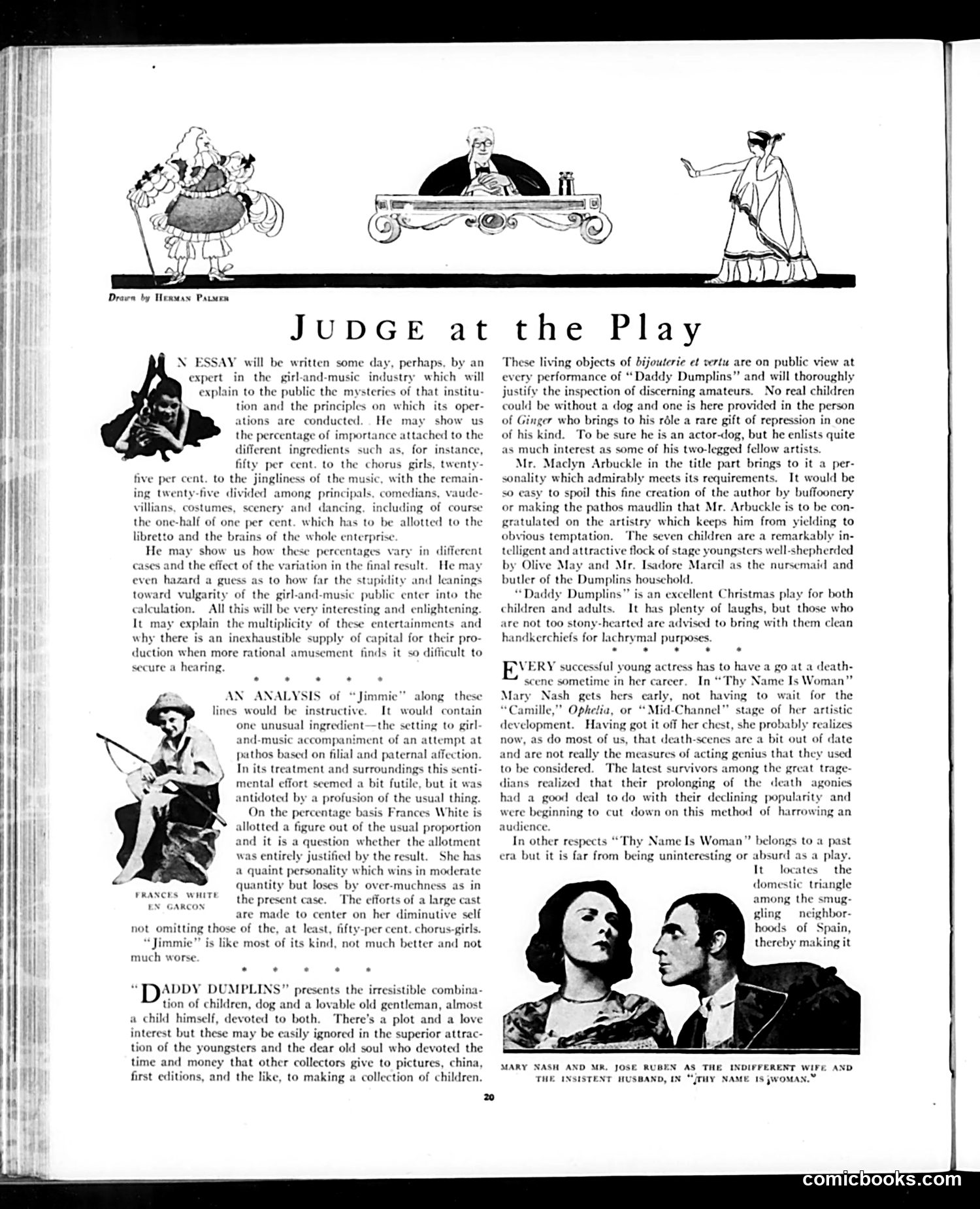
This page contains theatrical reviews from *Judge* magazine's drama section. The top illustration by Herman Palmer depicts a judge (literally) overseeing theatrical productions—a visual pun on the magazine's "Judge at the Play" column. The reviews critique two Broadway productions. "Jimmie" is dismissed as typical girl-and-music entertainment where the reviewer sarcastically calculates that chorus girls comprise 50% of the appeal, with music, principals, and actual plot relegated to minimal percentages. Actress Frances White receives a mixed assessment: charming in moderation but exhausting in excess. "Daddy Dumplins" receives more praise, praised for featuring child actors and a dog as genuine attractions rather than mere plot devices. Actor Maclyn Arbuckle is commended for avoiding maudlin sentimentality. The final photograph shows Mary Nash and Jose Ruben in the Spanish-set domestic drama "Thy Name Is Woman." The satire targets Broadway's commercial formula: lavish production values prioritize spectacle over substance, with genuine artistry being secondary to audience manipulation.
📄 Transcribed text from this page (OCR, searchable)
Machine-transcribed from the original scan — historical spelling and the odd misread are preserved.
Draws by Heaway Patan N ESSAY will be written some day, perhaps. by an expert in the girl-and-music industry which will explain to the public the mysteries of that institu- tion and the principles on which its oper- ations are conducted. He may show us the percentage of importance attached to the different ingredients such as, for instance, fifty per cent. to the chorus girls, twenty- five per cent. to the jingliness of the music, with the remain- ing twenty-five divided among principals, comedians, vaude villians, costumes, scenery and dancing, including of course the one-half of one per cent. which has to be allotted to the libretto and the brains of the whole enterprise. He may show us how these percentages vary in different { cases and the effect of the variation in the final result. He may even hazard a guess as to how far the stupidity and leanings toward vulgarity of the girl-and-music public enter into the calculation. All this will be very interesting and enlightening. It may explain the multiplicity of these entertainments and why there is an inexhaustible supply of capital for their pro- 1 duction when more rational amusement finds it so difficult to secure a hearing. Tl Z AN ANALYSIS of “Jimmie” along these lines would be instructive. It would contain one unusual ingredient—the setting to girl and-music ‘ompaniment of an attempt at pathos based on filial and paternal affection. In its treatment and surroundings this senti- mental effort seemed a bit futile, but it was antidoted by a profusion of the usual thing. On the percentage basis Frances White is allotted a figure out of the usual proportion and it is a question whether the allotment was entirely justified by the result. She has a quaint personality which wins in moderate quantity but loses by over-muchness as in the present case. The efforts of a large cast are made to center on her diminutive self not omitting those of the, at least, fifty-per cent. chorus-girls. | “Jimmie” is like most of its kind, not much better and not | much worse. FRANCES. EN GARCON : ADDY DUMPLINS” presents the irresistible combina- tion of children, dog and a lovable old gentleman, almost a child himself, devoted to both. There’s a plot and a love interest but these may be casily ignored in the superior attrac- tion of the youngsters and the dear old soul who devoted the time and money that other collectors give to pictures, china, first editions, and the like, to making a collection of children. ie JUDGE at the Play 20 These living objects of bijouterie et vertu are on public view at every performance of “Daddy Dumplins” and will thoroughly justify the inspection of discerning amateurs. No real children could be without a dog and one is here provided in the person of Ginger who brings to his réle a rare gift of repression in one of his kind. To be sure he is an actor-dog, but he enlists quite as much interest as some of his two-legged fellow artists. Mr. Maclyn Arbuckle in the title part brings to it a per- sonality which admirably meets its requirements. It would be asy to spoil this fine creation of the author by buffoonery or making the pathos maudlin that Mr. Arbuckle is to be con- gratulated on the artistry which keeps him from yielding to obvious temptation. The seven children are a remarkably in- telligent and attractive flock of stage youngsters well-shepherded by Olive May and Mr. Isadore Marcil as the nursemaid and butler of the Dumplins household. “Daddy Dumplins” is an excellent Christmas play for both children and adults. It has plenty of laughs, but those who are not too stony-hearted are advised to bring with them clean andkerchiefs for lachrymal purposes. so VERY successful young actress has to have a go at a death- scene sometime in her career. In “Thy Name Is Woman” Mary Nash gets hers early, not having to wait for the Camille,” Ophelia, or “ Mid-Channel” stage of her artistic development. Having got it off her chest, she probably realizes now, as do most of us, that death-scenes are a bit out of date and are not really the measures of acting genius that they used to be considered. The latest survivors among the great trage- dians realized that their prolonging of the death agonies had a good deal to do with their declining popularity and were beginning to cut down on this method of harrowing an audience. In other respects “Thy Name Is Woman” belongs to a past era but it is far from being uninteresting or absurd as a play. It locates the domestic triangle mong the smug- gling — neighbor- hoods of Spain, thereby making it MARY NASH AND MR. JOSE RUBEN THE INSISTENT HUSBAND, AS THE INDIFFERENT wire ‘JTUY NAME 18 jWOMAN. AND comicbooks.com