
A complete issue · 32 pages · 1920
Judge — December 4, 1920
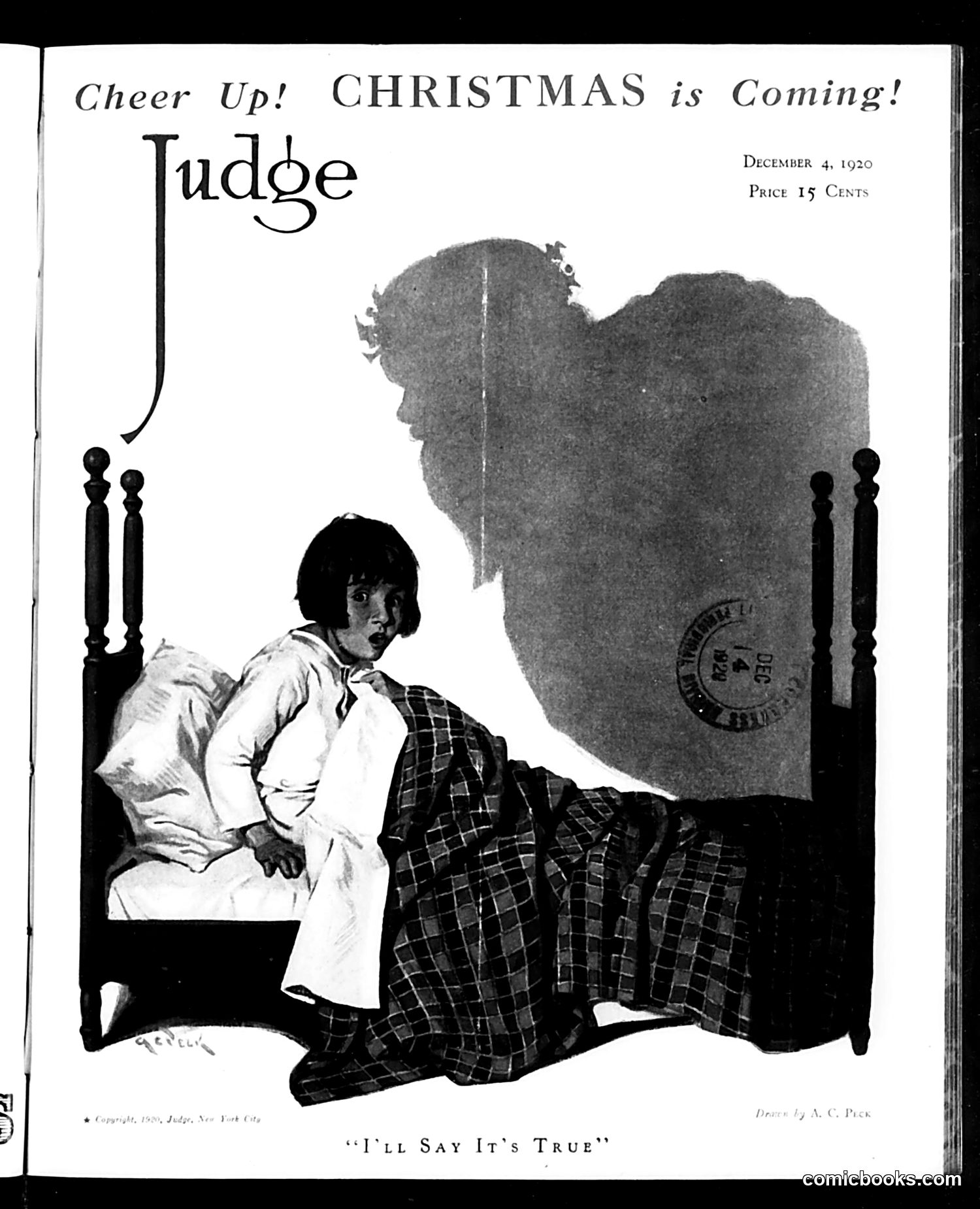
This Christmas-themed cover depicts a woman sitting on a bed, startled by a large silhouette of a man's head appearing on the wall behind her. The caption reads "I'll Say It's True," suggesting gossip or rumor-spreading. The satire likely comments on scandalous rumors or affairs circulating in 1920s society—a time of significant social change following WWI. The woman's shocked expression and the theatrical shadow effect humorously illustrate how gossip and innuendo spread through parlors and bedrooms of polite society. The Christmas headline ("Cheer Up! Christmas is Coming!") provides ironic contrast to the potentially scandalous scenario depicted below, reflecting Judge's typical use of irony and social commentary on contemporary morality and reputation.
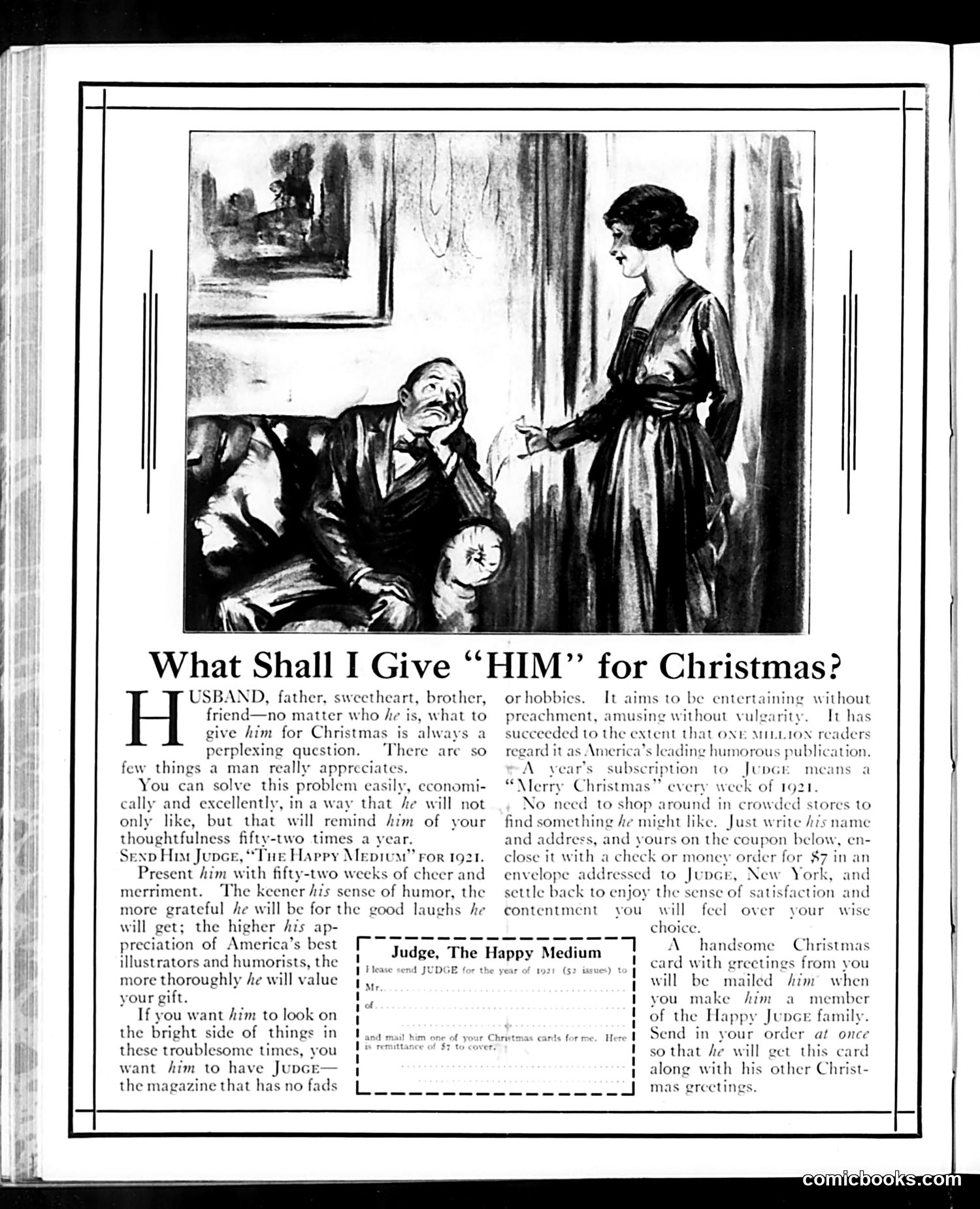
This appears to be primarily **advertising content** disguised as editorial advice, promoting a subscription to *Judge* magazine itself as a Christmas gift. The cartoon shows a woman offering a gift to a seated man (husband, father, or boyfriend—generically "HIM"), while he looks uncertain or unenthusiastic. The accompanying text argues that a year-long *Judge* subscription solves the perennial gift-giving problem for men. The pitch emphasizes *Judge*'s humor and illustrations will provide "cheer and merriment" throughout 1921, and claims the magazine reaches "over one million readers." A coupon offers to send a "handsome Christmas card" announcing the gift. This is essentially **gift marketing masquerading as lifestyle advice**—a common magazine promotional strategy of this era.
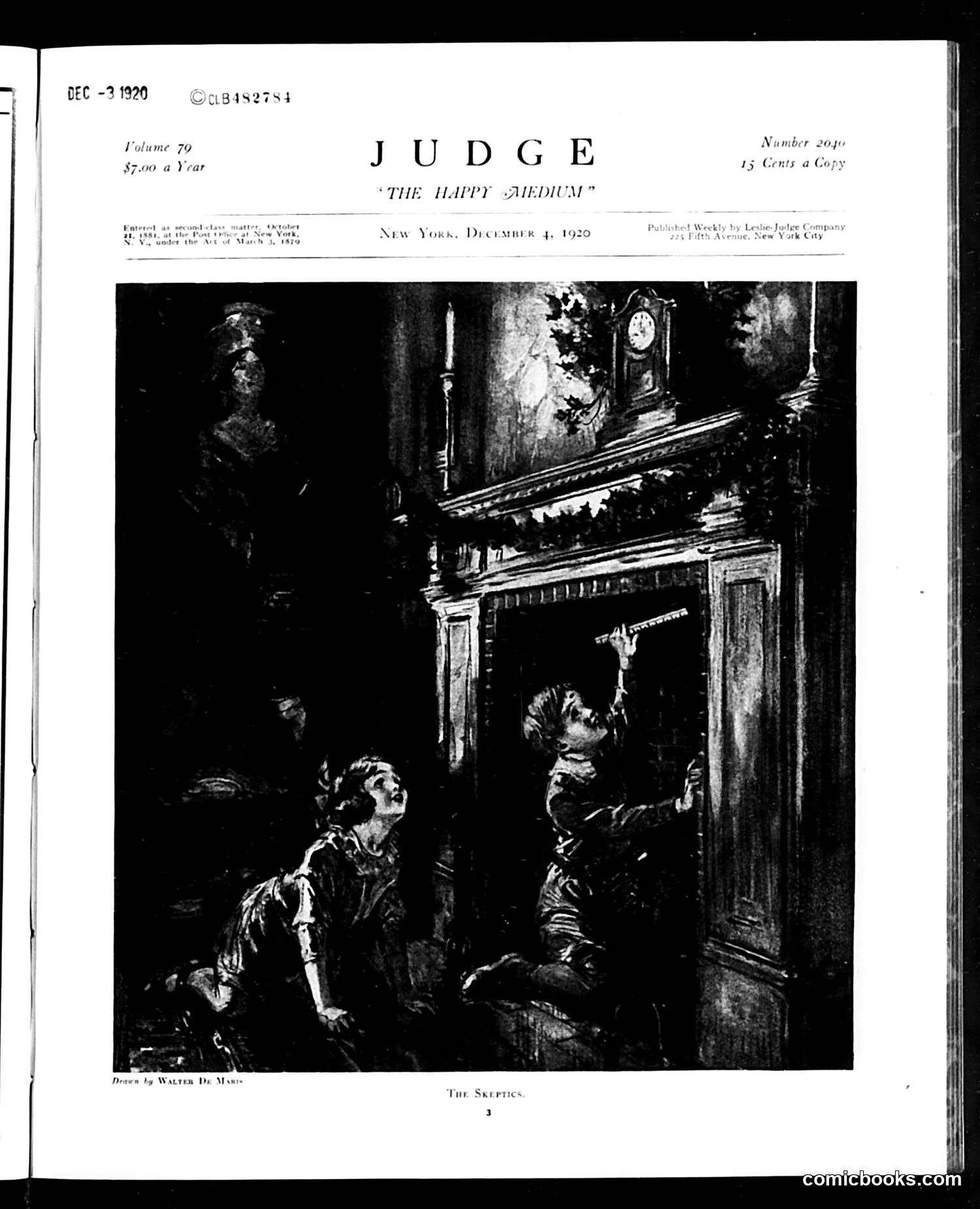
This illustration by Walter De Maris depicts two children gazing up a fireplace chimney, apparently looking for Santa Claus or evidence of his existence. The drawing is titled "The Skeptics." The satire likely references the post-Christmas period or the growing skepticism of children regarding Santa Claus mythology. Given the publication date of December 4, 1929—just days after the stock market crash of October 1929—there may be additional social commentary about lost faith and disillusionment during America's economic crisis. The children's upward gaze suggests doubt or questioning, embodying the broader cultural skepticism of the era. The composition emphasizes youthful innocence confronting harsh reality, whether regarding Santa or economic turmoil.
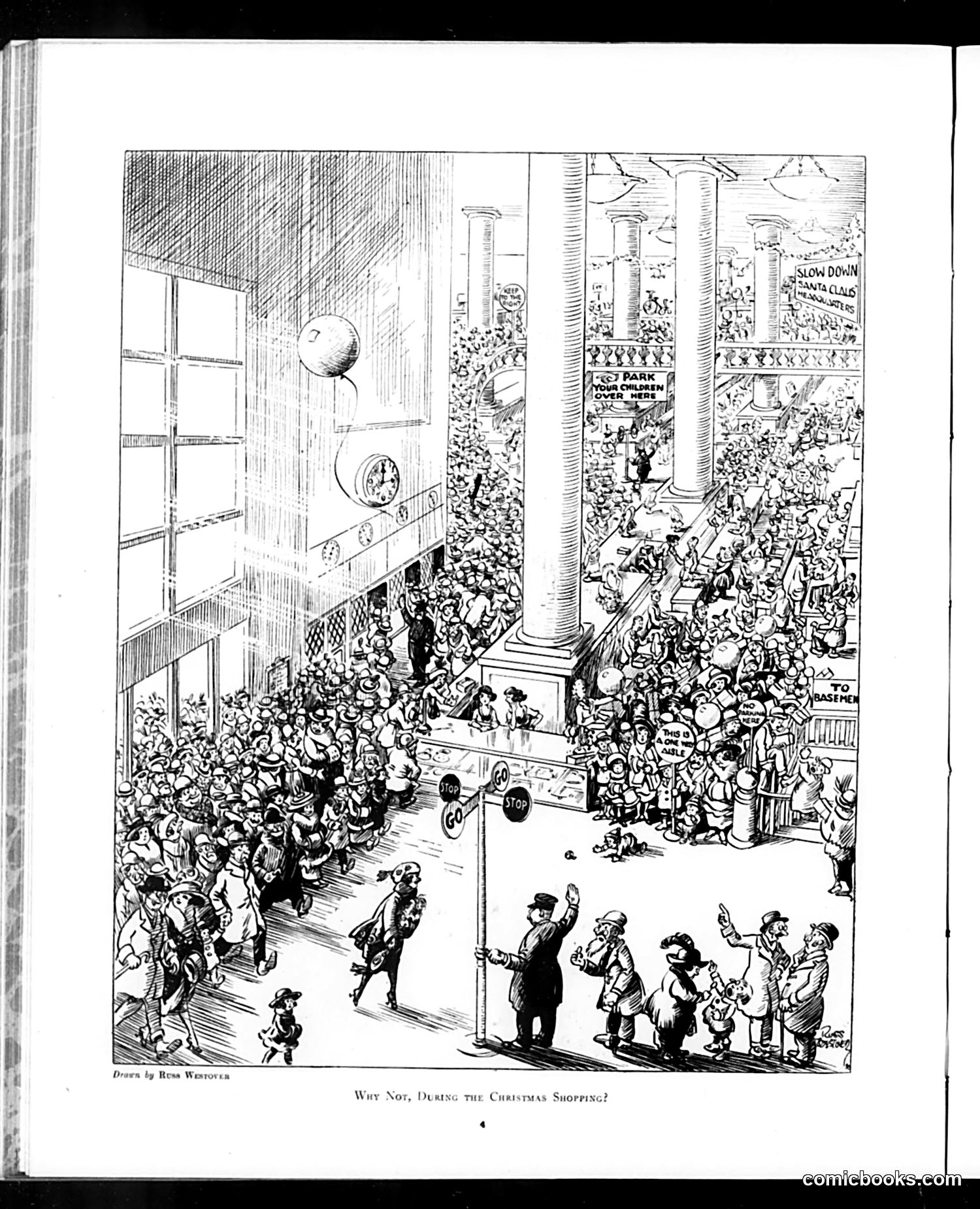
This cartoon by Ross Wentover satirizes the chaotic overcrowding of urban streets during Christmas shopping season. The scene shows a massive throng of pedestrians filling a city street, with a traffic policeman attempting to direct the crowd near a prominent column (appearing to be a public monument or building entrance). The satire targets the commercialization and madness of holiday shopping—the implication being that if crowds are this unmanageable anyway, why not also use the time for other purposes? The densely packed, frenzied composition emphasizes how shopping season transforms orderly city streets into barely-controllable human traffic jams. Store windows visible in background ("Slow Down Santa Claus," "Pet Park") suggest various retailers capitalizing on holiday commerce.
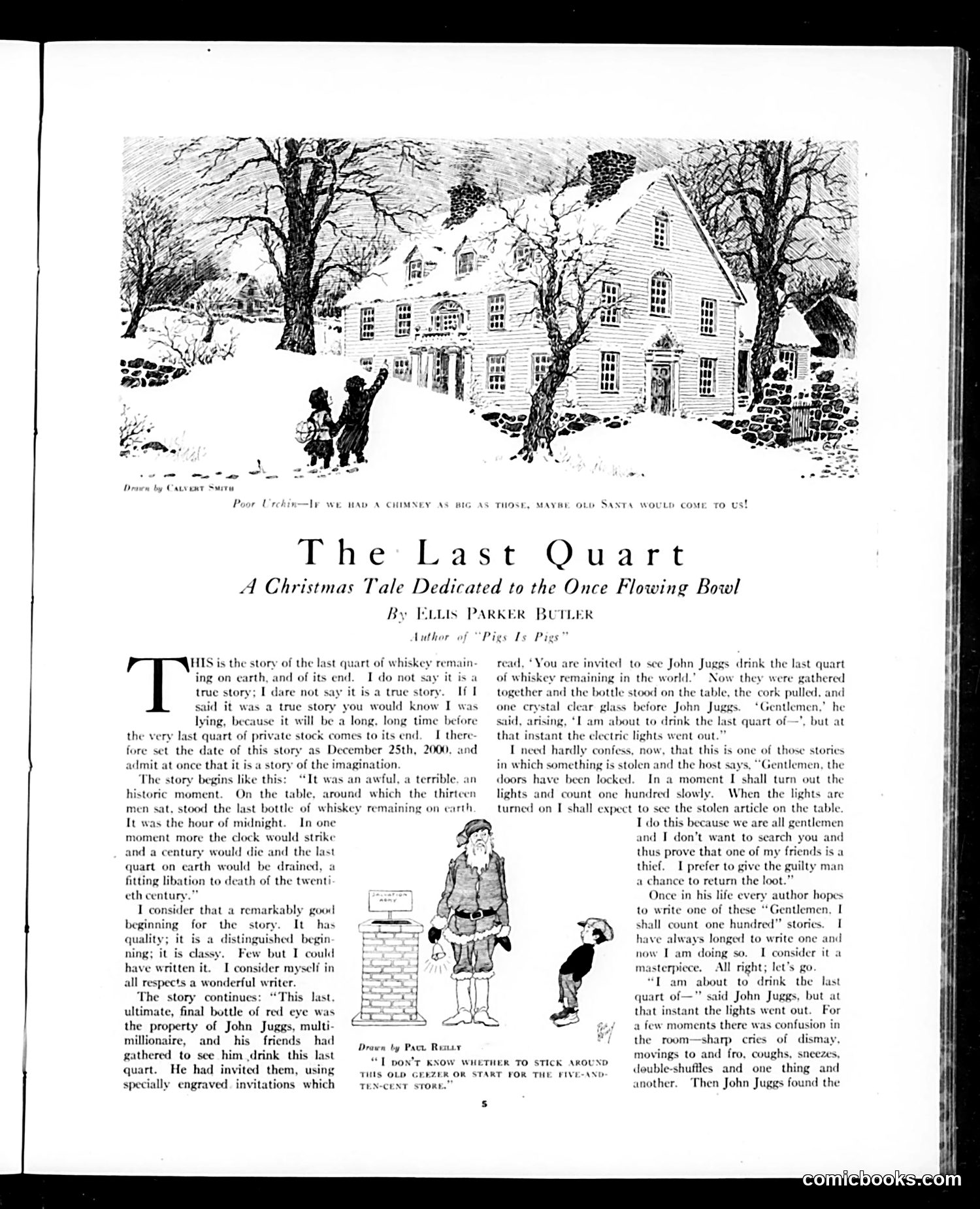
This page presents a short story by Ellis Parker Butler titled "The Last Quart," a satirical Christmas tale about the final bottle of whiskey remaining on Earth. The narrative concerns a wealthy man, John Juggs, who invites distinguished guests to witness him drink this last quart—an apparently absurd premise meant to mock both prohibition-era anxieties and the pretensions of wealthy collectors. The accompanying illustrations by Calvert Smith and Paul Bransom depict a snow-covered colonial house and John Juggs with his dog, visualizing the story's setting. The satire targets the obsessive materialism of the ultra-wealthy and the cultural anxieties surrounding alcohol scarcity, likely referencing Prohibition's impact on American society.
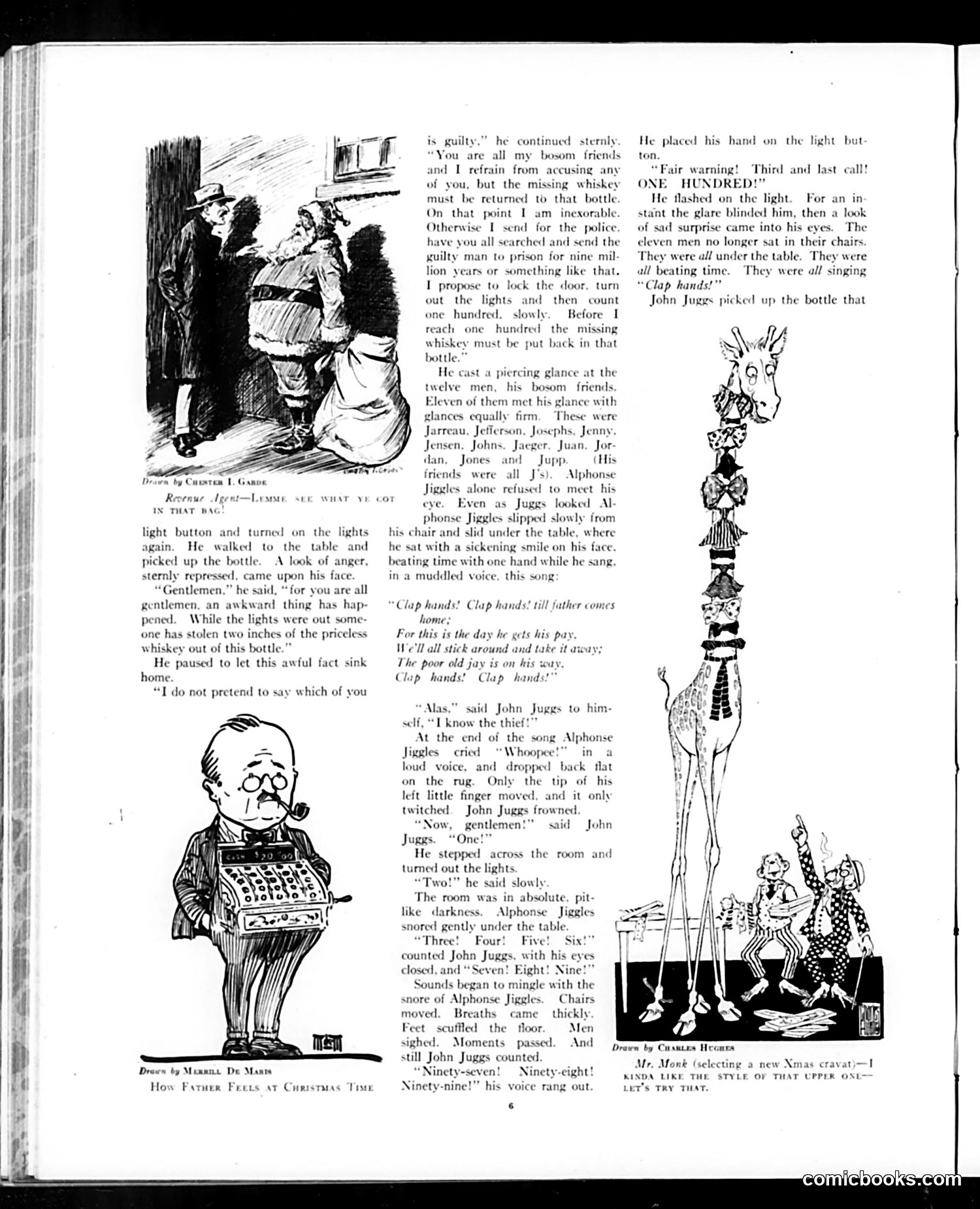
This page contains a satirical story about a missing whiskey bottle at a Christmas gathering. The narrative depicts a host (Alphonse Jiggles) discovering theft among his twelve "bosom friends" and devising a counting game to identify the guilty party. The left illustration by Merrell De Maris shows "How Father Feels at Christmas Time"—a portly gentleman with an accordion, likely satirizing sentimental holiday traditions. The right illustration by Charles Hughes depicts an exaggerated tall figure with children, captioned "Mr. Mook (selecting a new Xmas cravat)—I kinda like the style of that upper one—let's try that." The humor relies on period-specific references to holiday excess, theft among social circles, and fashion absurdity. Without additional context, the specific individuals or events referenced remain unclear, though the satirical tone targets contemporary holiday customs and social pretension.
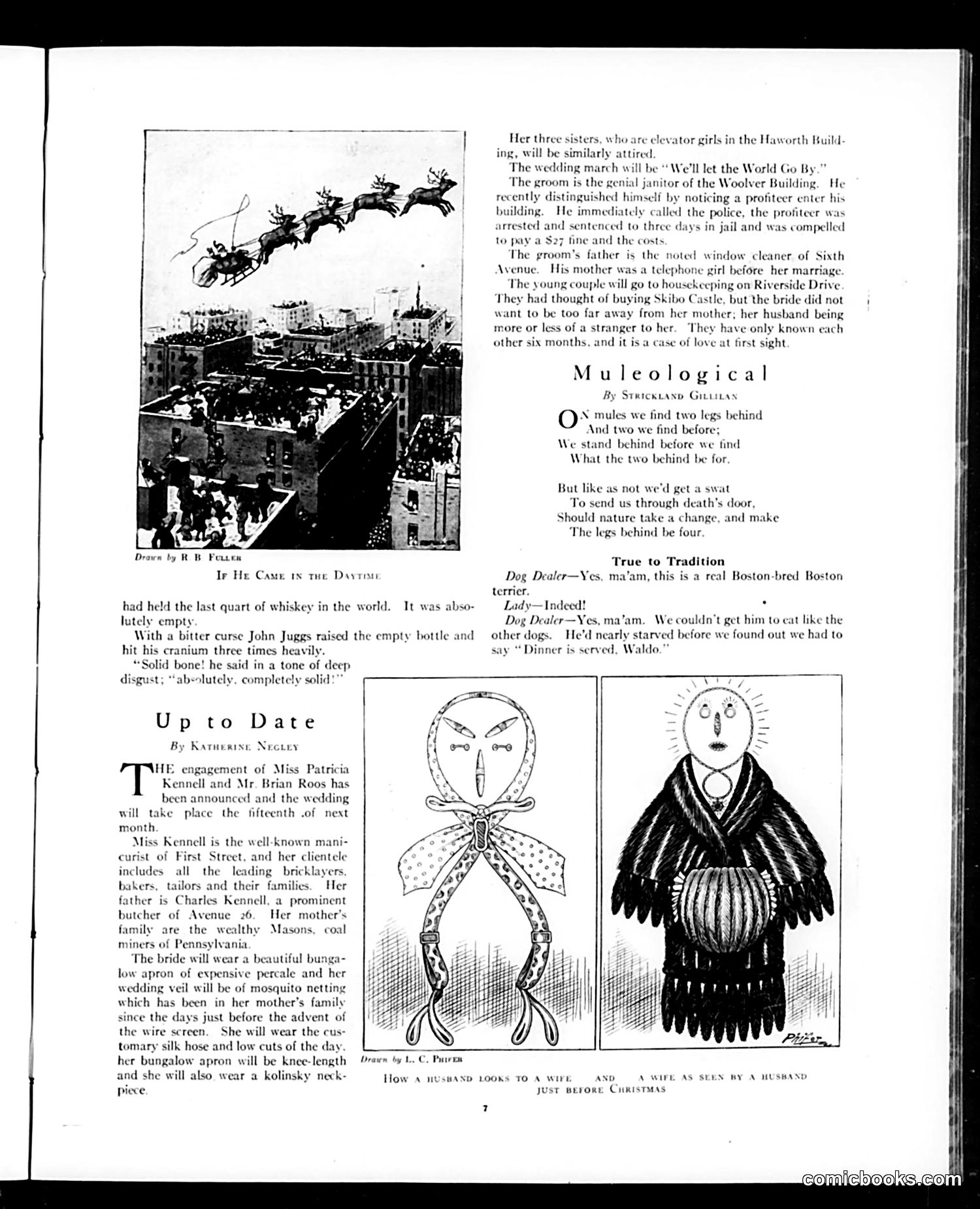
This Judge magazine page contains three satirical pieces: **"If He Came in the Daytime"** (top): A visual gag about a man so dense ("solid bone") that hitting his head with an empty whiskey bottle causes no damage. The humor relies on the absurdist premise and Prohibition-era whiskey references. **"Up to Date"** (middle): Social satire mocking working-class aspirations. A manicurist and building janitor get engaged; their families are tradespeople (butcher, coal miners, window cleaners). The joke is the ironic contrast: they plan to live on Riverside Drive (an upscale neighborhood) and considered buying Skibo Castle (Andrew Carnegie's Scottish estate), despite their modest backgrounds. "Up to date" sarcastically suggests their pretensions reflect modern social climbing. **"True to Tradition"** (bottom): A brief joke about a Boston terrier so aristocratic it requires formal dinner announcements. The cartoons on the right appear to be humorous figure studies unrelated to the text below them.
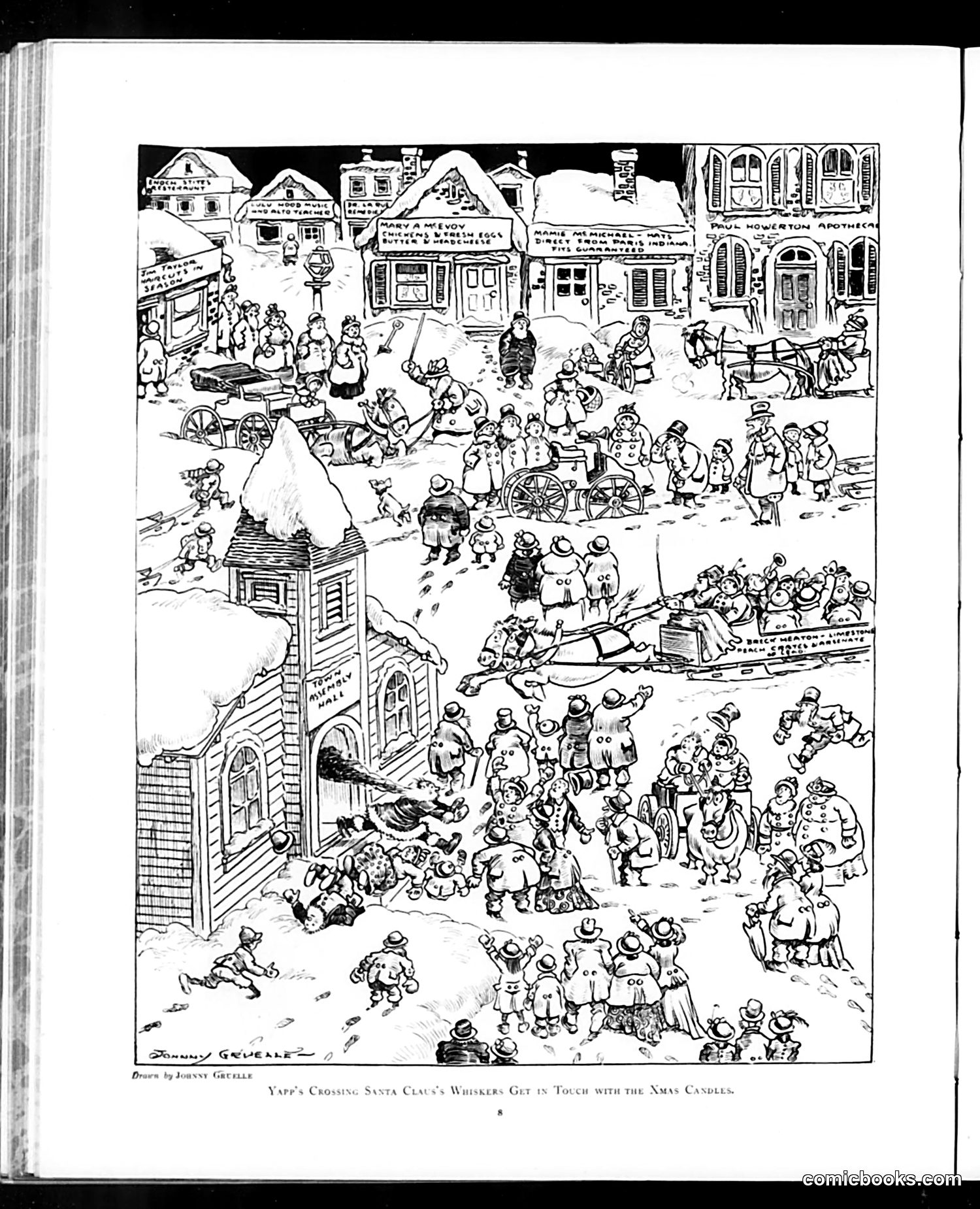
This is a winter scene by artist Johnny Gruelle titled "Yapp's Crossing: Santa Claus's Whiskers Get in Touch with the Xmas Candles." The cartoon depicts a crowded holiday celebration at what appears to be a small town or village square, with numerous figures enjoying winter activities around buildings and a prominent church or bell tower. The humor appears to reference Santa Claus's beard catching fire from Christmas candles—a physical comedy scenario typical of Judge magazine's satirical style. The chaotic scene with many characters suggests slapstick mishap. Without additional context about "Yapp's Crossing," the specific satirical target remains unclear, though the overall scene parodies holiday commercialization and village festivities common to early 20th-century American seasonal commentary.
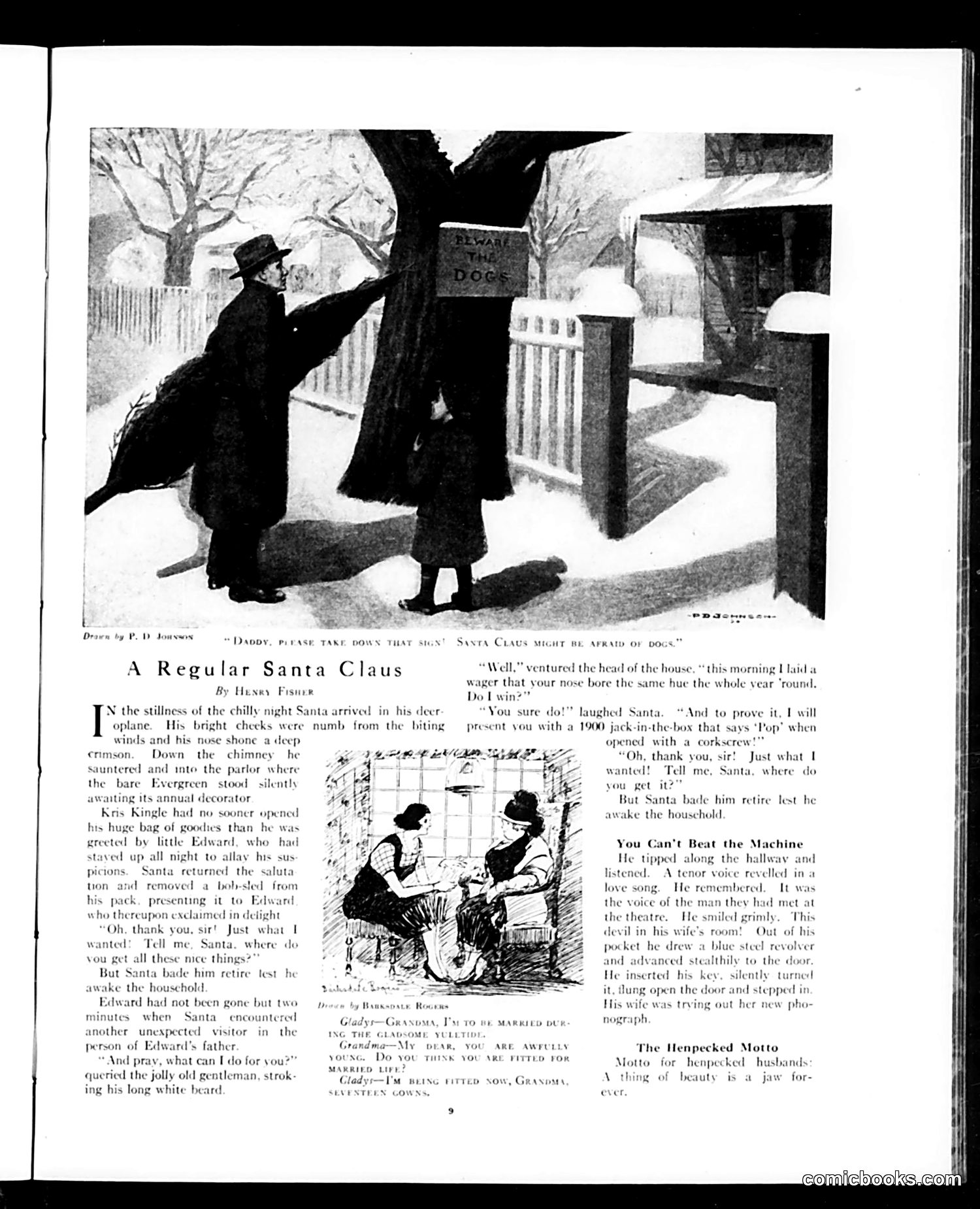
This page contains a humorous short story about Santa Claus visiting a household on Christmas Eve. The narrative follows Santa's encounter with a young boy named Edward who stays awake to catch him, then Santa's awkward meeting with Edward's father, who questions what Santa does for a living—a joke playing on Santa as an actual profession rather than mythology. The accompanying illustrations and comic scenarios satirize Victorian-era domestic life: a section titled "You Can't Beat the Machine" depicts a husband discovering his wife's infidelity through a phonograph recording, and "The Henpecked Motto" mocks marriages where husbands lack authority. The humor relies on period-specific anxieties about technology (phonographs as evidence), marital power dynamics, and the collision between childhood wonder and adult skepticism. The tone is lighthearted rather than biting social commentary.
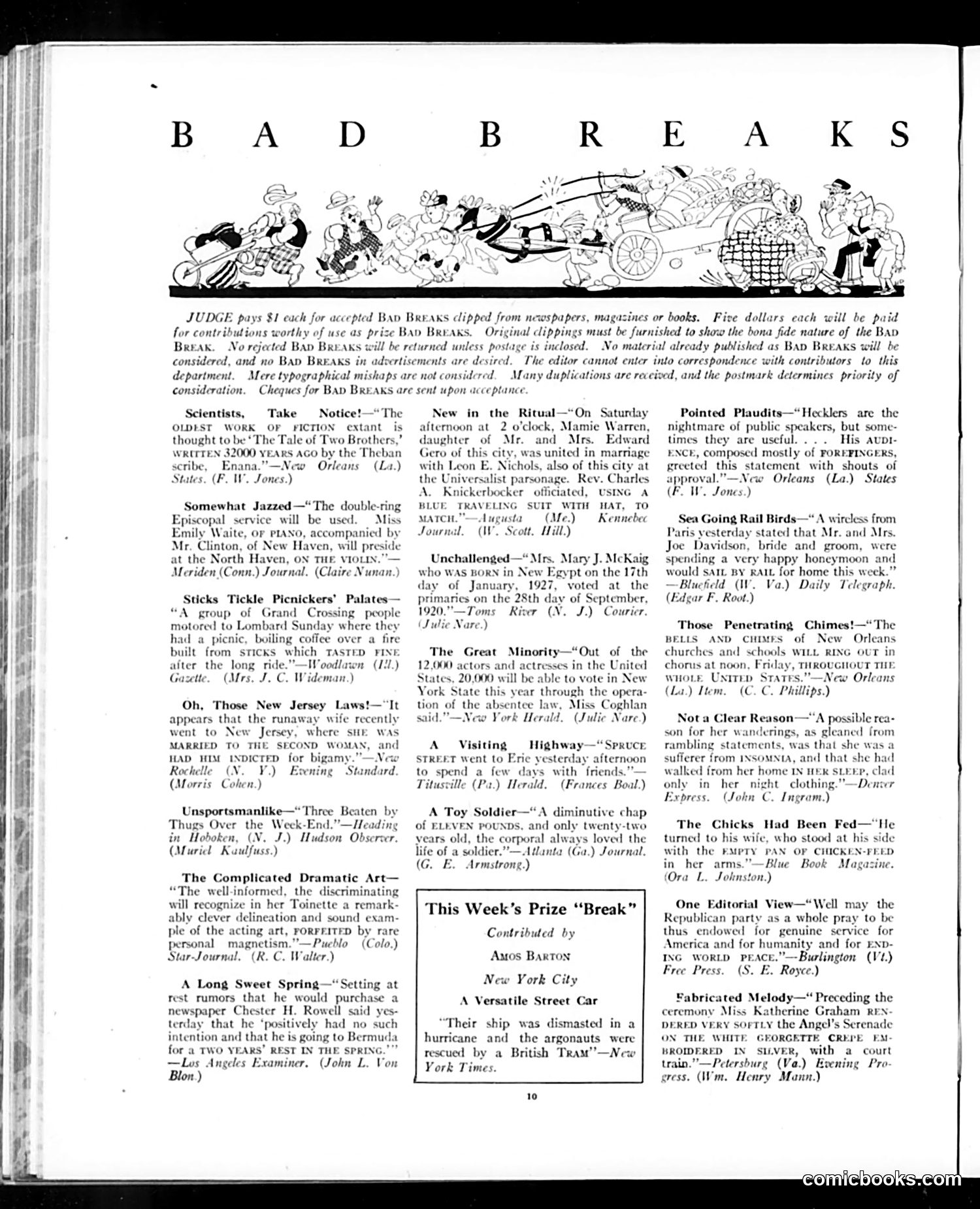
This page showcases **"Bad Breaks,"** Judge's humor column featuring unintentionally funny newspaper clippings—typographical errors, awkward phrasing, and logical absurdities from real newspapers. Readers submitted clippings for $1 each; Judge paid $5 weekly for the best. Examples include: - A wedding where the minister used "a blue traveling suit with hat" (unclear if the minister or bride wore it) - Math absurdity: "20,000 will be able to vote" out of "12,000 actors" - A "toy soldier" who was eleven pounds and twenty-two years old - A street car that rescued shipwreck survivors (confusing "car" with "crew") The humor relies on **reader familiarity with newspaper errors**—a popular early-20th-century pastime. The satire gently mocks sloppy journalism and editing rather than targeting political figures. This reflects pre-digital publishing's vulnerability to human error in typesetting and proofreading, making such mistakes far more common and amusing to contemporaries.
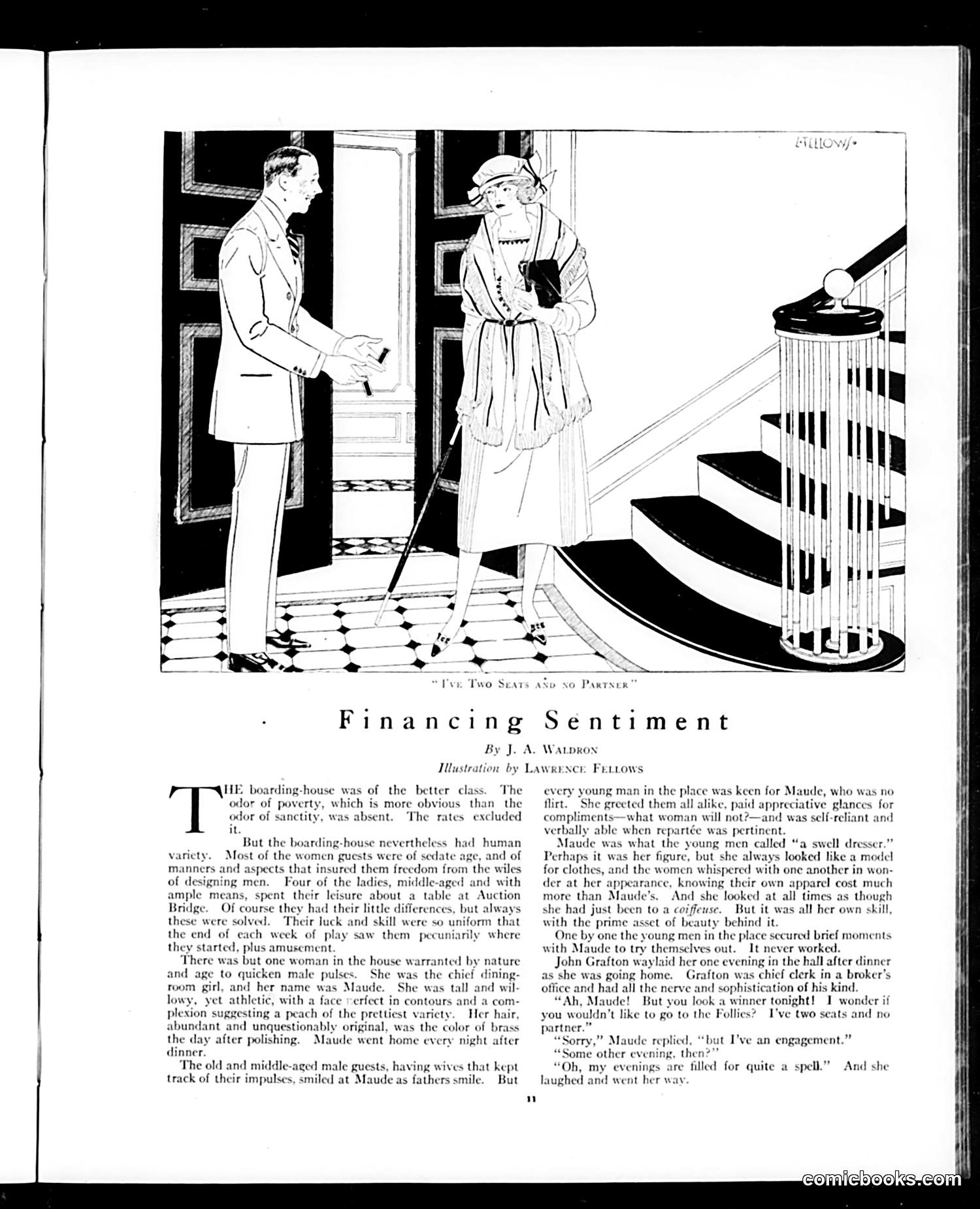
This is a romantic short story rather than political satire. The illustration shows a well-dressed man (John Grafton, a broker's clerk) attempting to court Maude, an attractive dining-room girl at a respectable boarding house. The satire targets *class and gender dynamics* of the era. Maude represents the "New Woman"—independent, well-dressed, self-reliant, and impervious to male advances despite her beauty. Young boarders repeatedly pursue her romantically, but she politely declines, maintaining her dignity and autonomy. The story's title suggests the joke: the men are financing their romantic "sentiment" (hoping to impress her with invitations to expensive venues like the Follies theater), but Maude resists commodification. She cannot be "purchased" through entertainment or attention, however sophisticated the suitor. The humor lies in exposing the gap between masculine presumption and female agency in early 20th-century courtship.
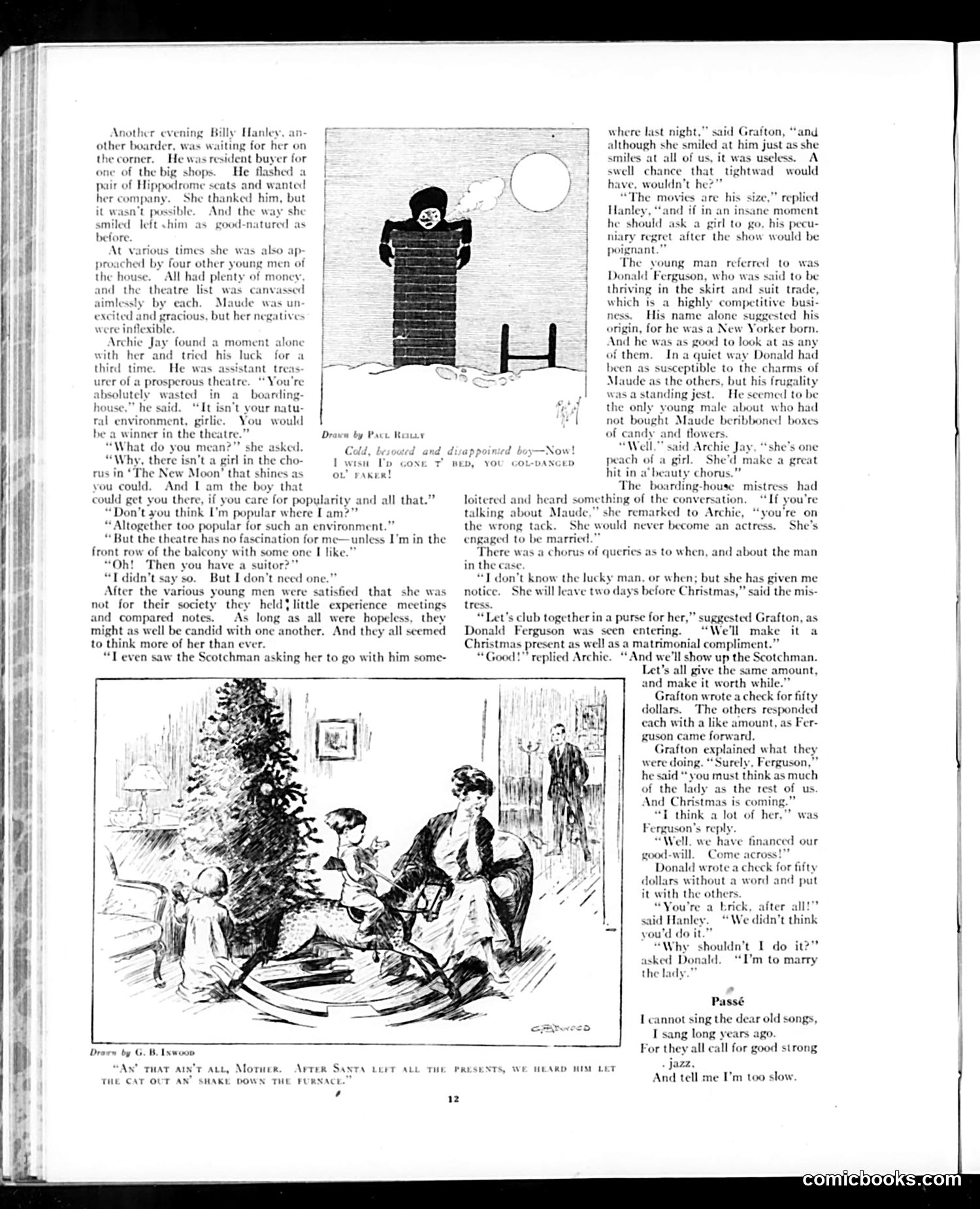
This page depicts a serialized romantic story about Maude, a boarding-house resident pursued by multiple young male lodgers. The narrative satirizes class dynamics and courtship customs of the era. **The Setup:** Various wealthy suitors (Archie Jay, Billy Hanley, Donald Ferguson) vie for Maude's attention through expensive gestures—theater tickets, lavish gifts. She politely refuses them all. **The Satire:** The joke centers on **Donald Ferguson**, a Scottish businessman in the skirt trade, whom the other men mock as a "tightwad" too cheap to court properly. They plan to embarrass him by collectively raising money for Maude as a Christmas gift. **The Twist:** Maude announces her engagement—to the very man they've been ridiculing. The final illustration shows the men gathered around a Christmas tree in awkward realization. **Social Commentary:** The piece gently mocks upper-class assumptions that wealth and theatrical glamour guarantee romantic success, while the frugal, practical man "wins." It reflects early 20th-century boarding-house culture and courtship norms among young urban professionals.
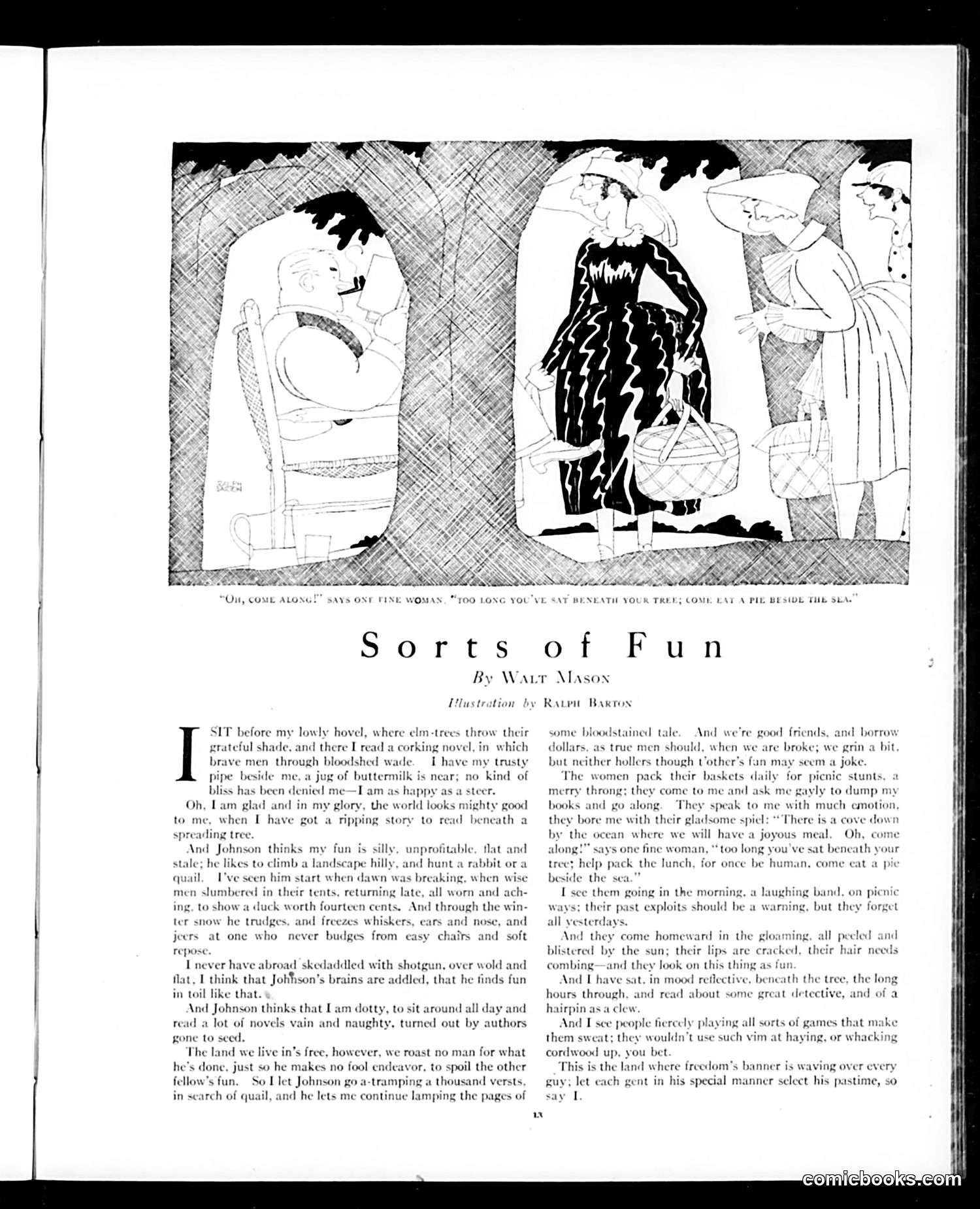
This is a humorous essay contrasting two rival philosophies of leisure. The narrator is a man who loves reading adventure novels beneath a tree, while his acquaintance Johnson prefers outdoor pursuits—hunting, hiking, and physical exertion. The piece gently satirizes both approaches: Johnson thinks the narrator is lazy and foolish for sedentary reading; the narrator considers Johnson's exhausting activities pointless. Women in the story represent a middle path, enjoying both social picnics and intellectual pursuits. The underlying message is characteristically American progressive-era optimism: in a free country, different people can pursue happiness differently without judgment. The phrase "freedom's banner is waving over every guy" emphasizes individual liberty to choose one's own amusements—whether books or outdoor adventure—as long as nobody spoils another's fun. The illustration shows a domestic scene, likely depicting the contrast between indoor and outdoor leisure activities discussed in the text.
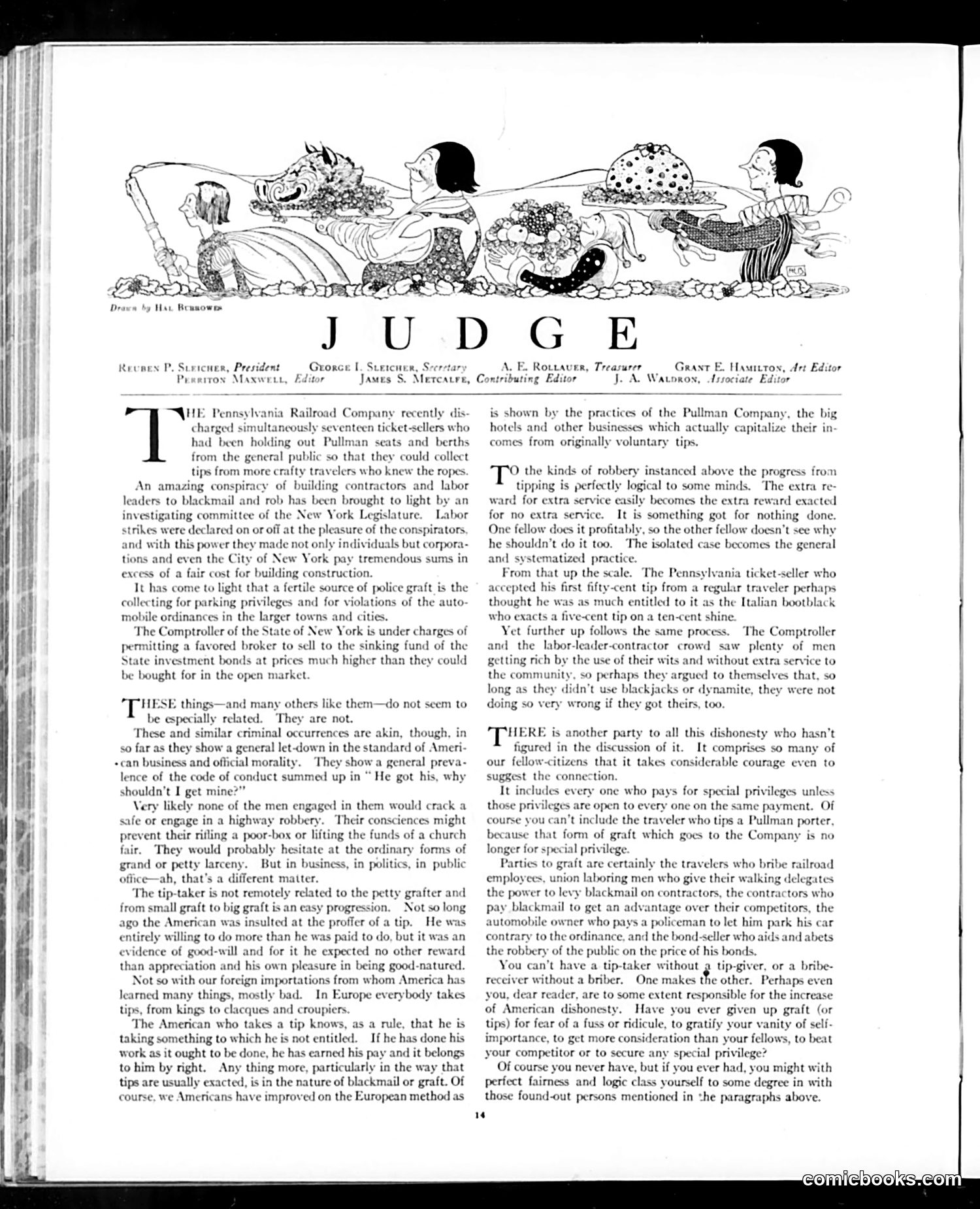
This editorial page attacks widespread corruption across American institutions. The illustration shows figures distributing various goods—likely representing different forms of graft and illegal profit-taking. The article connects seemingly unrelated scandals: Pennsylvania Railroad ticket-sellers withholding Pullman berths to extort tips; New York construction contractors blackmailing officials; police collecting bribes for parking violations; and a state comptroller manipulating bond sales. The satire's point: these aren't isolated crimes but symptoms of a cultural rot. The author argues Americans adopted the European practice of tipping—originally a voluntary gesture—and corrupted it into systematic extortion. Once profitable corruption begins, it spreads: "from small graft to big graft is an easy progression." The piece suggests that respectable businessmen and officials rationalize dishonesty in commerce and politics that they'd never attempt as street crime, using the logic "He got his, why shouldn't I get mine?" It's a jeremiad about American moral decline.
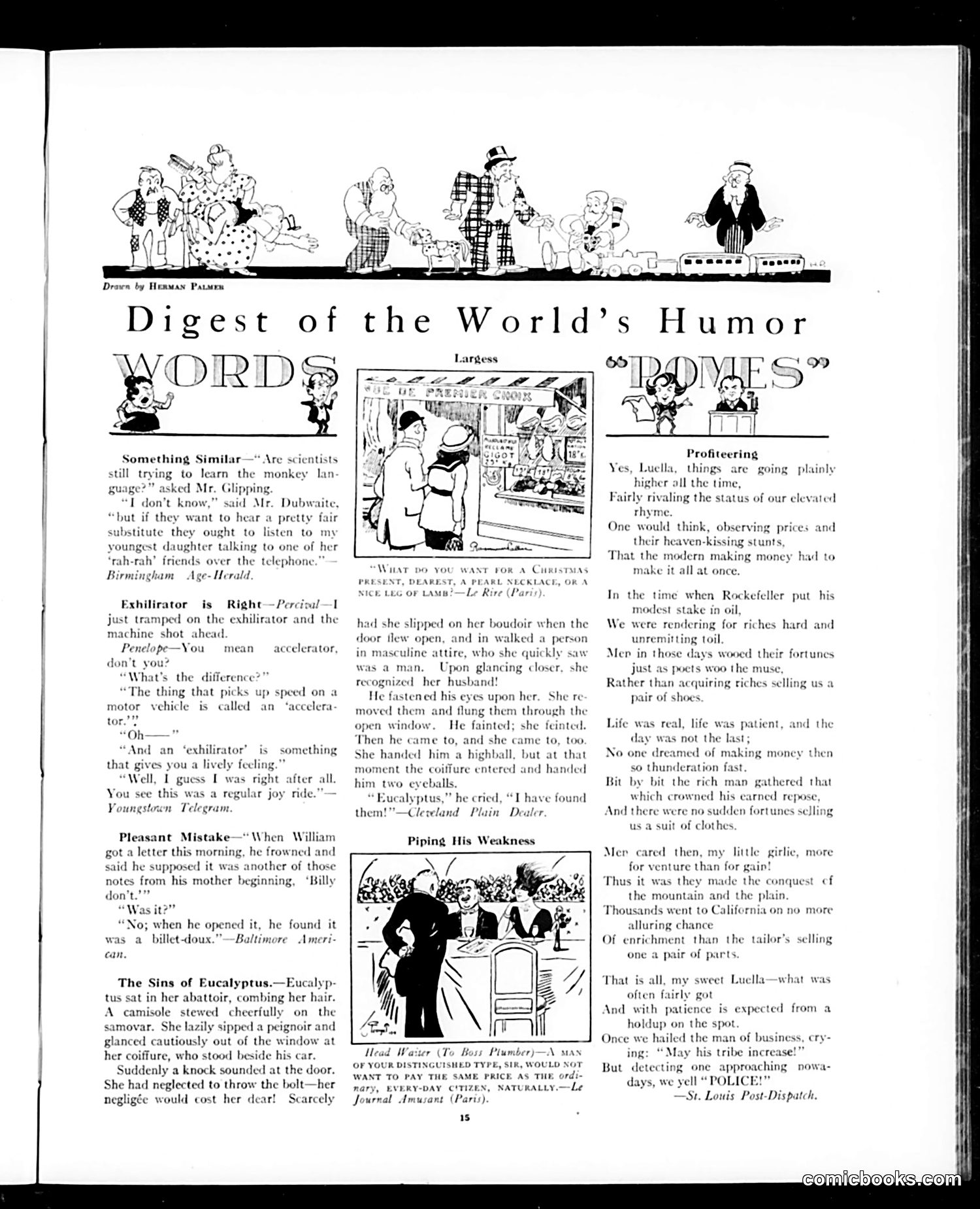
This page collects brief humorous anecdotes and jokes typical of Judge's satirical format. Key content includes: **Main cartoons/jokes:** - "Something Similar": Scientists studying monkey language compared to a girl's telephone chatter—mocking both scientific pretension and young women's speech patterns - "The Exhilirator": Wordplay on "accelerator" vs. "exhilirator" (something exciting) - "Pleasant Mistake": A wife misidentifies a love letter as her mother's scolding - "Eucalyptus": Absurdist fiction satirizing overwrought literary style through nonsensical word combinations ("samovar," "peignoir," "coiffure" as a person) **"Piping His Weakness"**: Cartoon mocking a plumber's pretension—charging wealthy clients premium prices while claiming special status **"Profiteering"**: Poem criticizing wartime/postwar price inflation and sudden fortunes, contrasting old-fashioned patient wealth-building (Rockefeller's gradual oil fortune) with modern quick enrichment. References California Gold Rush romantically. Overall, the page satirizes class pretension, modern materialism, and linguistic/literary affectation.
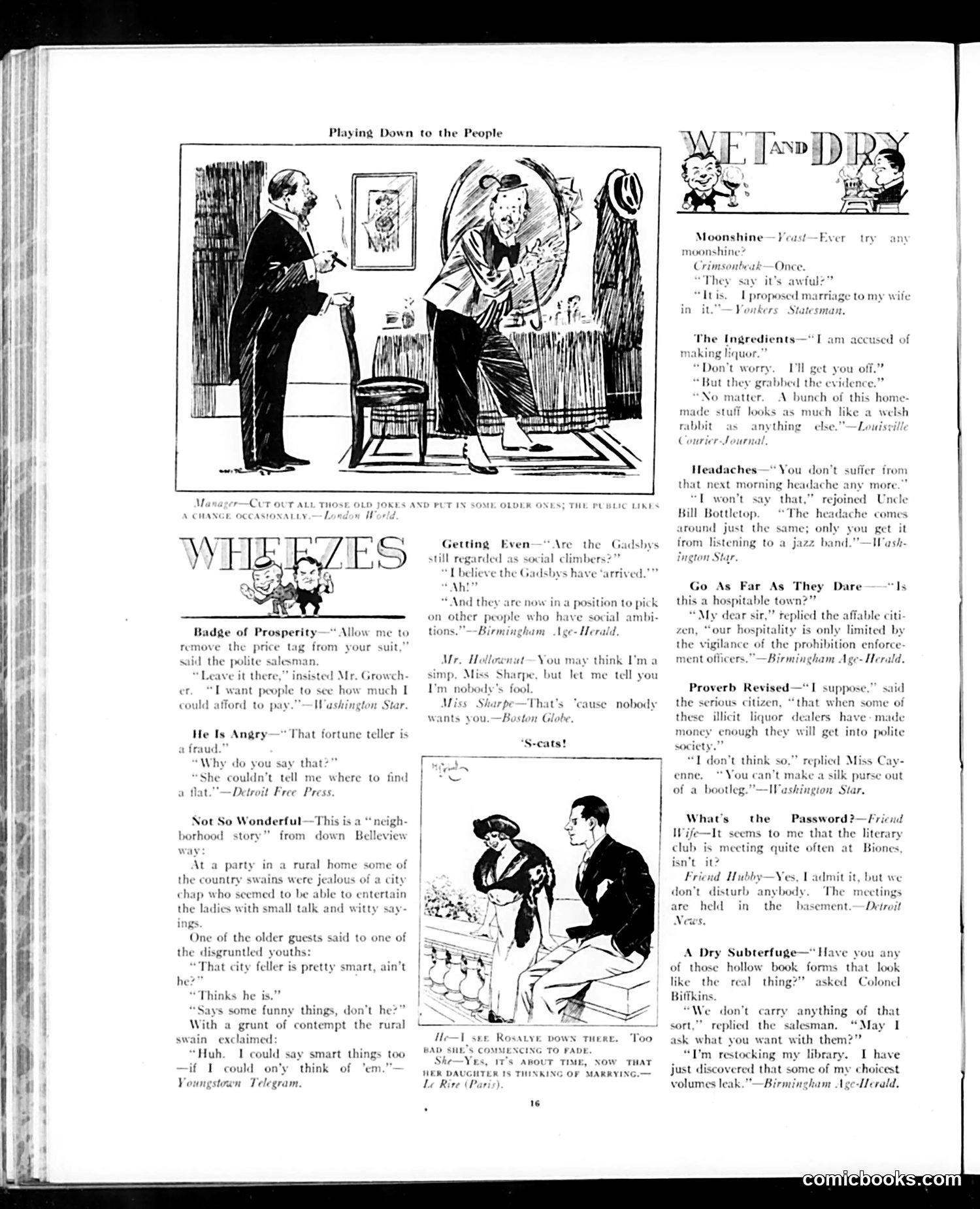
This page from the satirical magazine *Judge* contains multiple short humorous pieces mocking early 20th-century American society, particularly Prohibition-era concerns and social pretension. The main cartoon ("Playing Down to the People") depicts a manager instructing someone to remove a price tag from a suit—satirizing how wealthy people attempt to appear less ostentatiously rich to the general public. Several jokes target **Prohibition enforcement** and bootlegging culture: one quip about "hollow book forms" for hiding liquor, another about illicit liquor dealers eventually entering "polite society," and references to speakeasies meeting "in the basement." These reflect widespread public frustration with Prohibition laws (1920-1933). Other pieces mock social climbing (the "Gadsbys"), marital complaints, and rural-urban cultural differences. The humor assumes readers' familiarity with contemporary anxieties: wealth display, prohibition hypocrisy, and class mobility in post-WWI America.
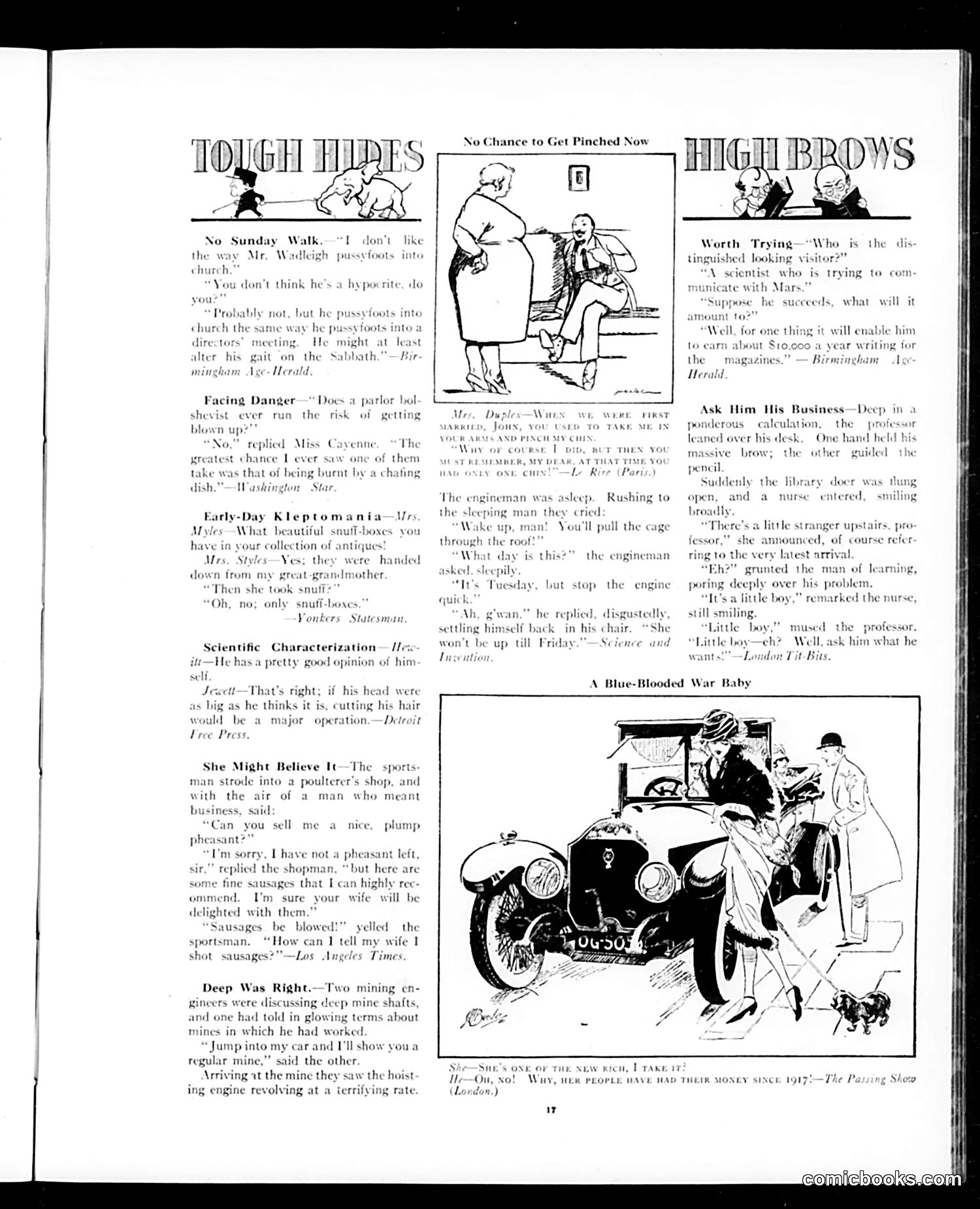
This page contains several short satirical pieces typical of early-20th-century American humor magazines. **"Tough Tides" and "High Brows"** mock social hypocrisy: a man who avoids church on Sundays but attends for appearances; the wealthy acquiring art collections; and intellectual pretension around Mars communication. **"A Blue-Blooded War Baby"** cartoon satirizes new wealth from wartime profiteering. The caption indicates that this woman's family acquired money only since 1917 (during WWI), mocking her pretense to aristocratic status. The comic juxtaposes her fancy automobile with her nouveau riche background. The remaining brief anecdotes—"Facing Danger," "Early-Day Kleptomania," "Scientific Characterization," etc.—are light social satire about human foibles: hypocrisy, theft, pomposity, and miscommunication. The humor relies on wordplay and situational irony rather than contemporary political references. Overall, the page reflects Judge's focus on mocking middle and upper-class social pretension during the post-WWI era.
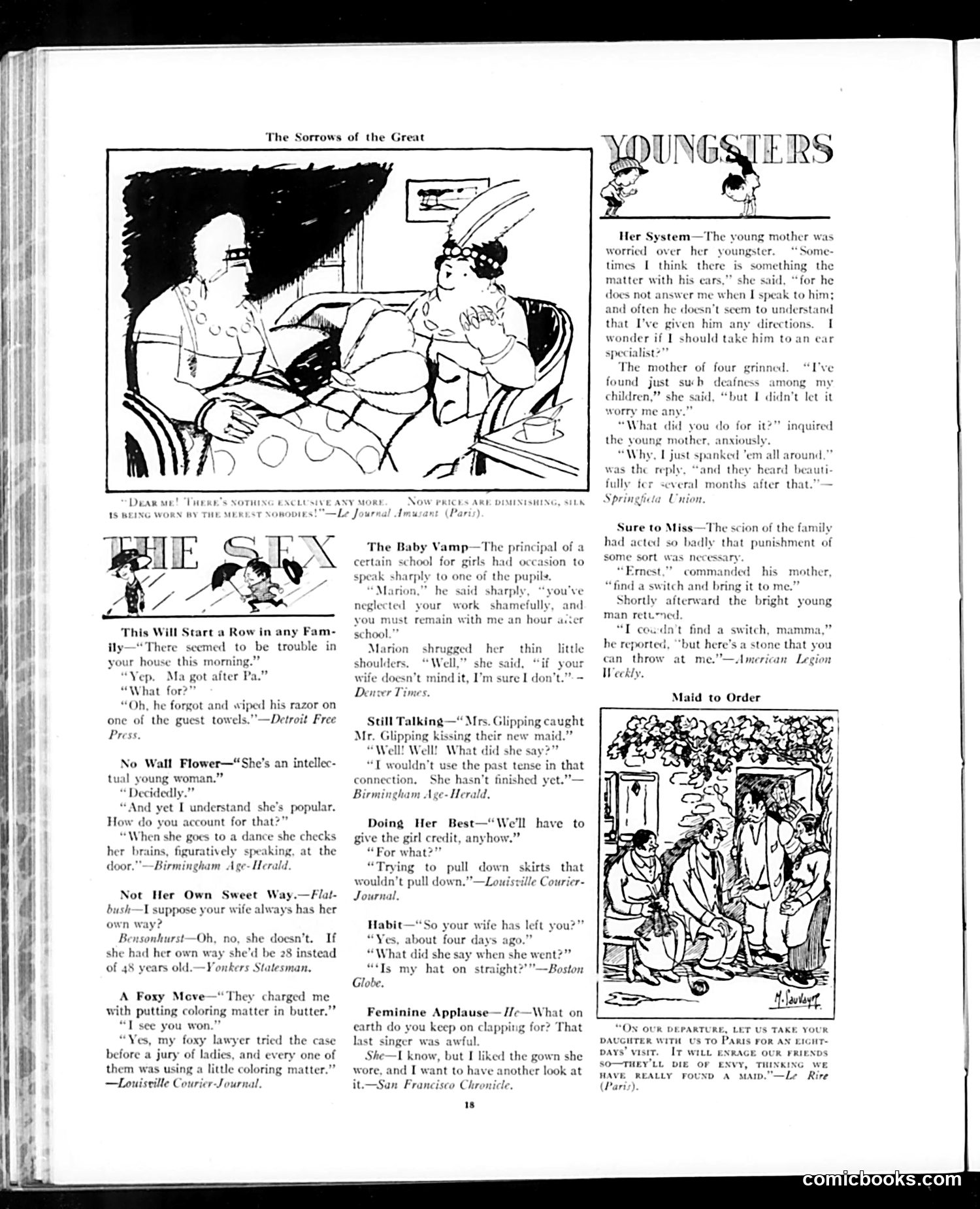
This page from the satirical magazine **Judge** contains humorous short anecdotes mocking domestic life and social pretensions of the era. The "Sex" section offers brief jokes about marriage and gender relations: husbands forgetting to use guest towels, wives lying about their age, and women using makeup. These jest at contemporary anxieties about domestic friction and female vanity. The "Youngsters" section ridicules parenting methods, particularly corporal punishment. One anecdote shows a mother casually spanking children for not listening—presented as effective discipline. Another depicts a boy searching for a switch to be beaten with, treated as humorous obedience. The illustrated cartoon "Maid to Order" (bottom right) satirizes wealthy Americans' social climbing: a couple plans to parade a hired maid as their "found" French servant in Paris to impress envious friends back home. This mocks both American social pretension and the era's fascination with European sophistication. Overall, the page reflects early 20th-century attitudes toward child-rearing, marriage dynamics, and class aspiration through gentle ridicule.
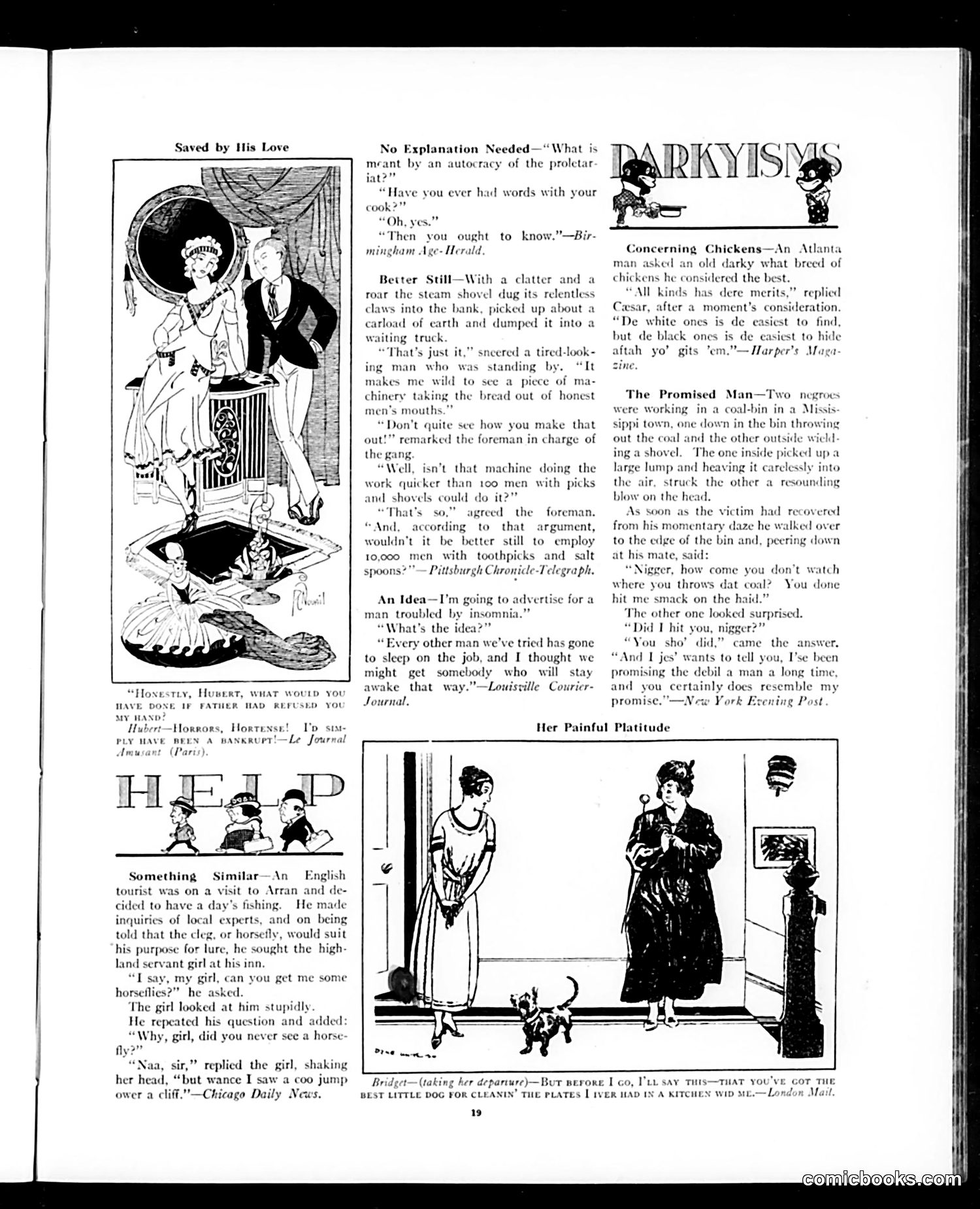
This page contains several short humorous anecdotes typical of early 20th-century American satirical magazines: **"Saved by His Love"** (top left): A romantic cartoon where a man claims he'd become bankrupt if refused marriage—satirizing male financial dependence on marriage for status. **The anecdotes mock various subjects:** - Labor displacement: A worker complains machinery steals jobs; the foreman humorously suggests replacing machines with 10,000 men using toothpicks—absurdist logic exposing the worker's flawed argument. - Insomnia advertising: An employer seeks someone who won't fall asleep on the job, poking fun at widespread workplace drowsiness. - Racial humor: Multiple jokes featuring Black characters using stereotypical dialect, reflecting the era's casual racism. - "Her Painful Platitude" (bottom): A departing servant's clichéd compliment about her dog's dishwashing abilities. These pieces represent Judge's blend of gentle social observation and period-typical prejudices. The humor targets labor tensions, employment absurdities, and domestic situations familiar to early-1900s readers.
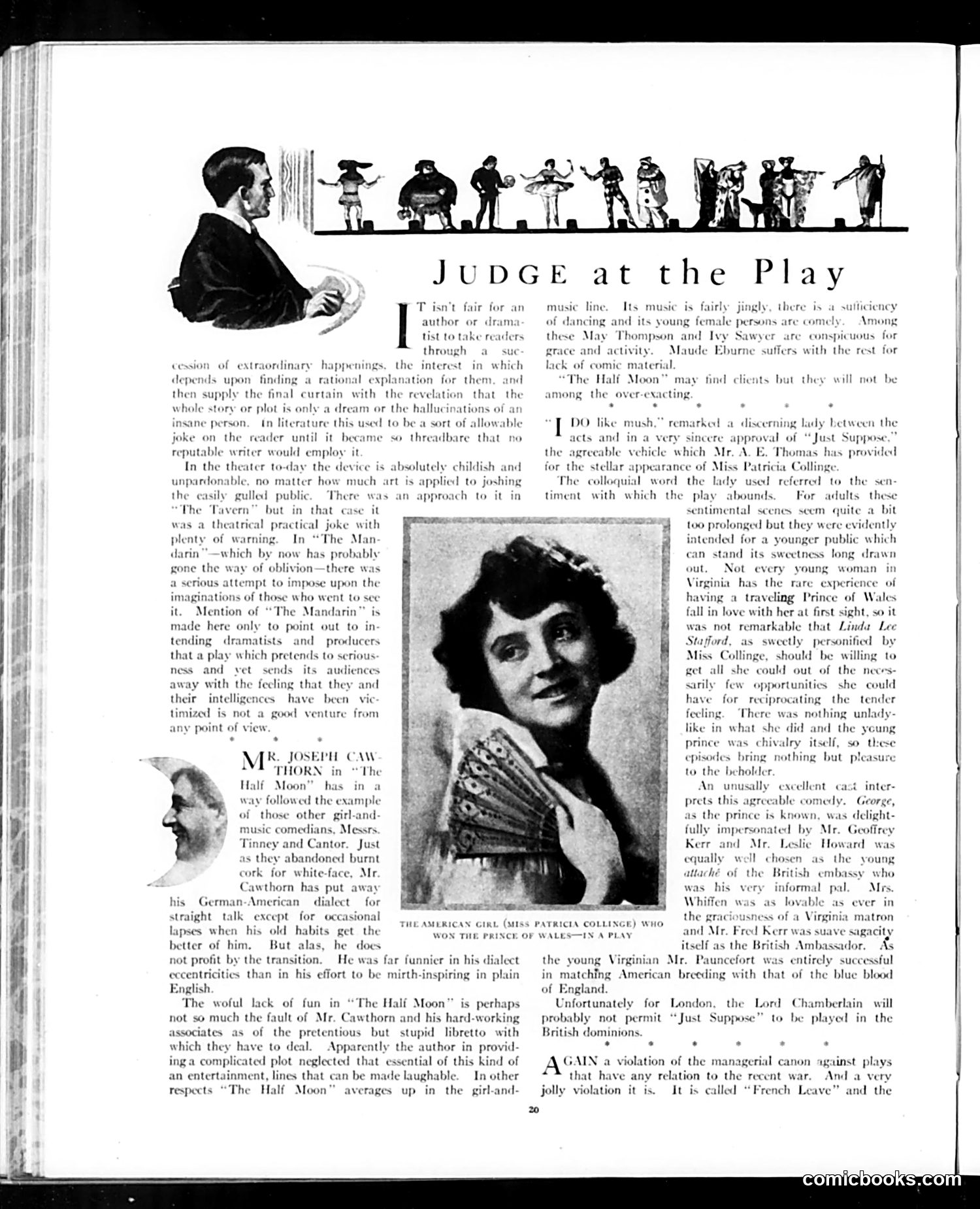
This page reviews theatrical productions for Judge magazine's discerning readers. The main article critiques the use of "it was all a dream" plot devices in plays like "The Mandarin" and "The Tavern," calling this narrative trick childish and a betrayal of audience intelligence—a fair complaint about lazy dramatic writing. The review then discusses "The Half Moon," starring Joseph Cawthorn. Cawthorn, formerly known for German-American dialect comedy (like the burnt-cork routines of contemporary comedians Tinney and Cantor), has abandoned this act for "straight talk." However, the critic finds him less funny without his dialect eccentricities. The real problem, though, is the show's weak libretto—despite pretty music and attractive female performers, it lacks laughable lines. A photograph shows "The American Girl" (Patricia Collinge) in the production opposite the Prince of Wales character. The review praises the supporting cast's excellent comic timing.
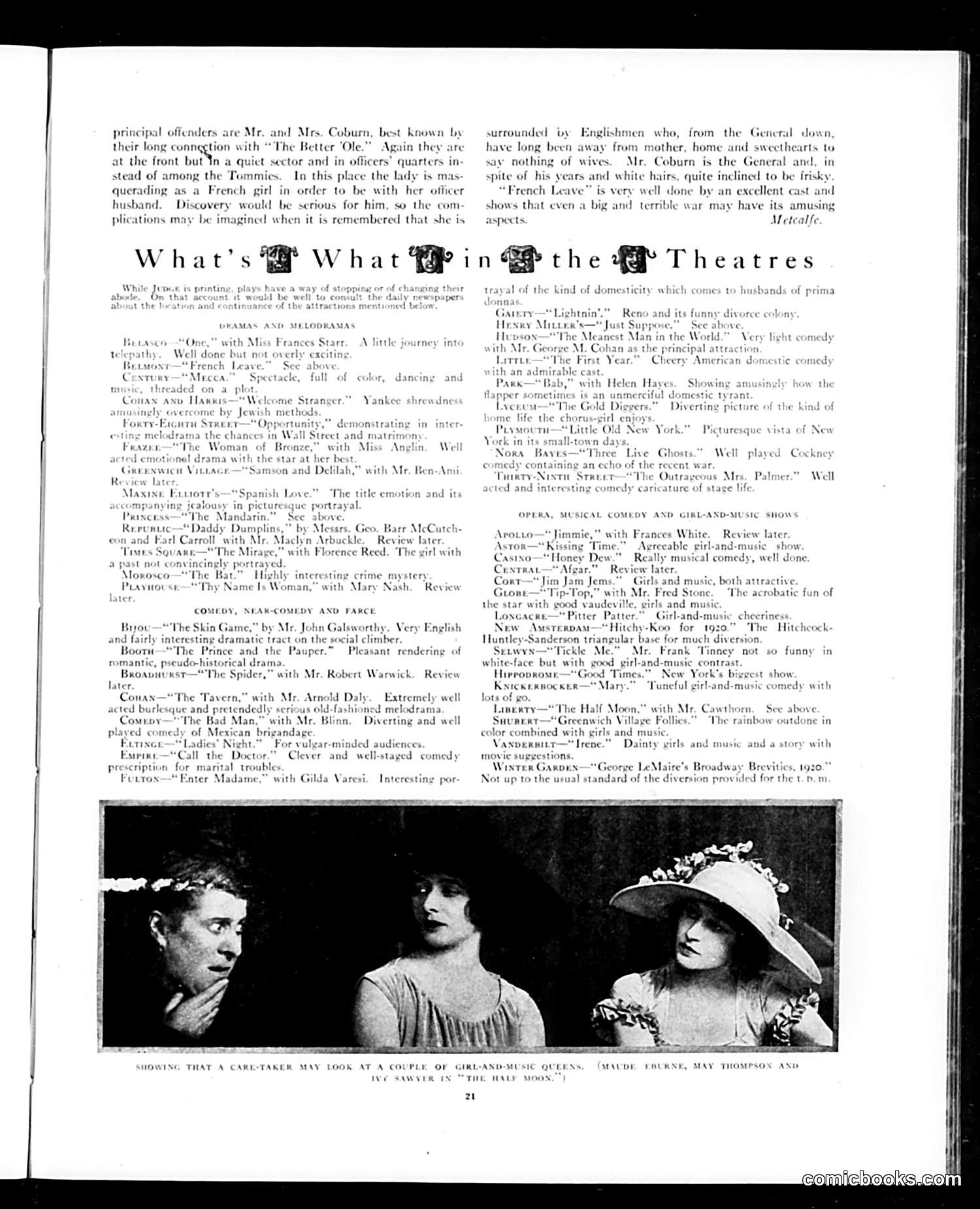
This page from *Judge* magazine is primarily a **theater review section** titled "What's On in the Theatres," listing current Broadway productions with brief critical assessments. The only illustration is a photograph at the bottom showing three people from the play *"The Half Moon,"* starring Maude Eburne, May Thompson, and Ivy Sawyer. The caption humorously notes the female character's appearance as a "care-taker" observing "a couple of girl-and-music queens." **The actual satirical content** is minimal on this page. The opening paragraphs reference Mr. and Mrs. Coburn performing in *"The Better 'Ole"* (a WWI-era play), where the wife disguises herself as a French girl to stay with her officer husband at the front—a domestic scenario presented as amusing rather than serious social commentary. This is essentially **entertainment journalism** rather than political satire—typical filler content for a humor magazine.
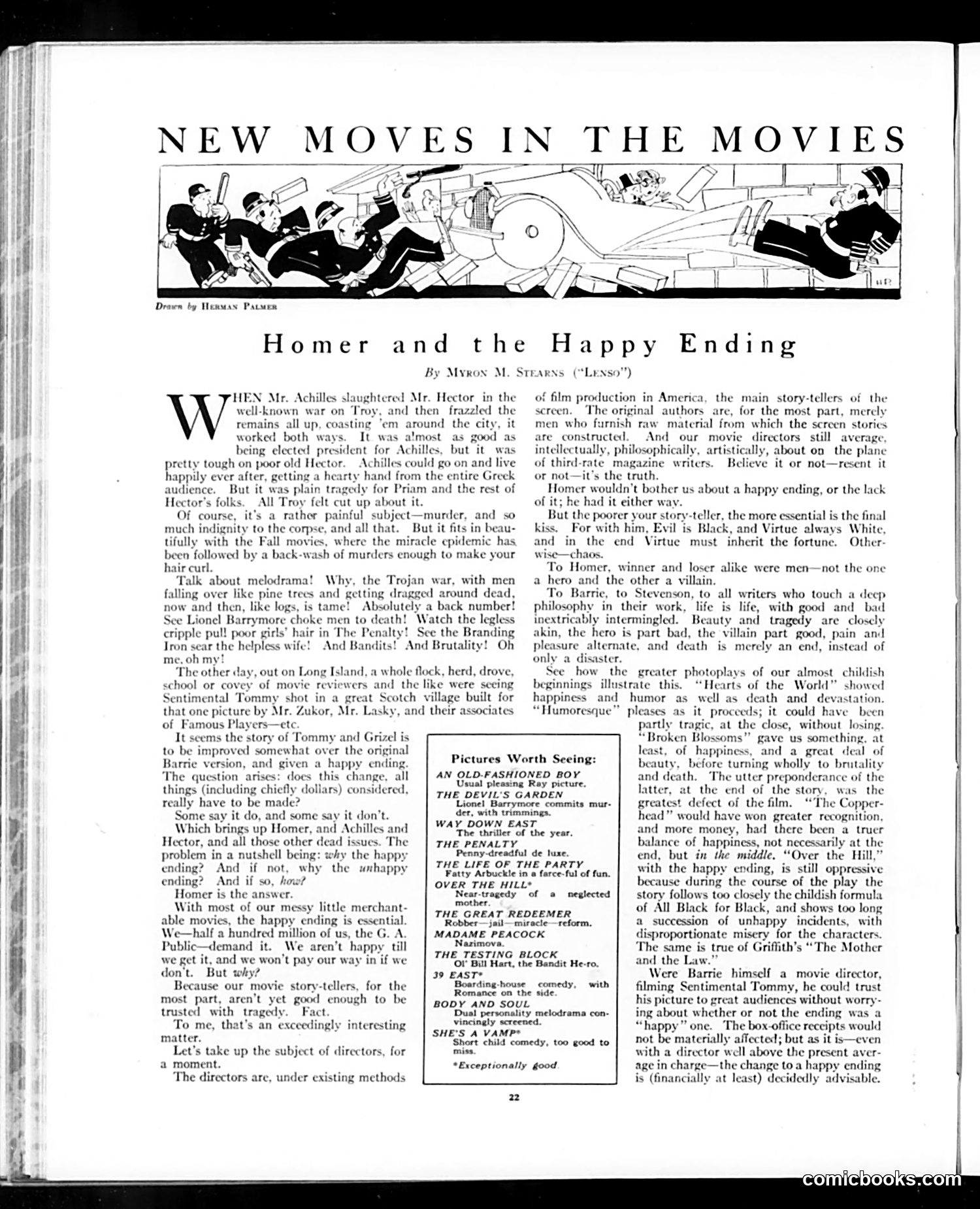
This article critiques Hollywood's reliance on artificial happy endings. The author (writing as "Lens") uses Homer's *Iliad* as a counterexample: the epic tragedy of Troy shows that great storytelling doesn't require happy resolutions—winners and losers are simply human. The piece argues that contemporary film directors, whom the author dismisses as intellectually inferior to classical authors, force simplistic morality plays onto stories: "Evil is Black, and Virtue always White." Real literature (citing Barrie and Stevenson) interweaves good and bad, pleasure and pain. The satirical point: Hollywood producers are adding happy endings to properties like Barrie's *Sentimental Tommy* for commercial reasons, not artistic ones. Better films like *Broken Blossoms* succeed despite—not because of—their tragedies. The author suggests that forcing upbeat conclusions actually undermines story quality and audience intelligence. This reflects 1920s debates over film as "low" entertainment versus serious art.
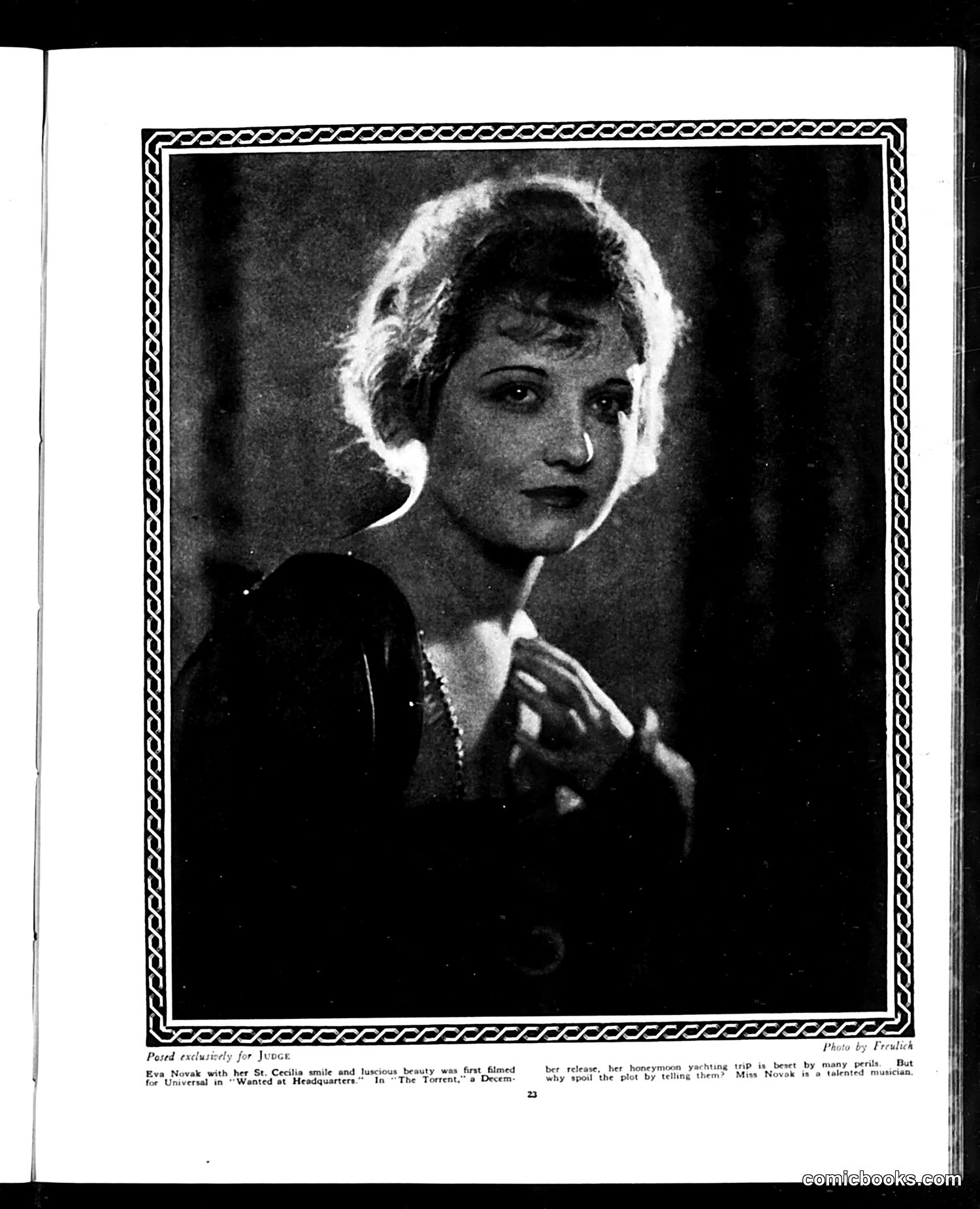
This is primarily a **portrait photograph** rather than a political cartoon. The image shows a woman in 1920s styling (short blonde/white hair, dark clothing with beaded necklace) photographed by Fredrick. The caption identifies her as **Eva Novak**, and references her film roles in "Wanted at Headquarters" and "The Torrent" for Universal and Decca studios. The text notes she was "first filmed" for Universal and mentions her "St. Cecilia smile and luscious beauty," describing her as "a talented musician." This appears to be **entertainment/celebrity content** rather than political satire—typical Judge magazine filler promoting Hollywood films and stars to readers. The page serves as advertisement masquerading as editorial content, common in early 20th-century periodicals.
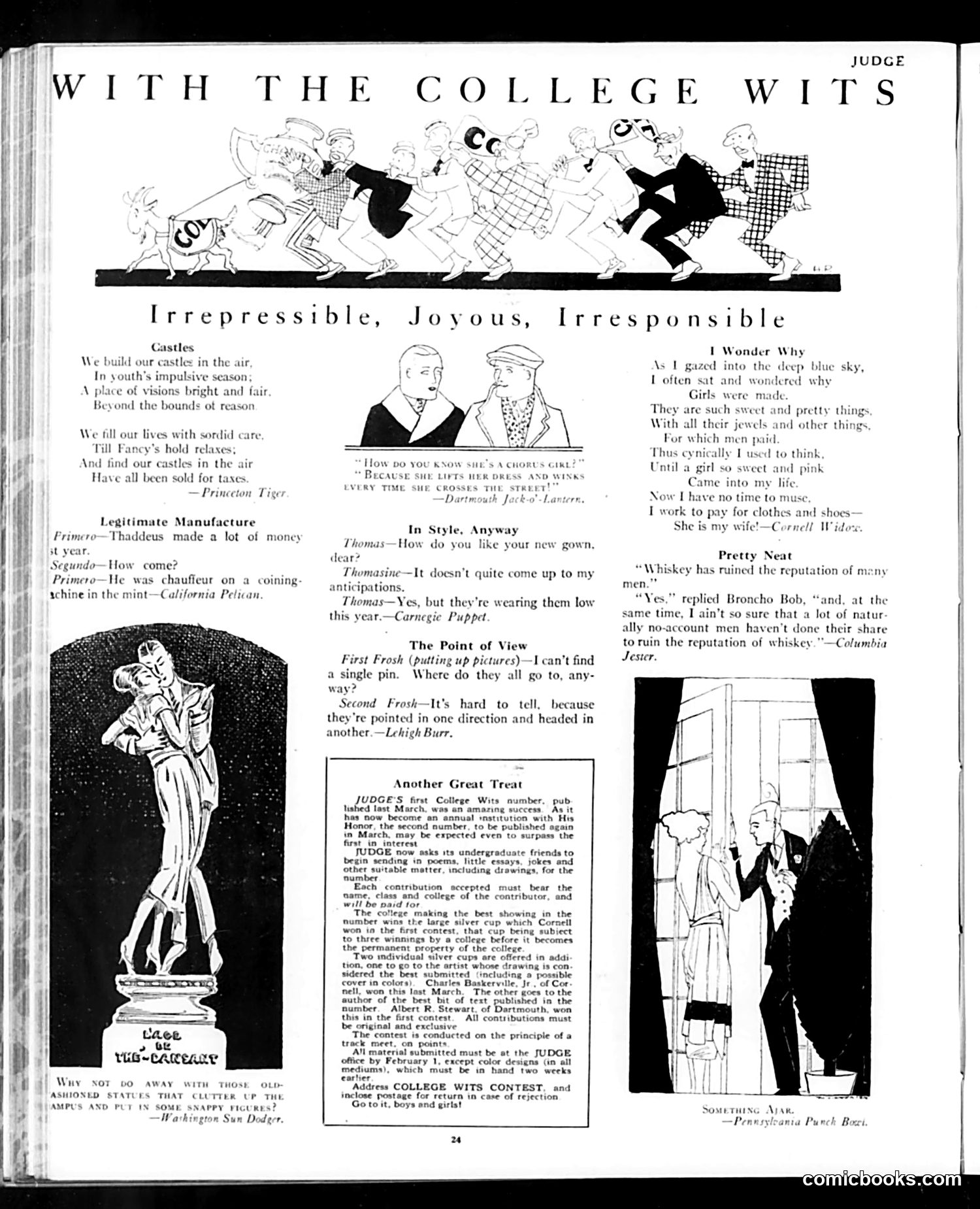
This page showcases college humor contributions to **Judge** magazine's "College Wits Contest"—an annual competition soliciting poems, jokes, and drawings from undergraduates. The content reflects 1920s college culture anxieties: financial precarity ("Castles"—dreams sold for taxes), gender dynamics ("I Wonder Why"—men working to support wives), and social commentary on Prohibition-era drinking. Notable satirical elements include jokes about counterfeit money ("chauffeur on a coining machine"), chorus girls' fashion ("lifts her dress"), and whiskey's reputation. The illustrations show period dress and college life scenarios. The "Pretty Neat" joke presents a cynical exchange where "Broncho Bob" suggests naturally disreputable men—not alcohol itself—damage whiskey's reputation, likely mocking both temperance reformers and masculine self-deception about personal responsibility. The tone is lighthearted college irreverence rather than sharp political satire.
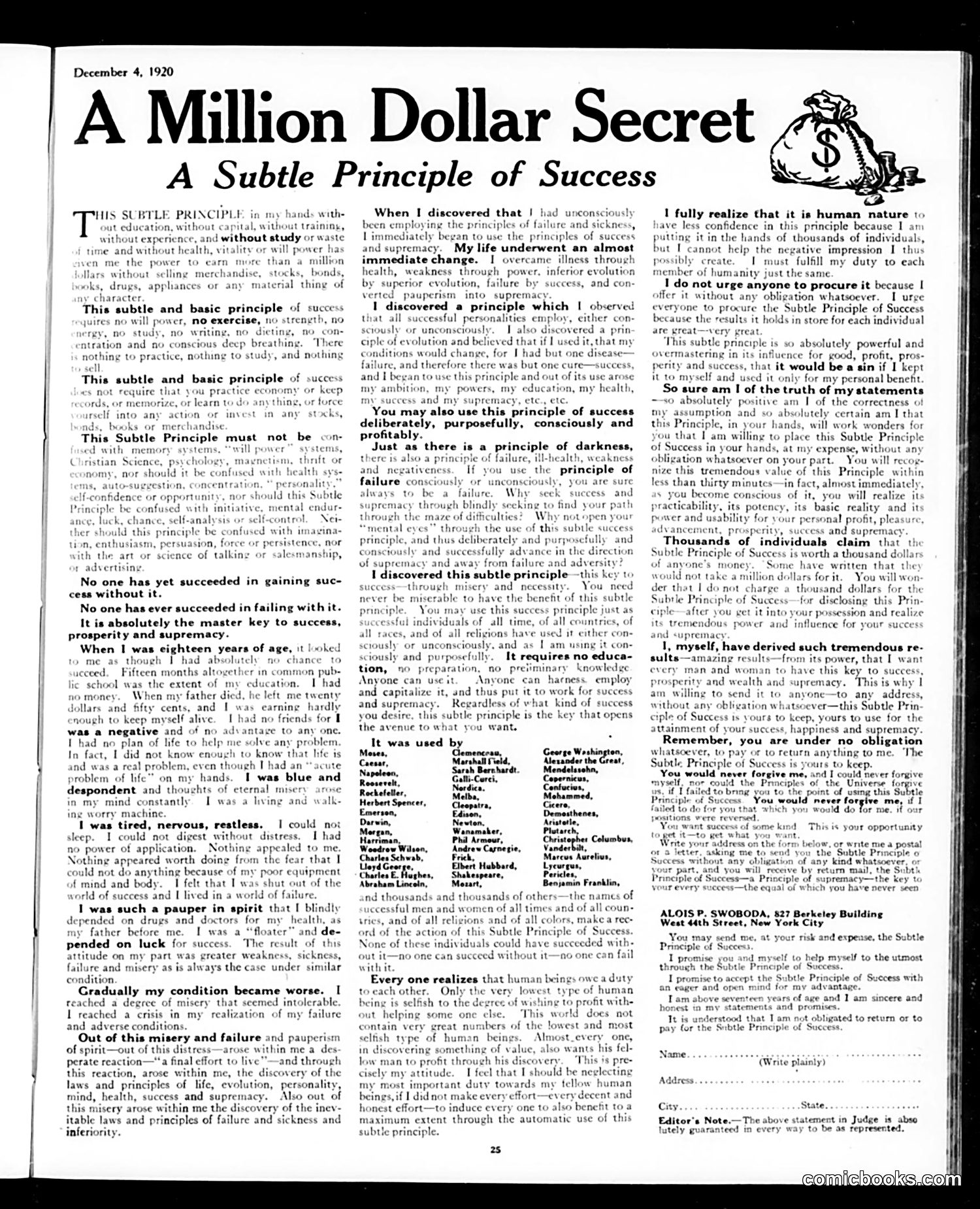
This is not a political cartoon but rather a self-help advertisement disguised as editorial content. The page features Alois P. Swoboda promoting his purported "Subtle Principle of Success"—a vaguely defined philosophy claiming that without education, capital, training, or experience, anyone can become wealthy by understanding this secret principle. The satire lies in Judge magazine's mockery of contemporary self-help culture and get-rich-quick schemes. Swoboda's testimonial recounts overcoming poverty through discovering this mysterious principle, yet he never actually explains what it is, merely asserting its power. The page lists dozens of supposed successful individuals who've used it, a common marketing tactic. For modern readers, this reflects 1920s America's fascination with pseudoscientific self-improvement, predating today's motivational industry. Judge satirizes both the charlatan promoter and the gullible public desperate for success formulas.
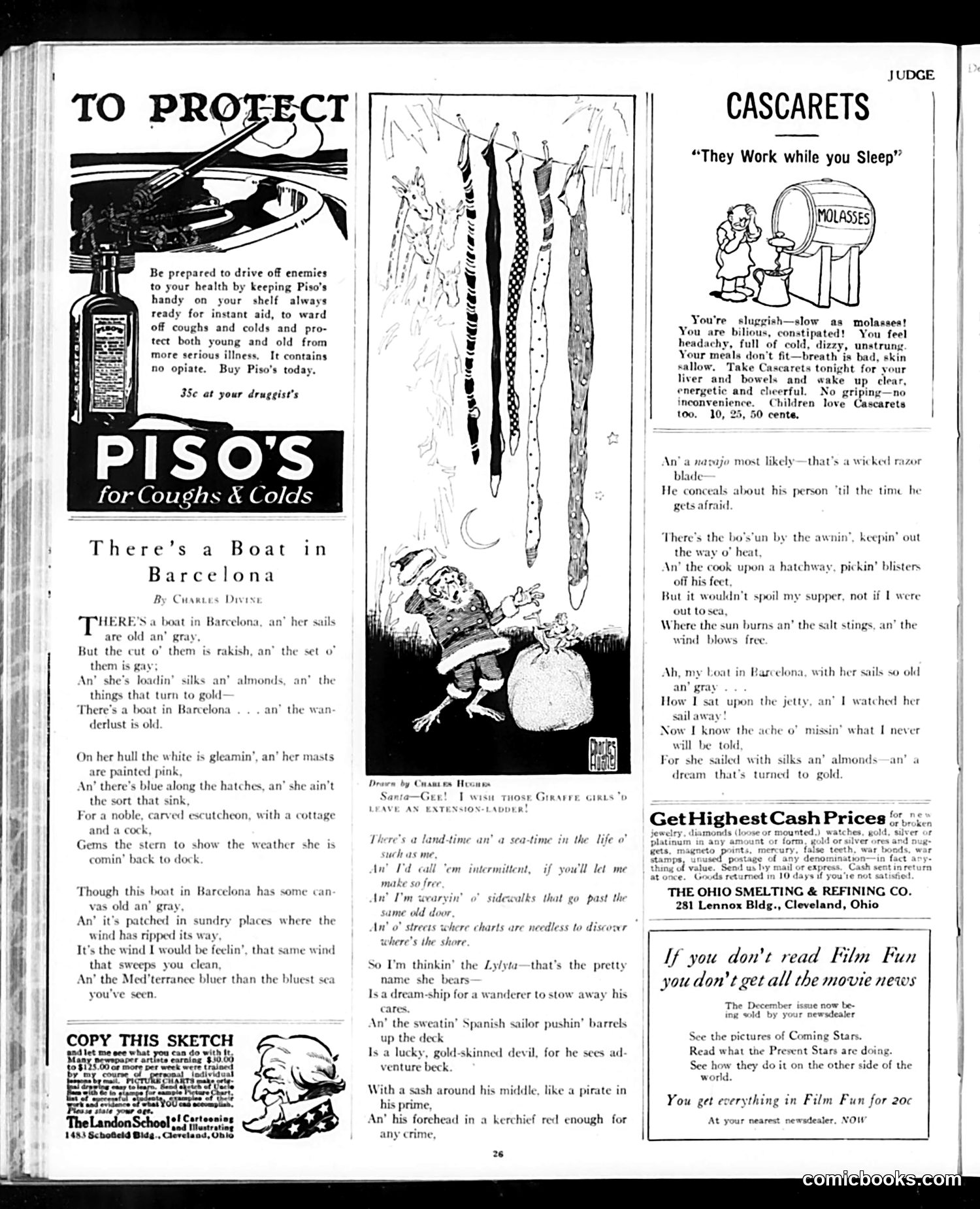
This page contains primarily **advertising and entertainment content** rather than political satire. The main features are: 1. **"To Protect" (Piso's Advertisement)**: A product ad for Piso's cough medicine, emphasizing it contains "no opiate"—relevant context being early 20th-century concerns about opium in patent medicines. 2. **"There's a Boat in Barcelona" (Poem by Charles Divine)**: A romantic poem about a weathered Spanish ship, seemingly nostalgic rather than satirical. The accompanying illustration depicts sailors and a ship with romanticized maritime imagery. 3. **Cascarets Advertisement**: Promotes a laxative using colloquial language to describe constipation symptoms, claiming the product "works while you sleep." 4. **Supporting Ads**: For art school training, precious metals buying, and Film Fun magazine. The page exemplifies **Judge's mixed content model**—blending satirical commentary (elsewhere in the magazine) with commercial advertising and light entertainment pieces. The tone is escapist and commercial rather than politically pointed.
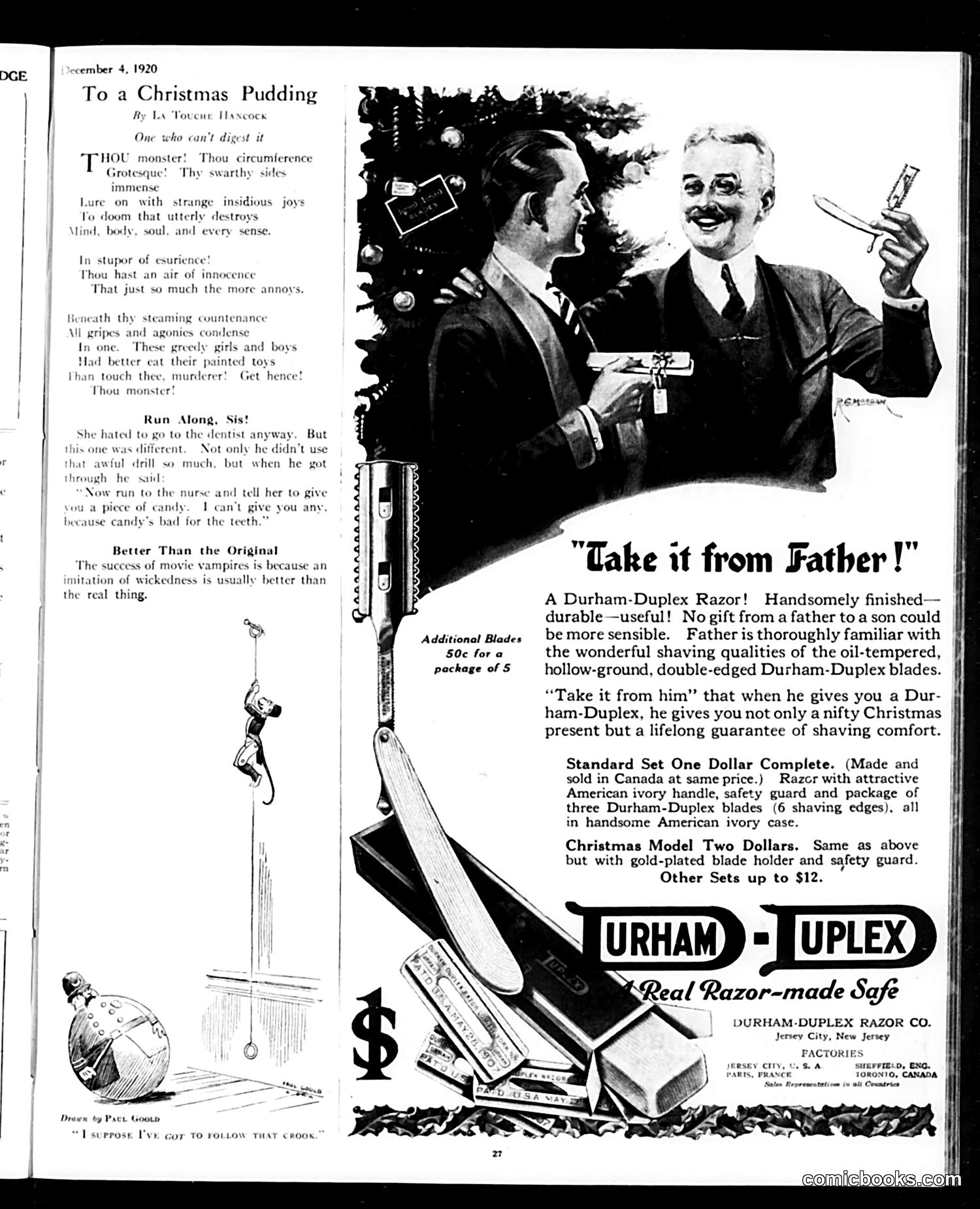
This page contains three distinct items: 1. **"To a Christmas Pudding"** — A humorous poem by La Touche Hancock mocking the indigestibility of traditional Christmas pudding, personifying it as a dangerous "monster" that causes physical distress. 2. **"Run Along, Sis!"** — A brief anecdote about a dentist who, unlike others, refuses to give candy to a child patient because "candy's bad for the teeth" — presented as humorously unusual dental practice. 3. **"Better Than the Original"** — A short observation that movie portrayals of wickedness are more appealing than actual wickedness (social commentary on entertainment). The bulk of the page is a **Durham-Duplex Razor advertisement** featuring "Take it from Father!" — a Christmas gift advertisement emphasizing that a safety razor is a sensible paternal present, with detailed pricing ($1-$12) and product specifications. The cartoons are light domestic humor; the page is primarily commercial advertising typical of 1920s magazine content.
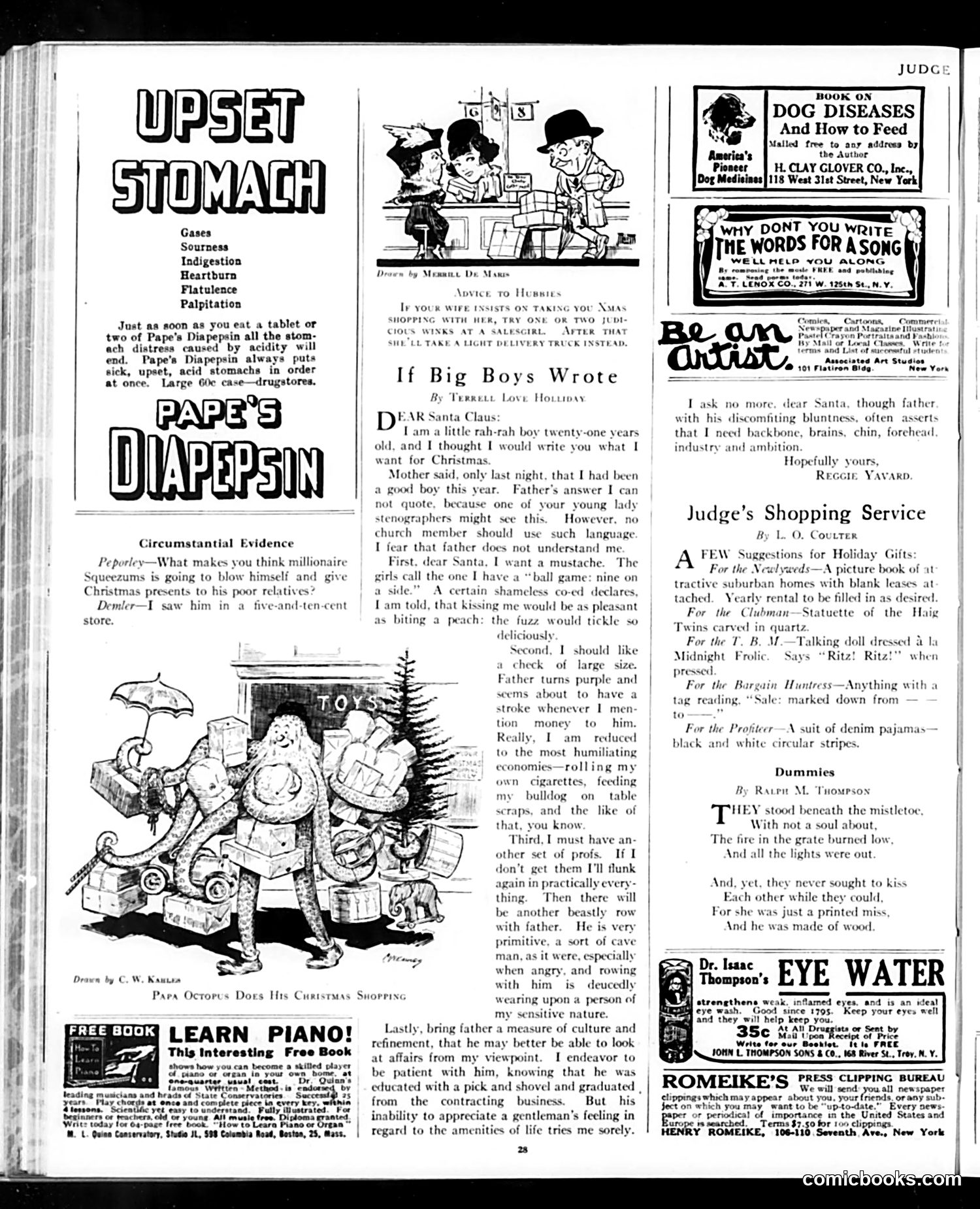
This page from the satirical magazine *Judge* contains several distinct pieces: **Main Cartoon ("Papa Orders Does His Christmas Shopping"):** Shows a well-dressed father figure overwhelmed by shopping, carrying enormous packages and toys. The satire mocks the commercial excess of Christmas shopping and the financial burden on fathers expected to provide lavish gifts—a commentary on consumer culture and masculine economic pressure. **"If Big Boys Wrote" Letter:** A wealthy young man writes Santa with absurd demands: a mustache, a large check, and better grades. The satire mocks entitled, immature wealthy young men who expect financial handouts and special treatment while blaming their "primitive" fathers for not understanding their "sensitive nature." It's social commentary on privileged youth and generational conflict. **"Circumstantial Evidence" Joke:** A brief gag about a man seen at a five-and-ten-cent store, implying he must be wealthy (counterintuitive reasoning—absurdist humor). The remainder consists of period advertisements for patent medicines, piano lessons, and books—typical of early 20th-century magazines.
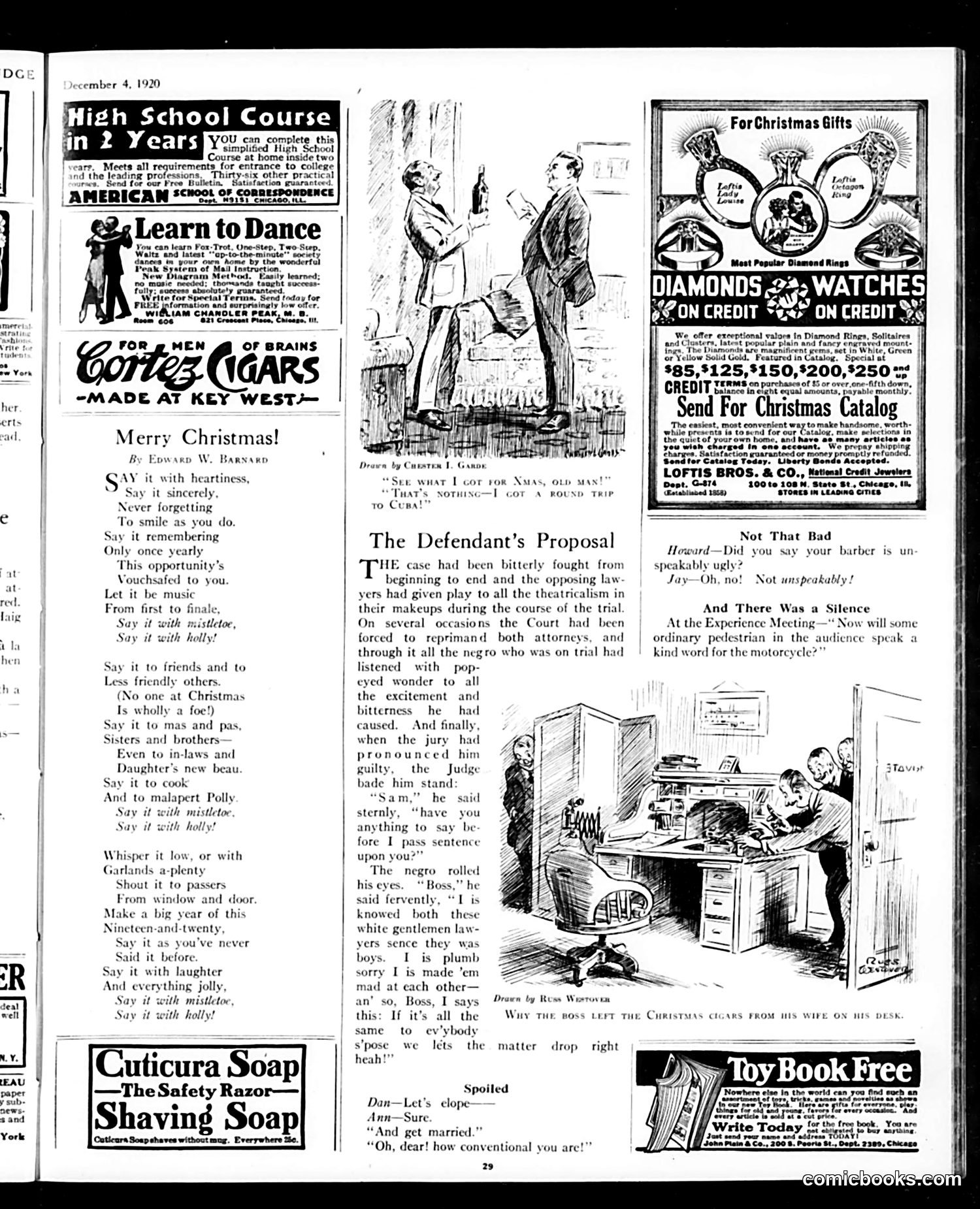
This page is primarily **advertisements and light humor**, not political satire. The main content includes: **"The Defendant's Proposal"** — A sketch using racial stereotypes common to the era. A Black defendant on trial, portrayed through dialect humor, proposes to the judge that since two white lawyers fighting bitterly caused him trouble, they should "drop the matter" and settle it. The humor relies on minstrelsy-style dialect and the idea of a defendant making absurd procedural suggestions. **Other humor pieces** include mild jokes about barbershops and motorcycles, and a "Spoiled" bit about an elopement. **Advertisements dominate**: high school correspondence courses, dance lessons, cigars, diamonds on credit, and shaving soap fill the page. The racial caricature reflects Judge's period conventions (1920) but would be considered deeply offensive today. The sketch trades entirely on dialect humor and stereotyped characterization rather than social commentary.
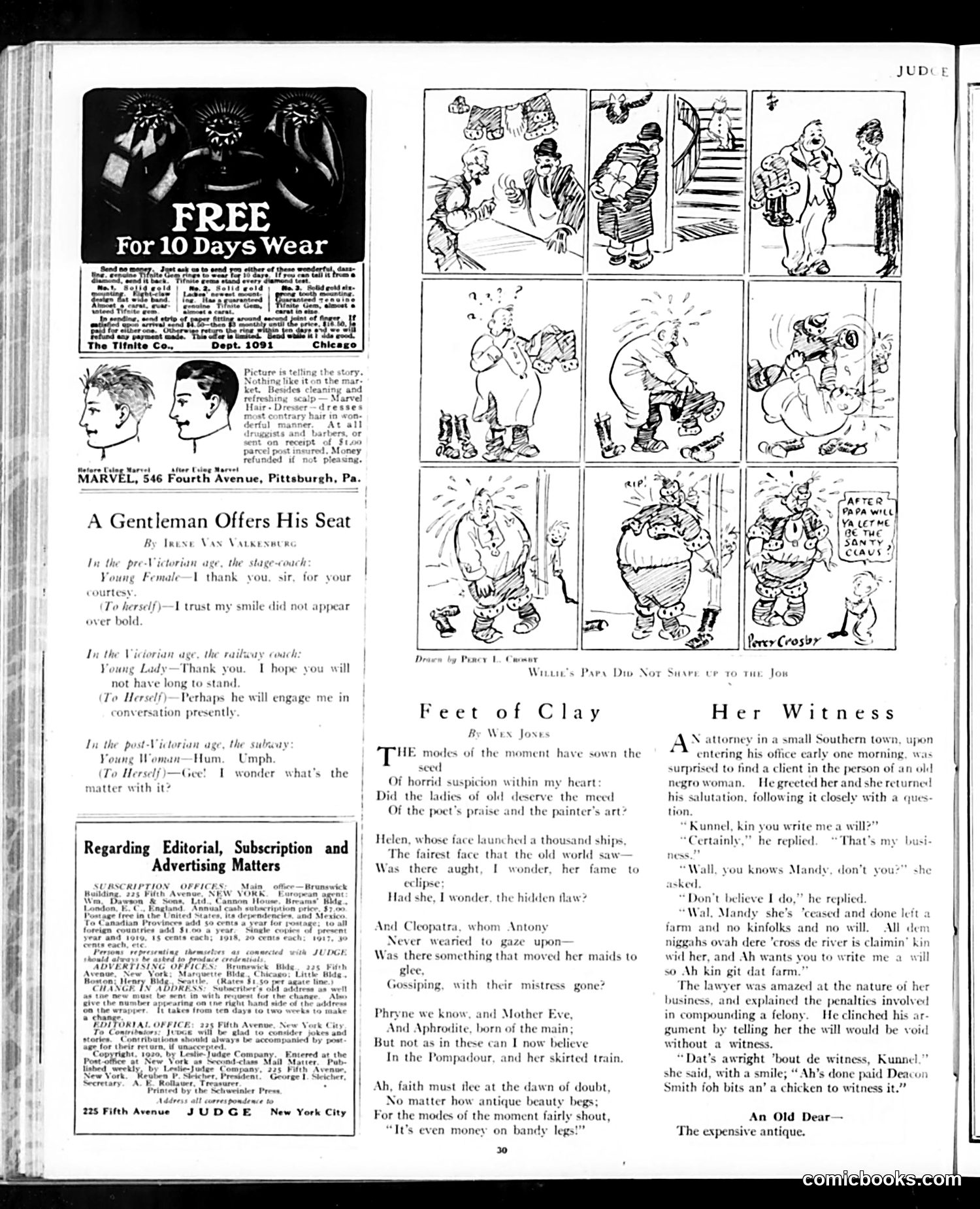
This page contains three distinct pieces of satirical content: **"A Gentleman Offers His Seat"** (left): A three-panel comic contrasting Victorian-era courtesy with modern behavior. It mocks the decline of chivalry across historical periods—pre-Victorian gentlemen offered seats gallantly, Victorian men did so with hope of engagement, and post-Victorian men simply grunt indifference. The joke targets early 20th-century society's perceived loss of manners. **"Feet of Clay"** (center): A poem questioning whether famous historical beauties (Helen, Cleopatra, Phryne) had physical flaws. The concluding joke—"It's even money on bandy legs!"—satirizes contemporary fashion trends by suggesting modern women's fashions expose ungainly legs, undermining the idealization of female beauty. **"Her Witness"** (right): A racist anecdote about a Black woman seeking a will written to inherit a deceased woman's farm. The "humor" relies on dialect stereotypes and the punchline that she's paid a preacher to serve as witness—mocking both her legal ignorance and implicit corruption. This reflects deeply prejudiced attitudes typical of early 20th-century American humor.
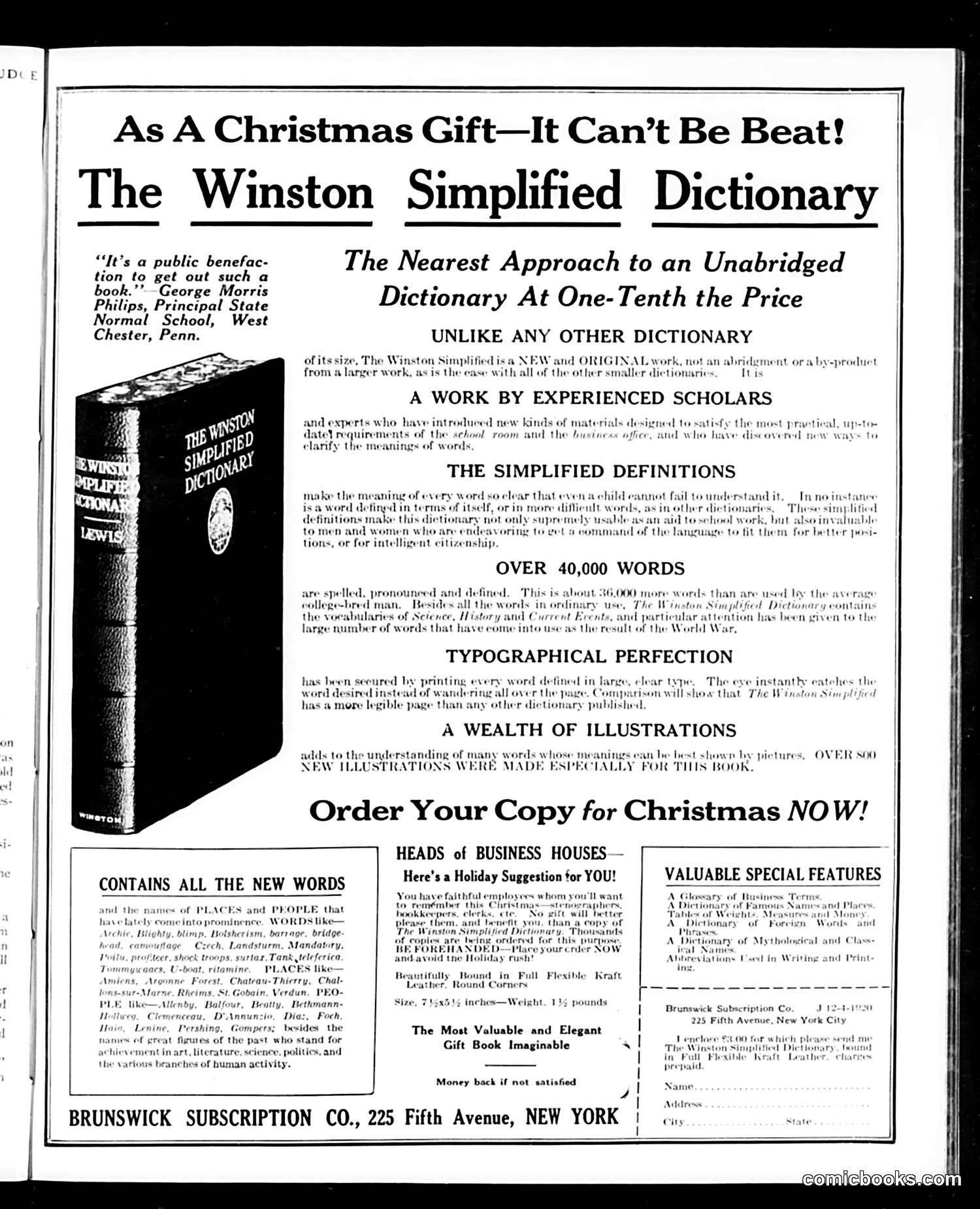
This is **not a cartoon or satirical piece**—it's a full-page advertisement for *The Winston Simplified Dictionary*, placed in Judge magazine as a Christmas gift suggestion. The ad pitches the dictionary as an affordable alternative to unabridged versions ("one-tenth the price"), emphasizing its practical features: over 40,000 words, clear definitions accessible to children, new vocabulary from science and current events, good typography, and 800+ illustrations. It targets both individual consumers and business leaders as gift-givers. The endorsement from a Pennsylvania school principal lends credibility. The emphasis on "simplified definitions" and accessibility reflects early-20th-century educational progressive values—making knowledge democratic and available to ordinary people, not just the educated elite. The ad's presence in Judge (a humor magazine) is simply commercial placement; there is no satirical content here—just period marketing emphasizing practicality and value.

This page is primarily a **Postum cereal advertisement** from 1916, not political satire. The central image features a large circular design reading "HEALTH FIRST" with the slogan "Drink POSTUM—'There's a Reason'" at its center. Postum was a caffeine-free coffee substitute marketed as a health beverage. The advertisement includes product images (a can and box) positioned in the corners. The "There's a Reason" slogan was Postum's actual marketing tagline, implying health benefits from choosing this product over regular coffee. This represents early-20th-century advertising's emerging focus on health claims to drive consumer purchases. The page demonstrates how Judge magazine, while known for satire, also contained commercial advertisements to fund publication.