
Judge, 1920-12-04 · page 14 of 32
Judge — December 4, 1920 — page 14: what you’re looking at
What you’re looking at
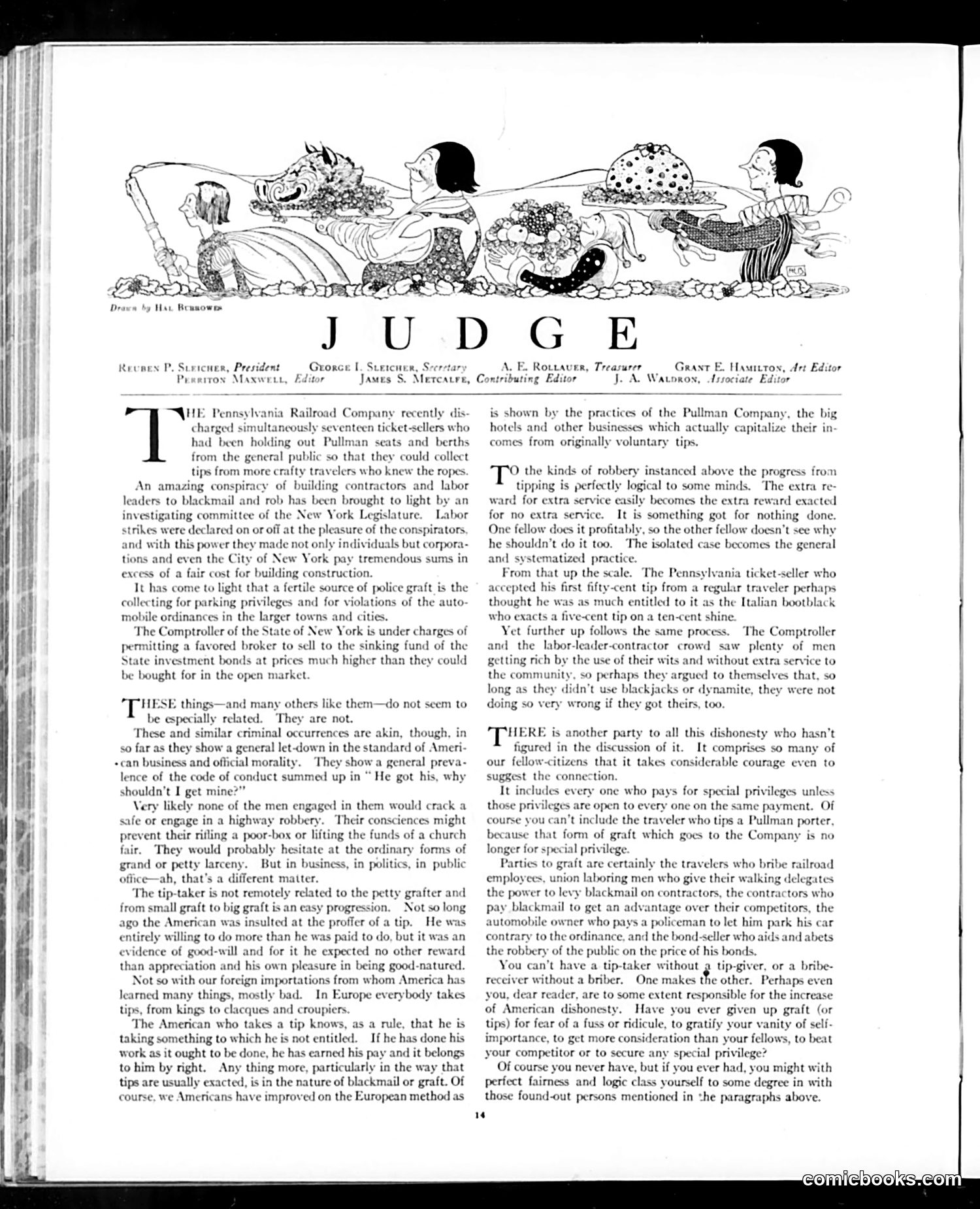
This editorial page attacks widespread corruption across American institutions. The illustration shows figures distributing various goods—likely representing different forms of graft and illegal profit-taking. The article connects seemingly unrelated scandals: Pennsylvania Railroad ticket-sellers withholding Pullman berths to extort tips; New York construction contractors blackmailing officials; police collecting bribes for parking violations; and a state comptroller manipulating bond sales. The satire's point: these aren't isolated crimes but symptoms of a cultural rot. The author argues Americans adopted the European practice of tipping—originally a voluntary gesture—and corrupted it into systematic extortion. Once profitable corruption begins, it spreads: "from small graft to big graft is an easy progression." The piece suggests that respectable businessmen and officials rationalize dishonesty in commerce and politics that they'd never attempt as street crime, using the logic "He got his, why shouldn't I get mine?" It's a jeremiad about American moral decline.
📄 Transcribed text from this page (OCR, searchable)
Machine-transcribed from the original scan — historical spelling and the odd misread are preserved.
Gee ee hn aes oS OL ee ee ee = a. Drawn by Har Beanowen Ju Gronce I. Suercuen, Seeretar Revpes P. Suricner, President Preeerron Maxwett, Editor D . James S. Metcatre, Con G E ~ Rotraver, Treasurer ibuting Editor J. AL Wat Editor Grant E. Hasttctos, RON, Associate Editor QHE Pennsylvania Railroad Company recently dis- charged simultaneously seventeen ticket-scllers who had been holding out Pullman seats and berths from the general public so that they could collect tips from more crafty travelers who knew the ropes. nd labor ht by an Labor An amazing conspiracy of building contractors leaders to blackmail and rob has been brought to lij investigating committee of the New York Legislature. strikes were declared on or off at the pleasure of the conspirators. and with this power they made not only individuals but corpora- tions and even the City of New York pay tremendous sums in excess of a fair cost for building construction. Tt has come to light that a fertile source of police graft is the collecting for parking privileges and for violations of the auto- mobile ordinances in the larger towns and cities. The Comptroller of the State of New York is under charges of permitting a favored broker to sell to the sinking fund of the State investment bonds at prices much higher than they could be bought for in the open market. HESE things—and many others like them—do not seem to be especially related. ‘They are not. These and similar criminal occurrences are akin, though, in so far as they show a general let-down in the standard of Ameri can business and official morality. They show a general preva- lence of the code of conduct summed up in “ He got his, why shouldn't I get mine?” Very likely none of the men engaged in them would crack a safe or engage in a highway robbery. Their consciences might prevent their rifling a poor-box or lifting the funds of a church fair. They would probably hesitate at the ordinary forms of grand or petty larceny. But in business, in politics, in public office—ah, that’s a different matter. The tip-taker is not remotely related to the petty grafter and from small graft to big graft is an easy progression. Not so long ago the American was insulted at the proffer of a tip. He was entirely willing to do more than he was paid to do, but it was an evidence of good-will and for it he expected no other reward than appreciation and his own pleasure in being good-natured. Not so with our foreign importations from whom America has learned many things, mostly bad. In Europe everybody takes tips, from kings to clacques and croupiers. The American who takes a tip knows, as a rule, that he is taking something to which he is not entitled. If he has done his work as it ought to be done, he has earned his pay and it belongs to him by right. Any thing more, particularly in the way that tips are usually exacted, is in the nature of blackmail or graft. Of course, we Americans have improved on the European method as is shown by the practices of the Pullman Company, the big hotels and other businesses which actually capitalize their in comes from originally voluntary tips. ) the kinds of robbery instanced above the progress from tipping is perfectly logical to some minds. The extra re- ward for extra service easily becomes the extra reward exacted for no extra servic It is something got for nothing done. One fellow does it profitably, so the other fellow doesn’t see why he shouldn’t do it too. The isolated case becomes the general and systematized practice. From that up the scale. The Pennsylvania ticket-seller who accepted his first fifty-cent tip from a regular traveler perhaps thought he was as much entitled to it as the [talian bootblack who exacts a five-cent tip on a ten-cent shine. Yet further up follows the same process. The Comptroller and the labor-leader-contractor crowd saw plenty of men getting rich by the use of their wits and without extra service to the community, so perhaps they argued to themselves that, so long as they didn’t use blackjacks or dynamite, they were not doing so very wrong if they got theirs, too. HERE is another party to all this dishonesty who hasn’t figured in the discussion of it. It comprises so many of our fellow-citizens that it takes considerable courage even to suggest the connection, It includes every one who pays for special privileges unless those privileges are open to every one on the same payment. Of course you can’t include the traveler who tips a Pullman porter, because that form of graft which gocs to the Company is no longer for special privilege. Parties to graft are certainly the travelers who bribe railroad employees, union laboring men who give their walking delegates the power to levy blackmail on contractors, the contractors who pay blackmail to get an advantage over their competitors, the automobile owner who pays a policeman to let him park his car contrary to the ordinance, and the bond-seller who aids and abets the robbery of the public on the price of his bonds. You can’t have a tip-taker without g tip-giver, or a bribe- receiver without a briber. One makes the other. Perhaps even you, dear reader, are to some extent responsible for the increas of American dishonesty. Have you ever given up graft (or tips) for fear of a fuss or ridicule, to gratify your vanity of self- importance, to get more consideration than your fellows, to beat your competitor or to secure any special privilege? Of course you never have, but if you ever had, you might with perfect fairness and logic class yourself to some degree in with those found-out persons mentioned in the paragraphs above. 4