
Judge, 1920-12-04 · page 11 of 32
Judge — December 4, 1920 — page 11: what you’re looking at
What you’re looking at
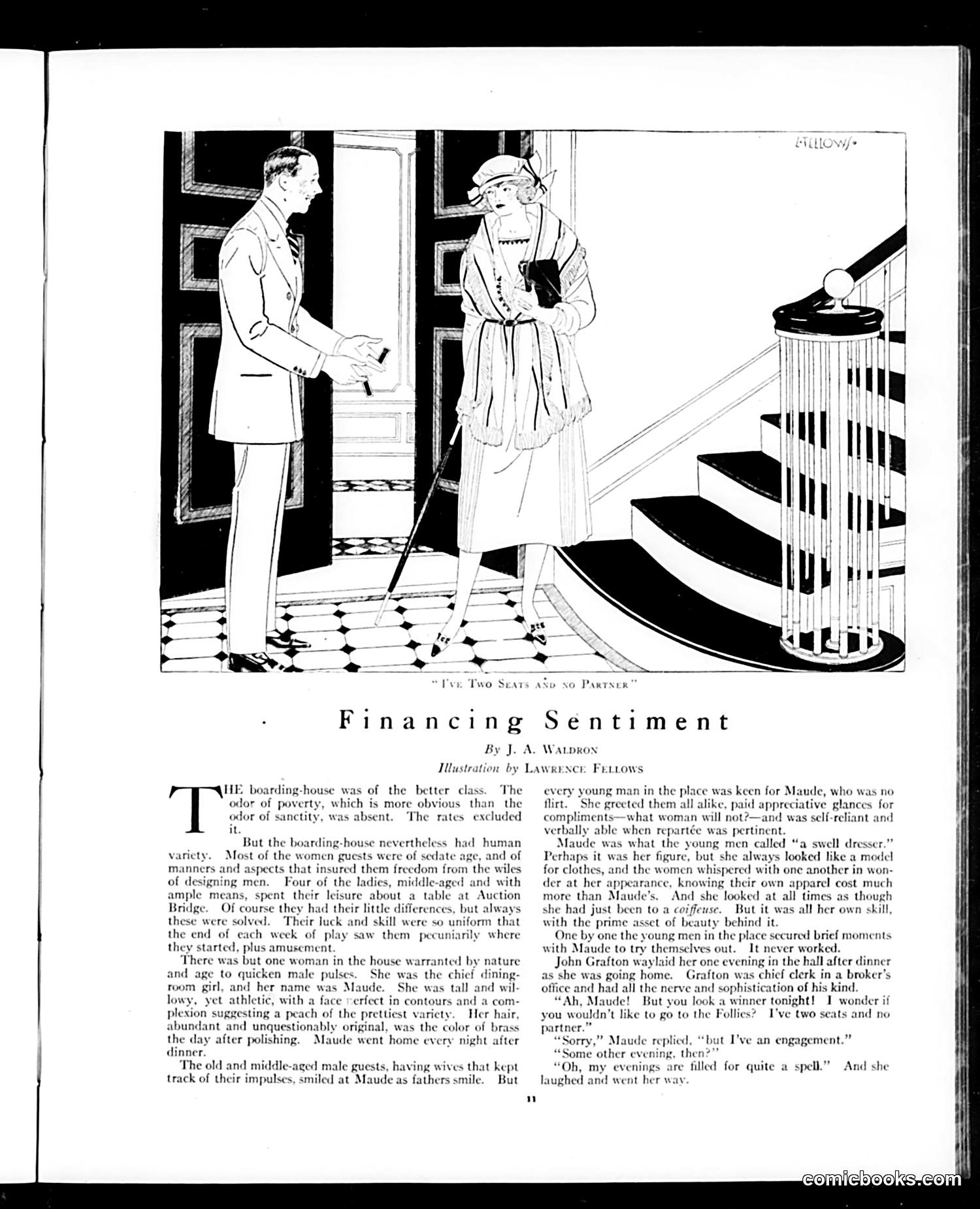
This is a romantic short story rather than political satire. The illustration shows a well-dressed man (John Grafton, a broker's clerk) attempting to court Maude, an attractive dining-room girl at a respectable boarding house. The satire targets *class and gender dynamics* of the era. Maude represents the "New Woman"—independent, well-dressed, self-reliant, and impervious to male advances despite her beauty. Young boarders repeatedly pursue her romantically, but she politely declines, maintaining her dignity and autonomy. The story's title suggests the joke: the men are financing their romantic "sentiment" (hoping to impress her with invitations to expensive venues like the Follies theater), but Maude resists commodification. She cannot be "purchased" through entertainment or attention, however sophisticated the suitor. The humor lies in exposing the gap between masculine presumption and female agency in early 20th-century courtship.
📄 Transcribed text from this page (OCR, searchable)
Machine-transcribed from the original scan — historical spelling and the odd misread are preserved.
. Financing HE boarding-house was of the better cl. The odor of poverty, which is more obvious than the odor of sanctity, was absent. The rates excluded it But the boarding-house nevertheless had human Most of the women guests were of sedate age, and of uspects that insured them freedom from the wiles variety. manners anc of designing men. Four of the ladies, middle-aged and with ample means, spent their leisure about a table at Auction Bridge. Of cou they had their little differences, but always these were solved. Their luck and skill were so uniform that the end of each week of play saw them pecuniarily where they started, plus amusement There was but one woman in the house warranted by nature and age to quicken male pulses. She was the chief dining- room girl, and her name was Maude. She was tall and wil- lowy, yet athletic, with a face rerfect in contours and a com- plexion suggesting a peach of the prettiest variety. Her hair abundant and unquestionably original, was the color of brass the day after polishing. Maude went home every night after dinner. The old and middle-aged male guests, having wives that kept track of their impulses, smiled at Maude as fathers smile. But Two Seats Sentiment By J. A. Watprox Illustration by LAWRENCE FrLtows every young man in the place was keen for Maude, who was no flirt. She grected them all alike, paid appreciative glances for pliments—what woman will not?—and was self-reliant and verbally able when repartée was pertinent. Maude was what the young men called “a swell dresser.” Perhaps it was her figure, but she always looked like a model for clothes, and the women whispered with onc another in won- der at her appearance, knowing their own apparel cost much more than Maude’s. And she looked at all times as though she had just been to a coi But it was all her own skill, with the prime asset of beauty behind it. One by one the young men in the place secured brief moments with Maude to try themselves out. It never worked. John Grafton waylaid her one evening in the hall after dinner as she was going home. Grafton was chief clerk in a broker's office and had all the nerve and sophistication of his kind. “Ah, Maude! But you look a winner tonight! I wonder if you wouldn’t like to go to the Follies? I've two seats and no partner.” “Sorry,” Maude replied, “Some other eve then “Oh, my evenings are filled for quite a spell.” laughed and went her way use. but I’ve an engagement.” And she n