
A complete issue · 36 pages · 1920
Judge — July 24, 1920
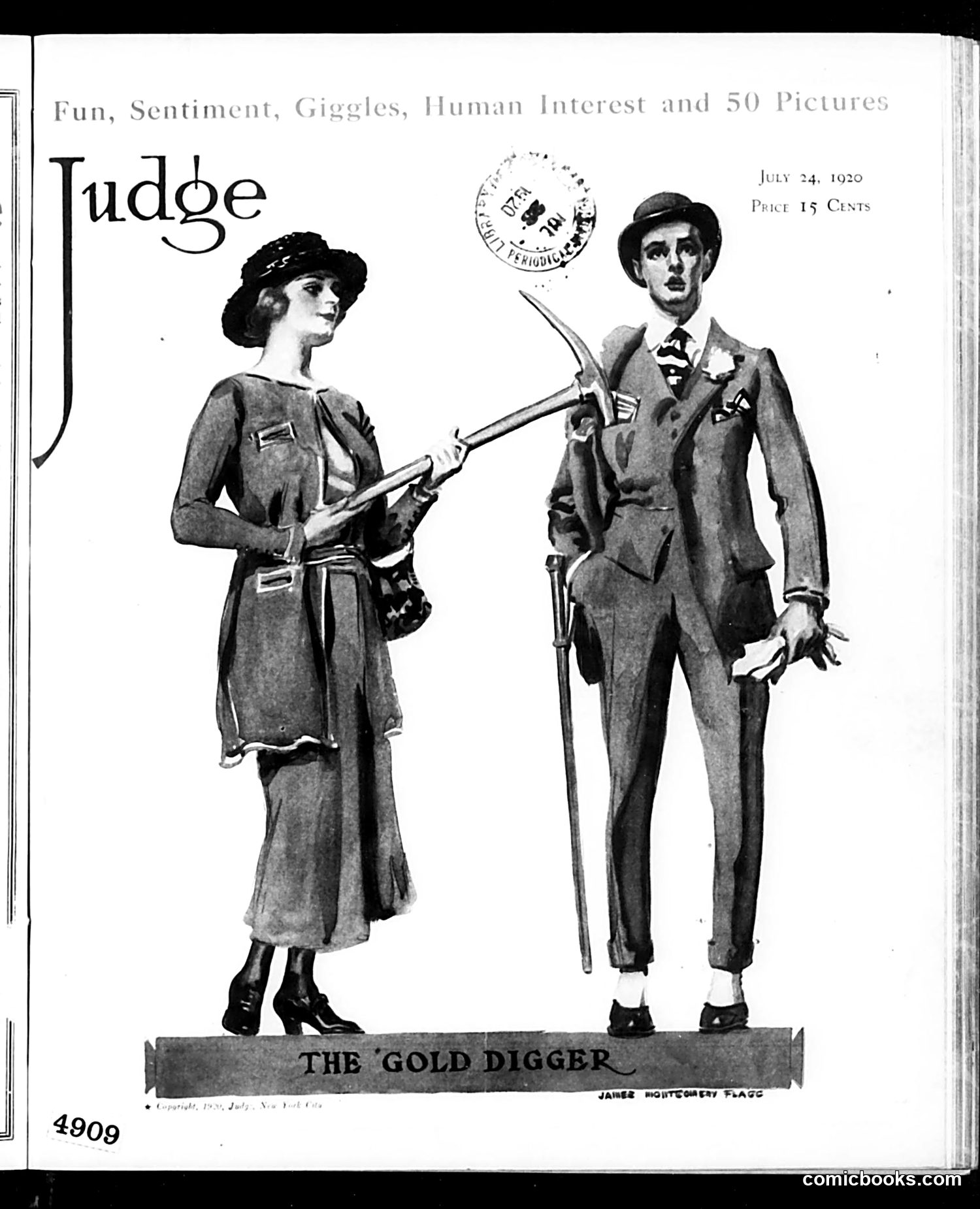
This satirical illustration depicts two figures labeled "The Gold Digger"—a period term for a woman who pursues men primarily for financial gain. The woman on the left holds what appears to be a pickaxe or mining tool, while the well-dressed man on the right looks alarmed, clutching his wallet. The satire plays on the literal meaning of "gold digger" by showing the woman as an actual prospector attacking a man for his money. This reflects 1920s social anxieties about women's changing roles—the recent suffrage movement (19th Amendment passed in 1920) and increasing female economic independence made some men fear predatory female behavior. The cartoon mocks both the "gold digger" stereotype and male paranoia about women's financial ambitions.
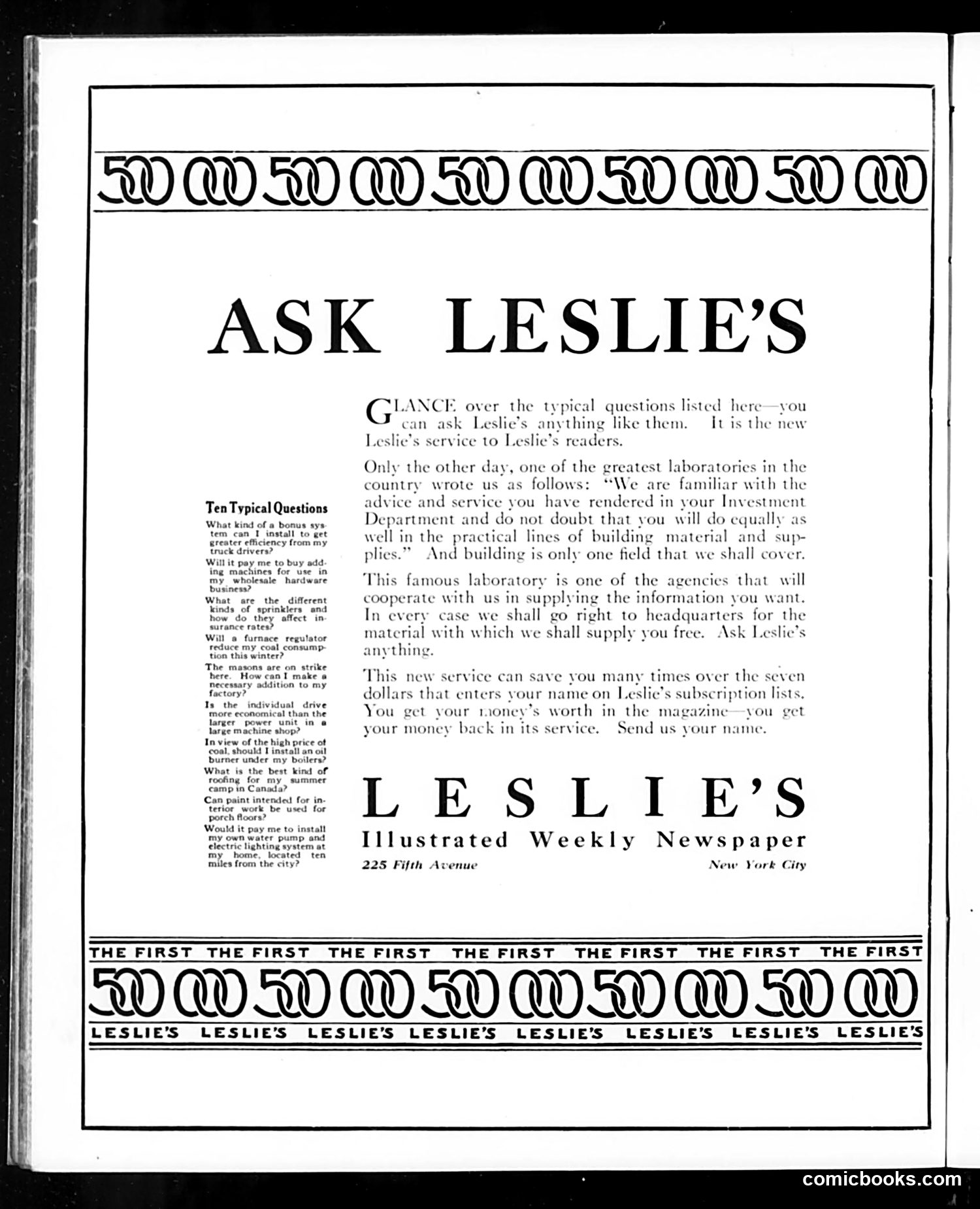
This page is primarily **advertising**, not satire or political commentary. It's a full-page advertisement for Leslie's Illustrated Weekly Newspaper promoting a new "Ask Leslie's" advice service. The ad lists "Ten Typical Questions" readers might ask—ranging from practical concerns (installing machinery, building materials) to domestic issues (plumbing, electrical systems). The pitch emphasizes that Leslie's will answer reader questions for free, connecting subscribers with expert laboratories and agencies. The decorative Art Deco-style borders with "50" (likely referring to price or an anniversary) frame the content. There's no political satire here—it's a straightforward service announcement highlighting Leslie's value proposition: access to authoritative information at no cost beyond subscription.
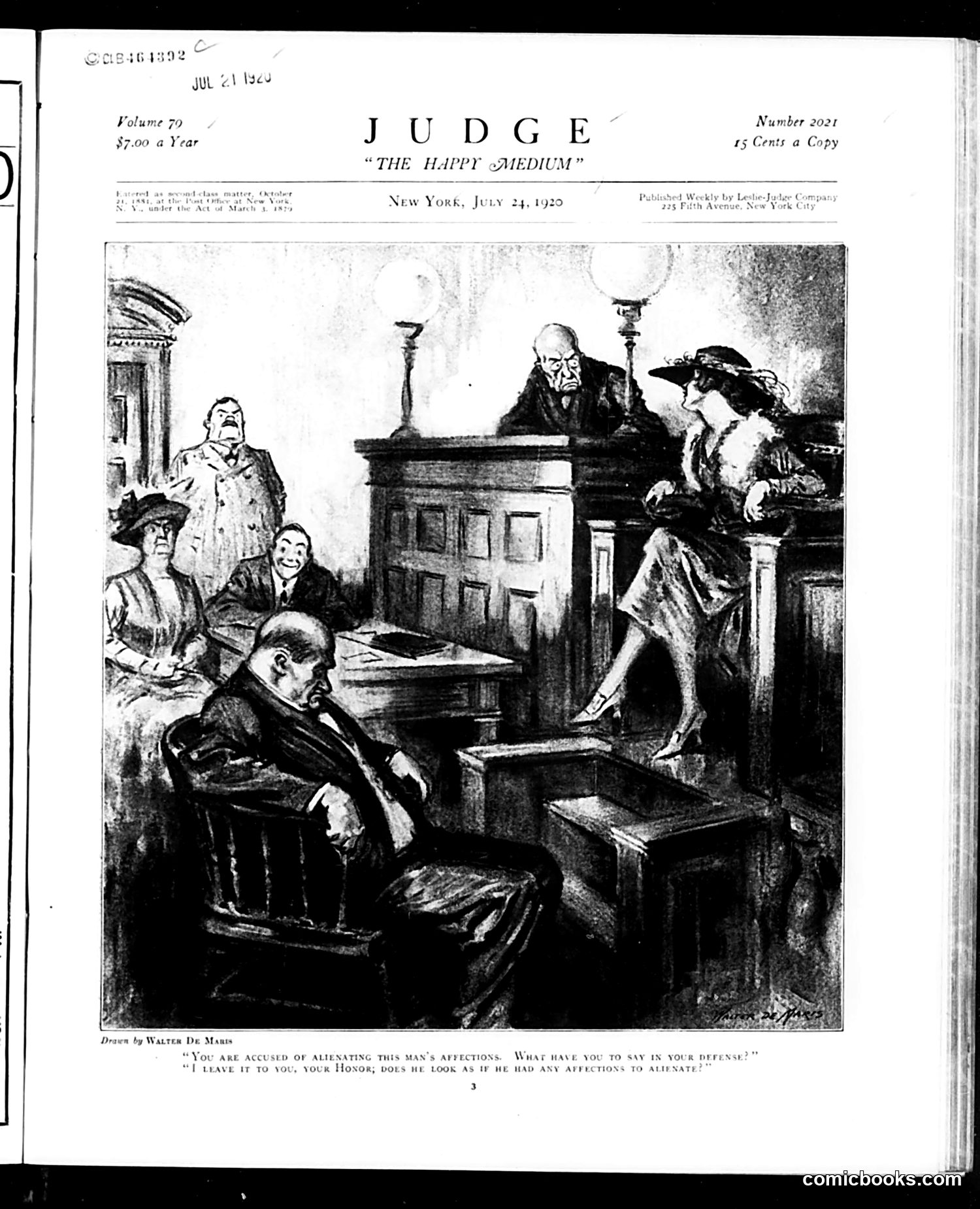
This courtroom scene, drawn by Walter De Maris, depicts a legal proceeding where a man (seated, center-left) is accused of "alienating this man's affections"—a now-obsolete legal claim where someone could sue another for damages if they caused their spouse to withdraw affection. The judge questions the defendant's credibility, asking sarcastically whether he appears capable of attracting anyone's affections at all. The satire mocks both the absurdity of "alienation of affections" lawsuits (which were taken seriously legally in 1929) and the defendant's apparent unattractiveness. This reflects early 20th-century legal culture when such suits were common, ridiculous by modern standards, and frequently the subject of satirical commentary.
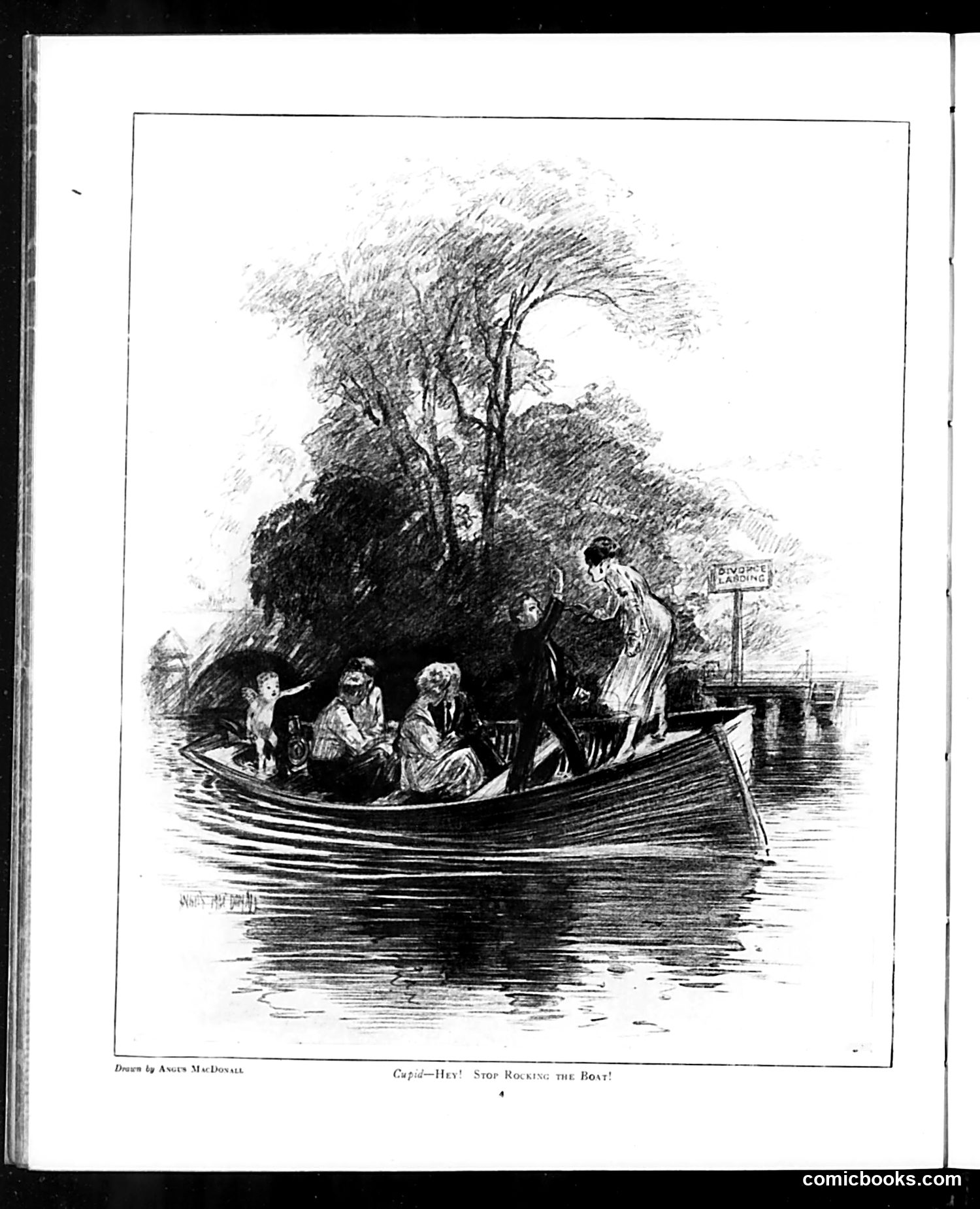
This illustration by Agnes MacDonald depicts a boat on water with multiple passengers, one standing and gesturing urgently. The caption "Cap'—Hey! Stop Rocking the Boat!" is a common idiom meaning "don't cause trouble" or "don't disturb the status quo." Without additional context from Judge magazine's publication date, the specific political figures remain unclear. However, the cartoon likely satirizes political instability or internal conflict—possibly depicting a government or organization where one faction (the standing figure) is disrupting established order, prompting others to demand restraint. The nautical metaphor was typical of satirical magazines to represent the ship of state or institutional stability threatened by discord or radical action.
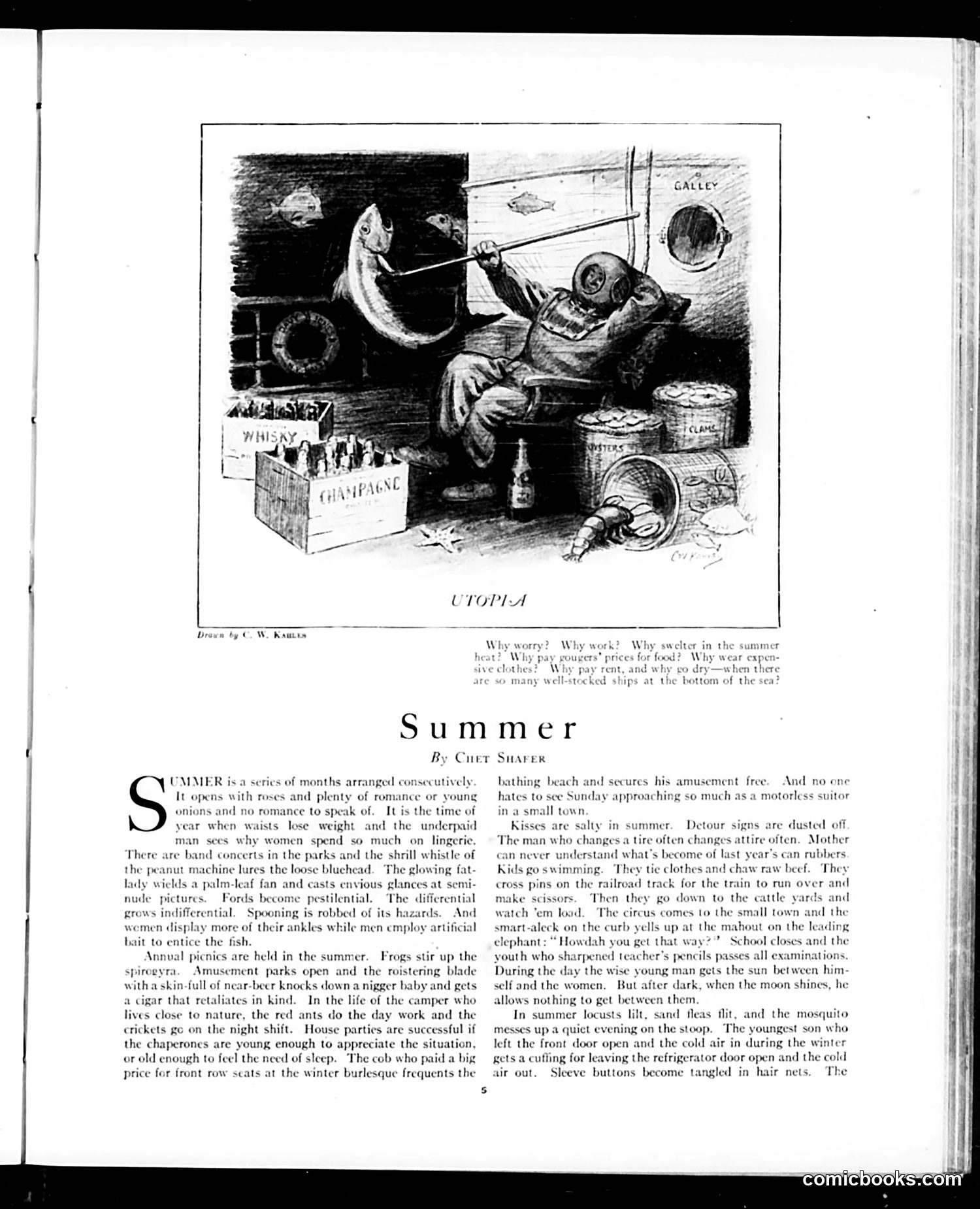
This cartoon satirizes naive idealism about technological progress and leisure. The figure wearing a gas mask reclines in an underwater submarine cabin, fishing for what appears to be a large fish. Surrounding him are bottles labeled "whisky" and "champagne," crates of provisions, and various luxuries—suggesting someone who has retreated from society. The caption "UTOPIA" is ironic. The cartoon mocks the fantasy of perfect living through technology and escapism. The absurdity of deep-sea fishing while surrounded by alcohol and supplies suggests criticism of those who imagine utopian futures without confronting real social problems. The gas mask hints at industrial pollution or warfare concerns of the era, implying escape from technological civilization's actual hazards rather than its benefits.
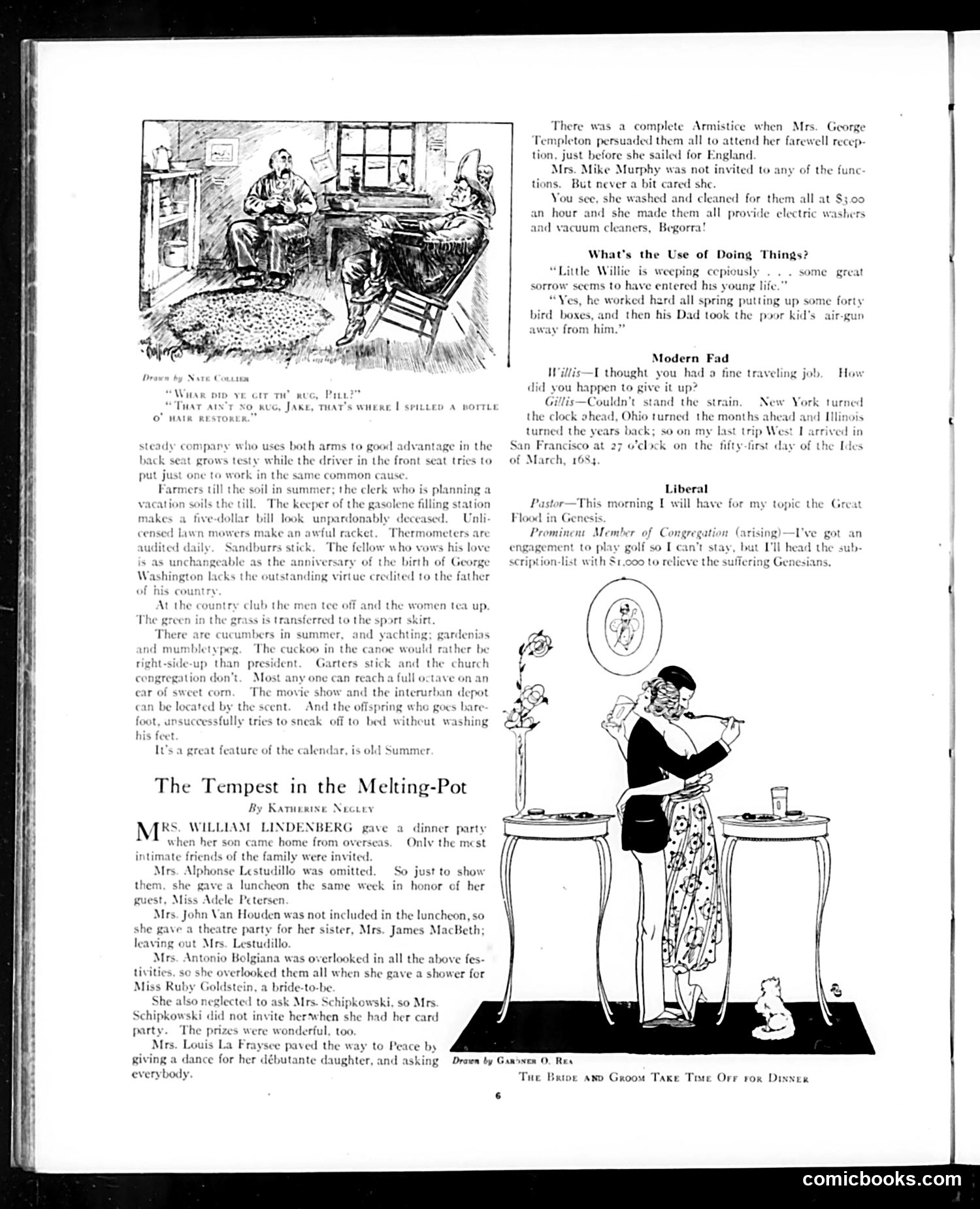
This page contains three distinct sections: 1. **Top cartoon** ("Where did ye get the rug, Bill?"): A sketch satirizing working-class domesticity, showing two men examining a rug, with text suggesting one obtained it through questionable means at a restorer's shop. The humor targets common fraud or deception in the restoration trade. 2. **"Modern Fad"** section: A brief gossip column about someone named Willis relocating from Ohio to San Francisco, satirizing the trend of people chasing opportunities westward. 3. **"The Tempest in the Melting-Pot"** (main article): Social satire about wealthy women's competitive entertaining and social one-upsmanship—various Mrs. [surnames] giving overlapping parties for the same guests, with Mrs. Schipkowski notably excluded, causing offense. The satire mocks upper-class social hierarchies and etiquette obsessions. The illustration shows a bride and groom taking a dinner break, likely accompanying this society gossip.
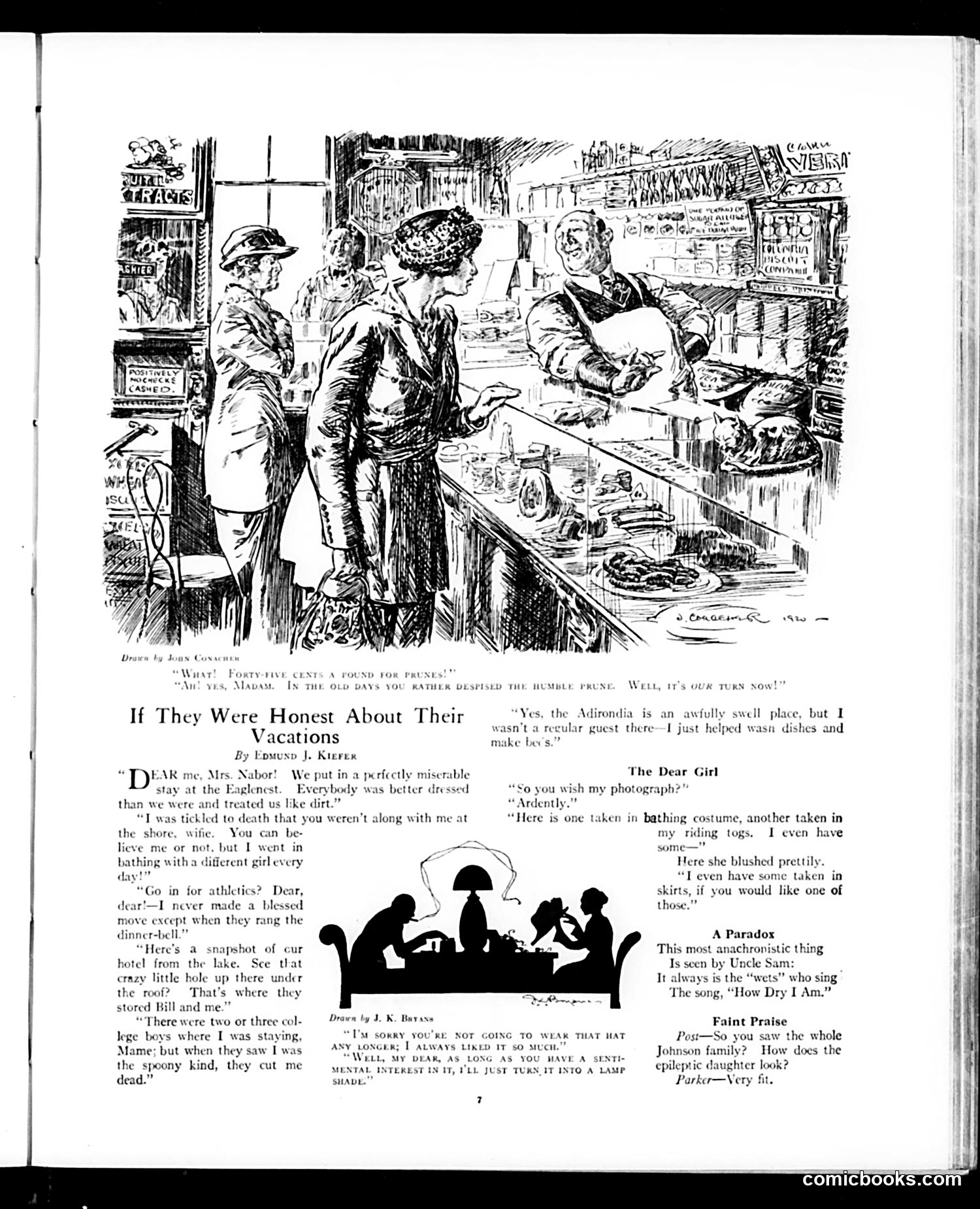
This page satirizes wealthy Americans' dishonest vacation boasts. The main article mocks how people exaggerate or lie about their holidays. In the top cartoon, a shopkeeper charges 45 cents for prunes while a customer complains—the caption suggests the wealthy once scorned prunes as peasant food, but now must buy them, reversing social positions. The "If They Were Honest About Their Vacations" section features a man admitting embarrassing truths: he wasn't a real guest at an upscale resort but washed dishes; he bathed with different girls daily; the "hotel" was actually storage. His wife's sarcastic responses expose his pretense. The smaller cartoons parody similar social dishonesty—women lying about photographs, praising hats they despise. The "Paradox" jokes about Prohibition-era irony (Uncle Sam promotes temperance while a song celebrates drinking). The satire targets early 20th-century class anxiety and social climbing among the emerging middle class.
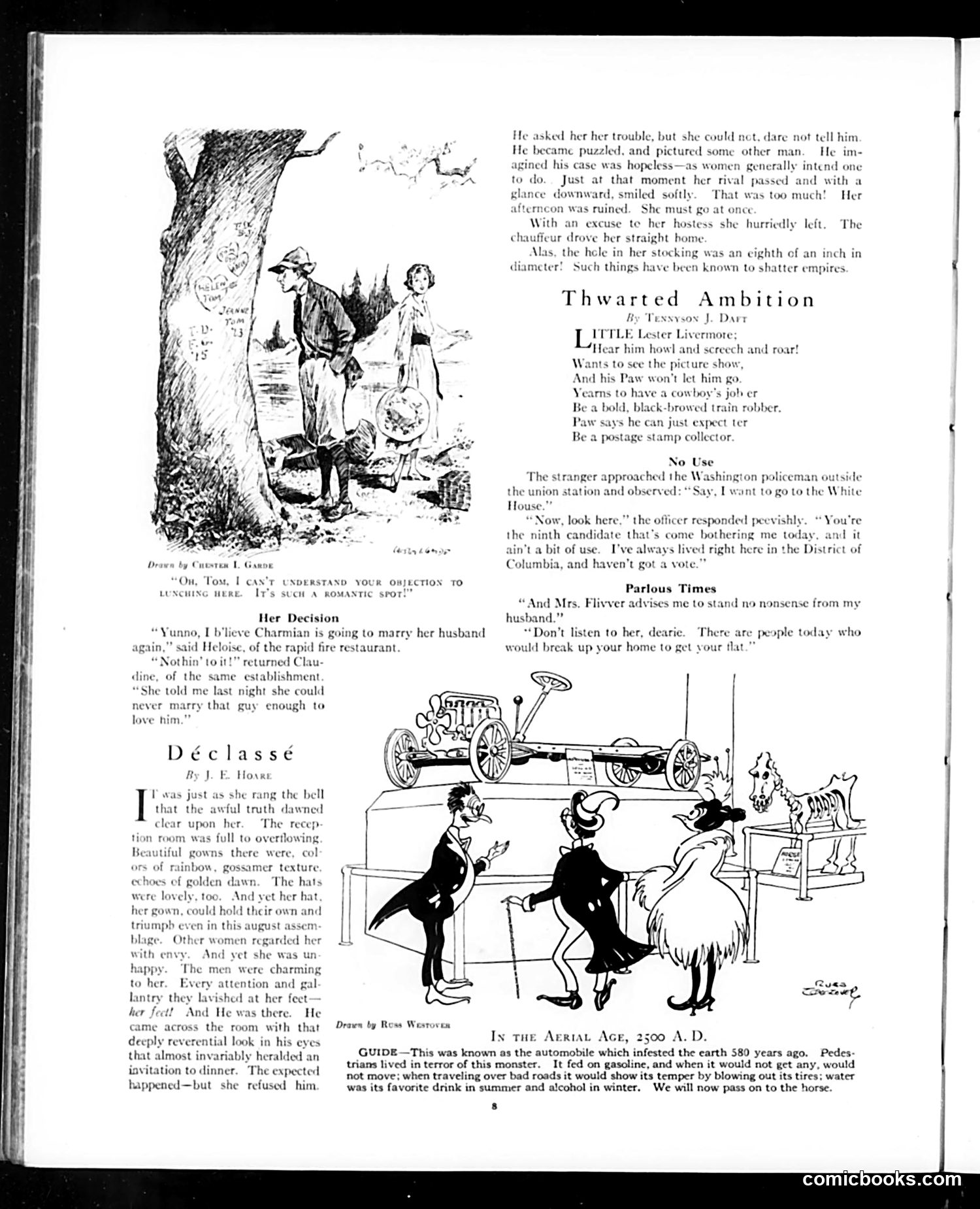
This page contains several satirical pieces typical of early 20th-century American humor: **"Her Decision"** and **"Déclassé"**: Social comedies about romantic entanglements among the upper class. The jokes hinge on women's superficiality—one woman refuses a dinner invitation because a rival appeared, then discovers she had a hole in her stocking. The satire mocks both feminine vanity and the performative nature of high-society courtship. **"Thwarted Ambition"**: A brief comic verse about a boy wanting to become a train robber, mocking both childhood fantasies and criminal aspiration. **"No Use"**: Political satire about a man seeking entry to the White House, turned away by a cop who notes he's the ninth such candidate that day and lacks voting rights in D.C. This likely references widespread frustration with election access or suffrage issues. **"In the Aerial Age, 2500 A.D."**: A satirical future-history treating automobiles as extinct monsters, mocking the newfangled technology's unreliability and danger—a common Judge theme ridiculing modern innovations.
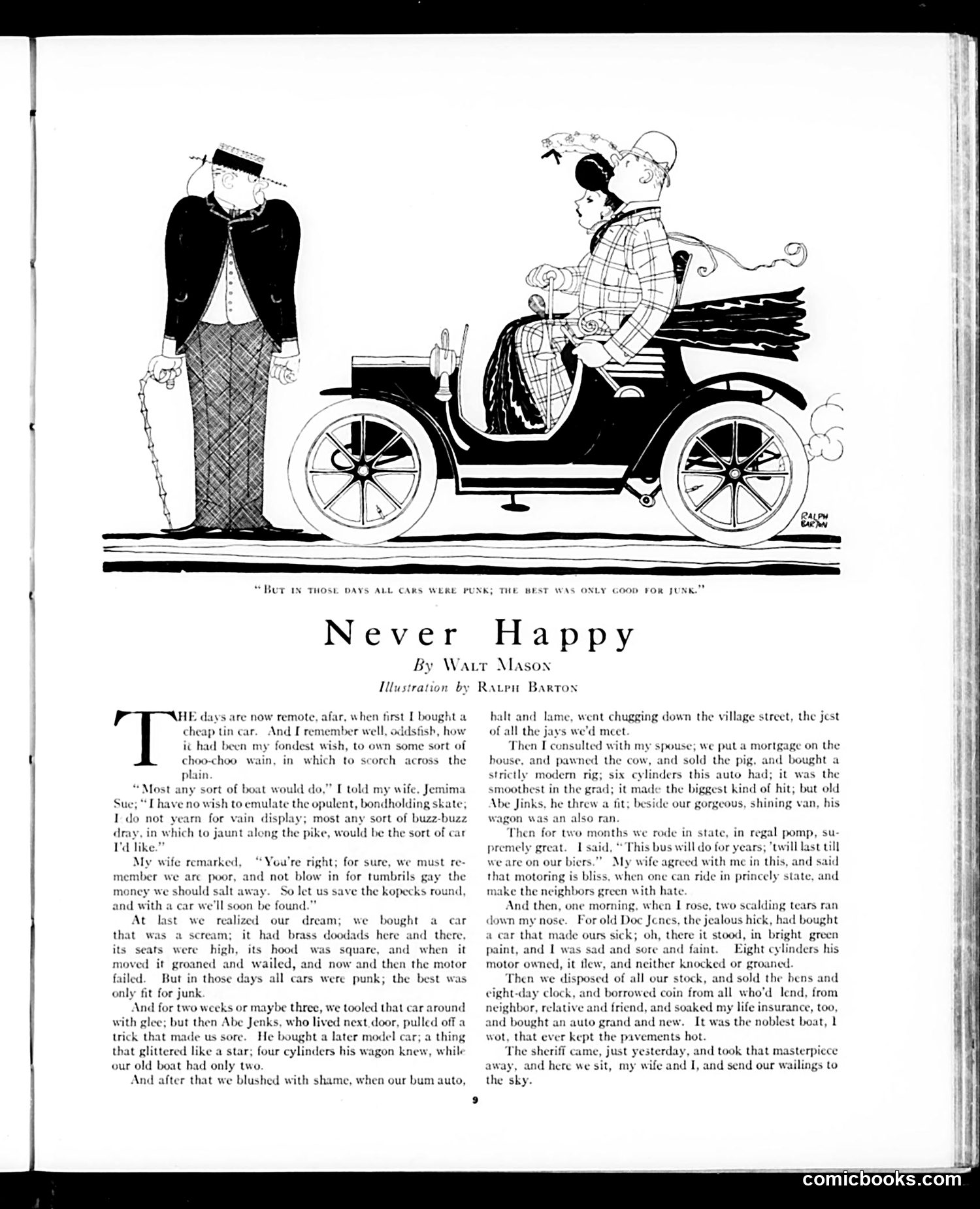
This story-cartoon satirizes the early automobile era's social dynamics. The narrator, a poor man, initially buys a cheap, unreliable car ("all cars were punk"). When his neighbor Abe Jenks acquires a newer, better model, shame drives the narrator to mortgage his house, sell livestock, and buy a superior six-cylinder car. But Jenks one-ups him again with an eight-cylinder vehicle. The cycle of competitive consumption continues until the narrator's final, grandest car is repossessed by the sheriff. The satire targets the "keeping up with the Joneses" mentality consuming Americans during the automobile boom. Each upgrade meant financial ruin, yet status anxiety compelled participation in an endless arms race of consumption. The moral: striving for material superiority leads to disaster. The caption's opening quote sets the theme—even the best cars are "junk," yet people destroy themselves acquiring them.
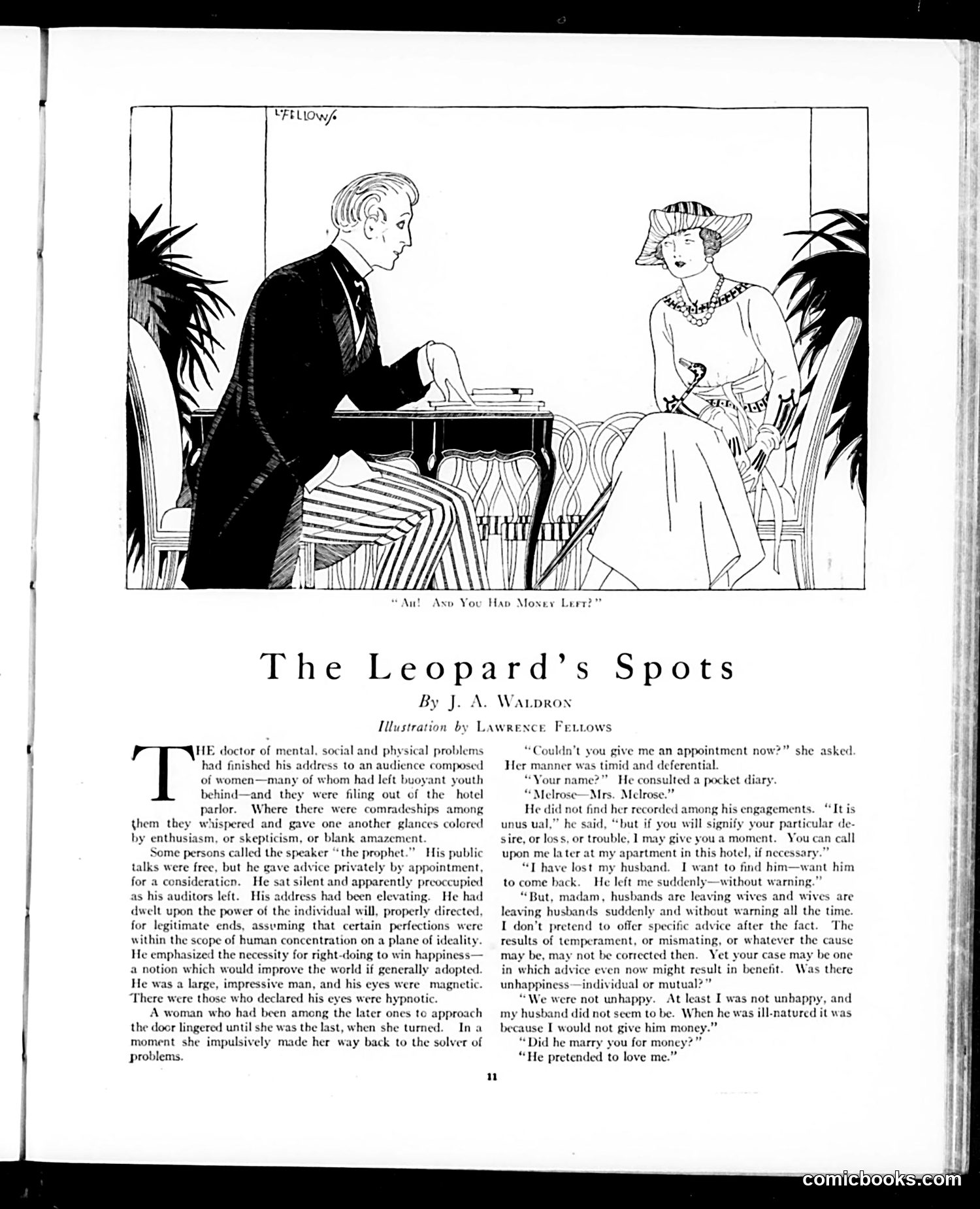
This is the opening page of a serialized short story, not a political cartoon. The illustration shows a well-dressed man—a self-styled "doctor" of personal problems—consulting with a woman named Mrs. Melrose, who seeks his advice about her departed husband. The story satirizes the era's popular "self-help" and pseudo-psychological advice culture. The doctor is presented as an impressive, magnetic figure who gives public lectures on willpower and personal improvement to women, then offers private consultations. The bitter irony emerges in Mrs. Melrose's confession: her husband left because she wouldn't give him money, yet he'd "pretended to love me." The title "The Leopard's Spots" likely suggests that fundamental character flaws cannot be changed—a reference to the biblical phrase "can the leopard change his spots?" The satire mocks both the charlatan advisor and the woman's naive belief that professional counsel can solve what amounts to a mercenary marriage.
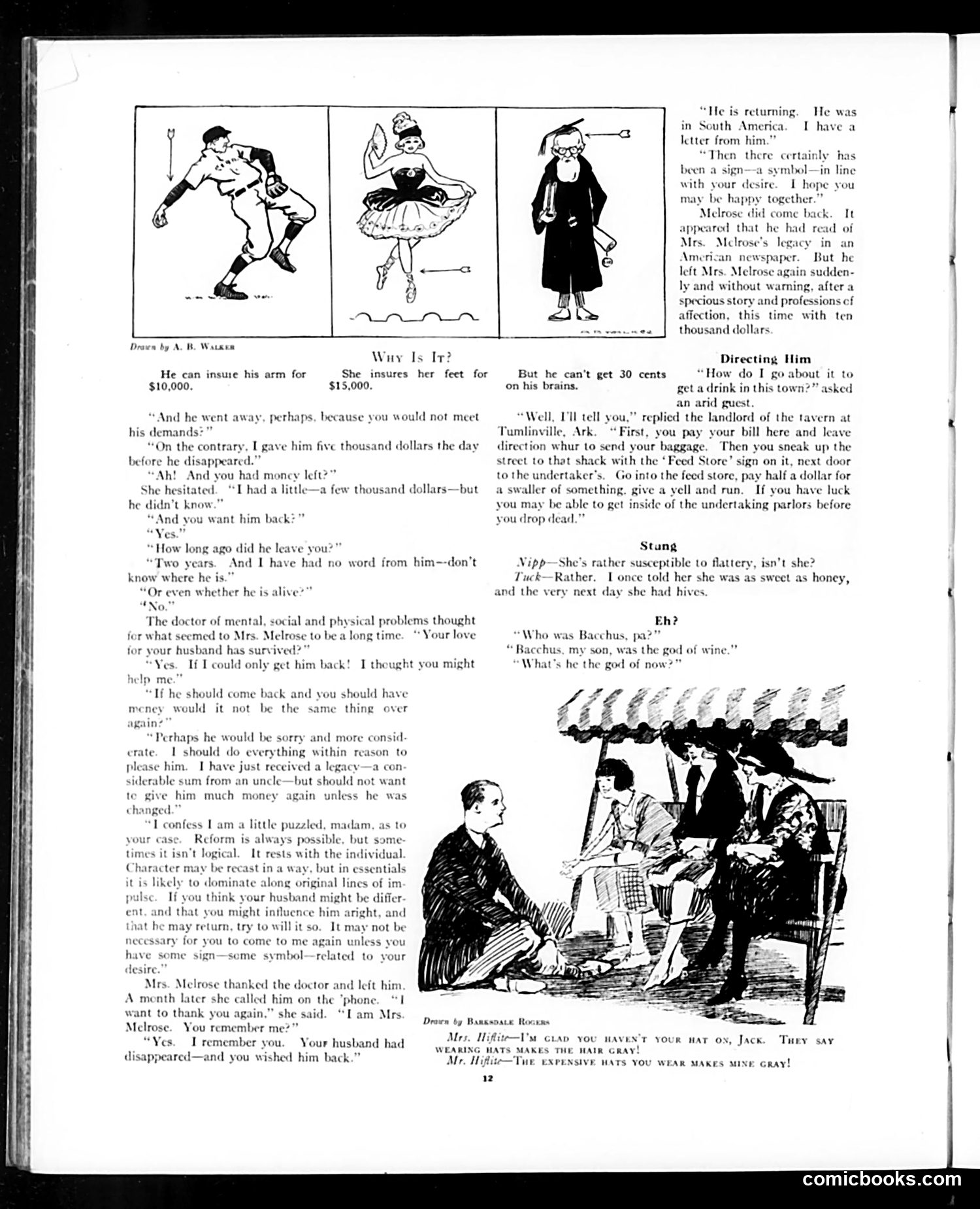
This page contains multiple satirical pieces typical of early 20th-century Judge magazine: **Top Cartoon ("Why Is It?")**: Mocks gender disparities in insurance valuations—men can insure their arms for $10,000, women their feet for $15,000, yet men supposedly can't get "30 cents on his brains." The joke satirizes both gender inequality and male intellectual capacity. **Main Story ("Melrose")**: A domestic drama about a woman whose husband abandoned her for South America with her money. A doctor advises her to "will" his return through positive thinking (a reference to New Thought/self-help movements popular then). The husband does return—only to steal again, this time taking ten thousand dollars from her inheritance. The satire targets both gullible faith in psychological solutions and predatory husbands. **Smaller Jokes**: - "Directing Him": Rural Arkansas bootlegging humor during Prohibition - "Stung": A quip about flattery backfiring - Bottom cartoon: A married couple joke about expensive hats causing gray hair The overall tone is cynical about romance, wealth, and contemporary fads.
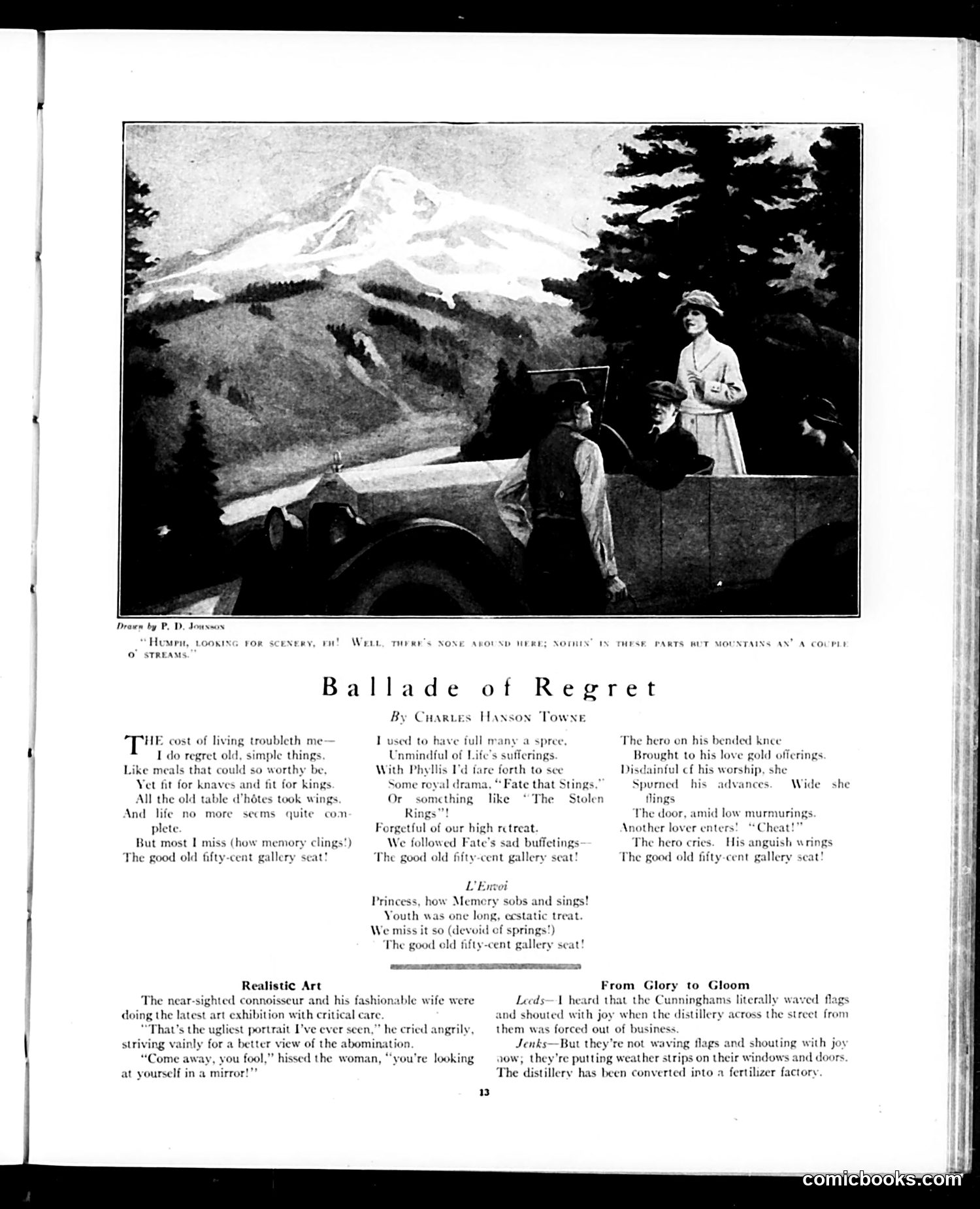
This page contains three distinct pieces from Judge magazine: **Top Illustration:** A scenic mountain landscape with figures in period dress (early 1900s). The caption humorously depicts characters searching for scenery, with the joke being that mountains and streams surround them—they're already in the landscape they seek. **"Ballade of Regret":** A nostalgic poem by Charles Hanson Towne lamenting lost cheapness and simpler times, particularly the "fifty-cent gallery seat" (cheap theater seating). This reflects early-20th-century anxiety about rising costs of living and vanishing affordable pleasures. **Two Short Humorous Pieces:** - "Realistic Art" mocks pretentious modern art criticism—a man insults an ugly portrait, only for his wife to reveal he's looking at himself in a mirror. - "From Glory to Gloom" jokes about neighbors initially celebrating a distillery's closure, then immediately regretting it when a fertilizer factory replaces it (worse smell/pollution). The page represents typical Judge content: nostalgic commentary, social observation about class and consumption, and visual/verbal puns for educated readers.
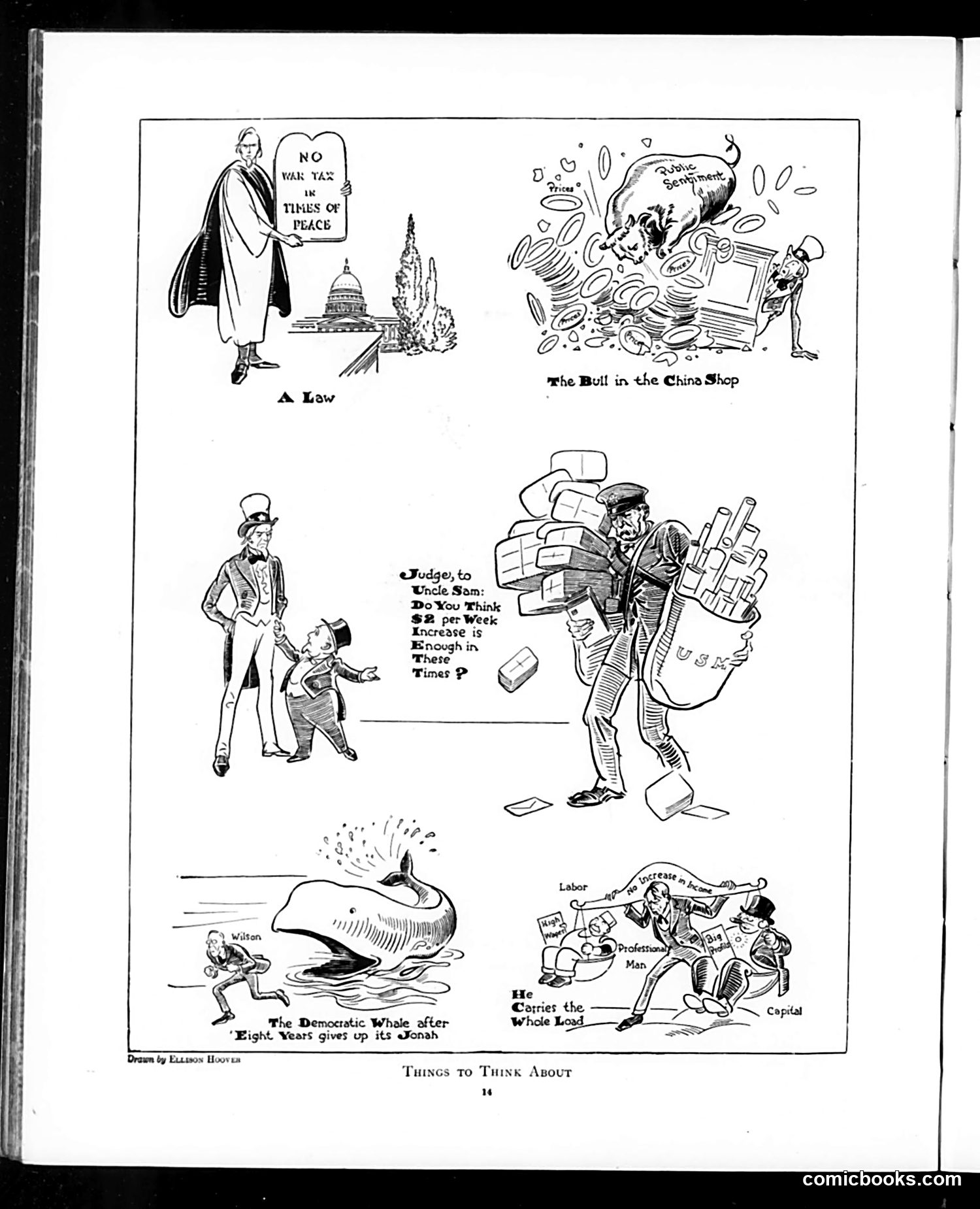
This page contains six political cartoons critiquing early 20th-century American politics and social issues: **"A Law"** depicts a robed figure advocating "no war tax in times of peace" near the Capitol, satirizing pacifist or anti-military spending positions. **"The Bull in the China Shop"** shows chaotic destruction, likely commenting on reckless political or economic management. **The wage cartoon** features Uncle Sam asking a judge whether a $2 weekly wage increase is sufficient, addressing labor disputes and working conditions. **"The Democratic Whale"** presents a whale vomiting up "Jonah" (a biblical reference to something rejected), suggesting Democrats expelling an unpopular figure after eight years—likely referencing an outgoing administration. **"Carrier the Whole Load"** depicts figures representing Labor, Capital, a Professional Man, and other groups struggling under burden, critiquing unequal economic distribution. The cartoons collectively satirize labor struggles, political incompetence, and wealth inequality of the period.
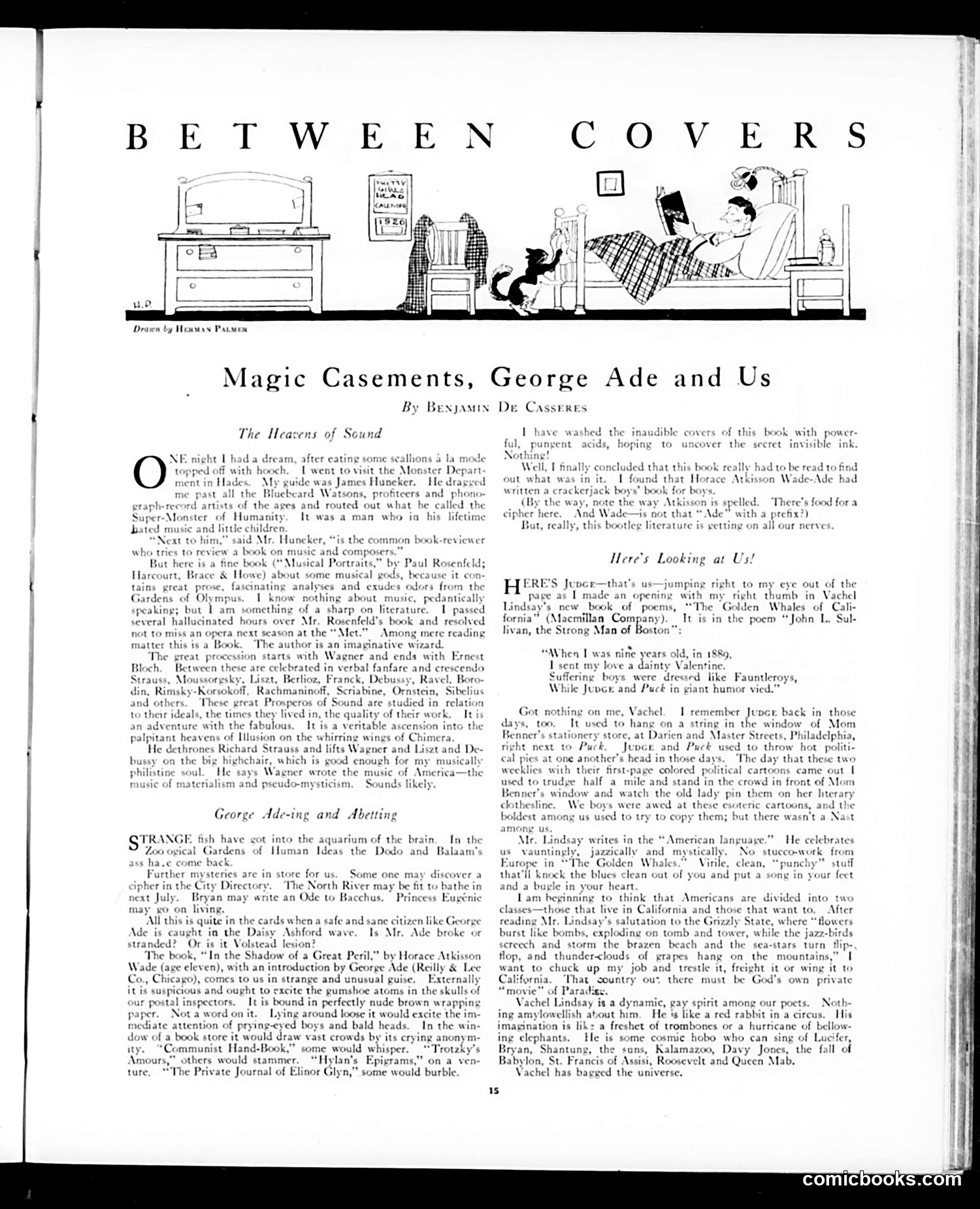
This page features a satirical article by Benjamin De Casseres about George Ade's new book of poetry, *The Golden Whales of California*. The cartoon (drawn by Hesper Palmer) depicts a domestic scene where someone reads in bed while a dog jumps nearby—illustrating the casual, intimate nature of reading. The satire mocks both the book and American literary culture. De Casseres playfully critiques how Ade's work deals with "magical casements" (literary escapism) while poking fun at Vachel Lindsay, another poet, describing him as a "cosmic hobo" who indiscriminately celebrates everything from Lucifer to Queen Mab. The piece satirizes the pretentiousness of contemporary poetry and its readers, while also gently mocking the act of reviewing books themselves. References to censorship ("invisible ink," postal inspectors) suggest anxiety about literary content regulation during the Prohibition era. The overall tone is affectionate mockery of American literary ambitions rather than harsh criticism.
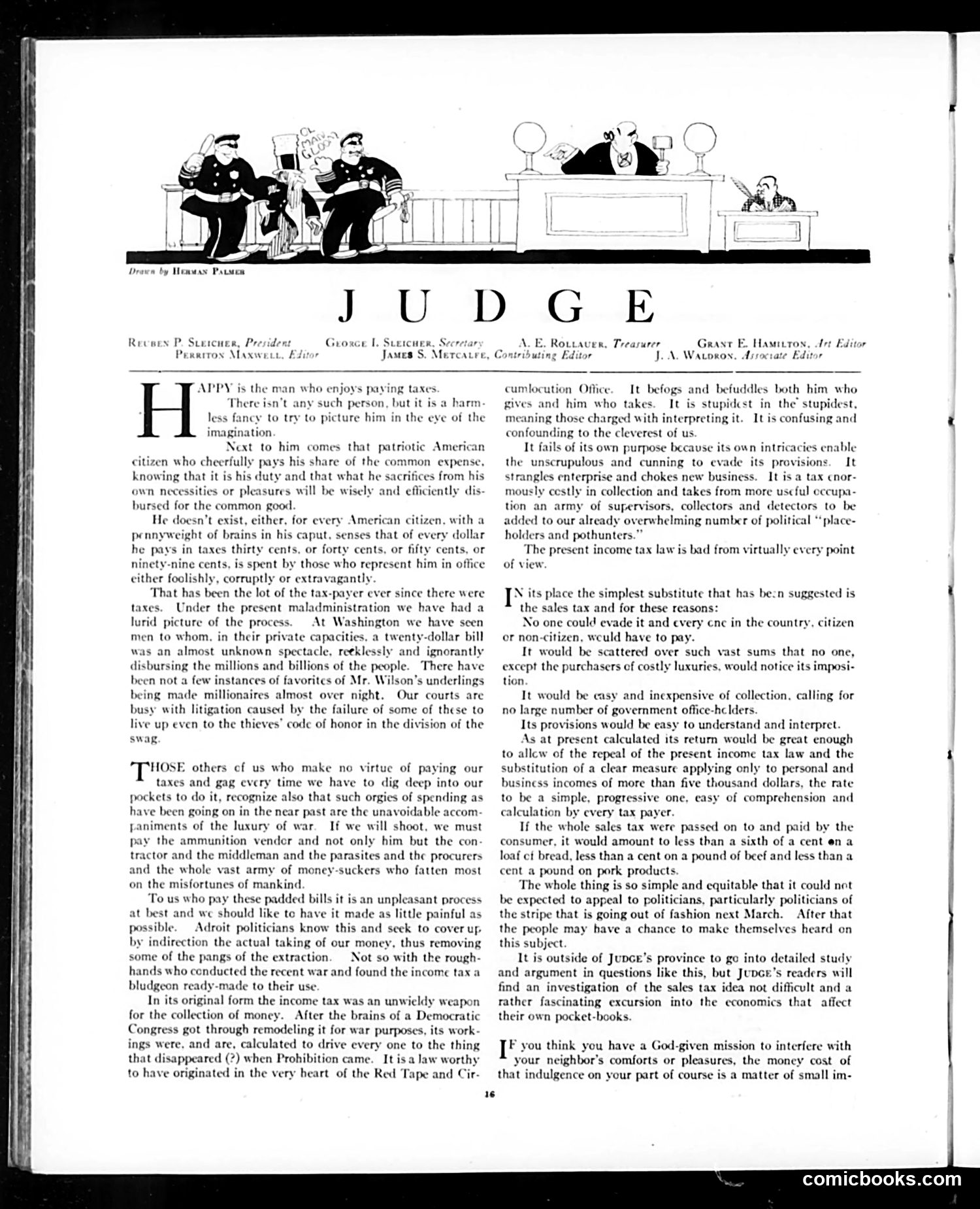
This is an editorial page (not primarily a cartoon) from Judge magazine criticizing the U.S. income tax system, likely from the Wilson administration era (early 1920s, given references to WWI and Prohibition). **The Cartoon Header:** Shows a courtroom scene with a judge presiding—a visual pun introducing the editorial column titled "JUDGE." **Main Argument:** The editorial attacks the income tax as poorly designed, claiming it: - Is confusingly written and administered - Allows the wealthy and unscrupulous to evade it through loopholes - Strangles business and entrepreneurship - Requires massive bureaucratic overhead **Political Context:** The piece blames "a Democratic Congress" for making the tax "unwieldy" during wartime. It suggests the tax system rivals the absurd "Red Tape and Circumlocution Office" (Dickens reference)—implying government incompetence. **Satire:** Opens by mocking anyone who enjoys paying taxes, establishing that taxes themselves are acceptable but *this* tax system is indefensible.
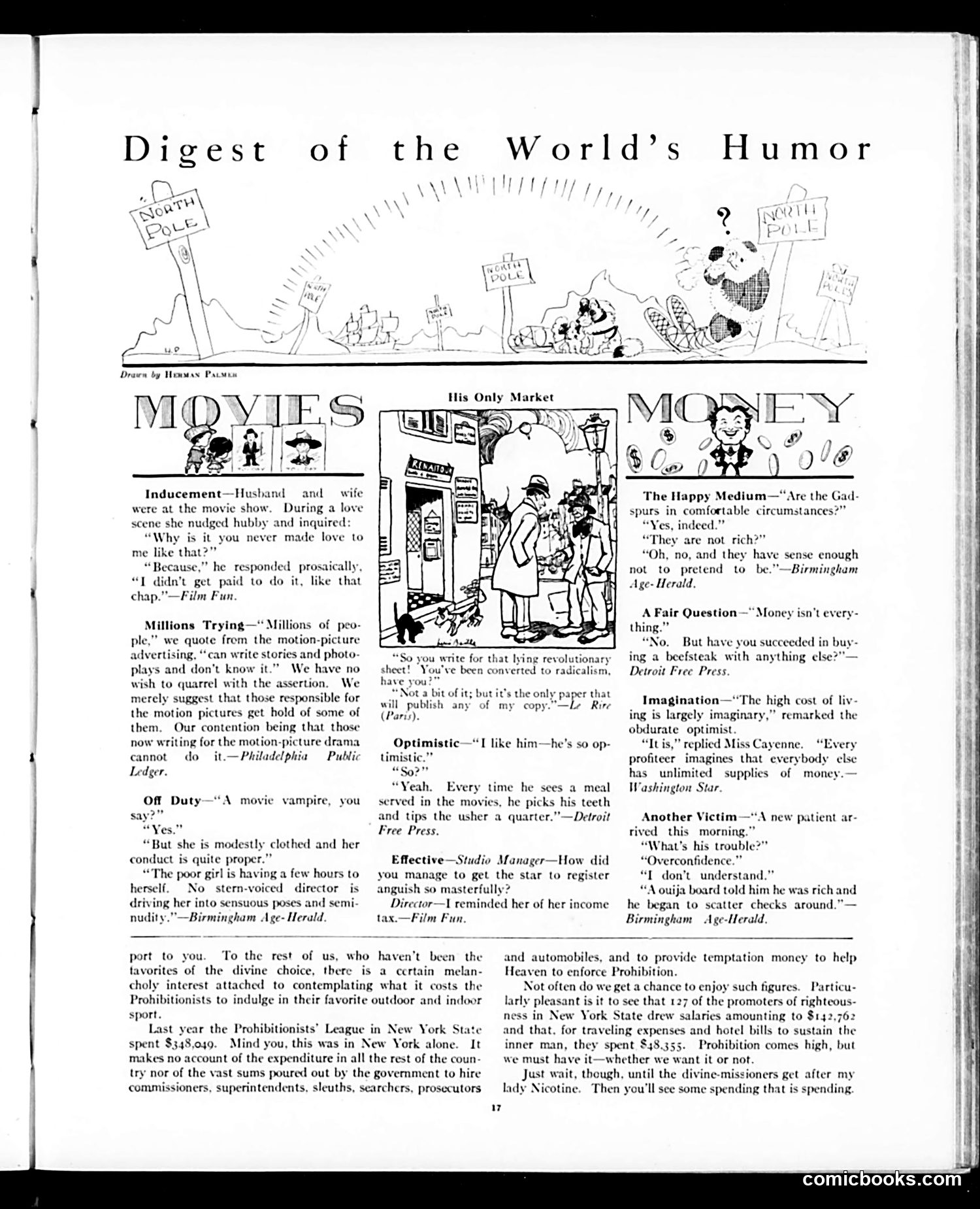
This page collects humorous anecdotes satirizing early 20th-century American life, particularly Hollywood and Prohibition enforcement. **Key themes:** 1. **Movies and morality**: Multiple jokes mock cinema's hypocrisy—studios claiming millions can write screenplays while depicting sensuous actresses in "modest" roles, and the gap between on-screen romance and real life. 2. **Prohibition's costs**: The substantial text section critiques Prohibition enforcement, revealing the New York Prohibitionists' League spent $348,049 annually (plus government expenditures), with 127 officials drawing salaries totaling $142,762. The satirical point: Prohibition is expensive to enforce yet ineffective—suggesting the crusade wastes public money. 3. **Economic anxiety**: Several jokes reference money concerns during this era—profiteers, the "high cost of living," and working-class struggles. 4. **The "ouija board" joke** mocks nouveau riche profiteers who received sudden wealth and foolishly scattered money. The page reflects 1920s skepticism toward Prohibition's practical implementation and its supporters' self-righteousness.
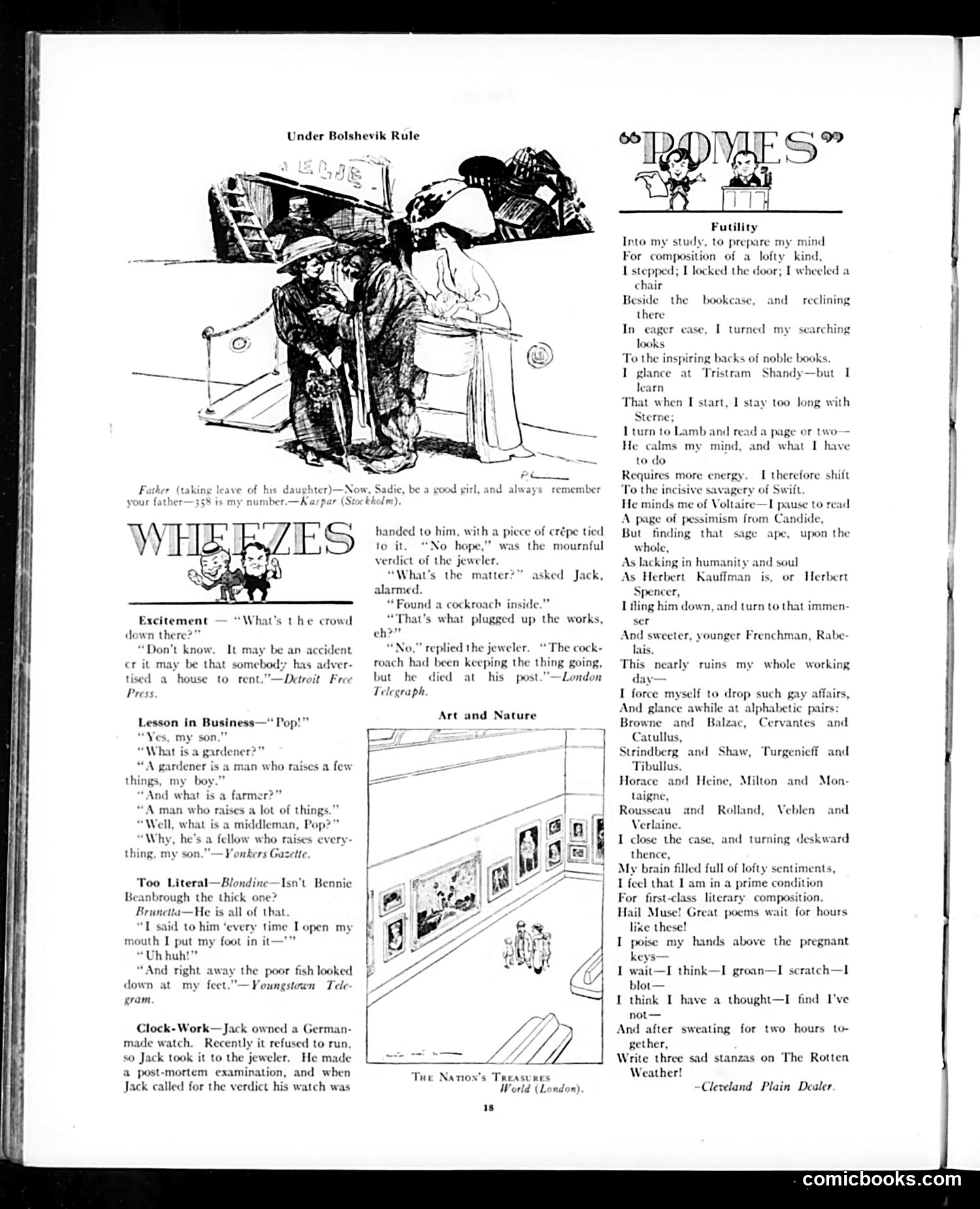
This Judge magazine page contains several satirical pieces mocking contemporary concerns and absurdities: **"Under Bolshevik Rule"** (top left): The cartoon depicts Russians under Soviet control, with the accompanying joke suggesting that Soviet communism has made life so bleak that even advertising a house for rent draws crowds—implying desperate poverty or that people gather for any distraction. This reflects American anti-communist anxiety of the early Soviet period. **"Excitement"** and **"Lesson in Business"**: These are brief jokes about American capitalism and class structures—the middleman "raises everything" by exploiting others. **"Too Literal"** and **"Clock-Work"**: Wordplay humor about misunderstandings and a German-made watch that ironically needed a cockroach to function—possibly a jab at German engineering or wartime sentiment. **"Futility"** (right): A longer poem mocking intellectual pretension—an author surrounds himself with famous literary works to inspire writing, only to spend hours struggling and producing nothing worthwhile. It satirizes pretentious literary ambition. The page blends political commentary (anti-Bolshevism) with gentle social satire about American life.
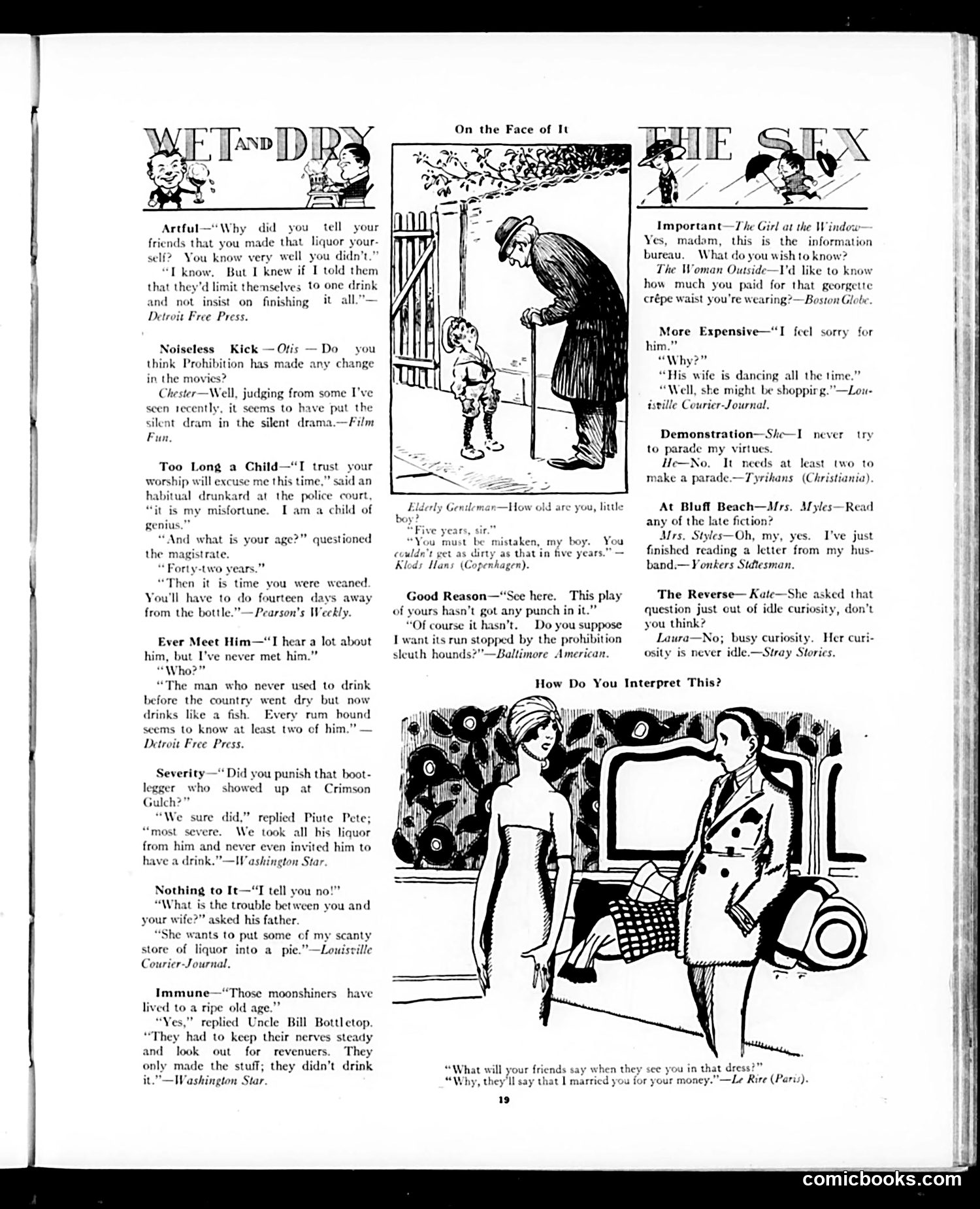
This page collects brief humorous anecdotes satirizing **Prohibition and its social consequences** (likely 1920s America, when alcohol was banned). The jokes mock: - **Bootleggers and illegal drinking**: Multiple quips reference homemade liquor, moonshiners, and people circumventing Prohibition laws - **Hypocrisy**: "Artful" shows someone claiming credit for illegal liquor to seem impressive; "Ever Meet Him" jokes about people who never drank before Prohibition but now do excessively - **Prohibition's failure**: "Good Reason" suggests even theater scripts avoid controversial content to escape government "prohibition sleuth hounds" - **Social disruption**: References to wives' behavior, marital discord, and moral decay The central cartoon ("How Do You Interpret This?") depicts a woman in revealing clothing with a man—likely satirizing post-Prohibition social loosening or concerns about women's independence and changing morality. The page assumes readers understand Prohibition created widespread illegal alcohol production, enforcement difficulties, and unexpected social changes—particularly affecting gender roles and public behavior.
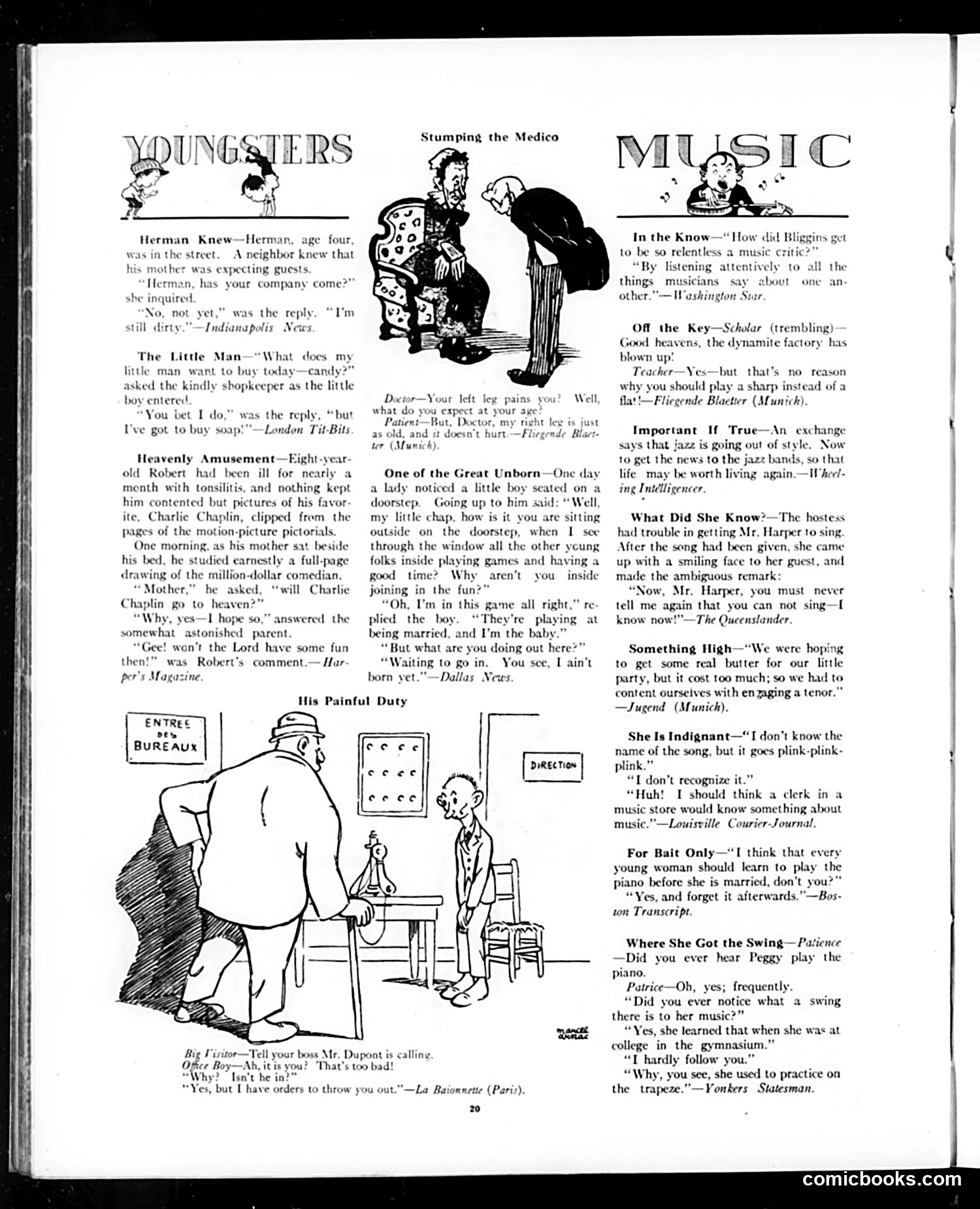
This page collects brief humorous anecdotes and jokes organized by theme. The content reflects early 20th-century American and European humor. **"Youngsters" section** features children's innocent misunderstandings: a four-year-old staying "dirty" before guests arrive; a boy needing soap money; eight-year-old Robert imagining Charlie Chaplin in heaven. These jokes rely on child logic and contemporary celebrity references (Chaplin was hugely famous). **"Stumping the Medico"** and **"His Painful Duty"** cartoons depict doctor-patient interactions and bureaucratic absurdity, with a portly official figure. **"Music" section** satirizes musicians and music culture: critics' pretentiousness, musical ignorance (not recognizing songs), tone-deaf singers, and a joke equating tenor singers with expensive butter—suggesting singers were costly luxuries. The page mixes reprinted jokes from international sources (Paris, Munich, Dallas), typical of Judge's eclectic approach. Humor centers on class differences, gender roles (women learning piano before marriage), and gentle mockery of professional and artistic pretension—characteristic of early 20th-century magazine satire.
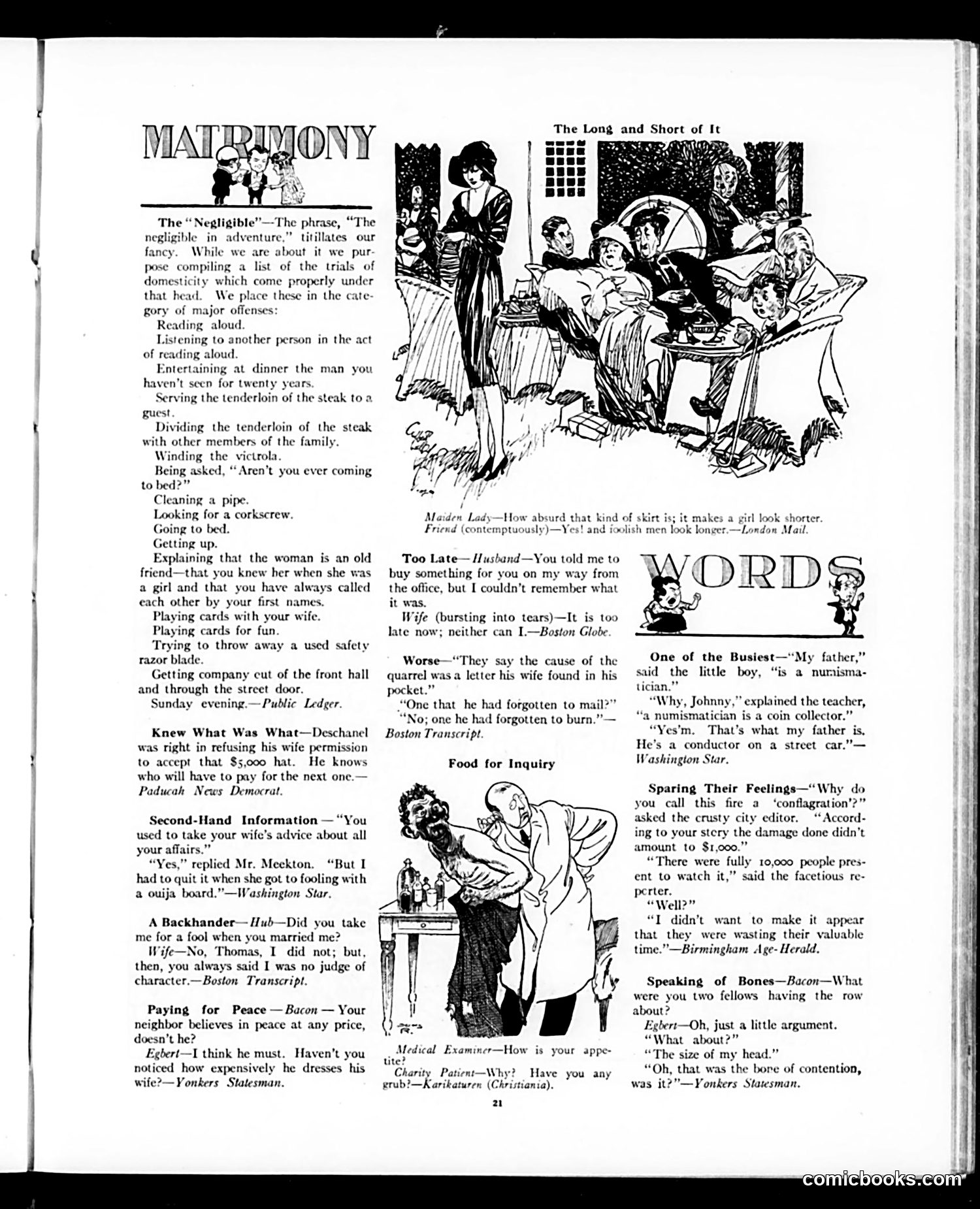
This page from *Judge* compiles domestic humor targeting early 20th-century married life. The "Negligible" column lists mundane household annoyances—reading aloud, winding the victrola, getting up/going to bed—presenting marriage as a catalog of petty irritations rather than romance. The cartoon "The Long and Short of It" depicts a dinner party where a woman complains that short skirts make girls look shorter; her friend snaps back that men actually look *longer* in them—a dig at masculine vanity. Other anecdotes mock wives' spending habits ("Paying for Peace"), marital memory lapses ("Too Late"), and the absurdity of job titles ("One of the Busiest"—a conductor is called a "numismatician" because he collects fares/coins). The satire's target: the gap between romantic ideals and domestic reality, with particular focus on wives as spendthrifts and marriage as mutual annoyance. It reflects period attitudes about gender relations while presenting marital discord as comedic entertainment.
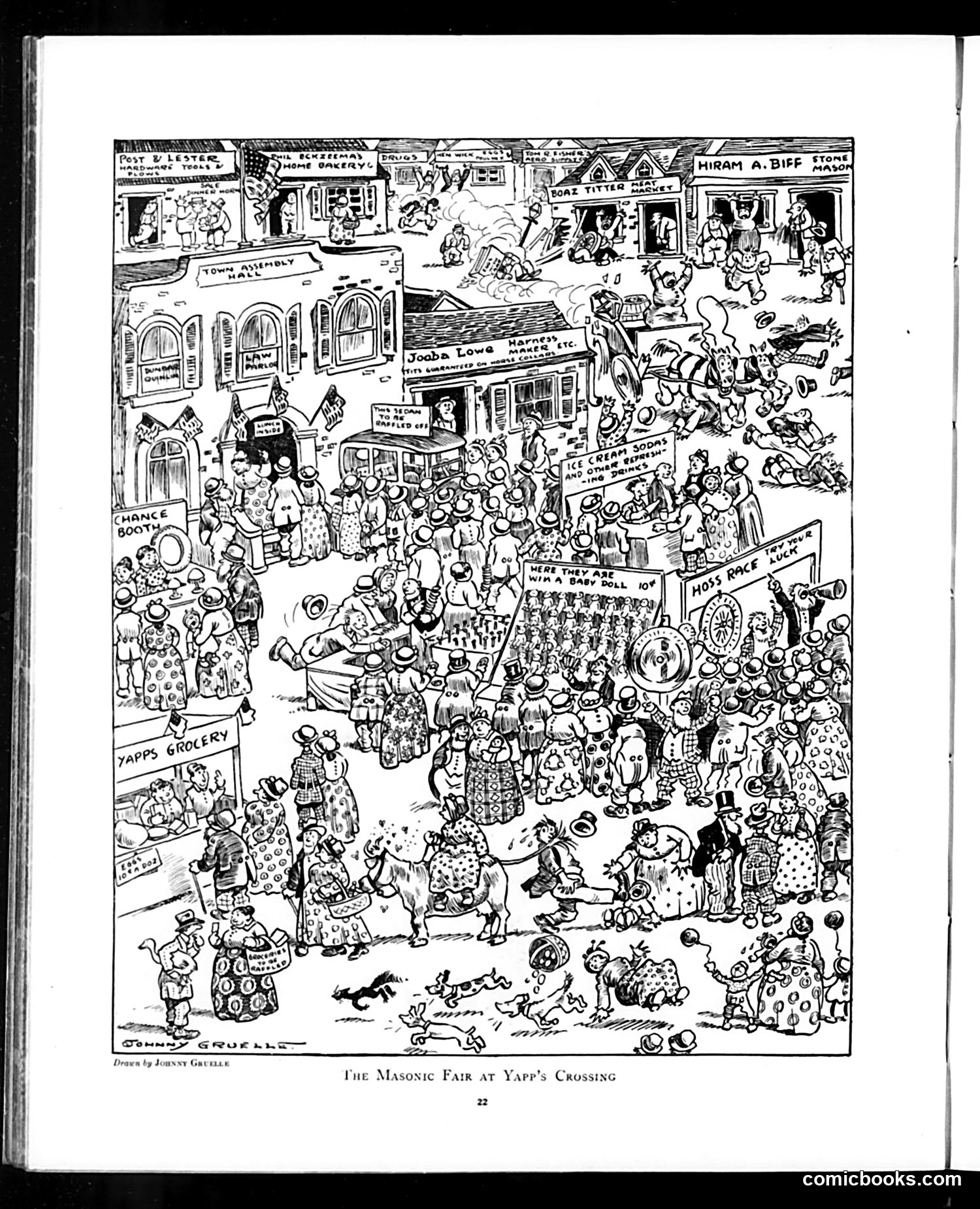
This is a crowded street-fair scene drawn by Johnny Gruelle, depicting a lively community gathering. The illustration shows numerous figures in period dress (appearing early 20th century) engaging in various activities around storefronts and attractions including "Yapp's Grocery," "Hiram A. Biff Stone Mason," and various fair booths. The cartoon satirizes small-town America through bustling, chaotic activity—children playing, people shopping, dogs running underfoot, and general pandemonium. The Masonic Fair reference suggests this depicts a fraternal organization's public fundraising event. The satire appears gentle, poking fun at small-town spectacle and the collision of respectable institutions (Masonry) with everyday commercial chaos rather than making pointed political commentary.
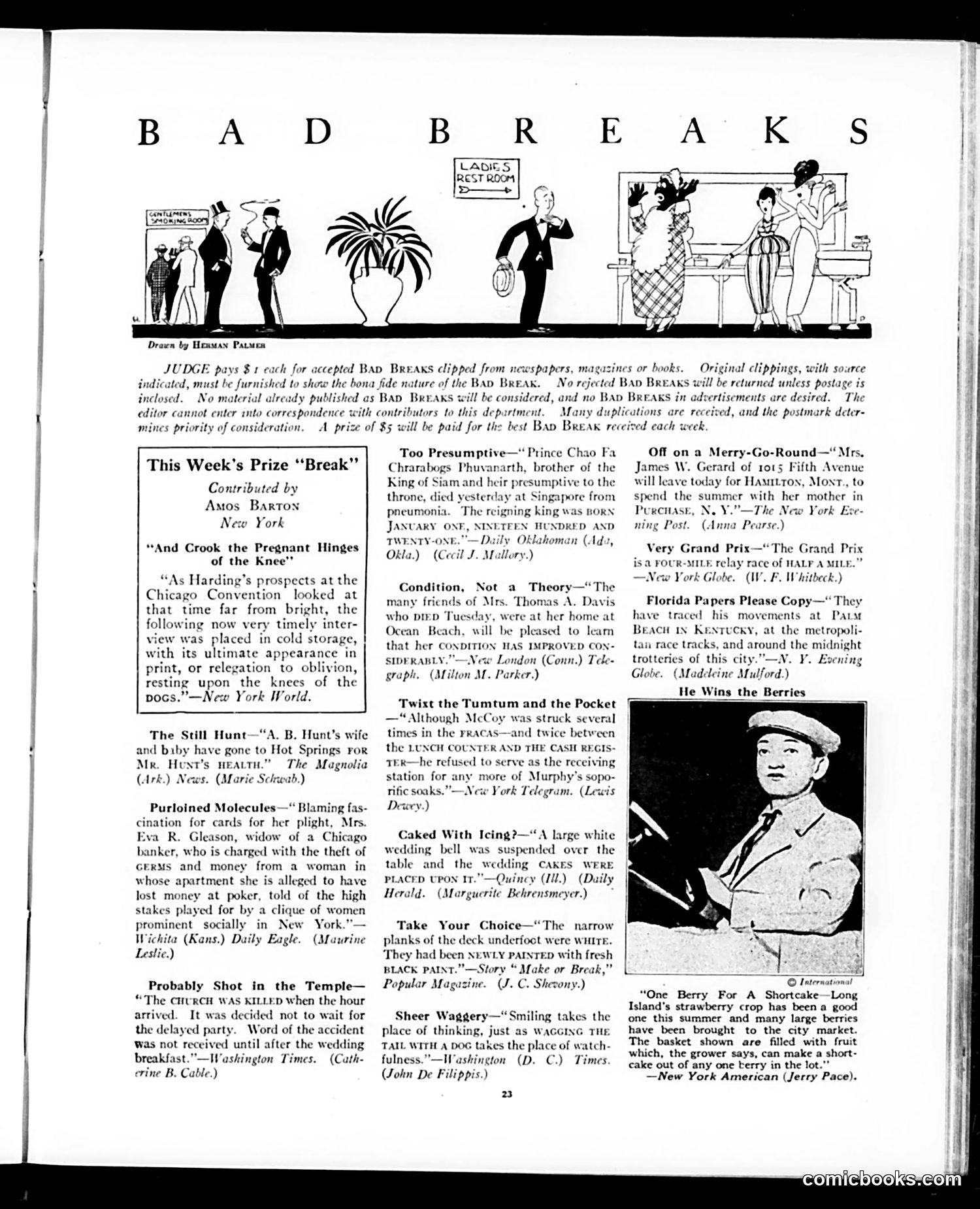
This page showcases Judge's "Bad Breaks" feature—a humor column paying readers $1 for amusing typographical errors or awkward phrasings clipped from newspapers and magazines. The concept relies on unintentional comedy: publication errors create absurd or contradictory statements. Examples include a reference to "crooking the pregnant hinges of the knee" (likely garbled phrasing), a church being "killed" instead of a wedding being delayed, and contradictory statements like a deck painted "white" then "newly painted with fresh black paint." The humor is gentle, pre-digital satire targeting newspaper quality control. Contributors submit clippings with source citations; the best receives a $5 prize weekly. This reflects 1920s-era public amusement at print media's slip-ups—before mass corrections became instantaneous. The feature essentially mocked professional journalism's carelessness through readers' shared discovery of these verbal mishaps.
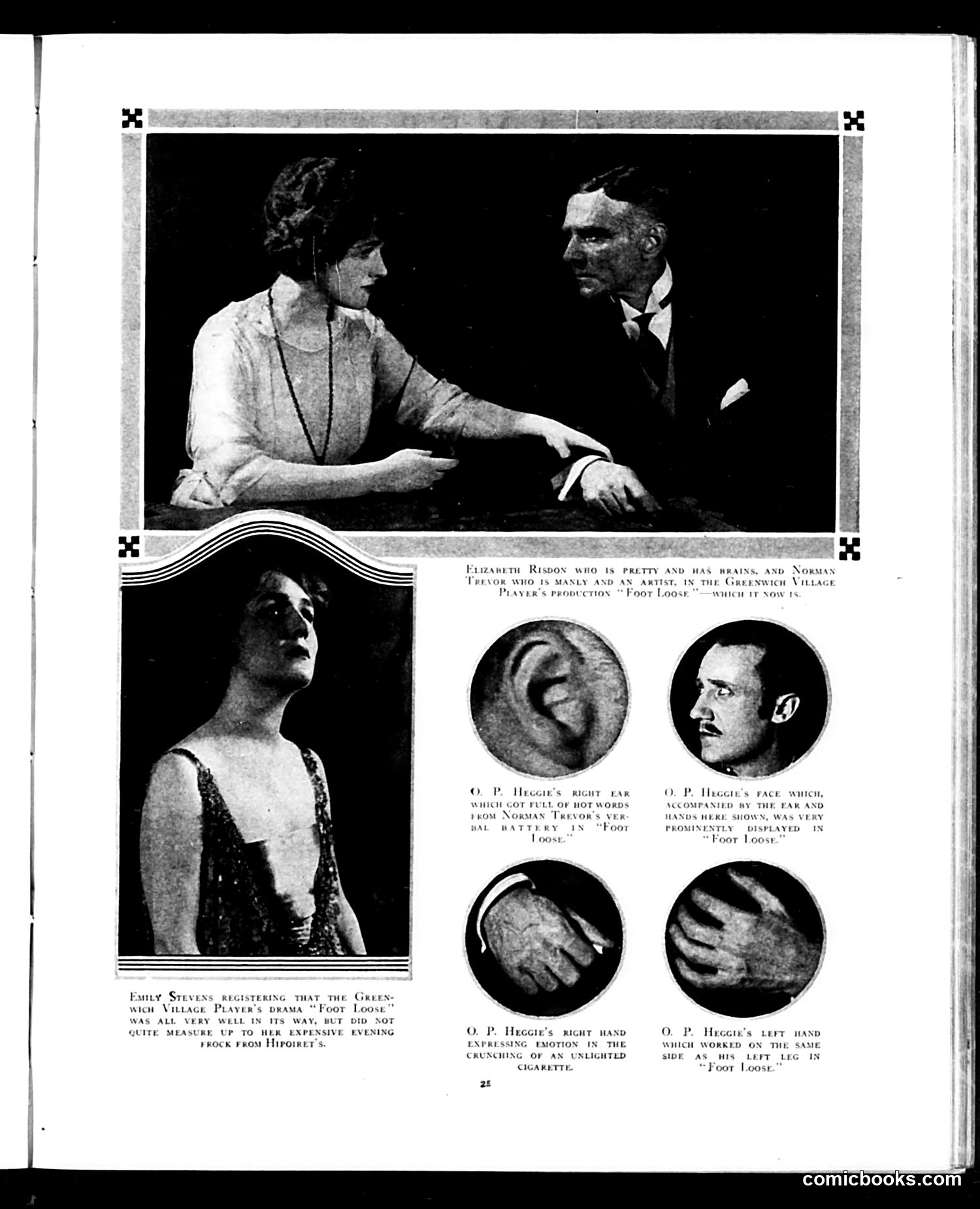
This page covers the Greenwich Village Players' production of "Foot Loose," a play apparently notable for its physical comedy and emotional expressiveness. The page satirizes both the theatrical production and audience pretension. **Main figures:** Emily Stevens (actress) and Norman Trevor (actor) appear in the top scene. O. P. Heggie is featured in close-up photographs of his hands, face, and ear—anatomical details emphasized to mock his exaggerated, physicalized acting style. **The satire:** Stevens' caption jokes that the avant-garde Village theater production, while entertaining, couldn't compete with her expensive Hepburn's evening gown—mocking the clash between bohemian theater culture and high society fashion. The repeated focus on Heggie's bodily expressions (ear, hands, face contorting) ridicules the overwrought, physical "method" acting style popular in experimental theater of the era. **Context:** Greenwich Village Players represented New York's artistic avant-garde; Judge's readership likely found their theatrical pretensions amusing and worthy of gentle mockery.
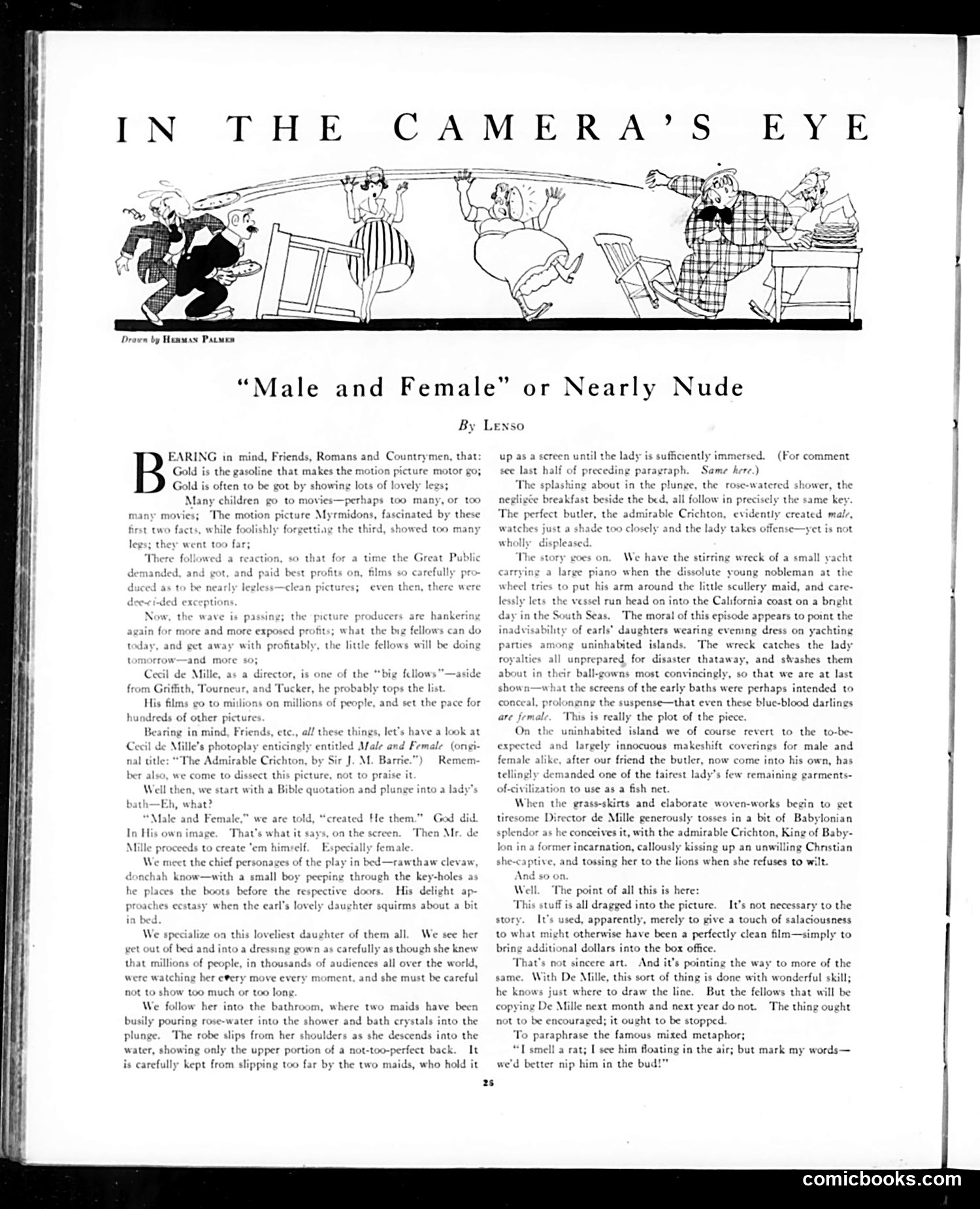
This Judge article critiques Cecil B. DeMille's film *Male and Female* (adapted from J.M. Barrie's play). The author "Lenso" attacks DeMille for unnecessarily including scenes of near-nudity and scantily-clad women to boost box office revenue, rather than serving the story's needs. The satire targets: - **DeMille's manipulation**: Using "lovely legs" and bathing scenes as commercial hooks, not artistic necessity - **The film industry's race to profit**: Other directors will copy DeMille's formula, escalating gratuitous content - **Hypocrisy**: Calling it art while cynically exploiting audience voyeurism The article warns that this trend—adding "salaciousness" to otherwise "clean films"—will corrupt cinema if unchecked. The headline's ironic quotation marks around "Nearly Nude" emphasizes the author's disdain for this marketing strategy. The author calls for industry self-regulation before the practice spreads.
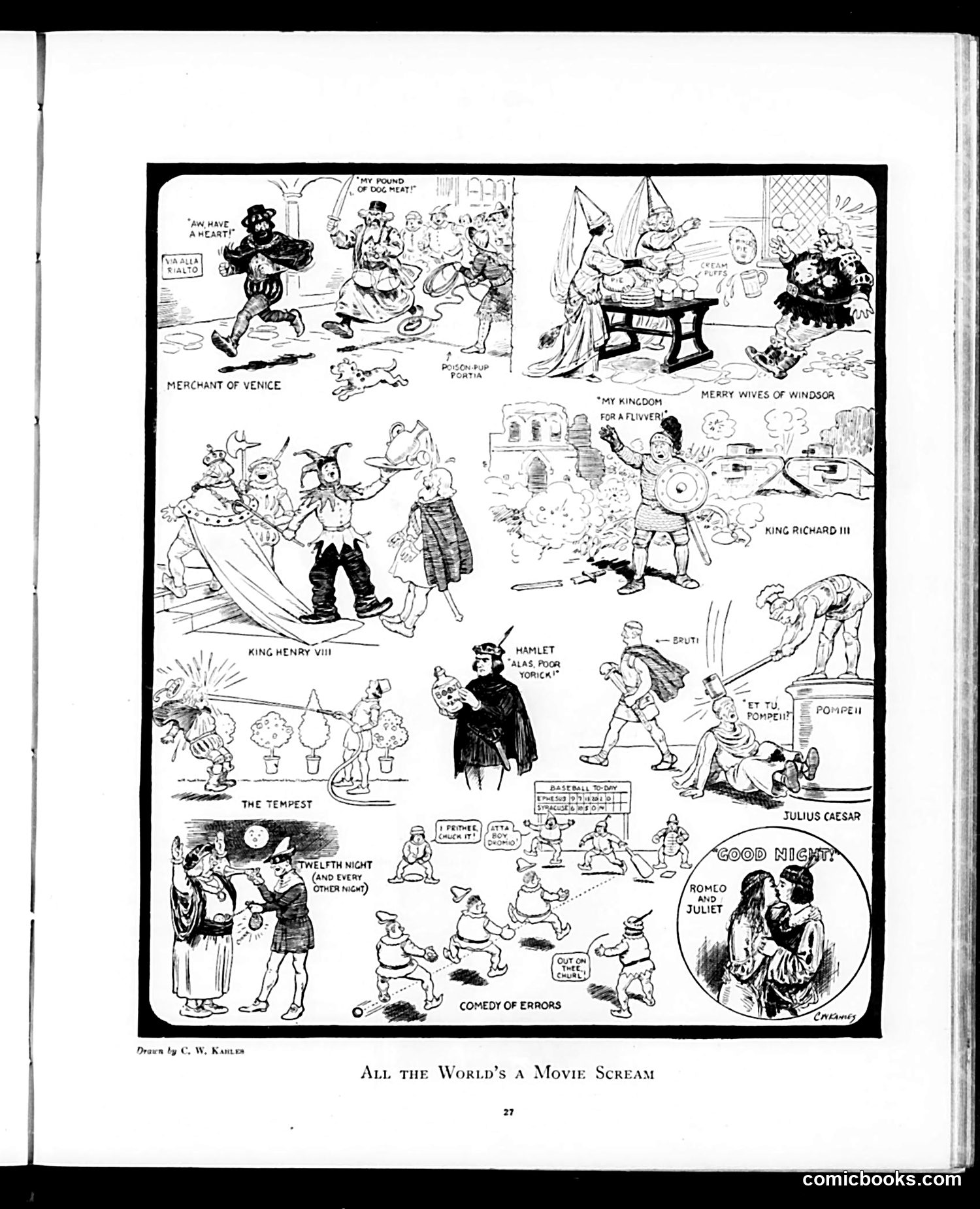
This page satirizes Shakespeare's plays as if they were silent films or movie comedies. The cartoonist (C.W. Kahles) illustrates famous scenes from *Merchant of Venice*, *The Tempest*, *King Henry VIII*, *Hamlet*, *My Kingdom for a Flower* (likely *Richard III*), *Merry Wives of Windsor*, *King Richard III*, *Comedy of Errors*, *Julius Caesar*, *Romeo and Juliet*, and *Twelfth Night*. The satire mocks how Hollywood adapted or reimagined classical literature—reducing profound tragedies to slapstick "scream" comedies with exaggerated physical humor and pratfalls. The juxtaposition of dignified source material with crude, vaudeville-style gags pokes fun at both theatrical adaptation and cinema's commercial prioritization of cheap laughs over artistic merit.
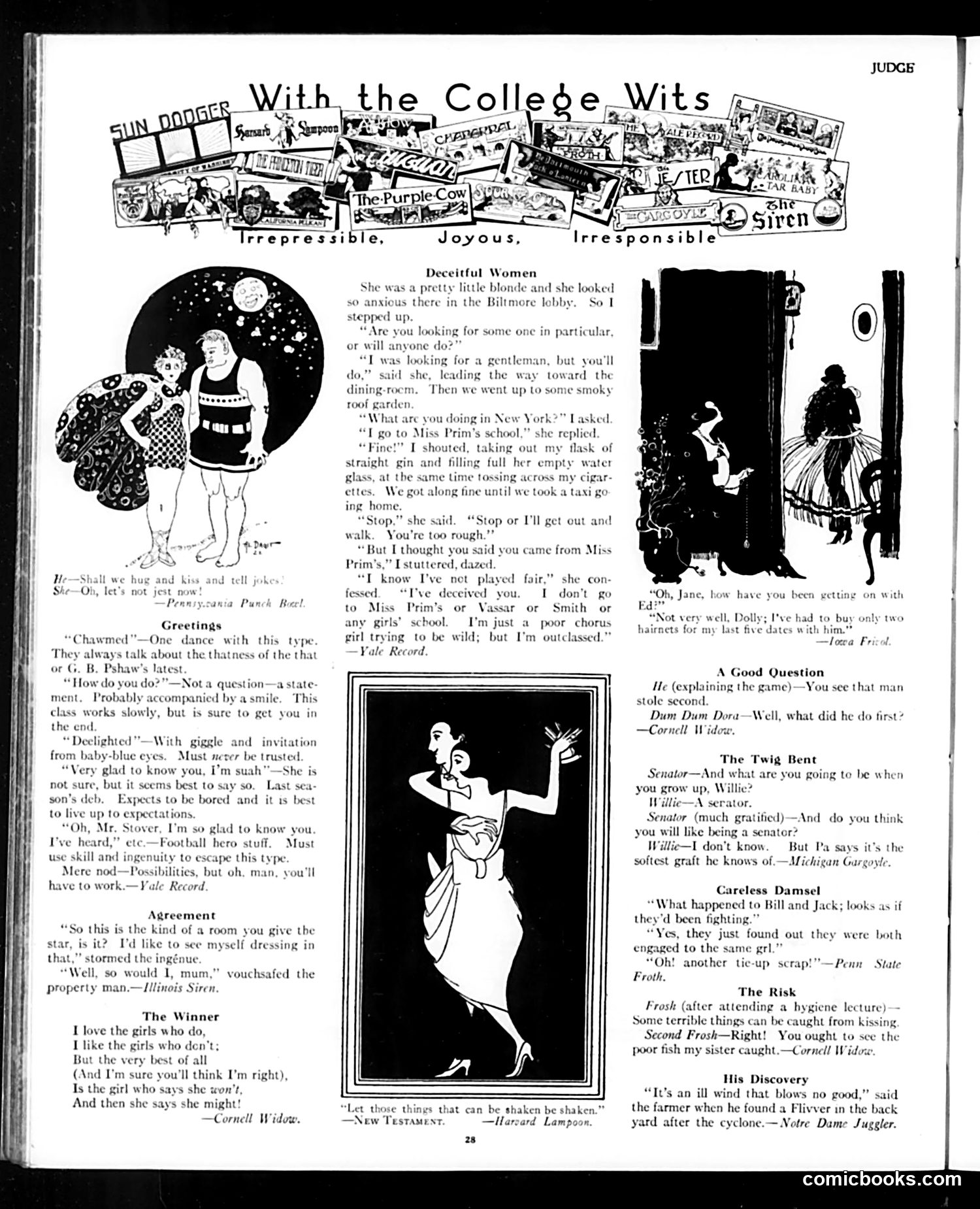
This page collects humor from college publications, satirizing early 20th-century courtship and social pretense among young people. The main story, "Deceitful Women," mocks the era's "fallen woman" trope: a man meets an apparently innocent blonde at the Biltmore Hotel lobby who claims to attend Miss Prim's finishing school. She flirts aggressively, then confesses she's actually a chorus girl "trying to be wild" but "outclassed"—reversing expectations about respectability and duplicity. The satire targets both men's gullibility and women's contradictory social performances. The surrounding snippets mock college social types: affected greetings, calculated flirtation, fortune-hunting, and pretense. References to "Yale Record," "Cornell Widow," and other college papers indicate this was shared humor among university students. The central illustration shows a woman caught mid-deception, reinforcing the theme. Overall, the page satirizes the gap between public propriety and private behavior during the Jazz Age.
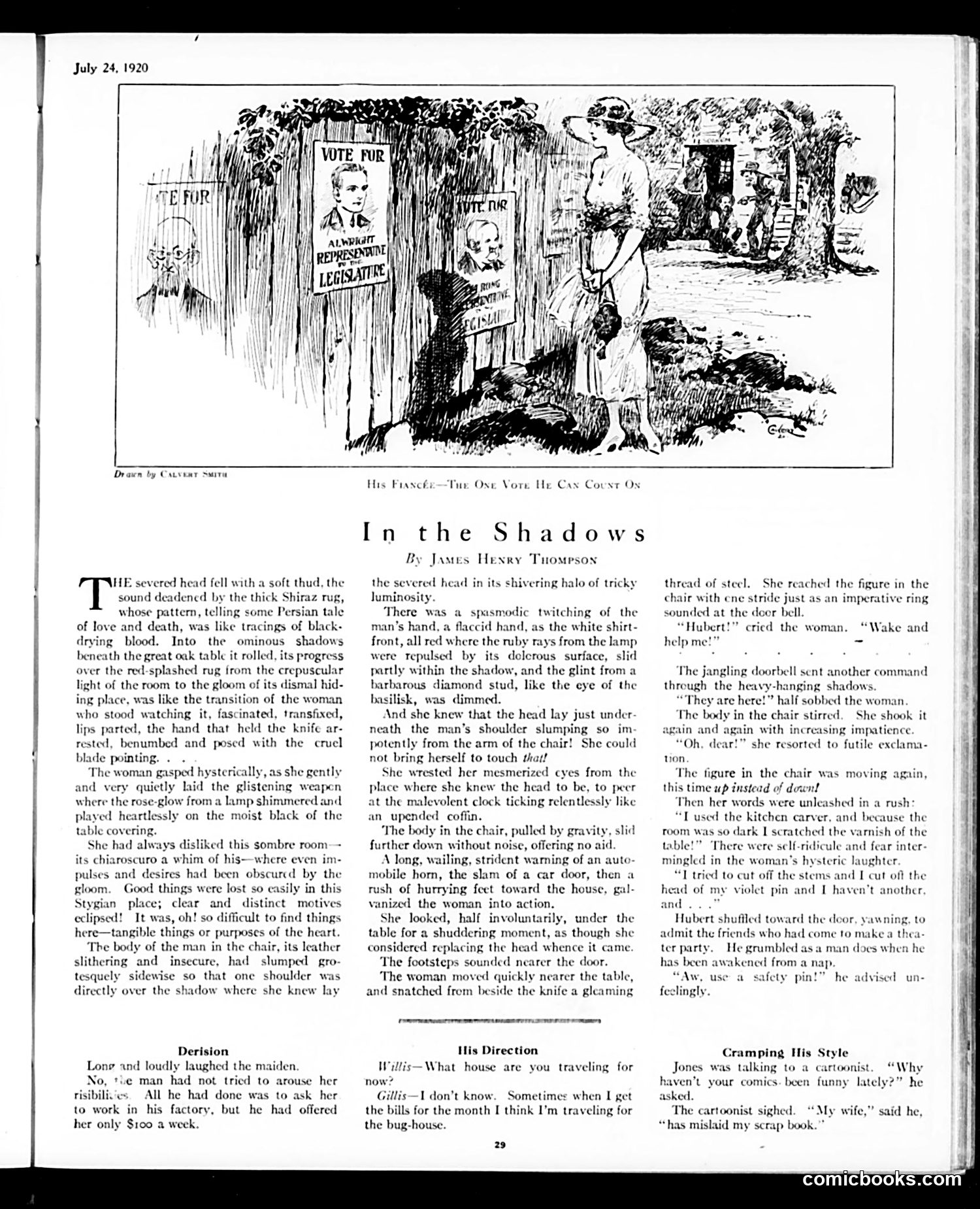
The page contains a serialized crime story titled "In the Shadows" by James Henry Thompson, featuring gothic melodrama about a woman who has apparently decapitated a man and must conceal the crime when visitors arrive. The cartoon at the top, titled "His Fiancée—The One Vote He Can Count On," satirizes women's suffrage (newly granted nationally in 1920). It depicts a woman at a polling place with "VOTE FÜR" signs showing male candidates. The joke suggests women voters are so devoted to their fiancés that they represent only one additional reliable vote per man—implying female voters lack independent judgment and merely follow their beaus' preferences. This reflects anti-suffrage sentiment common in 1920, mocking women's political autonomy. The bottom includes humor snippets: one jokes about low factory wages ($100/week), another about traveling salesmen and "the bug-house" (asylum), playing on common period stereotypes.
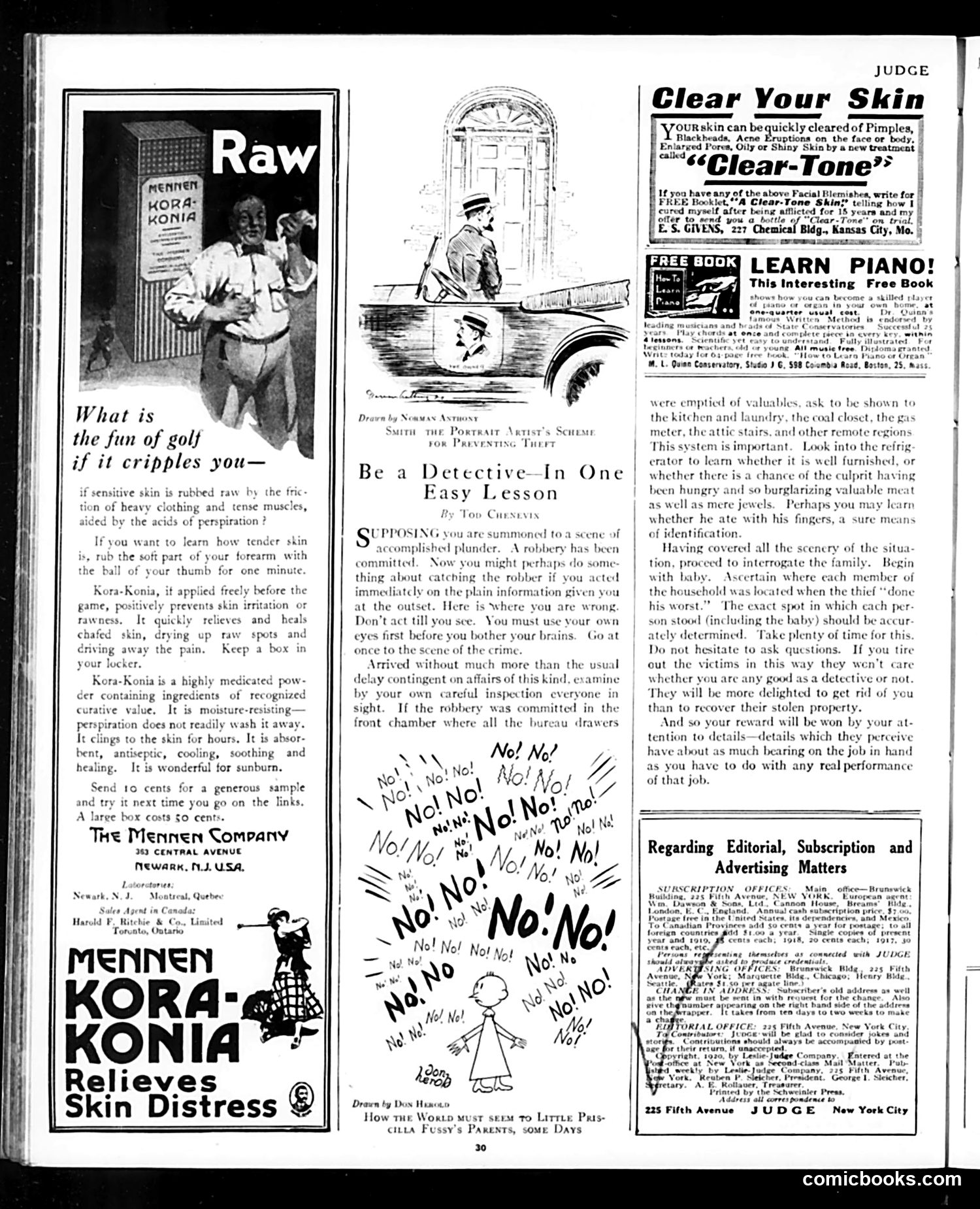
This page from *Judge* magazine is primarily **advertisements and instructional content** rather than political satire. **Main content:** The central illustration is titled "Be a Detective—In One Easy Lesson" by Tod Chesney. It depicts a humorous instructional cartoon about investigating a robbery. A man stands before a door while a cartoon child shouts "No! No! No!" repeatedly—the joke being that amateur detectives often overlook obvious clues, miss how uncooperative witnesses (including children) can be, and bungle crime scenes. **Advertisements:** The left column features Mennen Kora-Konia powder, marketed to golfers whose skin chafes from physical activity. The right column advertises "Clear-Tone," a skin-clearing treatment for acne and blemishes, along with a free piano instruction booklet. These reflect early 1900s consumer culture: skin remedies were heavily advertised, and self-improvement goods (piano lessons) were sold via magazine ads targeting middle-class readers.
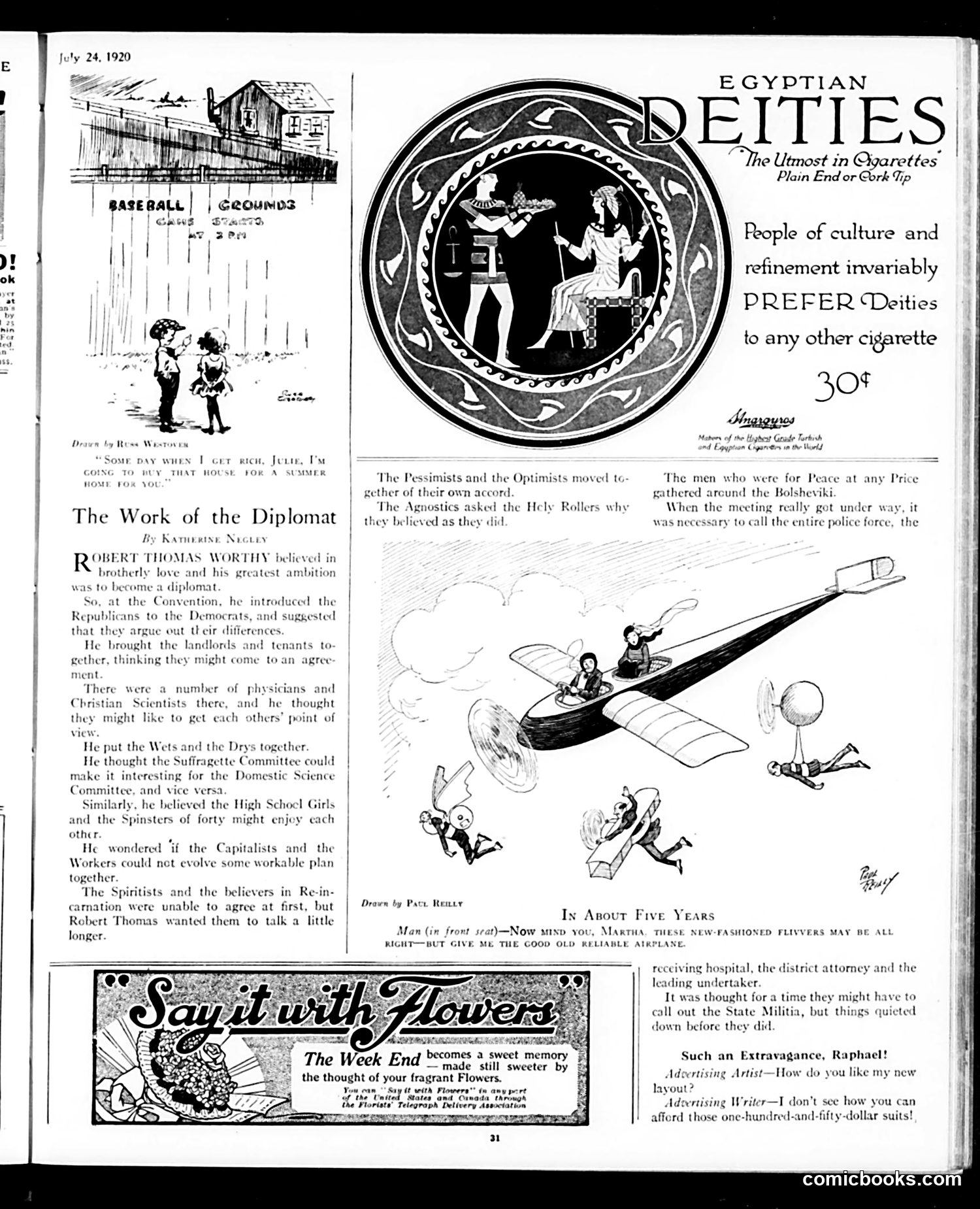
This satirical piece mocks idealistic peace-building efforts, likely referencing post-WWI diplomatic attempts. Robert Thomas Worthy attempts to reconcile America's deeply divided factions by forcing dialogues: Republicans with Democrats, Wets (Prohibition supporters) with Drys (Prohibition opponents), Capitalists with Workers, and Spiritualists with Reincarnationists. The satire's point: these groups are so fundamentally opposed that bringing them together is absurd and futile. The text culminates in a police force being called during a "Peace at any Price" meeting with Bolsheviks, suggesting even well-intentioned diplomacy risks chaos. The airplane cartoon jokes about preferring old technology to modern "flivvers" (Model T Fords), likely commentary on rapid technological change in the 1920s. The page is primarily text-driven satire with supporting illustrations rather than traditional comic strips.
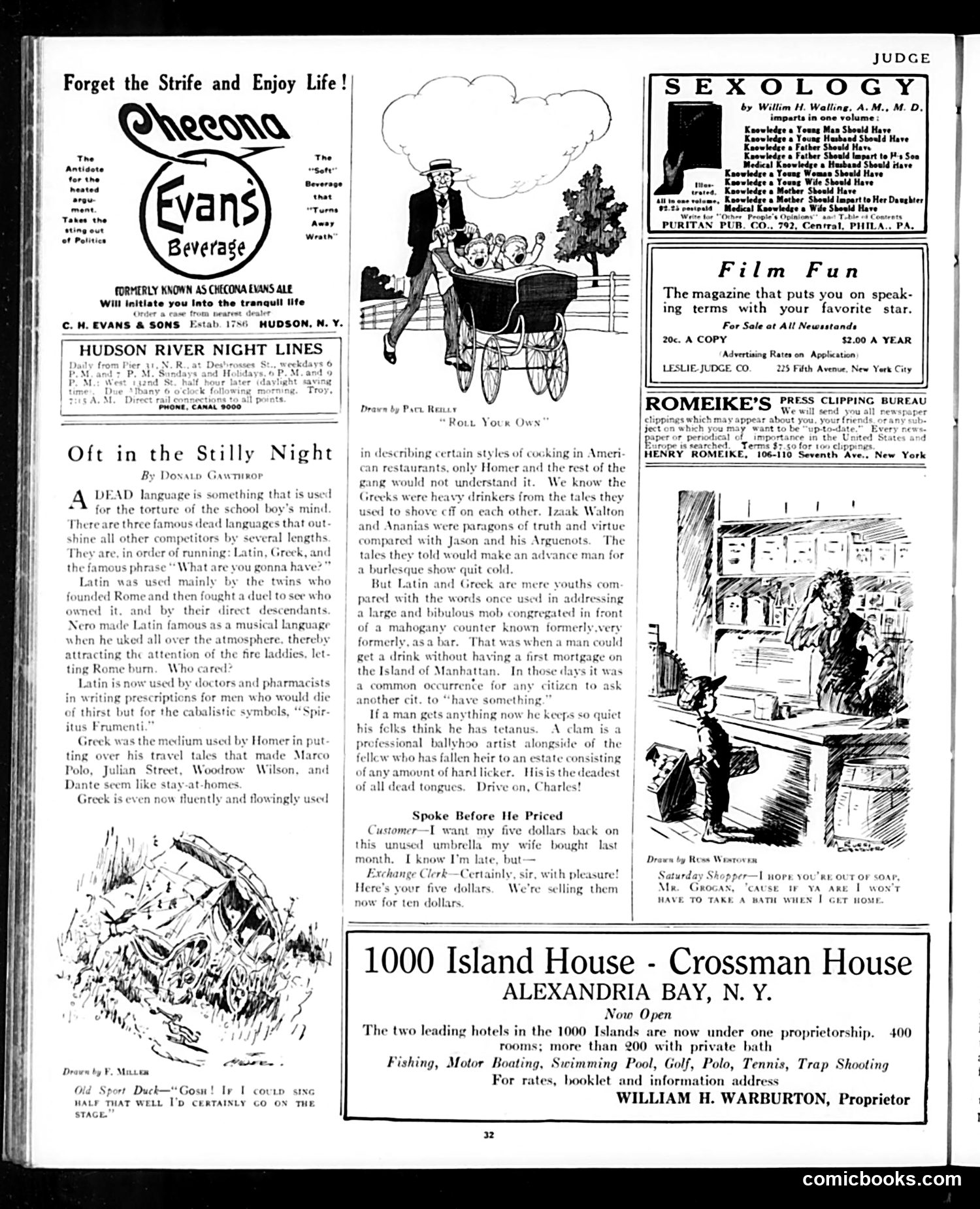
This page is primarily **advertising and filler content** rather than political satire. The main illustrated cartoons are apolitical humor: **"Roll Your Own"** (top center): A man contentedly pushes a baby carriage while smoking, suggesting domestic leisure and self-sufficiency—a gentle joke about comfortable domesticity. **"Old Sport Duck"** (bottom left): A duck comments that if he could sing as well as another duck, he'd go on stage. Simple animal humor with no political meaning. The page is dominated by **advertisements** for beverages (Checona Evans ale), hotels, magazines, and services typical of early 20th-century publications. The article "Oft in the Stilly Night" discusses classical languages humorously but contains no political content. There are no identifiable political figures, caricatures of politicians, or social commentary targeting contemporary events. This appears to be a standard Judge magazine page mixing light humor with commercial advertisements rather than the satirical political content the magazine was known for.
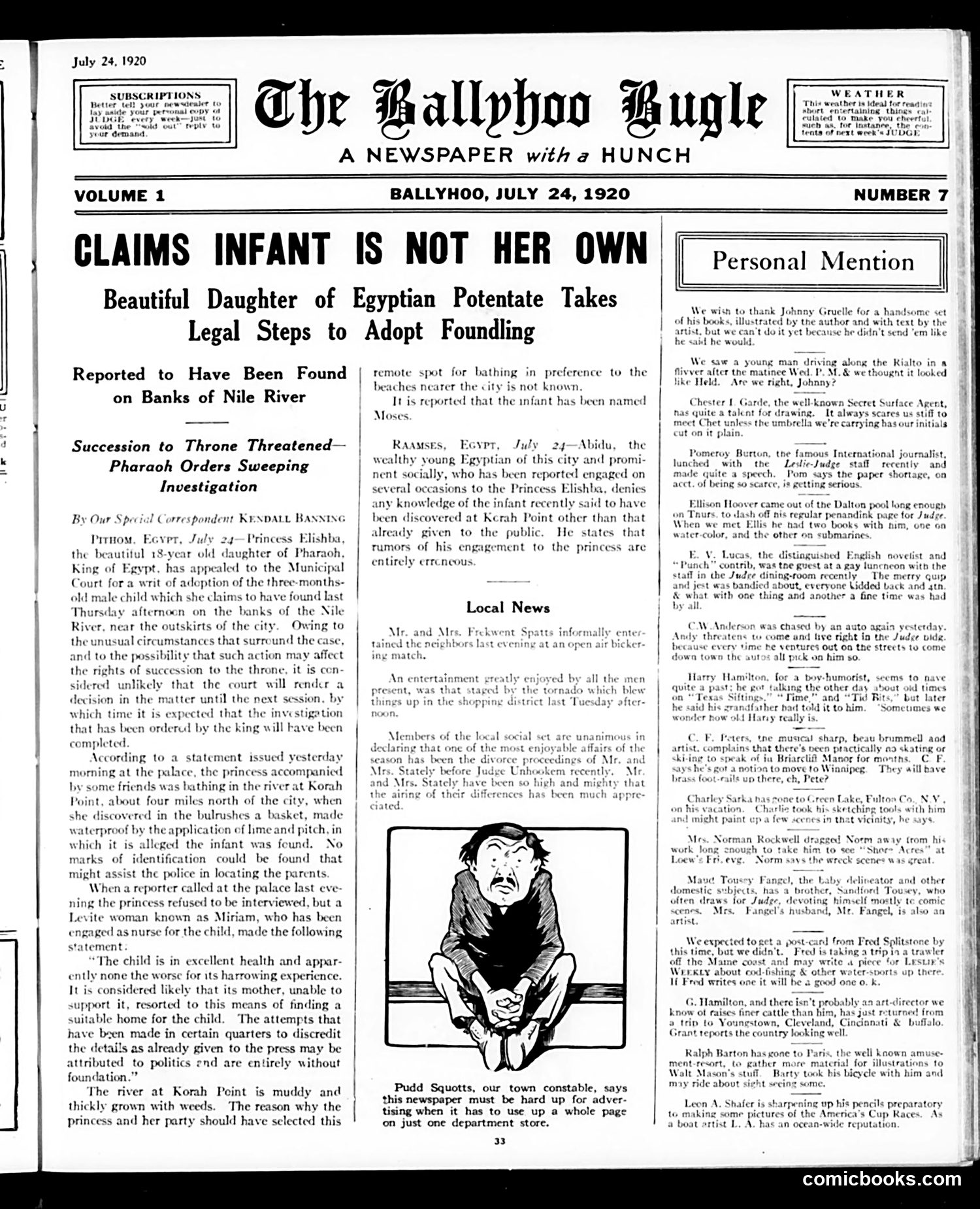
This page from "The Ballyhoo Bugle"—a fictional newspaper created as satire—mocks sensationalist journalism and exotic scandal coverage. The main story parodies breathless reporting of a supposed Egyptian princess claiming an abandoned infant isn't actually hers, supposedly found in the Nile. The cartoon depicts a grotesque figure, likely representing exaggerated Egyptian stereotypes or the absurdity of the implausible story itself. The satire targets how newspapers of 1920 exploited: - Foreign intrigue and royal drama - Implausible human-interest stories - Detailed "eyewitness" accounts of dubious legitimacy - Vague explanations (why bathe in muddy, weed-choked water?) The naming of the infant "Moses" adds biblical irony—another foundling story. The page exemplifies how Judge magazine critiqued yellow journalism's manufacture of outlandish tales to sell papers, a common 1920s concern about media sensationalism.
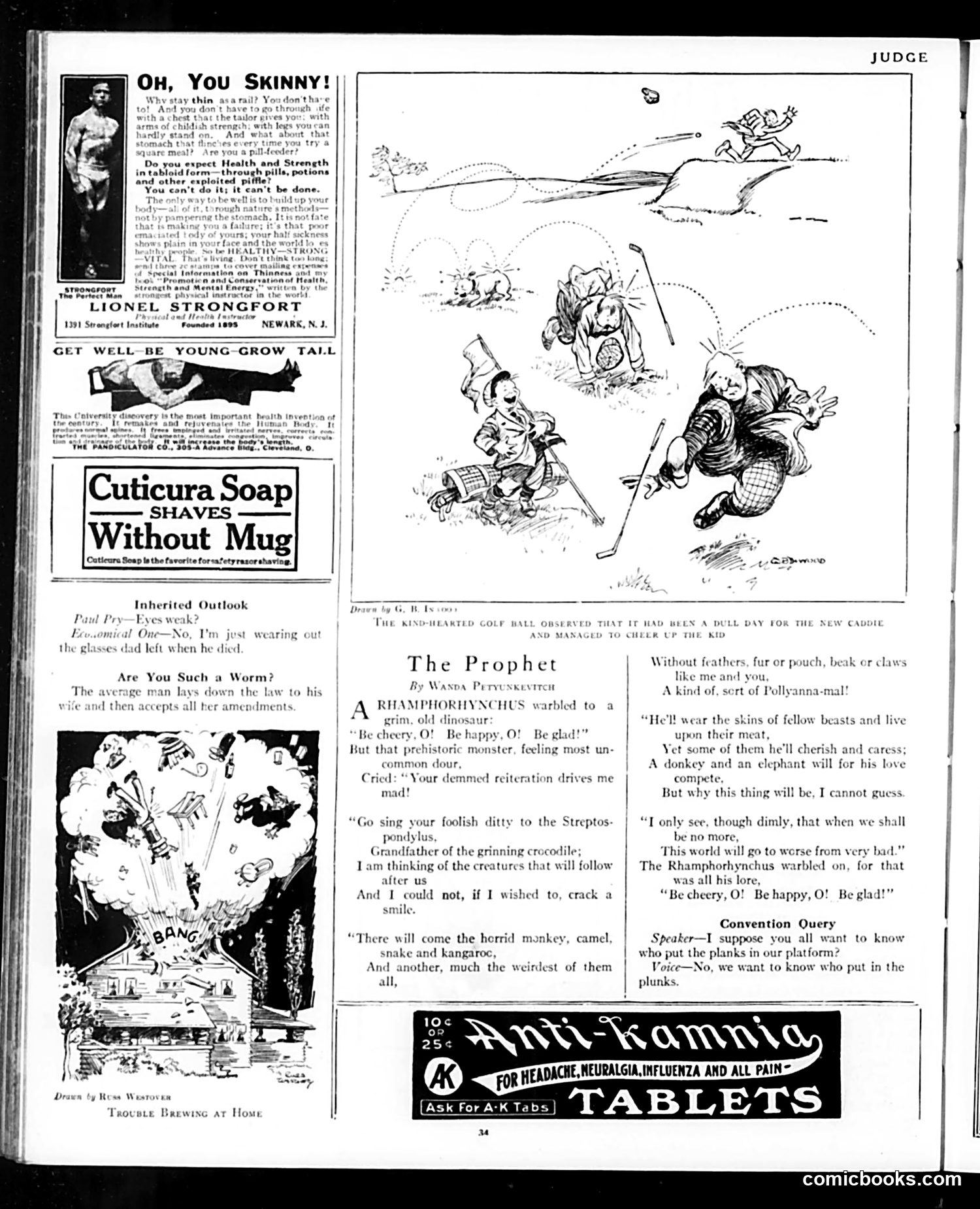
This page features a satirical poem/cartoon by Wanda Petunsevitch titled "The Prophet," depicting a prehistoric Rhamphorhynchus (flying reptile) conversing with other extinct creatures about the future. The satire targets **optimistic progressivism and forced cheerfulness**. The dinosaur expresses grim pessimism about humanity's future ("This world will go to worse from very bad"), yet keeps repeating hollow platitudes ("Be cheery, O! Be happy, O! Be glad!")—mocking those who maintain forced optimism despite evidence of decline. The creatures debating what will inherit Earth after humans suggests **skepticism about human superiority and progress**. The final section's "Convention Query" joke—where politicians care more about *who created* platform planks than *what's in them*—extends this critique to political superficiality and empty rhetoric. The cartoon satirizes both misguided optimism and political phoniness circa the early 1900s.
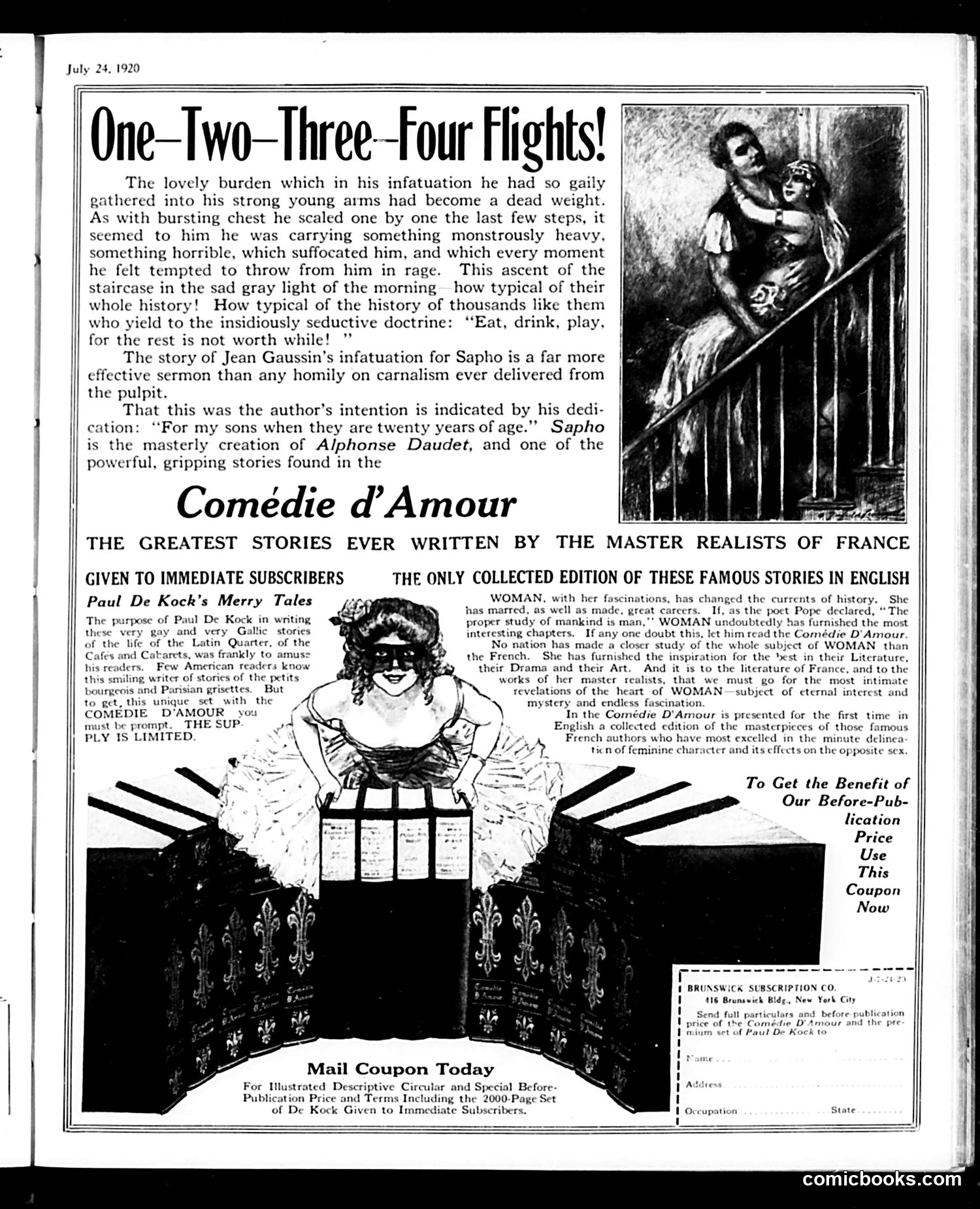
This page is primarily **advertising for a book subscription series**, not satirical content. The headline and accompanying illustration advertise a collected edition of French literature by "master realists"—Paul De Kock and Alphonse Daudet. The illustration shows a man climbing stairs while carrying a woman, visually depicting a passage from Daudet's *Sapho*. The text describes his burden becoming increasingly unbearable—a metaphor for the consequences of hedonistic living ("Eat, drink, play, for the rest is not worth while"). The advertisement frames these French novels as moral instruction, particularly for young men, arguing that stories about women and romance offer lessons about life's emptiness without higher purpose. The marketing emphasizes that France's greatest authors uniquely understood "WOMAN" and feminine character. This is essentially a **pre-publication sales pitch** using literary prestige and moral instruction to sell a 2,000-page subscription set to American readers in 1920.
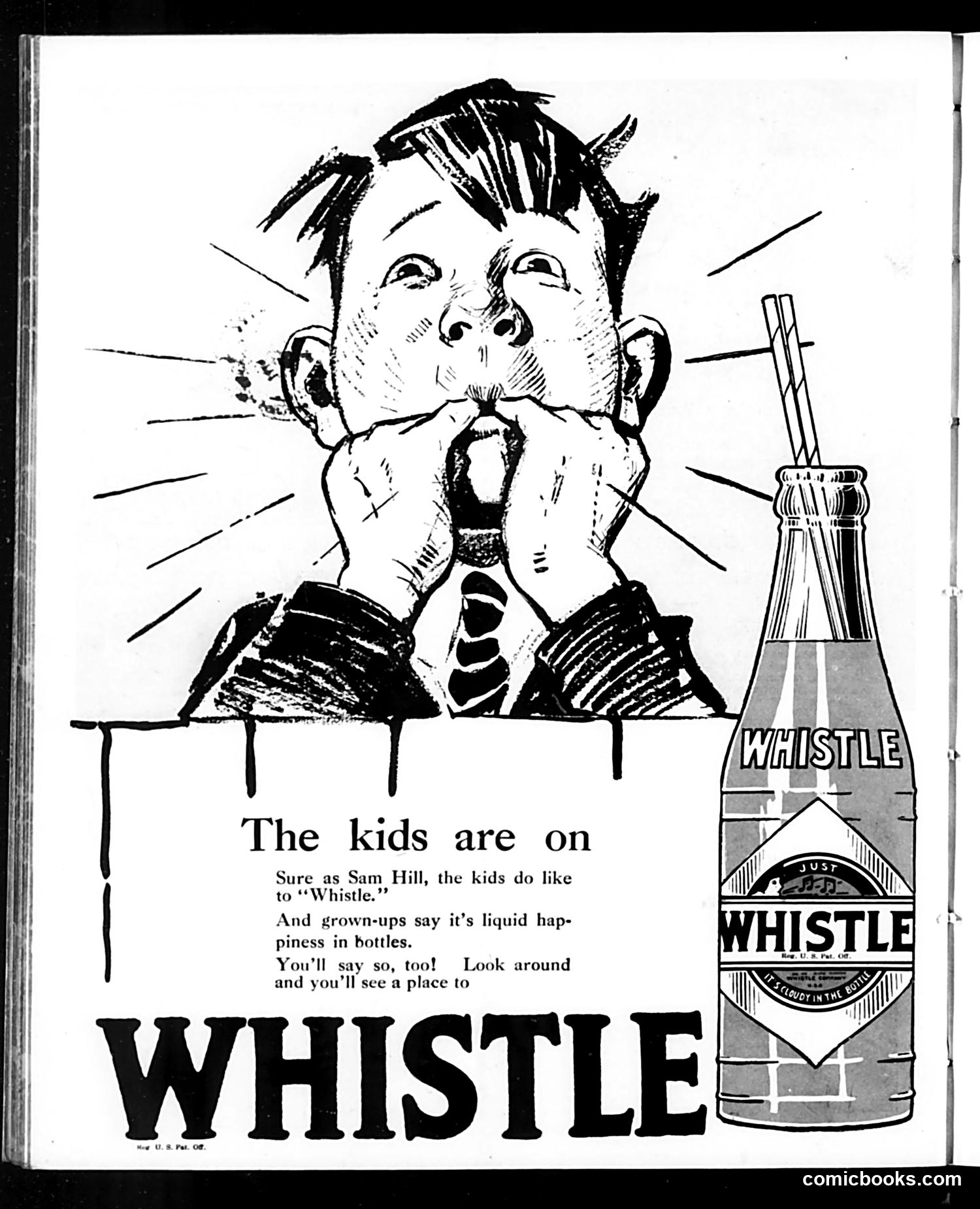
This is a **Whistle soft drink advertisement** disguised as editorial content in Judge magazine. The cartoon depicts a delighted child enthusiastically consuming the beverage, with radiating lines emphasizing excitement. The ad uses colloquial language ("Sure as Sam Hill") and appeals to multiple demographics: children enjoy the drink, while adults appreciate it as "liquid happiness in bottles"—a lighthearted euphemism suggesting refreshment and pleasure. The text invites readers to "look around" and find Whistle available everywhere, a typical marketing strategy. This appears to be early-to-mid 20th century advertising, when soft drink marketing commonly featured wholesome imagery of children to build brand appeal and normalize consumption across age groups. The ad exploits Judge's satirical format to present commercial messaging as entertainment content.