
Judge, 1920-07-24 · page 11 of 36
Judge — July 24, 1920 — page 11: what you’re looking at
What you’re looking at
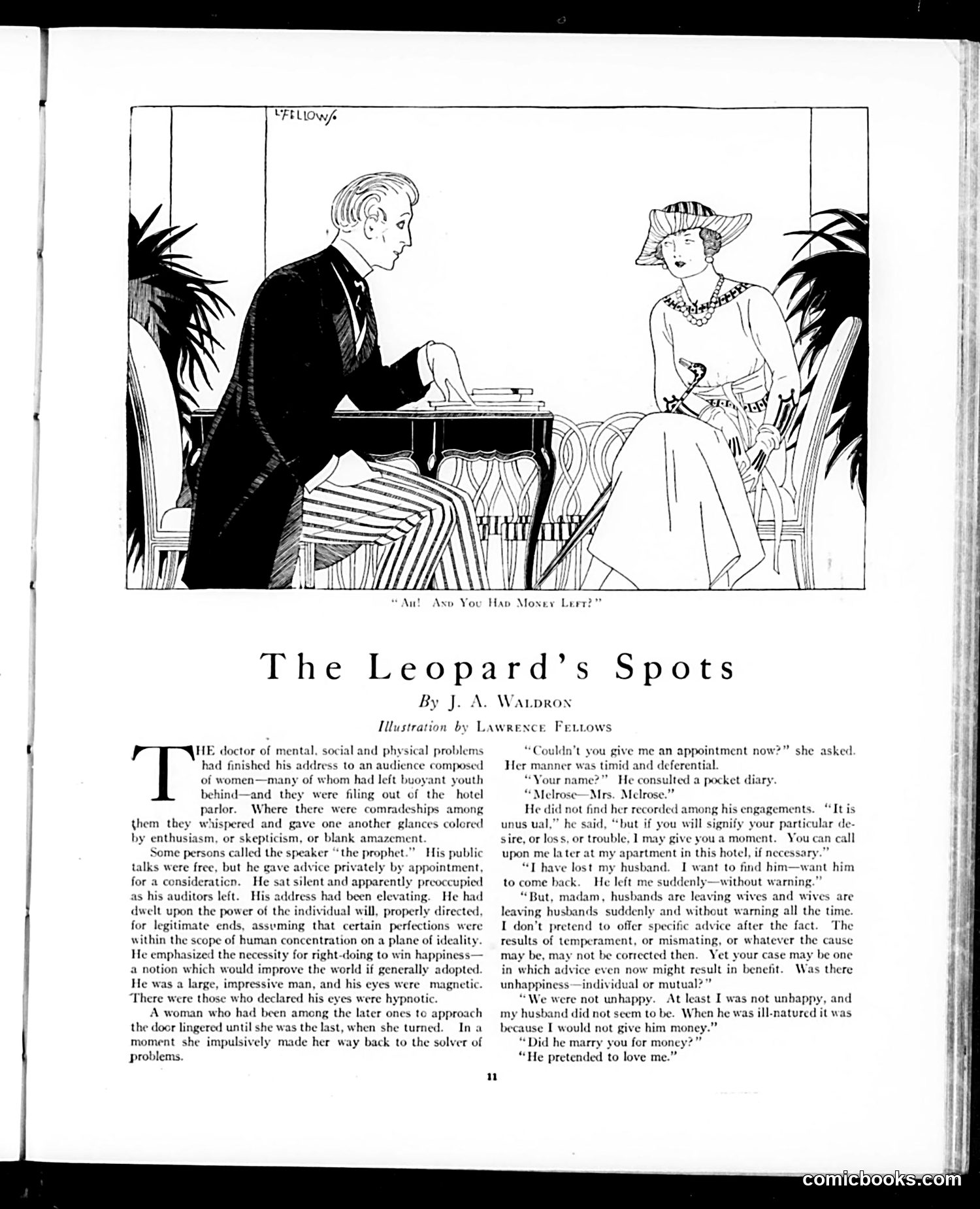
This is the opening page of a serialized short story, not a political cartoon. The illustration shows a well-dressed man—a self-styled "doctor" of personal problems—consulting with a woman named Mrs. Melrose, who seeks his advice about her departed husband. The story satirizes the era's popular "self-help" and pseudo-psychological advice culture. The doctor is presented as an impressive, magnetic figure who gives public lectures on willpower and personal improvement to women, then offers private consultations. The bitter irony emerges in Mrs. Melrose's confession: her husband left because she wouldn't give him money, yet he'd "pretended to love me." The title "The Leopard's Spots" likely suggests that fundamental character flaws cannot be changed—a reference to the biblical phrase "can the leopard change his spots?" The satire mocks both the charlatan advisor and the woman's naive belief that professional counsel can solve what amounts to a mercenary marriage.
📄 Transcribed text from this page (OCR, searchable)
Machine-transcribed from the original scan — historical spelling and the odd misread are preserved.
UFTLIOWsé “At Axp You Hap Money Lert?” The Leopard’s Spots By J. A. Illustration by L HE doctor of mental, social and physical problems had finished his address to an audience composed of women—many of whom had left buoyant youth behind—and they were filing out of the hotel parlor. Where there were comradeships among them they whispered and gave one another glances colored by enthusiasm, or skepticism, or blank amazement Some persons called the speaker “the prophet.”” His public talks were free, but he gave advice privately by appointment, for a considerati He sat silent and apparently preoccupied as his auditors left. His address had been elevating. He had dwelt upon the power of the individual will, properly directed, for legitimate ends, assuming that certain perfections were within the scope of human concentration on a plane of ideality. He emphasized the necessity for right-doing to win happiness— a notion which would improve the world if generally adopted. He was a large, impressive man, and his eyes were magnetic. There were those who declared his eyes were hypnotic. A woman who had been among the later ones to approach the door lingered until she was the last, when she turned. In a moment she impulsively made her way back to the solver of problems. WatLpron AWRENCE FELLows “Couldn't you give me an appointment now?” she ask: Her manner was timid and deferential. “Your name?” He consulted a pocket diary. “Melrose—Mrs. Melrose.” He did not find her recorded among his engagements. “It is unus ual,” he said, “but if you will signify your particular de- sire, or loss, or trouble, 1 may give you a moment. You can call upon me later at my apartment in this hotel, if necessary.” “T have lost my husband. I want to find him—want him to come back. He left me suddenly—without ning.” “But, madam, husbands are leaving wives and wives are leaving husbands suddenly and without warning all the time. I don’t pretend to offer specific advice after the fact. The results of temperament, or mismating, or whatever the cause may be, may not be corrected then. Yet your case may be one in which advice even now might result in benefit. Was there unhappine: individual or mutual?” “We were not unhappy. At least I was not unhappy, and my husband did not seem to be. When he was ill-natured it was because I would not give him money.” Did he marry you for money?” “He pretended to love me.”