
Judge, 1920-07-24 · page 16 of 36
Judge — July 24, 1920 — page 16: what you’re looking at
What you’re looking at
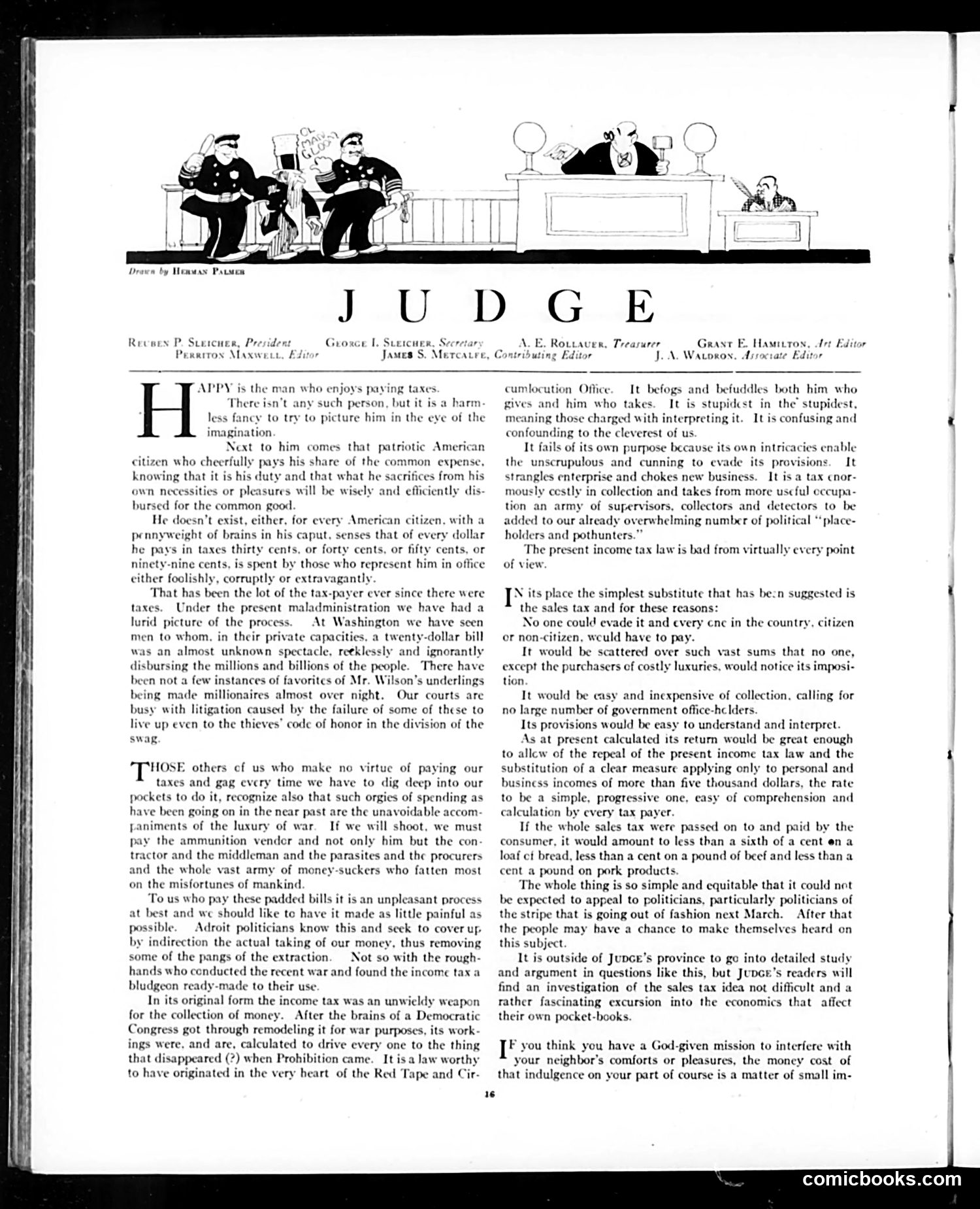
This is an editorial page (not primarily a cartoon) from Judge magazine criticizing the U.S. income tax system, likely from the Wilson administration era (early 1920s, given references to WWI and Prohibition). **The Cartoon Header:** Shows a courtroom scene with a judge presiding—a visual pun introducing the editorial column titled "JUDGE." **Main Argument:** The editorial attacks the income tax as poorly designed, claiming it: - Is confusingly written and administered - Allows the wealthy and unscrupulous to evade it through loopholes - Strangles business and entrepreneurship - Requires massive bureaucratic overhead **Political Context:** The piece blames "a Democratic Congress" for making the tax "unwieldy" during wartime. It suggests the tax system rivals the absurd "Red Tape and Circumlocution Office" (Dickens reference)—implying government incompetence. **Satire:** Opens by mocking anyone who enjoys paying taxes, establishing that taxes themselves are acceptable but *this* tax system is indefensible.
📄 Transcribed text from this page (OCR, searchable)
Machine-transcribed from the original scan — historical spelling and the odd misread are preserved.
Drown by Hewes Patwen Groxce I. Suetcuer, Secretar James S. Mercaree, Reve P. Stercner, Pre. Perarrox Maxwett, Editor Routaver, Treasurer Grast E. Hasitros, 2 J.A. Watoros, Asroctate Editor APPY is the man who enjoys paying taxes. There isn’t any such person, but it is a ha less fancy to try to picture him in the eve of the imagination Next to him comes that patriotic American citizen who cheerfully pays his share of the common expense. knowing that it is his duty and that what he sacrifices from his own necessities or pleasures will be wisely and efficiently dis- bursed for the common good He doesn’t exist, either, for every American citizen. with a pennyweight of brains in his caput, senses that of every dollar he pays in taxes thirty cents, or forty cents, or fifty cents, or ninety-nine cents, is spent by those who represent him in office either foolishly, corruptly or extravagantly That has been the lot of the tax-payer ever since there were taxes. Under the present maladministration we have had a lurid picture of the process. At Washington we have seen men to whom. in their private capacities, a twenty-dollar bill was an almost unknown spectacle, reeklessly and ignorantly disbursing the millions and billions of the people. There have been not a few instances of favorites of Mr. Wilson’s underlings being made millionaires almost over night. Our courts are busy with litigation caused by the failure of some of these to live up even to the thieves’ code of honor in the division of the swag. HOSE others cf us who make no virtue of paying our taxes and gag evcry time we have to dig deep into our pockets to do it, recognize also that such orgies of spending as have been going on in the near past are the unavoidable accom faniments of the luxury of war. If we will shoot, we must pay the ammunition vender and not only him but the con- tractor and the middleman and the parasites and the procurers and the whole vast army of money-suckers who fatten most on the misfortunes of mankind ‘To us who pay these padded bills it is an unpleasant process at best and we should like to have it made as little painful as possible. Adroit politicians know this and seek to cover up by indirection the actual taking of our money, thus removing some of the pangs of the extraction. Not so with the rough- hands who conducted the recent war and found the income tax a bludgeon ready-made to their use. In its original form the income tax was an unwieldy weapon for the collection of money. After the brains of a Democratic Congress got through remodeling it for war purposes, its work- ings were, and are, calculated to drive every one to the thing that disappeared (?) when Prohibition came. It is a law worthy to have originated in the very heart of the Red Tape and Cir- cumlocution Office It befogs and befuddles both him who gives and him who takes. It is stupidest in the’ stupidest, meaning those charged with interpreting it. It is confusing and confounding to the cleverest of us. It fails of its own purpose because its own intricacies enable the unscrupulous and cunning to evade its provisions. It strangles enterprise and chokes new business. It is a tax cnor- mously cestly in collection and takes from more uscful eccupa- tion an army of supervisors, collectors and detectors to be added to our already overwhelming number of political * place- holders and pothunters.”” The present income tax law is bad from virtually every point of view. N its place the simplest substitute that has be:n suggested is the sales tax and for these reasons: No one could evade it and every cnc in the country, citizen or non-citizen, weuld have to pay. It would be scattered over such vast sums that no one, except the purchasers of costly luxuries, would notice its imposi- tion It would be casy and inexpensive of collec no large number of government office-hclders. Its provisions would be easy to understand and interpret. As at present calculated its return would be great enough to allcw of the repeal of the present income tax law and the substitution of a clear measure applying only to personal and busincss incomes of more than five thousand dollars, the rate to be a simple, progressive one, easy of comprehension and calculation by every tax payer. If the whole sales tax were passed on to and paid by the consumer, it would amount to less than a sixth of a cent ena loaf ct bread, less than a cent on a pound of beef and less than a cent a pound on pork products. The whole thing is so simple and equitable that it could net be expected to appeal to politicians, particularly politicians of the stripe that is going out of fashion next March. After that the people may have a chance to make themselves heard on this subject. It is outside of JupGe’s province to go into detailed study and argument in questions like this, but Jupce’s readers will find an investigation of the sales tax idea not difficult and a rather fascinating excursion into the economics that affect their own pocket-books. ion, calling for F you think you have a God-given mission to interfere with your neighbor's comforts or pleasures, the money cost of that indulgence on your part of course is a matter of small im- comicbooks.com