
Judge, 1920-07-24 · page 24 of 36
Judge — July 24, 1920 — page 24: what you’re looking at
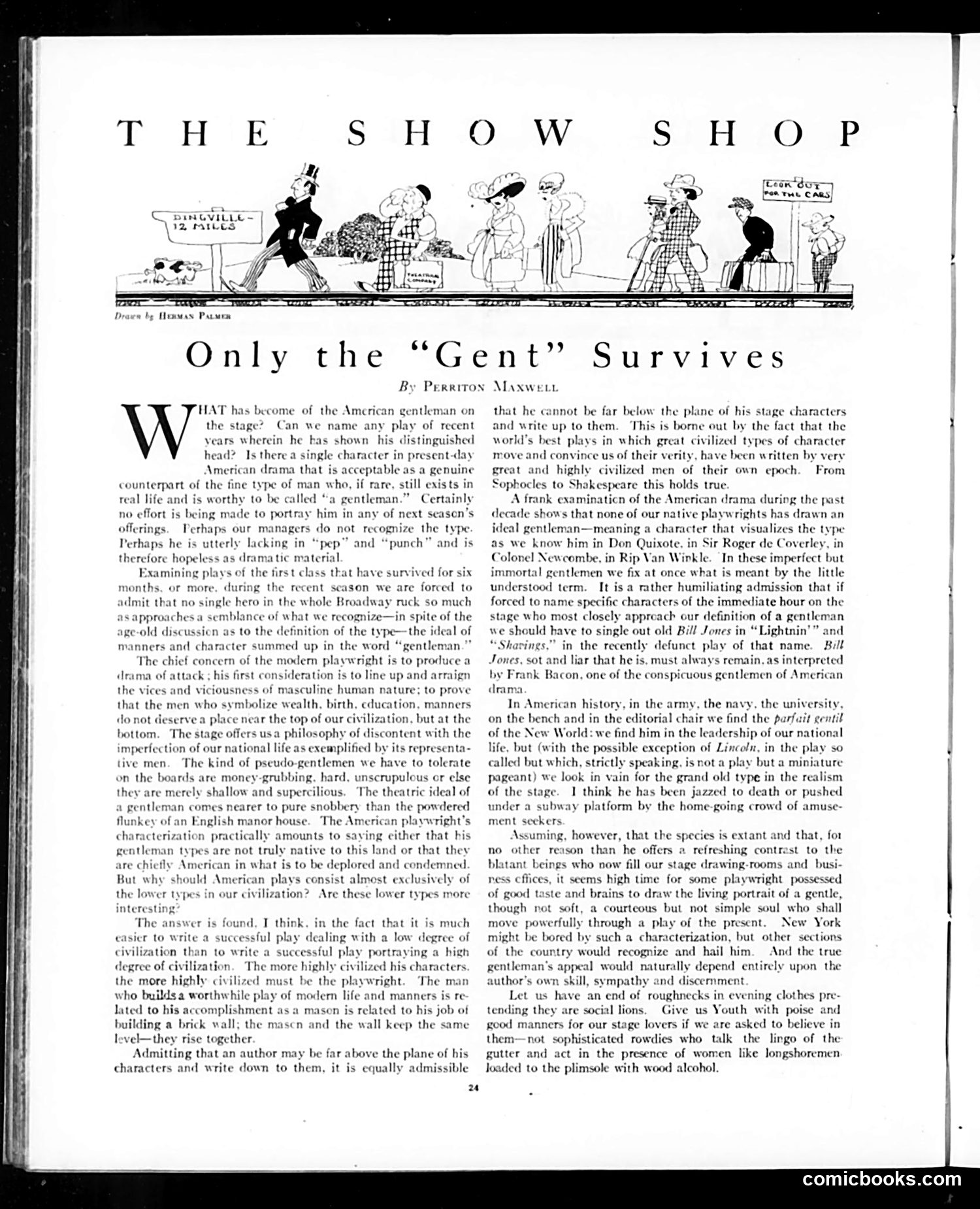
A restored page from Judge, 1920-07-24. Page through the whole issue in the reader above.
📄 Transcribed text from this page (OCR, searchable)
Machine-transcribed from the original scan — historical spelling and the odd misread are preserved.
BINGVILLE— \ 92 mares Draws by Uexwas Pacwen Only the “Gent” Survives By Perrrron Maxwetr HAT has become of the American gentleman on the stage? Can we name any play of recent years wherein he has shown his distinguished head? Is there a single character in present-day American drama that is acceptable as a genuine counterpart of the fine type of man who, if rare, still exists in real life and is worthy to be called “a gentleman.” Certainly no effort is being made to portray him in any of next season's offerings. Perhaps our managers do not recognize the type. Perhaps he is utterly lacking in “pep” and “punch” and is therefore hopeless as dramatic material Examining plays of the first class that have survived for six months, or more, during the recent season we are forced to admit that no single hero in the whole Broadway ruck so much as approaches a semblance of what we recognize—in spite of the age-old discussion as to the definition of the type—the ideal of manners and character summed up in the word “gentleman.” The chief concern of the modem playwright is to produce drama of attack ; his first consideration is to line up and arraign the vices and viciousness of masculine human nature; to prove that the men who symbolize wealth, birth, education, manners » not deserve a place near the top of our civilization, but at the bottom. The stage offers usa philosophy of discontent with the imperfection of our national life as exemplified by its representa- tive men. The kind of pseudo-gentlemen we have to tolerate on the boards are money-grubbing, hard, unscrupulous or else they are merely shallow and supercilious. The theatric ideal of a gentleman comes nearer to pure snobbery than the powdered flunkey of an English manor house. The American playwright’s characterization practically amounts to saying either that his gentleman types are not truly native to this land or that they are chiefly American in what is to be deplored and condemned. But why should American plays consist almost exclusively of the lower types in our civilization? Are these lower types more interesting The answer is found, I think. in the fact that it is much casier to write a successful play dealing with a low degree of civilization than to write a successful play portraying a high degree of civilization. The more highly civilized his characters. the more highly civilized must be the playwright. The man who buildsa worthwhile play of moder life and manners is re lated to his accomplishment as a masen is related to his job of building a brick wall; the mascn and the wall keep the same level—they rise together. Admitting that an author may be far above the plane of his characters and write down to them, it is equally admissible that he cannot be far below the plane of his stage characters and write up to them. This is borne out by the fact that the world’s best plays in which great civilized types of character move and convince us of their verity, have been written by very great and highly civilized men of their own epoch. From Sophocles to Shakespeare this holds true A frank examinaticn of the American drama during the past decade shows that none of our native playwrights has drawn an ideal gentleman—meaning a character that visualizes the type as we know him in Don Quixote, in Sir Roger de Coverley, in Colonel Newcombe, in Rip Van Winkle. ‘In these imperfect but immortal gentlemen we fix at once what is meant by the little understood term. It is a rather humiliating admission that if forced to name specific characters of the immediate hour on the stage who most closely approach our definition of a gentleman we should have to single out old Bill Jones in “Lightnin’” and “Shavings,” in the recently defunct play of that name. Bill Jones, sot and liar that he is, must always remain. as interpreted by Frank Bacon, one of the conspicuous gentlemen of American drama In American history, in the army, the navy, the university, on the bench and in the editorial chair we find the parfait gentit of the New World: we find him in the leadership of our national life, but (with the possible exception of Lincoln, in the play so called but which, strictly speaking. is not a play but a miniature pageant) we look in vain for the grand old type in the realism of the stage. 1 think he has been jazzed to death or pushed under a subway platform by the home-going crowd of amuse- ment seekers. Assuming, however, that the species is extant and that, for no other reason than he offers a refreshing contrast to the blatant beings who now fill our stage drawing-rooms and_busi- ness effices, it seems high time for some playwright possessed of good taste and brains to draw the living portrait of a gentle, though not soft, a courteous but not simple soul who shall move powerfully through a play of the present. New York might be bored by such a characterization, but other sections of the country would recognize and hail him. And the true gentleman's appeal would naturally depend entirely upon the author’s own skill, sympathy and discernment Let us have an end of roughnecks in evening clothes pre- tending they are social lions. Give us Youth with poise and good manners for our stage lovers if we are asked to believe in them—not sophisticated rowdies who talk the lingo of the gutter and act in the presence of women like longshoremen loaded to the plimsole with wood alcohol. comicbooks.com