
A complete issue · 36 pages · 1920
Judge — June 5, 1920
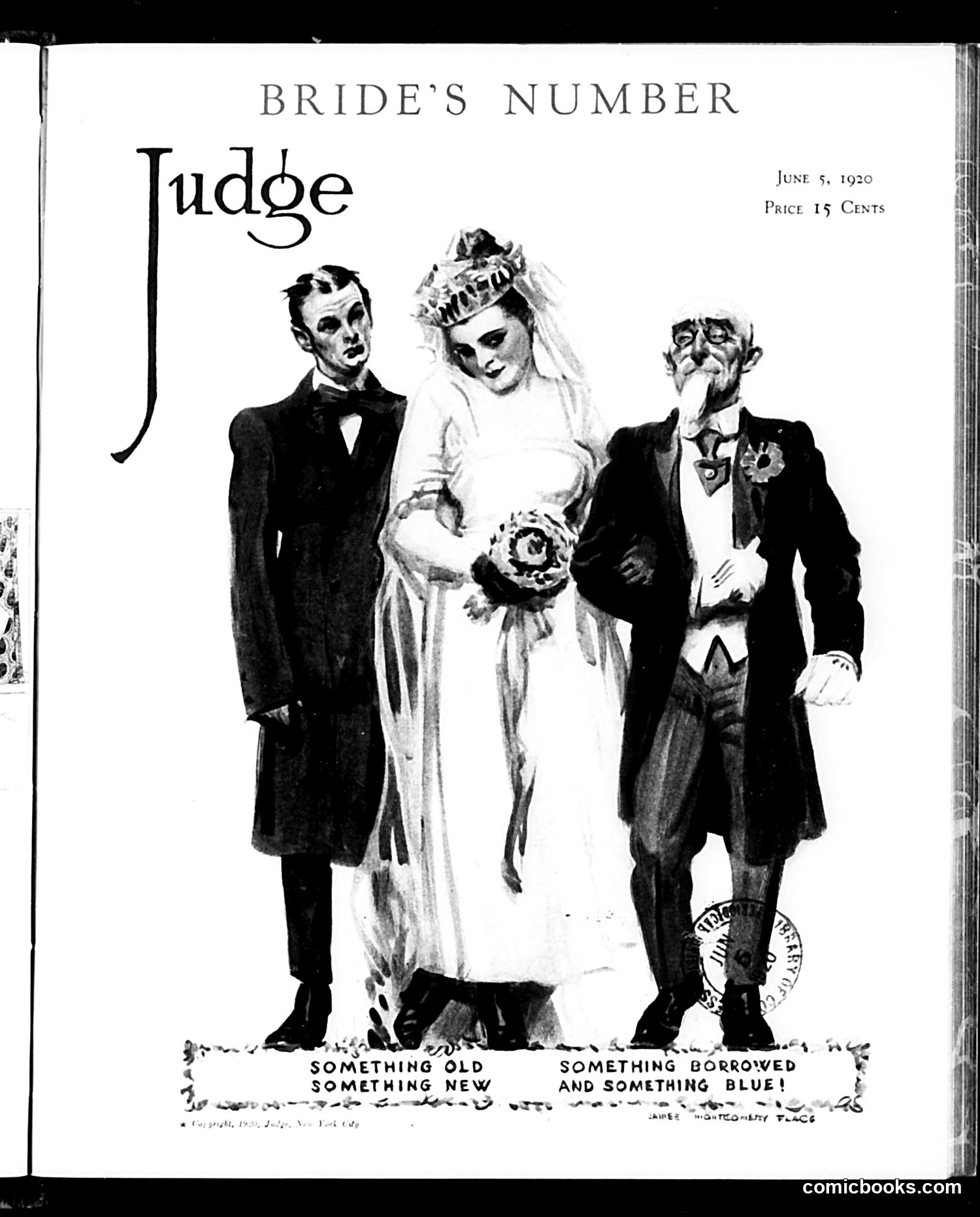
This is Judge's "Bride's Number" from June 5, 1920, priced at 15 cents. The cover illustrates the traditional wedding rhyme about what a bride should have: "something old, something new, something borrowed, and something blue." The cartoon depicts a bride in the center flanked by three men representing these elements. The left figure (young man in formal wear) appears to represent "something new," the center bride wears traditional white, and the right figure (older man, appearing somewhat disheveled) likely represents "something old." The captions below confirm "something old," "something new," "something borrowed and something blue." The satire appears to play on marriage tradition and the absurdity of literally embodying the superstition with actual people rather than objects.

This page is primarily **advertising**, not satire or political commentary. It promotes "The World's Best Stories"—a 1,341-story collection in four volumes sold by Brunswick Subscription Co. The photograph shows two men in business attire: one standing, one seated at a desk with papers. This illustrates the advertisement's premise that good stories are useful business tools—"Many a good business deal has been closed by the salesman after his prospect has been put in good humor by a corking good story." The text references Abraham Lincoln's famous use of anecdotes to make points persuasively, positioning storytelling as a valuable skill for salesmen and professionals. The "concentrated essence of fun" messaging targets early 20th-century consumers seeking entertainment and practical value in one purchase.
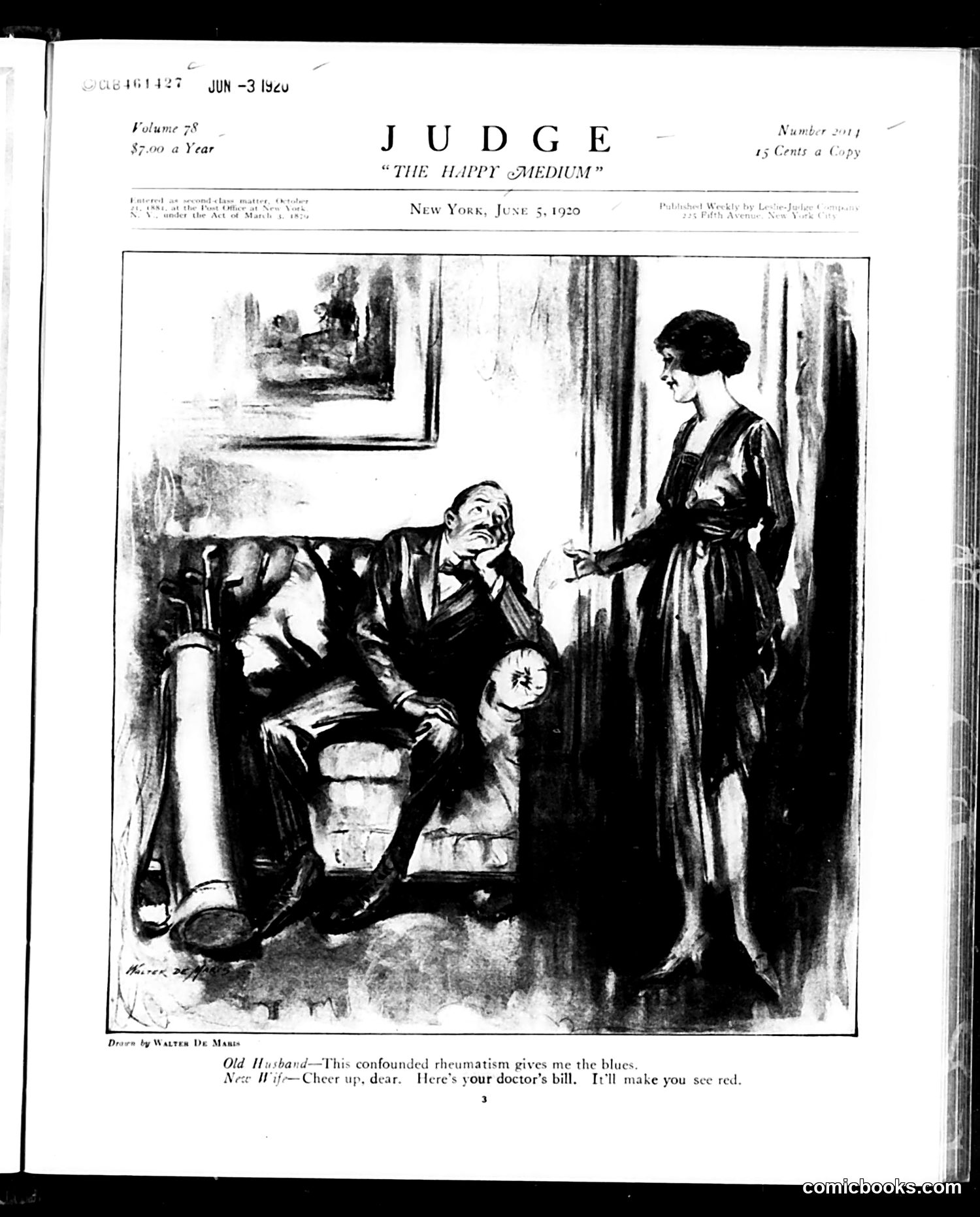
This cartoon by Walter De Maris depicts a domestic scene with satirical commentary on marriage and healthcare costs. An older man sits on a couch, appearing distressed, while his wife stands nearby. The caption reads: "Old Husband—This confounded rheumatism gives me the blues. New Wife—Cheer up, dear. Here's your doctor's bill. I'll make you see red." The joke satirizes the financial burden of medical bills as a "cure" worse than the illness itself. The "new wife" character suggests either a recent remarriage or a commentary on younger wives' materialism. The humor relies on the common trope of spouses exacerbating their husbands' anxieties—here, substituting physical pain with financial anxiety from expensive healthcare. The cartoon reflects 1920s concerns about rising medical costs and marital tensions over money.
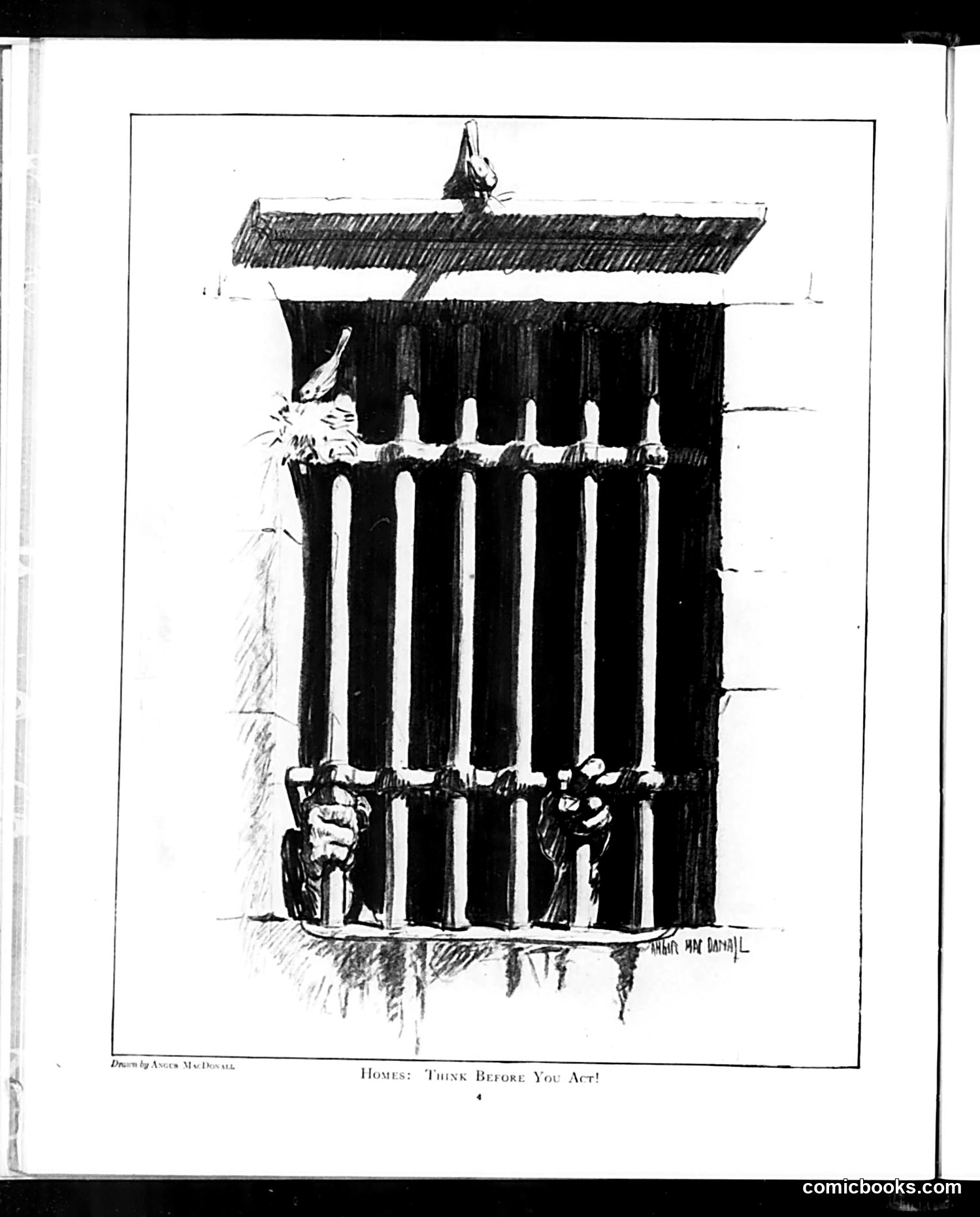
This political cartoon depicts a jail or prison cell with vertical bars. The caption reads "Homes: Think Before You Act!" The drawing shows what appears to be figures behind bars—one at the top of the structure and two at the bottom—suggesting incarceration as a consequence. The sardonic title suggests the cartoon warns against hasty or reckless behavior that could lead to imprisonment. Without additional context about the specific historical moment this Judge issue was published, I cannot definitively identify which political figures or scandal is being satirized. The cartoon appears to be warning the public (or specific politicians) about the legal consequences of their actions, but the precise reference remains unclear from the image alone.
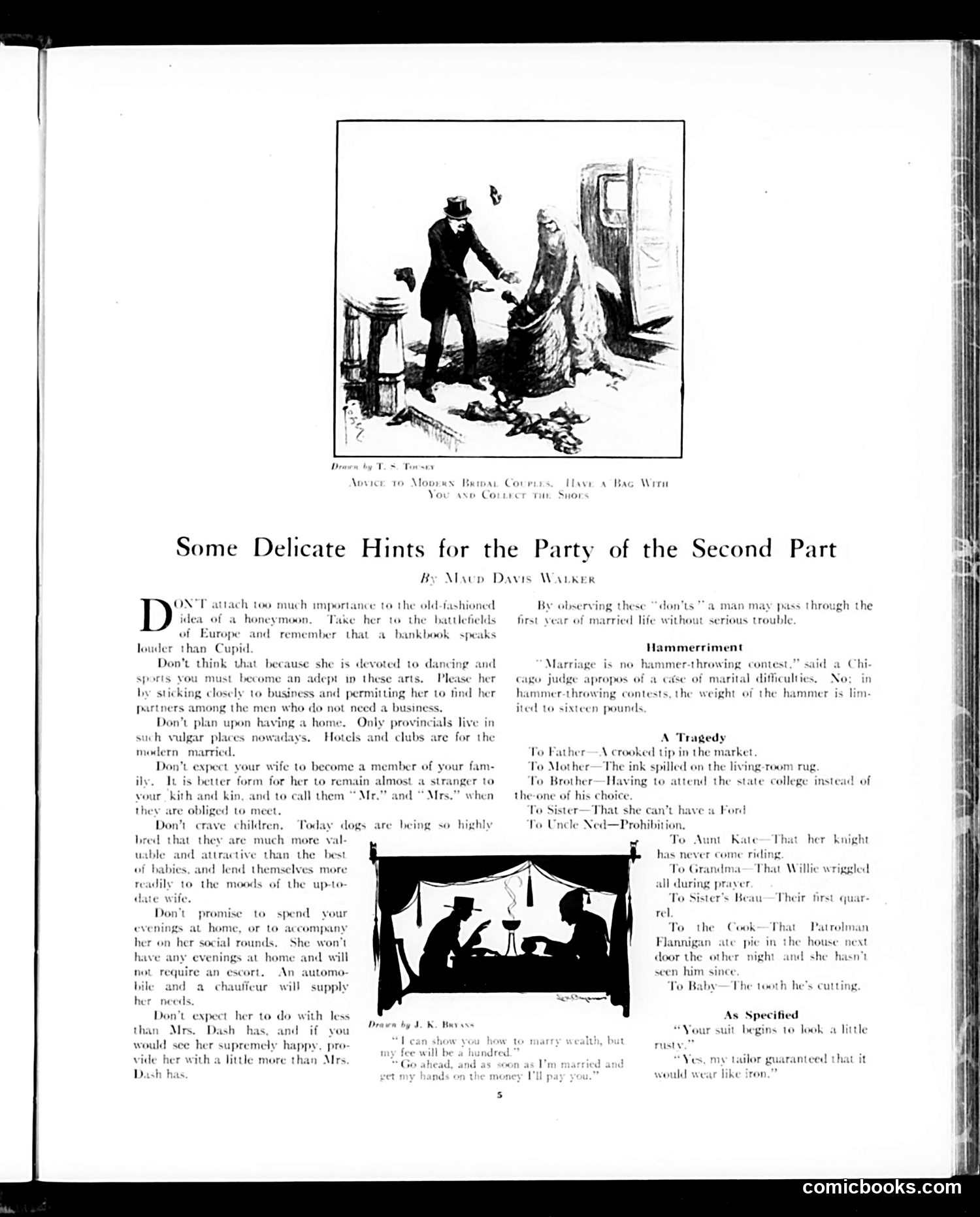
This page from *Judge* magazine presents satirical "advice to newly married couples" for the "second part" (presumably of the honeymoon or early marriage). The top cartoon shows a well-dressed man instructing a woman on practical domestic matters—likely commenting on the gap between romantic expectations and marital reality. The caption advises collecting shoes, suggesting financial prudence. The main article by Maud Davis Walker offers tongue-in-cheek marriage tips: don't over-romanticize honeymoons, avoid excessive dancing/sports, don't expect wives to adopt family obligations, and manage household expenses carefully. The embedded illustrations humorously depict newlywed disasters. The "Tragedies" and "As Specified" sections list domestic misadventures—spilled ink, failed college attendance, lost pets—with deadpan humor about marriage's mundane disappointments. The satire targets both romantic idealization and practical incompetence in early married life.
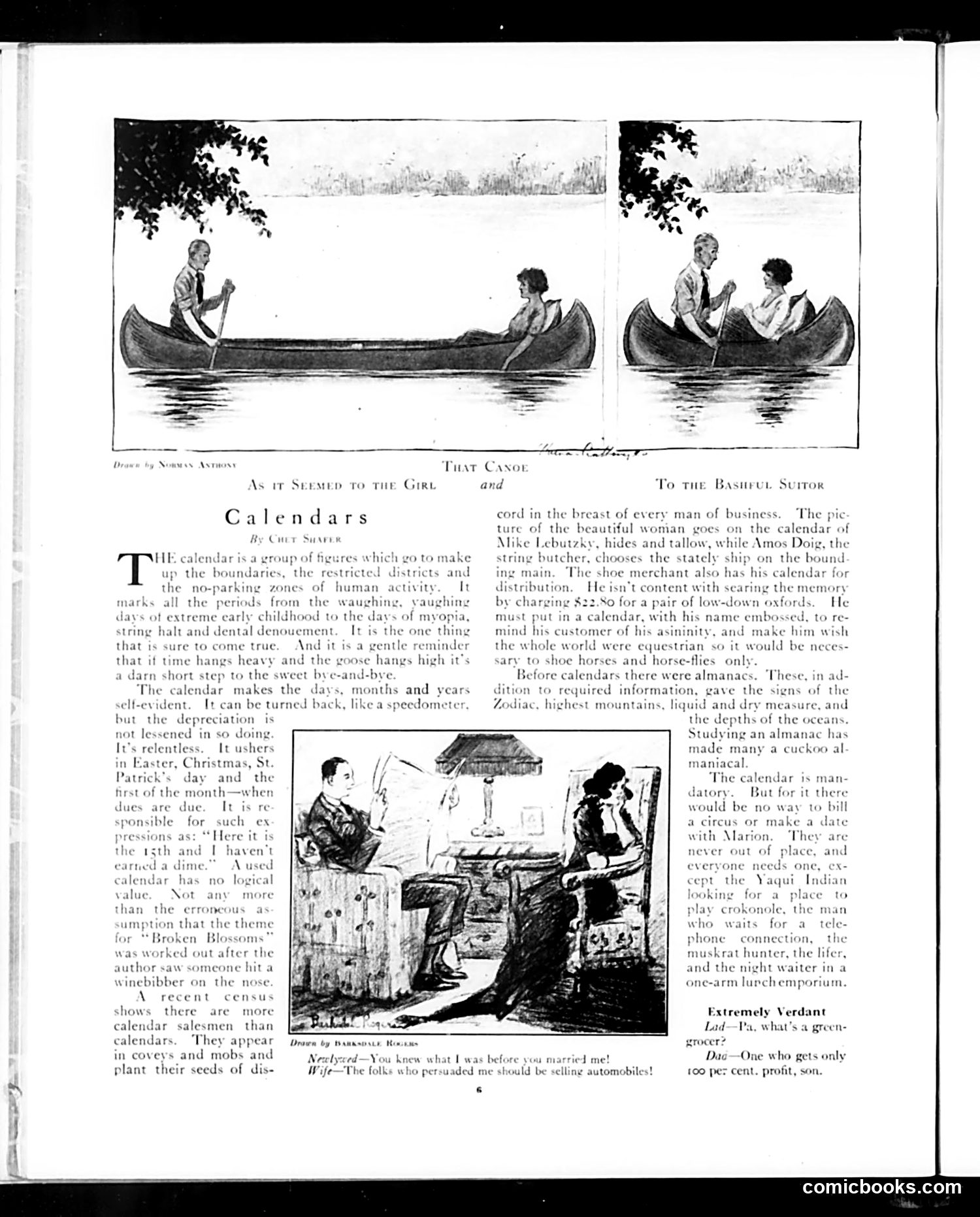
This page contains an essay titled "Calendars" by Chief Shaver alongside illustrations. The top shows two drawings of a canoe with figures, captioned "That Canoe As it Seemed to the Girl and To the Bashful Suitor"—a visual gag about subjective perception in romantic situations. Below is an illustration showing a domestic interior scene with the caption "You knew what I was before you married me!" / "The folks who persuaded me should be selling automobiles!"—satirizing how salesmanship and persuasion tactics were being applied to marriage prospects, suggesting people were being "sold" into relationships like commodities. The essay discusses calendars as commercial objects, noting calendar salesmen were ubiquitous. The humor derives from contrasting the mundane necessity of calendars with the aggressive sales culture of early 20th-century America.
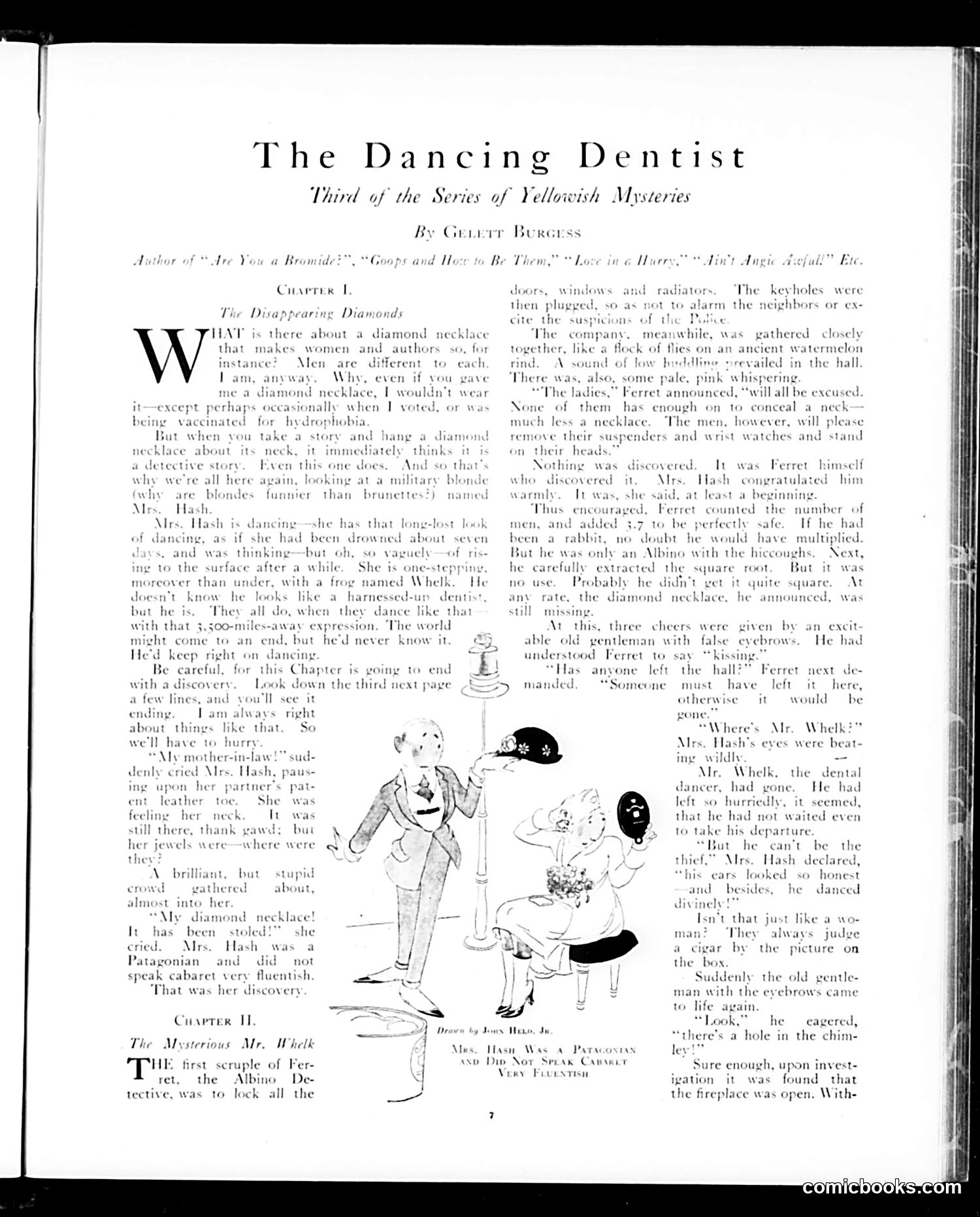
This is page one of a serialized mystery-comedy story by Gelett Burgess, part of his "Yellowish Mysteries" series. The narrative concerns a stolen diamond necklace belonging to Mrs. Hash, a Patagonian woman. A character named Mr. Whelk, described as an "Albino Detective," investigates the theft. The accompanying cartoon depicts the social chaos of the discovery—well-dressed society figures (men in suspenders, women in hats) reacting dramatically to the missing jewel. The humor stems from the absurdist mystery setup typical of Burgess's work: the detective's peculiar name, the ethnically stereotyped victim, and the comic mayhem surrounding the investigation. This represents early 20th-century magazine fiction—lighthearted, serialized entertainment blending text and illustration for educated middle-class readers.
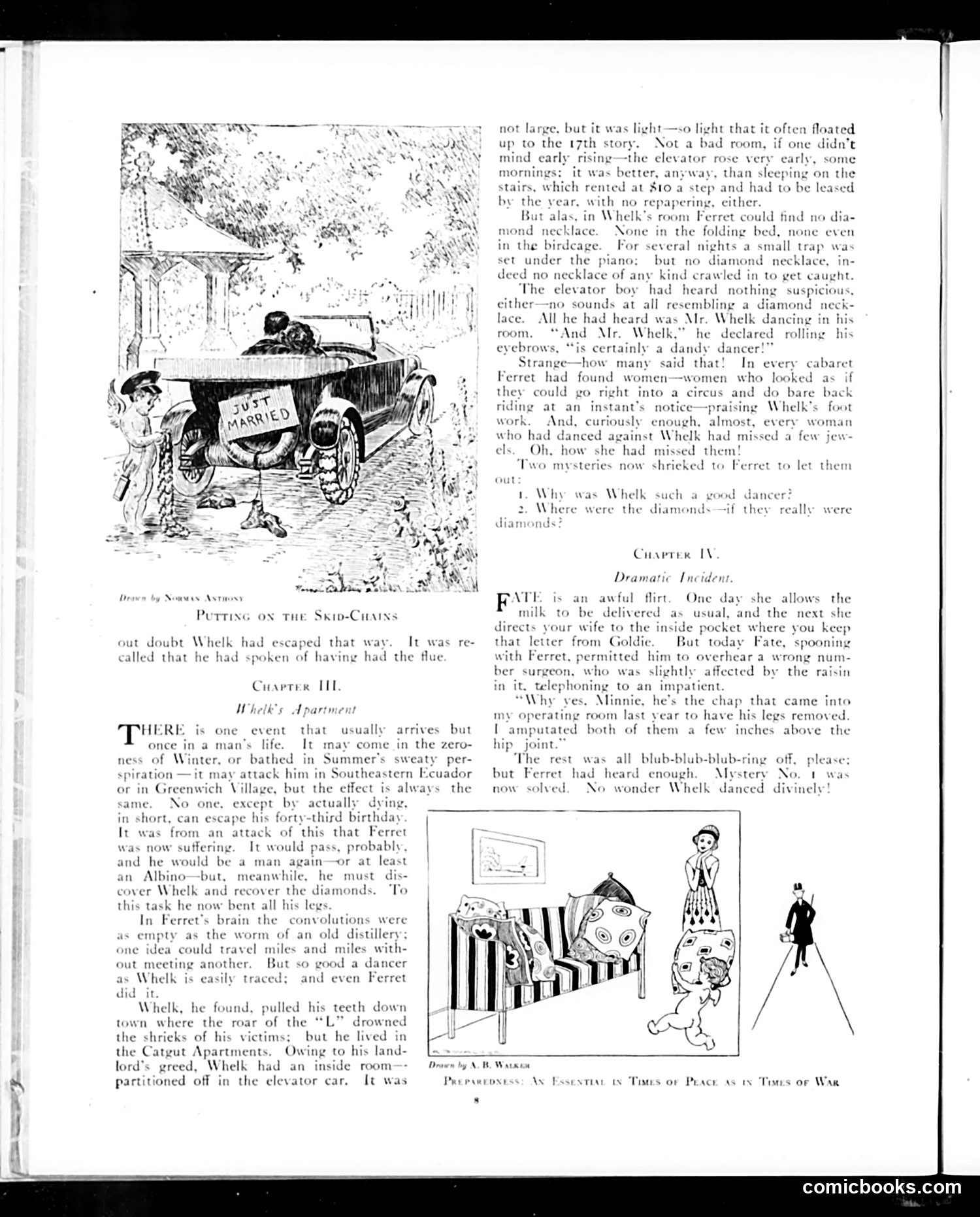
This page contains a serialized story with two illustrations. The narrative concerns a character named Whelk, apparently a skilled dancer and jewel thief, and a pursuer named Ferret attempting to recover stolen diamonds. The top illustration shows a "Just Married" automobile, depicting Whelk's escape method. The text establishes that Whelk occupies a modest apartment in the Catgut Apartments building, accessible via elevator. The lower illustration depicts domestic chaos—a woman in bed with a child, suggesting the domestic disruptions caused by Whelk's activities. The story presents two mysteries: why Whelk is an exceptionally good dancer, and the whereabouts of missing diamonds. A surgeon character provides exposition, revealing he amputated Whelk's legs years earlier, yet mysteriously Whelk now dances professionally—suggesting either a miraculous recovery or deception. This appears to be light satirical fiction rather than political commentary—the humor derives from the absurd premise of a legless jewel thief and the detective story's convoluted plot mechanics typical of early 20th-century Judge magazine humor.
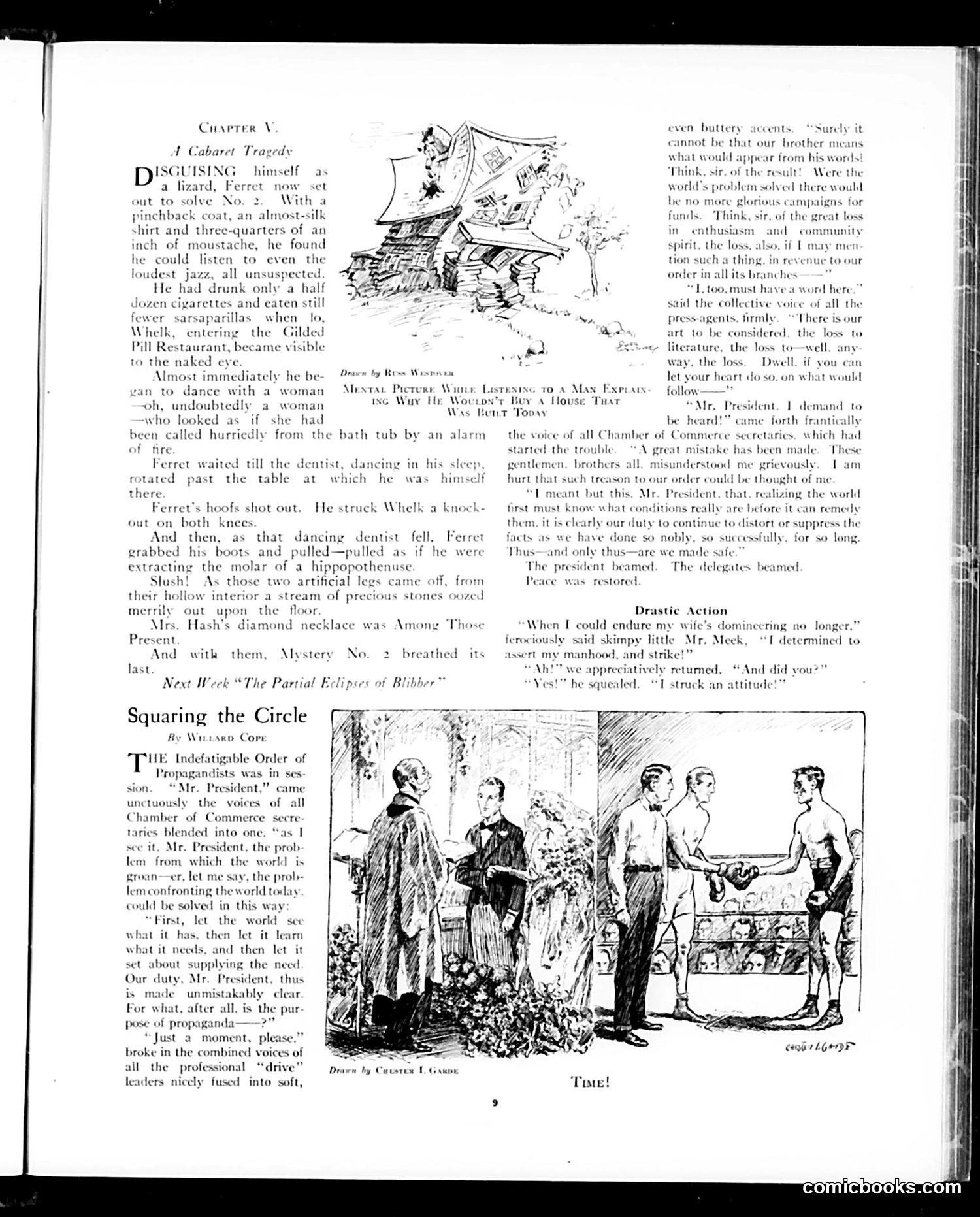
**"Squaring the Circle"** satirizes propagandists and Chamber of Commerce leaders who prioritize their own institutional interests over solving actual problems. The setup: A propagandist proposes that to solve the world's problems, society should first identify what it has, learn what it needs, then supply those needs—a reasonable-sounding plan. However, Chamber of Commerce secretaries immediately object, fearing that *actually solving* world problems would eliminate the need for their campaigns and revenue streams. They argue that ongoing crises justify their continued existence and funding. **The satire's point**: Organizations ostensibly dedicated to public welfare are actually invested in perpetuating the problems they claim to address. By exposing this contradiction, Judge mocks the hypocrisy of self-serving institutions that benefit from maintaining societal dysfunction. The upper "Cabaret Tragedy" story appears to be separate comedic fiction about mistaken identities at a nightclub, unrelated to the propaganda critique below.
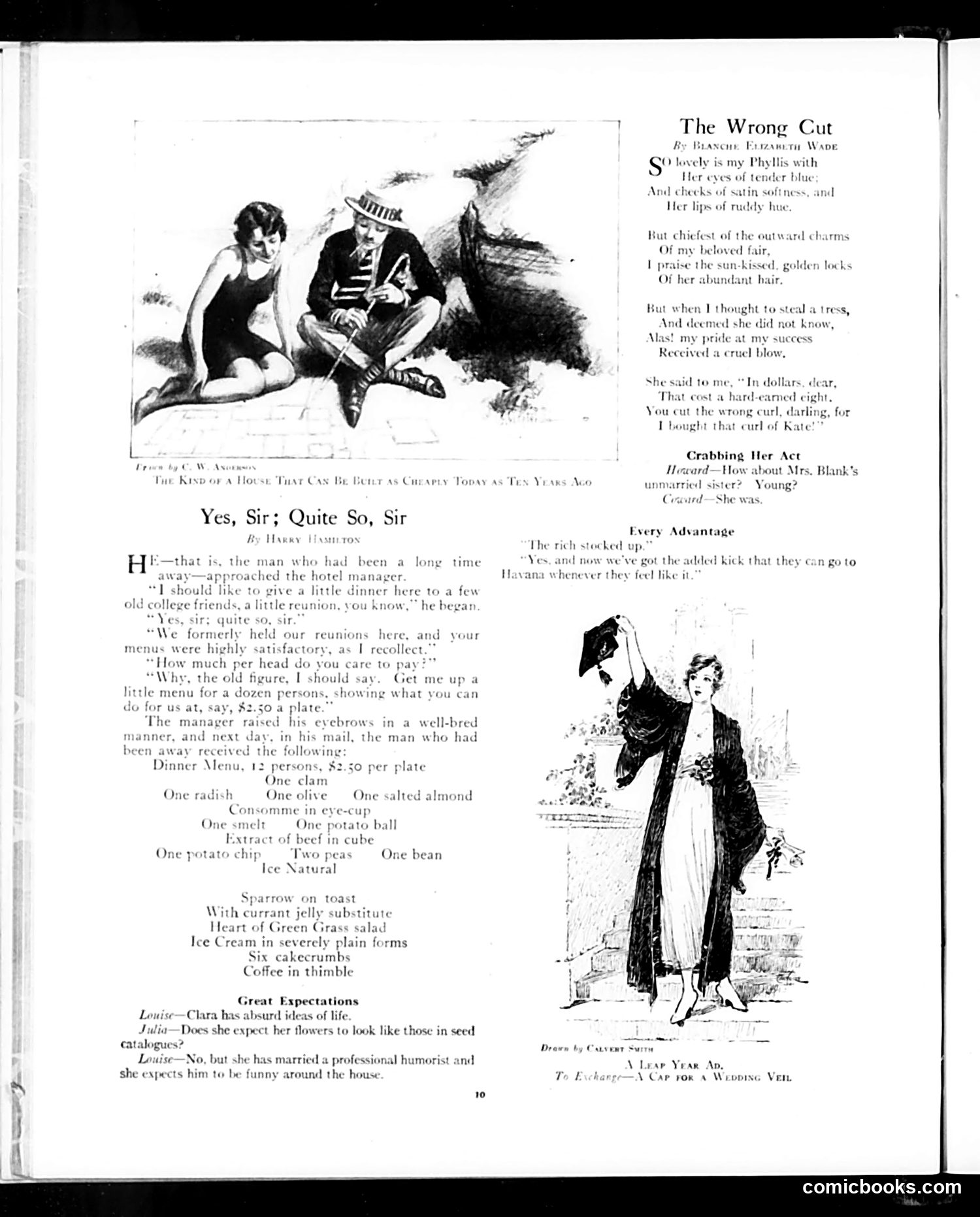
This page contains three satirical pieces reflecting early 20th-century social humor: **"Yes, Sir; Quite So, Sir"** mocks nouveau riche pretension. A man boasts of hosting an elegant dinner for college friends at $2.50 per plate, but the actual menu is absurdly meager—a single clam, radish, olive, thimble of coffee—revealing the gap between his aspirations and means. The joke targets social climbers attempting to appear wealthy through dining. **"The Wrong Cut"** satirizes a husband's embarrassment when his wife's expensive new hairstyle actually copies another woman's (Kate's), not the fashionable style he praised. He's humiliated that his compliments were coincidental. **"Every Advantage"** and brief sections like "Crabbing Her Act" and "Great Expectations" offer short quips about absurd social expectations—women expecting humorists to be funny at home, or expecting flowers to match seed catalogs. The overall theme: satirizing class pretension, marital misunderstandings, and the gap between social expectations and reality in early 1900s America.
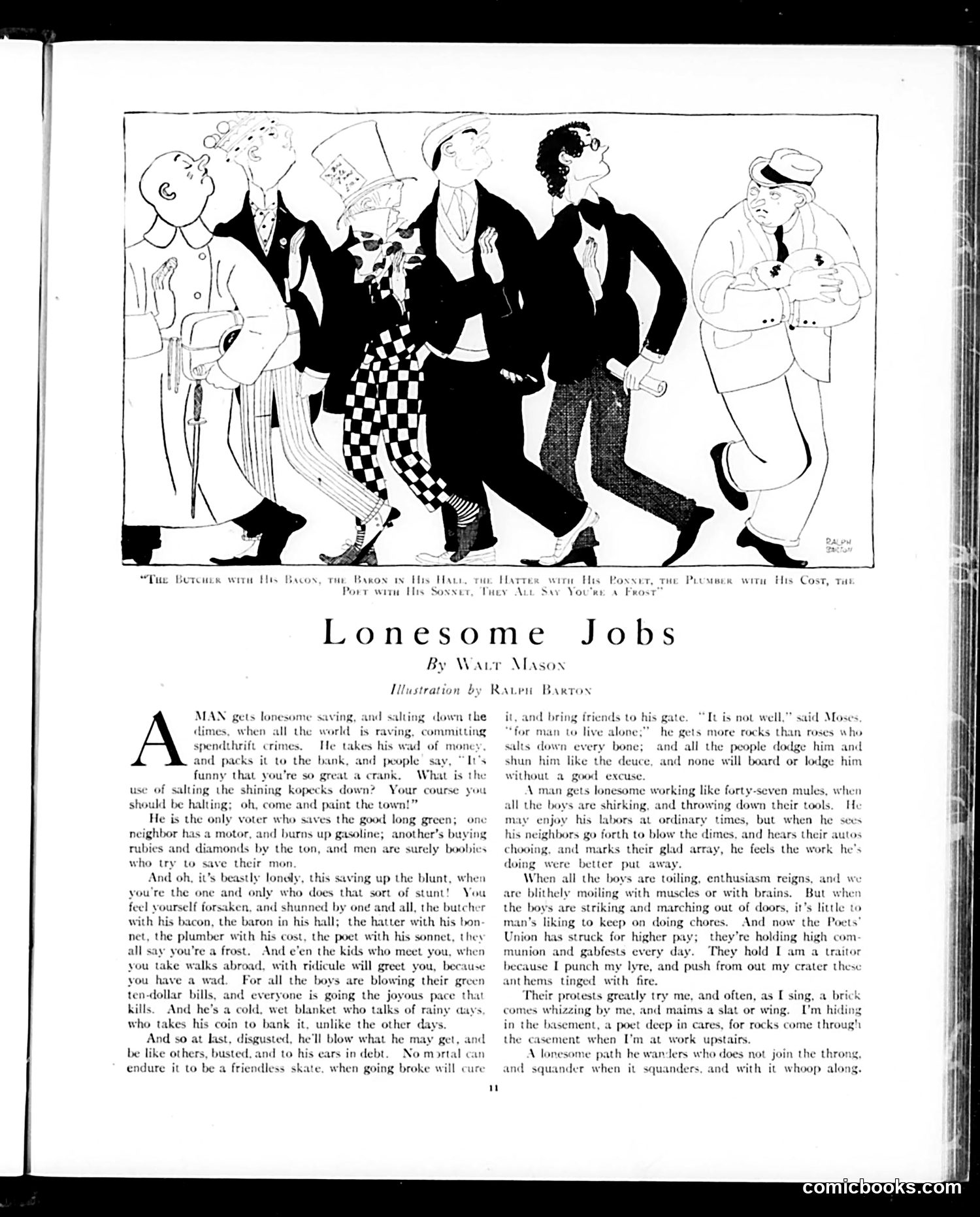
This satirical piece critiques American social conformity and peer pressure through the story of men who deviate from crowd behavior. The illustration depicts various tradesmen and professionals (butcher, baron, hatter, plumber, poet) who ostracize the virtuous protagonist. **The satire's point:** Mason mocks how society punishes thrift, hard work, and restraint. A man who saves money instead of spending frivolously, or who continues working while others strike (notably referencing a Poets' Union strike), faces social rejection—literally shunned by his community and tradespeople. **The joke:** The title is ironic. These aren't truly "lonesome jobs" but rather lonesome *choices*—being responsible and principled isolates you in a culture of reckless spending and mob mentality. The poem suggests that virtue makes you a "frost" (social outcast), yet vice leads to financial ruin anyway. It's commentary on American consumerism and herd behavior during an era of labor unrest and economic uncertainty.
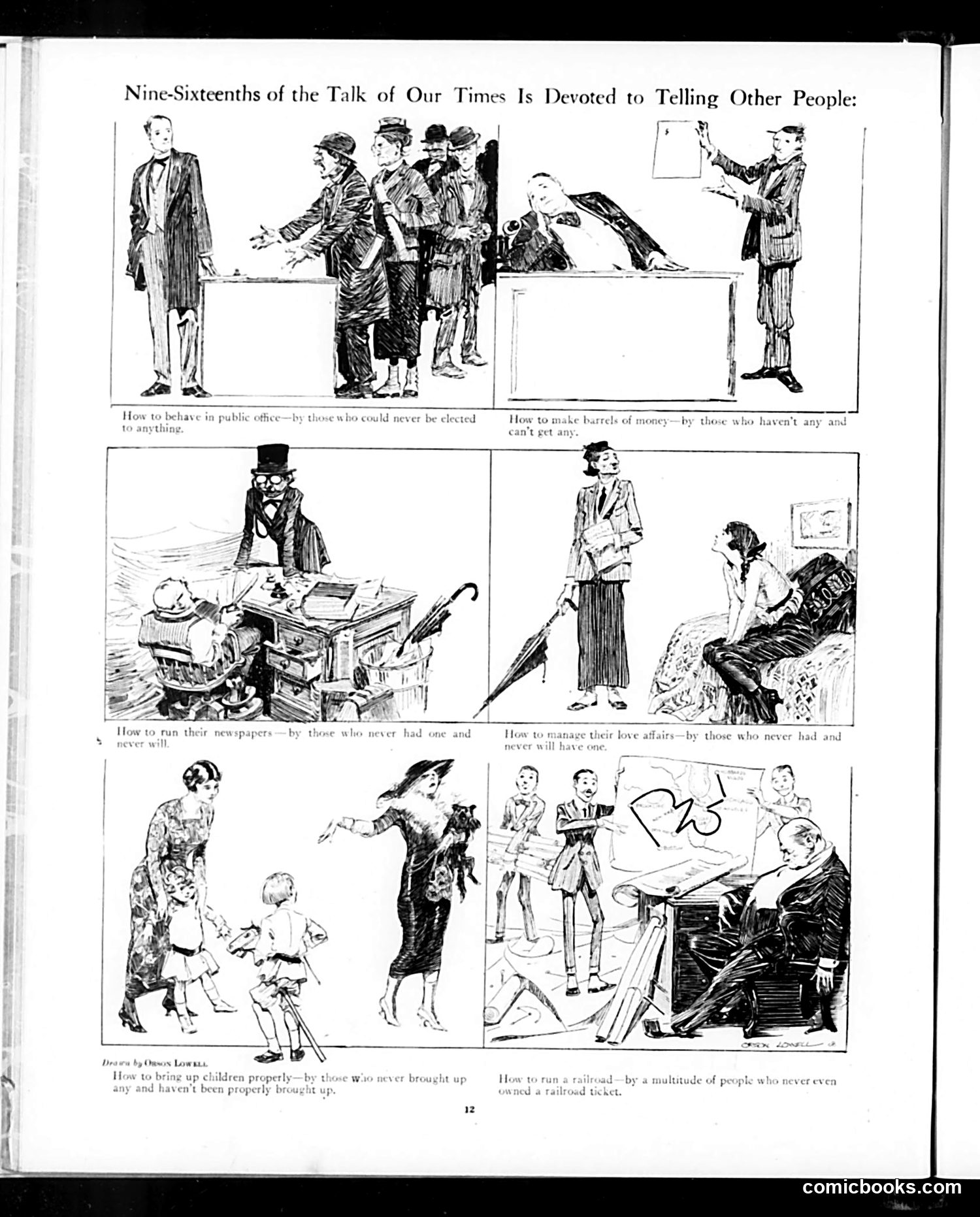
This page satirizes people who give advice on subjects they have no expertise in. Each panel depicts someone pontificating about a field they've never experienced: - A man lecturing about public office (never elected) - Someone explaining how to make money (penniless themselves) - A person advising on newspaper management (never owned one) - A woman counseling on love affairs (never had any) - Someone instructing child-rearing (never properly raised children) - Multiple people advising on railroad management (never owned a ticket) The satire targets a universal human tendency: confidently instructing others on matters outside one's personal experience. The title suggests this comprises the majority of everyday conversation—a critique of empty talk and unearned authority in society.
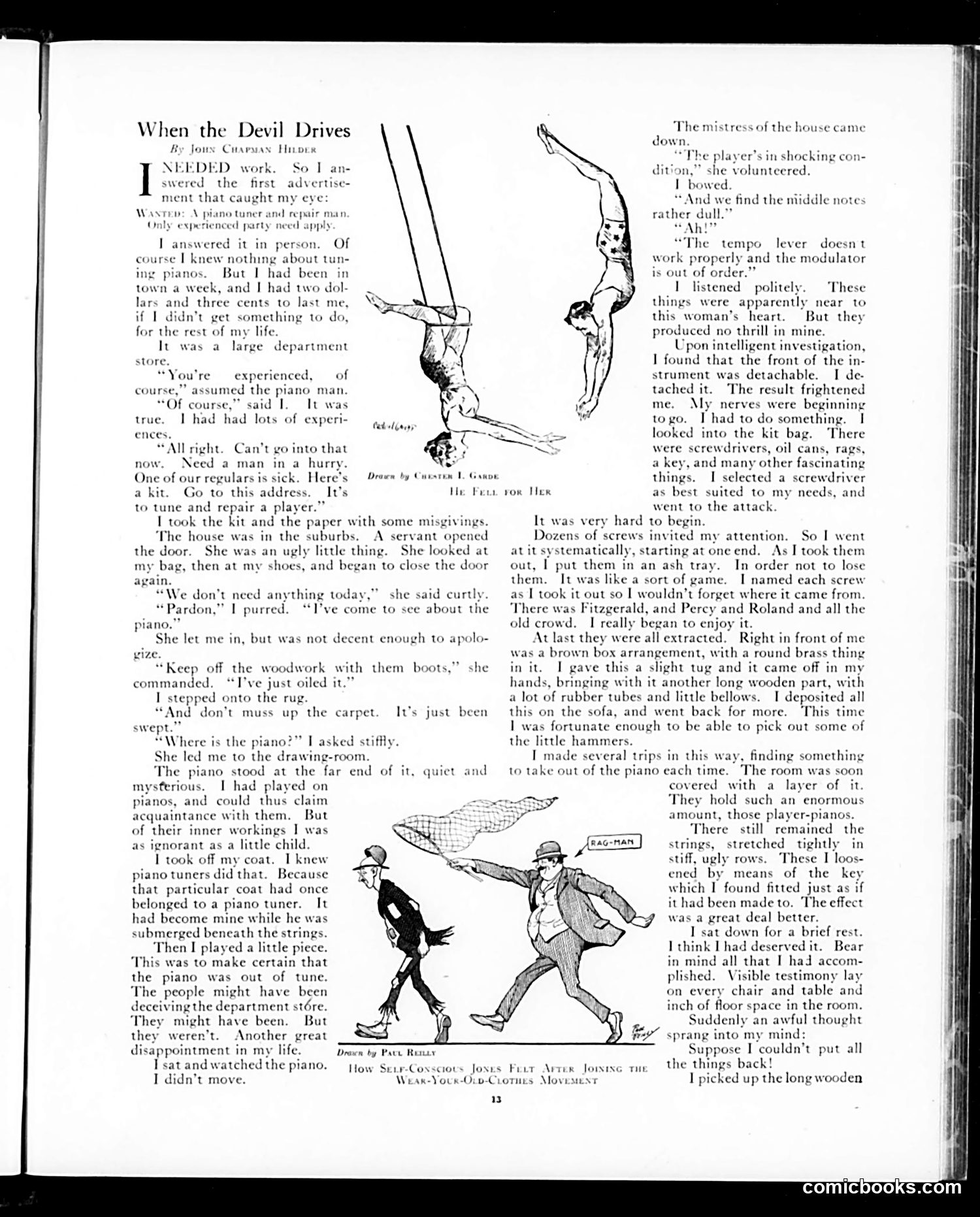
This is a humorous short story illustrated with cartoons about an unemployed man who falsely claims experience as a piano tuner to land a job. Desperate for work and nearly broke, he answers a help-wanted ad and lies during the interview, claiming extensive experience despite knowing nothing about pianos. The joke centers on his deception unraveling as he's sent to repair a wealthy family's player piano. The snobbish household (depicted in the cartoons—the servants and mistress are drawn mockingly) treats him with disdain. When confronted with the instrument's actual problems, he's forced to improvise, methodically disassembling it while naming screws after old acquaintances to track them. The cartoon titled "How Self-Conscious Jones Felt After Joining the Weak-You-Up-Clothes Movement" (bottom) appears unrelated to the main story—a separate satirical piece about social embarrassment. The satire targets both the protagonist's desperation-driven dishonesty and the class pretension of his employers.
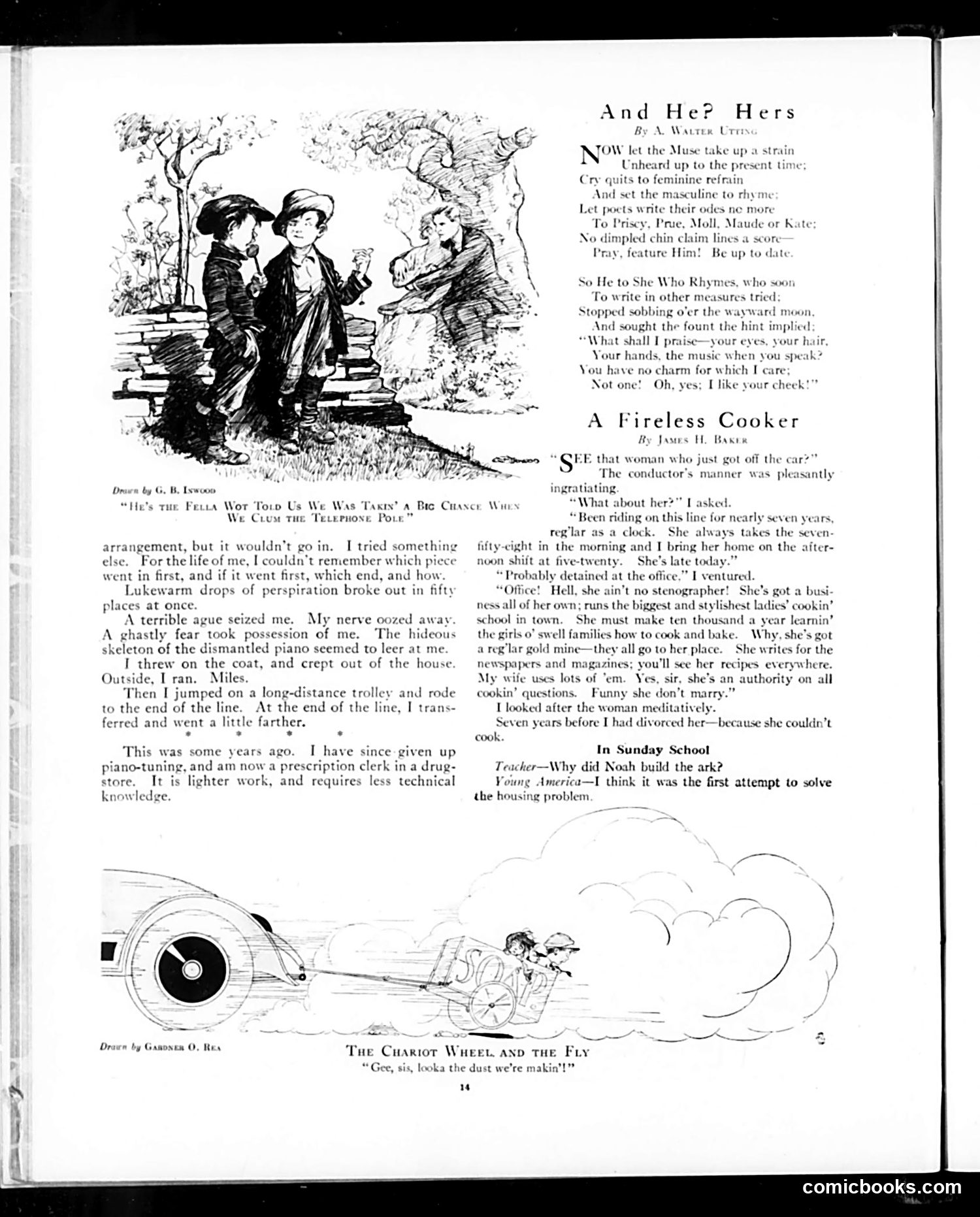
This page contains three separate satirical pieces reflecting early 20th-century attitudes: 1. **"He's the Fella Wot Told Us We Was Takin' a Big Chance When We Crust the Telephone Pour"**: A humorous anecdote about a man hired to tune a piano who becomes so anxious about reassembling it that he flees and eventually abandons the profession entirely for pharmacy work. The satire mocks male incompetence at technical tasks. 2. **"And He? Hers"**: A poem satirizing the shift from romantic, feminine-focused poetry to celebrating masculine qualities—though the male speaker ironically can only compliment his subject's cheek, undermining the supposed masculine focus. 3. **"A Fireless Cooker"**: A story about a successful woman running a cooking school and writing recipes for publications, yet remaining unmarried. The irony: she couldn't cook when married, implying her professional success stems from her divorce—a subtle commentary on women's economic independence. The "In Sunday School" joke offers a child's innocent reinterpretation of Noah's ark as a housing solution.
This is a literary review/essay by Benjamin De Casseres, not a political cartoon. The page discusses two books: 1. **"Two Ghost-Enumerators"** reviews a work by Lady Gregory and W.B. Yeats collecting Irish folklore about ghosts from the West Coast of Ireland. The piece mocks their earnest cataloging of supernatural beliefs among Irish peasants—presenting ghost-hunting as both quaint and absurd. 2. **"No Cabellyache Here"** praises James Branch Cabell's novel "The Cream of the Jest," calling it a genuine book of "mystery, terror and wonder of life" with humor and wisdom. Cabell is positioned as a serious literary genius whose work transcends the mundane. The satire contrasts pretentious folklore collection with "real" literary merit. The tone suggests the author views Yeats and Gregory's ghost-gathering as precious antiquarianism, while Cabell's philosophical fiction represents authentic artistic accomplishment.
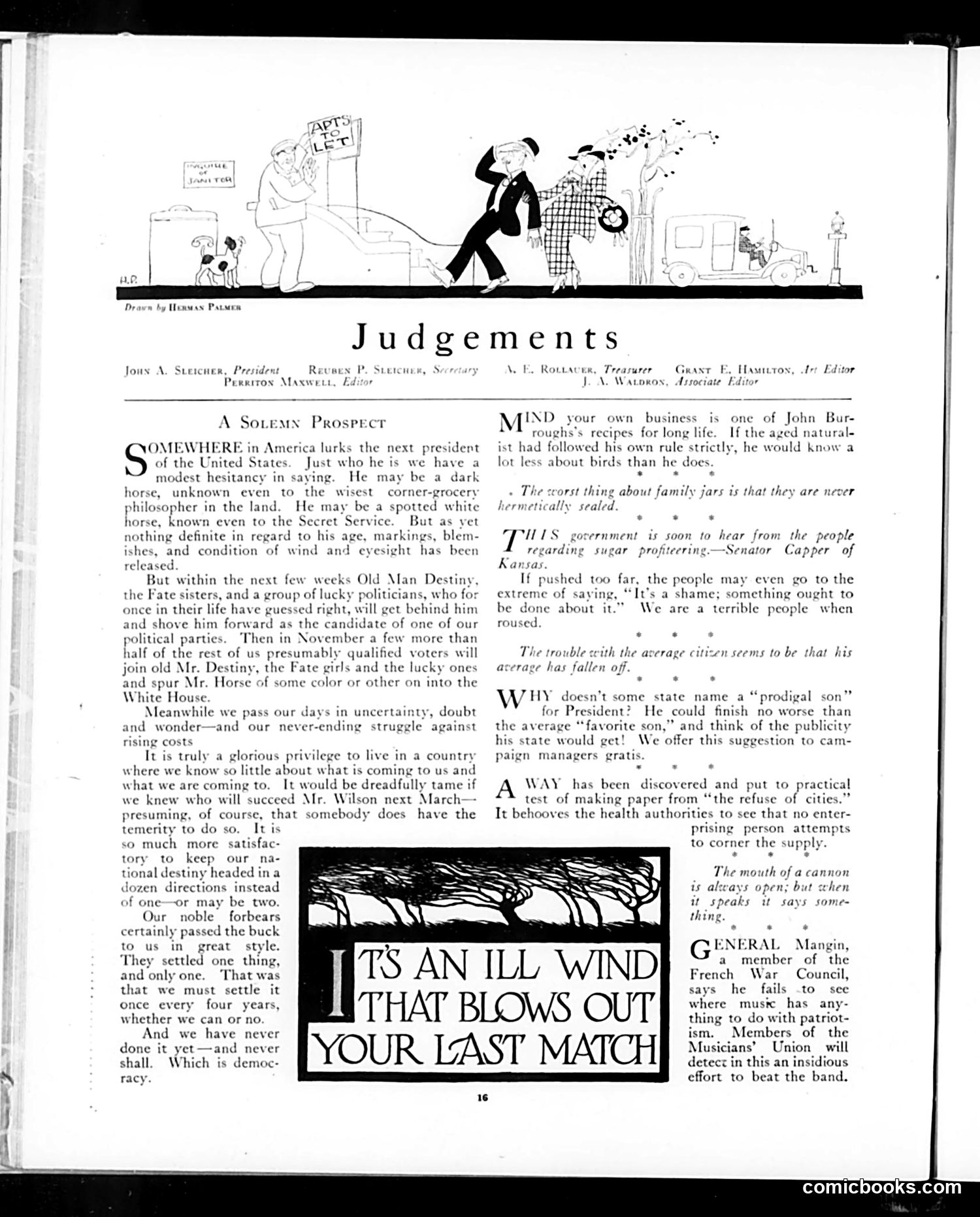
This editorial commentary page satirizes American political uncertainty circa 1916. The main essay mocks the mystery surrounding the next presidential candidate—described as an unknown "dark horse" or "spotted white horse" of unknown qualities. The satire suggests this uncertainty is paradoxically presented as democratic virtue, though the author notes Americans have never successfully settled presidential succession despite voting every four years. The accompanying brief items use humorous observations to critique contemporary issues: sugar profiteering during wartime (Senator Capper of Kansas receives criticism), waste management solutions, and a jab at French General Mangin for opposing military musicians. The cartoon header depicts chaotic urban life reflecting the disorganization theme. The bold quote—"It's an ill wind that blows out your last match"—appears to reference wartime shortages or economic hardship affecting ordinary citizens, connecting to the broader theme of national uncertainty and mismanagement during this pre-election period.
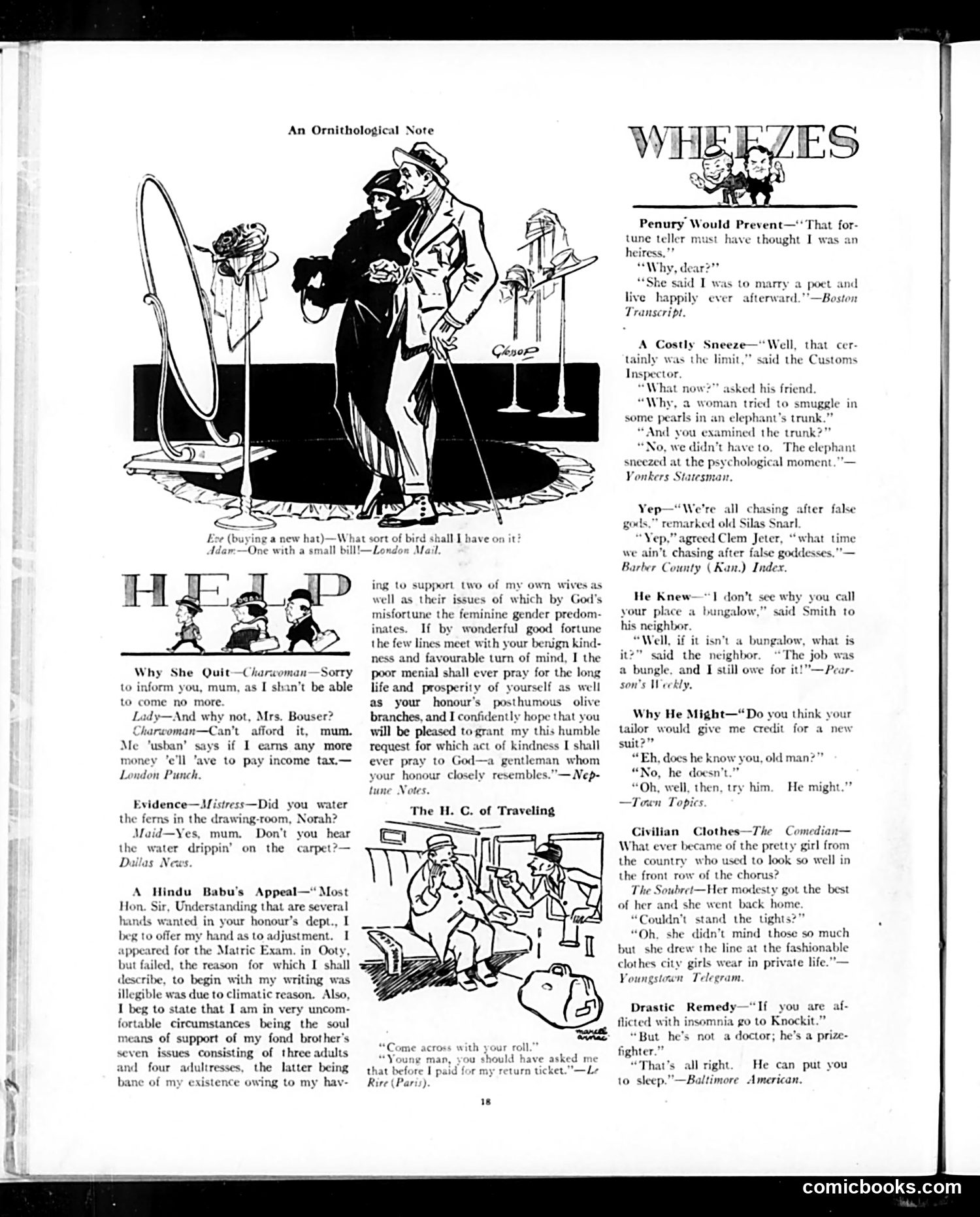
This page contains several brief humor pieces typical of early 20th-century American satire magazines. The content mocks contemporary social issues: **"Why She Quit"** satirizes new income tax burdens on working-class families—a charwoman must quit her job because her husband fears the income tax implications of her earnings. **"Evidence"** is a domestic humor joke about a maid's literal interpretation of watering plants. **"A Hindu Babu's Appeal"** mocks both Indian job applicants and bureaucratic pretension through an exaggerated letter full of grammatical errors and excessive flattery, reflecting period prejudices. The remaining pieces are brief quips about fortune-telling, smuggling, religion, and tailor credit—lightweight social commentary on marriage, customs enforcement, and class differences. **"An Ornithological Note"** (top illustration) shows customs officials examining travelers, likely referencing smuggling concerns. The cartoons use working-class characters and situations for humor aimed at middle-class readers.
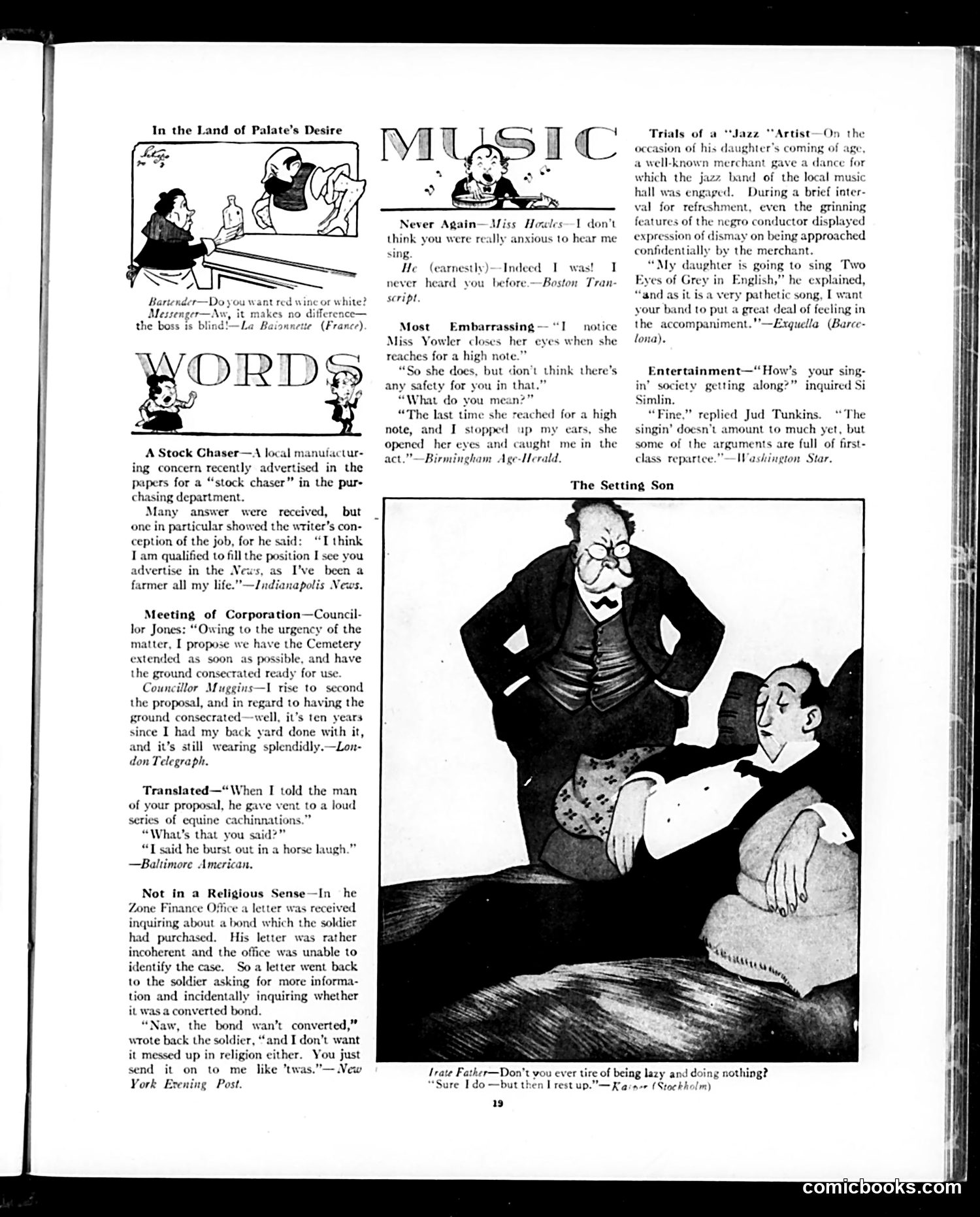
This page contains humorous anecdotes and a cartoon rather than political commentary. The jokes mock various social situations: **The anecdotes** include: - A farmer applying for a "stock chaser" position, misunderstanding corporate terminology - A councilman conflating cemetery consecration with his yard work - A soldier misinterpreting "converted bond" as religious terminology - A singer closing her eyes at high notes, embarrassing the narrator - A jazz band conductor dismayed by a merchant's request for emotional accompaniment to a sentimental song **"The Setting Son" cartoon** depicts a lazy father being confronted by an angry man about his idleness. The caption plays on words: when asked if he tires of laziness, he responds he rests up—a pun on "rest." The humor relies on **misunderstandings, malapropisms, and class-based comedy** typical of early 20th-century satirical magazines. The jazz reference reflects 1920s cultural anxieties. Overall, this is lighthearted wordplay rather than sharp political satire.
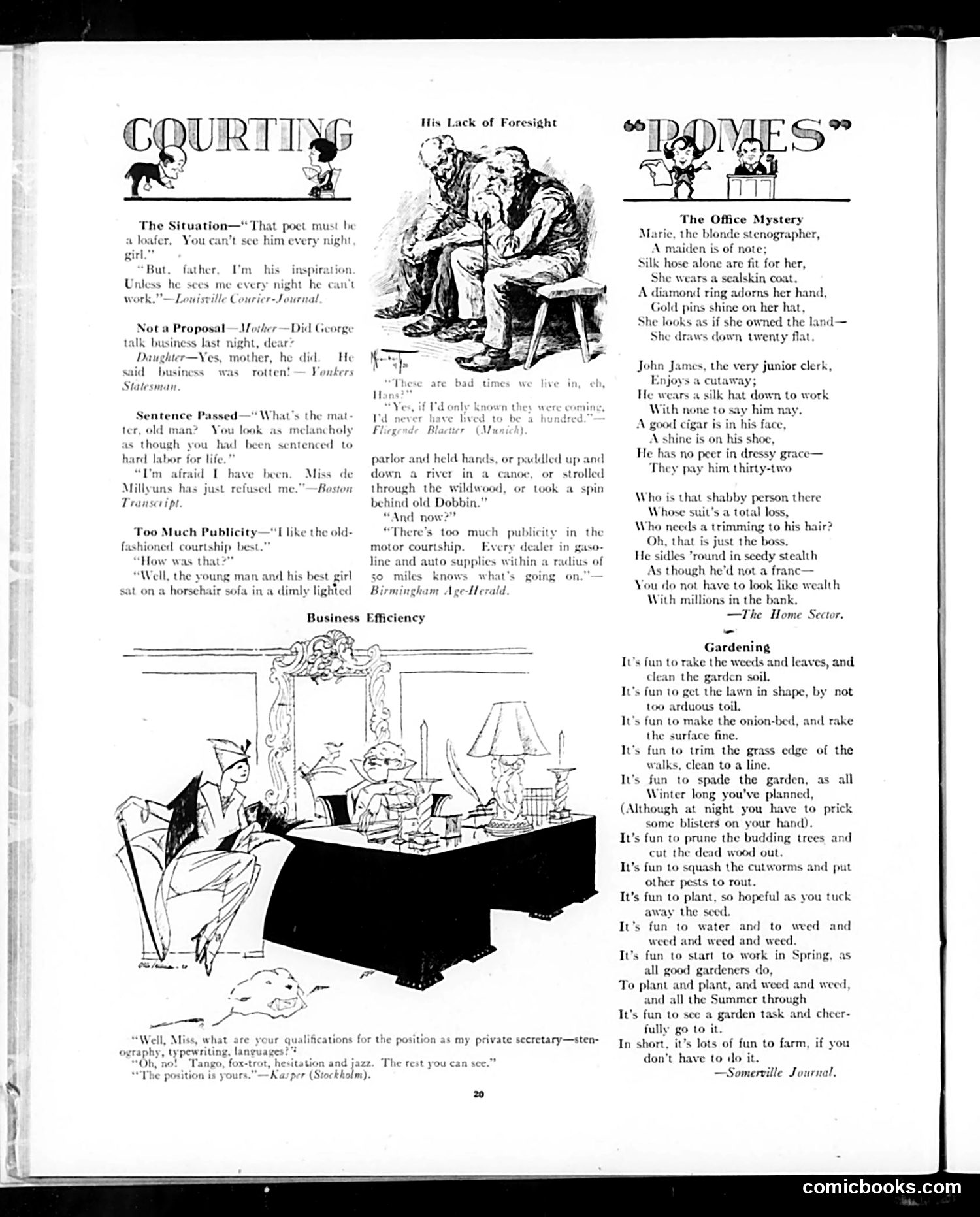
This page contains several short humorous anecdotes satirizing early 20th-century social customs and class anxieties. **"The Situation"** mocks bohemian artist pretension—a poet claims he needs nightly visits from his girlfriend for "inspiration," a transparent excuse for constant courting. **"Not a Proposal"** jokes about economic anxiety: a suitor discusses only how "business was rotten," disappointing a mother hoping for an engagement announcement. **"Too Much Publicity"** contrasts old-fashioned private courtship with modern motor-car dating, where auto dealers and gasoline retailers observe every outing—satirizing how automobiles eroded social privacy. **"Business Efficiency"** cartoons a secretary applicant listing only stenographic skills while a boss figure sits beneath the desk, suggesting office chaos or incompetence. **"The Office Mystery"** contrasts a well-dressed stenographer earning "$20 flat" with a fashionable junior clerk earning $32, yet the millionaire boss dresses shabbily—satire on wealth not requiring appearance. **"Gardening"** ironically catalogs gardening's "fun" while emphasizing the labor involved, concluding it's only enjoyable if you don't actually have to do it.
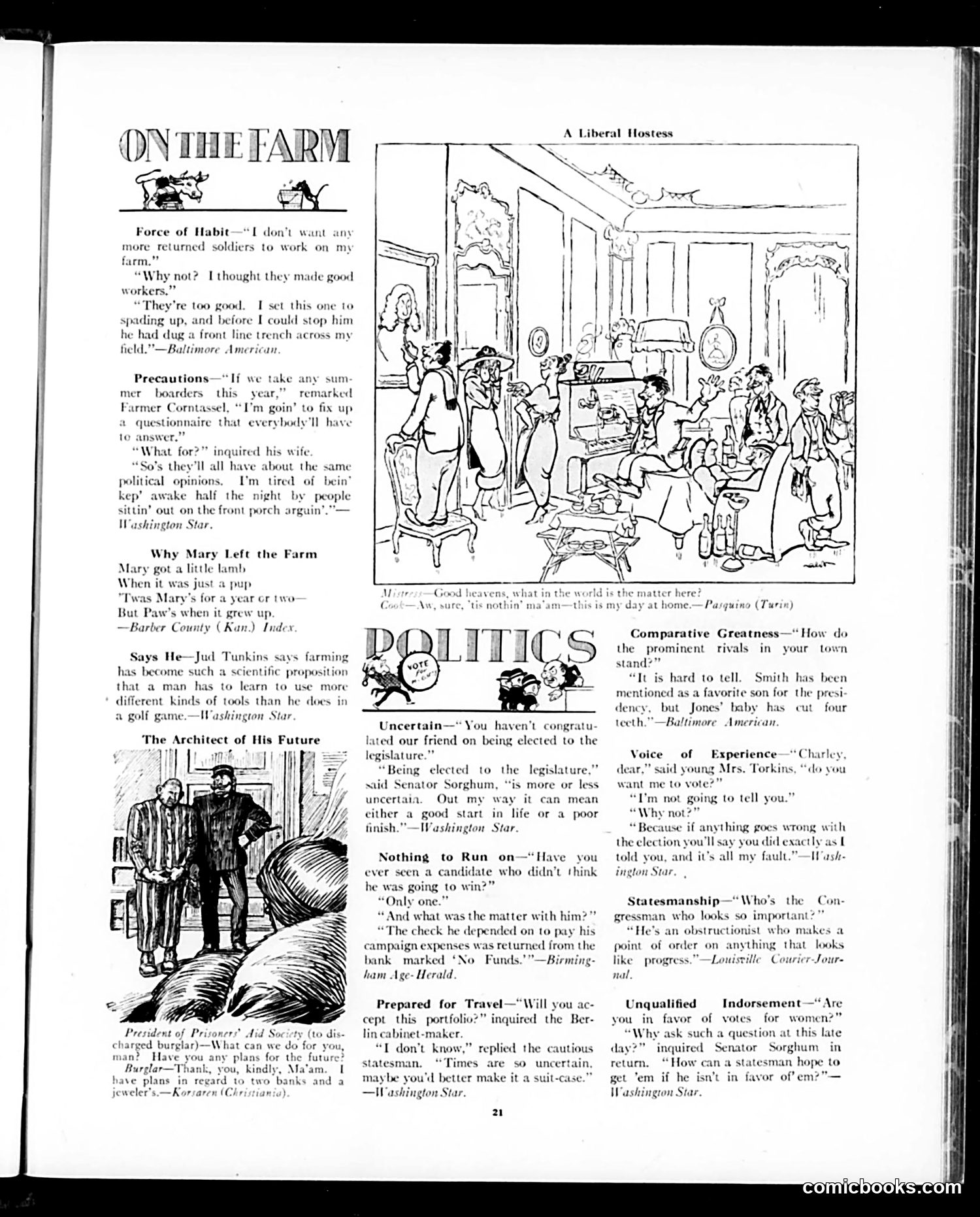
This page contains multiple brief satirical quips rather than developed political cartoons. The humor targets early 20th-century American social and political concerns: **WWI Reference**: "Force of Habit" jokes about returned soldiers unable to stop military behaviors—digging trenches on farms—reflecting post-WWI readjustment anxieties. **Political Satire**: Several quips mock politicians' opportunism and inconsistency. "Unqualified Indorsement" portrays Senator Sorghum cynically supporting women's suffrage only to secure votes, not from principle. "Nothing to Run On" implies candidates lack funding or substance. **Social Commentary**: "Comparative Greatness" mocks small-town status competitions. "Why Mary Left the Farm" suggests rural exodus. "Precautions" satirizes polarized dinner-table arguments over politics. **General Themes**: The page emphasizes politicians' hypocrisy, uncertainty about social change (women's voting, mechanized farming), and the gap between public rhetoric and private self-interest—characteristic Judge satire of the era.
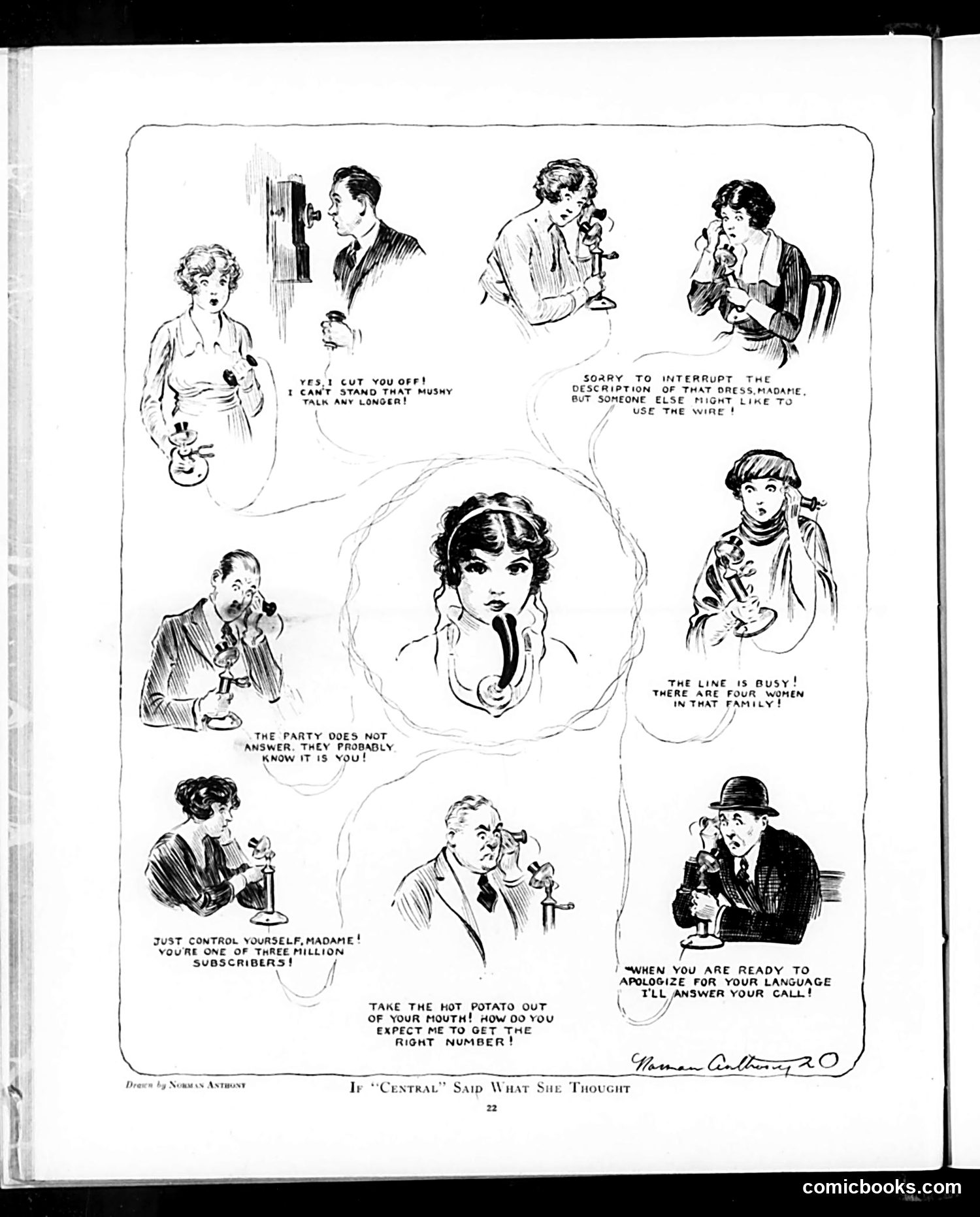
This satirical cartoon mocks the frustrations of early telephone service, specifically party lines—shared telephone lines serving multiple households. The central character represents a telephone operator at the "Central" exchange who must connect calls. The joke presents what the operator is *thinking* but cannot say to callers, who complain about busy lines, interruptions, and slow connections. Her silent frustrations include: subscribers monopolizing the line with gossip, callers using profanity, families with multiple women tying up shared lines, and people not recognizing their own number. The satire targets both the limitations of early telephone infrastructure and the social behaviors it enabled—particularly middle-class women's use of phones for extended social conversation. The operator's unspoken barbs reveal class and gender tensions underlying this new communication technology, where shared resources bred resentment among users and frustrated service workers.
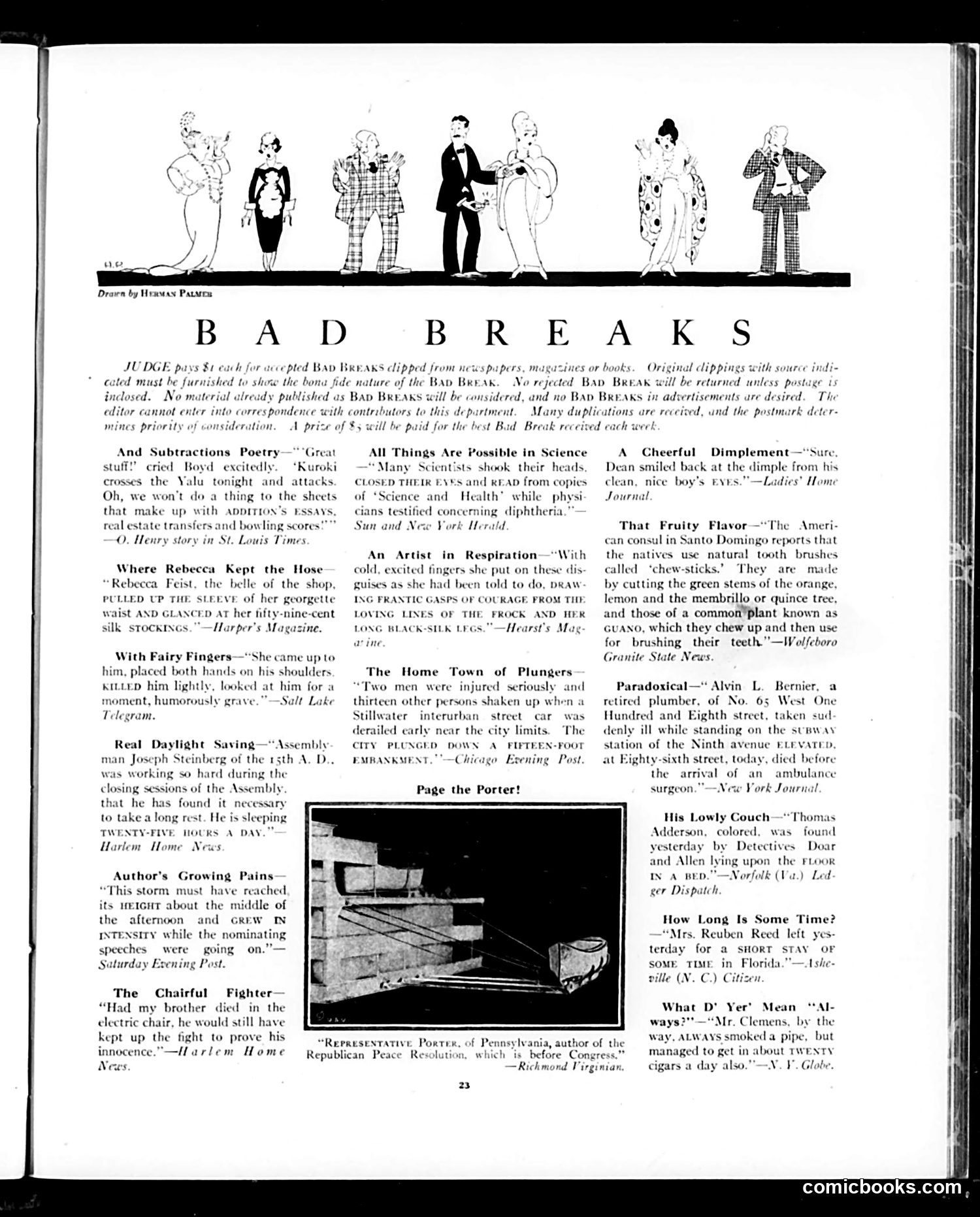
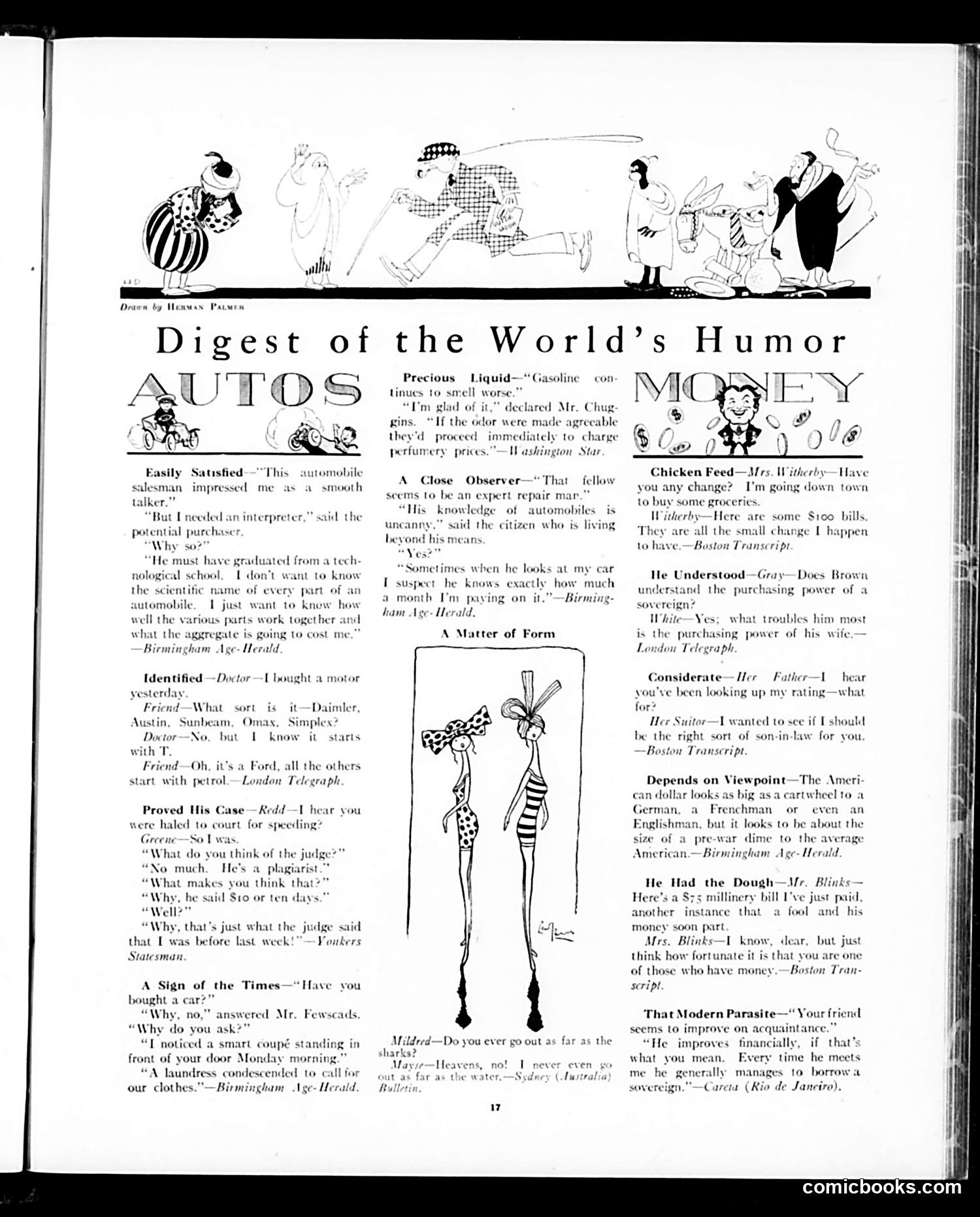
This is a **humor submission section** from *Judge* magazine. The page header explains the concept: *Judge* pays $1 each for "bad breaks"—unintentionally funny or absurd passages clipped from newspapers, magazines, and books. The seven illustrated figures at top represent comedic character types, drawn by Heynas Palmer. Below are brief examples of submitted "bad breaks," mostly contradictions or illogical phrasings: - "Real Daylight Saving": A politician sleeping 25 hours daily - "And Subtractions Poetry": A poem describing military action written matter-of-factly - "The Chairful Fighter": A quote so oddly phrased it becomes comical - "Paradoxical": A man dying on a subway platform before an ambulance arrives The humor relies on readers recognizing journalistic **awkward wording, logical absurdities, or unintended double meanings** in published writing. This was a popular feature encouraging reader participation—essentially crowdsourcing comedy by highlighting bad editing or unfortunate phrasing in contemporary media.
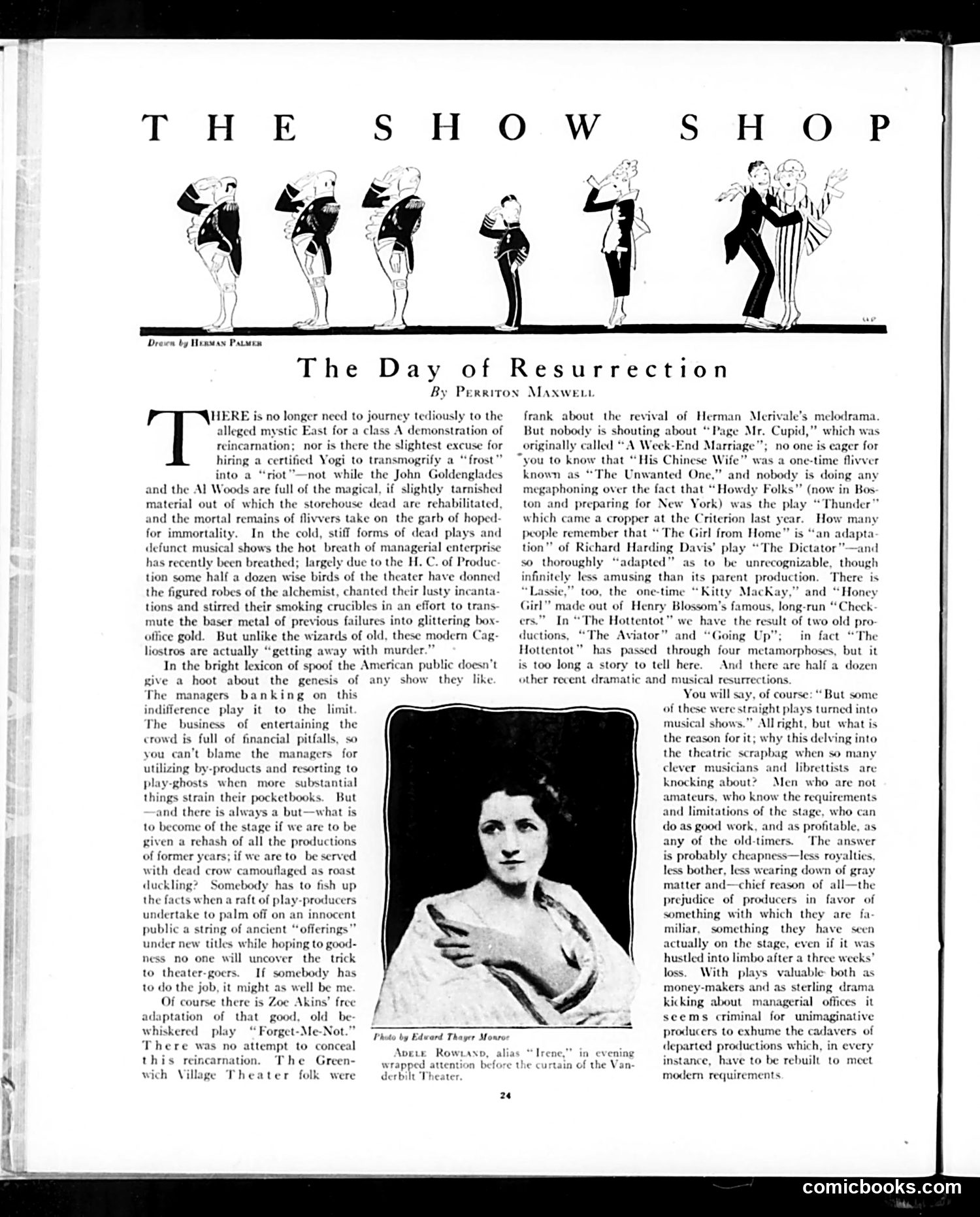
This article by Perriton Maxwell critiques Broadway's practice of reviving and recycling failed plays and musicals as "new" productions. The cartoon at top (drawn by Herman Palmer) shows six theatrical figures in progressive states of decay, illustrating the concept of resurrecting dead material. Maxwell argues that producers like John Golden and Al Woods are repackaging old failures under new titles to deceive audiences—renaming "The Unwanted One" as "His Chinese Wife," or combining two failed shows into "The Hottentot." He sarcastically notes managers get away with this because audiences don't investigate a show's origins. The satire's point: Broadway is intellectually lazy and cheap, recycling theatrical "corpses" rather than investing in original work or commissioning competent new writers. The real scandal isn't deception itself, but that producers prioritize cost-cutting over quality and artistic integrity.
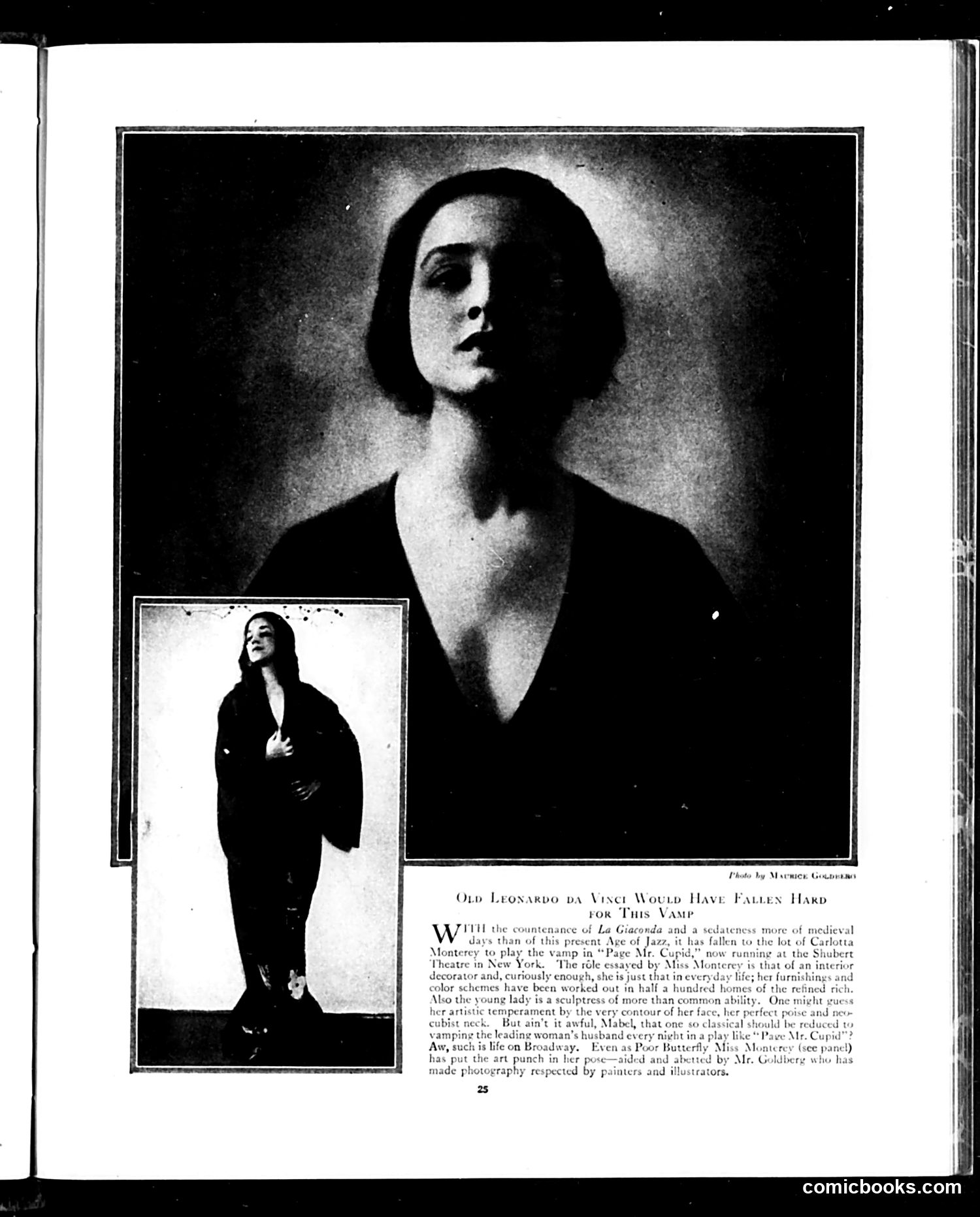
This page features **Mabel Monterey**, an actress playing a vampire role in the Broadway production "Page Mr. Cupid" at the Shubert Theatre in New York. The satire's title—"Old Leonardo da Vinci Would Have Fallen Hard for This Vamp"—compares Monterey's theatrical vampire character to Renaissance artistic ideals. The joke plays on "vamp" (both theatrical seductress and vampire), suggesting her beauty and mysterious pose would have captivated the Renaissance master painter. The photographs showcase her in character: the larger portrait emphasizes her pale, dramatic appearance and sculptural face; the smaller image shows her in full vampire costume. The text praises her "artistic temperament" and "perfect pose," while the overall layout celebrates her as both a serious actress and artistic subject worthy of painters' attention. This reflects 1920s Jazz Age fascination with theatrical horror roles and the glamorization of vampire characters in popular entertainment.
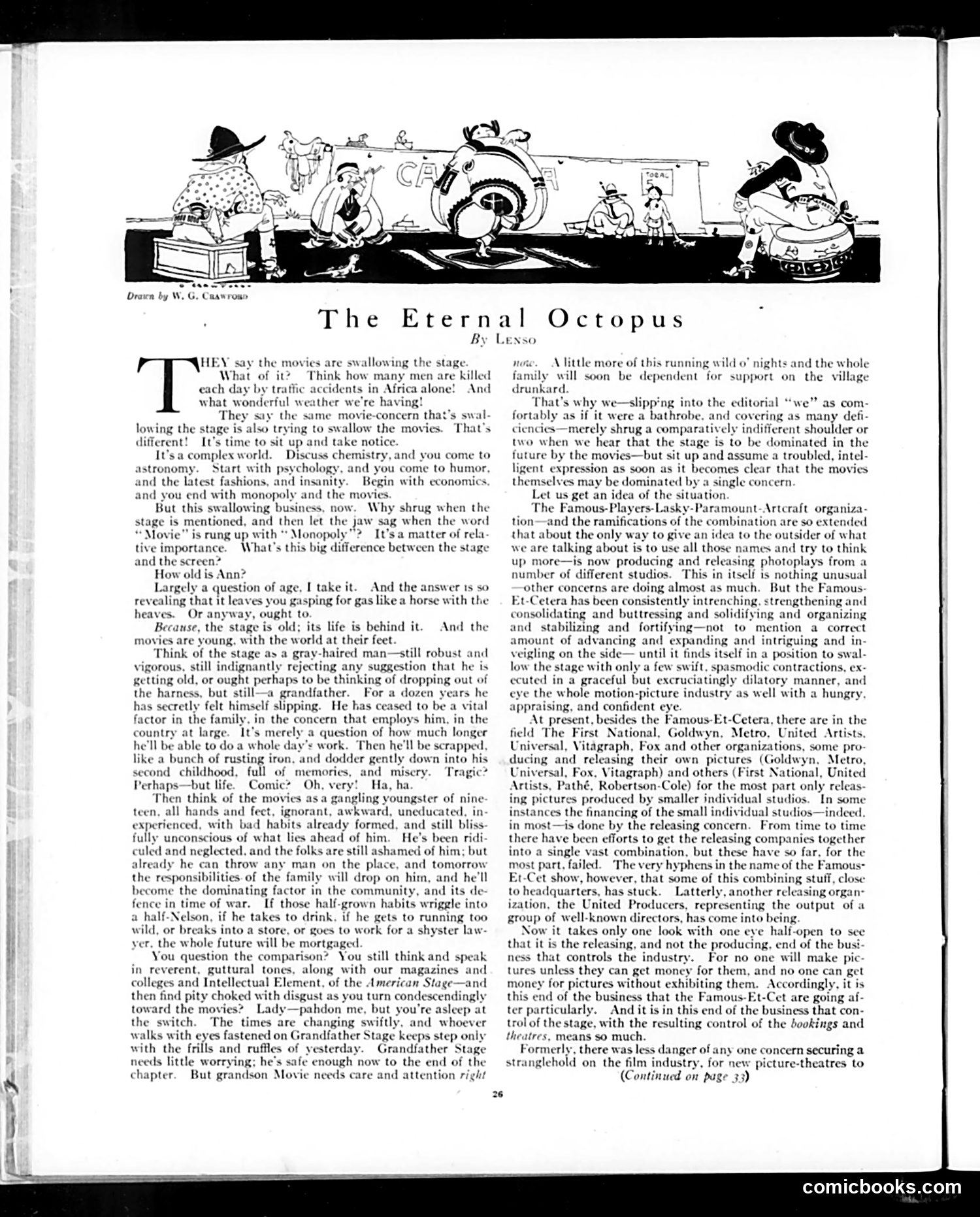
The cartoon (drawn by W.G. Cawford) depicts what appears to be a film studio or production facility with various characters and equipment, illustrating the article's theme about corporate consolidation in entertainment. The article argues that movie monopolies absorbing both theatrical stages and film production are the real concern—not merely that movies compete with theater. Using a generational metaphor, the author compares the theatrical stage to an aging grandfather figure losing relevance, while movies represent a reckless, undisciplined teenager gaining power. The satire criticizes both the cultural establishment's reverent attitude toward "the American Stage" and the film industry's uncontrolled expansion. The piece warns that if this young monopoly ("grandson Movie") continues its "running wild"—unregulated corporate consolidation—it will harm the entire entertainment family's future. The author advocates for regulatory attention to prevent corporate overreach, not nostalgic defense of theater against film competition.
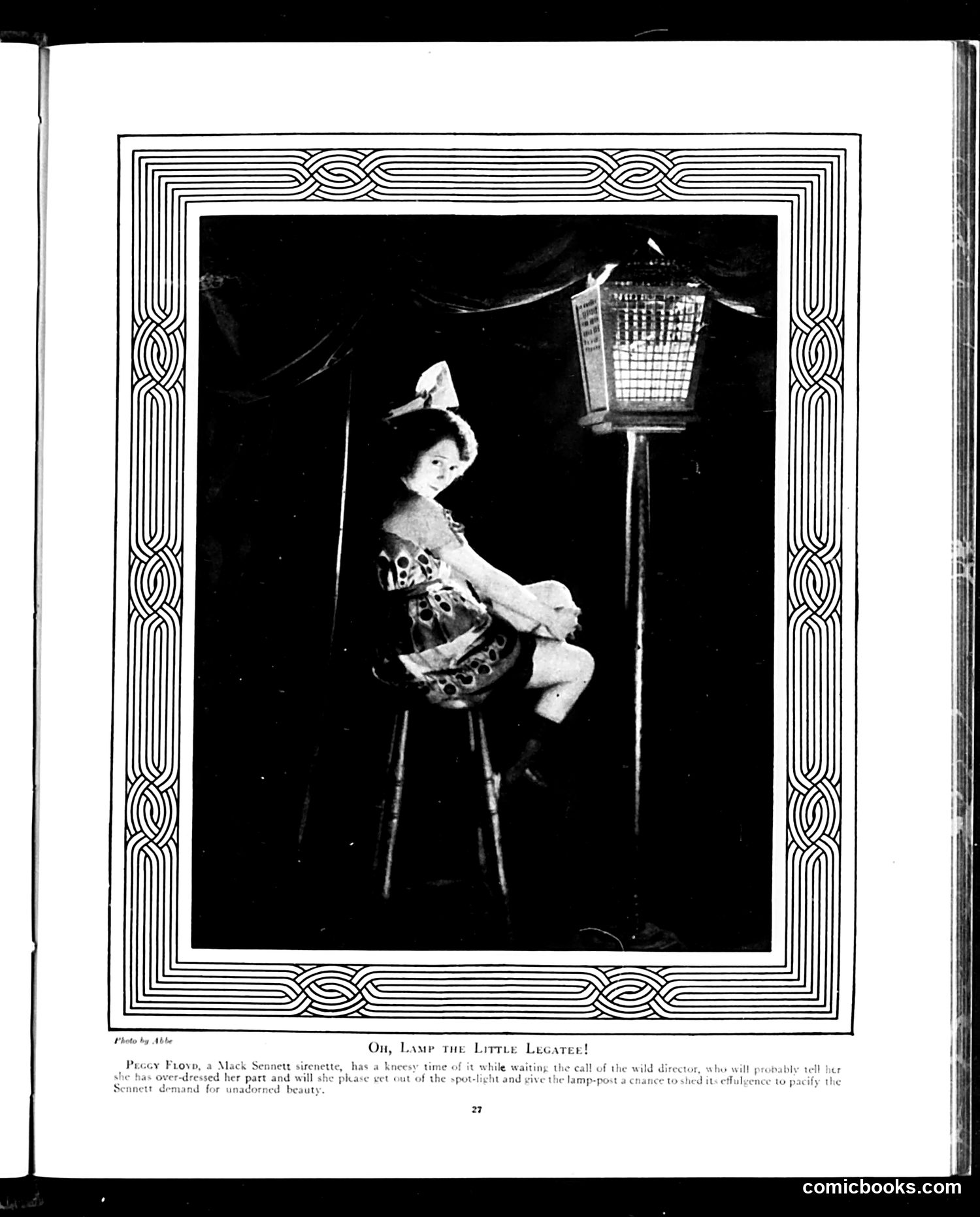
This page features a photograph (credited to Abe) showing **Peggy Floyd**, described as "a Mack Sennett sirene," sitting under studio lighting equipment. The caption's humor plays on her predicament: she's "waiting the call of the wild director" while overdressed in her part, hoping to escape the spotlight and obtain "a chance to shed it, effulgence to pacify the Bennett-demand for undoubted beauty." The satire mocks **Hollywood's film industry conventions**—specifically the exploitative nature of studio system casting. Sennett's comedies were known for featuring attractive women in absurd situations. The joke suggests the actress is trapped under harsh studio lights, ironically needing to remove her "effulgence" (radiance) rather than display it, highlighting the uncomfortable conditions and unrealistic demands placed on performers in early cinema.
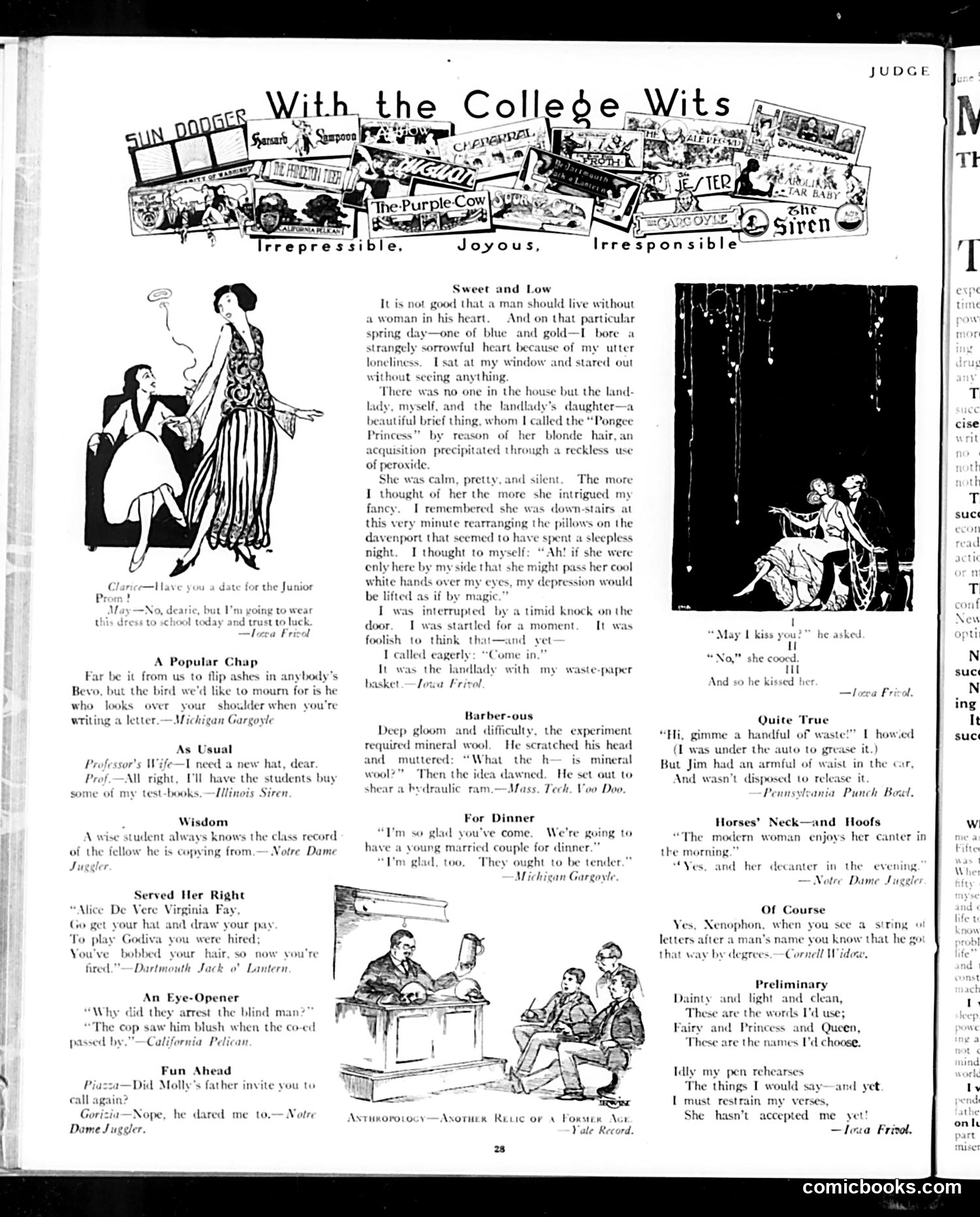
This page collects humorous short pieces and jokes from various college humor magazines of the era (likely 1920s, based on references to bobbed hair and "Bevo" beer). The main narrative, "Sweet and Low," depicts a lovelorn man whose melancholy is interrupted by a landlady's daughter—a blonde presented as attractive but somewhat frivolous. The piece plays on romantic cliché: his fantasy of her comfort contrasts with the mundane reality (she's carrying a wastebasket). Surrounding jokes target college life stereotypes: professors exploiting students, young wives wanting luxuries, women's bobbed hair as grounds for dismissal, and unsuccessful courtship. The humor relies on period-specific social anxieties—particularly around changing women's roles and appearance. "Horses' Neck—and Hoofs" appears to contain a risqué double-entendre about a woman's "waist" that a man won't "release." Overall, this reflects early 20th-century collegiate humor: romanticism mixed with mild social satire and gender-based comedy now reading as dated.
This page is primarily **advertising disguised as editorial content**—a common practice in early 20th-century magazines. The central "article" promoting a mysterious "Subtle Principle of Success" is actually a **mail-order scam advertisement** by Alois P. Swoboda. The pitch claims an effortless path to wealth requiring "no education," "no study," and "no conscious deep breathing"—red flags for fraud. The long list of historical and contemporary figures (Moses, Caesar, Napoleon, Theodore Roosevelt, J.P. Morgan, etc.) falsely implies they used this "principle," lending fake legitimacy. The notice at bottom warns the price will double soon—a classic pressure tactic. This exemplifies **early 20th-century consumer gullibility**, when such schemes proliferated in magazines. The fact that *Judge*—a satirical publication—ran this unironically reflects how normalized such dubious advertising had become, or possibly satirizes readers' susceptibility to get-rich-quick promises.
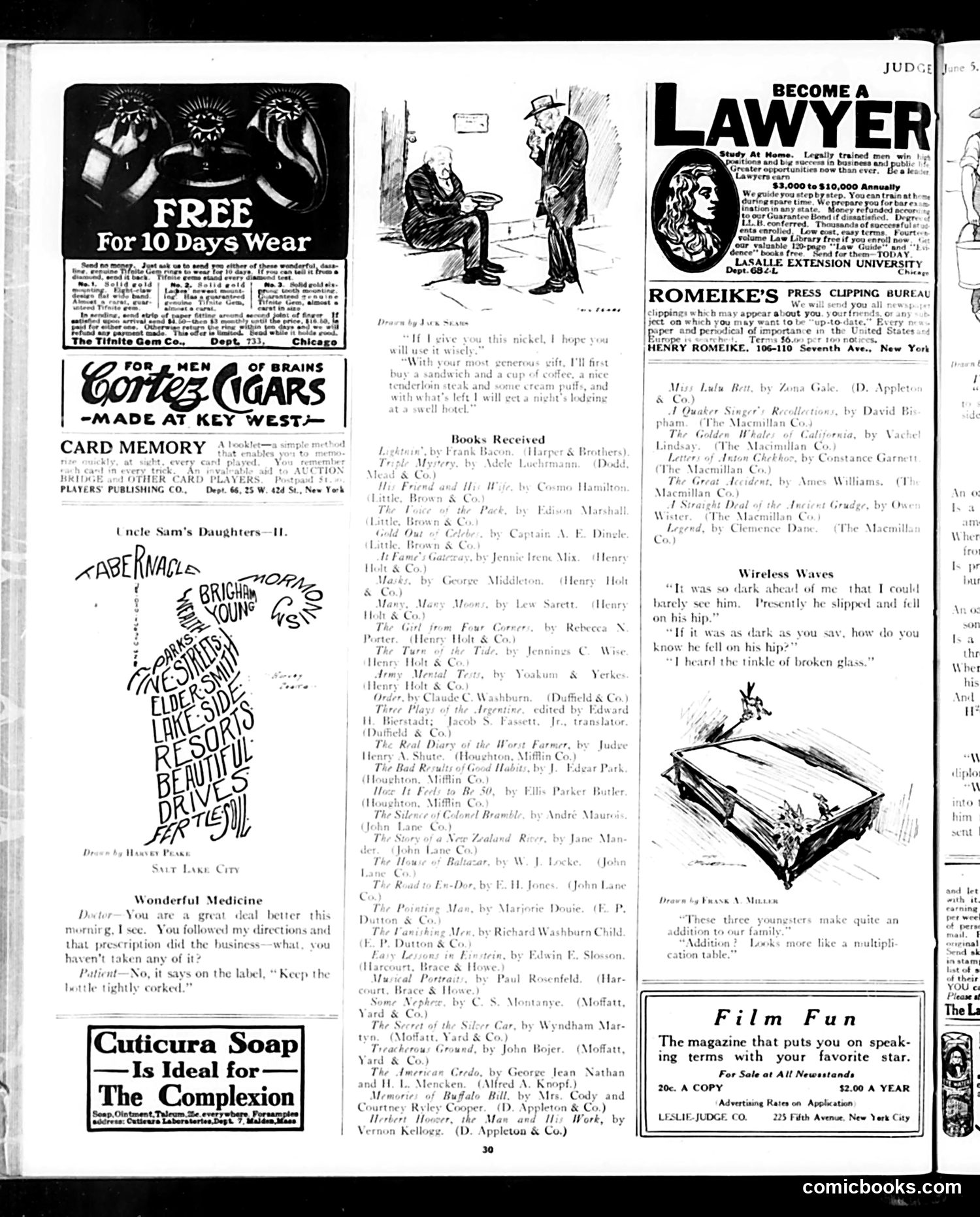
This page is primarily **advertising and book notices**, not political satire. The main content includes: **Advertisements:** Cuticura Soap, Cortez Cigars, a card memory game, and LaSalle Extension University promoting legal training as a path to $3,000-$10,000 annually. **The cartoon "Uncle Sam's Daughters—II"** (bottom left) appears to be a humorous narrative or social commentary, though the full context is unclear from this fragment alone. **"Wireless Waves"** is a dialogue joke about a couple in darkness, where the woman mentions hearing "broken glass"—apparently a sexual innuendo about the man's performance. **Books Received** is a standard literary review section listing contemporary publications. The page reflects early 20th-century commercial culture: career advancement through correspondence schools, consumer products marketed to middle-class readers, and light humor about courtship and romance. Without additional context, specific satirical targets remain unclear.
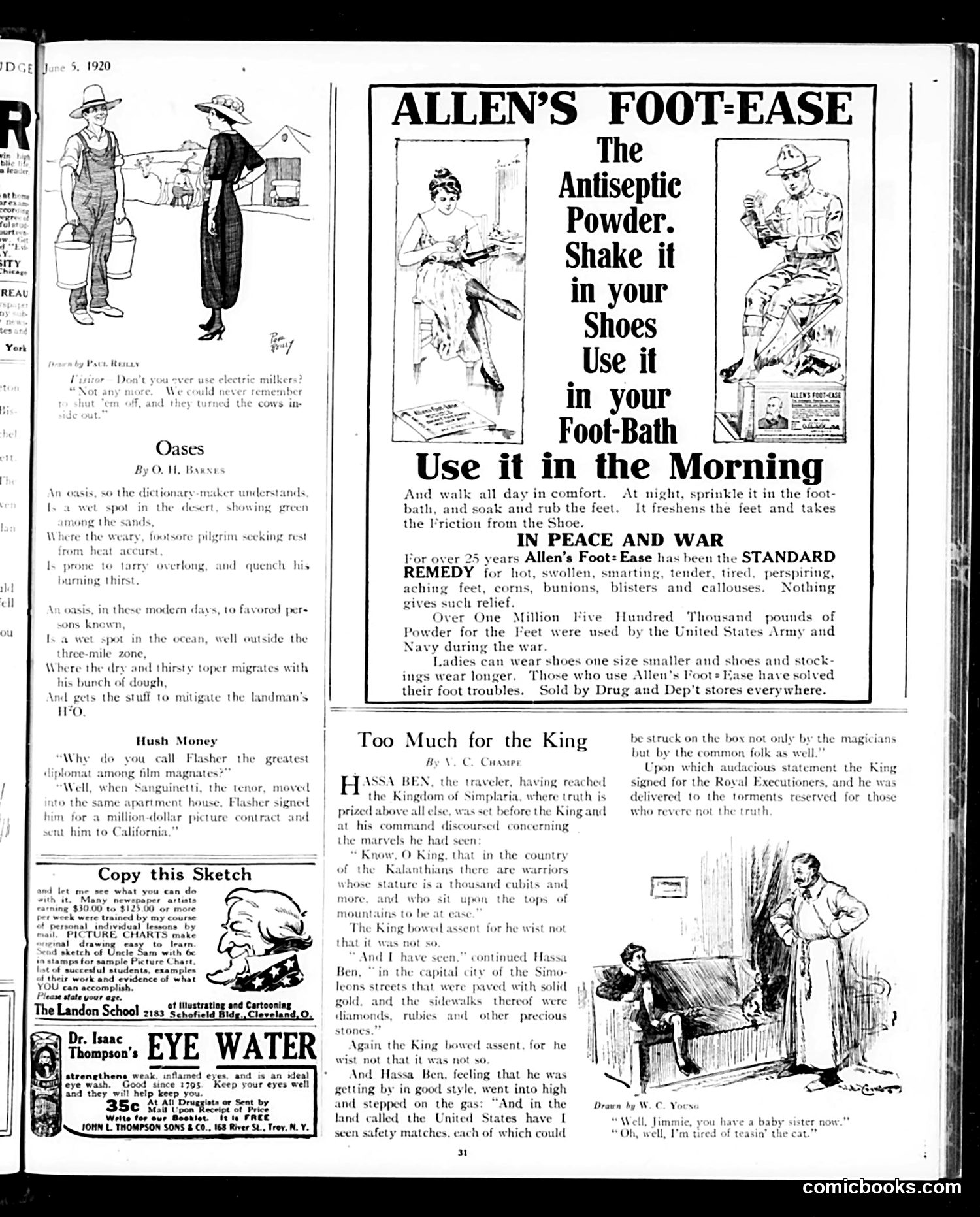
This page contains primarily **advertisements and unrelated content** rather than political satire. The dominant feature is a large **Allen's Foot-Ease powder advertisement**, marketed as an antiseptic foot remedy. It notably emphasizes that "Over One Million Five Hundred Thousand pounds of Powder for the Feet were used by the United States Army and Navy during the war"—a post-WWI appeal to patriotic consumers and soldiers' foot comfort needs. Below that is a brief satirical story titled **"Too Much for the King"** by V.C. Chubb, a fable-like tale about a traveling merchant (Hassa Ben) in the fictional kingdom of Simplaria who tells tall tales to a king about paved-gold cities. The king, unable to distinguish truth from lies, ultimately executes him—a moral commentary on gullibility and the dangers of uncritical belief. The page also includes minor content: poetry snippets ("Oases," "Hush Money") and educational advertisements (art instruction, eye water). The overall page reflects 1920 commercial magazine content blending advertising with lightweight literary humor rather than sharp political commentary.
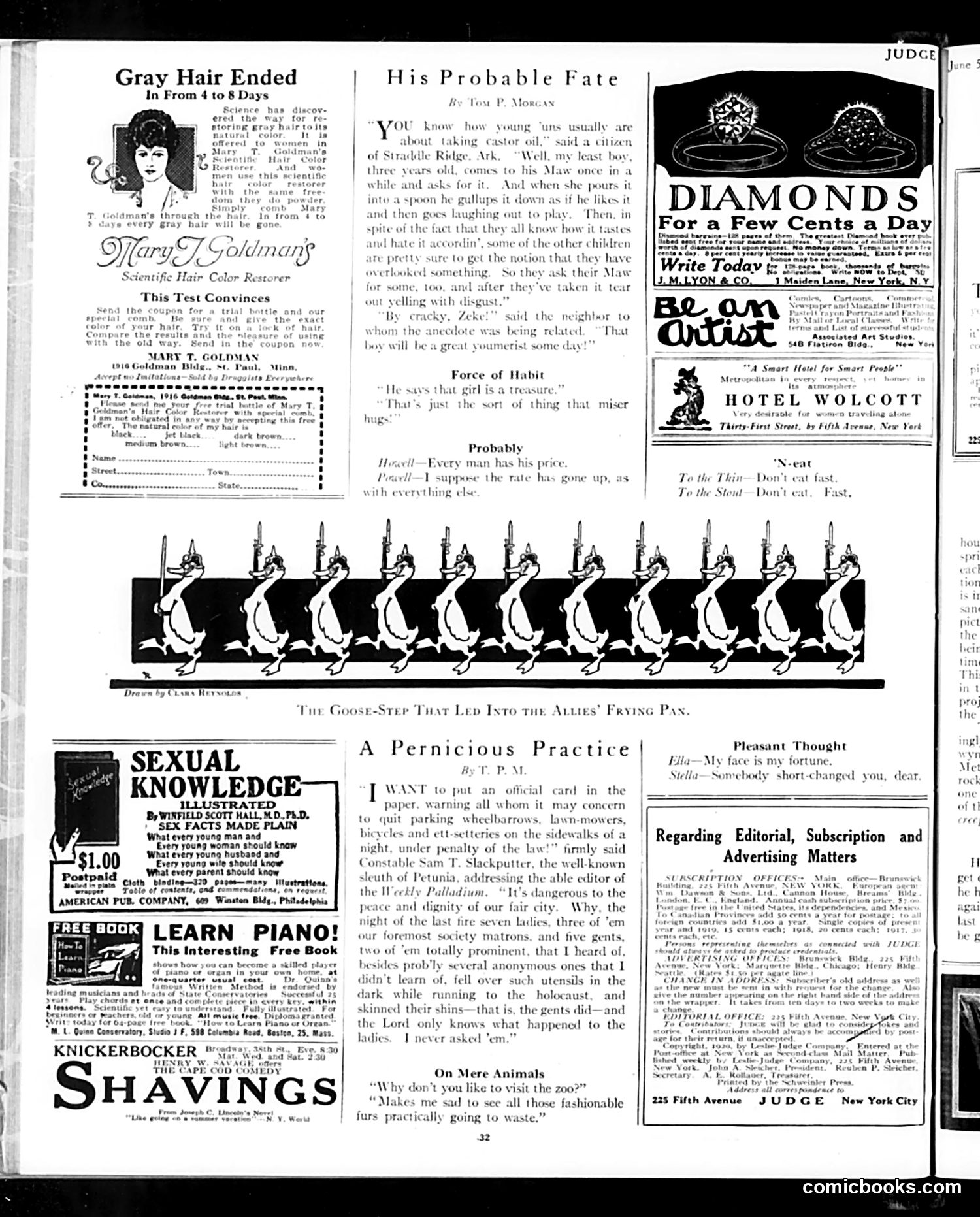
This page from Judge magazine contains several satirical pieces typical of early 20th-century American humor: **Main Cartoon**: "The Goose-Step That Led Into the Allies' Frying Pan" depicts geese marching in military formation—a visual metaphor likely mocking German military discipline and its ultimate defeat during World War I. The geese are "stepping" toward destruction, suggesting the futility of aggressive military posturing. **Text Pieces**: Short humorous stories mock everyday American life—a father giving castor oil to a resistant child, a constable complaining about sidewalk obstructions causing injuries during a fire, and a socialite's obsession with furs at the zoo. **Advertisements**: The page heavily features period remedies (hair color restorer, sexual education books) and jewelry ads, reflecting common consumer products and anxieties of the era. The satire targets German militarism and contemporary American social pretensions and domestic absurdities.
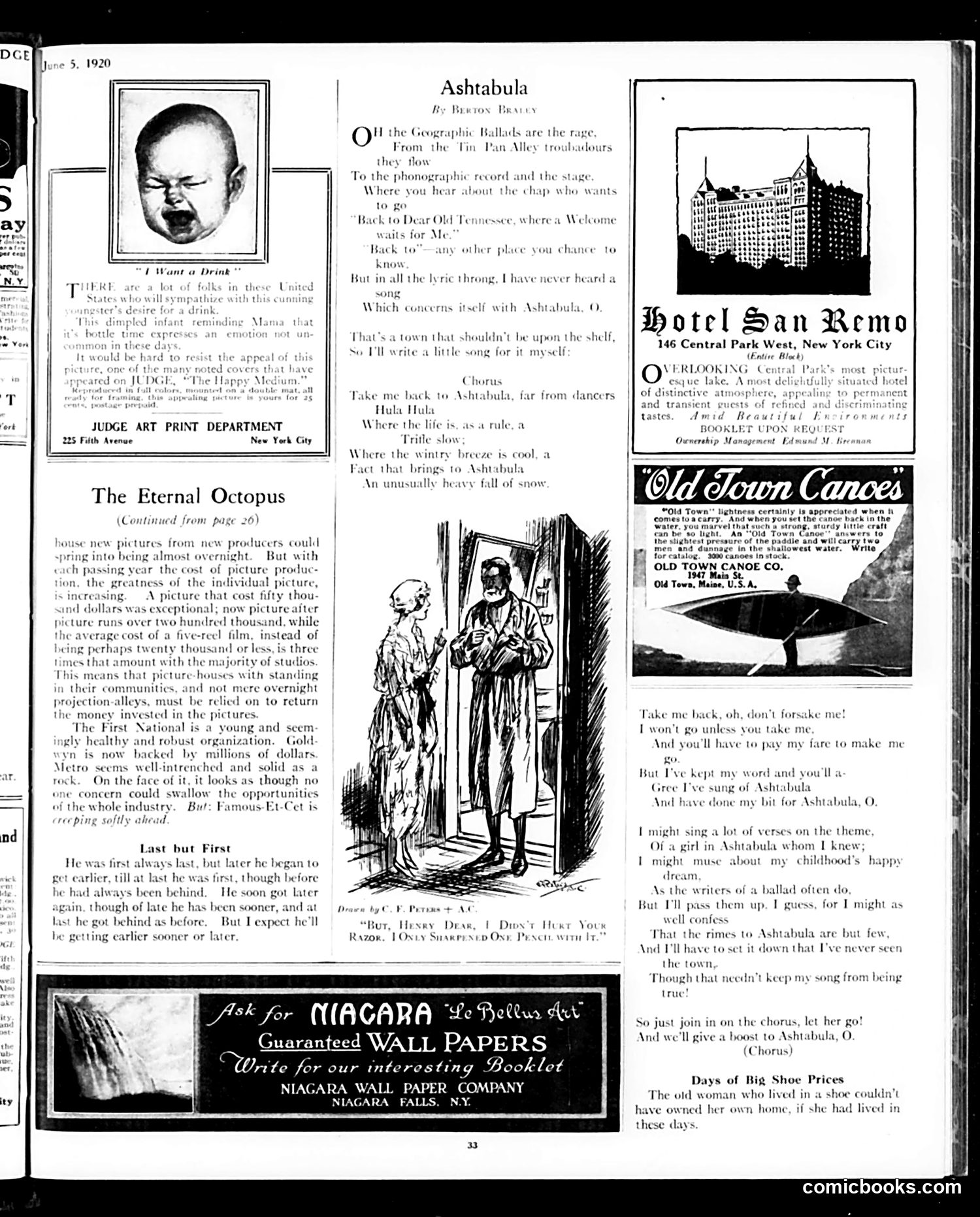
This page features a song by Bryon Hersey celebrating the town of Ashtabula, Ohio. The satire targets the popular "geographic ballad" genre—sentimental songs about American towns and cities that dominated commercial music and phonograph records of the era. Hersey's point: despite countless songs praising places like Tennessee and exotic destinations, *no one* has written about Ashtabula, despite its merits (cool winters, snow, slow-paced life). The joke mocks both the formula of these ballads and Ashtabula's relative obscurity—suggesting that even minor American towns deserved commemoration in popular song. The accompanying sketch depicts two figures (likely representing the song's narrative), reinforcing the ballad's conversational tone about returning to this overlooked destination. It's gentle satire of Americana nostalgia and mass-market sentimentality.
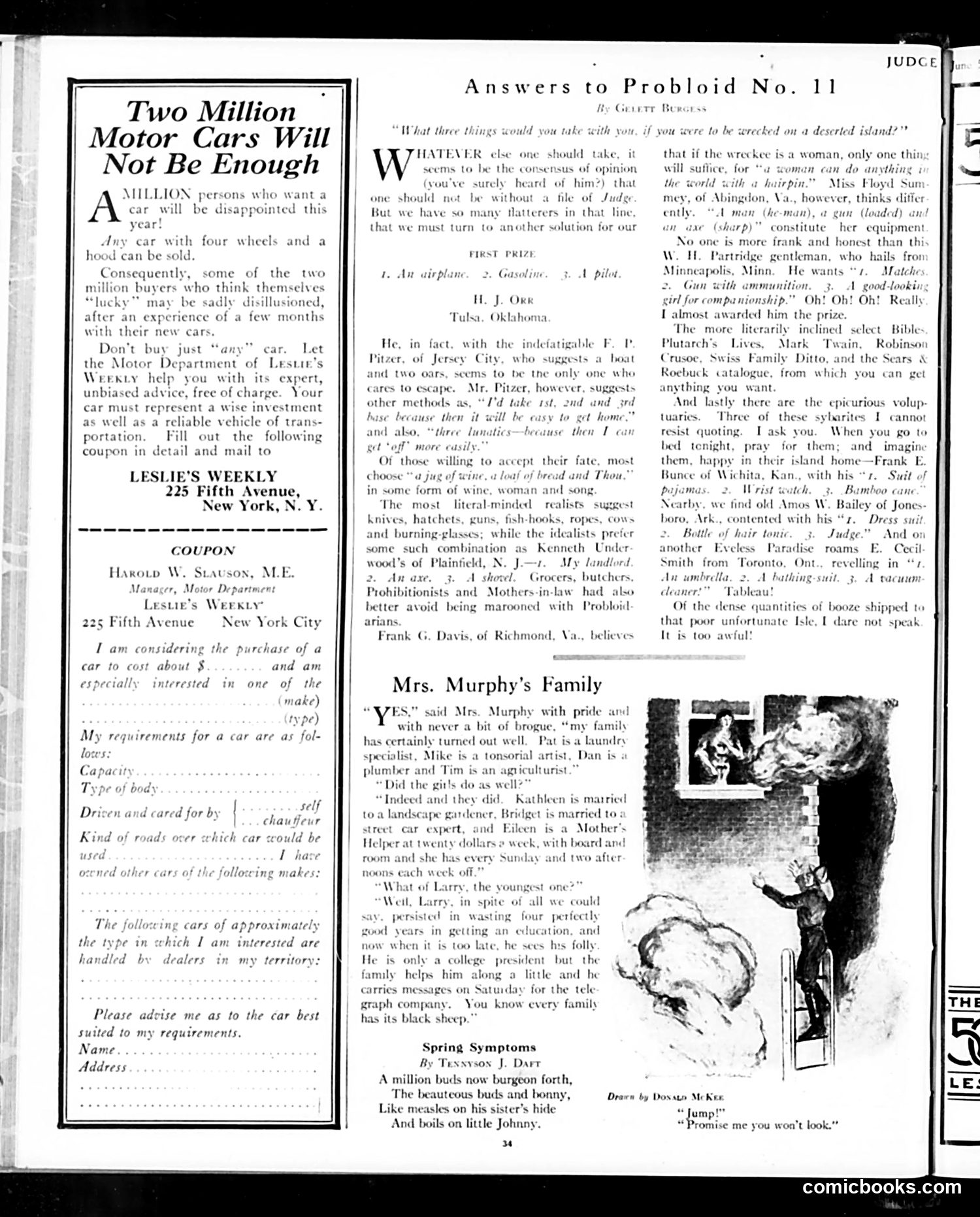
This page primarily consists of **advertising and reader content** rather than political satire. The main elements are: **Left side:** A Leslie's Weekly motor department coupon offering expert car-buying advice to readers considering purchasing one of the "two million motor cars" expected to flood the market—reflecting 1920s automobile boom anxieties. **Center:** "Answers to Probloyd No. 11," a humorous reader-submitted contest. The prompt asks what three items people would take if stranded on a deserted island. Responses range from practical (boat and oars, groceries, a gun) to absurd (wine, women, and song) to darkly comedic (suicide methods like ropes and hatchets). The satire gently mocks people's varying personalities through their desert-island choices. **Right side:** "Mrs. Murphy's Family," an ethnic-humor piece celebrating an Irish immigrant family's upward mobility—each child has respectable work. The youngest, Larry, is portrayed as the family's "black sheep" for pursuing education rather than working. **Bottom:** "Spring Symptoms," a brief humorous poem comparing spring buds to childhood ailments. The page reflects 1920s American preoccupations: consumerism, immigration success narratives, and gentle domestic humor.
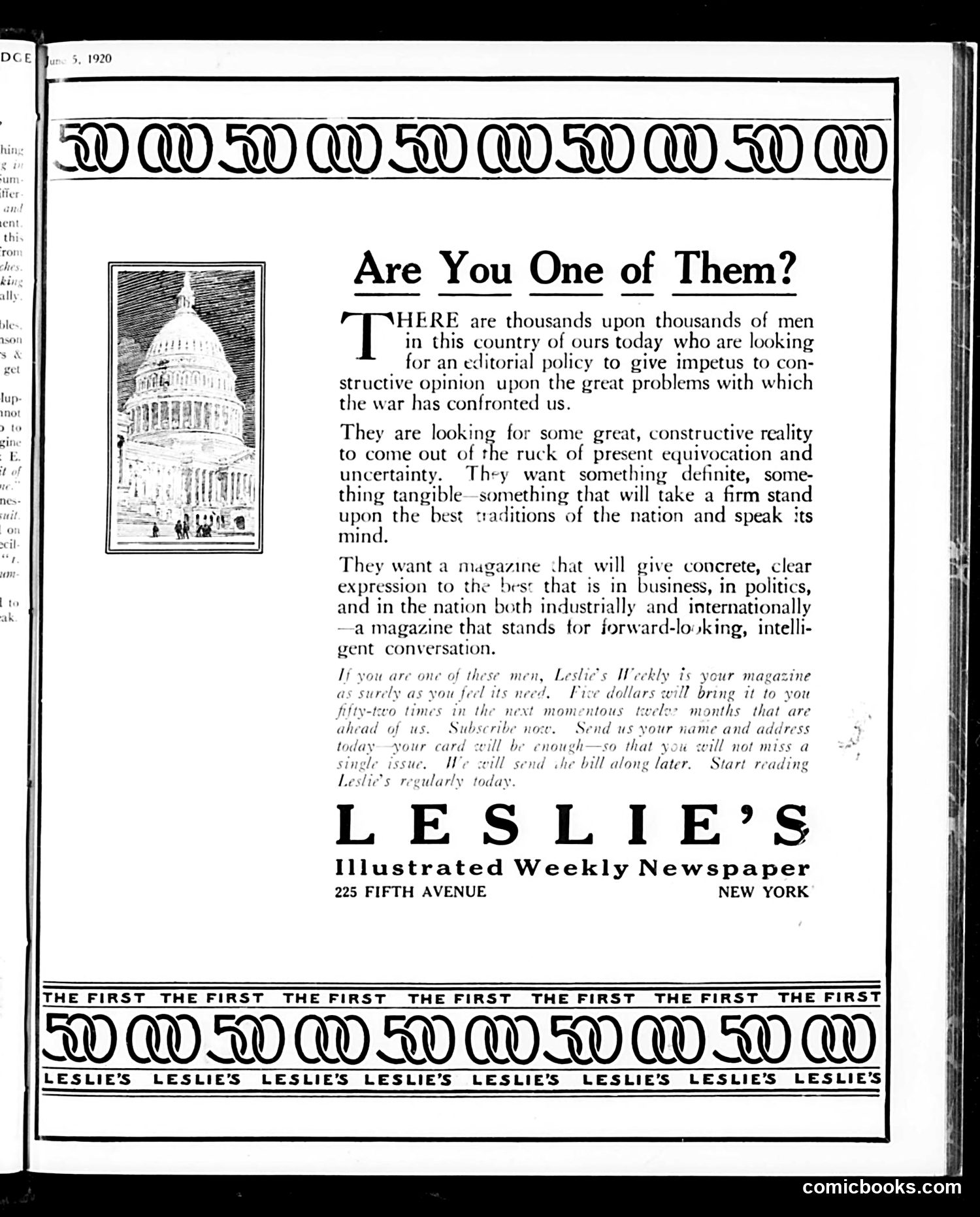
This is primarily a **subscription advertisement**, not a political cartoon. The page features the U.S. Capitol building and appeals to post-WWI readers seeking clarity on national direction. **Context:** Published June 5, 1920, just after World War I ended, the ad targets men unsettled by postwar uncertainty and "equivocation." It promises that Leslie's Weekly magazine offers "constructive opinion" on major national problems—positioning the publication as providing definitive answers where government and media apparently offered confusion. **The pitch:** For five dollars, readers receive 52 issues over the coming months. The ad emphasizes Leslie's would deliver "concrete, clear expression" on business, politics, and national affairs through "forward-looking, intelligent conversation." **Satire/irony:** The repetitive decorative borders and emphatic language ("THE FIRST") suggest the magazine's confident tone during a period of genuine postwar anxiety—though modern readers might note the somewhat overwrought sales approach to what is essentially journalism.

This page is primarily a **cigarette advertisement**, not political satire. It promotes Murad brand Turkish cigarettes to Judge magazine's readers. The ad argues that Turkish tobacco represents superior quality and justifies premium pricing (20¢). The decorative Ottoman-style medallion at top reinforces the "Turkish" branding. The copy uses a exclusivity appeal: Turkish tobacco is "the best...grown on earth," and because quality is inherently costly, Murad's higher price proves its superiority—"the more Turkish of superior quality used, the better the cigarette." The phrase "Judge for yourself—!" invites readers to test the product themselves. The packaged cigarettes pictured show the product alongside marketing claims about purity and grade. There is no detectable political cartoon or satire here. This reflects early 20th-century marketing practices and cigarette advertising conventions before health warnings became standard.