
Judge, 1920-06-05 · page 11 of 36
Judge — June 5, 1920 — page 11: what you’re looking at
What you’re looking at
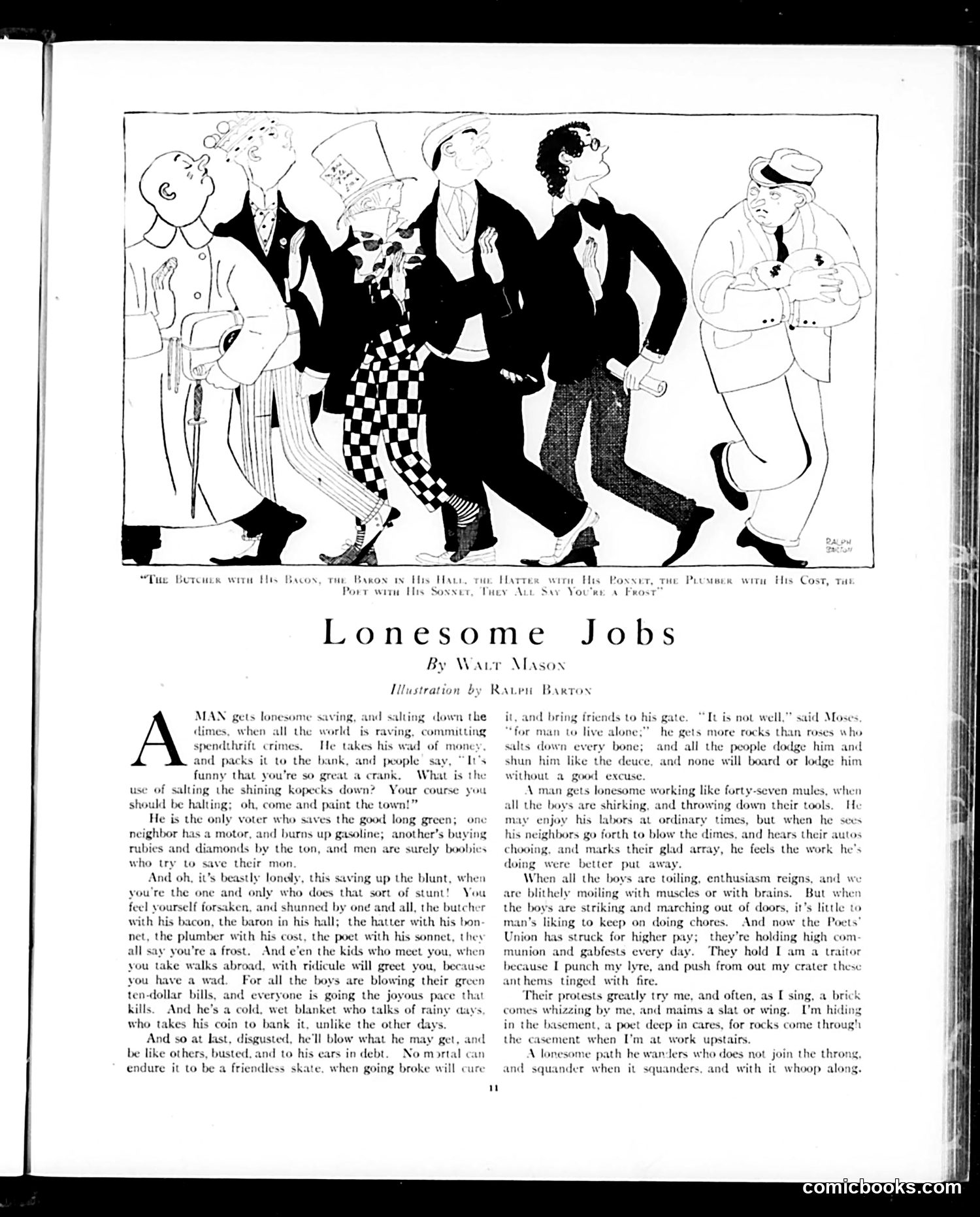
This satirical piece critiques American social conformity and peer pressure through the story of men who deviate from crowd behavior. The illustration depicts various tradesmen and professionals (butcher, baron, hatter, plumber, poet) who ostracize the virtuous protagonist. **The satire's point:** Mason mocks how society punishes thrift, hard work, and restraint. A man who saves money instead of spending frivolously, or who continues working while others strike (notably referencing a Poets' Union strike), faces social rejection—literally shunned by his community and tradespeople. **The joke:** The title is ironic. These aren't truly "lonesome jobs" but rather lonesome *choices*—being responsible and principled isolates you in a culture of reckless spending and mob mentality. The poem suggests that virtue makes you a "frost" (social outcast), yet vice leads to financial ruin anyway. It's commentary on American consumerism and herd behavior during an era of labor unrest and economic uncertainty.
📄 Transcribed text from this page (OCR, searchable)
Machine-transcribed from the original scan — historical spelling and the odd misread are preserved.
Hau Sonxet SaKON IN His yey wirnt Ets “Tue Butcurk wren His Bacox, tie mn ru Hts THe Promwer wero Ets Your Poxxur, \ Frost fatter w Ait Sav Lonesome Jobs By War Mason Raven Hlustration MAN gets lonesome saving, and salting down the es. when all the world is raving, committing spendthrift crimes. He takes his wad of mone and packs it to the bank, and people’ say, “It” funny that you're so great a crank. What is t use of salting the shining kopecks down? Your course you should be halting; oh, come and paint the town!” He is the only voter who saves the good long green; one neighbor has a motor, and burns up gasoline; another’s buying y the ton, and men are surely boobies rubies and diamonds who try And oh, it’s beastly lonely, this saving up the blunt, when you're the one and only who does that sort of stunt! You feel yourself forsaken, and shunned by one and all, the butcher with his bacon, the baron in his hall; the hatter with his bon net, the plumber with his cost, the poet with his sonnet, they all say you're a frost. And e’en the kids who meet you, when you take walks abroad, with ridicule will greet you, because you have a wad. For all the boys are blowing their green ten-dollar bills, and everyone is going the joyous pace that kills. And he’s a cold, wet blanket who talks of rainy days. who takes his coin to bank it, unlike the other days. And so at last, disgusted, he'll blow what he may get, and be like others, busted, and to his ears ir No mortal can endure it to be a friendless skate. when going broke will cure to save their mon. n Barros it, and bring friends to his gate. “It is not well.” said 3 he gets more rocks than roses who salts down every bone; and all the people dodge him and like the deuce, and none will board or lodge him ‘for man to live alone,” shun him without a good excuse. \ man gets lonesome working like f all the boys are shirking, and throwing down their tools. may enjoy his labors at ordinary times, but when he his neighbors go forth to blow the dimes, and hears their aute chooi and marks their glad array, he feels the work he doing were better put , When all the boys are toiling, husiasm reigns, and we are blithely moiling with muscles or with brains. But when the boys are striking and marching out of doors, it’s little man’s liking to keep on doing chores. And now the Poets’ Union has struck for higher pa they’re holding high com munion and gabfests every day. They hold I am a traitor because I punch my lyre, and push from out my crater these anthems tinged with fire. Their protests greatly try me, and often, as [ sing, a brick comes whizzing by me, and maims a slat or wing. [’m hiding in the basement, a poet decp in cares, for rocks come throug! the casement when [’'m at work upstairs. \ lonesome path he wan-lers who does not join the th r when it squanders, and with it whoop alo rty-seven mules, when He aws and squan¢