
Judge, 1920-06-05 · page 26 of 36
Judge — June 5, 1920 — page 26: what you’re looking at
What you’re looking at
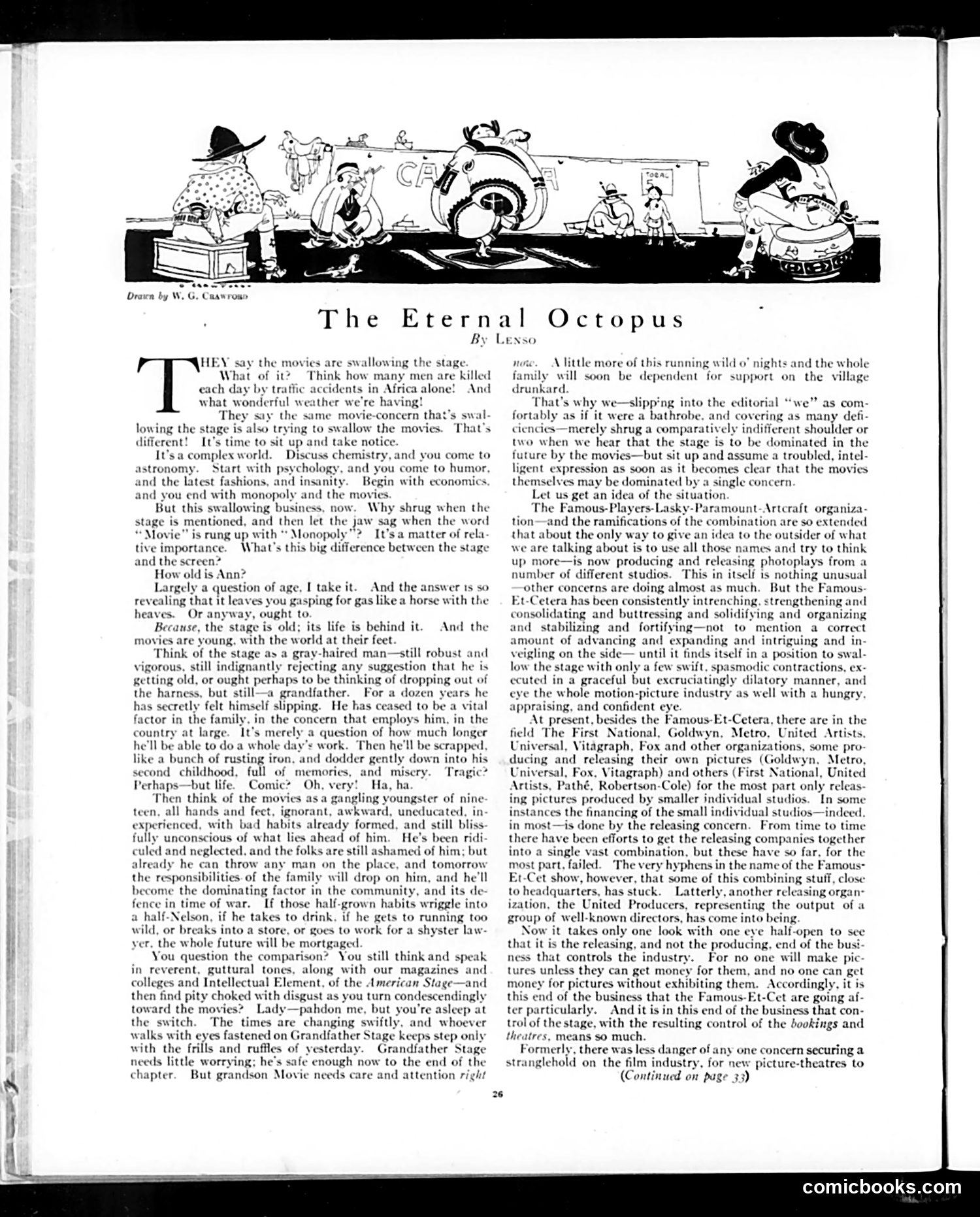
The cartoon (drawn by W.G. Cawford) depicts what appears to be a film studio or production facility with various characters and equipment, illustrating the article's theme about corporate consolidation in entertainment. The article argues that movie monopolies absorbing both theatrical stages and film production are the real concern—not merely that movies compete with theater. Using a generational metaphor, the author compares the theatrical stage to an aging grandfather figure losing relevance, while movies represent a reckless, undisciplined teenager gaining power. The satire criticizes both the cultural establishment's reverent attitude toward "the American Stage" and the film industry's uncontrolled expansion. The piece warns that if this young monopoly ("grandson Movie") continues its "running wild"—unregulated corporate consolidation—it will harm the entire entertainment family's future. The author advocates for regulatory attention to prevent corporate overreach, not nostalgic defense of theater against film competition.
📄 Transcribed text from this page (OCR, searchable)
Machine-transcribed from the original scan — historical spelling and the odd misread are preserved.
Drain by W. G. Caawroao The Etern HEY say the movies are swallowing the stage. What of it? Think how many men are killed each day by traffic accidents in Africa alone!) And what wonderful weather we're having! They say the same movie-concern that’s swal- lowing the stage is also trying to swallow the movies. That's different! It’s time to sit up and take notice. It’s a complex world. Discuss chemistry, and you come to astronomy. Start with psychology, and you come to humor, and the latest fashions, and insanity. Begin with economics. and you end with monopoly and the movies. But this swallowing business, now. Why shrug when the stage is mentioned, and then let the jaw sag when the wor “Movie” is rung up with “ Monopoly"? It’s a matter of rela tive importance. What's this big difference between the stage and the screen? How old is Ann? Largely a question of age, I take it. And the answer ts so revealing that it leaves you gasping for gas like a horse with the heaves. Or anyway, sught to. Because, the stage is old; its life is behind it. And the movies are young, with the world at their feet. Think of the stage as a gray-haired man—still robust and vigorous, still indignantly rejecting any suggestion that he is getting old, or ought perhaps to be thinking of dropping out of the harness, but still—a grandfather. For a dozen years he has secretly felt himself slipping. He has ceased to be a vital factor in the family. in the concern that employs him, in the country at large. It’s merely a question of how much longer he'll be able to do a whole day’s work. Then he'll be scrapped, like a bunch of rusting iron, and dodder gently down into his second childhood, full of memories, and misery. Tragic? ns—but life. Comic? Oh, very! Ha, ha hen think of the movies asa gangling youngster of nine teen, all hands and fect, ignorant, awkward, uneducated, in- experienced, with bad habits already formed, and still bliss. fully unconscious of what lies ahead of him. He's been ridi culed and neglected, and the folks are still ashamed of him; but already he can throw any man on the place, and tomorrow the responsibilities. of the family will drop on him, and he'll become the dominating factor in the community, and its de fence in time of war. If those half-grown habits wriggle into a half-Nelson, if he takes to drink. if he gets to running too wild, or breaks into a store, or goes to work for a shyster law- yer, the whole future will be mortgaged. You question the comparison? You still think and speak in reverent, guttural tones, along with our magazines and colleges and Intellectual Element, of the American Stage—and then find pity choked with disgust as you turn condescendingly toward the mov Lady—pahdon me, but you're asleep at the switch. The times are changing swiftly, and whoever walks with eyes fastened on Grandfather Stage keeps step only with the frills and ruffles yesterday. Grandfather Stage needs little worrying; he’s safe enough now to the end of the chapter. But grandson Movie needs care and attention right al Octopus . Leyso now. \ little more of this running wild o' nights and the whole family will soon be dependent for support on the village drunkard. That's why we—slipp‘ng into the editorial “we'? as cor fortably as if it were a bathrobe. and covering as many de ciencies—merely shrug a comparatively indifferent shoulder or two when we hear that the stage is to be dominated in the future by the movies—but sit up and assume a troubled, intel- ligent expression as soon as it becomes clear that the movies themselves may be dominated by a single concern: Let us get an idea of the situation. The Famous-Players-Lasky-Paramount-Artcraft organiza- tion—and the ramifications of the combination are so extended that about the only way to give an idea to the outsider of what we are talking about is to use all those names and try to think up more—is now producing and releasing photoplays from a number of different studios. This in itself is nothing unusual other concerns are doing almost as much. But the Famous. Et-Cetera has been consistently intrenching, strengthening and consolidating and buttressing and solidifying and organizing and stabilizing and fortifying—not to mention a correct amount of advancing and expanding and intriguing and in- veigling on the side— until it finds itself in a position to swal- low the stage with only a few swift, spasmodic contractions, ex- ecuted in a graceful but excruciatingly dilatory manner, and eye the whole motion-picture industry as well with a hungry appraising, and confident eye At present, besides the Famous-Et-Cetera, there are in the field The First National, Goldwyn, Metro, United Artists. Universal, Vitagraph, Fox and other organizations, some pro- ducing and releasing their own pictures (Goldwyn, Metro, Universal, Fox, Vitagraph) and others (First National, United Artists, Pathé, Robertson-Cole) for the most part only rele: ing pictures produced by smaller individual studios. In some instances the financing of the small individual studios—indeed. in most—is done by the releasing concern. From time to time there have been efforts to get the releasing companies together into a single vast combination, but these have so far, for the most part, failed. The very hyphens in the name of the Famous Et-Cet show, however, that some of this combining stuff, close to headquarters, has stuck. Latterly, another rel ng organ- ization, the United Producers, representing the output of a group of well-known directors, has come into being. Now it takes only one look with one eye half-open to see that it is the releasing, and not the producing, end of the bus! ness that controls the industry. For no one will make pic tures unless they can get money for them, and no one can ge money for pictures without exhibiting them. Accordingly, i itis this end of the business that the Famous-Et-Cet are going ter particularly. And it is in this end of the business that con- trol of the stage, with the resulting control of the bookings and theatres, means so much. Formerly, there was less danger of any one concern securing a stranglehold on the film industry, for new picture-theatres to (Continued on page 33) comicbooks.com