
A complete issue · 36 pages · 1920
Judge — May 29, 1920
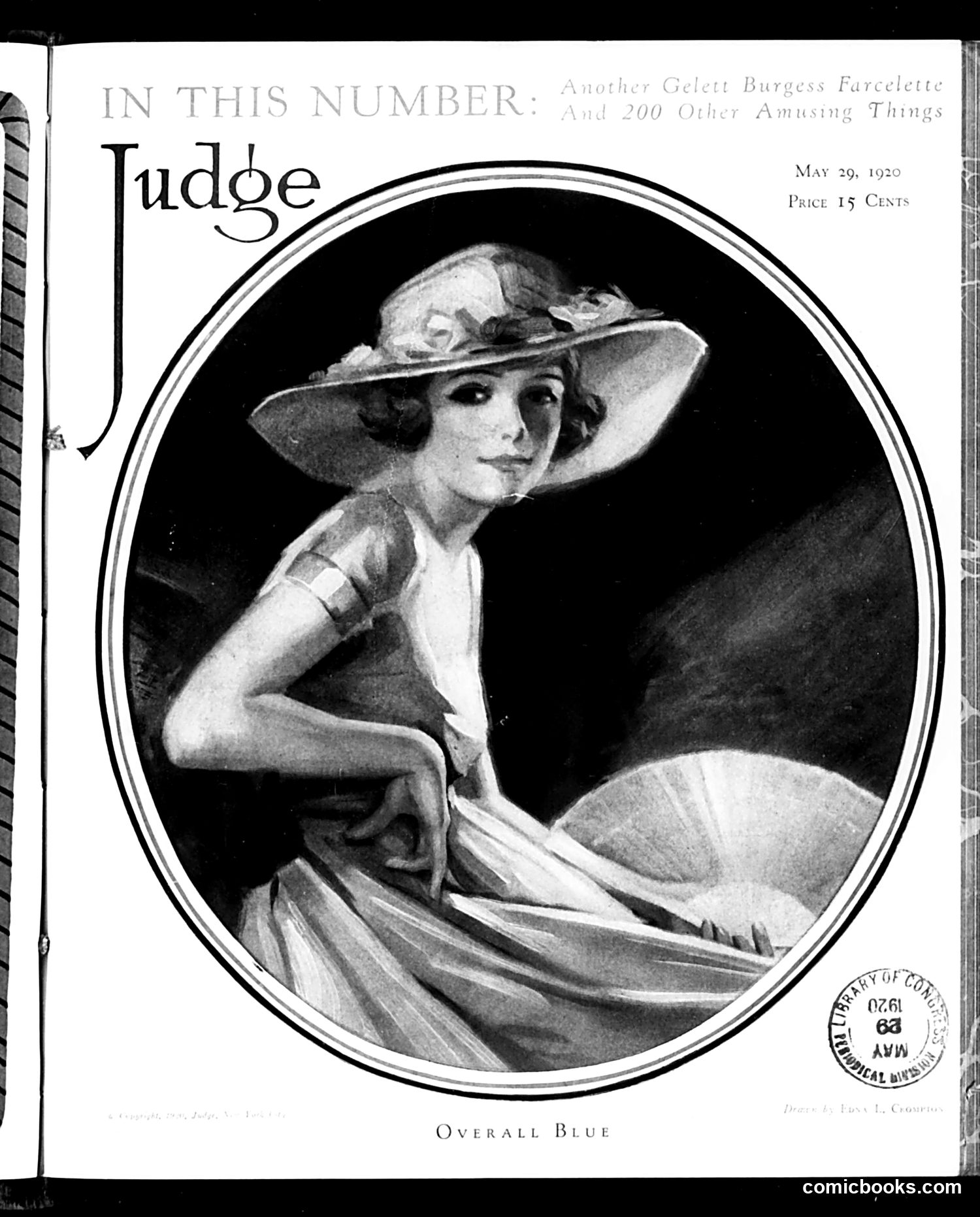
This is a cover page for Judge magazine from May 29, 1920. The image shows a woman in fashionable 1920s attire—a wide-brimmed hat, short-sleeved dress, and flowing fabric—titled "Overall Blue." Rather than political satire, this appears to be a fashion or lifestyle illustration typical of Judge's editorial content. The title likely references the blue-colored garment or overall aesthetic of her outfit. The subtitle mentions "Another Gelet Burgess Farcelette / And 200 Other Amusing Things," indicating the issue contains various humorous pieces and stories. The image reflects 1920s women's fashion trends following World War I, when women's clothing became less restrictive. The page functions primarily as decorative cover art rather than political commentary.

This page is primarily a **Camel cigarette advertisement**, not satire or political cartoon content. The ad features the iconic Camel logo (a camel) and uses the phrase "It's a cinch to figure why Camels sell!" to promote the brand's tobacco blend. The advertisement emphasizes product qualities like "refreshing flavor" and "mellow-mildness," claiming Camels are superior to competitors. The ad is from **R.J. Reynolds Tobacco Co.** in Winston-Salem, North Carolina. **Historical context for modern readers**: This represents mid-20th-century cigarette marketing before health warnings were required. The casual promotion of smoking as desirable and the emphasis on taste—rather than any health considerations—reflects an era when tobacco advertising faced no regulatory restrictions and health dangers were not openly acknowledged in commercial messaging.
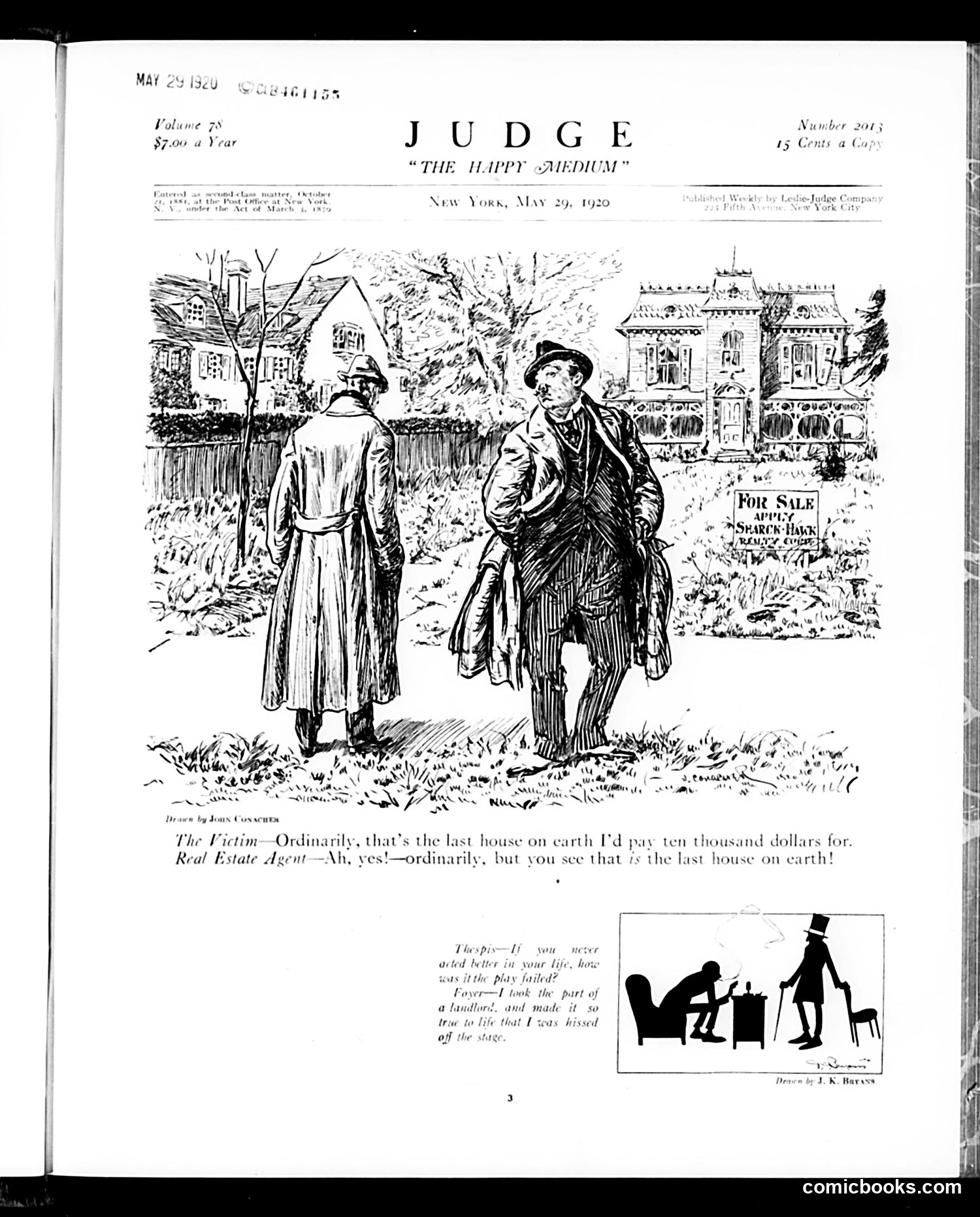
**Main Cartoon (by John Cosgrave):** This satirizes real estate agents' aggressive sales tactics. A shabbily-dressed man (the "victim") tells an agent that he wouldn't pay $10,000 for the last house on earth. The agent responds that this *is* the last house on earth—implying the victim has no choice but to buy. The joke critiques how real estate professionals exploit desperation and limited options to make sales. **Secondary Cartoon (by J.K. Barnes):** A silhouetted scene of domestic conversation, apparently about life experiences. The specific dialogue is partially legible but context-dependent. The page reflects post-WWI American anxieties about housing scarcity and rising property values during the 1920s real estate boom.
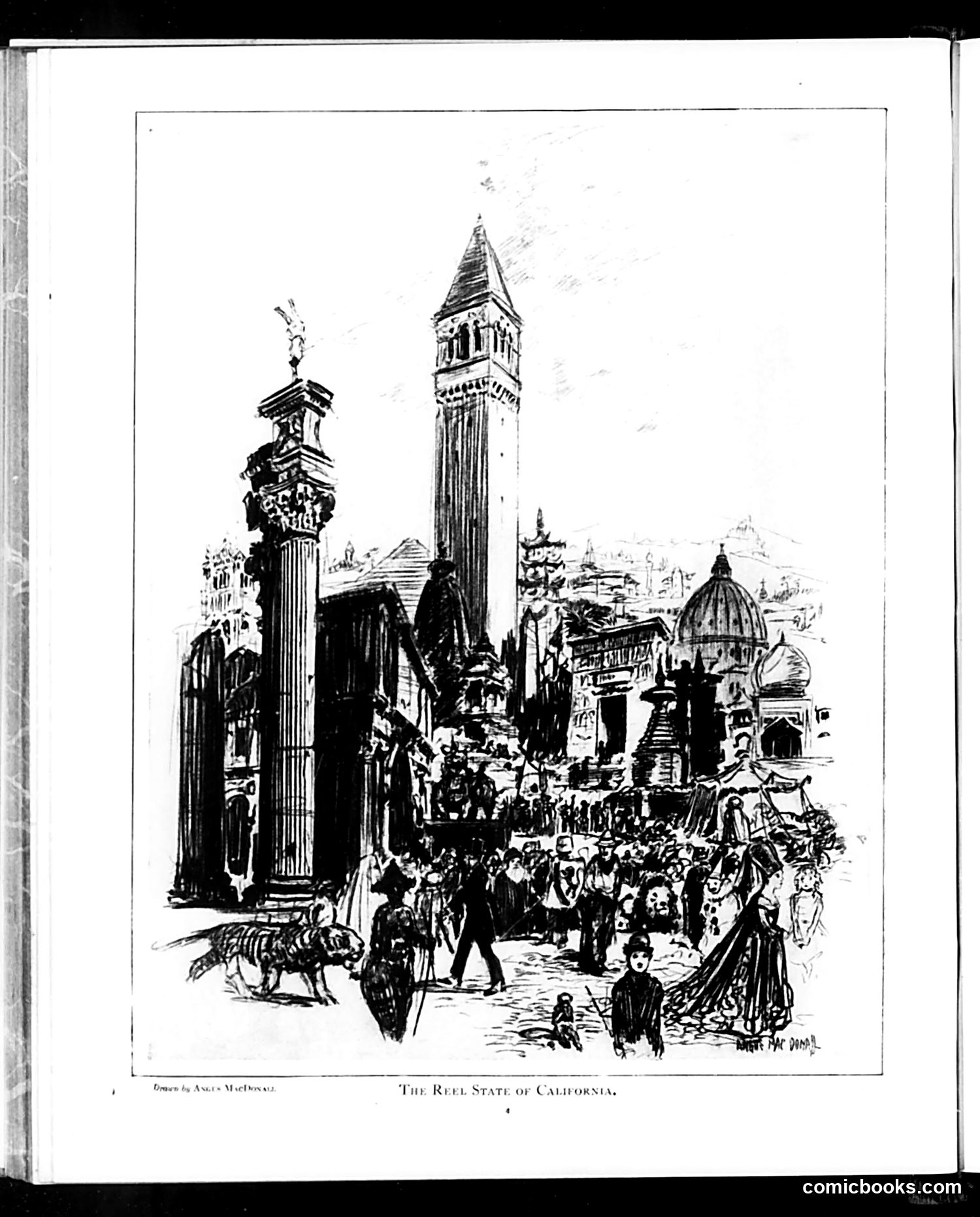
This political cartoon depicts a crowded, chaotic scene in what appears to be Venice or San Marco in Italy, dominated by tall columns and a prominent bell tower. The title "The Reel State of California" suggests wordplay—"reel" (as in film) versus "real." The satire likely critiques California's film industry (then rapidly developing) as creating an illusory, theatrical version of the state rather than reflecting reality. The Italian Renaissance setting may emphasize artificiality and grandeur disconnected from actual California conditions. The massive crowds and ornate architecture suggest entertainment spectacle overwhelming substance—a commentary on how cinema was reshaping California's image and identity through fantasy rather than truth. The artist is credited as Alice Macdonell.
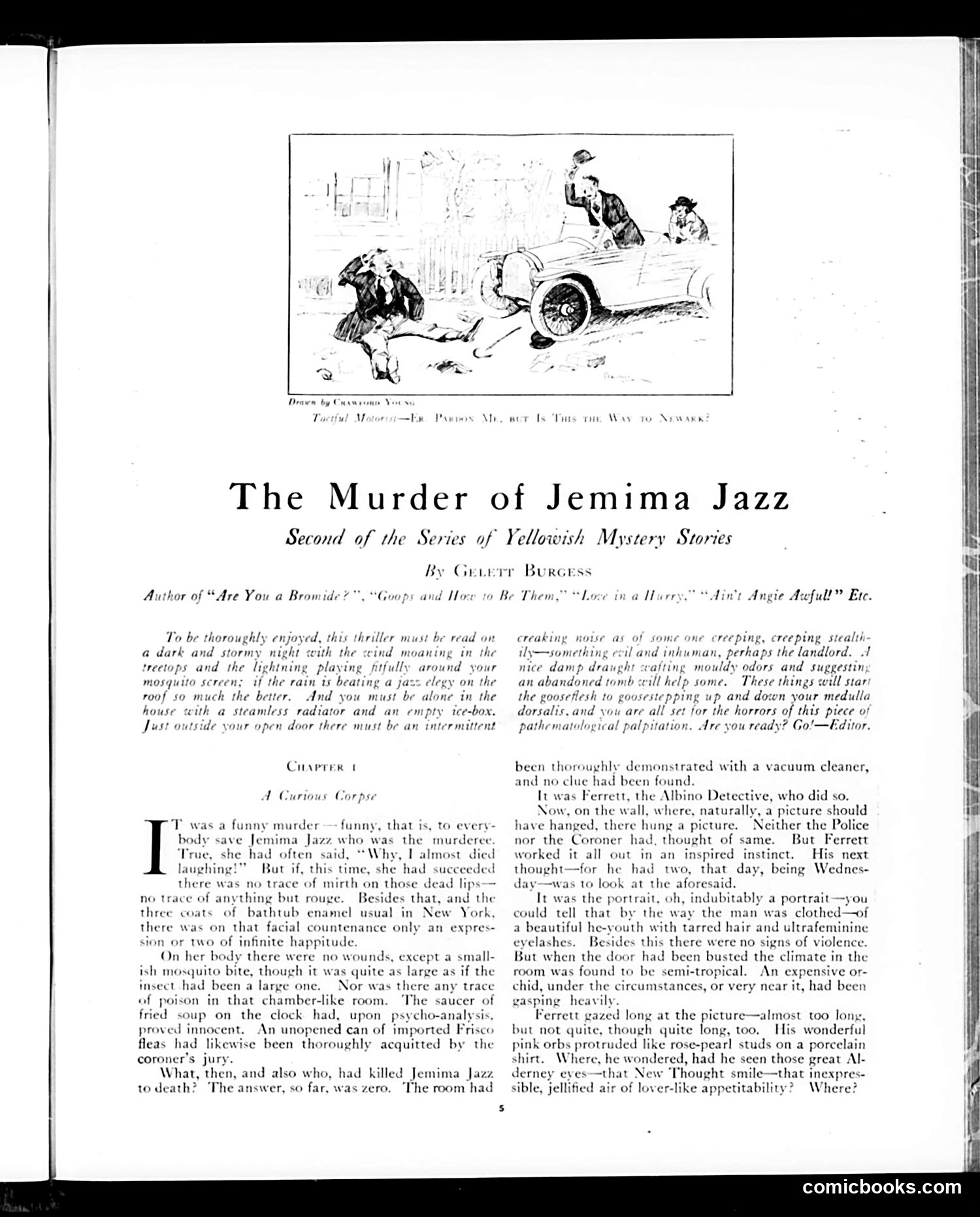
This page introduces "The Murder of Jemima Jazz," a mystery story by Gillett Burgess, second in a series called "Yellowish Mystery Stories." The illustration at top depicts an automotive accident scene: a woman lies on the ground while men in the car (wearing hats typical of the 1910s-20s era) appear unconcerned or suspicious. The caption reads "Pardon Me—Is This the Way to Newark?" This appears to be satirizing casual attitudes toward traffic deaths during the early automobile era, when cars were still novel and accidents common. The joke's dark humor lies in the contrast between the severe injury/death below and the drivers' apparent indifference or deflection ("just asking directions"). The cartoon likely comments on reckless driving and society's nonchalant response to automotive fatalities—a emerging social problem of that period.
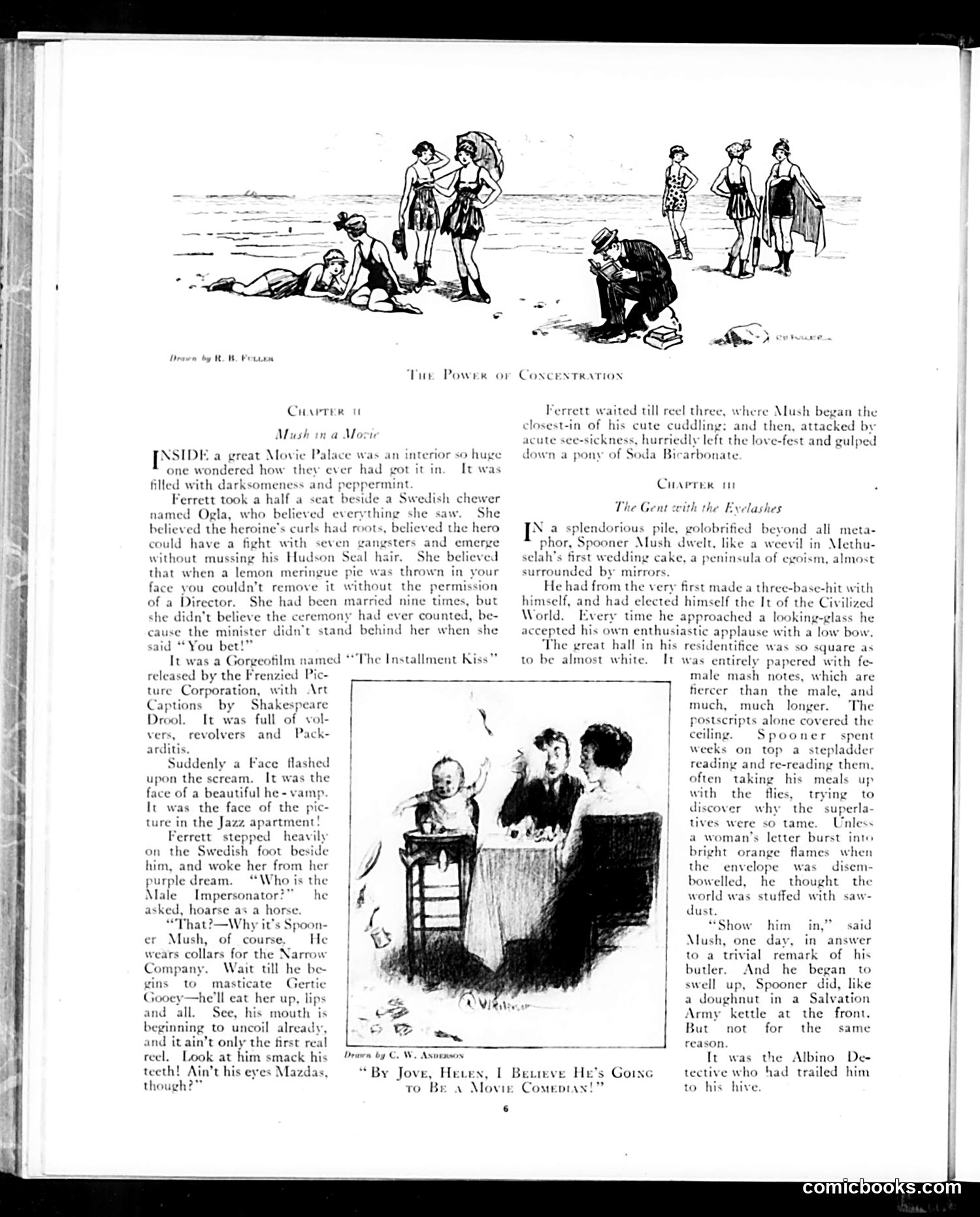
This page contains a serialized fictional story titled "The Power of Concentration," illustrated with two drawings. The top illustration shows beachgoers, while the middle illustration depicts three men in an interior setting, captioned "By Jove, Helen, I Believe He's Going to Be a Movie Comedian!" The narrative is satirizing the early movie industry and aspiring actors. The story follows characters named Ferrett, Mush, and Spooner within a "Movie Palace." The humor centers on the absurdity of someone becoming a film comedian—suggesting that almost anyone, even untalented individuals, could achieve success in the nascent motion picture business. This reflects early 1910s skepticism about cinema as a legitimate art form and mocks both the industry's lack of standards and the desperate ambitions of would-be performers.
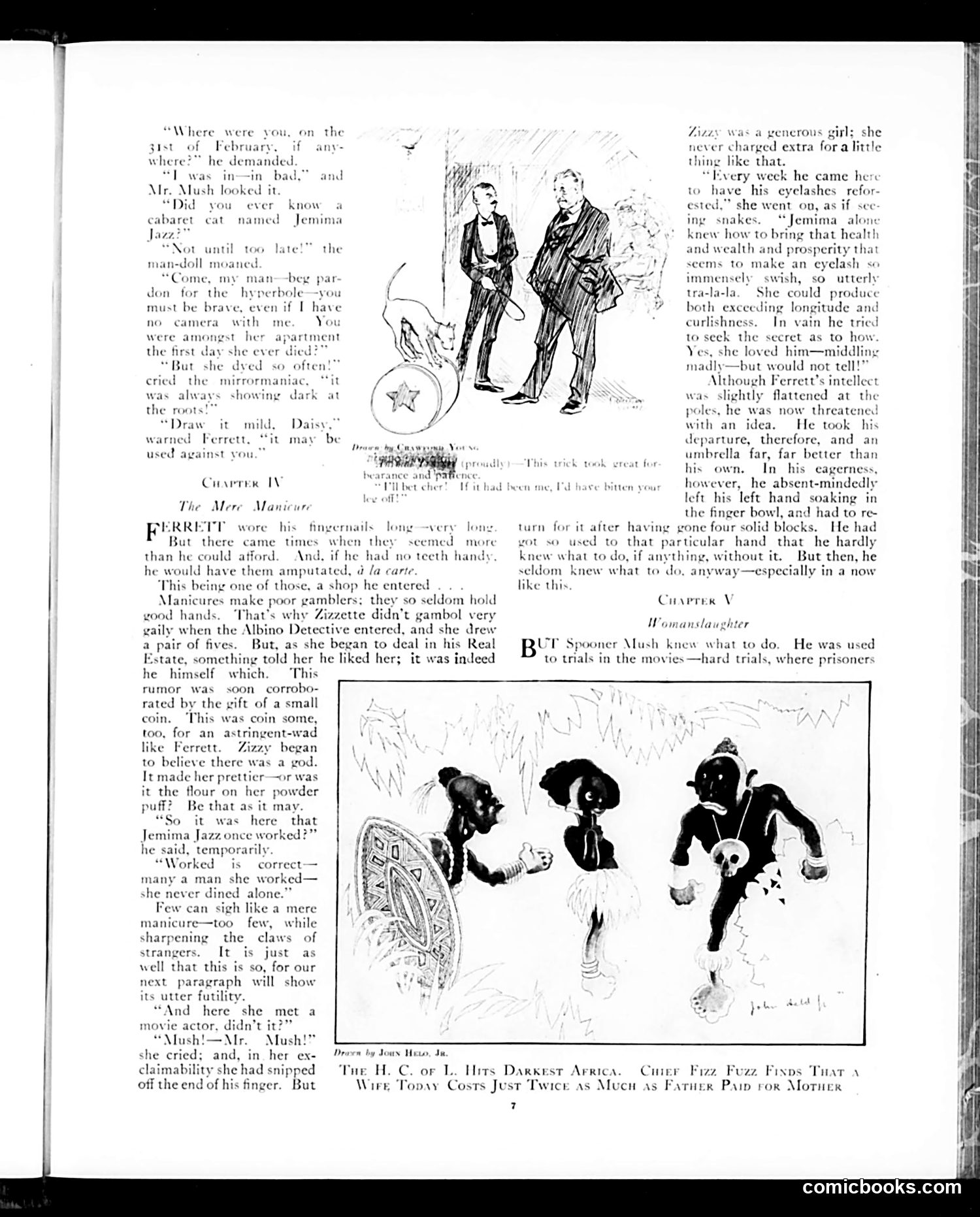
This page contains a serialized satirical story featuring two interconnected narratives mocking early 20th-century urban characters and situations. The main plot involves "Ferrett" (an "Albino Detective") frequenting a manicure shop run by "Zizzette," who performs eyelash treatments. The satire targets gamblers and detectives of the era—Ferrett is portrayed as dim-witted and absent-minded (he forgets his hand soaking in a finger bowl). The humor relies on period slang ("swish," "tra-la-la") and absurdist physical comedy. The lower cartoon, titled "The H.C. or L. Hits Darkest Africa," depicts what appears to be a silent-film scenario involving "Chief Fizz Fuzz," likely satirizing Hollywood's crude racial caricatures and exotic adventure films popular at the time. The caption suggests commentary on colonial-era entertainment tropes. Overall, the page mocks detective fiction, manicure culture, gambling, and Hollywood's treatment of non-Western subjects—all popular targets for Judge's satirical humor.
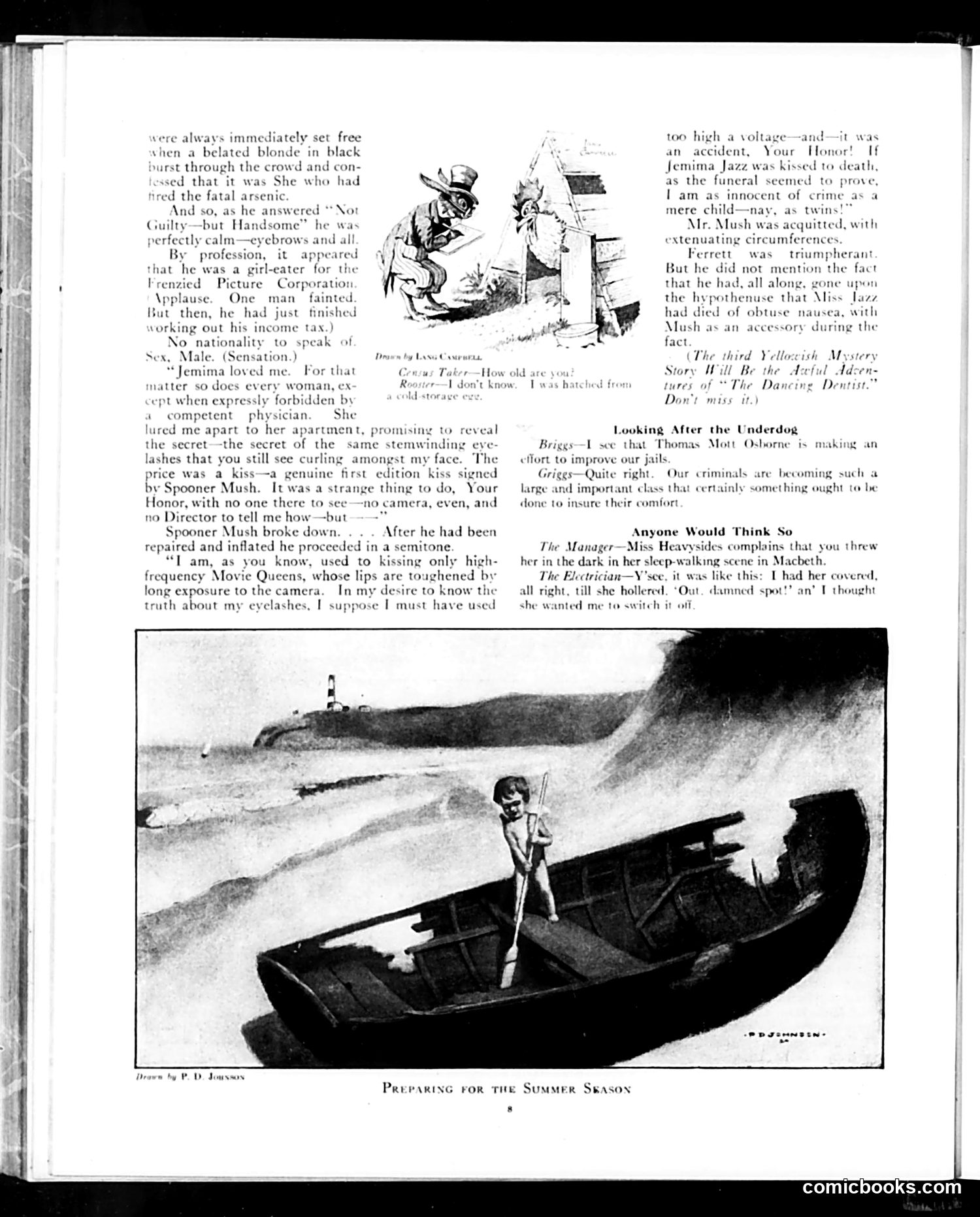
This page contains satirical commentary on early 20th-century cinema and criminal justice. The main cartoon depicts a silent film scenario where an actor named "Spooner Mush" is accused of accidentally killing a woman named "Jemima Jazz" by kissing her with "too high a voltage"—a absurdist joke mocking melodramatic movie plots and the implausibility of silent film narratives. Below are three brief humorous exchanges: one about prison reformer Thomas Mott Osborne's efforts to improve jail conditions (sardonically suggesting criminals deserve comfort); another joking about a theater electrician misunderstanding an actress's stage direction ("Out, damned spot!") as a command to turn off lights during a *Macbeth* performance. The satire targets both the overwrought artificiality of early cinema and contemporary social reform efforts, using exaggeration and wordplay typical of Judge magazine's style.
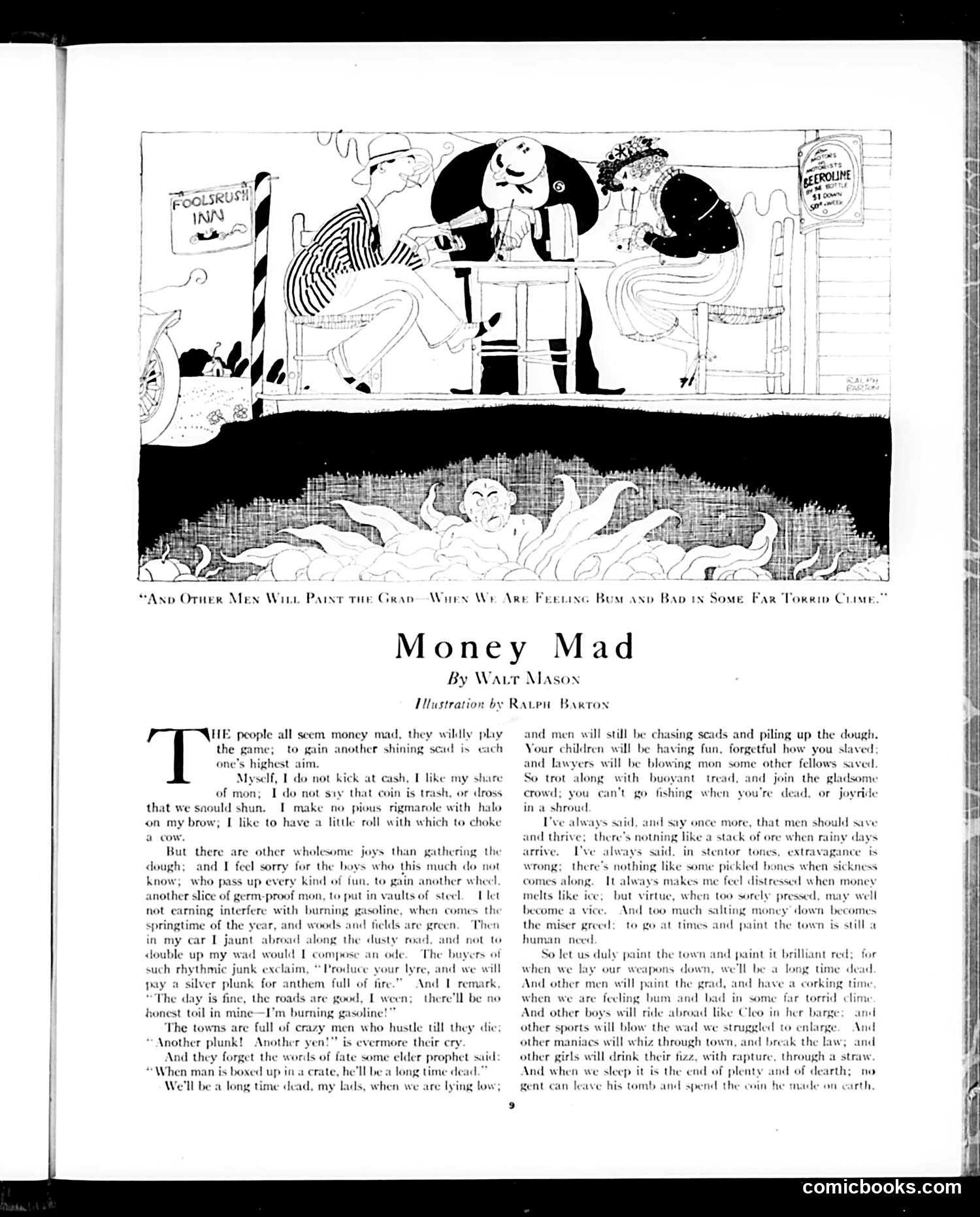
This is a satirical poem by Walt Mason (illustrated by Ralph Barton) critiquing American obsession with wealth accumulation during the early 20th century. **The Satire:** Mason acknowledges he enjoys money himself—"I like my share"—but mocks those who sacrifice all other pleasures to hoard wealth. He contrasts the joy of spending money on leisure (cars, travel, entertainment) against the joyless greed of endless accumulation. **The Dark Humor:** The repeated refrain "we'll be a long time dead" undercuts materialism's logic: you can't take money with you, yet men still "pile up the dough" obsessively. After you die, others will enjoy what you sacrificed to earn. **The Social Critique:** The cartoon shows wealthy men at leisure while workers toil below (depicted as chaotic, grotesque figures). Mason suggests the money-mad ignore how their wealth was built on others' labor ("lawyers will be blowing mon some other fellows saved"). **The Message:** Live a little—paint the town red—because life is short and endless money-chasing is hollow vanity.
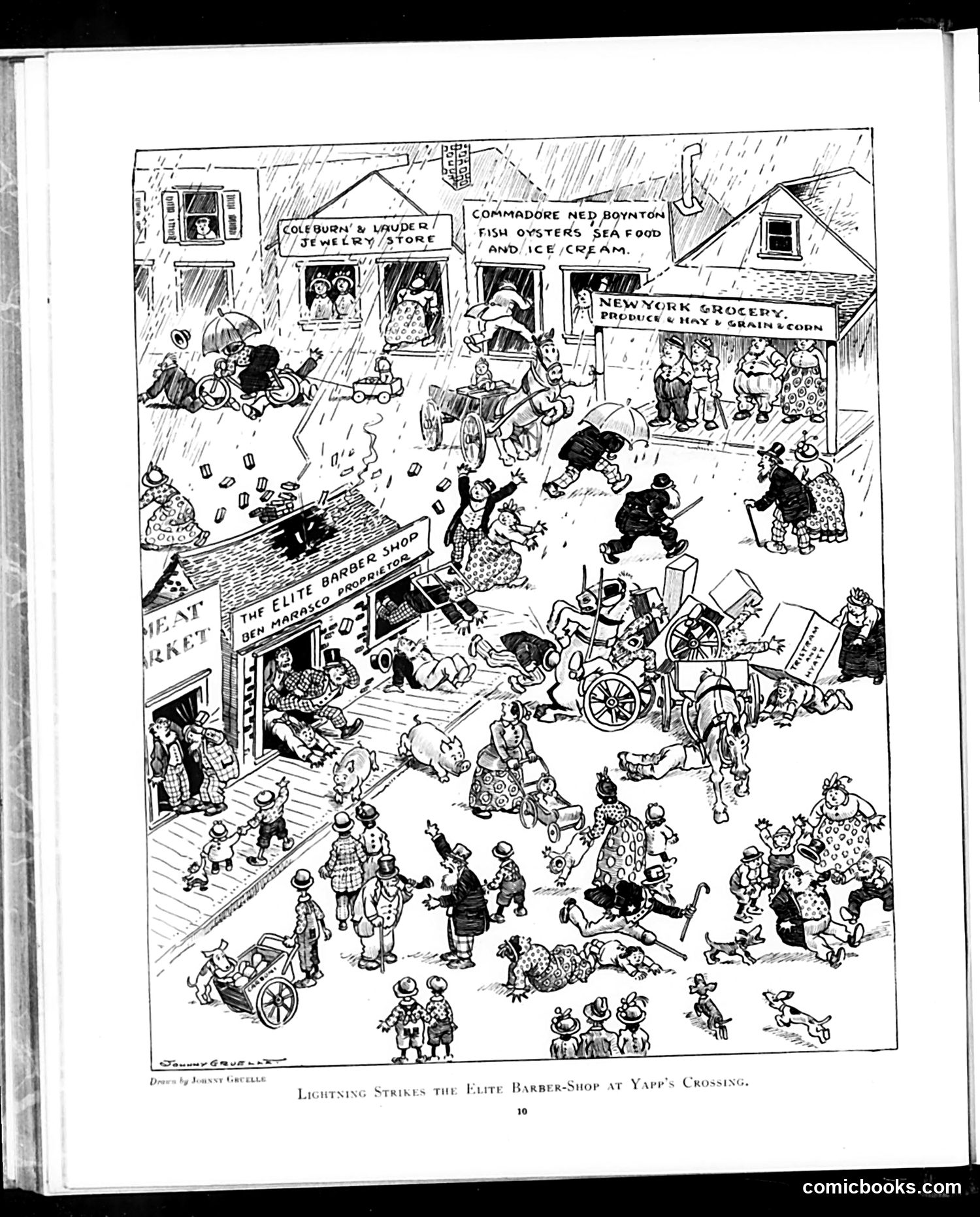
This is a crowded street scene depicting chaos at an upscale barber shop during what appears to be a lightning strike. The illustration shows numerous figures—children, adults, and women in period dress—scattered across the street in disarray, with bicycles, carriages, and merchandise tumbling about. The cartoon satirizes the disruption of genteel, respectable urban commerce. "The Elite Barber-Shop" represents pretension and respectability, while "Yapp's Crossing" appears to be a busy commercial intersection. The lightning strike serves as a humorous equalizer—a force of nature that destroys order and decorum at an establishment that likely markets itself as refined and distinguished. Visible shop signs reference fish, oysters, ice cream, and groceries, suggesting a working-class neighborhood despite the "elite" barber shop's pretensions. The satire mocks social pretense disrupted by chaotic reality.
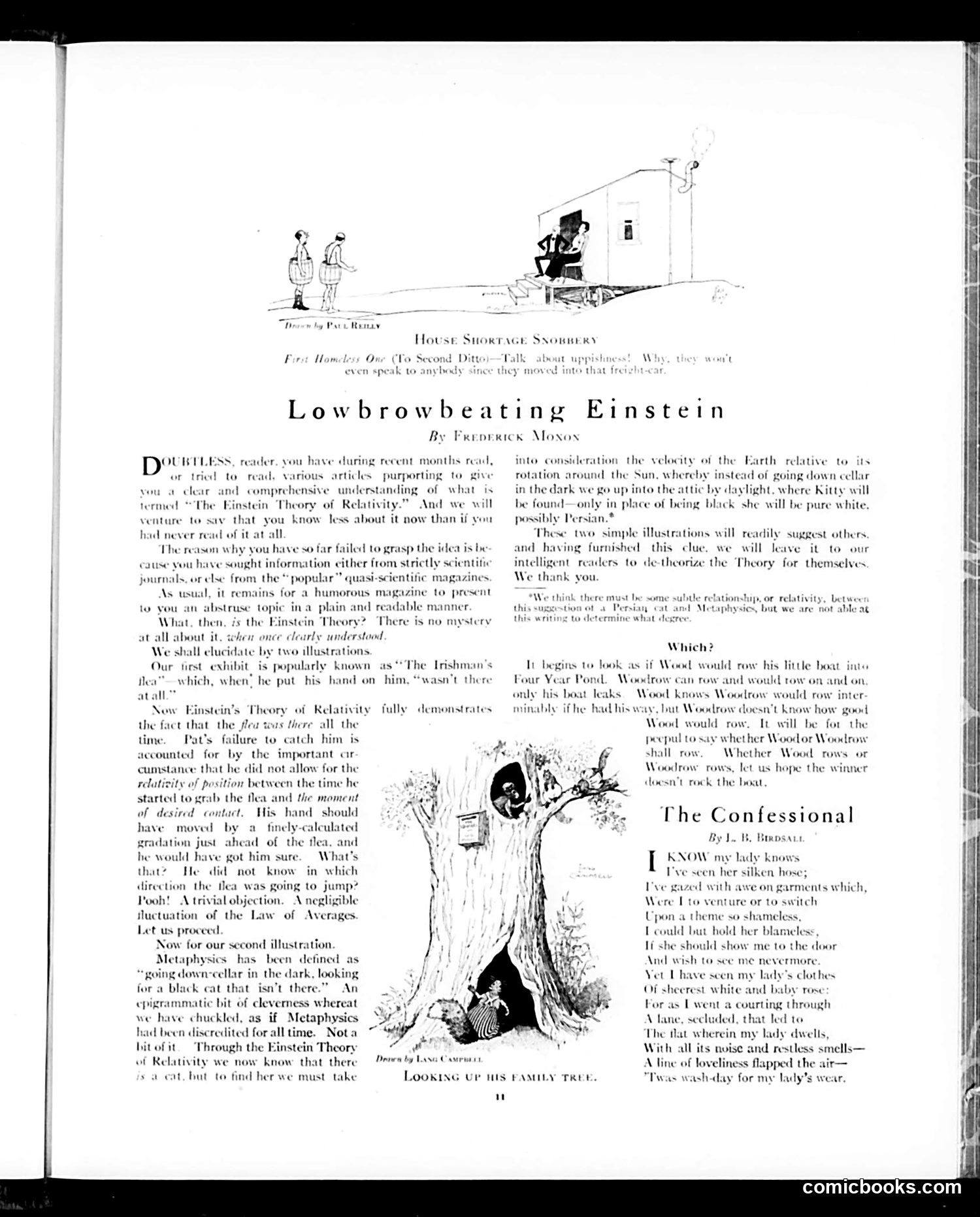
This satirical piece mocks the public's struggle to understand Einstein's Theory of Relativity, which was becoming a sensation in popular discourse during the 1920s. **The Cartoon**: The top illustration depicts two people outside a house labeled "House Shortage Snobbery," referencing housing shortages of the era—a visual non-sequitur emphasizing how disconnected the public is from complex theory. **The Satire**: Frederick Moxon claims *Judge* magazine will explain relativity simply, then deliberately offers absurd "illustrations": (1) the Irishman's flea—claiming Einstein proves the flea was always there, Pat just miscalculated its position; (2) finding a black cat in the cellar that becomes a white Persian cat in the attic, by accounting for Earth's rotation. **The Point**: Moxon satirizes both the public's desperation to understand relativity and the pseudo-intellectual magazine articles attempting to simplify it. By offering deliberately nonsensical "explanations" that sound physics-adjacent, he suggests that most popular treatments of Einstein's theory are equally meaningless—just using scientific-sounding language to mask confusion. The secondary content ("Which?" about rowing, "The Confessional") appears unrelated filler.
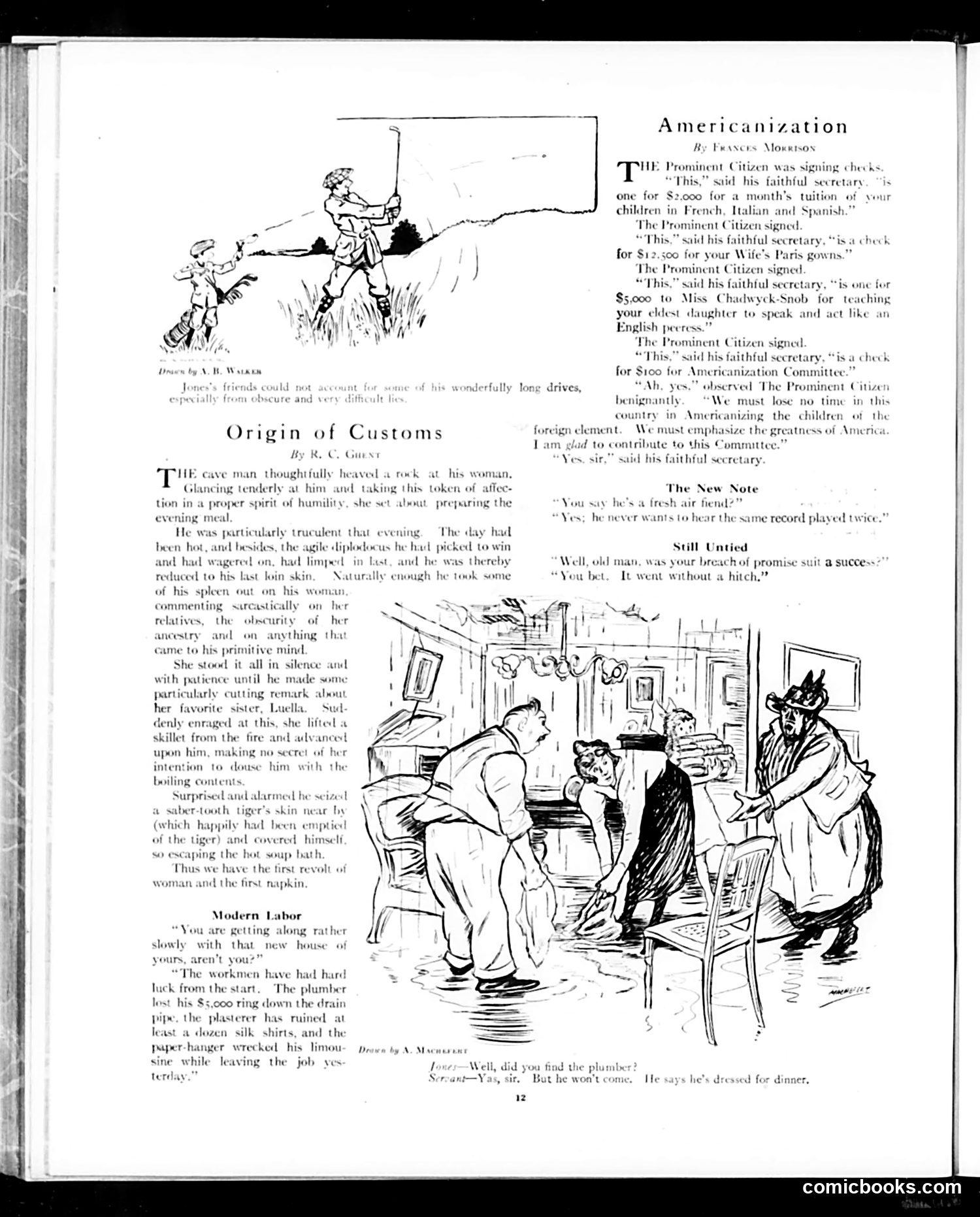
This satirical piece mocks wealthy Americans' hypocrisy regarding "Americanization." A prominent citizen signs checks for his children's foreign language tuition, his wife's Paris gowns, and an English accent coach—expensive luxuries that emphasize European refinement. When asked to contribute $100 to an "Americanization Committee," he enthusiastically agrees, declaring the need to "Americanize the children of the foreign element" and emphasize "the greatness of America." The satire is sharp: the wealthy man spends thousands making his own family *un*-American (French, Italian, elite European manners) while publicly supporting efforts to strip immigrants of their foreign ways. The cartoon exposes the class hypocrisy of Progressive-era Americanization movements—assimilation was demanded of poor immigrants while the rich openly celebrated European culture as superior.
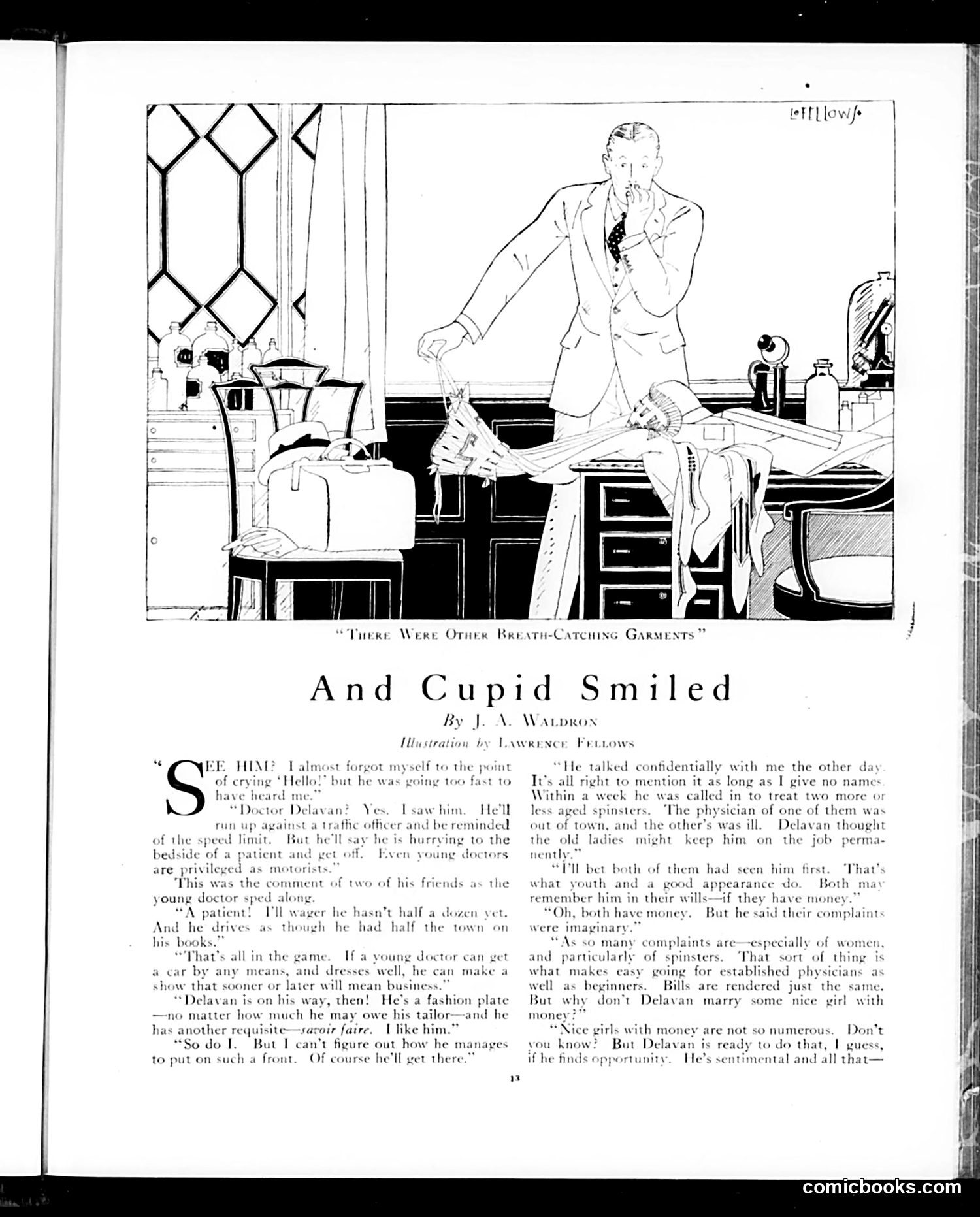
This is a short story illustration (not a political cartoon) about a young doctor named Delavan. The satire targets the aspirations and romantic calculations of early 20th-century professional life. **The Setup:** Two acquaintances discuss how Delavan, despite owing his tailor money, maintains an impressive appearance and lifestyle—presenting a false front of success ("savoir faire") to advance his medical career. **The Joke:** Delavan gains patients through charm rather than credentials. When he treats elderly unmarried women, they become devoted to him, presumably hoping to remember him in their wills. His friends cynically observe that his romantic prospects depend on finding a wealthy woman, since "nice girls with money are not so numerous." **The Satire:** The piece mocks how doctors (and young professionals generally) use appearance, charm, and calculation rather than genuine skill to build practices, and how courtship itself is transactional—especially regarding women's financial status. The illustration shows Delavan in his office with scattered medical items and fashionable clothing, embodying the contradiction between his polished exterior and presumed financial instability.
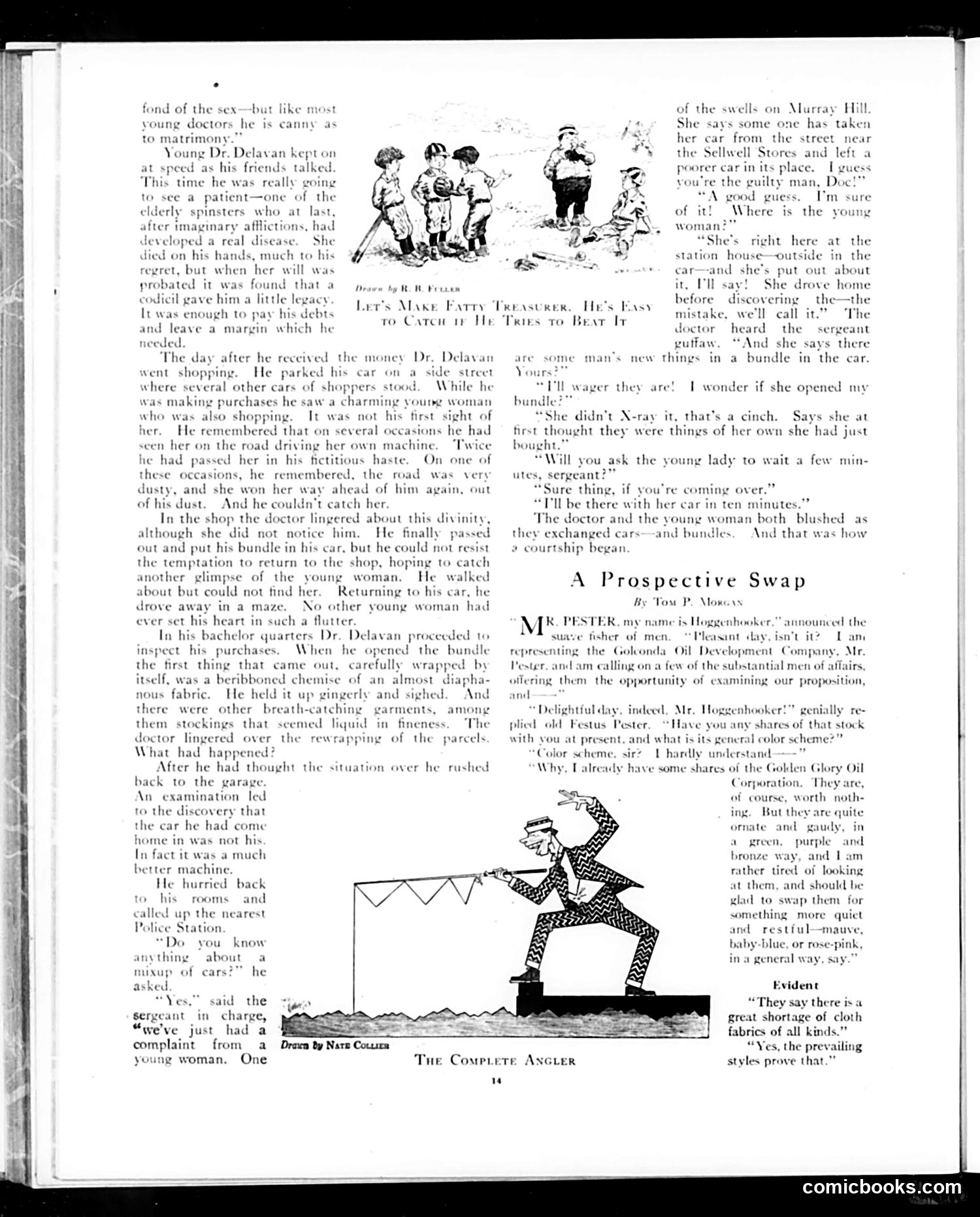
**Main Cartoon ("Complete Angler"):** A man in patterned clothing strikes an exaggerated fishing pose, apparently satirizing someone or a type. The title references fishing, suggesting the cartoon mocks a particular person's behavior or profession as deceptive or predatory. **Story with Illustrations:** "Let's Make Party" depicts a romantic comedy of errors. Dr. Delavan accidentally swaps cars with an attractive woman at a shopping district on Murray Hill (an upscale Manhattan neighborhood). When he opens her purchased bundle, he discovers intimate women's garments, creating embarrassment. Their mix-up leads to a courtship. The satire gently mocks doctor's pursuit of wealthy patients and young women, and the social awkwardness of the era. **"A Prospective Swap":** A salesman named Pester represents the Golconda Oil Development Company, pitching investment shares to wealthy men. The setup suggests satire about oil speculation schemes or dubious financial propositions marketed to the wealthy—likely referencing early 20th-century stock manipulation or investment fraud targeting affluent targets.
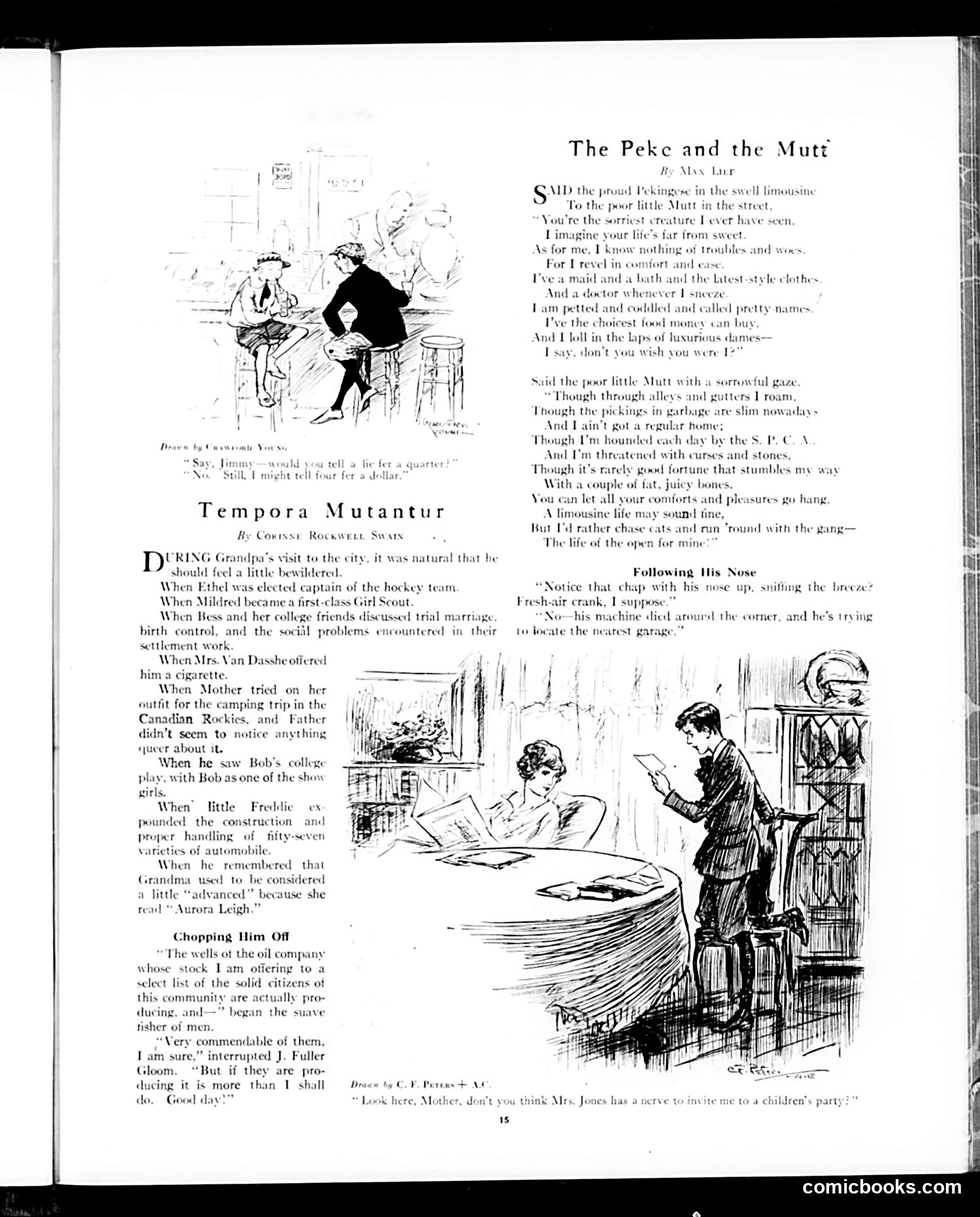
**"Tempora Mutantur"** (Latin: "Times Change") satirizes generational shock. An elderly grandfather visits the city and is bewildered by modern women's independence—daughters becoming sports captains, Girl Scouts, and college actresses; young women discussing "trial marriage" and birth control; even his wife preparing for a camping trip in the Canadian Rockies. The joke: he remembers when his own wife was considered "advanced" merely for reading Aurora Leigh (a serious poem). The satire mocks conservative anxiety about 1920s women's liberation. **"The Peke and the Mutt"** is a class-commentary poem contrasting a pampered Pekingese dog in a limousine with a street mutt. The wealthy dog boasts of luxury; the poor dog counters that freedom and adventure ("run 'round with the gang") beat comfort. It's social commentary using animal fables—likely critiquing both wealth's emptiness and romanticizing poverty. **"Following His Nose"** is a brief visual gag about a motorist sniffing the air for the nearest garage after his car breaks down—a joke about the ubiquity of automobiles and repair shops in modern life.
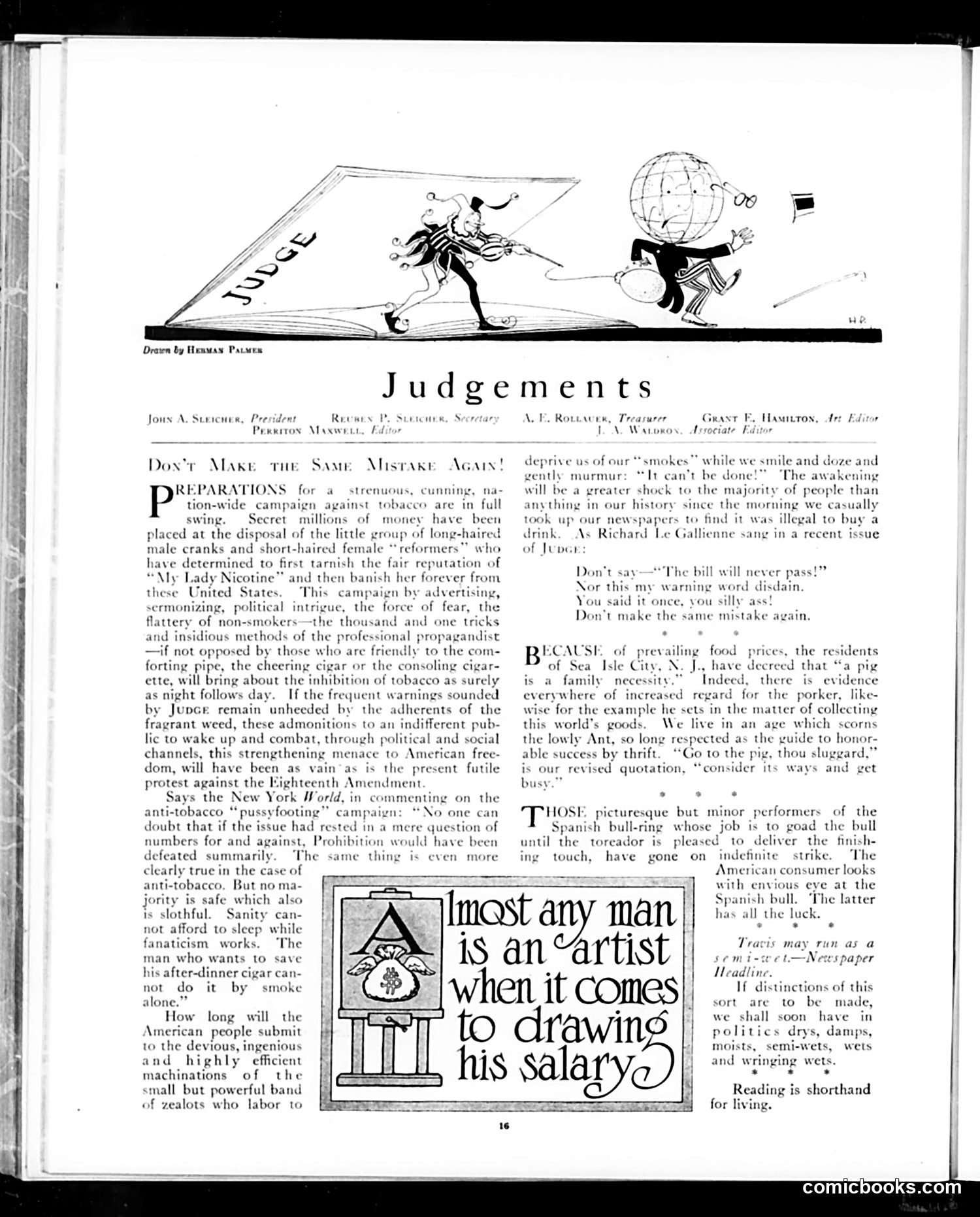
This editorial page attacks anti-tobacco reformers as dangerous propagandists threatening American freedom. The top cartoon shows a figure labeled "Injustice" emerging from a book, chasing businessmen and globe-symbolism—warning that tobacco prohibition will succeed through manipulation, fear, and "professional propagandist" tactics, just as Prohibition (the 18th Amendment) did. The editors mock reformers as "long-haired" activists and "cranks" attempting to ban smoking nationwide. They argue that while Prohibition failed logically on numbers alone, anti-tobacco forces use similar underhanded methods. The sidebar joke about "most any man is an artist when it comes to drawing his salary" appears unrelated—generic workplace satire. Other brief items mock Sea Isle City's pro-pig decree and Spanish bullfighting strikers. The page represents Judge's libertarian, anti-reform editorial stance: opposing what it frames as elitist, manipulative crusades against ordinary citizens' pleasures and livelihoods.
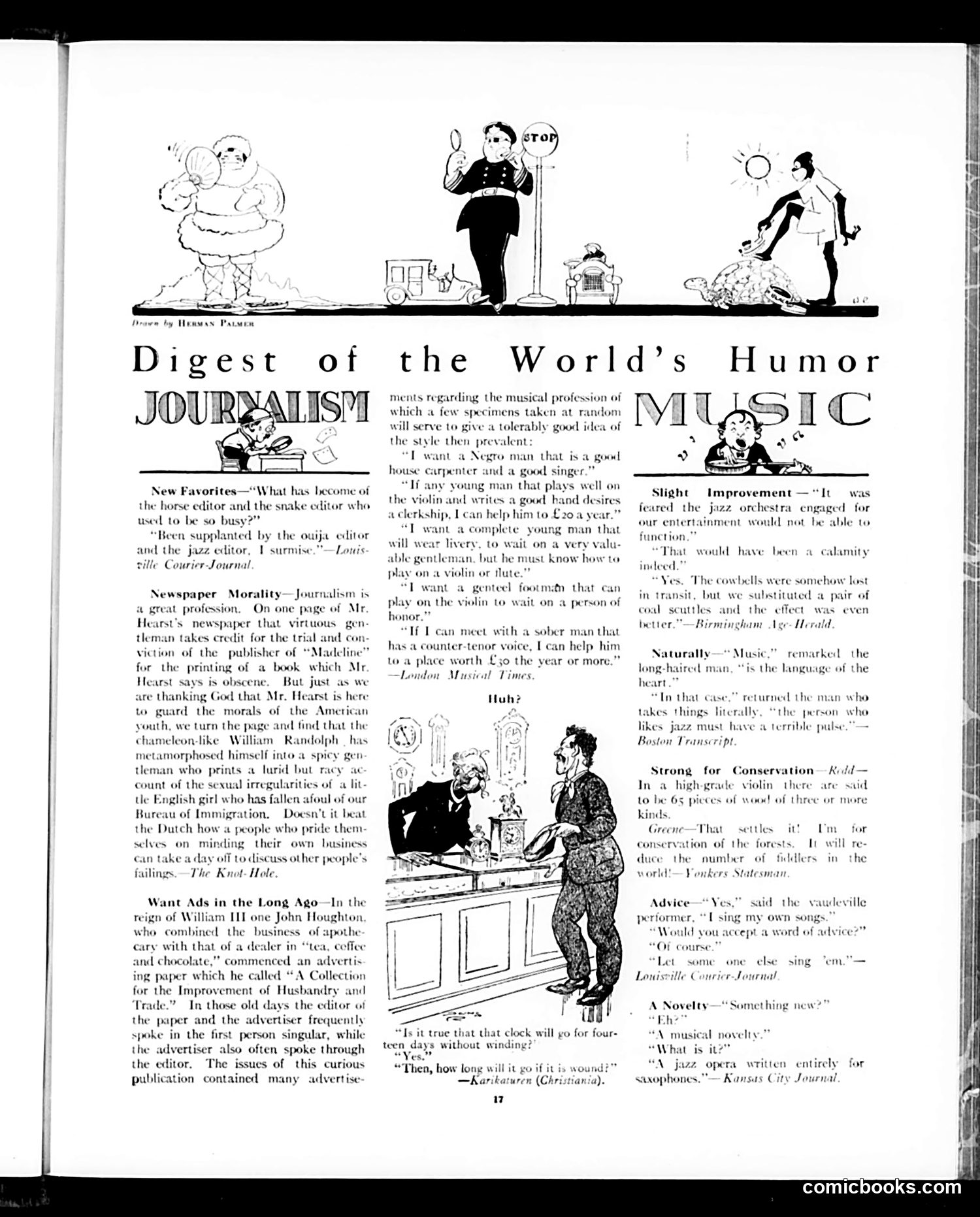
This is a humor digest page collecting jokes and satirical observations about journalism and music from various publications. Key points: **Main Satire - Newspaper Morality:** Judge criticizes William Randolph Hearst's hypocrisy. On one newspaper page, Hearst crusades against obscenity by prosecuting a publisher; on another page, he sensationalizes sexual scandals involving an English girl and immigration authorities. The joke: Hearst poses as a moral guardian while profiting from the very lurid content he condemns. **Music Section Jokes:** The page collects period employment ads and humorous observations about musicians and jazz, including complaints that jazz orchestra cowbells were lost in transit (replaced with coal scuttles) and a joke about a "jazz opera written entirely for saxophones." **Historical Reference:** A sidebar discusses old advertising where editors and advertisers spoke in first person, blurring professional boundaries. The page targets early 20th-century journalistic hypocrisy and the era's ambivalent attitudes toward jazz as entertainment.
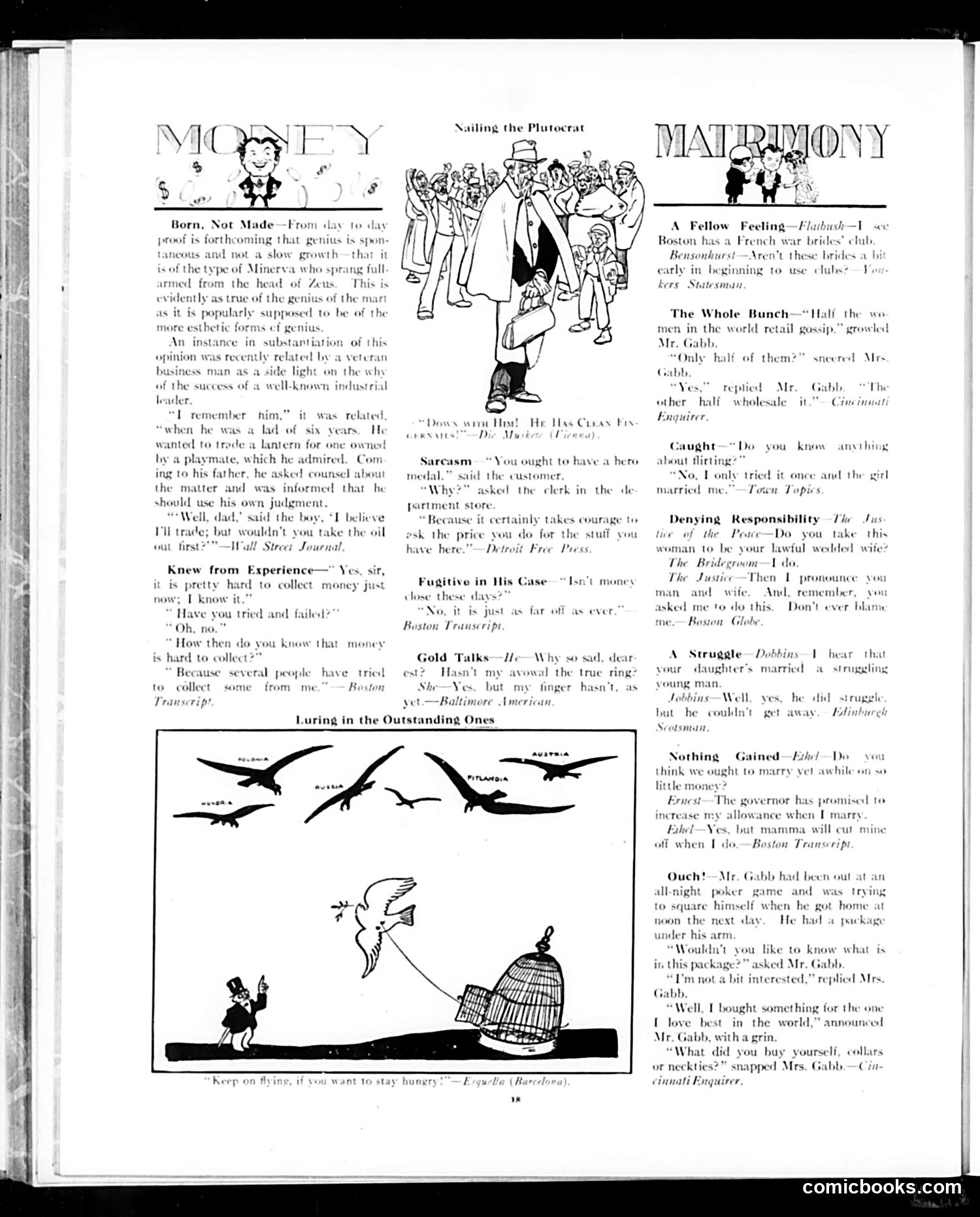
This page from the satirical magazine **Judge** contains multiple short humorous anecdotes mocking wealthy industrialists and marital dynamics of the era. The central cartoon "Nailing the Plutocrat" depicts a well-dressed wealthy man being surrounded and confronted by working-class figures—a visual metaphor for public pressure against plutocrats (extremely rich business owners). The title references the Progressive Era's anti-monopoly sentiment. The accompanying jokes reinforce anti-wealth themes: a store clerk sarcastically awards a "hero medal" for charging outrageous prices; a woman notes her engagement ring lacks substance despite her fiancé's flowery words about love. The remaining jokes satirize marriage and gender relations, portraying husbands as foolish spenders (poker games, mysterious packages) and wives as mercenary or sarcastic. "Nothing Gained" mocks a young man hoping marriage will increase his allowance, only to face his mother-in-law's retaliation. Overall, the page reflects early 20th-century anxieties about wealth inequality, consumer culture, and domestic power struggles—presented through cynical humor typical of Judge's satirical approach.
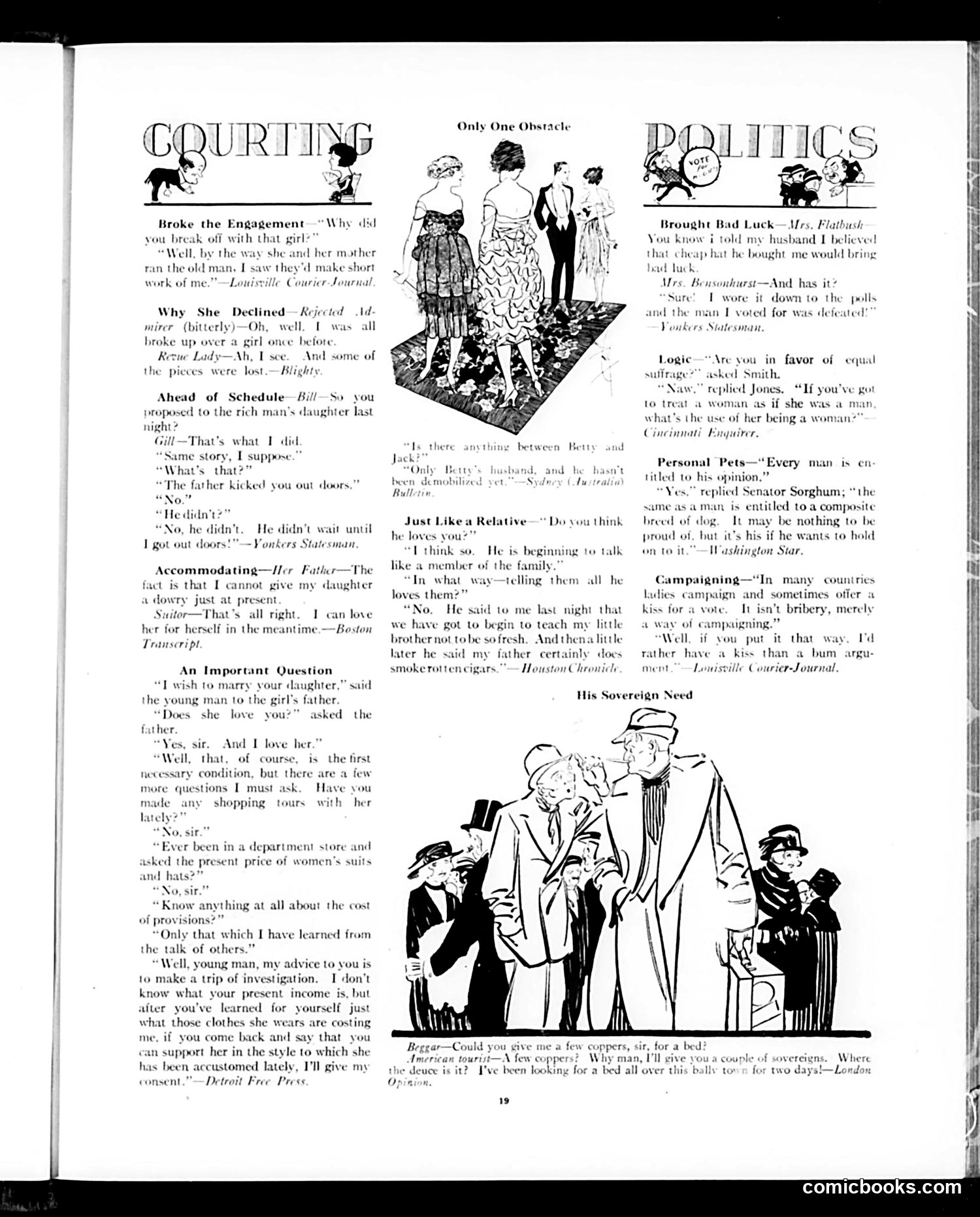
This page collects brief humorous anecdotes satirizing early 20th-century courtship, politics, and gender relations. **The Courting Section** mocks romantic expectations: a man rejects a girl because her mother is overbearing; suitors get kicked out by fathers; a young man must prove he can afford a woman's lifestyle before marrying her. **The Politics Section** includes election humor: a woman's "cheap hat" causes bad luck—she wore it voting and "the man I voted for was defeated." Senator Sorghum defends personal opinions as a man's right, comparing them to owning an inferior dog. These jokes reflect anxiety about newly enfranchised female voters and political independence. **"His Sovereign Need"** depicts a homeless or desperate man seeking a bed, with an American tourist offering sovereigns (British currency)—playing on transatlantic confusion. The humor relies on class anxiety, gender stereotypes, and political cynicism typical of 1910s American satire.
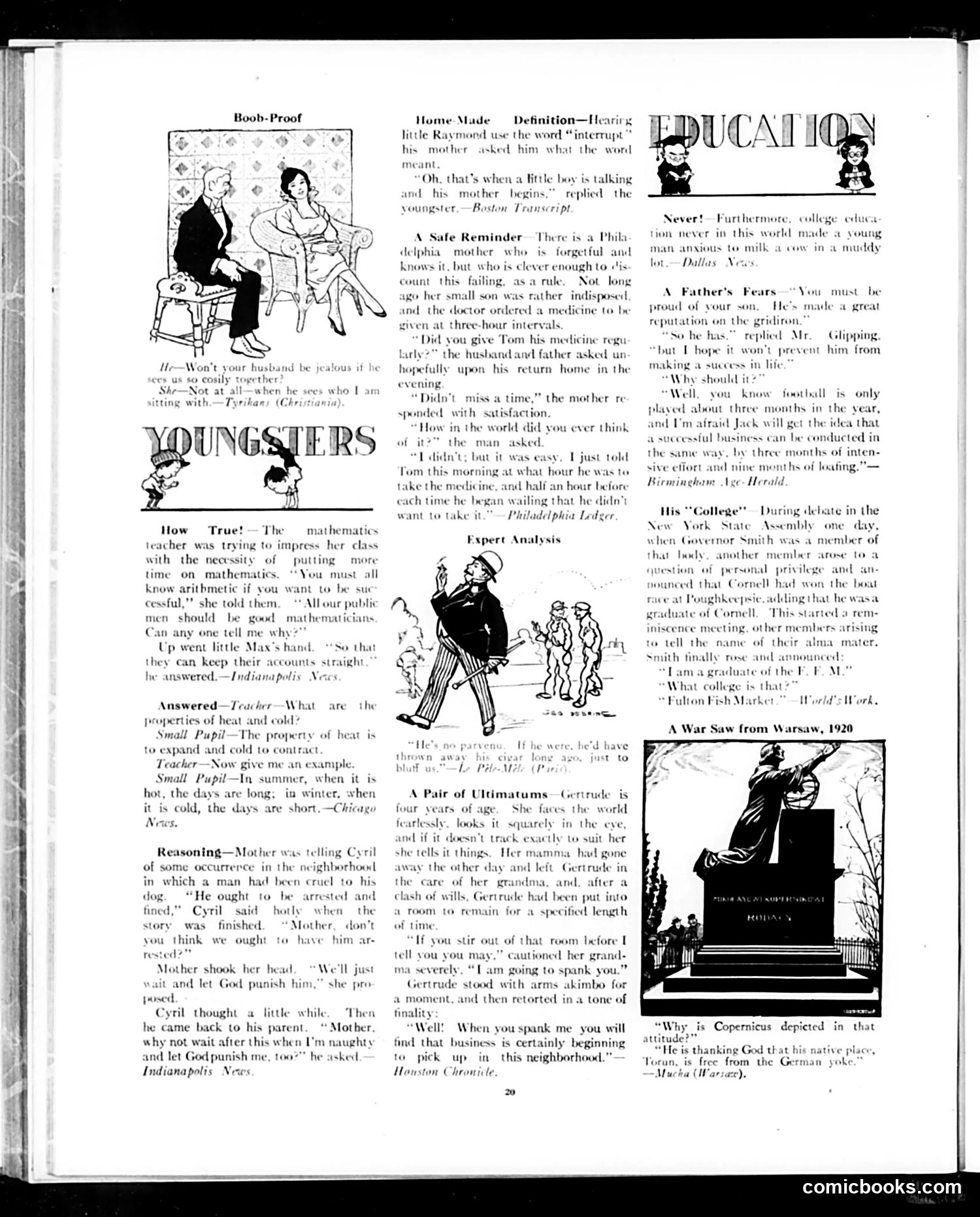
This page from *Judge* contains several humorous anecdotes mocking common social situations and human nature circa the 1920s. The main cartoons illustrate domestic comedy: **"Boob-Proof"**: A couple where the husband appears oblivious while the wife makes a pointed comment—typical satire of marital dynamics and male foolishness. **"Youngsters"** section: Multiple brief jokes about children's literal interpretations and innocent logic exposing adult hypocrisy. For example, a child's definition of "interrupt" as "when a little boy is talking and his mother begins" mocks mothers' behavior. **"Expert Analysis"**: A cartoon showing a man demonstrating something to children, likely about professional pretension. **"A War Saw from Warsaw, 1920"**: A political illustration referencing post-WWI Poland, showing conflict or instability in that region. The overall tone satirizes American middle-class life: forgetful mothers, ambitious fathers, precocious children, and public figures. The humor relies on observation of everyday absurdities rather than topical politics.
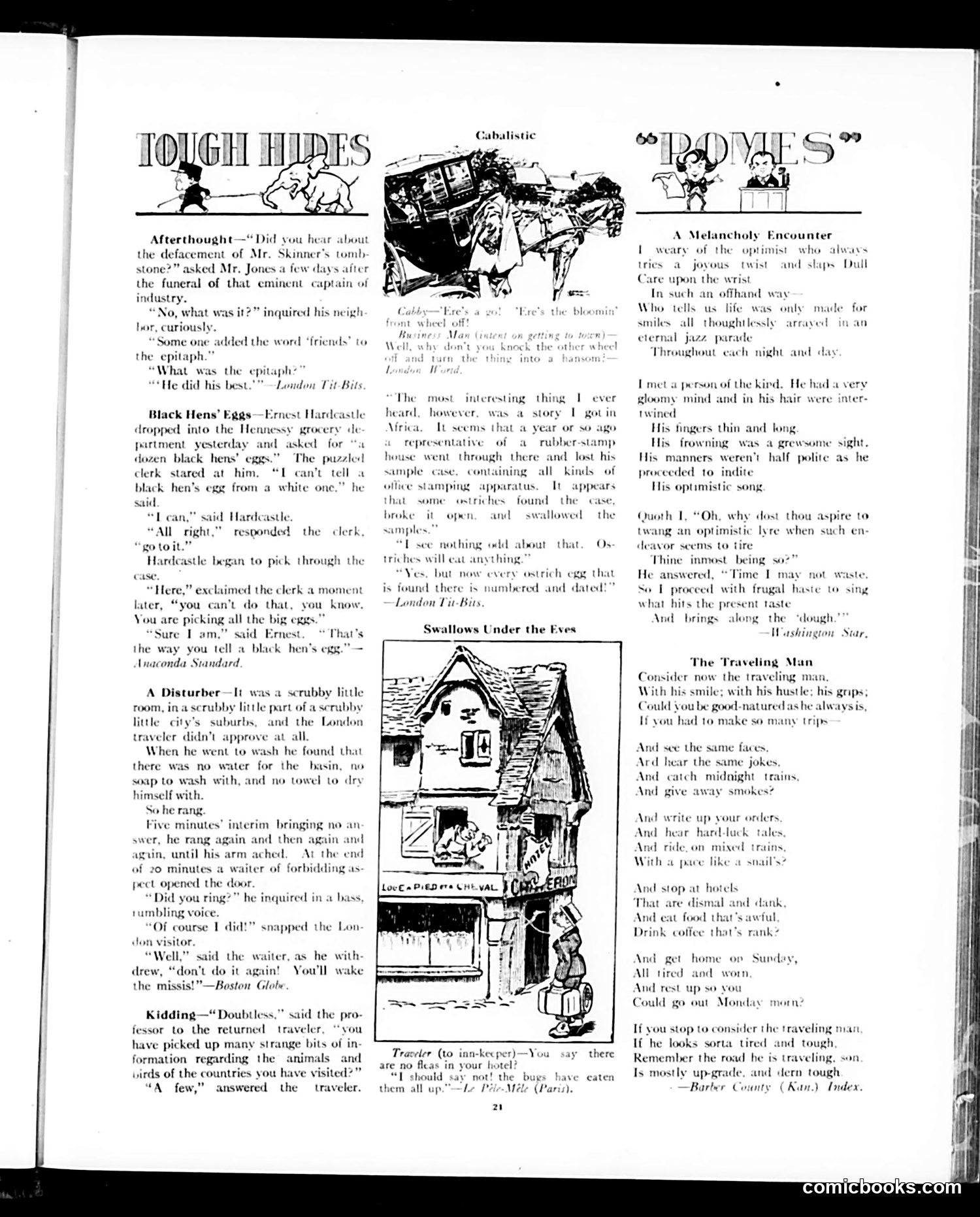
This page from Judge contains several humorous short anecdotes and poems satirizing everyday life and human nature. **The anecdotes** mock social pretense and absurdity: a man's tombstone epitaph is insulted by adding "friends" (implying he had none), a customer foolishly asks for "black hens' eggs," and a traveler complains about poor hotel service only to be ignored by an indifferent waiter. **"The Traveling Man"** satirizes the grinding monotony of commercial life—the salesman enduring repetitive encounters, bad jokes, uncomfortable travel, and tedious paperwork, questioning whether anyone could maintain cheerfulness under such conditions. **"A Melancholy Encounter"** pokes fun at forced optimism by contrasting a cheerful optimist with a perpetually gloomy person, suggesting both attitudes toward life have merit depending on circumstances. The humor relies on recognizable turn-of-the-century frustrations: class consciousness, skepticism about relentless positivity, and the tedium of modern commercial travel—themes still resonant today.
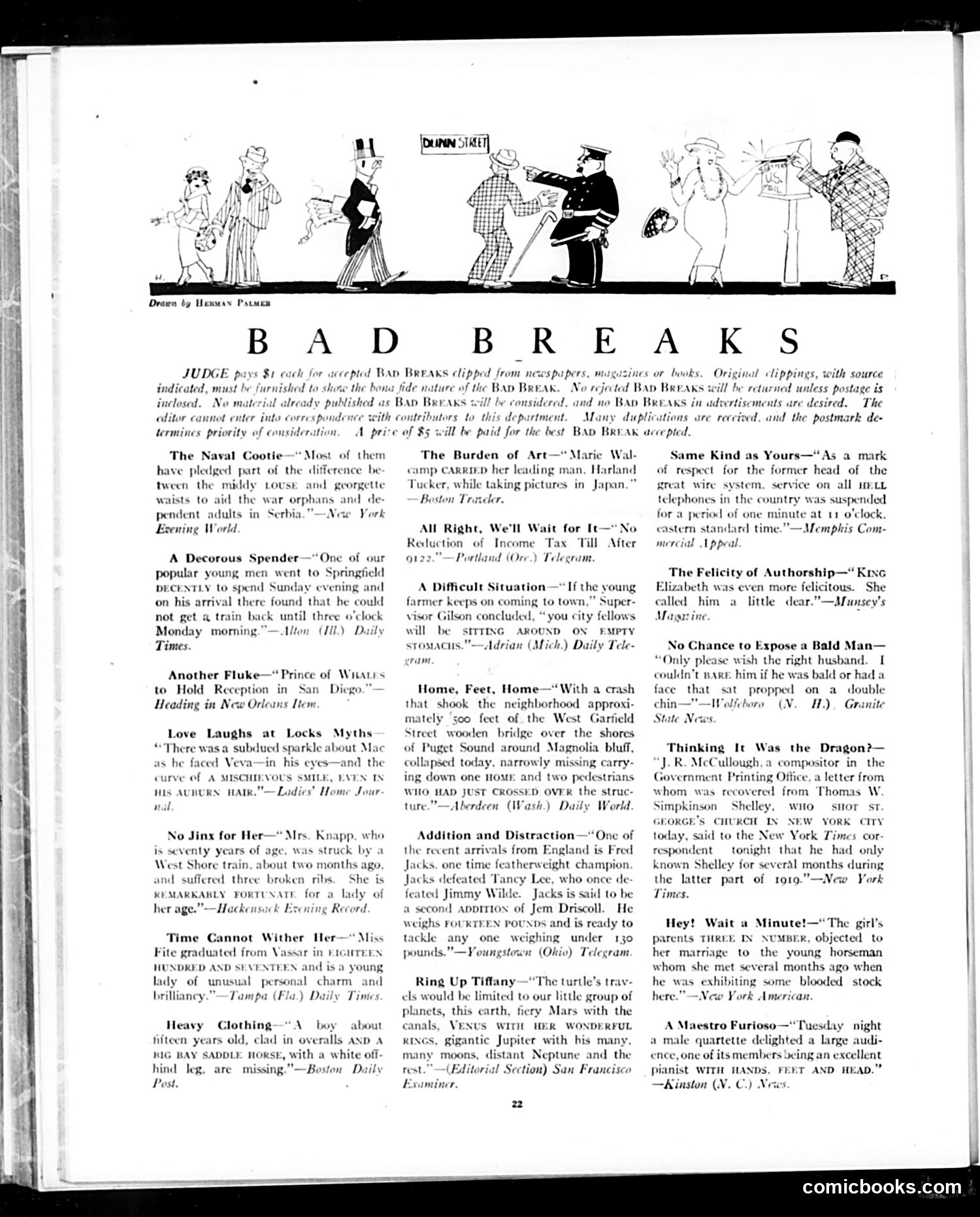
This page showcases "Bad Breaks"—a Judge magazine feature paying readers $1 for typographical errors and awkward phrasings clipped from newspapers. The cartoon header by Herman Palmer satirizes the concept with exaggerated newspaper characters and mishaps. The collected entries mock unintentionally absurd newspaper passages through humor. Examples include: a WWI-era reference to "naval lice" versus "georgette waists" for war relief; a train accident victim described as "remarkably fortunate" despite broken ribs; and a boxer weighing fourteen pounds claimed ready to fight opponents under 130 pounds. The satire targets newspapers' carelessness and the gap between intended and actual meaning. One entry jokes that a phone company suspended service for one minute at 11 o'clock—the timing's ambiguity creating absurdity. Another describes a seventy-year-old Vassar graduate from 1817, mathematically impossible. This feature exemplifies early 20th-century media criticism through crowd-sourced humor, celebrating readers who caught journalistic slip-ups.
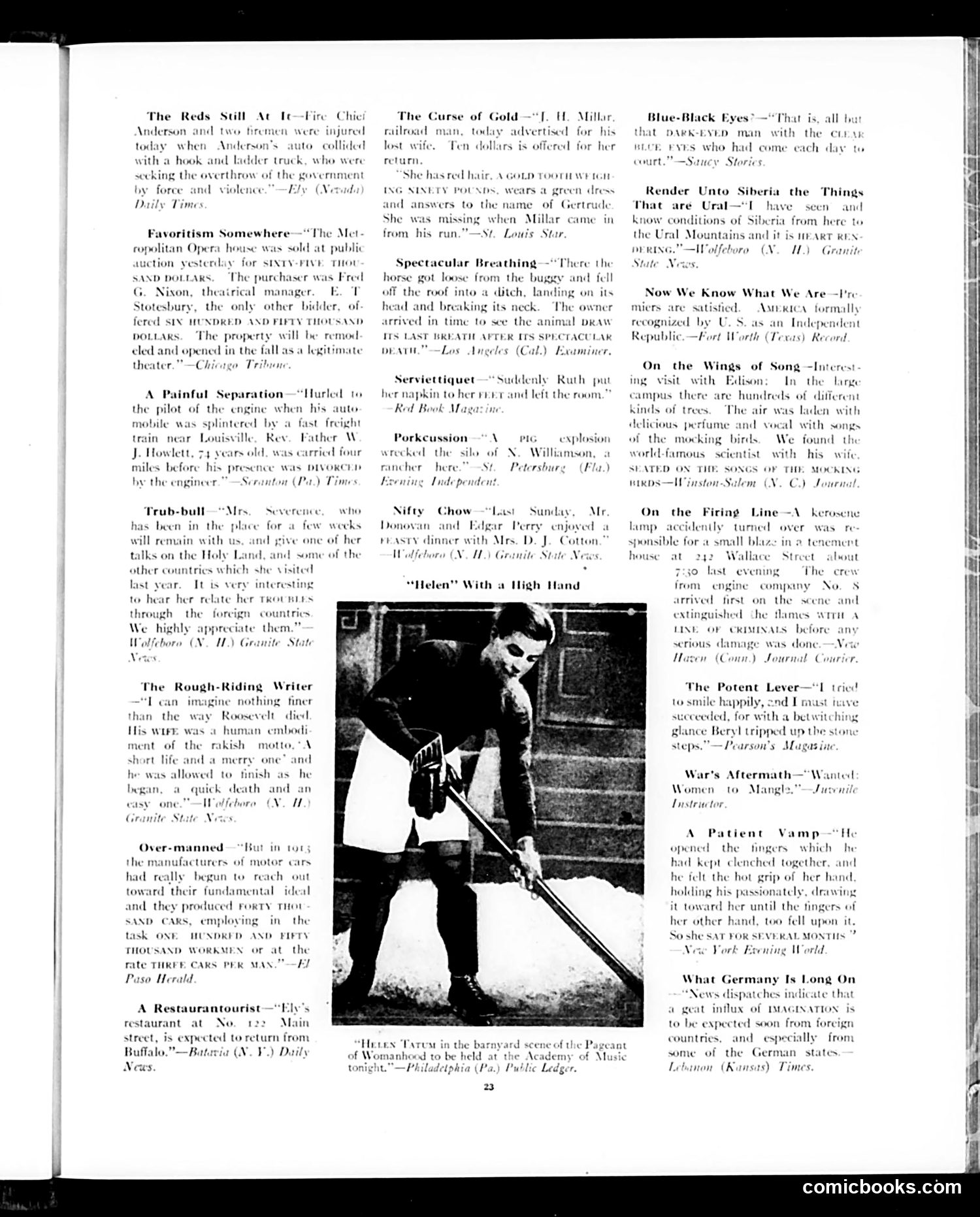
This page from *Judge* magazine contains brief humorous "news items" typical of early 20th-century satirical journalism—short, punchy observations on contemporary life presented as mock news briefs. The central image shows a woman in a theatrical pose with a sword or staff, illustrating "Helen" With a High Hand"—likely a reference to a contemporary stage production or society figure named Helen. The caption identifies this as related to a pageant at the Academy of Music. The surrounding text items mock various absurdities: a man advertising for his runaway wife by listing her "gold tooth" and eye color; a horse mysteriously falling off a roof; Theodore Roosevelt's "rough-riding" reputation; over-production in the automobile industry; and peculiar local incidents. The humor relies on incongruity and wordplay rather than specific political targets. These pieces reflect early 1900s American journalism's appetite for the oddball and ridiculous, presented as deadpan "news" from various newspapers.
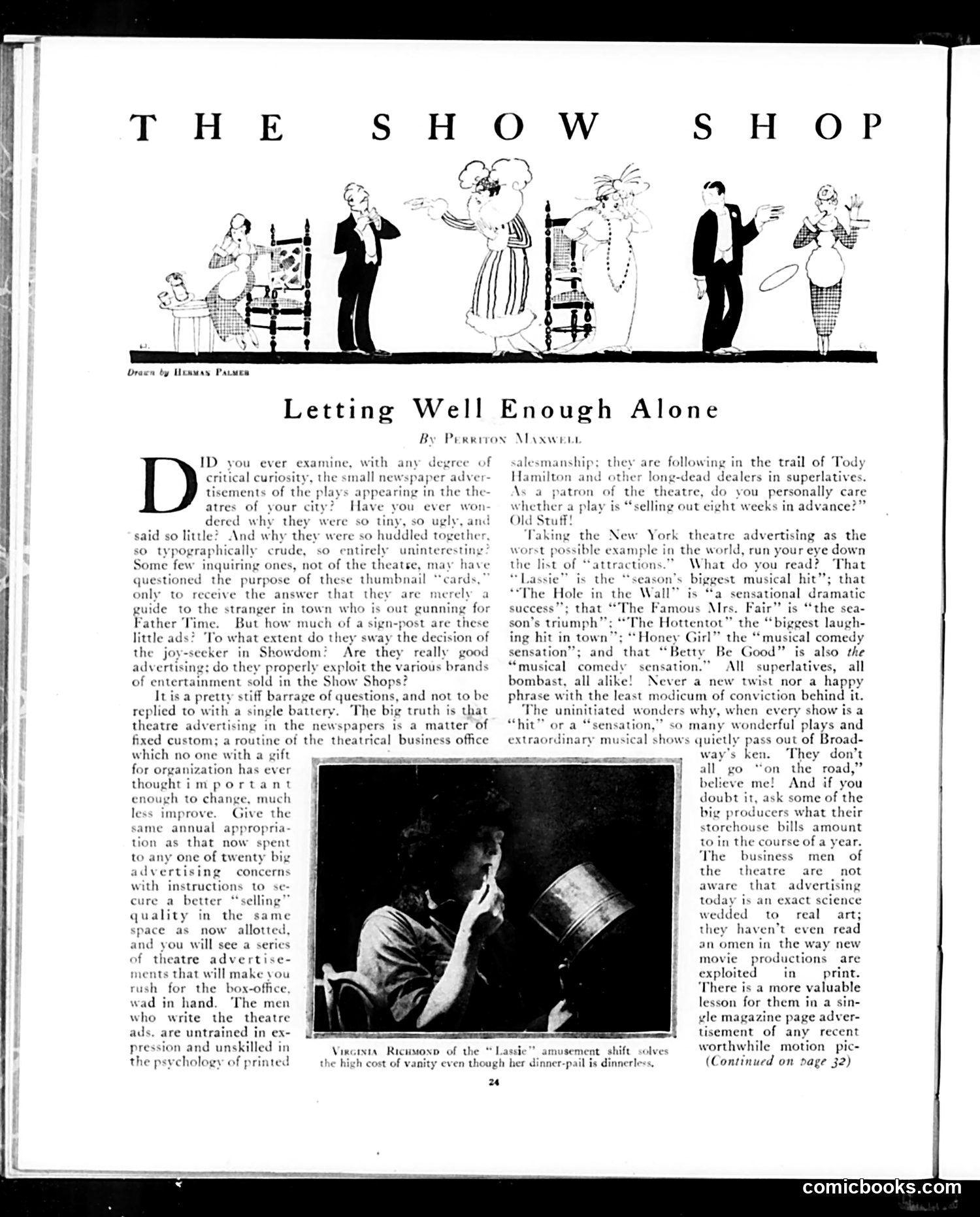
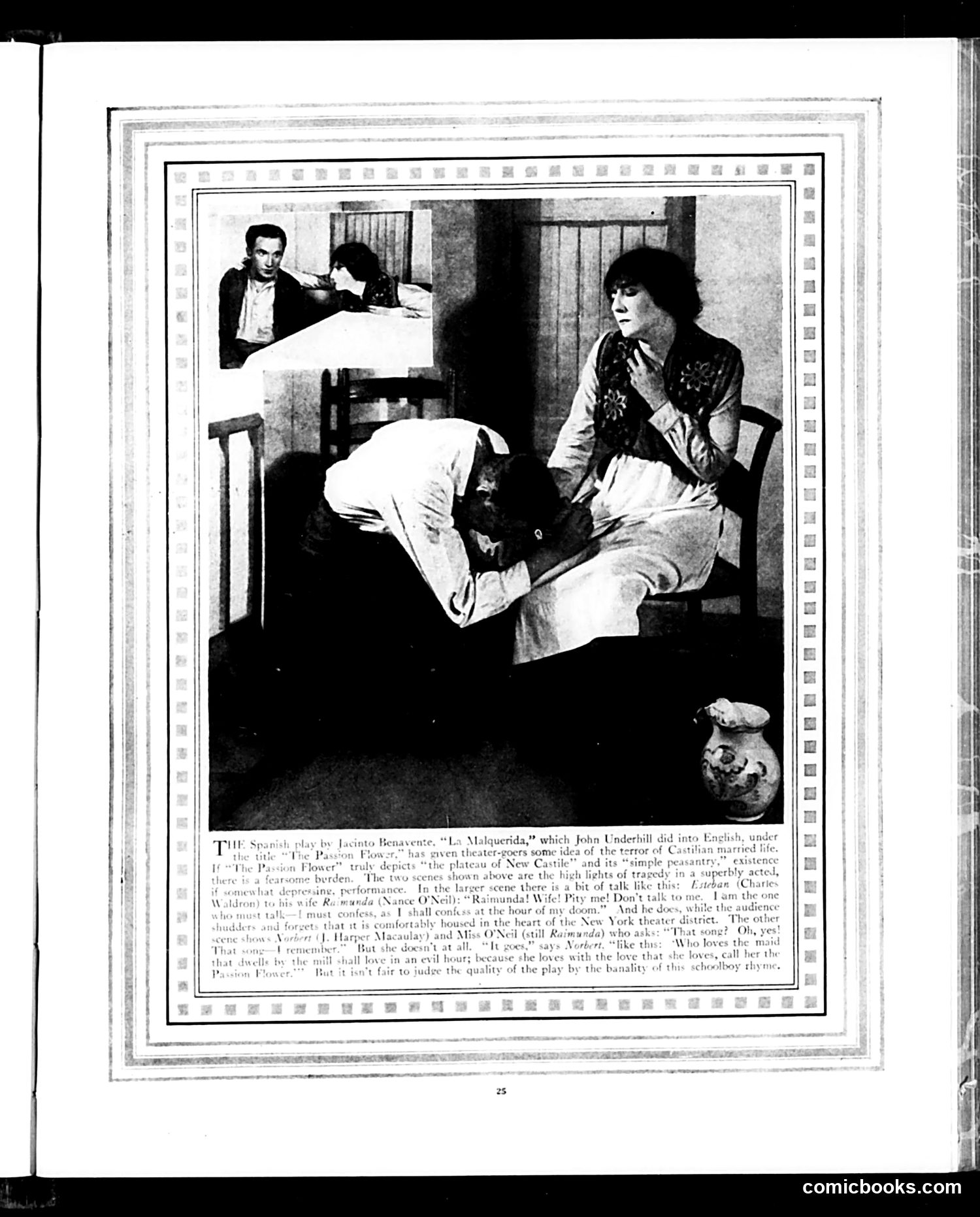
This article by Perriton Maxwell critiques how Broadway theatres advertise plays in newspapers. Maxwell argues that theatre ads are poorly designed, tiny, and filled with exaggerated claims—calling every show a "sensation," "biggest hit," or "musical comedy sensation" without distinction. The illustration depicts various theatrical figures and shows how advertisements use identical superlatives bombastically. Maxwell's point: this approach destroys credibility. He argues theatre owners haven't modernized their advertising methods, contrasting them unfavorably with movie studios, which use sophisticated advertising strategy combined with artistry. The photograph shows Virginia Richmond from "The Lassie," exemplifying the shows being promoted. Maxwell essentially accuses Broadway of lazy, old-fashioned marketing that fails to actually convince potential audiences—all superlatives alike ring hollow, making genuine hits indistinguishable from mediocre productions.
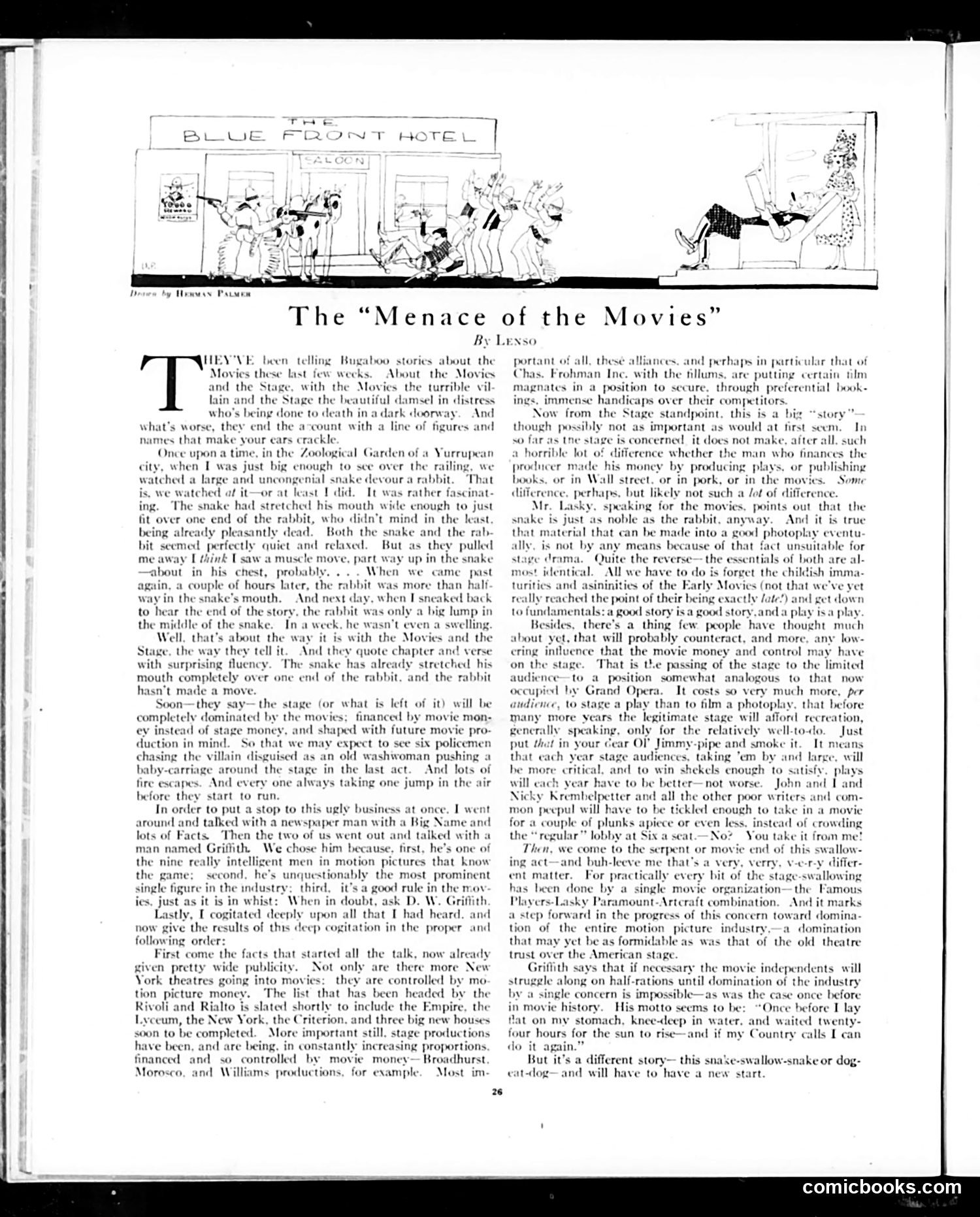
This page presents a satirical essay by Lexso debating whether movies threaten live theater's survival. The decorative header cartoon shows a crowded hotel lobby scene, illustrating the social upheaval the article discusses. The essay uses an extended metaphor: movies are a snake swallowing theater (the rabbit) whole—slowly but inevitably. The author interviewed D.W. Griffith, then cinema's most prominent figure, to explore whether stage productions will be completely absorbed by film industry financing and control. The specific concern: major New York theaters (Rivoli, Rialto, Empire, Lyceum) and stage producers (Broadhurst, Morosco, Williams) increasingly depend on movie money, giving film magnates unfair competitive advantages through "preferential bookings." The satire's point: Judge presents this "menace" somewhat tongue-in-cheek—acknowledging real economic shifts while questioning whether theatrical panic is proportional to actual threat. It's early 1920s anxiety about cinema's growing commercial dominance over traditional stage entertainment.
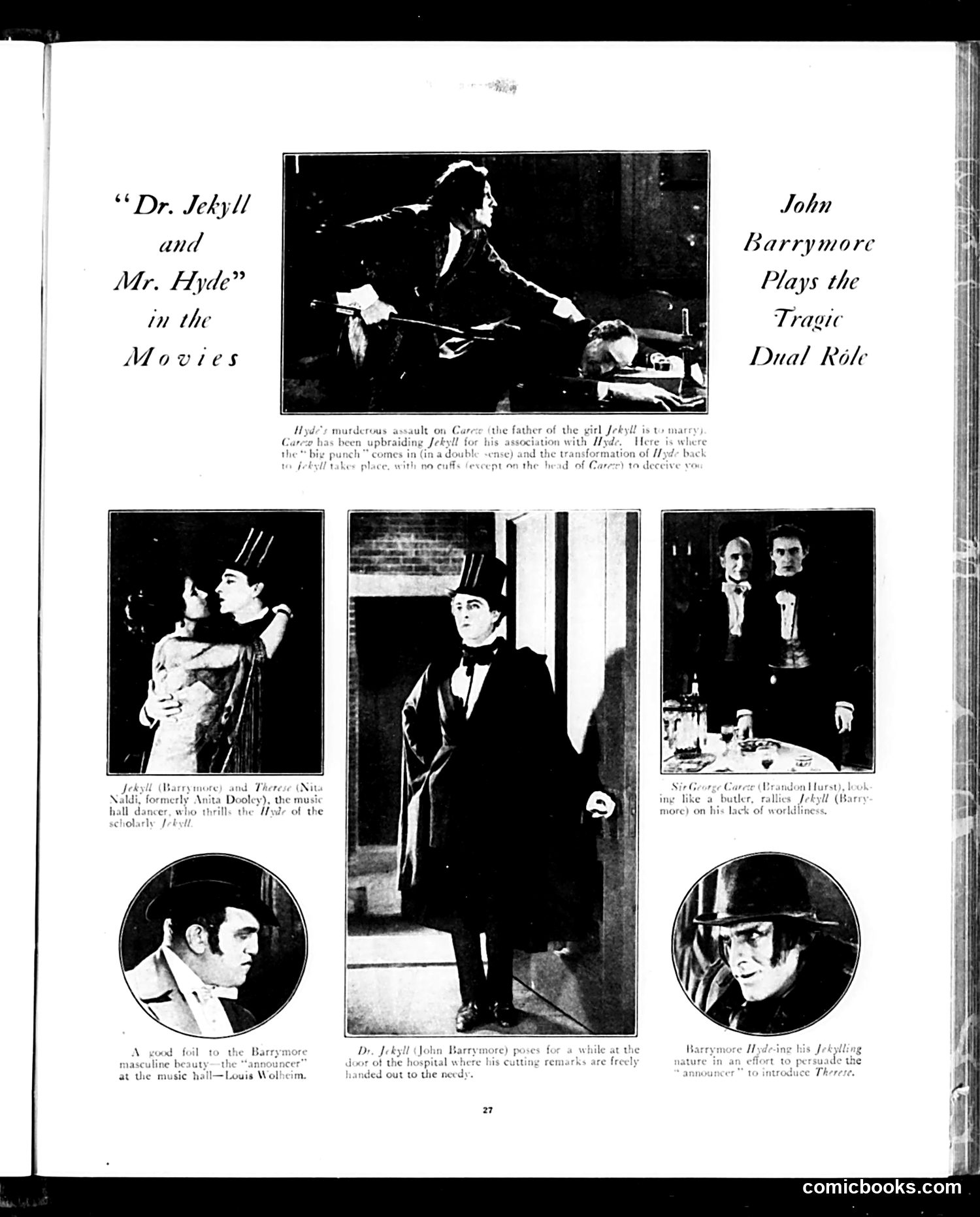
This page features John Barrymore's dual role performance in a film adaptation of Robert Louis Stevenson's classic novella. The images show Barrymore portraying both the respectable Dr. Jekyll and his evil alter ego Mr. Hyde across various scenes—including a confrontation, a hospital scene, and social situations. The commentary references the dramatic transformation between the two characters, with particular attention to the physical transformation of Hyde and Jekyll's internal conflict. The page appears to be a straightforward film review or promotional piece celebrating Barrymore's acting range in this famous dual role, rather than political satire. The images showcase key dramatic moments from the film adaptation.
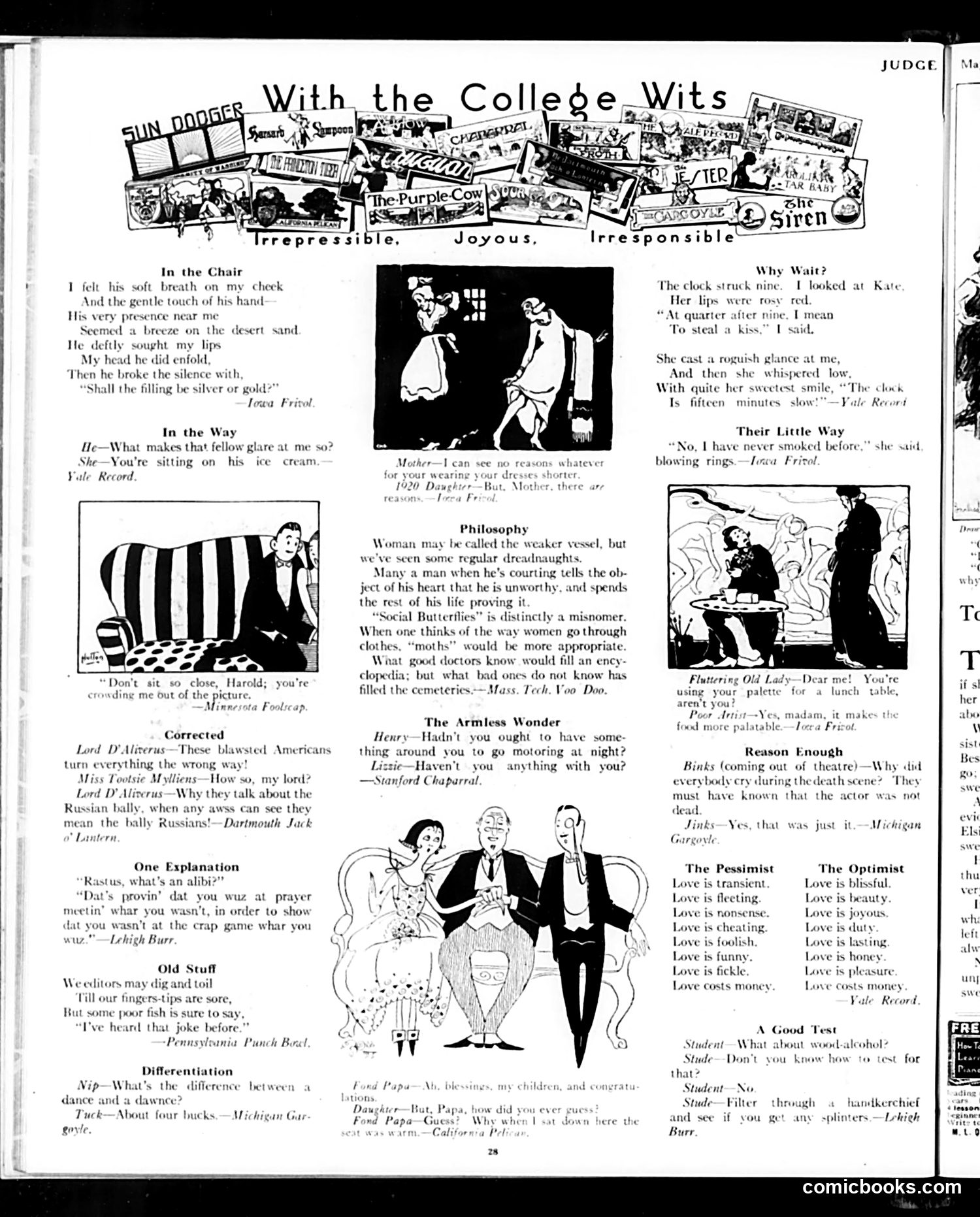
This page collects brief humorous sketches and jokes typical of early 20th-century college humor magazines. Rather than political cartoons, these are social comedies targeting courtship, class differences, and generational attitudes. Key pieces include: **"In the Chair"** — A romantic moment interrupted when the man asks about dental filling material (silver or gold), deflating the sentiment. **"Corrected"** — A British aristocrat ("Lord D'Aliverus") mocks Americans for mispronouncing "Russian bally" — likely satirizing both affected British speech and American ignorance of foreign affairs. **"Philosophy" section** — Observational humor about women as the "weaker vessel" yet "dreadnaughts," and mockery of courtship pretense. **"The Pessimist/Optimist"** — Contrasting perspectives on love (one cynical, one romantic) — likely satirizing college-age romantic idealism versus world-weary realism. The tone is lighthearted mockery of courtship customs, class pretension, and youthful attitudes — standard Judge magazine fare for educated, urban audiences of the era.
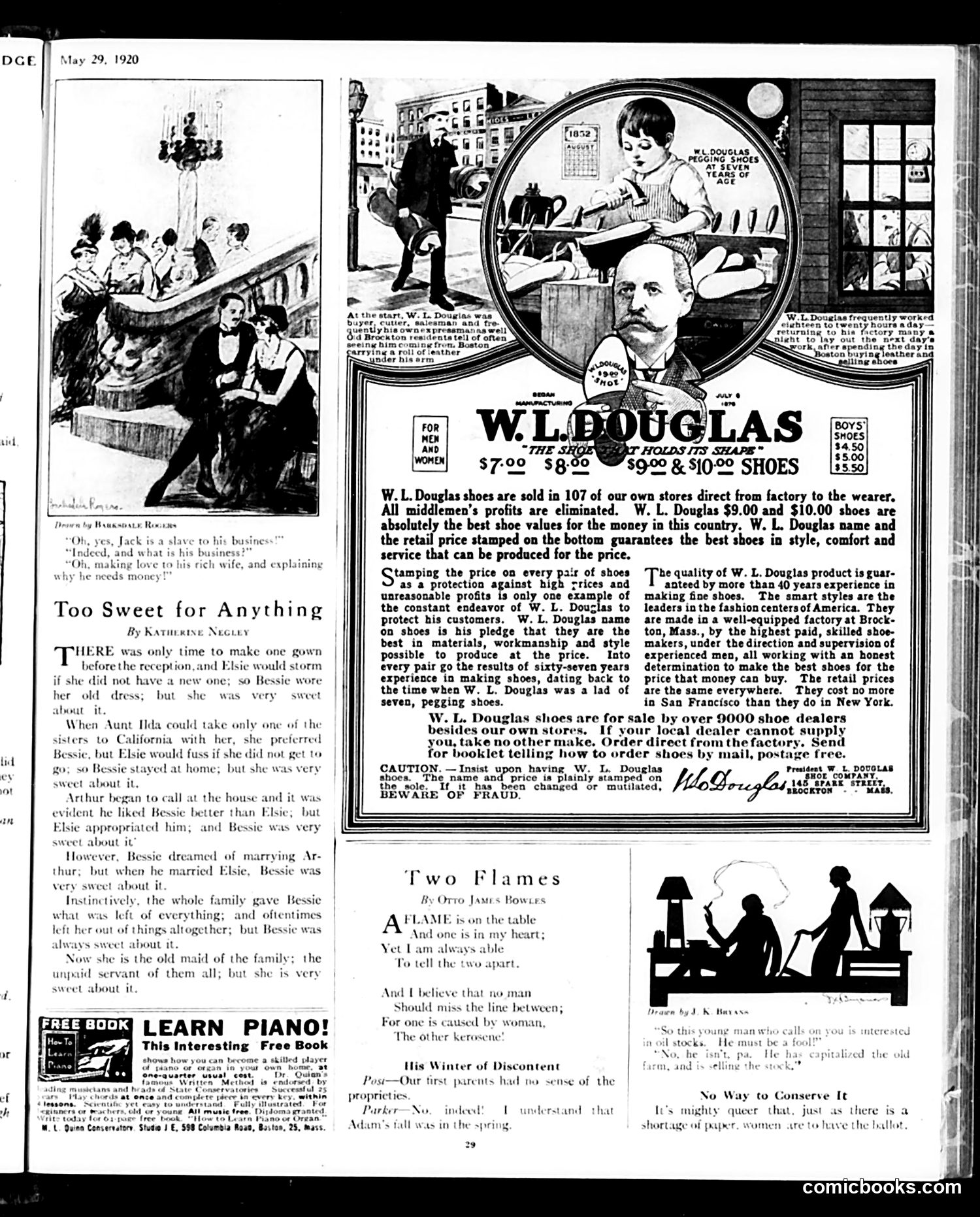
This May 29, 1920 *Judge* page is primarily **advertising-heavy**, dominated by a large W.L. Douglas shoe company advertisement. The page contains three minor literary pieces: 1. **"Too Sweet for Anything"** — A domestic satire about Bessie, a perpetually self-sacrificing sister who always acquiesces when her more demanding sister Elsie gets preferential treatment. The joke is that Bessie's eternal sweetness and lack of assertiveness result in her becoming the family's unpaid servant—a critique of excessive female passivity. 2. **"Two Flames"** — A brief humorous poem distinguishing between romantic passion ("flame in my heart") and literal fire (kerosene lamp), playing on double meaning. 3. **"His Winter of Discontent"** — A joke about Adam's fall occurring in spring rather than autumn, playing on seasonal wordplay. The main content is the shoe advertisement, which was common in *Judge*. No political satire or social commentary of note appears on this page.
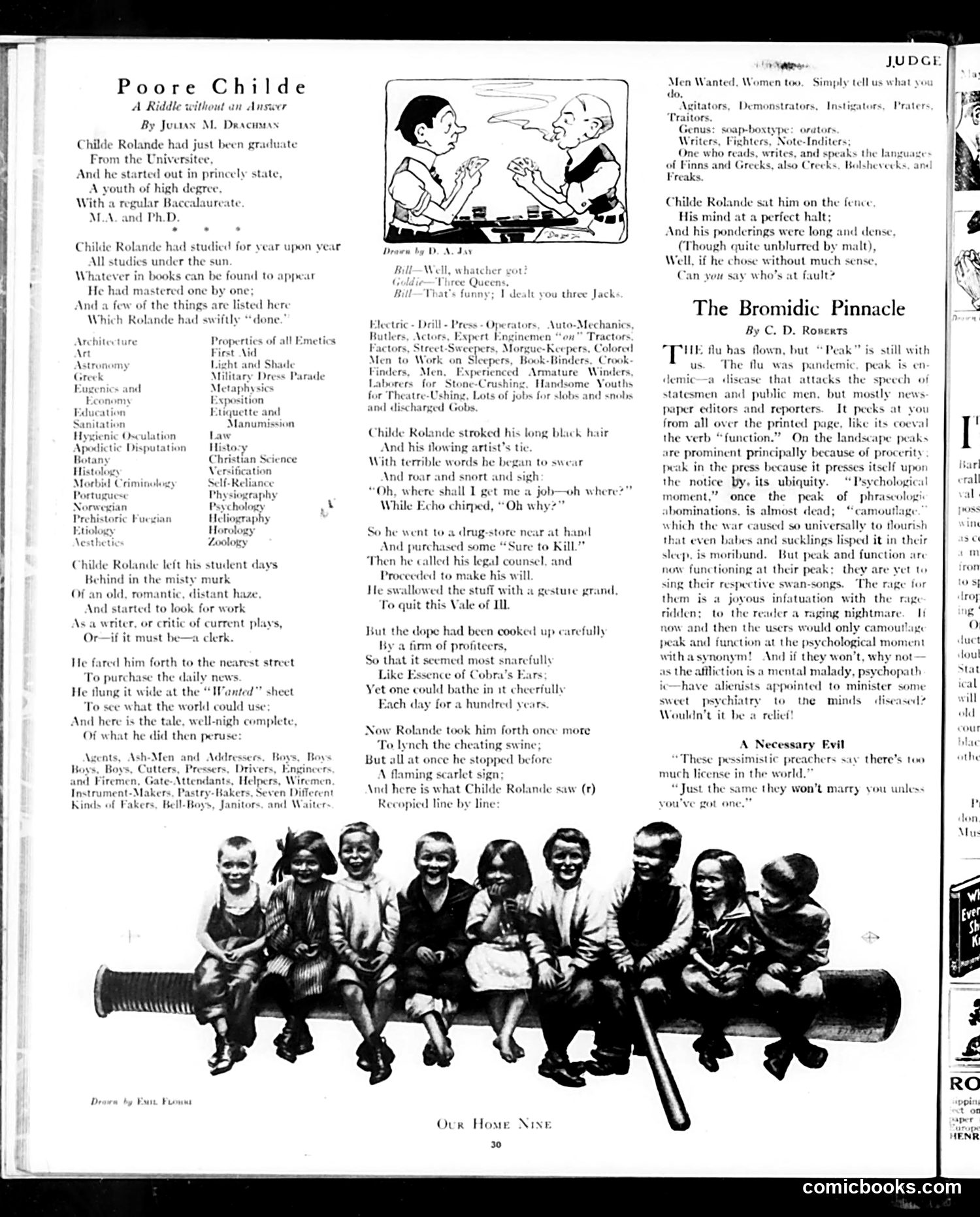
This satirical poem mocks the plight of an overqualified college graduate (Childe Rolande) unable to find work. Despite mastering numerous academic disciplines—from architecture to "Prehistoric Fuegian"—he discovers the job market offers only menial positions: street sweepers, butlers, gate attendants, and various laborers. The joke's bitterness emerges when, confronted with a help-wanted sign seeking "Men Wanted. Women too" for agitators, demonstrators, and "soap-box type orators," Rolande faces an impossible choice: accept humiliating work or embrace radical activism. The cartoon satirizes post-WWI economic conditions and the disconnect between university education and actual employment. It also subtly critiques radicalism as an "option" for desperate intellectuals—suggesting that agitation and political extremism appeal to the unemployed educated class. The dark humor culminates in his attempted suicide with poisoned "dope," reflecting genuine desperation beneath the satirical tone. This reflects genuine 1920s anxieties about unemployment and social instability.
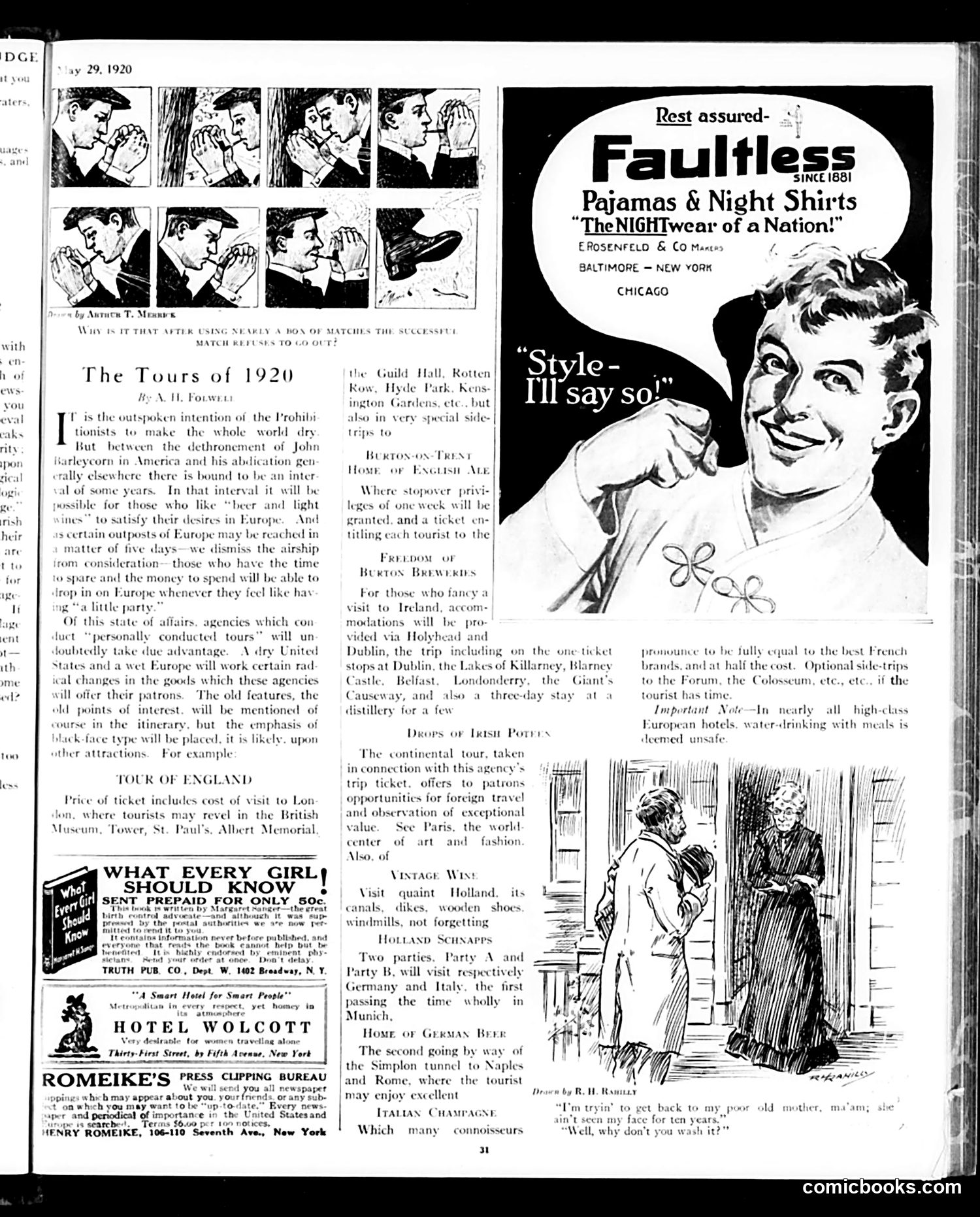
This page satirizes how American travel agencies will adapt to Prohibition (which took effect in 1920). The article by A.H. Fowler jokes that since the U.S. is going "dry," wealthy Americans seeking alcohol will take "personally conducted tours" to Europe—specifically to beer gardens in England, breweries in Burton-on-Trent, Irish distilleries, and champagne regions in Italy and France. The humor lies in the frank acknowledgment that tourism will now be *openly organized around drinking*. Travel agencies will pivot from traditional sightseeing (museums, cathedrals) to what the text sarcastically calls "points of interest"—essentially alcohol tourism. The cartoon at top (by Alonzo T. Moores) appears to show frustration, likely illustrating the absurdity of Prohibition's consequences. The satire assumes readers understand that Prohibition, while legally banning alcohol in America, cannot stop Americans from traveling abroad to drink legally.
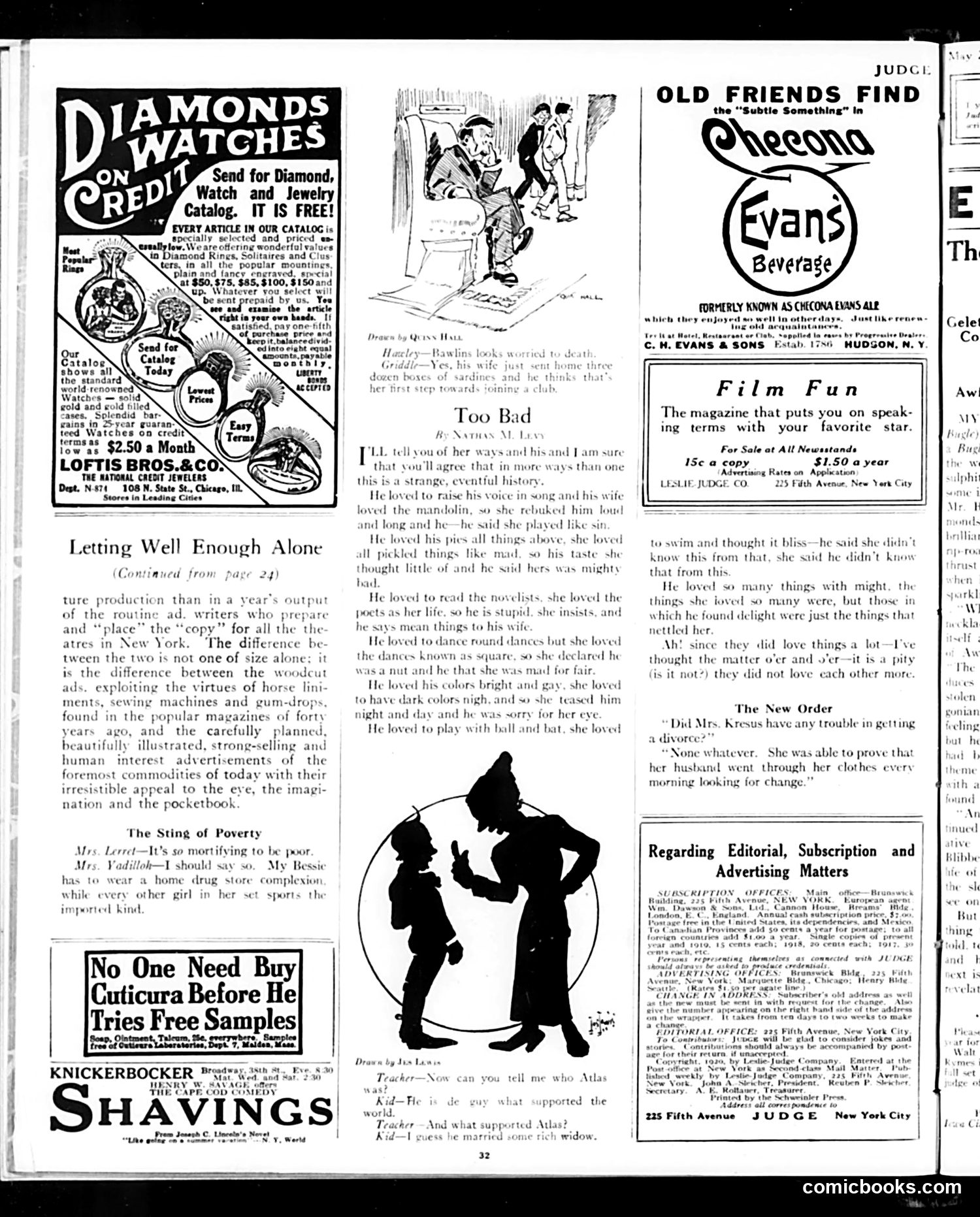
This page is primarily **advertising and advice columns** rather than political satire. The main content includes: **Advertisements:** Diamond watches/jewelry (Loewi Bros.), Cuticura products, Knickerbocker Shaggings film, Cheeona Evans beverage, and Film Fun magazine. **Humorous Short Features:** - "Too Bad" — a domestic comedy about a married couple with incompatible tastes (he loves singing/mandolin/pies; she prefers pickled things/novels/square dancing). The joke: despite loving "things," they don't love each other. - "The Sting of Poverty" — brief class-consciousness humor about a poor girl wearing home-dyed stockings while peers wear store-bought. - A teacher-student exchange about Atlas supporting the world, with the punchline that Atlas "married some rich widow" (plays on "support"). **Context for modern readers:** These are gentle domestic humor and light social commentary typical of early 20th-century magazines—poking fun at marriage mismatches and class anxieties without serious political edge.
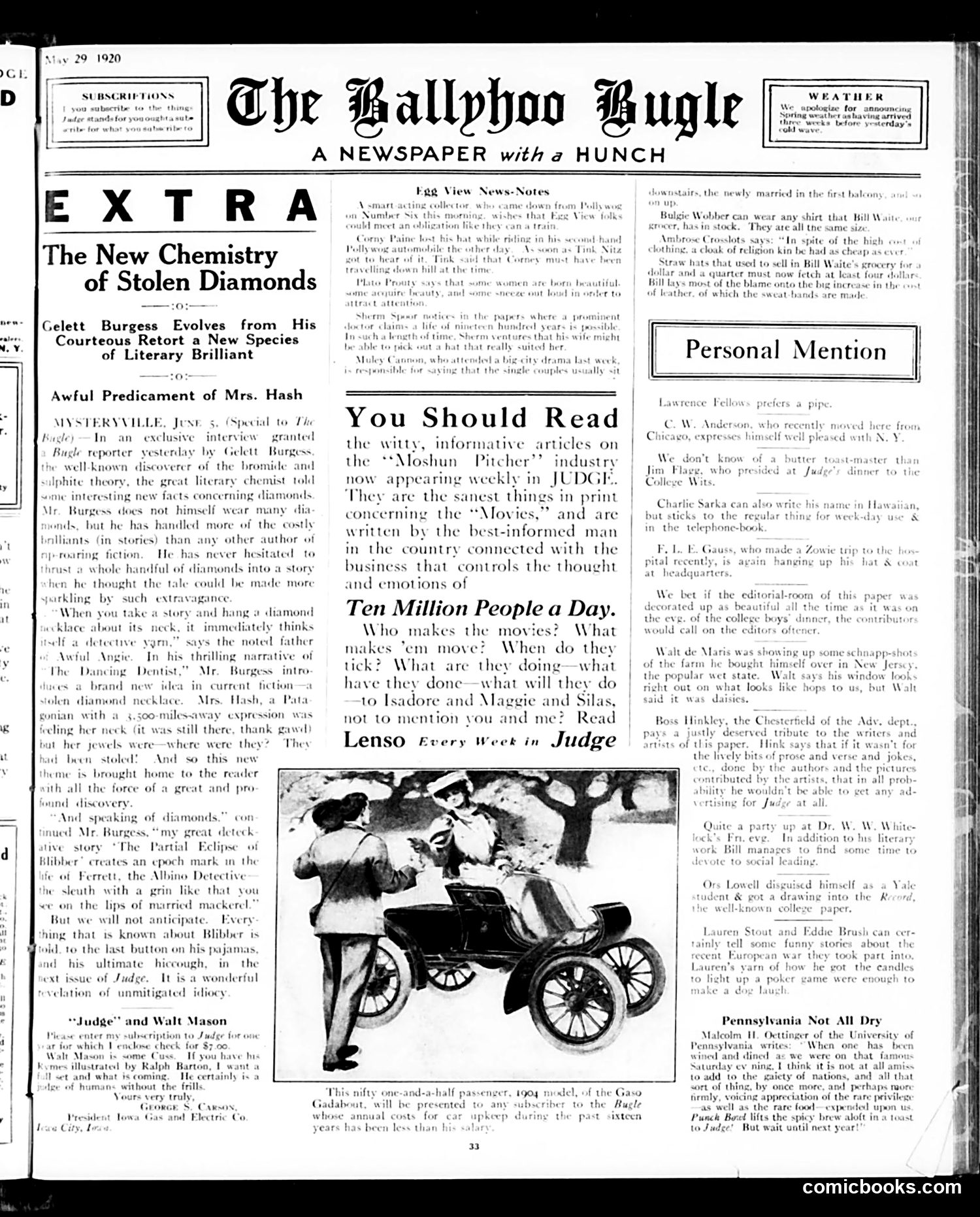
This page features **Gelett Burgess**, a real humorist and author, discussing "The New Chemistry of Stolen Diamonds"—a humorous literary concept. Burgess playfully explains how inserting stolen diamonds into detective stories automatically makes them more exciting, using absurdist logic typical of the magazine's satirical style. The main illustration shows a **vintage 1904 Gainsvoort automobile**, presented as a humorous visual gag related to the "Ten Million People a Day" section about movies and modern life. The page mixes genuine celebrity profiles with mock-serious commentary on contemporary entertainment (the movie industry's influence on "thought and emotions"). The personal mention section offers light gossip about local figures. A notable letter from "Pennsylvania" jokes about the state's Prohibition enforcement—claiming that despite dry laws, abundant alcohol remains available—a satirical jab at the hypocrisy and ineffectiveness of Prohibition, recently enacted in 1920. The overall tone reflects Judge's characteristic blend of literary wit, celebrity culture coverage, and social commentary on modern American life.
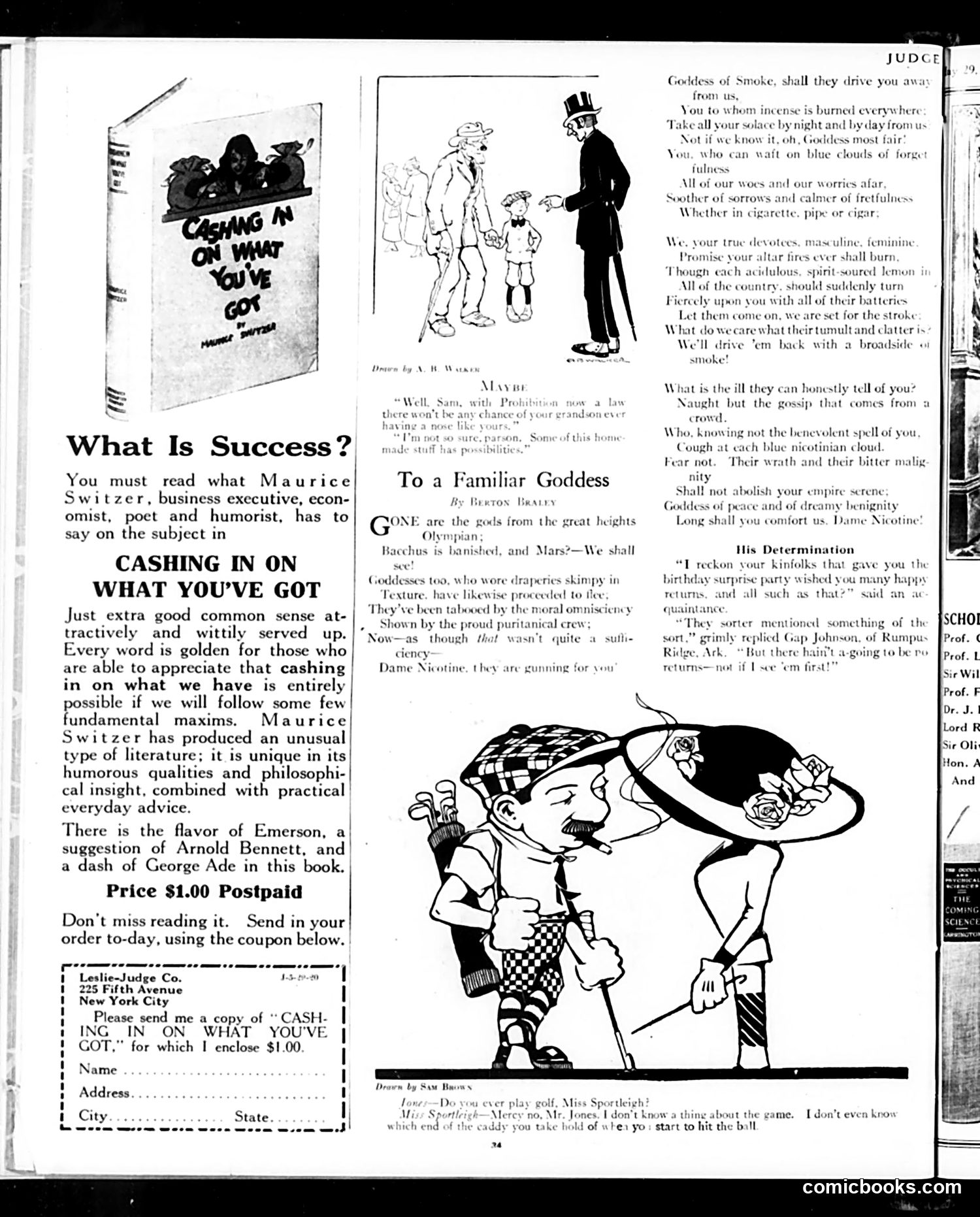
This page primarily advertises Maurice Switzer's book **"Cashing in on What You've Got,"** promoting it as practical wisdom with literary merit (compared to Emerson, Arnold Bennett, and George Ade). The satirical content includes two pieces: 1. **"To a Familiar Goddess"** (poem by Berton Braley): A mock-heroic defense of **tobacco/smoking** against Prohibition-era morality campaigns. The "Goddess" is personified nicotine. The satire mocks puritanical anti-smoking crusaders by presenting smokers as devoted "devotees" willing to defend their habit against moral attacks. This reflects early 20th-century resistance to anti-tobacco movements. 2. **"His Determination"** (cartoon): A brief joke about a man whose relatives gave him a birthday surprise party; he's determined they won't see him again—unclear specific reference, but typical period humor about unwanted social obligations. The page reflects 1920s-era attitudes: commercialism framed as philosophy, and satire defending recreational vices against growing reform movements.
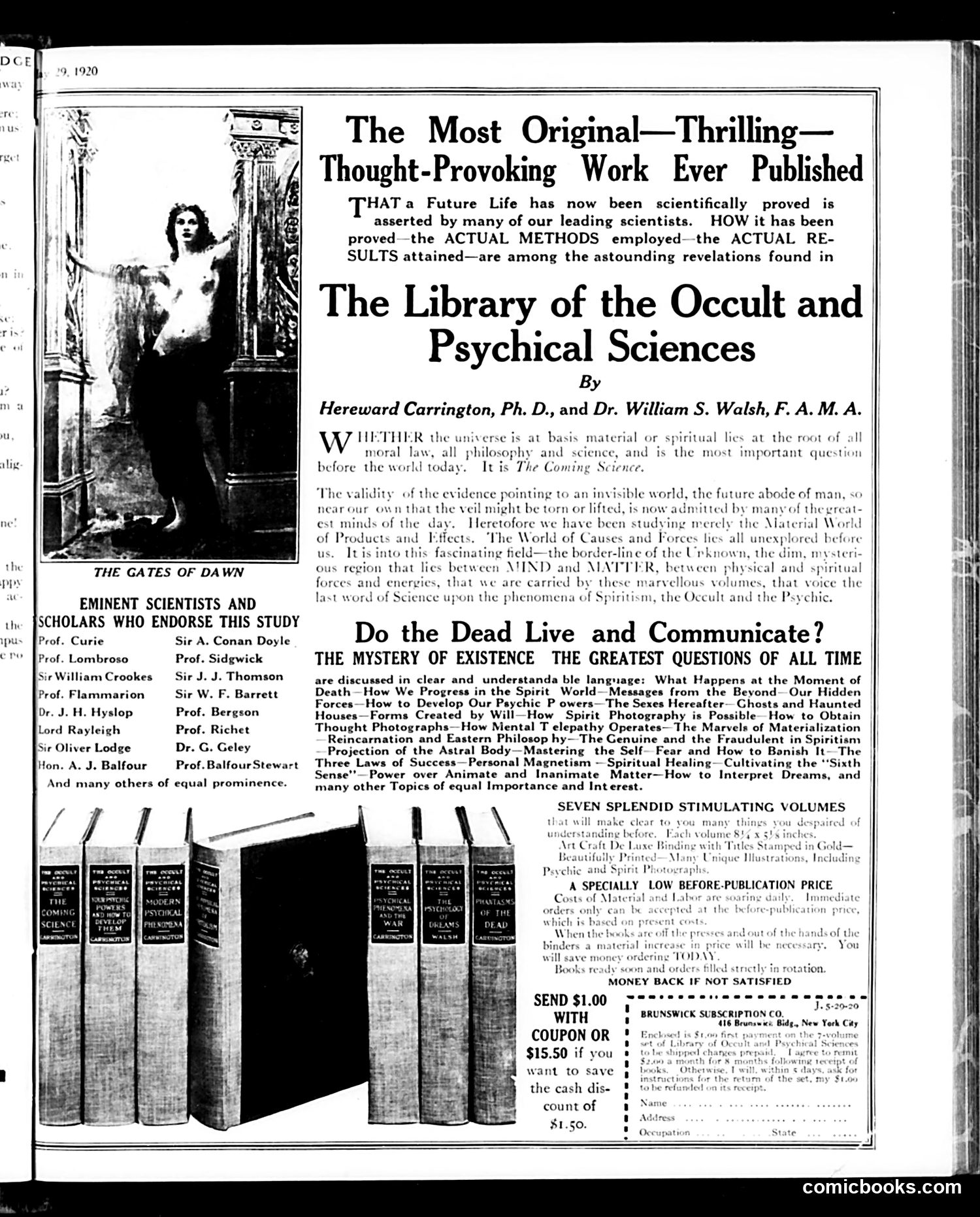
This is primarily a **book advertisement**, not a political cartoon. It promotes a seven-volume set on spiritualism and psychical research by Hereward Carrington and William S. Walsh. The satire lies in the **credulous endorsement strategy**: the ad lists genuinely eminent scientists (Sir Arthur Conan Doyle, Sir Oliver Lodge, Marie Curie) who were actually interested in spiritualism—a pseudoscience now thoroughly discredited. By 1920, spiritualism was already considered dubious by mainstream science, though it retained wealthy, educated adherents. The accompanying illustration ("The Gates of Dawn") depicts a ghostly female figure, reinforcing the supernatural claims. The ad's breathless language—"astounding revelations," "scientifically proved"—combined with the legitimate names creates false authority. **The satire**: Judge magazine mocks how pseudoscientific works exploit the reputations of real scientists to sell occult books to gullible readers, even as those scientists' credibility was questionable on this topic.
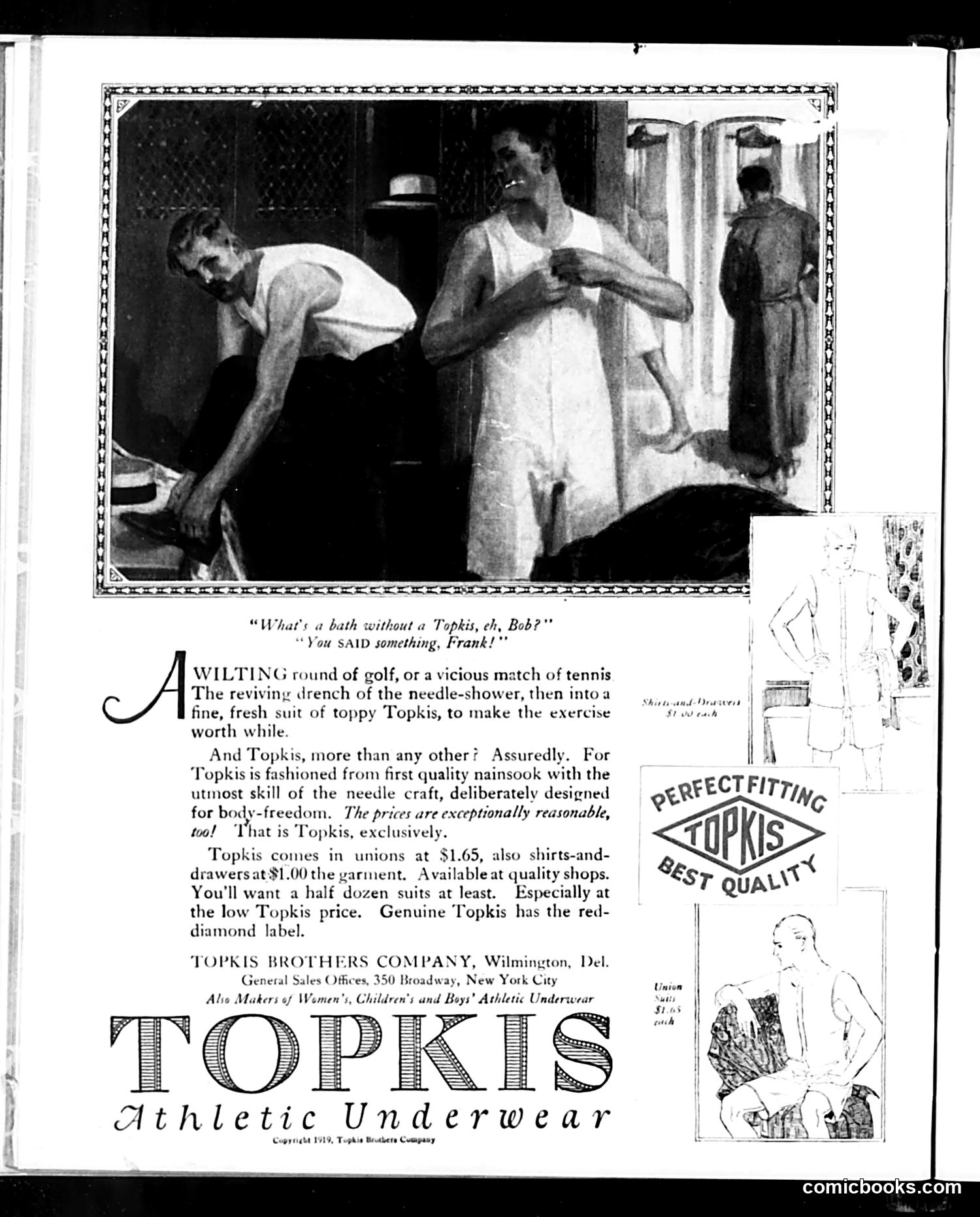
This is primarily a **product advertisement**, not political satire. The page promotes Topkis brand athletic underwear through Judge magazine. The scene depicts two men (Frank and Bob) showering after sports—golf or tennis—to establish the product's athletic context. The ad emphasizes that Topkis underwear provides "body-freedom" and comfort for active men, making post-exercise freshness worthwhile. The humor is gentle: the dialogue suggests that proper underwear is essential to enjoying athletic activity, a common advertising trope of the era. Prices are listed ($1.65 for unions, $1.00 for shirts-and-drawers), positioning the product as affordable quality goods. This reflects early-20th-century marketing strategies: using Judge's satirical platform to reach educated, affluent male readers by associating the product with leisure activities (golf, tennis) and masculine vitality. The "red-diamond label" serves as the brand's authentication mark.