
Judge, 1920-05-29 · page 26 of 36
Judge — May 29, 1920 — page 26: what you’re looking at
What you’re looking at
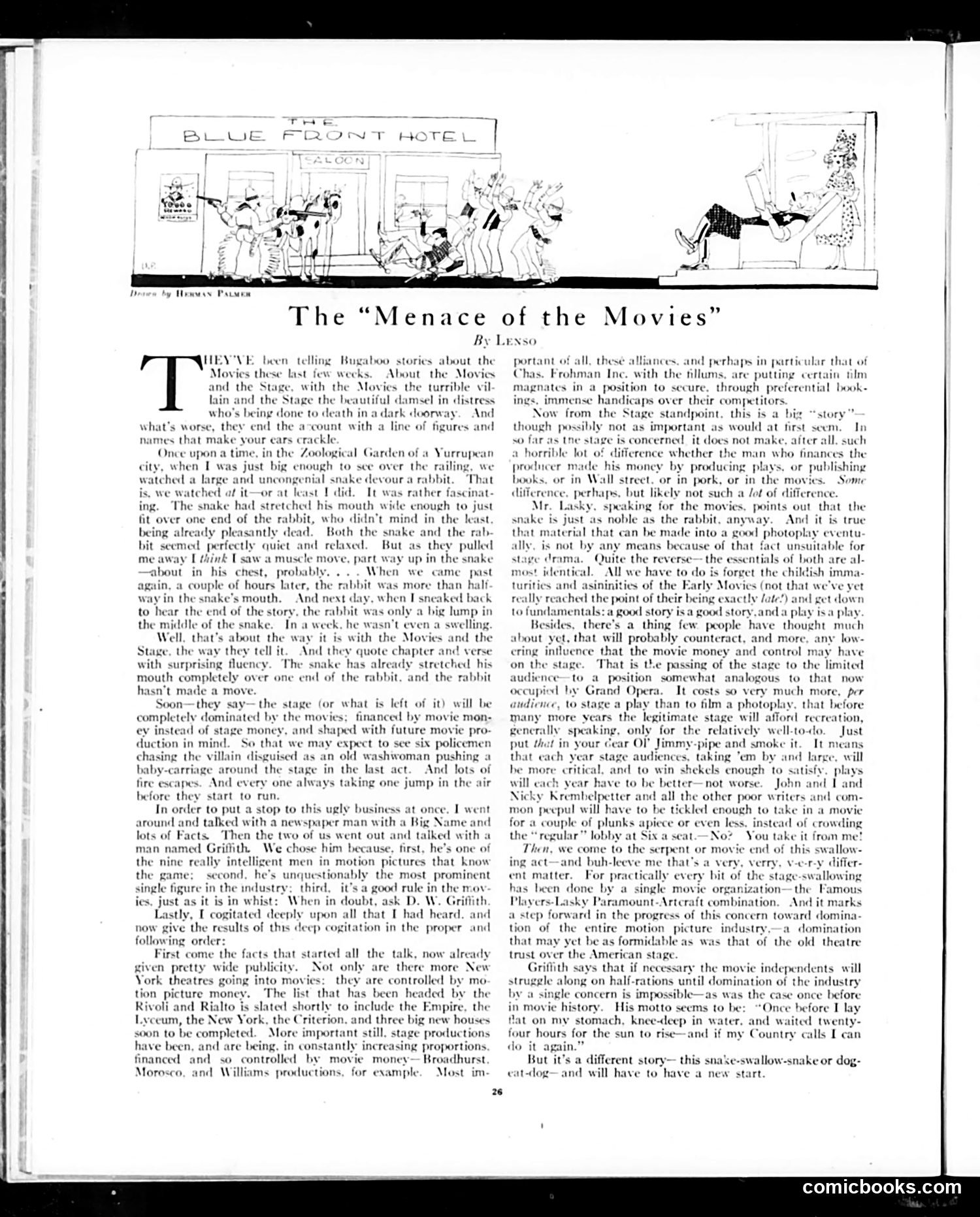
This page presents a satirical essay by Lexso debating whether movies threaten live theater's survival. The decorative header cartoon shows a crowded hotel lobby scene, illustrating the social upheaval the article discusses. The essay uses an extended metaphor: movies are a snake swallowing theater (the rabbit) whole—slowly but inevitably. The author interviewed D.W. Griffith, then cinema's most prominent figure, to explore whether stage productions will be completely absorbed by film industry financing and control. The specific concern: major New York theaters (Rivoli, Rialto, Empire, Lyceum) and stage producers (Broadhurst, Morosco, Williams) increasingly depend on movie money, giving film magnates unfair competitive advantages through "preferential bookings." The satire's point: Judge presents this "menace" somewhat tongue-in-cheek—acknowledging real economic shifts while questioning whether theatrical panic is proportional to actual threat. It's early 1920s anxiety about cinema's growing commercial dominance over traditional stage entertainment.
📄 Transcribed text from this page (OCR, searchable)
Machine-transcribed from the original scan — historical spelling and the odd misread are preserved.
The “Menace of the Movies” By Lexso HEY'VE been telling Bugaboo stories about the Movies these last few weeks. About the Movies and the Stage, with the Movies the turrible vil lain and the Stage the beautiful damsel in distress who's being done to death in adark doorway. And what's worse, they end the account with a line of figures and names that make your cars crackle. Once upon a time, in the Zoological Garden of a Yurrupean city, when T was just big enough to sce over the railing, we watched a large and uncongenial snake devour a rabbit. That is. We watched af it at least Edid. It was rather fascinat- ing. The snake had stretched his mouth wide enough to just fit over one end of the rabbit, who didn’t mind in the least. being already pleasantly dead. Both the snake and the rab bit seemed perfectly quiet and relaxed. But as they pulle me away I tink Lsaw a muscle move, part way up in the snake bout in his chest, probably. ... When we came past again, a couple of hours later, the rabbit was more than half way in the snake’s mouth. And next day, when I sneaked back to hear the end of the story. the rabbit was only a big lump in the middle of the snake. In a week, he wasn’t even a swelling Well, that’s about the way it is with the Movies and the Stage. the way they tell it. And they quote chapter and verse with surprising fluency. The snake has already’ stretched his mouth completely over one end of the rabbit. and the rabbit hasn't made a move. Soon—they say—the stage (or what is left of it) will be completely dominated by the movies; financed by movie mon- ey instead of stage money, and shaped with future movie pro- duction in mind. So that we may expect to see six policemen chasing the villain disguised as an old washwoman pushing a baby-carriage around the stage in the last act. And lots of fire escapes. And every one always taking one jump in the air before they start to run, In order to put a stop to this ugly business at once. I went around and talked with a newspaper man with a Big Name and lots of Facts Then the two of us went out and talked with a man named Griffith, We chose him because, first, he’s one of the nine really intelligent men in motion pictures that know the game; second, he’s unquestionably the most prominent single figure in the industry: third, it’s a good rule in the mov ies. just as it is in whist: When in doubt, ask D. W. Griffith Lastly, [ cogitated deeply upon all that [ had heard. and now give the results of this deep cogitation in the proper and following order: First come the facts that started all the talk, now alre given pretty wide publicity. Not only are there more } York theatres going into movies: they are controlled by mo tion picture money. The list that has been headed by the Rivoli and Rialto is slated shortly to include the Empire, the Lyceum, the New York, the Criterion, and three big new houses soon to be completed. More important still, stage productions have been, and are being, in constantly increasing proportions. financed and so controlled by movie money— Broadhurst Morosco, and Williams productions, for example. Most im- dy ew portant of all, thesé alliances. and perhaps in particular that of Chas. Frohman Ine. with the fillums, are putting certain tilm magnates in a position to sccure. through preferential book- ings. immense handicaps over their competitors. Now from the Stage standpoint. this is a big “story though possibly not as important as would at first seem. In so far as tne stage is concerned it does not make, after all. such horrible lot of difference whether the man who finances the producer made his money by producing plays. or publishing books. or in Wall street. or in pork, or in the movies. Some difference, perhaps, but likely not such a /ot of difference. Mr. Lasky, speaking for the movies. points out that the snake is just as noble as the rabbit, anyway. And it is true that material that can be made into a good photoplay eventu: ally, is not b means because of that fact unsuitable for © drama. Quite the reverse— the essentials of both are al- + identical. All we have to do is forget the childish imma turities and asininities of the Early Movies (not that we've yet really reached the point of their being exactly /ate!) and get down to fundamentals: a good story isa good story,and a play isa f Besides, there’s a thing few people have thought much about yet, that will probably counteract, and more, any low- ering influence that the movie money and control may have on the stage. That is the passing of the stage to the limited audience—to a position somewhat analogous to that now occupied by Grand Opera. It costs so very much more, per audience, to stage a play than to film a photoplay, that before many more years the legitimate stage will afford recreation, generally speaking, only for the relatively well-to-do. Just put thet in your Cear OF Jimmy-pipe and smoke it. It means that each year stage audiences, taking ’em by and large, will he more critical, and to win shekels cnough to satisfy. plays will cach year have to be better—not worse. John and T and Nicky Krembelpetter and all the other poor writers and com- mon pecpul will have to be tickled enough to take in a movie for a couple of plunks apiece or even less. instead of crowding the “regular” lobby at Six a seat—No? You take it from me! Then, we come to the serpent or movie end of this swallow- ing act—and buh-leeve me that’s a very, verry, v-e-r-y differ- ent matter. practically every bit of the stage-swallowing has been done by a single movie organization—the Famous Players-Lasky Paramount-Artcraft combination. And it marks a step forward in the progress of this concern toward domina tion of the entire motion picture industry—a domination that may yet be as formidable as was that of the old theatre trust over the American stage iffith says that if necessary the movie independents will gle along on half-rations until domination of the industry by a single concern is impossible—as was the case once before in movie history. His motto seems to be: “Once before I lay flat on my stomach, knee-deep in water. and waited twenty- four hours for the sun to rise—and if my Country calls I can > it again.” But it’s a different story— this snase-swallow-snake or dog- cat-dog—and will have to have a new start. comicbooks.com