
A complete issue · 36 pages · 1920
Judge — February 28, 1920
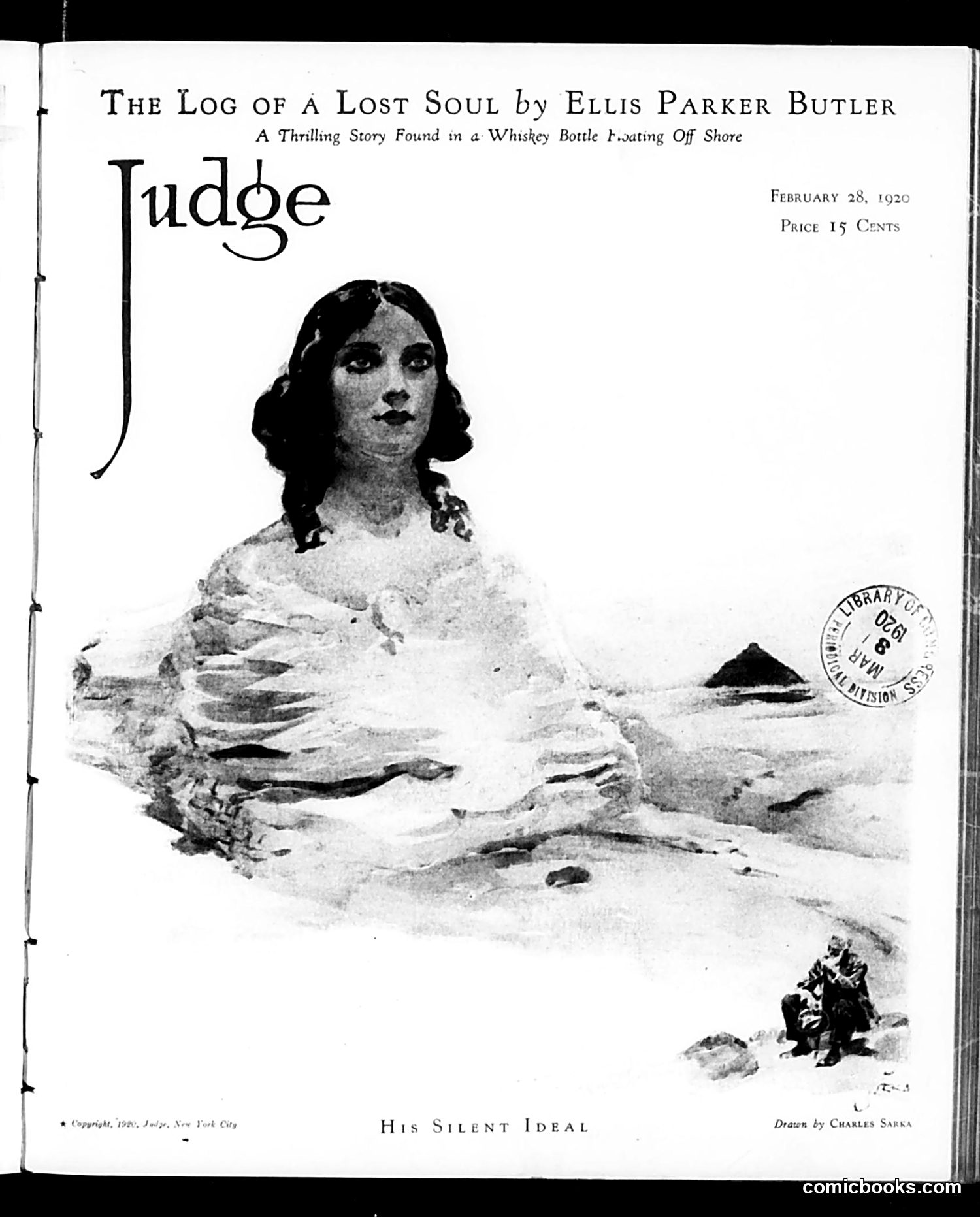
This is the cover of Judge magazine (February 28, 1920, 15 cents). The main illustration, titled "His Silent Ideal," is drawn by Charles Sarka and accompanies a story by Ellis Parker Butler called "The Log of a Lost Soul" — described as "A Thrilling Story Found in a Whiskey Bottle Floating Off Shore." The image shows a woman's portrait superimposed over a desolate rocky coastal landscape with a bottle. The artwork appears to be romantic or melodramatic in nature, typical of pulp fiction covers of the era. Without additional context from Butler's actual story, the specific satirical point remains unclear, though the juxtaposition of an idealized woman with shipwreck imagery suggests themes of lost love or impossible romance — common subjects for Judge's humorous commentary on sentimental fiction.
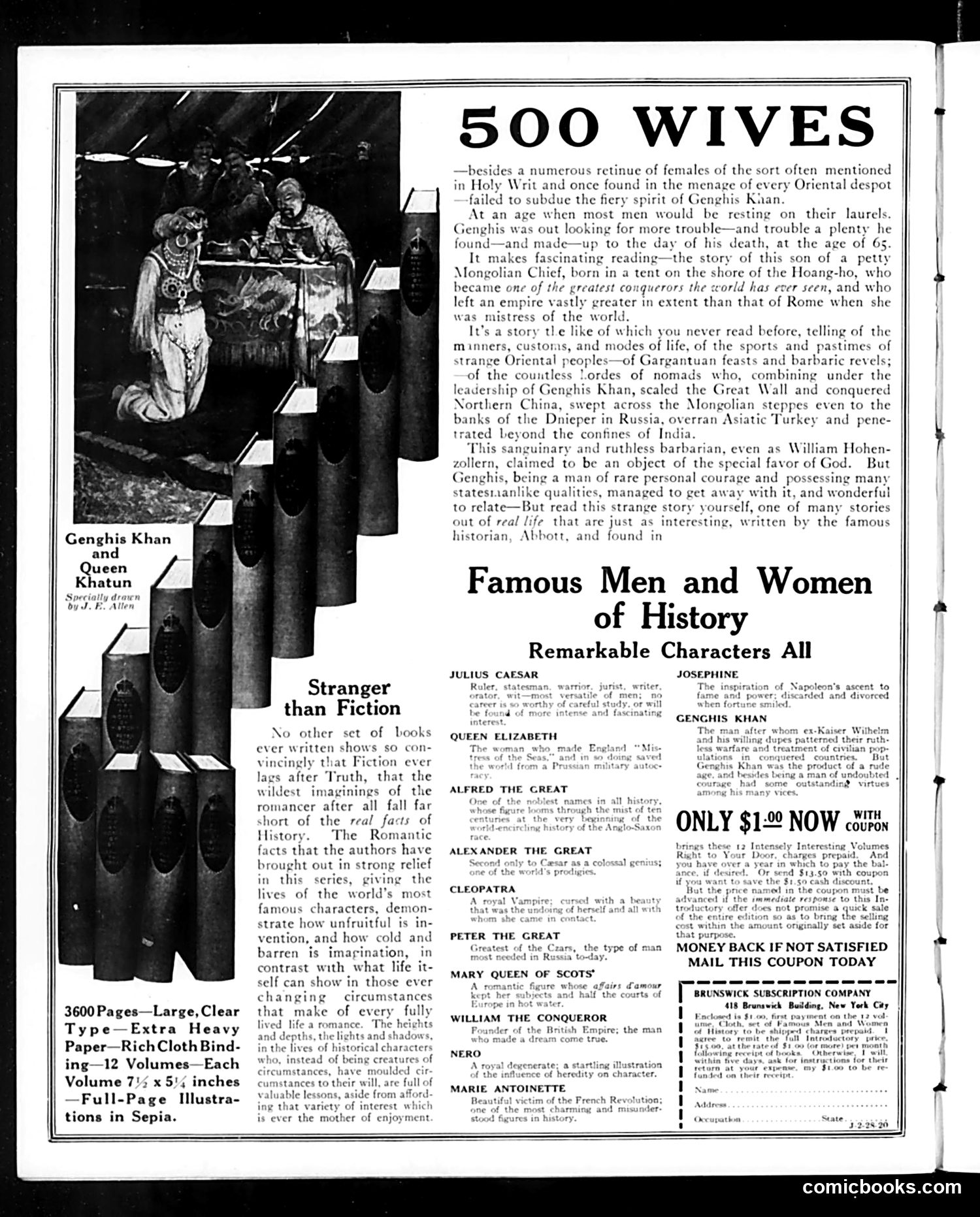
This page is predominantly **advertising**, not satire or political commentary. The main content promotes a 12-volume encyclopedia set titled "Famous Men and Women of History: Remarkable Characters All," published by Brunswick Subscription Company, priced at $1.00 with coupon. The left side features an illustration labeled "Genghis Khan and Queen Khatun" drawn by J.E. Allen. The advertisement emphasizes historical figures like Julius Caesar, Queen Elizabeth, Alfred the Great, and Cleopatra, marketed as educational material featuring "real life" stories that are "stranger than fiction." The page represents early 20th-century direct-mail marketing targeting middle-class readers seeking self-improvement through historical knowledge—a common advertising approach in Judge magazine during this period.
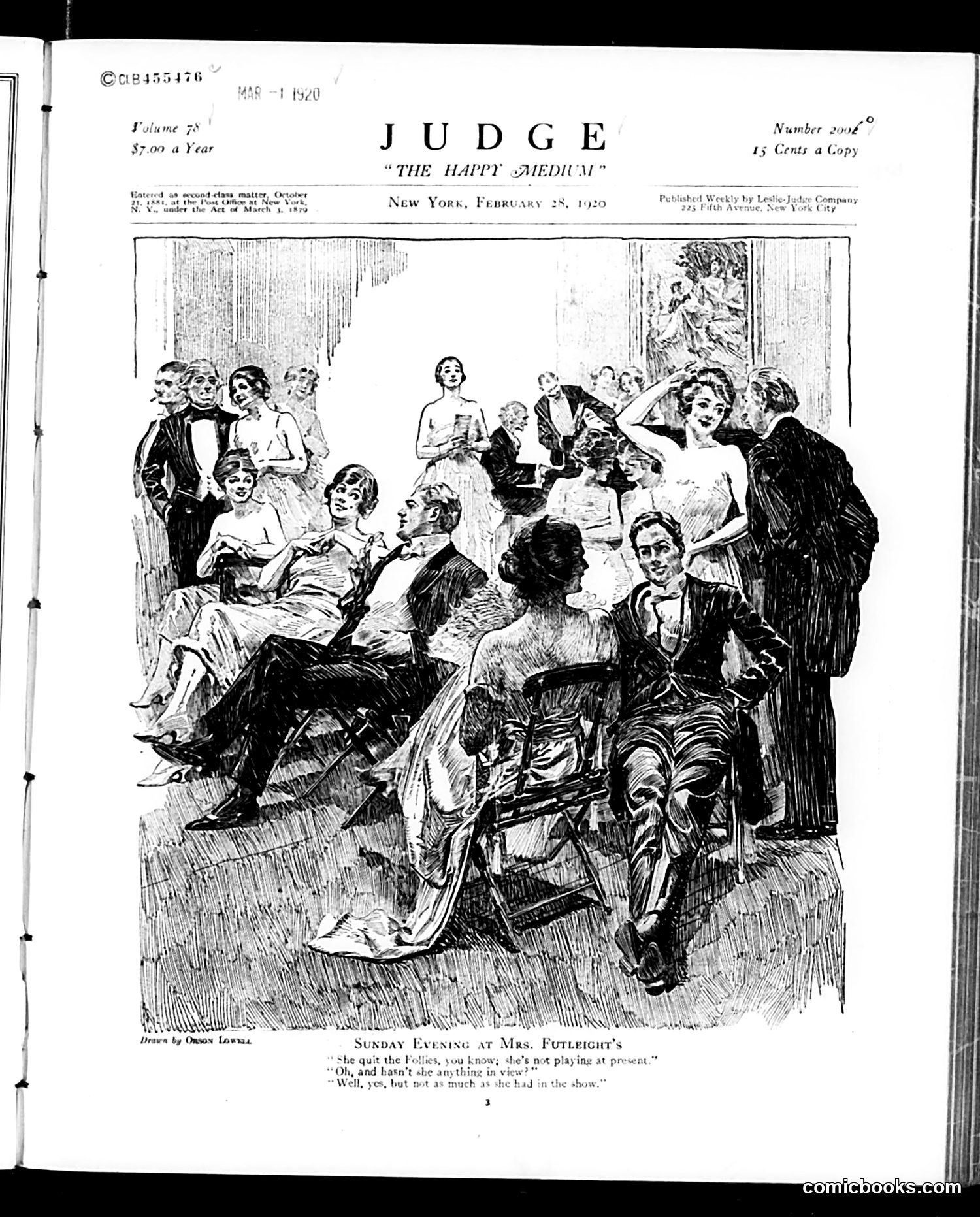
This is a social satire cartoon from *Judge* magazine (February 28, 1920) depicting a wealthy drawing-room gathering. The caption and dialogue mock upper-class pretension: - A woman asks about an absent guest: "She quit the Follies, you know; she's not playing at present" - Response: "Oh, and hasn't she anything in view?" - Punchline: "Well, yes, but not as much as she had in the show" The joke targets both the social climbing of entertainment industry figures and the voyeuristic nature of theatrical performance—suggesting that a performer's stage costumes (or lack thereof) were her primary claim to status. It's satirizing how wealthy society both judges and secretly admires performers, particularly showgirls known for revealing costumes.
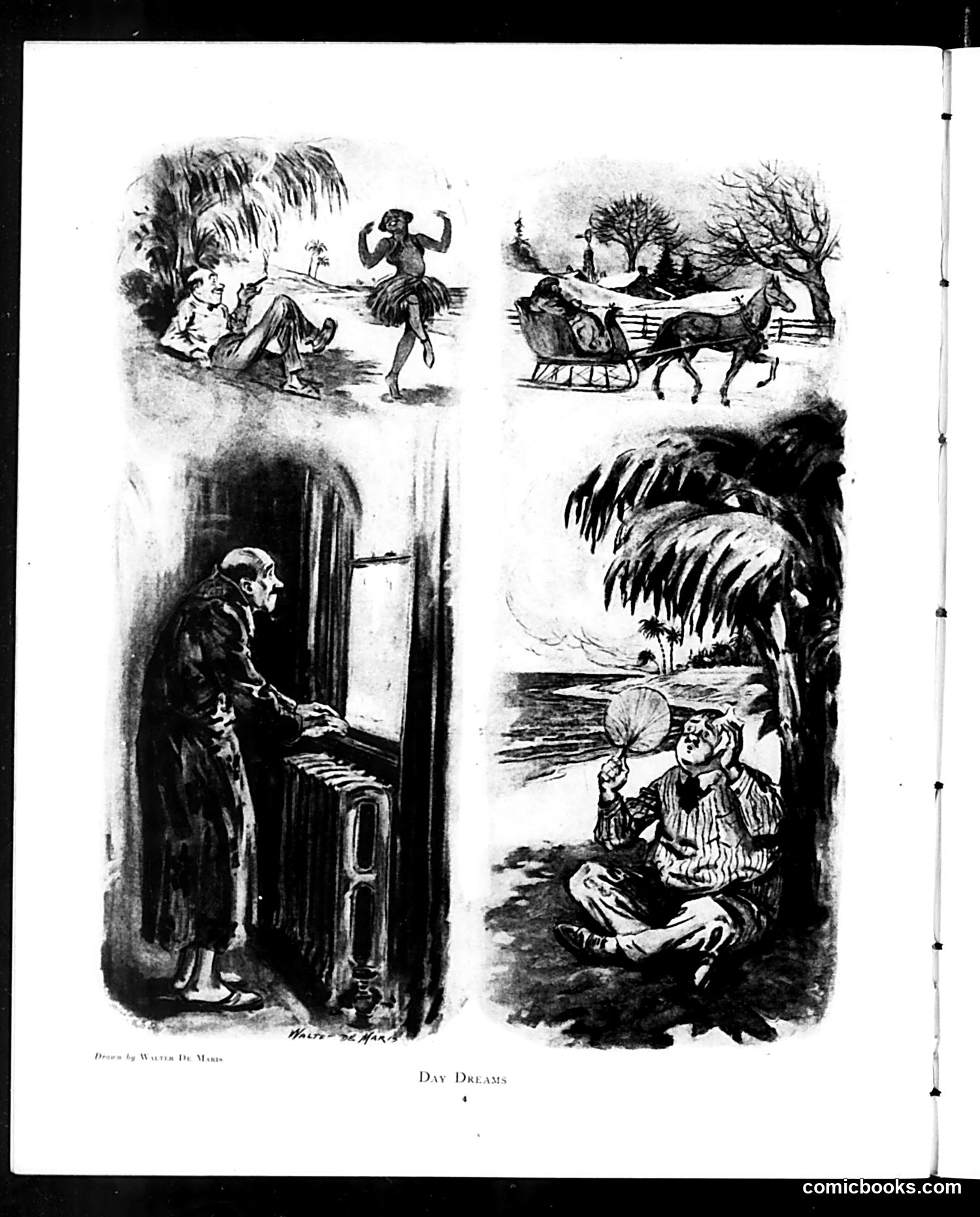
This page, titled "Day Dreams" and drawn by Walter De Maris, presents four satirical vignettes exploring fantasies and wishful thinking. The cartoons appear to depict: - **Top left**: A figure daydreaming of performing acrobatics - **Top right**: Someone imagining a sleigh ride through winter scenery - **Bottom left**: A person at a window, possibly fantasizing about escape or romance - **Bottom right**: A figure in tropical or exotic surroundings, suggesting dreams of adventure The overall theme mocks the gap between mundane reality and people's imaginative desires—a common Judge magazine subject. Without additional context about specific 1890s-era events or figures, the humor seems to target universal human tendency toward escapist fantasizing rather than particular political or social commentary.
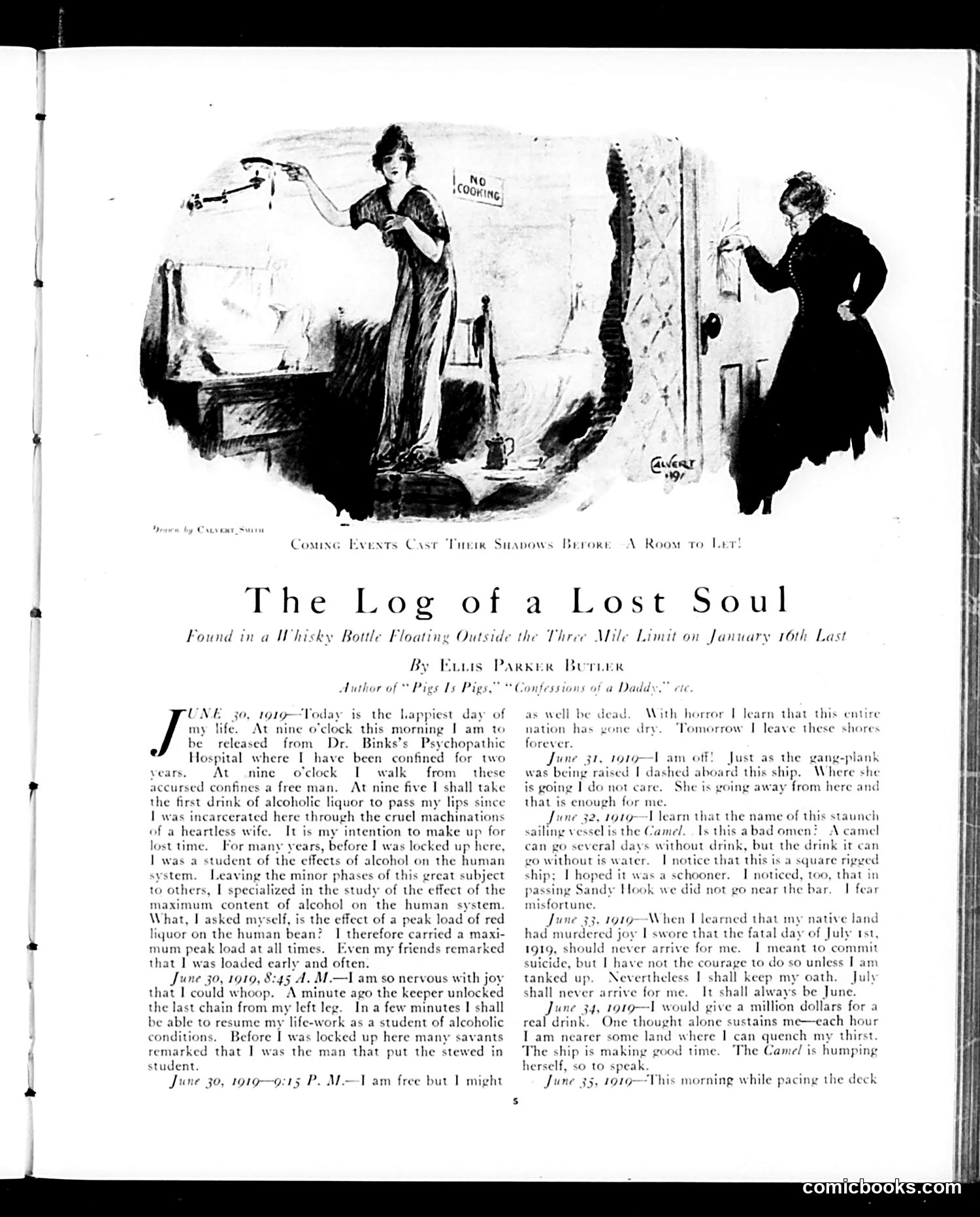
This appears to be a serialized story rather than a traditional political cartoon. The illustration shows a domestic scene with a woman operating what appears to be modern plumbing ("No Cooking" sign visible), contrasting with an older woman at right, likely depicting generational differences in household management. The narrative, attributed to Ellis Parker Butler, presents a satirical first-person account from a man released from a "Psychopathic Hospital" after two years of confinement for alcoholism. His diary entries chronicle increasing despair about Prohibition ("this entire nation has gone dry"), his lost love, and his ship's voyage, conveying dark humor about temperance laws and their social consequences. The satire targets Prohibition's impact on American life and morality during the 1919-1920 period.
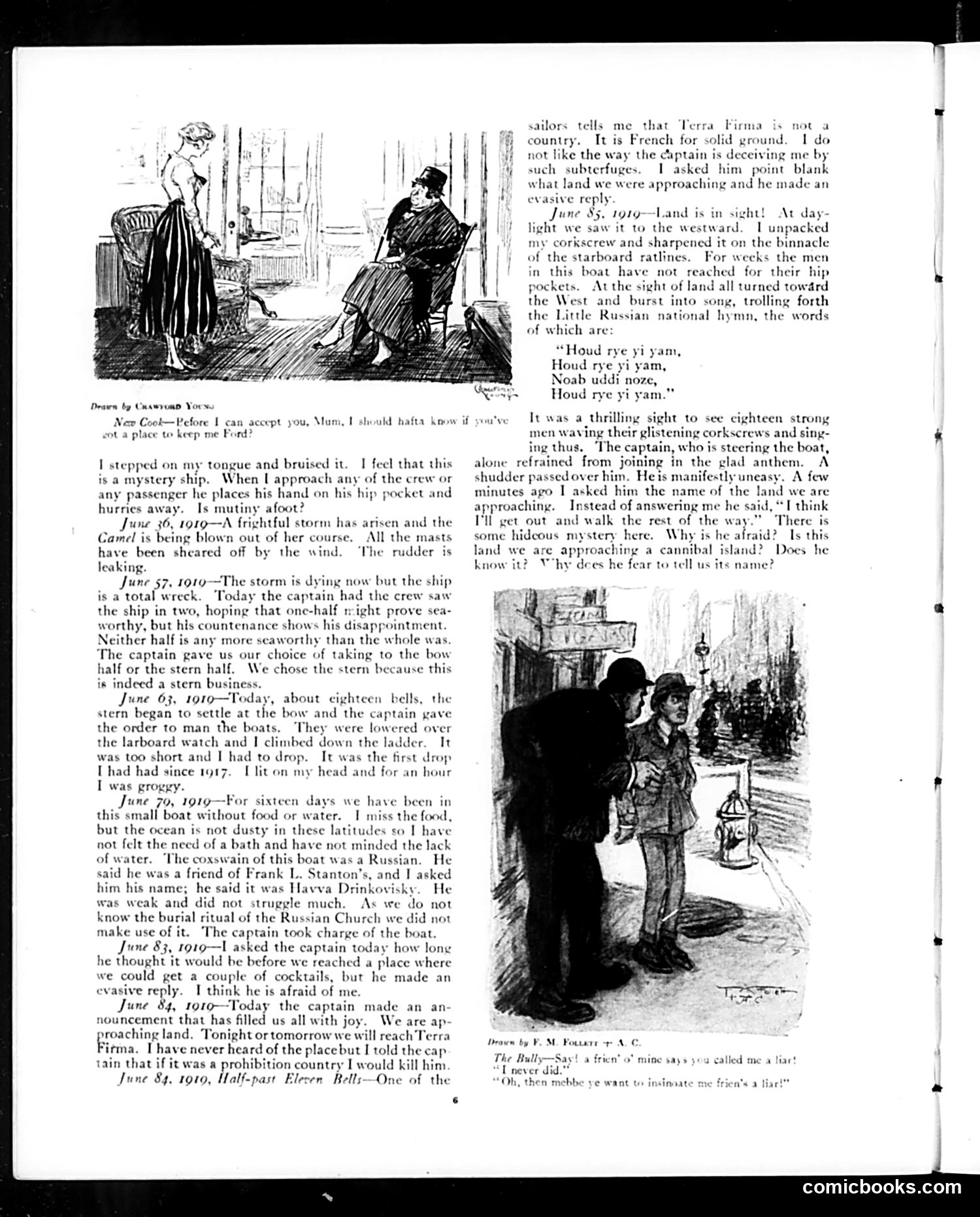
This page contains a narrative diary excerpt (dated June 1910) describing a shipwreck and survival at sea, illustrated with two black-and-white drawings. The text recounts the sinking of a vessel called the *Gamd*, the crew's ordeal in lifeboats, and encounters with Russian sailors. One illustration shows two figures in a ship's cabin; the other depicts someone in a small boat. This appears to be **not political satire but rather adventure fiction or reportage**—a dramatic true-or-fictionalized account of maritime disaster. The page functions as serialized entertainment content rather than the satirical political cartoons Judge magazine was known for. There are no evident caricatures, political figures, or social commentary visible.
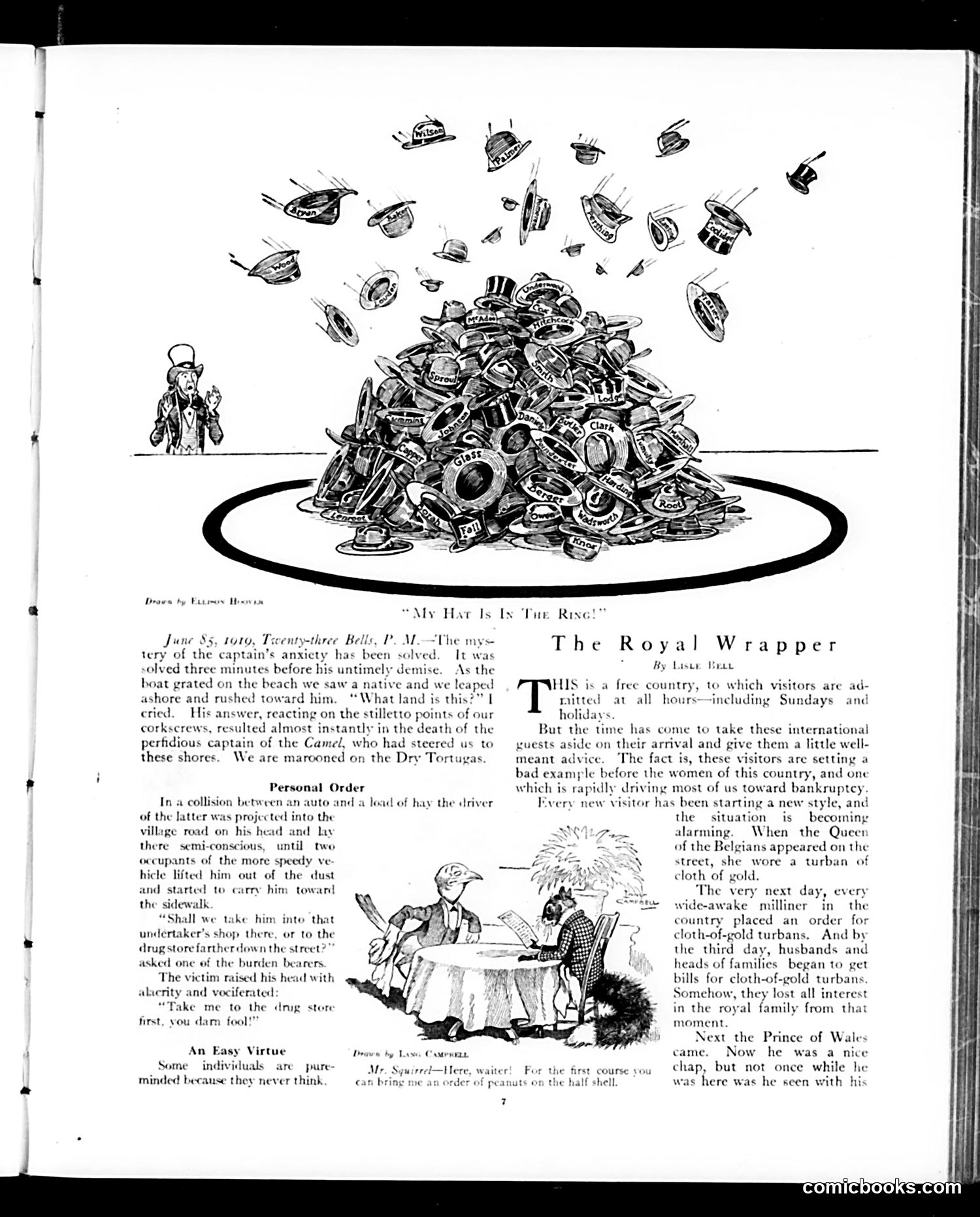
The main satire criticizes wealthy foreign visitors—particularly European royalty visiting America—for inadvertently causing economic chaos through fashion imitation. When the Queen of the Belgians wore a gold-cloth turban, American society women immediately copied it, forcing husbands to pay for expensive new clothing. The Prince of Wales similarly triggered fashion trends. The cartoon's point: America's wealthy are obsessively status-conscious and financially reckless, bankrupting families by chasing royal fashions. The accompanying illustration (drawn by Lisle Campbell) depicts a waiter taking an order, supporting the theme of social anxiety and pretension among the American upper class. The satire targets American materialism and class anxiety rather than foreign visitors directly—mocking how desperate Americans are to emulate perceived sophistication, regardless of cost. The "free country" opening is ironic: we're free, yet enslaved to fashion trends set by visitors.
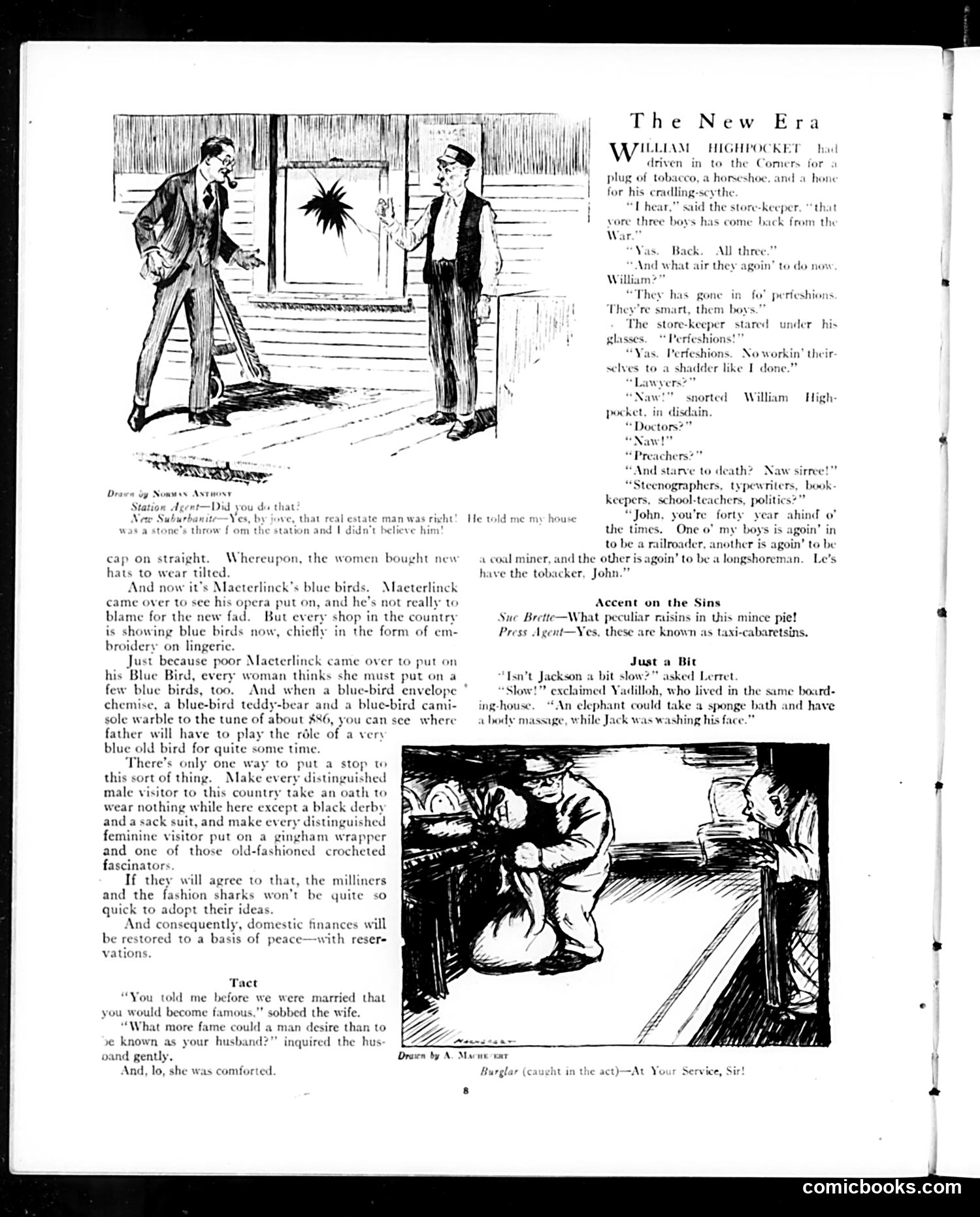
This satirical page contains three distinct pieces mocking early 20th-century American trends and attitudes: **"The New Era"** (top): Satirizes how women blindly adopt fashions inspired by celebrity visitors. When Belgian playwright Maurice Maeterlinck's play *The Blue Bird* premiered in America, women obsessively purchased blue-bird embroidered lingerie and accessories. The satire suggests this creates financial strain on husbands ("father will have to play the rôle of a very blue old bird"). The proposed solution—forcing distinguished visitors to dress plainly—humorously exaggerates the problem's perceived severity. **"William Highpocket" dialogue**: A rural character reports his three sons returning from World War I now pursue modern working-class careers (railroader, coal miner, longshoreman) rather than traditional professions (law, medicine, clergy). The store-keeper's amazement at these "perfessions" reflects changing post-war labor and social attitudes. **"Just a Bit"**: A quick joke about Jackson's extreme slowness—so slow that an elephant could bathe while he washes his face. The page satirizes both frivolous fashion trends and evolving post-war social expectations.
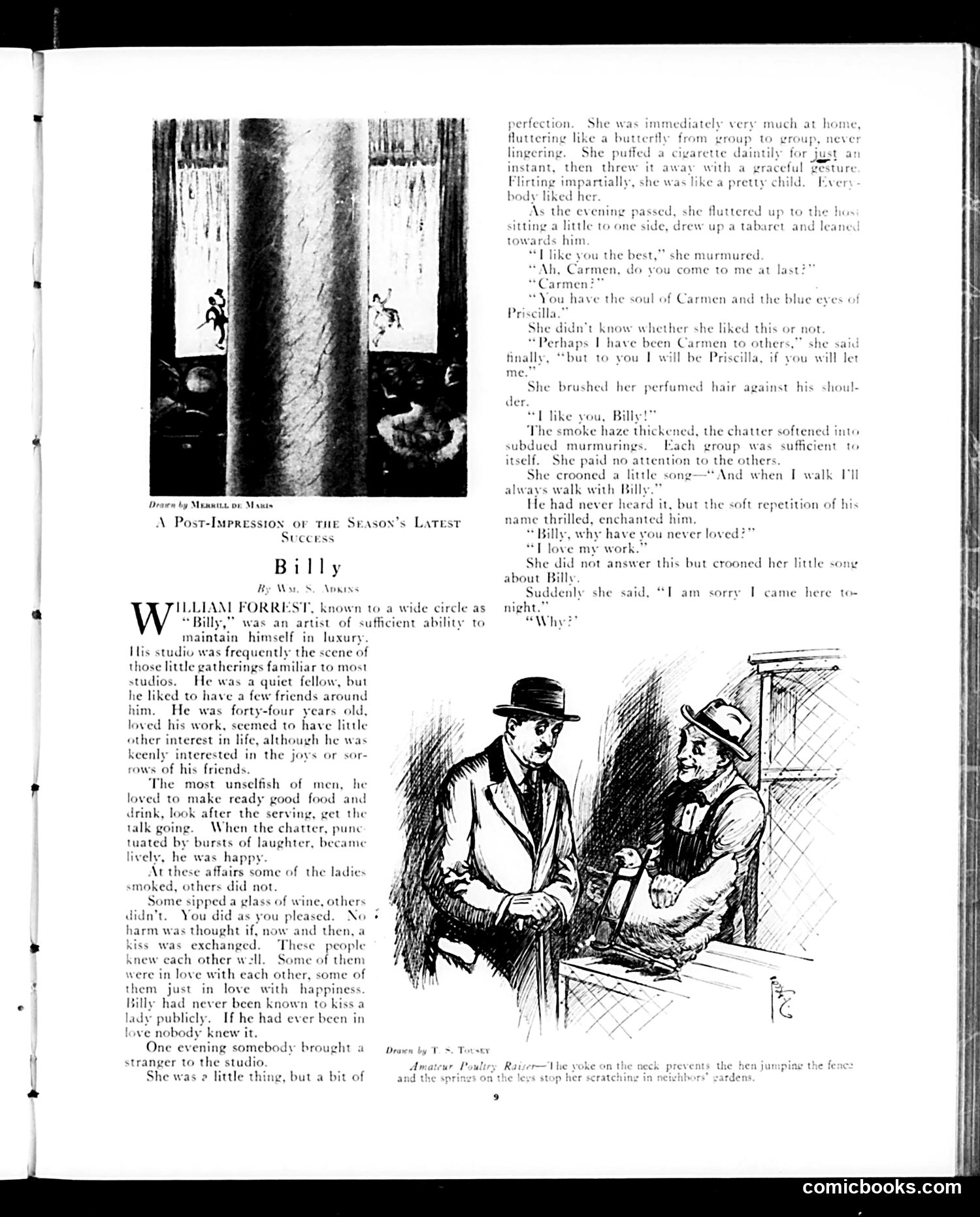
This is a short story with illustrations rather than a political cartoon. It depicts a bohemian artist's studio gathering in early 20th-century America, satirizing artistic society's attitudes toward romance and propriety. **The figures:** William Forrest ("Billy"), a 44-year-old artist who hosts gatherings; an unnamed female visitor described as charming and flirtatious. **The social commentary:** The story gently mocks the pretensions of artistic circles where smoking women, casual kissing, and unconventional behavior are tolerated, yet Billy himself—despite his sophisticated milieu—remains emotionally detached from romance, devoted only to his work. **The joke's point:** The irony that someone surrounded by bohemian freedom and admiring women has never actually loved anyone, suggesting that artistic devotion can be an excuse for emotional unavailability or that even "liberated" society cannot resolve fundamental human isolation.
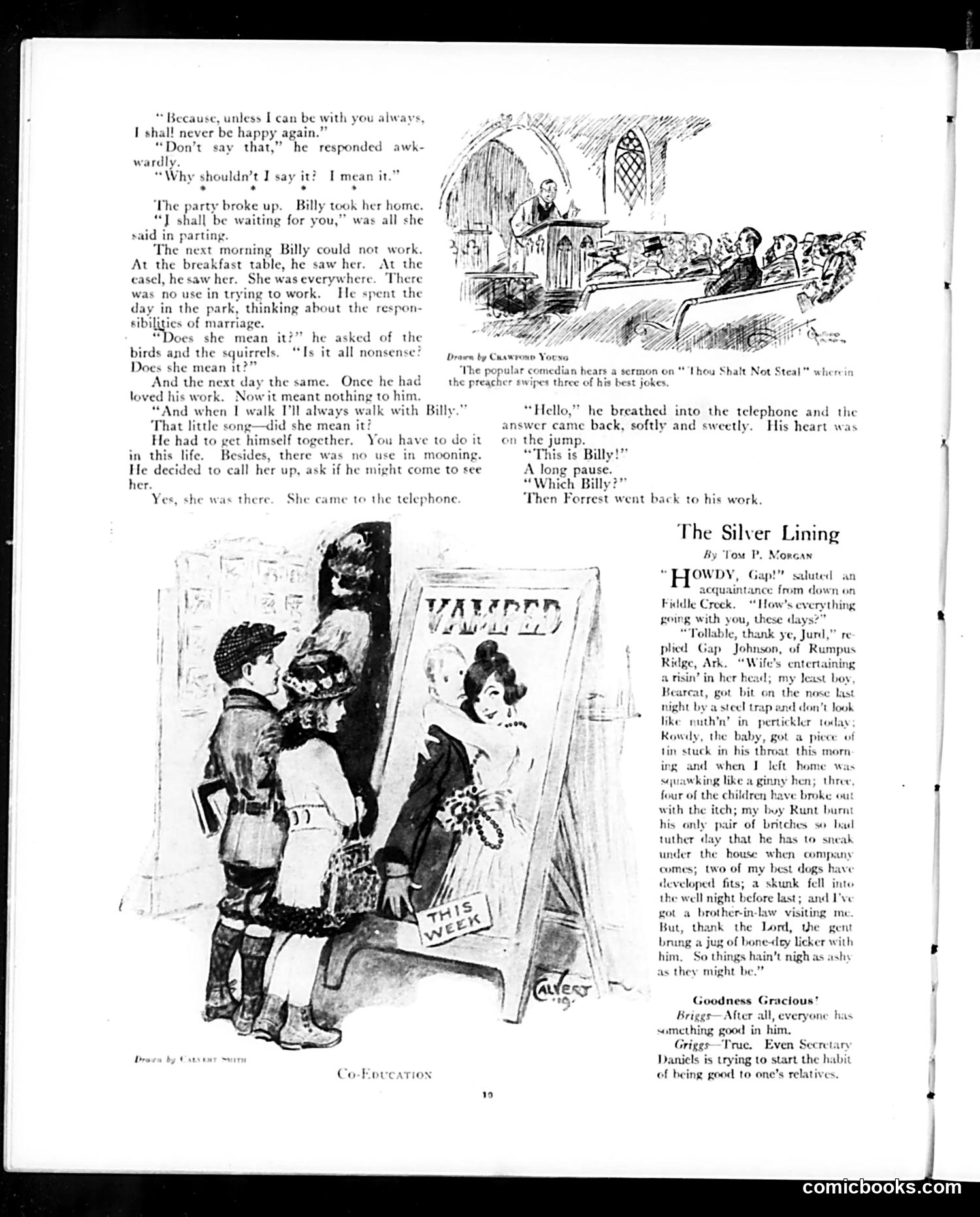
This page contains two distinct pieces of satirical content: **"Co-Education"** (left cartoon): The illustration shows two young people at what appears to be a "Wanted" poster or advertisement. The accompanying text depicts a romantic conflict where Billy and his girlfriend struggle with commitment anxieties about marriage. The satire targets young romance and the anxieties surrounding early 20th-century courtship—particularly the tension between desire for constant companionship and the practical realities of adult responsibility. The "co-education" title likely references the then-controversial practice of men and women studying together, implying social mixing leads to romantic entanglement. **"The Silver Lining"** (right): A humorous monologue where Gap Johnson catalogs his family's recent disasters—children injured, animals sick, property damage—yet maintains optimism because a visiting relative brought whiskey. The satire mocks rural poor and their stoicism in the face of hardship, while the "silver lining" joke hinges on alcohol providing the sole comfort amid genuine misery. Both pieces reflect Judge's focus on domestic life and social class commentary.
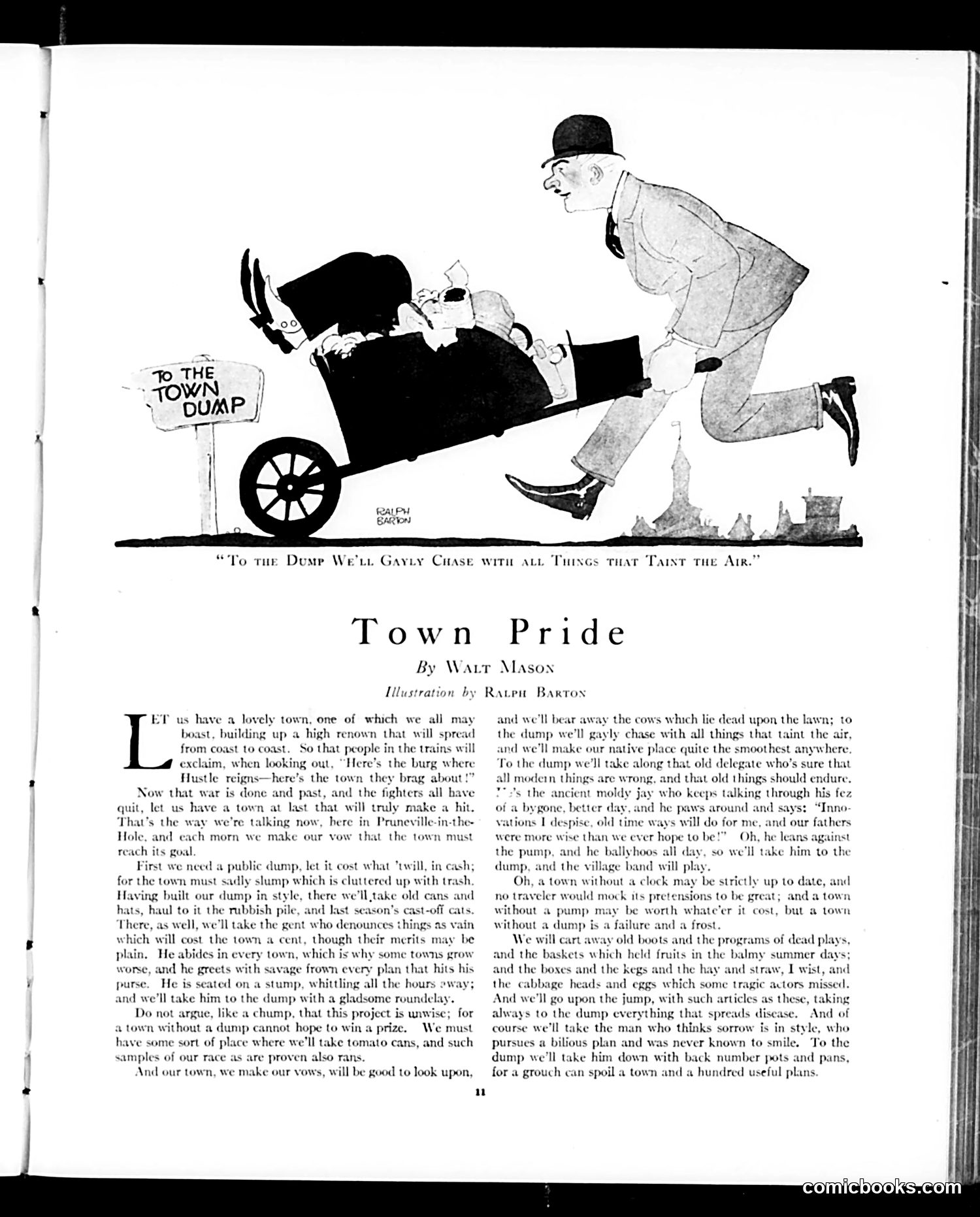
This is a humorous article-and-cartoon by Walt Mason, illustrated by Ralph Barton, mocking small-town civic boosterism. The cartoon shows a man kicking a reluctant, overstuffed figure into a wheelbarrow labeled "To the Town Dump." The satire targets the obsessive drive to improve one's town for appearances and pride. Mason's poem ironically advocates building a grand municipal dump as the solution to town improvement—then humorously expands the concept to include disposing of undesirable *people*: the pessimistic "gent who denounces things as vain," the old-fashioned curmudgeon clinging to bygone days, and crucially, "the man who thinks sorrow is in style"—the chronic complainer and "grouch." The joke is that towns waste energy removing garbage and people they deem unpleasant rather than addressing actual problems. It's gentle social commentary on small-town conformity and the arbitrary standards of respectability.
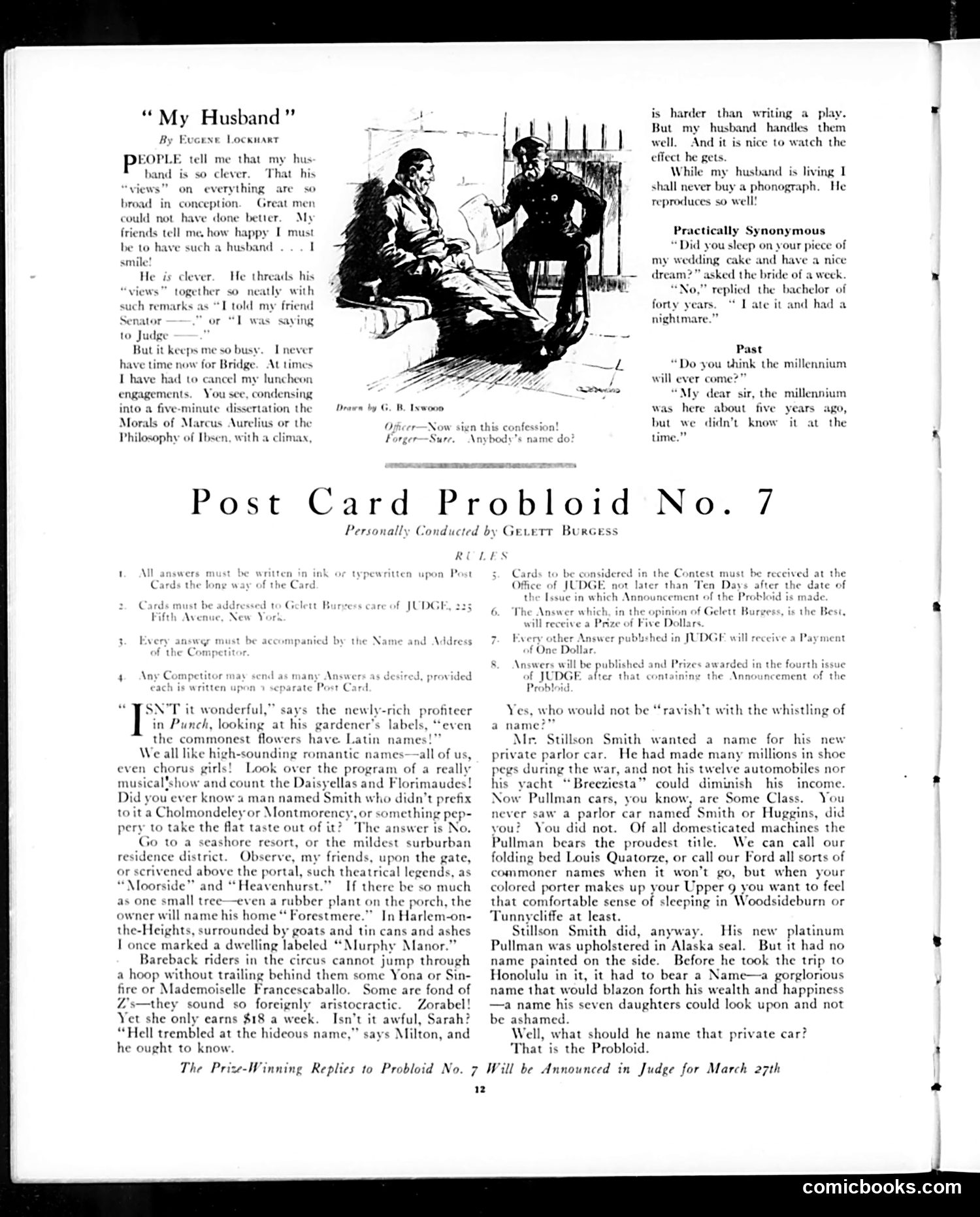
This page contains three distinct items: a domestic comedy essay, a social satire piece, and a contest announcement. ## "My Husband" (by Eugene Lockhart) A wife humorously complains that her clever husband—respected for his broad views and intellectual remarks—keeps her perpetually busy. She must constantly condense complex philosophical topics (Marcus Aurelius, Ibsen) into five-minute discussions, leaving no time for leisure activities like bridge or lunch. The satire targets pretentious intellectualism and the exhausting demands of verbose husbands who perform their cleverness socially. ## "Practically Synonymous" (by Gelett Burgess) This piece mocks the American obsession with adopting fancy, foreign-sounding names for ordinary things. Wealthy people and even circus performers adopt grandiose titles—"Flormaudes," "Mademoiselle Francescaballo"—to appear cultured and aristocratic, even when earning modest wages. The satire ridicules social pretension and the gap between actual circumstance and affected appearance. The cartoon illustration appears to show a police officer and civilian interaction, though context is unclear.
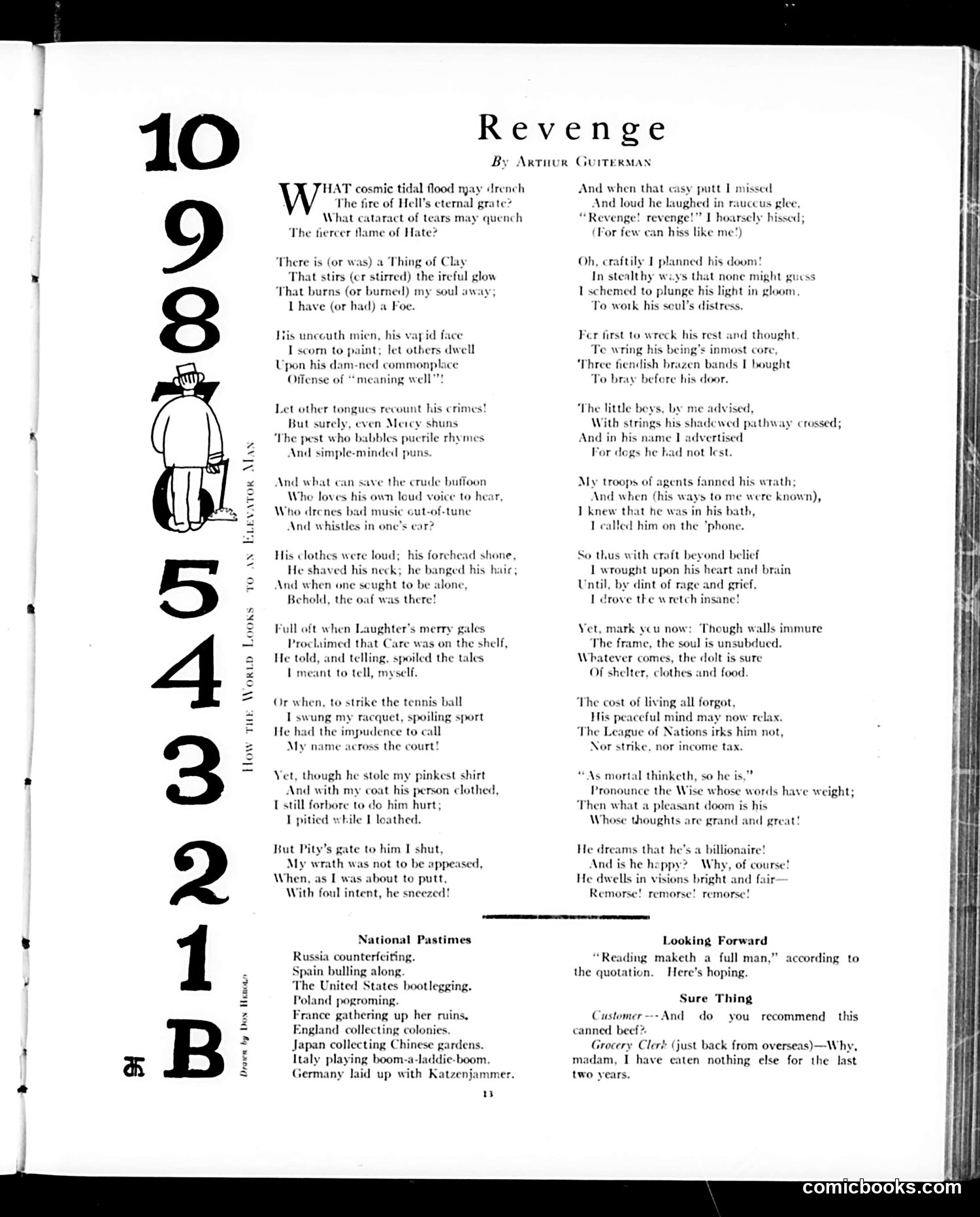
This is a satirical poem about the narrator's elaborate revenge against an annoying rival—a loud, tactless man who steals his belongings, interrupts his tennis game, spoils his stories, and fatally sneezed during a crucial golf putt. The revenge scheme includes hiring brass bands to play outside his door, arranging for stray dogs to be advertised under his name, and calling him while bathing. The joke's twist: the scheme works *too well*—it drives the man insane. But the narrator discovers insanity has freed him from modern anxieties (taxes, the League of Nations, cost of living). The moral: thoughts shape reality, so the "wretch" now enjoys a pleasant delusion of billionaire wealth. The surrounding content includes "National Pastimes" (satirizing post-WWI nations' activities) and a joke about a grocer recommending canned beef having eaten only that for two years—likely mocking American soldier rations or post-war food scarcity.
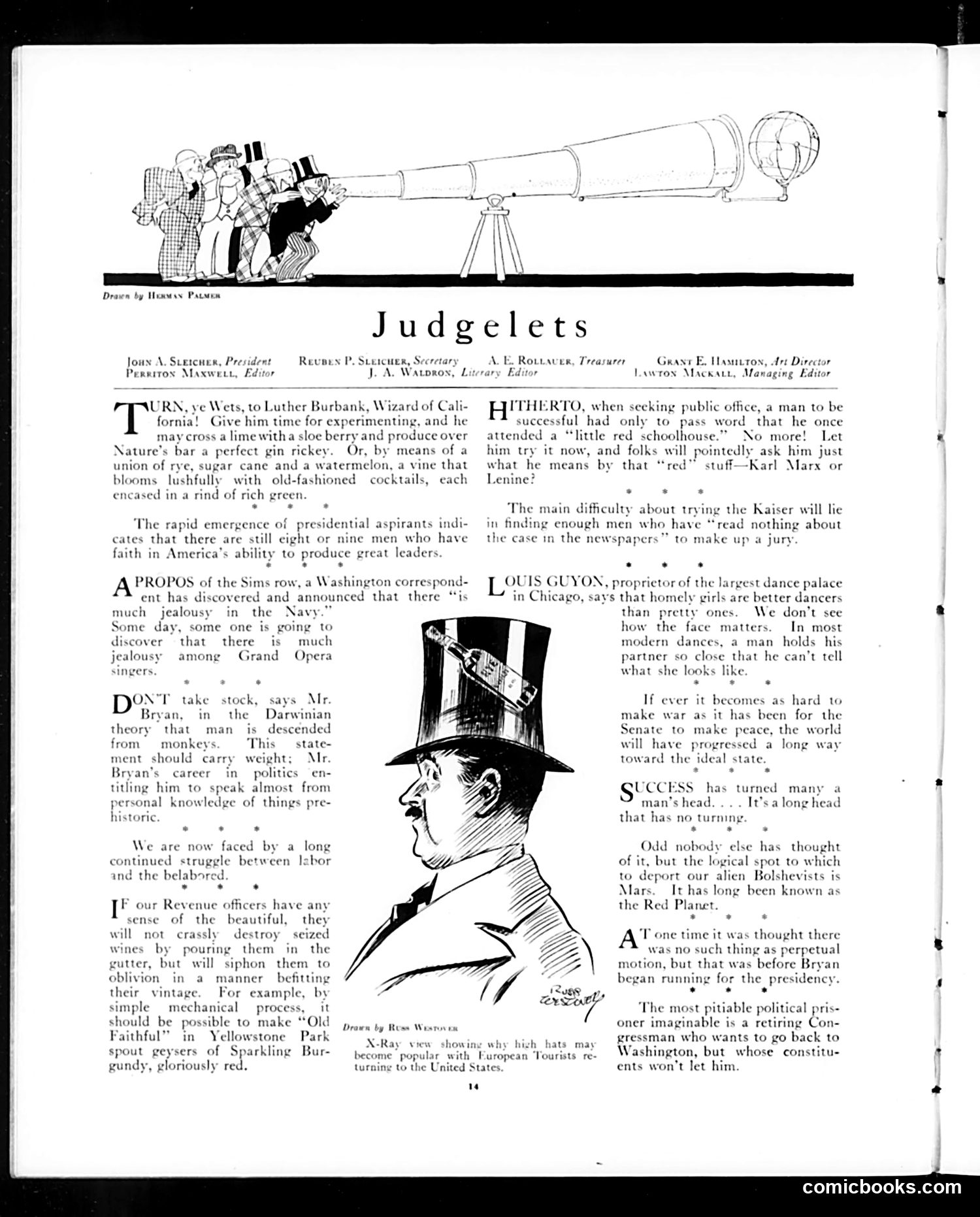
This is a humor/editorial page from *Judge* magazine featuring short satirical quips on contemporary political and social topics, circa 1918-1920 (based on references to the Kaiser, Bolsheviks, and Bryan). **Key References:** - **Luther Burbank joke**: Mocks the famous horticulturist by suggesting he could cross-breed plants to create cocktails—satire on Prohibition-era anxieties. - **"Sims row" / Navy jealousy**: References internal Navy disputes, likely relating to Admiral Sims. - **Bryan/Darwinism**: Attacks William Jennings Bryan's anti-evolution stance, sarcastically suggesting his political career proves humans descended from monkeys. - **"Little red schoolhouse" / Marx / Lenin**: Mocks how candidates once used humble origins as credentials; now such rhetoric invites suspicion of Bolshevism—reflecting post-WWI "Red Scare" paranoia. - **Kaiser trial**: References post-WWI discussions of prosecuting the German Emperor. - **Mars/Bolshevists**: Dark humor suggesting deporting communists to Mars (the "Red Planet"). - **Bryan running for presidency again**: Assumes Bryan's perpetual candidacy. The cartoon (by Rice Weston) shows a man's profile in a top hat, likely a generic political figure or possibly Bryan himself.
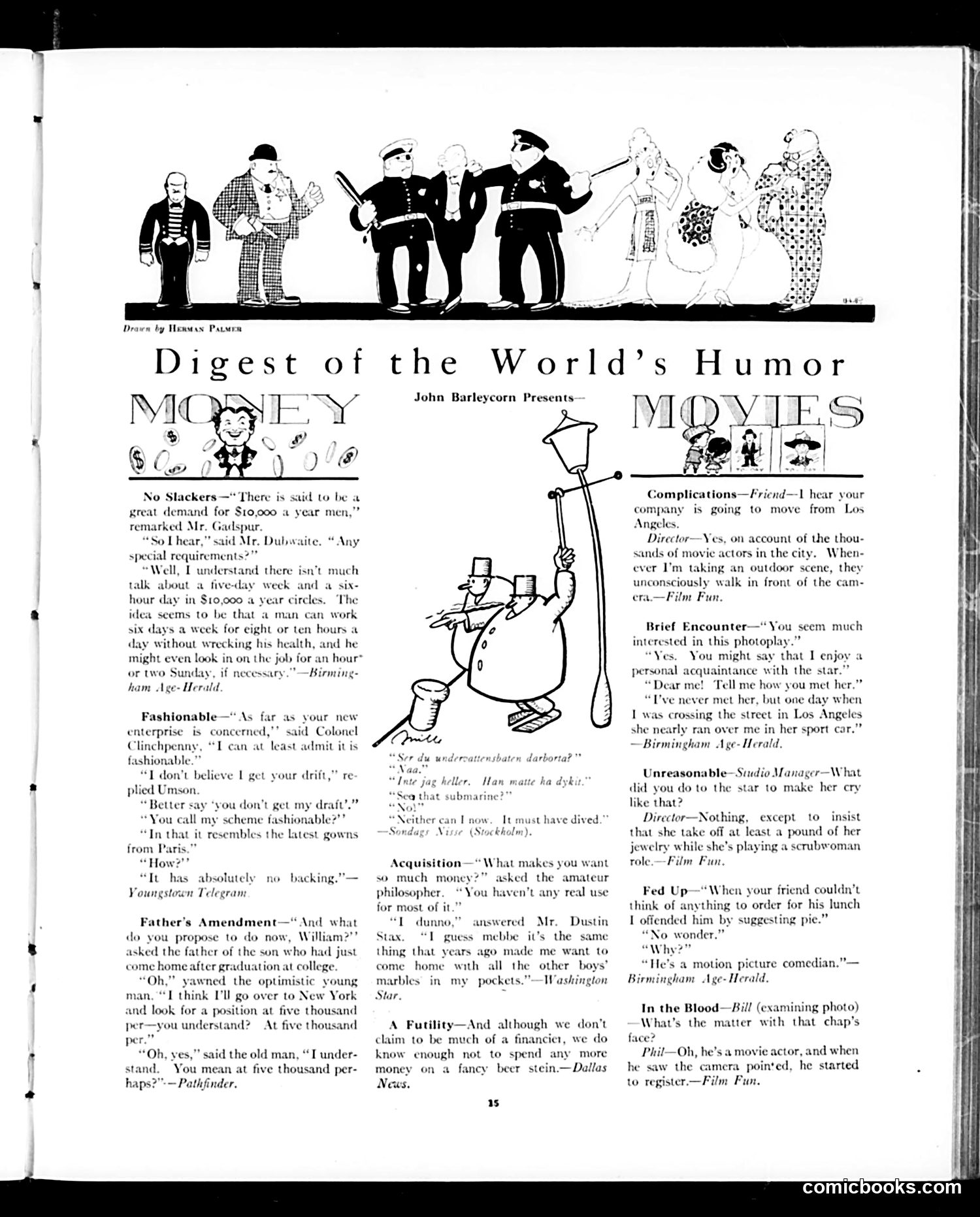
This is a humor digest page featuring jokes about early 1920s American society, with particular emphasis on **movie industry satire**. The cartoon at the top (drawn by Herman Paten) shows caricatured figures, likely representing different social types or professions. The jokes address contemporary concerns: high salaries for executives ("$10,000 a year men"), post-WWI labor expectations (five-day work weeks), and college graduates seeking unattainable wealth. Several pieces mock the **nascent film industry in Los Angeles**—actors unconsciously blocking shots, studios losing locations due to too many actors, and actors' exaggerated "registering" (facial expressions) for cameras. The humor reflects 1920s anxieties about modern wealth, leisure expectations, and the novelty of Hollywood filmmaking. References to "John Barleycorn" (alcohol personified) indicate this predates Prohibition's end or satirizes drinking culture. The overall tone is gently mocking of social pretension and greed.
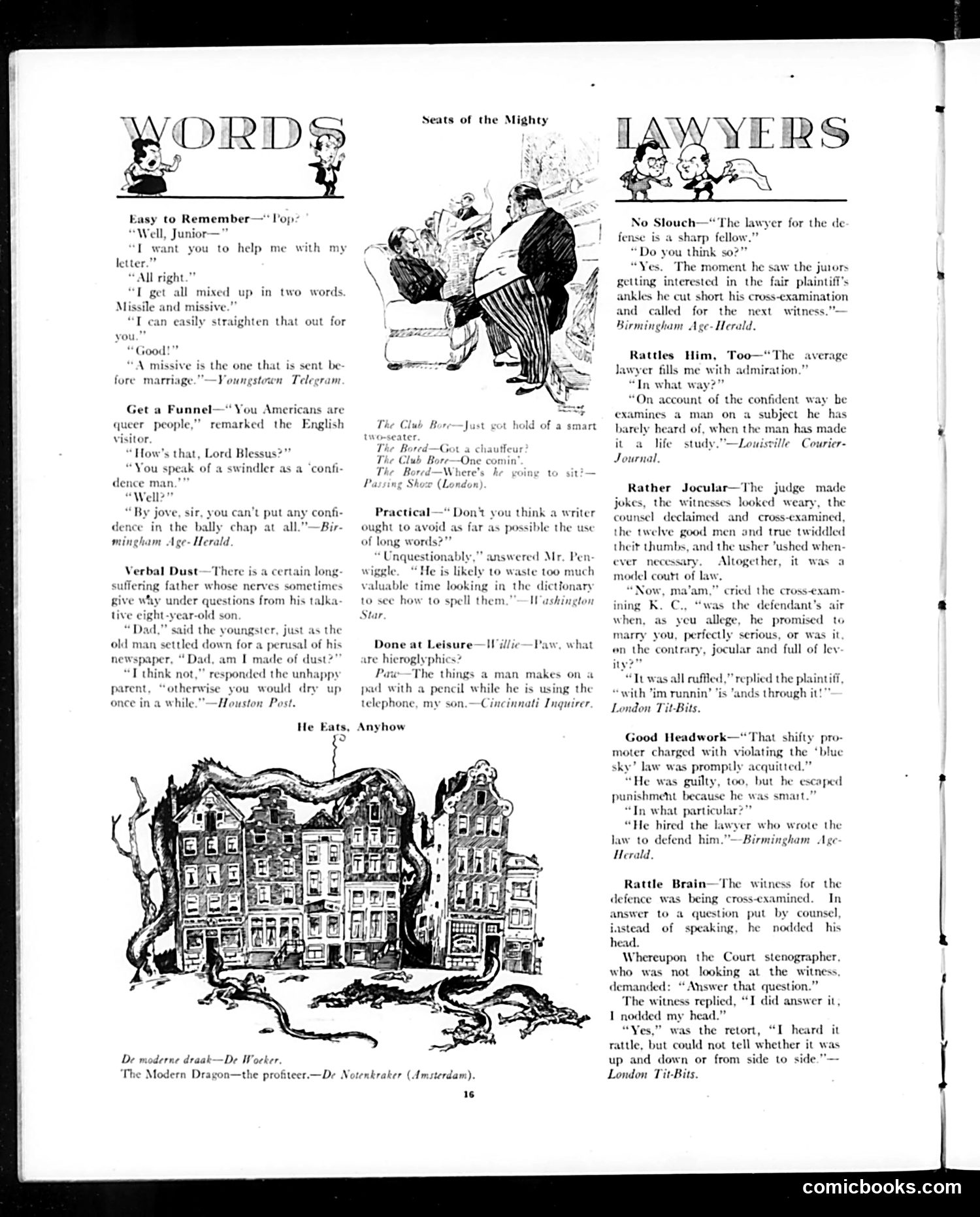
This page from the satirical magazine *Judge* contains humorous anecdotes mocking lawyers, legal proceedings, and courtroom behavior—common targets of early 20th-century American satire. The "Lawyers" section features six brief jokes ridiculing legal professionals: one lawyer wins by exploiting jurors' distraction with a plaintiff's appearance; another examines subjects he barely understands; a judge presides over a chaotic courtroom; a cross-examined witness merely nods instead of answering; a "shifty promoter" escapes conviction by hiring the lawyer who *wrote* the law; and a stenographer mockingly questions whether a witness's silent head-nod was "up and down or side to side." The left side contains unrelated humor about words ("missile" vs. "missive"), English visitors, and talkative children. A small illustration shows a medieval-style dragon labeled "the profiteer," likely referencing war-profiteering—a contemporary concern. The satire targets lawyer incompetence, courtroom absurdity, and legal system cynicism rather than specific political figures or events.
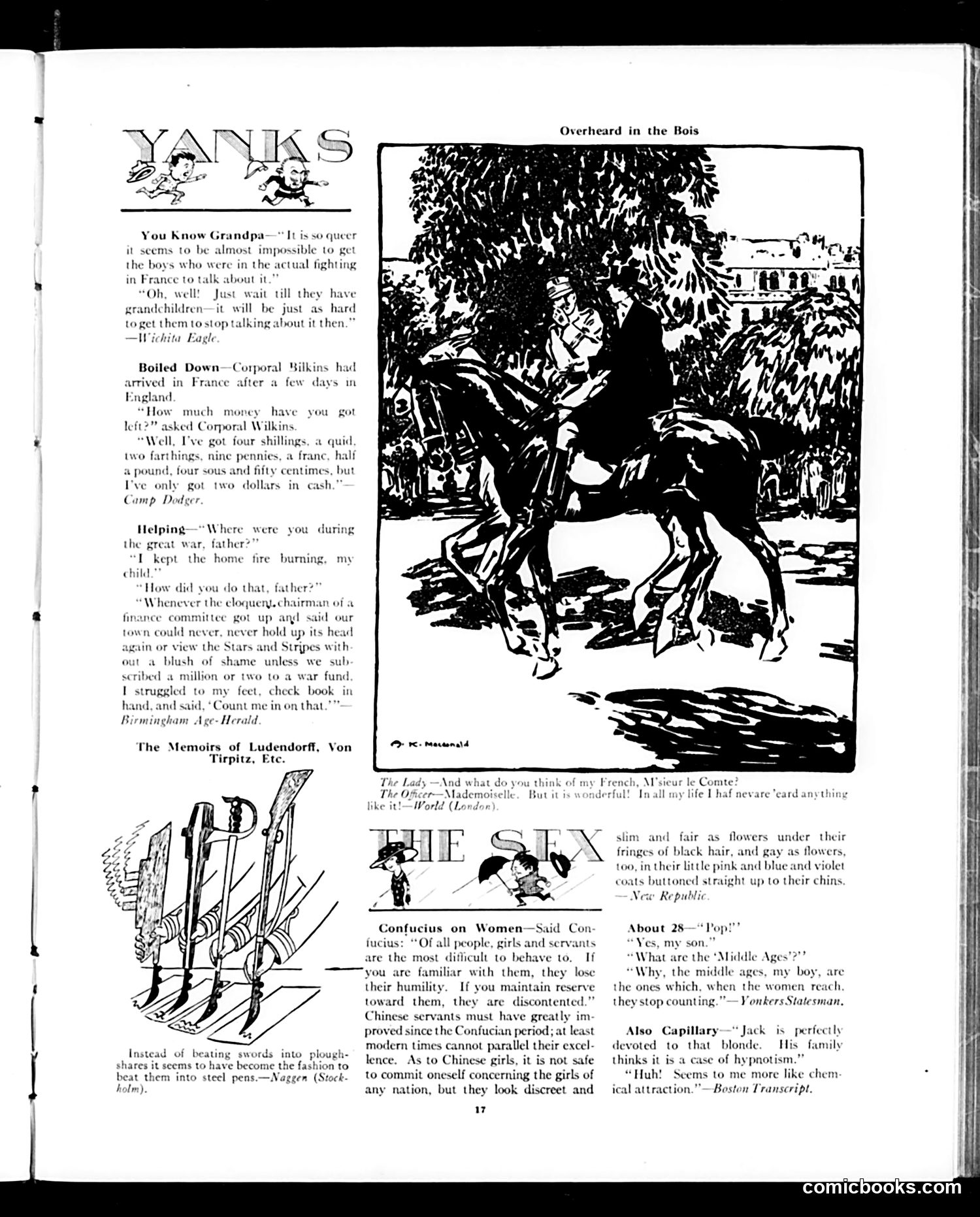
This page collects brief satirical items about post-WWI America and social observations: **"You Know Grandpa"** jokes about soldiers' reluctance to discuss combat experiences, predicting they'll bore grandchildren endlessly with war stories later. **"Boiled Down"** depicts soldiers exchanging currencies (shillings, francs, dollars), satirizing the confusion of military finance across Allied nations. **"Helping"** mocks home-front "patriotism"—a man claims he "kept the home fire burning" by repeatedly donating to war bond drives when shamed by finance committee chairmen. It's satire on performative patriotism and financial coercion. **"The Memoirs" caption** references German generals (Ludendorff, Von Tirpitz) whose memoirs were appearing post-war, sarcastically suggesting they'd melted swords into steel pens for writing. **"Confucius on Women"** and **"About 28"** offer period-typical gender commentary—describing Chinese women's appearance and joking that men stop counting women's ages at a certain point. **"Capillary"** makes a chemistry pun about attraction to blonde women. The overall tone reflects 1920s post-war American humor and social attitudes.
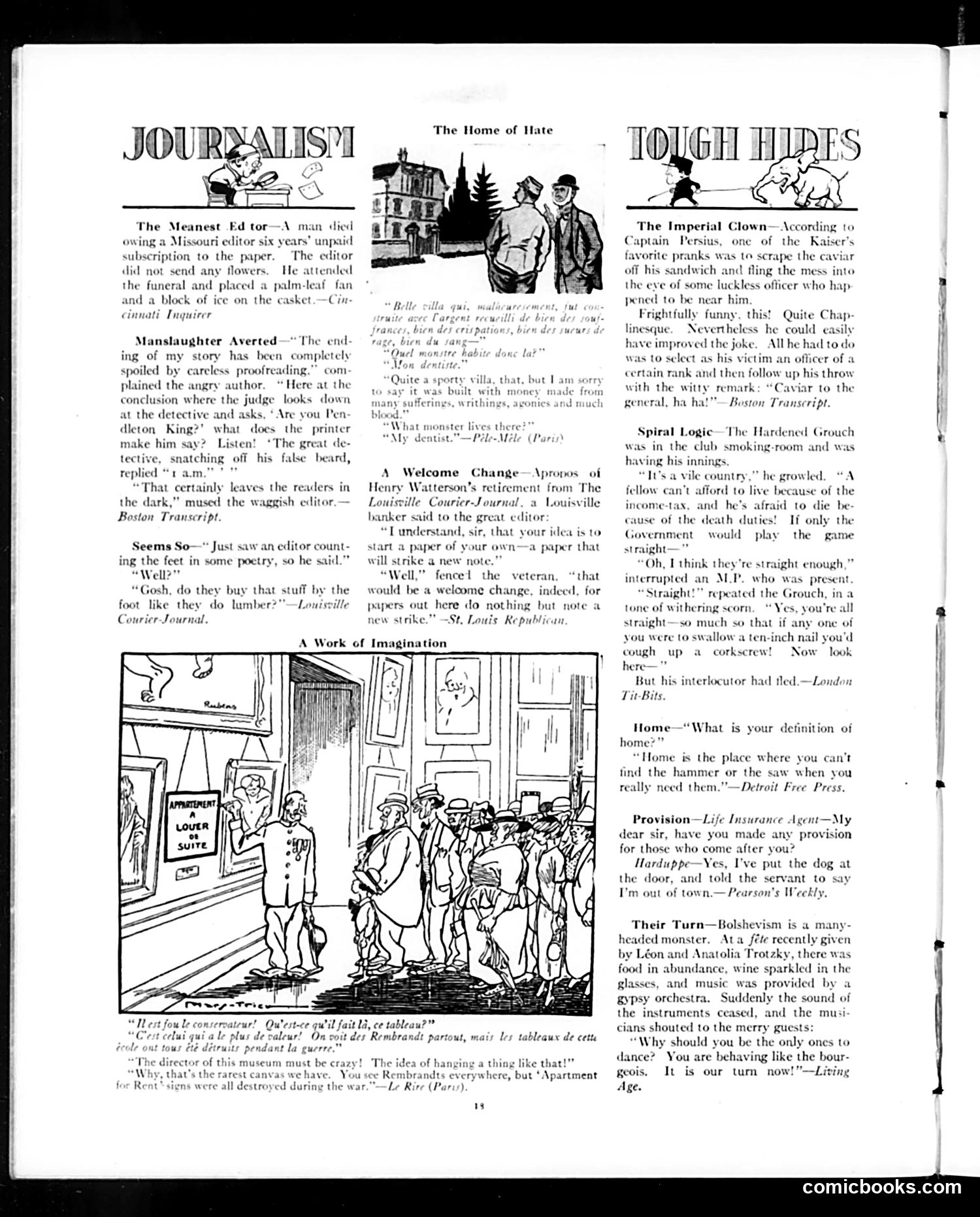
This page from Judge contains several brief humorous anecdotes about journalism and contemporary society, plus one cartoon. **The Main Cartoon** ("A Work of Imagination") depicts a crowd of people outside an apartment building marked "APARTMENT LOWER SUITE," with French text below. The joke appears to reference art theft or forgery—the text mentions "Rembrandts" and "canvases," suggesting satire about fake masterpieces or insurance fraud claims during wartime (referencing destroyed artworks). **The Anecdotes** mock: - Cheap newspaper editors (the Missouri editor who attended a subscriber's funeral but brought only a fan and ice instead of flowers) - Typographical errors that ruin story conclusions - Henry Watterson's retirement from the Louisville Courier-Journal - British taxation and death duties ("Spiral Logic") - Insurance and class anxiety ("Provision") - A satirical reference to Bolshevism (Leon Trotsky) and workers demanding equal leisure time The page's overall theme targets journalistic incompetence, editorial parsimony, and contemporary social anxieties about labor, taxes, and political upheaval.
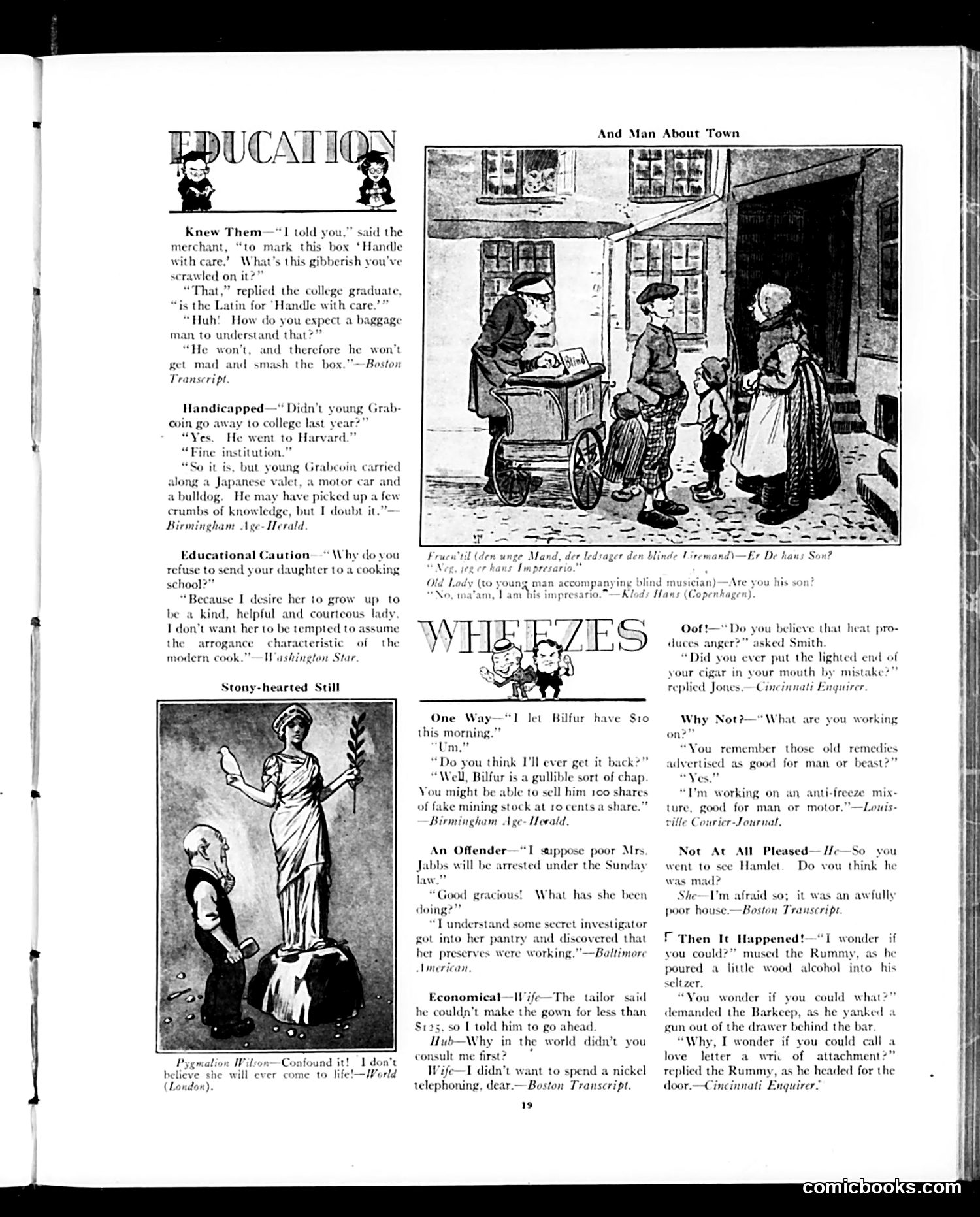
This page contains multiple short humorous anecdotes satirizing early 20th-century American attitudes toward education, class, and social pretension. **Key satirical targets:** - **"Knew Them"**: Mocks college graduates' impracticality—using Latin on a shipping box is useless when addressed to uneducated baggage handlers. - **"Handicapped"**: Ridicules wealthy students who attend prestigious universities (Harvard) while bringing servants, cars, and dogs—accumulating no actual knowledge. - **"Educational Caution"**: Suggests cooking schools produce arrogant, rude women, implying domestic work breeds superiority. - **"Economical"** and other brief jokes: Satirize wives' frivolous spending and illogical reasoning. The overall theme critiques how education and wealth create social disconnection from practical reality and working-class competence. The humor assumes readers share skepticism toward educated elites who lack common sense.
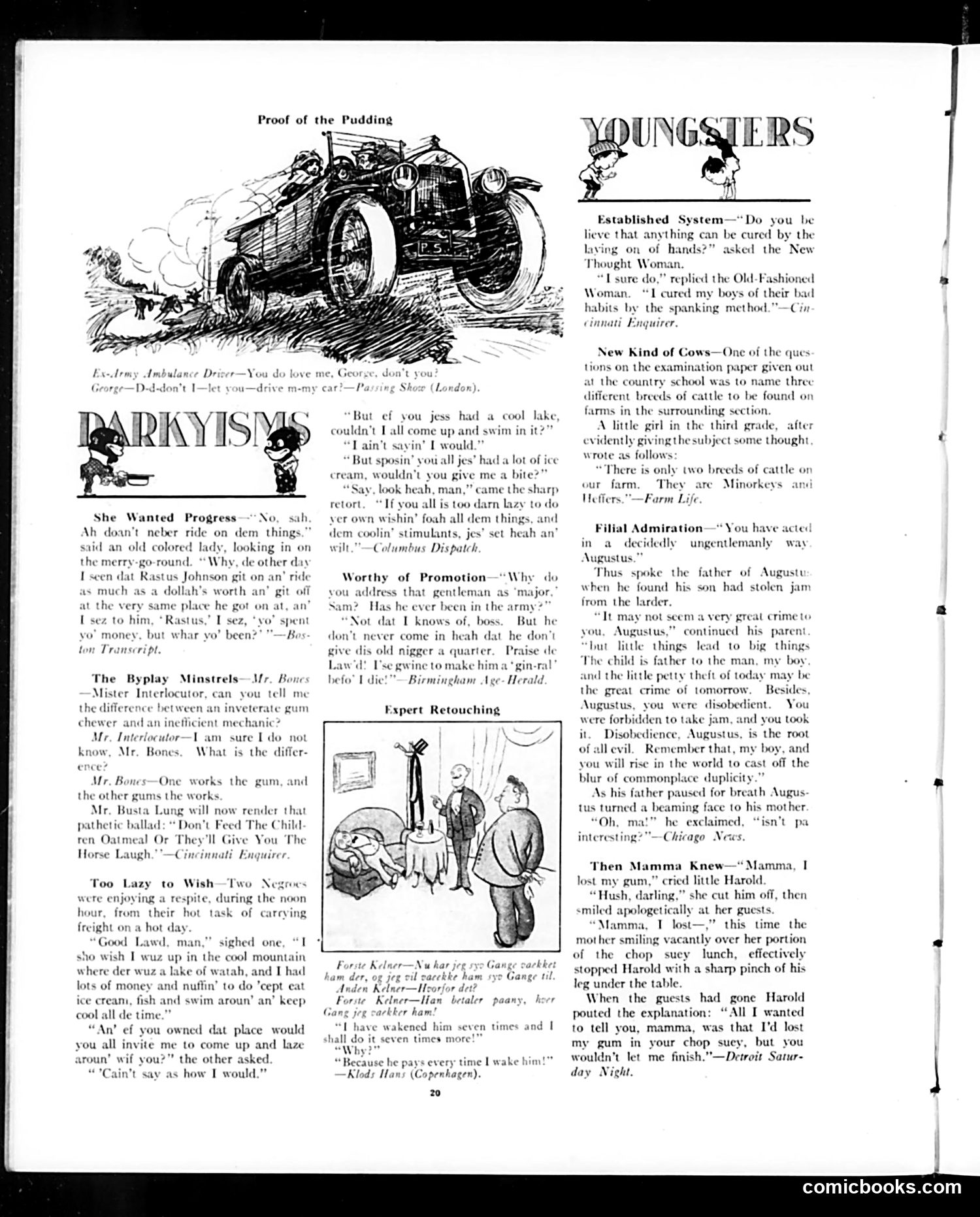
This page from the satirical magazine **Judge** contains several humorous sketches with racial stereotypes typical of early 20th-century American humor. The cartoons employ **racist caricatures of African Americans** as their primary comedic device: - **"She Wanted Progress"**: Mocks an elderly Black woman for refusing a merry-go-round ride, suggesting resistance to modern progress. - **"Too Lazy to Wish"**: Depicts two Black laborers as unwilling to share resources, playing on stereotypes of selfishness and laziness. - **"Worthy of Promotion"**: Shows a Black man bribing another with quarters to earn a promotion, reinforcing stereotypes about corruption and dishonesty. - **"New Kind of Cows"**: A child's misspelling ("Minorkeys" and "Hetiers") provides innocent humor unrelated to race. Other sketches like "Then Mamma Knew" and "Filial Admiration" use conventional family situations for gentle satire. The page reflects period attitudes where dehumanizing racial caricature was considered mainstream entertainment.
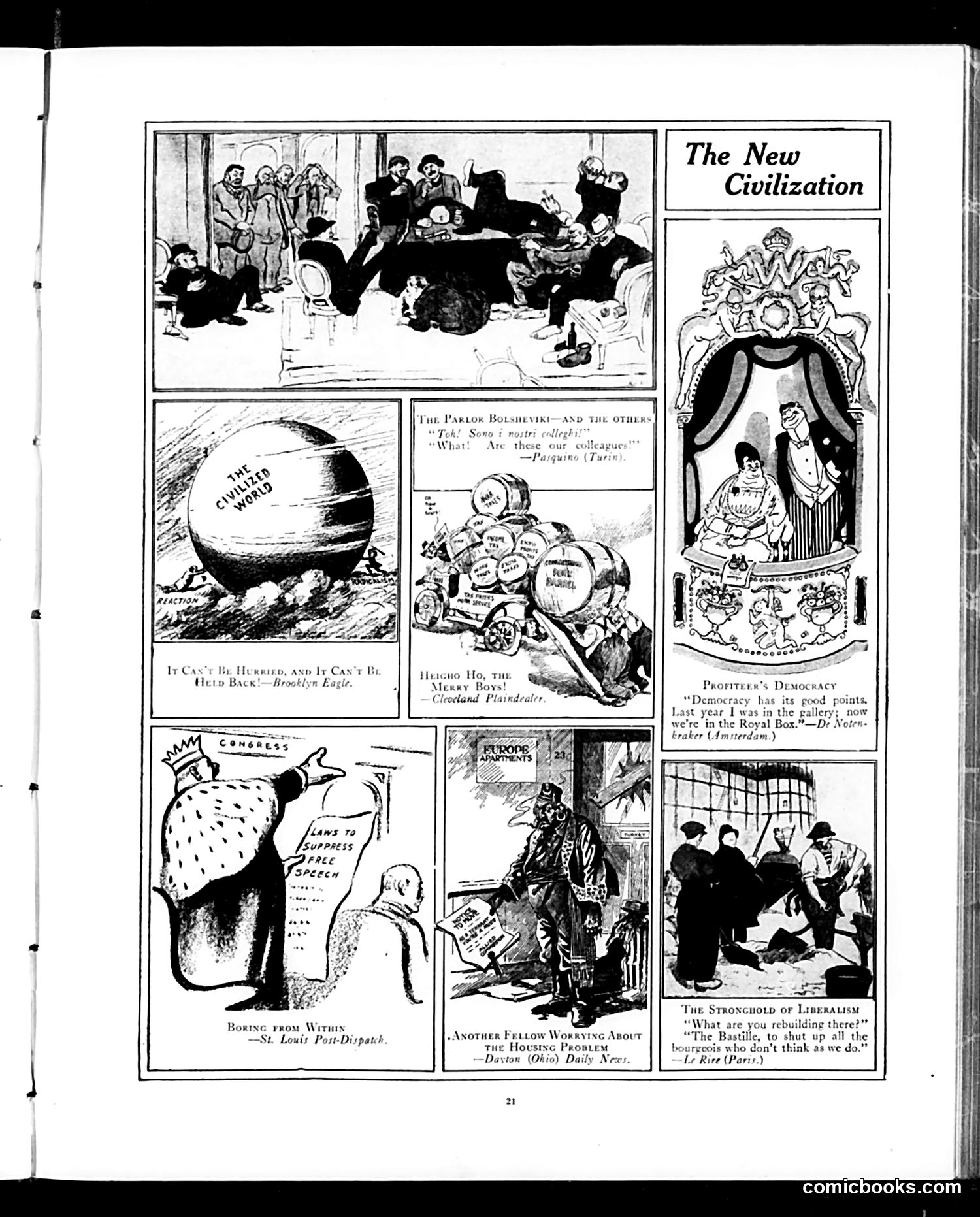
This page satirizes early 20th-century political and social upheaval, likely referencing the Russian Revolution and its international impact. The cartoons mock: **Top panels**: Bolshevik chaos and violence ("The Parlor Bolshevik"), depicting revolutionary fervor as destructive and absurd. **"Profiteer's Democracy"**: Critiques wealth inequality—democracy exists only for the rich in galleries while workers suffer below. **"Boring from Within"**: Shows a figure labeled "Congress" being hollowed out, suggesting radical infiltration of American institutions. **Housing Problem & Stronghold of Liberalism**: Depict revolutionary movements threatening social order—the Bastille reference suggests fears that liberals might support violent upheaval to silence political opponents. The overall message: Judge presents "The New Civilization" as chaotic, destructive radicalism threatening American democracy, wealth, and stability. The satire warns against both revolutionary movements and wealthy hypocrisy.
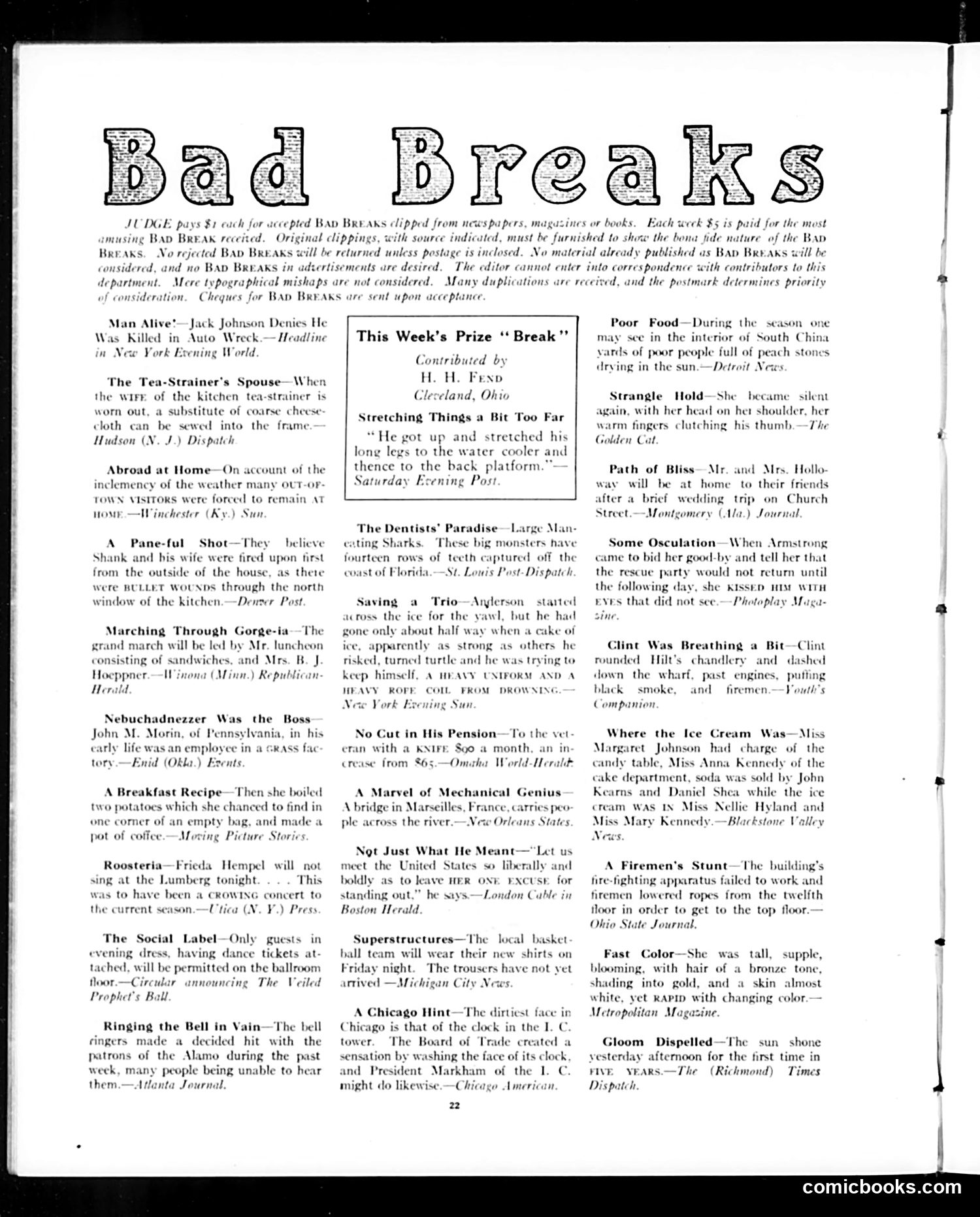
This page is the "Bad Breaks" section of *Judge* magazine—a humor column collecting amusing typographical errors and misleading headlines clipped from newspapers. The jokes exploit unintentional ambiguities in newspaper text. For example, "Jack Johnson Denies He Was Killed in Auto Wreck" creates dark comedy by implying Johnson died (he was a famous boxer). "He got up and stretched his long legs to the water cooler and thence to the back platform" absurdly suggests his legs physically extended across the room. Other breaks mock malapropisms ("Marching Through Gorge-ia" instead of Georgia) and logical contradictions ("The bell ringers made a decided hit...many people being unable to hear them"). This was popular turn-of-the-century satirical humor—ridiculing newspapers' carelessness while entertaining readers through wordplay. The prize winner is submitted by H.H. Fend of Cleveland, Ohio.
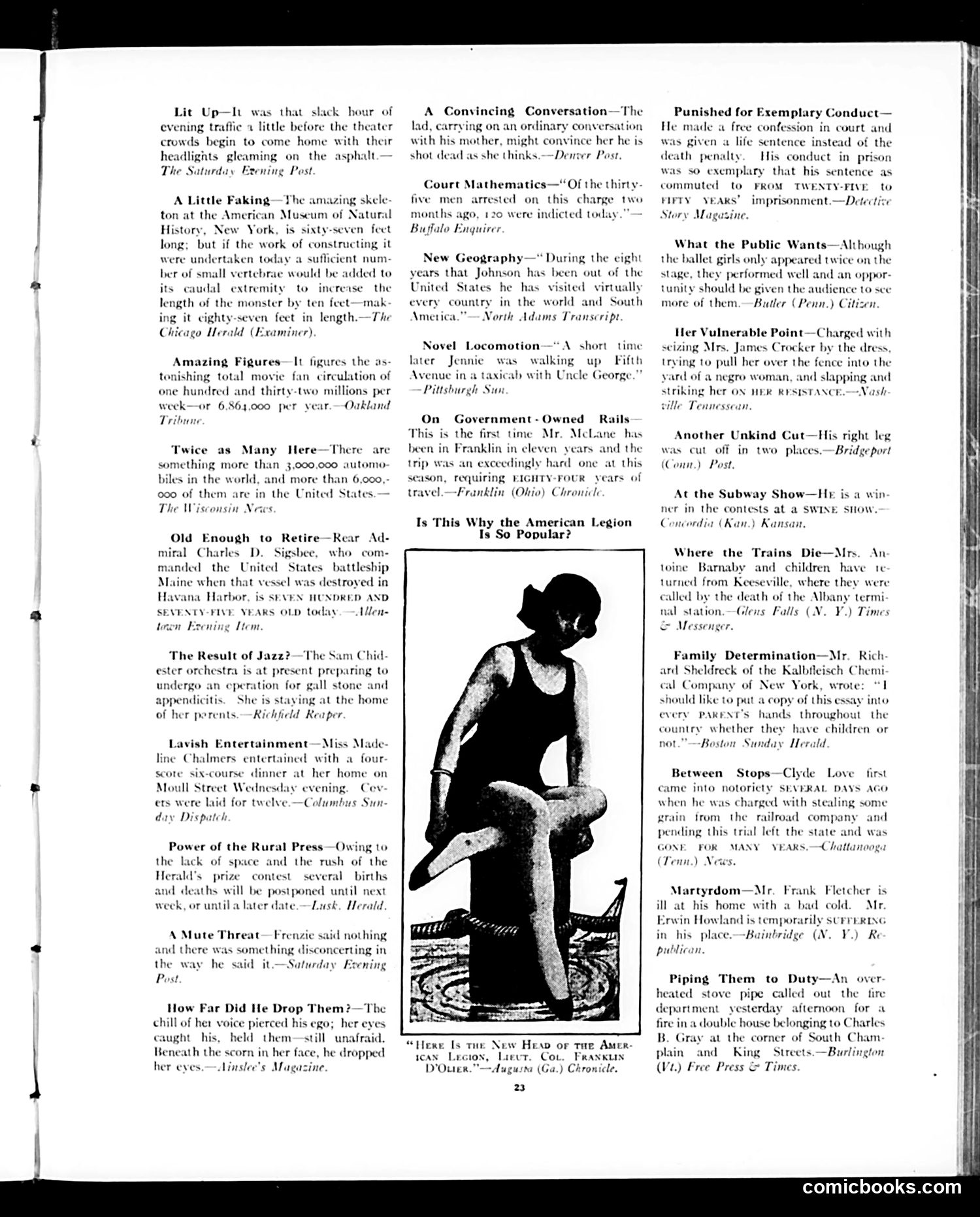
This page from *Judge* magazine contains short satirical observations rather than political cartoons. The single illustration depicts the new head of the American Legion—a muscular, idealized male figure—with the caption suggesting why the organization is "so popular." The text items are brief absurdist jokes mocking logical inconsistencies in newspaper reporting. Examples include: a skeleton that would need extra vertebrae added if reconstructed today (implying modern "improvements" to history), a government rail trip requiring "eighty-four years of travel," and a criminal given a life sentence reduced to fifty years for exemplary prison conduct (rewarding good behavior with extended punishment). These are gentle social satire typical of *Judge's* style—poking fun at newspaper errors, bureaucratic absurdity, and modern contradictions rather than direct political critique. The Legion cartoon appears the only visual humor on the page.
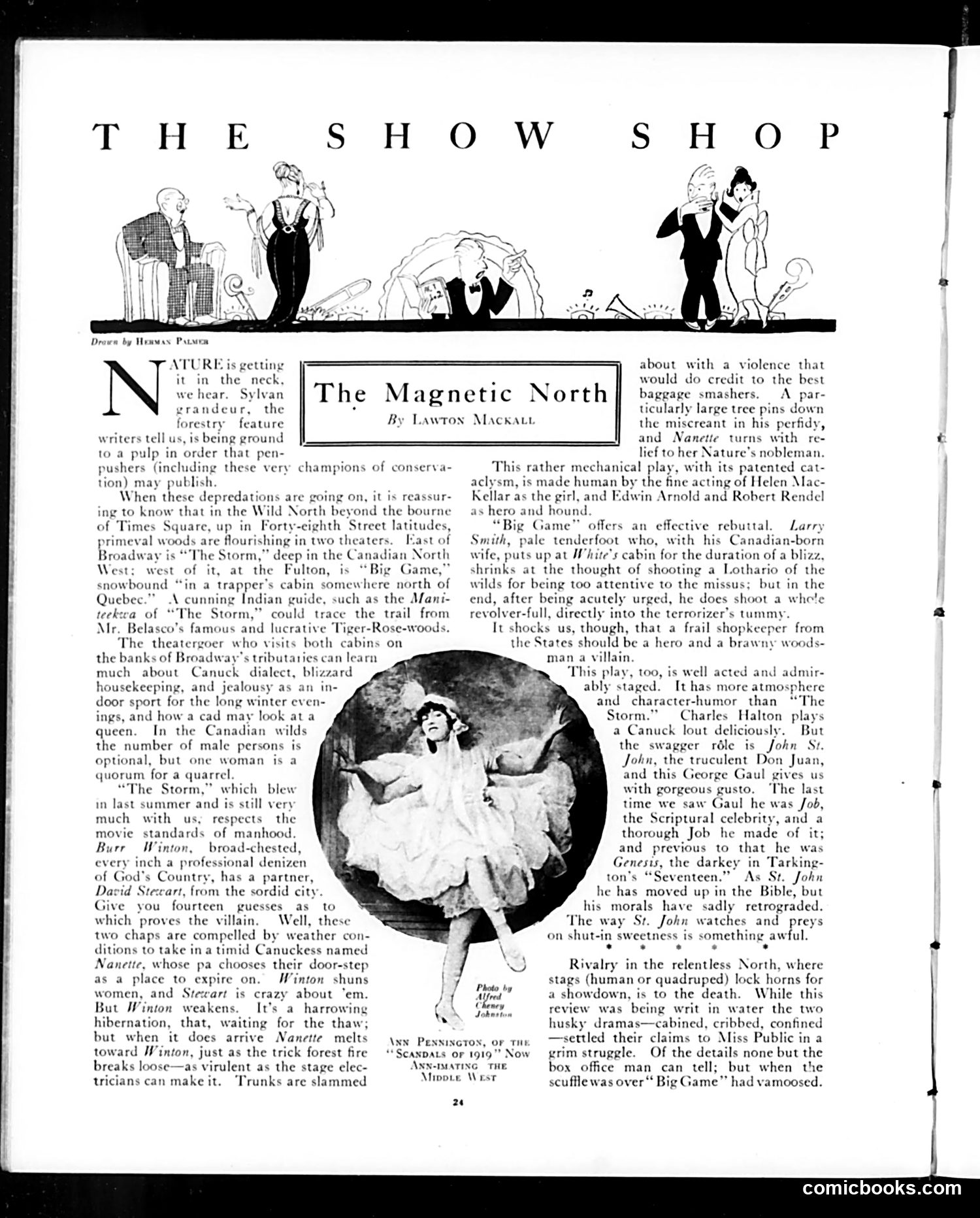
This page reviews two Broadway plays set in the Canadian wilderness: "The Storm" and "Big Game," both staged at theaters near Times Square. The top illustration is a theatrical sketch showing actors in various dramatic poses. The article satirizes how New York theaters capitalize on nature conservation while simultaneously grinding forests into pulp for publishing. It mocks the irony that Broadway offers "primeval woods" in indoor cabins while writers preach forestry. Both plays follow similar formulas: isolated Canadian settings with romantic triangles and masculine posturing. "The Storm" features the virtuous woodsman Burr Winton versus the city cad David Stewart competing for Nanette, while "Big Game" depicts a tenderfoot husband shooting a seducer. The reviewer critiques the mechanical plotting but praises the acting, particularly Helen Mackellar, Edwin Arnold, and George Gaul. The satire suggests these plays peddle escapist "Nature" while reinforcing conventional morality—ironically, the refined city men prove villainous while rough woodsmen are noble, contradicting actual character.
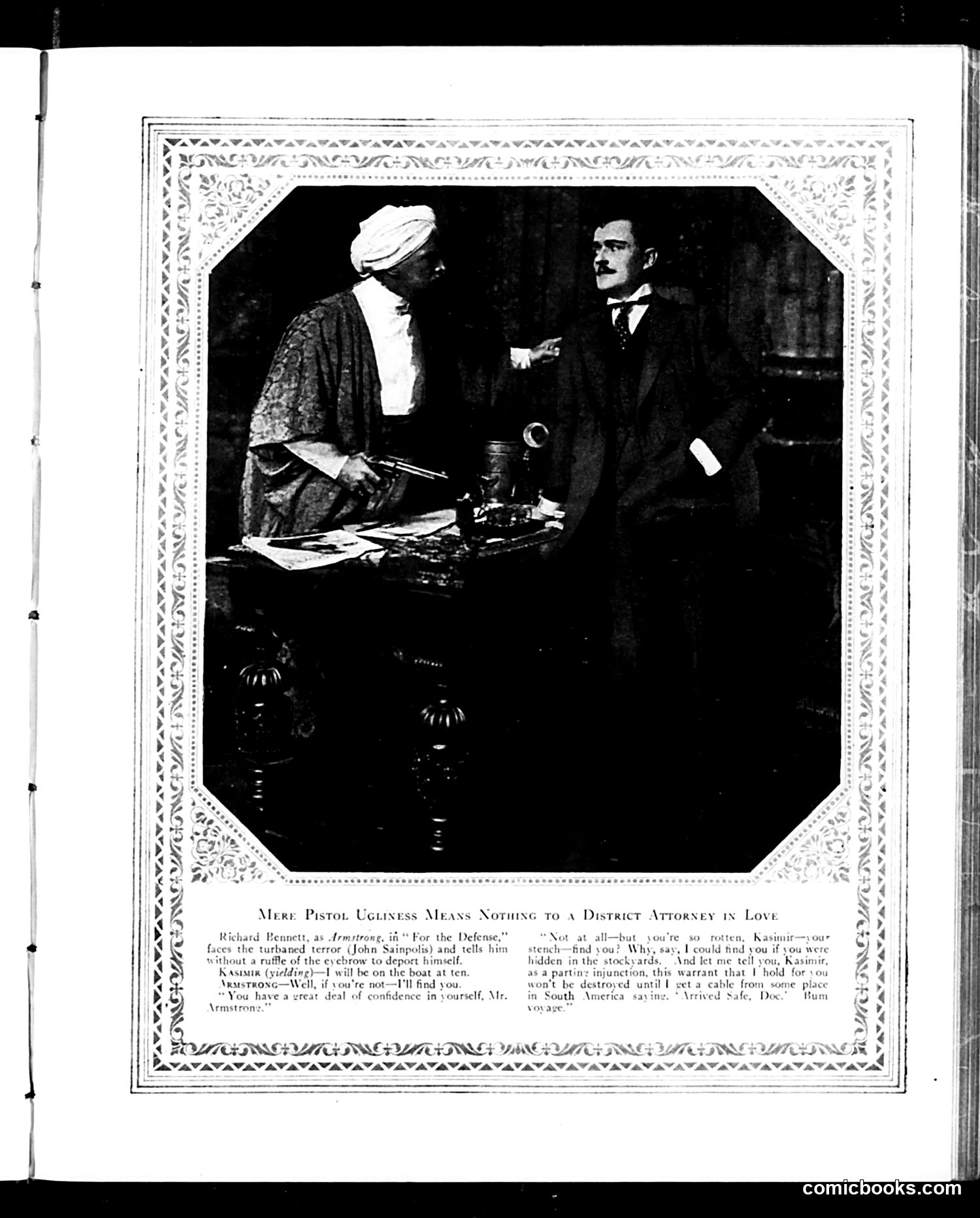
This is a satirical scene from *Judge* magazine depicting a conversation between two men in what appears to be a legal office. The caption reads "Mere Pistol Ugliness Means Nothing to a District Attorney in Love." The image shows Richard Bennett (identified in the text as playing "Armstrong") on the right speaking with another man on the left who wears a turban, suggesting a character named Kasimir. The dialogue indicates a plot involving hidden documents in stockyards and a warrant that won't be destroyed until receiving a cable from South America. The satire appears to mock the selective enforcement of law—suggesting that a district attorney in love would overlook serious crimes ("mere pistol ugliness") or legal violations. The exotic character and international intrigue suggest this references a theatrical plot or popular story of the era, though the specific play or context is unclear from the page alone. The joke centers on corruption of justice through romantic interest.
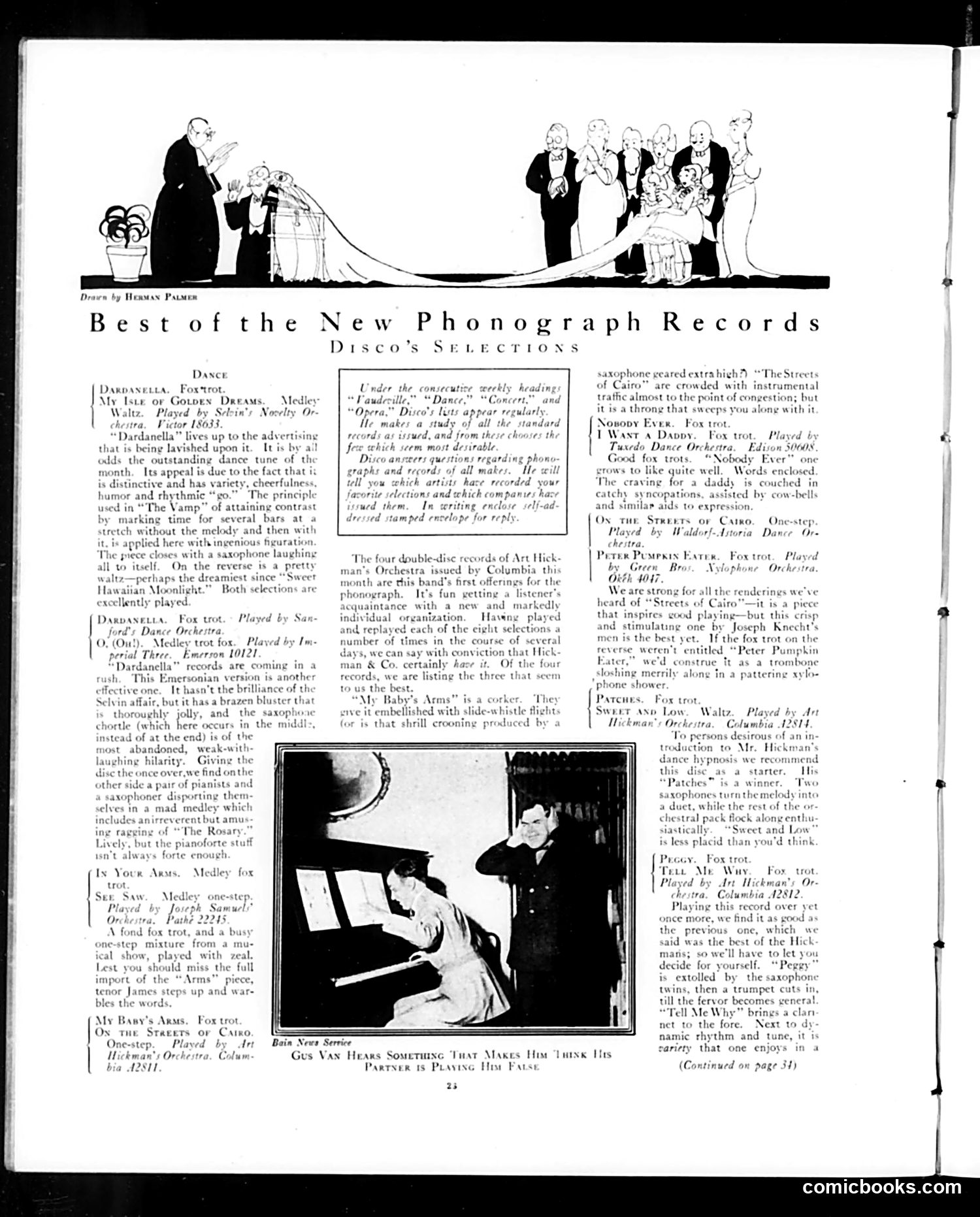
This page is primarily a **phonograph record review** rather than political satire. It catalogs "Best of the New Phonograph Records" from what appears to be the early 1920s, featuring popular dance music selections like fox trots and waltzes. The central photograph shows a couple in formal attire with the caption about Gus Van Hears "Something That Makes Him Think His Partner is Playing His False"—likely a humorous reference to a specific musical piece or performance. The reviews discuss various recordings and orchestras, evaluating their quality and appeal. The text emphasizes novelty and entertainment value typical of the era's phonograph industry. **This is not political satire.** Rather, it's entertainment journalism/advertising content reflecting 1920s popular culture and the phonograph industry's growth. The decorative header illustration (by Herman Patten) depicts formal society figures, establishing the upscale market being targeted.
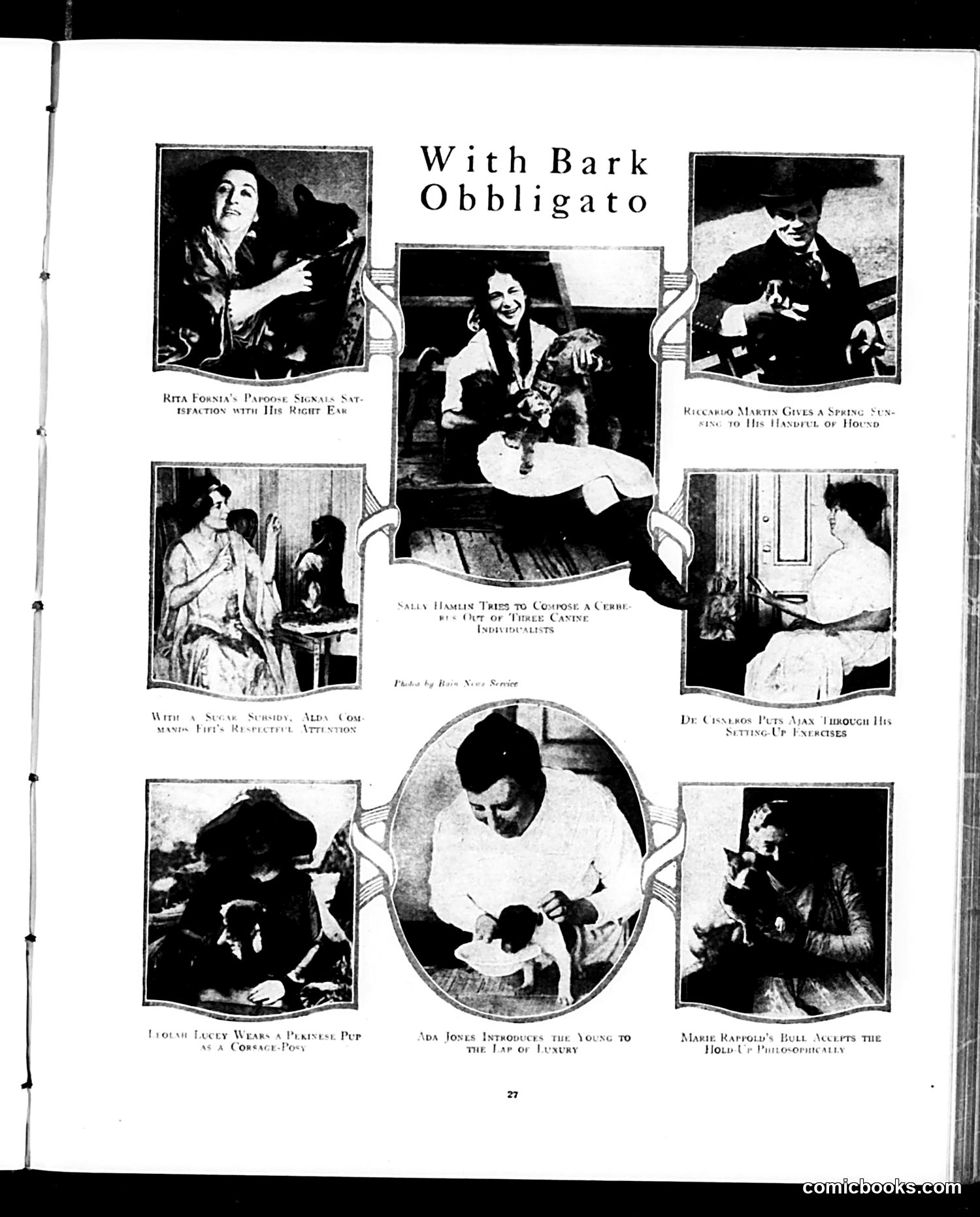
This page showcases scenes featuring **Bark Obligato**, apparently a performing dog that was notable enough to warrant a full feature in Judge magazine. The layout presents eight vignettes depicting the dog's various "talents" and interactions with human actors and actresses of the era. The humor appears to derive from anthropomorphizing the dog's actions—suggesting it deliberately performs sophisticated behaviors like "composing" music, exercising, and maintaining "philosophical" posture. Each caption treats the dog's mundane canine activities as if they were intentional artistic or intellectual accomplishments. This reflects early 20th-century entertainment culture's fascination with trained animal acts, which were popular vaudeville attractions. The satire likely mocks both the exaggerated claims performers made about their animals' abilities and audiences' gullibility in believing dogs possessed human-like reasoning. The page number indicates this is content from a larger issue of Judge magazine.
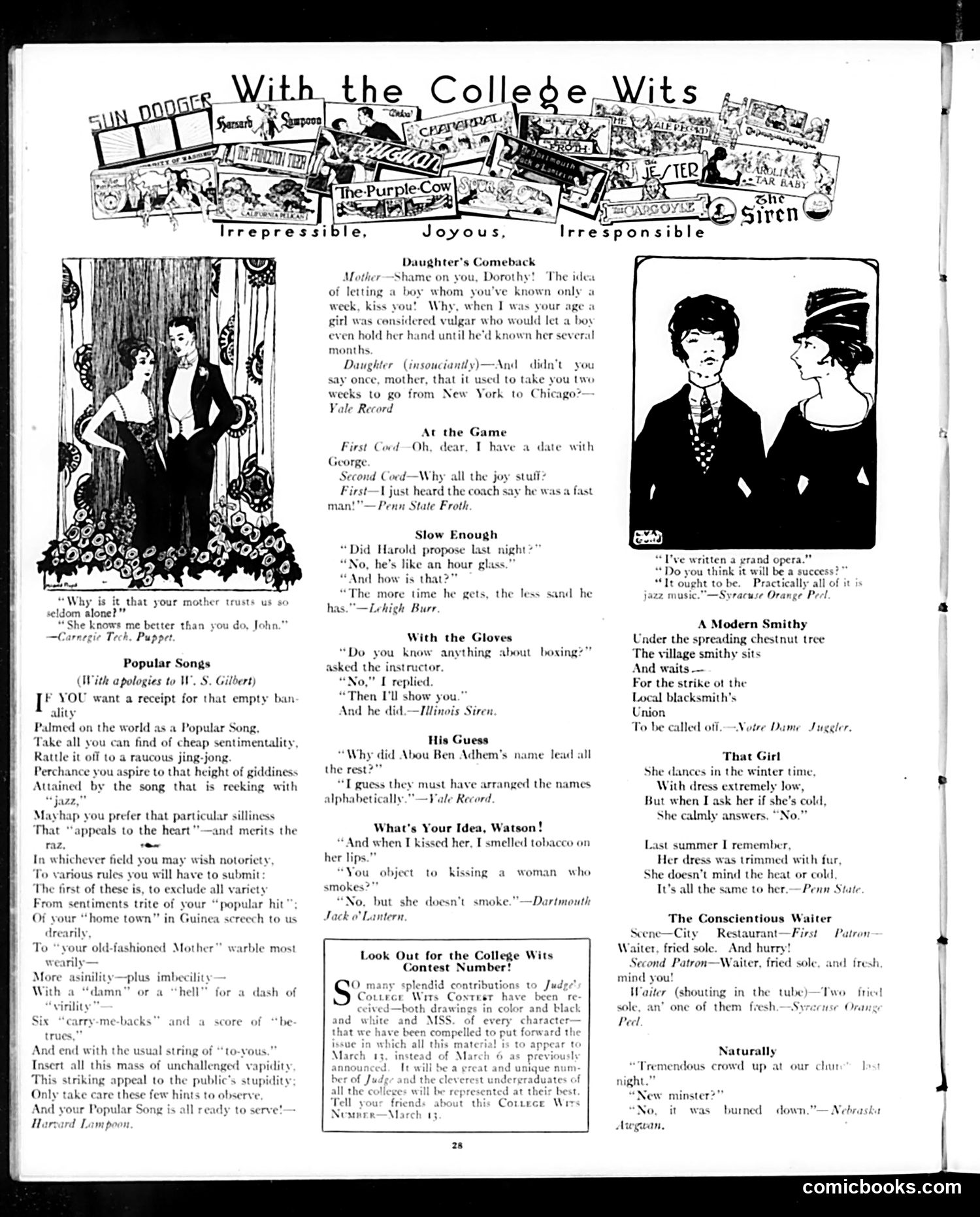
This page collects collegiate humor and satirical commentary typical of Judge magazine. The content mocks several social conventions of the era: **Social satire** includes "Daughter's Comeback," where a modern girl's casual dating practices contrast sharply with her mother's Victorian standards—the mother recalls needing weeks of courtship; the daughter dismisses such formality. **College humor** (drawn from various university publications like Yale Record, Penn State Froth, Illinois Siren) targets student life: dating, boxing instruction, romantic proposals, and kissing. **"Popular Songs" section** ridicules sentimental jazz-age music as vapid, formulaic drivel relying on clichés ("home town," "mother," repetitive "to-vous" endings) designed to exploit public stupidity rather than genuine emotion. The overall tone is urbane mockery of both old-fashioned propriety and modern youth culture's shallow sentimentality. The page reflects 1920s anxieties about changing social mores and popular entertainment's perceived dumbing-down effect.
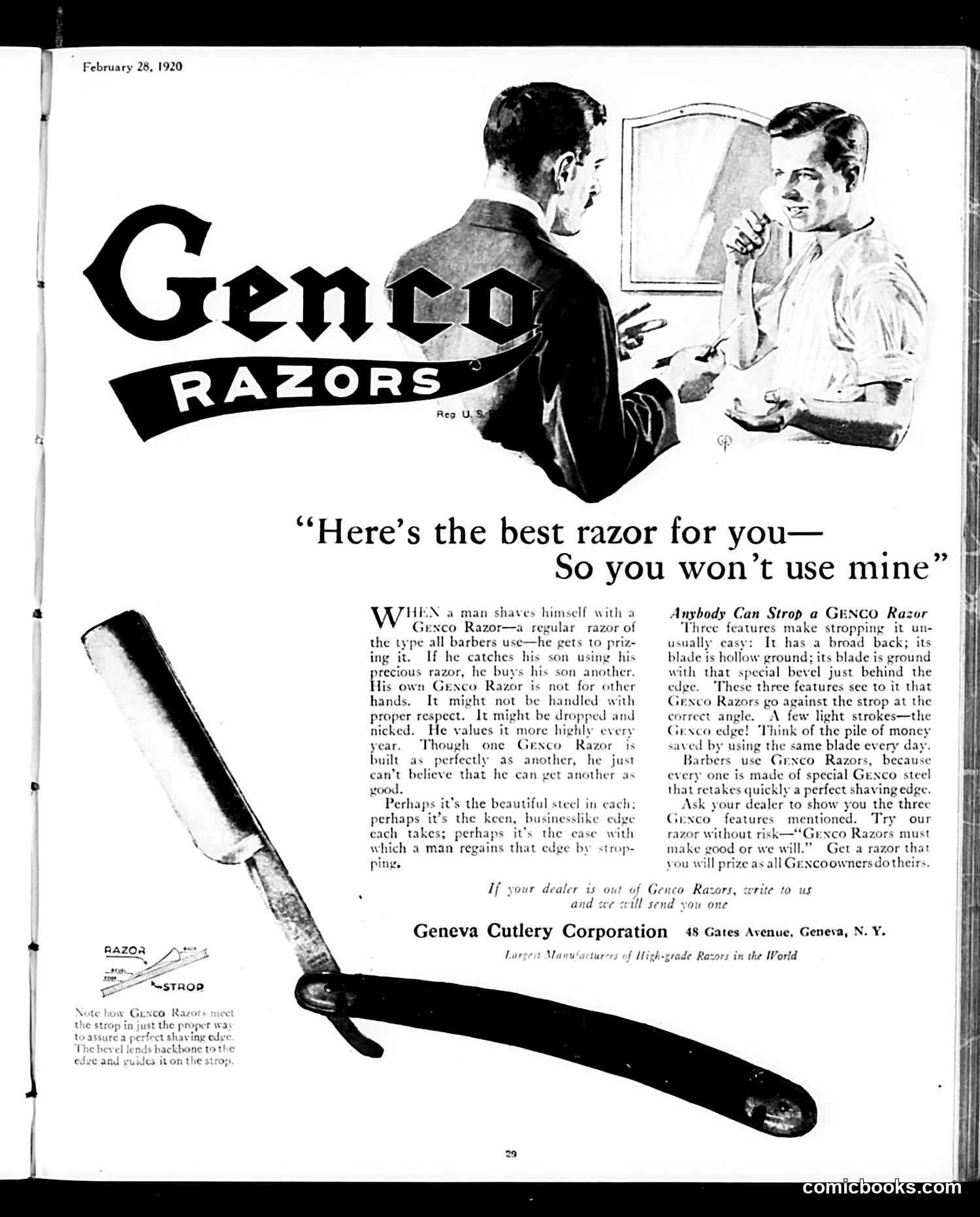
This is **not a political cartoon or satire**—it's a straightforward product advertisement for Genco brand razors, occupying the entire page. The ad uses a domestic scenario to market razors: a man so protective of his own Genco razor that he buys his son a separate one rather than share his prized blade. The accompanying illustration shows the father-son interaction and a detailed product image. The ad's sales pitch emphasizes three technical features: broad back, hollow-ground blade, and a special bevel design that supposedly maintain a sharp edge through stropping. It appeals to both home users and barbers, stressing durability, ease of maintenance, and economy (keeping the same blade longer). This represents typical early-20th-century advertising rhetoric—manufacturing quality, masculine pride in possessions, and practical value propositions.
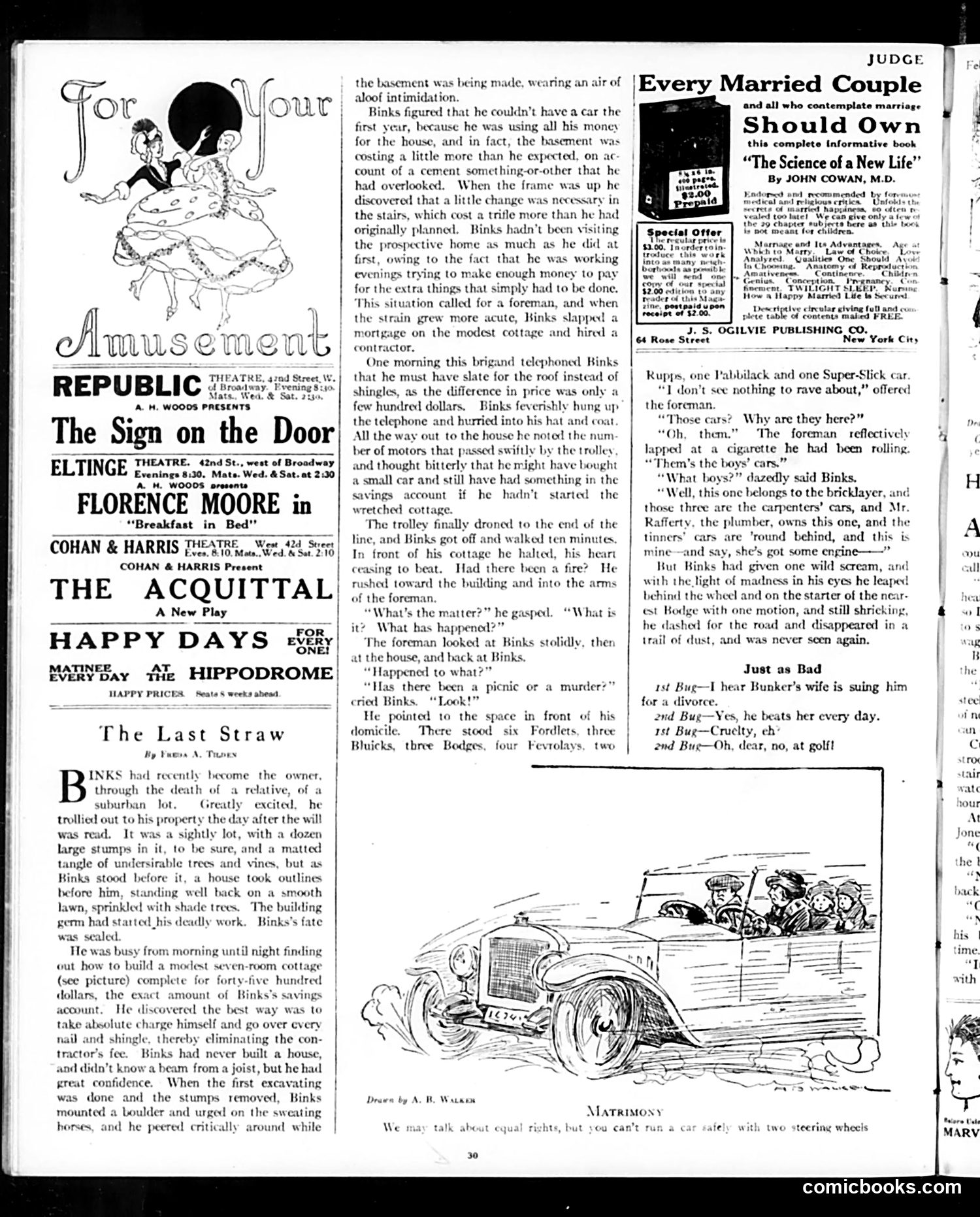
This story mocks the financial trap of home ownership for ordinary Americans. Binks inherits a modest suburban lot and decides to build a $4,500 house—his entire life savings. He oversees construction himself to save money, but constantly discovers hidden costs: cement foundations, stair modifications, slate roofing instead of shingles, and eventually a mortgage. The climax reveals the satire's point: six Fords, three Buicks, three Dodges, and four other cars clutter his property. The caption reads: "We may talk about equal rights, but you can't run a car safely with two steering wheels"—suggesting marital discord. The joke operates on two levels: Binks spent everything on a house he can barely afford while his neighbors own multiple automobiles, and homeownership itself creates domestic conflict. For Depression-era readers, this resonated as commentary on aspiration, debt, and the American dream's hidden costs.
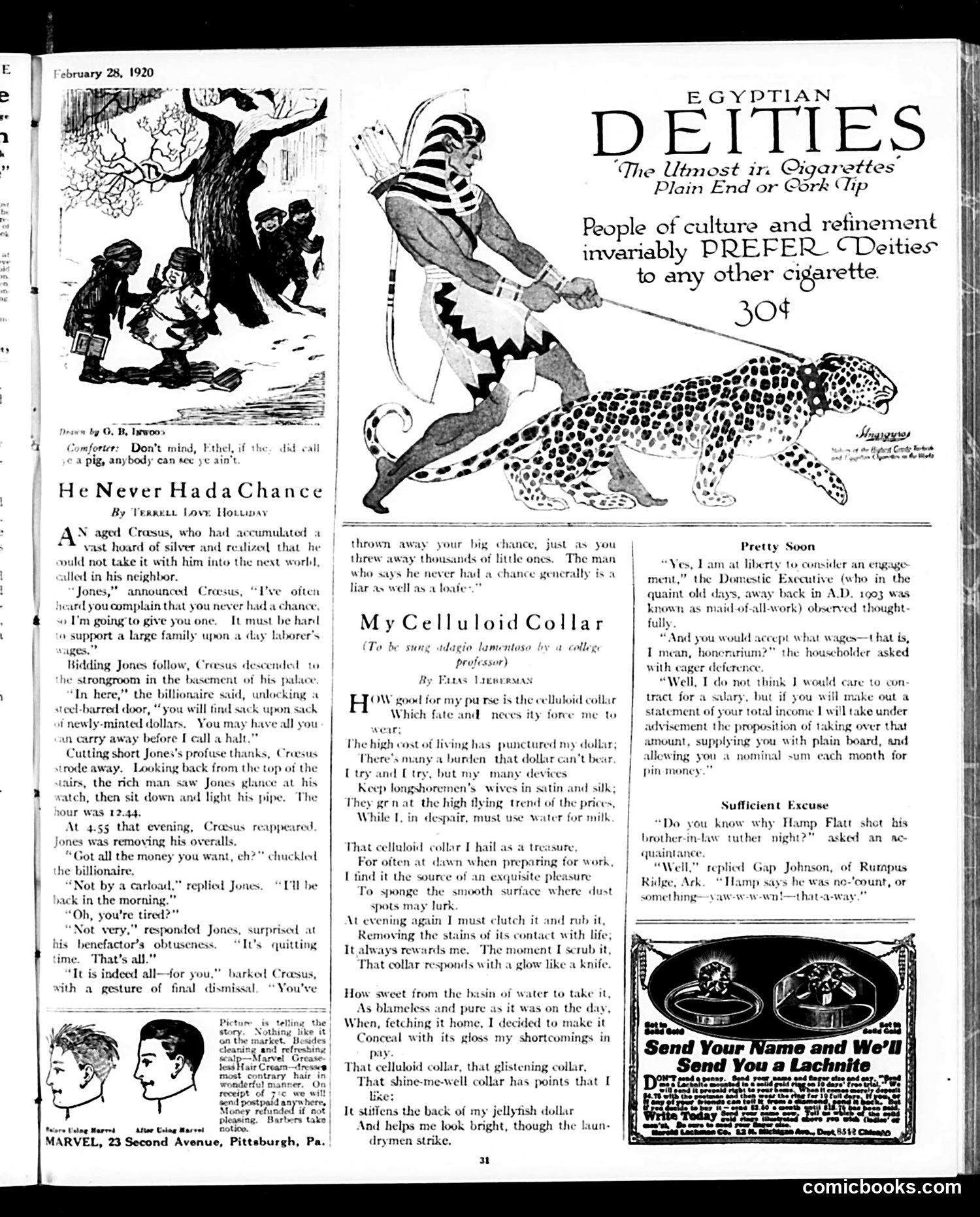
**"He Never Had a Chance"** is a class-commentary story. A wealthy man (Croesus, the famously rich ancient king) offers poor laborer Jones access to unlimited money in his basement vault. Jones glances at his watch, sits down to smoke, and leaves—because it's 12:44 p.m., quitting time. He returns next morning having taken nothing. Croesus dismisses him, declaring Jones is a "liar" and "loafer" who squanders chances. The satire cuts both ways: it mocks the poor for lacking ambition, but also skewers wealthy paternalism. The premise that a desperate laborer would ignore free money rather than work overtime reveals how industrial-era workers had rigid, exhausting schedules that trapped them in poverty—they literally couldn't seize "opportunities" without violating labor norms. The other content includes cigarette advertising and light verse about celluloid collars (cheap, washable alternatives to expensive cloth collars—a working-class concern). "Pretty Soon" jokes about domestic servants now demanding formal "honorariums" rather than simple wages, reflecting post-WWI labor unrest.
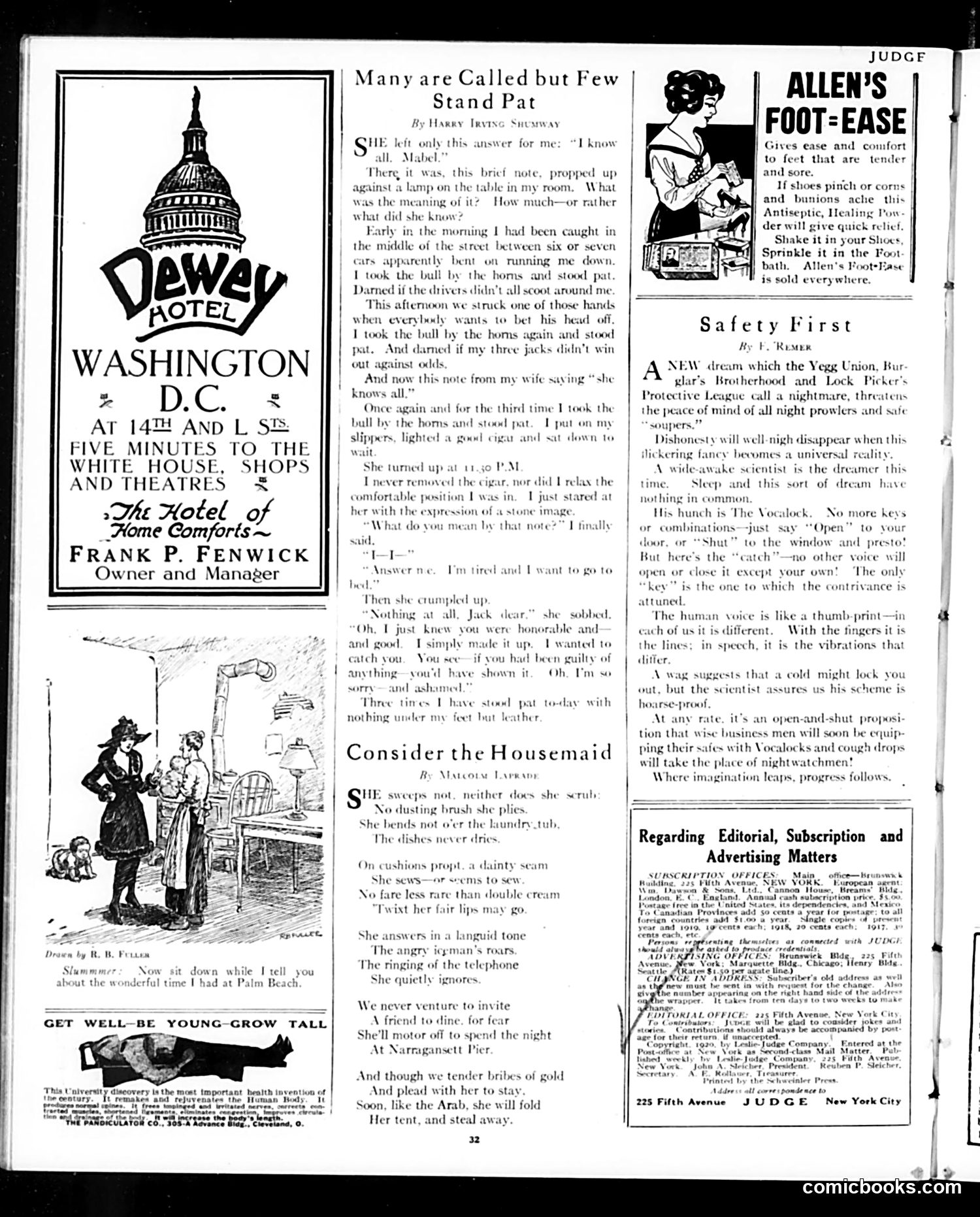
This page contains three distinct pieces of satirical content: **"Many Are Called but Few Stand Pat"** (top center): A humorous short story by Harry Irving Shemway about a man who repeatedly "stands pat" (holds firm/refuses to budge) in various situations—caught between cars, gambling with poor poker hands, confronting his wife's cryptic note. The joke plays on the phrase "stand pat," showing how stubborn resolve accidentally produces favorable outcomes. The wife's final note reveals she was testing his loyalty; he "won" by refusing to move. **"Consider the Housemaid"** (bottom left): Satirical verse mocking the modern housemaid who avoids all actual domestic labor, lounging on cushions while appearing to sew, ignoring the iceman and telephone, and constantly threatening to abandon her employer for leisure trips. It critiques the leisure class pretenses of servants. **"Safety First"** (right column): Commentary on a fictional "Vocalock"—a voice-activated security device that would recognize only the owner's voice. The satire targets both inventors' optimism and criminals' concerns, joking that even a cold could defeat this "hoarse-proof" system.
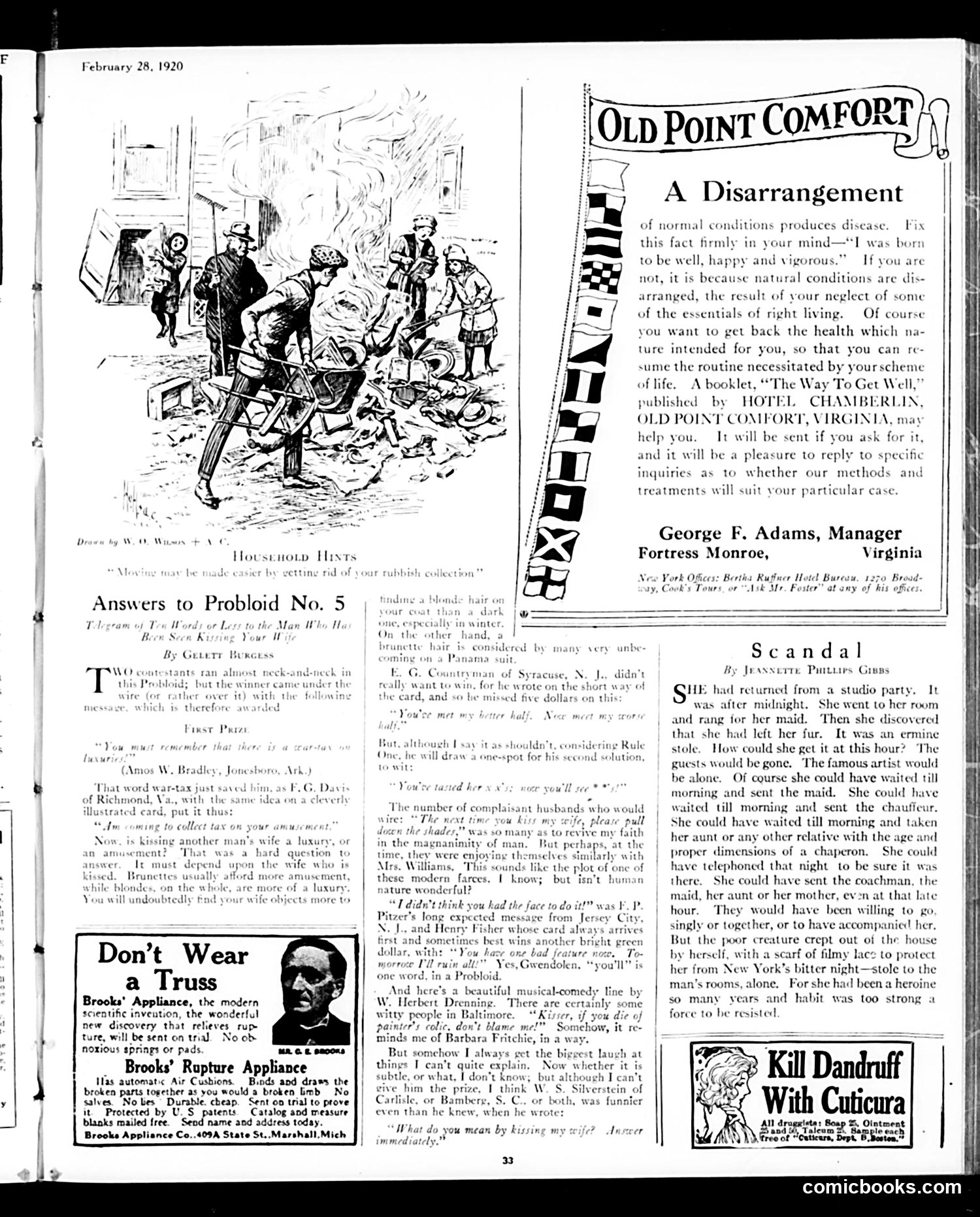
This page contains no coherent political cartoon. Instead, it's primarily **advertising and advice columns** typical of Judge's content. The main illustrated piece, "Household Hints," shows a chaotic domestic scene (drawn by W.O. Wilson) with the caption "Moving must be made easier by retiring old of your rubbish collection"—a mundane domestic joke about decluttering during a move. The page features **commercial advertisements** for a rupture appliance and hotel health treatments, alongside advice columns addressing readers' submitted problems (including a "Scandal" column about a woman retrieving a fur stole). The date (February 1920) places this during the post-WWI period, but nothing on this specific page engages with that era's major political events. It's a standard issue mixing light humor, practical advice, and advertising—not satirical commentary.
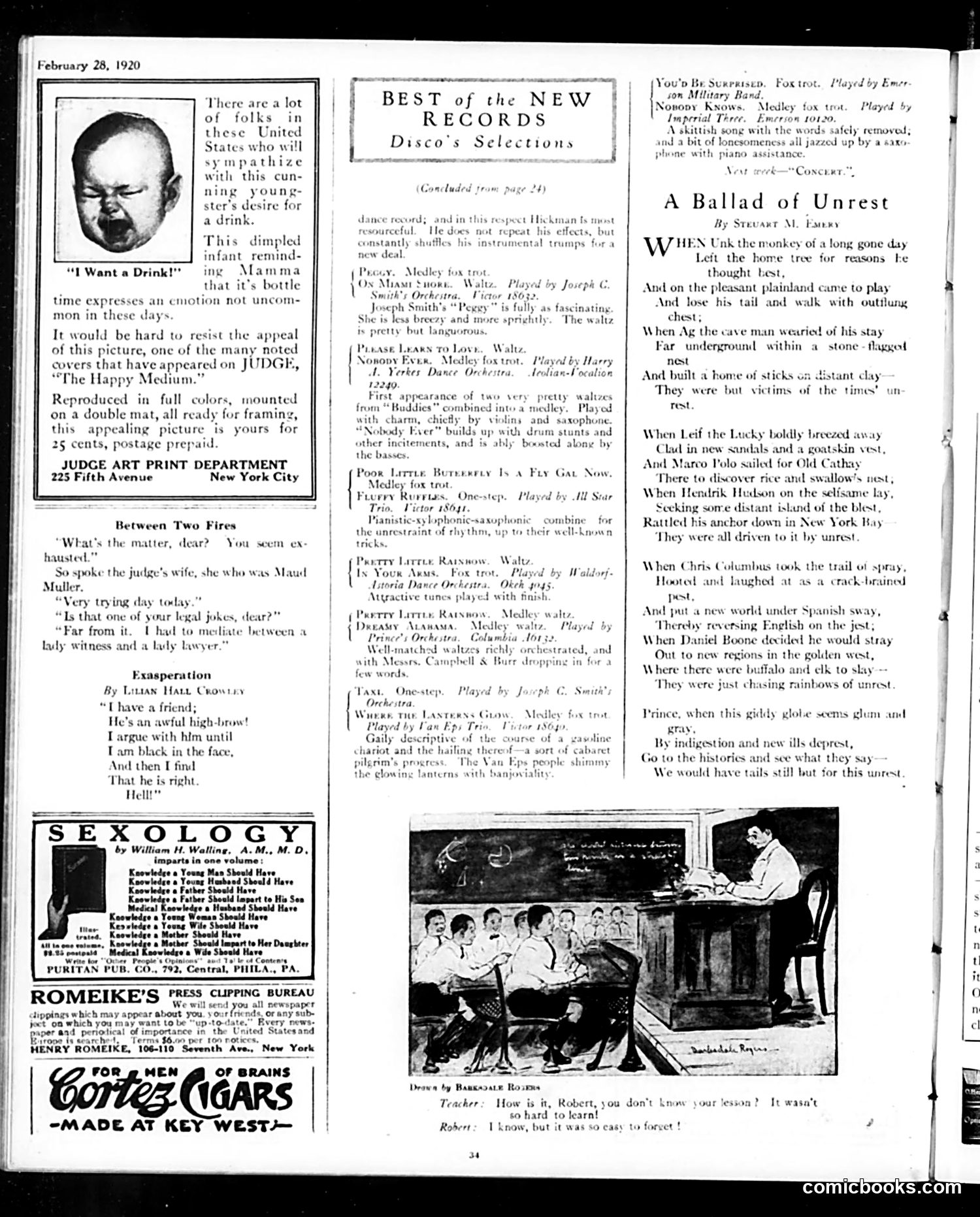
The cover cartoon "I Want a Drink!" depicts a dimpled infant requesting a bottle, but the caption explicitly states this represents adult longing for alcohol. This is a direct reference to Prohibition, which took effect January 17, 1920—just six weeks before this issue. The joke satirizes Americans' widespread desire to drink despite the new constitutional ban, suggesting even infants would sympathize with those craving forbidden liquor. The accompanying text notes this emotion was "not uncommon in these days," reflecting the public resistance and nostalgia for legal drinking that characterized early Prohibition. Judge, a satirical weekly, used humor to comment on this unpopular federal mandate that would ultimately last thirteen years.
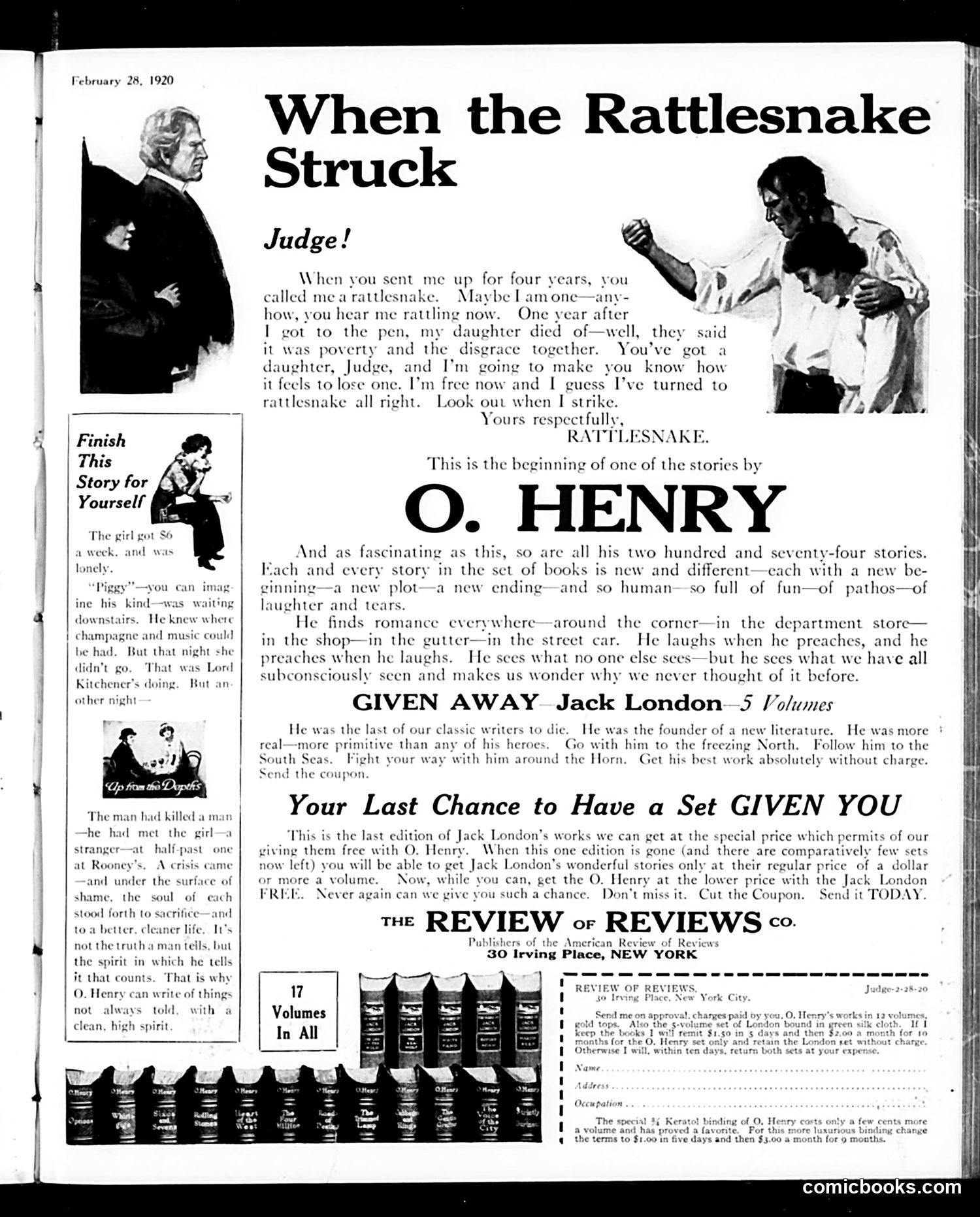
This page primarily advertises O. Henry short-story collections (with a bonus Jack London set) by featuring the opening of one of Henry's tales. The "rattlesnake" is a convict writing to a judge who sentenced him years earlier. The convict's daughter died from poverty and shame while he was imprisoned, and now free, he seeks revenge—a darkly ironic threat delivered through a letter. The satire works on two levels: it showcases O. Henry's talent for finding dramatic human stories in ordinary urban life (his stated specialty), while the "rattlesnake" letter itself demonstrates his gift for depicting the moral complexity of lower-class characters society typically dismisses. The advertisement emphasizes that Henry treats serious social themes—poverty, justice, redemption—with both pathos and insight, justifying why readers should collect his works.
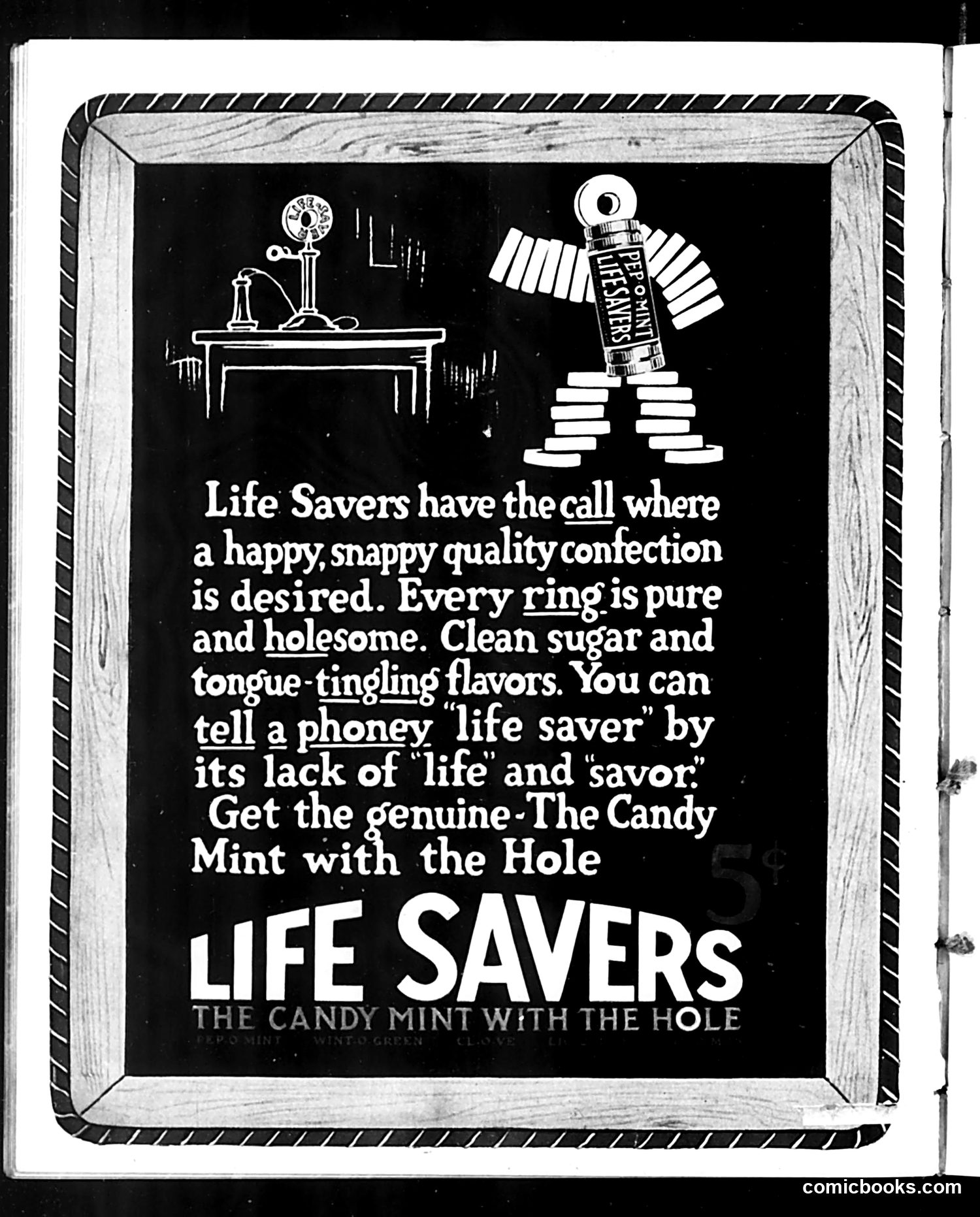
This is a Life Savers candy advertisement, not a political cartoon. The page promotes Life Savers mints, emphasizing their authentic quality through wordplay: genuine Life Savers have "life" and "savor," while counterfeit versions lack these qualities. The anthropomorphic Life Saver character (right) made from stacked mints illustrates the product's distinctive hole. The left illustration shows a laboratory or quality-control setting, suggesting scientific manufacturing standards. The ad targets consumers concerned about product authenticity during an era when counterfeit goods were apparently a marketplace concern. The tagline "The Candy Mint with the Hole" became Life Savers' defining marketing feature.