
A complete issue · 36 pages · 1920
Judge — February 21, 1920
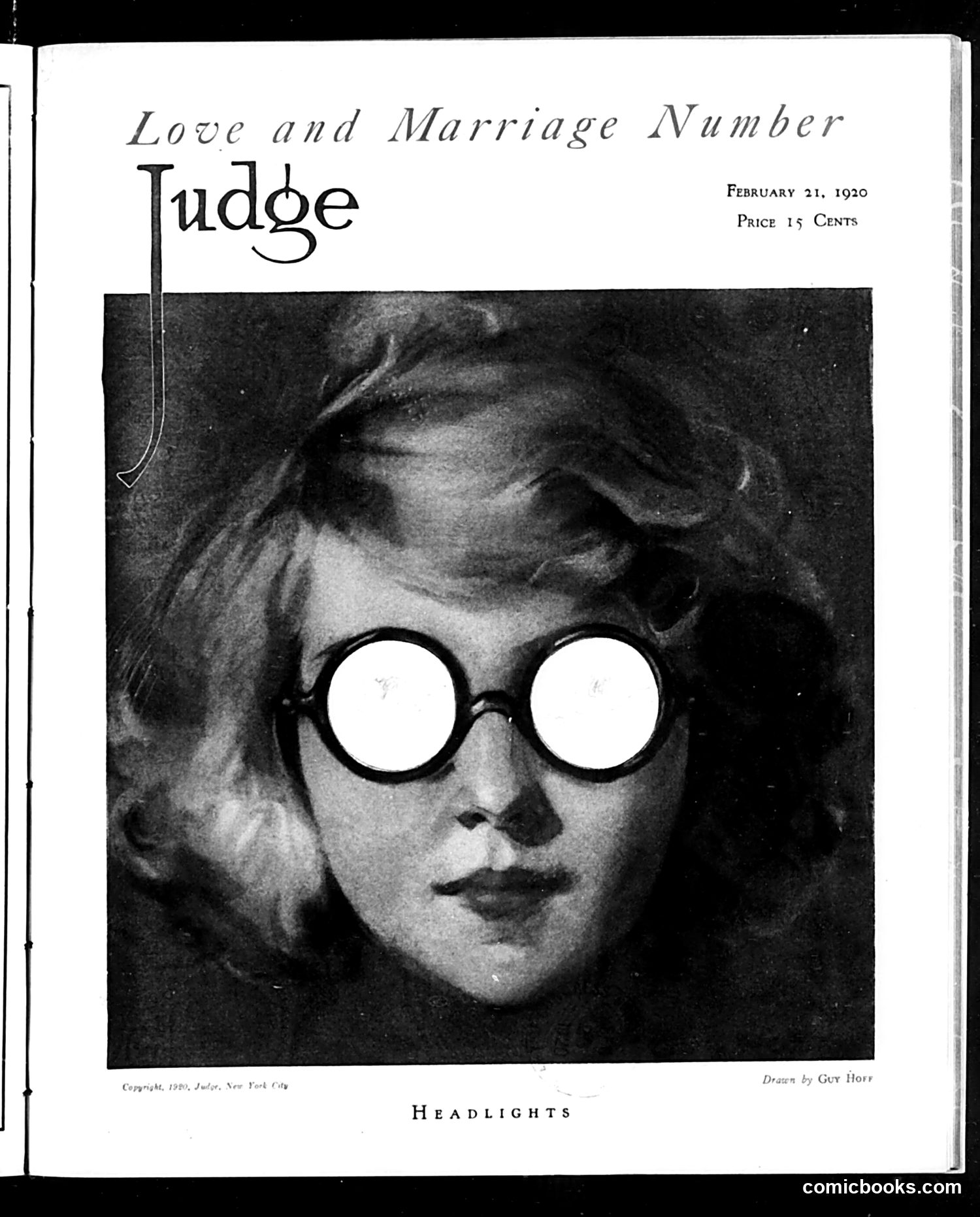
This satirical illustration by Guy Hore depicts a figure wearing oversized round spectacles labeled "Headlights." The cartoon appears to be social commentary on 1920s fashion or behavior, though the specific reference is unclear without additional context. The title "Love and Marriage Number" suggests this issue focused on romantic themes. The exaggerated glasses may mock: - A fashion trend of the era - Deliberate affectation or pretension - A specific public figure known for wearing such glasses The style is typical of Judge magazine's visual satire—using physical exaggeration to ridicule contemporary social attitudes or aesthetics. Without knowing the specific person caricatured or the exact cultural reference, the precise satirical target remains uncertain.
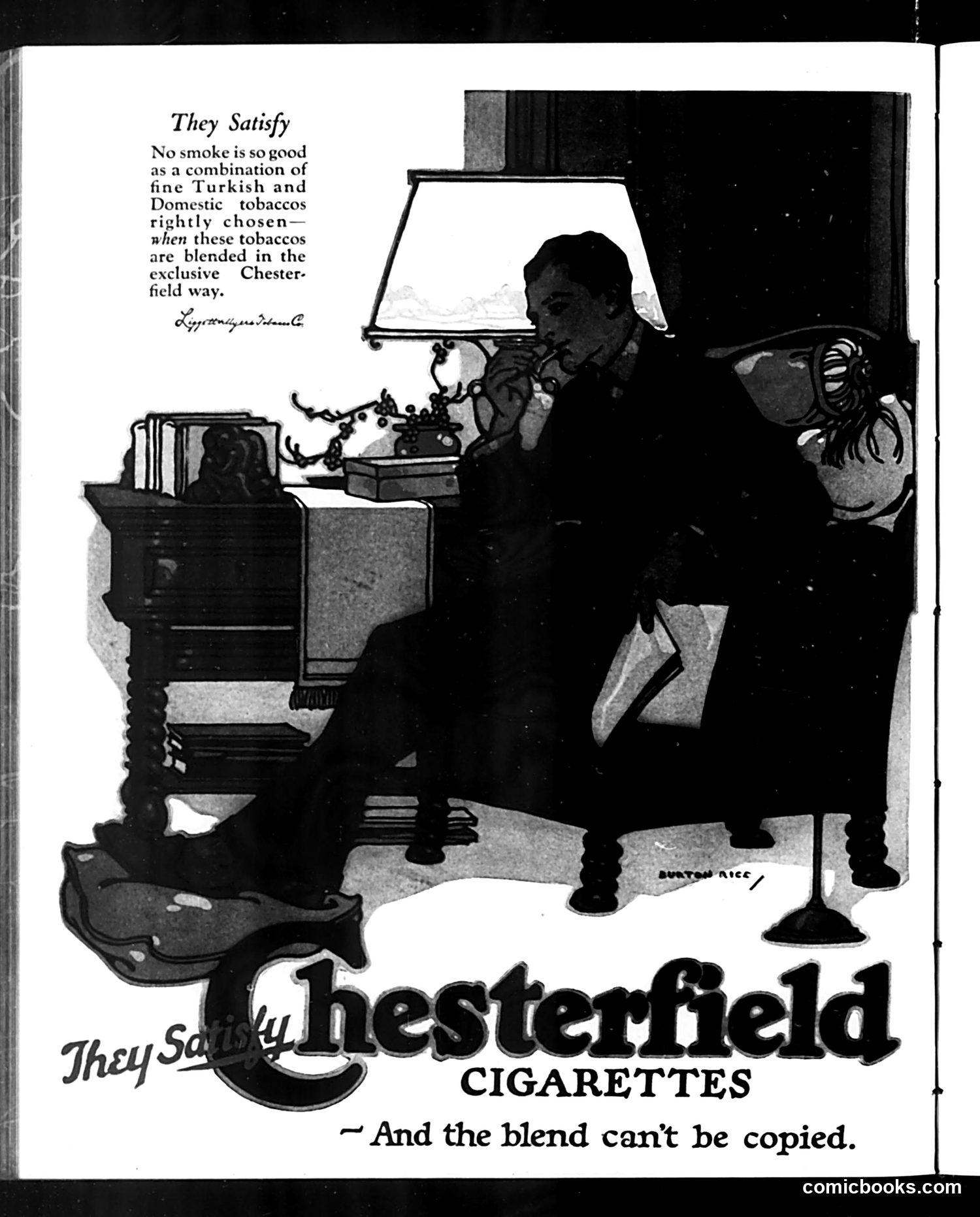
This is a **cigarette advertisement**, not political satire. The page promotes Chesterfield cigarettes through an illustration of a well-dressed man at his desk, smoking contentedly in an upscale interior setting. The ad's selling points are: 1. **"They Satisfy"** — the headline emphasizing consumer satisfaction 2. **Tobacco blend exclusivity** — claims that Turkish and domestic tobaccos are "rightly chosen" and blended using an "exclusive Chesterfield way" 3. **Inimitability** — the tagline states "the blend can't be copied," suggesting unique quality The sophisticated illustration and refined domestic setting are designed to associate the product with affluence and success. This represents typical mid-20th-century cigarette marketing, before health warnings were required.
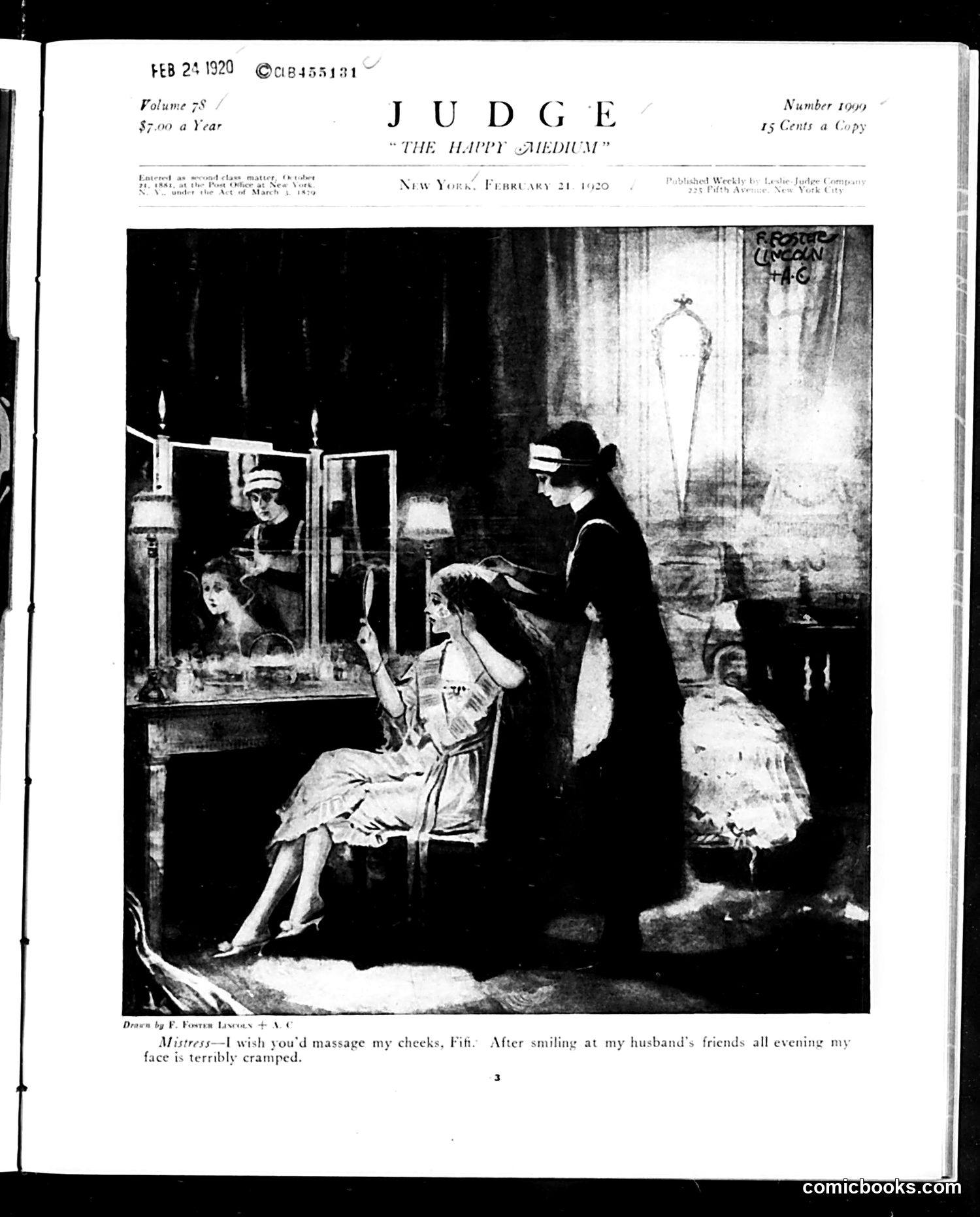
This illustration depicts a beauty salon scene, likely satirizing 1920s cosmetic culture and gender dynamics. A woman sits at a vanity while salon workers attend to her appearance. The caption reads: "Mistress—I wish you'd massage my cheeks, Fin. After smiling at my husband's friends all evening my face is terribly cramped." The satire targets the social expectation that women must maintain constant artificial cheerfulness and attractiveness for male entertainment. The "cramped face" from forced smiling suggests the physical toll of performing femininity. The manicure/massage setting emphasizes how women's bodies were commodified through beauty routines—what today we'd call "emotional labor." The joke mocks both the superficiality of beauty culture and the exhausting performance gender norms demanded of women.
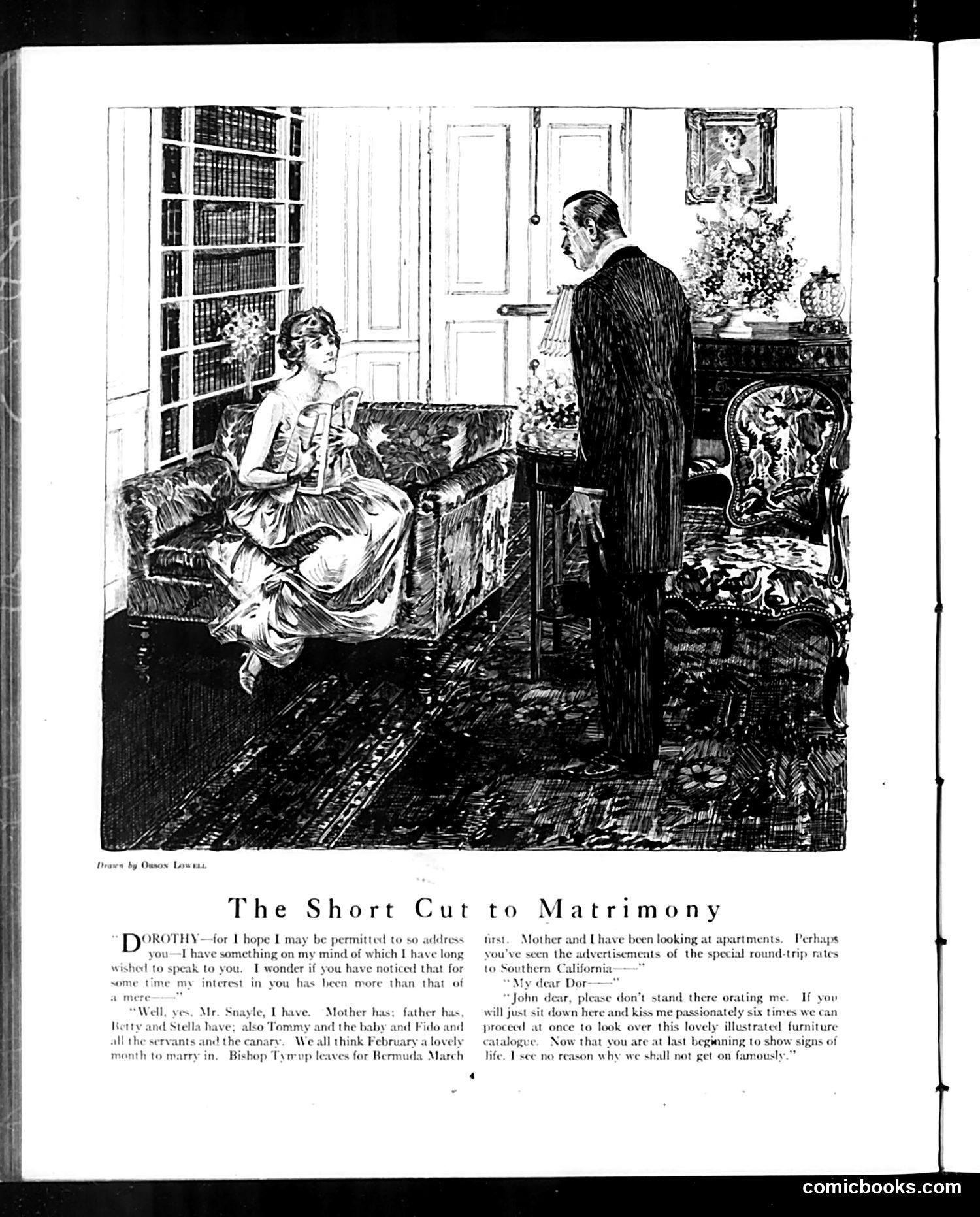
This illustration depicts a domestic scene satirizing marriage proposals and courtship rituals of the early 20th century. A woman sits on a sofa while a man stands before her in what appears to be a formal drawing room with bookshelves and fine furnishings. The accompanying text presents a humorous dialogue where a man proposes marriage to "Dorothy," mentioning family members and property ("We all think February a lovely month to marry in"). The woman's response suggests she finds his approach unromantic—he's treating marriage like a business transaction or furniture purchase rather than an emotional commitment. The satire mocks how some suitors approached matrimony as a practical arrangement rather than a romantic endeavor, reflecting period attitudes about class, property, and gender relations.
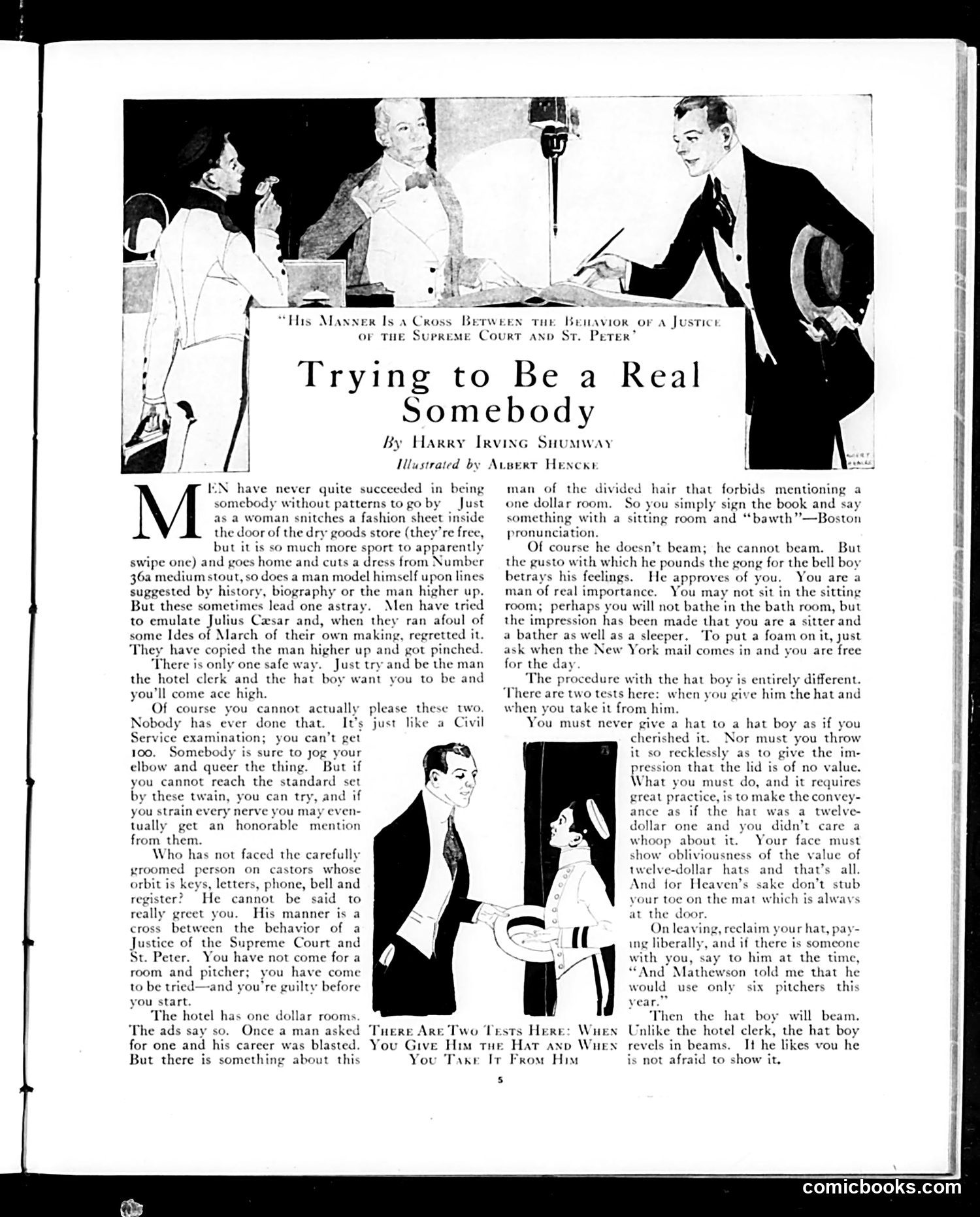
This satirical article by Harry Irving Shahway (illustrated by Albert Hencke) mocks the aspiration to appear dignified and important through affected mannerisms. The opening epigraph compares someone's behavior to "a cross between the behavior of a Justice of the Supreme Court and St. Peter"—suggesting pretentious, self-important deportment. The piece humorously describes how people attempt to emulate authority figures (mentioning Julius Caesar) and advises readers on how to behave in cheap hotel rooms and with hat-check boys to maintain an impression of importance and wealth. The satire targets social-climbing and performative respectability—the desire to *seem* somebody significant through affected formality rather than genuine accomplishment.
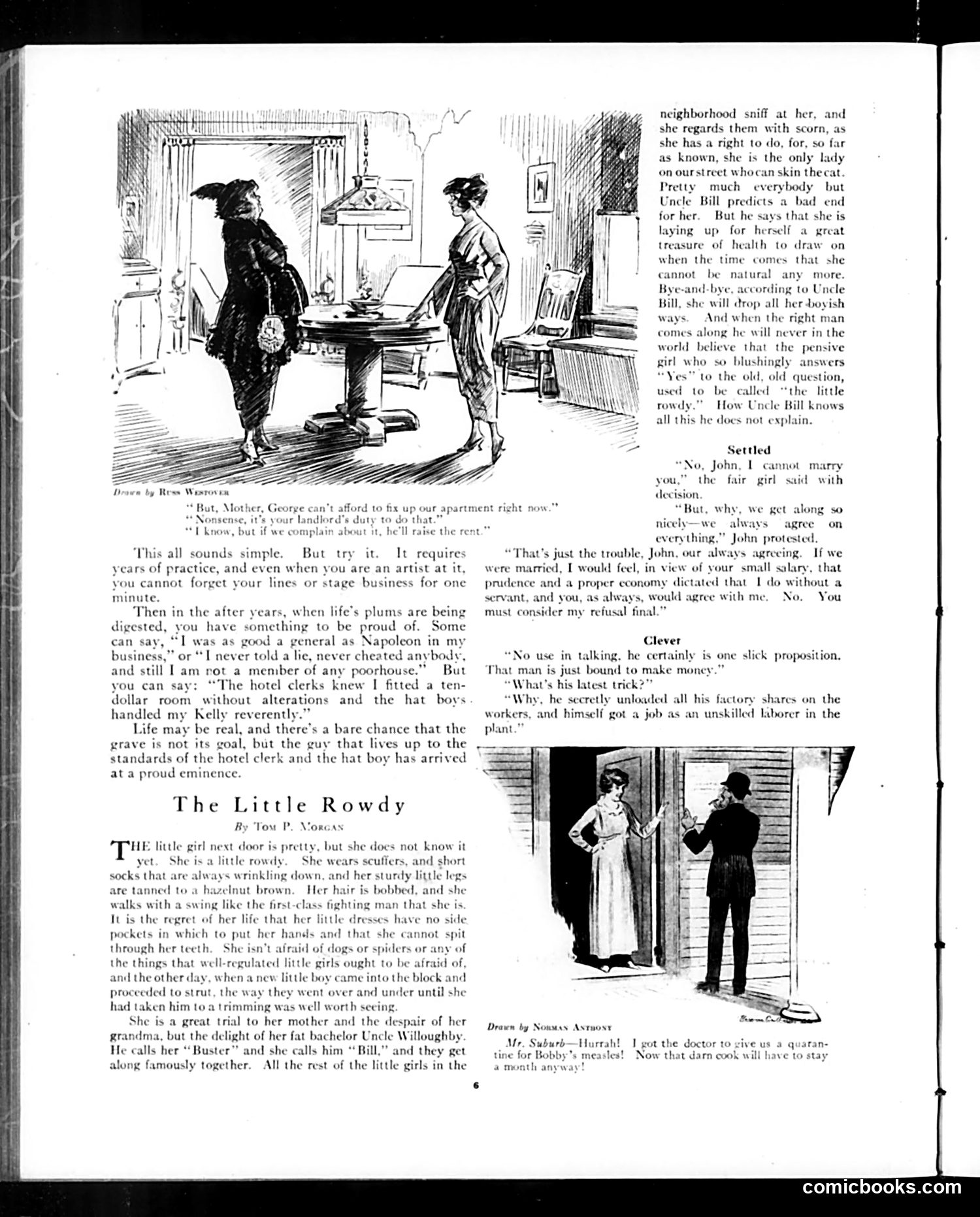
This page contains two separate pieces of social satire: **"Settled"** (top): A domestic dispute cartoon showing a couple negotiating marriage terms. The woman refuses marriage, citing the man's modest salary and need for household help. The satire critiques how women's economic dependence on husbands created unequal power dynamics in marriage negotiations—she wants financial security and household servants before agreeing to wed. **"The Little Rowdy"** (bottom): A story about a tomboy girl living in an urban neighborhood. The narrative satirizes parental anxiety about girls' unladylike behavior—her lack of pockets, inability to spit, and fighting spirit—while suggesting such "rowdiness" is actually healthy. The piece gently mocks both overprotective mothers and rigid gender expectations for girls. Both pieces address early 20th-century social anxieties about gender roles and respectability.
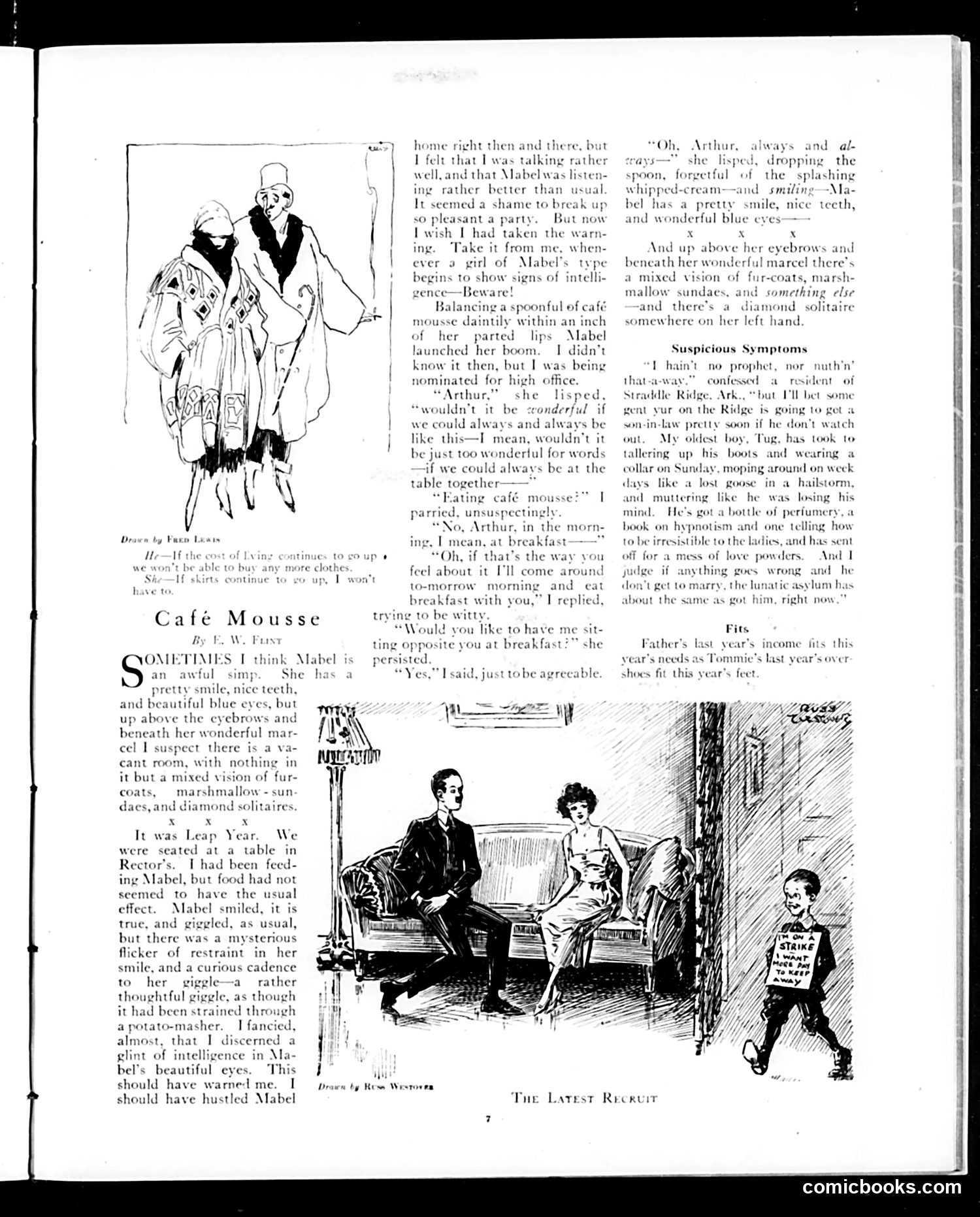
This page contains two distinct pieces of social satire typical of Judge magazine's commentary on 1920s American life. **"Café Mousse"** (main story with illustration) mocks the shallow materialism of young women of the era. The narrator describes Mabel as beautiful but intellectually vacant—her mind filled only with "fur-coats, marshmallow sundaes, and diamond solitaires." The satire peaks when Mabel, during a romantic dinner at Rector's (a fashionable restaurant), uses the occasion to manipulate the narrator into a marriage proposal. The joke: her sudden display of intelligence frightens him because it reveals her calculated self-interest. The "Leap Year" reference allows her to propose, inverting traditional gender roles for comic effect. **"Suspicious Symptoms"** and **"The Latest Recruit"** (bottom illustrations) satirize working-class courtship anxieties—a father's concerns that his son's sudden grooming and mysterious behavior indicate romantic entanglement leading to unwanted marriage. Together, these pieces mock both upper and lower-class romantic dynamics, suggesting women uniformly scheme for marriage regardless of social station.
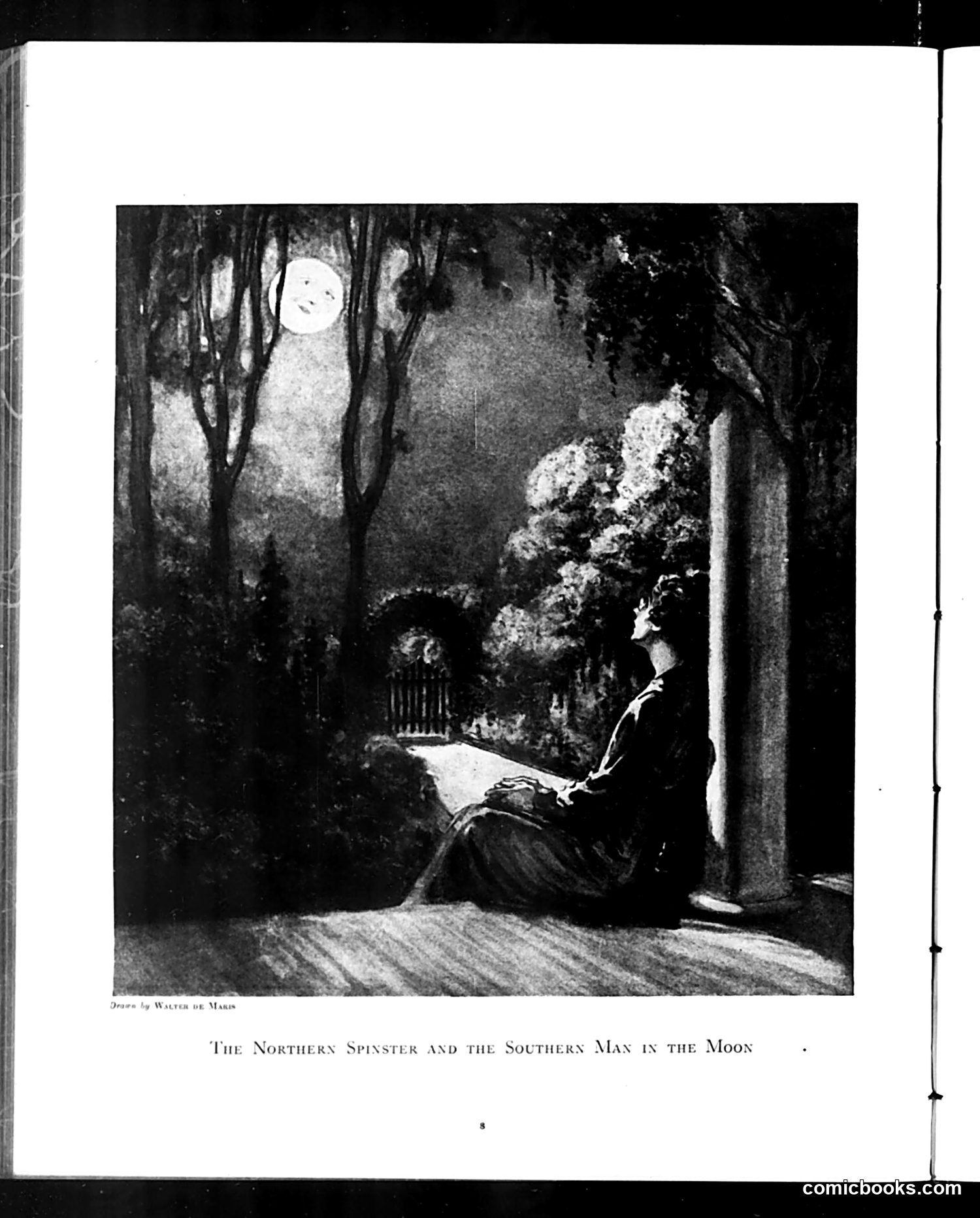
This illustration, drawn by Walter de Maris, depicts a romantic or flirtatious nighttime scene. A woman sits outdoors gazing upward at the moon, while a man approaches from behind. The title's reference to "Northern Spinster" and "Southern Man" suggests sectional American humor, likely playing on regional stereotypes or romantic tropes common in late 19th/early 20th-century Judge magazine satire. The "Man in the Moon" appears to be both a literal celestial reference and possibly a coded romantic rival or observer. Without additional context about Judge's specific issue date, the exact political or social commentary remains unclear, though the piece appears to satirize courtship customs or regional romantic dynamics between North and South.
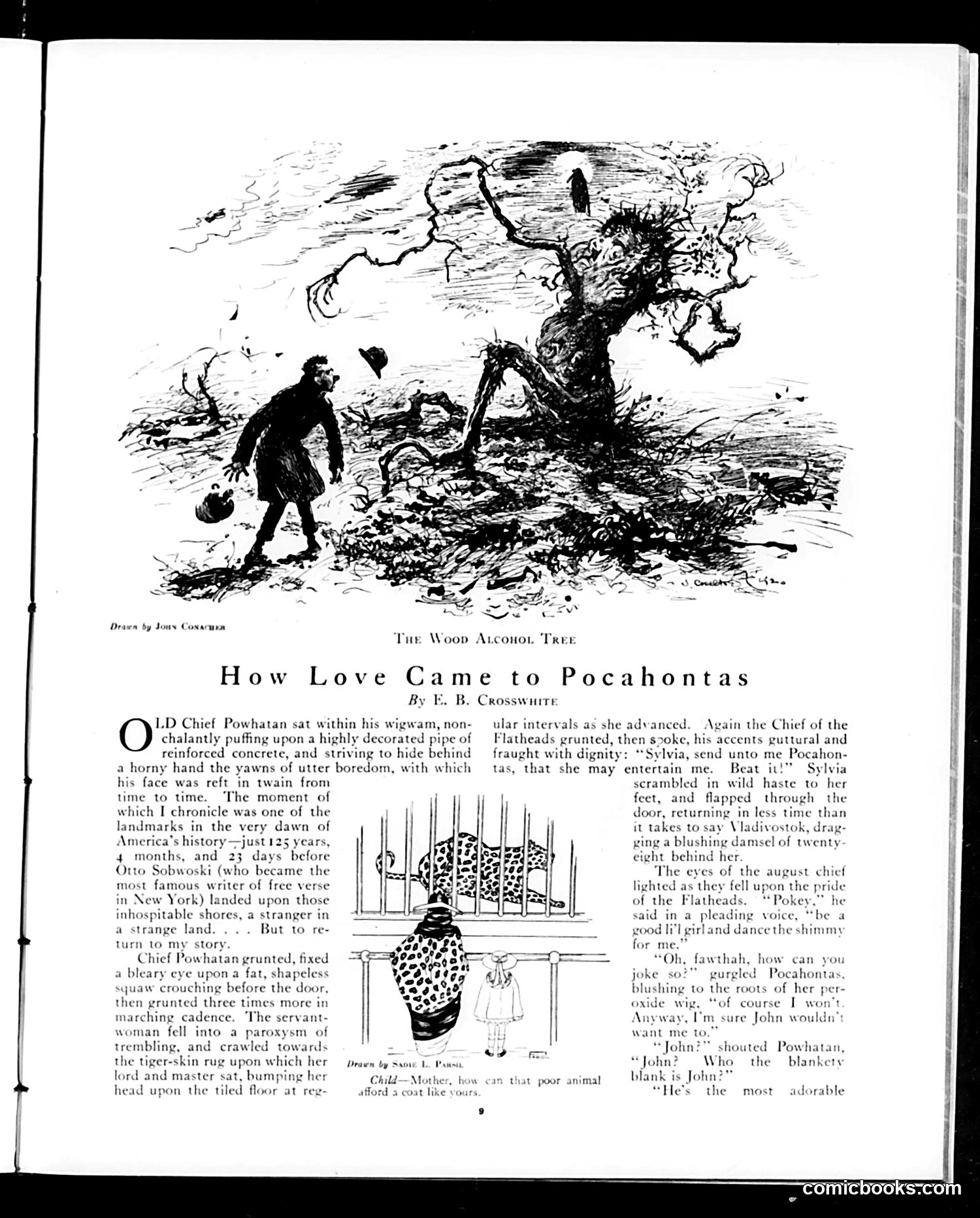
This is a satirical story illustrated with anachronistic comedy. The text mocks the romanticized "Pocahontas" narrative by inserting modern absurdities: Chief Powhatan smokes a "highly decorated pipe of reinforced concrete," and the timeline references "Otto Sobwoski (who became the most famous writer of free verse in New York)." The illustrations show domestic comedy rather than historical drama—a father figure ordering around servants in a comically exaggerated "primitive" setting. The joke appears to be puncturing the nobility of the Pocahontas legend by depicting it as mundane domestic life with incongruous modern details. The reference to Pocahontas's "peroxide wig" and her mention of "John" (implying a suitor) suggests the story parodies the famous love narrative, treating it as silly gossip rather than historical romance. The overall effect is irreverent mockery of American foundational mythology.
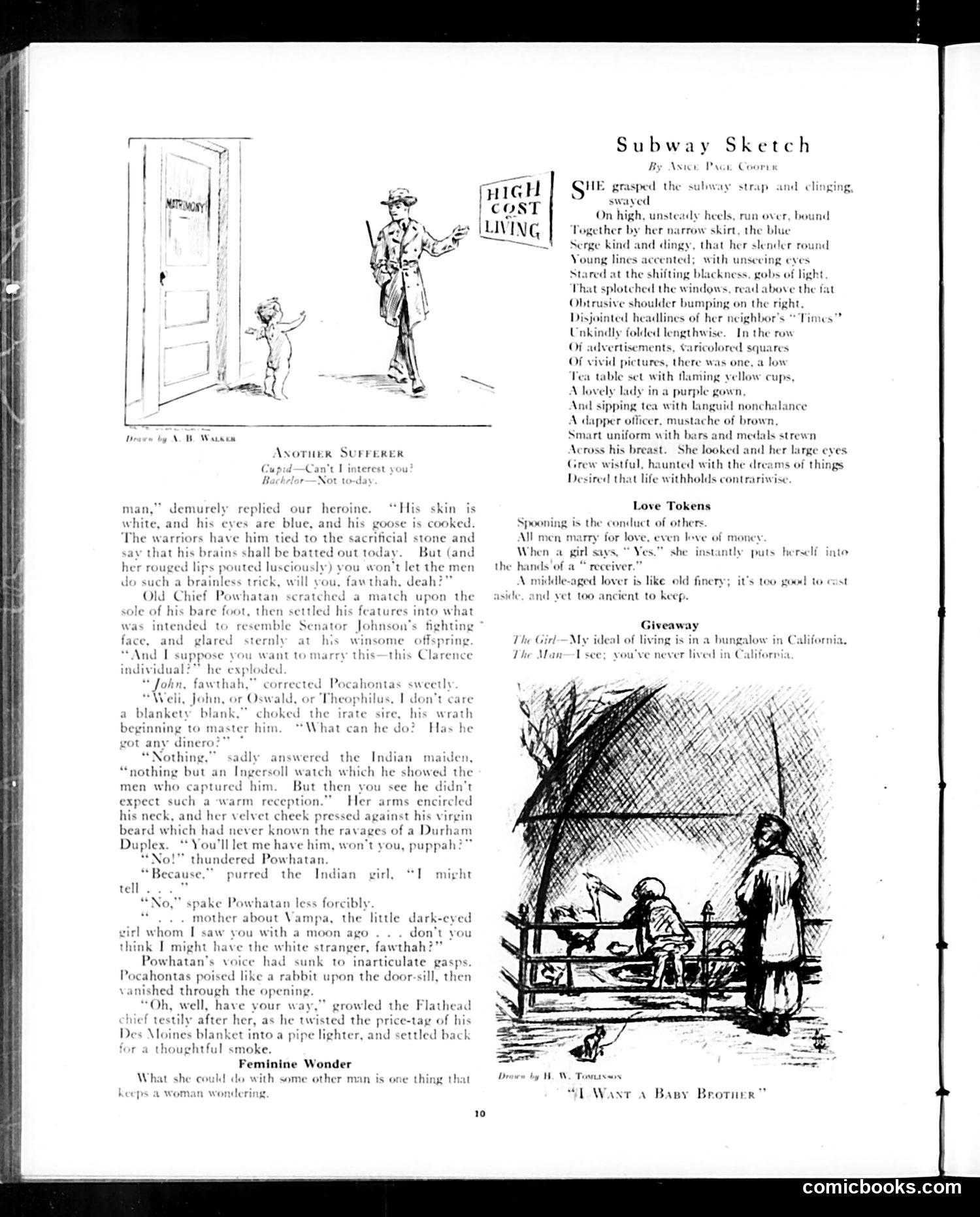
This page contains two distinct pieces of satire: **"Another Sufferer"** (top left): A domestic comedy sketch mocking marital discord. A husband complains he can't interest his wife in conversation; she's absorbed in a newspaper. The satire targets the disconnect between spouses and suggests wives' growing independence through reading and outside interests—a mild jab at changing gender roles in the early 20th century. **"Subway Sketch"** (top right): Social commentary on urban working-class life and aspiration. A weary woman on the subway notices an advertisement featuring a refined lady in elegant clothes sipping tea with a dapper officer. The poem contrasts her drab reality ("blue serge kind and dingy") with the glamorous fantasy she desires but cannot access. The satire critiques both commercial advertising's false promises and the harsh gap between working women's actual lives and the luxury lifestyle marketed to them. Both pieces reflect Judge's typical focus on domestic life and social observation rather than partisan politics.
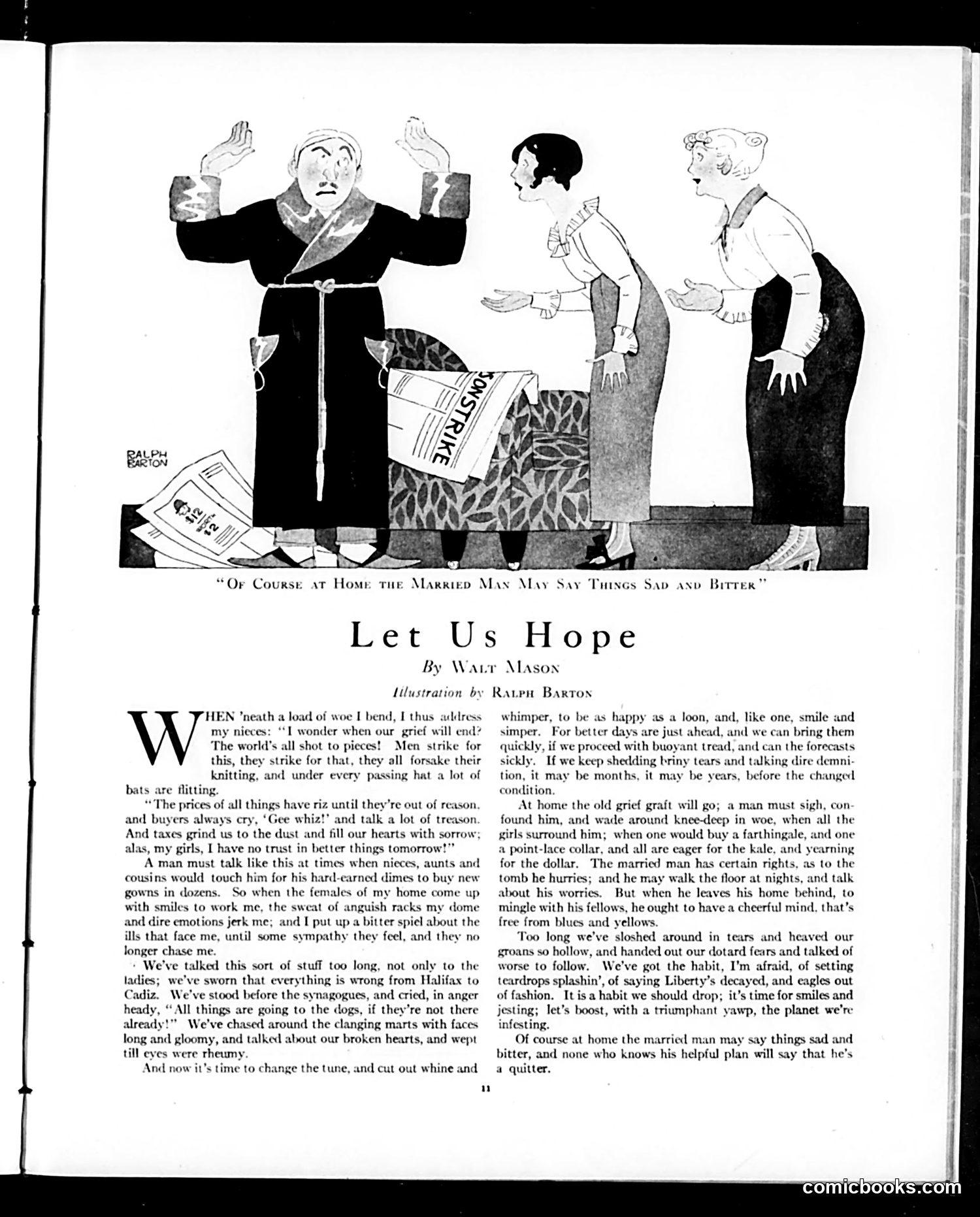
This article by Walt Mason, illustrated by Ralph Barton, is a morale-boosting piece targeting post-WWI American pessimism. The cartoon depicts a complaining man surrounded by women (nieces, aunts, cousins) demanding money while he laments that "everything is wrong from Halifax to Cadiz." Mason argues that Americans have wallowed too long in grief, tears, and defeatist talk about societal collapse. He criticizes the habit of constant complaint—about strikes, inflation ("prices have riz"), taxes, and national decay—which he sees as contagious negativity spread to dependents. The satirical point: stop the doom-saying and emotional indulgence. Mason calls for optimism and "a triumphant yawp" to boost "the planet we're infesting." Even married men complaining at home should maintain composure. The piece reflects post-war exhaustion and pushes readers toward patriotic uplift rather than legitimate grievances.
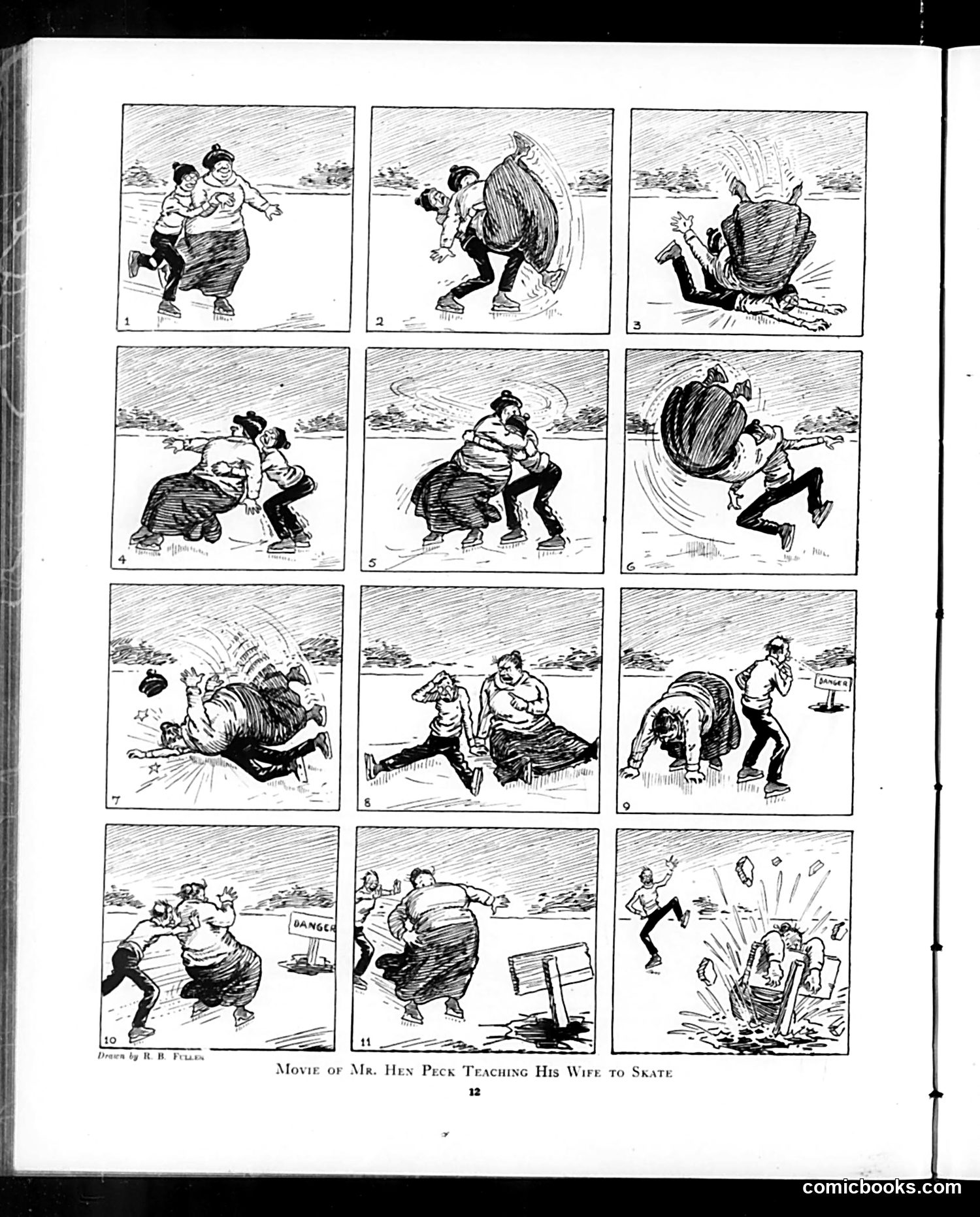
This is a twelve-panel comic strip showing a husband attempting to teach his wife ice skating, with increasingly disastrous results. The title "Mr. Hen Peck" suggests a domestically dominated husband—a stock character in period humor representing a man subordinate to his wife's will. The satire lies in the ironic reversal: despite being the "teacher," the husband suffers all the falls and mishaps while his wife remains relatively composed. Each panel escalates the physical comedy, culminating in a massive explosion of chaos in panel 12. The joke targets both domestic power dynamics and the era's skepticism about women's athletic capabilities. By showing the wife's competence and the husband's incompetence, it mocks the "henpecked" husband trope while poking fun at gender relations—a common Judge magazine theme.
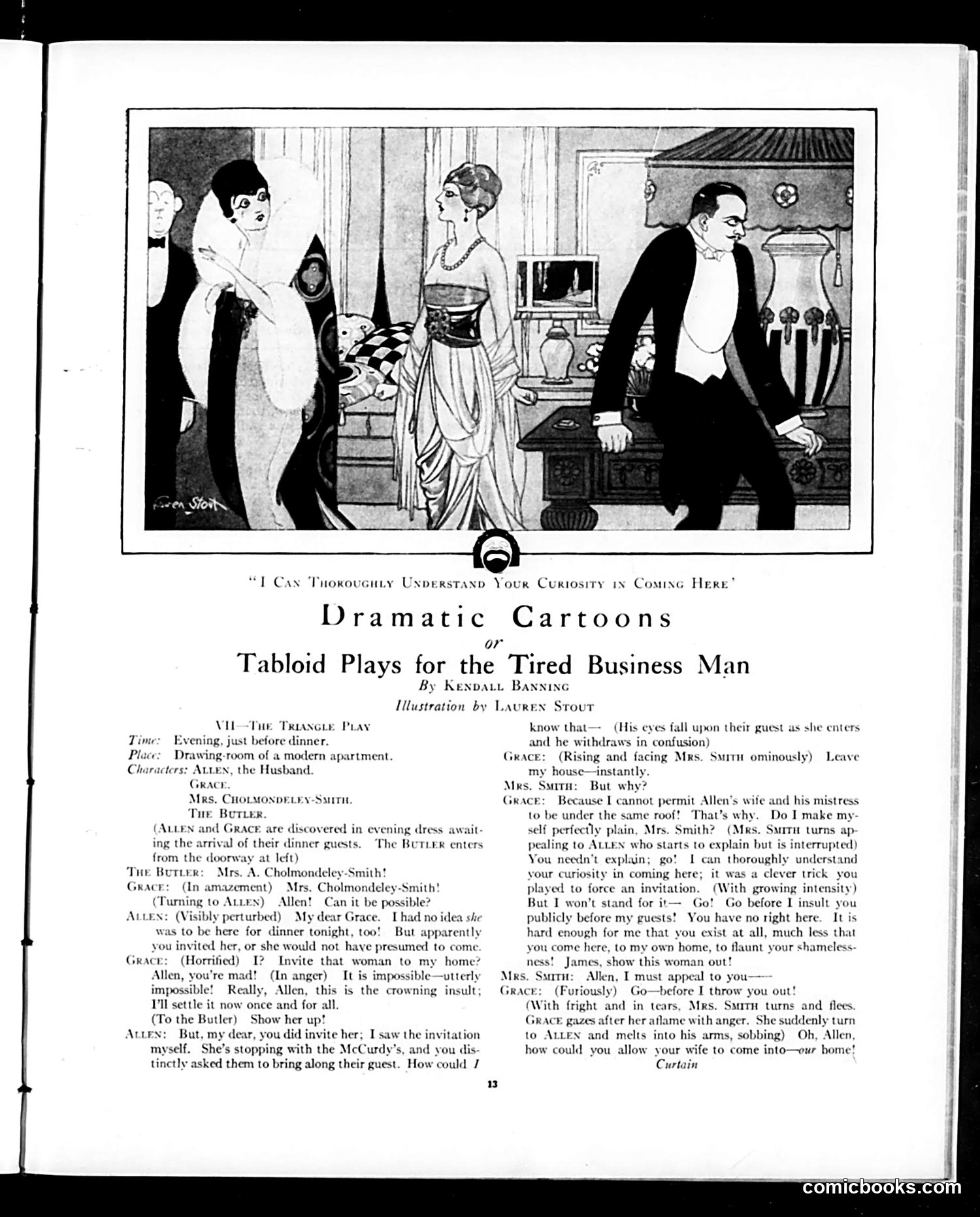
This page presents a comedic one-act play titled "The Triangle Play"—a satirical take on the classic "love triangle" melodrama popular in early 20th-century tabloid theaters and pulp fiction. The setup: A man (Allen) has invited his mistress (Mrs. Smith) to dinner without realizing his wife (Grace) has also invited her—and Grace discovers the deception. The humor lies in the absurd domestic chaos that follows: Grace dramatically orders the mistress out, then—in the final twist—reveals she herself is Allen's *mistress*, not his wife. This "Tabloid Play for the Tired Business Man" mocks both sensationalist melodrama and the hypocrisy of infidelity. The joke targets wealthy men juggling multiple relationships while their various partners confront each other in drawing rooms. The satire suggests that such scandalous entanglements were common enough among the affluent to warrant comedic treatment in Judge magazine's satirical commentary on contemporary urban society.
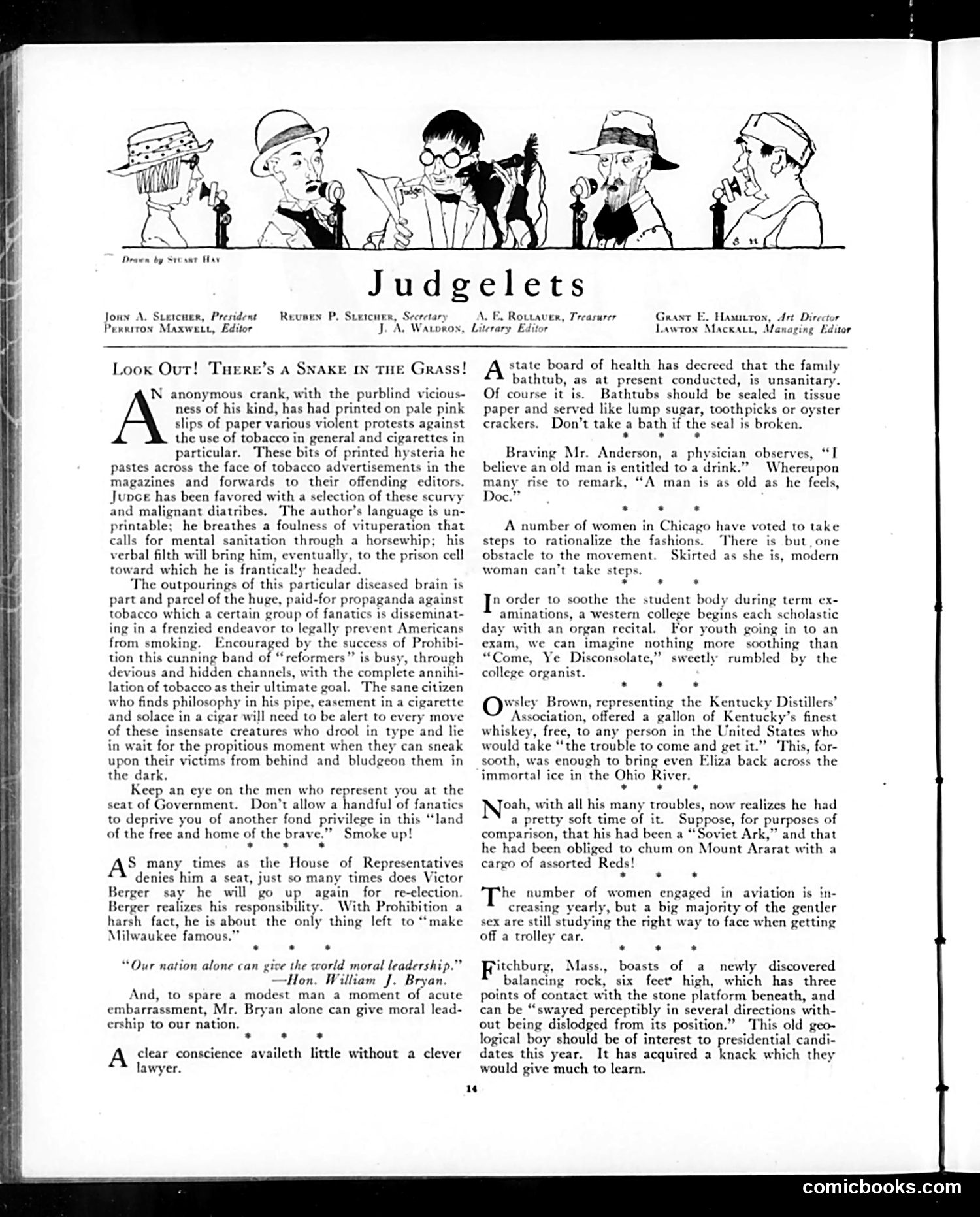
This page from *Judge* magazine contains five separate editorial cartoons and brief satirical commentaries on American social issues of the Prohibition era (likely 1920s). The main cartoon at top shows five caricatured figures representing different viewpoints. The "Judgelets" section presents short, punchy satirical takes: 1. **Anti-smoking crusaders**: Mocked as "fanatics" attempting prohibition of tobacco following alcohol's ban 2. **Victor Berger**: A Socialist congressman repeatedly denied his House seat; the joke is he's now Milwaukee's only remaining "famous" thing post-Prohibition 3. **William Jennings Bryan**: Sarcastically praised for moral leadership, implying hypocrisy 4. **Chicago women's fashion reform**: Joked that women in skirts cannot literally "take steps" toward change 5. **Owsley Brown/Kentucky Distillers**: Offering whiskey to test Prohibition enforcement The satire reflects *Judge*'s anti-Prohibition, pro-tobacco stance and targets reform movements as overzealous while defending individual liberties and commercial interests.
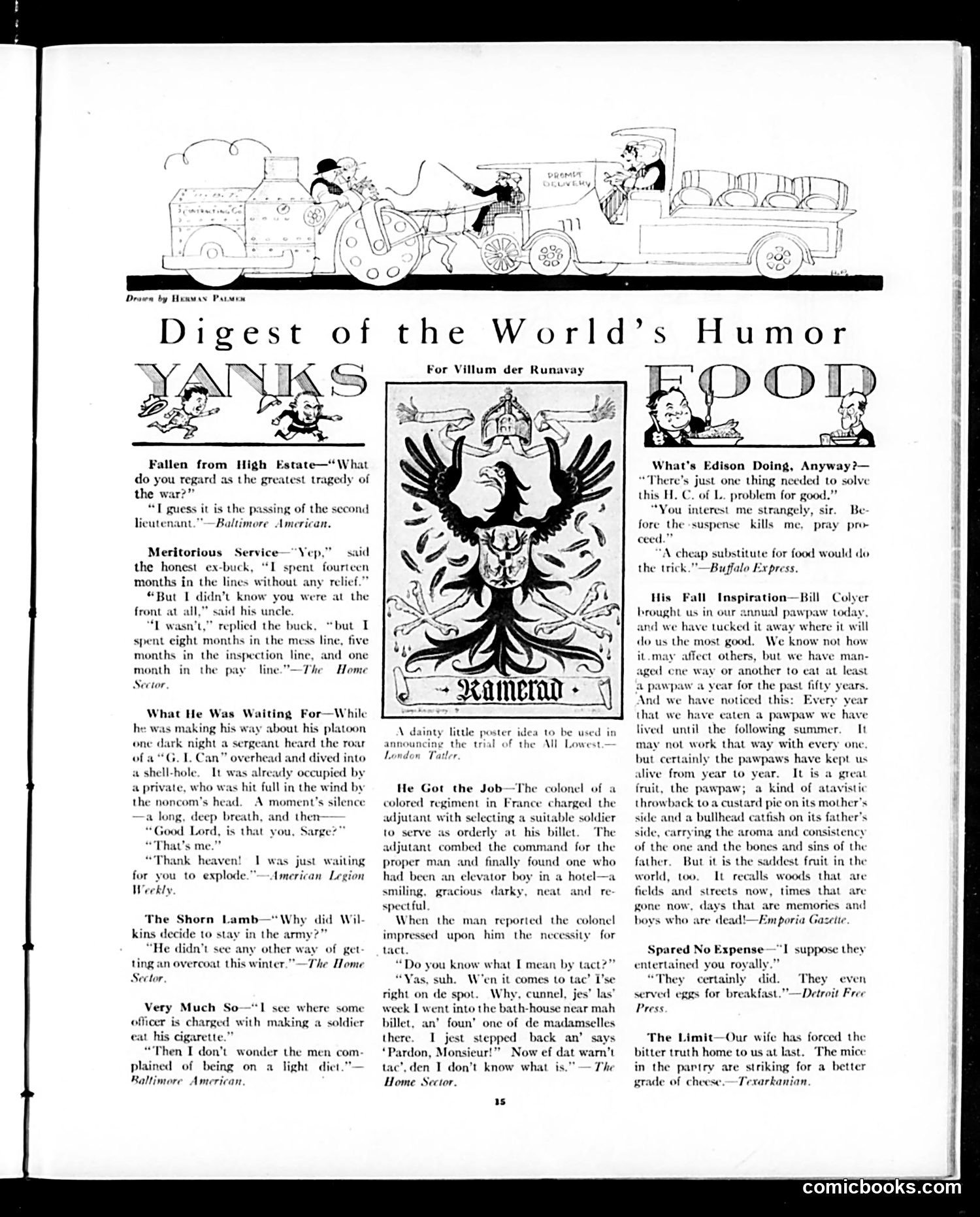
This page collects wartime humor pieces, primarily about World War I military life. The jokes mock various aspects of soldiering: a soldier brags about "fourteen months in the lines" but admits he actually spent time in mess, inspection, and pay lines instead of combat. Another joke depicts a Black elevator boy hired as a colonel's orderly who misinterprets "tact" by apologizing to a French woman in a bathhouse. The central cartoon shows an ornate eagle emblem labeled "Kamerad"—a German word meaning "comrade," likely mocking German military or propaganda imagery. Other pieces ridicule home-front absurdities: the "H.C. of L." (High Cost of Living), food shortages, and domestic inconveniences. The humor relies on period military slang, class distinctions, and racial stereotypes common to 1910s-20s American magazines. The satire targets both wartime inefficiency and civilian complaints about rationing and inflation.
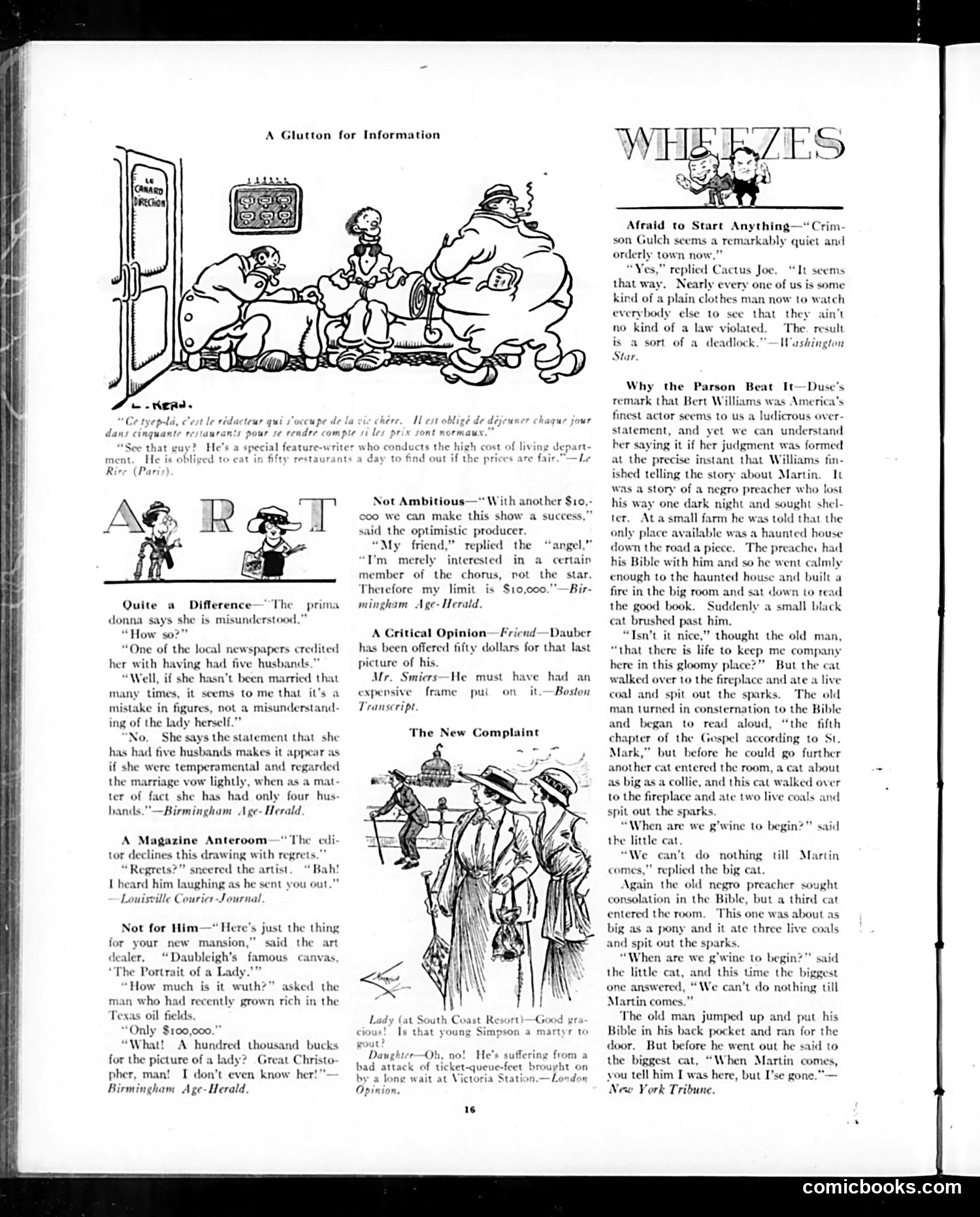
This page contains several brief satirical anecdotes typical of Judge magazine's humor: **"Quite a Difference"** mocks a prima donna whose reputation for multiple marriages (five reported vs. four actual) damages her image of respectability—satire on vanity and reputation management. **"Not for Him"** jokes about a newly wealthy oil baron from Texas who won't pay $100,000 for a famous painting because he doesn't know the subject—poking fun at nouveau riche philistinism. **"Not Ambitious"** features a theatrical "angel" (financial backer) more interested in a chorus girl than the show's success—satirizing investor priorities. **"Why the Parson Beat It"** is a longer humorous story about a Black preacher in a haunted house who encounters increasingly large cats eating live coals from a fireplace. It appears to be racial humor typical of the era, using dialect and the preacher's escalating bewilderment for comedic effect. The cartoons and jokes reflect early 20th-century American satirical sensibilities, targeting pretension, materialism, and social pretense.
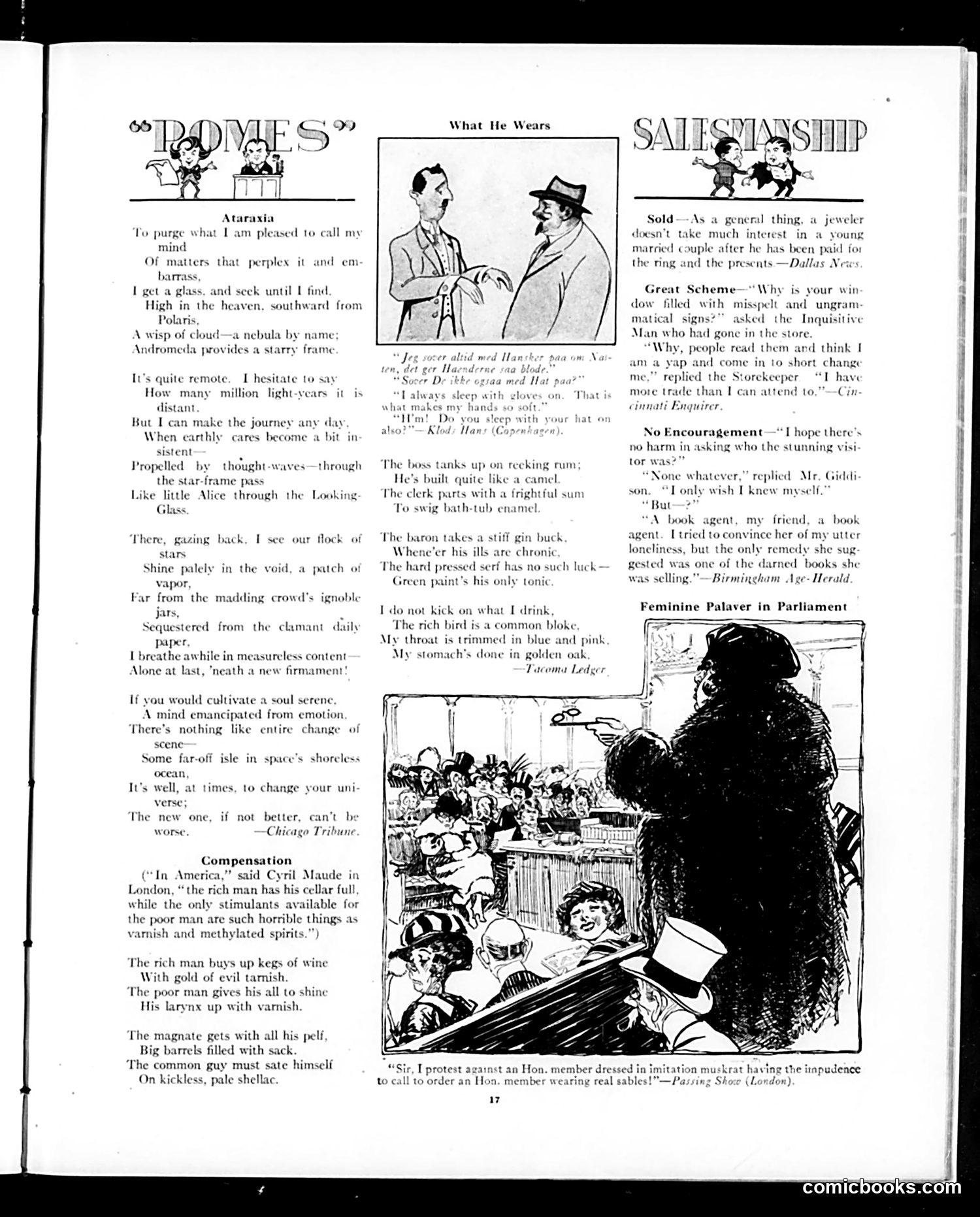
This page contains **poems and satirical quips** rather than political cartoons. The main content includes: **"Ataraxia"** (left column): A philosophical poem about escaping worldly troubles through contemplation of distant space—escapism as mental health. **"What He Wears"** (center): A humorous illustrated dialogue between two men discussing clothing, likely mocking pretentious or absurd fashion choices of the era. **"Salesmanship"** (right column): Multiple brief jokes about commerce and human nature—a jeweler indifferent to customers after the sale, a storekeeper's deliberate misspellings to attract the gullible, and a book agent's intrusive sales tactics. **"Compensation"**: A poem contrasting wealthy men's access to quality alcohol with poor men forced to drink toxic substitutes like varnish and shellac—social commentary on class inequality during Prohibition or economic hardship. **"Feminine Palaver in Parliament"** (illustration, lower right): A woman addressing Parliament, likely satirizing early women's political participation. The page emphasizes **class conflict and consumer culture satire** typical of Judge's social commentary.
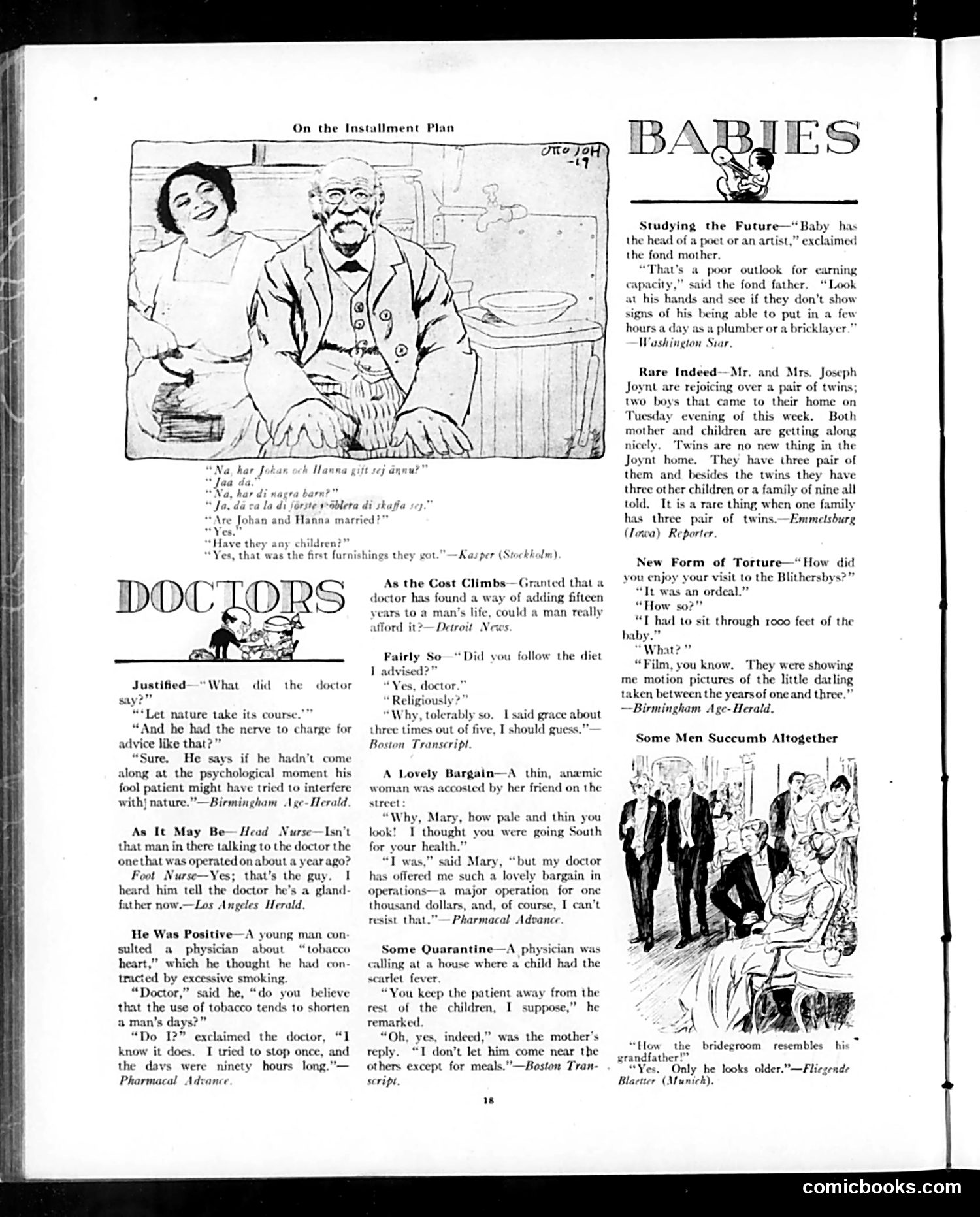
This page collects brief humorous anecdotes mocking doctors and medical practice, typical of Judge's early 20th-century satirical style. The cartoons and jokes target: 1. **Medical incompetence/greed**: Doctors charging fees for doing nothing ("let nature take its course"), performing unnecessary expensive surgeries, and exploiting patients' anxieties. 2. **Absurd medical claims**: A doctor claiming tobacco shortened his life to "ninety hours"—obvious exaggeration highlighting dubious medical advice. 3. **Social pretension**: Parents projecting artistic futures onto babies based on head shape, then hoping they become manual laborers instead for "earning capacity." 4. **Quarantine failures**: A physician's patient instruction about isolating sick children is undermined when the mother allows contact "except for meals"—defeating the purpose entirely. The satire assumes readers' skepticism toward medical authority and professional pretense. The humor relies on irony, contradiction, and the disconnect between what doctors claim versus reality—reflecting Progressive-era distrust of unchecked professional expertise.
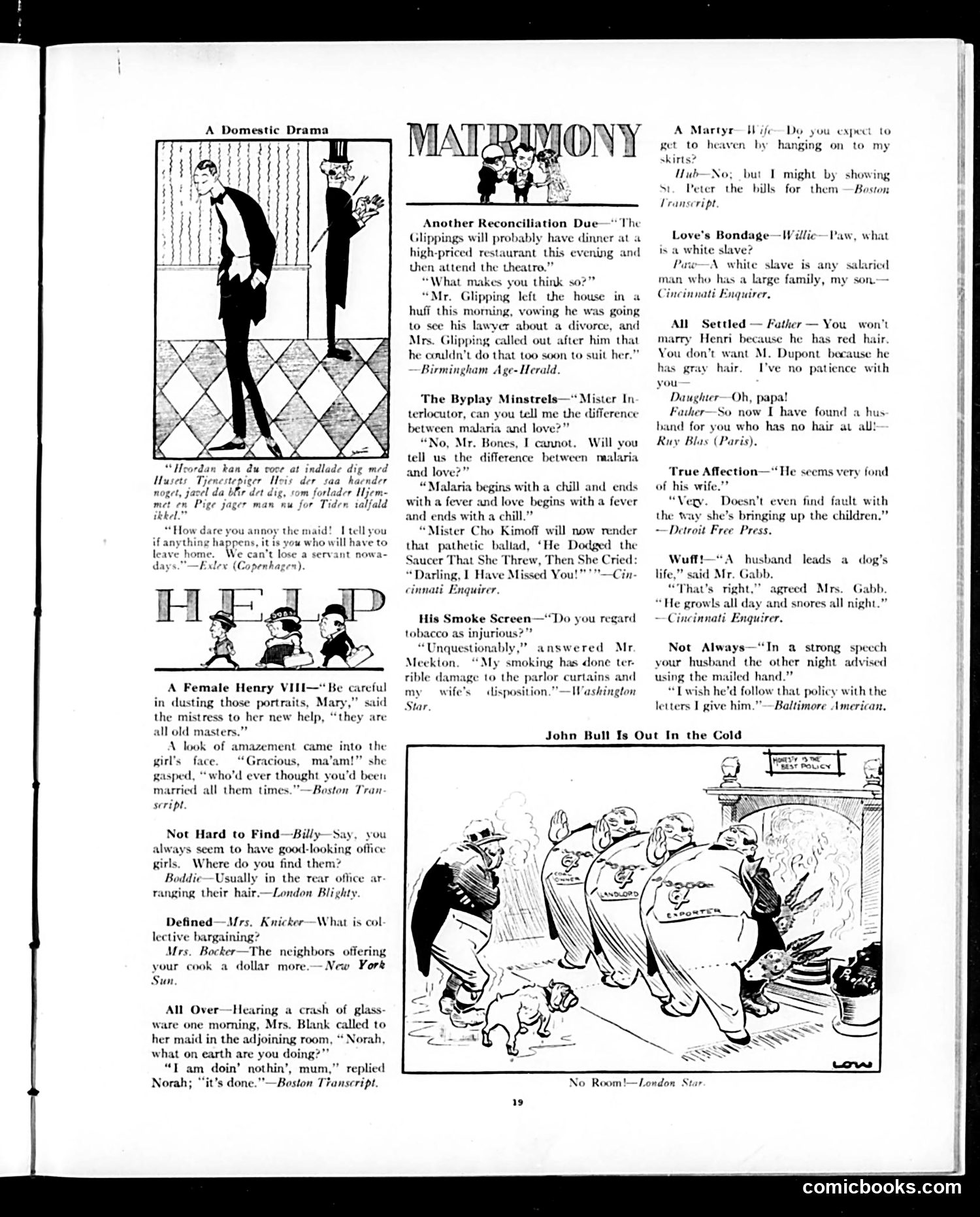
This page from *Judge* (a satirical American magazine) collects brief humorous pieces about marriage and domestic life, typical of early 20th-century humor. The jokes mock marital discord and gender dynamics: **Key pieces:** - "A Female Henry VIII" jokes that a mistress resembles the king by having been "married all them times" - "Another Reconciliation Due" satirizes the Glippings' predictable cycle: husband threatens divorce, wife encourages it, they reconcile over dinner and theater - "The Byplay Minstrels" uses a minstrel-show format (popular entertainment of the era) to compare malaria and love as similar afflictions - The bottom cartoon, "John Bull Is Out In the Cold," depicts John Bull (Britain personified) literally shivering outside while others stay warm—likely commenting on Britain's diplomatic or military isolation **Overall tone:** These pieces reflect period attitudes viewing marriage as inherently contentious, with wives controlling husbands through nagging, while husbands escape through infidelity or legal threats. The humor relies on readers recognizing these as exaggerated domestic stereotypes.
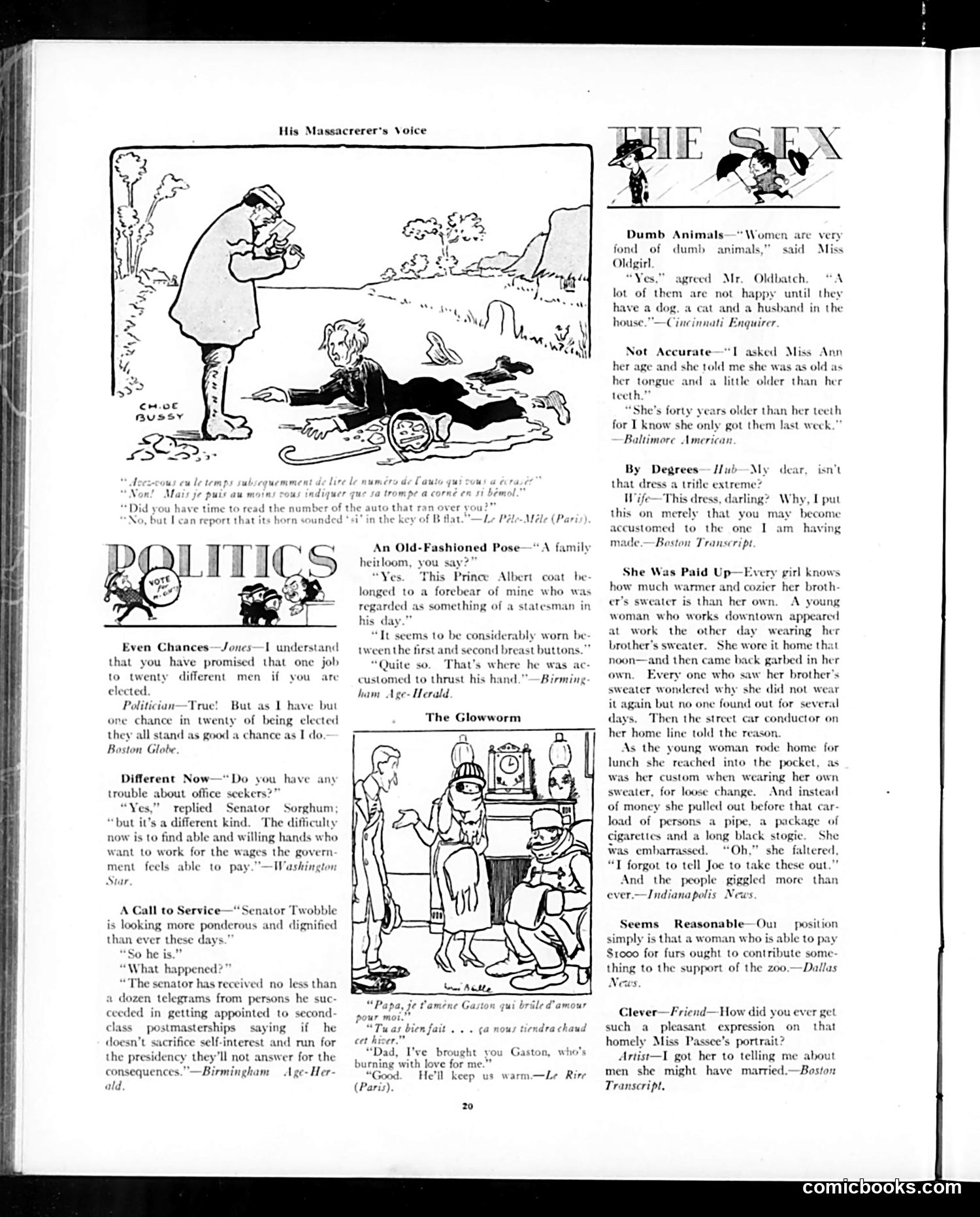
This page from *Judge* (a satirical weekly) contains brief political and social humor pieces typical of early 20th-century American wit. **Key cartoons/jokes:** - **"His Massacrerer's Voice"**: A cartoon showing a man standing over a prone figure, likely satirizing political violence or intimidation during elections. - **Politics section**: Multiple one-liners mocking politicians and office-seekers—particularly Senator Sorghum (a fictional character used for satire) about difficulty finding willing government workers, and Senator Twobble receiving threats from appointees demanding he run for president. - **Social humor**: Jokes about women being "dumb animals" without husbands, a woman accidentally displaying her brother's pipe and cigarettes at work, and a woman gradually introducing an extreme dress style to her husband. The overall tone reflects turn-of-the-century American cynicism about political corruption, gender stereotypes (women as subordinate), and workplace absurdities. The humor relies on puns and social observation rather than visual comedy.
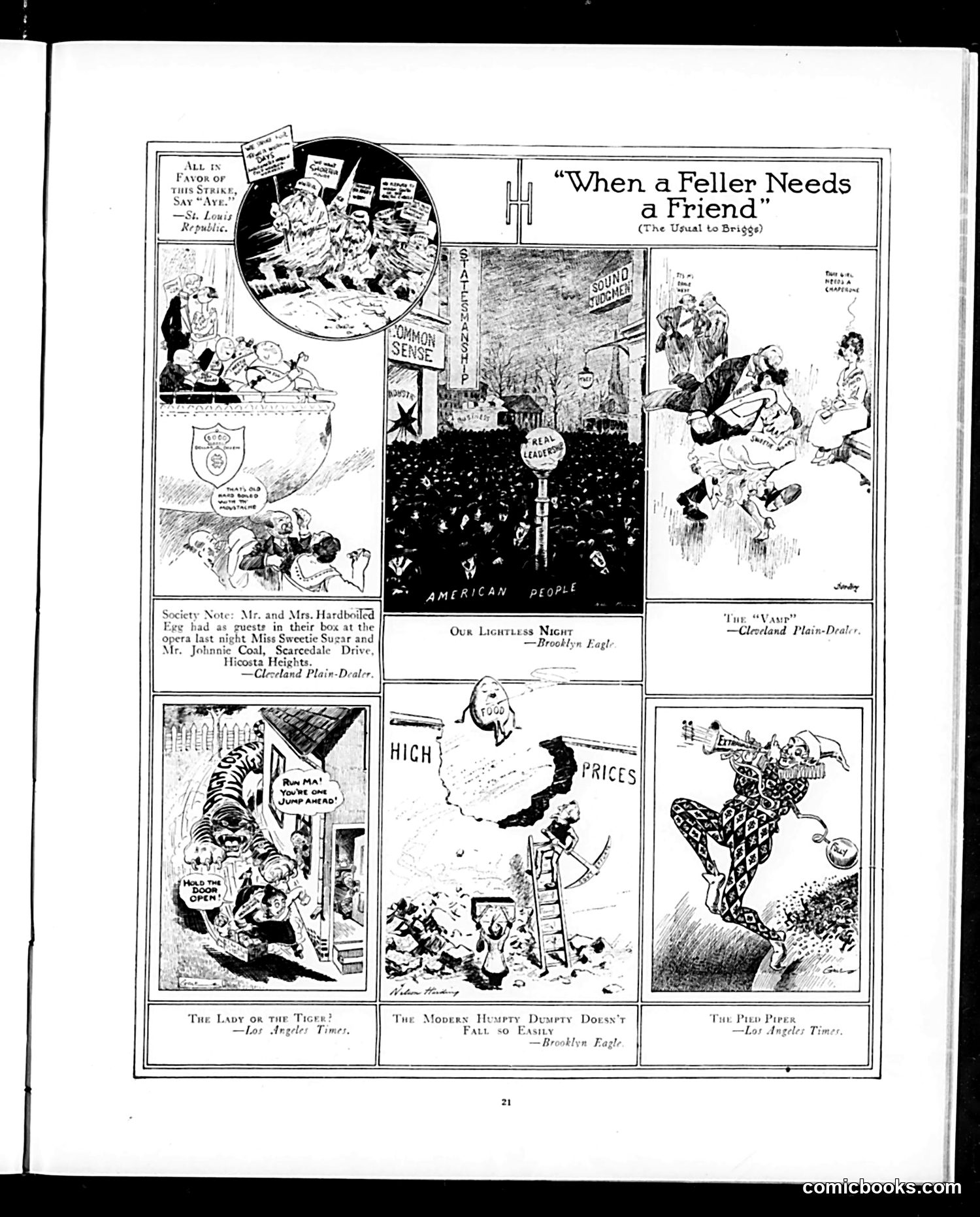
This page collects political cartoons from various newspapers, satirizing contemporary American social and economic issues. The central panel "Our Lightless Night" (Brooklyn Eagle) depicts a massive crowd of "American People" in darkness, likely referencing hardship or crisis—possibly economic depression or wartime conditions. Surrounding cartoons address specific grievances: "High Prices" shows citizens struggling with cost-of-living; "The Lady of the Tiger" and "Humpty Dumpty Doesn't Fall so Easily" appear to critique political figures or systems. The title "When a Feller Needs a Friend" (credited to Briggs) is ironic—suggesting ordinary people feel abandoned by leadership during difficult times. The page format, attributing cartoons to different papers, suggests Judge was reprinting syndicated commentary on shared national anxieties about economic hardship and political responsiveness during an unspecified crisis period.
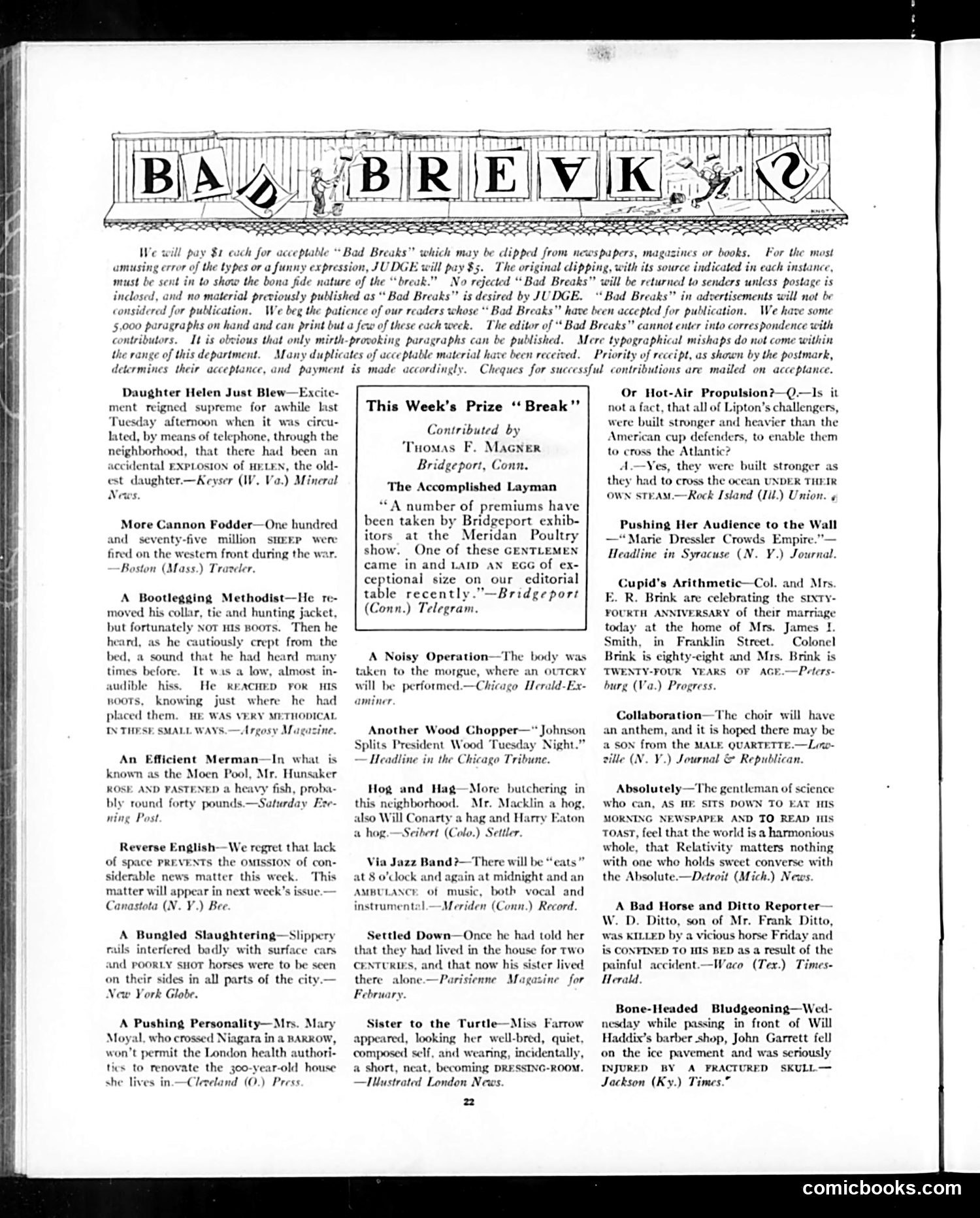
This is a humor feature where Judge pays readers $1 for amusing typographical errors or malapropisms clipped from newspapers. The page shows the winning submission and examples of accepted "breaks." The prize-winning error from the Bridgeport Telegram reads: an exhibitor "LAID AN EGG of exceptional size" on an editorial table—clearly a double entendre joke, as "laid an egg" meant to fail badly. Other examples include absurd newspaper mistakes: "HELEN...EXPLODED" (likely "ELOPED"), "OUTCRY will be performed" (probably "AUTOPSY"), horses shot but described as merely "on their sides," and an "AMBULANCE of music" instead of "ensemble." The humor depends on readers spotting unintentional sexual innuendos, malapropisms, and nonsensical phrasings that slip into print. This reflects early 20th-century newspaper production's vulnerability to typesetting errors—before modern editing—making such mistakes common enough to sustain a regular feature.
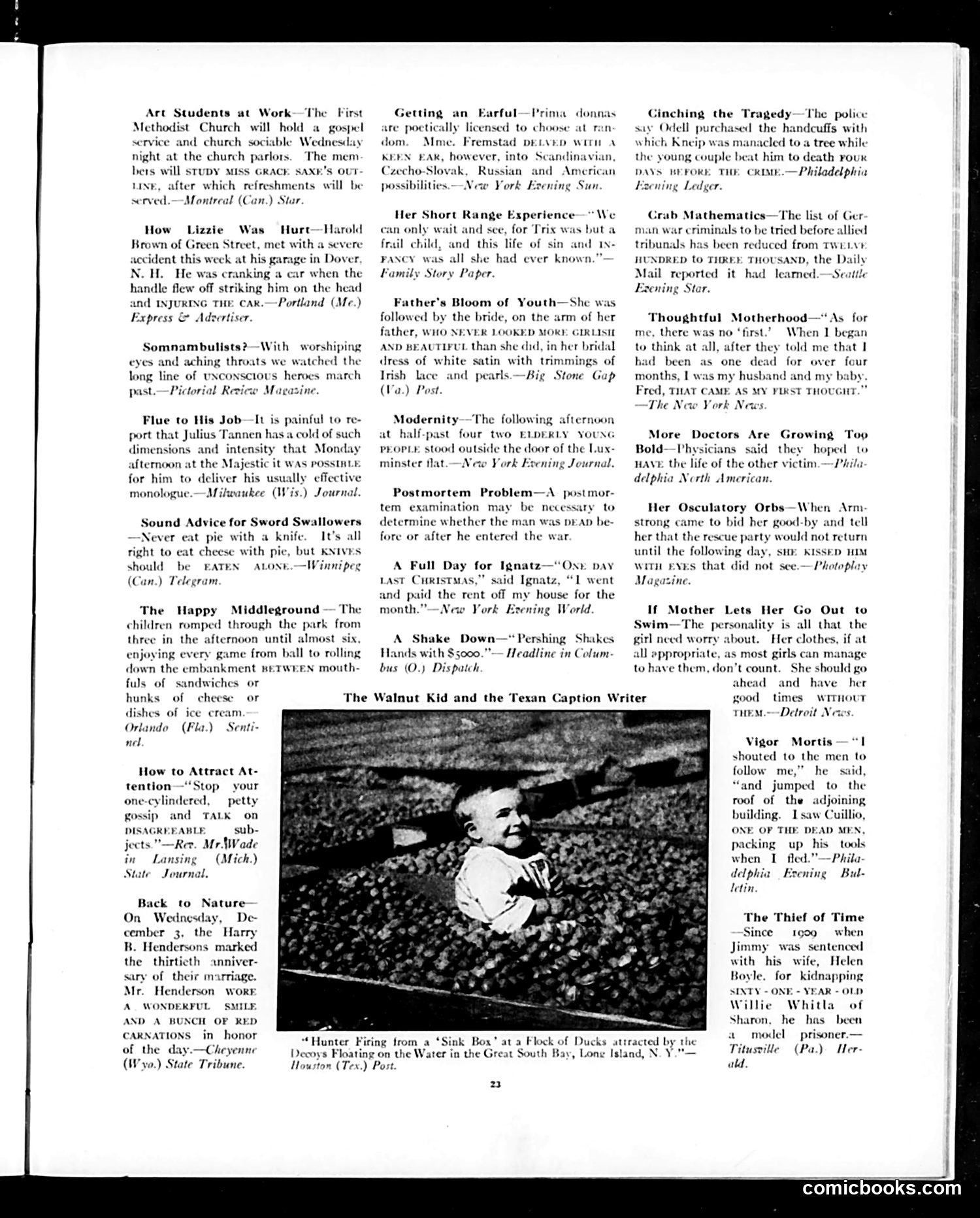
This page showcases **Judge's satirical humor formula**: reprinting absurd excerpts from newspaper articles, highlighting unintentional logical contradictions or dark ironies through capitalization and commentary. **Key examples:** - **"How Lizzie Was Hurt"**: The joke is that the car injury is emphasized over the man's head injury—inverted priorities. - **"Sound Advice for Sword Swallowers"**: Nonsensical advice mocking preachy newspaper columns. - **"Postmortem Problem"**: Dark WWI-era humor—gallows joke about whether soldiers died before or after entering combat. - **"Crab Mathematics"**: Sardonic commentary on inflating German war criminal estimates (12,000 to 3,000), criticizing journalistic accuracy during post-WWI trials. The **photograph** shows a man hunting ducks, captioned with absurdly specific details—typical Judge mockery of overly elaborate newspaper photo captions. This represents Judge's formula: find real newspaper oddities and let absurdity speak for itself, often highlighting wartime propaganda, journalistic incompetence, or human folly. The magazine thrived on readers' schadenfreude at others' published mistakes.
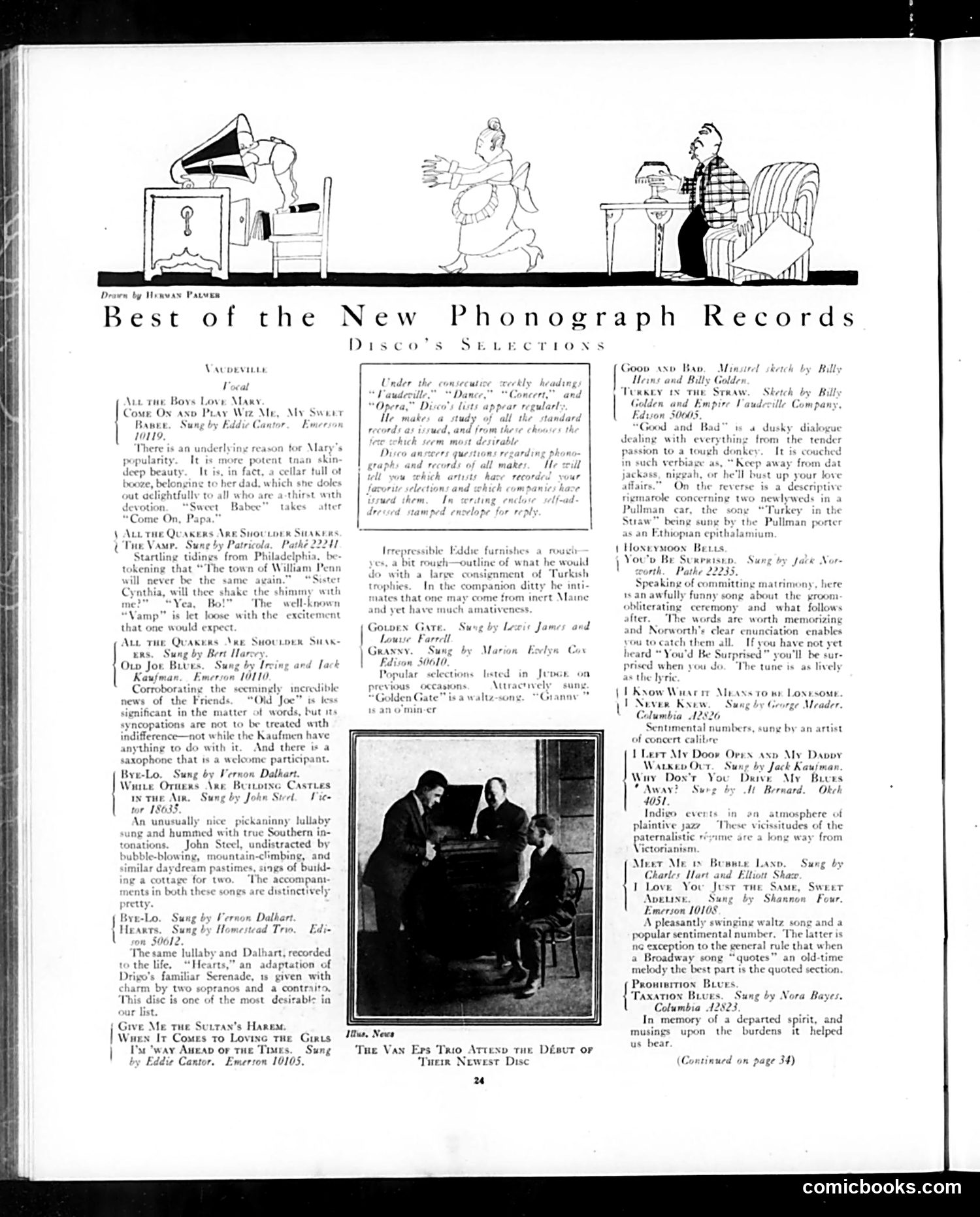
This page is primarily a **phonograph record review** rather than political satire. The header cartoon by Herman Palmer shows three scenes of domestic life (man with gramophone, woman dancing, couple listening), illustrating how records fit into American home entertainment. The bulk of the page catalogs "Best of the New Phonograph Records" from Disco's selections, reviewing popular songs of the era. Notable artists mentioned include Eddie Cantor and Vernon Dalhart—vaudeville and early recording stars. The social context: This represents the **early phonograph industry's marketing push** (likely 1920s, based on artists and record labels like Emerson and Columbia). The reviews emphasize sentimental and novelty songs—titles like "Good and Bad," "Turkey in the Straw," and "Prohibition Blues" reflect period concerns and entertainment tastes. The small photograph shows what appears to be a recording or radio studio session with musicians. The reviews themselves contain no obvious political satire—this is straightforward consumer content promoting the new technology of recorded music to middle-class American households.
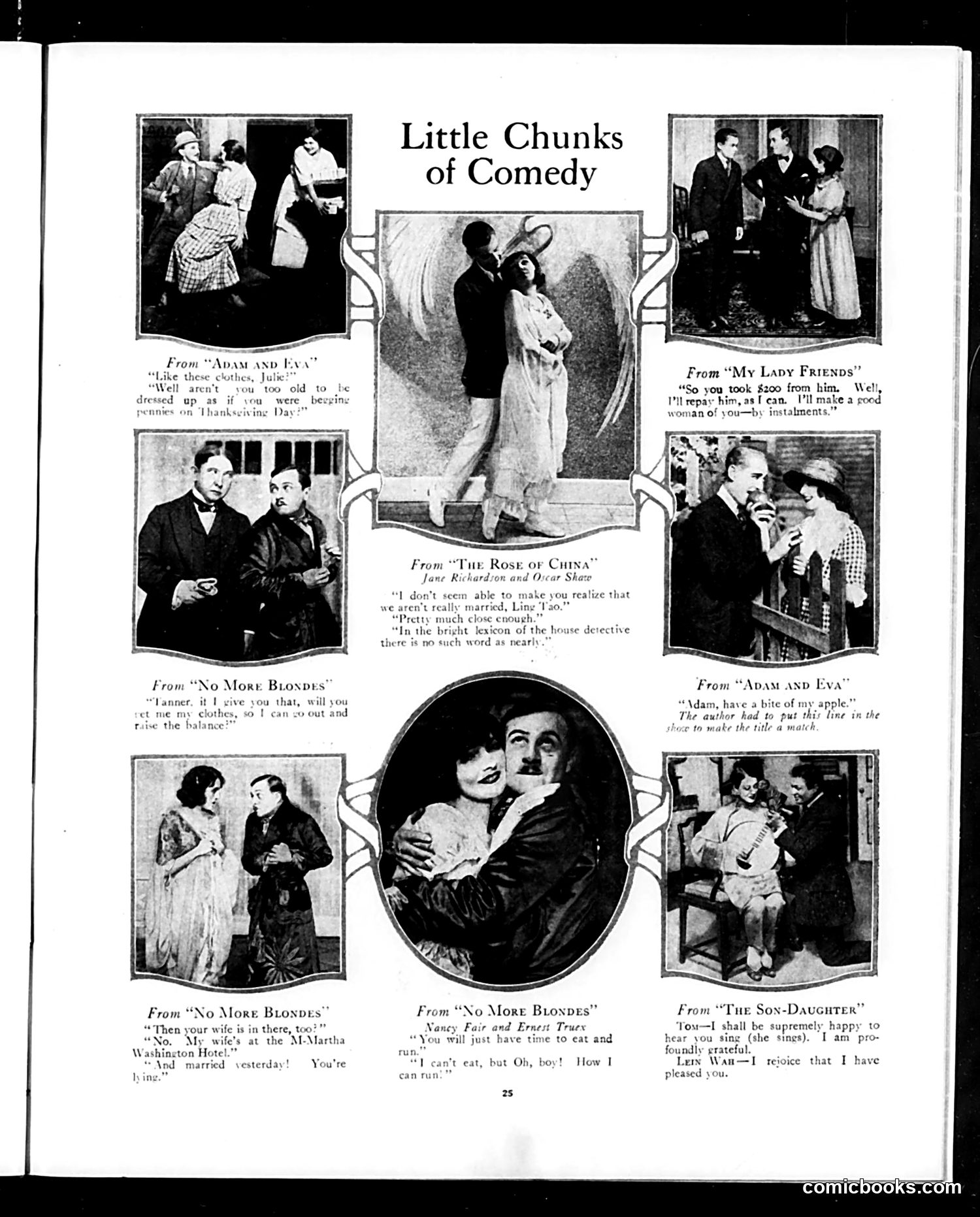
This page collects comedic scenes from early silent films, arranged as a visual anthology. Rather than satirizing politics or society, these are simply humorous moments extracted from theatrical productions of the era—titles like "Adam and Eva," "No More Blondes," "My Lady Friends," "The Rose of China," and "The Son-Daughter." The humor relies on period-typical domestic and romantic situations: marital confusion, financial desperation (borrowing money), misunderstandings about relationships, and awkward social encounters. The captions capture dialogue emphasizing comedic timing and wordplay common to stage comedy adapted for film. This appears to be entertainment coverage in *Judge* magazine, showcasing popular theatrical and film content rather than editorial satire. The "chunks" format—small, self-contained gags—was typical magazine filler celebrating popular culture of the period.
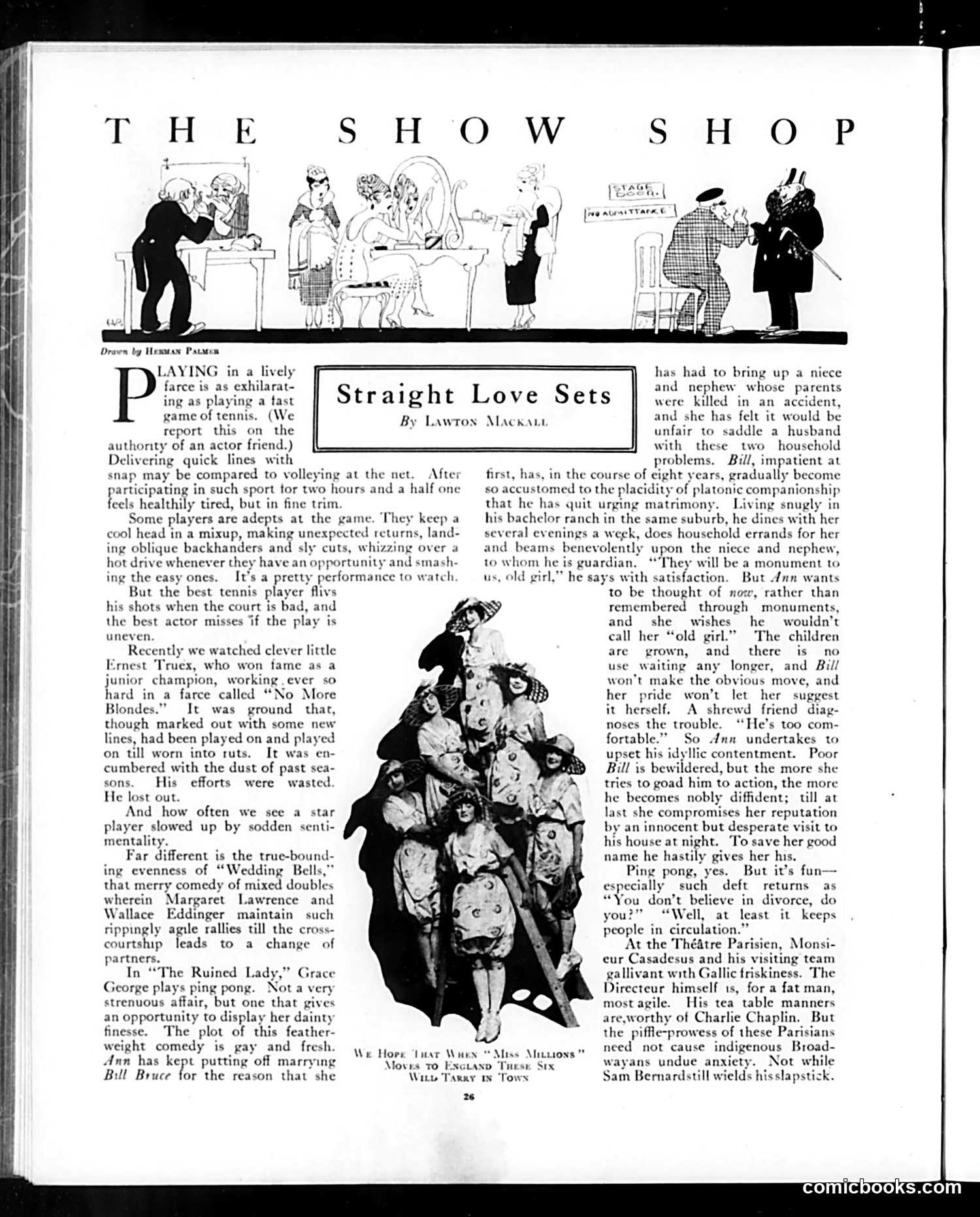
This page contains theater reviews comparing acting performances to sports, particularly tennis. The top illustration by Herman Palmer depicts "The Show Shop" — various theatrical scenes in silhouette. The main article by Lawton Mackall uses sports metaphors to evaluate actors. It praises Ernest Truex's effort in the farce "No More Blondes," though noting the script itself was worn out. It lauds Margaret Lawrence and Wallace Eddinger's "Wedding Bells" for maintaining sharp comedic timing ("rippingly agile rallies"). The plot synopsis of "The Ruined Lady" (featuring Grace George) describes a woman who must manipulate her reluctant suitor into marriage after eight years of domestic arrangement — she resorts to a compromising nighttime visit to finally provoke him into action. The review concludes by dismissing Parisian theatrical performers visiting Broadway, asserting that American performer Sam Bernard needs no anxiety about competition. This reflects period American theatrical nationalism and vaudeville competitiveness. The illustration shows multiple characters stacked together, likely depicting theatrical chaos or comedy.
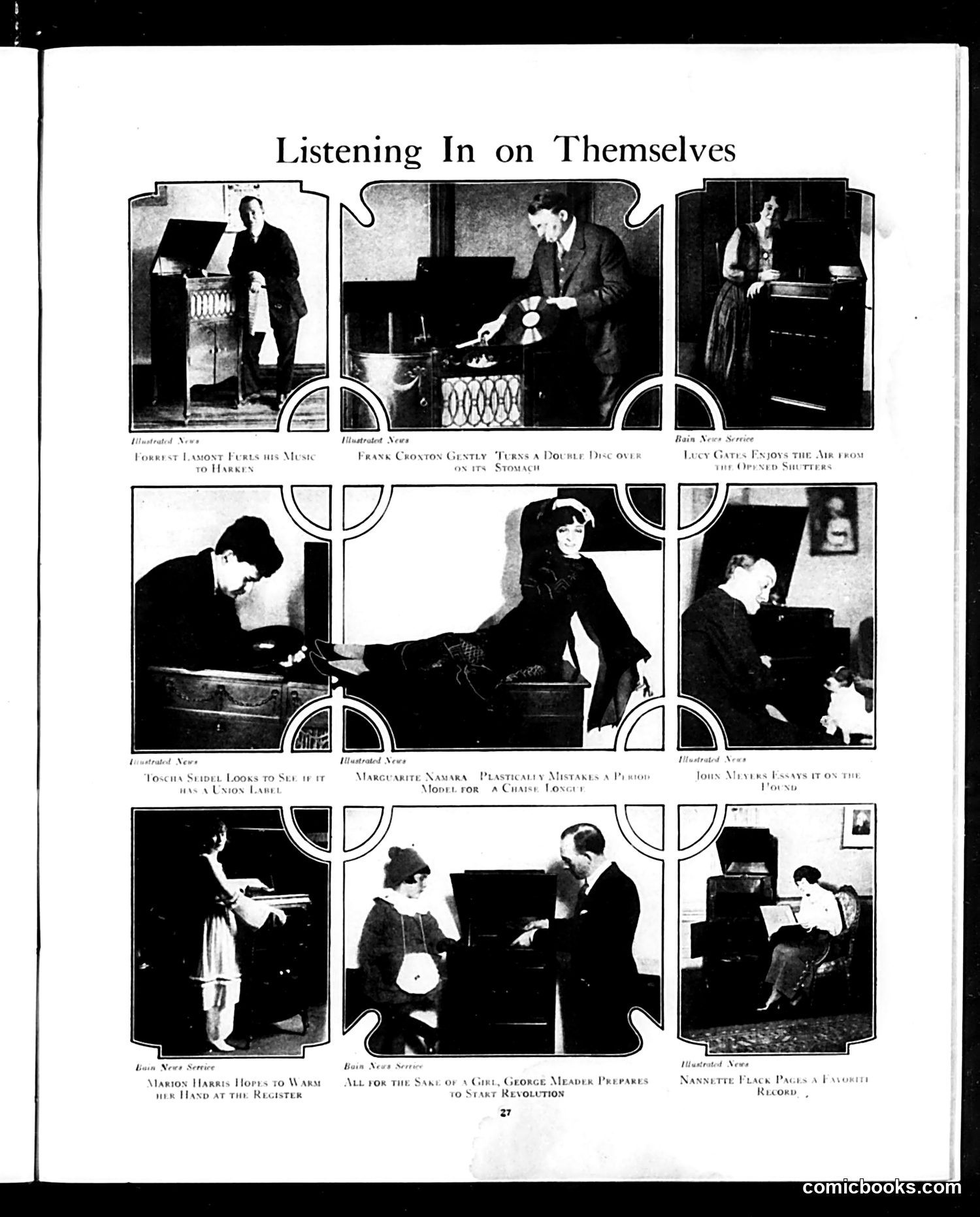
This page presents a series of vignettes depicting people enjoying early radio broadcasts and phonographs—technologies still novel in the 1920s. Each captioned scene shows individuals or couples listening to recorded music and entertainment in their homes. The satire appears gentle: the title suggests people are entertained by hearing themselves or their peers through these new media. References include "Forrest Lamont Fucks his Music to Harness," "Frank Croxtons Gently Turns a Double Discover on his Stomach," and "Lucy Gate's Enjoys the Air from the Unused Shutters." The page satirizes the era's fascination with radio and phonograph technology as middle-class home entertainment. The humor lies in depicting ordinary people's earnest engagement with these modern conveniences—a commentary on how transformative and absorbing the public found these new broadcast technologies to be.
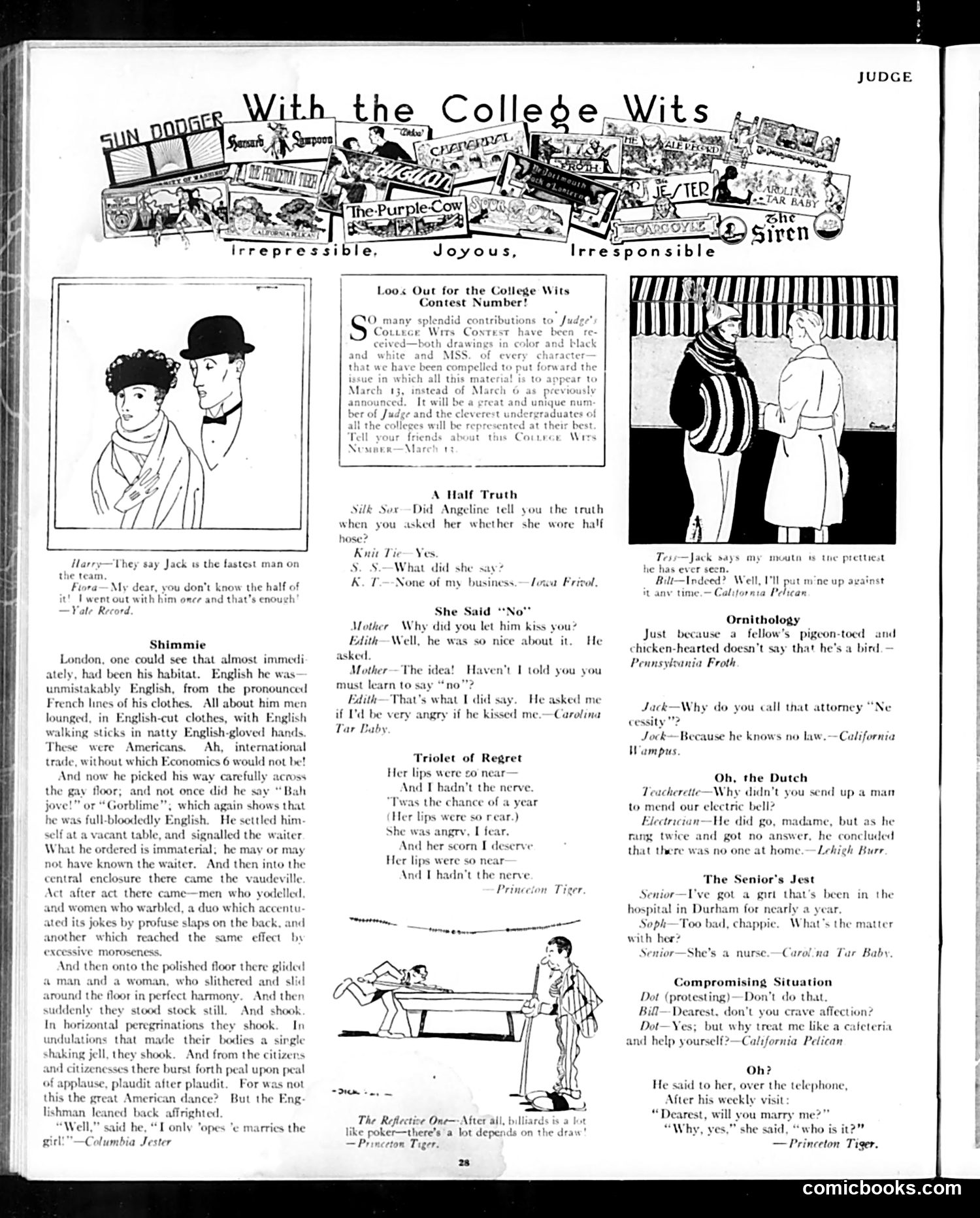
This page collects humorous anecdotes and jokes submitted from college humor magazines (indicated by credits to *Princeton Tiger*, *Columbia Jester*, *California Pelican*, etc.). The content reflects 1920s college social attitudes. **Key themes:** - **Dating/romance comedy**: Multiple jokes about courtship rituals—a woman asked to marry over the phone doesn't recognize the caller; a girl says "no" to a kiss after being asked nicely; a couple playfully negotiates physical affection. - **The "Shimmie" story**: Satirizes an Englishman's shock at the "Shimmie" dance (a 1920s popular dance involving rapid hip movements). The joke: he finds this "great American dance" distasteful and unrefined compared to English propriety. - **Light social satire**: Brief quips mock pretension, legal incompetence, and romantic miscommunication—standard college humor fare. The overall tone is lighthearted rather than biting—focused on amusing misunderstandings between young people navigating modern social conventions.
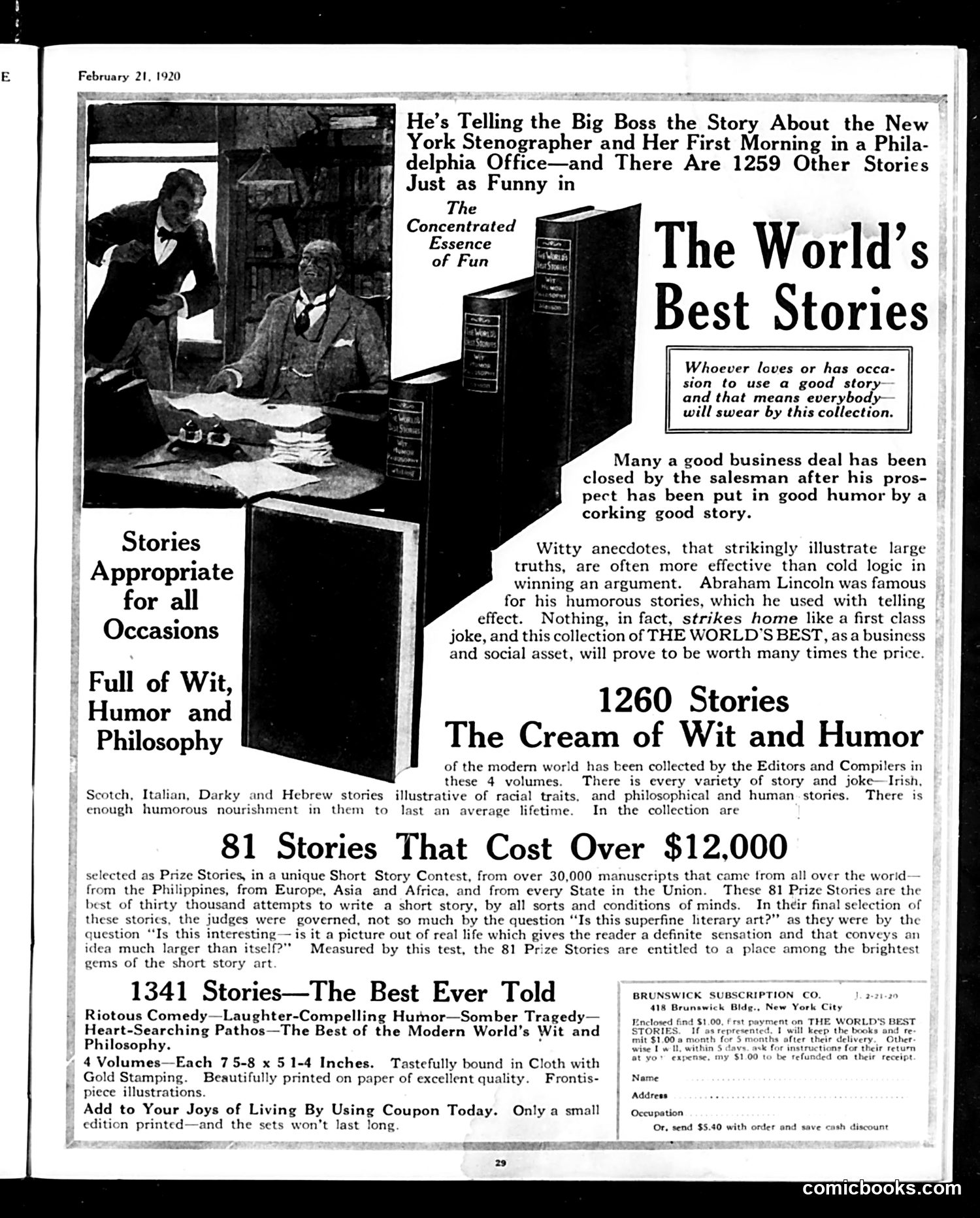
This is primarily a **full-page advertisement** for a four-volume story collection, not a political cartoon. The small illustration depicts a businessman telling his boss an anecdote—likely the setup for a sales pitch about storytelling's business value. The ad reflects **1920s business culture**: it markets stories as practical tools for salesmen to "close deals" through humor, and invokes Abraham Lincoln as an authority on using anecdotes persuasively. The text mentions "Irish, Scotch, Italian, Darky and Hebrew stories" as separate categories—language that reveals the **casual ethnic stereotyping** common in early 20th-century American publishing. These weren't seen as offensive then but represented distinct comedic "types." The ad emphasizes that 81 prize stories cost over $12,000 to acquire, positioning the collection as a prestigious, valuable purchase. The coupon offers a cash discount for immediate orders—standard marketing urgency tactics of the era.
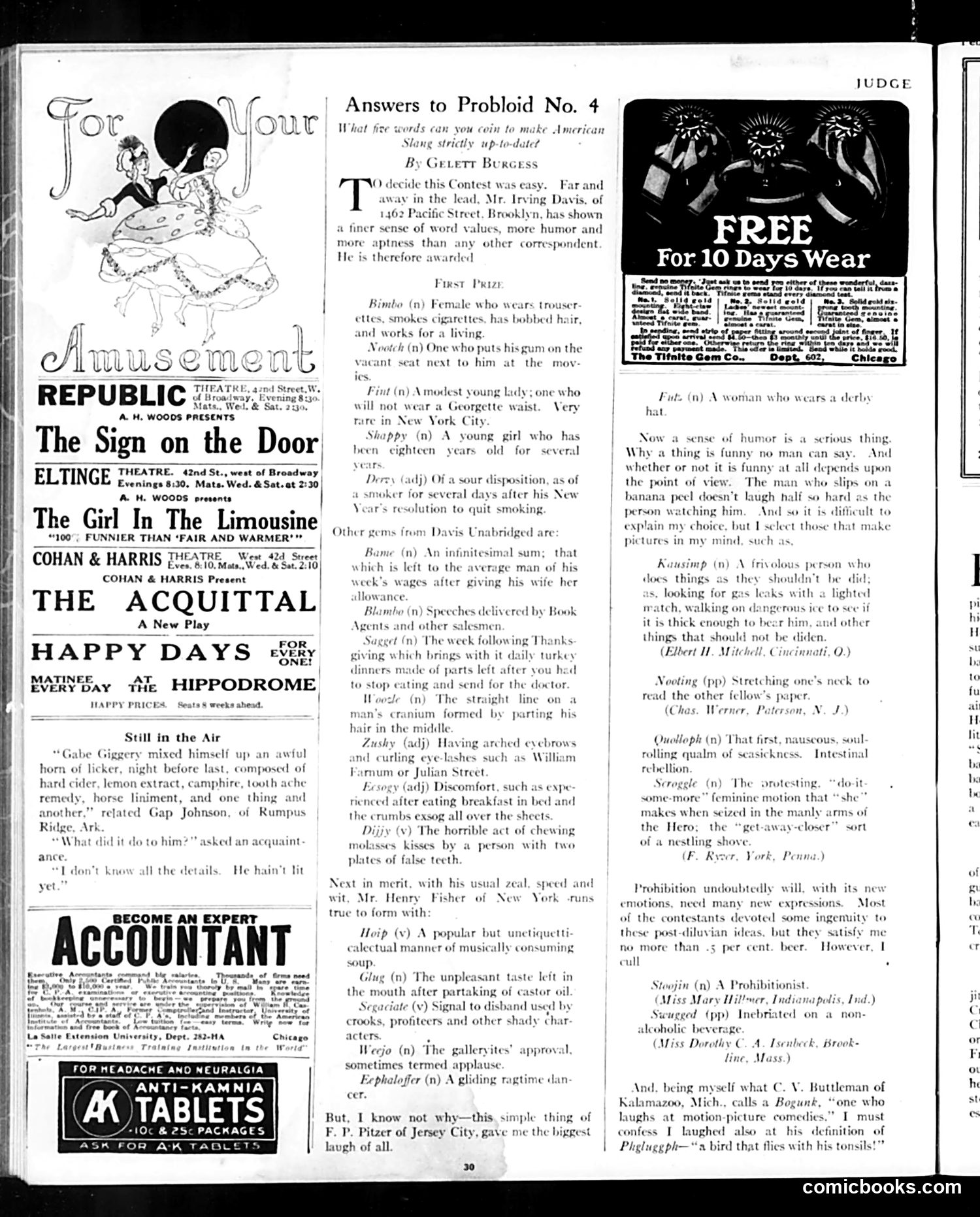
This page showcases **Judge magazine's "Probloid" contest**, where readers submitted newly coined slang terms to modernize American language. Irving Davis of Brooklyn won first prize for five inventive words that satirize contemporary 1920s social types and behaviors. His winning entries mock recognizable figures: "Bimbo" (independent working women); "Nootch" (inconsiderate moviegoers); "Flint" (modest young ladies); "Shappy" (teenagers); and "Dazzy" (people irritable after New Year's resolutions fail). The remaining entries are humorous neologisms targeting everyday annoyances—"Woozle" (hair parts), "Glugging" (castor oil aftertaste), "Dijjy" (chewing molasses kisses), and others. The satirical intent targets both changing social mores (women smoking, working, wearing makeup) and mundane modern frustrations. Judge uses the contest format to gently mock emerging 1920s culture while celebrating linguistic creativity. The page is primarily entertainment/wordplay rather than hard political satire.
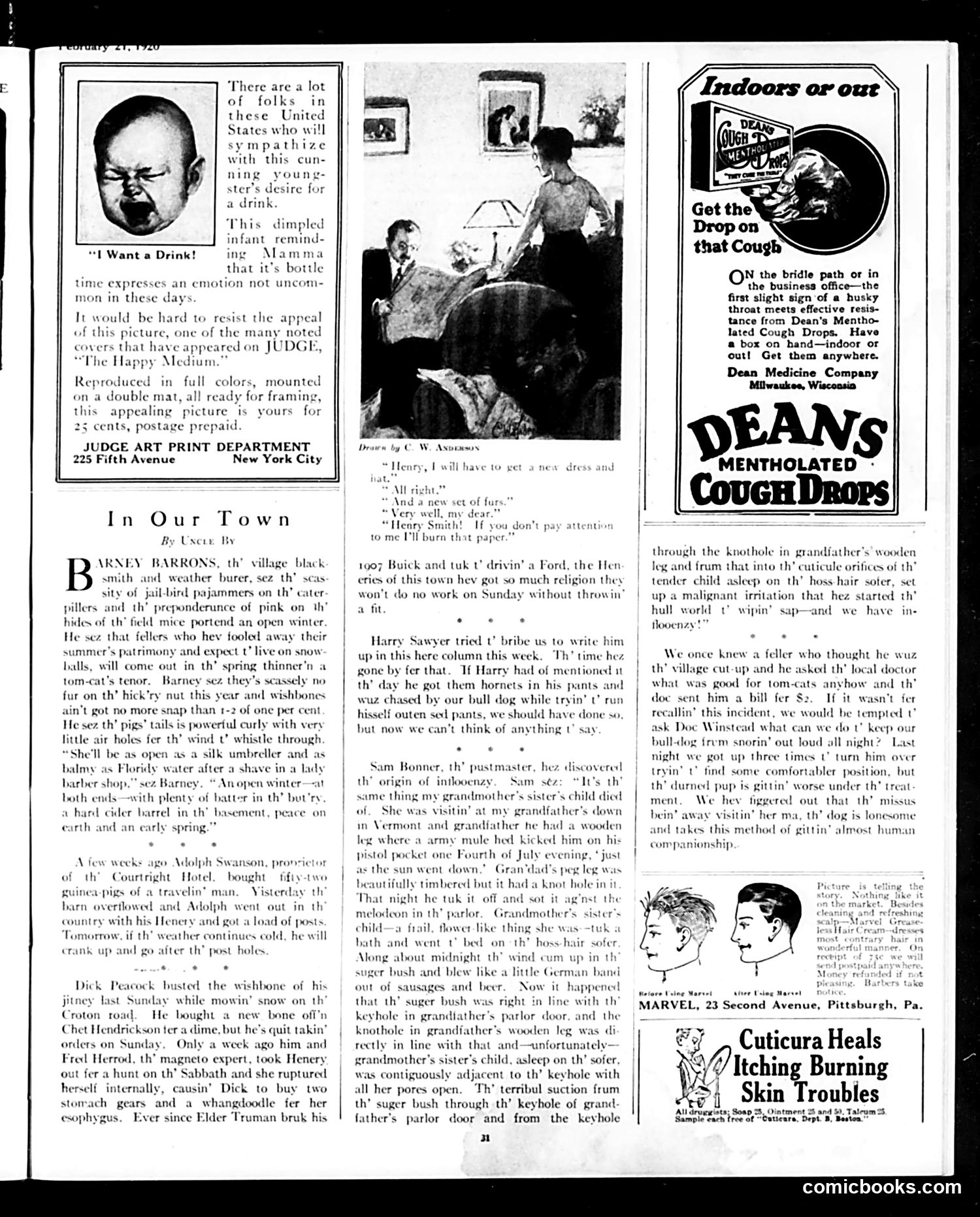
This page contains satirical rural humor and advertisements rather than political cartoons. The main content is "In Our Town," a dialect-heavy column by Uncle Eby mocking small-town life and rural superstitions. **The Satire:** The humor targets unsophisticated country folk through exaggerated dialectical speech and absurd anecdotes. Examples include: a blacksmith predicting harsh winters from animal behavior; villagers becoming overly religious after car accidents; and an elaborate, rambling story about a wooden peg leg causing intestinal illness through supernatural wind circulation. The implied joke is that rural Americans are credulous, crude, and comically backward. **Social Context:** Published during Prohibition's beginning (1920), this reflects urban magazine culture mocking rural America as intellectually inferior. The "I Want a Drink" advertisement at top left capitalizes on anti-drinking sentiment of the era. **Modern Relevance:** This exemplifies how early 20th-century satirical magazines reinforced class and regional prejudices, portraying rural Americans as buffoons for urban, educated readers' amusement.
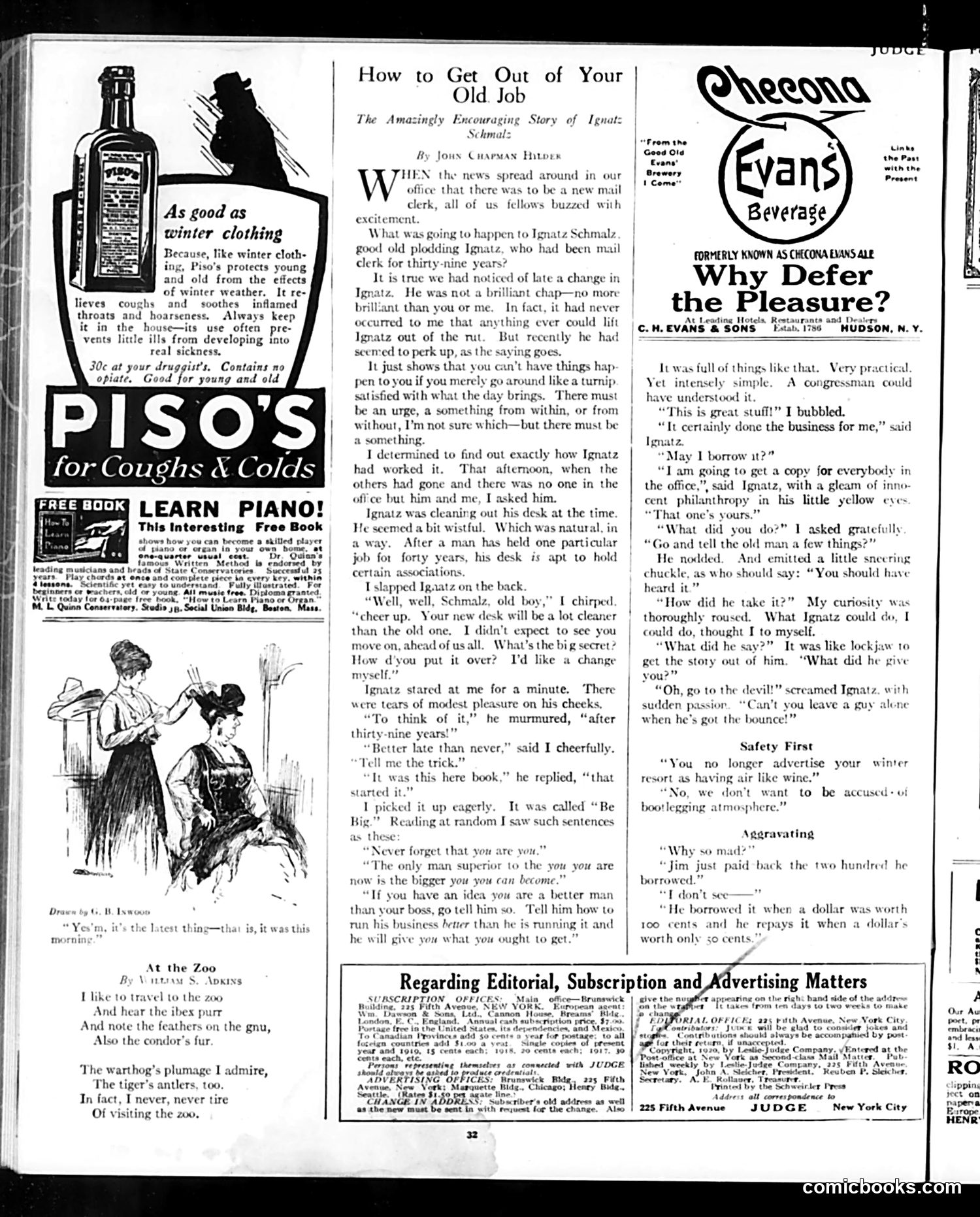
This page primarily contains **advertisements and humor columns** rather than political satire. The main elements: **"How to Get Out of Your Old Job"** - A humorous story about Ignatz Schmalz, a 39-year mail clerk who discovers a self-help book titled "Be Big" that supposedly transforms his career prospects. The satire mocks contemporary **self-help culture and motivational literature**, which were gaining popularity in early 20th-century America. The absurd advice ("tell your boss how to run his business better") lampoons the unrealistic promises of such books. **Advertisements** dominate: Piso's cough medicine, piano lessons, Evans' Beverage (beer), and various other products typical of the era. **Minor poems** include "At the Zoo" by Vivian S. Adkins, a light verse about zoo animals. The page reflects Judge's mix of satirical commentary on social trends (here, the snake-oil promise of self-improvement literature) alongside commercial advertising—a common format for magazines of this period.
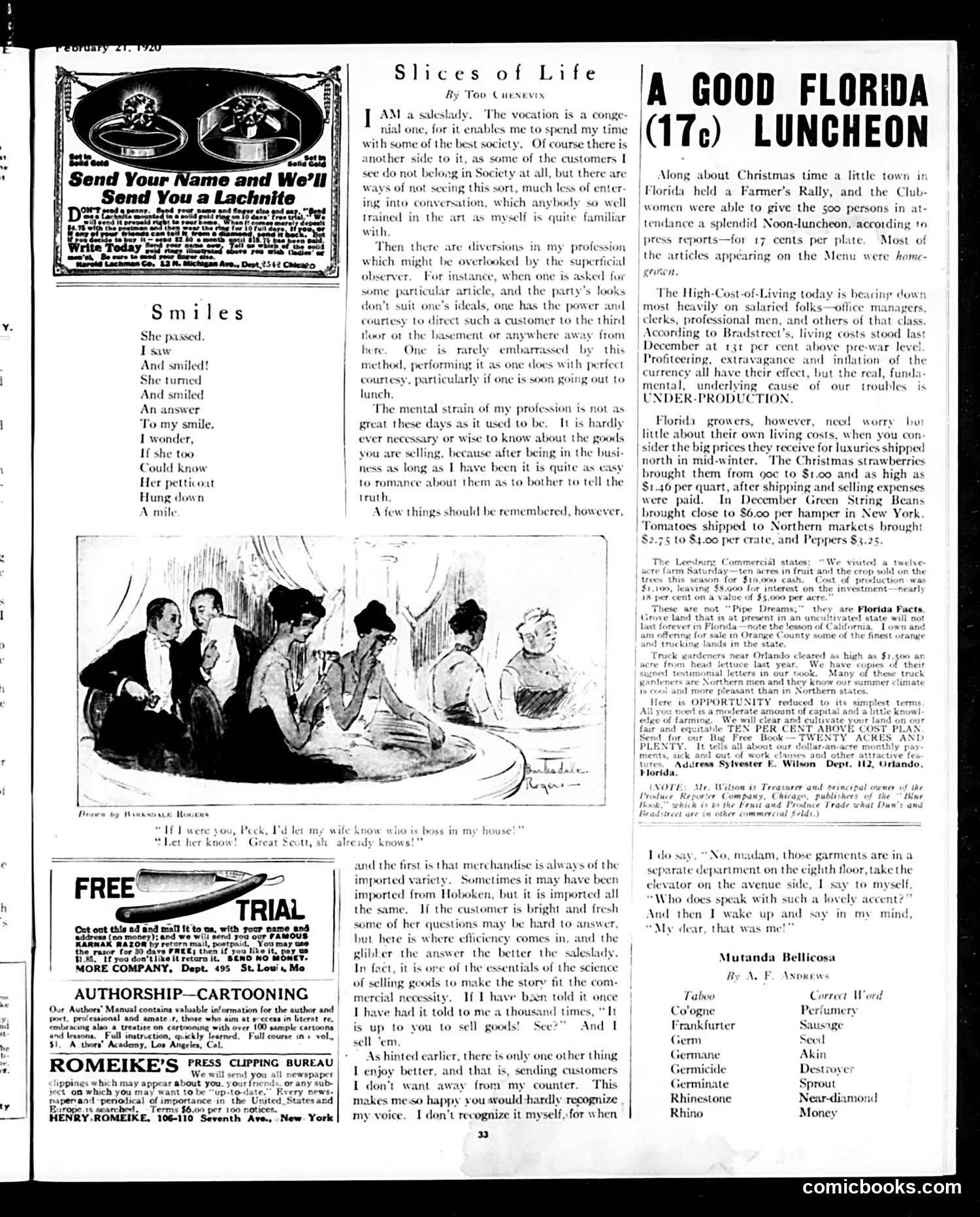
This page contains **three distinct pieces of satirical content**: 1. **"Slices of Life" column** (top center): A saleswoman's first-person account mocking retail customer service. She boasts of her refined ability to dismiss unfashionable customers by directing them to basement departments—satirizing both snobbish sales staff and the pretense of "Society." 2. **Political/Economic commentary** (right column): A piece titled "A Good Florida Luncheon" critiques high cost-of-living inflation post-WWI. It notes Florida farmers' produce commands premium prices ($1/quart strawberries, $6/hamper beans in December), yet ordinary salaried workers struggle. The satire blames "under-production" and inefficiency rather than farmer greed. 3. **Illustration** (center): A sketch of well-dressed dinner guests, accompanying a joke about spousal authority—typical domestic humor of the era. **Context**: This 1920 page reflects post-WWI economic anxiety about inflation, class distinctions, and consumer culture in Jazz Age America.
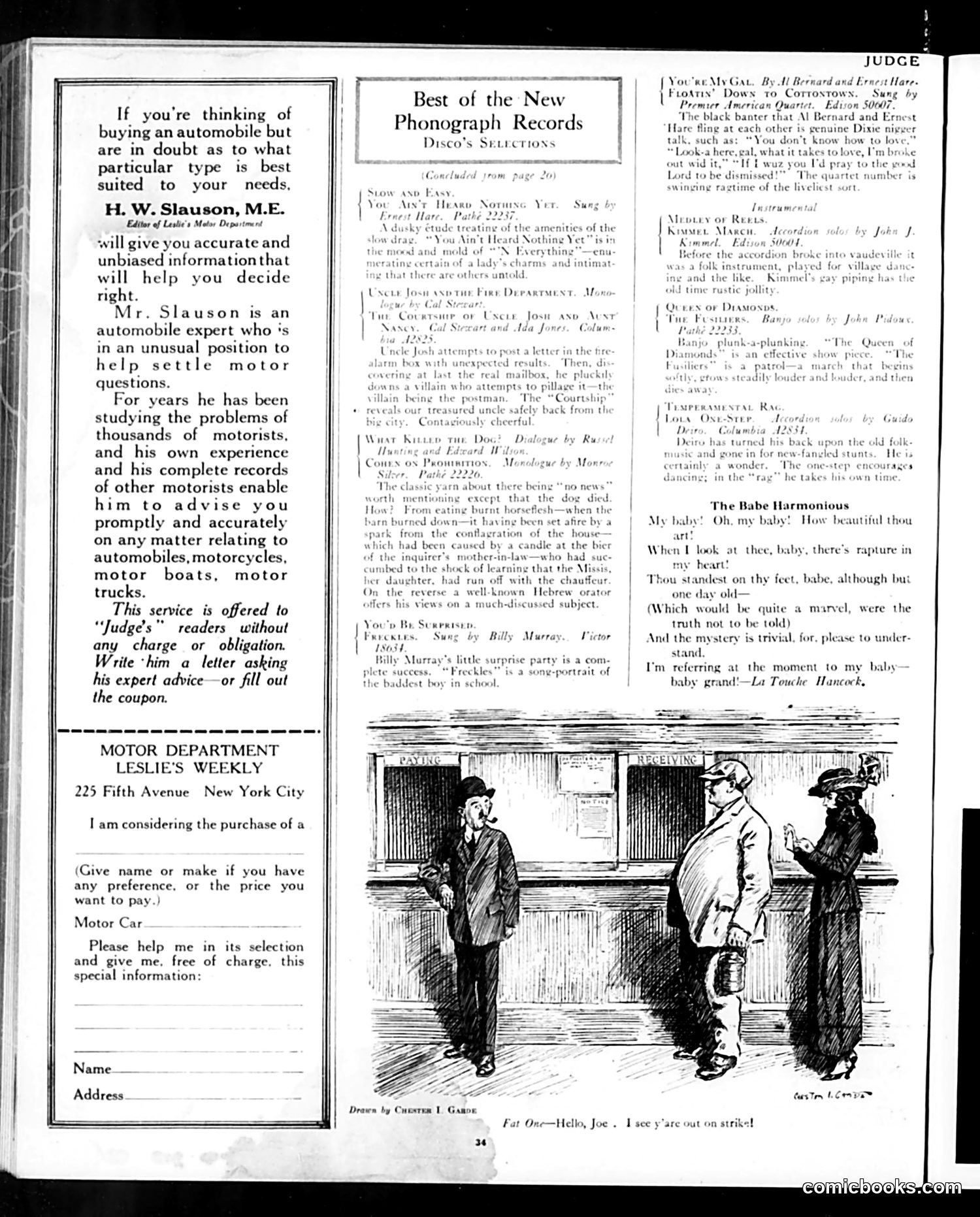
This page combines motor-car advertising with phonograph record reviews and a cartoon joke typical of early 20th-century humor. **The Main Cartoon** (bottom): Shows a man at what appears to be a pawn shop's "Paying" and "Receiving" windows. The caption "Fat One—Hello, Joe. I see y'are out on strike!" suggests commentary on labor unrest—the figure has pawned his possessions due to striking, likely referencing contemporary labor disputes that plagued American industries. **The Content**: The page mixes: - An advertisement for H.W. Slauson's motor-car advice column - Phonograph record reviews (popular entertainment of the era) - A sentimental poem called "The Babe Harmonious" (the joke being the "baby" is actually a baby grand piano, not an infant) The overall tone reflects Judge's satirical approach to modern American life, mixing consumer culture, labor tensions, and genteel humor for its middle-class readership.
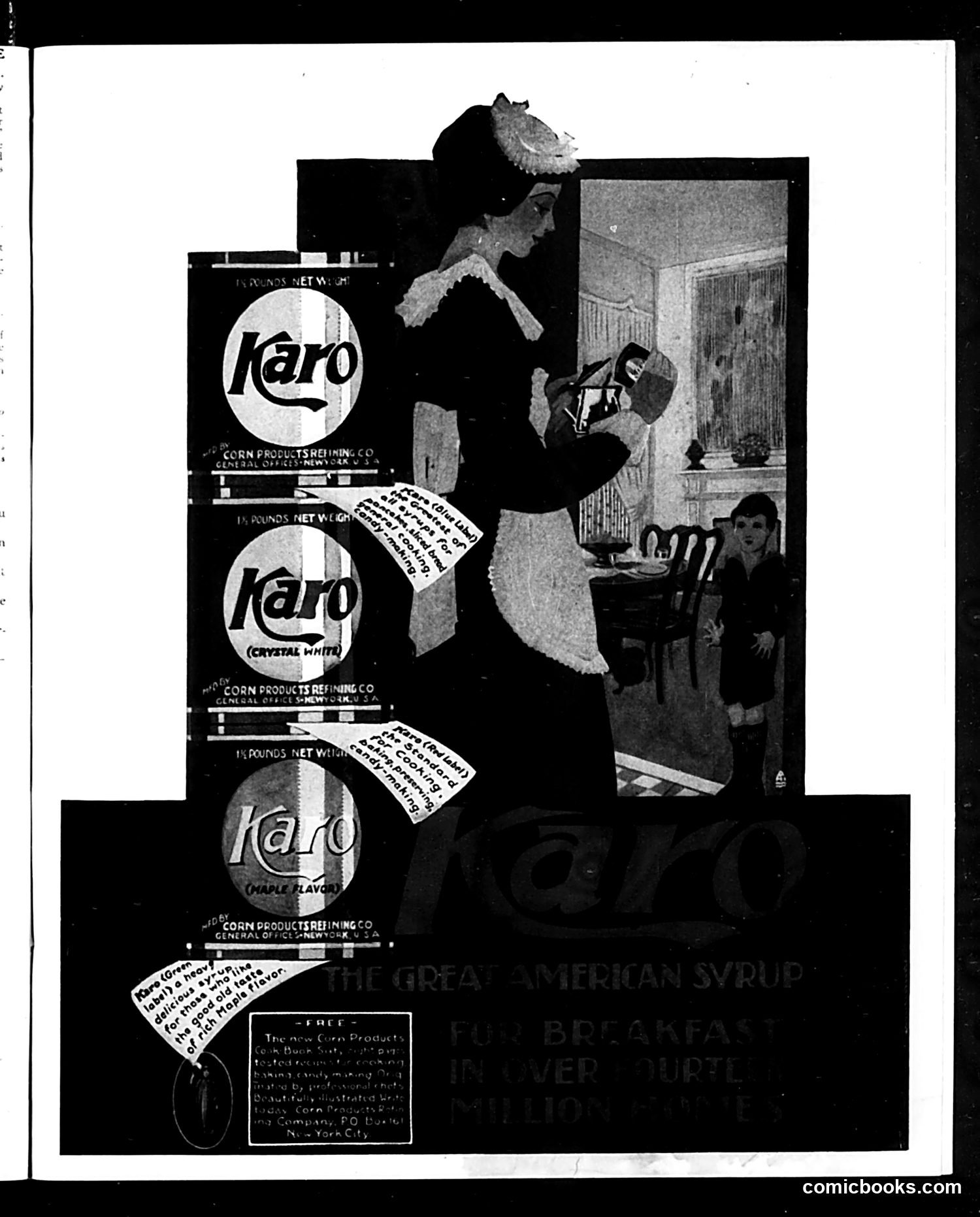
This appears to be a Karo syrup advertisement rather than a political cartoon. The image shows a stylishly dressed woman in 1920s fashion presenting three varieties of Karo syrup products (labeled as different flavors) to a domestic scene. A man photographs her while a child and another figure observe in a kitchen setting. The satire likely mocks the era's advertising culture and consumerism—presenting syrup as a glamorous, fashionable product worthy of professional photography and elaborate presentation. The contrast between the elegant, sophisticated woman and the humble kitchen product creates humorous irony. This reflects Judge magazine's tendency to satirize commercial excess and the marketing techniques that treated mundane household goods as luxury items during the 1920s consumer boom.
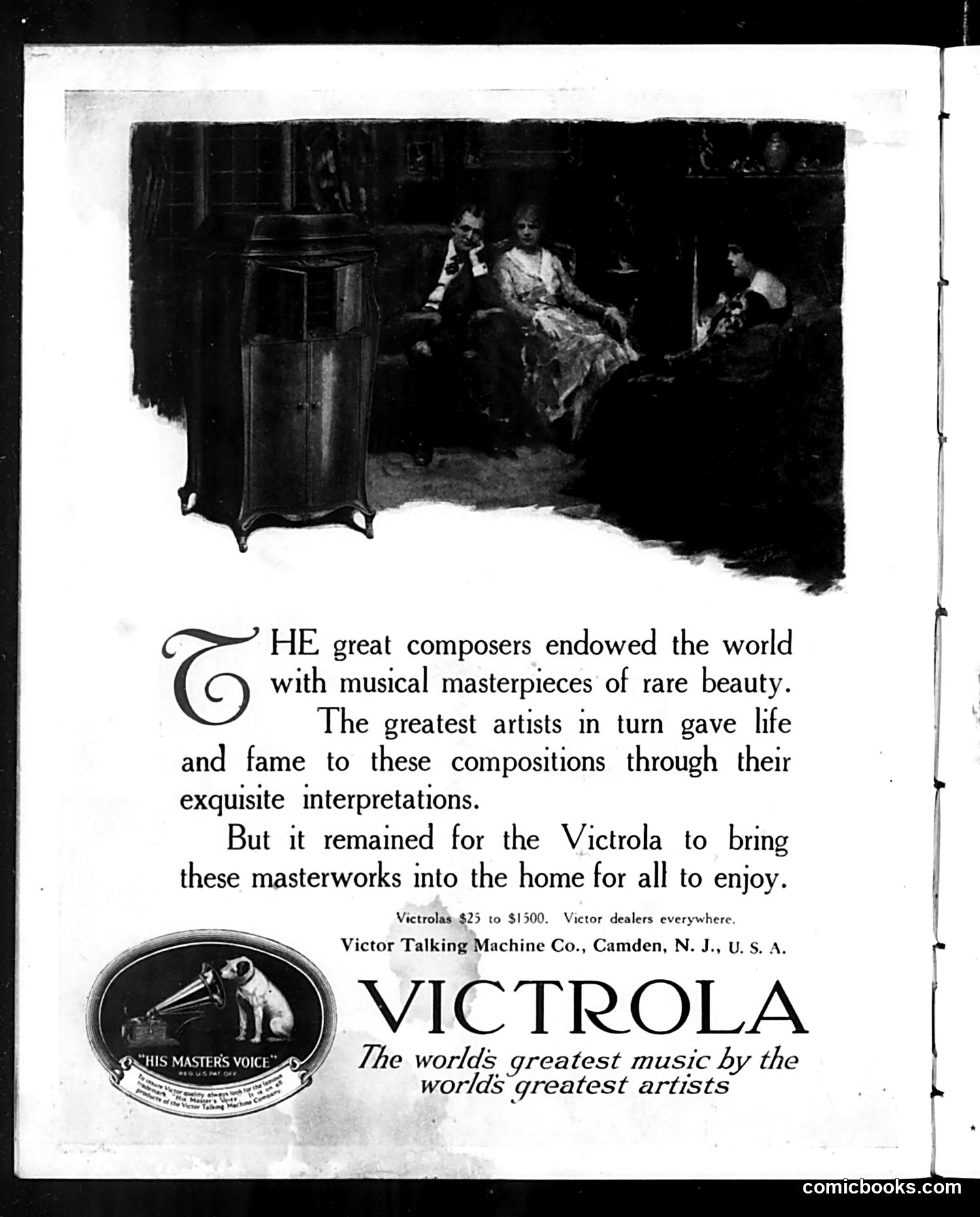
This is a **product advertisement**, not political satire. The page promotes the Victrola, an early phonograph/record player manufactured by Victor Talking Machine Co. in Camden, New Jersey. The advertisement argues that while great composers created masterpieces and great artists performed them, the **Victrola democratized access** to classical music by bringing professional performances into ordinary homes. The photograph shows a well-dressed family listening to the device. The tagline—"The world's greatest music by the world's greatest artists"—emphasizes that owners could enjoy professional classical performances without attending concerts. This was a genuine technological innovation of the early 20th century, positioning the Victrola as a luxury product ($25-$1,500) that made high culture accessible to the middle class. There's no satirical critique here—it's straightforward marketing.