
Judge, 1920-02-21 · page 26 of 36
Judge — February 21, 1920 — page 26: what you’re looking at
What you’re looking at
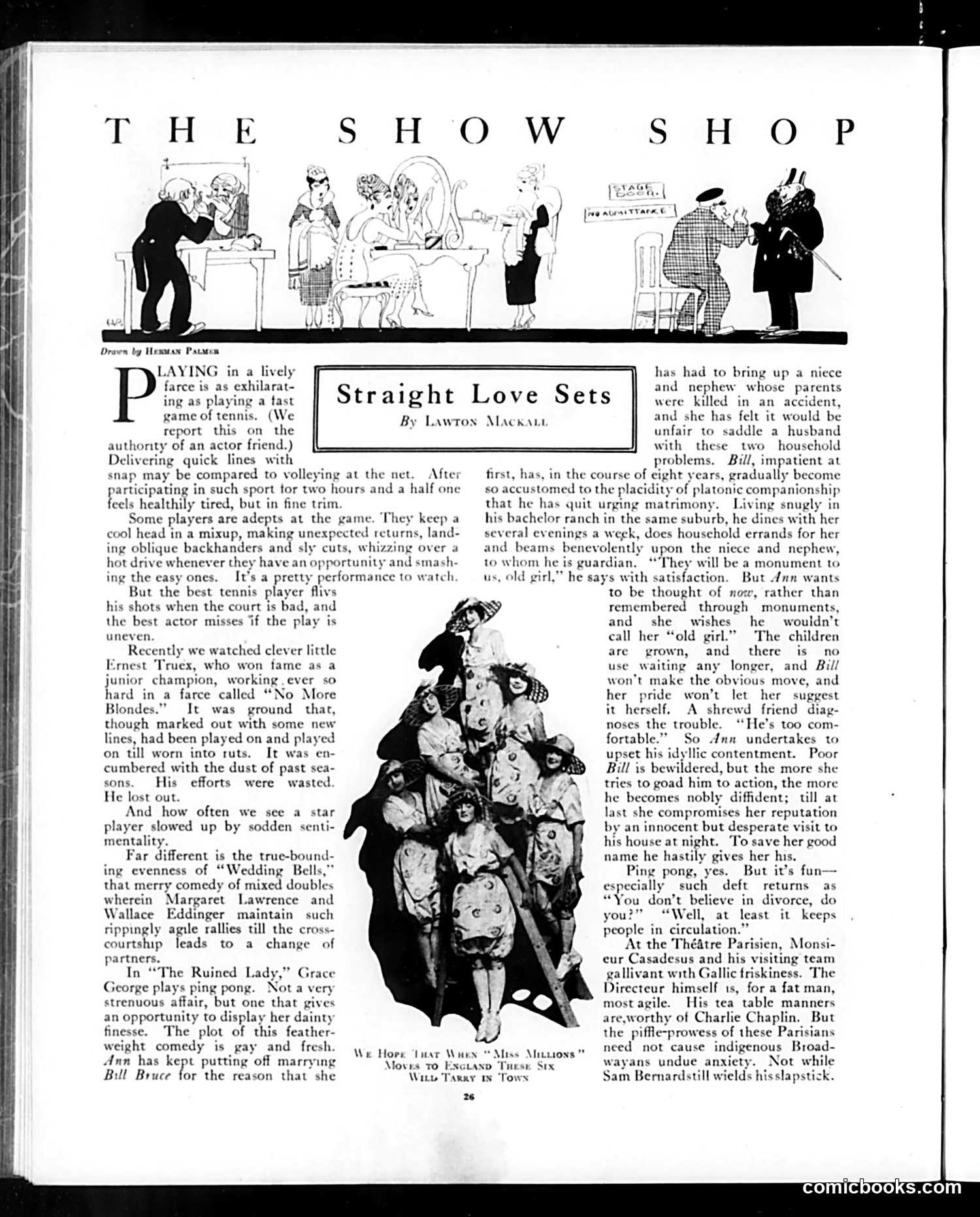
This page contains theater reviews comparing acting performances to sports, particularly tennis. The top illustration by Herman Palmer depicts "The Show Shop" — various theatrical scenes in silhouette. The main article by Lawton Mackall uses sports metaphors to evaluate actors. It praises Ernest Truex's effort in the farce "No More Blondes," though noting the script itself was worn out. It lauds Margaret Lawrence and Wallace Eddinger's "Wedding Bells" for maintaining sharp comedic timing ("rippingly agile rallies"). The plot synopsis of "The Ruined Lady" (featuring Grace George) describes a woman who must manipulate her reluctant suitor into marriage after eight years of domestic arrangement — she resorts to a compromising nighttime visit to finally provoke him into action. The review concludes by dismissing Parisian theatrical performers visiting Broadway, asserting that American performer Sam Bernard needs no anxiety about competition. This reflects period American theatrical nationalism and vaudeville competitiveness. The illustration shows multiple characters stacked together, likely depicting theatrical chaos or comedy.
📄 Transcribed text from this page (OCR, searchable)
Machine-transcribed from the original scan — historical spelling and the odd misread are preserved.
Drown by Hemeas Patwen LAYING in a lively farce is as exhilarat- ing as playing a tast game of tennis. (We report this on the authonty of an actor friend.) Delivering quick lines with snap may be compared to volleying at the net. participating in such sport tor two hours and a half one feels healthily tired, but in fine trim Some players are adepts at the game. They keep a cool head in a mixup, making unexpected returns, land- ing oblique backhanders and sly cuts, whi have an opportunity and smash- It’s a pretty performance to watch, hot drive whenever the ing the easy ones. But the best tennis player flivs his shots when the court is bad, and the best actor misses if the play is uneven Recently we watched clever little Ernest Truex, who won fame as a junior champion, working ever so hard in a farce called “No More Blondes.” It was ground that, though marked out with some new lines, had been played on and played on till worn into ruts. It was en- cumbered with the dust of past sea- sons. His efforts were wasted. He lost out. And how often we see a star player slowed up by sodden senti- mentality. Far different is the true-bound- ing evenness of “Wedding Bells, that merry comedy of mixed doubles wherein Margaret Lawrence and Wallace Eddinger maintain such rippingly agile rallies till the cross- courtship leads to a change partners. In “The Ruined Lady George plays ping pong. Nota very strenuous affair, but one that gives an opportunity to display her dainty finesse. The plot of this feather- weight comedy is gay and fresh. Ann has kept putting off marrying Bill Bruce tor the reason that she Straight Love Sets By Lawton Mackaut After seve ring Over a We Hore iar Wien Moves To ENctanp These Six Wity Taray ix Town Liss Mitisions al has had to bring up a niece and nephew whose parents were killed in an accident, and she has felt it would be unfair to saddle a husband with these two houschold problems. Bill, impatient at first, has, in the course of eight years, gradually become so accustomed to the placidity of platonic companionship that he has quit urging matrimony. his bachelor ranch in the same suburb, he dines with her evenings a week, does houschold errands for her and beams benevolently upon the niece and nephew, to whom he is guardian. “Th us, old girl,” he says with satisfaction. Living snugly in will be a monument to But dun wants to be thought of now, rather than remembered through monuments, and she wishes he wouldn't call her “old girl.” The children are grown, and there is no use waiting any longer, and Bill won't make the obvious move, and her pride won't let her suggest it herself. A shrewd friend diag- noses the trouble. ‘‘He’s too com- fortable.” So Ann undertakes to upset his idyllic contentment. Poor Bill is bewildered, but the more she tries to goad him to action, the more he becomes nobly diffident; till at last she compromises her reputation by an innocent but desperate visit to his house at night. To save her good name he hastily give g pong, yes. especially such deft returns as “You don’t believe in divorce, do you?” “Well, at least it keeps people in circulation.” At the Théatre Parisien, Monsi- eur Casadesus and his visiting team gallivant with Gallic friskiness. The Directeur himself 1s, for a fat man, most agile. His tea table manners are,worthy of Charlie Chaplin. But the piffle-prowess of these Parisians need not cause indigenous Broad- wayans undue anxiety. Not while Sam Bernardstill wields hisslapsti