
A complete issue · 36 pages · 1919
Judge — December 6, 1919
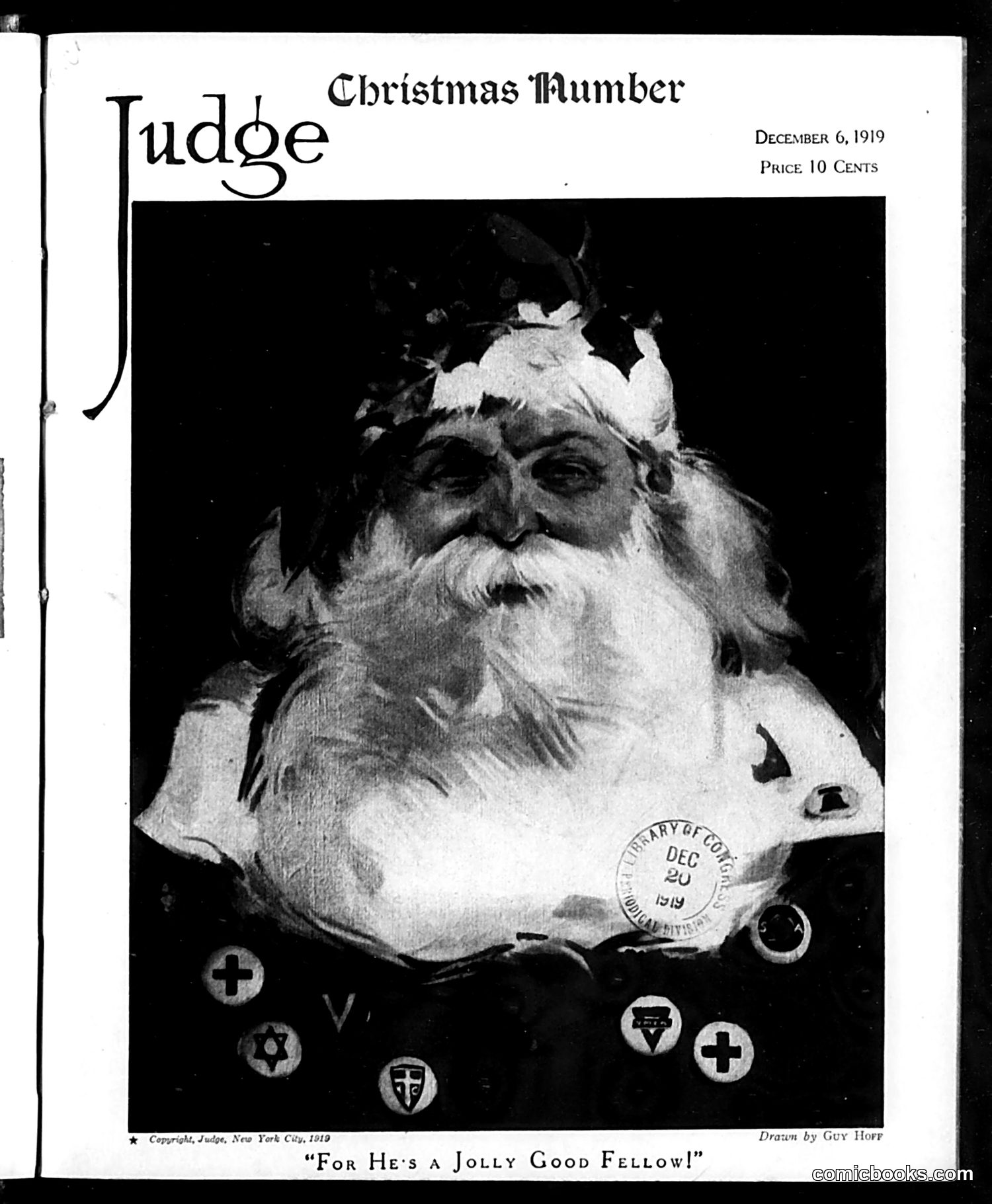
This cover features Santa Claus with the caption "For He's a Jolly Good Fellow!" The illustration appears to be a straightforward Christmas greeting rather than political satire—Santa is depicted in traditional form with his characteristic beard and jolly appearance. However, the small emblems at the bottom likely reference charitable or patriotic organizations of the era, possibly relating to WWI relief efforts or post-war charitable causes, suggesting Judge may be promoting charitable giving during the Christmas season of 1919 (shortly after WWI's November 1918 armistice). The cover is essentially a festive holiday issue without obvious satirical commentary—typical holiday magazine fare designed to appeal broadly to readers during the Christmas season.
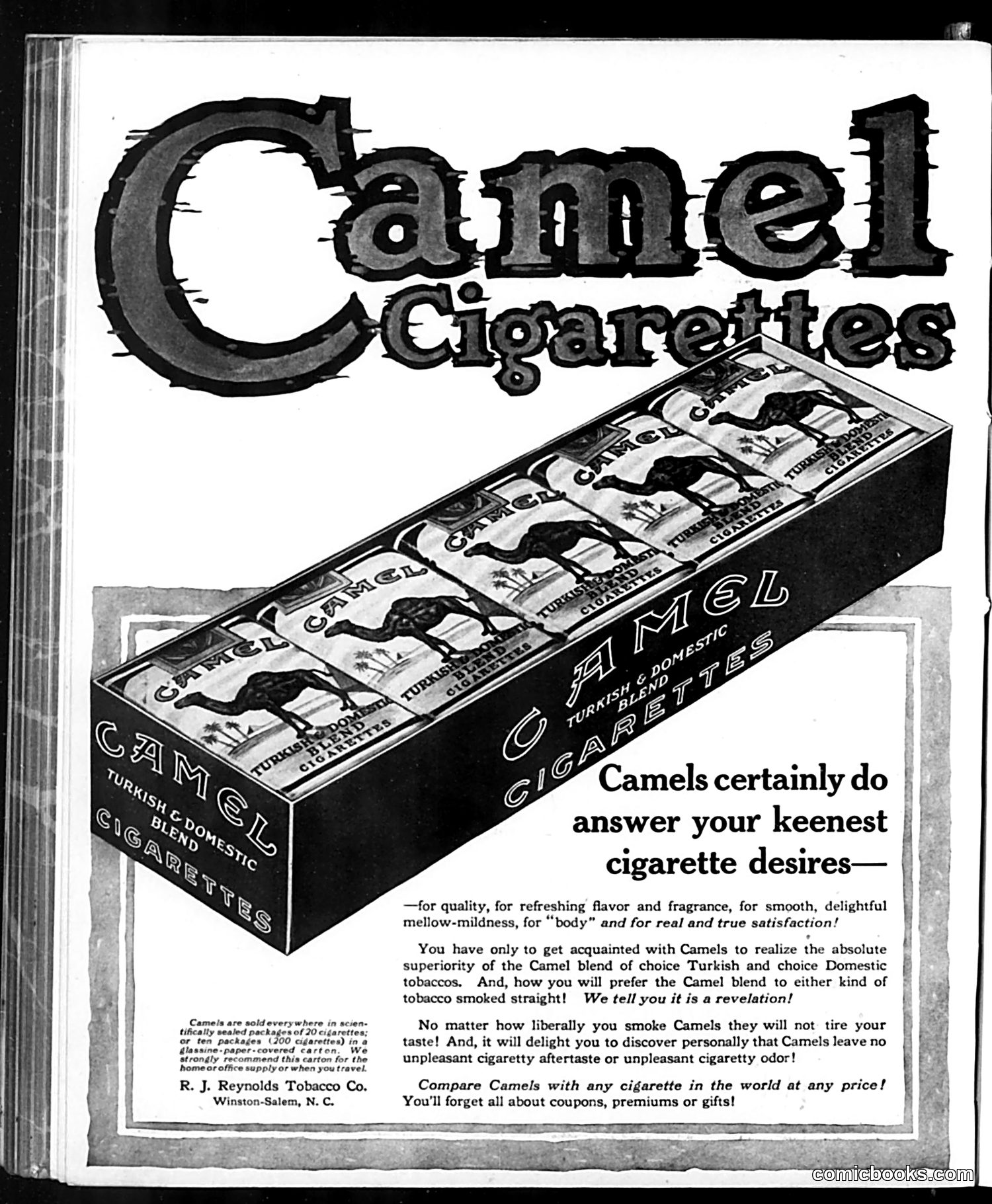
This is **not satire or political commentary**, but rather a straightforward **cigarette advertisement** from Judge magazine. The page promotes Camel cigarettes, manufactured by R.J. Reynolds Tobacco Co. in Winston-Salem, North Carolina. The ad emphasizes Camel's blend of Turkish and domestic tobaccos, claiming superior quality and flavor. Key selling points include: - No unpleasant aftertaste - Smooth, delightful "mellow-mildness" - Satisfaction without coupons or premiums The product image shows a carton displaying multiple cigarette packages. The advertisement reflects early 20th-century tobacco marketing, when health concerns were not yet widely publicized and cigarette advertising appeared regularly in mainstream publications without restriction.
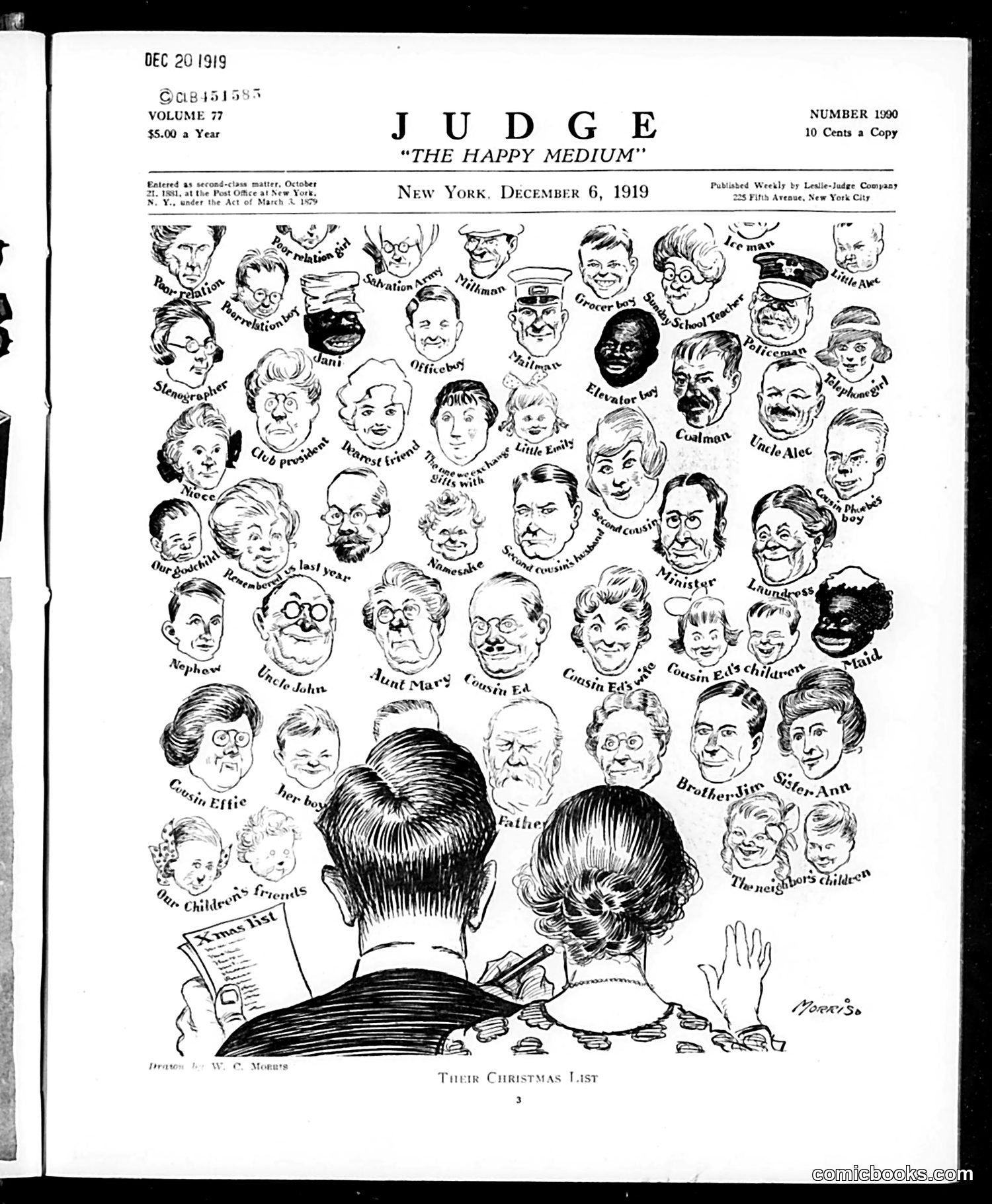
This cartoon satirizes a couple reviewing their extensive Christmas gift list, which is surrounded by caricatured faces of relatives, friends, and acquaintances they must buy for. The illustration humorously depicts the burden of holiday shopping and gift-giving obligations. The labeled faces represent various social roles and relationships—"Uncle," "Aunt Mary," "Cousin Ed," "The Maid," "Policeman," "Grocer," "School Teacher," and "The neighbors' children" among others. This reflects post-WWI American middle-class life and the social expectation to gift people across one's entire social circle. The satire targets the commercialization of Christmas and the financial/emotional stress of maintaining numerous gift-giving relationships—a timeless complaint that remains relevant today.
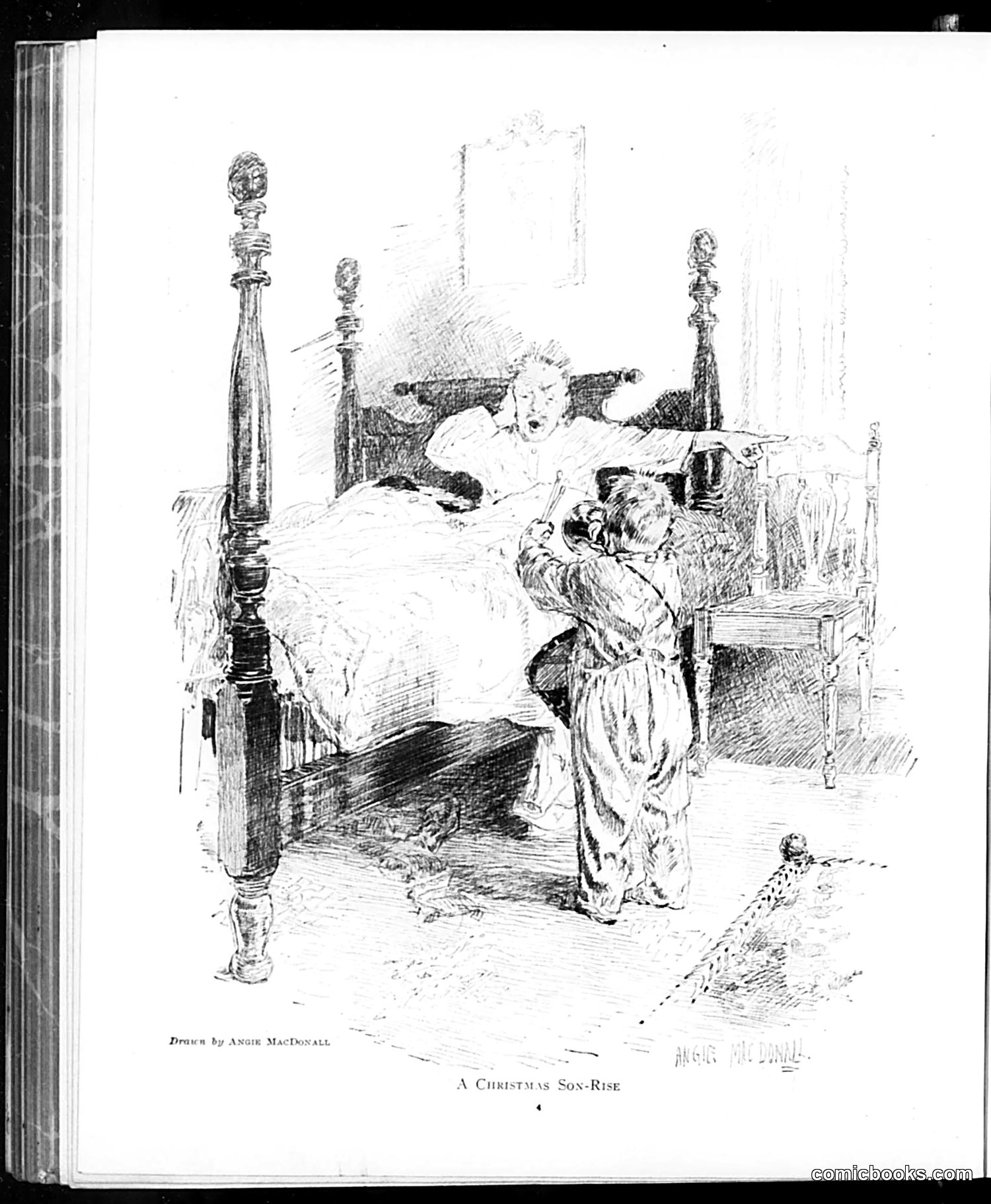
This sketch by Angus MacDonall depicts a domestic Christmas morning scene. A woman in a nightgown stands beside a bed where a man lies stretched out with arms extended, appearing to wake or rouse himself. A small child stands nearby watching the scene unfold. The title "A Christmas Son-Rise" is a pun playing on "sunrise" versus "son-rise"—the appearance or rising of a son (child) at Christmas morning. The satire likely mocks the disruption Christmas mornings bring to household peace, with the child's early awakening rousing the father from sleep in an exaggerated, theatrical manner. The humor targets the domestic chaos of holiday family life rather than political content.
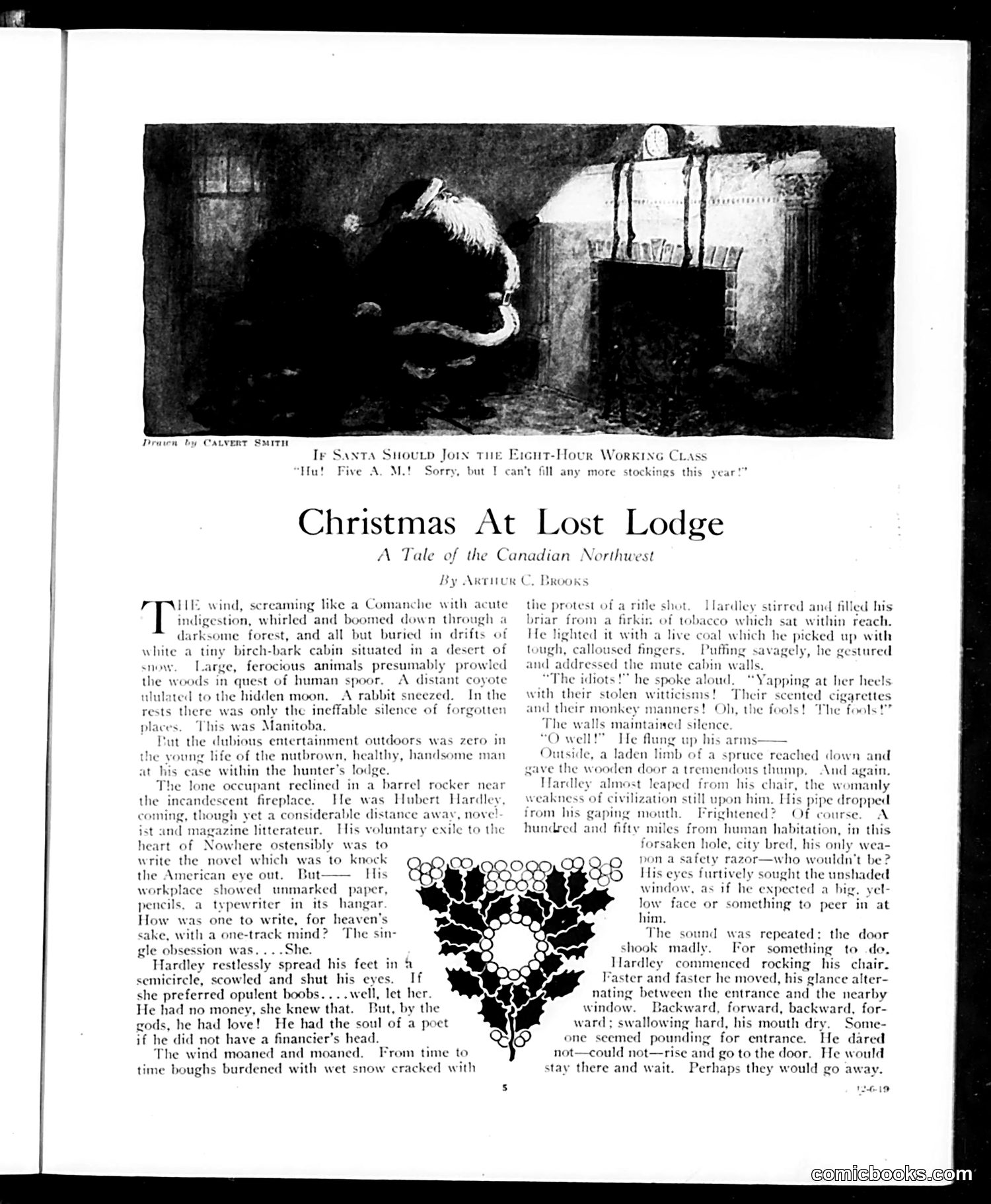
This page contains the beginning of a short story by Arthur C. Brooks titled "Christmas At Lost Lodge: A Tale of the Canadian Northwest." The narrative depicts a solitary man named Hardley isolated in a cabin during a harsh Manitoba winter, struggling with loneliness and poverty. The illustration at the top by Calvert Smith depicts a humorous scene of Santa supposedly joining the "Eight-Hour Working Class," with Santa apologizing: "Hi! Five A.M.! Sorry, but I can't fill any more stockings this year!" This cartoon satirizes labor disputes of the era—likely referencing demands for an eight-hour workday—by suggesting even Santa cannot meet Christmas expectations due to work restrictions. The joke targets contemporary labor debates by using the holiday gift-giving tradition as a vehicle for commentary on working-class demands.
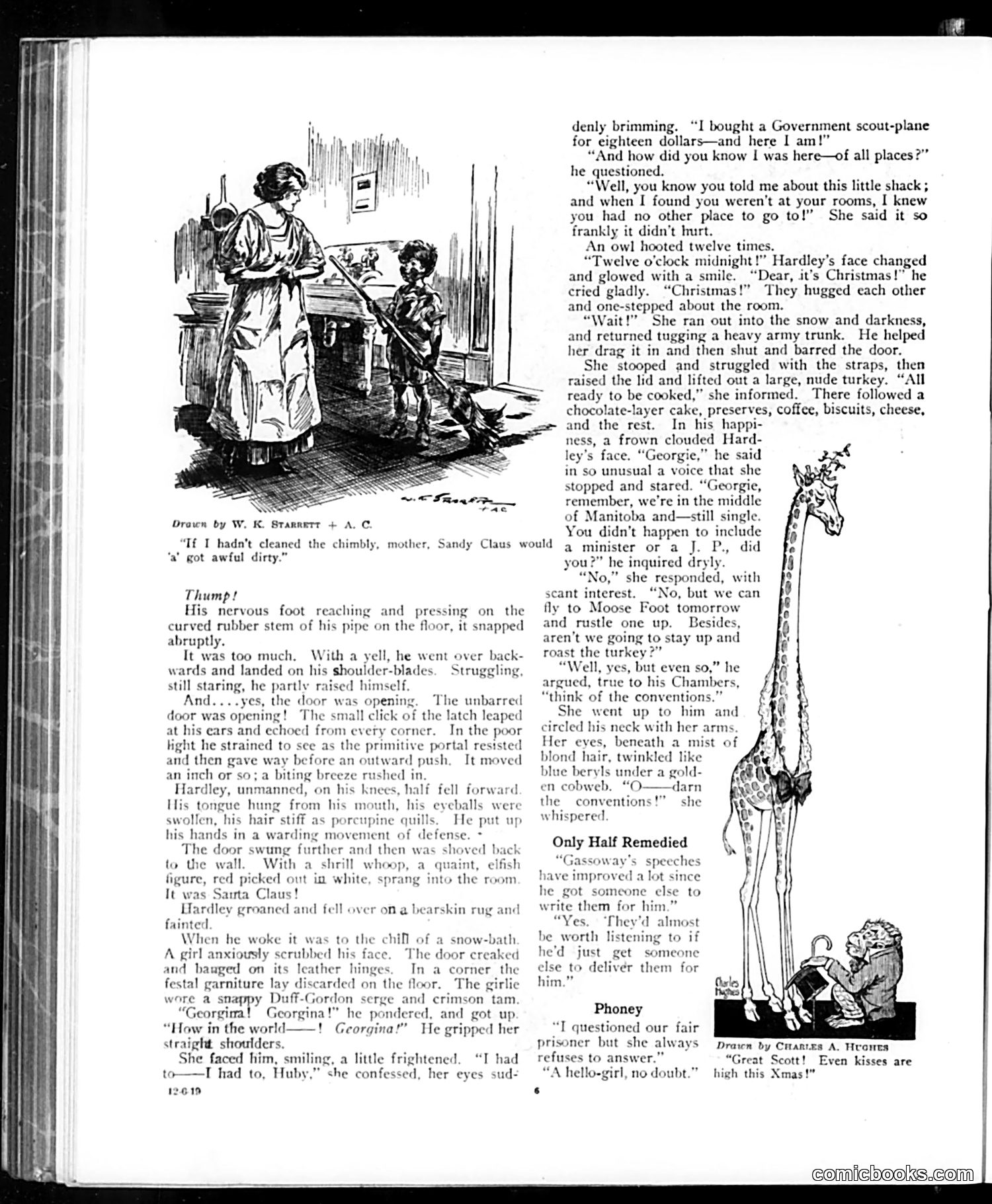
This page contains a short story with illustrations rather than political satire. The narrative follows a character named Hardley who discovers Santa Claus (an actual person in a red suit) has entered through a chimney and collapsed in his home during a Manitoba winter. The story's humor derives from the mundane reality interrupting Christmas fantasy—a man dressed as Santa, exhausted from travel, literally falls down the chimney. The exchanges between Hardley and a woman (possibly his wife or companion) involve practical domestic concerns: cleaning the chimney, preparing Christmas dinner, and managing an unexpected guest. The illustrations by W.K. Starrett and Charles A. Hughes support this comedic narrative about Christmas day disruption, not political commentary.
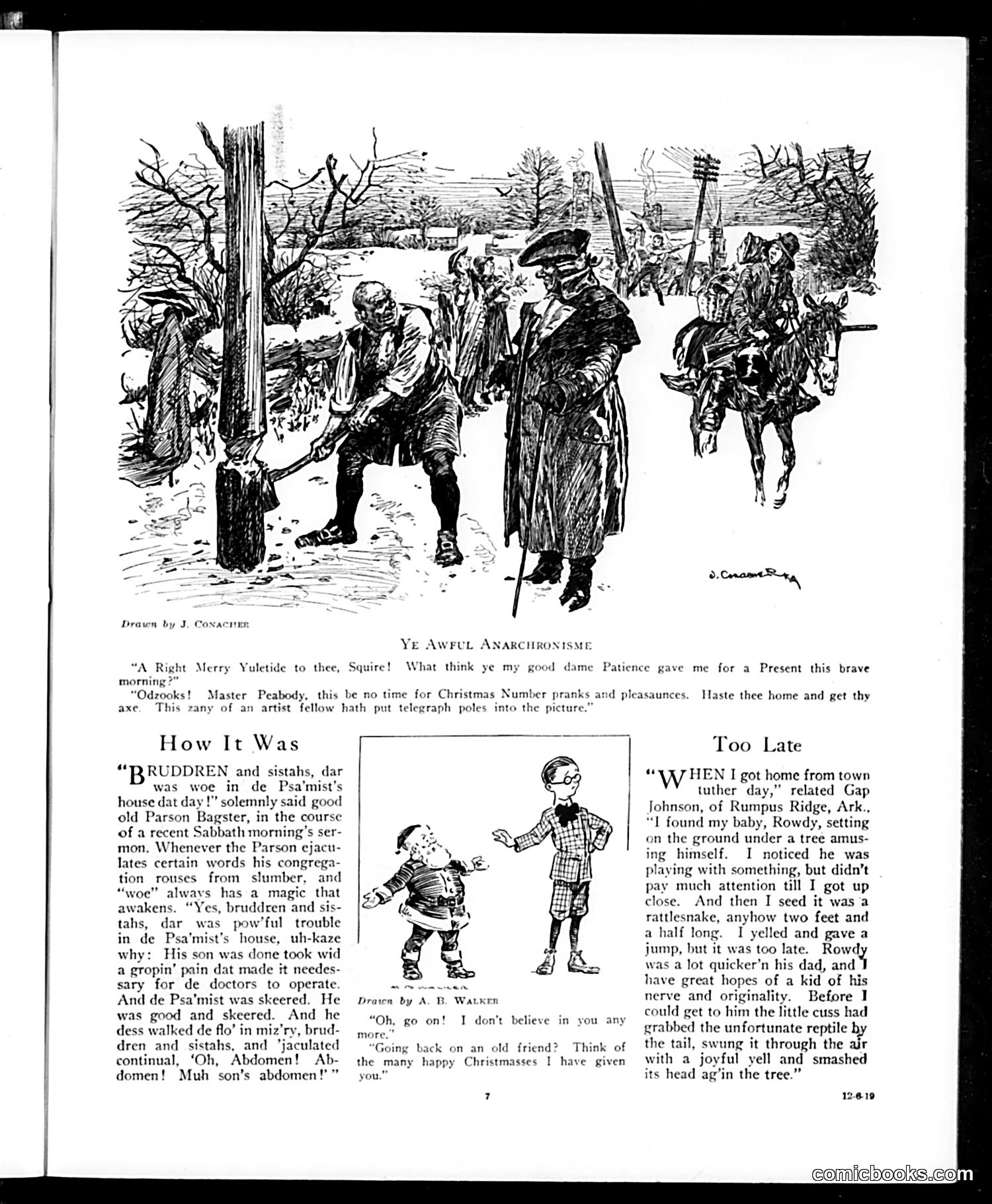
This page contains three separate satirical pieces typical of early Judge magazine: 1. **"Ye Awful Anachronisme"** (top): A visual joke mocking artistic anachronism. A character complains that an artist has foolishly included telegraph poles in what appears to be a historical or period scene, breaking the historical authenticity. 2. **"How It Was"** (left): A dialect-heavy parody of religious sermon delivery, mocking both a caricatured Black preacher's speech patterns and anxious parental concern. The humor relies on offensive period stereotypes. 3. **"Too Late"** (right): A frontier tall-tale about a child playing with a rattlesnake. The joke celebrates the child's fearlessness and quick action in killing the snake—celebrating frontier toughness and independence as virtuous traits. The page reflects Judge's style: visual gags, ethnic/racial caricature, and exaggerated Americana humor typical of late 19th/early 20th-century American satirical magazines. Much of this content would be considered offensive by modern standards.
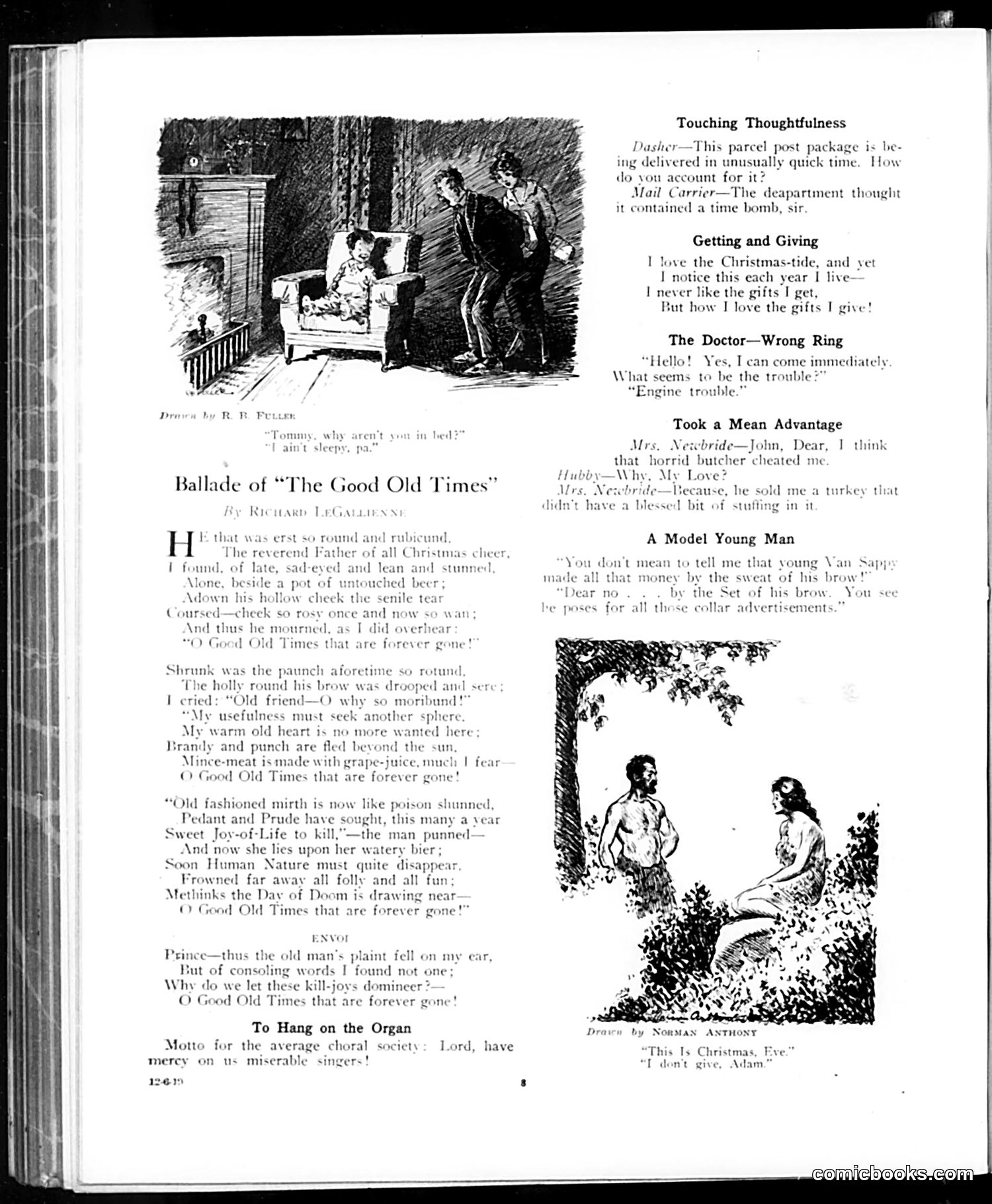
This page contains satirical short jokes and a longer poem, all Christmas-themed, typical of Judge magazine's humor circa early 20th century. **The jokes mock contemporary situations:** - "Touching Thoughtfulness" satirizes postal service paranoia—a mail carrier rushes delivery assuming the package contains a "time bomb," reflecting anxieties about anarchist violence common in that era. - "The Doctor—Wrong Ring" plays on miscommunication. - "Took a Mean Advantage" jokes about a butcher cheating a newlywed by selling undersized poultry. - "A Model Young Man" mocks a vain young man obsessed with advertising his expensive collar. **The long poem "Ballad of 'The Good Old Times'"** (by Richard LeGallienne) is nostalgic satire—an old man mourns the loss of Christmas cheer and traditional merriment, blaming modern "Pedant and Prude" for killing joy. The poem ironically celebrates disappearing "folly and fun." **The illustration** shows two figures in an outdoor scene, captioned "This Is Christmas, Eve" / "I don't give, Adam"—likely referencing the biblical Adam, playing on "give" versus "Adam" as a pun or moral commentary on generosity. The page emphasizes Judge's satirical tone about modern life's absurdities and nostalgia for earlier traditions.
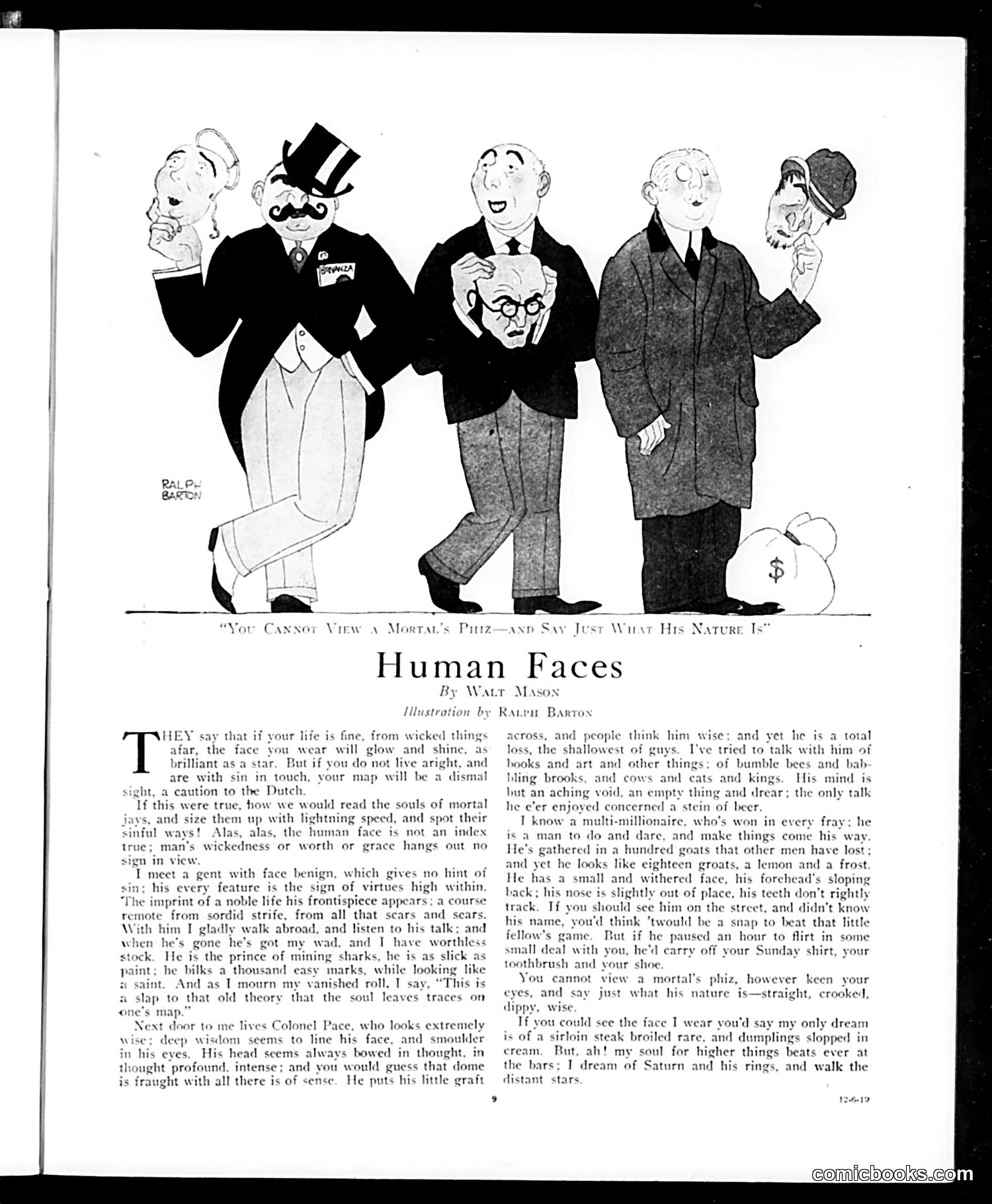
This is a satirical essay with caricature illustrations exploring the false premise that a person's character can be read from their facial features—a popular pseudoscience of the era. Mason argues this theory is nonsense through examples: a benign-faced gentleman who is actually a mining shark that swindles people; Colonel Pace, who appears wise but is intellectually empty and only discusses beer; and a millionaire with an unfortunate face who nonetheless succeeds through cunning. The satire's point: **you cannot judge a person's morality, intelligence, or true nature from appearance.** Dishonest or shallow people can look respectable, while the virtuous may appear unremarkable. The illustrations by Ralph Barton caricature these types to emphasize the disconnect between external presentation and internal character—a critique of physiognomy and surface-level social judgment common in early 20th-century American satire.
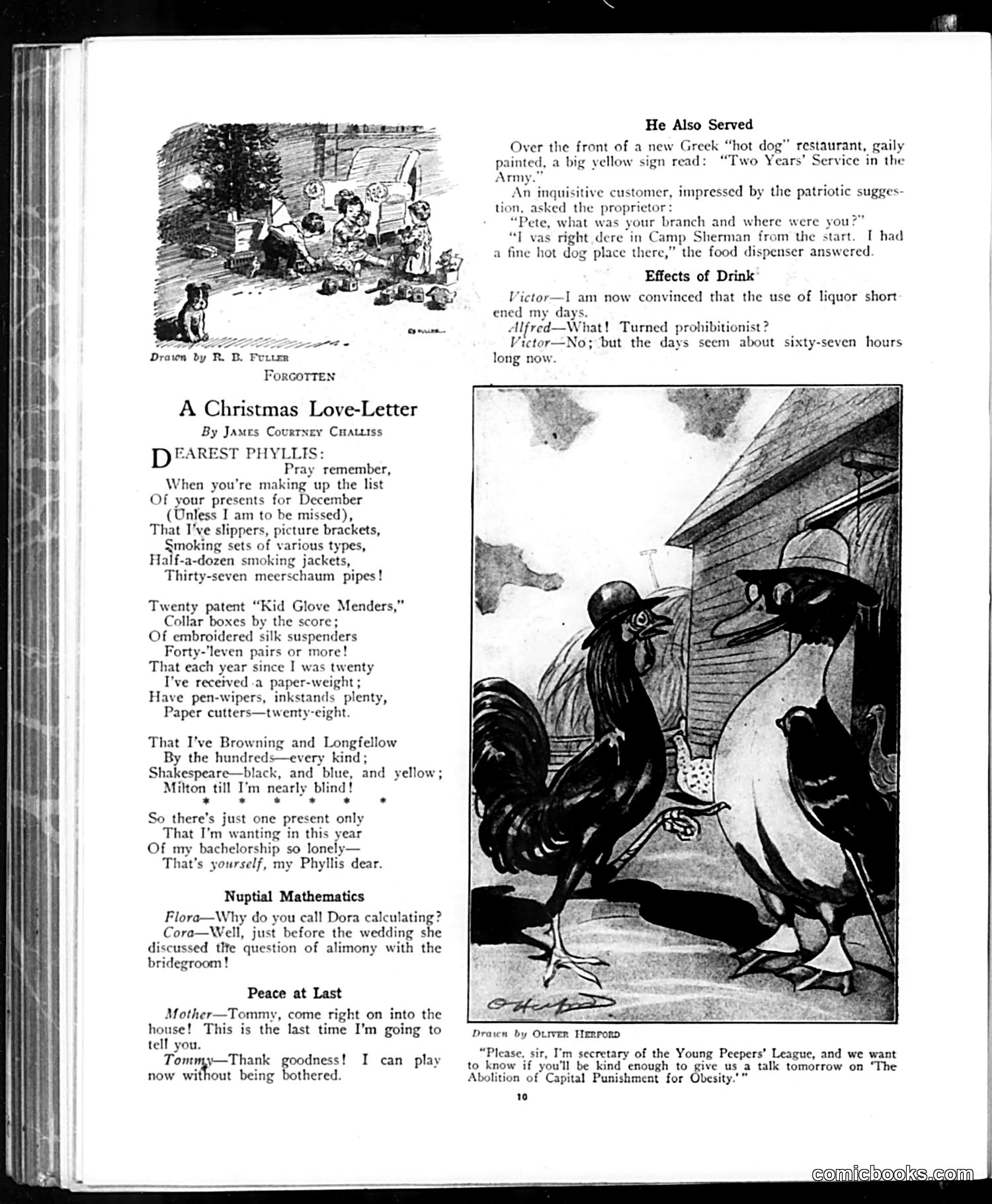
This page contains several unrelated satirical pieces typical of *Judge* magazine's humor: **"He Also Served"**: A joke about a Greek immigrant hot dog vendor displaying a sign claiming "Two Years' Service in the Army." When asked about his military service, he admits he only ran a hot dog stand at Camp Sherman. The satire mocks both the vendor's misleading patriotism and likely the prevalence of such exaggerated claims after WWI. **"Effects of Drink"**: A brief joke where Victor claims liquor shortened his life—not because it harmed him, but because prohibition (then in effect) has made days feel "sixty-seven hours long," suggesting alcohol's absence made time drag unbearably. **"A Christmas Love-Letter"** and smaller pieces ("Nuptial Mathematics," "Peace at Last"): Domestic humor about a bachelor's mounting gift collection, a woman calculating alimony before marriage, and a child seeking parental peace. These reflect early 20th-century middle-class concerns and family dynamics rather than political satire. The cartoons are sentimental or mildly humorous rather than hard-hitting social commentary.
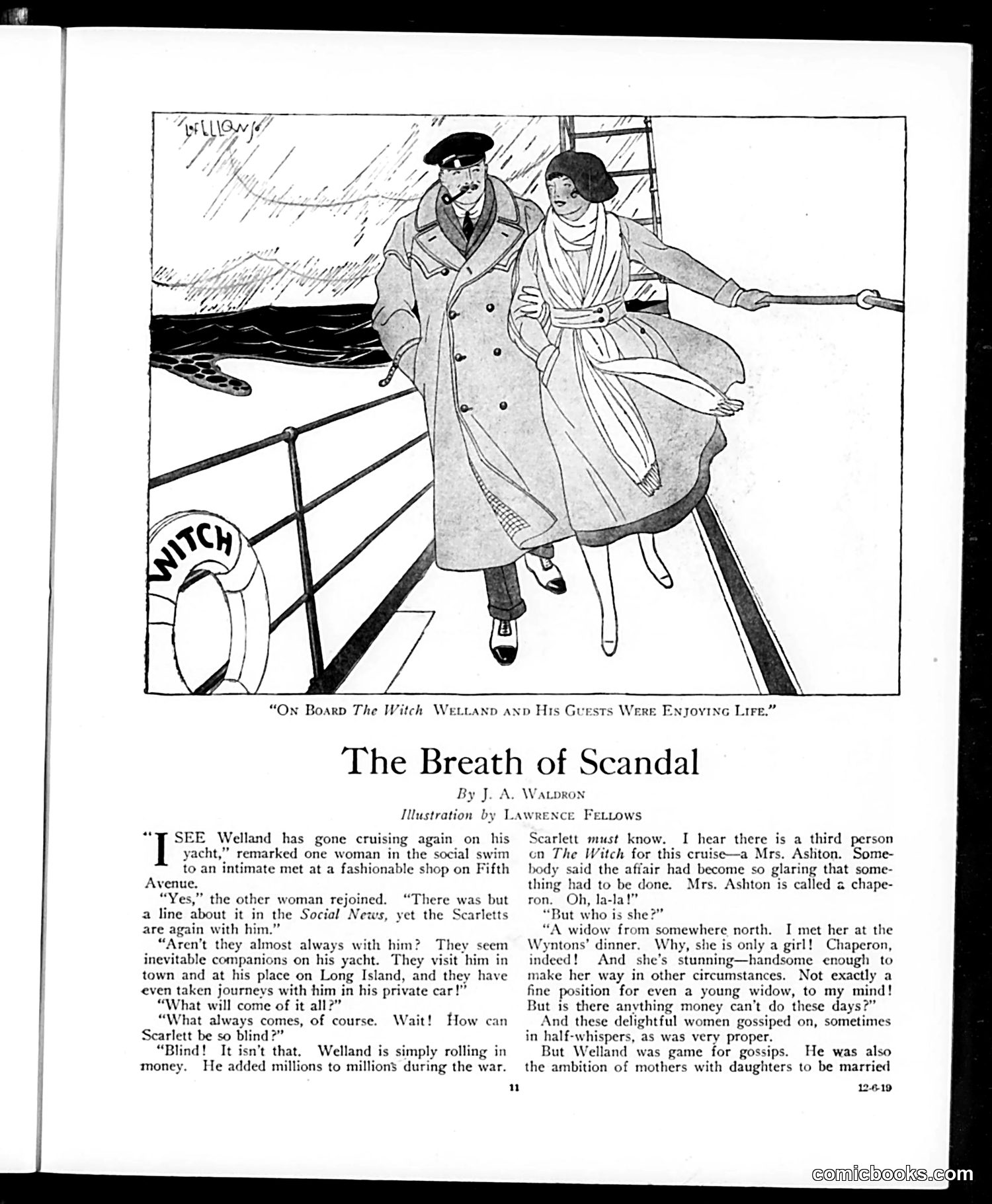
This story satirizes wealthy post-WWI society and its moral hypocrisy. Mr. Welland, a war profiteer who "added millions to millions during the war," openly maintains an affair with Mrs. Scarlett while she remains married. To preserve appearances, he hires a young widow, Mrs. Ashton, as a nominal "chaperone" aboard his yacht *The Witch*—a transparent fig leaf for respectability. The satire targets both the wealthy's brazen conduct and society women's complicit gossip. They whisper disapprovingly while recognizing money enables such scandals. Mrs. Ashton's acceptance of this dubious position—despite being "stunning" and potentially respectable—illustrates how financial desperation forces even genteel women into compromising situations. The cartoon illustrates this on-deck tableau of hollow propriety.
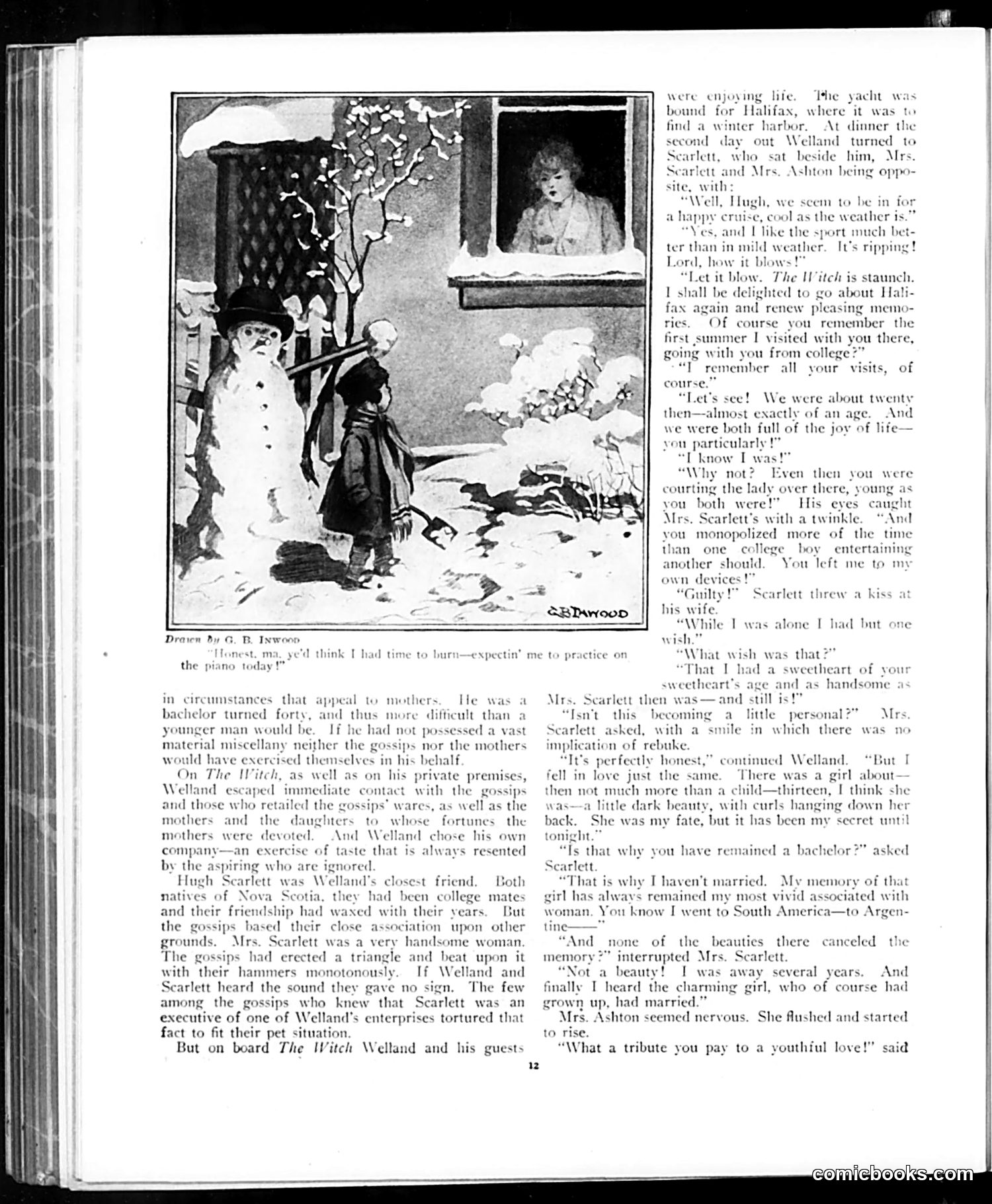
This page contains **illustrated serialized fiction** rather than political satire. The narrative concerns wealthy characters aboard a yacht called *The Witch* bound for Halifax. The illustration (credited to G.B. Inwood) depicts a snowman and a child in winter, though its connection to the yacht dinner scene is unclear—possibly a flashback or symbolic element. The text presents a drawing-room drama: Character Welland reveals to Scarlett that decades ago he fell in love with a young girl (around thirteen) during a college visit, remained devoted to her memory despite travels to South America, and never married because of this attachment. He's just learned she grew up and married someone else. This appears to be **sentimental Victorian-era romance fiction**, not satire. The "Judge" magazine, while primarily satirical, clearly published serialized stories alongside its political cartoons. The themes—nostalgic love, social propriety among the wealthy, maritime leisure—reflect early 20th-century popular fiction conventions rather than political commentary.
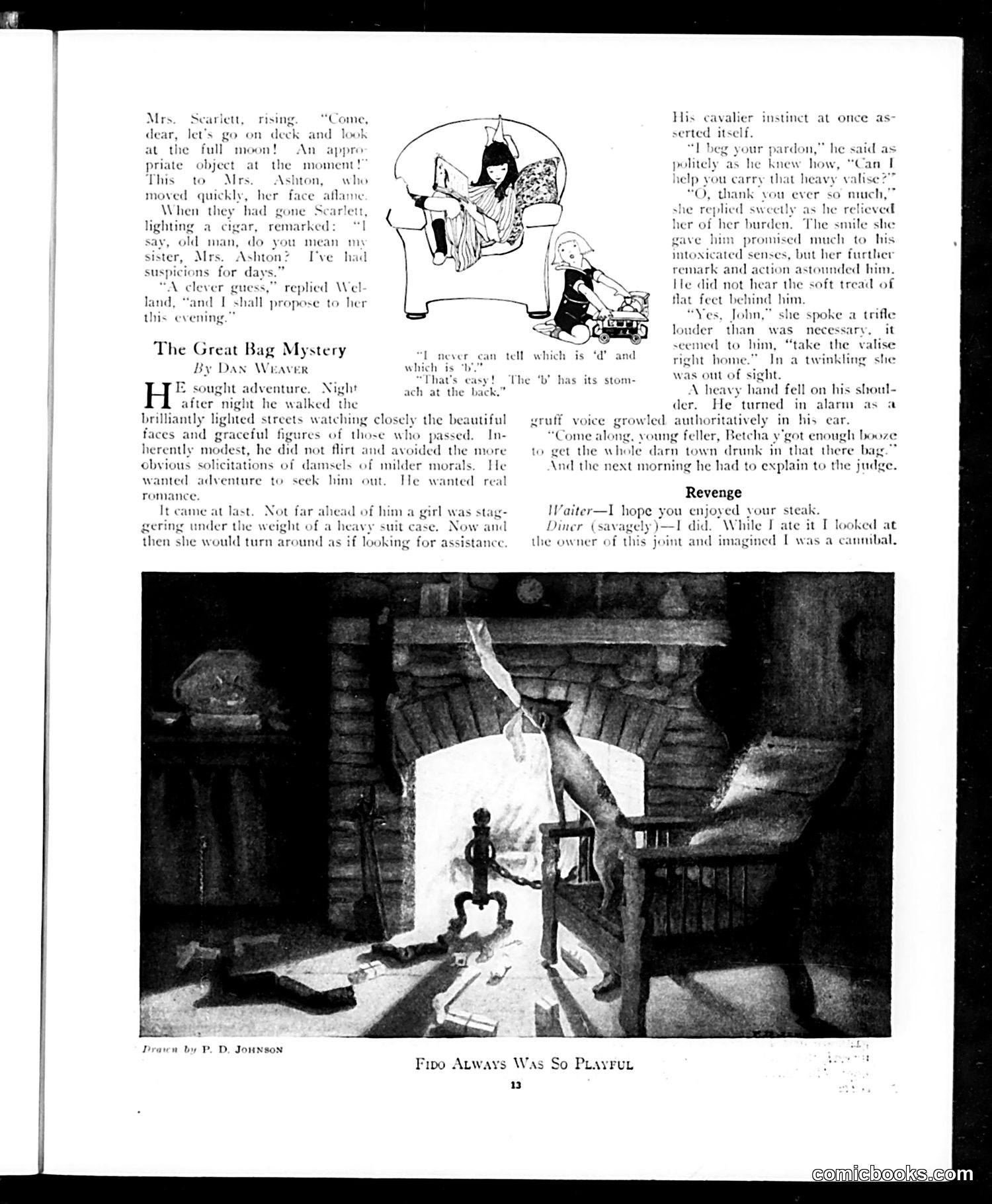
This page contains two unrelated short humorous stories from Judge magazine. **"The Great Bag Mystery"** depicts a common con game: a woman deliberately staggers under the weight of a heavy bag to attract a gentleman's help. When he gallantly offers assistance, she loudly instructs him to "take the valise...home," making it appear to a nearby accomplice (likely her husband or partner) that he's a drunk carrying stolen goods. The accomplice then arrests him as a thief. The protagonist must explain the setup to a judge the next morning. **"Revenge"** is a brief joke about a diner's response to poor service or quality food—he claims the meat was so tough and unappetizing that he imagined eating the restaurant owner (a cannibal reference) instead. Both pieces reflect early 20th-century urban humor targeting con artists, petty crime, and restaurant quality complaints. The illustrations show the con's setup and a restaurant interior scene.
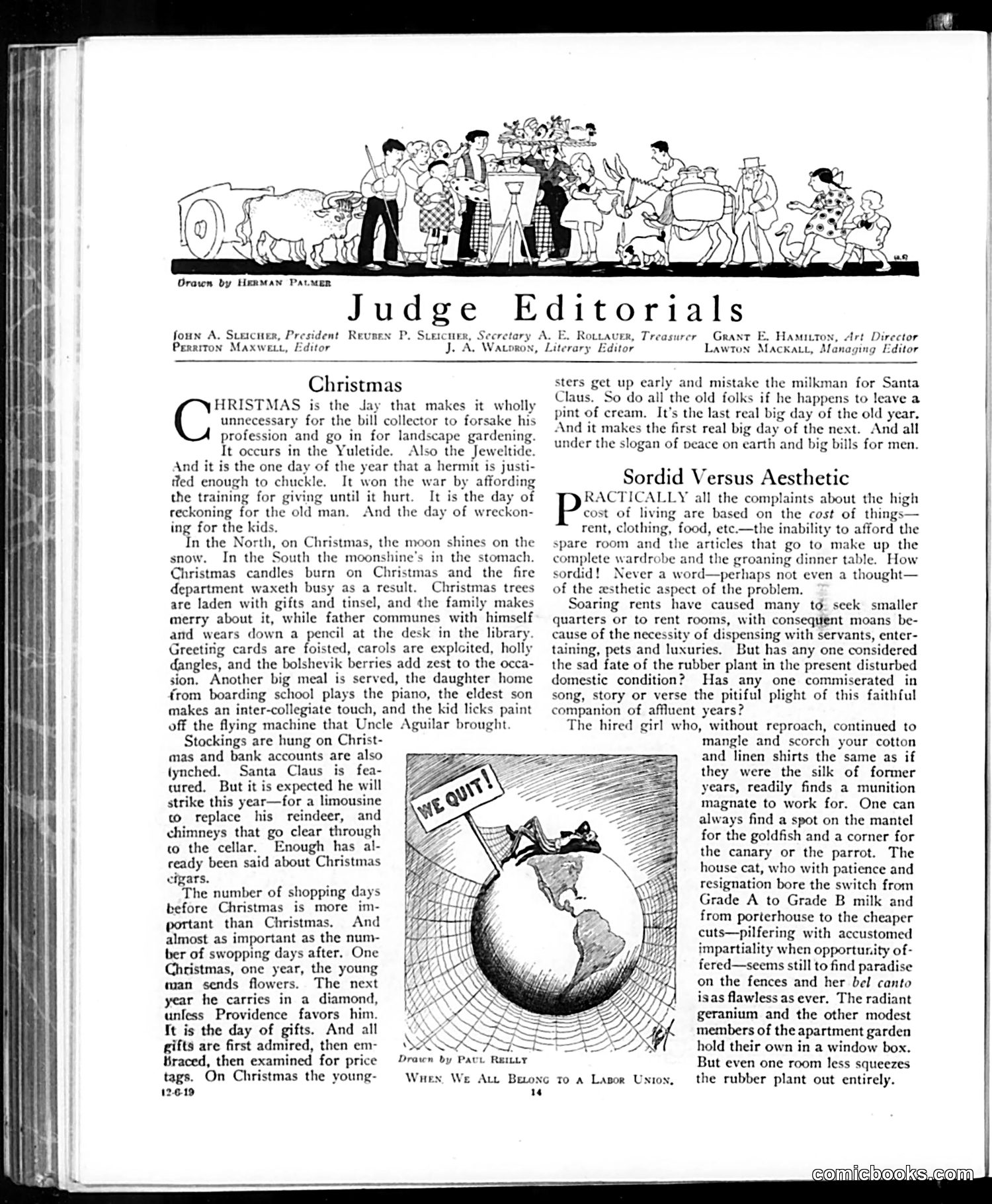
This page contains two editorial pieces satirizing American society circa 1919. **"Christmas" editorial** mocks the holiday's commercialism and social performance. It presents Christmas as hypocritical—a day when bill collectors are forgotten, yet families strain finances buying gifts that are immediately price-checked. The piece cynically observes that gift-giving follows predictable patterns (flowers one year, diamonds the next) and that children confuse the milkman with Santa Claus. The final line's sarcasm—"peace on earth and big bills for men"—exposes the contradiction between Christmas's spiritual message and its financial burden. **"Sordid Versus Aesthetic" editorial** (with accompanying cartoon by Paul Reilly) criticizes people complaining about the high cost of living while ignoring aesthetic concerns. The cartoon shows someone quitting a job, apparently refusing lower wages. The piece sarcastically laments that rising rents force families to abandon servants and luxuries, focusing on the "tragedy" of the rubber plant and canary losing their comfortable homes—mocking the self-pity of formerly affluent people adapting to economic hardship.
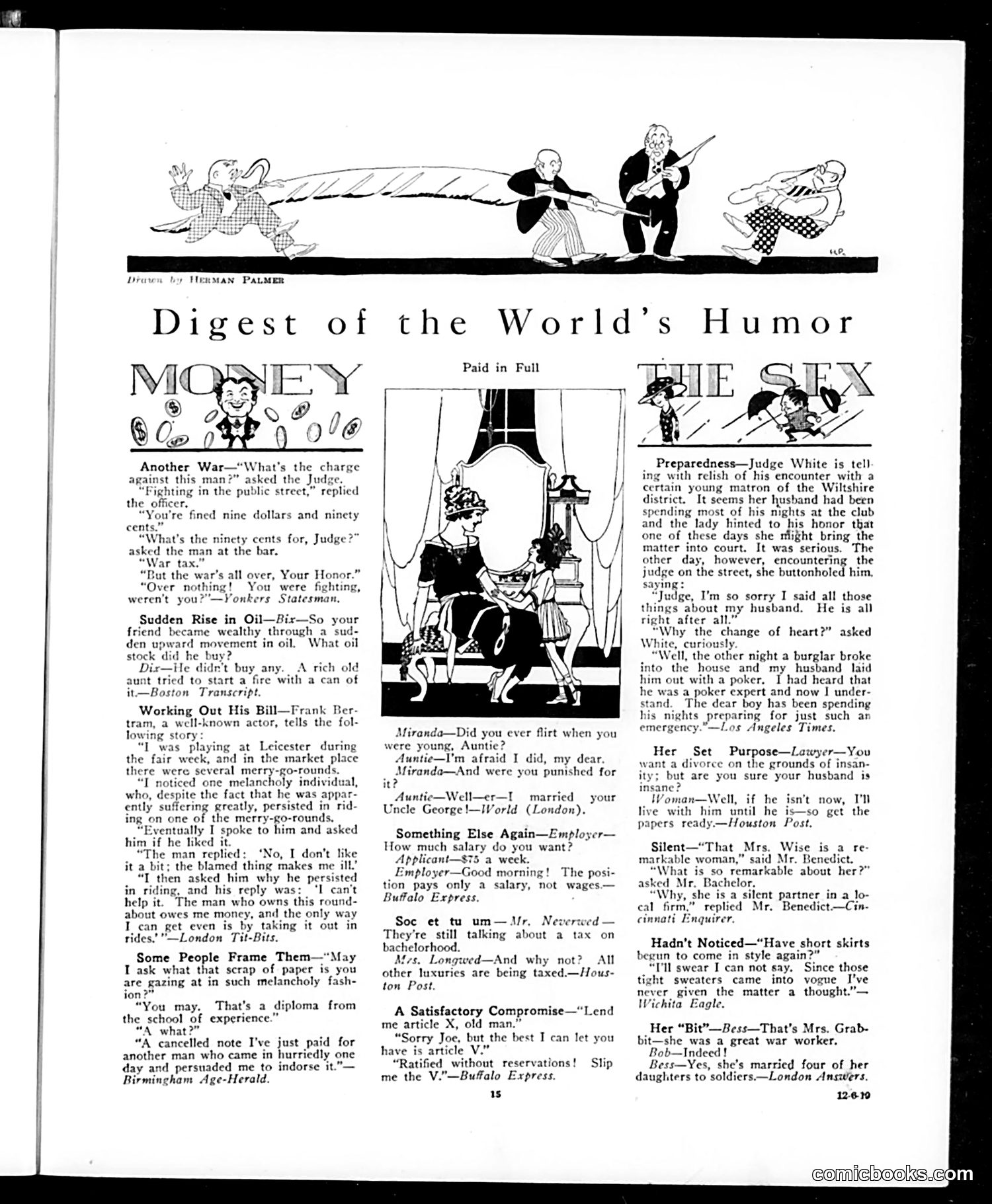
This page from *Judge* magazine presents a collection of brief humorous anecdotes and jokes, typical of the publication's format. The top illustration by Herman Palmer shows figures in a tug-of-war, setting a lighthearted tone. The jokes reflect early 20th-century concerns: a "War Tax" pun on recent conflict; oil speculation wealth; and marital discord. Several target specific social anxieties—one about a woman threatening divorce, another about a wife discovering her husband's "preparedness" (poker skills developed at night). The humor is largely domestic and economic: endorsing bad loans, cancelled debts, salary negotiations, bachelor taxes, and divorce grounds. One joke sardonically portrays a woman willing to stay married until her husband becomes insane. The cartoons and text reveal period attitudes toward gender relations, financial obligation, and social propriety—with wives monitoring husbands' behavior and legal proceedings as marital weapons. The tone is conservative, celebrating feminine manipulation over direct action.
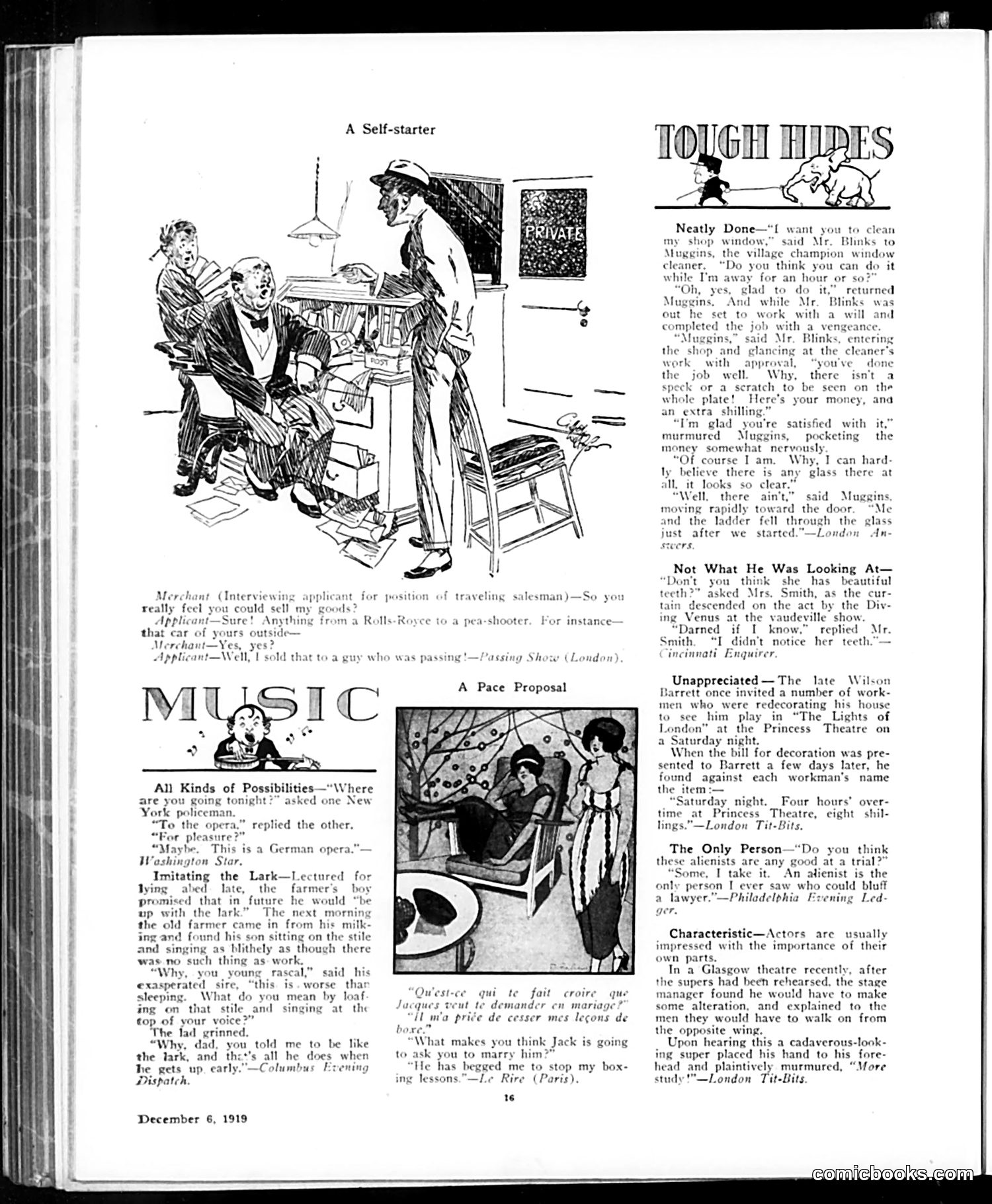
This page contains several brief humorous anecdotes typical of Judge's satirical style, rather than political cartoons. **"A Self-starter"**: A job applicant boasts he can sell anything—even a used car to someone who already owns one. The joke targets overly confident salesmen of the era. **"Neatly Done"**: A window cleaner does such thorough work that the shop owner can't see any glass—because the cleaner and ladder fell *through* it. The humor relies on the owner's obliviousness to obvious damage. **"Not What He Was Looking At"**: At a vaudeville show, a husband claims he didn't notice the performer's teeth, implying he was distracted by her appearance. **"Unappreciated"**: Playwright Wilson Barrett invites workmen to his play as thanks, but they bill him for the time spent at the theatre, missing the honor entirely. These are workplace and domestic comedies mocking human folly—salesmanship, carelessness, distraction, and ingratitude—rather than political satire.
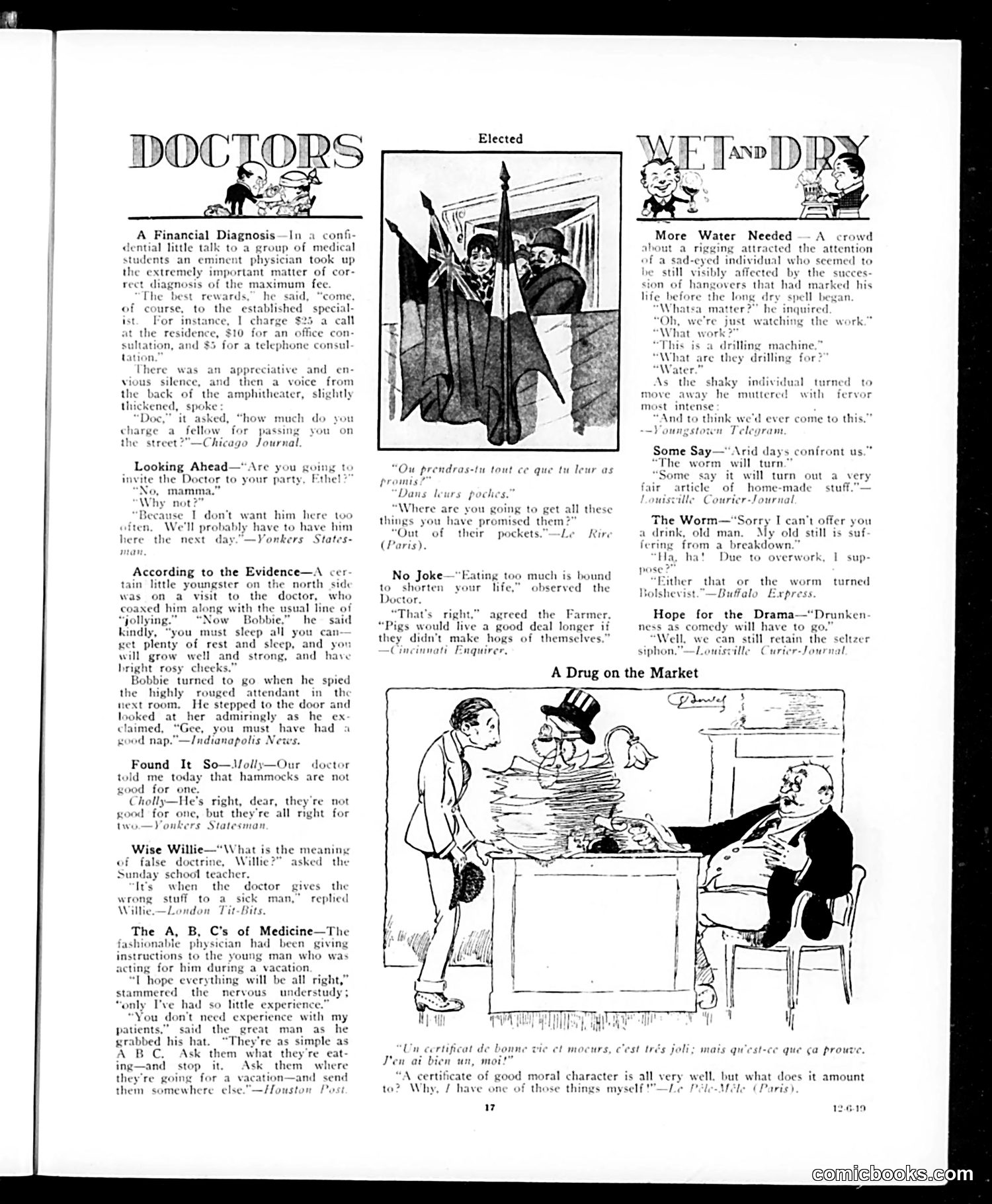
This page contains several satirical pieces mocking the medical profession circa early 20th century. **"A Financial Diagnosis"** ridicules doctors' fee structures, showing physicians more interested in maximizing payment than treating patients—charging different rates for office visits versus phone consultations. **"A Drug on the Market"** (cartoon) depicts a charlatan or quack doctor hawking dubious remedies, with a prosperous-looking patient skeptically observing the transaction. The satire targets fraudulent medical practitioners. **Other vignettes** mock doctors' dismissive attitudes toward patients ("The A, B, C's of Medicine"), overwork causing nervous breakdown, and false medical advice. The central theme: **distrust of the medical establishment**—portraying doctors as greedy, incompetent, or fraudulent. This reflects early-20th-century skepticism of professionalized medicine before it gained credibility through scientific advancement. The French captions suggest international commentary on medical quackery. The overall tone is cynical about whether doctors genuinely serve patients' interests or merely exploit them.
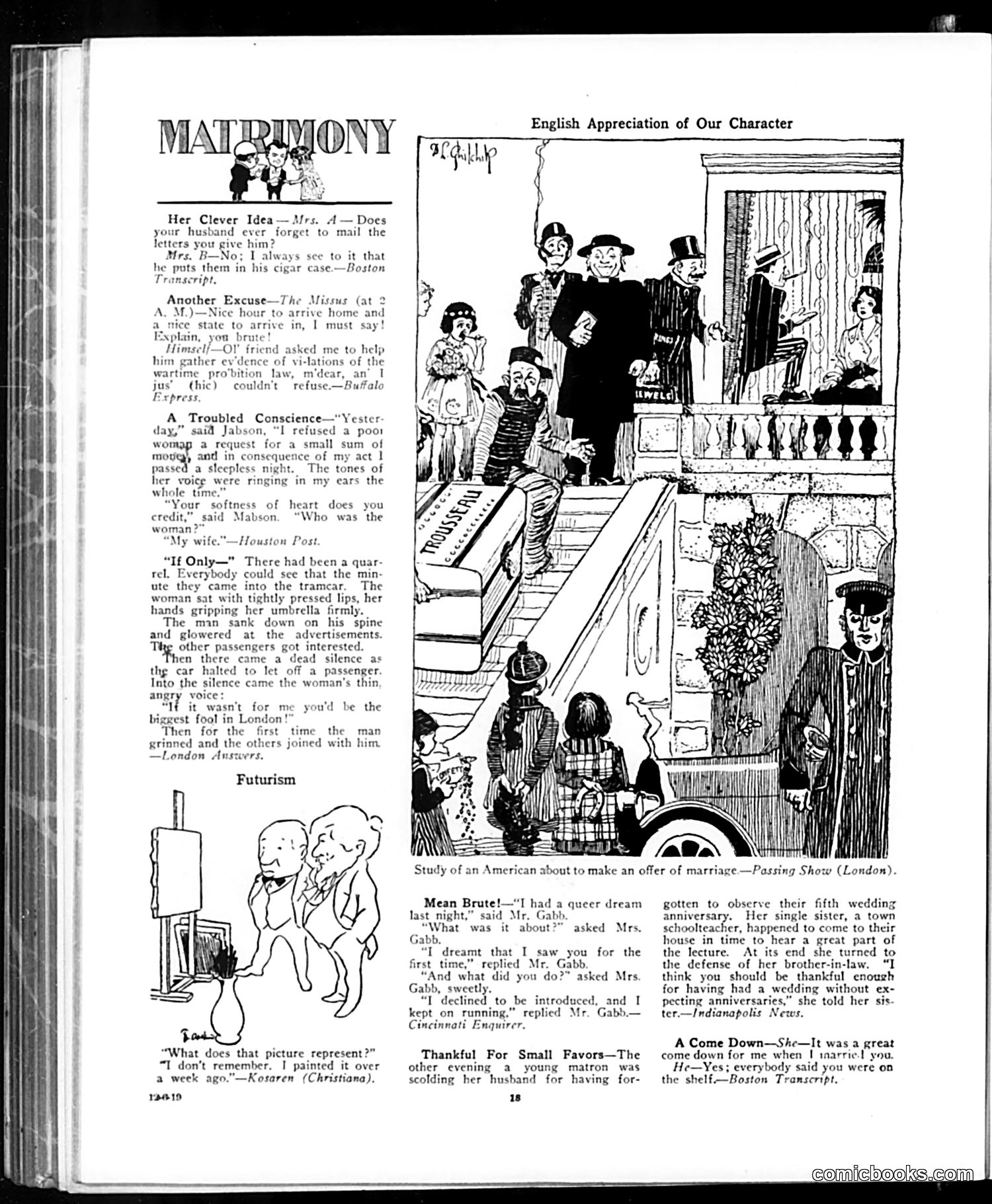
This page contains several brief humorous anecdotes satirizing domestic life and marriage, a staple of early 20th-century American humor magazines. **The cartoons mock:** 1. **Wives' complaints about husbands**: Multiple jokes depict women scolding men for arriving home drunk, forgetting anniversaries, or behaving badly—while husbands respond with indifference or excuse-making. 2. **Marriage as entrapment**: The large illustration shows an American man proposing to a woman while onlookers watch from a building. The caption ironically credits it to *Passing Show (London)*, suggesting even the British find American courtship amusing. 3. **Gender dynamics**: Women are portrayed as nagging, controlling (monitoring mail), or unreasonably demanding; men as drunk, inconsiderate, or unwilling participants in marriage. 4. **The "shelf" reference**: A woman laments marrying "down," while her unmarried sister notes that at least she got married at all—implying spinsterhood was worse. The humor relies on period stereotypes: wives as shrews, husbands as disappointing, and marriage as inevitable misery both partners endure.
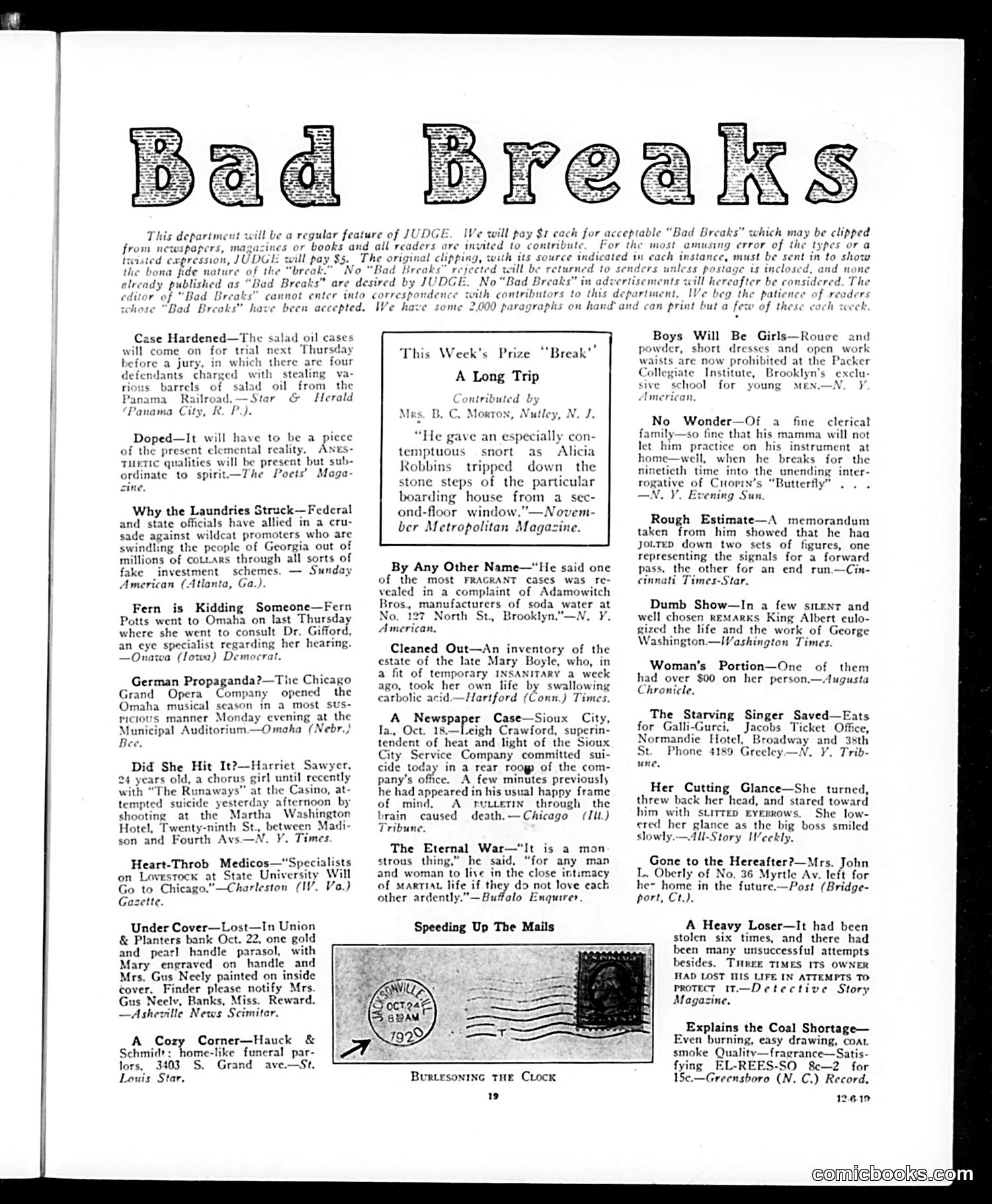
This page features "Bad Breaks," *Judge* magazine's humor column collecting amusing typos and contextual errors from newspapers. The section titled "BURLESONING THE CLOCK" shows a postal envelope, sardonically commenting on mail delivery speed. The featured "Bad Breaks" examples mock newspapers' careless proofreading through absurd misreadings: - A woman "tripped down stone steps" from a second-floor window (suicide described as graceful movement) - A soda manufacturer's complaint described as "fragrant" instead of "fragrant" (unintentionally suggesting pleasant smell from something supposedly problematic) - A superintendent's death from a "ruttetin" through the brain (garbled medical terminology) These weren't intentional satire but rather genuine newspaper errors that became humorous when the factual context contradicted the accidental word choice. The column functioned as lighthearted media criticism, exposing editorial carelessness by amplifying the unintended dark comedy of misprint juxtapositions.
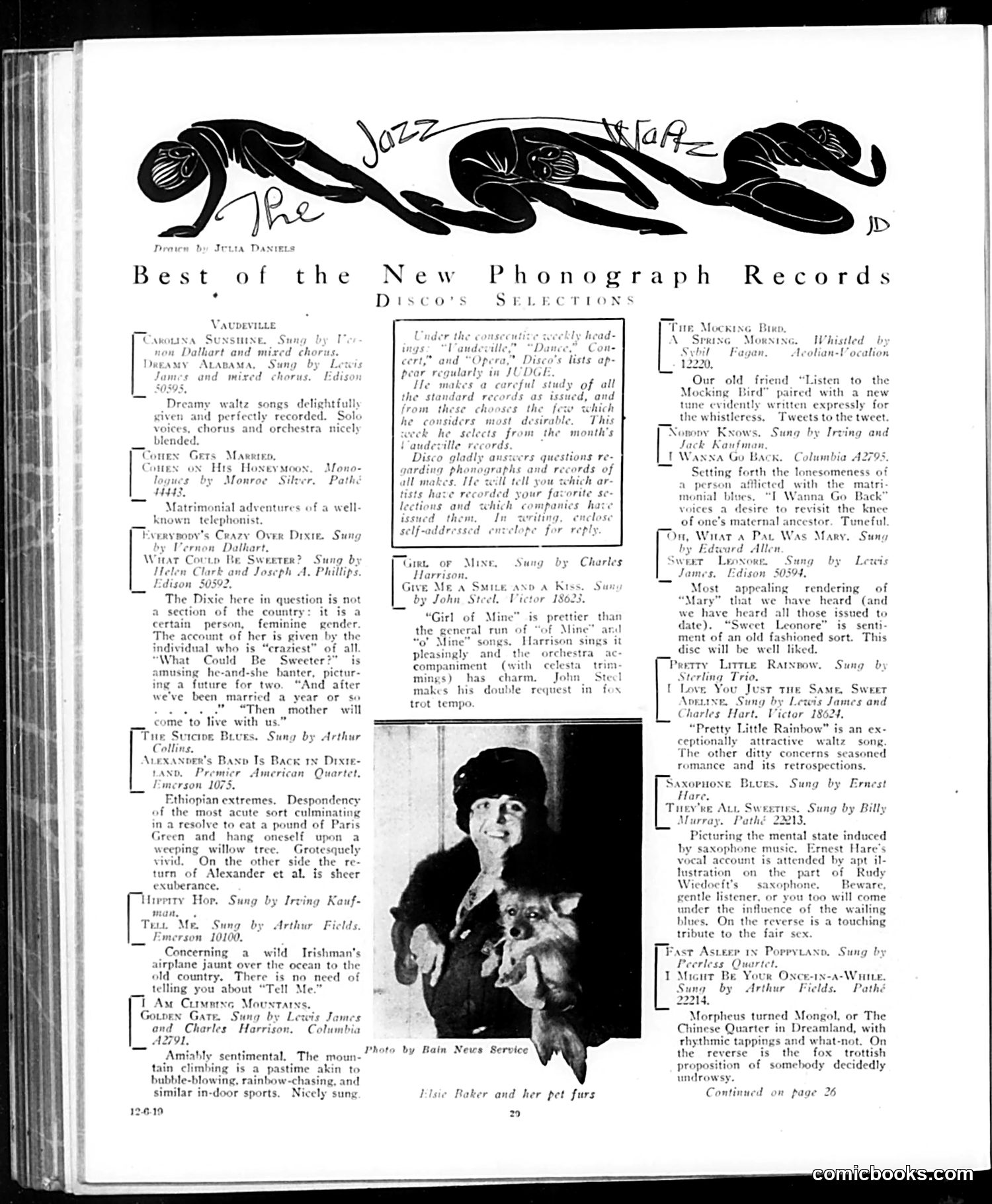
This page is primarily a **record review column**, not a political cartoon. It showcases phonograph record selections across various genres (Vaudeville, jazz, blues, popular songs) with brief critical commentary. The central image shows **Elsie Baker with her pet dog**, accompanying a record review. The page discusses recordings by popular artists of the era, including songs with titles like "Girl of Mine," "Sweet Leonore," and "Saxophone Blues." The only satirical element appears minimal—this is essentially **entertainment journalism/product review** rather than political satire. The "Judge" magazine context suggests light social commentary through song selections and their descriptions, but the page functions mainly as **consumer guidance for phonograph record buyers** of the 1920s era. The writing critiques musical quality, arrangement, and emotional appeal of specific recordings to help readers select discs worth purchasing—a practical consumer service for the period.
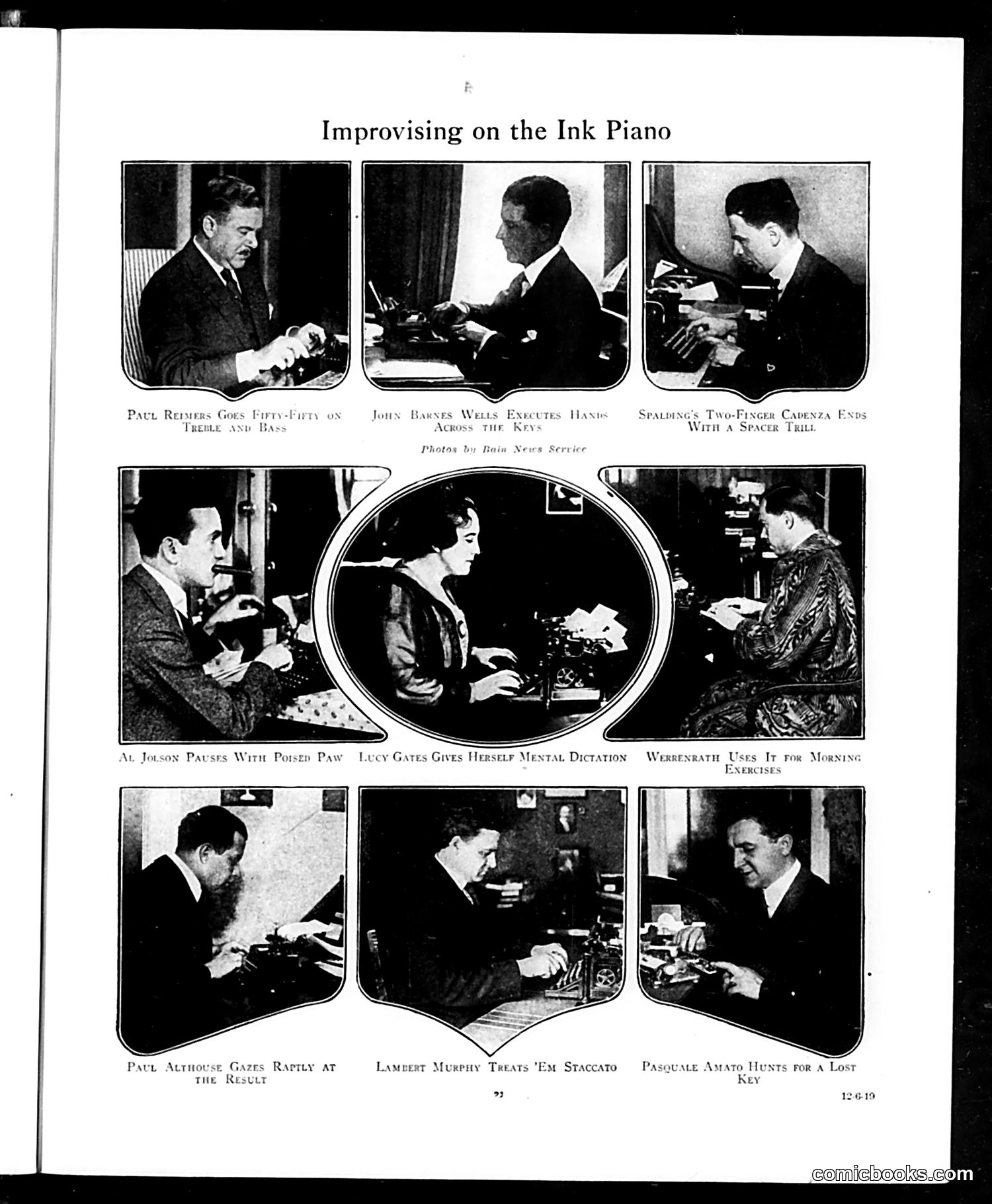
This page from *Judge* magazine presents a humorous photo essay about people typing on typewriters, which are cleverly called an "Ink Piano." The captions use musical terminology to describe typing actions—treating the typewriter keyboard like a musical instrument. The named figures appear to be public personalities or celebrities of the era (Paul Revere, John Barnes Wells, Spalding, Al Jolson, Lucy Gates, Werrenrath, Paul Althouse, Lambert Murphy, Pasquale Amato), likely entertainers or performers. The satire suggests these individuals are attempting to use typewriters with varying degrees of competence and humor—some "pausing," others "treating 'em staccato," hunting for lost keys. The joke plays on the novelty of typewriter technology and the amusing parallel between musical and typing performance, mocking these public figures' unfamiliarity with the machines.
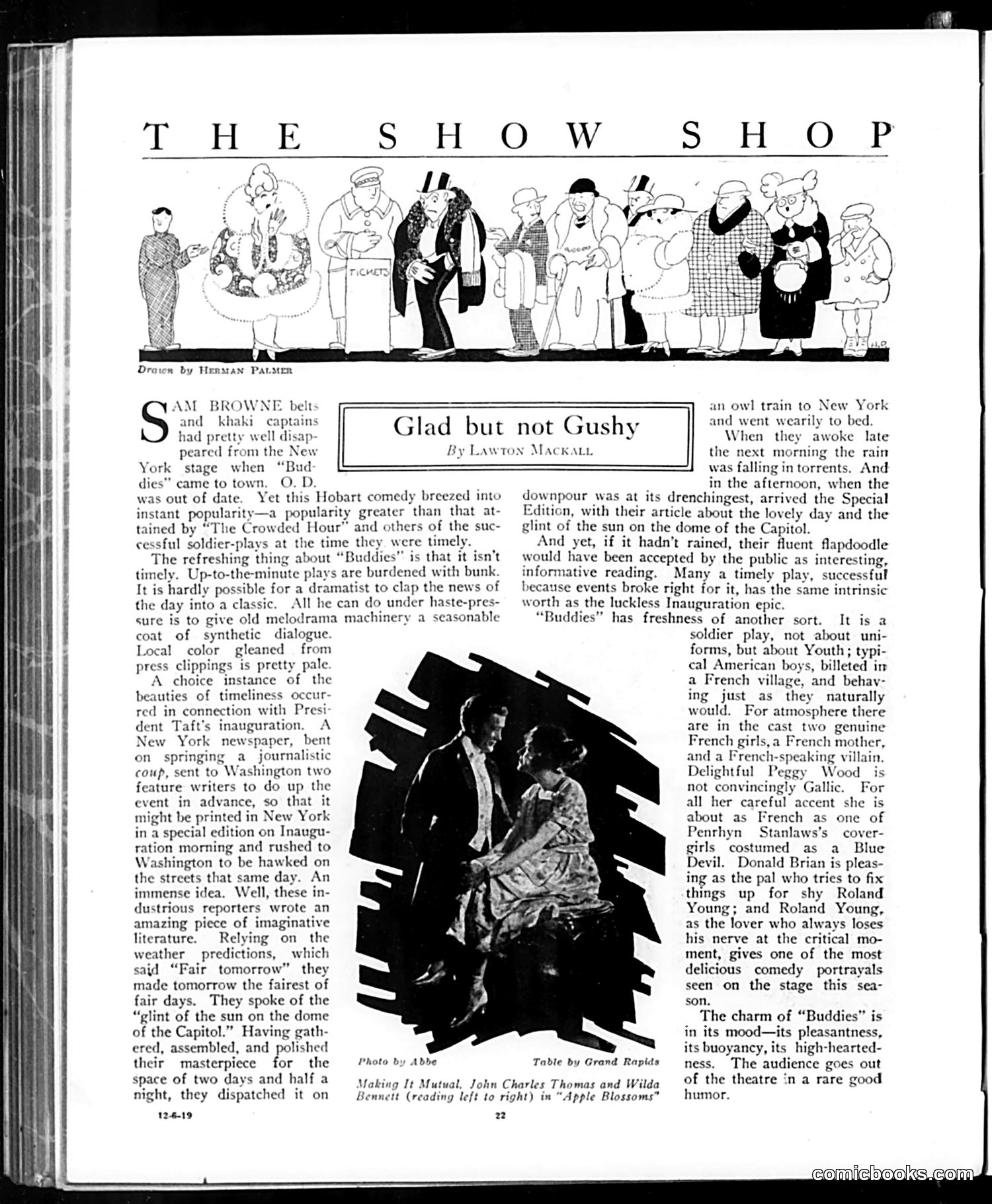
This Judge magazine page reviews the theatrical production "Buddies," a soldier comedy set in a French village during WWI. The header illustration by Herman Palmer depicts various theater-goers and characters. The accompanying article by Lawton Mackall criticizes contemporary "timely" plays that chase current events. Mackall uses a memorable anecdote about President Taft's 1909 inauguration: newspapers predicted fair weather and wrote glowing descriptions of sunshine on the Capitol dome—only to have torrential rain arrive before the special edition reached Washington, rendering the advance reporting ridiculous. Mackall argues "Buddies" succeeds precisely because it *isn't* topical. Rather than exploiting WWI relevance, it focuses on authentic youth behavior and atmosphere, featuring genuine French actors alongside American stars like Roland Young and Donald Brian. The photograph shows actors from "Apple Blossoms" (another production reviewed nearby). Mackall praises "Buddies" for its charm, pleasantness, and good humor—qualities that transcend the play's immediate historical moment.
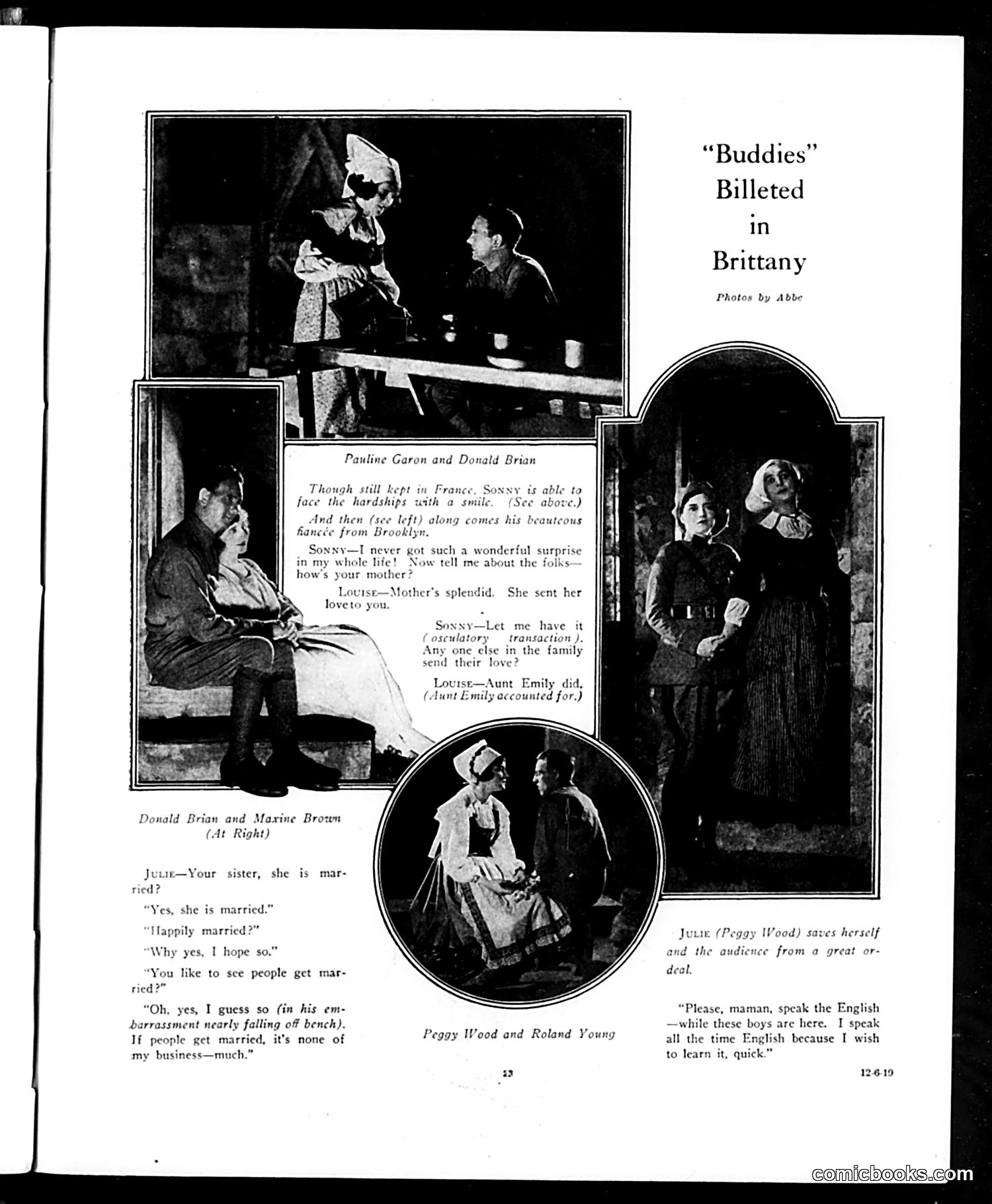
This is a photo-essay from a WWI-era *Judge* magazine featuring scenes from the theatrical production "Buddies," which depicts American soldiers (called "Buddies") stationed in France during the war. The page shows romantic comedic situations between soldiers and French/American women. The humor centers on cultural and romantic misunderstandings: a soldier (Sonny) is surprised by his Brooklyn fiancée's arrival; another character (Julie) discusses his sister's marriage in awkwardly embarrassed terms; and a French woman (played by Peggy Wood) humorously insists on speaking English with the American soldiers to learn the language. The satire gently mocks both soldier sentimentality and the clash between American and French customs. The "osculatory transaction" reference is a euphemistic joke about kissing. This represents typical WWI-era entertainment that played on the novelty and humor of American military presence in France.
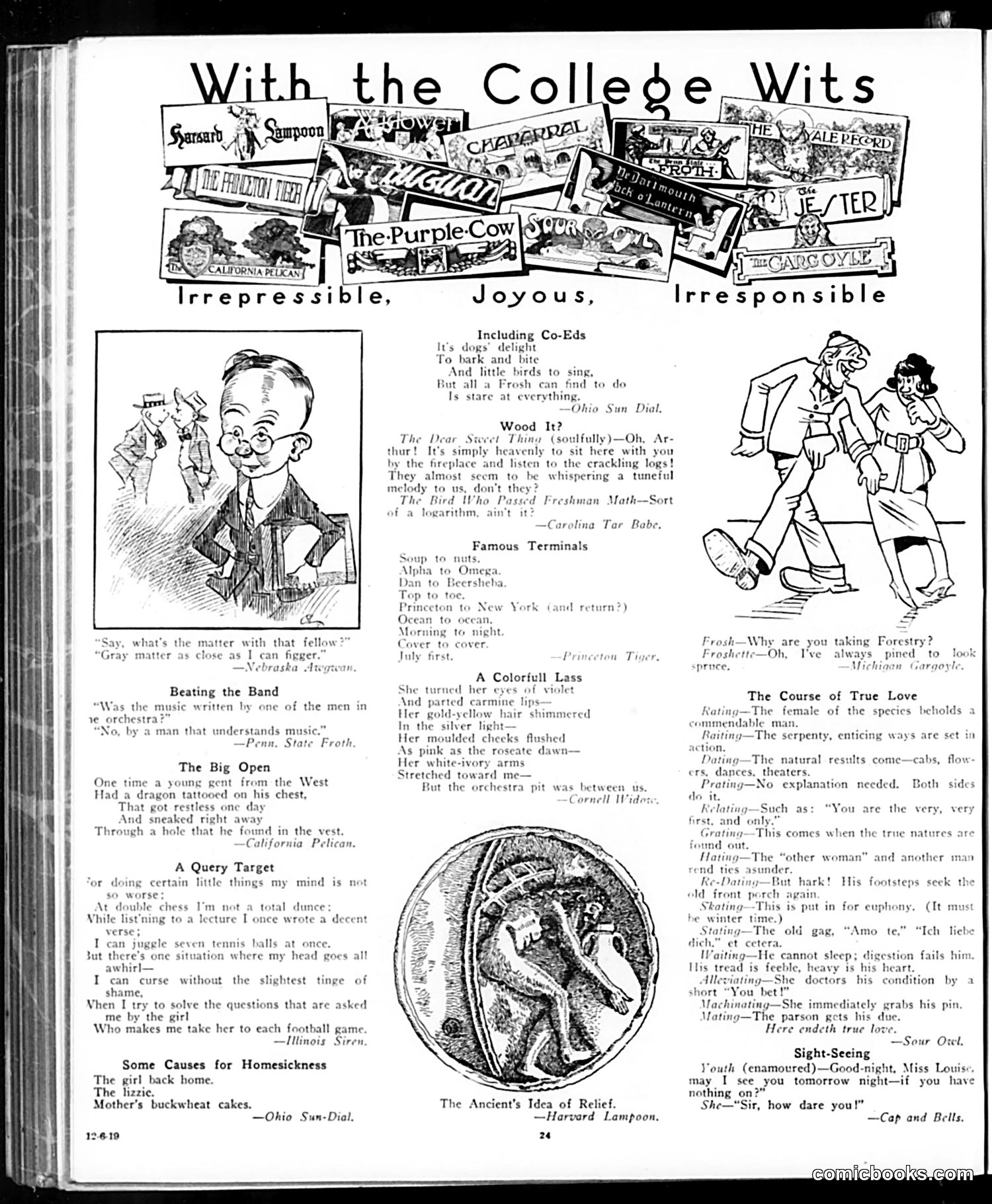
This page collects humorous poems and jokes from various college humor magazines (Ohio Sun-Dial, California Pelican, Illinois Siren, Carolina Tar Heel, Cornell Widow, Harvard Lampoon, etc.). **Key content:** The cartoons and verses mock college student life: freshman confusion ("stare at everything"), romantic awkwardness (a couple separated by an orchestra pit), dating rituals presented as a cynical progression from "Rating" through "Hating" to "Mating" (marriage), and male students' befuddlement around women. **The satire:** These pieces gently ridicule college culture—youthful pretension, romantic fumbling, homesickness, and the gap between idealized courtship and reality. The "Course of True Love" sequence is particularly satirical, reducing romance to predictable stages ending in the parson (minister). **Context:** This reflects 1910s-era college life when these student publications were popular vehicles for undergraduate humor and social commentary on campus life.
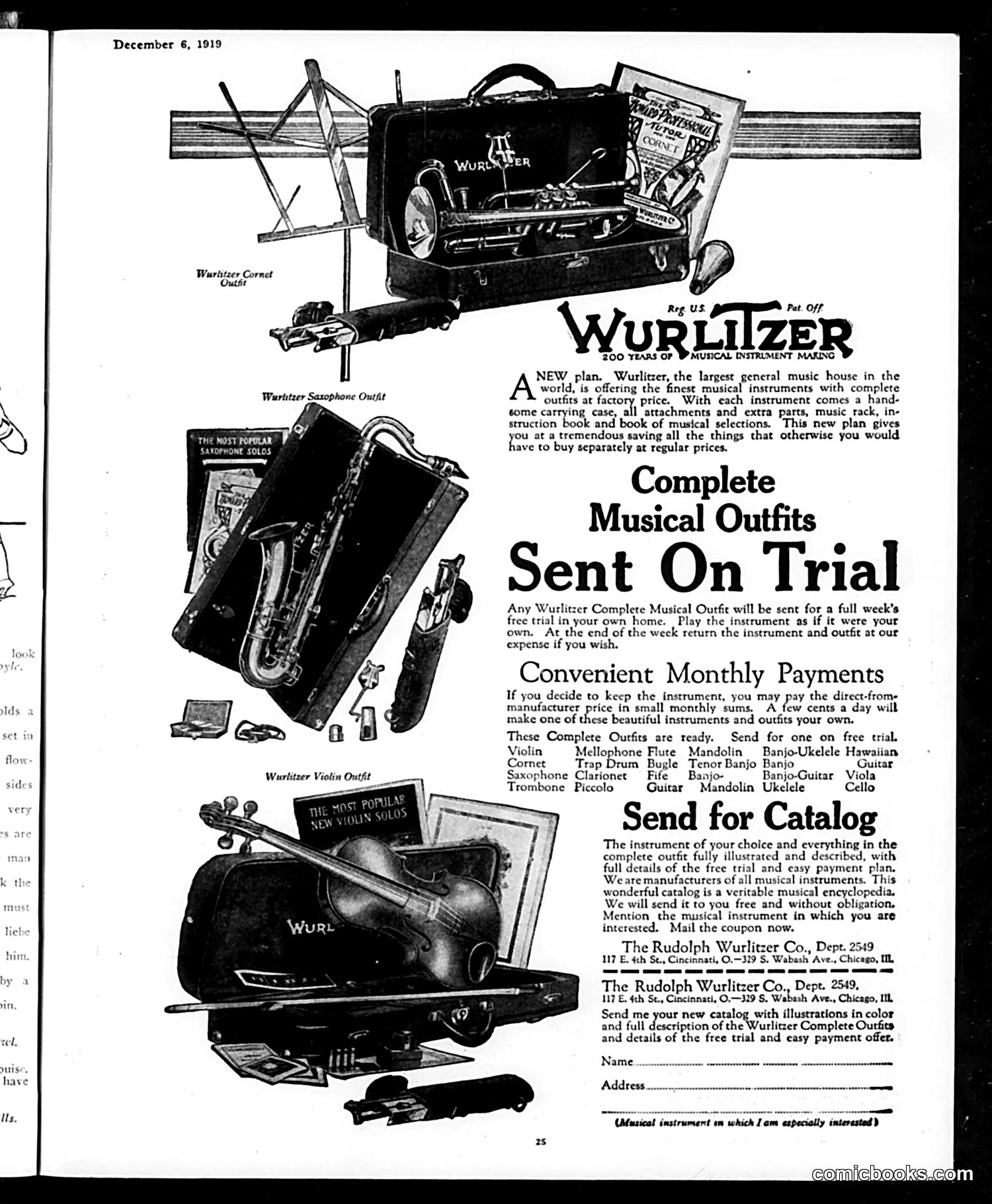
This is **not a cartoon or satirical content**—it's a full-page advertisement for Wurlitzer musical instruments, appearing in Judge magazine on December 6, 1919. The ad promotes Wurlitzer's new business model: selling complete musical instrument "outfits" (instrument plus case, accessories, instruction books) at factory prices with convenient terms. Key selling points include: - **Free one-week home trial** with no obligation - **Monthly payment plans** ("a few cents a day") - Wide instrument selection (violin, cornet, saxophone, banjo, etc.) The visual elements show various instruments and their carrying cases arranged attractively. This reflects post-WWI American consumer culture—businesses marketing aspirational products to middle-class buyers through payment plans that made luxury items accessible. The ad's placement in a satirical magazine suggests even humor publications carried mainstream advertising to fund operations. There is no satire or political commentary here.
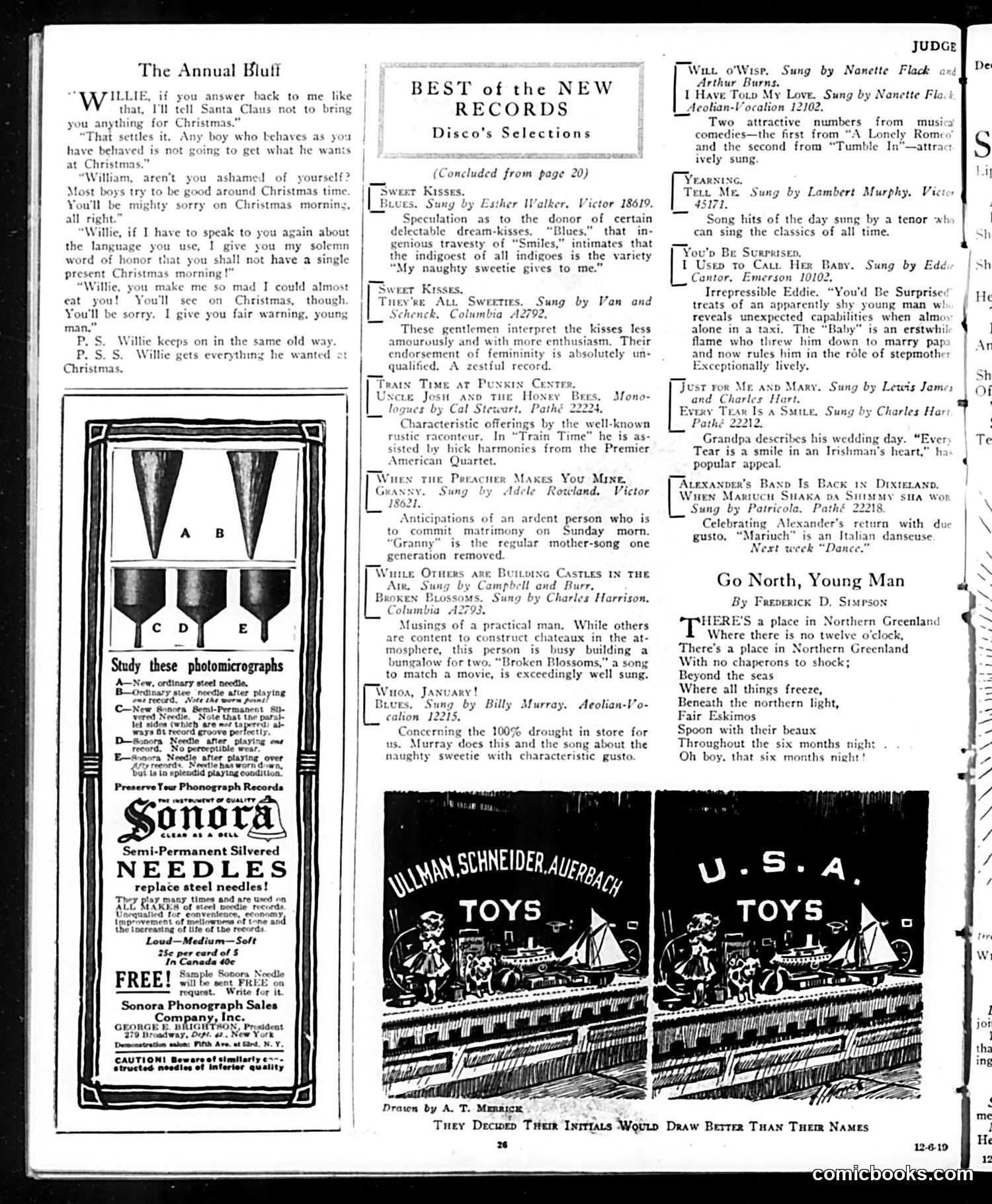
This page mixes editorial content with advertising. **"The Annual Bluff"** depicts a familiar domestic scene: a mother threatens her misbehaving son Willie with Christmas punishment if he doesn't reform, but the postscript reveals the satire—Willie ignores her warnings and gets everything he wanted anyway. The joke satirizes parental empty threats and children's ability to manipulate adult authority through calculated misbehavior. The page also features a **phonograph needle advertisement** (Sonora brand) using photomicrographs to demonstrate product durability, a record review section discussing popular songs, and at the bottom, a cartoon about toy store displays showing identical window setups with the caption "They Decided Their Initials Would Draw Better Than Their Names"—apparently mocking toy manufacturers' emphasis on branding over individual identity. The overall page reflects 1920s consumer culture and domestic humor.
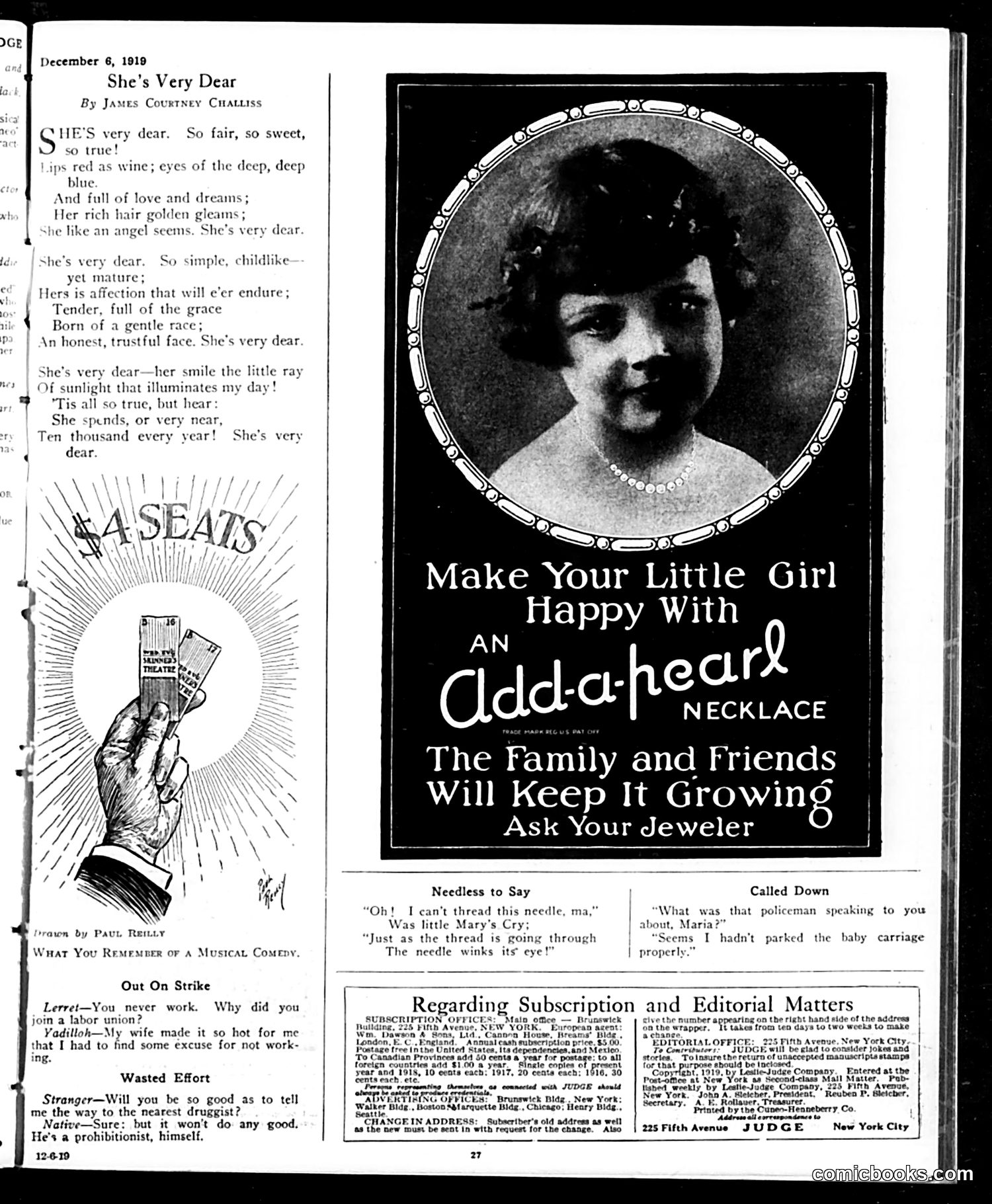
This page contains poetry, humor columns, and advertisements typical of Judge's satirical format. **"She's Very Dear"** is a sentimental poem by James Courtney Chaffee that describes an idealized young woman—beautiful, innocent, graceful—before the final stanza reveals the satire: she spends "ten thousand every year." The joke targets both wealthy men infatuated with expensive women and the contradiction between feminine virtue and material excess—a common 1919 critique of modern romance. **The humor columns** mock everyday frustrations: a man joins a labor union to escape his nagging wife; a druggist who opposes Prohibition (referencing the recent 18th Amendment, ratified in 1919) can't help anyone seeking alcohol. **The "Add-a-Pearl" necklace advertisement** promotes a jewelry marketing scheme where families and friends could purchase additional pearls to expand a child's necklace over time—a novel mid-century sales strategy. The page reflects post-WWI American society: anxieties about labor, women's spending, Prohibition's implications, and consumer culture.
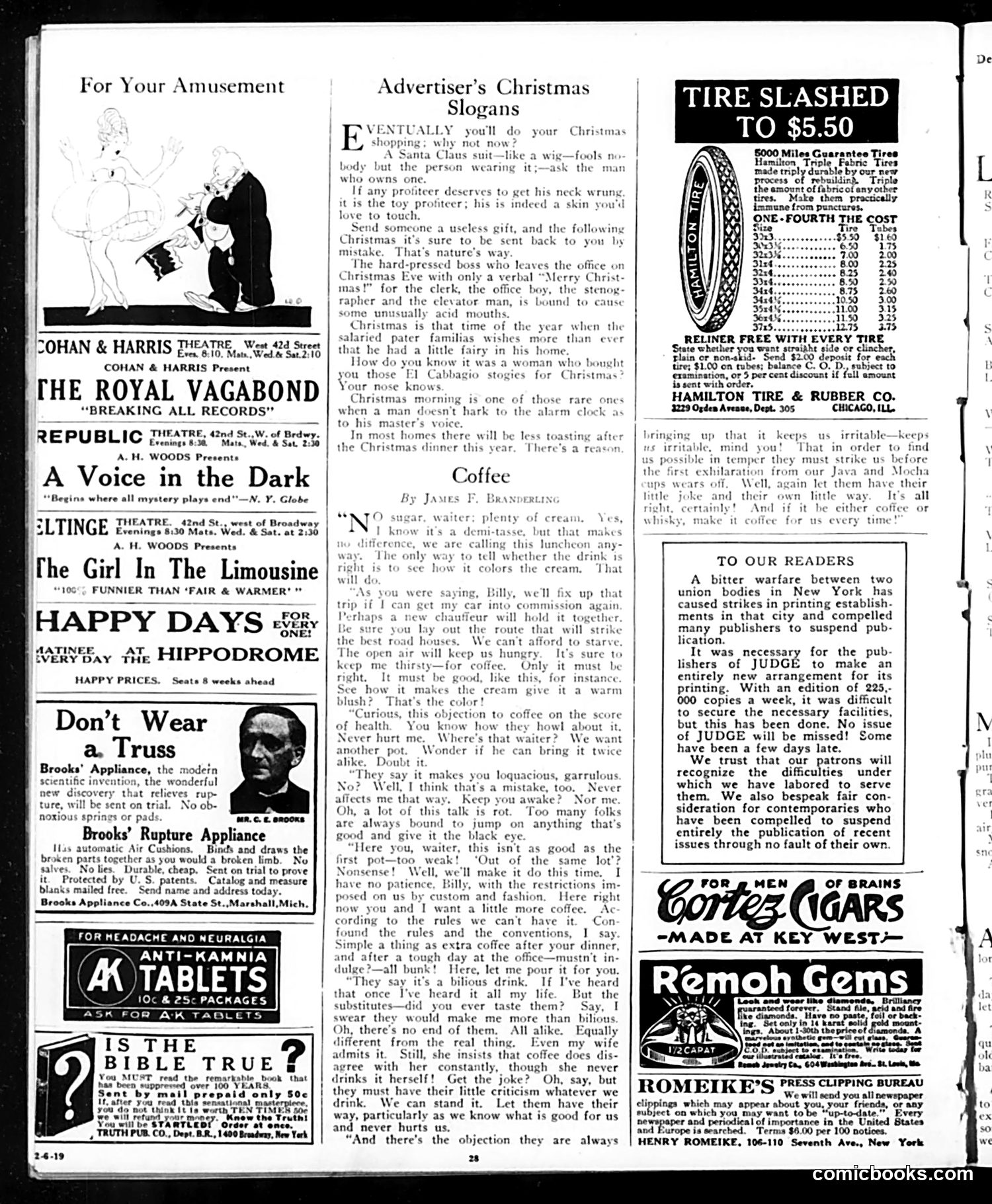
This page is primarily **advertising and theatrical notices** with minimal editorial cartooning content. The visible cartoon ("For Your Amusement," upper left) shows a couple in formal dress—likely depicting a fashionable man and woman in a social scene, though the specific satire is unclear from the image alone. The bulk of the page consists of: 1. **Theatre advertisements** (Cohan & Harris productions, Republic Theatre, etc.) promoting Broadway shows with titles like "The Royal Vagabond" and "A Voice in the Dark" 2. **Commercial ads** for medical devices (Brooks' Rupture Appliance), patent medicines (Anti-Kamnia tablets), and consumer goods 3. **"Advertiser's Christmas Slogans"** section—a humorous column satirizing holiday commercialism and consumer behavior, discussing toy profiteers, cheap gifts, and workplace gift-giving practices 4. **"Coffee" dialogue column**—social commentary on coffee culture and dining etiquette The page reflects early 20th-century consumer culture and satirizes commercialism during the Christmas season, rather than political satire.
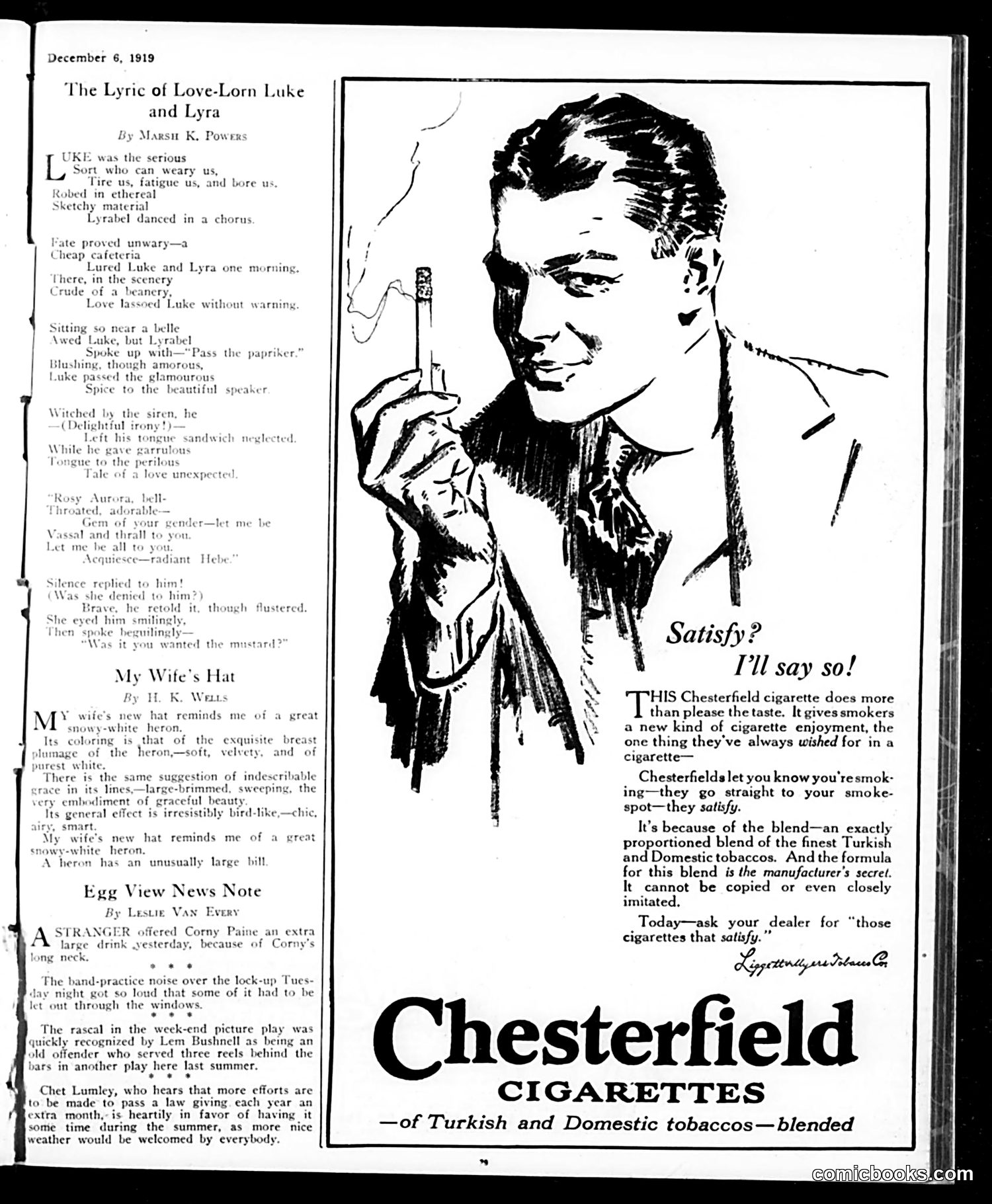
This page combines literary content with advertising—not political satire. The left side features three humorous poems/sketches typical of Judge's light humor: **"The Lyric of Love-Lorn Luke and Lyra"** satirizes sentimental romantic poetry through a deliberately awkward, forced narrative about a chorus dancer named Lyra who rejects lovestruck Luke's flowery declarations by asking him to "pass the paprika"—deflating his ardor with mundane practicality. **"My Wife's Hat"** uses elaborate, overwrought description comparing a woman's hat to a heron, mocking the pretentious language men used to describe fashion. **"Egg View News Note"** contains brief, absurdist local humor items—typical filler content. The right half is a **Chesterfield cigarette advertisement** featuring an illustrated man asking "Satisfy? I'll say so!" The ad emphasizes the cigarette's "blend" of Turkish and domestic tobaccos as its unique selling point. This represents pre-regulation tobacco advertising when health claims were unregulated. No specific political figures or events are referenced—this is primarily entertainment and commercial content.
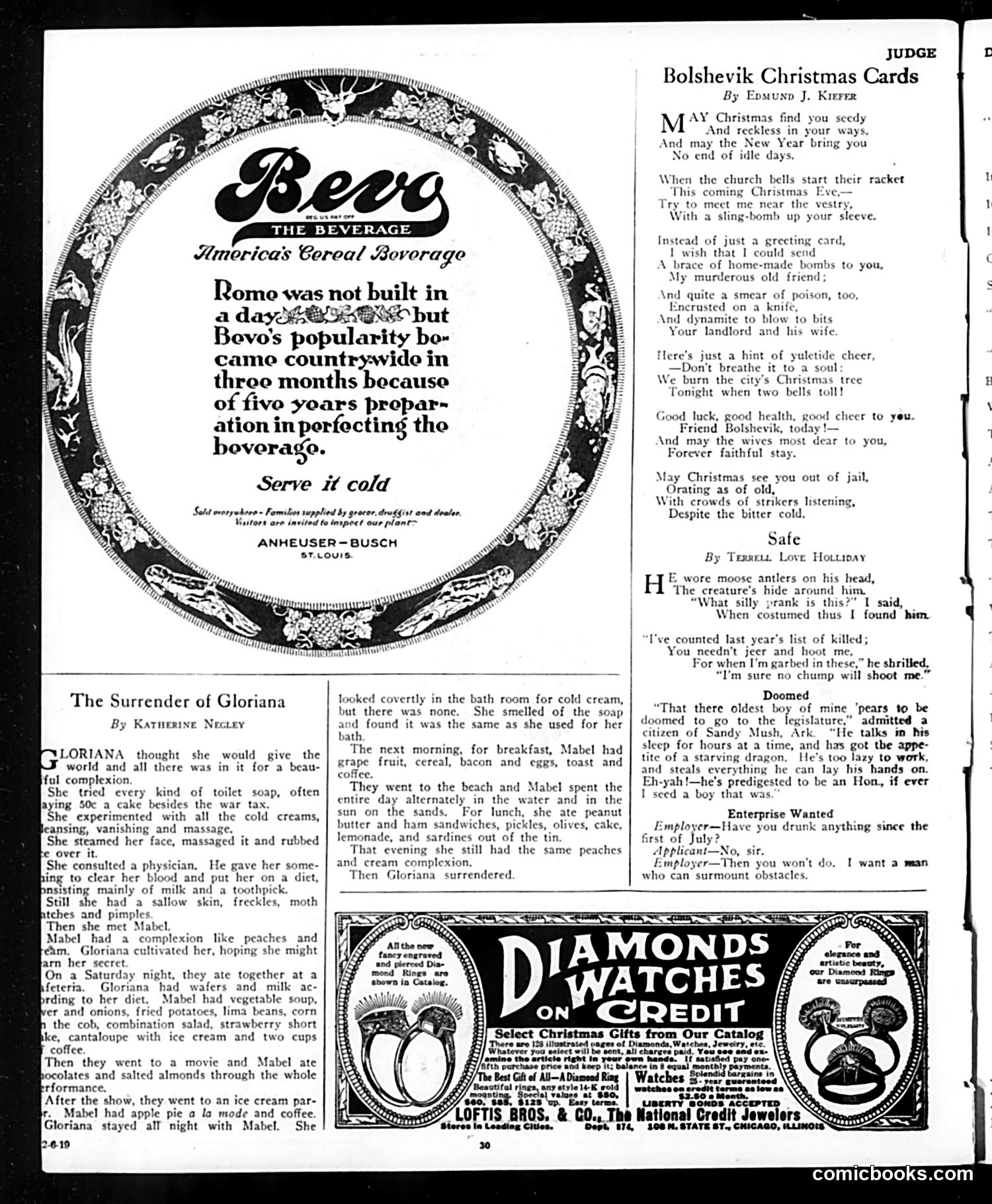
This Judge magazine page contains satirical poetry and fiction targeting "Bolsheviks" (communists/radicals) during the Red Scare era. **"Bolshevik Christmas Cards"** mocks communist sympathizers by presenting grotesque holiday greetings featuring violent imagery: home-made bombs, poison, dynamite targeting landlords. The satire portrays Bolsheviks as violent extremists threatening property owners and social order. References to jail, strikes, and agitation reinforce contemporary fears of communist revolution. **"The Surrender of Gloriana"** is unrelated social satire about beauty standards, not political commentary. A vain woman obsesses over achieving perfect skin through expensive treatments, then discovers her friend Mabel has perfect complexion despite eating junk food and avoiding beauty regimens—implying natural advantages trump effort. The **Bevo advertisement** promotes a non-alcoholic cereal beverage (likely produced during Prohibition). The page reflects 1920s American anxieties about communist threats while satirizing consumerism and vanity. The violent "Christmas Cards" poem is particularly harsh, portraying Bolsheviks as dangerous rather than merely foolish.
This December 1919 *Judge* page contains three distinct pieces: **"The Faithful at Jimtown"** (poem by Arthur Chapman): A sentimental rural narrative about a small-town "Welcome Home" sign greeting returning World War I soldiers. The worn sign symbolizes the community's pride in their sacrifice. The poignant final line—"one of mine" didn't return—acknowledges wartime loss while celebrating those who did. **"Nervous Americans"** (by Paul von Boeckmann): An advertisement for a self-help book about American nervousness/neurasthenia. This reflects genuine 1919 anxiety about modern life's pace causing psychological exhaustion—a real medical concern of that era. The author positions American "high-strung" nature as both a civilizational achievement and health problem requiring his book's solution. **Minor pieces**: Light verse and jokes filling space (typical *Judge* filler). The page's dominant theme—honoring WWI veterans while addressing post-war American psychological strain—captures the era's conflicting emotions: patriotic pride alongside anxiety about modernity's psychological costs.
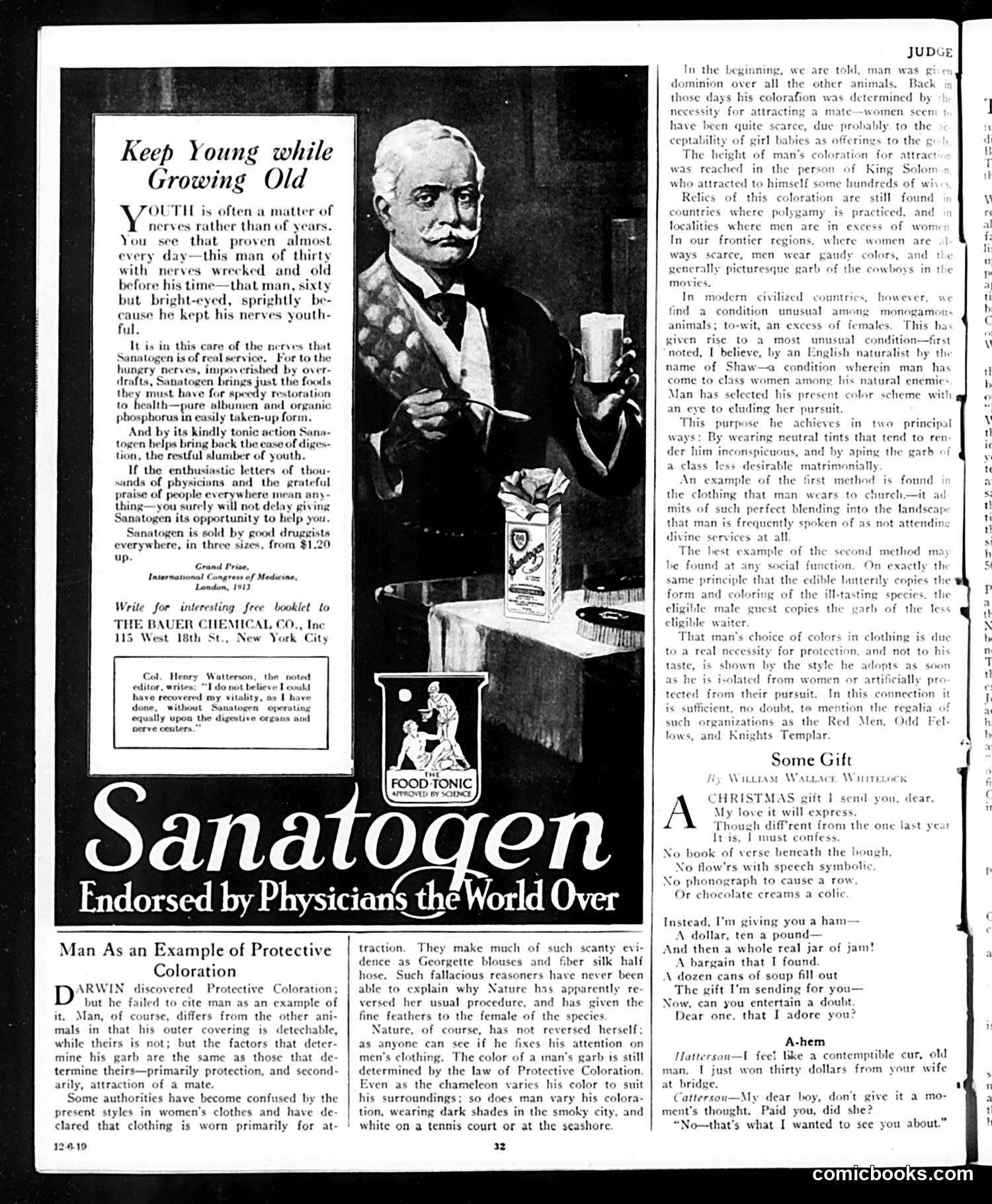
This page contains two distinct pieces of content: **Left side:** A Sanatogen advertisement featuring an endorsement by "Col. Henry Watterson," a real historical newspaper editor. The ad promotes Sanatogen, a nerve tonic/food supplement, claiming it restores youthful vigor by strengthening nerves. The marketing pitch: youth is about nerve health, not age. **Right side:** A satirical essay titled "Man As an Example of Protective Coloration" that applies Darwin's evolutionary concept to human clothing. The author argues men wear dark colors in cities and white at the seashore—not for fashion but for *camouflage*, like animals. The piece humorously suggests men dress defensively to avoid women (portrayed as "natural enemies"), using neutral clothing colors to render themselves inconspicuous. The satire mocks both pseudo-scientific reasoning and gender dynamics of the era—specifically, the notion that men must hide from women seeking marriage, inverting typical "women as ornamental" tropes by suggesting men are the ones doing protective disguising.
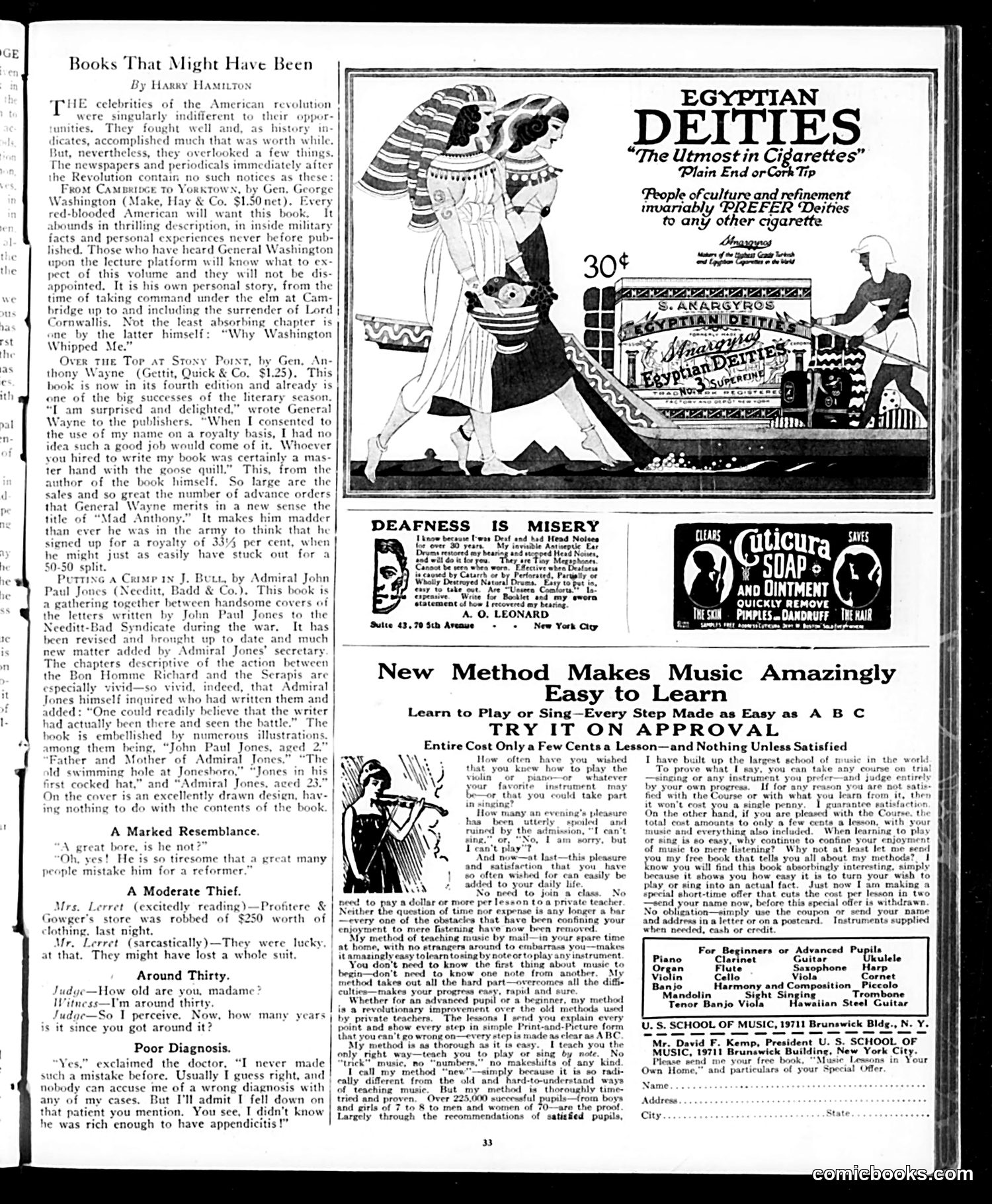
This page from *Judge* magazine presents satirical "book reviews" imagining Revolutionary War figures as contemporary authors. The satire works by incongruously treating 18th-century generals (Washington, Anthony Wayne, John Paul Jones) as if they were modern celebrity authors publishing memoirs with commercial publishers and royalty negotiations. The humor targets several things: the emerging American appetite for celebrity autobiographies; the commercialization of history; and perhaps the vanity of contemporary generals who might actually attempt such ventures. For example, the joke about Wayne being "madder than ever" upon discovering he signed for only 33% royalties instead of 50-50 mocks both authorial greed and the absurdity of these historical figures engaging in modern business dealings. The page also contains period advertisements (Egyptian Deities cigarettes, deafness cures, music lessons) typical of the era, plus brief humor pieces at bottom.
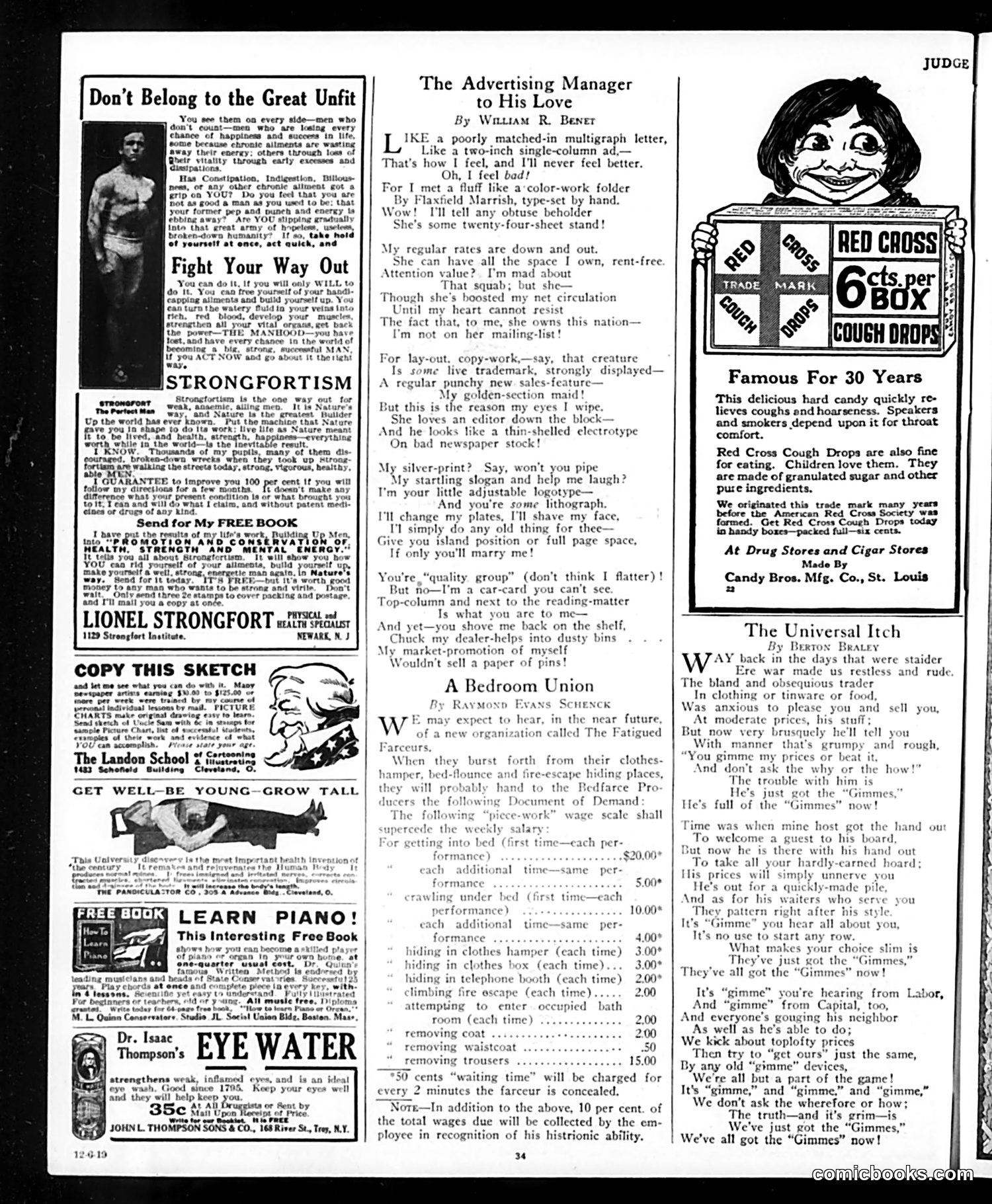
This page combines **advertisements for male vigor products** with **satirical poetry** mocking advertising culture itself. The left side features typical early-20th-century "health" ads promising to cure "chronic ailments," "loss of vitality," and general male weakness through products like "Strongfortism." These exploited anxieties about masculinity and virility—common in magazines of this era. The central poem, "The Advertising Manager to His Love," is satire. It mocks advertising industry jargon by having a lovesick advertising executive describe his romantic feelings entirely in advertising terminology: his beloved is a "color-work folder," a "twenty-four-sheet stand," a "trademark," etc. The joke is his professional language completely colonizes his emotional life—he can't even express love without marketing speak. The punchline: she ignores him because she loves a newspaper editor instead. The satire works on multiple levels: ridiculing both the absurdity of advertising language *and* the shallow concerns of advertising professionals who reduce everything to metrics and layouts. It's social commentary wrapped in humor.
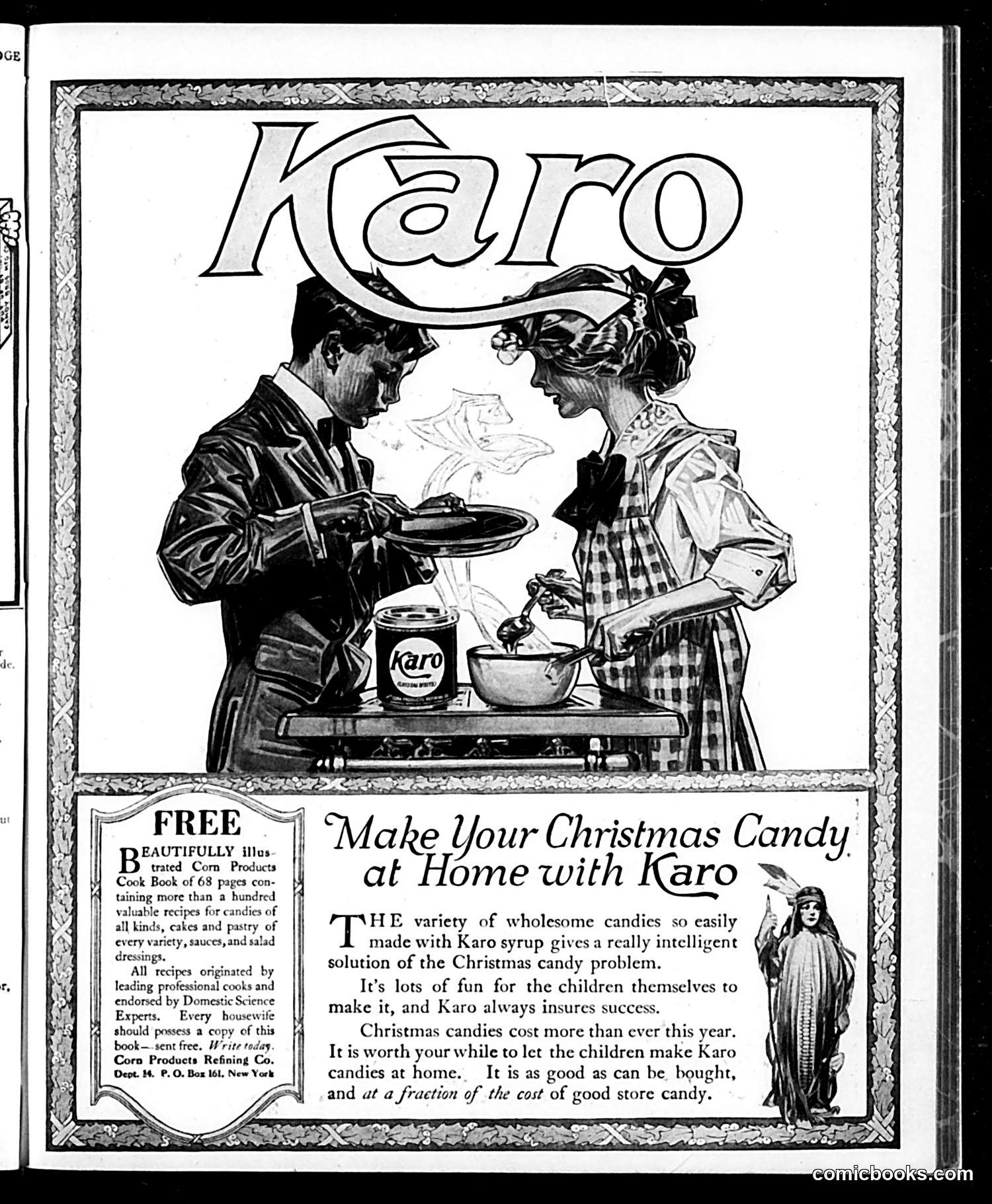
This is a **Karo syrup advertisement**, not a political cartoon. The page shows a domestic scene of a man and woman making candy together, with the Karo product prominently displayed. The ad's appeal targets **wartime economy concerns** (likely WWI era, given the "Judge" magazine context). The pitch emphasizes that homemade Karo candies cost "a fraction of the cost of good store candy" while being "as good as can be bought." This frames candy-making as both economical and wholesome family fun. The accompanying offer of a free corn products cookbook (68 pages, 100+ recipes) was a common early 20th-century marketing tactic to drive product sales. The illustration romanticizes domestic thrift and home production rather than satirizing anything—it's straightforward consumer marketing dressed in period style, appealing to middle-class housewives to save money during economically uncertain times.
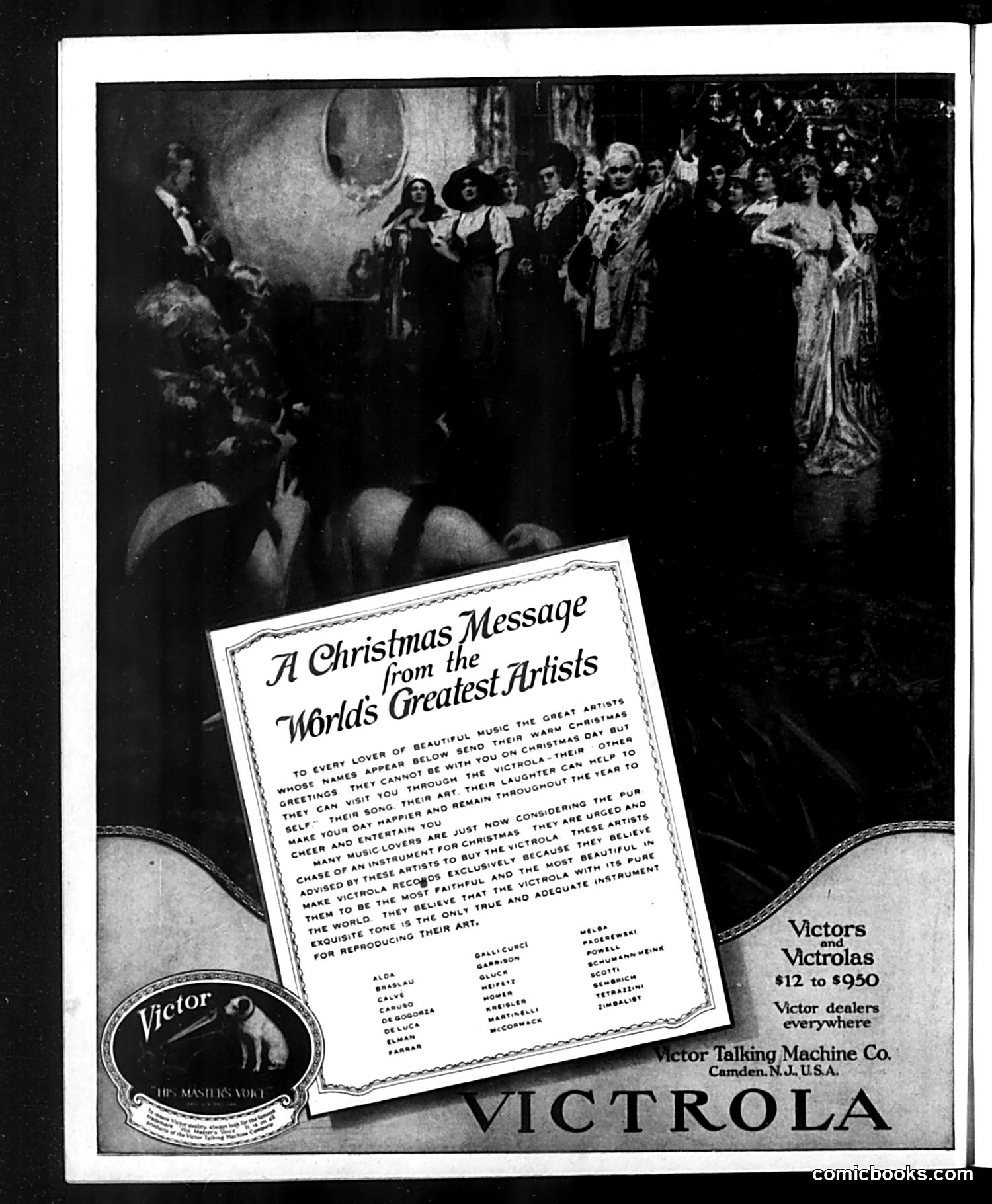
This is primarily a **Victrola phonograph advertisement**, not political satire. The ad features "A Christmas Message from the World's Greatest Artists" and displays a formal scene of elegantly dressed people gathered around a large phonograph horn. The text promotes Victor Talking Machine Company's records, claiming that great artists' performances can be heard through their Victrola machines, making beautiful music accessible to everyday families during Christmas. The advertisement leverages the prestige of classical musicians (names listed in small print) to market their product across a broad price range ($12 to $950). This represents early 20th-century marketing that positioned recorded music as a luxury cultural good bringing "refined" entertainment into homes. There is no apparent political cartoon or satire on this page.