
Judge, 1919-12-06 · page 22 of 36
Judge — December 6, 1919 — page 22: what you’re looking at
What you’re looking at
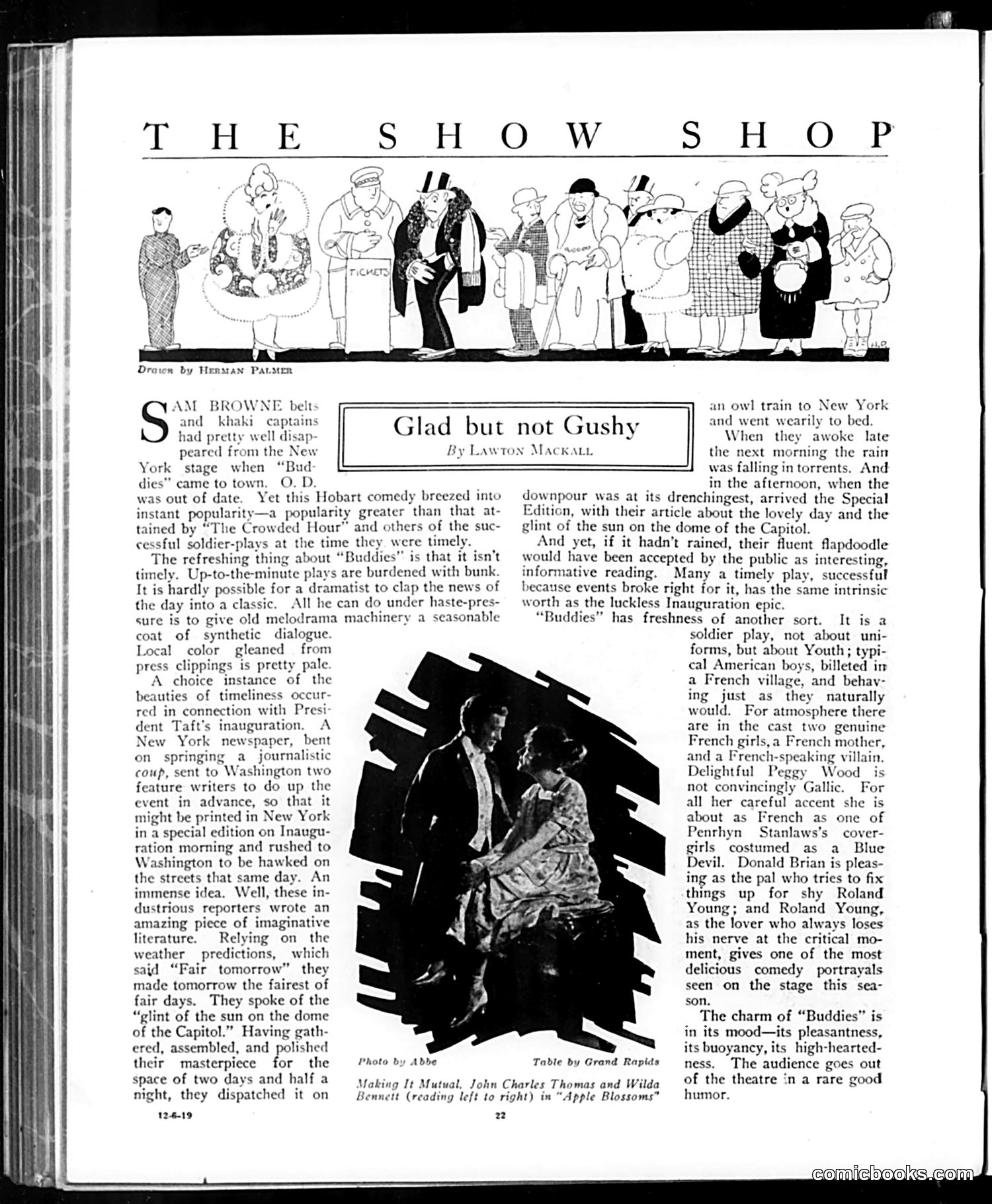
This Judge magazine page reviews the theatrical production "Buddies," a soldier comedy set in a French village during WWI. The header illustration by Herman Palmer depicts various theater-goers and characters. The accompanying article by Lawton Mackall criticizes contemporary "timely" plays that chase current events. Mackall uses a memorable anecdote about President Taft's 1909 inauguration: newspapers predicted fair weather and wrote glowing descriptions of sunshine on the Capitol dome—only to have torrential rain arrive before the special edition reached Washington, rendering the advance reporting ridiculous. Mackall argues "Buddies" succeeds precisely because it *isn't* topical. Rather than exploiting WWI relevance, it focuses on authentic youth behavior and atmosphere, featuring genuine French actors alongside American stars like Roland Young and Donald Brian. The photograph shows actors from "Apple Blossoms" (another production reviewed nearby). Mackall praises "Buddies" for its charm, pleasantness, and good humor—qualities that transcend the play's immediate historical moment.
📄 Transcribed text from this page (OCR, searchable)
Machine-transcribed from the original scan — historical spelling and the odd misread are preserved.
Drawn by Henstan PALMER AM BROWNE belts an owl train to New York and khaki captains had pretty well disap peared from the New Glad but not Gushy By Lawton Mackat and went wearily to bed. When they awoke late the next morning the rain was falling in torrents. And: York stage when “Bud dies” came to town. O. D. was out of date. Yet this Hobart comedy breezed into instant popularity—a popularity greater than that at- tained by © Crowded Hour” and others of the suc- cessful soldier-plays at the time they were timely. The refreshing thing about “Buddies” is that it isn’t timely. Up-to-the-minute plays are burdened with bunk. It is hardly possible for a dramatist to clap the news of the day into a classic. All he can do under haste-pre sure is to give old melodrama machinery a seasonable coat of synthetic dialogue. Local color gleaned from press clippings is pretty pale A choice instance of the beauties of timeliness occur- red in connection with Presi dent Taft's inauguration. A New York newspaper, bent on springing a journalistic coup, sent to Washington two feature writers to do up the event in advance, so that it might be printed in New York in a special edition on Inaugu- ration morning and rushed to Washington to be hawked on the streets that same day. An immense idea. Well, these in- dustrious reporters wrote an amazing piece of imaginative literature. Relying on the weather predictions, which said “Fair tomorrow” they made tomorrow the fairest of fair days. They spoke of the “glint of the sun on the dome of the Capitol.” Having gath- ered, assembled, and polished their masterpiece for the space of two days and half a night, they dispatched it on Photo by Abbe 12-46-19 Making It Mutual. John Charles Thomas and Wilda Bennett (reading left to right) in “. in the afternoon, when the downpour was at its drenchingest, arrived the Special ition, with their article about the lovely day and the glint of the sun on the dome of the Capitol. — And yet, if it hadn't rained, their fluent flapdoodle would have been accepted by the public as interesting, informative reading. Many a timely play, successful because events broke right for it, has the same intrinsic worth as the luckless Inauguration epic. “Buddies” has freshness of another sort. It is a soldier play, not about uni- forms, but about Youth; typi- cal American boys, billeted in a French village, and behay- ing just_as they naturally would. For atmosphere there are in the cast two genuine French girls,a French mother, and a French-speaking villain. Delightful Peggy Wood is not convincingly Gallic. For all her careful accent she is about as French as one of Penrhyn Stanlaws’s cover- girls costumed as a Blue Devil. Donald Brian is pleas- ing as the pal who tries to fix things up for shy Roland Young; and Roland Young, as the lover who always loses his nerve at the critical mo- ment, gives one of the most delicious comedy portrayals seen on the stage this sea- son. The charm of “Buddies” is in its mood—its pleasantness, its buoyancy, its high-hearted- ness. The audience goes out of the theatre in a rare good Apple Blossoms” — humor. Table by Grand Rapids