
A complete issue · 36 pages · 1919
Judge — August 30, 1919
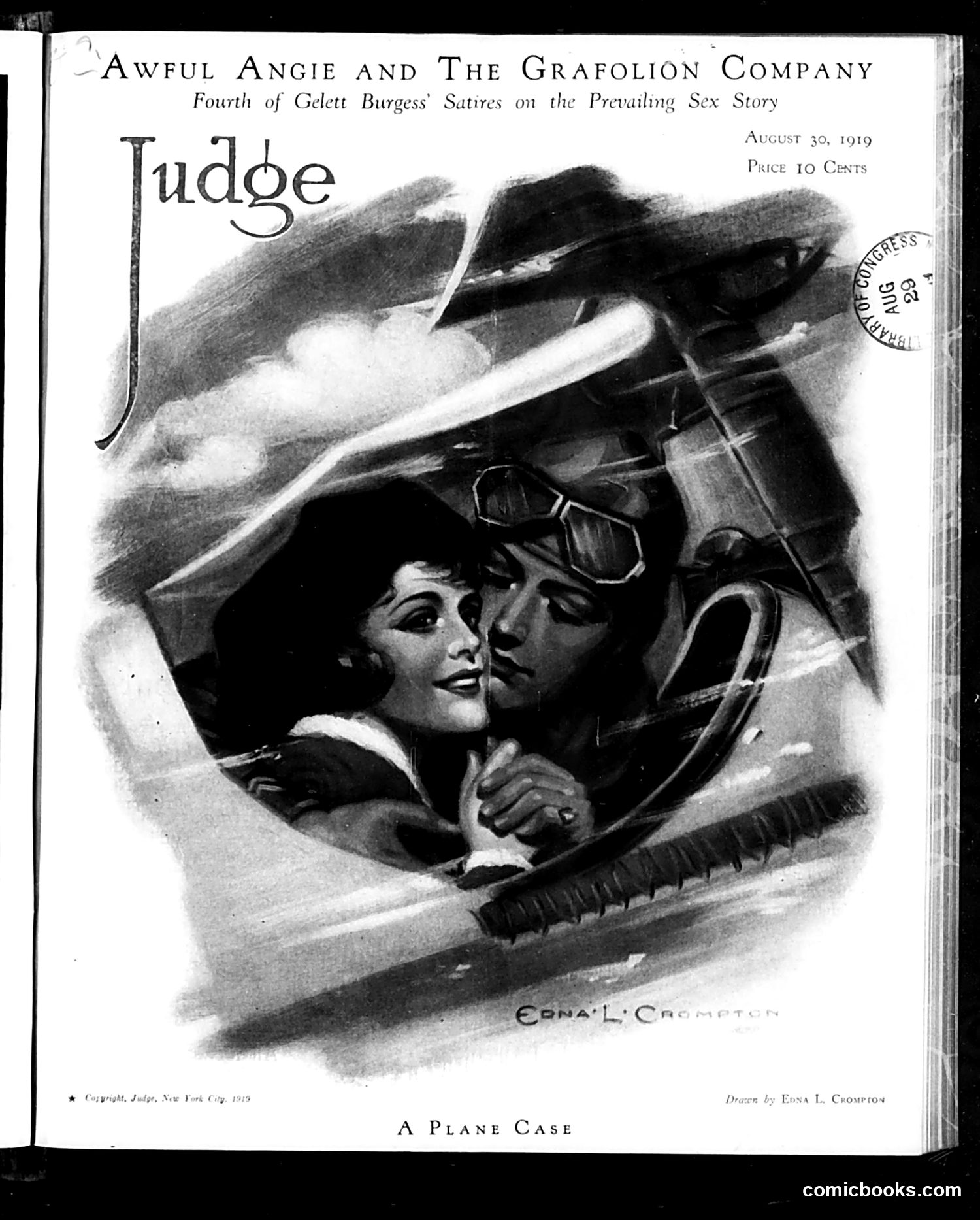
This illustration by Eona L. Crompston depicts two figures in an airplane cockpit, subtitled "A Plane Case." The page header indicates this is the "Fourth of Gelett Burgess' Satires on the Prevailing Sex Story"—suggesting the content mocks popular romantic narratives of the era. The cartoon likely satirizes the contemporary fascination with aviation as a modern, daring backdrop for romance. The intimate positioning of the two figures in the cramped cockpit space plays on "prevailing sex story" tropes—the juxtaposition of cutting-edge technology with conventional romantic clichés. The title puns on "plane" versus "plain," suggesting the absurdity of staging romance in such an impractical setting.
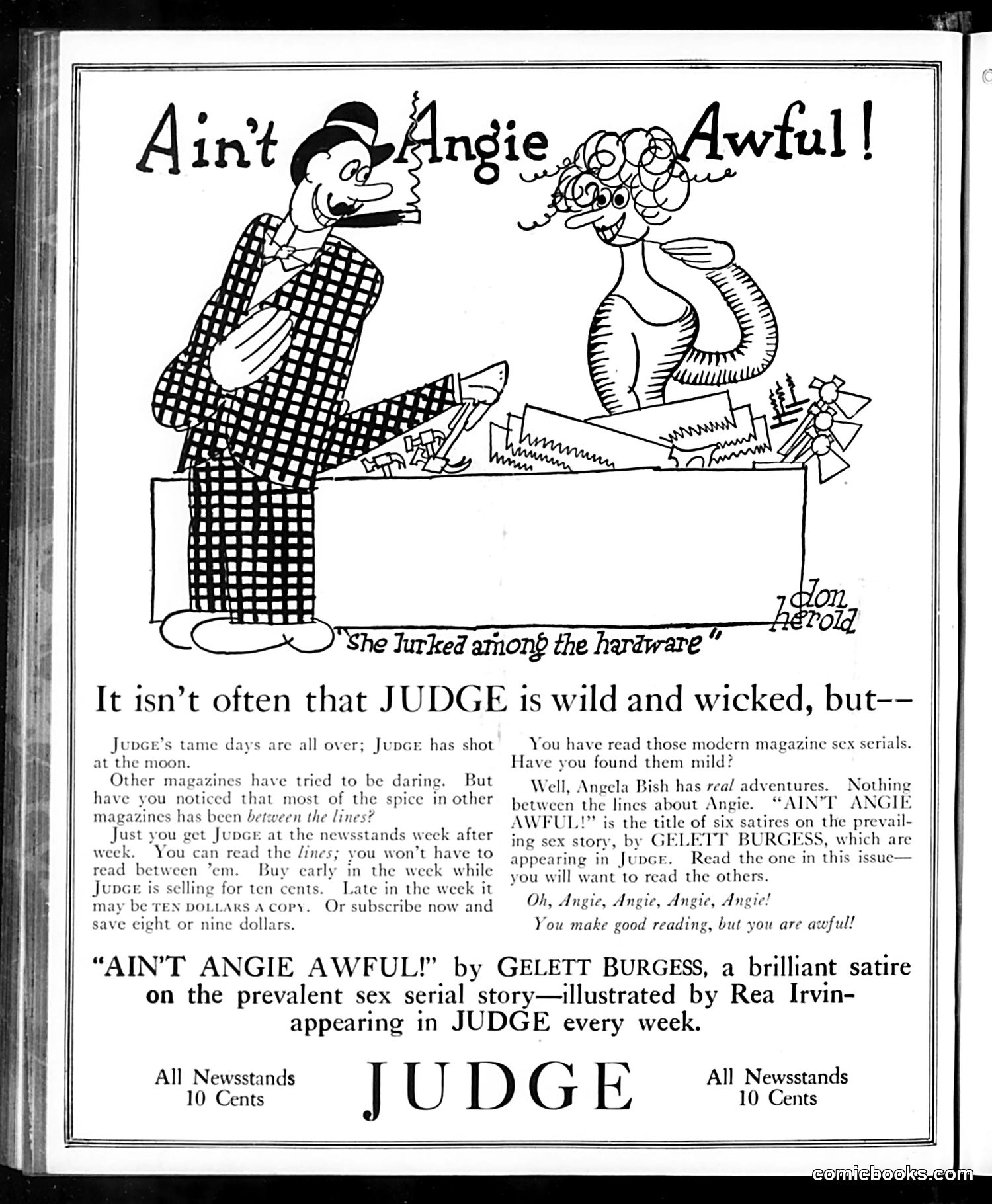
This page is primarily an advertisement for Judge magazine's serialized satire "Ain't Angie Awful!" by Gelett Burgess, illustrated by Rea Irvin. The cartoon depicts a man in a checkered suit confronting a voluptuous woman, with the caption "She lurked among the hardware." The satire mocks popular "sex serial" stories appearing in contemporary magazines, which the ad claims are often mild despite sensational marketing. Judge positions itself as offering genuinely daring, witty content compared to competitors. The ad emphasizes that Judge costs only 10 cents and appears weekly, with readable content readers "won't have to read between" the lines to understand—a jab at other magazines' pretentious or obscure storytelling. The overall tone satirizes both the prevalence of sex-themed fiction and the magazines that promote them.
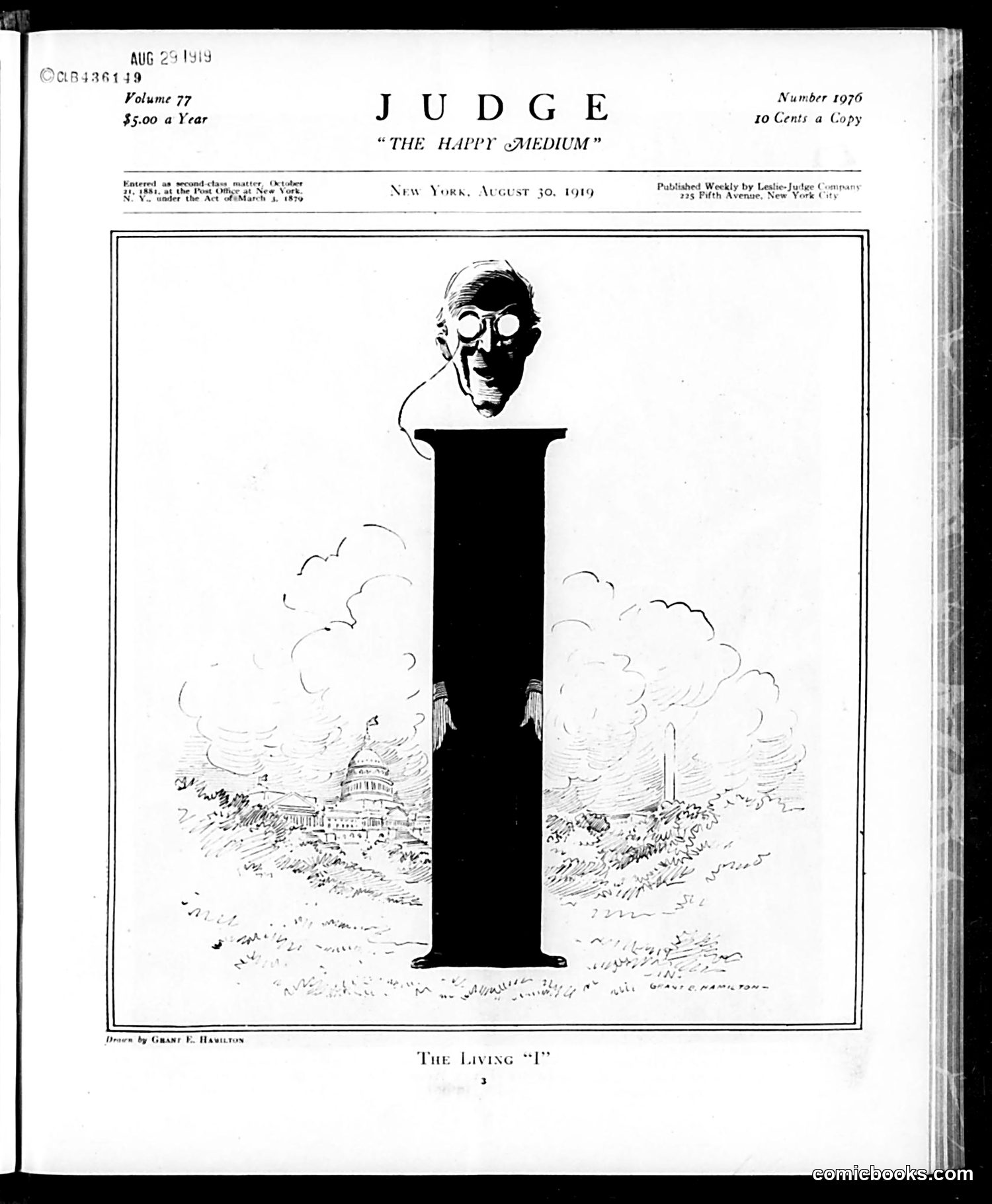
This political cartoon depicts a massive, looming figure of an elderly man's head atop a classical pedestal, dominating Washington D.C.'s landscape below (identifiable by the Capitol and Washington Monument). The towering "I" represents egotistical self-importance. The caption "The Living 'I'" satirizes an authoritative political figure—likely President Woodrow Wilson, given the 1919 date coinciding with post-WWI treaty negotiations and Wilson's dominating influence over American politics. The cartoon critiques Wilson's perceived arrogance and outsized ego during this period, suggesting his personal ambitions overshadowed national interests. The monumental scale emphasizes how one individual's self-regard was portrayed as towering over the nation itself.
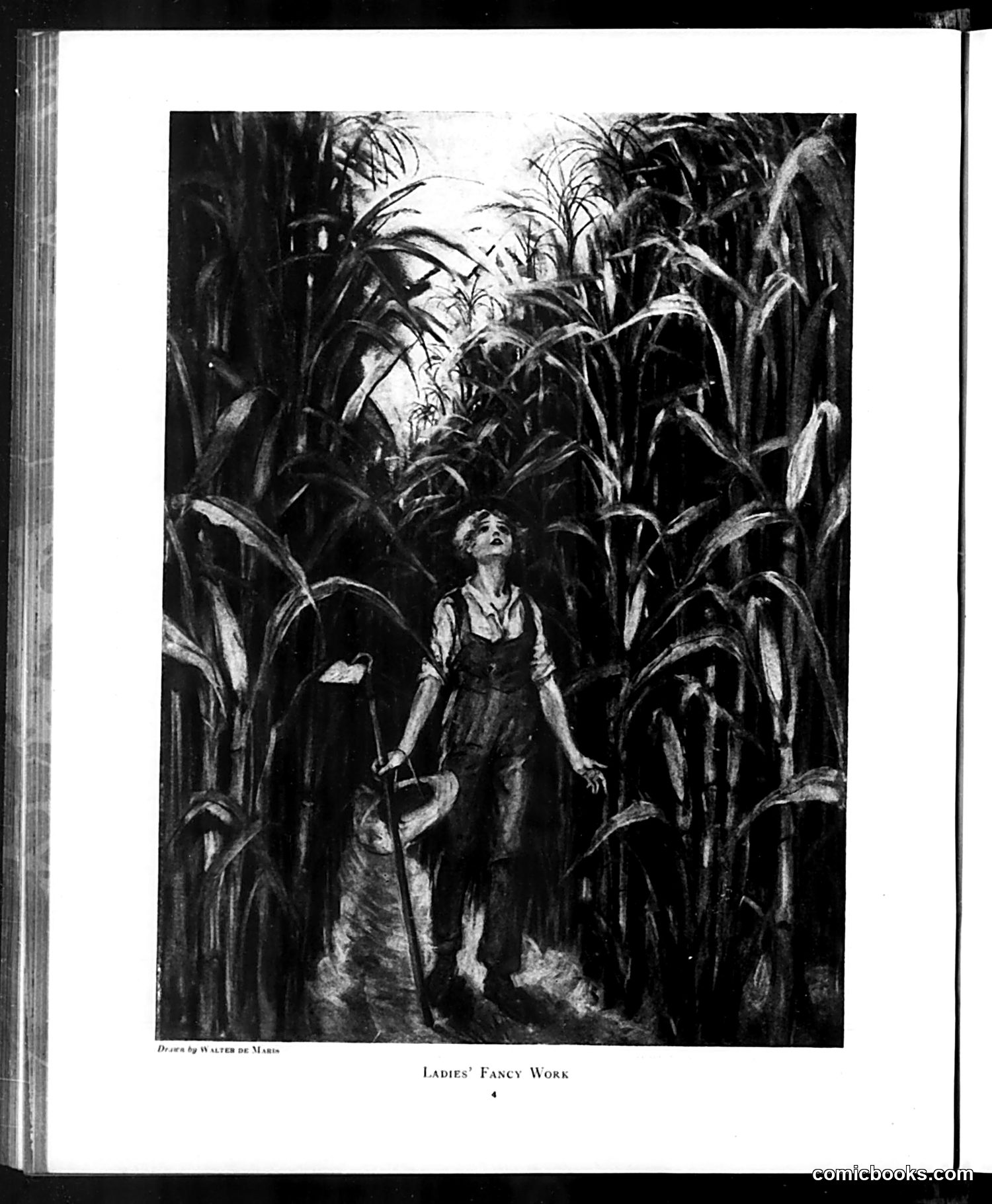
This illustration by Walter de Maris depicts a woman standing in a cornfield, looking upward. The title "Ladies' Fancy Work" is a satirical reference to genteel needlework and decorative crafts traditionally associated with upper-class women. The joke likely mocks the contrast between delicate, ornamental "fancy work" and agricultural labor—suggesting that women's actual work in farming or fieldwork constitutes their "fancy work." The woman's pose and expression suggest either aspiration, exhaustion, or resignation to farm labor. Without additional context, the exact satirical target remains unclear, but the piece appears to comment on women's labor, class expectations, or rural life during the period Judge was published.
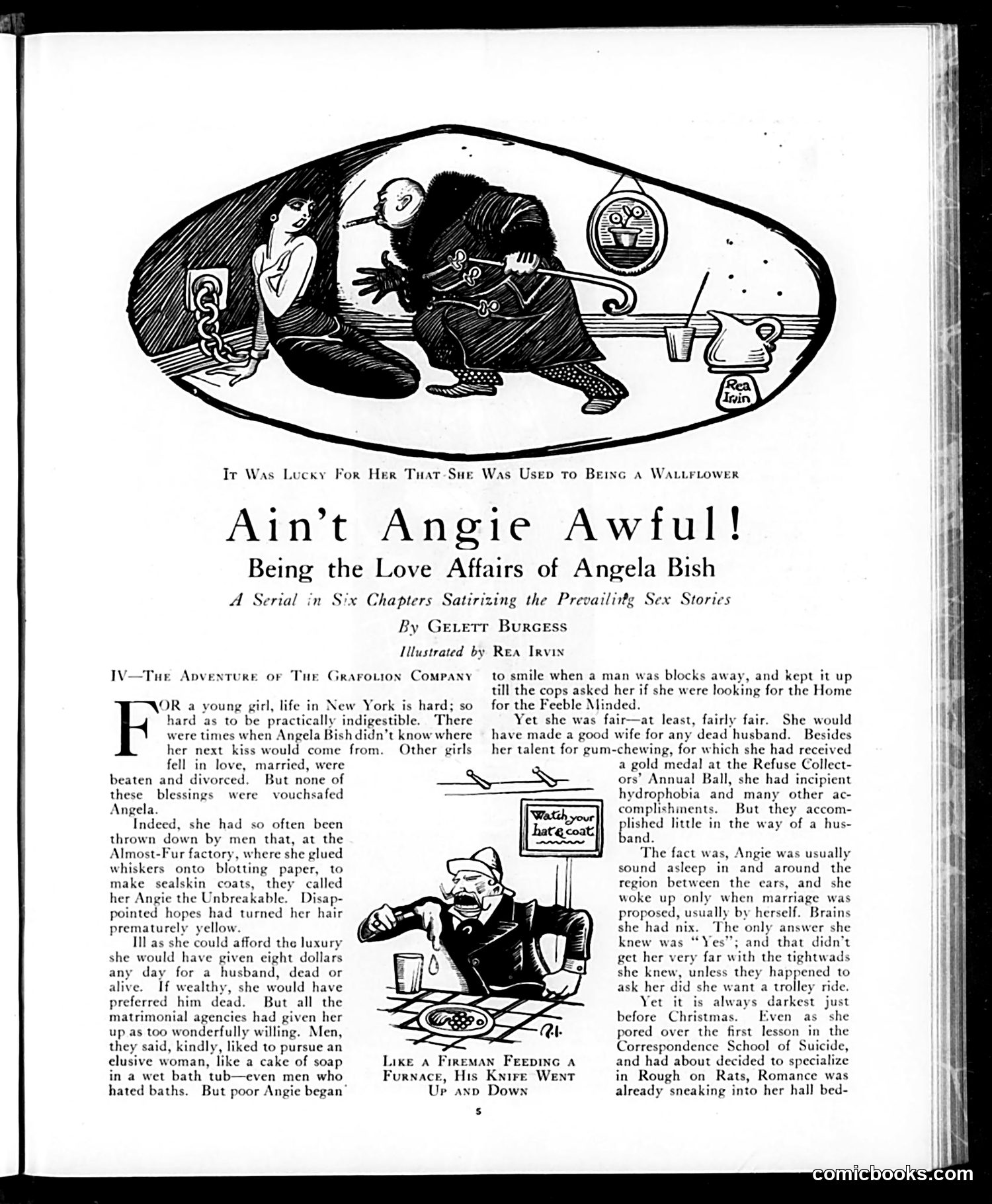
This page satirizes Angela Bish through a serial fiction titled "Being the Love Affairs of Angela Bish," illustrated by Rea Irvin. The narrative mocks a woman characterized as perpetually unlucky in romance and marriage—repeatedly "thrown down by men" despite being "fair" and possessing useful domestic skills like gum-chewing. The embedded cartoon depicts a fireman at a furnace, captioned "Like a Fireman Feeding a Furnace, His Knife Went Up and Down." This appears to illustrate Angela's misadventures with yet another male figure. The satire targets prevailing gender stereotypes: women's limited value beyond matrimony, their supposed emotional volatility, and the era's cynical view of women's romantic prospects. The humor relies on schadenfreude—finding entertainment in a woman's romantic failures.
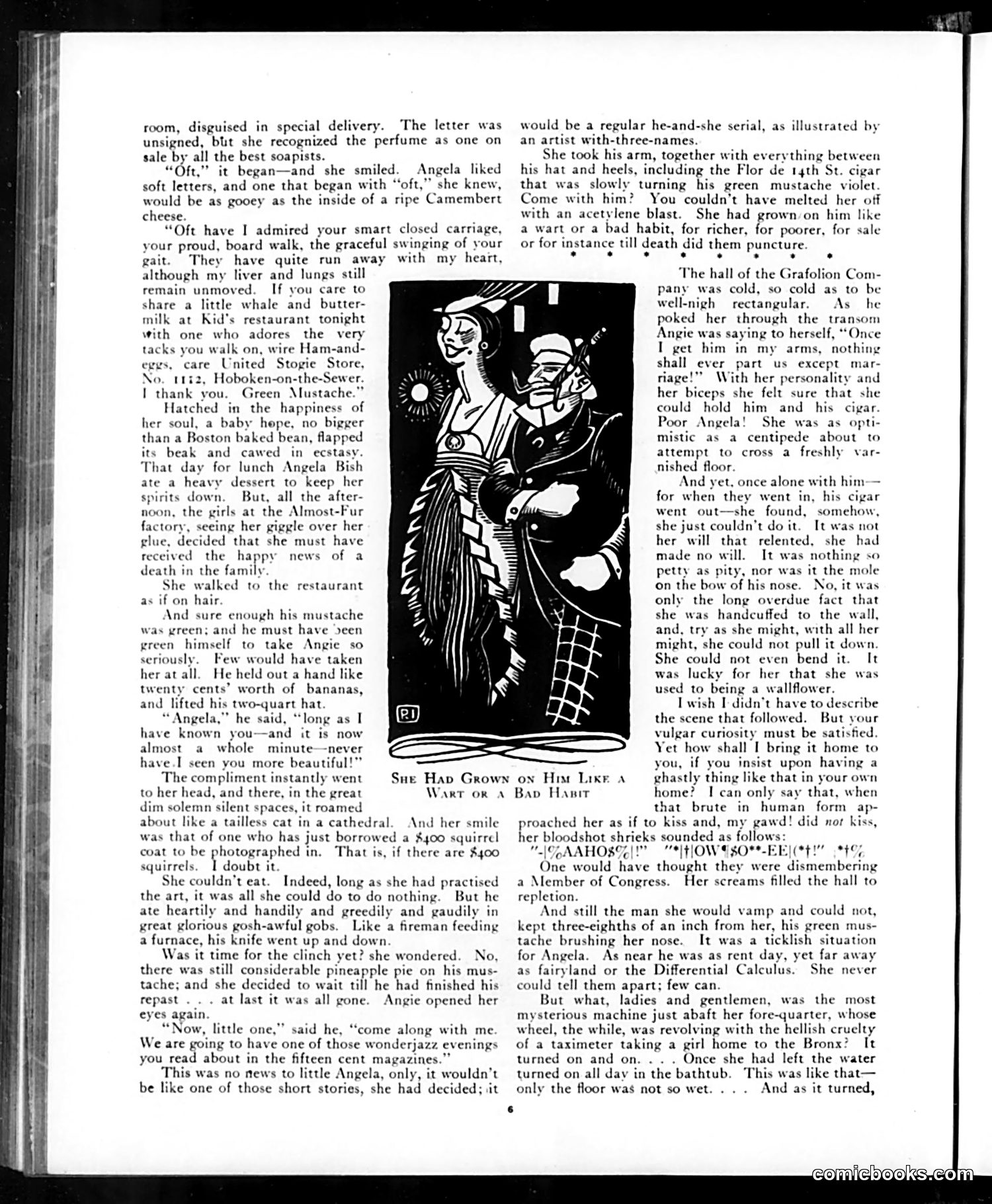
This page contains a short story titled "She Had Grown on Him Like a Wart or a Bad Habit" rather than a political cartoon. The illustration shows a couple in an intimate moment—a man in formal attire leaning toward a woman in an elaborate dress. The story's narrative concerns a romantic relationship, with the accompanying illustration serving as decorative accompaniment to the fiction. The title suggests comedic commentary on how relationships develop through habit or familiarity rather than grand passion. This is **not political satire** but rather humorous romantic fiction typical of Judge magazine's miscellaneous content. Without clearer identifying details in the image, specific character identities remain unclear, though the piece appears to mock conventional romantic expectations of the era.
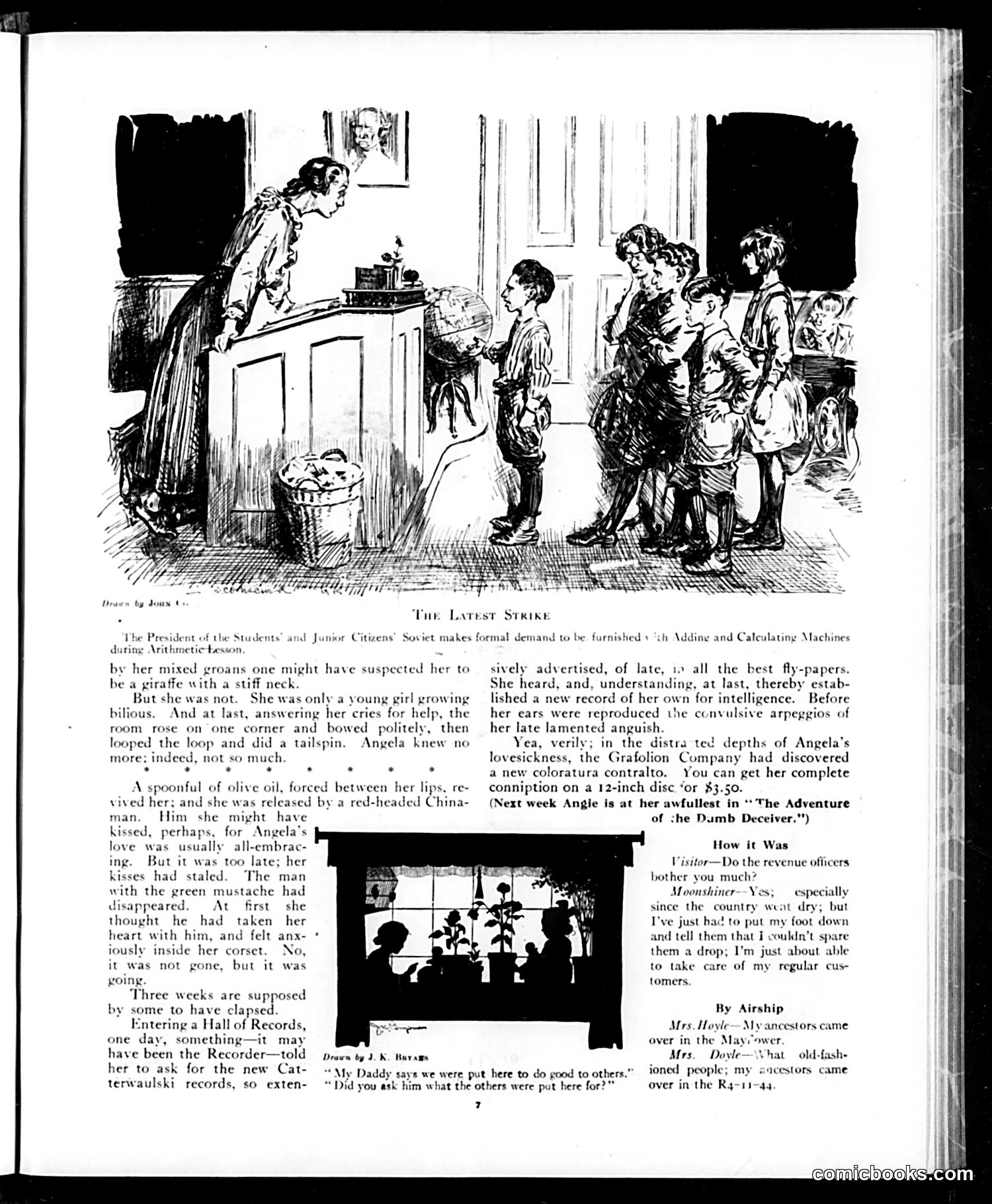
This cartoon satirizes Soviet-style labor organizing among schoolchildren. The title references the communist "Soviets" (workers' councils) that existed in Russia, particularly prominent during the 1917-1920s period. The joke: the "President of the Students' and Junior Citizens' Soviet" is formally demanding that schools provide "Adding and Calculating Machines" during arithmetic lessons—a mock-serious labor strike demand by children. The satire targets two things: (1) the perceived absurdity of Soviet communism and its organizational methods, and (2) growing concerns about radical ideology influencing American youth. By depicting children as mini-communists making formal demands, Judge mocks both communism as inherently childish and fears about communist infiltration of American institutions. The accompanying stories appear to be unrelated comic fiction filler typical of Judge's format.
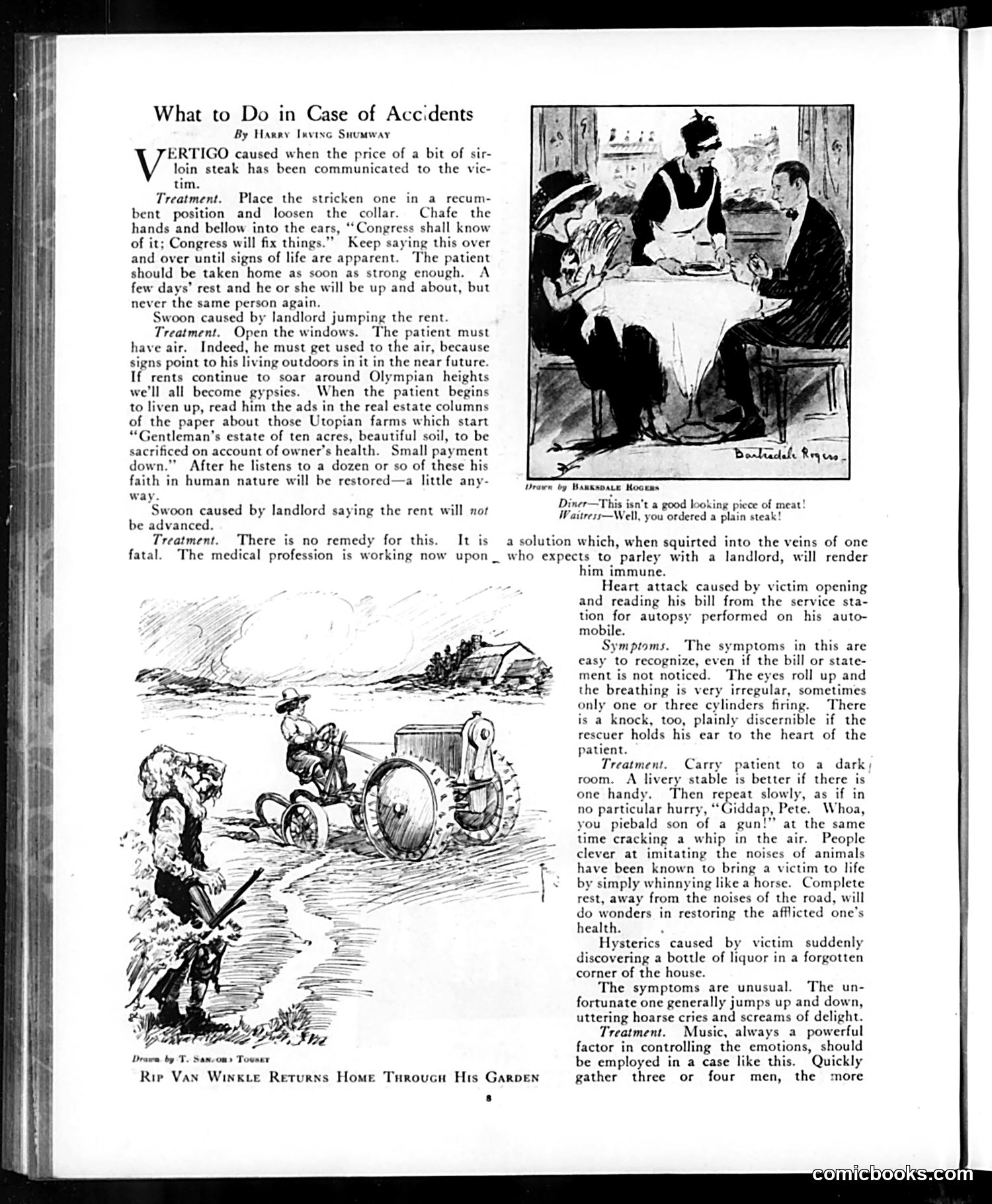
This is a humorous article by Henry Irving Shumway satirizing various "accidents" and their "treatments"—but the "accidents" are actually common frustrations of the era. The satire targets: 1. **Rising food prices**: "Vertigo" from learning sirloin steak costs, treated by Congress reassurance 2. **Housing crisis**: Multiple conditions caused by landlords—rent increases, threatened eviction, and paradoxically, *not* raising rent (deemed "fatal") 3. **Auto repair costs**: "Heart attack" from reading service station bills, treated by taking the patient to a stable and making horse sounds 4. **Alcohol Prohibition**: "Hysterics" from finding hidden liquor—treated by gathering men with music (implying drinking) The accompanying illustrations include a Rip Van Winkle reference and a diner scene about poor meat quality. The article mocks post-WWI economic anxieties—inflation, housing shortages, automobile expenses, and Prohibition—by presenting them as medical emergencies requiring absurd treatments. The humor lies in the exaggeration of ordinary hardships.
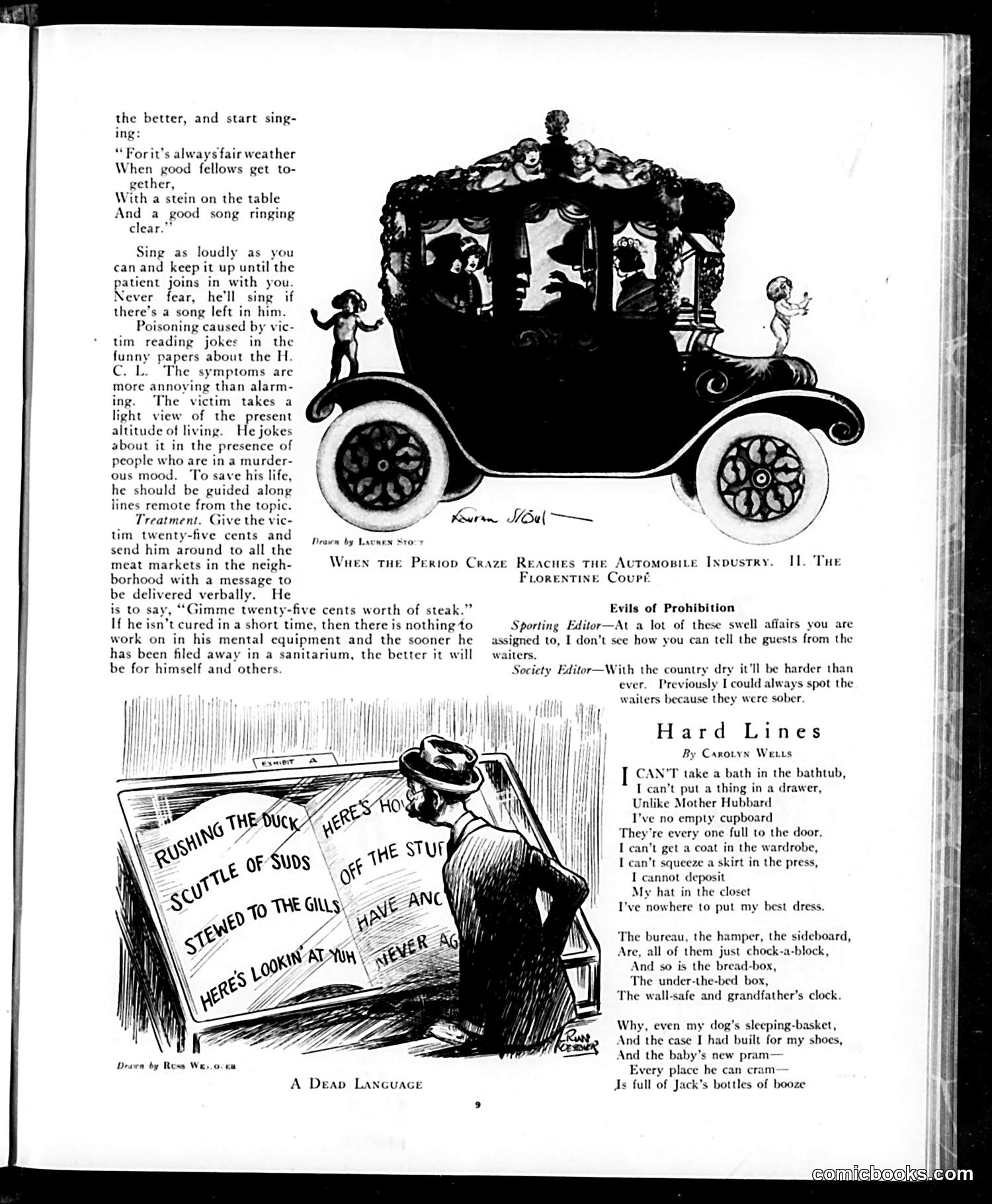
This page contains three distinct satirical pieces from Judge magazine: **"A Dead Language"** (cartoon, lower left): A man reads absurdly titled sheet music ("Rushing the Duck," "Scuttle of Suds," etc.)—likely mocking the era's popular song titles as nonsensical or lowbrow. **"When the Period Craze Reaches the Automobile Industry"** (top illustration): A decorative automobile filled with figures. "Period craze" likely refers to 1920s fashion for historical revival styles; the satire suggests applying this trend absurdly to cars. **"Evils of Prohibition"** (text section): Two editors joke about Prohibition's impact on high-society events. The Sporting Editor quips he can't distinguish guests from waiters anymore—previously, drunk waiters stood out, but now everyone is sober. This mocks Prohibition's failure to stop drinking at wealthy gatherings. **"Hard Lines"** (poem): A housewife complains about overcrowded storage—every space filled with "Jack's bottles of booze"—satirizing how Prohibition-era citizens illegally hoarded alcohol, consuming household space. All three pieces mock Prohibition's ineffectiveness and social hypocrisy.
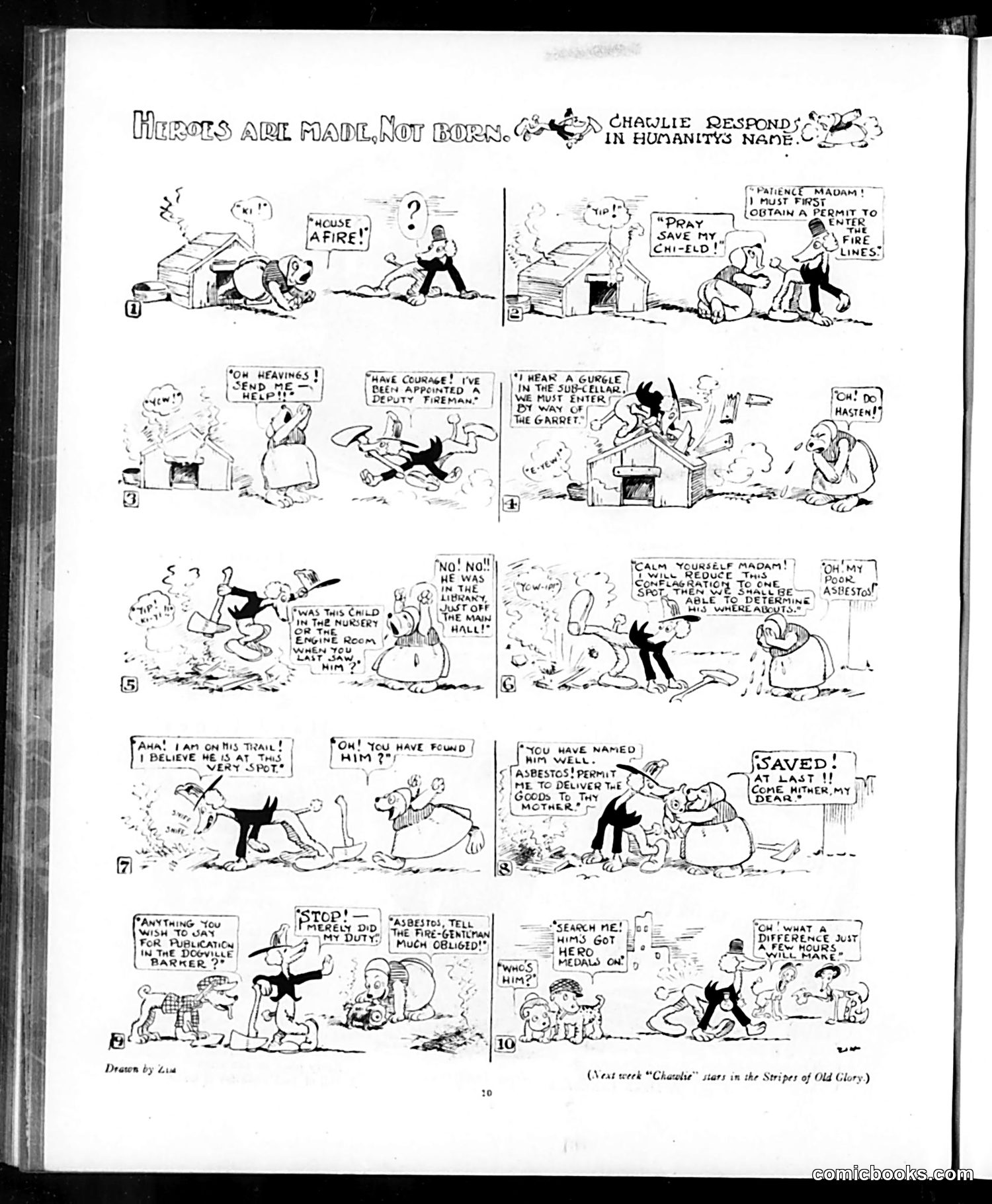
This is a narrative comic strip (numbered 1-10) featuring a character named Charlie (likely a dog or animal character, based on the black silhouette figure). The plot concerns a house fire and rescue efforts. The satire targets bureaucratic absurdity: a woman must obtain a "permit to pray" before entering a burning house to save her child. Subsequent panels mock red tape further—a "deputy fireman" is appointed, characters debate procedure while the child remains in danger, and officials obsess over permits and proper channels rather than acting. The title "Heroes are Made, Not Born" ironically suggests that heroism requires bureaucratic approval. The humor derives from the obvious conflict between life-threatening emergency and administrative procedure, critiquing how government regulation and formality can paralyze practical action. The reference to "asbestos" in later panels appears to relate to fire-safety regulations, though the exact context is unclear from the image alone.
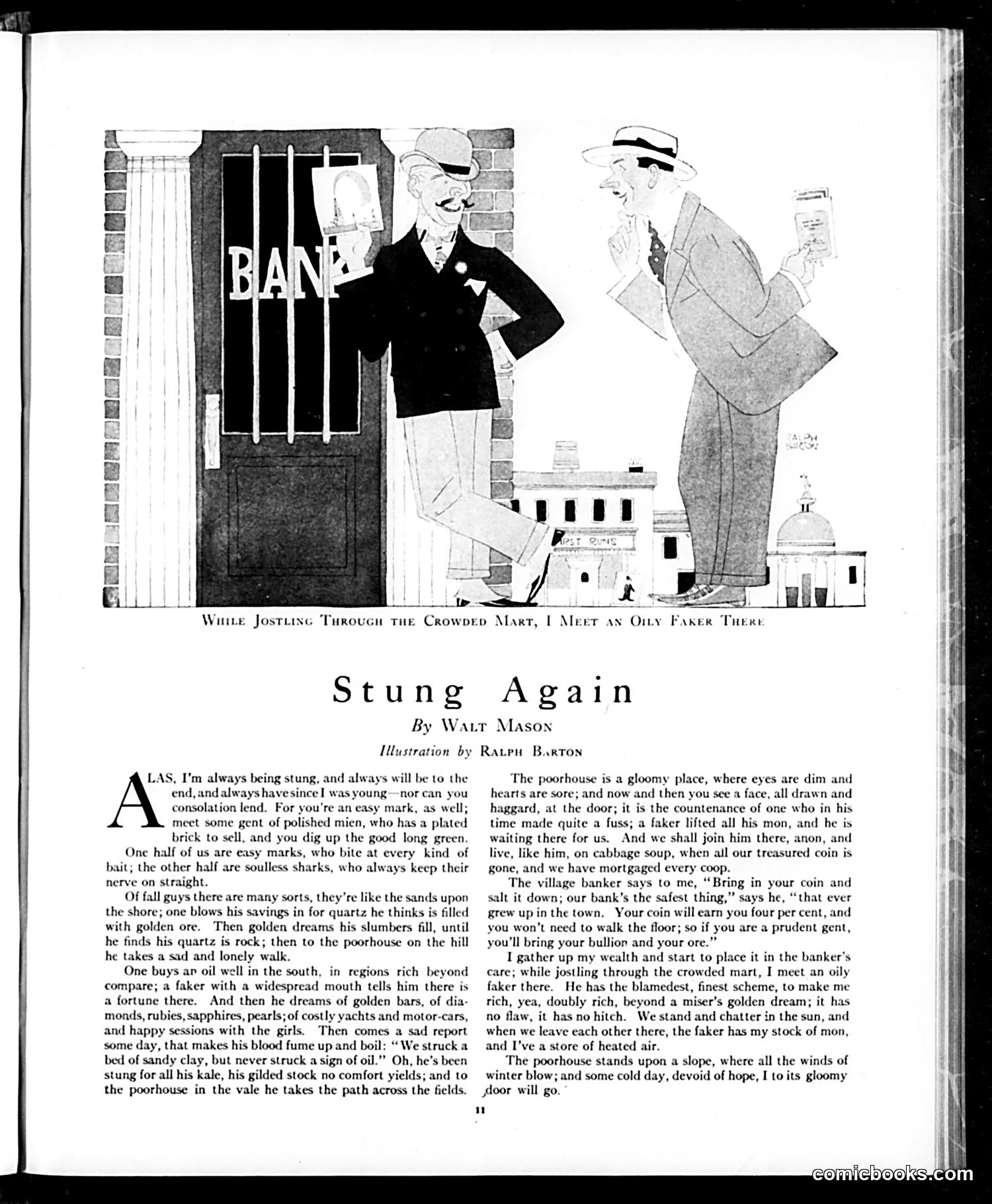
This piece satirizes the vulnerability of ordinary people to con artists and financial schemes. The illustration shows a banker at his locked bank door meeting a well-dressed "oily faker" (con man) on the street, with a capitol building visible—suggesting corruption reaches institutional levels. The story, by Walt Mason, describes how gullible citizens are repeatedly swindled: some invest in fake gold ore or oil wells, lose everything, and end up in the poorhouse. The narrator himself plans to deposit savings with a banker for safety, but encounters a smooth-talking faker in the marketplace who convinces him into a fraudulent scheme, leaving him with "heated air" instead of wealth. The satire's point: both bankers and street-level con artists exploit the working class equally. The inevitable destination for victims is the poorhouse—a damning commentary on economic vulnerability and institutional failure to protect ordinary people.
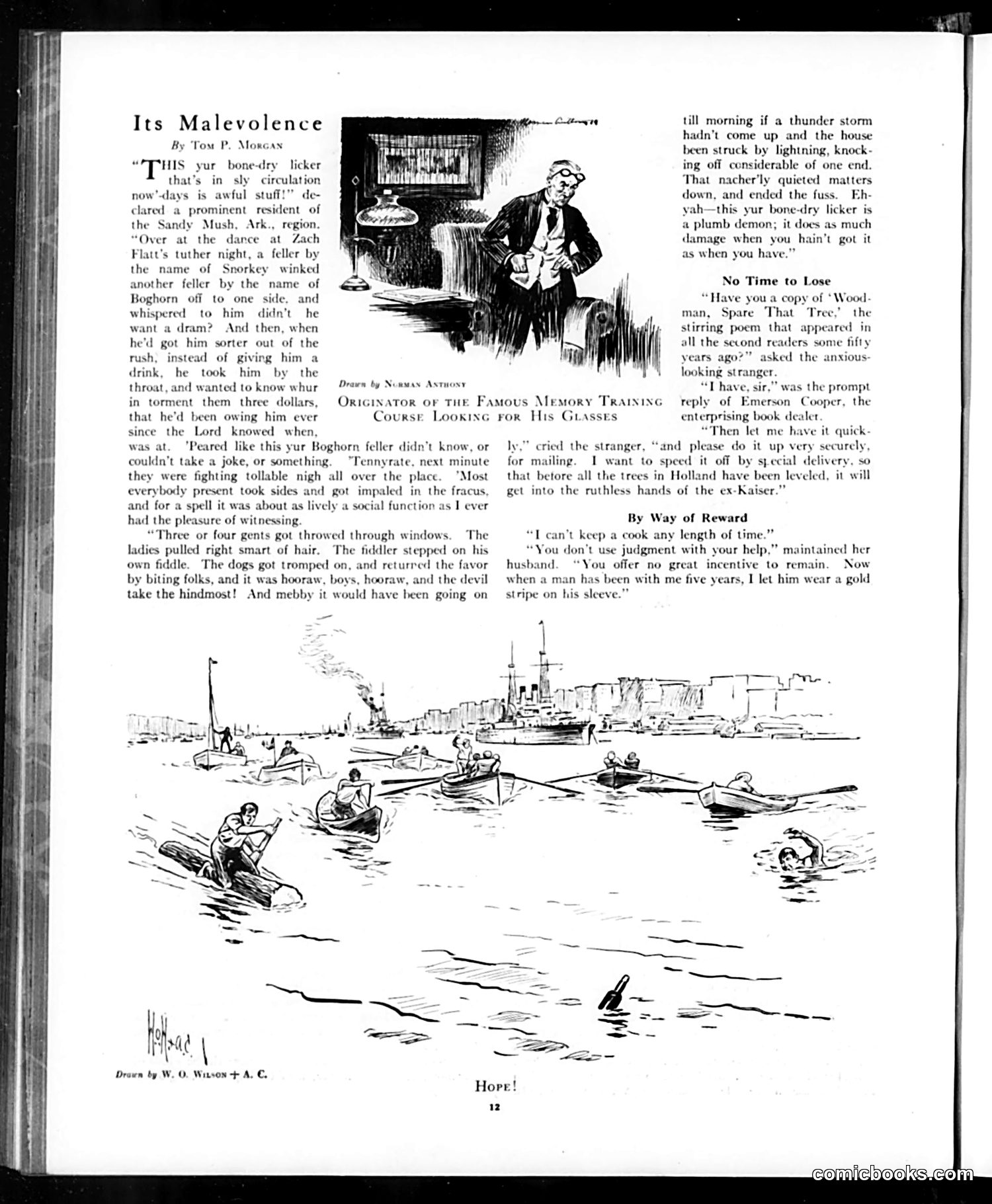
This Judge magazine page contains three separate satirical pieces: 1. **"Its Malevolence"** (top): A rural dialect story mocking Prohibition-era "bone-dry" (illegal) liquor. The joke: bootleg alcohol causes violence—a man threatens another over a debt, sparking a massive brawl at a dance that destroys the venue. The satire criticizes both the poor quality of illegal alcohol and suggests Prohibition itself creates disorder. 2. **"No Time to Lose"** (middle): A customer urgently buys the poem "Woodman, Spare That Tree" to mail to the "ex-Kaiser" (Germany's Wilhelm II, defeated in WWI). The satire: the poem's plea to preserve trees is being sent to someone perceived as ruthlessly destructive, implying the ex-Kaiser would destroy forests. It's post-WWI mockery of German militarism. 3. **"By Way of Reward"** (bottom): A wife complains she can't keep cooks; her husband suggests offering incentives like he does for employees (a gold stripe after five years). The joke satirizes gender dynamics—wives lack management skills with domestic help compared to husbands' business practices.
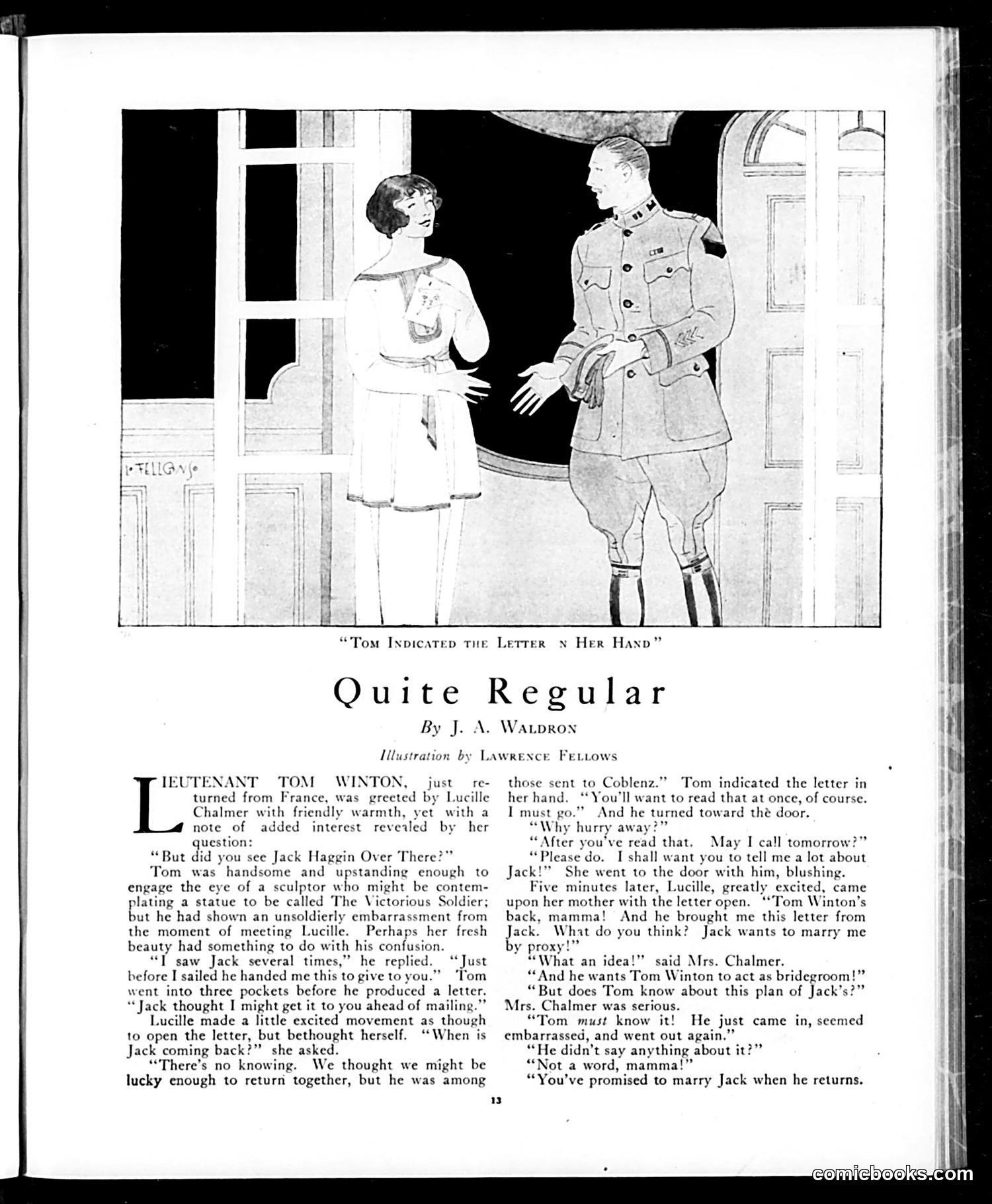
This is a romantic story illustrated by Lawrence Fellows, not a political cartoon. It depicts a post-WWI scenario: Lieutenant Tom Winton returns from France and delivers a letter from his friend Jack Haggin (stationed in Coblenz, Germany) to Jack's sweetheart, Lucille Chalmer. The plot's tension centers on Jack's unexpected proposal—marriage by proxy, with Tom serving as stand-in bridegroom. Tom's embarrassment and hurried departure suggest he harbors romantic feelings for Lucille himself, though he's bound by loyalty to deliver Jack's letter. The "satire" is gentle social comedy about wartime complications: soldiers separated from sweethearts, the awkwardness of romantic intermediaries, and unspoken affections. The title "Quite Regular" likely refers to the proposal's formality despite its unusual circumstances. This reflects post-WWI popular fiction's interest in soldiers' romantic entanglements.
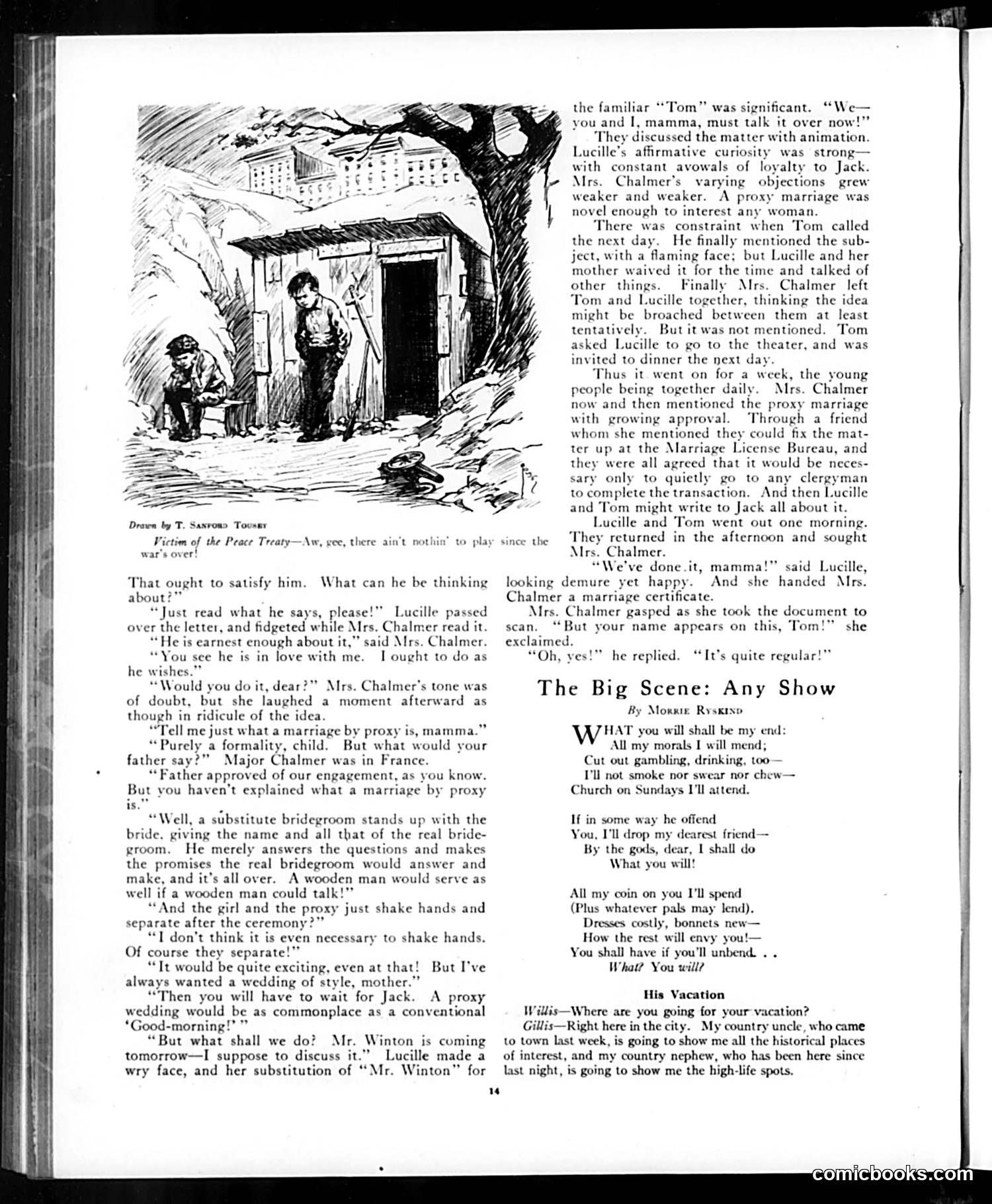
The cartoon depicts a man sitting dejectedly outside a modest cottage. The caption's bitter joke—"there ain't nothin' to play since the war's over"—suggests he's a soldier or war profiteer who thrived during WWI but now faces peacetime unemployment or irrelevance. The accompanying story reveals the cartoon's darker irony: while this unnamed figure laments lost wartime opportunities, a young woman named Lucille and her suitor "Tom" scheme to marry *by proxy* (Tom standing in for her fiancé "Jack" overseas). Tom, initially hesitant, ends up marrying Lucille himself under false pretenses—his signature appears on the marriage certificate instead of Jack's. The satire cuts multiple ways: it mocks both postwar dislocation and the chaos of wartime separations that enabled such deceptions. The cartoon's title suggests even losers of the peace treaty face absurd predicaments. The page also includes unrelated poetry and a comedic dialogue about vacation plans, typical Judge magazine miscellany.
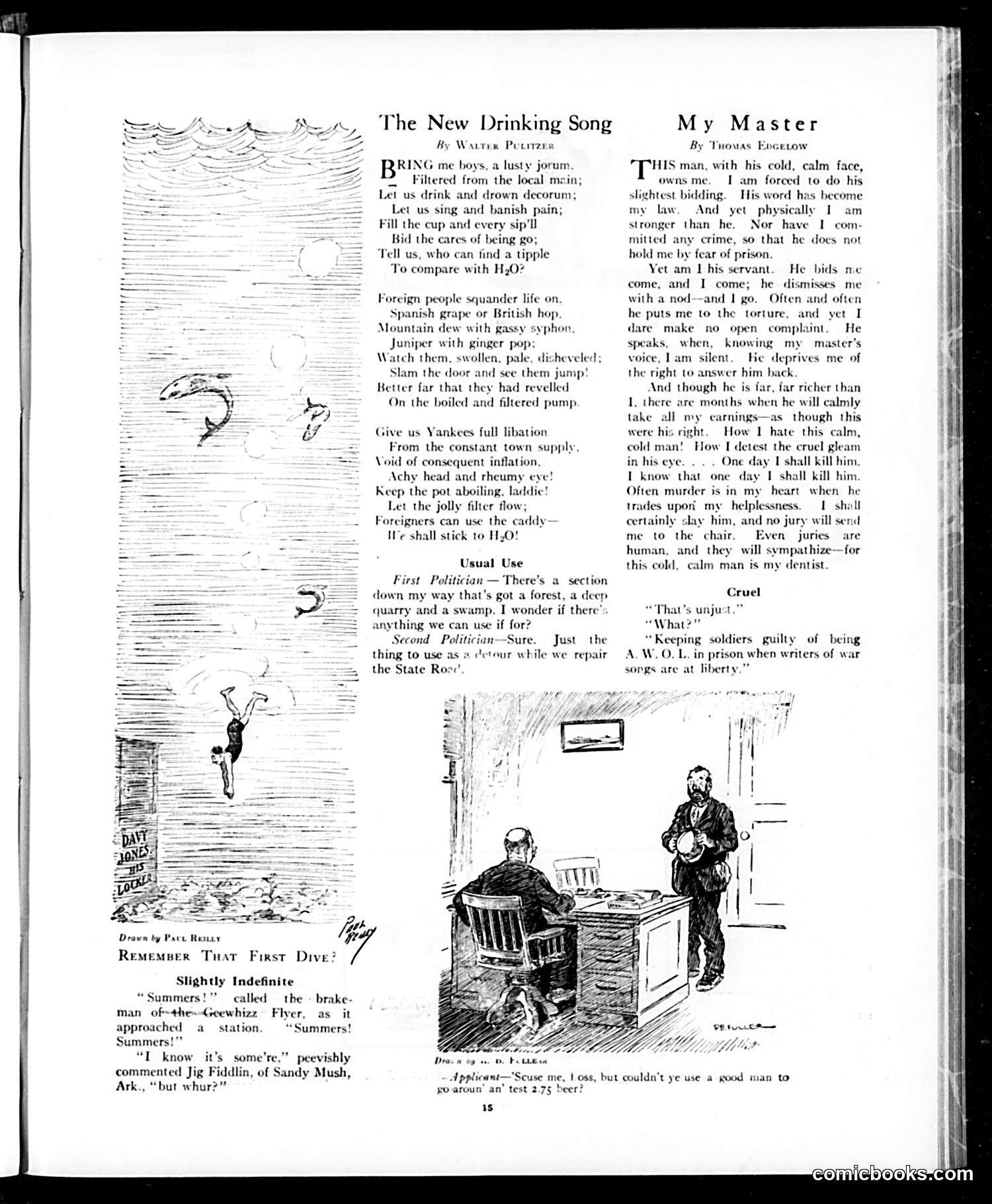
This page contains three distinct satirical pieces: **"The New Drinking Song"** mocks the contemporary push for pure water as a health measure. The poem humorously advocates for filtered tap water (H₂O) over alcohol, foreign beverages, and "mountain dew"—celebrating municipal water supplies as superior to all rivals. This reflects Progressive Era public health campaigns promoting sanitation. **"Remember That First Dive"** is a mild joke about a train conductor named "Summers" whose vague response to a passenger's question becomes a running gag. **"My Master"** and the accompanying cartoon depict a worker's resentment toward his employer, building to a dark punchline: the "master" is actually a dentist. The piece satirizes labor exploitation and class relations, portraying the psychological oppression workers endure—ultimately revealing the joke targets the universal dread of dental visits rather than genuine social critique. **"Usual Use"** is a brief political joke where two politicians discuss converting a problematic landscape (forest, quarry, swamp) into a dumping ground for road repairs—cynical commentary on corruption and misuse of public resources.
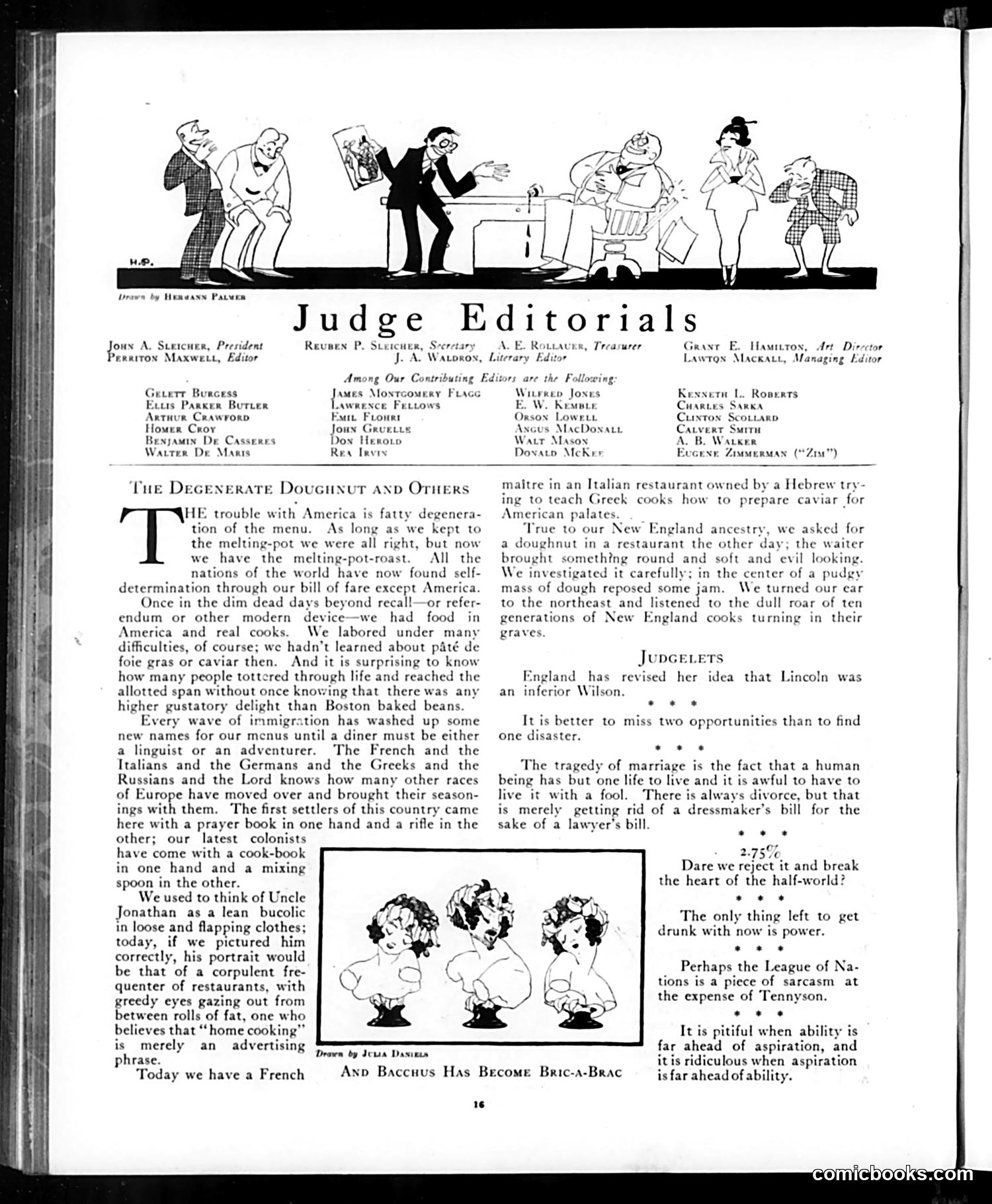
This page satirizes American cultural degradation through immigration and commercialization of cuisine. The main editorial, "The Degenerate Doughnut and Others," laments how successive immigrant waves—French, Italian, German, Greek, Russian—have complicated American menus with foreign dishes, replacing simple traditional foods like Boston baked beans. The satire's irony is sharp: the editorial nostalgically invokes "Uncle Jonathan" as a lean, self-reliant pioneer, but reveals modern America as a corpulent restaurant-goer obsessed with fancy foreign food. The specific example—requesting a simple doughnut and receiving an elaborate jam-filled pastry—exemplifies this cultural loss. The accompanying cartoon "And Baccchus Has Become Bric-a-Brac" (drawn by Julia Daniels) appears to mock the pretentious transformation of simple pleasures into fashionable affectations. The "Judgelets" (short editorial quips) touch on contemporary concerns: Lincoln vs. Wilson, marriage and divorce, and the League of Nations—suggesting this editorial represents post-WWI anxieties about American identity amid rapid social change.
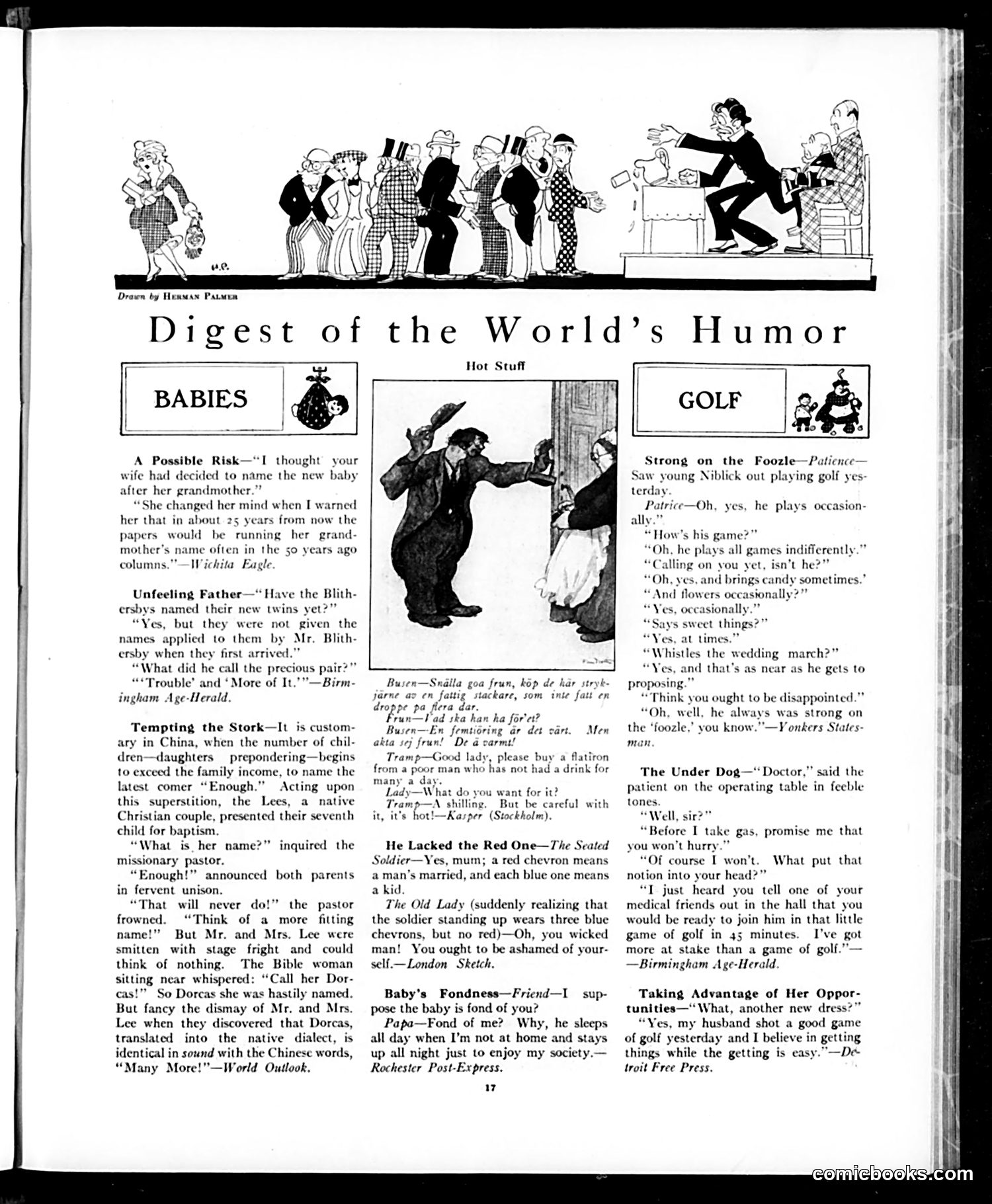
This is a humor compilation page featuring jokes about contemporary early-20th-century life. The cartoons and anecdotes satirize social customs and domestic situations: **"Babies" section**: Jokes about naming children, including one where a Chinese Christian couple unknowingly names their seventh child "Enough" (to discourage further births through superstition), but the native translation means "Many More"—defeating the purpose. **"Golf" section**: Satirizes a young man's courtship habits, showing he's attentive only during golf season, making minimal romantic progress. "Foozle" is golf terminology for a poor shot. **"Hot Stuff"**: A tramp's humorous pitch for selling a hot flatiron. **"The Under Dog"**: A surgery patient jokes that the doctor prioritizes golf over his operation. **"Taking Advantage"**: A wife exploits her husband's good mood after golfing to demand a new dress. The consistent golf theme reflects the sport's popularity among the era's middle and upper classes. The humor targets male preoccupations, domestic dynamics, and class-conscious anxieties about consumerism and leisure.
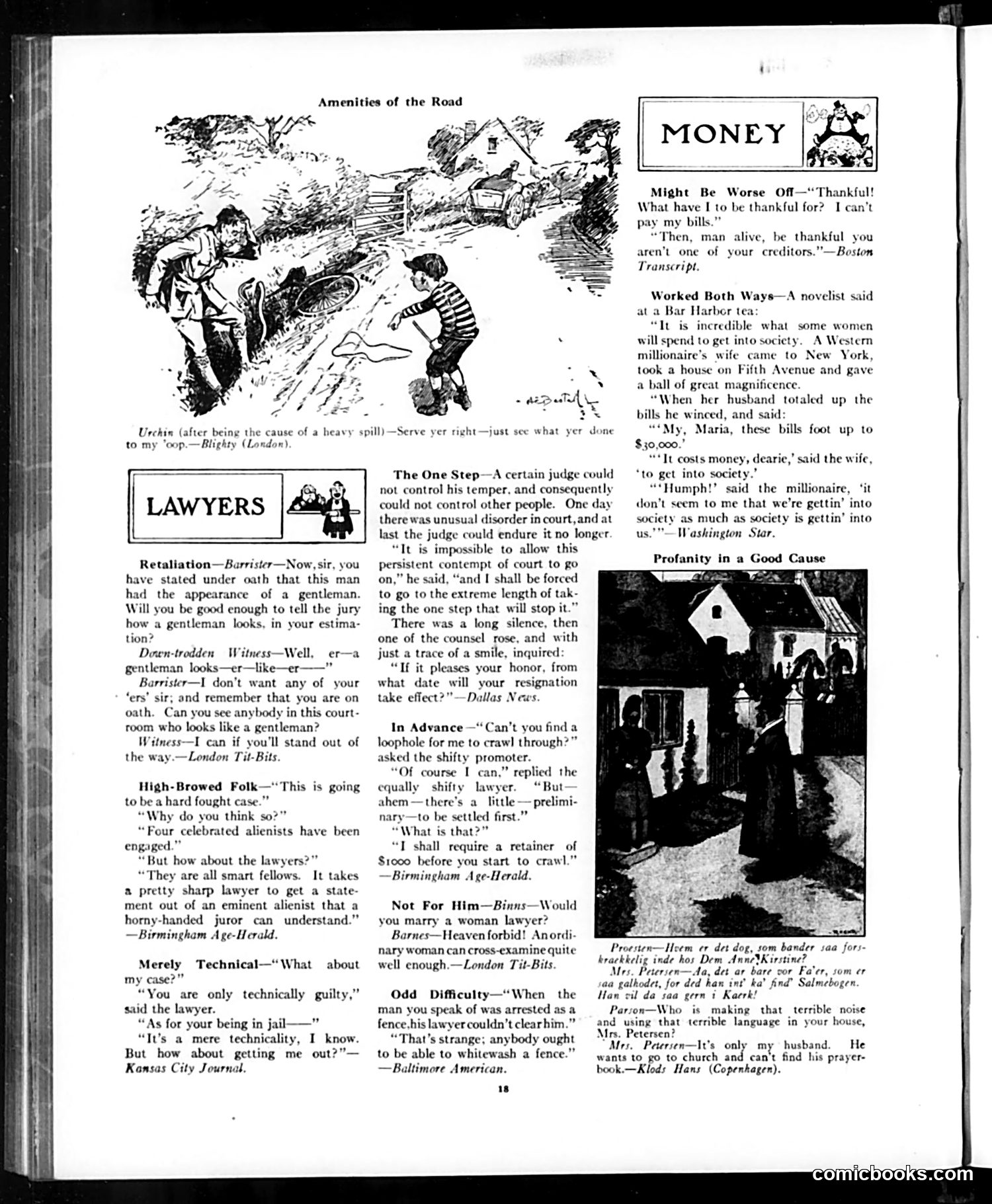
This page from *Judge* magazine presents multiple short humorous anecdotes mocking the legal profession and social pretensions. The **"Lawyers" section** contains jokes ridiculing barristers and judges: a witness outwits a cross-examining barrister by pointing out he's blocking the view of an actual gentleman; lawyers are portrayed as charging high retainers while offering dubious help; judges lose their temper yet expect court respect; and a lawyer uses expensive "alienists" (psychiatrists) as courtroom theater. The **"Money" section** satirizes wealthy social climbers: a Western millionaire's wife spends lavishly ($30,000) on a society ball, and her husband jokes that society is infiltrating *them* rather than vice versa. The **"Profanity in a Good Cause"** cartoon (with Danish/Scandinavian text) humorously depicts a man swearing profusely while searching for his prayer book to attend church—suggesting religious hypocrisy or the conflict between piety and human nature. The overall theme: lawyers exploit clients, the wealthy pursue status obsessively, and respectable society masks baser impulses.
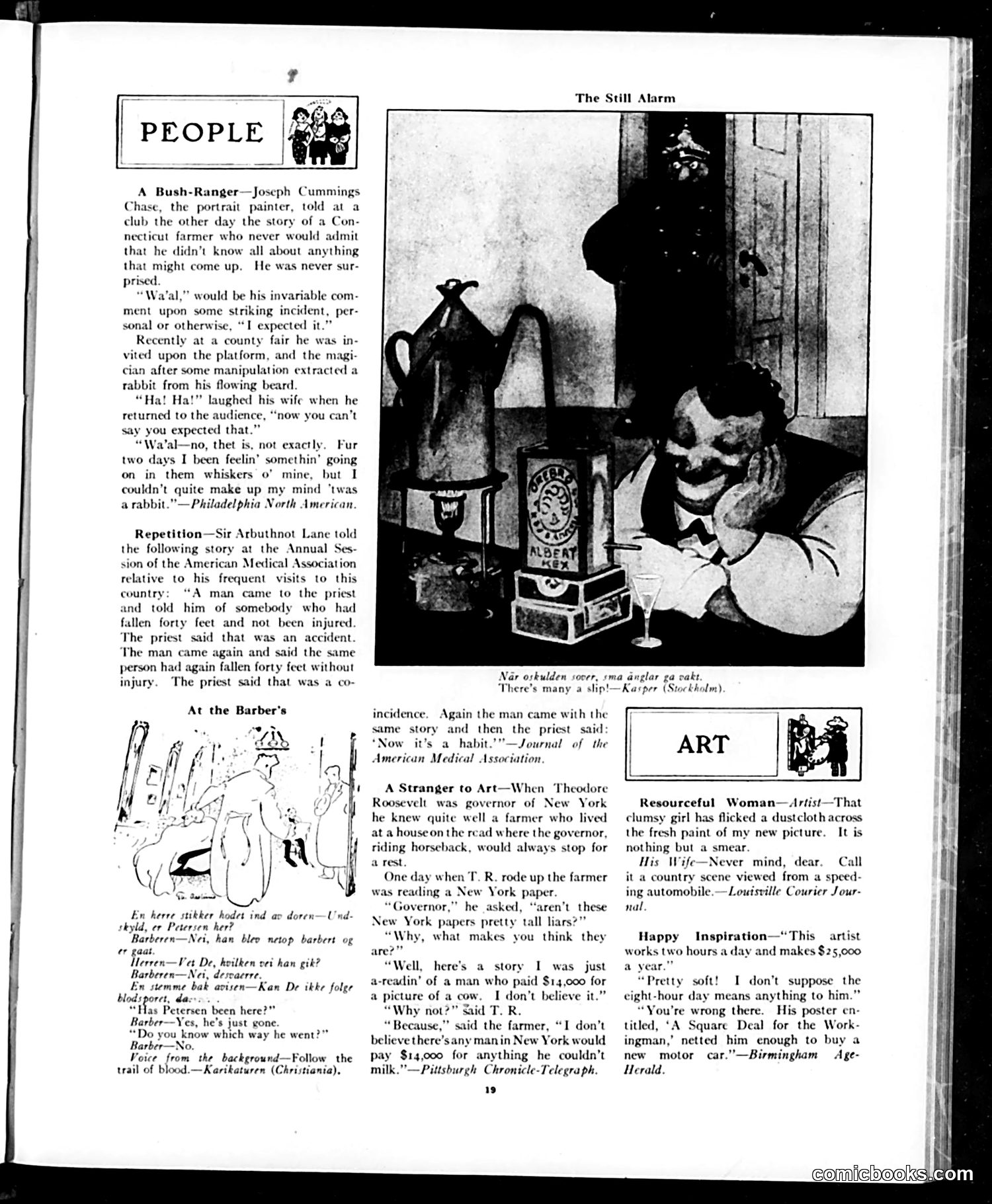
This page contains several brief humorous anecdotes typical of Judge's satirical style: **"A Bush-Ranger"** mocks a Connecticut farmer's pretense of omniscience. When a magician produces a rabbit from his beard at a county fair, the farmer—who always claims to expect everything—is finally caught. His attempted recovery ("I been feelin' somethin'" in his whiskers) satirizes rural rusticity and pompous ignorance. **"Repetition"** is a medical joke about habit formation, attributed to Sir Arbuthnot Lane. A man reports someone falling forty feet twice without injury; the priest recognizes the pattern indicates habitual behavior rather than miraculous accident. **"A Stranger to Art"** depicts Theodore Roosevelt as governor encountering a farmer skeptical of art market values. The farmer won't believe someone paid $14,000 for a painting, assuming New Yorkers wouldn't pay for anything they couldn't consume (milk). This satirizes rural practicality versus urban sophistication. The remaining art section contains light workplace humor about artists' productivity and income.
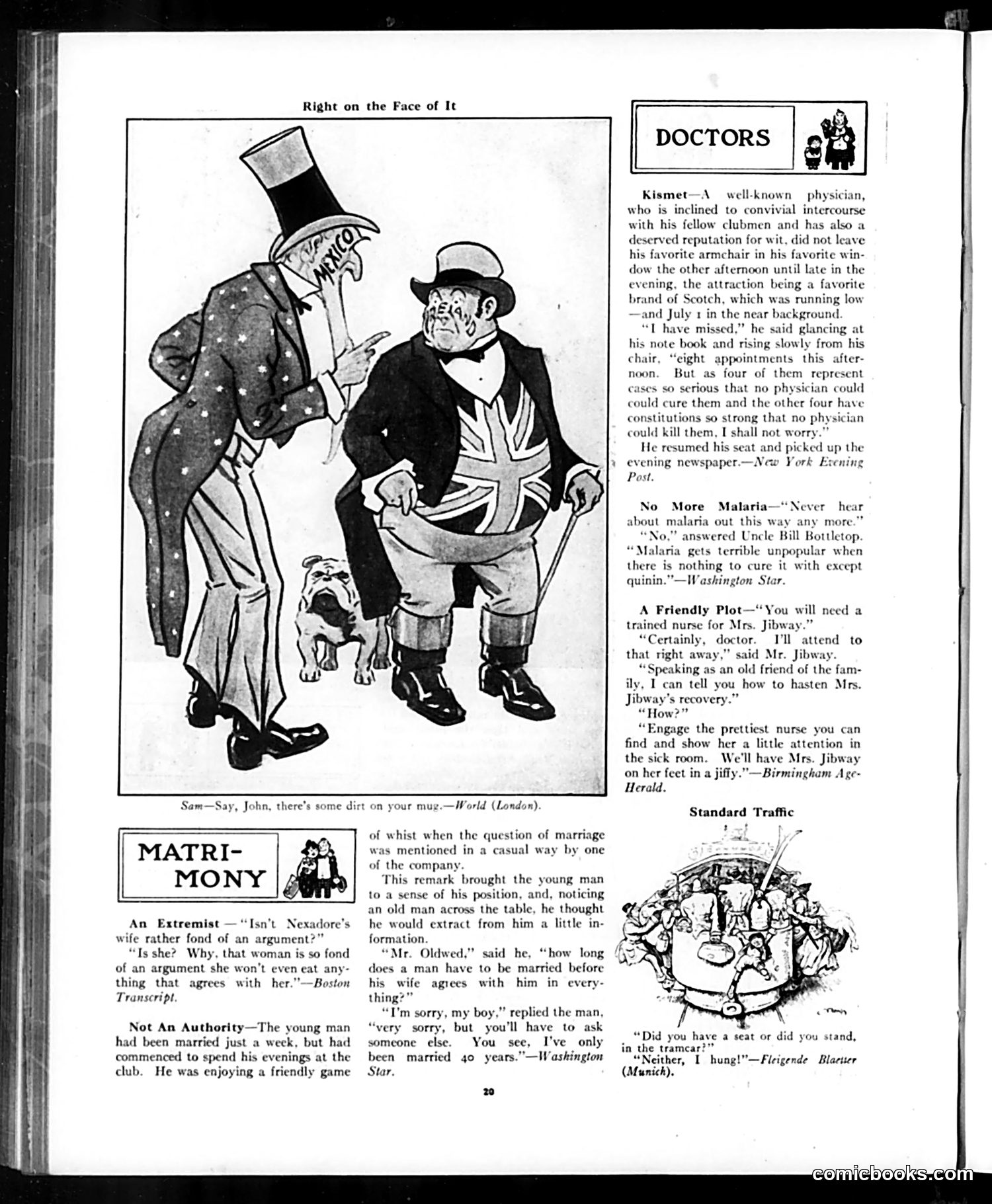
This page contains three satirical sections mocking marriage and professional life in early 20th-century America. **Main Cartoon ("Right on the Face of It"):** Shows two men in formal dress—one with a tall top hat—with a small dog. The caption suggests one man is pointing out dirt on the other's face. This appears to be a visual pun or joke about appearance and manners among the upper classes. **"Matrimony" Section:** Three brief anecdotes satirizing marriage. They mock wives as argumentative and stubborn ("won't eat anything that agrees with her"), and husbands as clueless about married life. One joke reveals a 40-year married man still can't predict his wife's agreement—suggesting wives are fundamentally unpredictable or tyrannical. **"Doctors" Section:** Humorous observations about physicians, including one who neglects patients while drinking scotch, and another who jokes about malaria becoming "unpopular" when quinine won't cure it. **"Standard Traffic":** A brief joke about crowded trams (streetcars). The satire reflects period attitudes: skepticism about marriage compatibility, mockery of professional pretension, and urban transportation complaints.
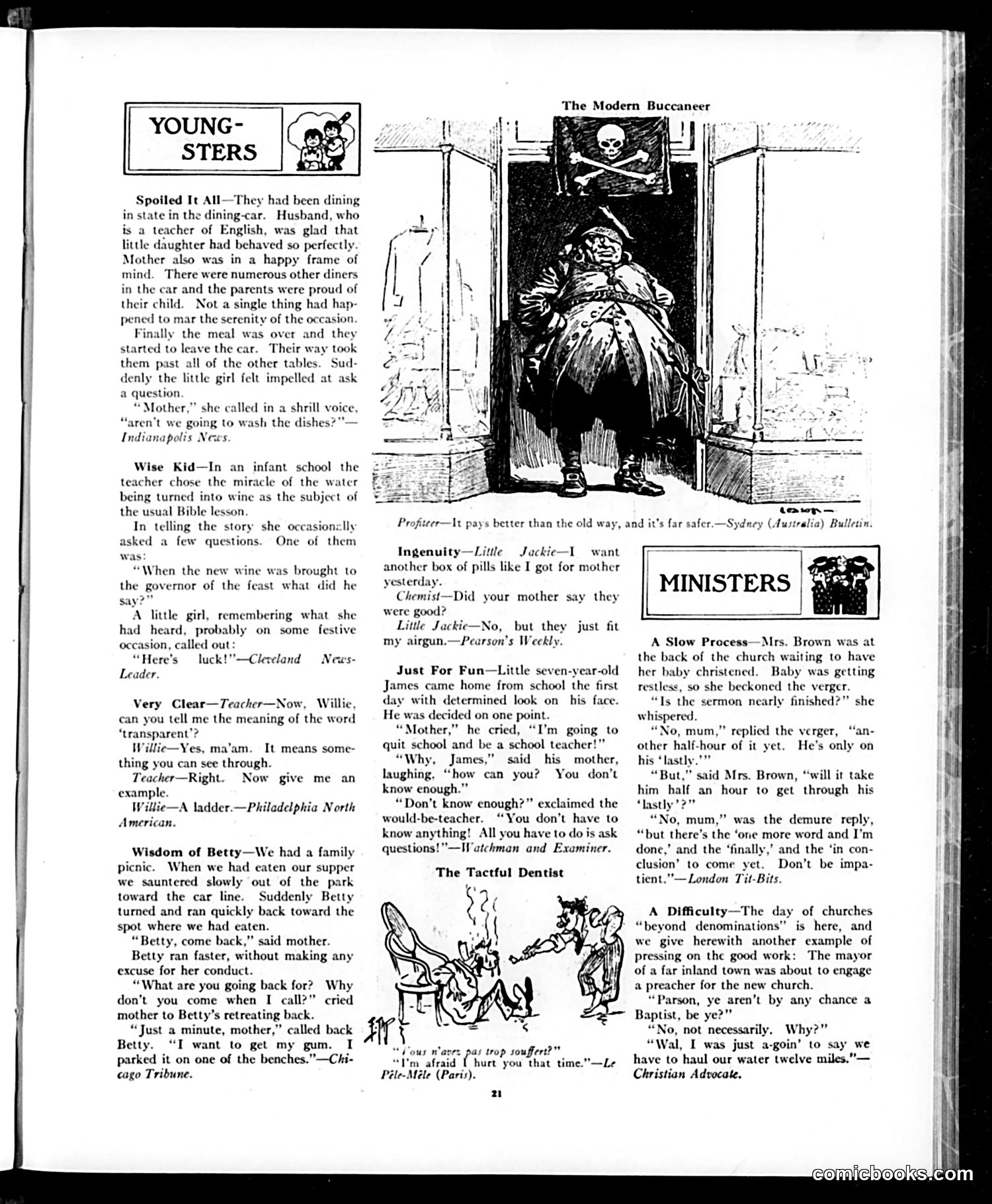
This page from *Judge* magazine contains several brief humorous anecdotes rather than a single political cartoon. The main illustrated piece, "The Modern Buccaneer," shows a skeletal pirate figure, likely representing contemporary commercial or medical exploitation. The surrounding short jokes satirize everyday American life: - "Spoiled It All" mocks a well-behaved child who embarrasses her parents by loudly asking about washing dishes in a dining car - "Wise Kid" jokes about a schoolgirl misinterpreting Biblical references through a secular lens - "Just For Fun" ridicules teachers as asking questions rather than requiring actual knowledge - "The Tactful Dentist" and "A Slow Process" target ministers' verbose sermons - "A Difficulty" satirizes rural Protestant concerns about water access The humor relies on children's innocent misstatements, class anxieties about public behavior, and gentle mockery of authority figures (teachers, clergy, doctors). These reflect early 20th-century middle-class preoccupations with propriety and education.
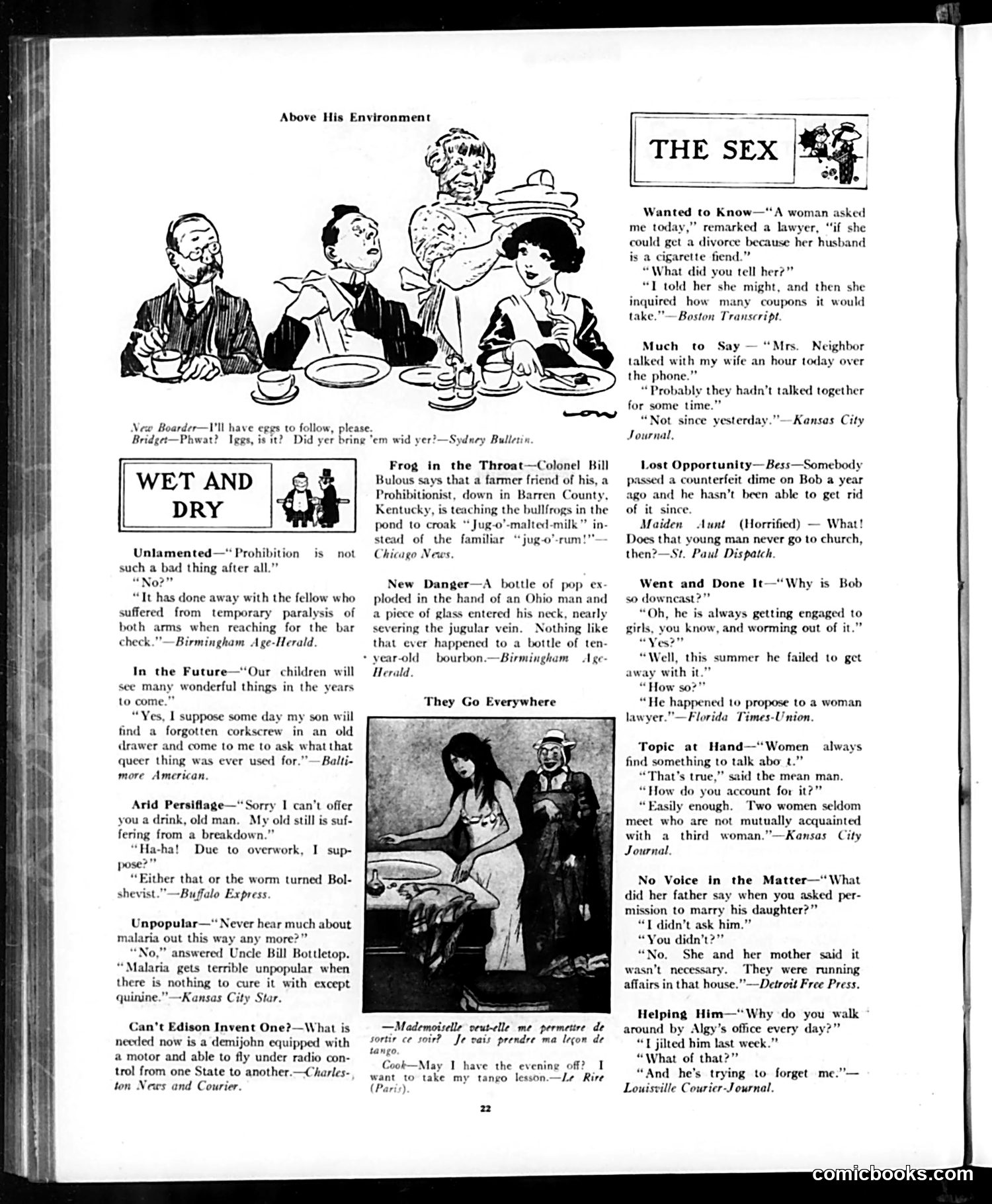
This page from Judge satirizes **Prohibition** (the nationwide ban on alcohol, 1920-1933) through multiple short jokes and a cartoon. The main cartoon, "Above His Environment," depicts a working-class Irish immigrant boarder ordering eggs from "Bridget" (a stereotypical Irish servant), highlighting class and ethnic humor common to the era. The "Wet and Dry" section collects anti-Prohibition quips mocking the law's effects: - People missing alcohol ("the worm turned Bolshevist") - A farmer teaching bullfrogs to croak "jug-o'-malted-milk" instead of "jug-o'-rum" - Nostalgia for pre-Prohibition drinking culture - Complaints about illegal stills breaking down The separate "Sex" column offers unrelated domestic humor about wives, engagements, and divorce. **Overall context:** Judge represents the urban, educated class skeptical of Prohibition, using humor to ridicule the policy's unpopularity and the public's continued desire for alcohol despite legal prohibition.
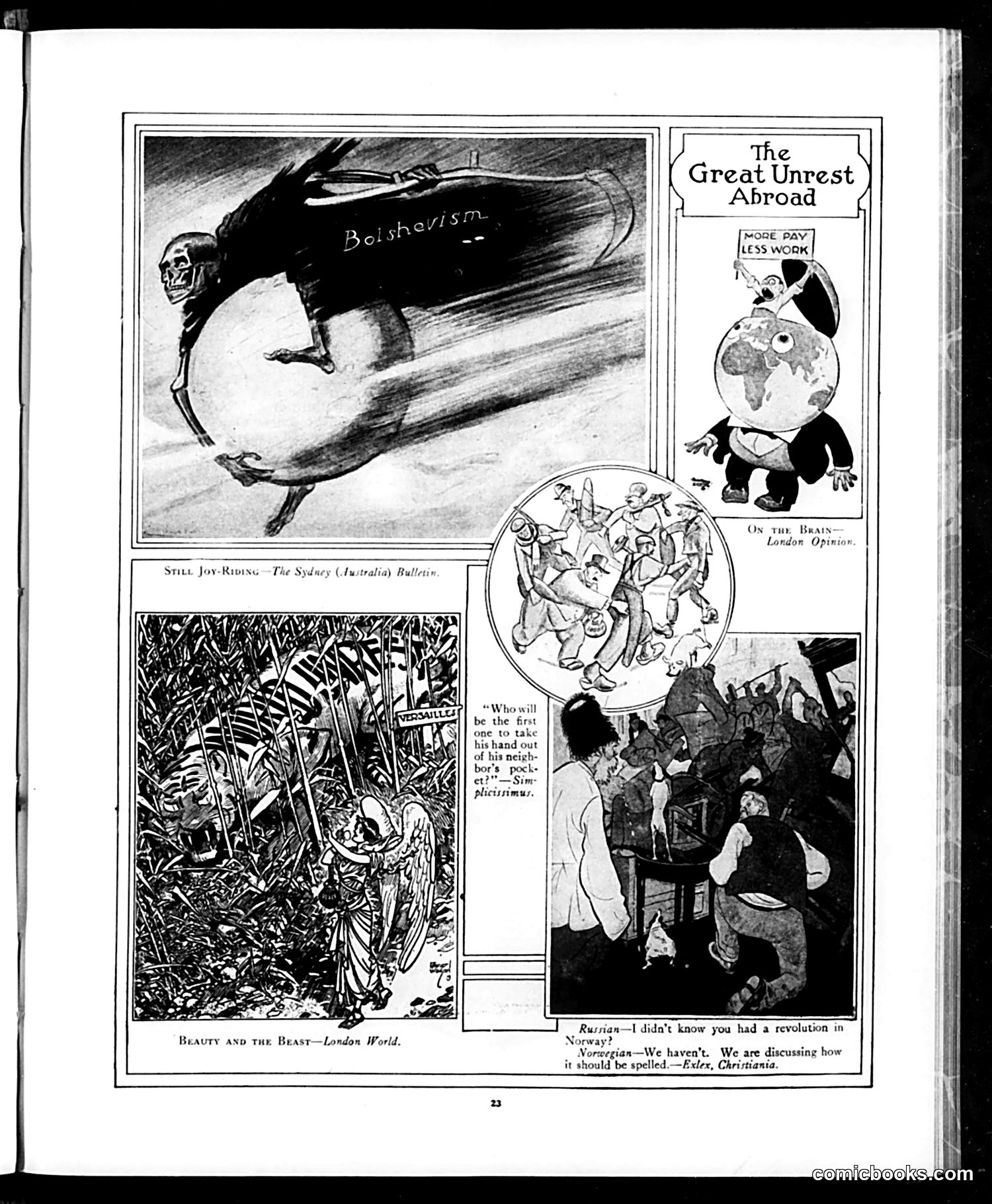
This page satirizes early 20th-century international labor unrest and socialist movements. The top-left panel depicts "Bolshevism" as a skeletal death figure riding a destructive wave—representing Western fears of the Russian Revolution spreading globally. "The Great Unrest Abroad" panel mocks anxieties about labor demands ("MORE PAY LESS WORK") destabilizing world order, shown as a businessman literally carrying the globe. The lower panels reference specific incidents: "Still Joy-Riding" from Sydney addresses Australian labor strikes; "Beauty and the Beast" appears to depict civil unrest. The bottom dialogue between a Russian and Norwegian satirizes how different nations were debating how to *spell* or define "revolution"—suggesting some European countries were discussing socialist movements theoretically while Russia was experiencing actual violent upheaval. The cartoon mocks European detachment from revolutionary reality.
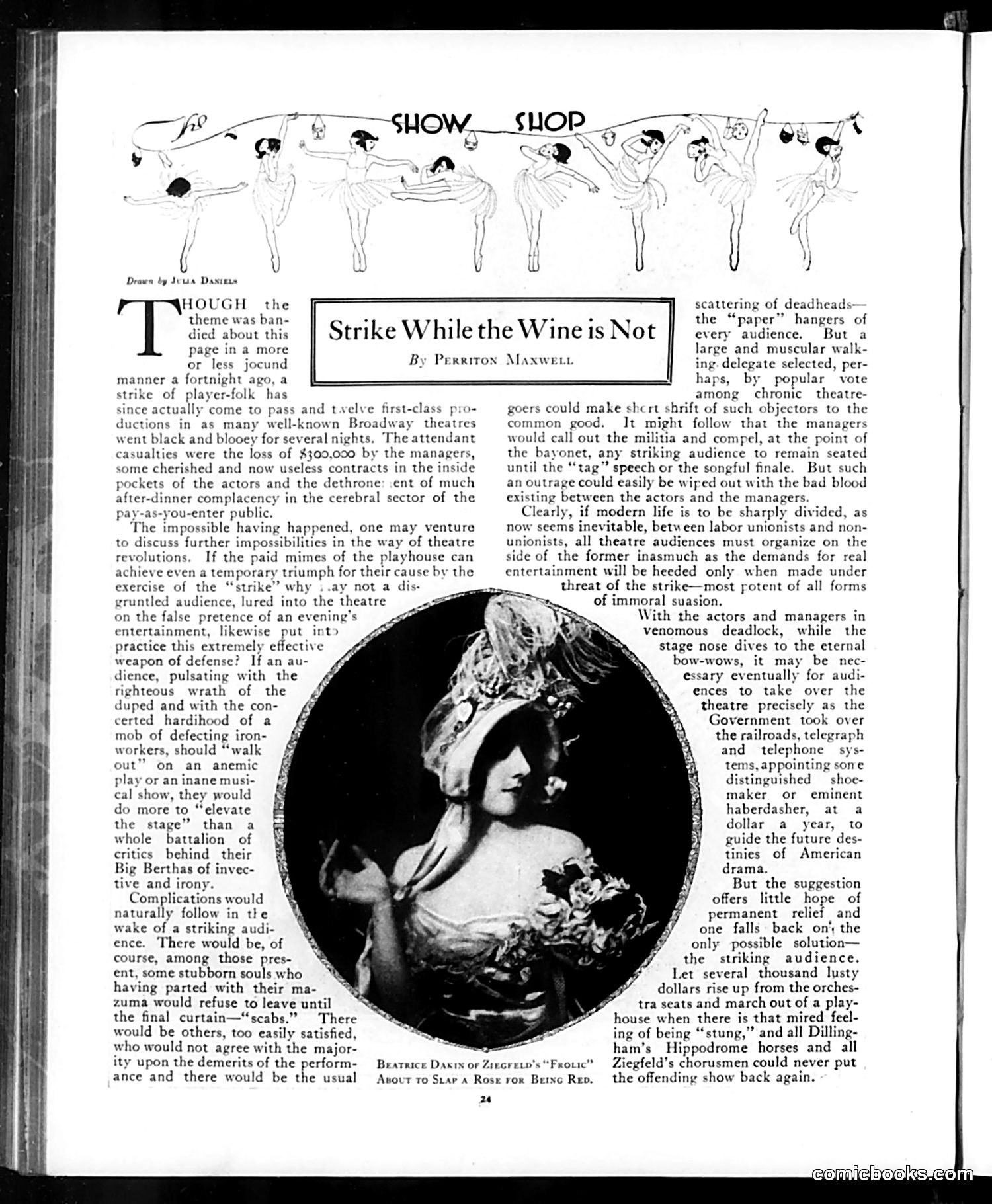
This 1919 Judge article satirizes the recent Broadway actors' strike by proposing an absurd solution: **audience strikes**. The piece mocks both labor unionism and theatrical management by suggesting that dissatisfied theatergoers should organize like unionized workers and "walk out" on bad shows—witholding their money as leverage, just as actors did. The accompanying illustration shows a female performer (likely referencing a popular actress, though the caption mentions Beatrice Dain in Ziegfeld's "Frolic"), representing the entertainment industry caught in labor disputes. The satire's logic: if actors can strike effectively, why not audiences? The author sarcastically escalates this to absurdity—suggesting the government might eventually regulate theatre like railroads, or that audience "scabs" would need union discipline enforced by delegates. The real target is the pretentiousness of both strikers and theatre management, presented through exaggerated reasoning. It's essentially saying the theatrical world's labor conflicts have become so ridiculous that even audiences should unionize.
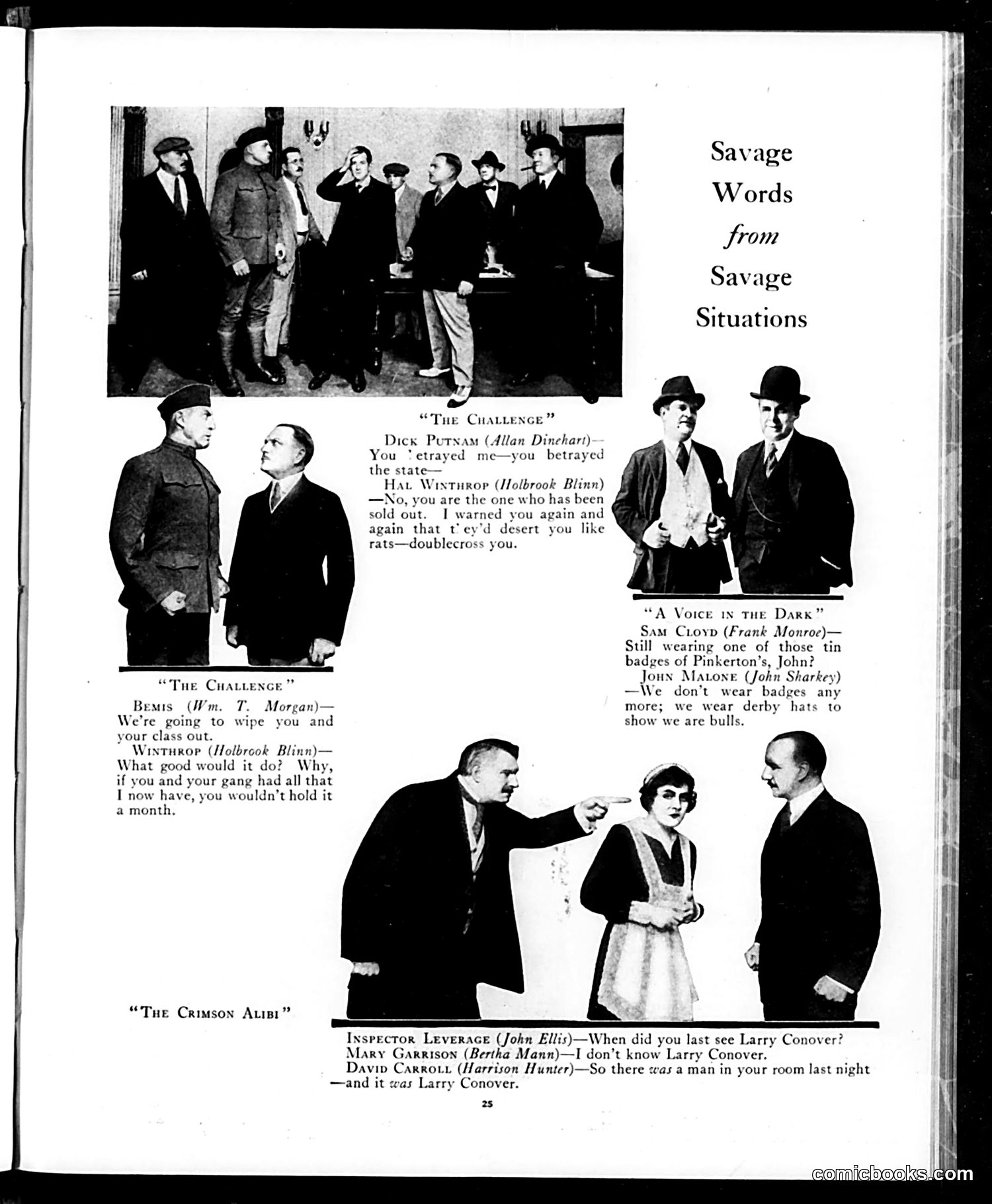
This page excerpts dialogue from what appear to be crime/detective films or plays from the silent or early sound era. The scenarios depict confrontations between criminals, police, and suspects—standard melodrama fare of the 1920s-30s. "The Challenge" shows gangsters threatening betrayal and double-crossing. "A Voice in the Dark" references Pinkerton detectives (private security/police). "The Crimson Alibi" depicts an interrogation where Inspector Leverage catches Mary Garrison in a lie about a mysterious nighttime visitor. The page's title—"Savage Words from Savage Situations"—frames these crime narratives as morality tales showcasing rough dialogue and criminal conduct. This likely appeared in *Judge* as entertainment commentary, possibly mocking the melodramatic conventions of contemporary crime dramas that were popular with audiences. The "savage" framing suggests both fascination with and moral disapproval of criminal underworld depictions.
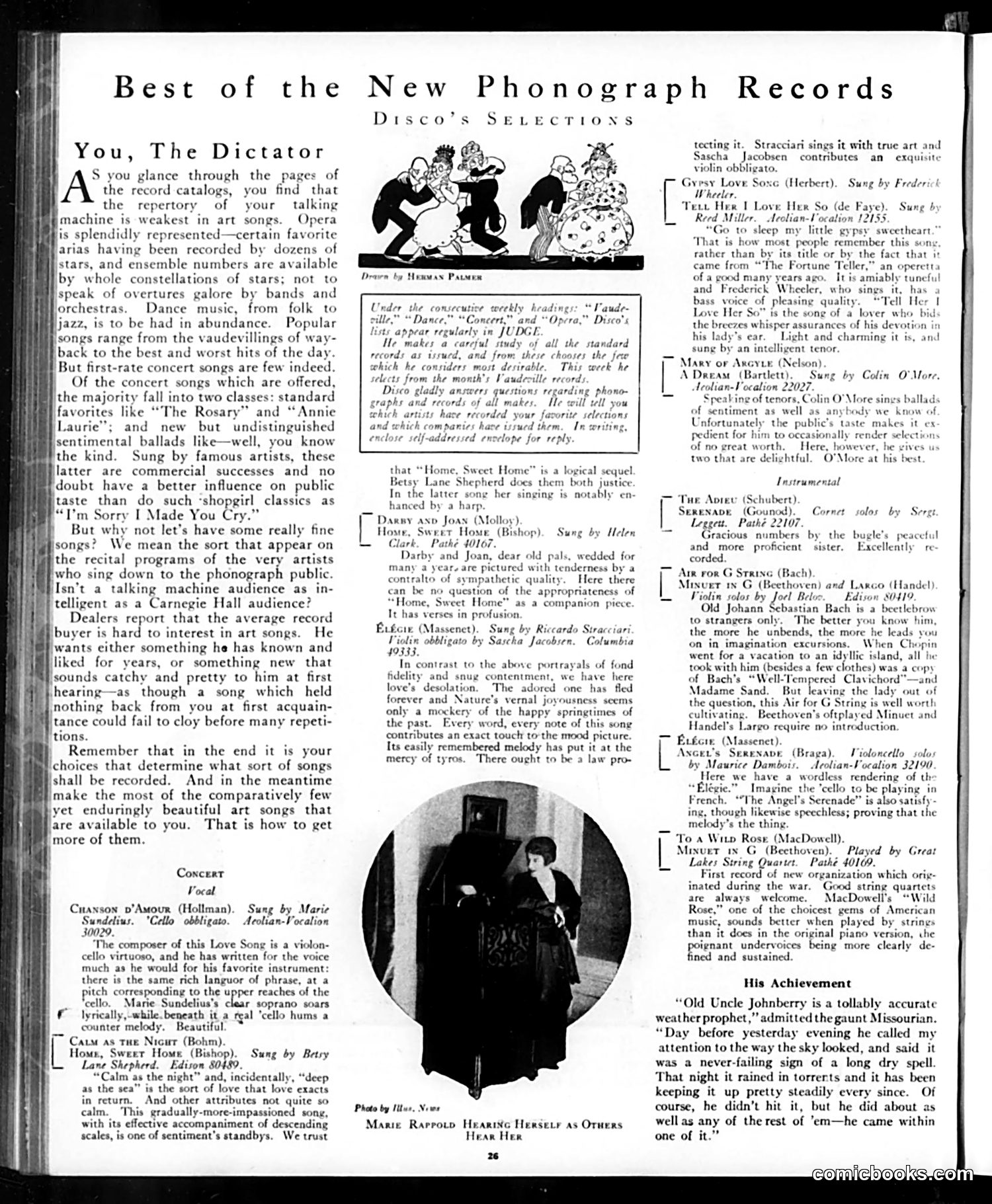
This page from *Judge* magazine features phonograph record reviews—essentially the era's equivalent of music criticism. The small cartoon at the top (credited "Drawn by Himan Peixotto") appears to satirize phonograph culture itself, showing figures examining or listening to records, likely mocking the pretensions of consumers who buy classical records to appear cultured. The page's main content is editorial commentary disguised as record reviews. The author criticizes the phonograph industry for flooding the market with *opera* and dance music while neglecting "art songs"—serious concert pieces. He's poking fun at average record buyers as unsophisticated ("shopgirl classics"), yet simultaneously complaining that phonograph audiences are *less* intelligent than Carnegie Hall attendees. The satire is subtle: *Judge* is mocking both the recording industry's commercialism and the snobbish pretensions of music critics who dismiss popular taste. The reference to songs like "I'm Sorry I Made You Cry" suggests that listeners want emotional, accessible music—not the high-art repertoire critics insist they *should* want.
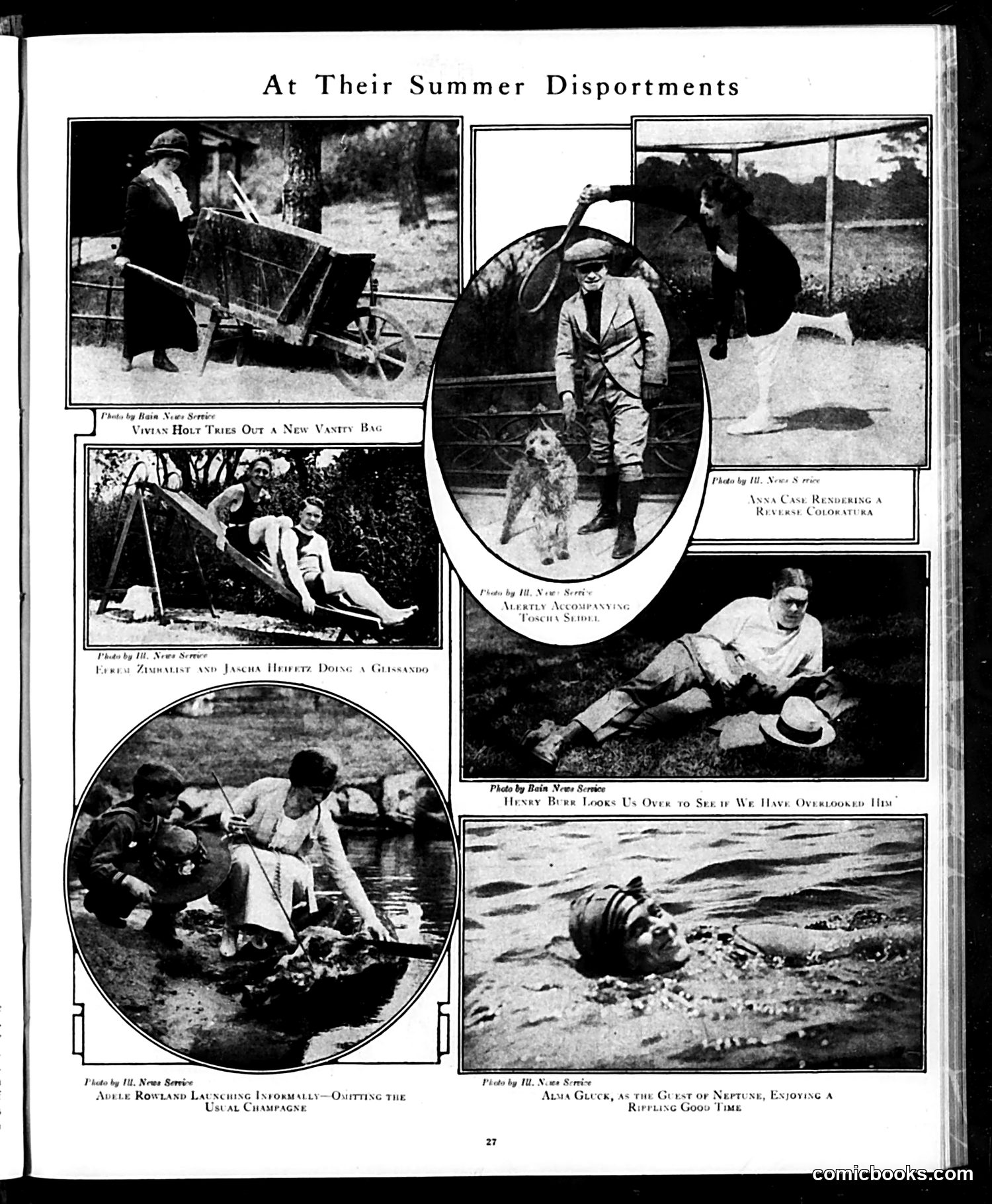
This page from Judge magazine features celebrity candid photographs labeled with humorous captions about summer leisure activities. The images show what appear to be early 20th-century entertainers and public figures engaged in recreational pursuits—trying new fashion items, posing with dogs, relaxing outdoors, swimming, and champagne drinking. The satire is gentle and lighthearted rather than political: it mocks the leisure habits and vanities of the wealthy and famous during summer vacation. The formal captions ("Vivian Holt Tries Out a New Vanity Bag," "Henry Burr Looks Us Over") juxtapose dignified phrasing with mundane or silly activities, creating humor through the contrast between elevated language and ordinary behavior. The overall effect is social comedy targeting celebrity culture and upper-class summer customs.
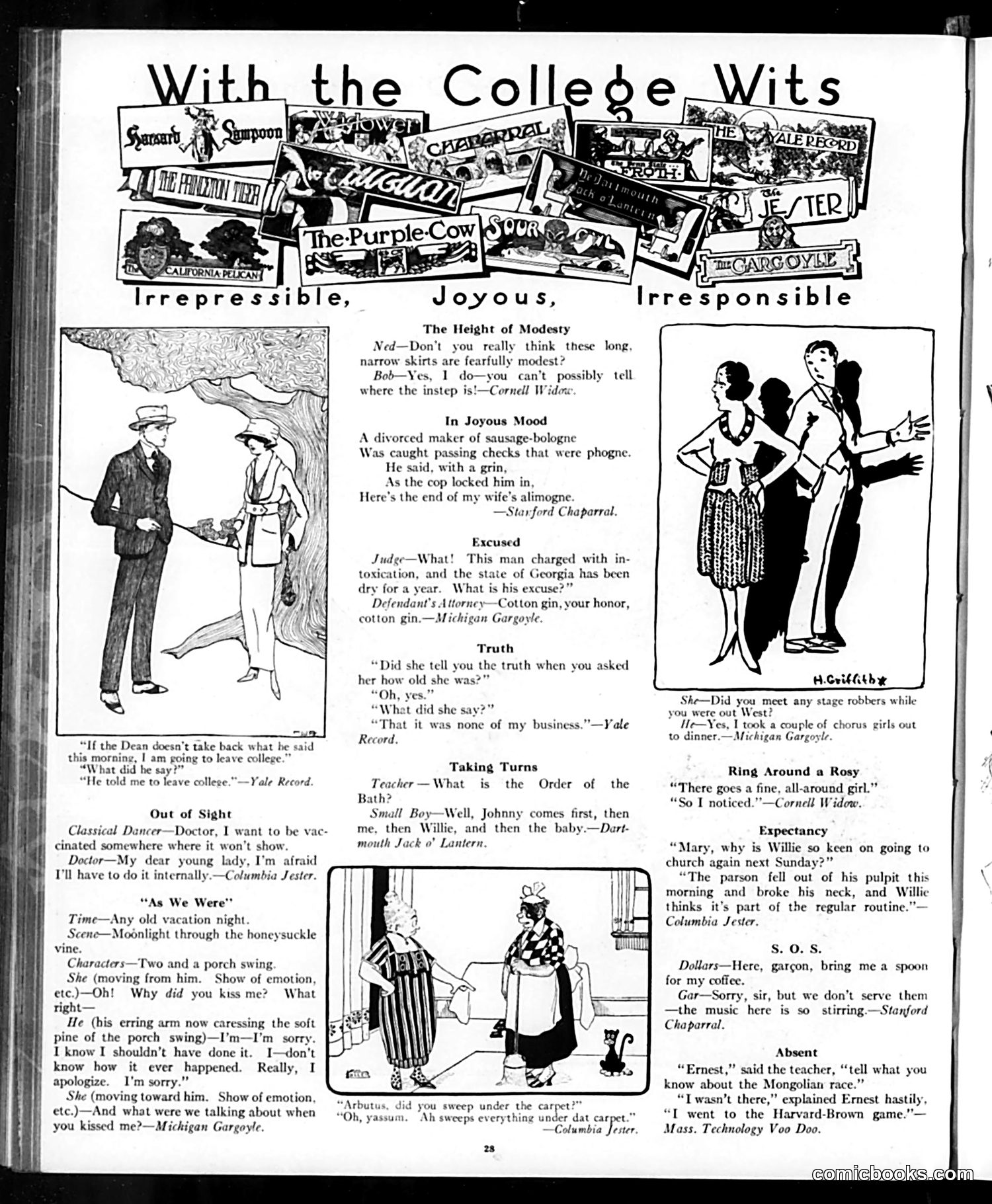
This page collects brief jokes from various college humor magazines (Yale Record, Columbia Jester, Michigan Gargoyle, etc.), a common practice in Judge magazine. The humor reflects early 20th-century college life and social attitudes: **Key themes:** - **Dating/romance**: Porch-swing seductions, kissing transgressions, and men pursuing women - **Student behavior**: Skipping class ("I went to the Harvard-Brown game"), drinking (Prohibition-era references), and general misbehavior - **Social pretension**: A woman feigning modesty about vaccination location; attempts at sophistication that backfire - **Gender attitudes**: Women as romantic objects; jokes about feminine dishonesty regarding age **The satire targets** college students themselves—their romantic fumbling, academic indifference, and mock-serious attempts at wit. There are no political figures or events; this is purely social satire aimed at collegiate audiences of the era, featuring the knowing, somewhat risqué humor considered daring for campus publications.
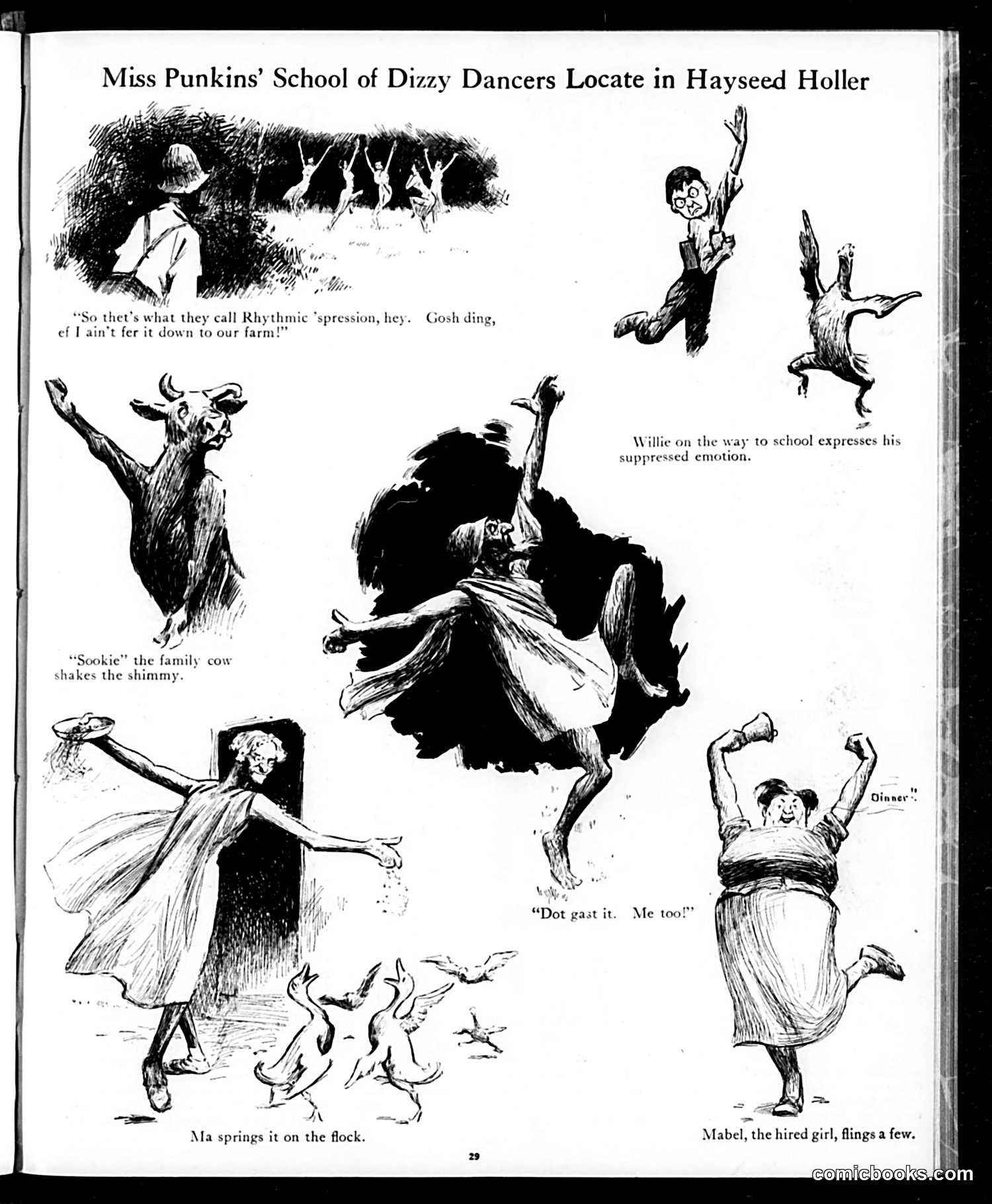
This satirical cartoon mocks the 1920s dance craze—specifically the "shimmy" and modern "rhythmic expression"—by depicting rural, unsophisticated farm people attempting to adopt urban dance fads. The humor relies on **class and cultural contrast**: a farmer dismisses modern dance as strange ("Rhythmic 'spression"), yet his entire family—including the hired girl Mabel, the cow "Sookie," and even young Willie—enthusiastically adopt these "dizzy" moves. The exaggerated, awkward postures emphasize their unfamiliarity with urban sophistication. "Hayseed Holler" (rural slang) and the rustic dialect underscore the satirical target: rural Americans eagerly consuming metropolitan trends without understanding them. The page mocks both rural naïveté and the absurdity of the dance fads themselves—presenting modern dance culture as contagiously ridiculous enough to spread even to farm animals.
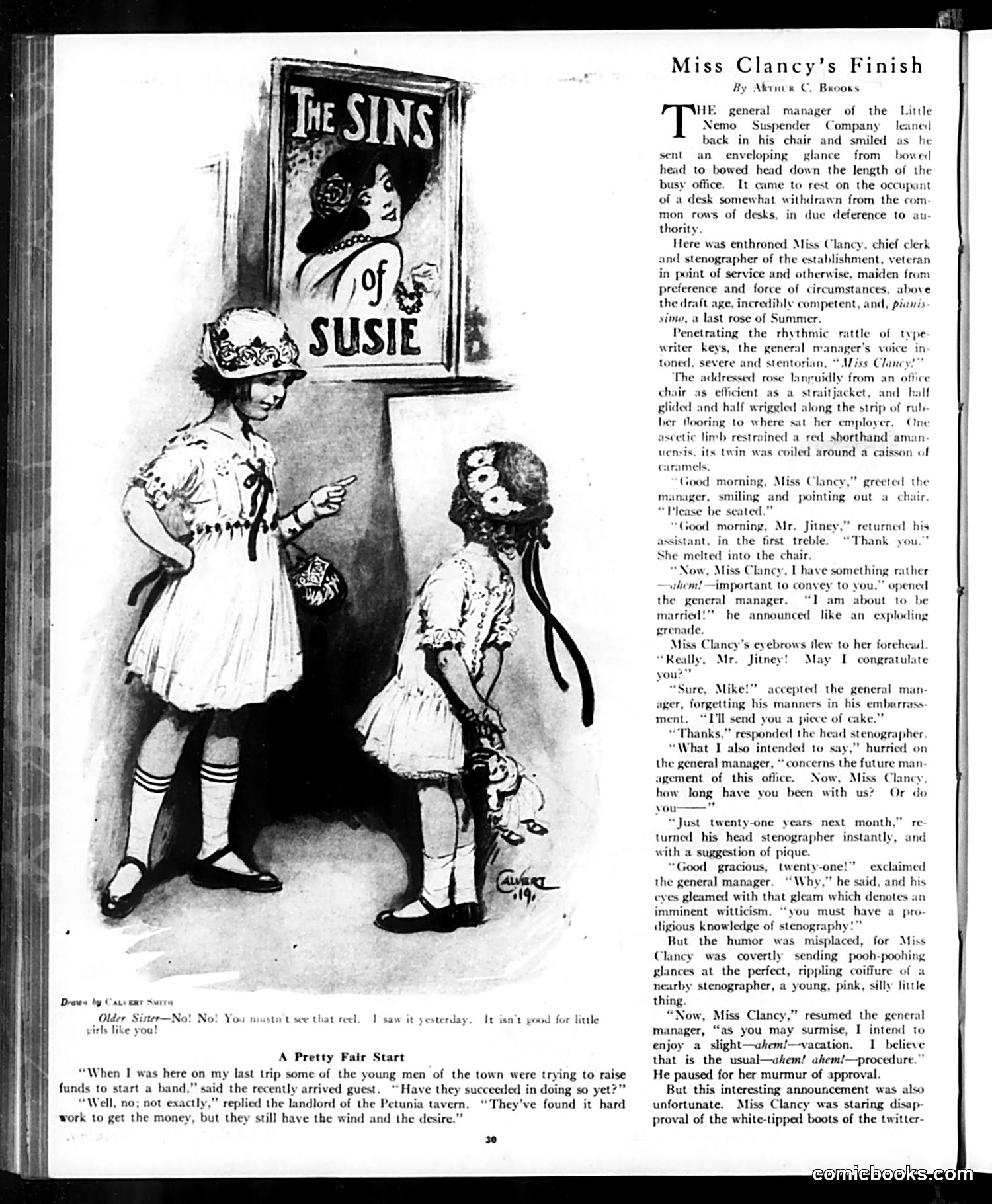
This page contains two separate pieces from *Judge* magazine: **"A Pretty Fair Start"** (top): A brief joke about small-town ambition. Young men want to start a brass band but lack funds; a tavern keeper notes they have "wind and the desire"—a pun on their literal need for wind instruments and their figurative enthusiasm. **"Miss Clancy's Finish"** (main story): A satirical short story about office dynamics. Miss Clancy is a long-serving, unmarried stenographer (secretary) at a suspender company. When her boss announces his upcoming marriage and vacation, implying she'll manage the office, she's visibly unimpressed—distracted instead by judging a younger, prettier coworker's fashion choices (her "rippling coiffure" and "white-tipped boots"). The satire mocks female office workers' cattiness and vanity, while also depicting the era's rigid workplace hierarchies and spinster stereotypes.
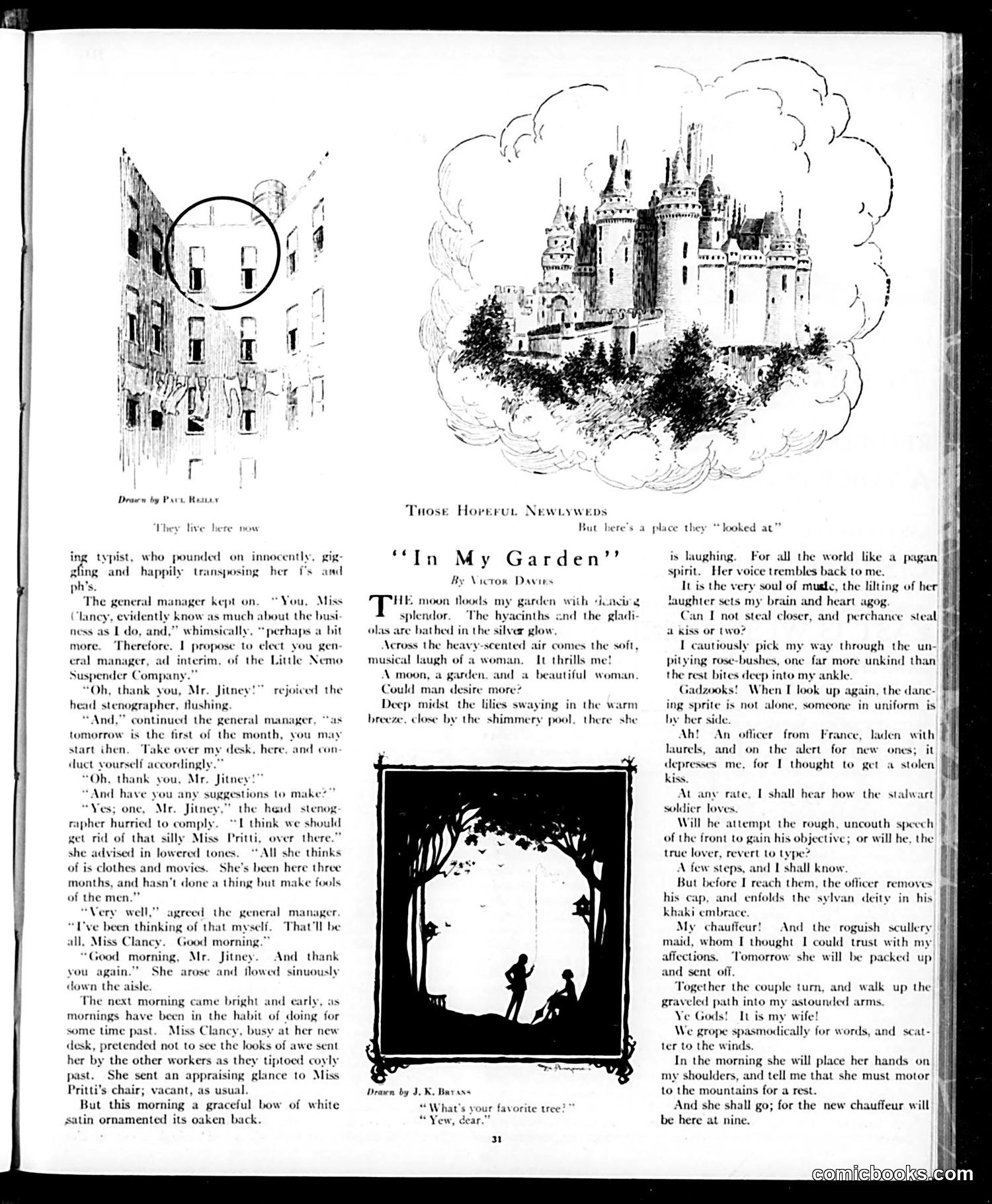
This page contains two separate short stories with illustrations: **Left side**: A workplace narrative about Miss Clancy, a typist promoted to temporary general manager of a suspender company. She immediately recommends firing Miss Pritti, a coworker she views as frivolous and man-distracting. The satire mocks workplace dynamics and female competition—Clancy uses her new authority to eliminate a rival, suggesting that women in power may replicate the same office politics they themselves face. The implication is cynical about female solidarity in professional settings. **Right side**: "In My Garden" is a romantic poem with dark comic twist. A man attempts to seduce a beautiful woman in moonlight, but discovers she's with a French officer. The punchline: the officer is his own chauffeur, and the woman is his wife. The satire targets infidelity and the narrator's casual assumption of seduction rights, undermined by his wife's own affairs. Both pieces use romantic/workplace scenarios to satirize contemporary social hypocrisy and gender dynamics in early 20th-century America.
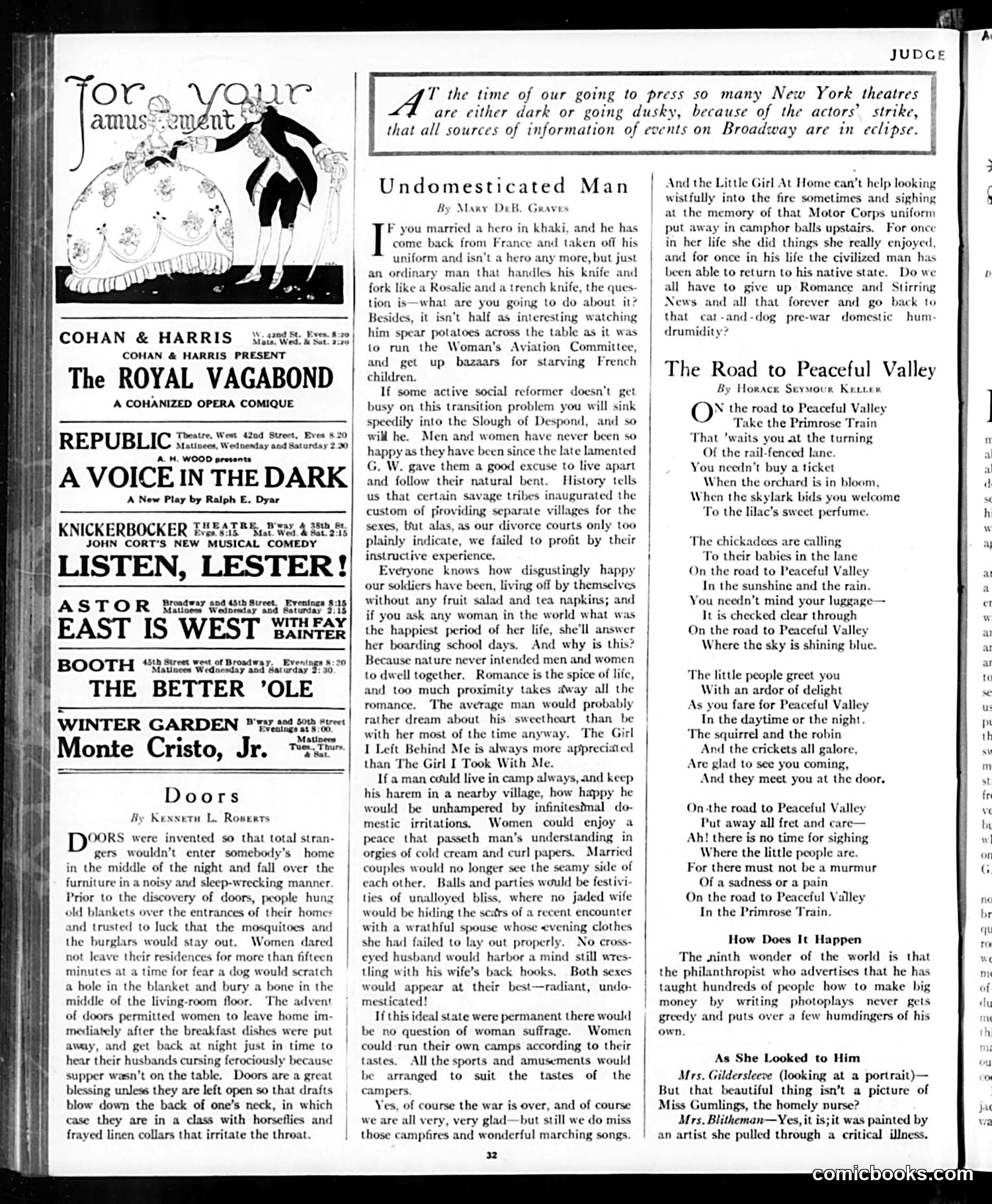
This page is primarily **theatrical advertising** with accompanying satirical commentary and fiction. The cartoon at top-left is a simple decorative vignette showing a silhouetted couple in formal dress. The substantive content includes: **"Undomesticated Man"** by Mary DeB. Graves satirizes post-WWI domestic adjustment. It mocks wives struggling when soldier-husbands returned from France, no longer heroic figures but ordinary men. The piece critiques how women found wartime roles (aviation committees, bazaars) more fulfilling than peacetime domesticity, arguing humorously that men and women were happier living separately—referencing "savage tribes" with segregated villages and modern divorce courts as evidence that cohabitation is unnatural. **"Doors"** by Kenneth L. Roberts offers mock-serious humor about door invention, presenting them ironically as women's liberation (allowing them to leave home) while also enabling domestic frustration. The page mostly showcases Broadway theaters advertising productions like "The Royal Vagabond" and "East is West," reflecting the actors' strike mentioned in the header that darkened New York stages.
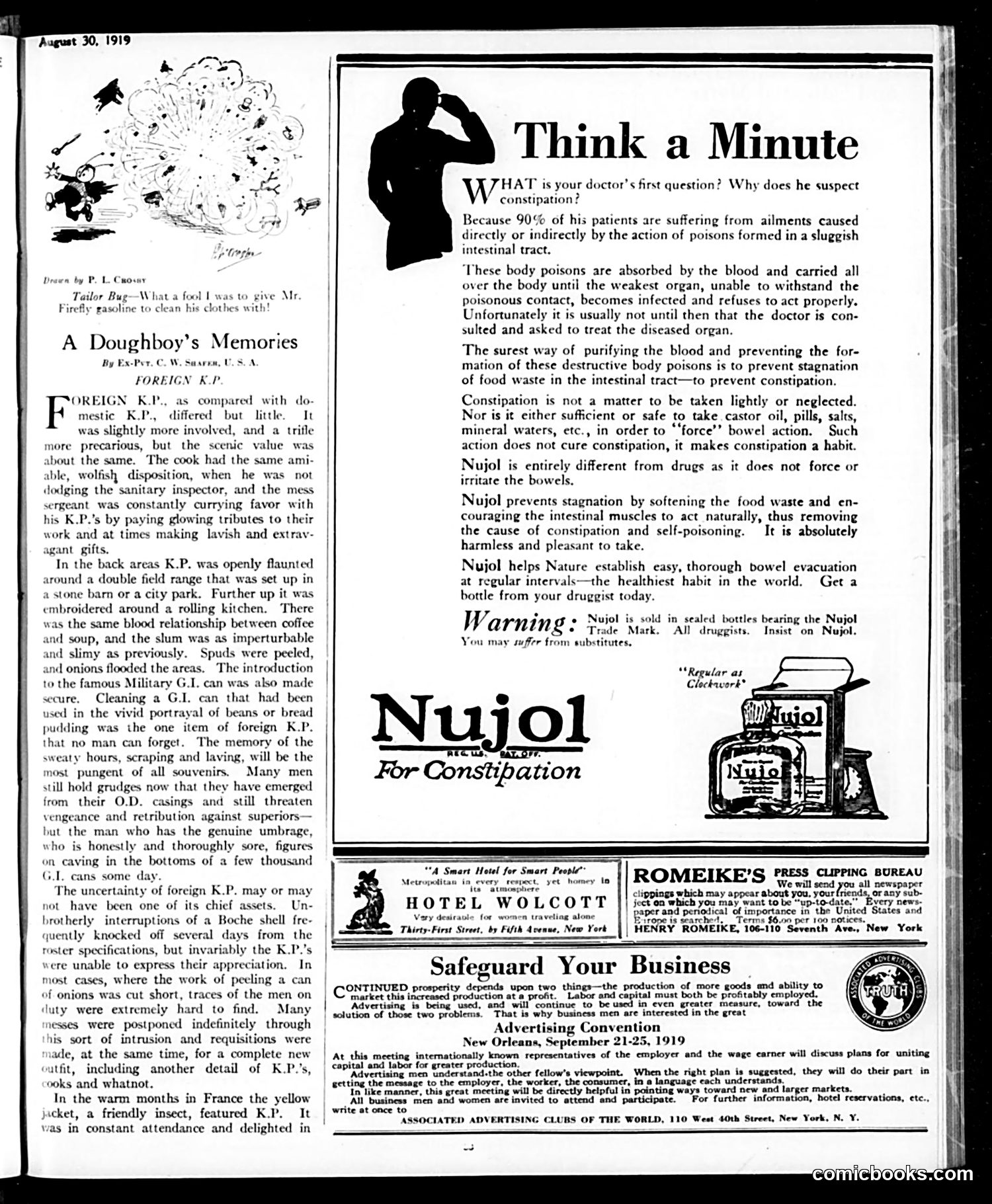
This page mixes editorial content with advertising typical of Judge magazine (August 30, 1919). **Left side:** "A Doughboy's Memories" is a humorous firsthand account by a WWI soldier about Kitchen Police (K.P.) duty—the unglamorous work of cleaning mess equipment. The author compares foreign K.P. duty to domestic versions, emphasizing the infamous difficulty of scrubbing G.I. cans (metal mess kits) used for beans and pudding. The tone is wry nostalgia, poking fun at military life's indignities. The small cartoon above shows a "Tailor Bug" making a joke about using gasoline to clean clothes. **Right side:** A large advertisement for "Nujol" laxative dominates, framed as health advice. The ad warns that constipation causes 90% of ailments and promotes Nujol as a gentle alternative to harsh purgatives—reflecting early 20th-century medical obsessions with intestinal "self-poisoning." The juxtaposition is typical of Judge: satirical soldier humor alongside patent medicine marketing aimed at the same readership.
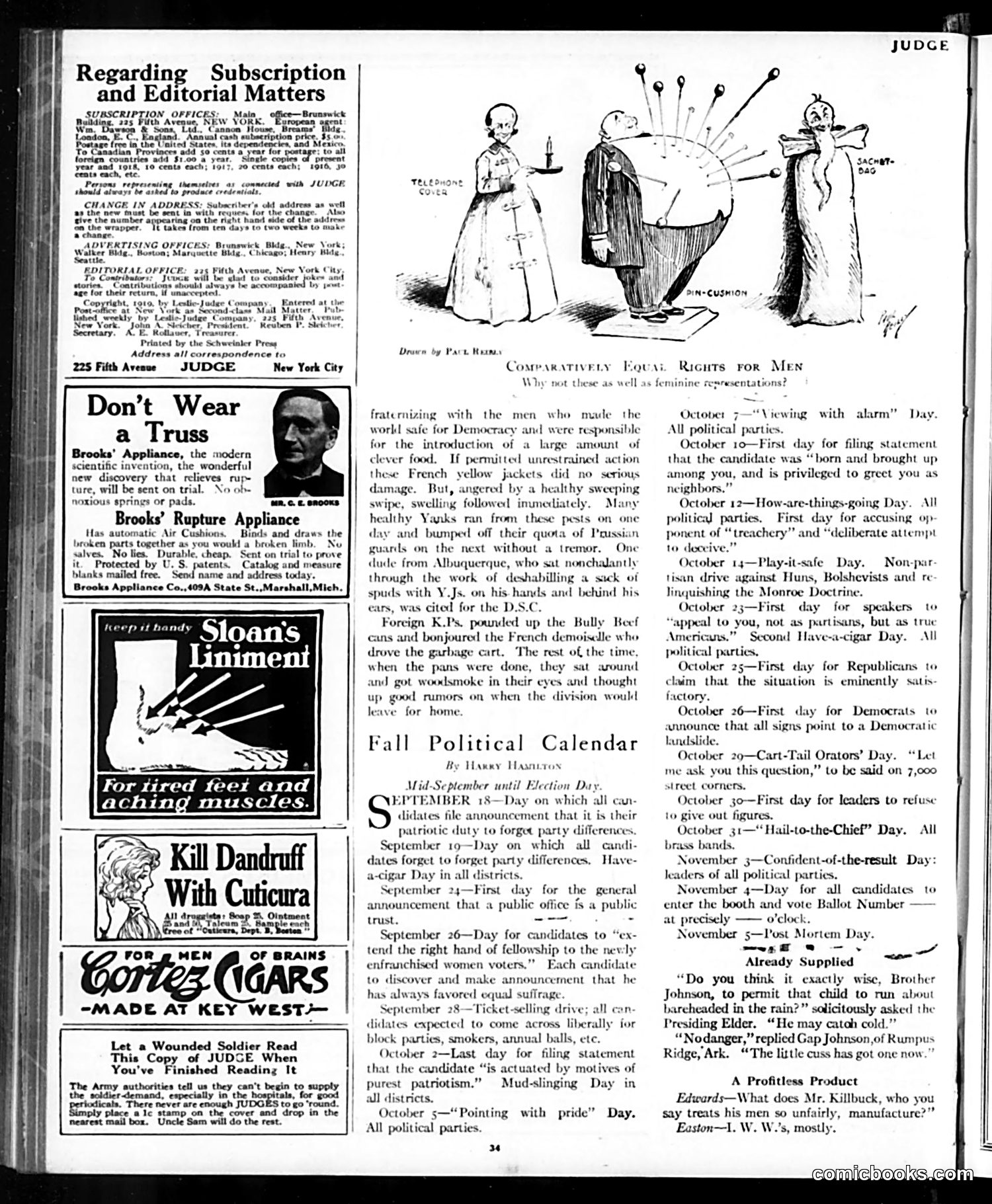
This page from Judge contains satirical political commentary centered on a "Fall Political Calendar" by Harry Hamilton. The calendar mocks election-season political rituals between September and November, listing absurd "observance days" that exaggerate typical campaign behaviors. The cartoon at top, drawn by Cesare, depicts three figures labeled "Telephone Girl," "In-Cushion," and "Short-Bag"—appearing to represent different voting constituencies or political interests being manipulated like puppets on strings by unseen forces above. The calendar itself satirizes politicians' predictable, hypocritical cycle: candidates announcing patriotic motives (Sept 18), immediately abandoning them (Sept 19), courting newly enfranchised women voters (Sept 26), and engaging in mudslinging (Oct 2). Events like "Viewing with Alarm Day" mock performative partisan outrage. The surrounding advertisements (Brooks Appliance, Sloan's Liniment, Cortez Cigars) are period commercial content unrelated to satire. This reflects Judge's consistent mockery of American political theater and campaign season duplicity.
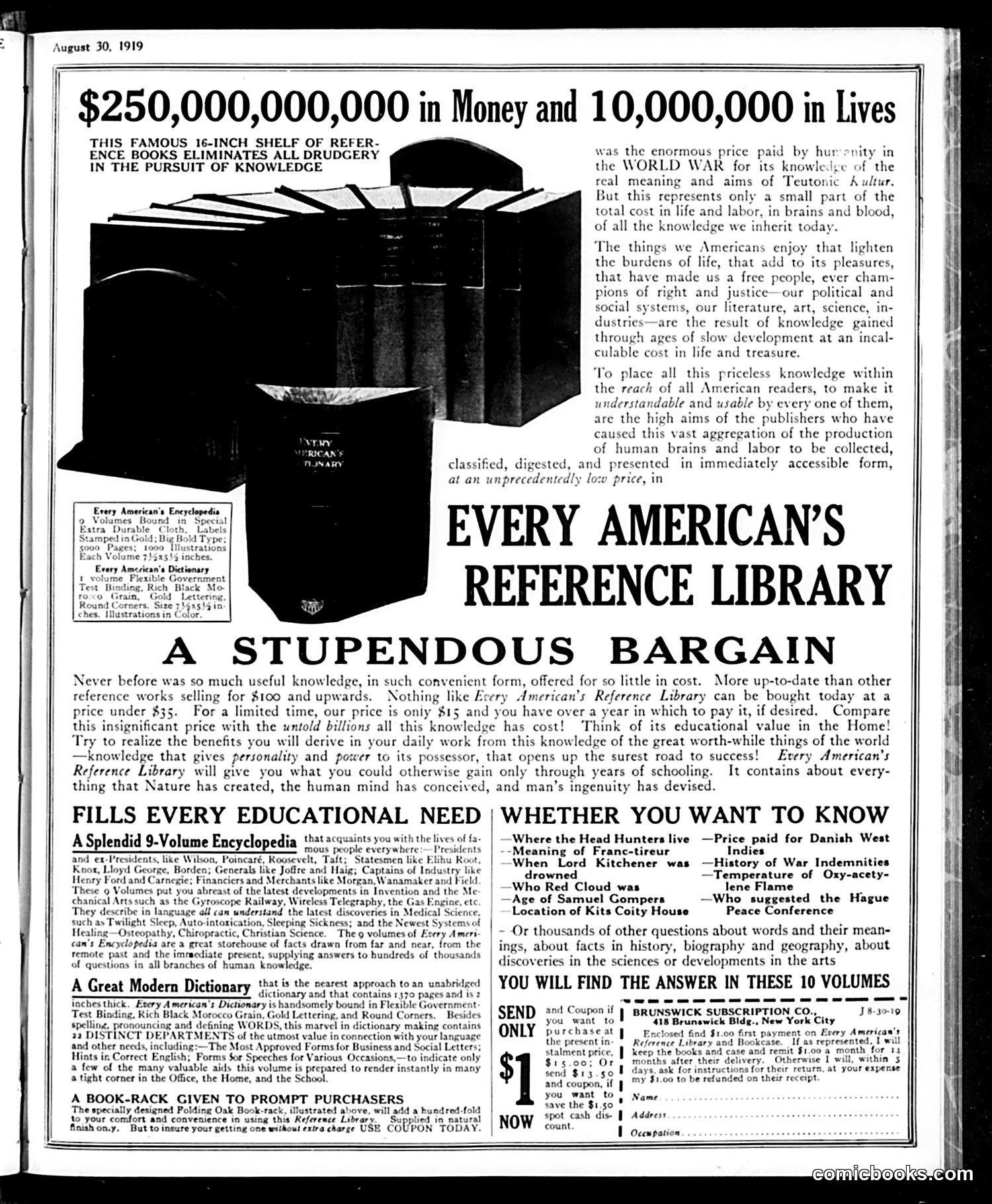
This is primarily a **full-page advertisement**, not political satire, though it uses WWI rhetoric persuasively. The ad promotes a 10-volume encyclopedia set priced at $15 (payable over a year). Its opening statement—"$250,000,000,000 in Money and 10,000,000 in Lives"—references the **enormous cost of World War I** (which ended in 1918, one year before this August 1919 publication). The advertisement argues that Americans inherited priceless knowledge through historical sacrifice and bloodshed, and now this encyclopedia makes that accumulated wisdom democratically accessible to ordinary citizens at bargain price. It's essentially using patriotic, post-WWI sentiment to sell educational products by framing knowledge acquisition as honoring those who died for American civilization. The rhetoric conflates military sacrifice with intellectual heritage to justify the product's value proposition to middle-class readers.
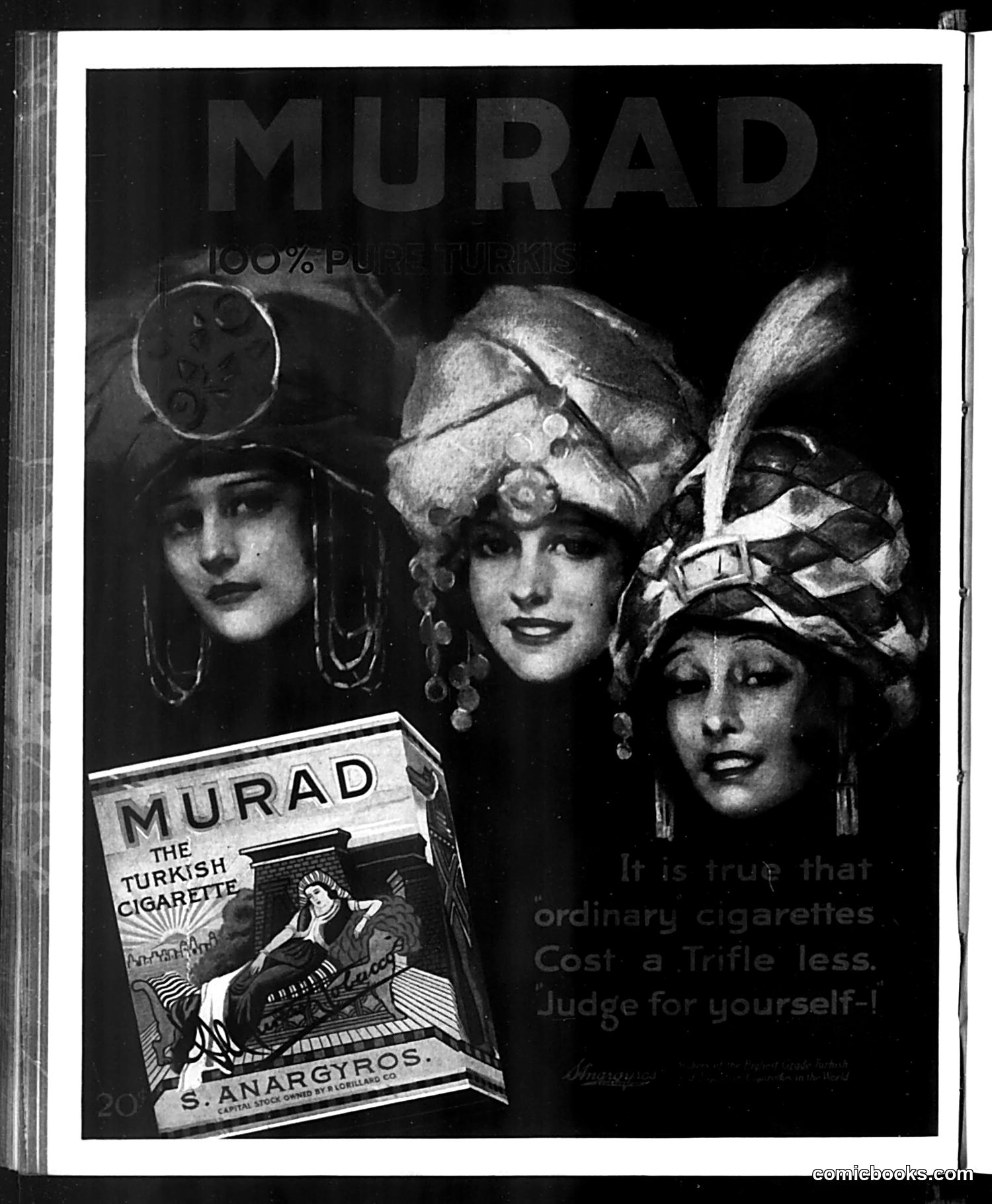
This is a **cigarette advertisement**, not political satire. The page promotes Murad brand Turkish cigarettes, marketed as "100% Pure Turkis" (Turkish). Three women in exotic costume—featuring turbans, veils, and ornate headpieces—embody an "Oriental" aesthetic popular in 1920s advertising. The styling evokes Orientalist fantasy rather than authentic Turkish culture. The sales pitch claims: "It is true that ordinary cigarettes cost a trifle less. Judge for yourself!" This positions Murad as a premium product justifying higher prices through quality and prestige. The exotic imagery was a common marketing strategy of the era, using foreign/non-Western aesthetics to make products seem luxurious and desirable to American consumers. The advertisement exploits period stereotypes about "the Orient" to sell cigarettes.