
Judge, 1919-08-30 · page 11 of 36
Judge — August 30, 1919 — page 11: what you’re looking at
What you’re looking at
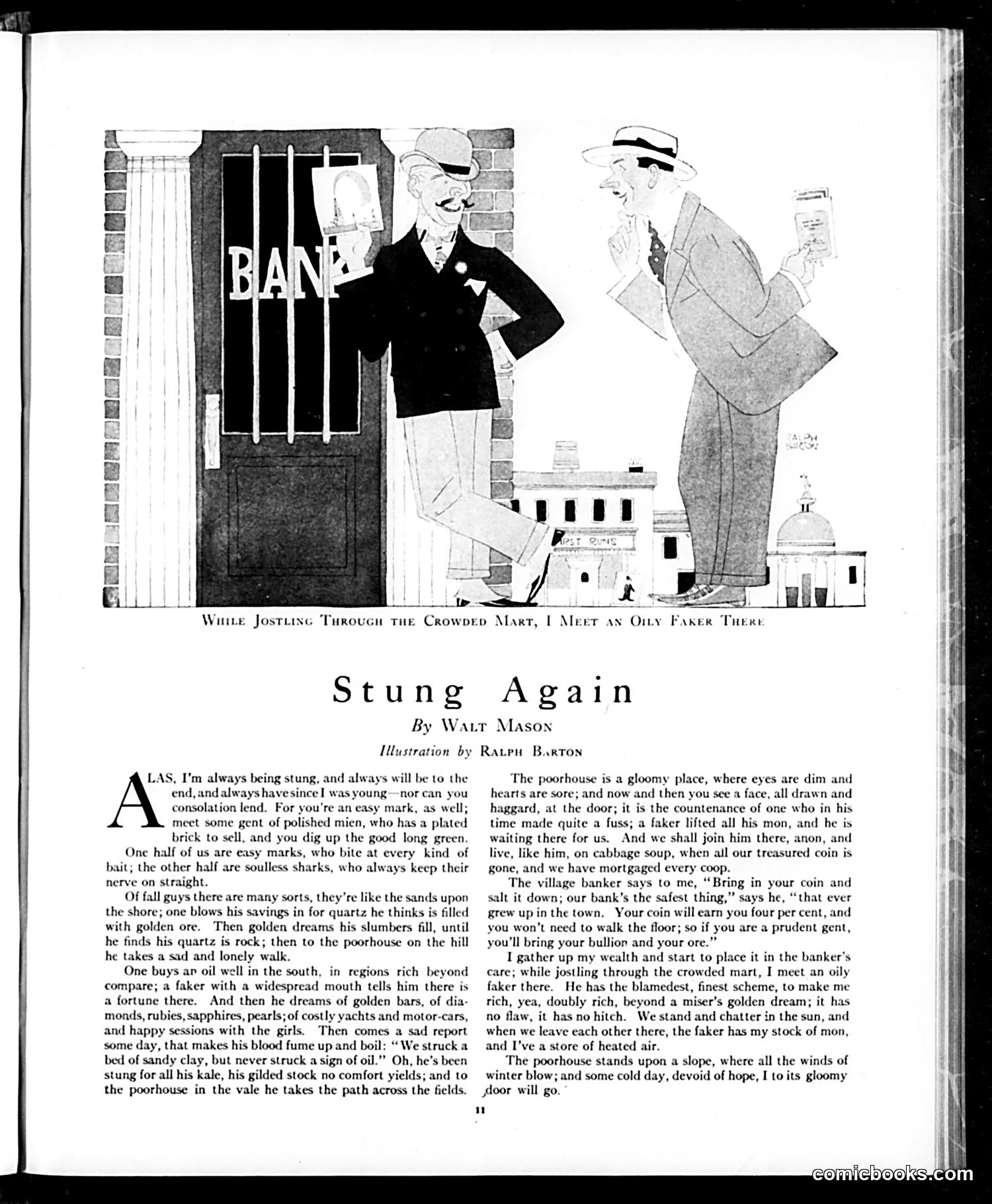
This piece satirizes the vulnerability of ordinary people to con artists and financial schemes. The illustration shows a banker at his locked bank door meeting a well-dressed "oily faker" (con man) on the street, with a capitol building visible—suggesting corruption reaches institutional levels. The story, by Walt Mason, describes how gullible citizens are repeatedly swindled: some invest in fake gold ore or oil wells, lose everything, and end up in the poorhouse. The narrator himself plans to deposit savings with a banker for safety, but encounters a smooth-talking faker in the marketplace who convinces him into a fraudulent scheme, leaving him with "heated air" instead of wealth. The satire's point: both bankers and street-level con artists exploit the working class equally. The inevitable destination for victims is the poorhouse—a damning commentary on economic vulnerability and institutional failure to protect ordinary people.
📄 Transcribed text from this page (OCR, searchable)
Machine-transcribed from the original scan — historical spelling and the odd misread are preserved.
in Wuite Jostiixc Turoucu tue Crowneo Mart, | Meer an Oiry FaKer Puere Stung Again By War Mason Ilustration by Rateu Barton LAS, I'm always being stung, and always will be to the end, and always have since I was young—nor can you consolation lend. For you're an easy as well; meet some gent of polished mien, who has a plated brick to sell, and you dig up the good long green. One half of us are easy marks, who bite at every kind of bait; the other half are soulless sharks, who always keep their nerve on straight. Of fall guys there are many sorts, they’re like the sands upon the shore; one blows his savings in for quartz he thinks is filled with golden ore. Then golden dreams his slumbers fill, until he finds his quartz is rock; then to the poorhouse on the hill he takes a sad and lonely walk. One buys ap oil well in the south, in regions rich beyond compare; a faker with a widespread mouth tells him there is a fortune there. And then he dreams of golden bars, of dia- monds, rubies, sapphires, pearls; of costly yachts and motor-cars, and happy sessions with the girls. Then comes a sad report some day, that makes his blood fume up and boil: “ We struck a bed of sandy clay, but never struck a sign of oil.” Oh, he’s been stung for all ale, his gilded stock no comfort yields; and to the poorhouse in the vale he takes the path across the fields. The poorhouse is a gloomy place, where eyes are dim and hearts are sore; and now and then you see a face, all drawn and haggard, at the door; it is the countenance of one who in his ime made quite a fuss; a faker lifted all his mon, and he is ing there for us. And we shall join him there, anon, and ike him, on cabbage soup, when all our treasured coin is ¢ have mortgaged every coop. lage banker says to me, “Bring in your coin and salt it down; our bank’s the safest thing,” says he, “that ever grew up in the town, Your coin will earn you four per cent, and you won’t need to walk the floor; so if you are a prudent gent, you'll bring your bullion and your ore.” I gather up my wealth and start to place it in the banker’s care; while jostling through the crowded mart, I meet an oily faker there. He has the blamedest, finest scheme, to make me doubly rich, beyond a miser’s golden dream; it has y, it has no hitch. We stand and chatter in the sun, and when we leave each other there, the faker has my stock of mon, and I've a store of heated air. The poorhouse stands upon a slope, where all the winds of winter blow; and some cold day, devoid of hope, I to its gloomy Moor will go.