
Judge, 1919-08-30 · page 32 of 36
Judge — August 30, 1919 — page 32: what you’re looking at
What you’re looking at
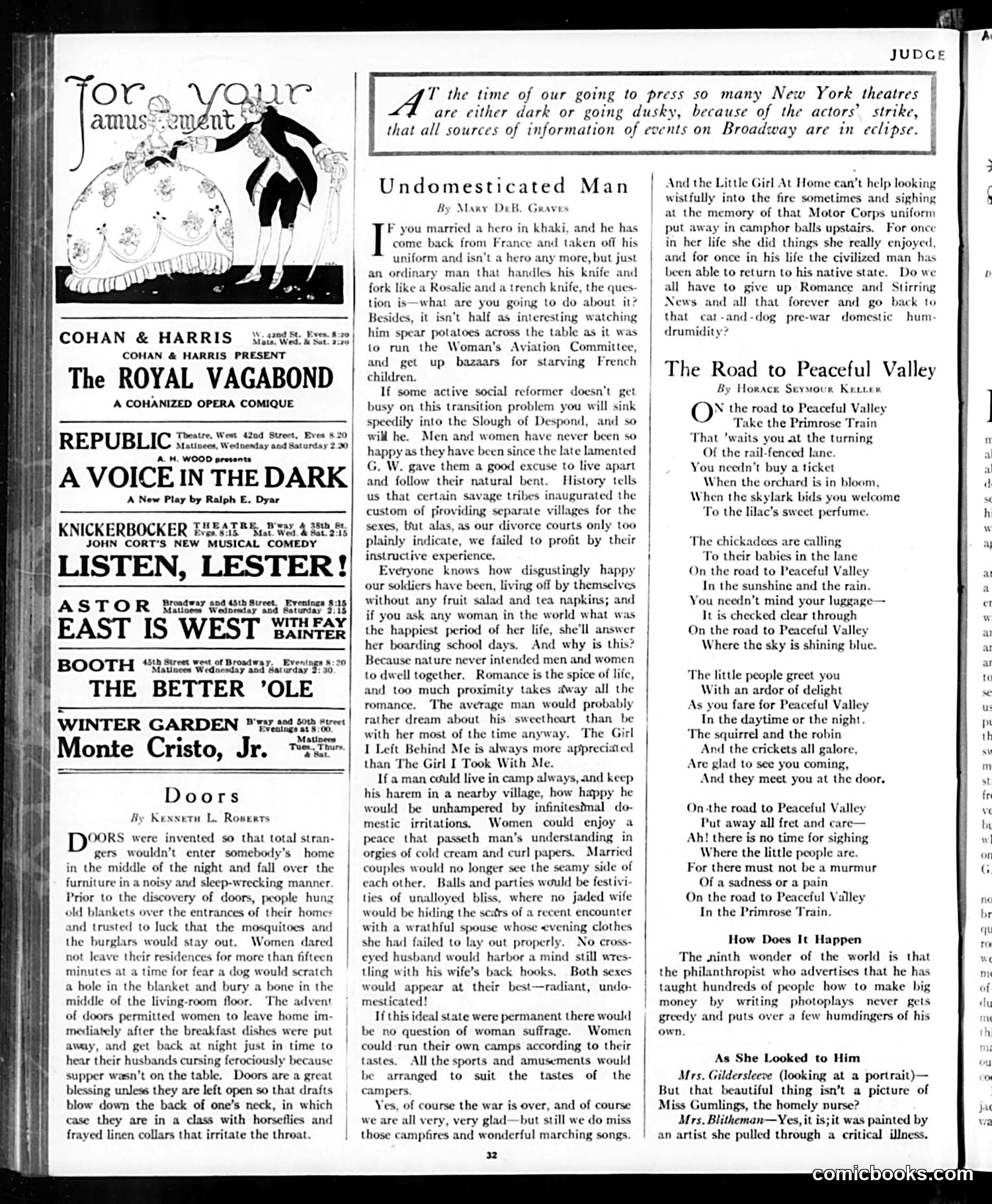
This page is primarily **theatrical advertising** with accompanying satirical commentary and fiction. The cartoon at top-left is a simple decorative vignette showing a silhouetted couple in formal dress. The substantive content includes: **"Undomesticated Man"** by Mary DeB. Graves satirizes post-WWI domestic adjustment. It mocks wives struggling when soldier-husbands returned from France, no longer heroic figures but ordinary men. The piece critiques how women found wartime roles (aviation committees, bazaars) more fulfilling than peacetime domesticity, arguing humorously that men and women were happier living separately—referencing "savage tribes" with segregated villages and modern divorce courts as evidence that cohabitation is unnatural. **"Doors"** by Kenneth L. Roberts offers mock-serious humor about door invention, presenting them ironically as women's liberation (allowing them to leave home) while also enabling domestic frustration. The page mostly showcases Broadway theaters advertising productions like "The Royal Vagabond" and "East is West," reflecting the actors' strike mentioned in the header that darkened New York stages.
📄 Transcribed text from this page (OCR, searchable)
Machine-transcribed from the original scan — historical spelling and the odd misread are preserved.
Oa somgut COHAN & HARRIS Xy, COHAN & HARRIS PRESENT The ROYAL VAGABOND A COHANIZED OPERA COMIQUE REPUBLIC 2S Ween ander 23 A.M. WOOD presen A VOICE IN THE DARK A New Play by Ralph E. Dyar 38th st KNICKERBOCKER fara ict Wes. 4 Sees LISTEN, LESTER! Brondway and asth Street, Evenings 8:15 ASTOR Sime wa Sed daturcay 3.18 EAST IS WEST bainter BAINTER BOOTH xtaitcs Weanenday and daitrday $30" THE BETTER ’OLE Biqay, and Both street WINTER GARD Treinen at 8 | Monte Cristo, Jr. “Si Doors By Kexxetu L. Roserrs OORS were invented so that total stran- gers wouldn’t enter somebody’s home in the middle of the night and fall over the furniture in a noisy and sleep-wrecking manner. Prior to the discovery of doors, people hung old blankets over the entrances of their homes and trusted to luck that the mosquitoes and the burglars would stay out. Women dared not leave their residences for more than fifteen minutes at a time for fear a dog would scratch a hole in the blanket and bury a bone in the middle of the living-room floor. The advent of doors permitted women to leave home im- mediately after the breakfast dishes were put away, and get back at night just in time to hear their husbands cursing ferociously because supper wasn’t on the table. Doors are a great blessing unless they are left open so that drafts blow down the back of one’s neck, in which case they are in a class with horseflies and frayed linen collars that irritate the throat. T the time of our going to press so many New York theatres are either dark or going dusky, because of the actors’ strike, that all sources of information of events on Broadway are in eclipse. Undomesticated Man By Mary DeB. Graves F you married a hero in k and he has come back from France and taken off his uniform and isn’t a hero any more, but just an ordinary man that handles his knife and fork like a Rosalie and a trench knife, the ques- tion is—what are you going to do about it? Besides, it isn’t half as interesting watching him spear potatoes across the table as it was to run the Woman's Aviation Committee, and get up bazaars for starving French children. If some active social reformer doesn’t get busy on this transition problem you will sink speedily into the Slough of Despond, and so will he. Men and women have never been so happy as they have been since the late lamented G. W. gave them a good excuse to live apart and follow their natural bent. History tells us that certain savage tribes inaugurated the custom of providing separate villages for the sexes, Wut alas, as our divorce courts only too plainly indicate, we failed to profit by their instructive experience. Everyone knows how disgustingly happy our soldiers have been, living off by themselves without any fruit salad and tea napkins; and if you ask any woman in the world what was the happiest period of her life, she'll answer her boarding school d: And why is this? Because nature never intended men and women to dwell together. Romance is the spice of life, and too much proximity takes away all the romance. man would probably rather dream about his sw with her most of the time anyw I Left Behind Me is always more appreciated than The Girl I Took With Me. If a man could live in camp always, and keep his harem in a nearby village, how happy he would be unhampered by infinitesimal do- mestic irritations. Women could enjoy a peace that passeth man’s understanding in orgies of cold cream and curl papers. Married couples would no longer see the seamy side of each other. Balls and parties would be festivi- ties of unalloyed bliss, where no jaded wife would be hiding the scars of a recent encounter with a wrathful spouse whose «evening clothes she had failed to lay out properly. No cross- eyed husband would harbor a mind still wres- tling with his wife’s back hooks. Both sexes would appear at their best—radiant, undo- mesticated! If this ideal state were permanent there would be no question of woman suffrage. Women could run their own camps according to their tastes. All the sports and amusements would be arranged to suit the tastes of the campers. of course the war is over, and of course y, very glad—but still we do miss those campfires and wonderful marching songs. 32 i} | And the Little Girl At Home can’t help looking wistfully into the fire sometimes and sighing at the memory of that Motor Corps uniform put away in camphor balls upstairs. For once in her life she did things she really enjoyed, and for once in his life the civilized man has been able to return to his native state. Do we all have to give up Romance and Stirring and all that forever and go back to and-dog pre-war domestic hum- The Road to Peaceful Valley By Horace Seymour Ketter N the road to Peaceful Valley Take the Primrose Train That ‘waits you at the turning Of the rail-fenced lane. You needn't buy a ticket When the orchard is in bloom, When the skylark bids you welcome To the lilac’s sweet perfume. The chickadees are calling To their babies in the lane On the road to Peaceful Valley In the sunshine and the rain. You needn’t mind your luggage— It is checked clear through On the road to Peaceful Valley Where the sky is shining blue. The little people greet you With an ardor of delight As you fare for Peaceful Valley In the daytime or the night. The squirrel and the robin And the crickets all galore, Are glad to see you coming, And they meet you at the door, On.the road to Peaceful Valley Put away all fret and ca Ah! there is no time for Where the little people are. For there must not be a murmur Of a sadness or a pain On the road to Peaceful V In the Primrose Train. How Does It Happen The ninth wonder of the world is that the philanthropist who advertises that he has taught hundreds of people how to make big money by writing photoplays never gets greedy and puts over a few humdingers of his own, As She Looked to Him Mrs. Gildersleeve (looking at a portrait)— But that beautiful thing isn’t a picture of Miss Gumlings, the homely nurse? Mrs. Blitheman—Yes, it is;it was painted by an artist she pulled through a critical Wness. “<-