
A complete issue · 36 pages · 1919
Judge — August 9, 1919
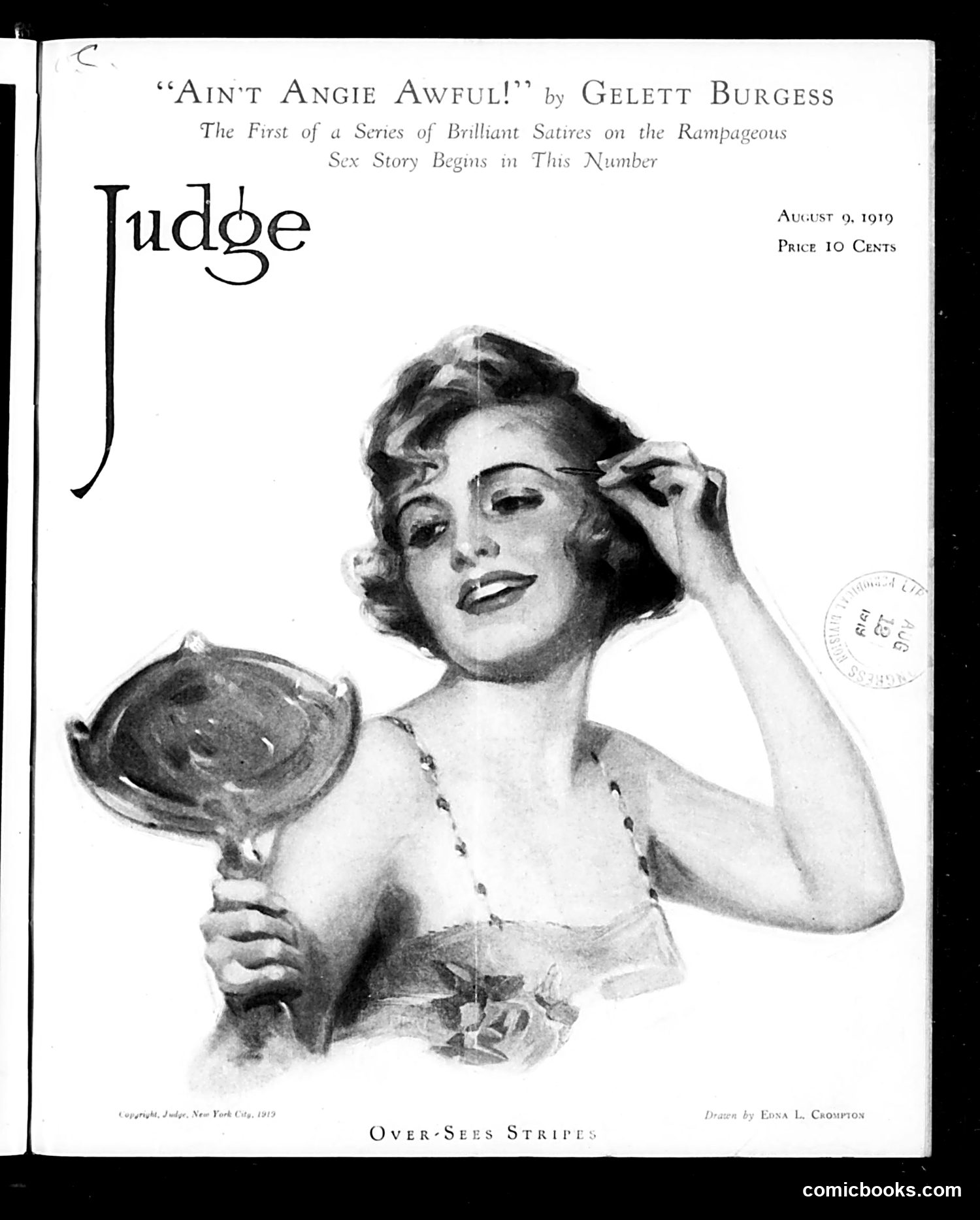
This is the cover of Judge magazine from August 9, 1919, priced at 10 cents. The main content advertises "Ain't Angie Awful!" by Gelett Burgess—described as the first in a series of satirical pieces about "the Rampageous Sex Story." The illustration depicts a woman in 1910s-1920s style clothing, holding a hand mirror and appearing to adjust her hair or makeup. The image exemplifies the magazine's satirical take on contemporary women's behavior and appearance. The title "Over-Sees Stripes" (suggesting women's fashions or social conduct) and the overall composition indicate this issue satirizes modern women's fashion, beauty routines, and social conventions during the post-WWI era. The tone suggests gentle mockery of women's vanity or changing social roles.
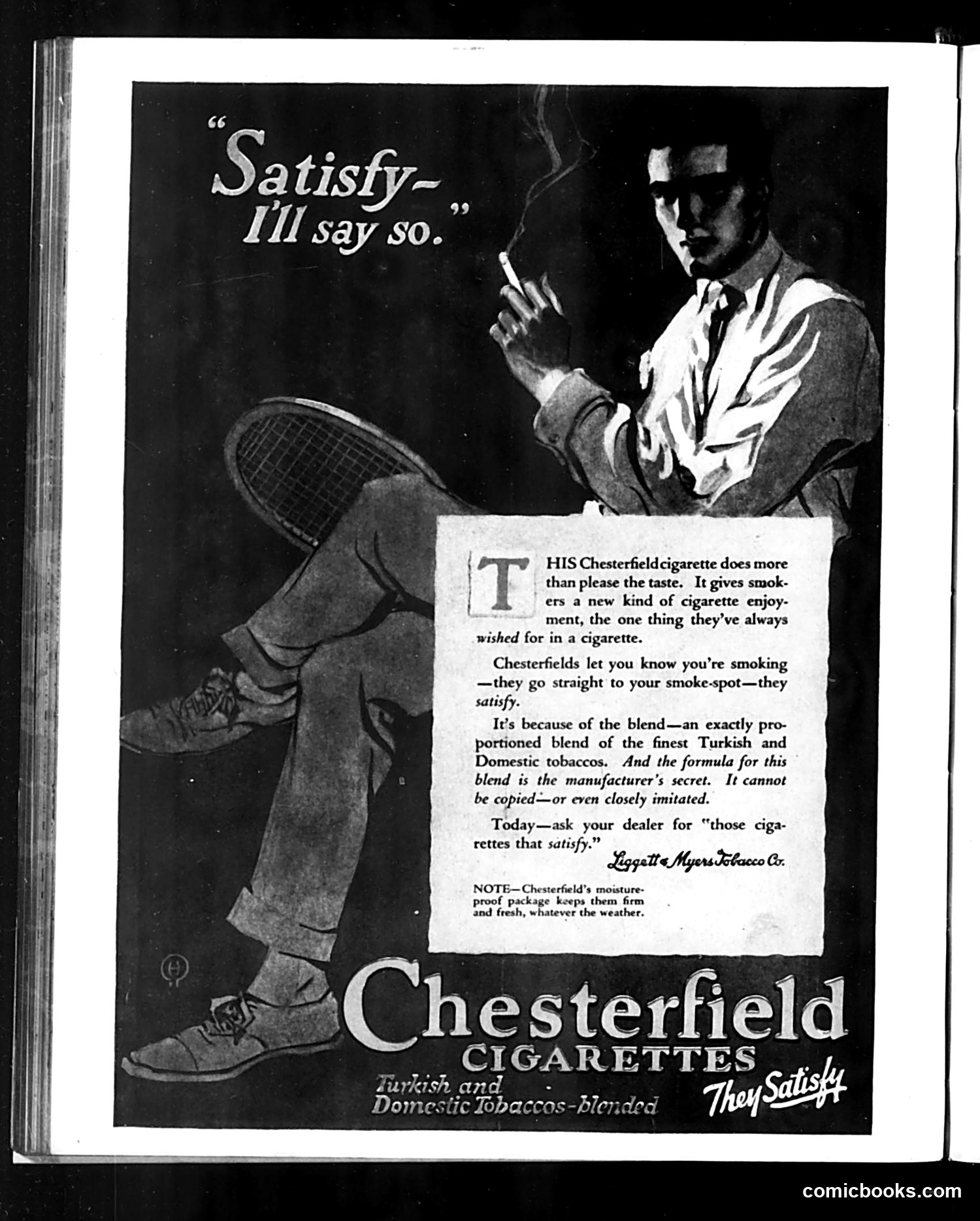
This is a **cigarette advertisement**, not satire or political commentary. It features a man in casual 1920s-30s attire (cap, white shirt, suspenders) holding a tennis racket, with the tagline "Satisfy—I'll say so." The ad claims Chesterfield cigarettes offer superior enjoyment through a secret blend of Turkish and domestic tobaccos that "go straight to your smoke-spot—they satisfy." It emphasizes the brand's moisture-proof packaging. This represents **pre-regulation tobacco marketing**, when cigarette companies could make health-related claims and target consumers without warning labels. Modern readers should note this advertisement predates any understanding of smoking's health dangers and reflects historical advertising practices now prohibited in most countries.
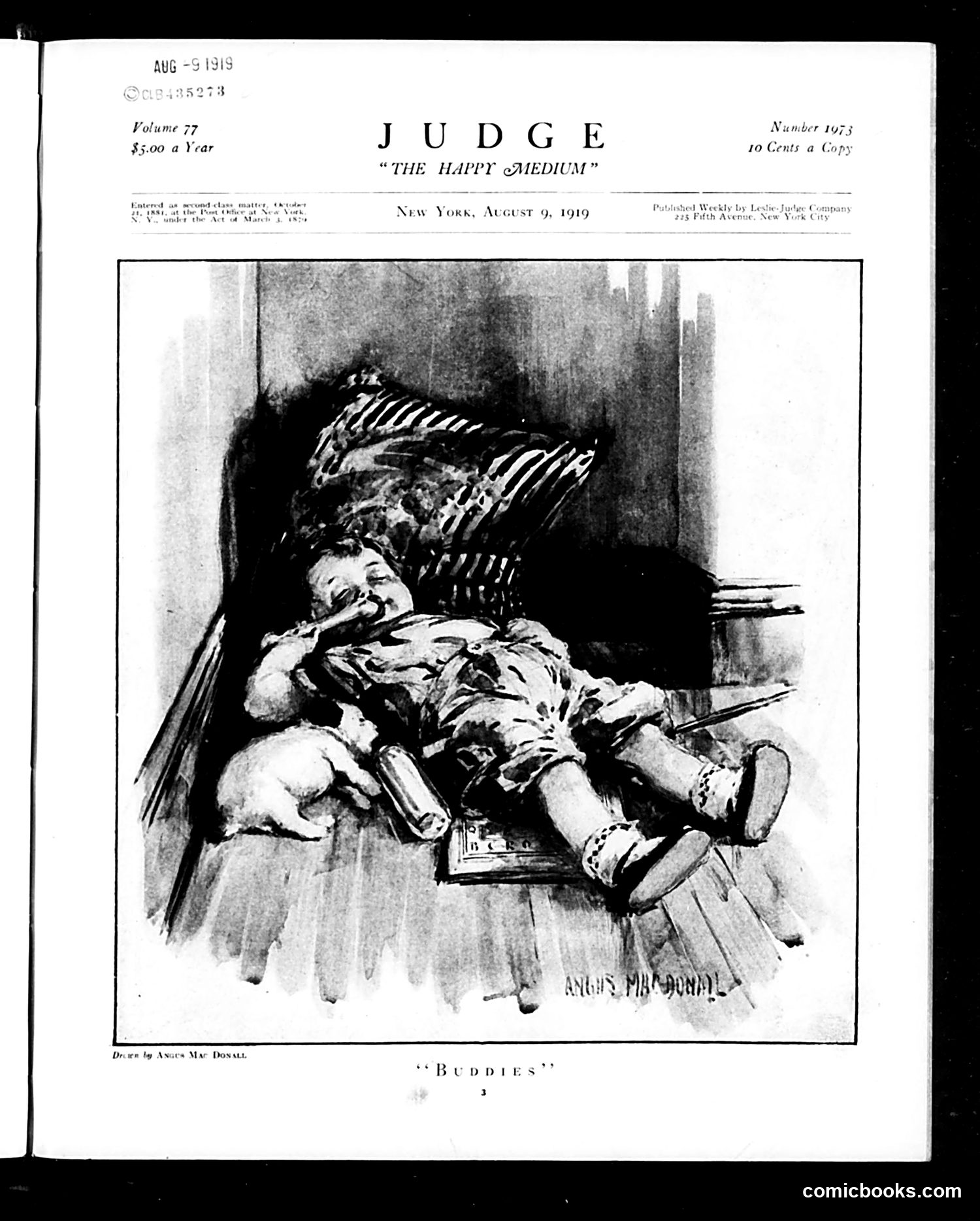
This cartoon by Angus MacDonald depicts two young children sleeping together in a chair, titled "Buddies." Given the 1919 publication date (shortly after World War I's November 1918 armistice), this likely represents American and British soldiers as the "buddies" who fought together in the war. The intimate, peaceful sleep suggests the bond formed between Allied forces during combat. The satire probably comments on post-war solidarity between the nations, or possibly critiques how quickly wartime camaraderie might fade during the subsequent peace negotiations and economic competition. The title's simplicity contrasts with any deeper political meaning about international relations in this uncertain post-war period.
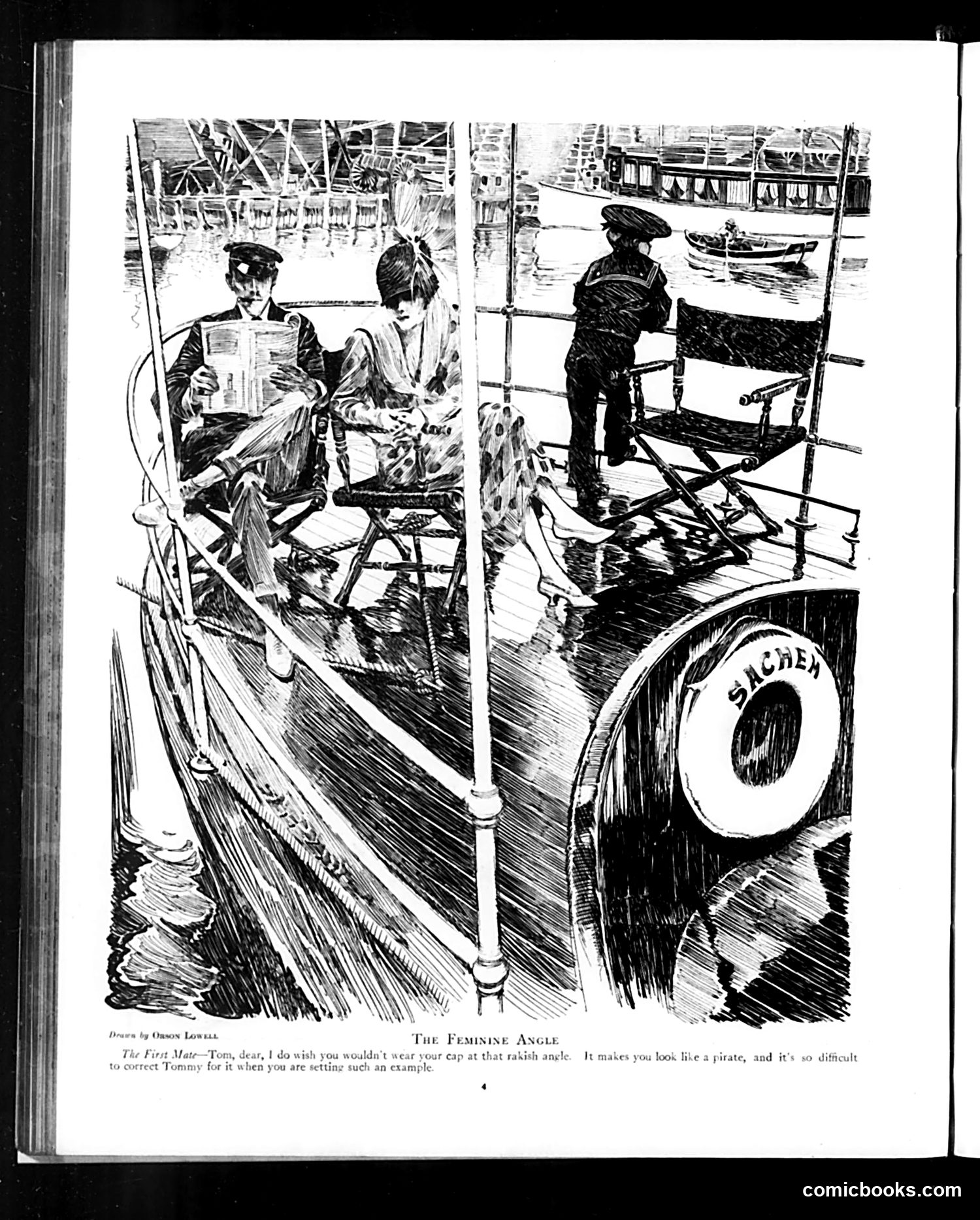
This cartoon satirizes early 20th-century debates about women's comportment and fashion. The left panel shows a woman sitting with proper posture while reading, labeled "The First Mate." The right panel shows the same woman sitting with legs crossed or sprawled, described as adopting a "rakish angle." The accompanying text mocks the "First Mate" (likely her husband) for complaining that his wife's casual sitting position makes her "look like a pirate" and is difficult to correct. The cartoon appears to critique both rigid masculine expectations about female decorum and the growing informality of women's public behavior—satirizing how minor changes in women's deportment could provoke exaggerated masculine concern about propriety and respectability.
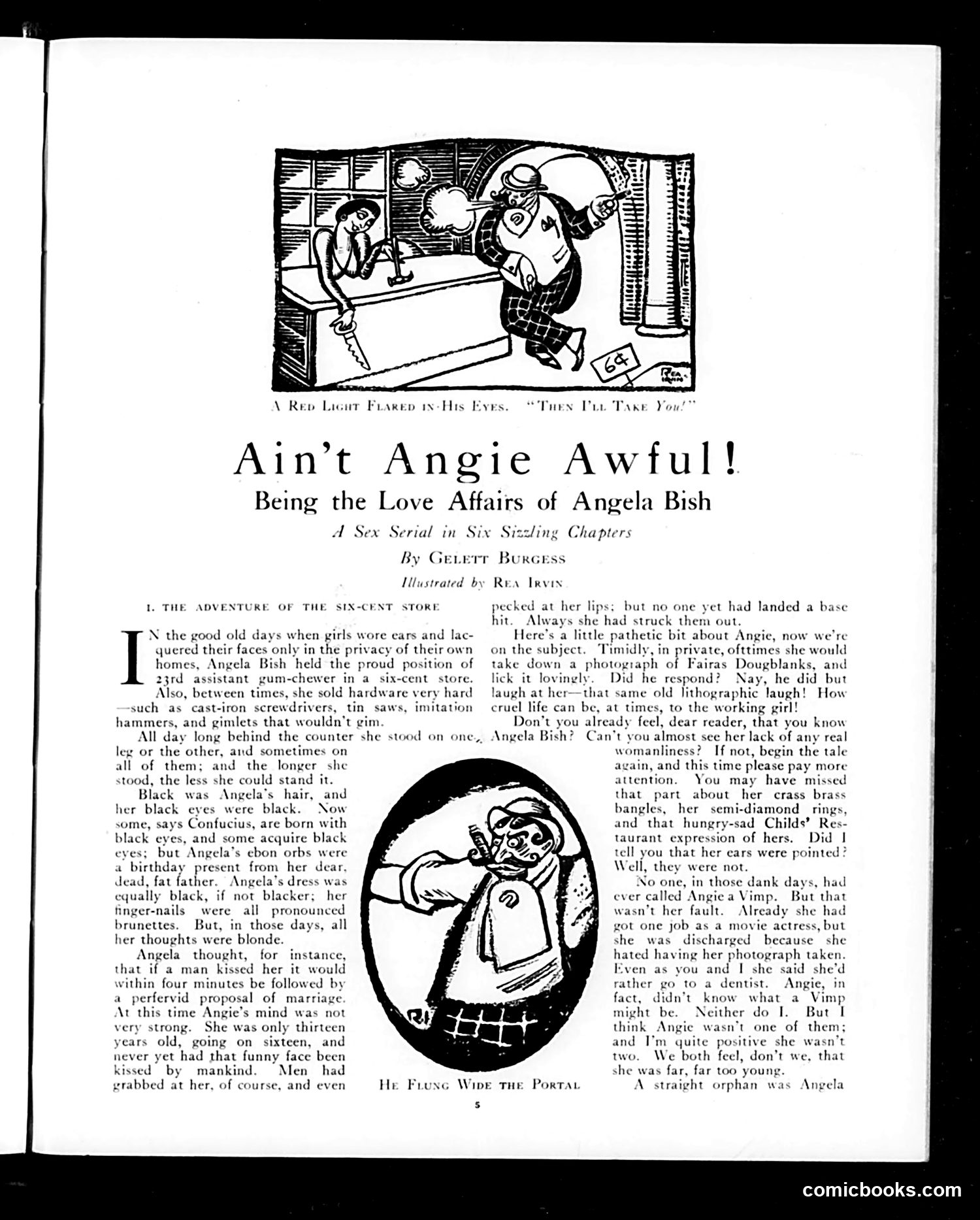
This page introduces a serial fiction titled "Ain't Angie Awful!" by Gelert Burgess, illustrated by Rea Irvin. The top cartoon shows a domestic scene where a man confronts a woman in a bathroom, with the caption "A Red Light Flaked in His Eyes. 'Then I'll Take You!'" The story concerns Angela Bish, a working-class woman employed at a five-and-dime store. The narrative describes her as plain-looking and somewhat manipulative, having struck out potential suitors and avoided romantic attention. The satire appears to target female independence and romantic scheming in the working class. Angela is portrayed as calculating and somewhat pathetic—she has few genuine womanly qualities and deliberately sabotages relationships. The serial suggests Judge's skepticism toward lower-class women's autonomy and romantic aspirations.
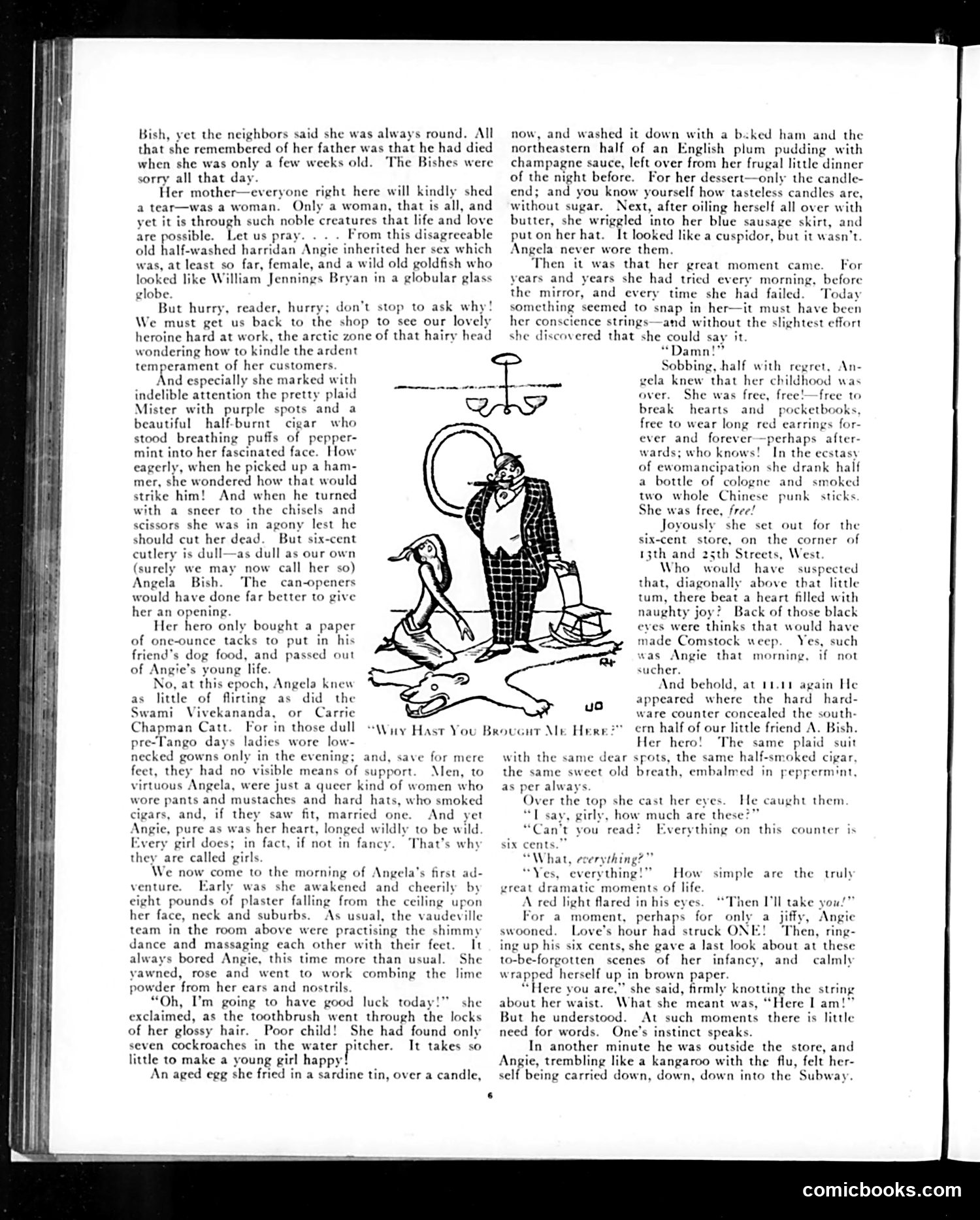
This page from *Judge* magazine contains a serialized story about a character named Angela Bish, accompanied by an illustration. The narrative describes Angela as a working-class woman—poor, independent, and unconventional for her era (she smokes cigars, wears red earrings, and frequents six-cent stores). The illustration, captioned "Why Have You Brought Me Here?", depicts a well-dressed man with a cigar confronting a woman in a working-class setting, likely meant to satirize class differences and social pretension. The story text emphasizes Angela's freedom and her attraction to a mysterious gentleman. The content appears to be satirical social commentary on working-class femininity and urban life, typical of *Judge*'s satirical approach to American society and manners of the period.
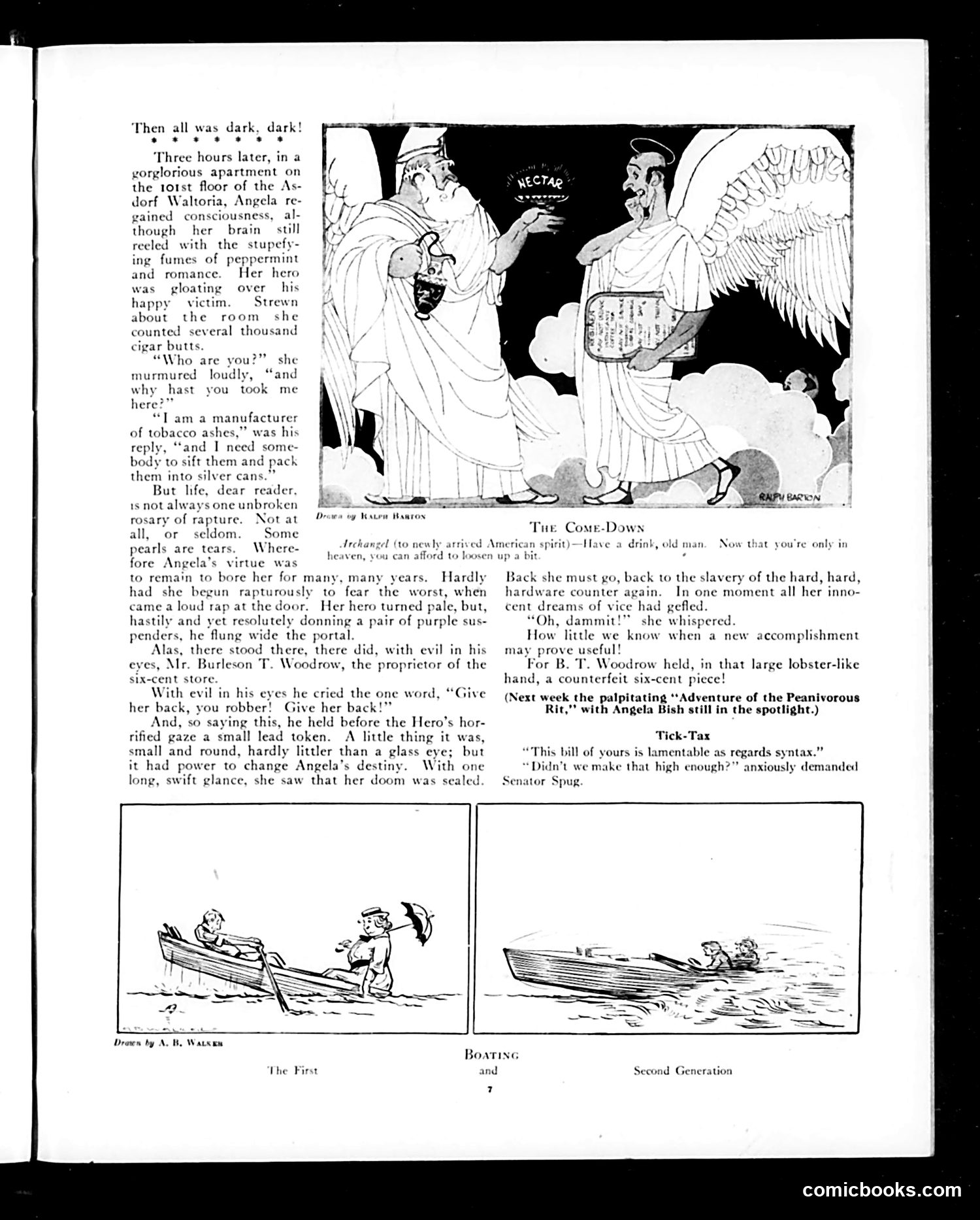
This page satirizes **American consumer culture and morality** through a serialized melodrama about "Angela," a working-class woman seduced by promises of romance. The story mocks both sentimental fiction and commercialism: her "hero" is literally a tobacco-ash manufacturer who abandons her for a counterfeit six-cent coin held by "Mr. Burleson T. Woodrow"—likely a reference to **Postmaster General Albert Burleson** (1913-1921), known for censoring publications. The satire critiques how easily working women are exploited and discarded by business interests. Angela's dramatic "fall" parodies melodramatic serials popular with female readers, while the counterfeit coin represents how capitalist schemes cheat consumers. The bottom panel "Tick-Tax" mocks **Senator Spug's** legislative language—likely satirizing actual political figures' verbose or poorly-written bills. The overall tone suggests Judge's skepticism toward both sentimental romance narratives and commercial exploitation of vulnerable workers.
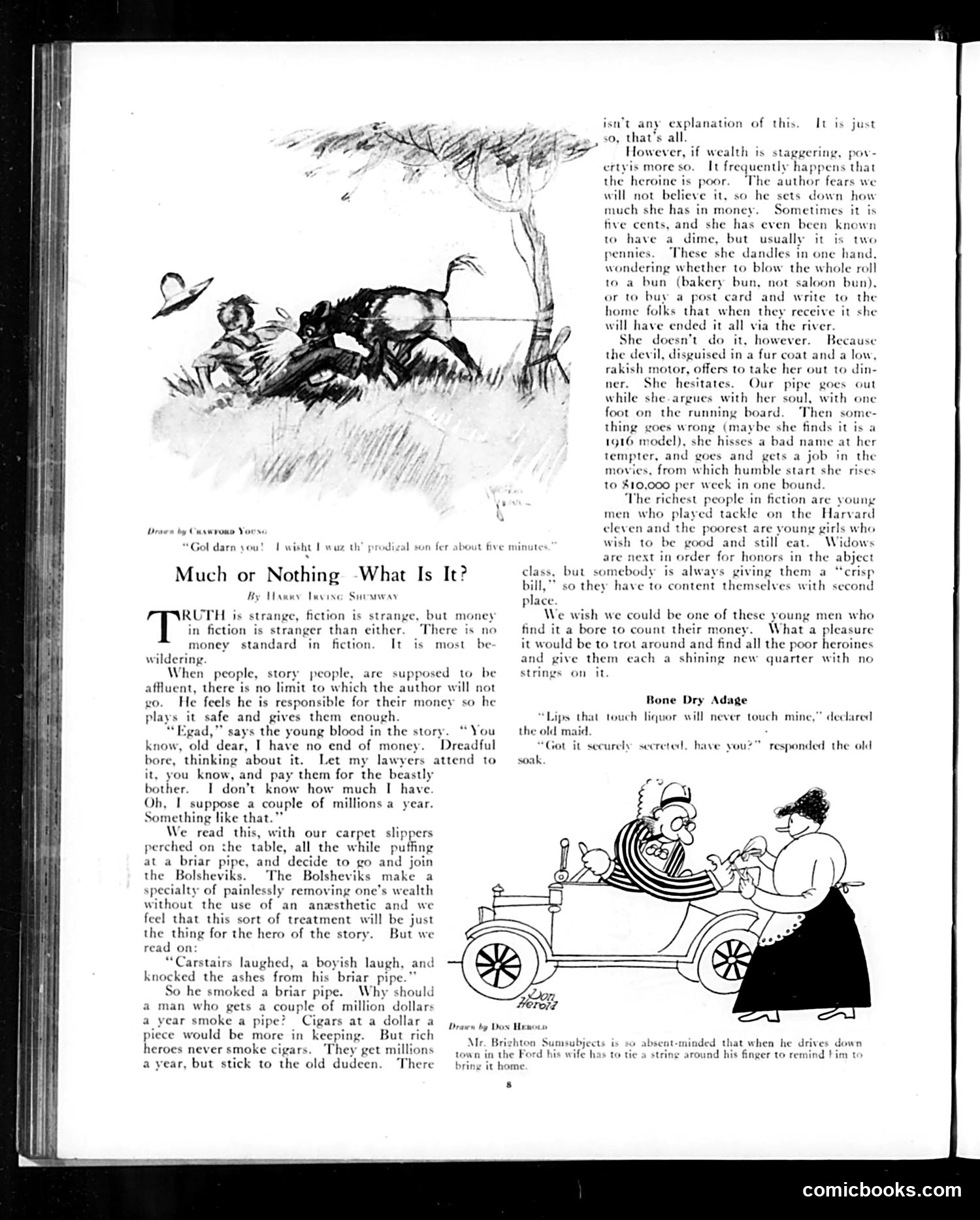
This satirical essay by Harry Irving Suesway critiques unrealistic wealth portrayals in fiction. The author argues that fictional wealthy characters casually demonstrate millions in assets (smoking cheap pipes despite earning millions yearly), while poor heroines obsess over pennies, contemplating suicide before conveniently being "rescued" into movie stardom at $10,000/week. The accompanying cartoons illustrate these absurdities: the top sketch shows a rural scene mocking naive poverty; the lower cartoon "Bone Dry Adage" depicts an old maid and man in a car, likely satirizing Prohibition-era hypocrisy about drinking. The essay's real target is authorial laziness—writers fail to portray wealth authentically, instead using caricatured gestures (briar pipes, vague millions) that ring false to ordinary readers. The Harvard football player millionaire and pure-but-poor girl represent tired literary tropes the author mocks as unconvincing wish-fulfillment fantasy.
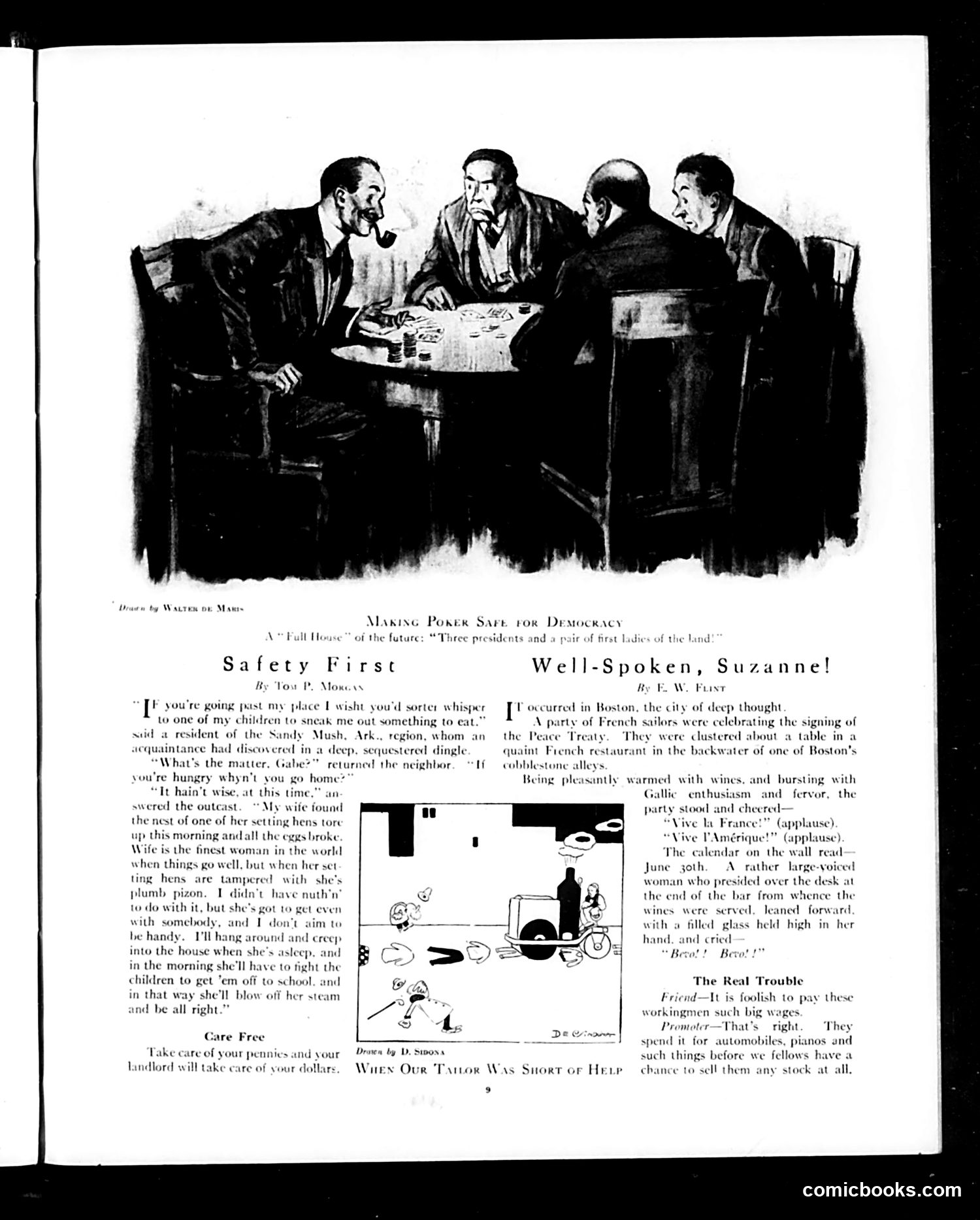
This Judge magazine page contains three separate satirical pieces: **"Making Poker Safe for Democracy"** (top): A political cartoon depicting four men—likely representing political leaders or "first ladies of the land" as the caption suggests—playing cards. The satire appears to mock government attempts to regulate or control activities under the guise of democratic safety. **"Safety First"** (left): A rural humor piece about a poor man hiding near his neighbor's property. The satire targets both rural poverty and domestic disputes, suggesting the man prefers to avoid his wife's anger over broken eggs rather than face her directly. **"Well-Spoken, Suzanne!"** (right): A story about French sailors celebrating a peace treaty in Boston, where a bar owner enthusiastically toasts "Bevo!"—a non-alcoholic beer. The joke appears to mock Prohibition-era substitutes for real alcohol, contrasting French wine culture with American temperance products. **"The Real Trouble"** (bottom): A dialogue mocking wealthy industrialists who complain that workers earn "too much" and spend it on cars and pianos—critiquing capitalist hypocrisy about labor wages.
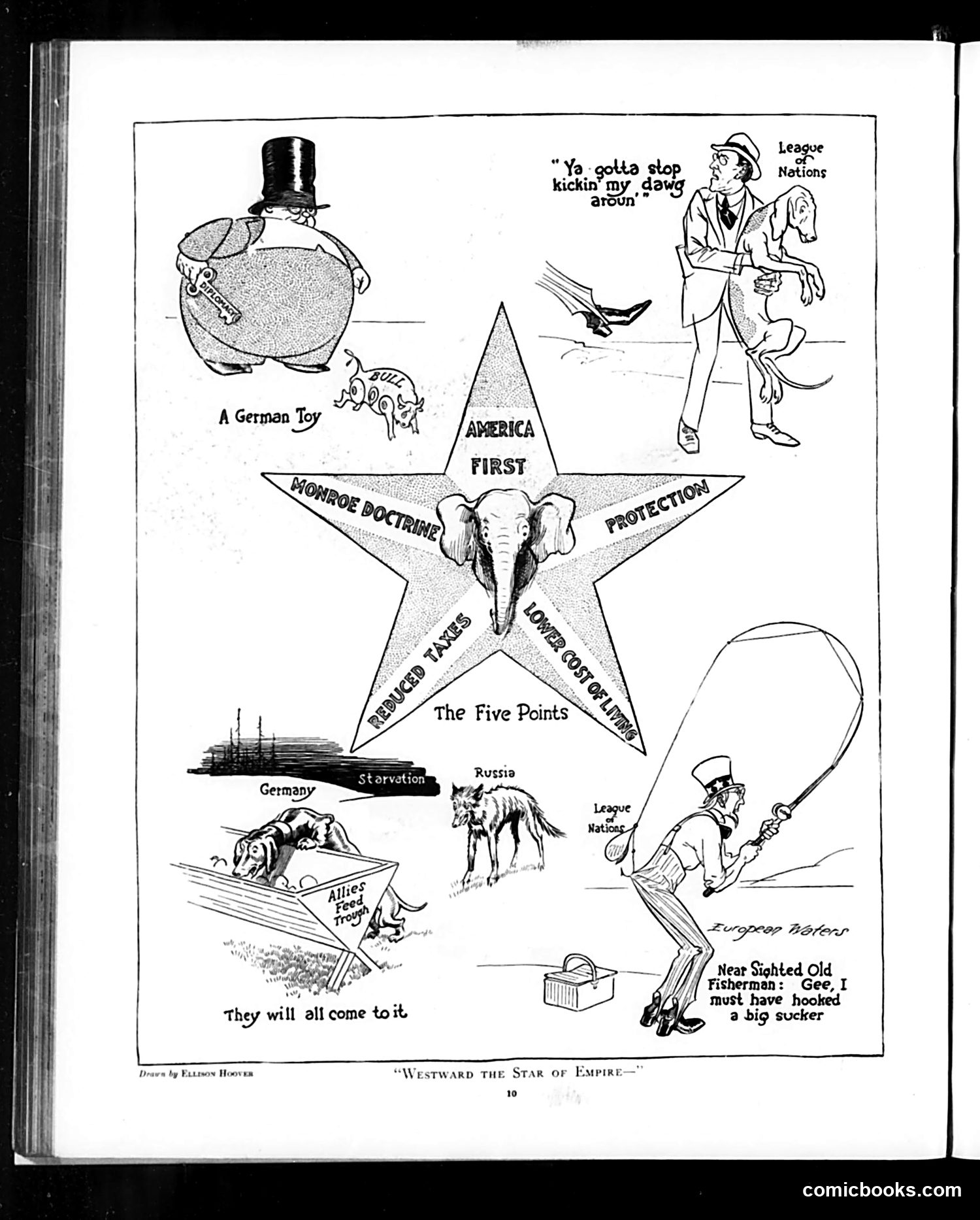
This political cartoon by Elinson Hoover satirizes American isolationism and interventionism debates following World War I. The central star represents "America First," surrounded by five points labeled Monroe Doctrine, Protection, Lower Cost Living, Reduced Taxes, and Tariffs. The surrounding vignettes mock the consequences: a bloated German militarist, starving Allied nations and Russia, the League of Nations being kicked away, and an old fisherman ("sucker") hooked by American isolationist policy. The cartoon argues that America's self-interested focus on domestic prosperity and trade protection comes at the expense of international stability, feeding future conflicts. It critiques those advocating protective tariffs and isolationism as naive—the "big sucker" foolishly believing his selfish policies avoid international entanglement when they actually invite disaster.
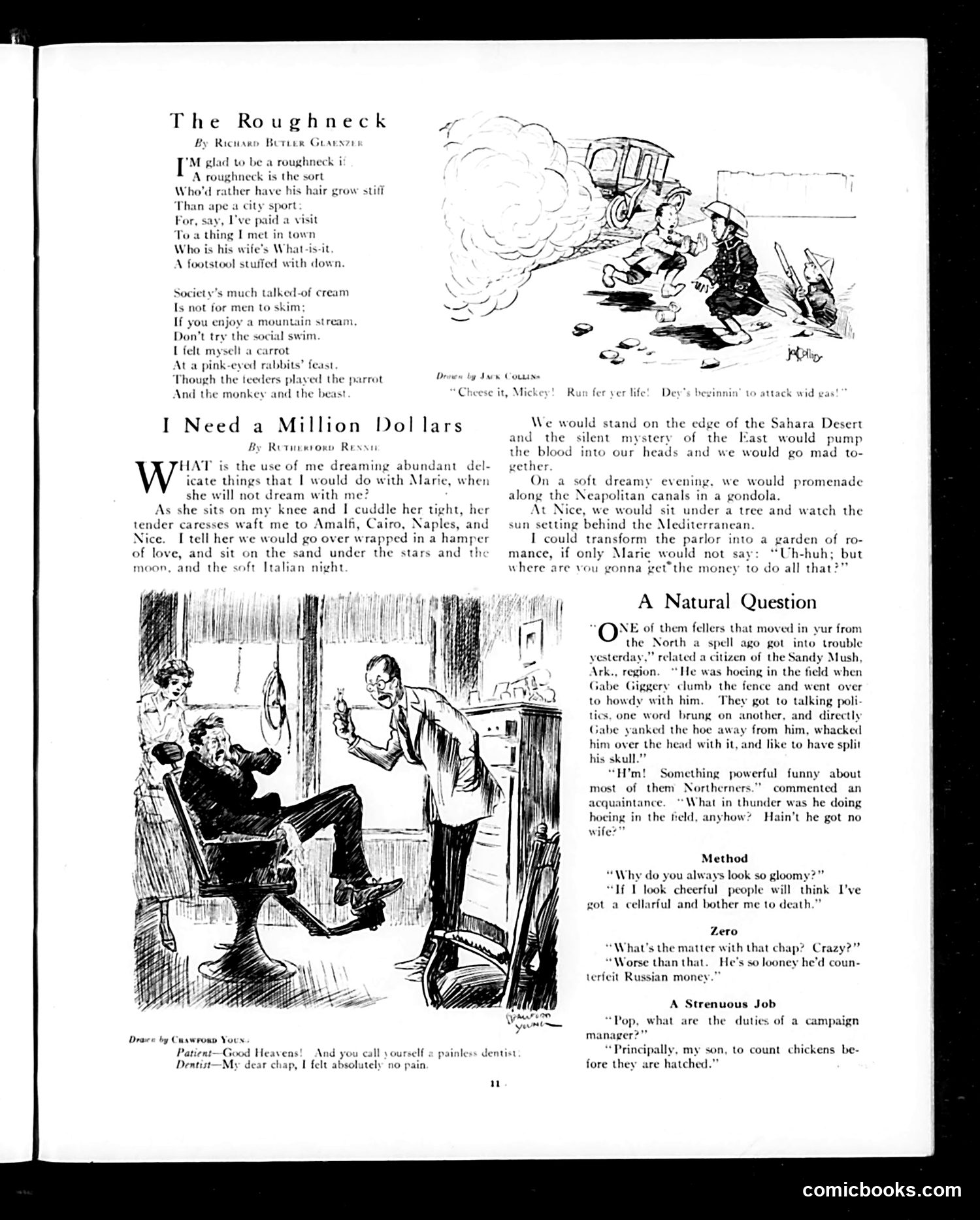
This page contains several satirical pieces targeting early 20th-century American social attitudes: **"The Roughneck"** mocks urban pretension through a speaker who claims superiority by rejecting "society" while describing his crude wife as a "footstool stuffed with down"—satirizing working-class men who boast of rejecting refined society while treating their wives as objects. **"I Need a Million Dollars"** depicts romantic fantasy versus reality: a man dreams of romantic travel with "Marie" to exotic locations (Sahara, Naples, Nice), but she repeatedly asks the practical question: "where are you gonna get the money?"—lampooning sentimental male dreamers disconnected from financial reality. **"A Natural Question"** uses rural Arkansas dialect to satirize Northern migrants: a man gets beaten with his own hoe during a political argument, and locals find it "funny" that he was hoeing at all instead of having his wife do it—mocking both sectional tensions and gender role assumptions. The remaining brief items are simple joke formats typical of the era's humor magazines.
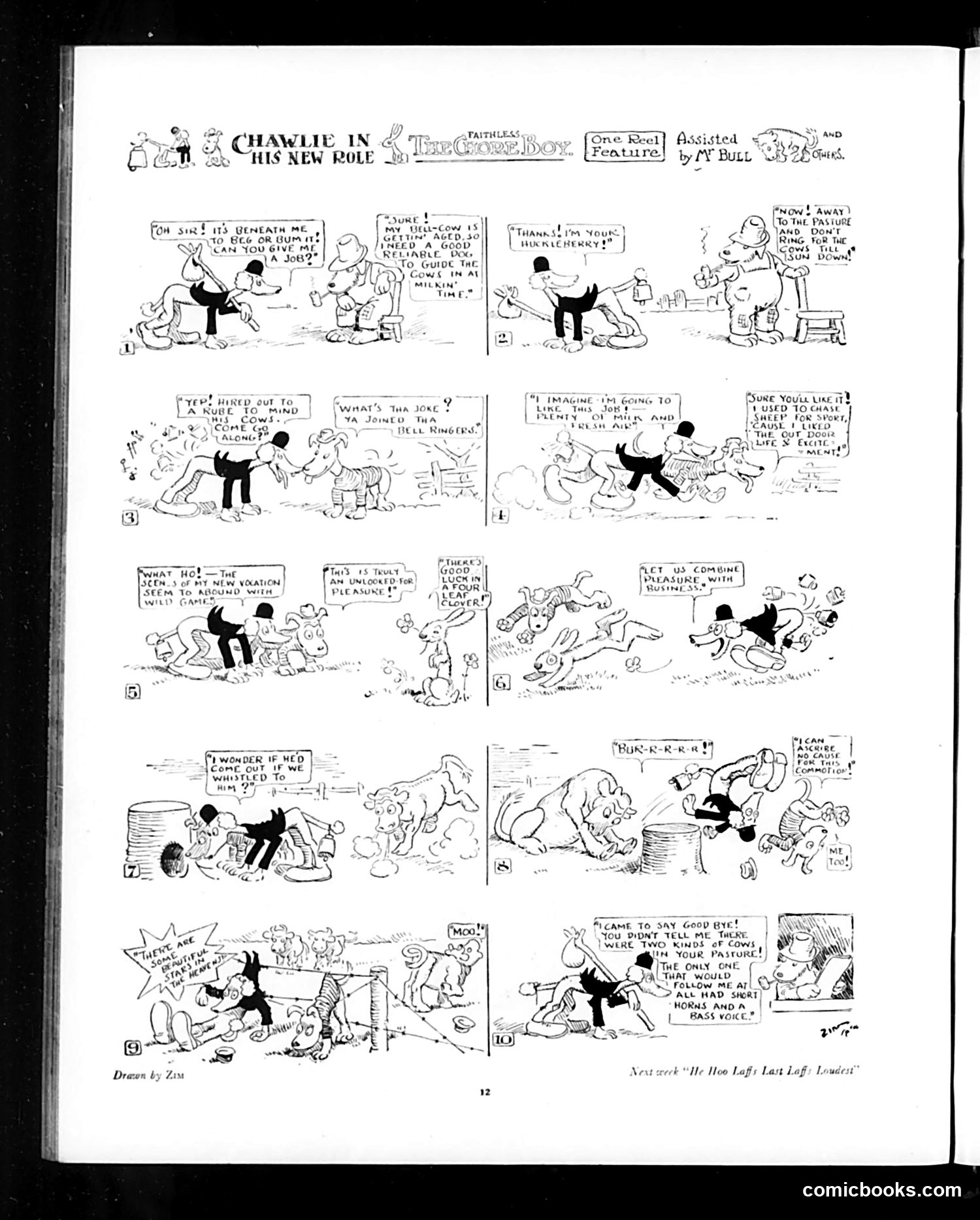
This comic strip features a character named Chawlie (likely a dialectal spelling referencing a working-class or immigrant character, possibly Charlie Chaplin-inspired) attempting a new job as a cowherd or pastoral worker. The humor centers on Chawlie's incompetence and confusion: he struggles to understand basic pastoral duties, confuses different types of cows, and comically fails at animal husbandry tasks shown through physical slapstick across 10 panels. The "new role" appears to be a comedown—suggesting he's taken an unsuitable job below his station. The satire likely mocks either working-class aspirations, immigrant labor experiences, or a specific public figure's career misstep (the character reference remains unclear without additional context). The strip's physical comedy and dialect humor reflect Judge magazine's style of satirizing contemporary social and class dynamics through exaggerated character types.
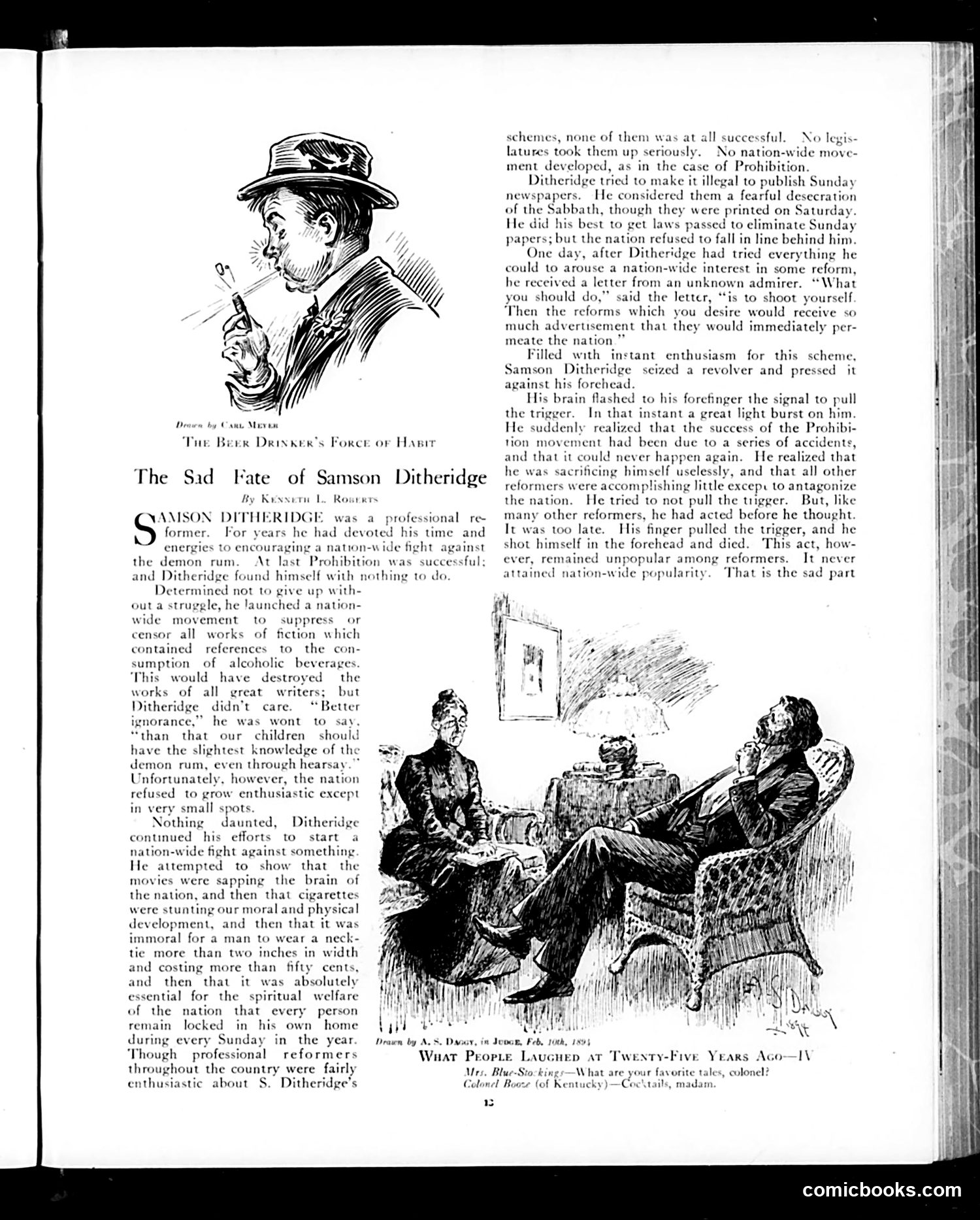
This 1895 Judge magazine page satirizes obsessive moral reformers through the character Samson Ditheridge. **The Story**: Ditheridge, a professional reformer who successfully championed Prohibition, becomes directionless afterward. He launches increasingly absurd crusades—censoring fiction with alcohol references, attacking movies, regulating necktie dimensions, and mandating home confinement on Sundays. None gain traction. Receiving anonymous advice to "shoot yourself" for publicity, Ditheridge attempts suicide but hesitates, realizing reform movements succeed through "accidents," not sacrifice. Too late—he kills himself, but the act remains unpopular. **The Satire**: The piece mocks single-issue reformers as inherently unstable and their causes as arbitrary moralism disconnected from public sentiment. The absurdist escalation (neckties to home imprisonment) ridicules prohibition's authoritarian logic. The dark ending—suicide gaining no traction—suggests reformers' grandiose self-importance versus society's indifference. **Context**: This reflects 1890s skepticism toward the temperance movement and paternalistic "vice" crusades dominating Progressive Era politics.
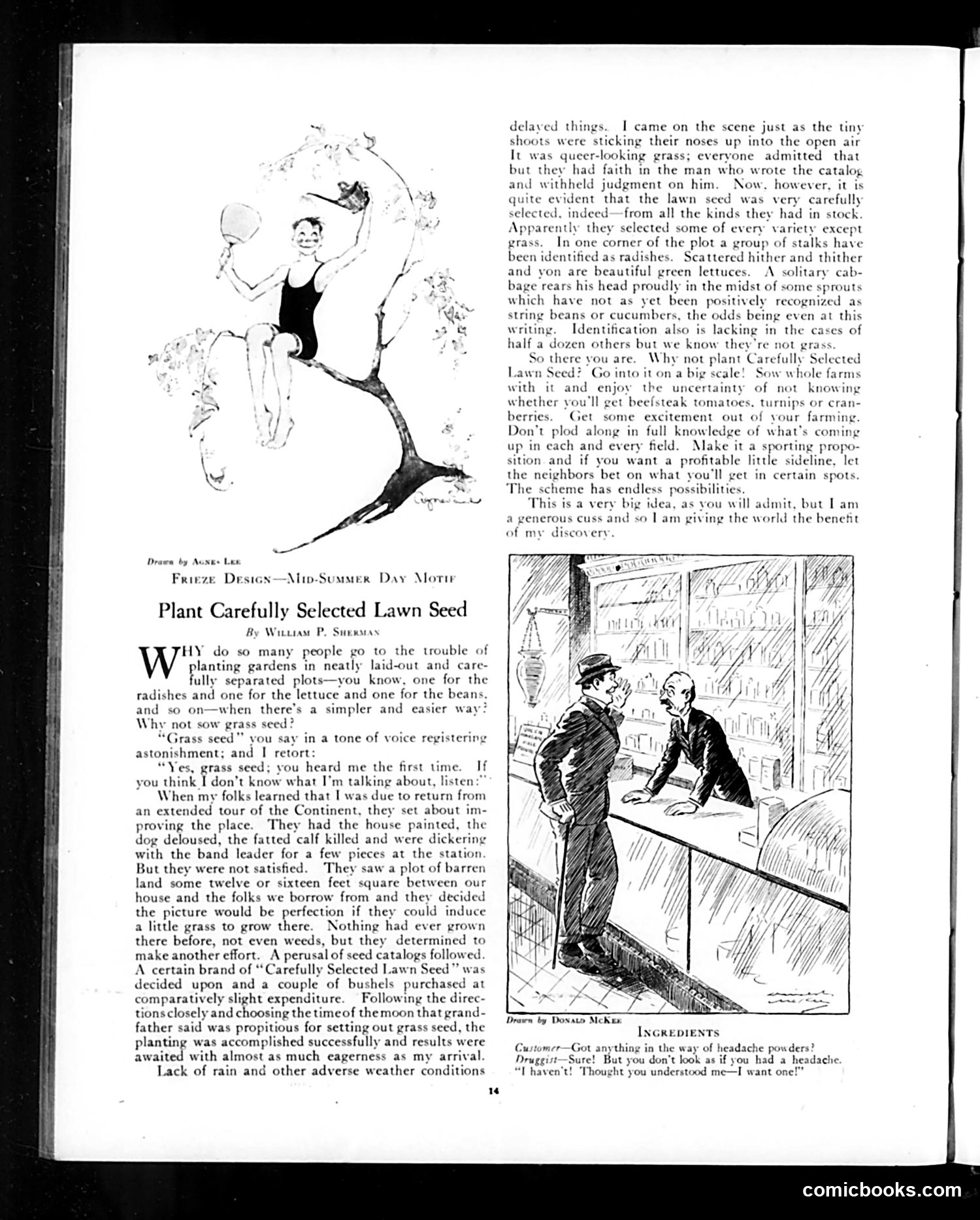
This page contains two satirical pieces from Judge magazine: **Main Article: "Plant Carefully Selected Lawn Seed"** A humorous essay mocking both seed catalog companies and naive consumers. The author's parents ordered "Carefully Selected Lawn Seed" to beautify their property while he was traveling in Europe. Upon his return, the lawn sprouted radishes, lettuce, cabbage, and beans—everything *except* grass. The satire targets the vague marketing language of seed catalogs ("carefully selected") and suggests the company simply dumped leftover seeds together. The author sarcastically recommends others do the same, treating farming like gambling. **Small Cartoon: "Ingredients"** A brief joke about a customer requesting headache powder despite claiming he has no headache. The druggist is confused until the customer clarifies he wants the powder *in anticipation* of getting a headache—likely from the customer's wife or life circumstances. It's a domestic-life joke common to the era, suggesting marriage causes stress. Both pieces reflect early-20th-century American humor about consumer products and marital dynamics.
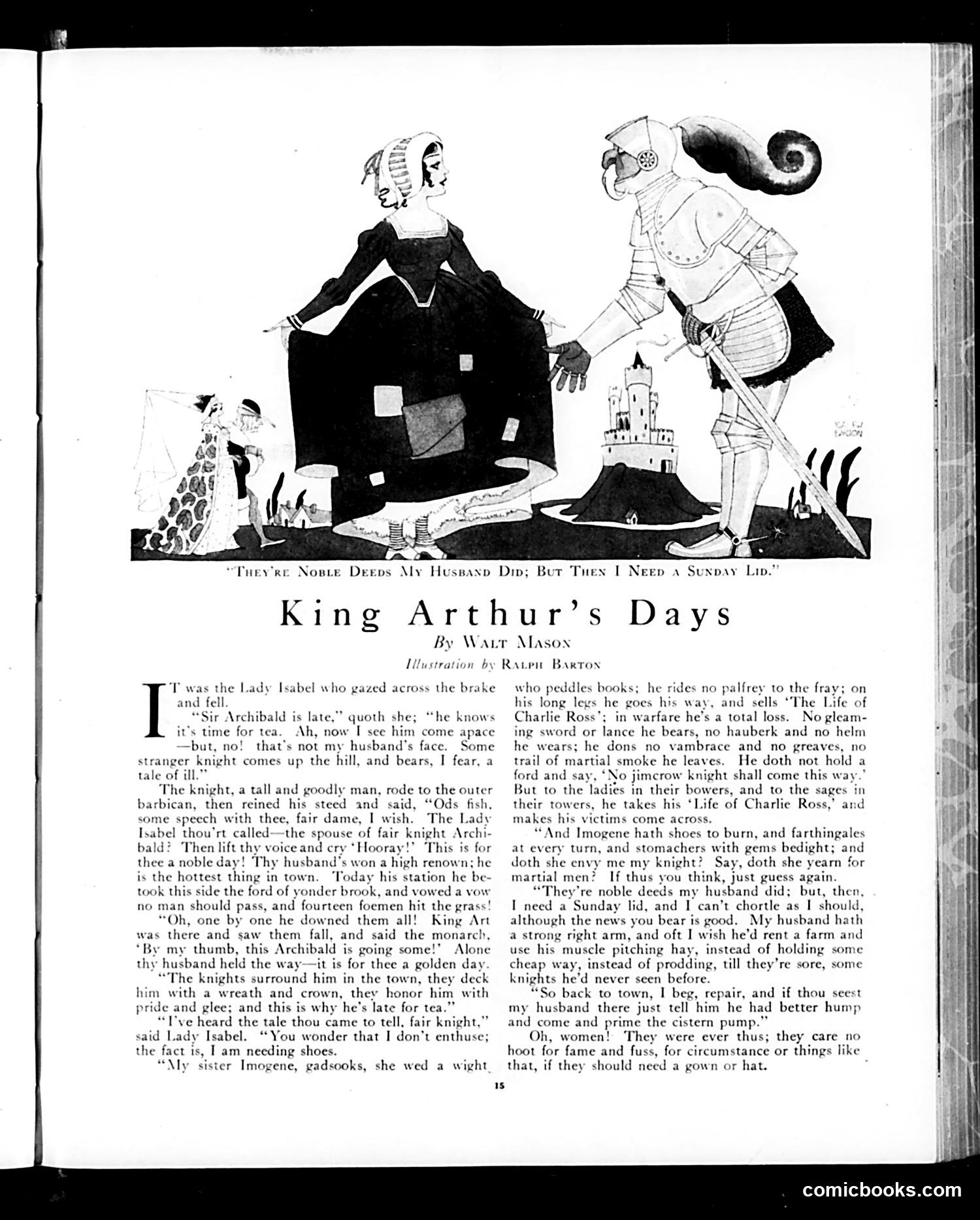
This is a humorous short story illustrated in Judge magazine that satirizes modern married life by placing it in a medieval Arthurian setting. Lady Isabel's husband Sir Archibald has just achieved great military glory—he defeated fourteen men in combat and earned the king's praise. However, Lady Isabel's response deflates this heroic achievement entirely. She doesn't care about his "noble deeds" because she needs practical things: shoes, a Sunday hat, home repairs (the cistern pump), and household maintenance. The satire targets the disconnect between what society values (masculine martial achievement) and what wives actually need (domestic stability and material support). The punchline criticizes women for prioritizing practical concerns over glory—but the joke actually lands on husbands who provide battlefield victories while neglecting family needs. The final line sardonically confirms women only care about "a gown or hat," presenting this as obvious and unchangeable.
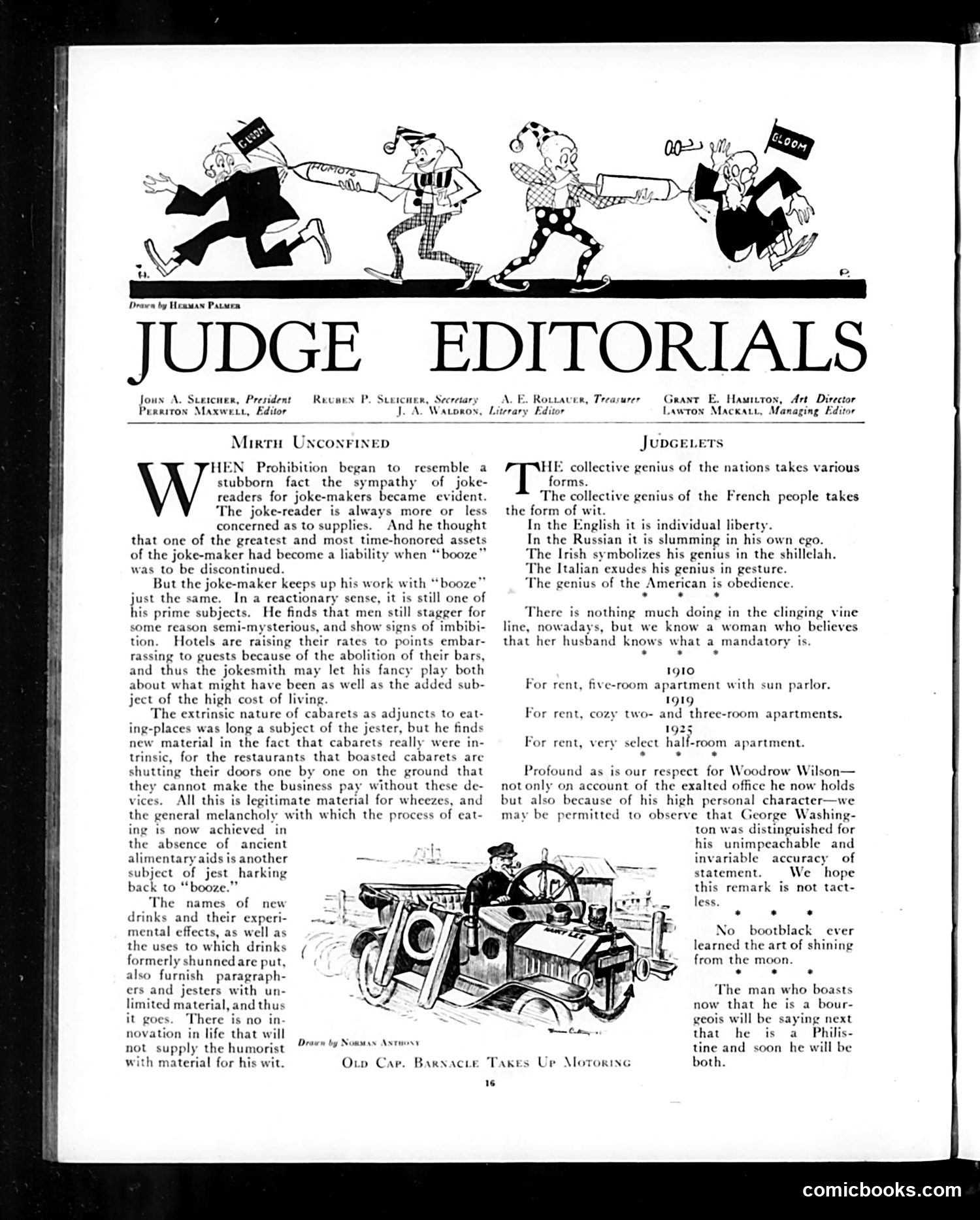
This is a editorial/opinion page from Judge magazine featuring satirical commentary and humor. The top illustration shows figures in a tug-of-war, likely depicting political or social conflict of the Prohibition era (referenced in the "Mirth Unconfined" column). The left column discusses how Prohibition eliminated the "booze" industry, forcing jokesters to find new material. It humorously notes that hotels are raising rates and cabaret entertainers are struggling—suggesting economic disruption from alcohol's abolition. The right column, "Judgelets," contains brief witticisms about national character traits (French wit, Russian ego, Irish rebellion, etc.) and includes rental advertisements and observations about political figures, including a mention of Woodrow Wilson and George Washington. The central illustration depicts "Old Cap. Barnacle Takes Up Motoring"—apparently a comedic character attempting automobile operation.
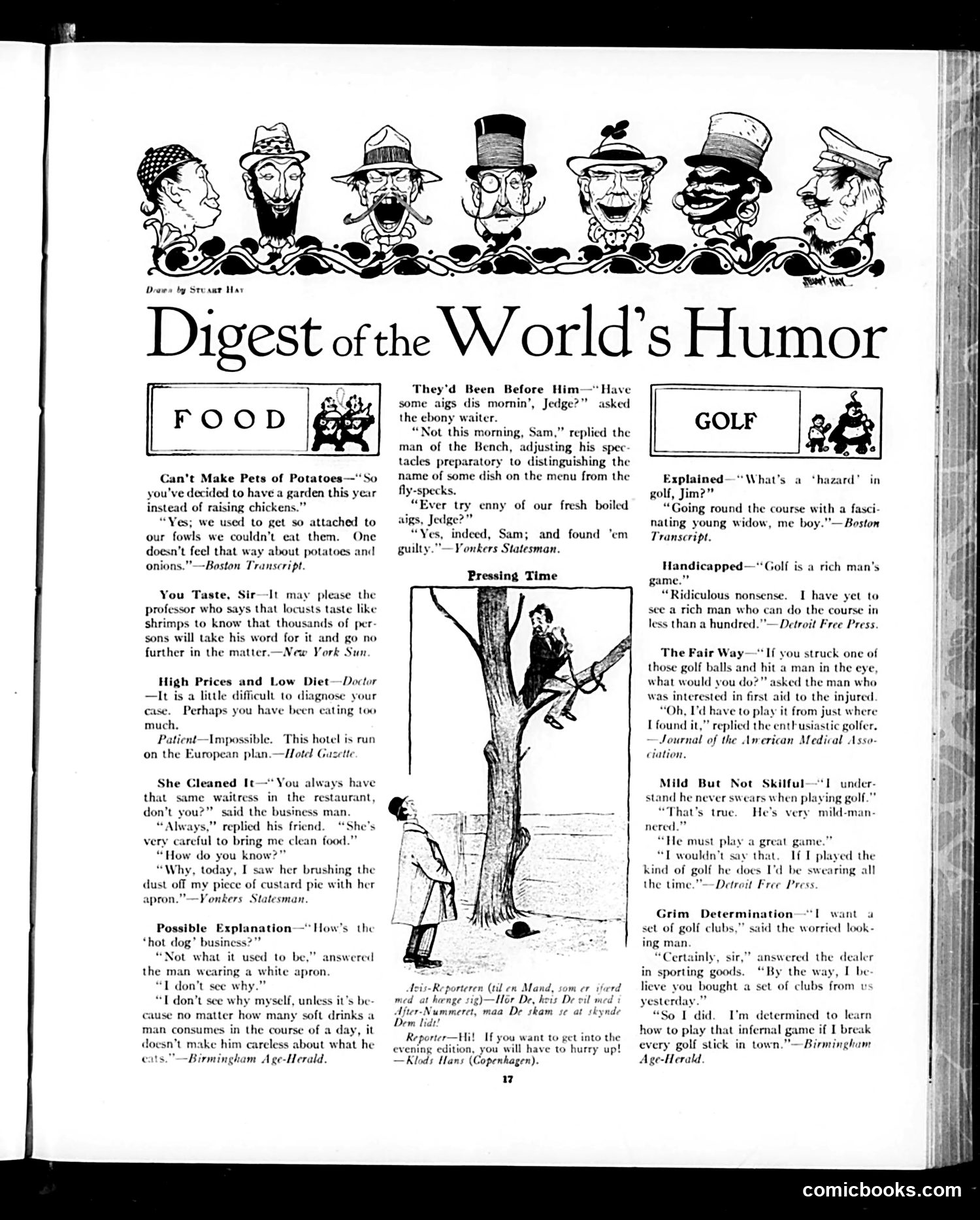
This page from *Judge* magazine collects brief humorous anecdotes organized by topic (Food and Golf). The content reflects early 20th-century American humor: genteel, class-conscious, and reliant on ethnic dialect humor (the "ebony waiter" using stereotypical speech patterns). The jokes target recognizable social types: overeager hotel staff, class differences (golf as a wealthy man's game), and marital attachment to possessions. The "Pressing Time" cartoon depicts a man struggling up a tree—likely illustrating the phrase about pressing business demands. The golf section satirizes the sport's popularity among the wealthy and its frustrations. Most humor relies on gentle wordplay and situations rather than visual gags. The page demonstrates *Judge*'s formula: accessible, topical comedy for educated middle-class readers, with occasional crude stereotypes typical of the era. No specific political figures or events are referenced—this is lifestyle humor aimed at contemporary audiences familiar with these social scenarios.
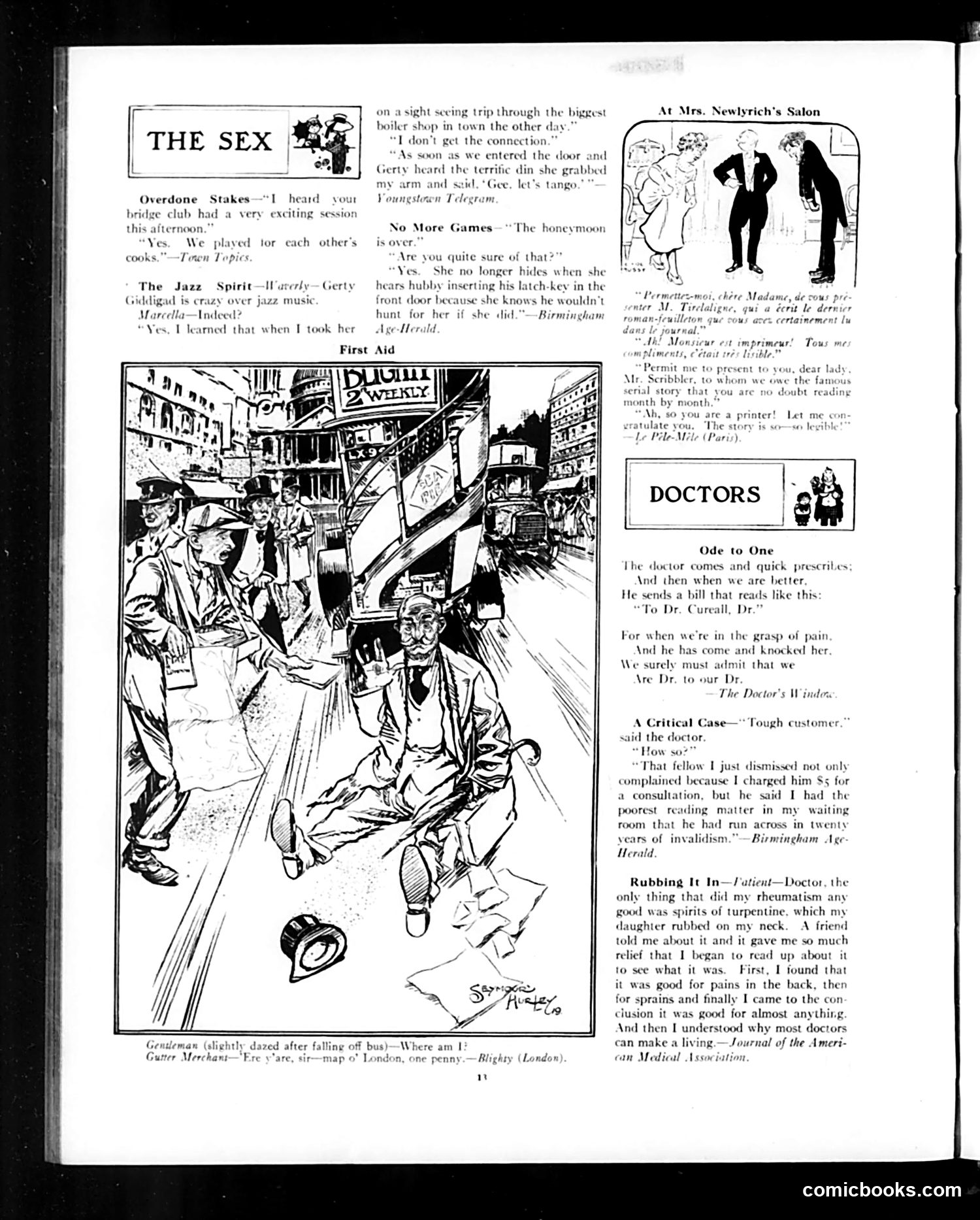
This page from *Judge* magazine contains humor pieces and a cartoon satirizing early 20th-century social life and medical practice. **"The Sex" section** presents three brief jokes about marriage and dating, mocking how quickly romance dies: bridge club wives compete over cooking, jazz music excites a date until she hears factory noise, and newlyweds' intimacy ends so thoroughly the husband stops trying to find his wife at home. **"First Aid"** cartoon depicts a street accident victim surrounded by well-dressed onlookers in a busy urban scene, likely satirizing how city dwellers respond to emergencies with indifference or curiosity rather than genuine help. **"Doctors"** section mocks physicians through humorous anecdotes: doctors send enormous bills despite minimal help; patients discover that turpentine (a common home remedy) works as well as medical treatment, suggesting doctors profit from people's desperation rather than actual expertise. The satire critiques both medical overcharging and the gap between professional medicine and folk remedies.
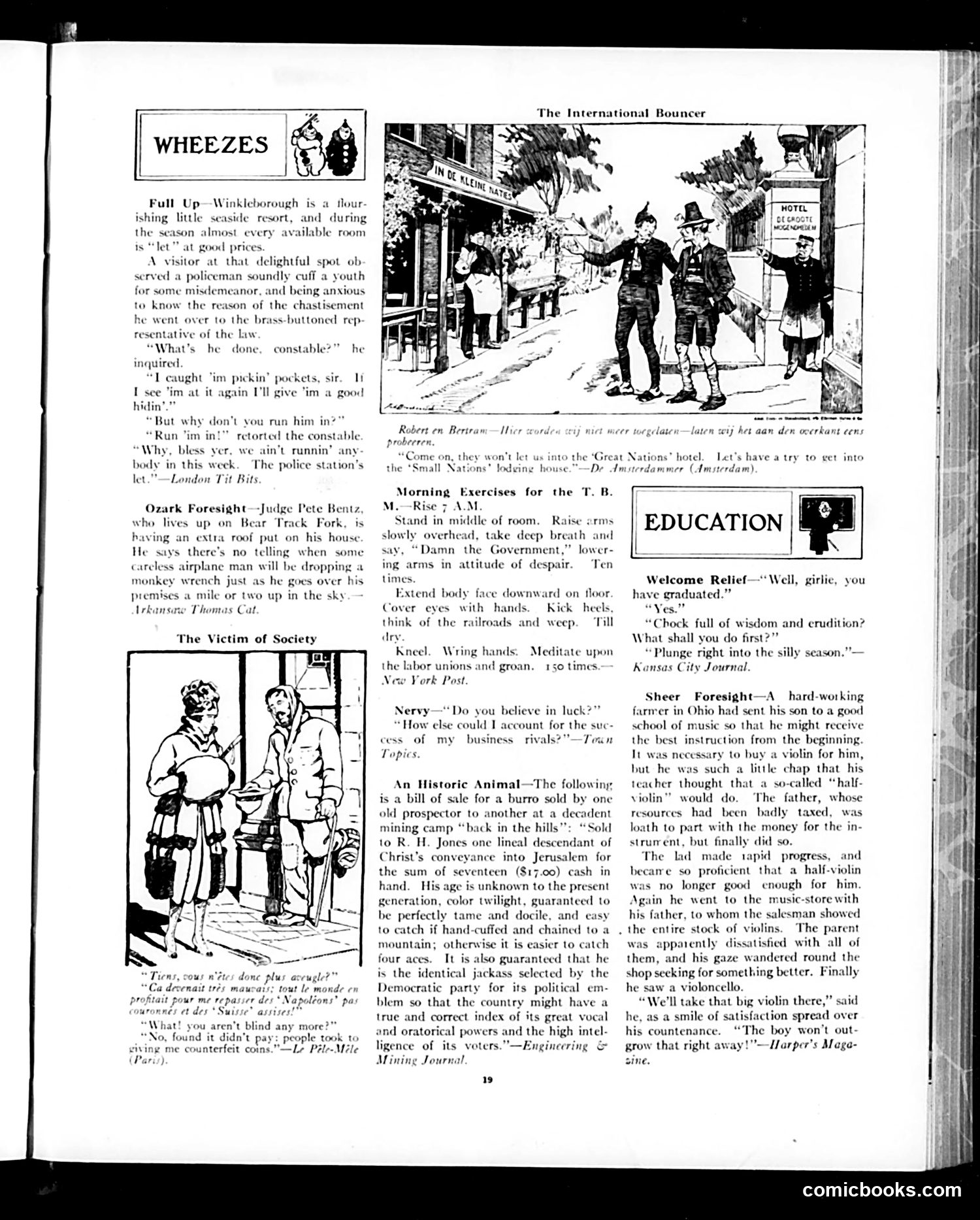
This page contains several short humor pieces typical of Judge magazine's satirical style: **"Full Up"** mocks English seaside resort overcrowding—a constable admits he won't arrest a pickpocket because the police station is "let" (rented out) to tourists. **"Ozark Foresight"** jokes about airplane safety paranoia, with a character reinforcing his roof against dropped tools. **"The Victim of Society"** cartoon depicts a blind beggar, satirizing economic hardship and counterfeit currency problems. **"Morning Exercises for the T.B."** (tuberculosis) offers dark humor about medical treatment and political despair, with instructions to express anger at "the Government" and "railroads." **"An Historic Animal"** ridicules the Democratic Party by presenting a humorous bill of sale for a burro, calling it a descendant of Christ's donkey and comparing it to Democratic leadership—a partisan jab at political opponents' intelligence. The **"Education"** section includes pieces on graduates entering the workforce and a father's foresight in buying progressively better violins as his musical son improves. The tone throughout is cynical, class-conscious, and overtly partisan.
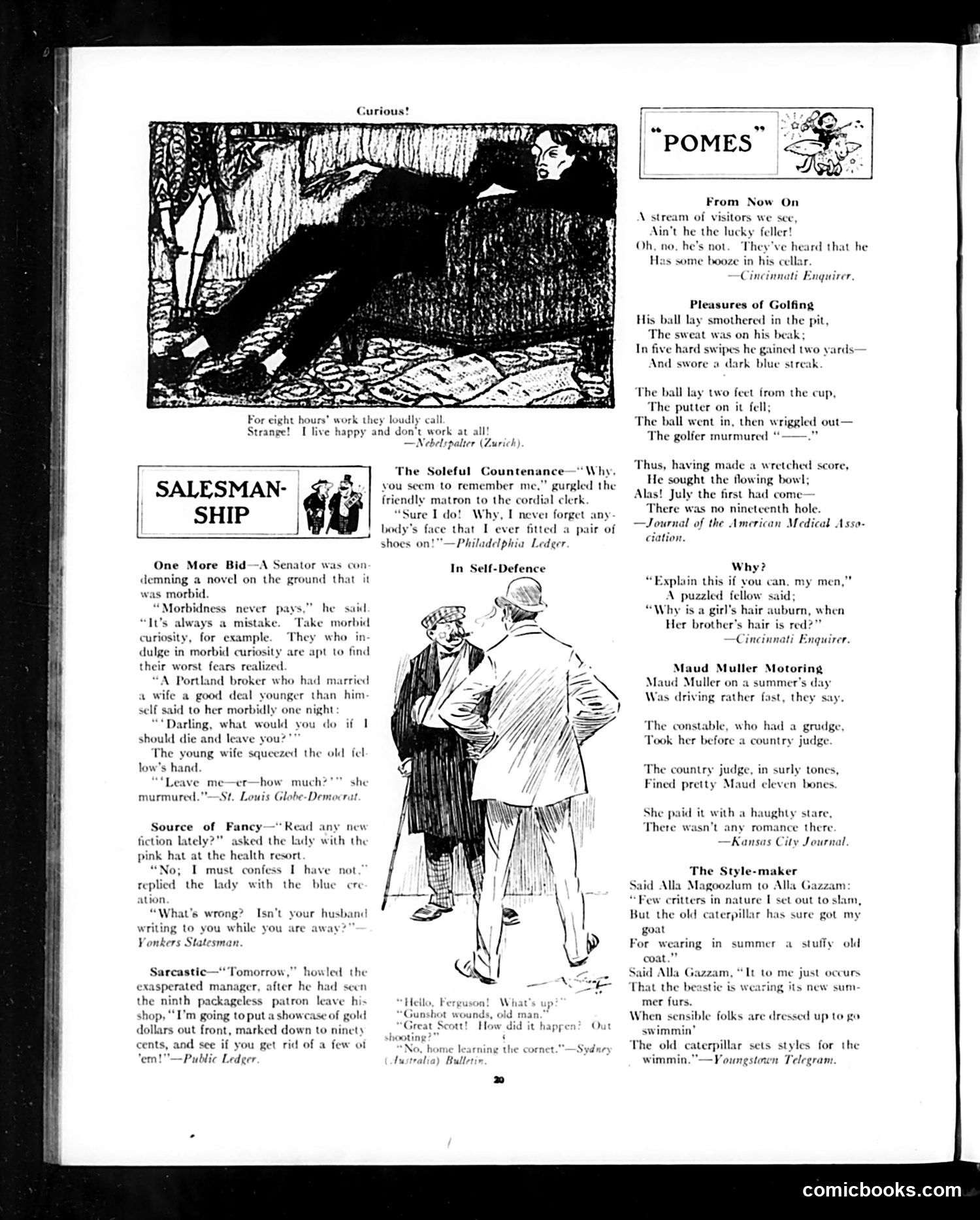
This page contains multiple short satirical pieces typical of early 20th-century Judge magazine humor: **Main Cartoon**: "In Self-Defence" shows two men in conversation—one appears to be a police officer or authority figure confronting another man. The caption references "Gumshoe wounds" and "Great Scott!" suggesting a crime or confrontation scenario. **Written Humor Pieces**: The page collects brief jokes and anecdotes mocking: - Senatorial hypocrisy (condemning novels while morally questionable) - Mercenary attitudes (the young wife asking "how much?" when widowed) - Golf frustrations and subsequent drinking - Gender absurdities (why siblings have different hair colors) - Traffic enforcement and romance (Maud Muller speeding) - Fashion trends set by unexpected sources (caterpillars) **Overall Purpose**: This is primarily a **humor/joke collection page** rather than political commentary. The satire targets universal human foibles—greed, hypocrisy, social pretension—rather than specific events or figures. The repeated anecdote format was standard Judge content for general entertainment.
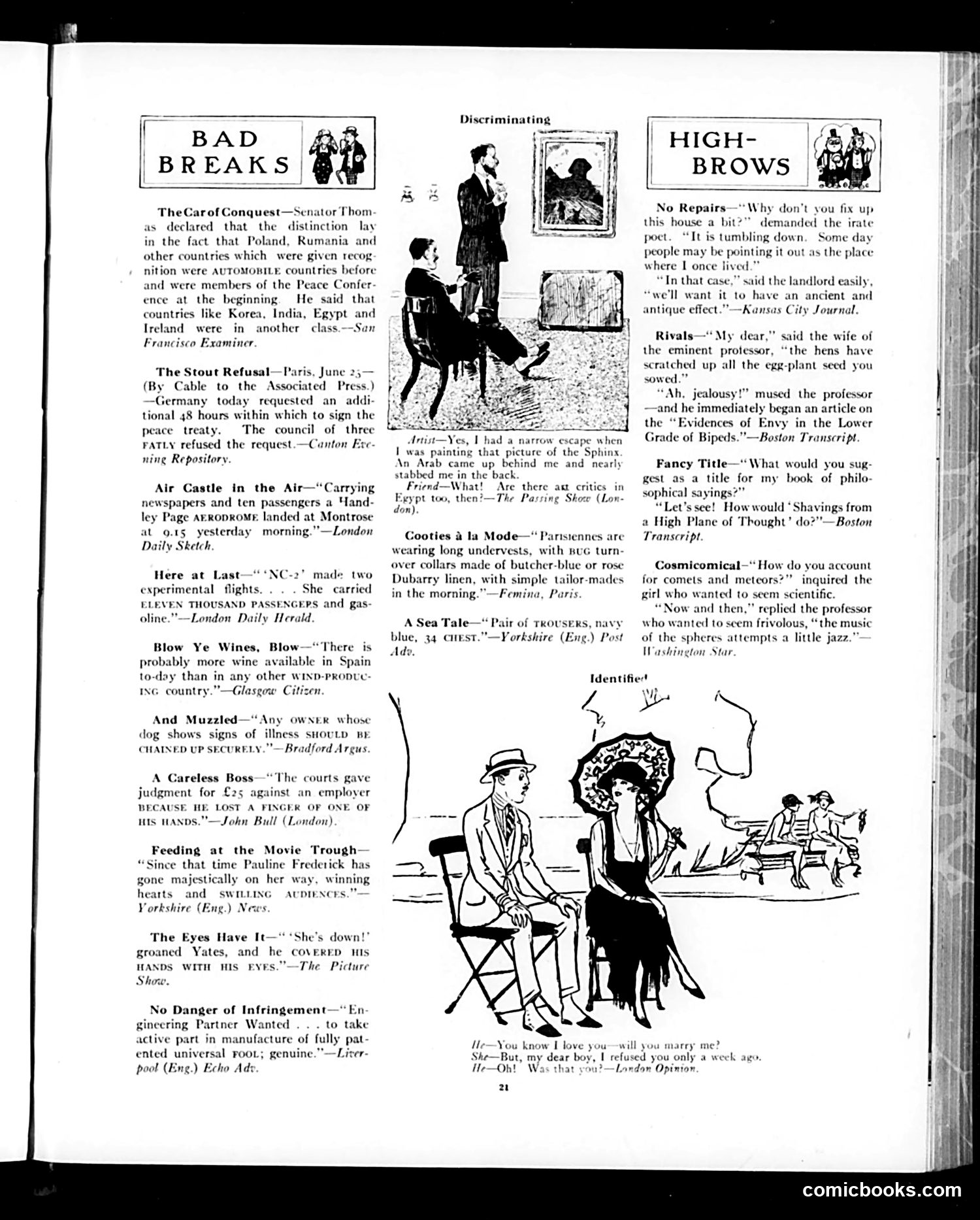
This page from Judge presents two sections of satirical short items and jokes reflecting early 20th-century concerns. **"Bad Breaks"** collects brief news-based humor: Germany's request for extra time signing the peace treaty (likely post-WWI), aviation advances, wine scarcity in Spain, and a court case where an employer was fined for losing an employee's finger—all presented as absurd situations worthy of ridicule. **"High-Brows"** features more sophisticated jokes targeting intellectual pretension. A poet demands his landlord repair his crumbling house for posterity; a professor's wife accuses him of jealousy over damaged seeds; another academic attributes jazz music to cosmic forces to seem cultured. The accompanying cartoon depicts a couple courting while observers identify them, with dialogue about refusing marriage proposals. The satire targets both post-war bureaucratic absurdity and the affectations of educated classes—people adopting false sophistication or using pseudoscientific explanations to maintain appearances of intellectualism. The humor relies on readers recognizing contemporary anxieties about modernity, class, and social pretension.
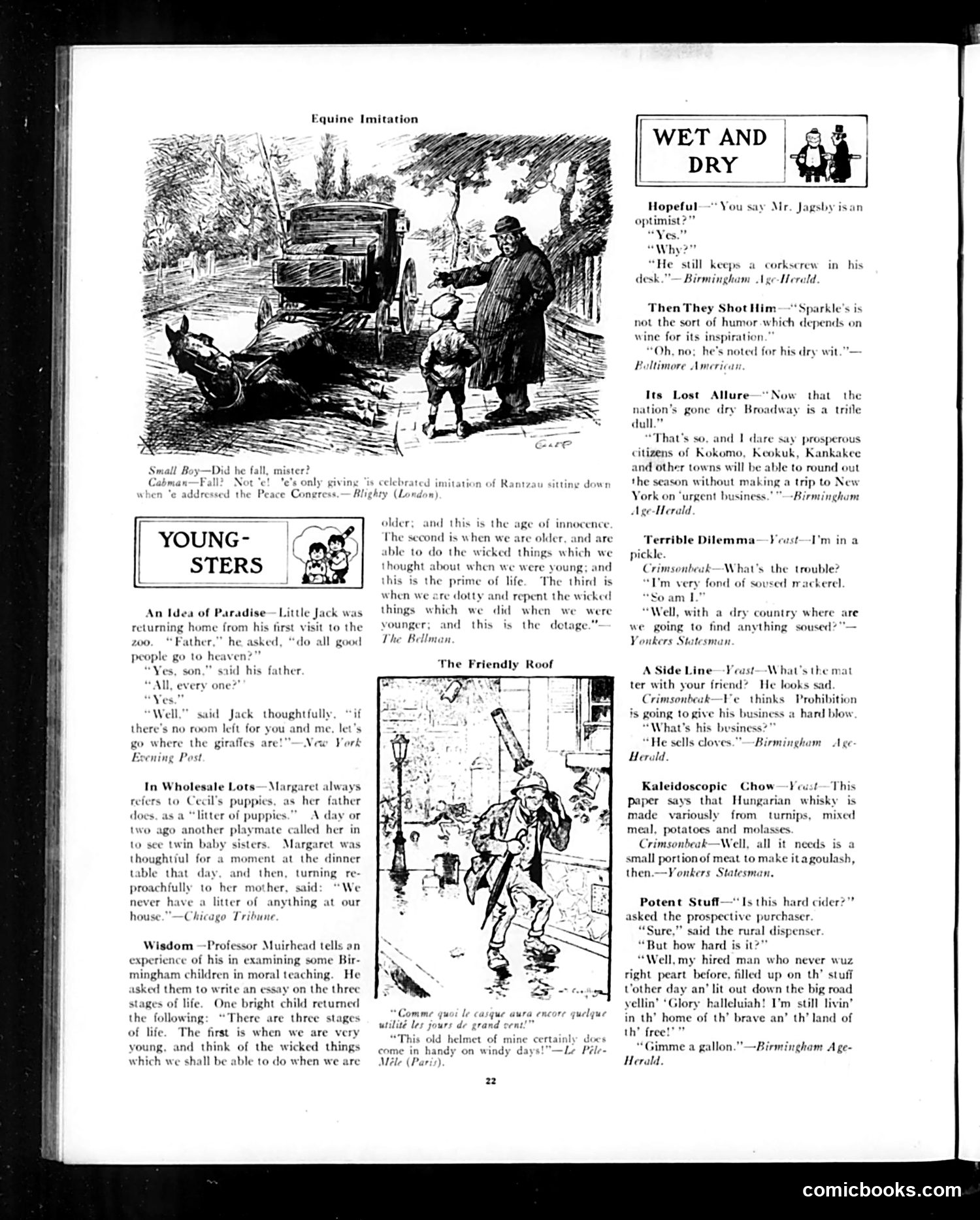
This page from *Judge* magazine collects short humorous anecdotes and jokes, many referencing **Prohibition** (the ban on alcohol in effect in the U.S. at this time). The top cartoon, "Equine Imitation," shows a man mimicking a horse's posture—a visual joke about absurd behavior. The right column's jokes satirize Prohibition's effects: - "Then They Shot Him" contrasts dry wit with drinking - "Its Lost Allure" mocks towns like Kokomo and Keokuk losing business when people can't travel to New York for alcohol - "Terrible Dilemma" and "A Side Line" joke about finding alcohol or selling related items under Prohibition - "Kaleidoscopic Chow" mocks poor-quality homemade whisky made from turnips and potatoes - "Potent Stuff" depicts rural bootleg cider so strong it makes a farmhand delirious The left section, "Young-Sters," offers sentimental children's anecdotes unrelated to Prohibition. Overall, the page reflects early Prohibition-era American humor, mocking both the law's impact and the poor substitutes people created.
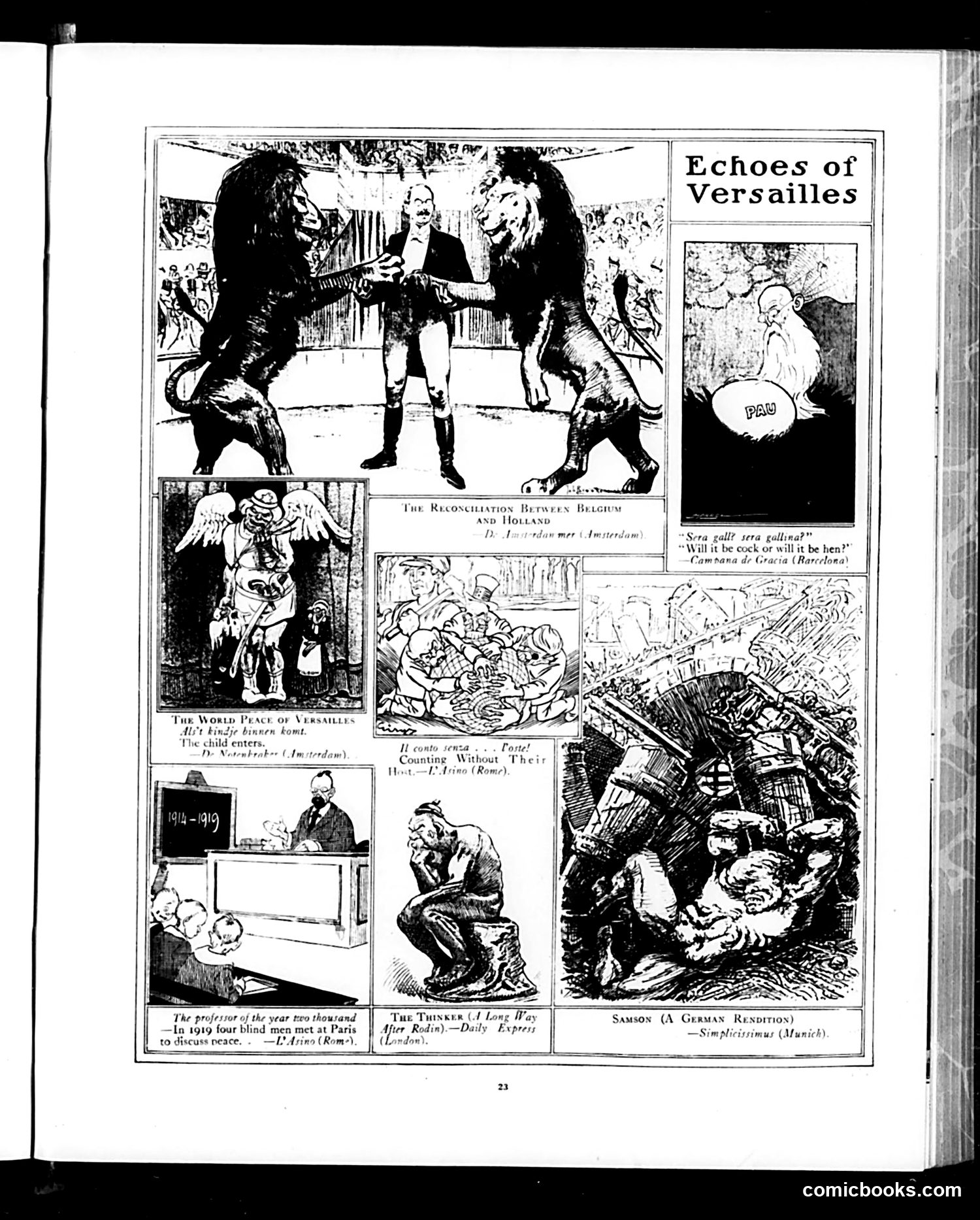
This page satirizes the 1919 Treaty of Versailles peace negotiations. The cartoons use animal and allegorical imagery to mock the proceedings: **Top panel**: Two aggressive animals (likely representing Belgium and Holland) are restrained by a central figure, referencing their territorial disputes being negotiated. **Other panels** depict: - An angelic figure with warring nations (the "World Peace" ideal versus reality) - Blind men discussing peace (suggesting negotiators lack vision/understanding) - A figure labeled "The Thinker" in despair - "Samson (A German Rendition)" showing destruction The title references how different European publications reported these same peace talks differently—each nation's press had its own "echo" or interpretation. The satire suggests the peace process was chaotic, contradictory, and unlikely to produce lasting results. Multiple foreign sources are credited (L'Asino, Daily Express, Simplicissimus), emphasizing how internationally fragmented the commentary was.
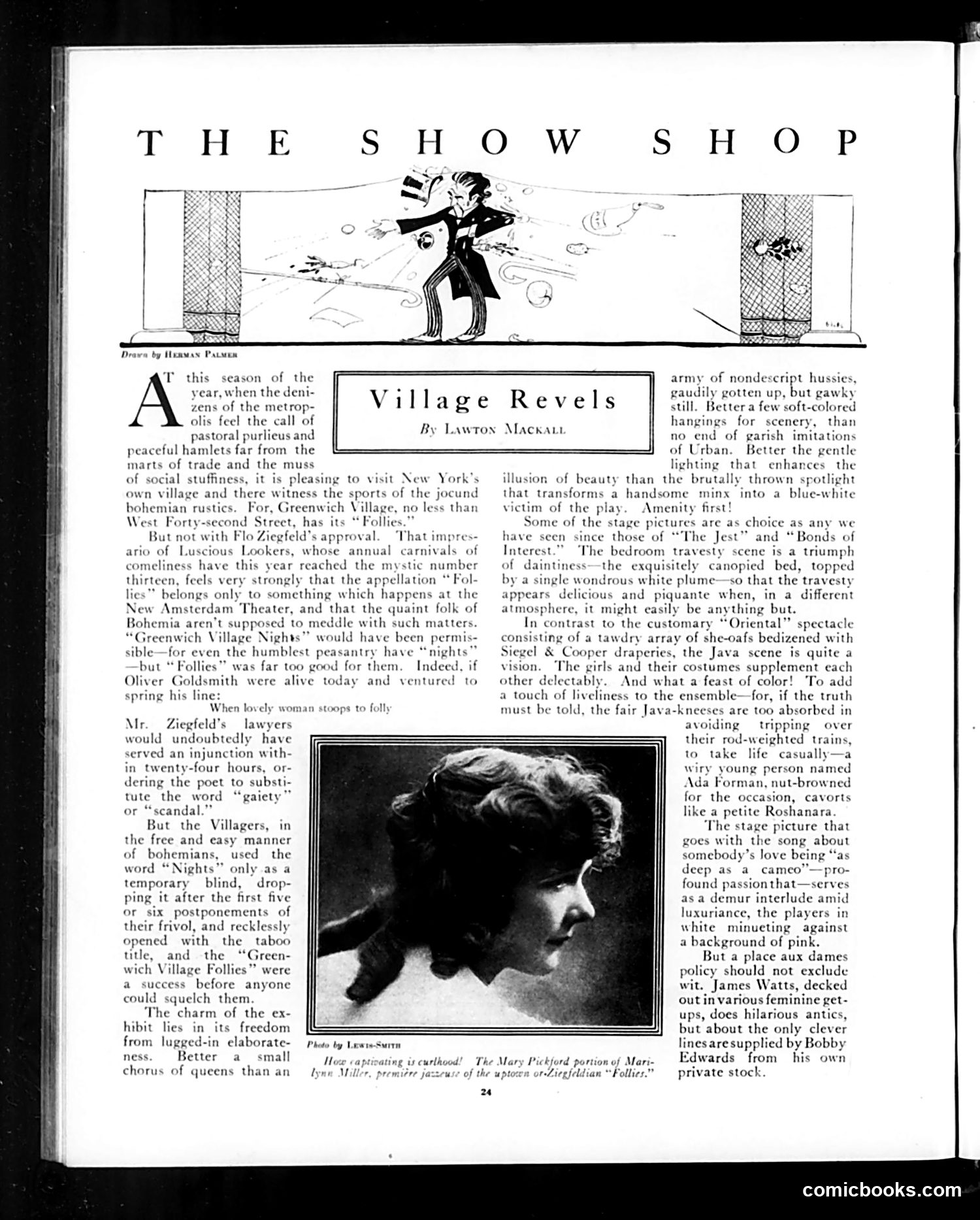
This theater review discusses the "Greenwich Village Follies," a Broadway show that emerged after Flo Ziegfeld's lawyers pressured producers to change the original title from "Greenwich Village Nights" (which Ziegfeld claimed infringed on his famous "Follies" brand). The satire mocks Ziegfeld's aggressive trademark protection—the text humorously suggests he would have sued Oliver Goldsmith himself for using the word "nights." The Villagers, bohemian theatrical folk, defied him by simply dropping the word after several postponements and opening with the forbidden "Follies" title anyway, succeeding before Ziegfeld could stop them. The review praises the show's intimate aesthetic—subtle lighting and elegant set design—contrasting it favorably with Ziegfeld's more garish, heavily decorated spectacles. It particularly celebrates the Java scene's visual artistry and performer Ada Forman's dancing.
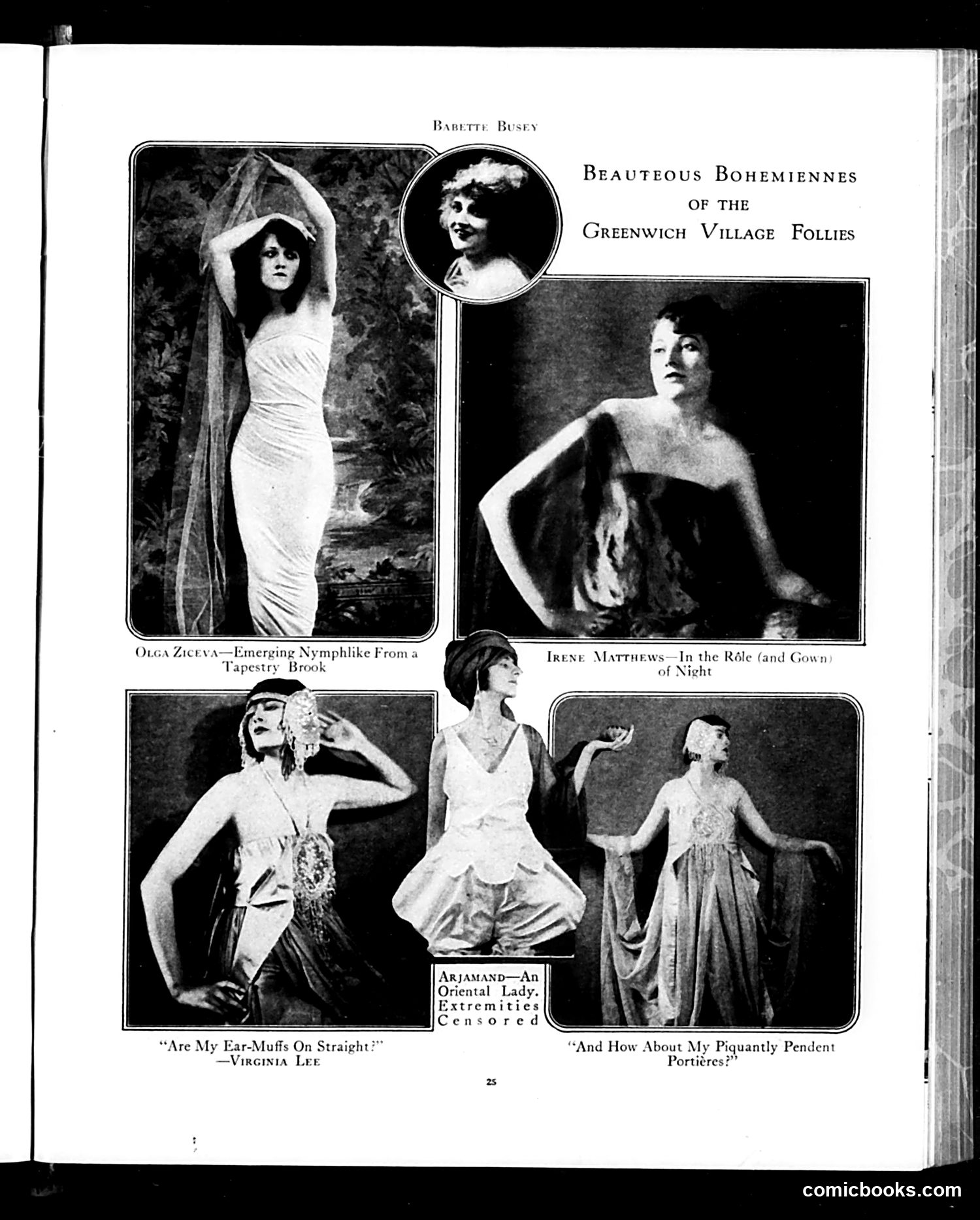
This page satirizes the "Bohemian" cultural scene of Greenwich Village (NYC's bohemian neighborhood in the 1920s). The title mocks pretentious artistic women through deliberately misspelled French words ("Bohemiennes," "Réle," "Portiéres"). The satire targets affectation: women adopting exotic personas and affected fashion choices while claiming artistic sophistication. Virginia Lee's quoted caption about "ear-muffs" and "piquantly pendent portiéres" ridicules this pretense—substituting mundane household items for supposedly artistic references. The note about "Extremities Censored" on the Arjamand image suggests some poses were deemed too risqué, poking fun at both the performers' willingness to push boundaries and censorship concerns of the era. Overall: Judge mocks Greenwich Village's artistic community as affected poseurs rather than genuine artists.
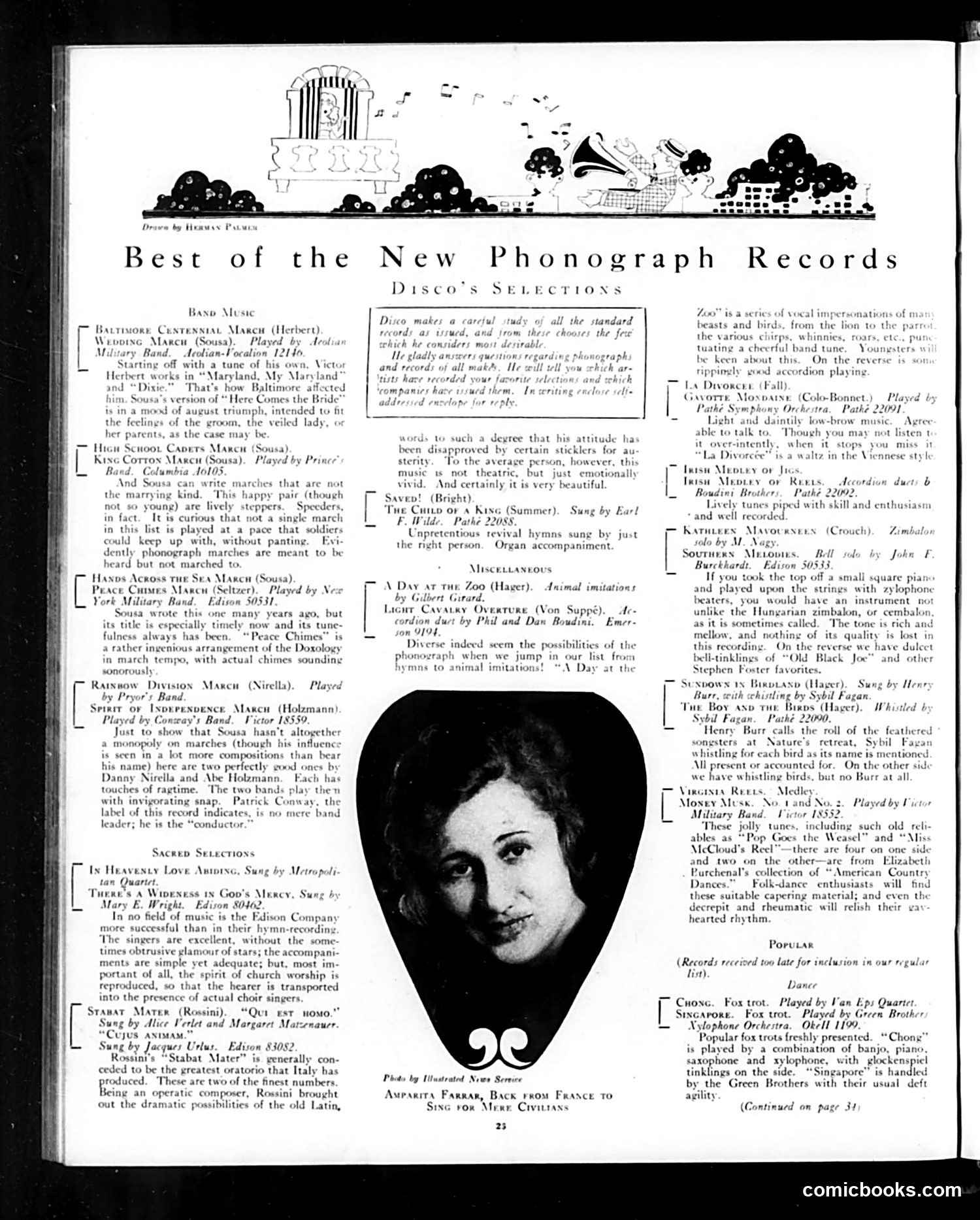
This is a **record review page**, not a political cartoon. It features a portrait photograph of **Amparita Farrar** (a famous soprano), captioned "Back from France to Sing for Merry Civilians." The page catalogs phonograph recordings across genres: band music (John Philip Sousa marches dominate), sacred selections, and popular dance records. The reviews discuss technical quality and performance style. **The only historical context worth noting**: The reference to Farrar "back from France" likely dates this to World War I era, when European performers returned to America. The closing phrase "for Merry Civilians" suggests wartime separation between military and civilian populations. Otherwise, this is straightforward music journalism—advertisements disguised as critical reviews, promoting new recordings to potential buyers. No satire or political commentary is evident on this page.
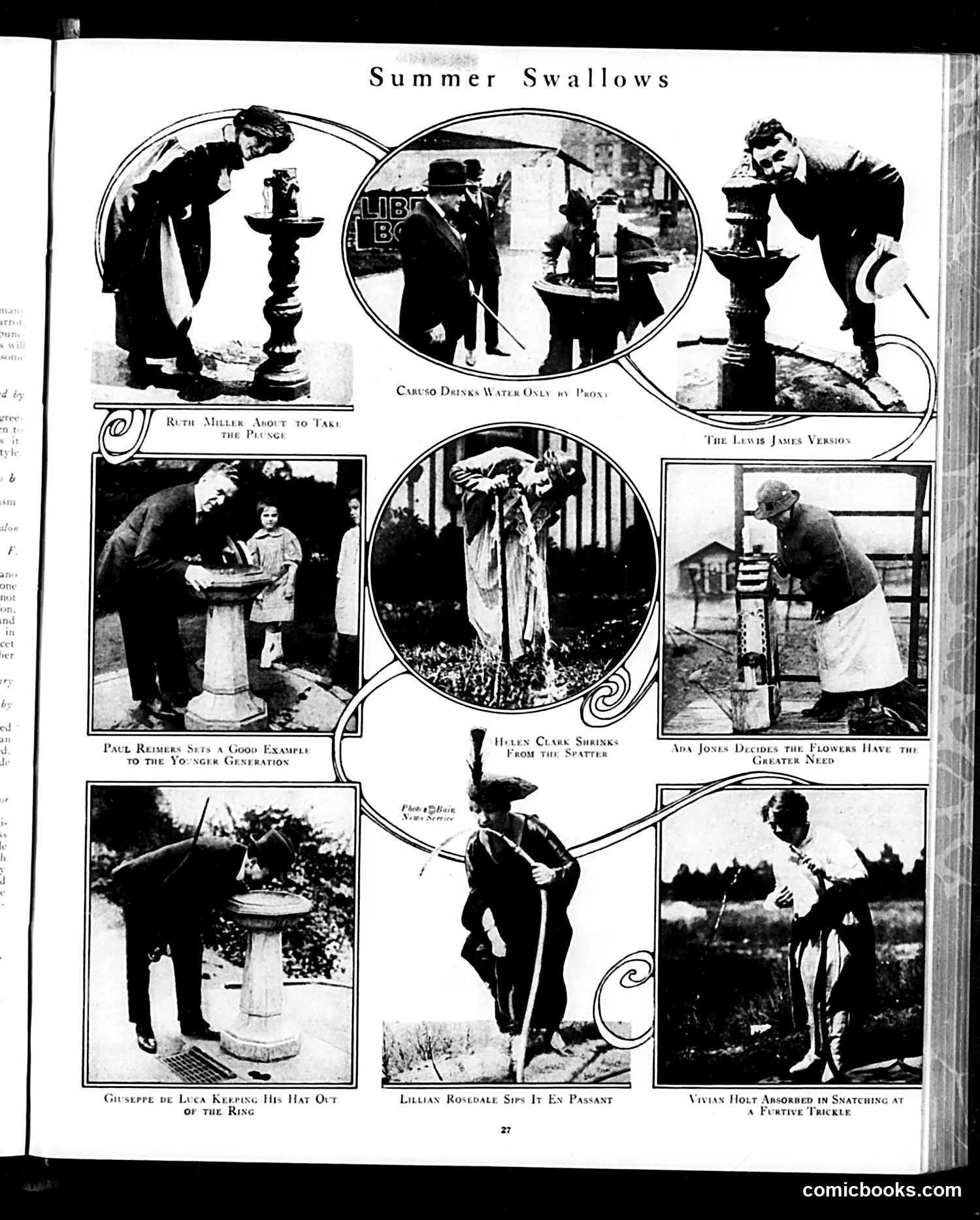
This page presents a series of photographic vignettes satirizing fashionable summer pastimes among the wealthy. The title "Summer Swallows" references people who migrate seasonally to leisure activities. The captions identify various social figures engaged in genteel pursuits: watering plants, fetching water, examining flowers, and other domestic or garden activities. The satire appears to mock the idle leisure class's ritualistic summer behaviors and their preoccupation with maintaining appearances of genteel sophistication. The photographic format—rather than drawn cartoons—suggests these may be actual society figures or archetypes of the era. The "swallows" metaphor implies these wealthy individuals follow predictable, migratory patterns of seasonal social behavior, much like birds following instinct rather than reason.
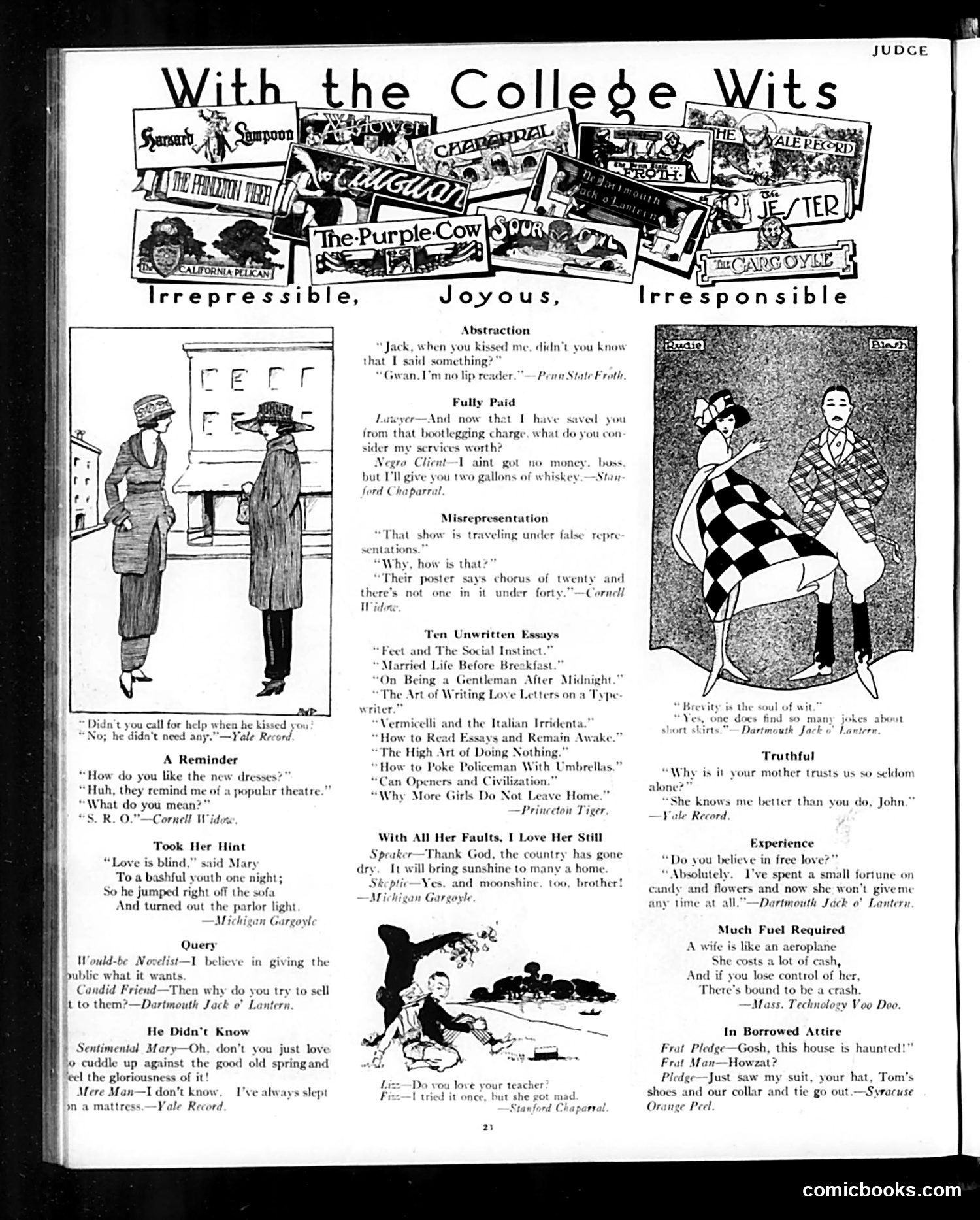
This page collects humorous quips and jokes from college humor magazines (Yale Record, Cornell Widows, Penn State Froth, etc.), organized by category. The cartoons and jokes satirize college life and contemporary social issues. Key themes include: **Prohibition era references**: Multiple jokes reference bootlegging and illegal whiskey, reflecting 1920s-era alcohol ban enforcement and widespread circumvention. **Gender dynamics**: Several jokes mock courtship rituals and women's fashion ("S.R.O." — standing room only — mocking skimpy new dresses). **Class and race**: One joke depicts a Black client offering whiskey as payment to a lawyer, perpetuating racist stereotypes about both Prohibition-era lawlessness and Black stereotypes. **College culture**: References to fraternity hazing, student romance, and academic pretension. The humor is period-typical collegiate comedy—often crude, sometimes offensive by modern standards—reflecting 1920s attitudes toward social propriety, romance, and authority.
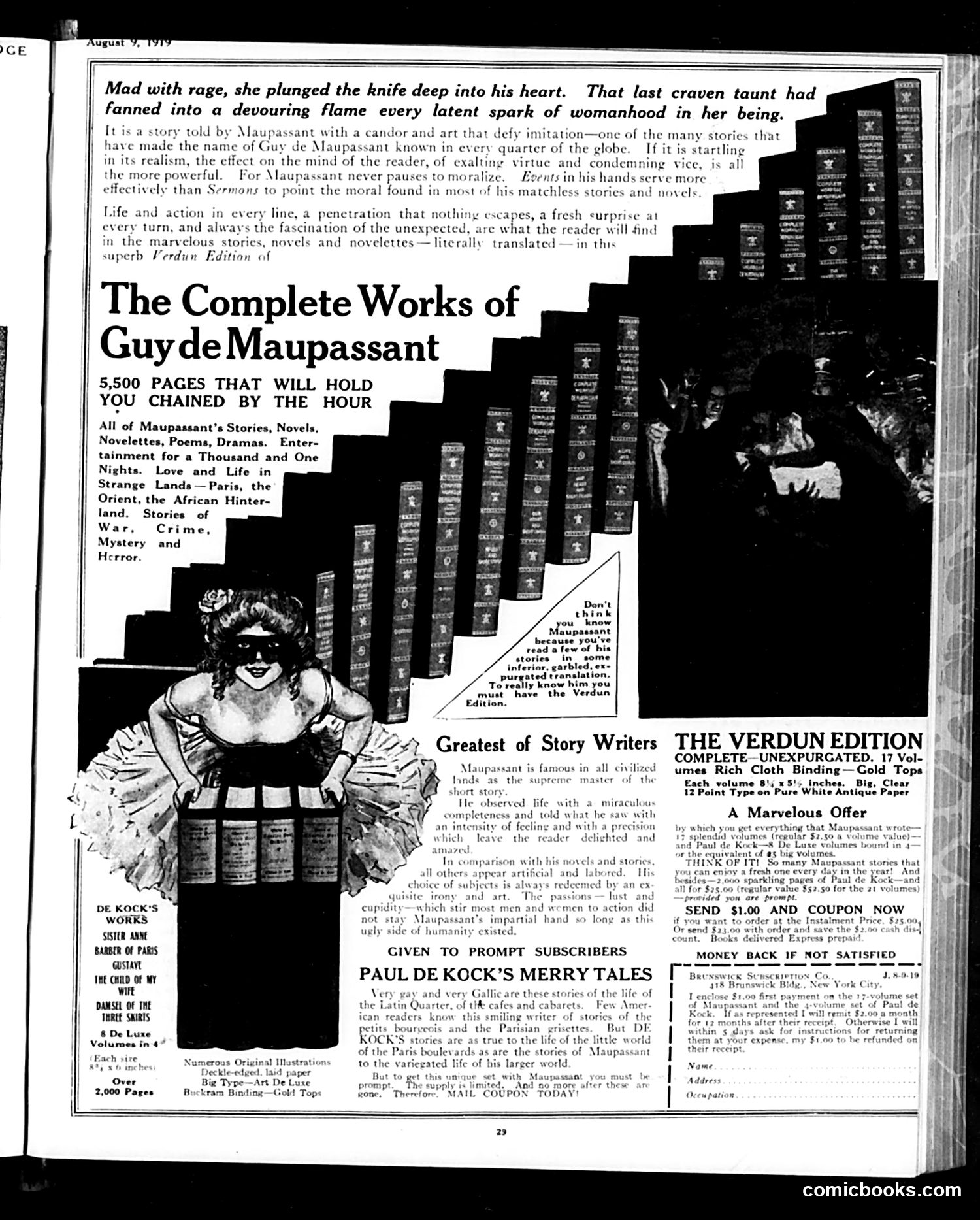
This page is primarily a **book advertisement**, not a political cartoon. It promotes "The Complete Works of Guy de Maupassant" (the Verdun Edition) and companion volumes by Paul de Kock, a 19th-century French writer. The page opens with a melodramatic passage—a woman stabbing a man—meant to entice readers with Maupassant's dramatic storytelling. The layout features stacked book spines to emphasize the 5,500-page collection and 17-volume set. The masked woman illustration is decorative, not satirical. The ad emphasizes the books' unexpurgated (uncensored) nature and appeals to subscribers with a "marvelous offer" and money-back guarantee. There is **no political commentary or social satire**—this is commercial marketing from *Judge* magazine's advertising section, typical of early 20th-century periodicals promoting literary collections to educated readers.
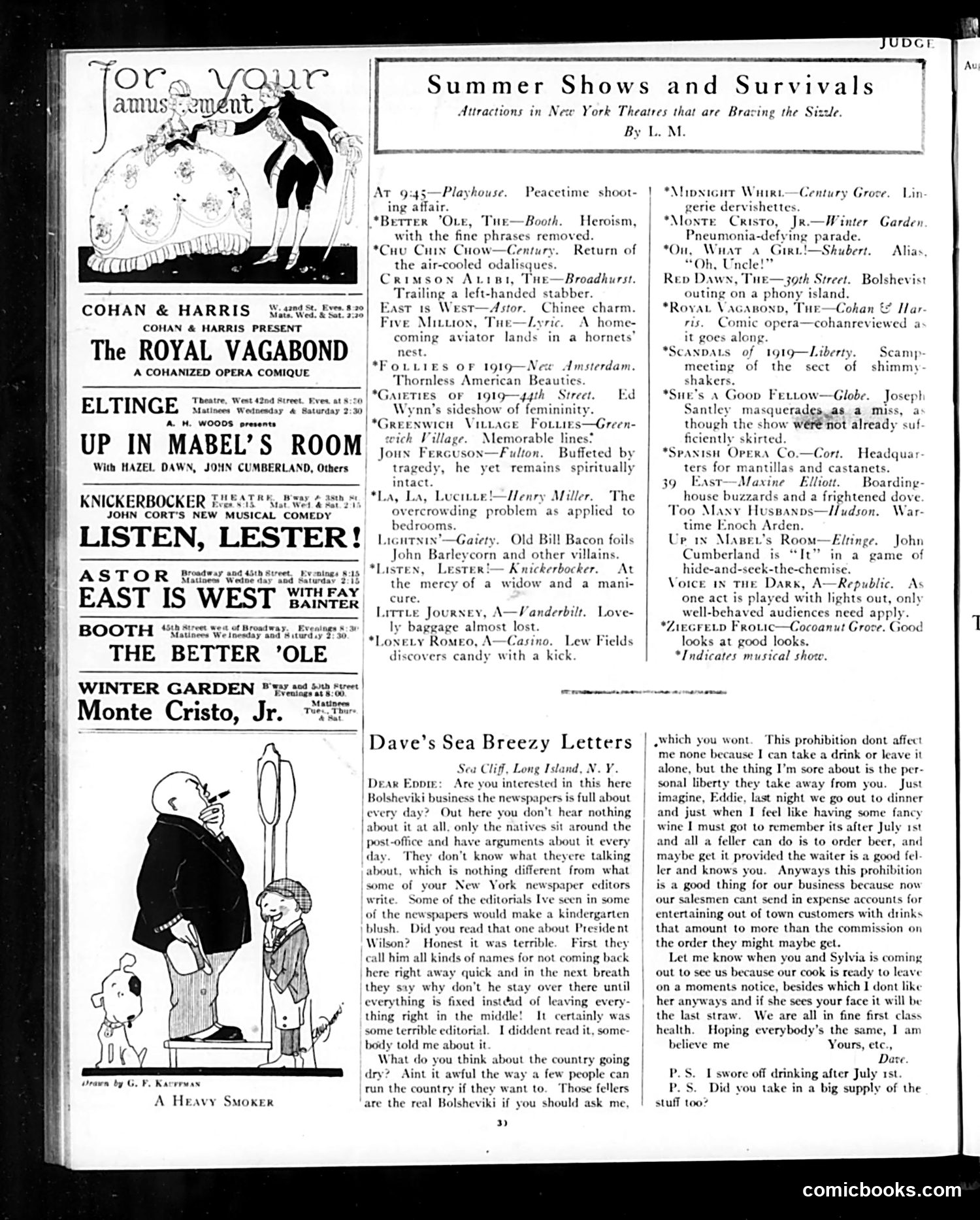
This page is primarily **theater advertising and reviews** for New York summer shows circa 1919, with a sidebar humor column. ## Main Content: The left side lists Broadway theaters and current productions with sardonic one-line descriptions (e.g., "*Better 'Ole*—Booth. Heroism, with the fine phrases removed"). These appear to mock post-WWI plays for their sentimentality or artificiality. ## "Dave's Sea Breezy Letters": A humorous letter from a Long Island reader complains about newspaper coverage of Bolshevism and Prohibition. The writer mockingly notes that locals don't understand the Bolshevik threat, and newspapers publish conflicting editorials attacking President Wilson for both leaving Europe too soon and staying too long. He sarcastically compares Prohibition advocates to "real Bolsheviki"—conflating temperance activists with communist revolutionaries as a joke about government overreach. The cartoon at bottom (credited to G.F. Kaufman) titled "A Heavy Smoker" is unclear without full visibility. **Context**: This reflects 1919 American anxiety about Bolshevism, Prohibition, and post-war politics.
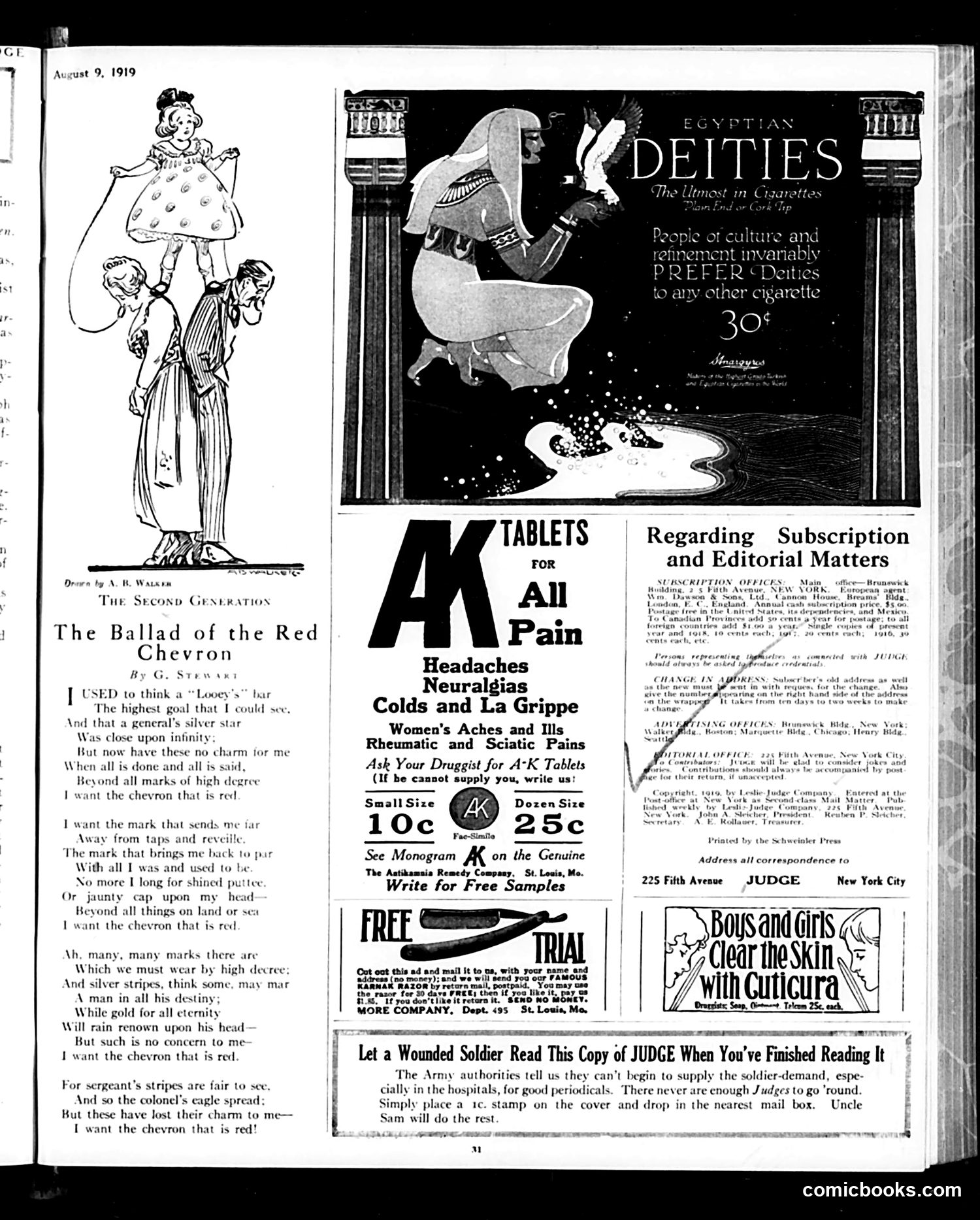
This poem satirizes post-WWI soldier priorities. The speaker, a returning serviceman, dismisses traditional military status symbols—officer bars, general's stars, sergeant stripes, colonel's eagles—as meaningless. Instead, he obsesses over the "red chevron," the wound stripe awarded to soldiers injured in combat. The satire captures the disillusionment of WWI veterans. After the war's devastation, conventional markers of rank and achievement rang hollow. What actually mattered was evidence of sacrifice: the wound stripe proved you'd bled for your country. This reflects broader post-war cynicism about institutional honors versus authentic suffering. The page also includes a public service message urging readers to send *Judge* magazines to wounded soldiers in hospitals—contextualizing the poem's patriotic sentiment within 1919's immediate post-war period.
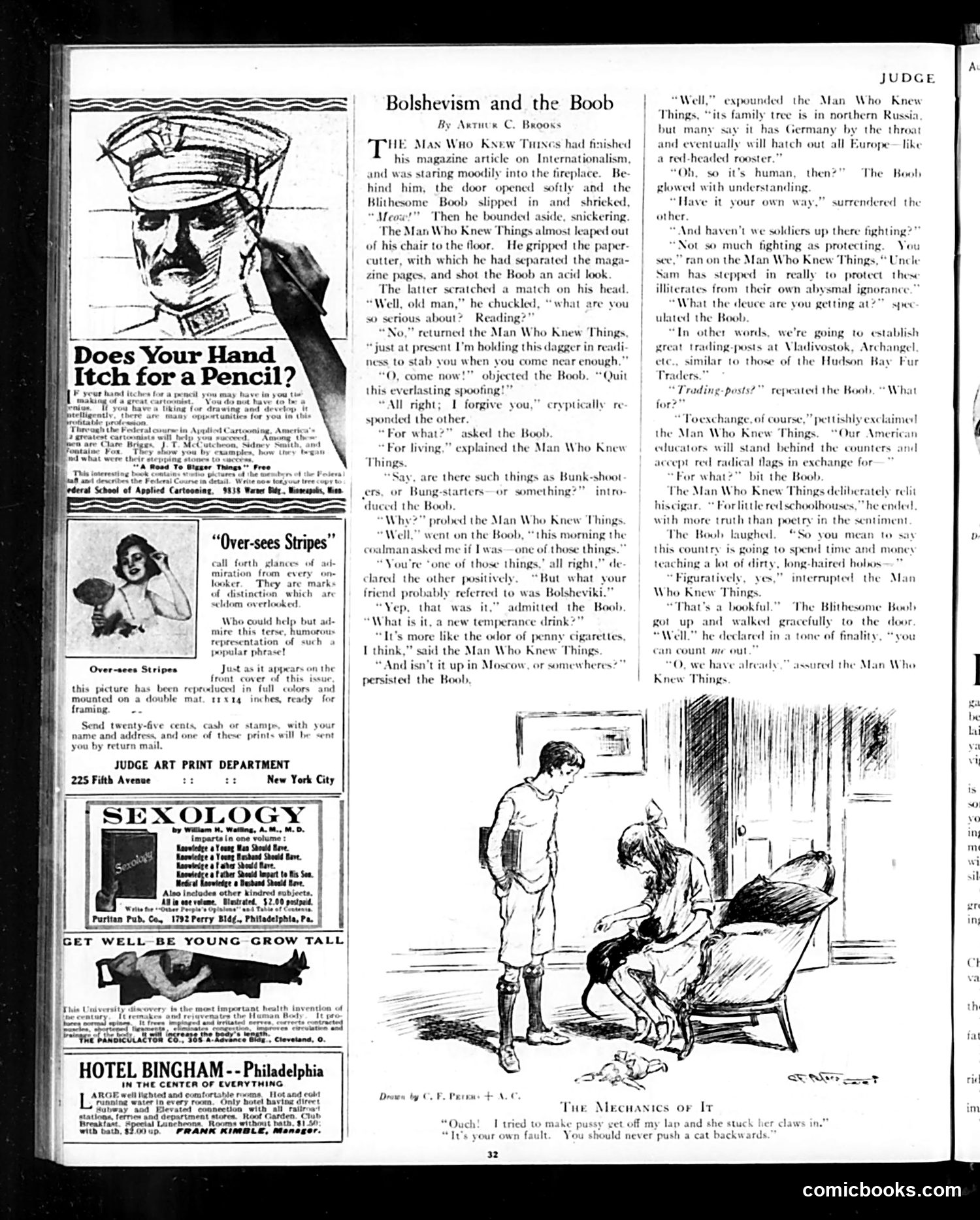
This satirical dialogue mocks American anti-Bolshevik attitudes following the Russian Revolution. "The Man Who Knew Things" represents the educated intellectual explaining Bolshevism to "The Blithesome Boob"—a foolish everyman character. The joke targets both figures: the Boob's ignorance (confusing "Bolsheviki" with a temperance drink), but more sharply, the intellectual's condescending justifications for U.S. intervention in Russia. The Man claims America's Siberian military presence aims to "protect" Russian "illiterates" while establishing "trading-posts"—mocking how interventionists dressed commercial interests and anti-communist ideology in humanitarian language. The satire suggests American elites are fooling themselves and the public about Russian intervention's true motives. The reference to "red radical flags" and "dirty, long-haired hobos" reflects 1920s Red Scare stereotypes the magazine is lampooning.
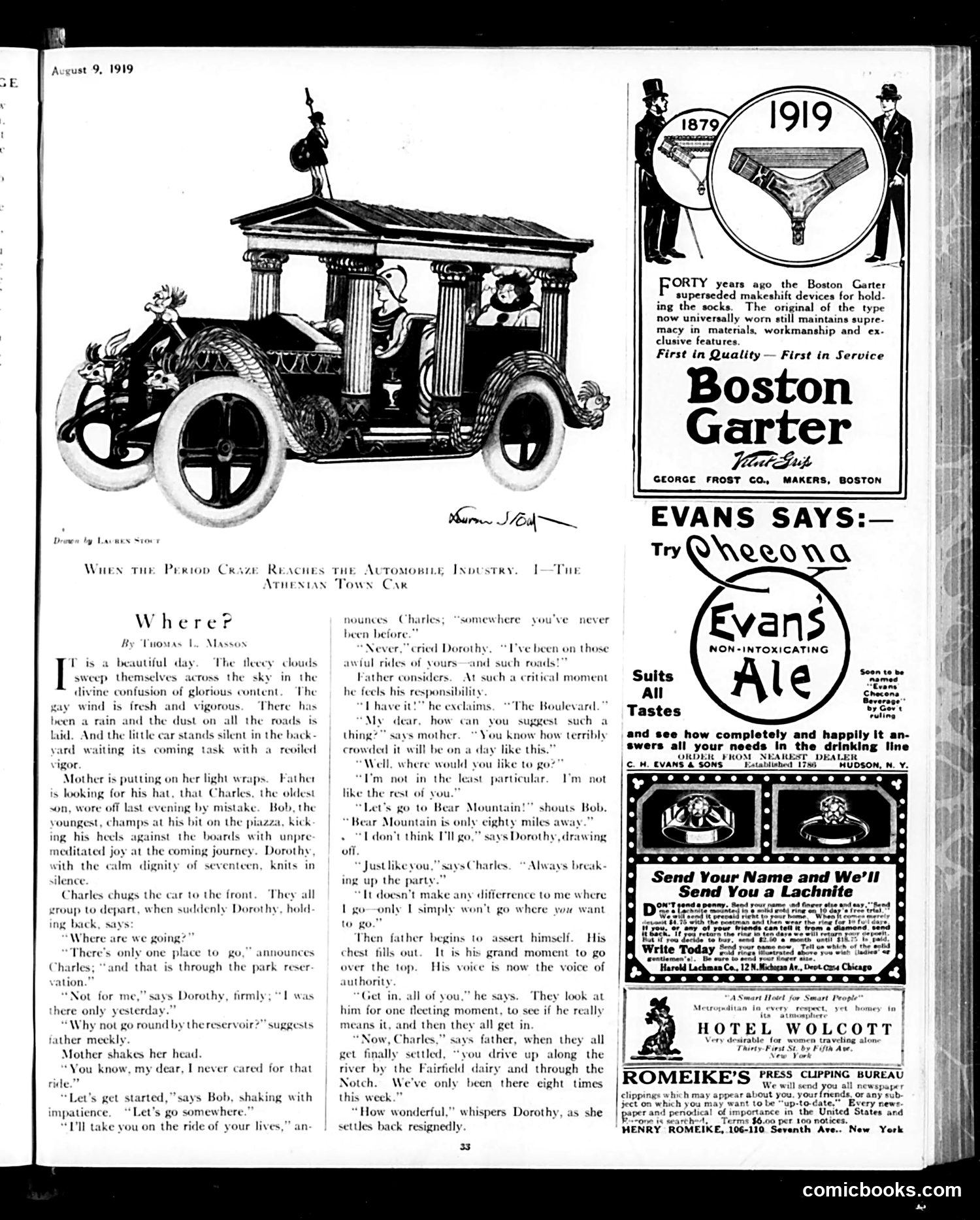
This humorous story-cartoon by Thomas L. Massos satirizes the chaos of early automobile family trips. The narrative follows the Mason family attempting to decide where to drive their new car on a beautiful day. Each family member proposes a destination—the park, Bear Mountain, the Boulevard—but Dorothy, the seventeen-year-old daughter, reflexively objects to every suggestion, claiming she's already been everywhere ("I was here only yesterday"). The satire targets the indecisiveness and bickering that plague group decision-making, particularly the frustration of planning leisure activities when one person perpetually refuses to cooperate. Father finally asserts authority, insisting they all get in the car. The joke culminates when Charles drives them to the same location they've visited eight times that week—the Notch by Fairfield dairy—and Dorothy accepts this resignedly. The page's advertisements (Boston Garter socks, Evans Ale, etc.) are period typical.
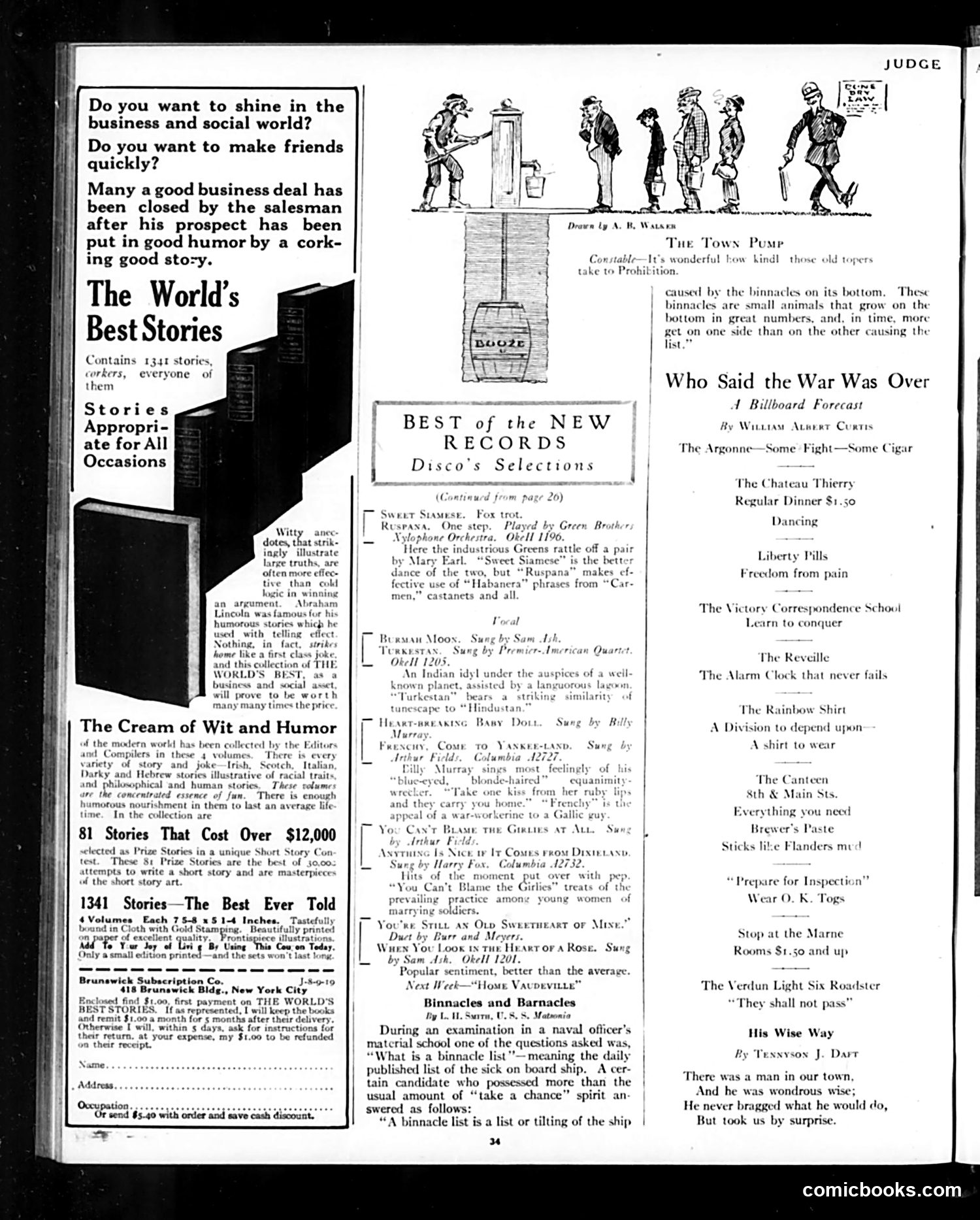
This page is primarily **advertising and editorial content** rather than political satire. The dominant feature is a large advertisement for "The World's Best Stories"—a mail-order book collection selling itself as a business tool for salesmen who close deals through humor. The cartoon at top, "The Town Pump" by A.B. Walker, appears to be a humorous sketch about an old pump causing a ship to list (tilt) due to barnacles, playing on naval terminology. The "Who Said the War Was Over" section contains **WWI-themed advertisements disguised as entertainment listings**—products and services named after famous 1918 battle sites: "The Argonne," "Chateau Thierry," "The Verdun," and "The Marne." This marketing strategy capitalized on Americans' fresh memories of World War I combat, using patriotic associations to sell ordinary goods like light roadsters and lodging. The "Binnacles and Barnacles" joke plays on naval jargon: a midshipman misdefines "binnacle list" (sick roster) by confusing it with actual barnacles causing a ship's tilt. Overall: a commercial-heavy issue exploiting wartime nostalgia.
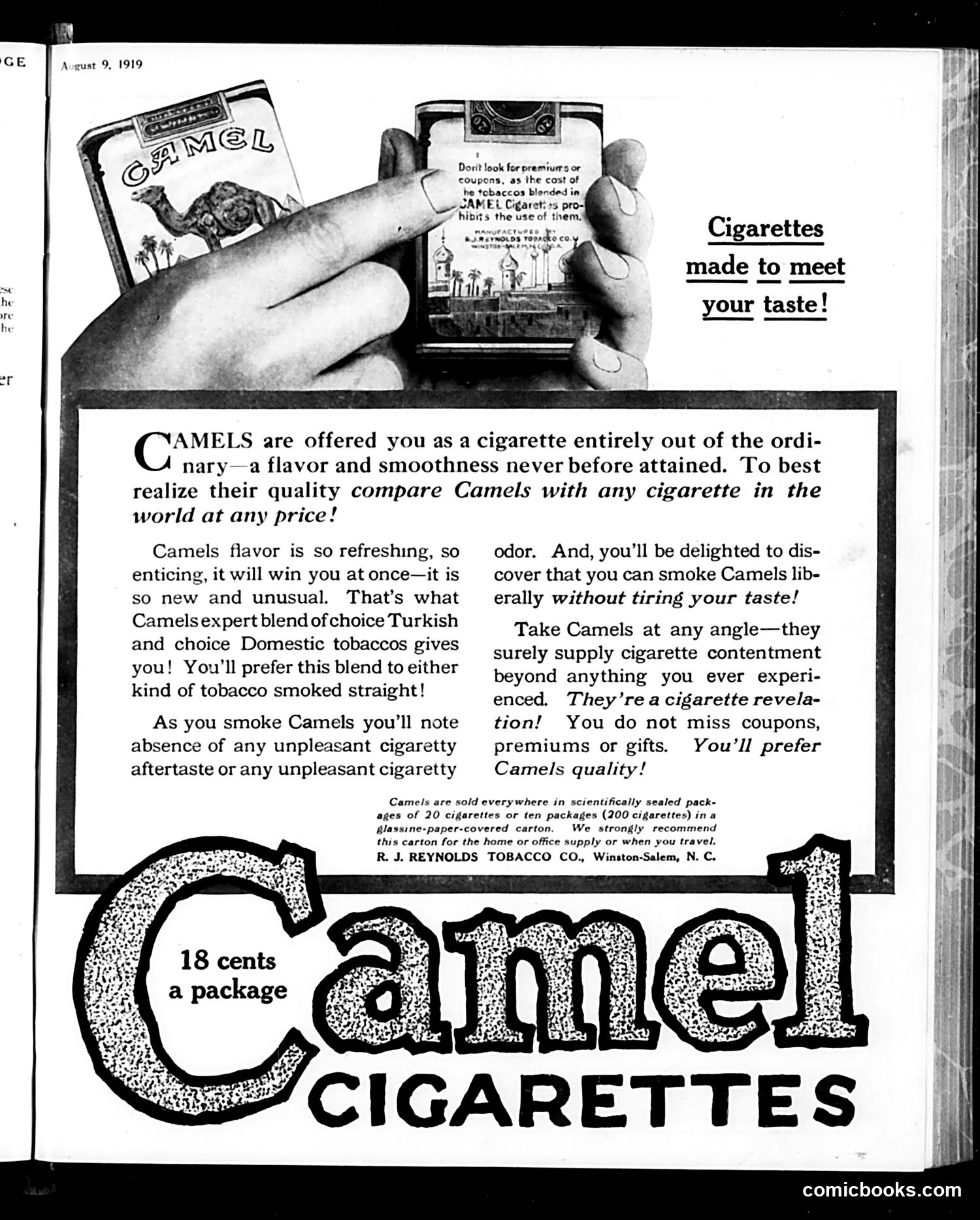
This page is **entirely a cigarette advertisement**, not satire or political commentary. It's a 1919 Camel cigarettes ad from Judge magazine. The image shows a hand holding a Camel cigarette pack. The text emphasizes Camel's "new and unusual" flavor from a blend of Turkish and domestic tobaccos, claiming superiority over competitors and notably that smokers won't experience "unpleasant cigaretty aftertaste." The ad explicitly addresses a contemporary marketing practice: "Don't look for premiums or coupons, as the cost of the tobaccos blended in JAMEL Cigarettes prohibits the use of them." Competing brands apparently offered premiums/coupons; Camel positioned itself as premium-quality, justifying higher cost through superior tobacco rather than giveaways. The price: 18 cents per package. This reflects early 20th-century cigarette marketing before health concerns dominated discourse.
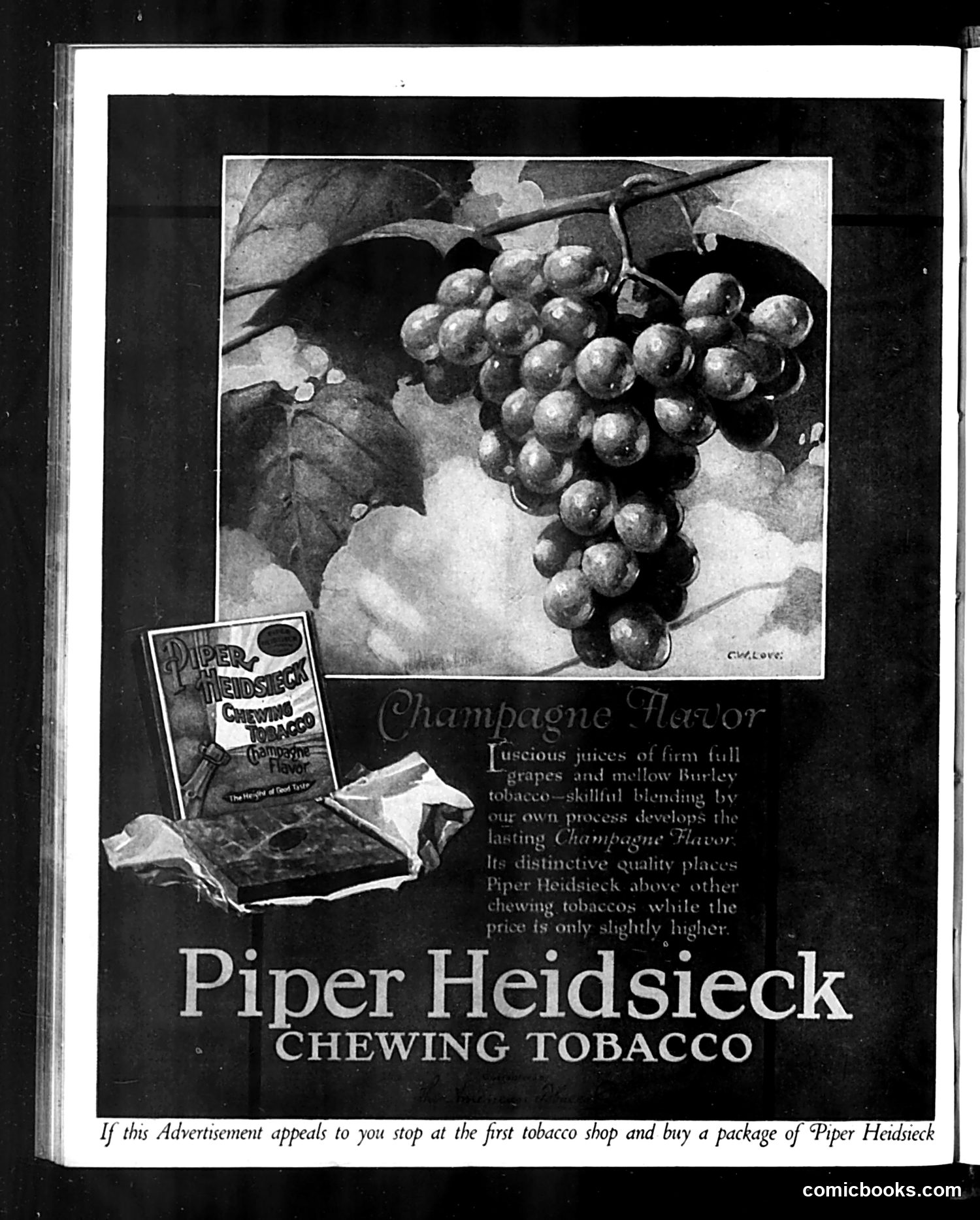
This page is primarily **advertising, not editorial content or satire**. It's a full-page advertisement for Piper Heidsieck chewing tobacco, featuring a large photograph of grapes on a vine. The ad copy emphasizes "Champagne Flavor," describing how the product blends tobacco to create this distinctive taste. It claims Piper Heidsieck stands above competitors while costing only slightly more. The grape imagery is clearly meant to reinforce the "champagne" branding—associating the chewing tobacco with luxury and sophistication. The product name itself references Piper-Heidsieck, a real French champagne house, leveraging that prestige. This appears to be from an era when such tobacco advertising was standard in magazines like *Judge*, before modern advertising restrictions.