
Judge, 1919-08-09 · page 13 of 36
Judge — August 9, 1919 — page 13: what you’re looking at
What you’re looking at
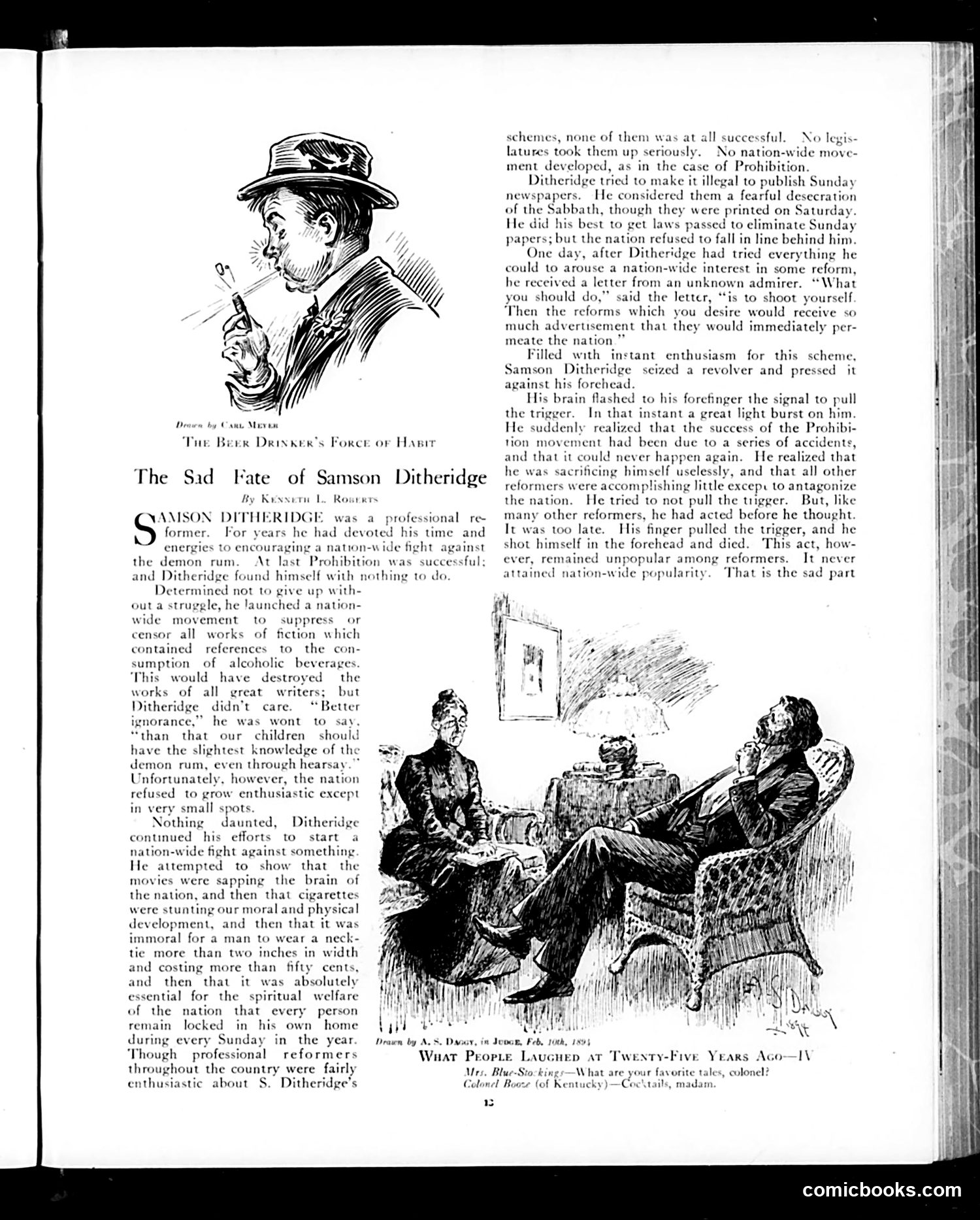
This 1895 Judge magazine page satirizes obsessive moral reformers through the character Samson Ditheridge. **The Story**: Ditheridge, a professional reformer who successfully championed Prohibition, becomes directionless afterward. He launches increasingly absurd crusades—censoring fiction with alcohol references, attacking movies, regulating necktie dimensions, and mandating home confinement on Sundays. None gain traction. Receiving anonymous advice to "shoot yourself" for publicity, Ditheridge attempts suicide but hesitates, realizing reform movements succeed through "accidents," not sacrifice. Too late—he kills himself, but the act remains unpopular. **The Satire**: The piece mocks single-issue reformers as inherently unstable and their causes as arbitrary moralism disconnected from public sentiment. The absurdist escalation (neckties to home imprisonment) ridicules prohibition's authoritarian logic. The dark ending—suicide gaining no traction—suggests reformers' grandiose self-importance versus society's indifference. **Context**: This reflects 1890s skepticism toward the temperance movement and paternalistic "vice" crusades dominating Progressive Era politics.
📄 Transcribed text from this page (OCR, searchable)
Machine-transcribed from the original scan — historical spelling and the odd misread are preserved.
# a4 | aie schemes, none of them was at all successful. No legis- ik latures took them up seriously. No nation-wide move- | ' ment developed, as in the case of Prohibition | Ditheridge tried to make it illegal to publish Sunday | newspapers. He considered them a fearful desecration \ of the Sabbath, though they were printed on Saturday. ! He did his best to get laws passed to eliminate Sunday papers; but the nation refused to fall in line behind him. t One day, after Ditheridge had tried everything he could to arouse a nation-wide interest in some reform, | he received a letter from an unknown admirer. “What | f you should do,” said the letter, “is to shoot yourself | Then the reforms which you desire would receive so much advertisement t they would immediately per- meate the nation ” Filled with instant enthusiasm for this scheme, Samson Ditheridge seized a revolver and pressed it against his forehead. His brain flashed to his forefinger the signal to pull the trigger. In that instant a great light burst on him. Drown by Cant M He suddenly realized that the success of the Prohibi- Hae Tue Beer Drinner’s Force or Hair tion movement had been due to a series of accidents, ing and that it could never happen again. He realized that at oe Sate Res rn oe he was sacrificing himself uselessly, and that all other , The Sad Fate of Samson Ditheridge (io). were accomplishing little excep to antagonize i By Kexseru Lb. Rowrrrs the nation. He tried to not pull the trigger. But, like ‘ q NAMSON DITHERIDGE was a. professional re many other reformers, he had acted before he thought. l S former. For years he had devoted his time and It was too late. His finger pulled the trigger, and he t energies to encouraging a nation-wide fight against shot himself in the forehead and died. This act, how- a the demon rum. At last Prohibition was successful; €Ver, remained unpopular among reformers. It never on and Ditheridge found himself with nothing to do. attained nation-wide popularity. That is the sad part cal Determined not to give up with- i out a struggle, he launched a nation- a $ wide movement to suppress or | Hi | censor all works of fiction which j ay contained references to the con- r | | sumption of alcoholic beverages ee ‘This would have destroyed — the works of all t writers; but Ditheridge didn’t care. “Better ignorane he was wont to say, “than that our children should have the slightest knowledge of the demon rum, even through hearsay.” Unfortunately, however, the nation refused to grow enthusiastic except in very small spots. Nothing daunted, Ditheridge continued his efforts to start a nation-wide fight against something He attempted to show that the movies were sapping the brain of the nation, and then that cigarettes were stunting our moral and physical development, and then that it was immoral for a man to wear a neck- tie more than two inches in width and costing more than fifty cents, and then that it was absolutely essential for the spiritual welfare of the nation that every person remain locked in his own home during every Sunday in the year. Prawn by A.S. Dancy, in Joven, Feb, 10th, 1895 at Though professional reformers Wuat Prope Laucuen at T Years Aco—I\ N throughout the country were fairly Mes. BlucStockings—What s, colonel? Me | enthusiastic about S. Ditheridge’s Colonel Booze (of Kentucky) oh 3 ot ou { comicbooks.com