
Judge, 1919-08-09 · page 8 of 36
Judge — August 9, 1919 — page 8: what you’re looking at
What you’re looking at
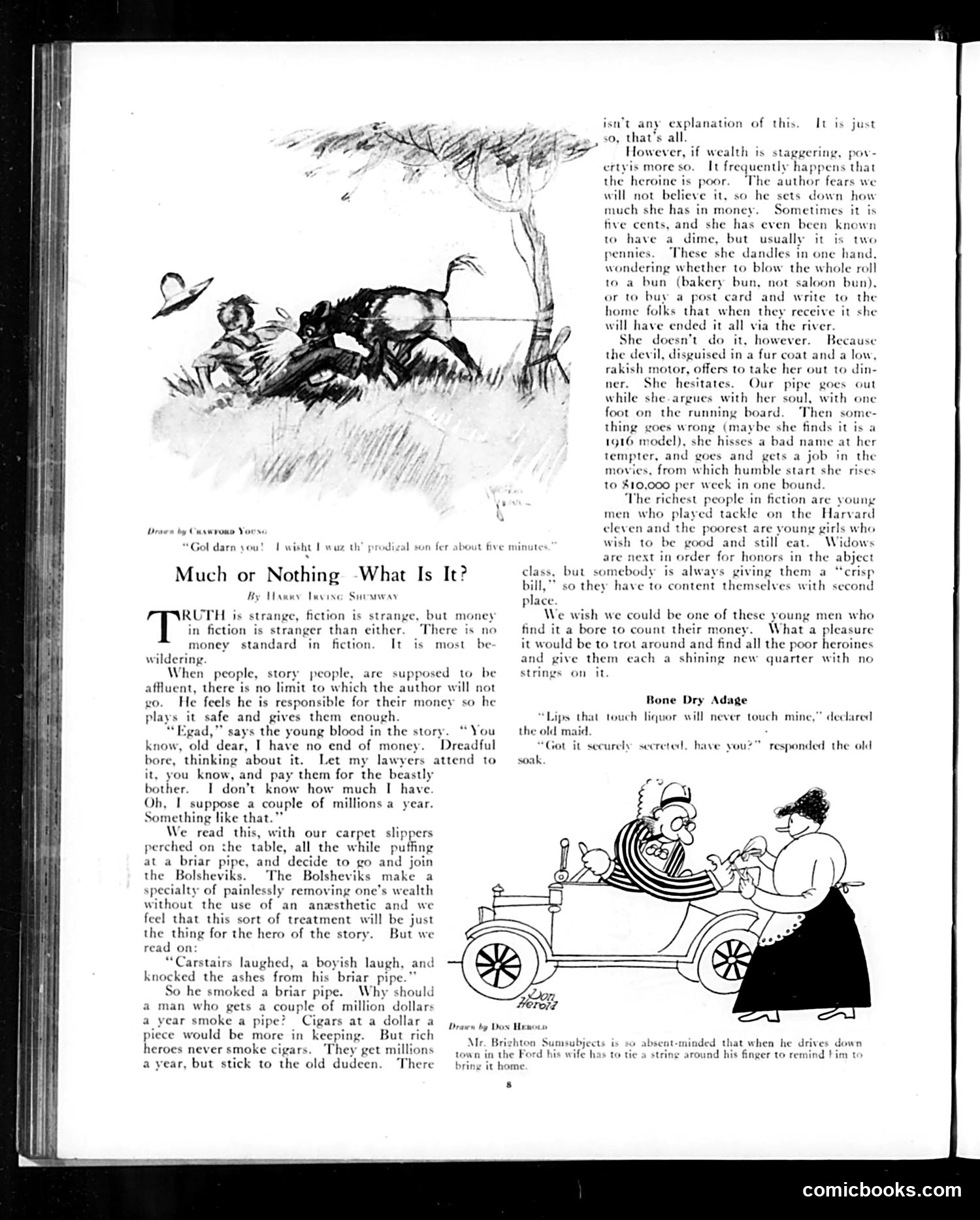
This satirical essay by Harry Irving Suesway critiques unrealistic wealth portrayals in fiction. The author argues that fictional wealthy characters casually demonstrate millions in assets (smoking cheap pipes despite earning millions yearly), while poor heroines obsess over pennies, contemplating suicide before conveniently being "rescued" into movie stardom at $10,000/week. The accompanying cartoons illustrate these absurdities: the top sketch shows a rural scene mocking naive poverty; the lower cartoon "Bone Dry Adage" depicts an old maid and man in a car, likely satirizing Prohibition-era hypocrisy about drinking. The essay's real target is authorial laziness—writers fail to portray wealth authentically, instead using caricatured gestures (briar pipes, vague millions) that ring false to ordinary readers. The Harvard football player millionaire and pure-but-poor girl represent tired literary tropes the author mocks as unconvincing wish-fulfillment fantasy.
📄 Transcribed text from this page (OCR, searchable)
Machine-transcribed from the original scan — historical spelling and the odd misread are preserved.
Deven by Carwrour Yous “Gol darn you! 1 wisht 1 wuz th’ prodigal son fer Much or Nothing -What Is It? Ry Uarky levine Suesway but money here is no most be RUTH is strange, fiction is strange. in fiction is stranger than either money standard in fiction. It is wildering. When people, story people, are supposed to be affluent, there is no limit to which the author will not go. He feels he is responsible for their money so he plays it safe and gives them enough. ‘gad,” says the young blood in the story. ow, old dear, I have no end of money. Dr bore, thinking about it. Let my lawyers attend to it, you know, and pay them for the beastly bother. I don’t know how much I have Oh, I suppose a couple of millions a year. Something like that.” We read this, with our carpet slippers perched on the table, all the while puffing at a briar pipe, and decide to go and join the Bolsheviks. The Bolsheviks make a specialty of painlessly removing one’s wealth without the use of an anzxsthetic and we feel that this sort of treatment will be just the thing for the hero of the story. But we read on “Carstairs laughed, a boyish laugh, knocked the ashes from his briar pipe So he smoked a briar pipe. Why should a man who gets a couple of million dollars a_year smoke a pip Cigars at a dollar a piece would be more in keeping. But rich heroes never smoke cis They get millions a year, but stick to the old dudeen. There and Draws Mr rs. bout five mii 8 explanation of this. It is just so, that’s all However, if wealth is staggering, pov- ertyis more so. It frequently happens that the heroine is poor. The author fears we will not believe it, so he sets down how much she has in money. Sometimes it is five cents, and she has even been known to have a dime, but usually it is two penni These she dandles in one hand, wondering whether to blow the whole roll to a bun (bakery bun, not saloon bun). or to buy a post card and write to the home folks that when they receive it sh will have ended it all via the river. She doesn’t do it, however. Because the devil, disguised in a fur coat and a low, rakish motor, offers to take her out to din- ner. She hesitates. Our pipe s out while she-argues with her soul, with one foot on the running board. Then some- thing goes wrong (maybe she finds it is a 1916 model), she hisses a bad name at her tempter, and goes and gets a job in the movies, from which humble start she rises to $10,000 per week in one bound The richest people in fiction are young men who played tackle on the Harvard cleven and the poorest are young girls who wish to be good and still eat. Widows are next in order for honors in the abject but somebody is always giving them a “crisp so they have to content themselves with second class, bill, place We wish we could be one of these young men who find it a bore to count their money. What a pleasure it would be to trot around and find all the poor heroines and give them each a shining new quarter with no strings on it Bone Dry Ai ach liq age Lips that 1 or will never touch mine,” declared the old maid “Got it securely soak secreted, have you?” responded the old 5 Here by Dos Hew Bright in the Ford his wife h bring it home ves down id tim to » absent-minded that when he d 4 string around his Sumsubjects i s to tie comicbooks.com