
A complete issue · 36 pages · 1919
Judge — July 12, 1919
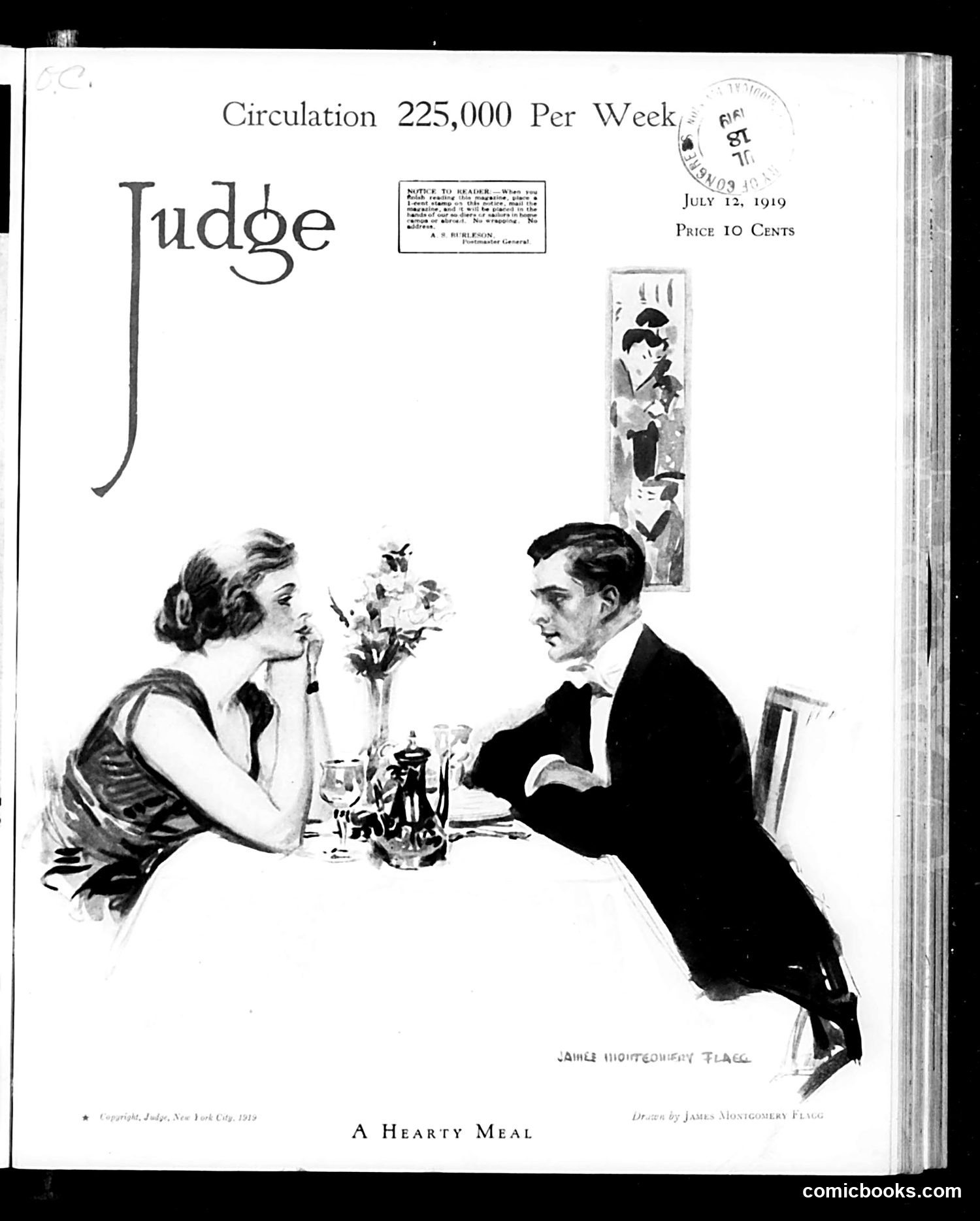
This illustration by James Montgomery Flagg depicts an elegant dinner scene between a man and woman. The title "A Hearty Meal" appears ironic given the modest plate visible and the formal, somewhat tense atmosphere suggested by their body language. Without additional context from the magazine's text or advertisements, the specific satirical target remains unclear. However, given the 1919 date (post-WWI, during Prohibition debates and economic adjustment), this likely comments on either wartime rationing remnants, food shortages, or social/courtship dynamics of the era. The careful composition and Flagg's signature style suggest social commentary on contemporary dining customs or domestic relations, though the precise meaning would require the full article text.
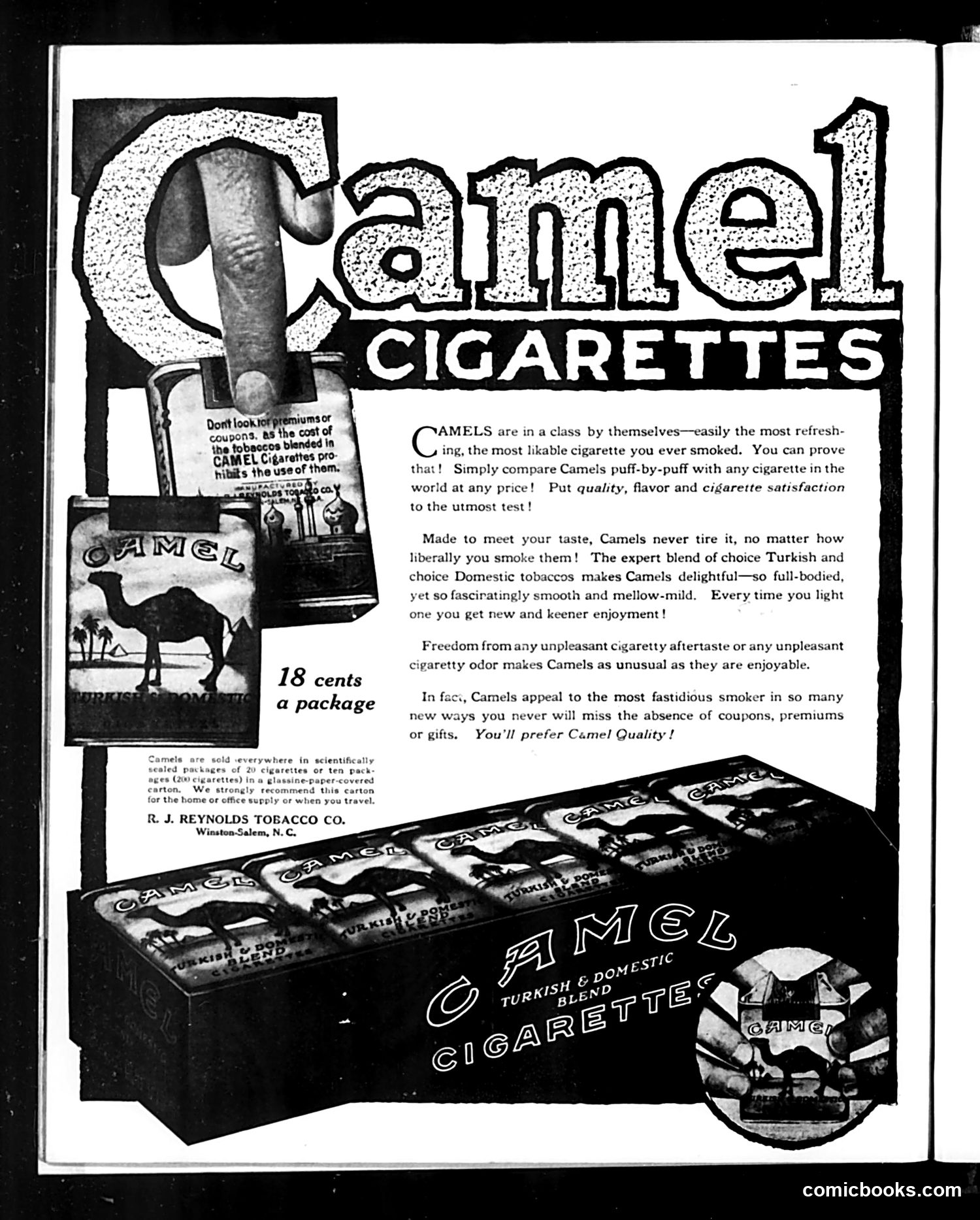
This page is primarily **a Camel cigarette advertisement**, not political satire. It shows a vintage tobacco ad from Judge magazine featuring: - A large camel's head (Camel's mascot) - Multiple cigarette package displays - Marketing claims about quality, flavor, and "Turkish and Domestic" tobacco blends - A price of "18 cents a package" - The manufacturer: R. J. Reynolds Tobacco Co., Winston-Salem, N.C. The ad emphasizes Camels' lack of "unpleasant cigarette aftertaste" and appeals to "fastidious smokers." There is **no political cartoon or satire present** on this page—it's straightforward commercial advertising typical of early-to-mid 20th century cigarette marketing, before health warnings were required.
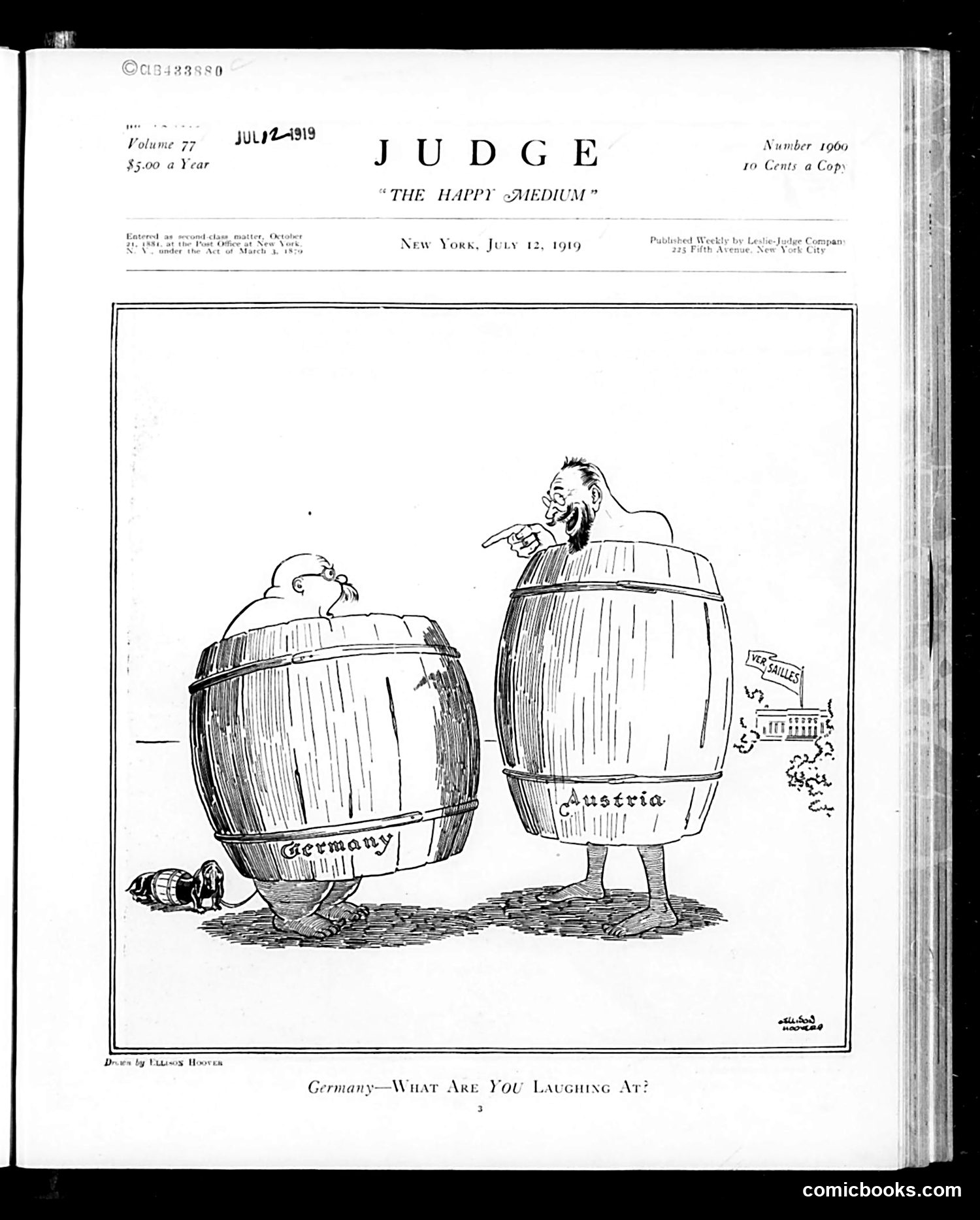
This July 1919 *Judge* cartoon depicts two barrel-shaped figures personifying Germany and Austria, labeled with their country names. Germany (left) appears smaller and distressed, while Austria (right) stands taller, pointing and laughing. The caption reads "Germany—What Are You Laughing At?" The satire likely references the post-WWI peace treaties being negotiated (Treaty of Versailles signed June 1919). Austria, despite also being defeated, appears to mock Germany's seemingly worse position. The barrel imagery suggests both nations are "bottled up" or constrained by war consequences, though Austria appears smugly amused by Germany's apparently greater suffering or harsher treaty terms. The cartoon mocks Austria's schadenfreude toward its former ally's misfortune.
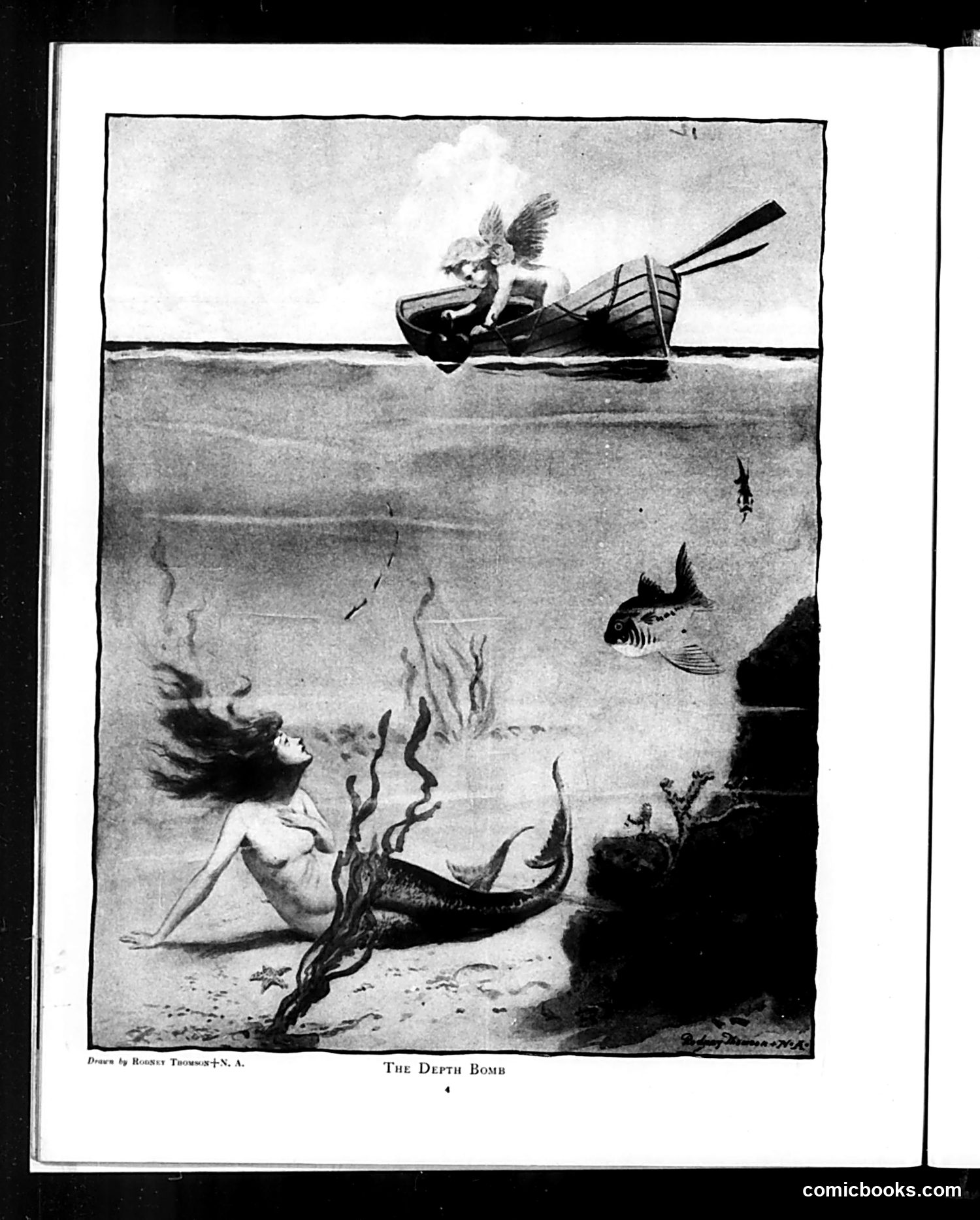
This illustration by Robert Thesemann depicts an underwater scene with satirical intent. A mermaid sits on the ocean floor near sea vegetation and rocks, while above her, an angel-like cupid figure pilots a small boat equipped with what appears to be a depth bomb or explosive device. The cartoon likely comments on courtship or romantic entanglement using naval/military imagery. The "depth bomb" suggests a dangerous romantic pursuit—the cupid figure is literally dropping explosive consequences into the depths where the mermaid waits. This appears to be social satire about the complications or "dangers" of romance, using the metaphor of underwater warfare to critique or humorously depict romantic complications of the era.
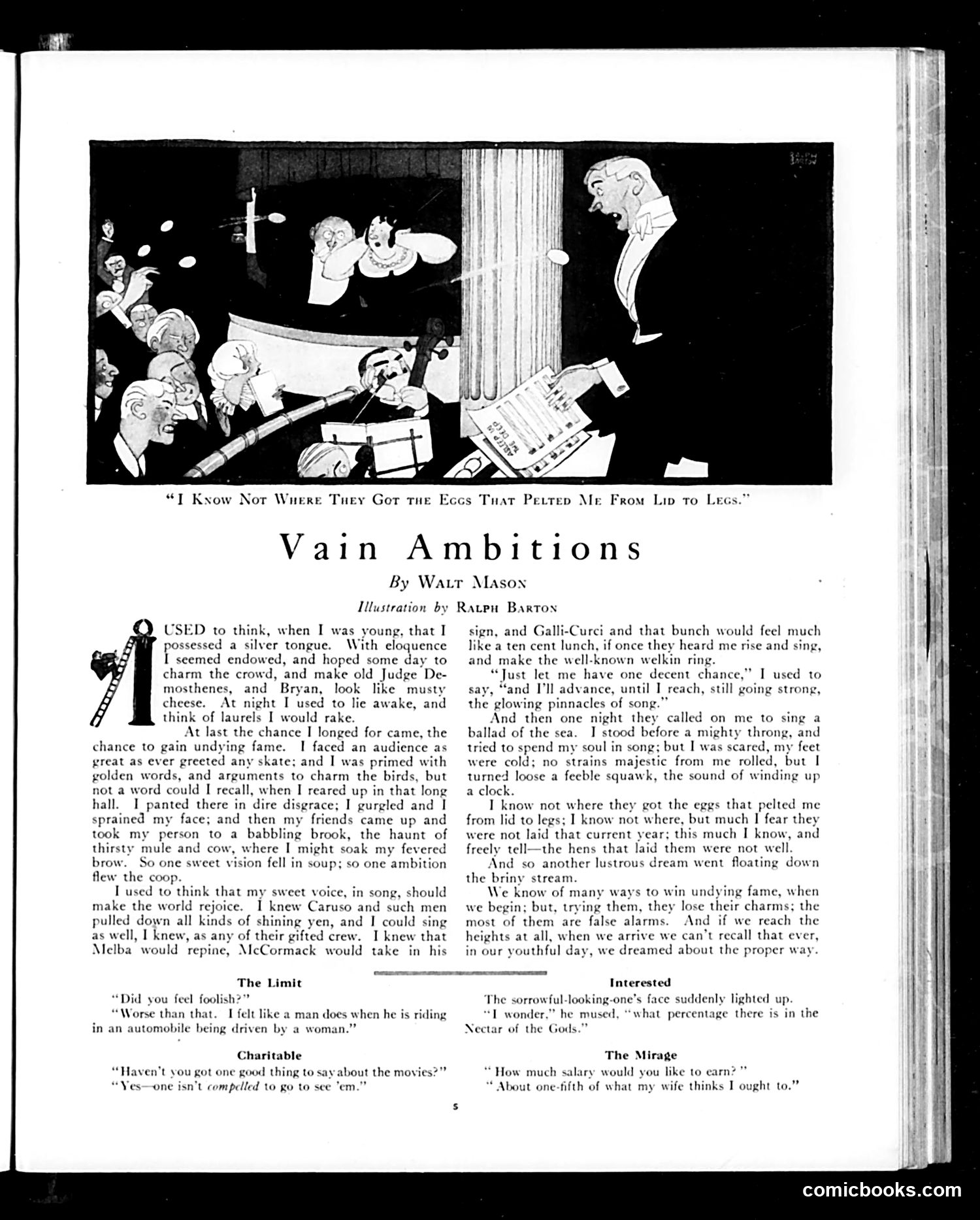
This satirical piece critiques a man's youthful dreams of becoming a famous singer. The illustration shows him performing before what appears to be an unimpressed or distracted audience in formal settings. Mason's narrative contrasts the narrator's youthful ambitions—imagining himself as a great tenor rivaling famous singers like Caruso and Melba—with his actual, modest reality. The story mocks how people overestimate their talents and chase unrealistic dreams of fame and fortune. The accompanying joke vignettes ("The Limit," "Charatable," "Interested," "The Mirage") reinforce themes of disappointed ambition and self-delusion. The overall message satirizes American aspirationalism and the gap between dreams and achievable reality, particularly regarding show business success.
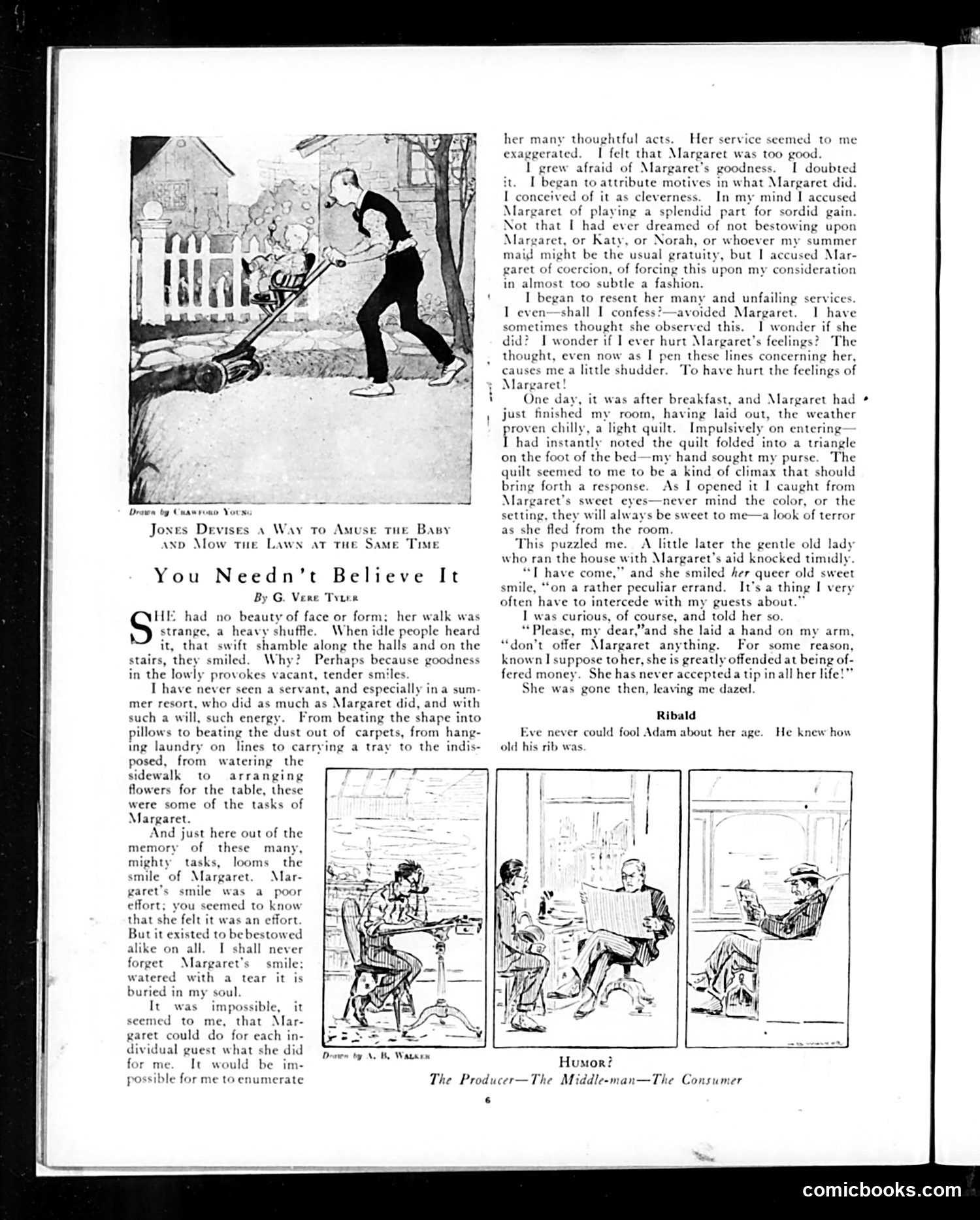
This page contains two unrelated pieces: **"You Need't Believe It"** is a short story by G. Vere Tyler about a servant named Margaret whose quiet dignity and gentle service earn the narrator's respect, despite initial prejudice. The accompanying illustration shows someone abusing a domestic worker—likely depicting the contrast between cruel employers and Margaret's virtuous character. **"Ribald"** is a three-panel humor strip (drawn by U.B. Walker) satirizing social class dynamics. The panels show "The Producer" (a farmer), "The Middle-man" (a businessman), and "The Consumer" (appears to be a wealthy client), illustrating how profits flow through distribution chains while different classes occupy their economic positions. Both pieces reflect early-20th-century American social commentary on class, labor, and domestic service.
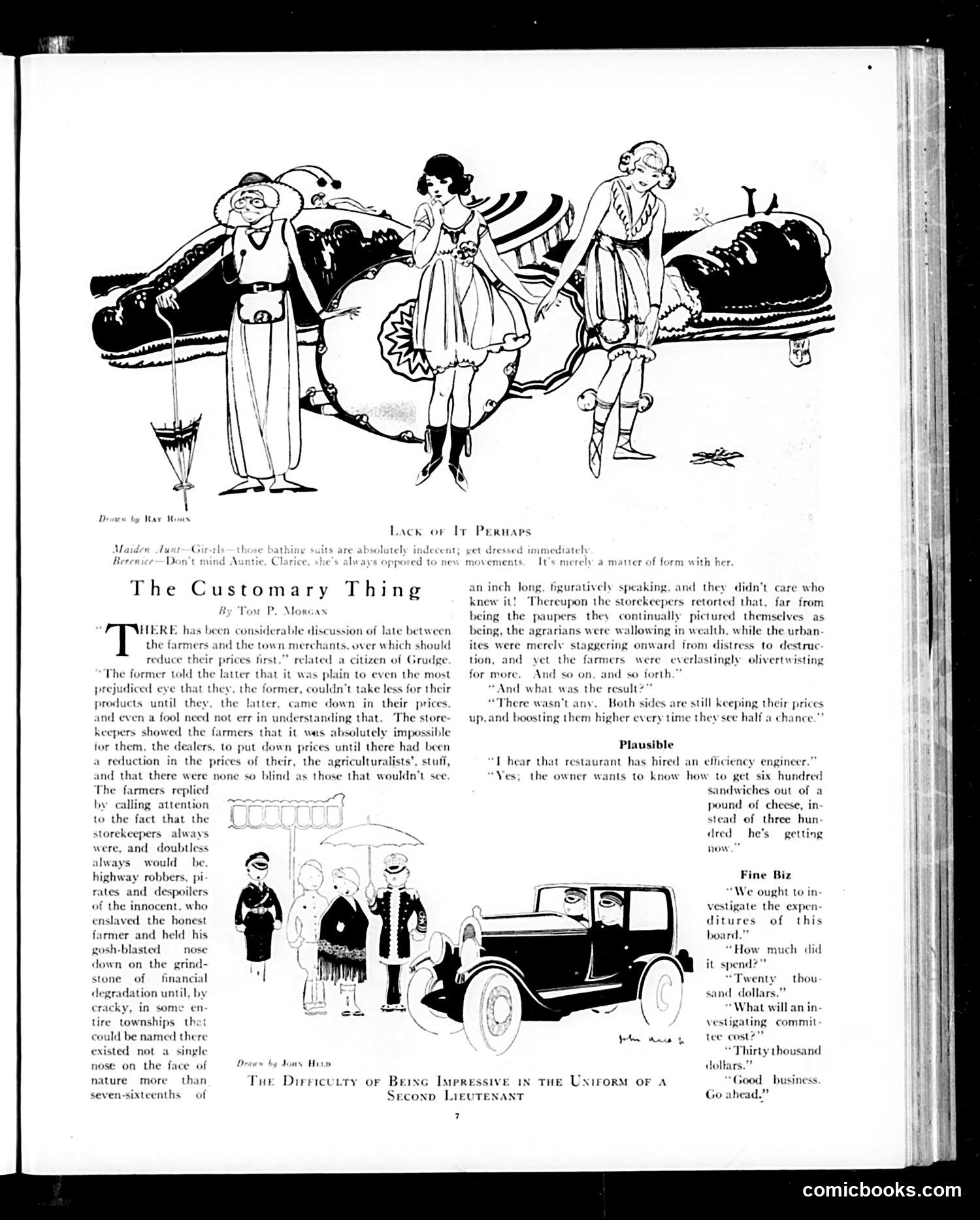
This Judge magazine page satirizes economic tensions between farmers and merchants during what appears to be an early 20th-century price dispute. **"The Customary Thing"** depicts a circular blame-game: farmers claim merchants must lower prices first; merchants claim farmers must reduce agricultural prices first. Each side accuses the other of profiteering—farmers call merchants "highway robbers," while merchants claim farmers are "wallowing in wealth." The satire's point: neither side will compromise, so prices stay high and nothing changes. This reflects genuine farmer-merchant conflicts common in early American industrial society. The bottom cartoons offer lighter satirical jabs: one mocks "efficiency engineers" (a trendy management concept) for absurd cost-cutting; another ridicules wasteful government spending—hiring an investigative committee that costs more than the alleged waste it investigates. The top illustration by Ray Hook appears decorative, showing fashionable women, likely unrelated to the text below.
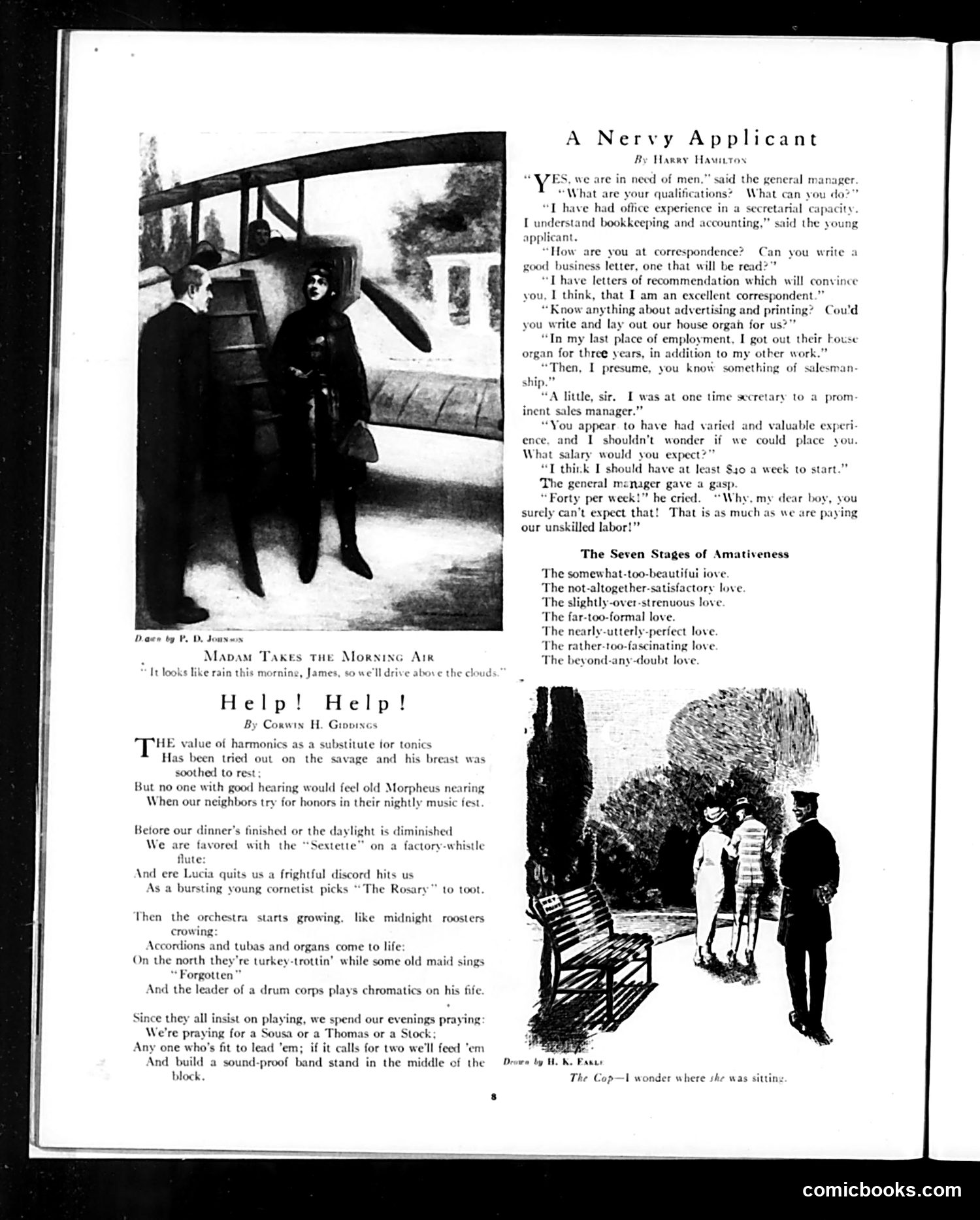
**"A Nervy Applicant"** satirizes workplace salary expectations during the early 20th century. A young job applicant confidently lists impressive qualifications—secretarial work, bookkeeping, correspondence, advertising, house-organ layout, and sales experience—expecting $30 weekly. The manager is shocked, gasping that this wage equals what they pay *unskilled laborers*. The joke mocks the applicant's audacity in demanding high pay despite being an entry-level worker, while also reflecting employers' resistance to fair compensation. It reflects era tensions over worker expectations versus employer stinginess. **Other content** includes "The Seven Stages of Amativeness" (romantic relationship types), a photo-caption joke about "Madam Takes the Morning Air," and a humorous poem titled "Help!" complaining about neighbors' cacophonous amateur musical performances—factory whistles, cornets, accordions, and drum corps disturbing the peace.
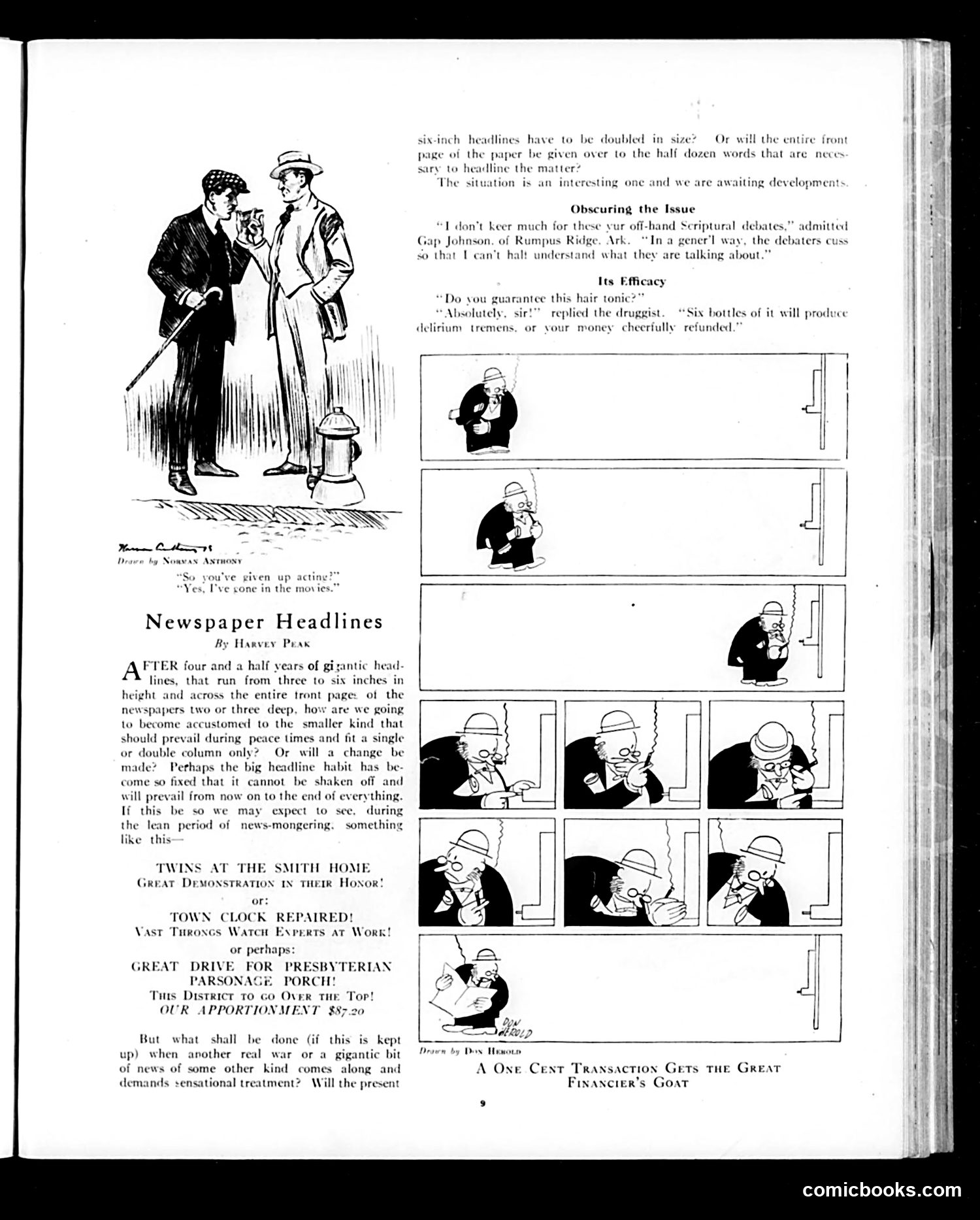
This page contains satire about post-WWI newspaper culture and includes three distinct pieces: **"Newspaper Headlines" by Harvey Peak** critiques the outsized headline trend that dominated newspapers during World War I. Peak jokes that editors have become so addicted to enormous, multi-column headlines that they won't be able to scale back to normal proportions during peacetime. He humorously imagines absurdly inflated headlines for trivial local news (twins born, a clock repaired) to illustrate how ridiculous this habit has become. The satirical point: wartime sensationalism has warped journalistic norms. **"Obscuring the Issue"** mocks religious debate, with a rural character (Gap Johnson) admitting he can't understand theological arguments because debaters curse so much. **"Its Efficacy"** is a drugstore joke where a druggist "guarantees" his hair tonic will work—by producing delirium tremens (alcohol poisoning), making the money-back guarantee darkly comic. This likely references patent medicine fraud common in the era.
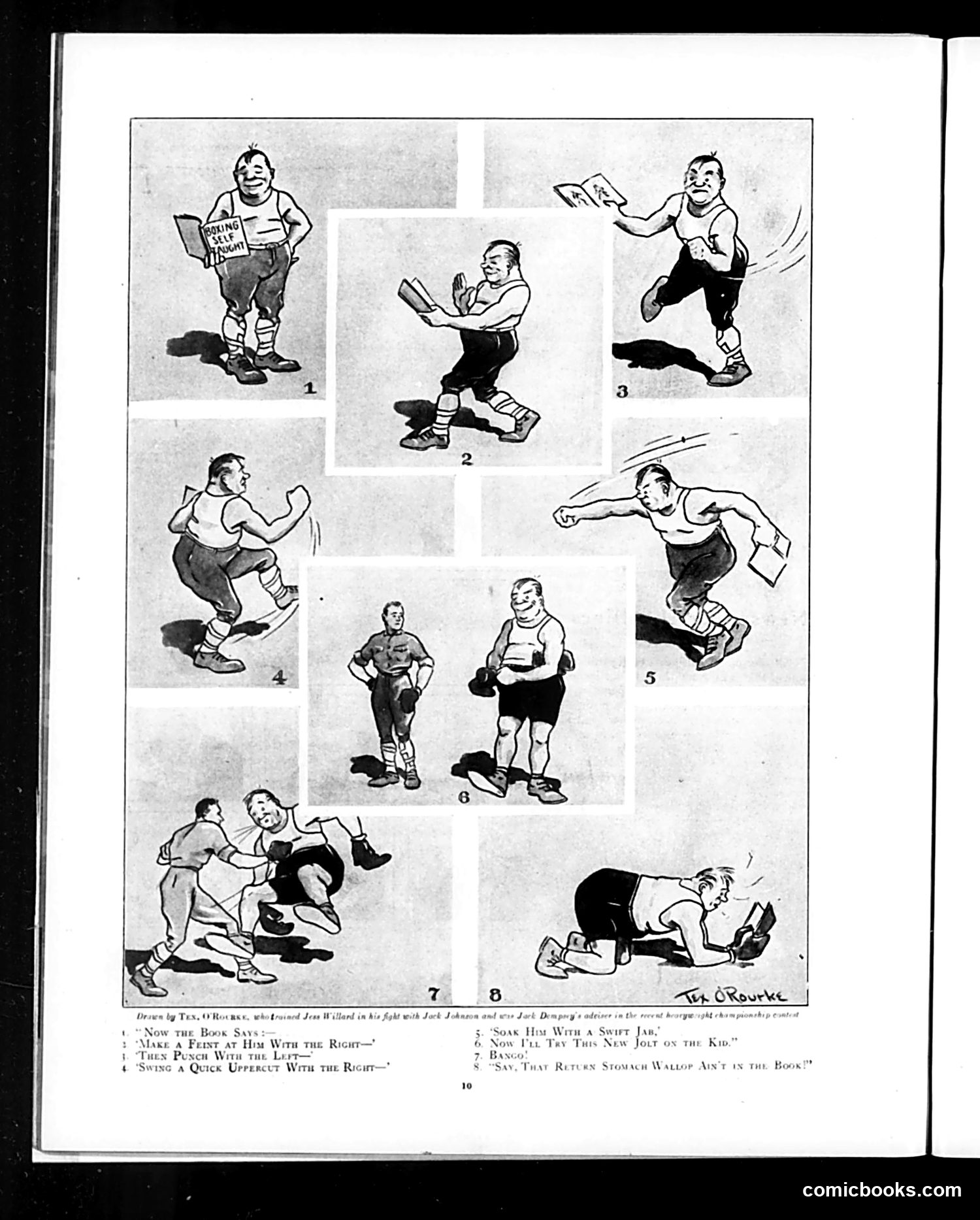
This is an instructional boxing satire titled "Draws by Tex O'Rourke, with Earnest Jack Dempsey's Advice to the Recent Heavyweight Championship Candidate." The eight panels mock a boxer's technique, labeled with phrases like "Now the Book Says," "Make a Feint at Him With the Right," and "Then Punch With the Left." Panel 8 shows the boxer knocked down, captioned "Say, That Really is Stomach Wallop Ain't in the Book!" The satire appears to criticize someone (the "recent heavyweight championship candidate") for incompetent boxing, with boxing champion Jack Dempsey allegedly providing commentary. The joke is that despite following boxing instruction manuals, the fighter gets defeated anyway—suggesting theoretical knowledge without practical skill is useless. The specific political candidate referenced is unclear without additional context.
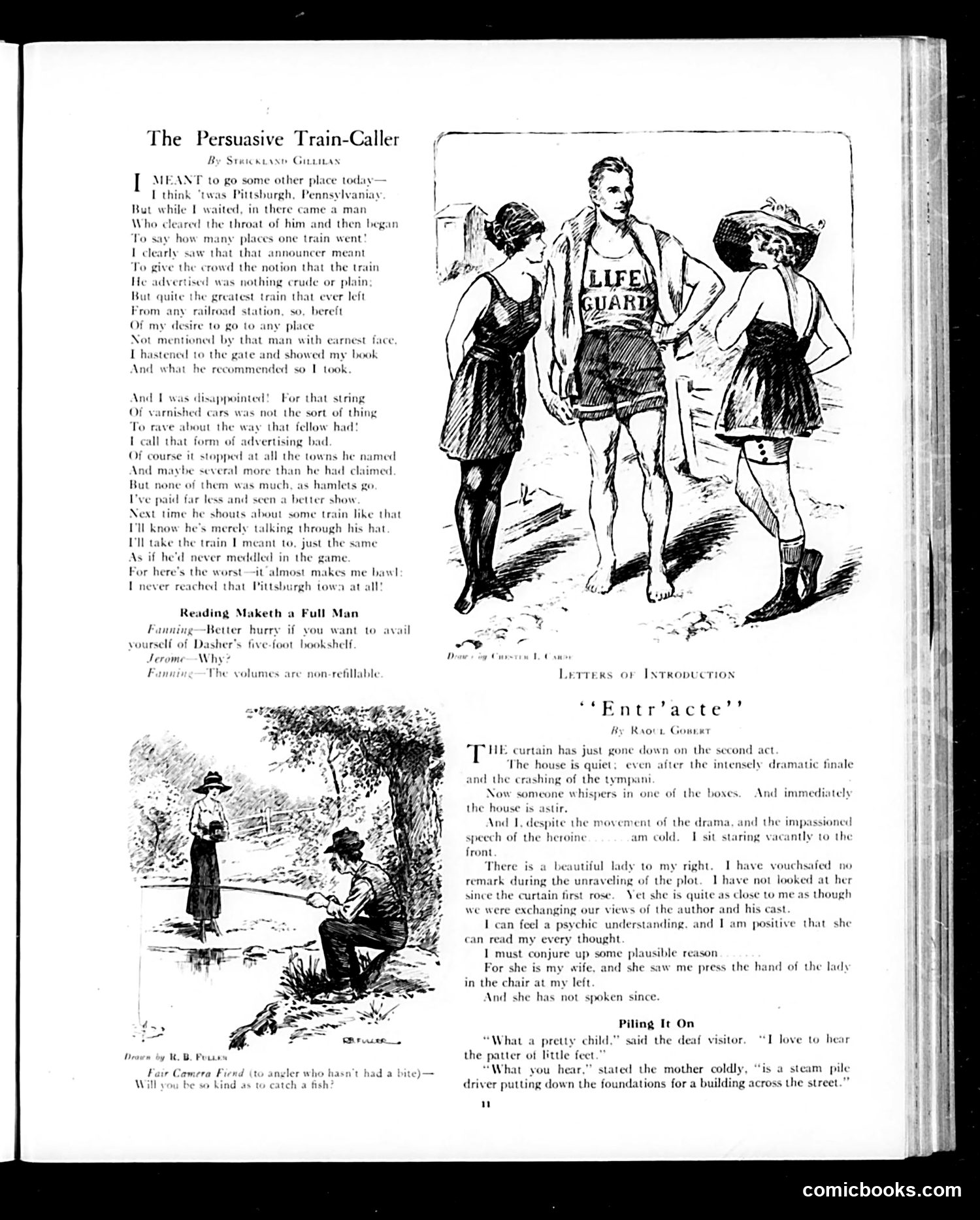
This satirical poem mocks aggressive railroad advertising. A station announcer delivers an enthusiastic pitch about a train's routes and amenities, persuading the narrator to abandon his original Pittsburgh destination. However, the actual journey disappoints—the train stops at unremarkable towns and never reaches Pittsburgh anyway. The satire targets deceptive marketing tactics: a skilled salesman's enthusiasm obscures the product's actual mediocrity. The joke is that eloquent advertising can manipulate consumers into poor choices. The accompanying illustrations show the announcer's persuasive gestures and a fishing scene (likely illustrating the phrase "talking through his hat"). The page also includes brief humorous items about book collecting and theater etiquette, typical of Judge magazine's miscellaneous satirical content.
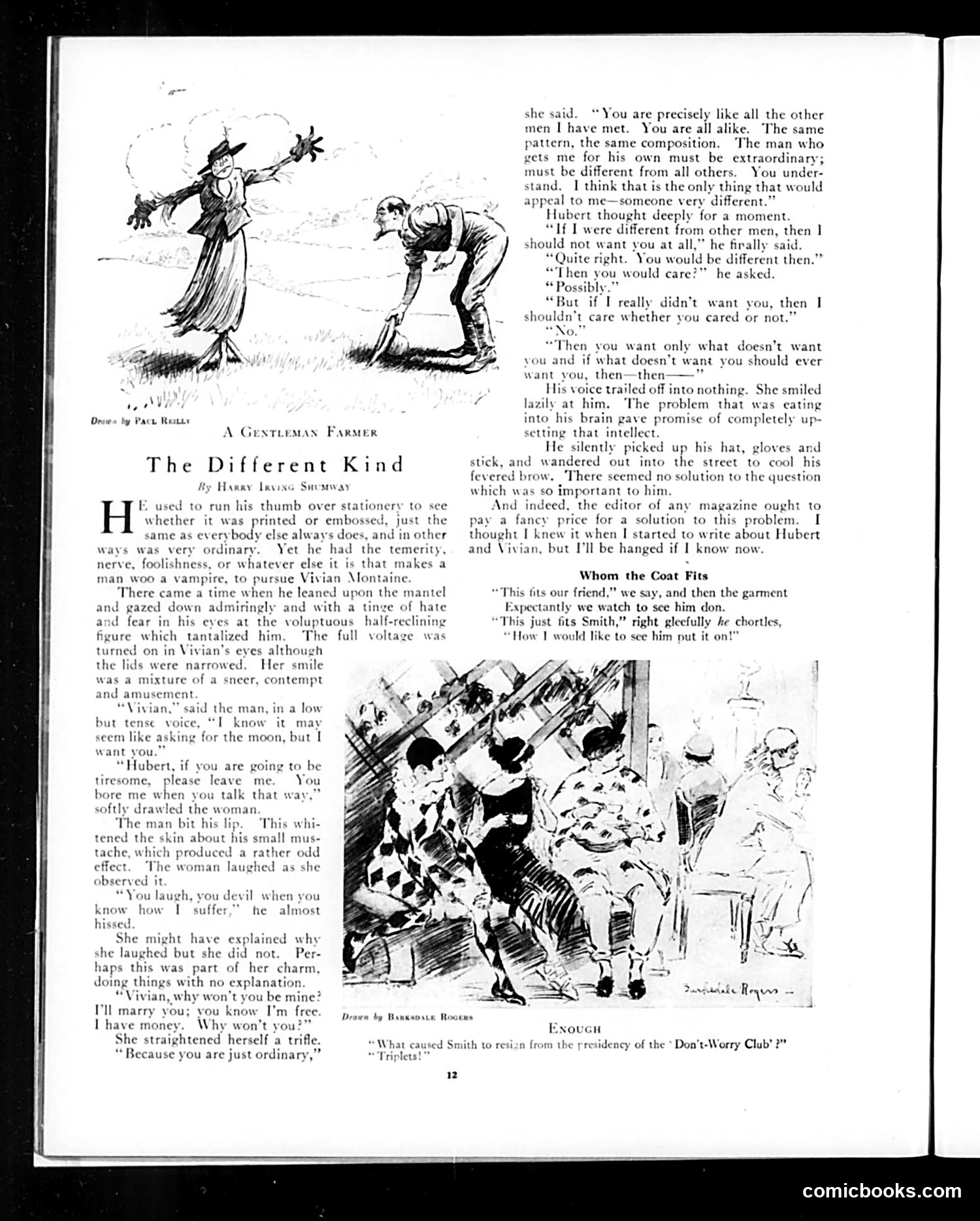
This story-illustrated feature satirizes the impossible logic of romantic pursuit. Hubert, an ordinary gentleman farmer, pursues the aloof Vivian Montaine, who demands he be "extraordinary" and "different" to win her. The joke turns on a logical trap: Hubert observes that if he were truly different—indifferent to her—she'd find him appealing. But if he *then* came to want her (ceasing to be indifferent), he'd contradict the very difference that attracted her. The editor admits the paradox has no solution. This reflects early 20th-century anxieties about courtship and female agency. Vivian represents the "new woman" with power to set impossible standards, while Hubert embodies the frustrated suitor caught in circular reasoning. The satire gently mocks both: her arbitrary cruelty masked as discernment, and his futile intellectual wrestling with romantic illogic.
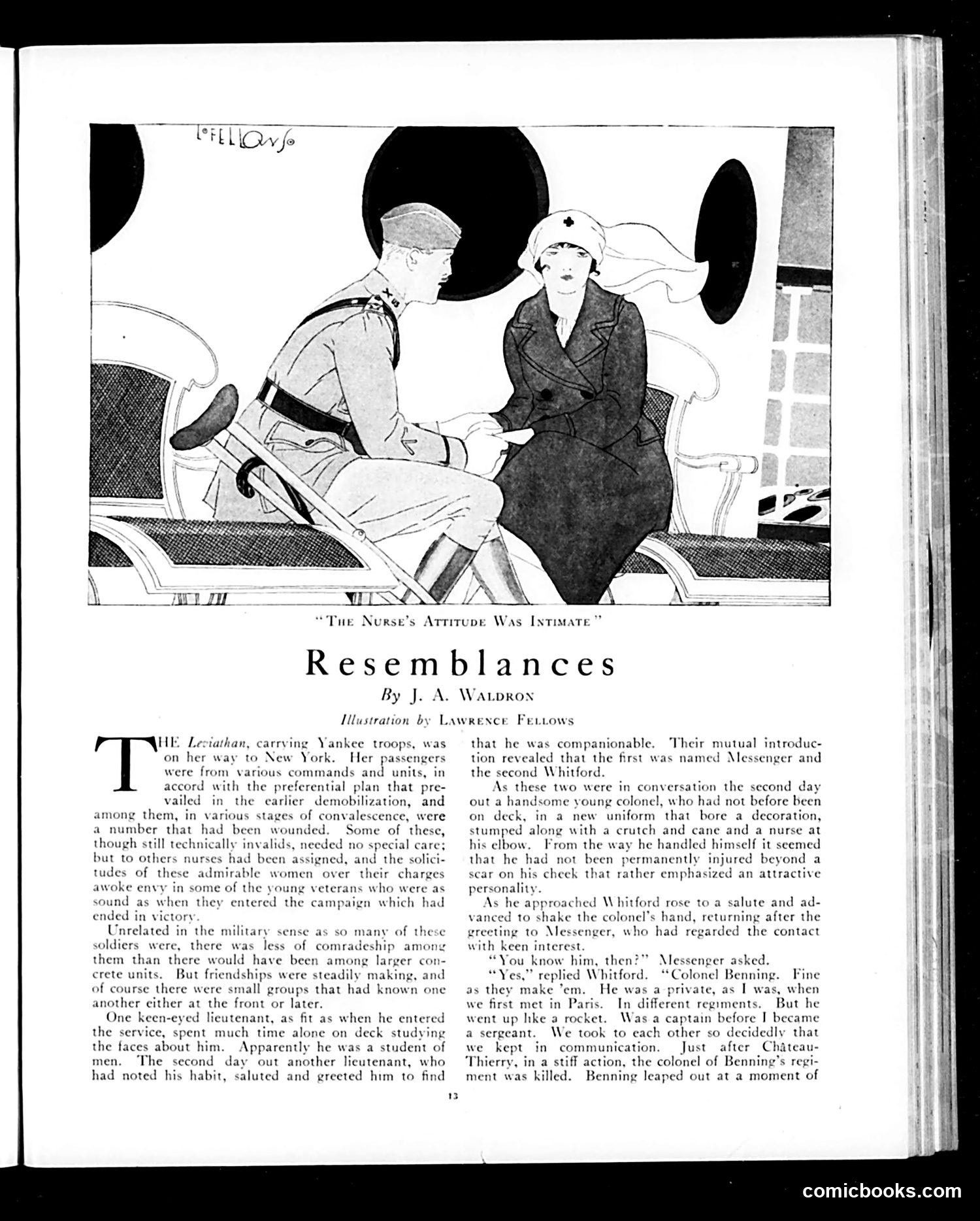
This is a narrative illustration accompanying a short story titled "Resemblances" by J.A. Waldron. The image shows two military officers on the deck of the *Leviathan* (a real WWI troop transport ship) conversing while observing a decorated colonel with a nurse. The story describes demobilization after WWI, when wounded soldiers were returning home. The two lieutenants—Messenger and Whitford—meet and discuss their acquaintance with Colonel Benning, a charismatic officer who rose from private to colonel during the war. The caption "The Nurse's Attitude Was Intimate" suggests romantic interest between the colonel and his attending nurse. This appears to be sentimental fiction celebrating military camaraderie and valor rather than satire. The "Resemblances" likely refers to how soldiers from different backgrounds formed bonds through shared wartime experience. No political satire is evident on this page.
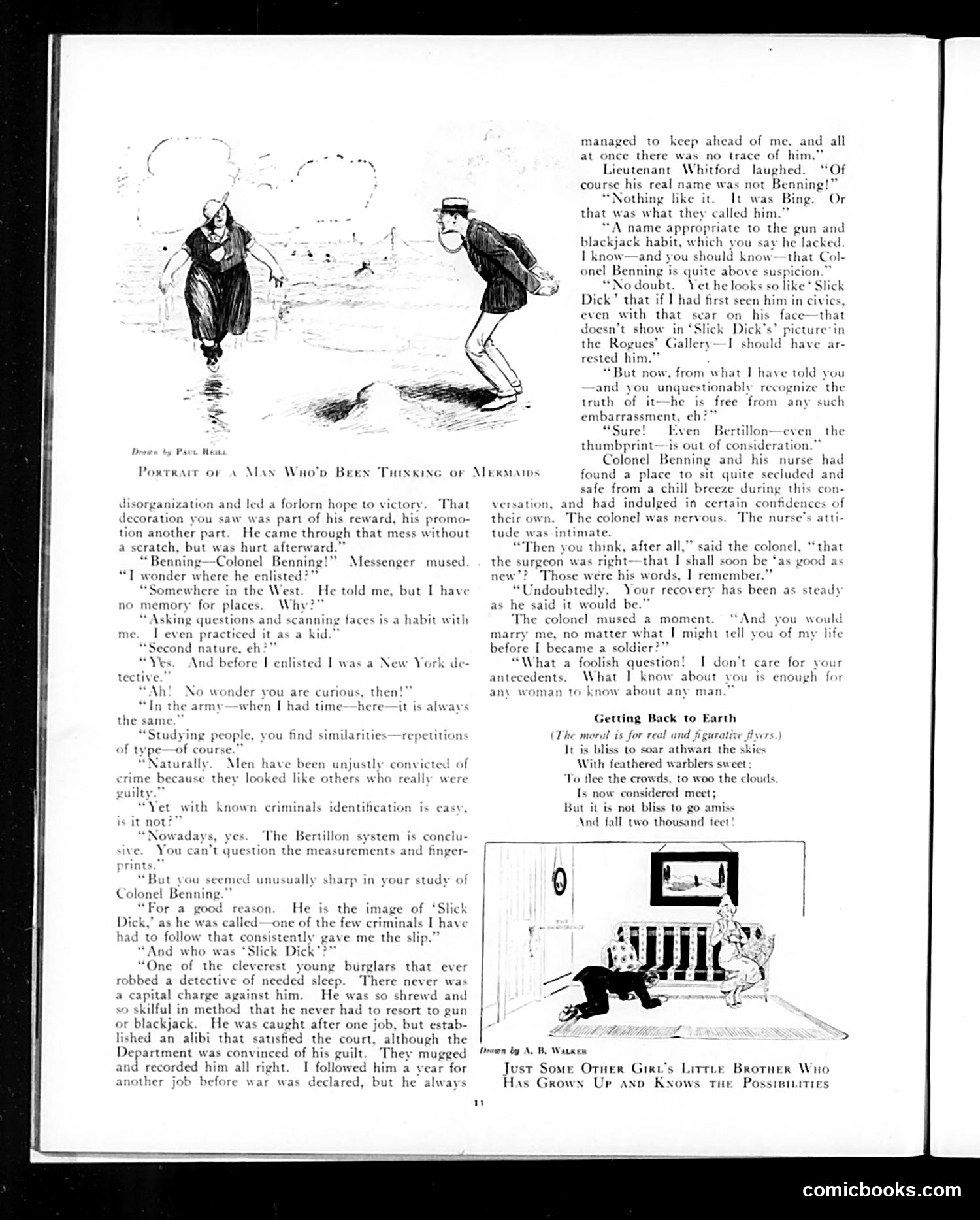
This page contains a narrative story about Colonel Benning, a decorated WWI officer, illustrated with sketches by Paul Reat. The main content concerns a conversation between a detective and Lieutenant Whitford about Benning's resemblance to "Slick Dick," a clever criminal who escaped justice despite police suspicion. The satire plays on early criminal identification methods—the Bertillon system (measurements and fingerprints)—suggesting that even with modern forensics, a guilty person's doppelgänger could evade arrest based on appearance alone. The irony is that Benning, though innocent and now a war hero, looks disturbingly like an unsolved criminal case. A secondary cartoon below shows a figure falling from the sky, illustrating the poem "Getting Back to Earth"—a joke about the literal danger of romantic daydreaming. The page reflects concerns about criminal justice reliability and WWI-era social anxieties about identity and trustworthiness during wartime.
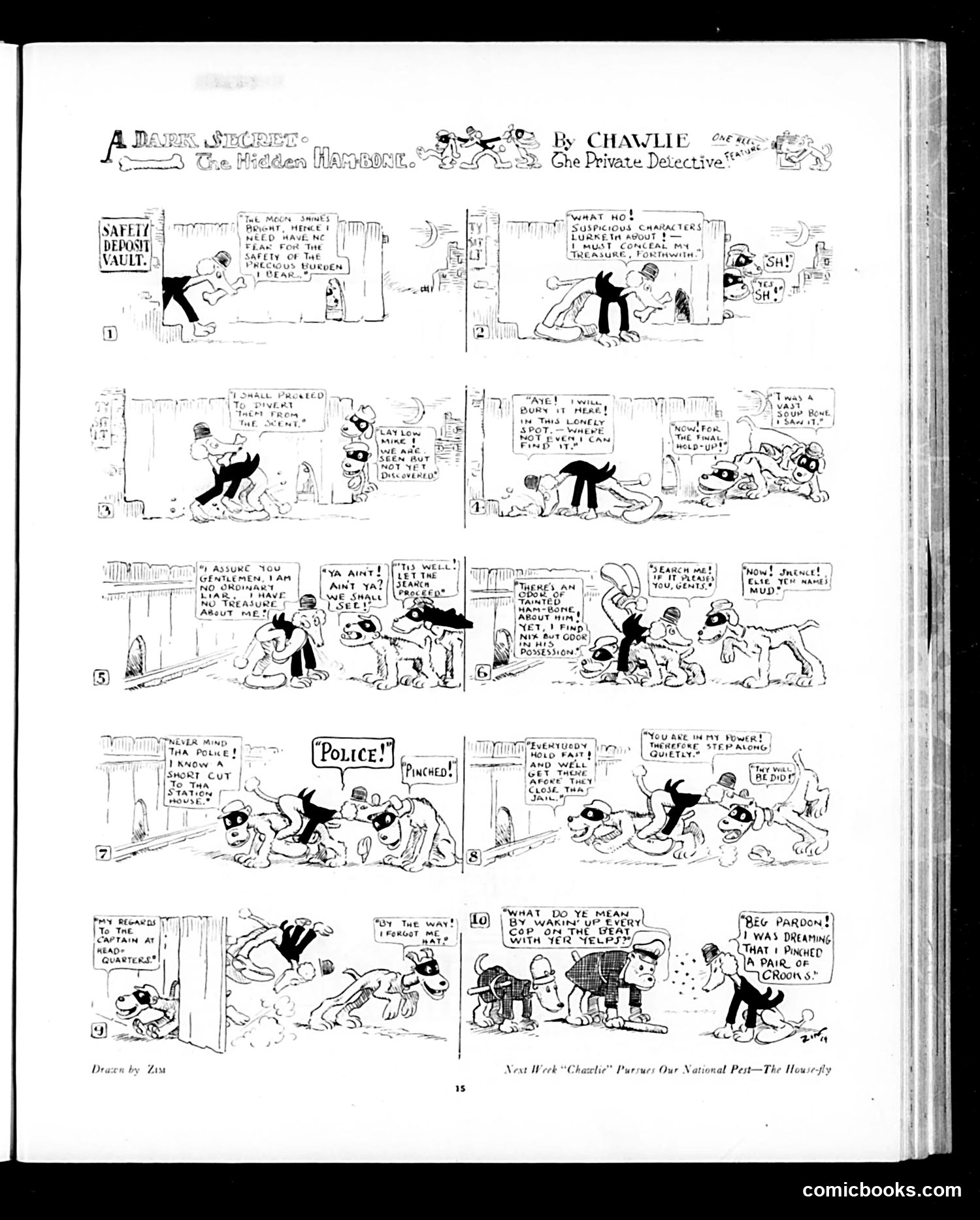
This is a slapstick comic strip featuring "Chawlie," an incompetent detective investigating a safe robbery at a harbor. The humor relies on physical comedy and misunderstandings: **Plot**: Chawlie bumbles through searching for stolen treasure, repeatedly roughing up innocent parties and creating chaos. He mistakes ordinary citizens for criminals, leading to police involvement and arrests of the wrong people. **The satire**: The strip mocks incompetent private detectives and police work—a common trope in early 20th-century humor. The final panel's subtitle ("Chawlie Pursues Our National Pest") suggests the detective himself is the real "pest," not any criminal. **Style**: Drawn by Zim, this represents typical Judge magazine humor: broad physical comedy, dialect speech, and exaggerated character types rather than sophisticated political commentary. The appeal is purely comedic rather than satirical commentary on actual events or figures.
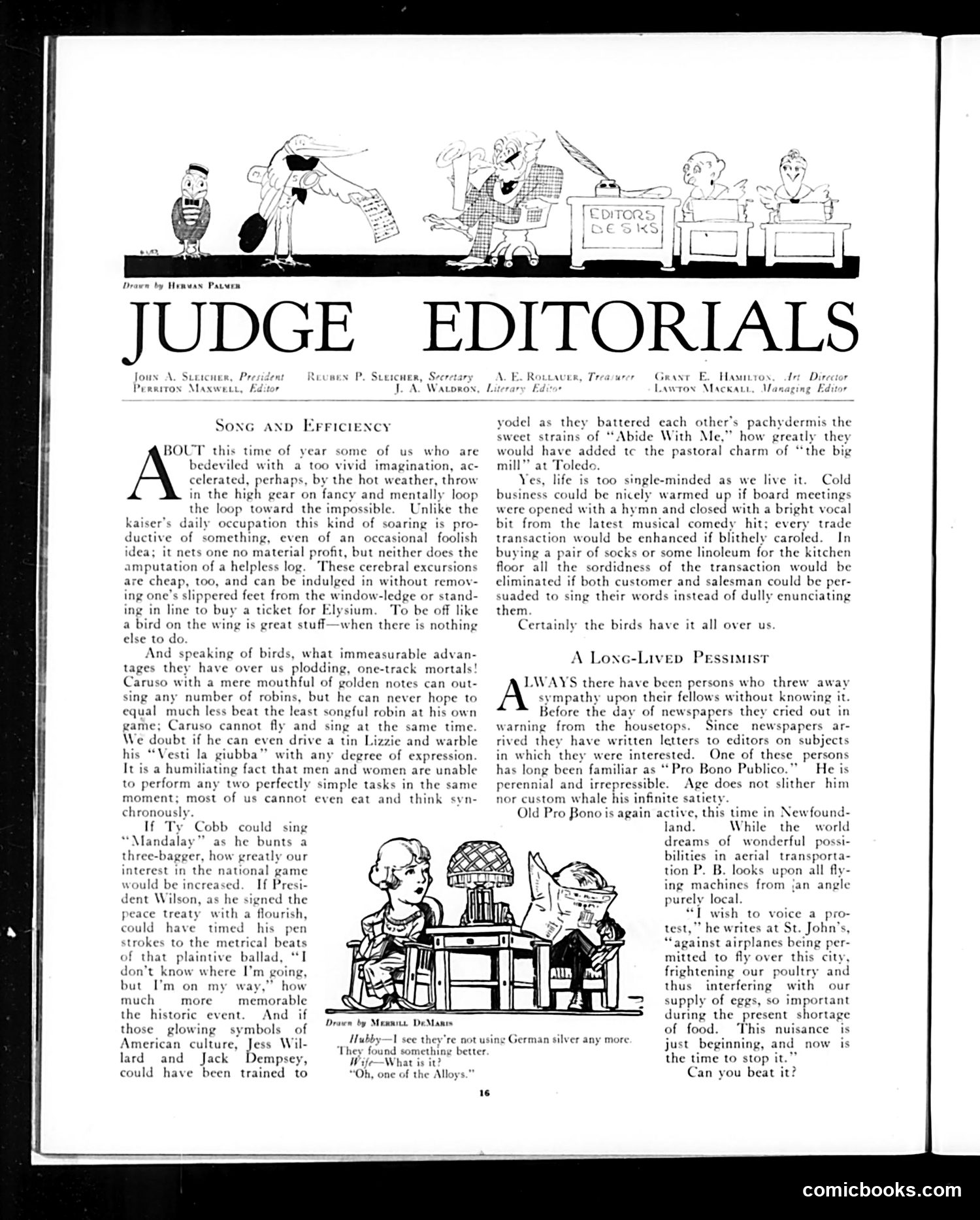
This is the editorial section of Judge, a prominent American satirical weekly. The page contains two short essays and a cartoon. **"Song and Efficiency"** satirizes Americans' inability to multitask. The author whimsically imagines famous figures—opera singer Caruso, President Wilson, and boxers Jess Willard and Jack Dempsey—simultaneously performing their signature activities while singing. The satire mocks modern life's rigid compartmentalization of tasks, contrasting humans unfavorably with birds' natural multitasking abilities. References to "the kaiser" suggest this was written during or shortly after World War I. **"A Long-Lived Pessimist"** introduces "Pro Bono Publico," a recurring character representing the perpetual letter-writer to newspaper editors—the stereotypical chronic complainer. The piece humorously notes that Pro Bono is currently active in Newfoundland, protesting aircraft flying over the city and threatening the poultry supply. **The cartoon** (by Mead DeMaris) depicts a couple discussing German silver no longer being used in manufacturing—a wartime reference to material shortages or anti-German sentiment.
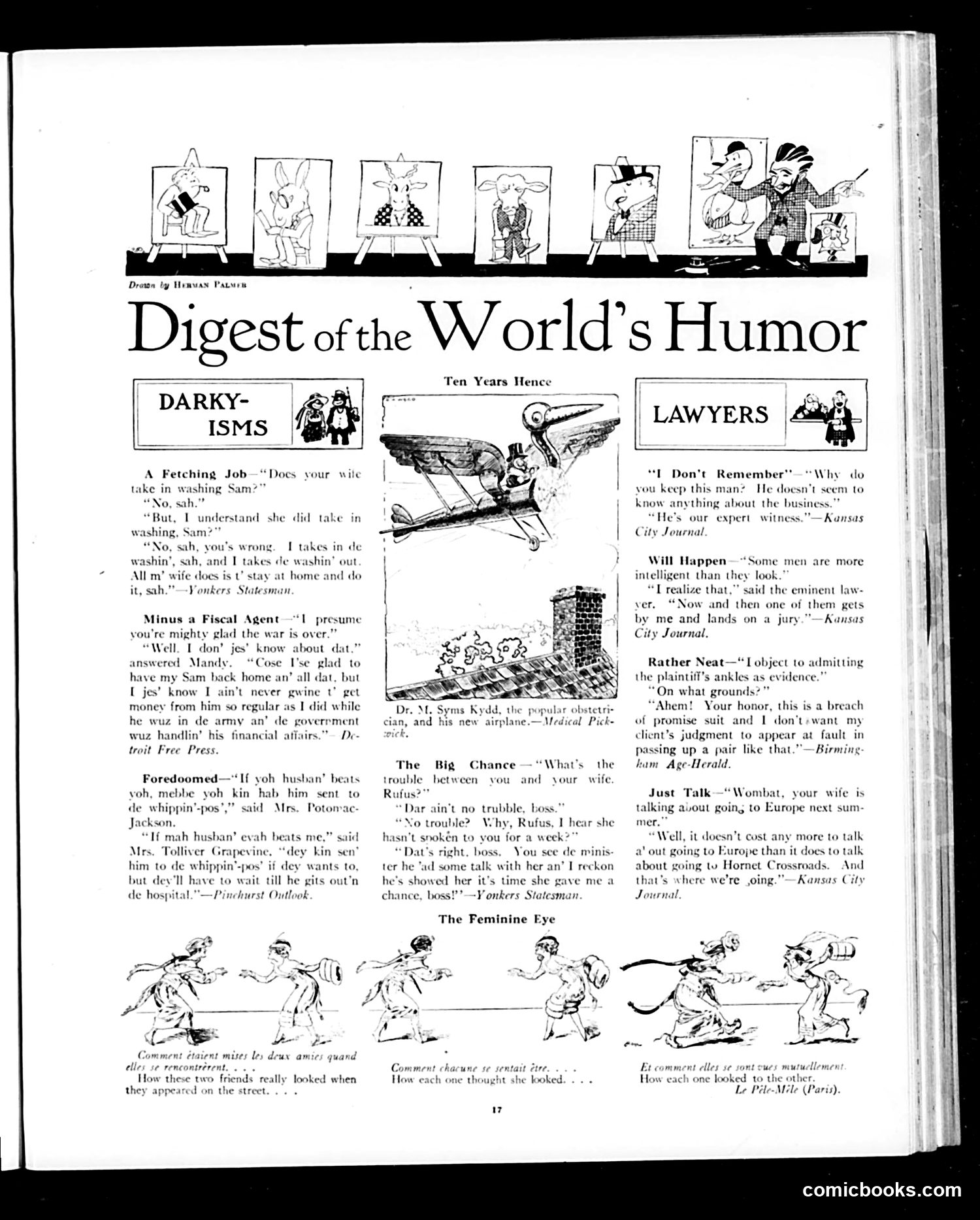
This page collects brief humorous anecdotes organized by category. The racial caricatures and dialect humor reflect early 20th-century prejudices common in American publications. **Key sections:** - **"Darkyisms"** and **"The Feminine Eye"**: Racist stereotypes depicting African Americans and women as foolish or illogical - **"Lawyers"**: Self-deprecating legal humor about lawyers' incompetence and venality - **Central illustration**: Shows "Dr. M. Syms Kydd" with an airplane, mocking early aviation claims **Recurring joke patterns:** Wife-husband conflicts, racial stereotypes, and professional ineptitude. "The Big Chance" treats marital silence as an opportunity for a man to regain control. **Historical context**: This represents typical Judge magazine content—satirizing marriage dynamics, gender roles, and professional failings through crude stereotypes considered acceptable humor of the era. The inclusion of French captions ("Le Petit-Mille") suggests international humor compilation. The page demonstrates how early 20th-century American satire relied heavily on ethnic and gender stereotypes rather than political commentary.
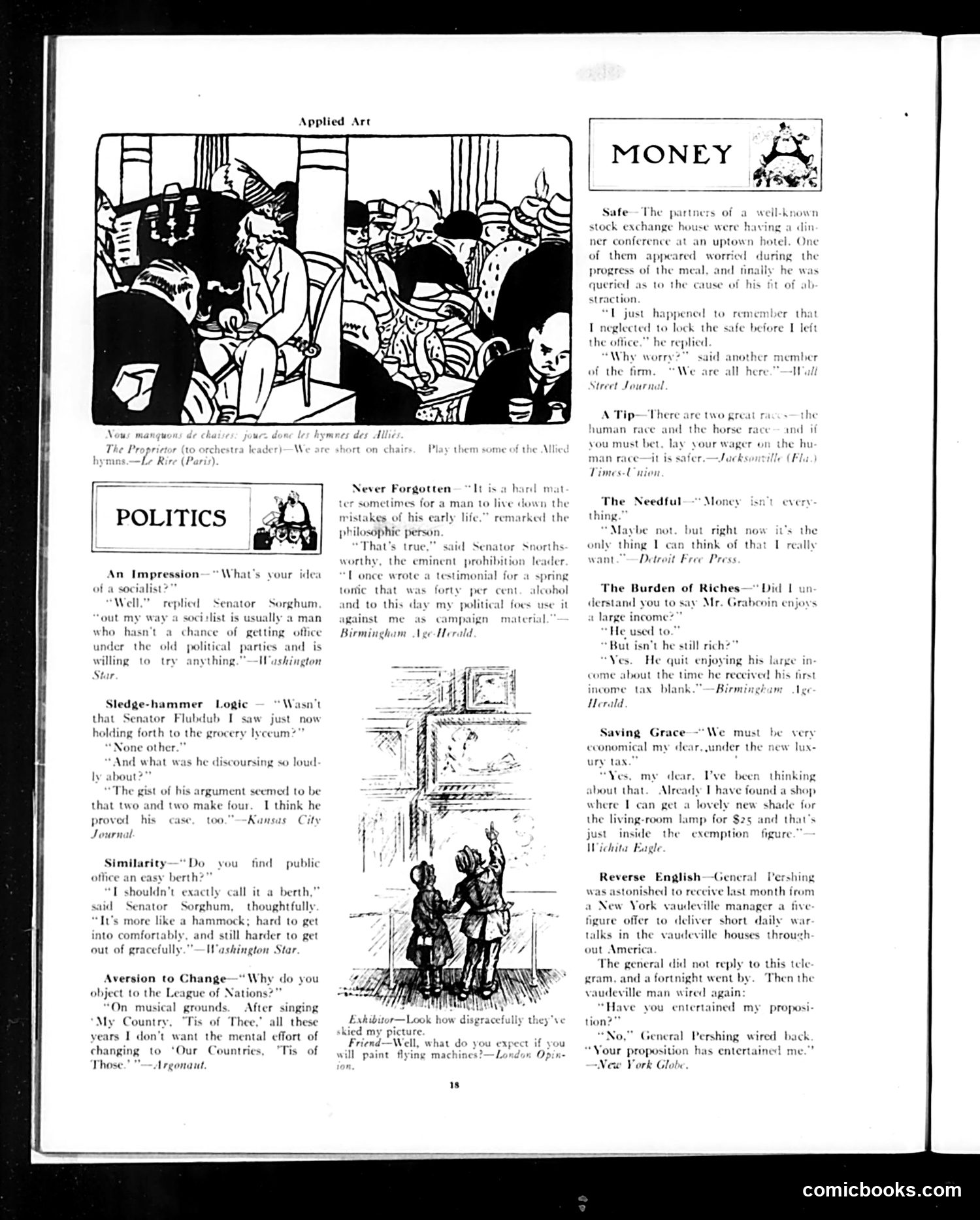
This page collects brief political and social satires, primarily poking fun at politicians and wealth during the post-WWI era. **Key satirical pieces:** 1. **"An Impression of a Socialist"** — Senator Sorghum's quip defines socialists as opportunists willing to abandon principles for office—a common conservative critique of the era. 2. **"Sledge-hammer Logic"** — Mocks Senator Flubdub for presenting elementary reasoning (2+2=4) as profound political argument. 3. **"Safe"** — Stock brokers remain worried about locked safes despite appearing relaxed—satirizing Wall Street's anxiety over security/regulations. 4. **Money section jokes** — Target wealth inequality, luxury taxes, and General Pershing's rejection of vaudeville offers, satirizing both the wealthy and commercialism. The humor assumes readers' familiarity with contemporary political figures (Senator Sorghum appears frequently) and post-war concerns: socialism, prohibition, the League of Nations, and new income/luxury taxes. The overall tone is conservative, mocking progressivism and wealth-redistribution policies.
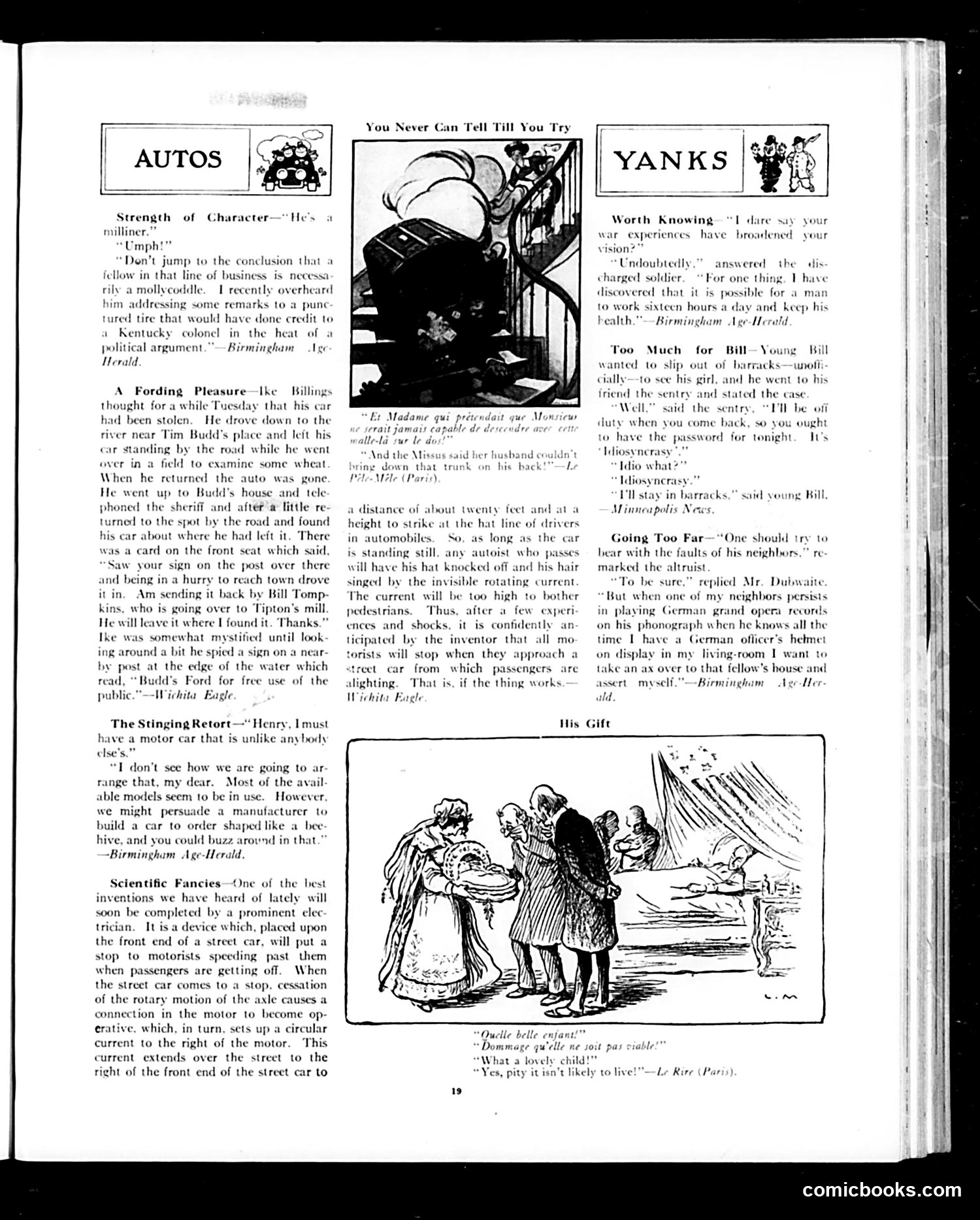
This page contains several brief humorous anecdotes about automobiles—a still-novel technology—and military life, typical of early 20th-century American humor. The cartoons mock contemporary attitudes: one depicts a woman receiving a baby as a gift (captioned in French, suggesting upper-class pretension), while another shows a street scene with multiple figures. The text anecdotes include: - A story about a man's car temporarily "stolen" from a ford (water crossing), playing on the double meaning - A husband's sarcastic suggestion to build his wife a car shaped like a beehive - A proposed invention: an electromagnetic device on streetcars to knock hats off speeding motorists—presented as serious but clearly absurd satire on traffic safety concerns - Military humor about a soldier seeking unauthorized leave from barracks - A joke about a neighbor playing German classical music, likely referencing anti-German sentiment (possibly WWI-era) The humor targets automobile culture, gender relations, technological optimism, and military discipline—reflecting early 1900s American preoccupations.
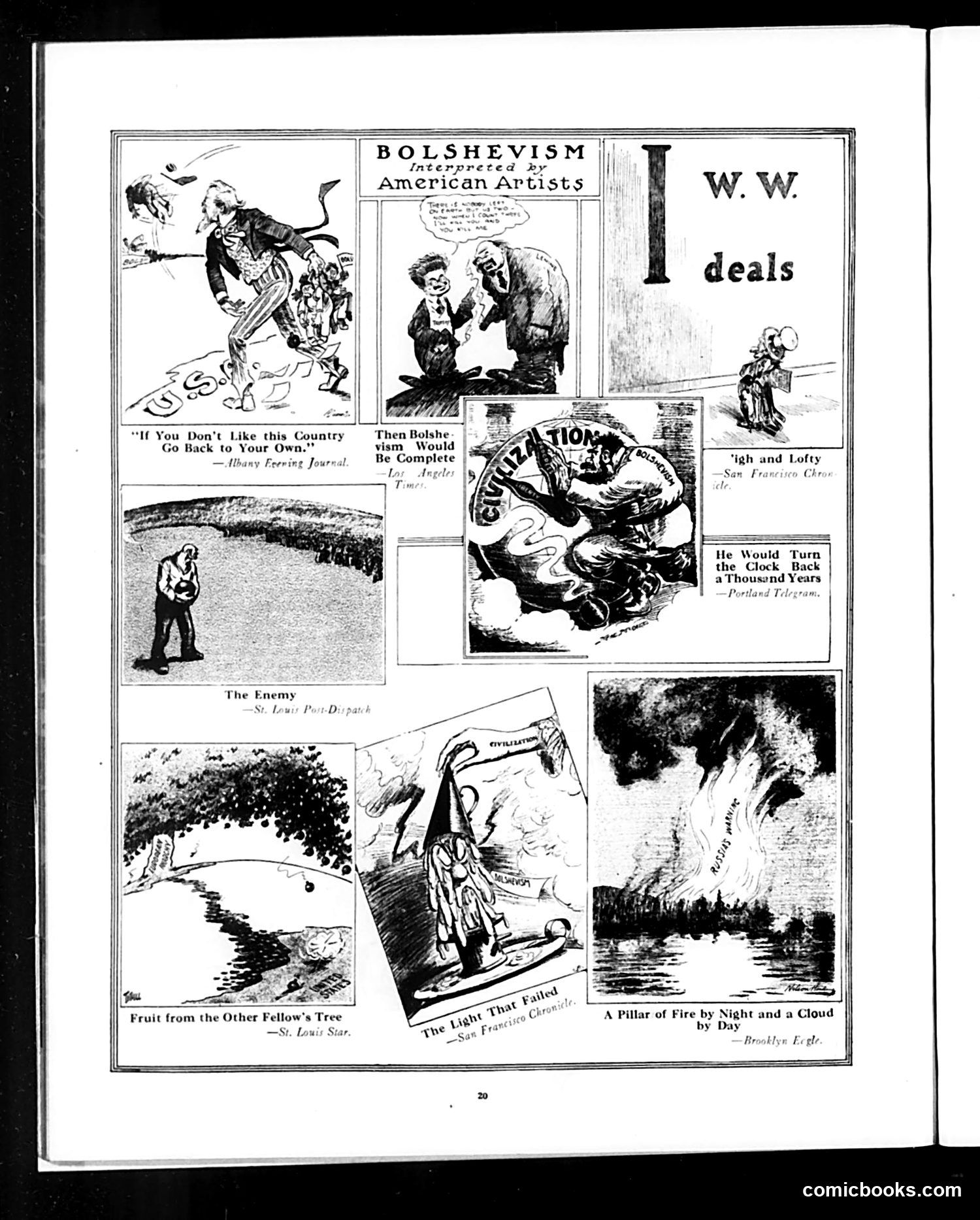
This Judge magazine page presents anti-Bolshevik propaganda from the Red Scare era (likely 1919-1920s). The cartoons satirize communism through exaggeration and caricature: The top panel depicts Bolshevism as destructive and foreign, with the caption "If You Don't Like this Country — Go Back to Your Own" suggesting communists are un-American agitators. Other panels portray Bolsheviks as violent revolutionaries and backward thinkers ("turn the clock back a thousand years"), using imagery of chaos, fire, and destruction. The title indicates these are "American Artists'" interpretations, suggesting the magazine is presenting mainstream American anti-communist views. The cartoons use dehumanizing caricature and inflammatory rhetoric typical of Red Scare political messaging that framed communism as a foreign threat incompatible with American values.
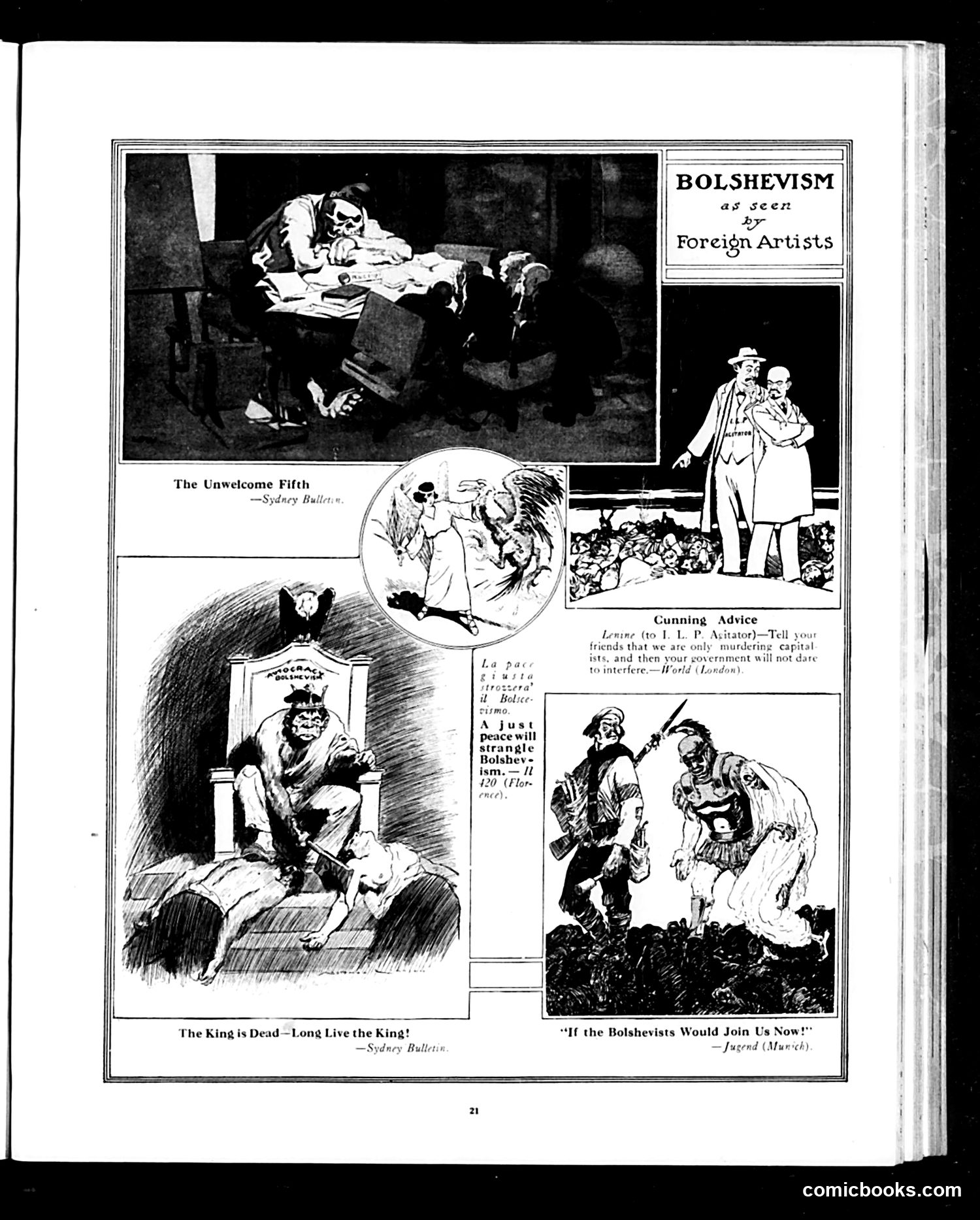
This page collects anti-Bolshevik propaganda cartoons from Judge magazine, likely from the early 1920s Red Scare period. The cartoons depict Bolshevism (Soviet communism) as a dangerous foreign threat: **"The Unwelcome Fifth"** suggests Bolshevists as a subversive "fifth column" infiltrating society. **"The King is Dead—Long Live the King!"** shows a figure enthroned over dead bodies, portraying Soviet leadership as tyrannical. **"Cunning Advice"** depicts Lenin advising Western radicals to hide their true intentions from governments. **"If the Bolshevists Would Join Us Now"** (appears incomplete) likely presents a satirical alternative scenario. The overall message: Bolshevism represents violent, deceptive foreign ideology threatening Western stability and order. The cartoons promote fear of communist infiltration during the post-WWI period when such anxiety was widespread in America.
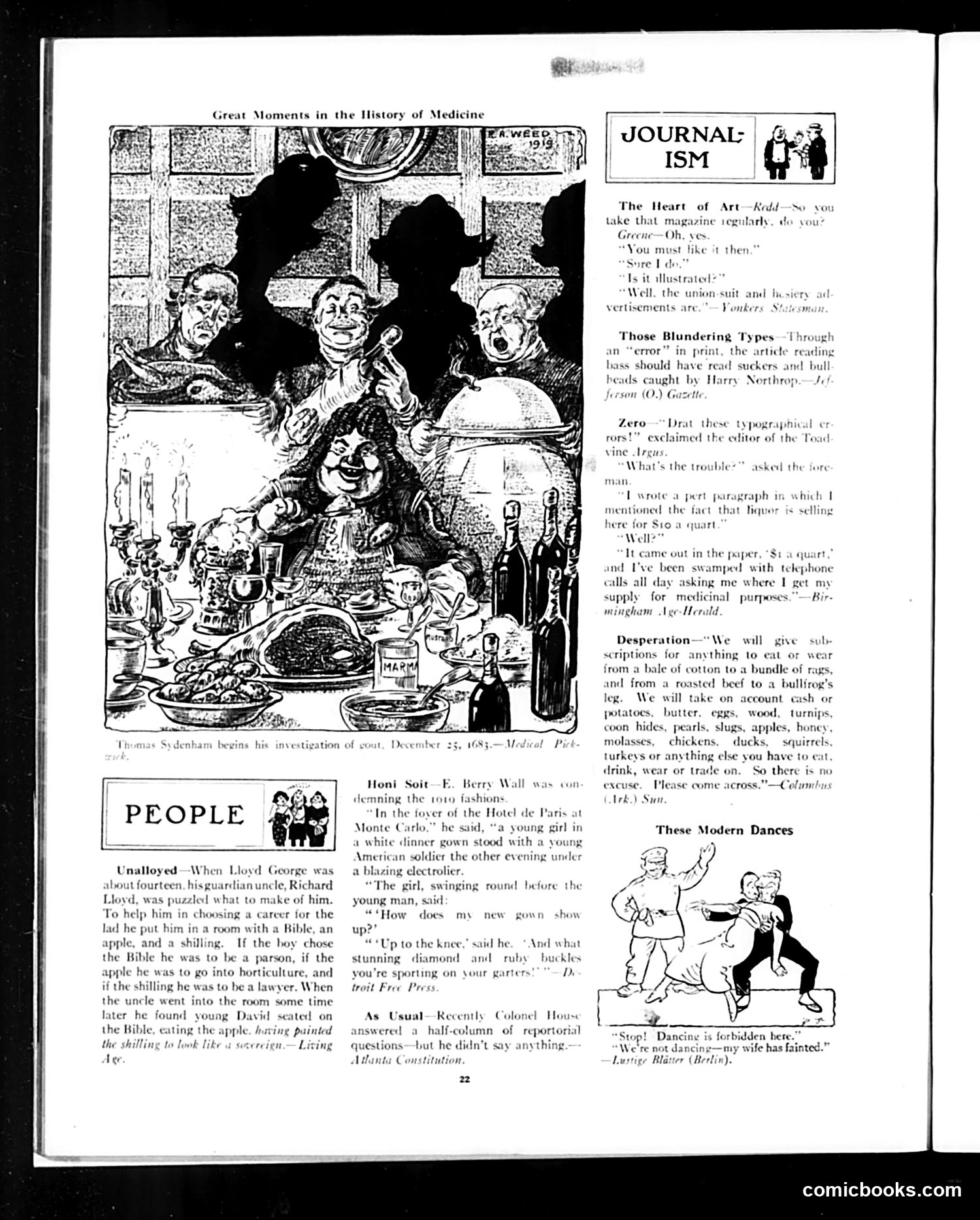
This page from the satirical magazine *Judge* contains three humorous anecdotes about notable figures: **"Unalloyed"** mocks Lloyd George (Welsh Liberal politician, later Prime Minister) with an apocryphal childhood story: his guardian uncle placed him in a room with a Bible, apple, and shilling to determine his future profession. Young Lloyd George supposedly sat on the Bible while eating the apple and pocketing the shilling—suggesting he combined all three pursuits (clergy, agriculture, law) through cunning or dishonesty. The joke implies George was unscrupulous or opportunistic. **"Honi Soit"** recounts E. Berry Wall (a fashion-conscious socialite) criticizing 1920s women's fashions, specifically short skirts and garters, through an anecdote about a soldier and woman at Monte Carlo. **"As Usual"** satirizes Colonel House (Woodrow Wilson's advisor) for giving evasive, non-committal answers to reporters—a dig at his political opacity. The page also includes minor humor pieces about printing errors and a "Desperation" ad seeking barter goods, plus a cartoon mocking modern dance as scandalous.
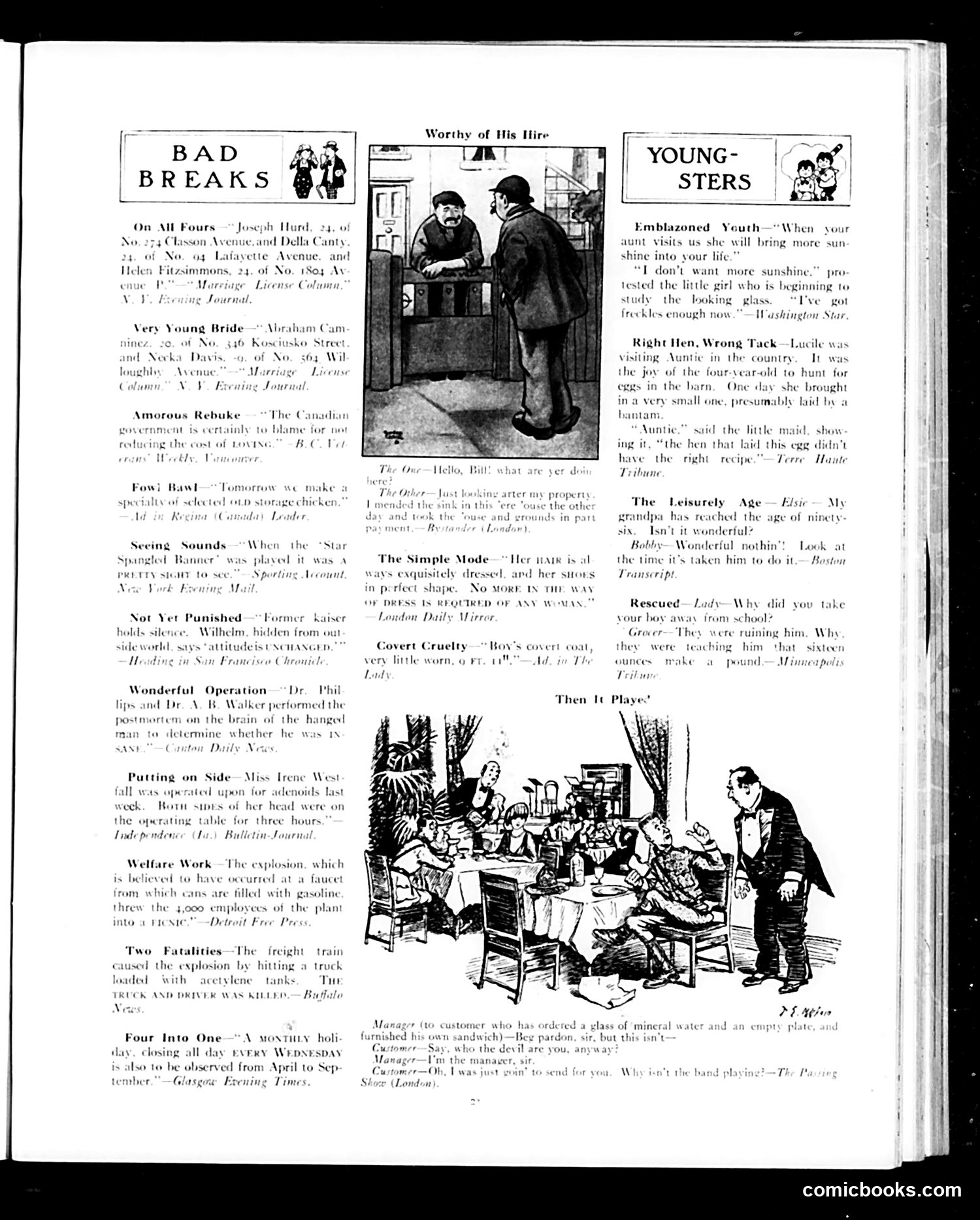
This page contains two sections: "Bad Breaks" (left) listing brief humorous news items, and "Youngsters" (right) presenting jokes about children. The "Bad Breaks" items are satirical takes on contemporary misfortunes—including a reference to the former Kaiser Wilhelm remaining in hiding with "UNCHANGED" attitudes (post-WWI context), medical oddities, industrial accidents, and welfare concerns. These mock both the subjects and the sensational journalism covering them. The "Youngsters" section offers gentle humor about children's logic and innocence. One joke mocks a child's literal interpretation of "freckles"—she resists more sunshine because she already has enough freckles. Another features a child's confusion about bantam eggs. A third jokes about parental impatience with a grandfather's slowness. The satirical thrust targets adult pretensions and contemporary anxieties (postwar attitudes, medical experimentation, industrial safety) while the children's section offers sentimental humor typical of early 20th-century American magazines.
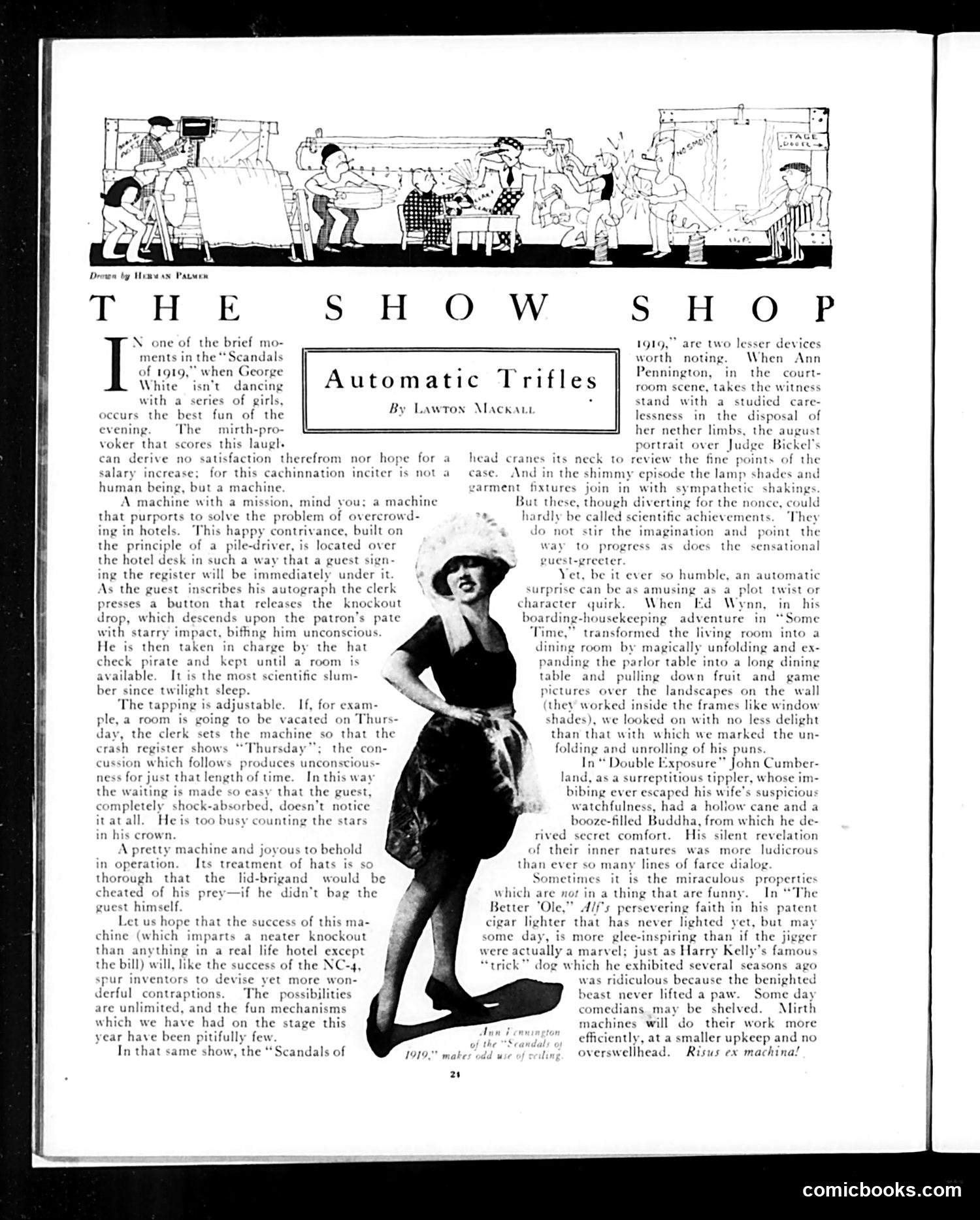
This article satirizes stage comedy mechanics from early 1920s Broadway, particularly George White's "Scandals of 1919." The main target is a fictional "automatic" hotel device—a pile-driver apparatus that knocks out guests unconscious when they register, keeping them knocked out precisely as long as needed until a room becomes available. The joke mocks both post-WWI hotel overcrowding and the era's obsession with mechanical efficiency. The piece celebrates clever stage "trifles"—unexpected mechanical or prop-based gags that surprise audiences. Examples cited include Ed Wynn's transforming dining room furniture and John Cumberland's prop Buddha hiding liquor. The satire praises how these automatic/mechanical surprises entertain better than dialogue alone. The article's underlying point: in an age of machines and efficiency, even theater should embrace automation—albeit absurdly. It's gentle satire on modernity's mechanical solutions to human problems.
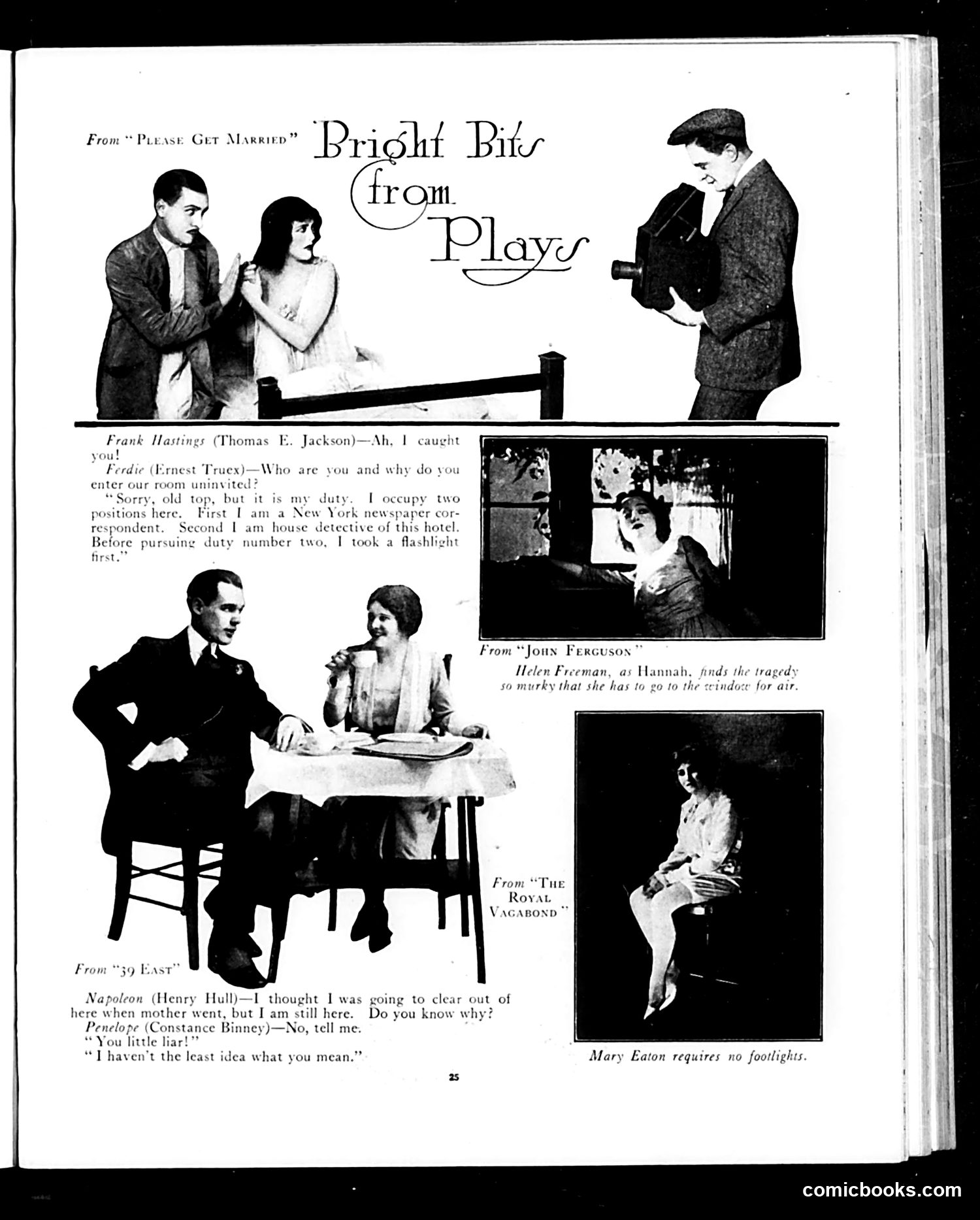
This page showcases scenes from contemporary theatrical productions, presenting humorous moments from plays then running on stage. The content functions as entertainment journalism rather than political satire. The page features excerpts from several plays: "Please Get Married," "39 East," "John Ferguson," and "The Royal Vagabond." Each scene depicts a comedic or dramatic moment with character names and brief dialogue snippets that capture the humor or tension of the moment. For example, one scene shows a newspaper correspondent and hotel detective confronting an intruder; another depicts a domestic misunderstanding between characters named Napoleon and Penelope. A final caption notes that actress Mary Eaton "requires no footlights"—meaning her beauty or talent is apparent even without theatrical staging. This appears to be a regular feature promoting Broadway productions to Judge's readership through captioned theatrical stills, blending entertainment promotion with light comedy commentary.
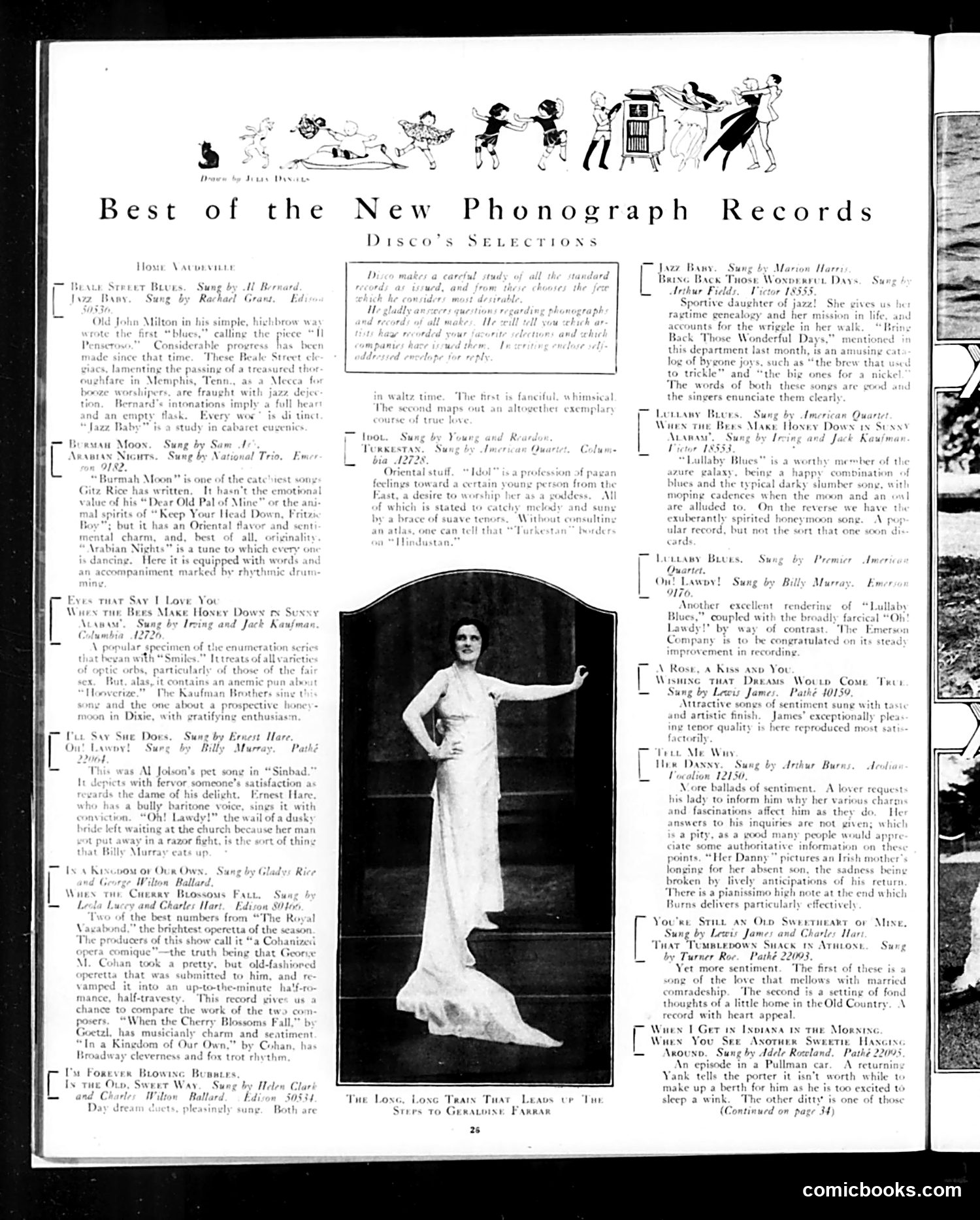
This page is **not a cartoon or comic strip**—it's a music review section from Judge magazine titled "Disco's Selections." The central image shows a woman in a white dress, likely a recording artist or performer of the era. The text reviews popular phonograph records, focusing on jazz and sentimental songs from artists like Irving and Jack Kaufman. Song titles include "Jazz Baby," "Lullaby Blues," and "The Long, Long Trail." This represents **early 20th-century popular music coverage**—Judge's attempt to appeal to readers interested in contemporary entertainment. The decorative header with dancing figures reinforces the jazz-age cultural context. There is no political satire here; this is straightforward entertainment journalism, showing Judge's broader appeal beyond political commentary to include lifestyle and consumer content that characterized 1920s magazines.
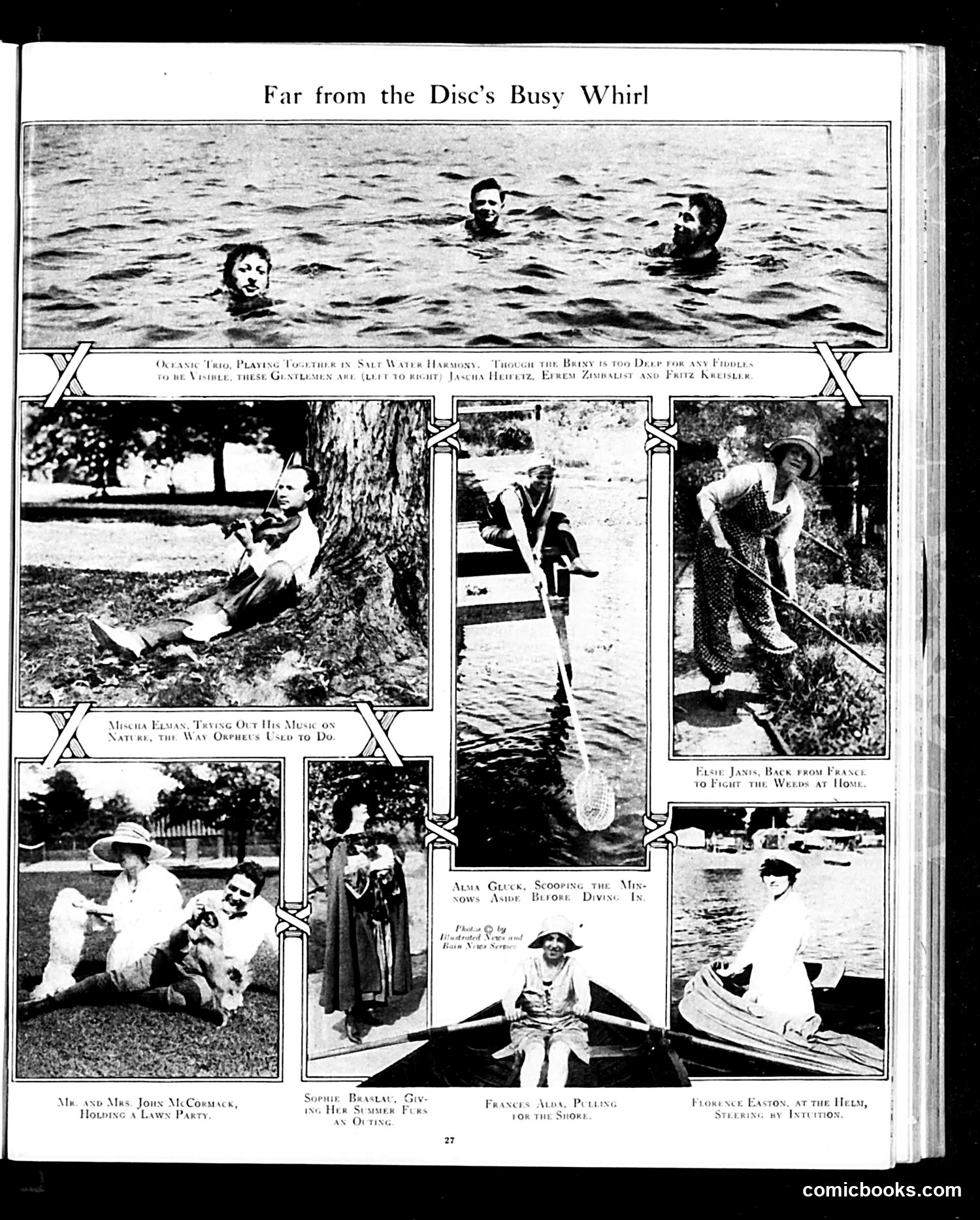
This page from *Judge* magazine features photographs of prominent socialites and wealthy New Yorkers engaged in leisure activities—swimming, boating, picnicking, and outdoor recreation. The title and captions suggest gentle satire of high society's summer pastimes and their escape from urban "busy" life. The individuals pictured appear to be members of New York's elite social circles (names like McCormick, Beauclaire, and Easton suggest wealthy families). The satire likely mocks the leisured lifestyle of the wealthy during summer—their ability to retreat to country pursuits while ordinary citizens remained in the city. Without clearer identification of specific figures or a visible date, the exact social commentary is difficult to determine, but the page's tone appears to be affectionate mockery of upper-class recreation and self-importance rather than sharp political critique.
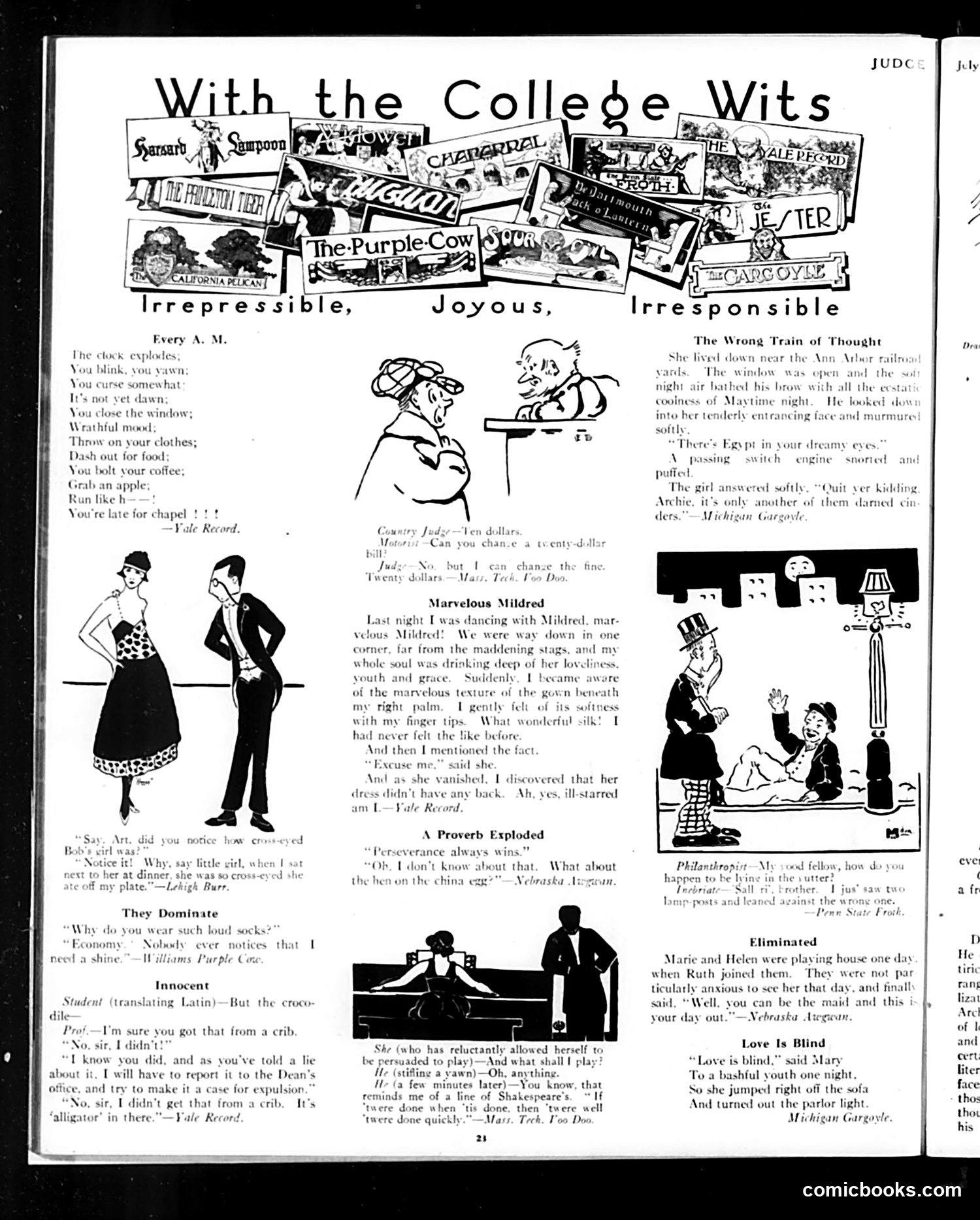
This page collects humorous anecdotes and cartoons from college humor publications (Yale Record, Michigan Gargoyle, Nebraska Masque). The content reflects early-20th-century college life through brief comedic sketches: **"Every A.M."** satirizes the chaotic morning routine of a hungover student—sleeping through alarms, rushing through getting dressed and eating, arriving late to chapel. **"The Wrong Train of Thought"** depicts a romantic railway encounter where a young man compliments his date's dress texture, only to discover it has no back—a joke about awkward flirtation and embarrassment. **"Marvelous Mildred"** similarly plays on romantic miscalculation: a dancer's beautiful silk gown turns out to be backless, humiliating the presumptuous admirer. Other brief sketches mock academic life: crocodile-riding professors, arguments about plagiarism, and romantic misunderstandings among dormitory residents. The humor targets youthful naïveté, social climbing, and the pretensions of college courtship.
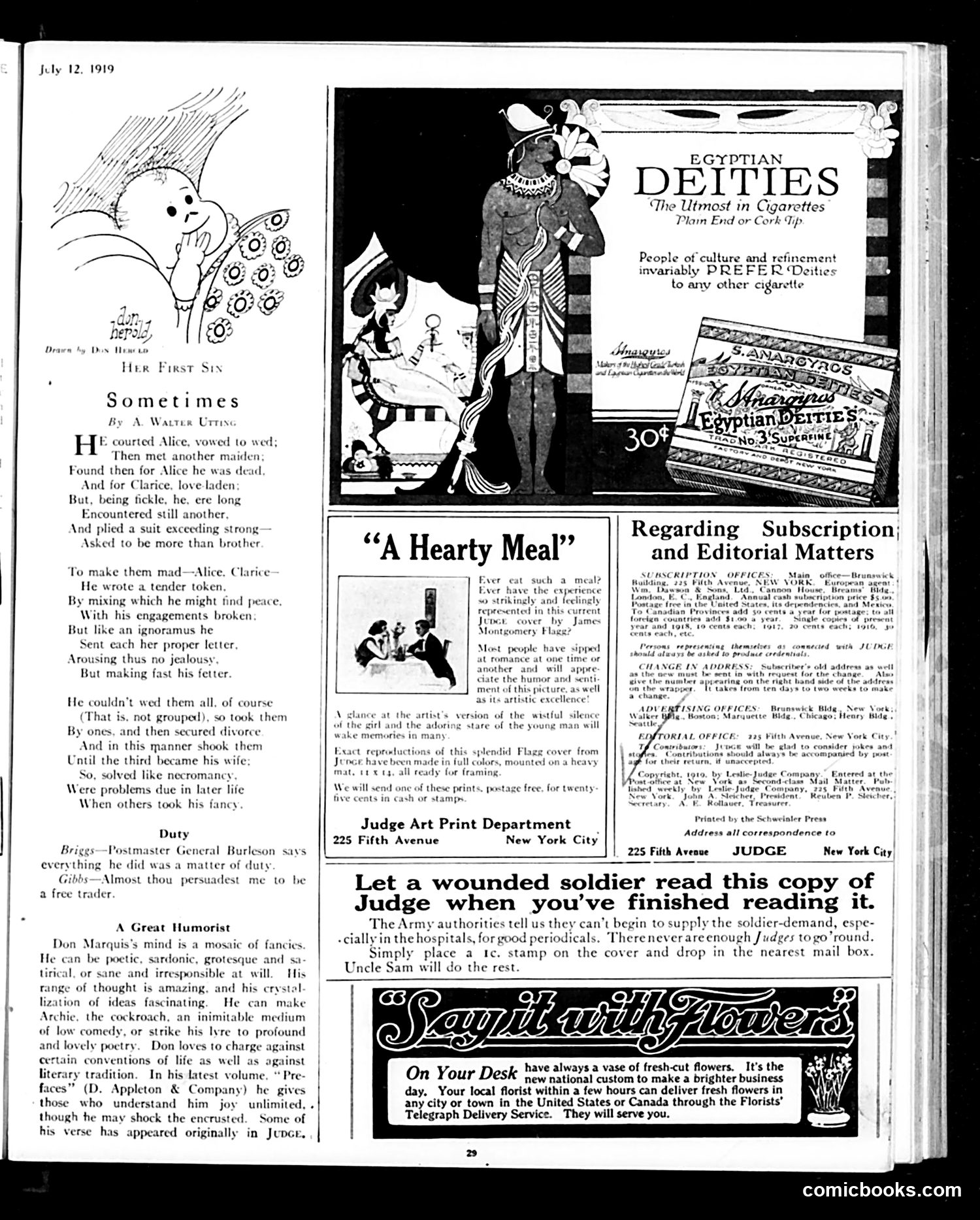
The main cartoon on this page is a poem by Walter Upton titled "Sometimes," illustrated with a simple line drawing of a woman's face. It's a satirical commentary on a chronically unfaithful man who courts multiple women sequentially—Alice, then Clarice, then another—but botches his attempt to manipulate them through carefully-written letters. His plan backfires: instead of making the women jealous (his goal), he accidentally sends each her "proper letter," which only solidifies his entanglement with all three. The joke's irony: his incompetence prevents the deception he intended. The poem mocks male romantic manipulation while celebrating his failure—he ends up marrying the third woman and later faces marital problems, a comeuppance for his duplicity. The page otherwise contains period advertisements (Egyptian Deities cigarettes) and editorial notices typical of Judge magazine's format.
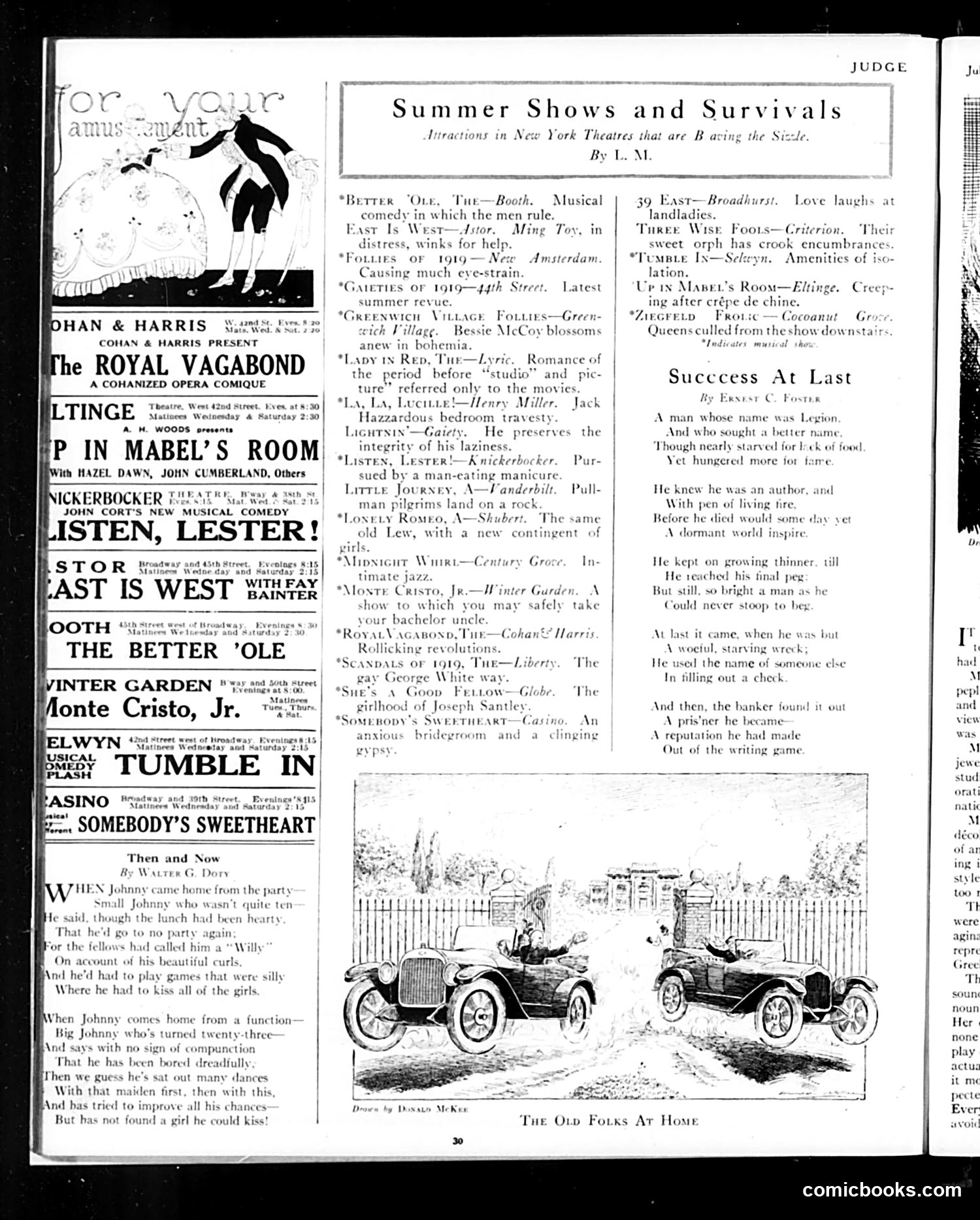
This page is primarily **theatrical advertising** for Broadway shows and musicals, typical of Judge magazine's era. The top section lists current New York theater attractions with brief comedic descriptions—shows like "The Royal Vagabond," "Listen, Lester!" and "Monte Cristo, Jr." The only significant satirical content is "Then and Now" by Walter G. Dory, contrasting a boy named Johnny at age ten (kissing girls at parties due to his "beautiful curls") with adult Johnny at twenty-three (now unable to find a girl willing to kiss him despite his efforts). The humor relies on the common early-20th-century trope of male romantic failure and changing social dynamics. The illustration "The Old Folks at Home" shows vintage automobiles, likely humorous commentary on early motorcar technology. The page reflects Judge's primary function: **entertainment industry promotion mixed with light social satire** rather than hard political commentary. The content targets urban readers familiar with Broadway theater and dating conventions of the 1910s-1920s.
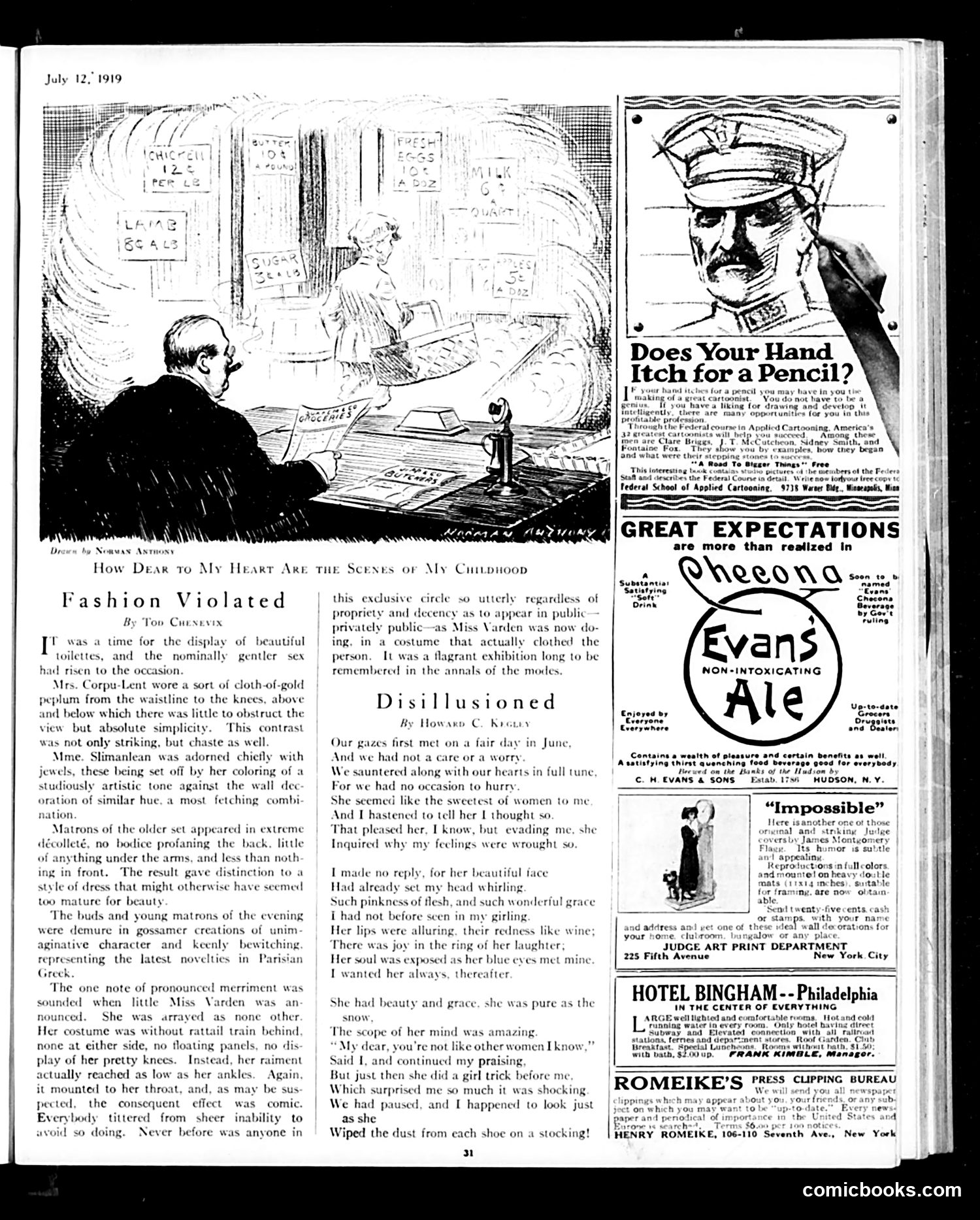
**"Fashion Violated"** is a satirical piece mocking post-WWI women's fashion. The cartoon depicts a woman in a full-length, modest dress at a formal social gathering—scandalous because contemporary 1919 fashion featured short skirts, bare arms, and décolletage. The joke is inverted: while society matrons display extreme exposure, Miss Varden shocks everyone by being *fully clothed*, covering even her ankles. The satire targets both the era's rapid fashion shifts and society's superficial obsession with propriety while actually embracing scandalous exposure. **"Disillusioned"** is a romantic poem about courtship that subverts sentimental expectations. A man falls for a beautiful, seemingly graceful woman but is shocked when she reveals herself as ordinary—wiping shoe dust on her stocking like an average person. The satire punctures romantic idealization with mundane reality. The advertisements (pencil courses, ale, hotels) are standard period commercial content.
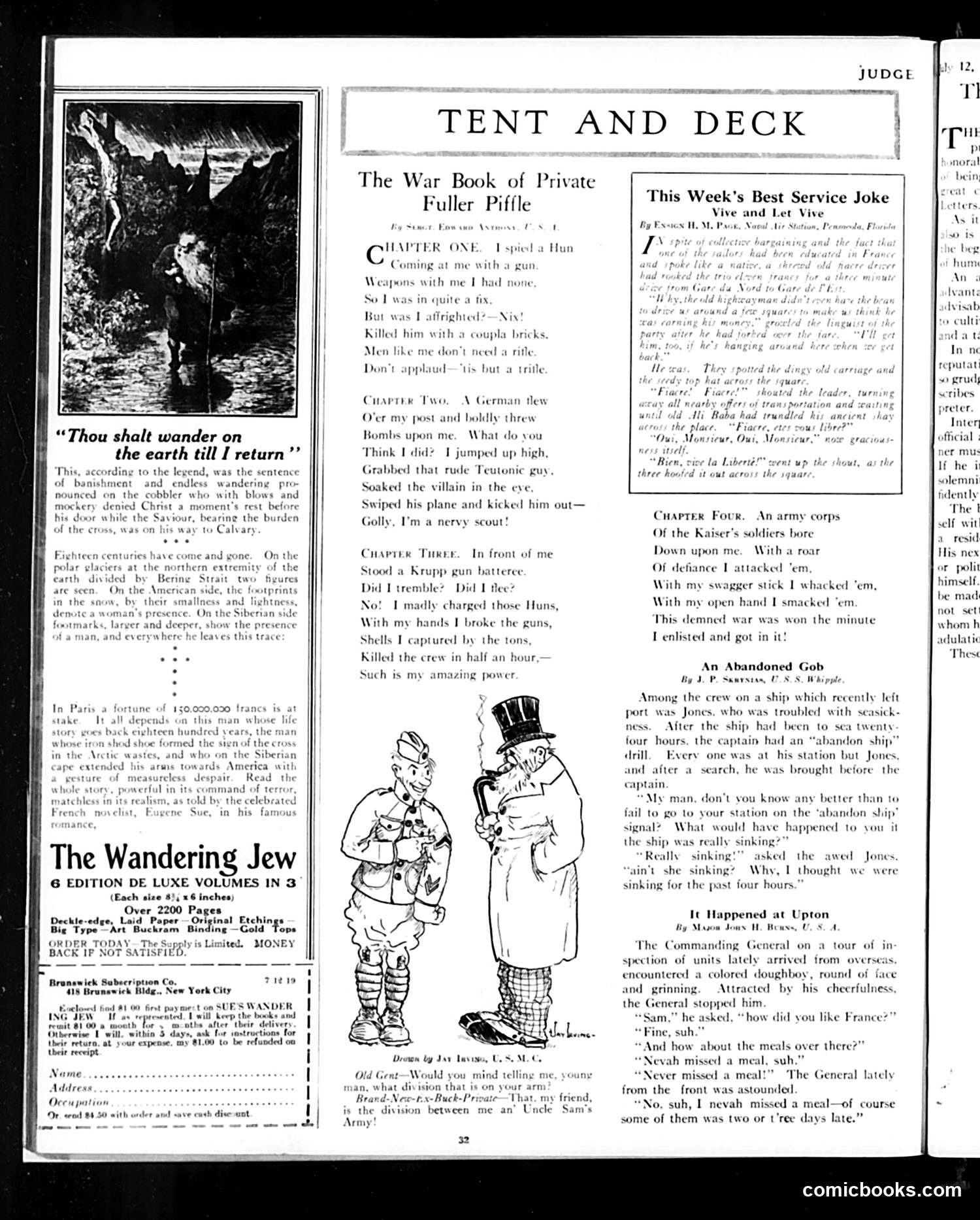
This page contains WWI-era humor and advertising, primarily targeting American soldiers and servicemen. **Main Content:** The "War Book of Private Fuller Piffle" is a comedic poem mocking soldiers' tall tales. Private Fuller boasts absurdly about single-handedly defeating Germans—jumping up to grab a flying pilot, breaking machine guns with his bare hands, killing entire crews. The joke is the transparent exaggeration; soldiers' bragging was apparently common enough to parody. **Service Jokes:** Three short anecdotes mock military life: one contrasts a soldier with "Uncle Sam's Army" (implying soldiers exaggerate their toughness), another depicts a seasick sailor so ill he doesn't notice an abandon-ship drill, and a third shows a Black soldier ("doughboy") joking that meals were so delayed they arrived days late—dark humor about military inefficiency. **Advertisement:** "The Wandering Jew" edition is promoted below, unrelated to the military content. The overall tone treats soldiers' experiences lightly, suitable for 1918-era morale-boosting magazine humor.
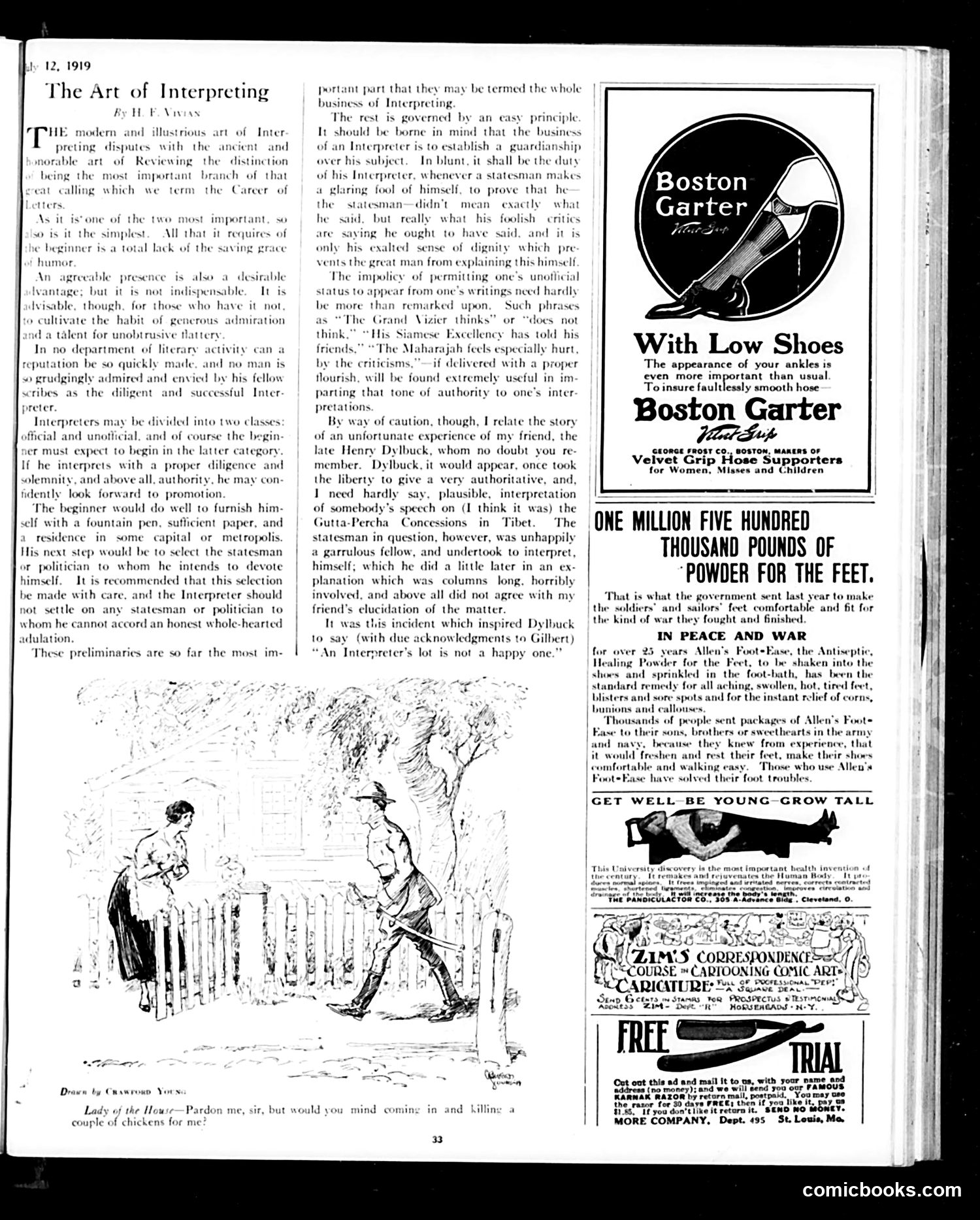
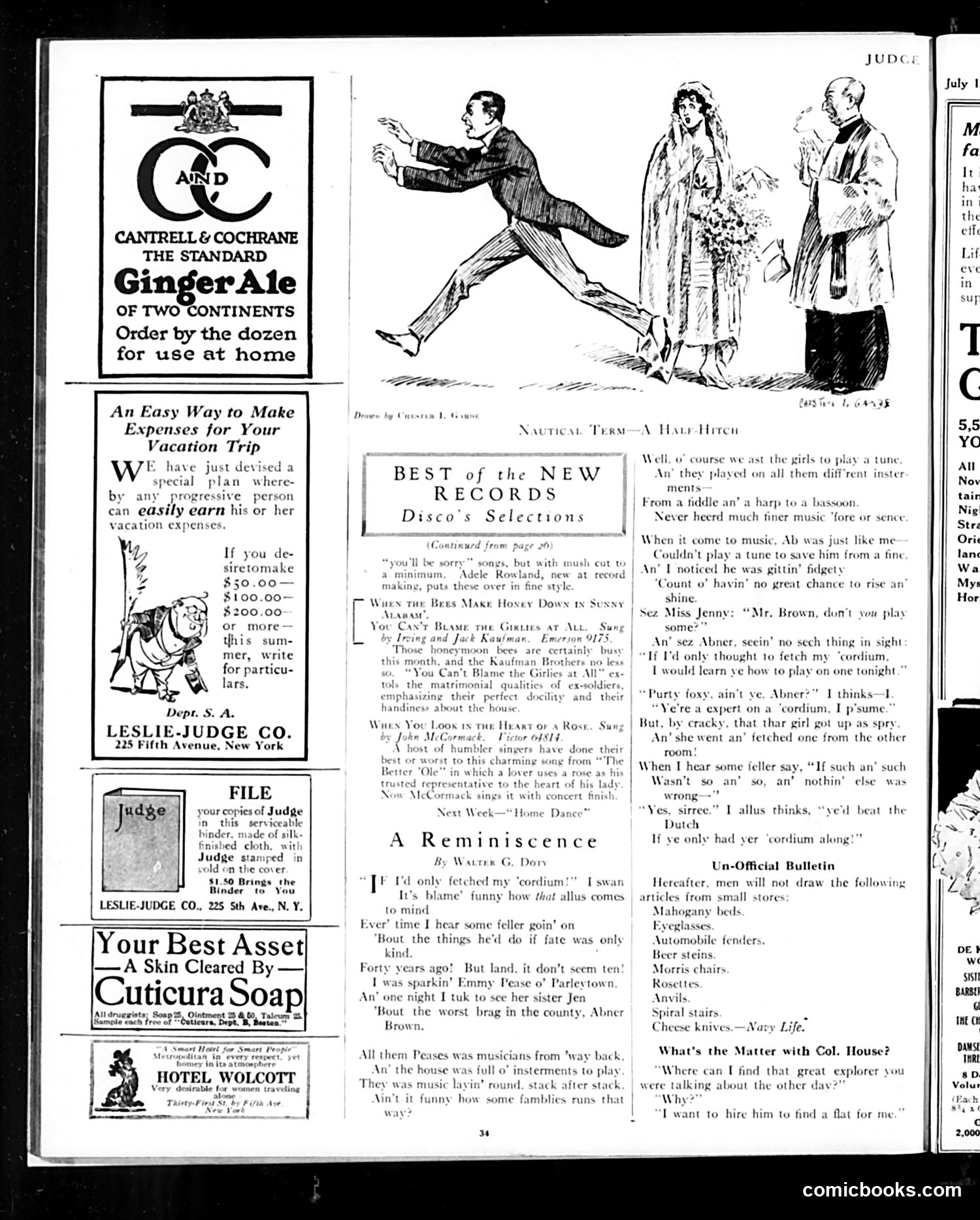
This page is primarily **advertising and miscellaneous content** rather than political satire. The main cartoon—"Nautical Term: A Half-Hitch"—depicts a wedding scene where a groom appears to be stumbling or losing balance, with the bride and clergyman present. The joke plays on the nautical term "half-hitch" (a knot), suggesting matrimony as an unstable or precarious situation—a common early-20th-century joke mocking marriage. The page includes ads for Cantrell & Cochrane ginger ale, Leslie-Judge vacation schemes, Cuticura soap, and Hotel Wolcott. Below the cartoon are two pieces of comic fiction: song selections and a nostalgic dialect story ("A Reminiscence") about a man regretting he didn't bring his accordion to impress a girl. The "Un-Official Bulletin" is military humor listing absurd items men supposedly cannot draw from stores—appearing to mock bureaucratic regulations.
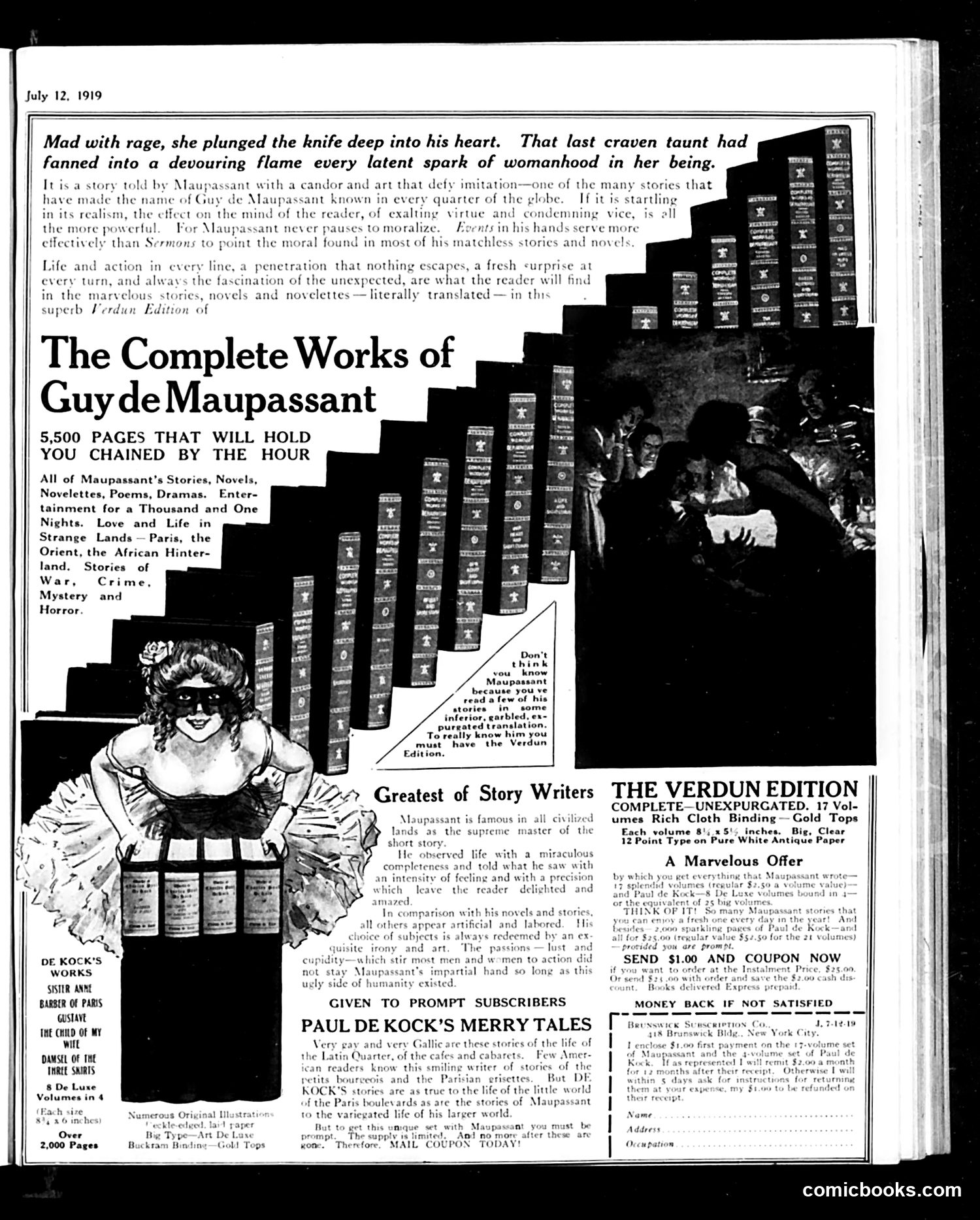
This page is primarily **advertising copy**, not political satire. It promotes two literary subscription offers: **Main Advertisement**: "The Complete Works of Guy de Maupassant" (Verdun Edition) — a 17-volume set of the French author's stories, novels, and poetry. The ad emphasizes the dramatic, sensual nature of his work ("Mad with rage, she plunged the knife...") to appeal to readers seeking sophisticated, unexpurgated literature. **Secondary Advertisement**: "Paul de Kock's Merry Tales" — stories about bohemian life in Paris's Latin Quarter and cafes, marketed as "gay and very Gallic." Both ads target educated American readers interested in Continental European literature. The page reflects post-WWI America (note "Verdun Edition" — Verdun was a major 1916 battle) when European literary works gained prestige. There is **no political cartoon or satire present** — this is a straightforward merchandising page using evocative literary excerpts to sell luxury book sets.
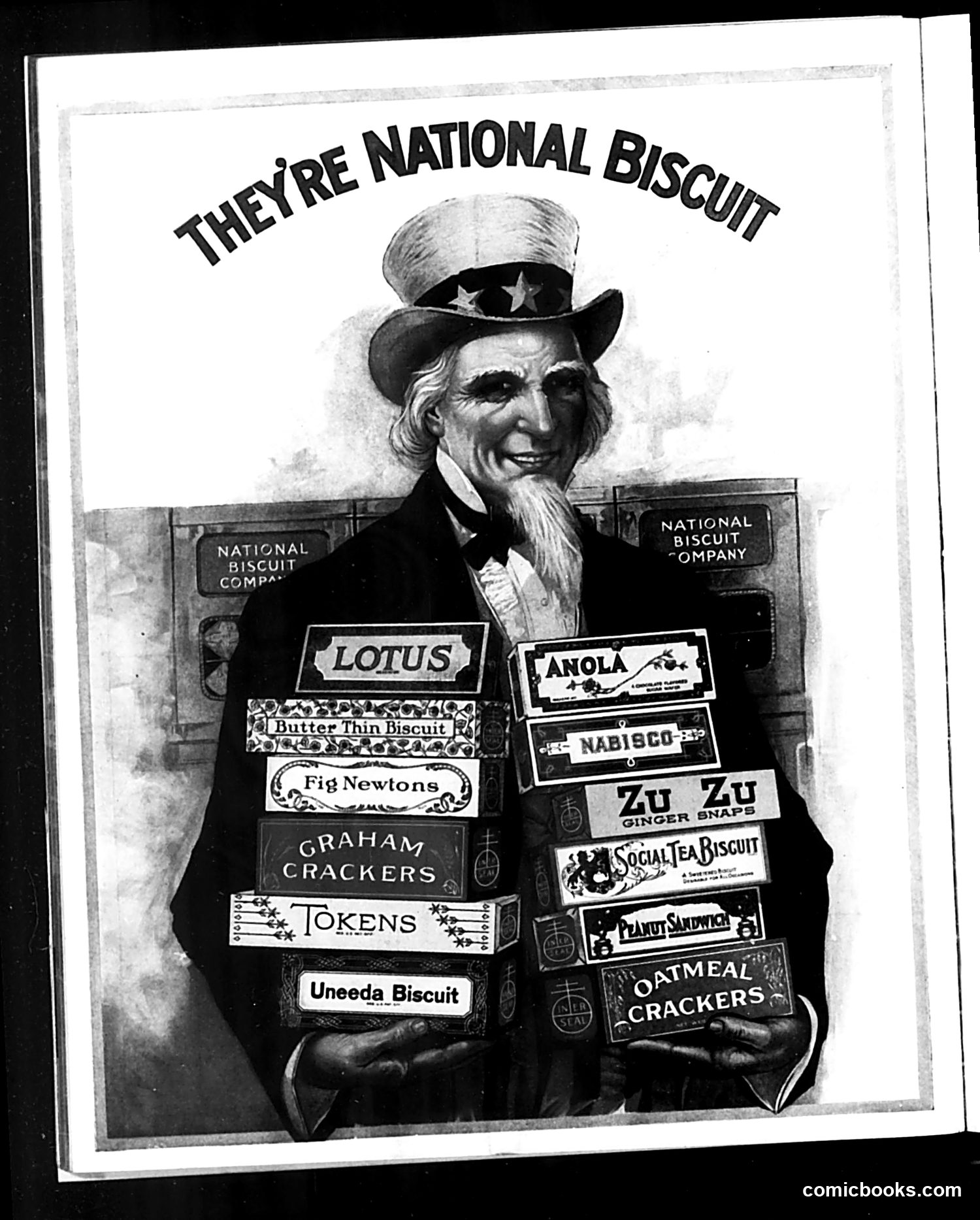
This advertisement features Uncle Sam (identifiable by his star-spangled top hat and patriotic attire) promoting various biscuit and cracker brands manufactured by the National Biscuit Company. The headline "THEY'RE NATIONAL BISCUIT" emphasizes patriotic branding. The satire lies in depicting Uncle Sam as a walking advertisement for commercial products, suggesting the commercialization of American identity and nationalism. By literally loading the iconic patriotic figure with branded products (Lotus, Anola, Nabisco, Graham Crackers, Tokens, Uneeda Biscuit, and others), the cartoonist critiques how corporations wrapped themselves in patriotic imagery to market goods to consumers. This reflects early 20th-century concerns about commercialism influencing American values and politics.