
Judge, 1919-07-12 · page 7 of 36
Judge — July 12, 1919 — page 7: what you’re looking at
What you’re looking at
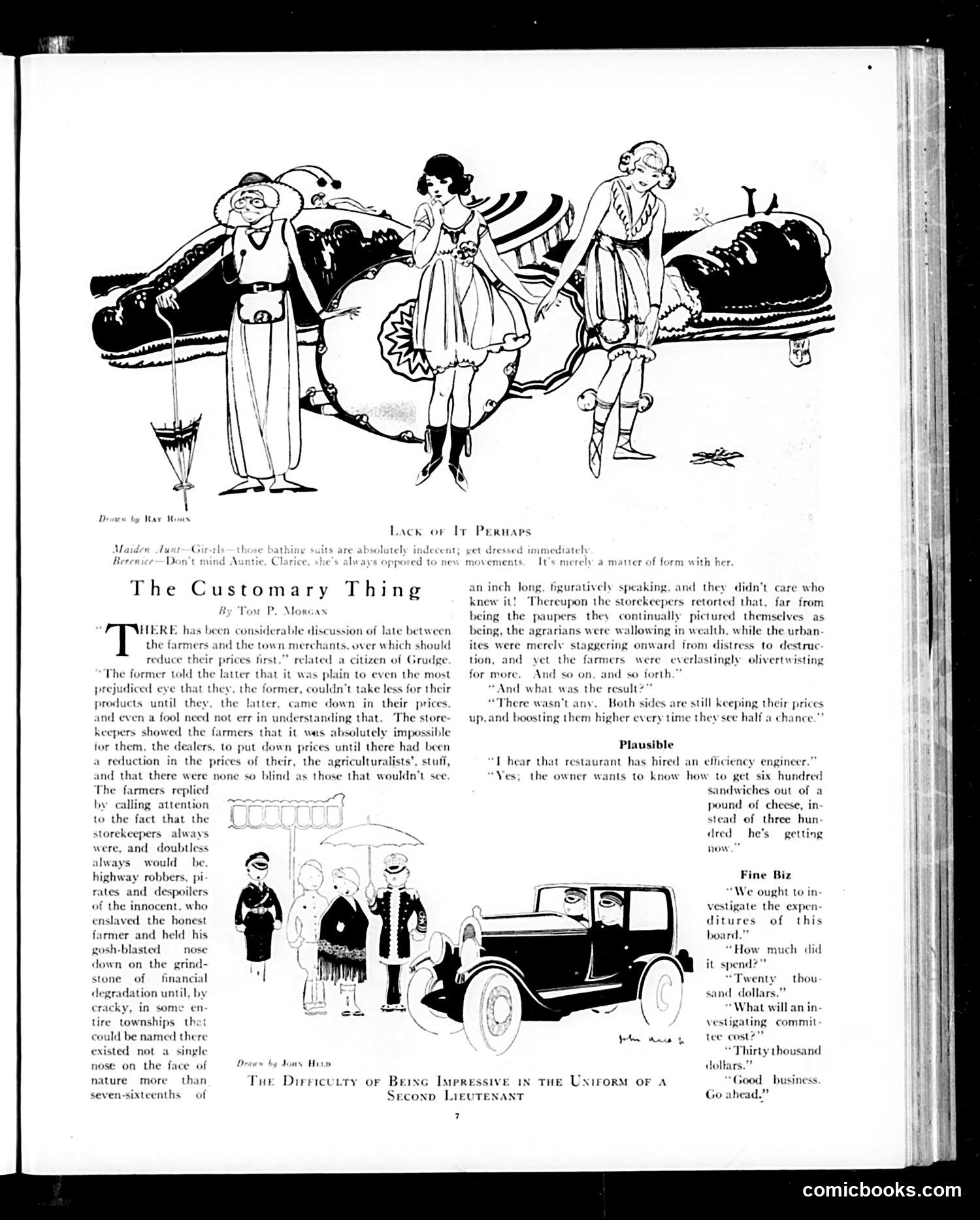
This Judge magazine page satirizes economic tensions between farmers and merchants during what appears to be an early 20th-century price dispute. **"The Customary Thing"** depicts a circular blame-game: farmers claim merchants must lower prices first; merchants claim farmers must reduce agricultural prices first. Each side accuses the other of profiteering—farmers call merchants "highway robbers," while merchants claim farmers are "wallowing in wealth." The satire's point: neither side will compromise, so prices stay high and nothing changes. This reflects genuine farmer-merchant conflicts common in early American industrial society. The bottom cartoons offer lighter satirical jabs: one mocks "efficiency engineers" (a trendy management concept) for absurd cost-cutting; another ridicules wasteful government spending—hiring an investigative committee that costs more than the alleged waste it investigates. The top illustration by Ray Hook appears decorative, showing fashionable women, likely unrelated to the text below.
📄 Transcribed text from this page (OCR, searchable)
Machine-transcribed from the original scan — historical spelling and the odd misread are preserved.
The Customary Thing Ry Tox PL Morcas TERE has been considerable discussion of late between the farmers and the town merchants, over which should reduce their prices first.” related a citizen of Grudge The former told the latter that it was plain to even the most the former, couldn't take less for their prejudiced eye that they came down in their prices products until they. the latter and even a fool need not err in understanding that. The store. keepers showed the farmers that it was absolutely impossible for them, the dealers, to put down prices until there had been a reduction in the prices of their, the agriculturalists’, stuff, ind that there were none so blind as those that wouldn't see. The farmers replied by calling attention to the fact that the storekeepers always were, and doubtless ilways would highway robbers, pi rates and despoilers who 8 of the innocent enslaved the honest farmer and held his gosh-blasted nose n the grind- financial own of idation until, by stone deg cracky, in some en tire townships thet vuld be named there existed not a single nost on the face of than of by Jous Hew nature more Pur seven-sixteenths Dirricurty of Beinc Impressive in THE UNiroRM OF A Seconn Lieutenant 7 with her. an inch long, figuratively speaking, and they didn’t care who knew it! Thereupon the storekecpers retorted that, far from being the paupers they continually pictured themselves as being, the agrarians were wallowing in wealth, while the urban ites were merely staggering onward from distress to destruc farmers everlastingly olivertwisting and so forth.” tion, yet the were for more. And so on “And wh ere wasn’t any. up. and boosting them higher every time they sec half a twas the result?” Both sides are still keeping their prices nee." Plausible I hear that restaurant has hired an efficiency engineer.” Ves; the owner wants to know how to get six hundred sandwiches out of a pound of cheese, in 1 of three hun dred he’s get Fine Biz “We ought to in vestigate the expen ditures of this board.” “How it spend?” “Twenty sand dollars.” *What will an in vestigating commit much did thou tee cost?” Thirty thousand doltars.” “Good Go ahead.” business comicbooks.com