
Judge, 1919-07-12 · page 6 of 36
Judge — July 12, 1919 — page 6: what you’re looking at
What you’re looking at
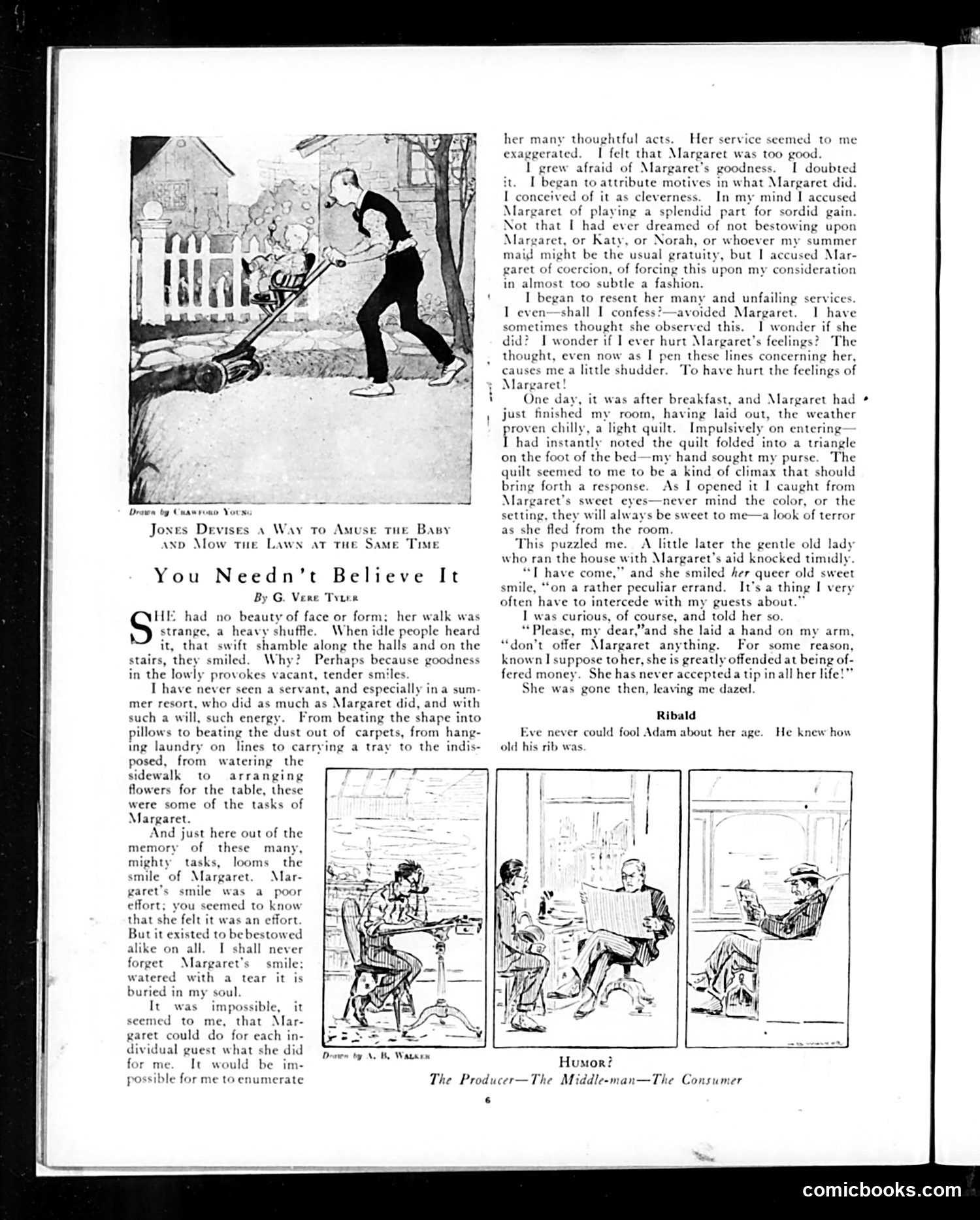
This page contains two unrelated pieces: **"You Need't Believe It"** is a short story by G. Vere Tyler about a servant named Margaret whose quiet dignity and gentle service earn the narrator's respect, despite initial prejudice. The accompanying illustration shows someone abusing a domestic worker—likely depicting the contrast between cruel employers and Margaret's virtuous character. **"Ribald"** is a three-panel humor strip (drawn by U.B. Walker) satirizing social class dynamics. The panels show "The Producer" (a farmer), "The Middle-man" (a businessman), and "The Consumer" (appears to be a wealthy client), illustrating how profits flow through distribution chains while different classes occupy their economic positions. Both pieces reflect early-20th-century American social commentary on class, labor, and domestic service.
📄 Transcribed text from this page (OCR, searchable)
Machine-transcribed from the original scan — historical spelling and the odd misread are preserved.
Drawn by Cuawvouo Yous: Joxes Devises 1 Way to Amuse THe Basy ano Mow tie Laws at tue Same Time You Needn’t Believe By G. Vere Trier HE had no beauty of face or form; her walk was S strange, a heavy shuffle. When idle people heard it, that swift shamble along the halls and on the stairs, they smiled. Why? Perhaps because goodness in the lowly provokes vacant, tender smiles. I have never seen a servant, and especially ina sum mer resort, who did as much as Margaret did, and with such a will, such energy. From beating the shape into pillows to beating the dust out of carpets, from hang- ing laundry on lines to carrying a tray to the indis- posed, from watering the It her many thoughtful acts. Her service seemed to me exaggerate I felt that Margaret was too good. I grew afraid of Margaret’s goodness. I doubted it. I began to attribute motives in what Margaret did. I conceived of it as cleverness. In my mind I accused Margaret of playing a splendid part for sordid gain. Not that I had ever dreamed of not bestowing upon Margaret, or Katy, or Norah, or whoever my summer maid might be the usual gratuity, but I accused Mar- garet of coercion, of forcing this upon my consideration in almost too subtle a fashion. I began to resent her many and unfailing servic I even—shall I confess?—avoided Margaret. I have sometimes thought she observed this. I wonder if she did? I wonder if I ever hurt Margaret's feelings? The thought, even now as I pen these lines concerning her, causes me a little shudder. To have hurt the feelings of argaret! One day, it was after breakfast, and Margaret had * just finished my room, having laid out, the weather proven chilly, a light quilt. Impulsively on entering I had instantly noted the quilt folded into a triangle on the foot of the bed—my hand sought my purse. The quilt seemed to me to be a kind of climax that should bring forth a response. As I opened it 1 caught from Margaret's sweet eyes—never mind the color, or the setting, they will always be sweet to me—a look of terror as she fled from the room. This puzzled me. A little later the gentle old lady who ran the house with Margaret's aid knocked timidly. “T have come,” and she smiled her queer old sweet smile, “on a rather peculiar errand. It’s a thing I very often have to intercede with my guests about.” I was curious, of course, and told her so. “Please, my dear,”and she laid a hand on my arm, “don’t offer Margaret anything. For some reason, known I suppose toher, she is greatly offended at being of- fered money. She has never accepteda tip in all her life!” She was gone then, leaving me dazed Ribald Eve never could fool Adam about her age. old his rib was. He knew how sidewalk to arranging flowers for the table, these were some of the tasks of Margaret. And just here out of the memory of these man mighty tasks, looms the smile of Margaret. Mar- garet’s smile was a poor effort; you seemed to know that she felt it was an effort But it existed to be bestowed alike on all. I shall never forget Margaret's smile: watered with a tear it is buried in my soul It was impossible, it med to me, that Mar- garet could do for each in- dividual guest what she did for me It would be im- possible for me to enumerate se The Producer— Humor? he Middle-man—The Consumer comicbooks.com