
Judge, 1919-07-12 · page 13 of 36
Judge — July 12, 1919 — page 13: what you’re looking at
What you’re looking at
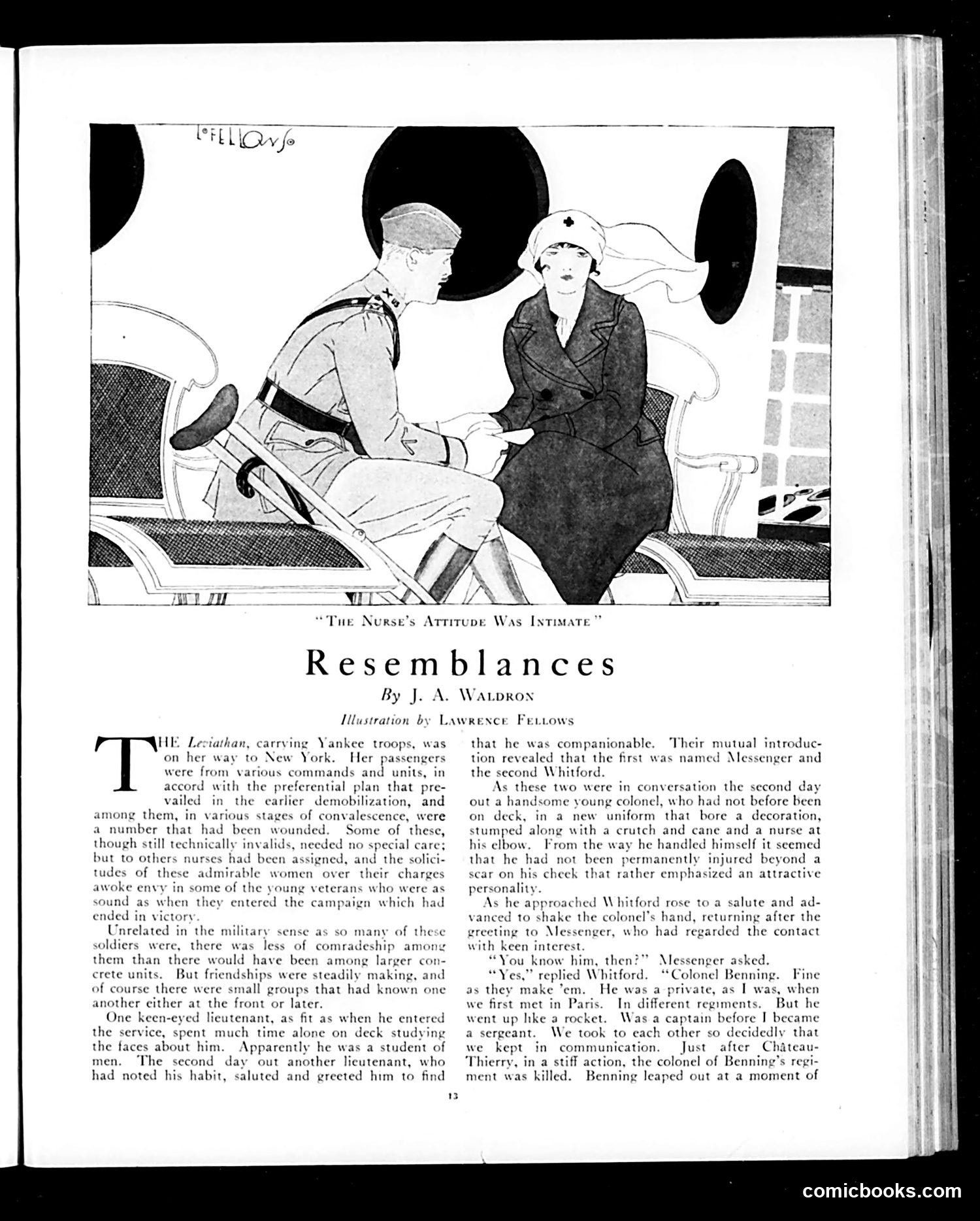
This is a narrative illustration accompanying a short story titled "Resemblances" by J.A. Waldron. The image shows two military officers on the deck of the *Leviathan* (a real WWI troop transport ship) conversing while observing a decorated colonel with a nurse. The story describes demobilization after WWI, when wounded soldiers were returning home. The two lieutenants—Messenger and Whitford—meet and discuss their acquaintance with Colonel Benning, a charismatic officer who rose from private to colonel during the war. The caption "The Nurse's Attitude Was Intimate" suggests romantic interest between the colonel and his attending nurse. This appears to be sentimental fiction celebrating military camaraderie and valor rather than satire. The "Resemblances" likely refers to how soldiers from different backgrounds formed bonds through shared wartime experience. No political satire is evident on this page.
📄 Transcribed text from this page (OCR, searchable)
Machine-transcribed from the original scan — historical spelling and the odd misread are preserved.
“Tue Nurse's Artitupe Was Ixtimate” Resemblances By J. A. Hlustration by L. HE. Leviathan, carrving Yankee troops, was on her way to New York. Her passengers were from various commands and units, in accord with the preferential plan that pre- vailed in the earlier demobilization, and among them, in various stages of convalescence, were a number that had been wounded. Some of these, though still technically invalids, needed no special care; but to others nurses had been assigned, and the solici- tudes of these admirable women over their charges awoke envy in some of the young veterans who were as sound as when they entered the npaign which had ended in victory Unrelated in the military soldiers were, there was less of comradeship amo them than there would have been among larger con- ete units. But friendships were steadily makin of course there were small groups that had known one another cither at the front or later. One keen-eyed lieutenant, as fit as when he entered the service, spent much time alone on deck studying the faces about him. Apparently he was a student of men. The second day out another lieutenant, who had noted his habit, saluted and greeted him to find sense as so many of AWRENCE WatLpRon Fe.tows that he was companionable. Their mutual introduc- tion revealed that the first was named Messenger and the second Whitford. As these two were in conversation the second day out a handsome young colonel, who had not before been on deck, in a new uniform that bore a decoration, stumped along with a crutch and cane and a nurse at his elbow. From the way he handled himself it seemed that he had not been permanently injured beyond a scar on his check that rather emphasized an attractive personality. As he approached Whitford rose to a salute and ad- vanced to shake the colonel’s hand, returning after the greeting to Messenger, who had regarded the contact with keen interest. “You know him, then?" Messenger asked. “Yes,” replied Whitford. ‘Colonel Bennin Fine as they make ’em. He was a private, as I was, when we first met in Paris. In different regiments. But he went up hke a rocket. Was a captain before I became a sergeant. We took to each other so decidedly that kept in communication. Just after Chateau- hierry, in a stiff action, the colonel of Benning’s regi- ment was killed. Benning leaped out at a moment of comicbooks.com